







Abstract
Queering mixed methods involves using queer theories to challenge the heteronormativity inherent in mixed methods designs. This article outlined attempts to apply queer critiques of heteronormativity and homonormativity at each integration stage of a mixed methods study, from design, methods to data analysis, and reporting. It reported an explanatory sequential mixed methods study, with 647 survey responses and 70 interviews, exploring the impacts of same-sex marriage legislation on same-sex couples in Taipei and Hong Kong. It illustrated how queer concepts of heteronormativity and homonormativity, specifically queer critiques of same-sex marriage, the privilege of monogamy, and monosexism, shaped the mixed methods research design. It discussed the opportunities, challenges, and limitations of conducting LGBQ+ inclusive mixed methods research beyond the Global North.
Keywords
Introduction
Empirical studies focusing on the lives of lesbian, gay, bisexual, transgender, queer, and other gender or sexual minorities (LGBTQ+) have received increasing attention from academic researchers and society in general (Badgett et al., 2024). This interest has been particularly fueled by the emergence of policy debates concerning the LGBTQ+ community, including anti-discrimination laws, same-sex marriage, and legal gender recognition (Drabble et al., 2021). There has been a growing demand for empirical studies to understand the experiences of LGBTQ+ people amid intersectional forms of oppression, culturally specific experiences of queerness, and the impact of these policies on their lives (Reid et al., 2022).
The development of queer theories has challenged the essentialist view of sex/gender, critiqued heteronormativity and cisnormativity in established institutions and practices, and questioned the emergence of homonormativity. Heteronormativity refers to a process that inherently privileges heterosexuality while excluding and repressing non-heterosexuality (Marchia & Sommer, 2019). Cisnormativity describes the social and cultural system that privileges cisgender people—whose self-identified gender aligns with their sex assigned at birth—over others (Linander et al., 2024). Homonormativity refers to a set of politics that does not challenge but instead upholds dominant heteronormative assumptions and institutions (Duggan, 2002). These concepts provide scholars with both theoretical and methodological insights. The integration of queer theories and qualitative methodology has been discussed across various dimensions, including critiques of heteronormativity and cisnormativity in existing sociocultural settings (Fish & Russell, 2018), the emphasis on fluidity in qualitative analysis of epistemological and ontological understandings (Wozolek, 2019), the documentation of queer communities’ lived experiences (Côté & Blais, 2021), and the use of queer connection-building and inclusion-fostering as methods to support qualitative research design (Betts & Herb, 2023). However, less integration has been seen in quantitative research, while queer theorists have extensively criticized the heteronormative and cisnormative nature of dichotomies and fixed boundaries inherent in quantitative approaches (Nash & Browne, 2016).
Mixed methods research combines the strengths of both qualitative and quantitative data collection and analysis. This combination has allowed researchers to gain better insights into the relationships and discrepancies within the data (Creswell & Plano Clark, 2018). Researchers have been calling for the use of mixed methods studies in examining the experiences of LGBTQ+ individuals and the possibility of queering mixed methods study (Shannon-Baker, 2021).
This article aimed to illustrate efforts to apply queer critiques of heteronormativity and homonormativity in each integration stage of a mixed methods study, from design, methods, to data analysis and reporting in an explanatory sequential mixed methods study. Drawing on data from 647 survey responses and 70 in-depth interviews with LGBQ+ individuals in committed same-sex relationships in Taipei (the first in Asia to legalize same-sex marriage) and Hong Kong (without same-sex marriage legislation), the case study examined the impacts of same-sex marriage legislation (or the lack thereof) on the marital intentions of same-sex couples and the challenges they faced in their families and societies. While the broader research project examined various substantive findings about same-sex relationships and marriage equality, this article focused specifically on methodological discussions of queering mixed methods research design. The article explored how queer concepts of heteronormativity and homonormativity, specifically queer critiques of same-sex marriage, the privilege of monogamous relationships, and monosexism, have shaped the mixed methods research design. It also explored both opportunities and challenges in conducting LGBQ+ inclusive mixed methods research beyond the Global North, specifically in Taipei and Hong Kong. This article contributed to academic discussions about queering mixed methods studies, particularly during the integration phase, and examined the feasibility of incorporating LGBQ+ inclusive research practices into mixed methods designs.
Queer Critiques of Heteronormativity and Homonormativity
Discussions on queer methodologies and queer methods have most commonly focused on qualitative approaches (Fish & Russell, 2018). However, a growing body of literature has been exploring the potential of integrating queer theories into the design of quantitative research and mixed methods studies (Shannon-Baker, 2021).
Quantitative research methods have been long criticized as masculine and heteronormative by feminist and queer methodologists (Nash & Browne, 2016). The tension between the flexible, subjective, anti-normative principles of queer methodologies and the standardized categories in quantitative research questionnaires has presented challenges for researchers (Nash & Browne, 2016). In particular, queer scholars have criticized how quantitative methodology reinforces heteronormativity and cisnormativity (Guyan, 2022). For instance, the current practice of quantitative research often assumes all respondents are heterosexual and cisgender without asking their sexual and gender identity (Nash & Browne, 2016). Many survey questions are designed within a heteronormative and cisnormative framework. These include questions about sex (assigned at birth) that overlook the respondent’s gender identity and questions related to marital status, household, and family that assume a heterosexual relationship and family composition (Manning & Payne, 2021).
These heteronormative and cisnormative practices in quantitative methodology make the LGBTQ+ community invisible in research findings and their implications for policy and practice (Garvey, 2022). This is particularly significant given that quantitative data influence discussions on public policy (e.g., same-sex marriage and legal gender recognition) and resource allocation in social and health services, education, and social welfare (Guyan, 2022).
In addition to heteronormativity, queer theories have criticized the emergence of homonormativity (Duggan, 2002; Kao, 2024). Queer scholars have criticized how the assimilationist politics of the LGBTQ+ movement is creating a new form of homonormativity (Teschlade et al., 2023). Particularly, the advocacy for same-sex marriage legislation has been seen as a homonormative act as it embraces and glorifies the concept of marriage, which is traditionally patriarchal and heteronormative (Bernstein, 2018). Simultaneously, queer scholars have argued that such policies and campaigns regulate, normalize, and assimilate same-sex couples. They have favored monogamous relationships over other forms of queer kinship, such as polyamorous relationships and families-of-choice (Sandbakken et al., 2022).
Queer critiques on homonormativity also highlight the privileges (social, economic, political, racial, class, gender-based, etc.) granted to specific forms of “homosexual” expression, which further marginalize other “deviant” sexualities (Van Eeden-Moorefield et al., 2011). Monosexism, which refers to attitudes favoring monosexuality (experiences and identity of single-gender attraction, such as heterosexual, gay, and lesbian) over plurisexuality (experiences and identity of multi-gender attraction, such as bisexual, pansexual, queer, and fluid), is prevalent within the LGBTQ+ community and society at large (Pollitt & Roberts, 2021). Common stereotypes about bisexual, pansexual, queer, and other plurisexual individuals include being promiscuous, sexually irresponsible, or experiencing temporary confusion about their sexual identities. Plurisexuality is often stigmatized and made invisible within the LGBTQ+ community (Chan & Leung, 2023).
Existing research on the lives of LGBTQ+ individuals has typically employed a qualitative approach. While there is a growing trend of using queer theories in quantitative study design (Garvey, 2022), more discussions are needed to explore the feasibility, challenges, and opportunities of incorporating queer perspectives into mixed methods study design. Specifically, the increasing conversation about LGBTQ+ inclusive quantitative and mixed methods research designs has mostly originated from societies in the Global North, where English is often used for data collection (Meyer & Elias, 2023). The challenges of translating and contextualizing the LGBTQ+ inclusive research design beyond the Global North warrant discussion, especially considering language barriers and the intricate interplay of culture and policy across various societies (Creamer, 2023). Furthermore, same-sex marriage continues to be a contentious topic worldwide and within the LGBTQ+ community due to its propensity to establish a new homonormativity (Van Eeden-Moorefield et al., 2011). The challenges and opportunities of bringing queer critiques into a mixed methods research design on same-sex marriage are both theoretically and empirically intriguing.
This article discussed how queer concepts of heteronormativity and homonormativity, specifically queer critiques of same-sex marriage, the privilege of monogamous relationships, and monosexism, have shaped my mixed methods research design. Queerness is defined as a critical, deconstructive, and expansive approach that challenges traditional understandings of gender, sexuality, and identity (Warner, 1993). In this article, queerness was examined through both methodological and geographical dimensions. Methodologically, this study used queer critiques to disrupt normative categories in typical mixed methods research design while exploring and experimenting with alternative approaches (Nash & Browne, 2016). It also investigated how queer communities navigated heteronormative and cisnormative sociocultural environments. Geographically, this study employed a queer lens to challenge Western-centric focus and addressed the need for decolonization in methodological discussion in queer studies (Kong, 2023). The article discussed the opportunities, challenges, and limitations encountered when applying queer critiques to mixed methods research design in societies beyond the Global North. A case study on the impacts of same-sex marriage on same-sex couples in Taipei and Hong Kong provided the context for illustrating and discussing this integration.
Example Study
This study explored the actual impacts of same-sex marriage legislation on same-sex couples, delving beyond the symbolic significance of marriage equality. Specifically, I examined the opportunities and challenges these same-sex couples encountered in their families and societies when they considered getting married (or not). Most existing research on the effects of same-sex marriage legislation on same-sex couples has originated from North American and European nations, where these laws were first enacted (Drabble et al., 2021). However, Taiwan’s legalization of same-sex marriage in 2019, the first in Asia, presented a unique chance to study the impact of such policies in societies outside the Global North (Huang & Hang, 2024). Given the deep-rooted Confucian culture that emphasizes familial harmony and relationships in Chinese societies, including Taipei and Hong Kong, LGBQ+ individuals often face immense pressure from their families to marry heterosexually and have children to continue their family lineage (Kong, 2023). Same-sex marriage legislation in a Chinese society allows us to understand how policy implementation intertwines with cultural aspects (Wong, 2025). A comparative study between Taipei (the capital of Taiwan) and Hong Kong was conducted. Both cities share a Confucian culture that prioritizes family values (Kong, 2023), but they differ in their same-sex marriage policies: Taiwan has legalized same-sex marriage in 2019, while Hong Kong continues to forbid it. This study comprised 647 online survey responses and 70 in-depth interviews with LGBQ+ individuals in committed same-sex relationships in Taipei and Hong Kong.
The inclusion criteria for this study were: (1) self-identified as gay, lesbian, bisexual, queer, or otherwise non-heterosexual (LGBQ+); (2) in a committed relationship with a same-sex partner; (3) self-identified as cisgender; (4) aged 18 or above; (5) resided in Hong Kong or Taipei; and (6) able to understand Chinese. The research has been approved by the research ethics committee of the author’s institution. The scales used in the survey were translated into traditional Chinese by a researcher proficient in both English and Chinese, and then back-translated by another bilingual researcher with same language proficiency to check for accuracy.
This study focused on LGBQ+ individuals who were in committed same-sex relationships, as the topic of marriage was more immediately relevant to their current situation and status. The question of whether to marry was not a theoretical one for them but a tangible decision they were facing. However, there were no assumptions of monogamous relationships among the participants. The procedures used to ensure a broader approach to various relationship dynamics would be explained further.
Furthermore, because the marriages of transgender and gender non-binary individuals involved other policies, such as legal gender recognition (Holzer, 2022), this study focused on the experiences of cisgender LGBQ+ individuals to comprehend the impacts of the policy focus of this paper: same-sex marriage legislation. A more detailed discussion would be provided in the limitations section.
Explanatory Sequential Mixed Methods Design
This study employed an explanatory sequential mixed methods design. It began with collecting and analyzing quantitative data from an online survey, followed by gathering qualitative data through in-depth interviews. The explanatory design was chosen because quantitative data first provided an overview picture of marital intention and uptake among LGBQ+ individuals in committed same-sex relationships, their parents’ attitudes, and their subjective well-being. The qualitative data then explained these quantitative results by exploring participants’ marital intention and contextualizing their concerns, worries, and challenges within legal and social constraints.
In traditional explanatory sequential mixed methods design, researchers often prioritize the quantitative component, which comes first and typically has a larger sample than the follow-up qualitative component (Haynes-Brown, 2023). Qualitative data typically serves to supplement or explain the broader findings from quantitative data (Maleku et al., 2021). However, this study prioritized the qualitative strand for two key reasons. First, it examined the nuances of same-sex couples’ marital intentions and experiences—specifically how they made meaning of marriage and navigated complex family dynamics within legal and social constraints. Qualitative data is particularly suited to delve into these nuances and relationship dynamics (DeJonckheere et al., 2024). Second, this study aimed to challenge heteronormative and homonormative assumptions in mixed methods research design. Detailed input from LGBQ+ interviewees in in-depth interviews enables researchers to examine and revise these embedded assumptions in research design (Farr et al., 2024). Nevertheless, this study did not adopt a traditional exploratory design—which often begins with qualitative research followed by quantitative components—because the online survey format offered distinct advantages in recruitment. The survey’s low participation threshold and anonymity (Robertson et al., 2018) made it an ideal first phase for reaching LGBQ+ participants from diverse backgrounds, particularly those who had not publicly disclosed their sexualities and who lived in hostile environments. This would be explored further in the discussion section.
Explanatory Sequential Design and the Practices Challenging Heteronormativity and Homonormativity.
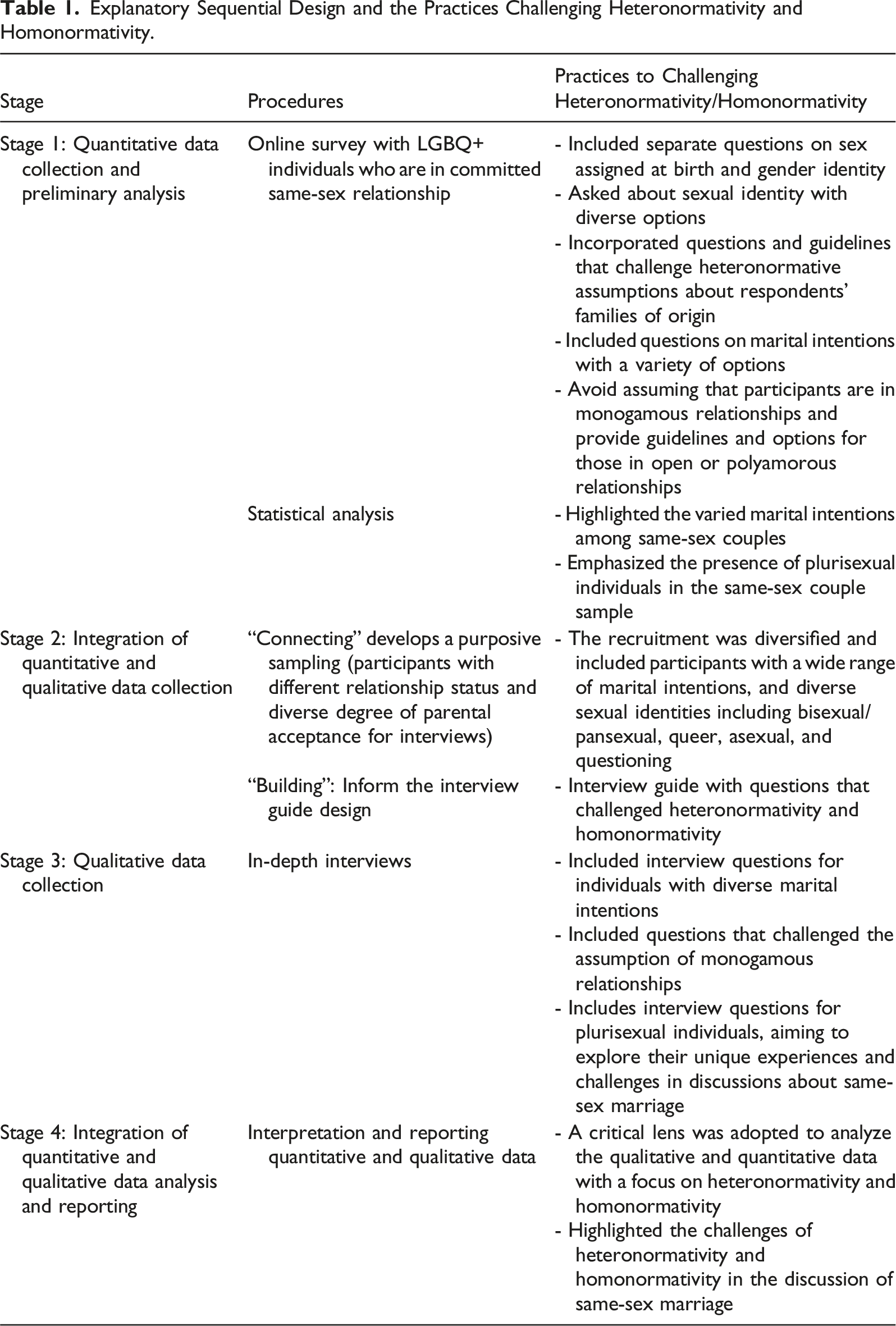
Stage 1: Quantitative Data Collection and Preliminary Analysis
This study’s quantitative phase was based on a collaborative project examining the lived experiences of LGBQ+ individuals in Taiwan and Hong Kong. The project included an online survey of 647 respondents conducted between 2021 and 2022, using purposive and snowball sampling methods. Participants were recruited through local LGBQ+ community organizations and social media platforms. After providing informed consent, participants completed a Qualtrics survey. Participants received a gift voucher (HK$60/NT$150, approximately US$5) as compensation and could withdraw at any time. Hierarchical multiple regression and logistic regression analyses were used to examine the association between marital intention, parental acceptance, and relationship satisfaction.
Stage 2: Integration of Quantitative and Qualitative Data Collection
For integration at the methods level, I employed both “connecting” and “building” techniques during the intermediate phase between quantitative and qualitative data analysis (McCrudden & McTigue, 2019). The quantitative data analysis informed the sampling framework for interview recruitment and the design of the interview guide.
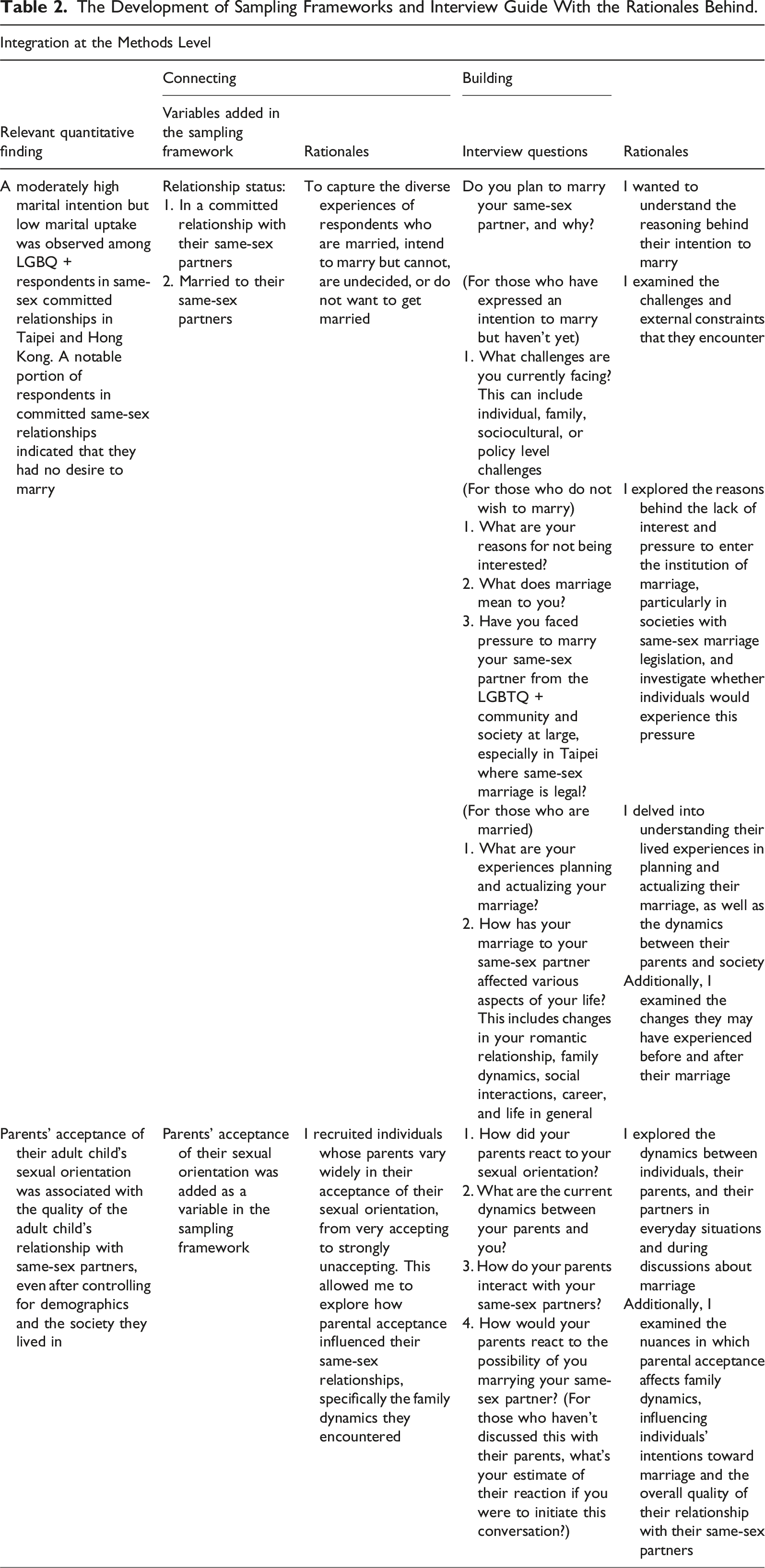
The quantitative data analysis provided a general understanding of the phenomenon and identified two research puzzles. First, the quantitative findings highlighted a moderately high marital intention but low marital uptake among LGBQ+ respondents in same-sex committed relationships. This discrepancy prompted questions regarding the issues and challenges these couples faced when attempting to realize their marital intentions. Also, a notable portion of LGBQ+ respondents in committed same-sex relationships indicated that they had no desire to marry.
The second finding highlighted the impact of parental acceptance of one’s sexual orientation on their relationship satisfaction with their same-sex partners. This result prompted inquiries about the role and influence parents had on their children’s same-sex relationships.
Connecting
For the sampling frame, I adopted “connecting,” an integration technique where one type of data informed the sampling frame of the other (Fetters et al., 2013). Based on my quantitative data analysis, I employed purposive sampling to recruit interview participants. Demographic variables were used to purposively select interviewees, ensuring they represented the demographic composition of the quantitative sample.
For the first research puzzle derived from quantitative analysis, I recruited respondents who were in committed relationships, as well as those who were married to their same-sex partners. Previous studies on same-sex marriage have often focused on couples who were already married, gathering retrospective accounts (Van Eeden-Moorefield et al., 2011). However, these studies have excluded those intending to marry but unable to do so because of social and economic constraints. Also, these studies have failed to capture those who do not want to get married. To better understand the moderately high intention to marry but low actualization found in my quantitative analysis, I included both married respondents and those in committed same-sex relationships for in-depth interviews.
For the second research puzzle, I have purposefully selected respondents with parents who held diverse attitudes toward their sexual orientation, from very accepting to strongly rejecting. By considering parental attitude as a variable in the purposive sample, I have ensured to include interviewees with parents who had varying levels of acceptance toward their sexual orientation. This sampling strategy has allowed me to investigate the impact of parental acceptance on their same-sex relationships and family dynamics.
Purposive Sampling for In-Depth Interviews
The quantitative survey data was used to recruit participants for in-depth interviews. At the end of the survey, respondents were asked if they would be interested in participating in in-depth interviews to share their lived experiences with the researchers. It was clearly stated that participation in the follow-up interviews was completely voluntary.
After analyzing the online survey data, I used purposive sampling to identify potential interviewees who fitted the demographic composition. In total, I sent 180 invitation emails to potential interviewees for follow-up interviews. Throughout the recruitment and data collection process, I monitored the demographic profiles of the interviewees. I made extra efforts to recruit individuals from underrepresented demographics, as these groups typically have lower participation rates in LGBQ+ research (Suen et al., 2020). For example, I specifically resent invitation emails to respondents (aged 40+) and those with lower education attainment through follow-up invitation emails. This resulted in 10.0% of interviewees being 40+ years old (compared to 8.7% in the survey) and 7% having lower education attainment (compared to 10.8% in the survey). I also aimed to match the parental attitude composition between survey and interview samples (approximately 35% unaccepting, 25% neutral, and 40% accepting in the survey). The final interview sample had slightly higher parental acceptance rates, with 50.0% having accepting mothers and 45.8% having accepting fathers. Overall, the interview sample closely resembled the quantitative sample in terms of demographic composition.
Building
The second method I employed to integrate at the methods level was through building. This involved using quantitative findings to inform the design of qualitative data collection. Specifically, two research puzzles derived from quantitative findings have guided the development of my interview guides.
For the first research puzzle, I designed interview questions focusing on the interviewees’ intentions to marry their same-sex partners and their perceived societal challenges in policy, sociocultural, and family domains. I sought to understand the impact of same-sex marriage legislation (or lack thereof) on couples’ marital intentions and their experiences in familial and public spheres.
The Development of Sampling Frameworks and Interview Guide With the Rationales Behind.
Stage 3: Qualitative Data Collection
In-depth interviews were conducted in Hong Kong (October–November 2021) and Taipei (February–March 2022). Due to COVID-19 social distancing measures, all interviews were conducted online via video calls using platforms such as Zoom, Skype, and Google Meet, based on the respondents’ preferences. All interviews were conducted in Chinese and typically lasted between 45 minutes to an hour. The interviews were conducted in a semi-structured manner, with a pre-set interview guide containing a few key questions. However, flexibility was provided for interviewees to share their personal experiences and thoughts on relevant topics (Hughes et al., 2021). The interview questions were intentionally broad and open-ended, allowing interviewees to discuss and explore various topics based on their interests and lived experiences. With the written consent of the interviewees, all interviews were audio-recorded and then transcribed verbatim.
Stage 4: Integration of Quantitative and Qualitative Data Analysis and Reporting
During data analysis and reporting, I have integrated both quantitative and qualitative findings (DeJonckheere et al., 2024). I have adopted a hybrid thematic analysis approach for analyzing qualitative data, which explicitly combined both inductive and deductive reasoning (DeJonckheere et al., 2024). Based on the quantitative findings, I have developed an initial coding scheme to guide the analysis (Fetters et al., 2013). Throughout the coding process, I have maintained flexibility by adding new codes to capture additional nuances, possible explanations, and unexpected results that have emerged from the qualitative data (DeJonckheere et al., 2024; James et al., 2023).
The coherence between quantitative and qualitative findings is vital for effective integration (Fetters et al., 2013). My study demonstrated a strong sense of complementarity—non-conflicting yet different narratives told by quantitative and qualitative findings. The quantitative data in my study has revealed a moderately high intention but low realization of marriage among same-sex couples, and an association between parental acceptance and the quality of same-sex relationships among LGBQ+ individuals. The qualitative data has highlighted the challenges faced by same-sex couples in public and private domains regarding marriage. It has also depicted the family dynamics between LGBQ+ individuals and their parents during same-sex marriage preparation. When compared, the qualitative and quantitative data differed, but did not conflict. They offered different perspectives on the same issue, presenting a more comprehensive picture than what either approach could provide independently.
For reporting, I have adopted integration through narrative approach to describe both quantitative and qualitative findings in a single report. I have used a contiguous approach, first reporting the quantitative findings and highlighting identified research puzzles (McCrudden & McTigue, 2019). Then, I have reported the qualitative findings to add explanations and nuances, underscoring the complexity of the issue investigated.
Discussion
Challenging Heteronormativity in Mixed Methods Design
To address the critiques of heteronormativity in quantitative data collection, this study has examined the wordings of survey questions, provided options, and underlying assumptions in the design. The survey has included as many options as possible and has provided an “other” category for further elaboration. Additionally, the limitations of this data design have been openly acknowledged and respondents have been invited to give feedback on terminology and question usage.
For example, when addressing questions related to gender identity and sexuality, the survey asked about sex assigned at birth and gender identity as two separate questions. More than two options were provided for both sex and gender questions to challenge binary perceptions. For gender identity, the options included: (1) cisgender man; (2) cisgender woman; (3) transman; (4) transwoman; (5) genderqueer/non-binary; and (6) others (please elaborate). Regarding sexual orientation, these options were provided: (1) gay; (2) lesbian; (3) bisexual; (4) pansexual; (5) heterosexual; (6) asexual; (7) queer; (8) questioning; (9) others (please elaborate); and 10) I don’t know.
The study has gone beyond addressing heteronormative critiques from LGBQ+ respondents themselves and has expanded these critiques to challenge assumptions of heteronormativity within their families of origin. Parental attitudes have played a significant role in this study. However, the study did not assume that participants’ parents conform to the mainstream heterosexual family model (one father and one mother). When asking about their families of origin, options have been provided including single-parent families, blended families, and rainbow families, which consist of LGBQ+ parents. Although rainbow families might be rare, this option has been intentionally included to challenge heteronormative assumptions about family structures.
In addition, footnotes were provided for questions related to their fathers/mothers/parents. These footnotes acknowledged that participants might have more than one father/mother, belonging to non-traditional heterosexual or rainbow families. Guidelines were also provided for these participants to answer the questions. Moreover, the limitations of word choices in the survey design were explicitly acknowledged and feedback was requested from participants for survey improvement.
After designing and collecting the data, I have critically examined the heteronormative nature of quantitative data and recognized its limitations. Given that this study followed a mixed methods design, I have relied heavily on qualitative data collection and analysis. This approach helped capture nuanced aspects of participants’ experiences and challenge heteronormative assumptions.
Challenging Homonormativity in Mixed Methods Design
Queer Critiques on Same-Sex Marriage
In the study, I have challenged homonormativity by not assuming that marriage is the ultimate, desirable option for same-sex couples in committed relationships. I have been particularly interested in individuals who want to get married but face social and economic constraints that prevent them from doing so. I have also been interested in those who do not wish to marry their same-sex partners.
To this end, I designed the study with two practices. First, I used “committed relationship with same-sex partner” as an inclusion criterion, instead of recruiting only those who were married. For those who are married, there may be certain privileges related to economic, gender, cultural, and family factors (Chauvin et al., 2021). Therefore, it was important to include those who were not married or did not wish to marry in order to get a holistic picture and challenge the homonormativity embedded in the debate of same-sex marriage.
My focus laid on LGBQ+ individuals in committed same-sex relationships, rather than those who are single or casually dating. This is because the concept of marriage directly relates to their current experiences and status. Those in committed same-sex relationships could contextualize the discussion of marriage in their personal lives. They could consider factors such as the perceived pros and cons of marriage in their societies, its impact on their career progression, and the family dynamics between their parents and their same-sex partners. These multifaceted real-life factors might not apply to LGBQ+ individuals who have not yet been in a committed same-sex relationship.
Second, I have explicitly asked about their marital intentions, offering a wide range of options in the survey design. Of the 647 respondents, 7.4% were married and 46.4% indicated intention to marry. Interestingly, 31.5% were undecided, while 14.7% have clearly stated they do not wish to marry their same-sex partners. The finding has presented a variety of marital intentions among same-sex couples. This has challenged the assumption that marriage is the ultimate and most desirable option for all same-sex couples.
In the in-depth interviews, I included questions for respondents who could not or chose not to marry, delving into their reasons. I also investigated whether they encountered pressure to marry their same-sex partners, particularly those living in Taipei where same-sex marriage has recently been legalized. This approach addressed the queer critiques on perceiving marriage as the ultimate and desirable goal for same-sex couples, especially in same-sex marriage debates.
Queer Critiques on the Assumption of Monogamy
To challenge and question the traditional monogamous relationship framework and promote a more inclusive approach, this survey has accommodated different relationship dynamics. It has not assumed participants are in monogamous relationships, but has recognized the potential for multiple committed partners or open/polyamorous relationships. The survey has provided guidelines for respondents who have had multiple committed partners or were in open/polyamorous relationships to fill in the specific questions about their partners. This approach has broadened the survey’s reach, capturing diverse relationship experiences and perspectives for a comprehensive understanding of varying relationship dynamics.
In my in-depth interviews, I have not presumed that my interviewees are in monogamous relationships. I have asked whether they have discussed monogamy or polyamory practice in their same-sex relationships and if the marriage framework would affect it. This approach has challenged the homonormativity in discussing marriage and has provided an opportunity for interviewees to share their own relationship framework and dynamics.
Queer Critiques on Monosexism
To challenge monosexism, I have adopted a diverse range of terminology for sexual identity/orientation to recruit research participants. Anyone who identified as LGBQ+ or non-heterosexual has been invited to participate in this study, provided they met other inclusion criteria. Using general terms like “LGBQ+” has allowed for the inclusion of a diverse population with a broader range of desires, behaviors, and identities that do not conform to heterosexuality (Russell et al., 2023). In recent years, there has been an expansion of sexual identities, and more LGBQ+ individuals, especially the younger generation, may not limit themselves to traditional labels like “gay,” “lesbian,” or “bisexual.” Instead, they may identify with a more diverse range of sexual identity labels (Russell et al., 2023). To ensure a greater degree of inclusion, challenge monosexism, and address the growing diversity within the LGBQ+ community, I have adopted broader terminology for the inclusion criteria in this study.
It is worth mentioning that within the participants included in my study (individuals who are in committed same-sex relationships), there was a wide spectrum of sexual identities. The majority (73.4% of survey respondents and 71.4% of interviewees) identified as gay or lesbian. Nearly one-fourth of individuals (23.2% of survey respondents and 25.7% of interviewees) identified as bisexual or pansexual. Notably, around 3% of survey respondents and interviewees identified as queer (1.5%), asexual (0.6%), questioning (0.8%), or other categories (0.5%). This diversity in sexual identities demonstrated the rich tapestry of individuals in committed same-sex relationships.
Prior literature has suggested that plurisexual and other sexual identities are often mislabeled as gay/lesbian when in same-sex relationships (Charley et al., 2023). In my interviews, I explored the often overlooked perspectives of bisexual, pansexual, queer, asexual, and questioning individuals in same-sex relationships. I asked about their unique challenges and experiences, as well as the implications of their sexual identities on their marital intentions. For instance, an asexual participant expressed disinterest in the discussion about same-sex marriage legislation. Meanwhile, a participant mentioned the increased marginalization and stigmatization he experienced because of his bisexuality when same-sex marriage was legalised. Adopting a diverse range of terminology for sexual identity/orientation in participant recruitment allowed me to capture the complexity within the LGBQ+ community. This approach also responded to the critiques of homonormativity and monosexism within the LGBQ+ community and typical research design.
Opportunities and Challenges in Conducting Queer Mixed Methods Research
This study presented several opportunities as well as key challenges in conducting queer mixed methods research. Sexual minorities are often a hidden, hard-to-reach, and vulnerable population, making the recruitment of participants for in-depth interviews challenging (Kong, 2023). Those residing in predominantly LGBQ+ unfriendly societies often fear the disclosure of their sexual identities during their research participation. Particularly, those who haven’t disclosed their sexual orientation publicly and those living in hostile families and communities may not feel safe or comfortable responding to interview recruitment. They may fear the risks associated with exposure or feel unprepared to share their stories with a stranger, such as a researcher. The hard-to-reach nature of the LGBQ+ community presents challenges for researchers.
Opportunities: Reaching the Hard-To-Reach Groups
I found that starting the data collection process with an online survey could alleviate participants’ concerns about anonymity. The only personal information collected was an email address for follow-up invitations and incentive distribution. Respondents could provide an email address that was not directly linked to their names or workplaces, or they could create a new email address specifically for this survey.
Respondents often felt a greater sense of control during online surveys (Robertson et al., 2018). They were aware they could withdraw at any time simply by closing the survey on their computer. Furthermore, they could decide the extent of their participation. Most survey questions were standardized, offering 2–7 options, with only a few optional open-text questions. This online platform offered participants increased autonomy and control when discussing their sexualities, a subject that was often private, concealed, and stigmatized.
A sequential design study, beginning with an online survey, can engage a more diverse population within the LGBQ+ community. This approach is especially effective in reaching those who are less visible or are living in hostile environments, due to its low participation threshold and anonymity.
For instance, in my survey sample, the majority of participants had not fully disclosed their sexual orientation in their daily lives. Within the realm of family, about 20% of respondents indicated that their parents were unaware of their sexual orientation (25.0% for fathers; 12.9% for mothers). Another 30% stated that their parents likely knew but rarely discussed it (37.6% for fathers; 32.6% for mothers). In terms of work or study domains, a sizable portion remained undisclosed. Specifically, 14.2% reported that their colleagues or classmates were completely unaware, and 34.2% indicated that their supervisors or teachers were also unaware. These findings suggested that my survey sample encompassed a diverse range of LGBQ+ individuals in committed same-sex relationships, spanning from those completely undisclosed to those fully open in their daily lives.
A study that includes participants from diverse backgrounds provides a more comprehensive view for further analysis. This is particularly vital when studying LGBQ+ populations and marriage. Queer scholars have criticized the discourse on same-sex marriage for being dominated by middle-class gay men and lesbians who have the economic and cultural privileges to be open about their identities (Bernstein, 2018). However, the perspectives of marginalized groups within the LGBQ+ community, especially those from the working class or those living in hostile environments forcing them to conceal their identities, often remain unheard. Using a sequential mixed methods study design addressed this issue by making it easier for respondents to participate in the study. It facilitated inclusion of a more diverse population, providing a more holistic understanding of the LGBQ+ community and the real impacts of same-sex marriage legislation.
Opportunities: Building Trust During the Sequential Mixed Methods Research
Adopting a sequential mixed methods research design offers another benefit: it cultivates trust between participants and the researcher during data collection. An online survey serves as an initial engagement tool. Its low participation threshold encourages more people to take part in the study. As participants gain more understanding about the project and the researcher’s expertise in LGBQ+ topics, their trust in the researcher gradually develops.
This online survey has been carefully designed and has adopted unconventional, LGBQ+ inclusive wording compared to typical survey designs. The attention to detail in the survey design has demonstrated researchers’ knowledge and respectful attitude toward the diversity within the LGBTQ+ community. This has given participants confidence to participate in in-depth interviews, disclose their identities, and share their personal experiences with me.
Five interviewees explicitly stated that the professionalism demonstrated in the survey design was the main reason they agreed to participate in the in-depth interview. One interviewee in Taipei said: “When I filled in your survey, I adopted a critical mindset to examine it. I kept thinking about whether there were scenarios and dimensions that the survey failed to capture or acknowledge. I couldn’t think of any. The survey was so well-designed, and I am very impressed. I am very curious and wanted to meet the research team behind this survey. That’s why I agreed when I received your follow-up interview invitation.” Another interviewee in Hong Kong shared her thoughts, “Your survey demonstrated your knowledge about LGBQ+ issues, which reflected your dedication and long-term commitment to the community. That’s why I wanted to help and join the in-depth interview. I trust your research can bring impacts to the LGBQ+ community.”
The testimonies from my interviewees have indicated that a well-designed survey can foster a connection between participants and researchers. It has encouraged participants to become more engaged in the study, leading them to participate in in-depth interviews and share their personal struggles and experiences candidly. The sequential mixed methods design has offered an opportunity to engage participants in multiple, in-depth ways.
Challenges: Participants’ Safety Concern in LGBQ+ Unfriendly Societies
Given that both Taipei and Hong Kong are predominantly unfriendly toward LGBQ+ individuals, respondents are greatly concerned about their anonymity and privacy. They fear being outed against their will, which can negatively impact their career progress and family relationships. To address these concerns, I have taken additional measures during both the data collection and analysis stages. First, no personally identifiable information was collected throughout the project, except for an email address provided by participants for follow-up contact.
Data Collection
When I conducted my online in-depth interviews, an online link for the video call was generated and sent to the respondents before each interview took place. To ensure privacy, respondents were not required to log in or provide any personal information to join the video call. During the interviews, respondents were given the choice to turn on their cameras, with the majority opting to do so. However, three respondents expressed concern and preferred to join the interviews with audio only.
Although the interviews were conducted on Zoom, Skype, and Google Meet, I chose not to use the recording functions on those software applications. The recording function embedded in these platforms is primarily designed for video recording. Since my academic analysis only required transcribed verbatim, audio recording was sufficient. Video recording would capture the interviewees’ faces, which could risk exposing their identities and invading their privacy. To minimize these risks, I opted to avoid using video recording functions for the interviews.
Some interviewees expressed concerns about the data security of video-calling software, particularly Zoom. As Zoom was perceived as a company with investments from Mainland China, interviewees, especially those from Taipei, expressed skepticism about using Zoom and its video recording functions. To address their concerns, I decided not to use the video recording function on Zoom. For interviewees in Taipei, I intentionally emphasized the options of using Google Meet, a software commonly used in Taipei.
To audio record the interviews (with interviewees’ consent), I used a portable audio recorder placed next to my computer during the interview. Immediately after the interview, I transferred the audio files to my computer and named them by interview number. To protect interviewees’ confidentiality, the audio files did not contain any personally identifiable information such as names or emails. The audio files were promptly deleted from the portable audio recorder.
Data Analysis
The mixed methods research design allowed collecting a broad range of information from participants through online surveys and in-depth interviews. Although no personally identifiable information was gathered, caution was exercised when integrating a participant’s quantitative and qualitative data into one file. To ensure safety, I removed the email from both types of data, assigning a unique code to each participant for further analysis and to build a link between the quantitative and qualitative data. Furthermore, I only extracted several data variables directly relevant to my study on same-sex marriage, such as marital intention, parental acceptance, and family relationships. These were linked with my qualitative data in MAXQDA for further analysis (Kuckartz & Rädiker, 2023). Other unrelated variables gathered in the survey were excluded from my dataset to avoid unnecessary risk.
Challenges: Translating English LGBQ+ Sensitive Surveys into Chinese and Contextualizing Them in Taipei and Hong Kong
The typical survey design often embeds heteronormativity and cisnormativity (Guyan, 2022). Addressing this issue requires considerable effort and self-reflection. The study took references from LGBQ+ sensitive surveys designed by English-speaking scholars, but translating these into Chinese presented challenges. Although back translation was conducted by two bilingual researchers—a common practice to ensure translated instruments maintain their original meaning and cultural relevance (Behr & Braun, 2023)—challenges existed regarding cultural nuances in how the LGBQ+ community and general public in Taipei and Hong Kong perceive and understand these questions and terminologies.
Heteronormativity, the gender binary notion, and cisnormativity are prevalent in Chinese languages, much like in English. A significant challenge was encountered during survey design regarding the use of third-person pronouns (he/she/they). Although discussions on gendered pronouns have been emerging, they have not yet been widely adopted in everyday practices in Taipei and Hong Kong.
In Chinese, third-person pronouns follow a gender binary system. Gender distinction is accomplished through radicals in the Chinese characters. For instance, the radical 女, meaning woman, is embedded in the character 她, which is the female third-person pronoun (she). On the other hand, the radical 人, meaning person, is used in the character 他, the male third-person pronoun (he) (Gallant & Sluchinski, 2023).
However, the Chinese language lacks an equivalent term for “they,” a gender-neutral pronoun commonly used to refer to people regardless of their gender. After careful consideration, the decision was made to include “TA,” a contemporary usage of the foreign romanized script instead of the native Chinese character script. “TA” can refer to “he,” “she,” and other third-person pronouns, regardless of gender. It allows readers to freely associate one of the gender options as the intended referred gender (Gallant & Sluchinski, 2023).
The use of “TA” had been more common within the Chinese-speaking transgender, gender non-binary, and genderqueer community (Sluchinski, 2024). However, it had been less widely used in the LGBQ+ community and general society in Hong Kong and Taiwan. Despite this, all three options (他/她/TA) were included in survey questions requiring third-person pronouns in order to challenge the gender binary notion and show inclusiveness. An explanation was provided as a footnote for survey respondents who might not be familiar with the usage of “TA.”
The challenges in choosing third-person pronouns for the survey design highlighted the limitations of Chinese languages. It also demonstrated the difficulties encountered when applying LGBQ+ inclusive research practices from English-speaking contexts to different languages and cultures (Creamer, 2023). Continuous self-reflection on the survey design is necessary to identify and acknowledge any heteronormative and cisnormative assumptions researchers might inadvertently make.
Challenges: Addressing the Heterogeneity within the LGBTQ+ Community
One of the key challenges when conducting mixed methods research is the heterogeneity within the LGBTQ+ community. This becomes particularly evident when contextualizing the discussion across diverse policy contexts.
A significant limitation of this study was its exclusive focus on cisgender individuals in the discussion of marriage. The marriage experiences of transgender and gender non-binary people often bear additional policy considerations, such as legal gender recognition (Holzer, 2022). The ability to marry varies greatly among these individuals, depending on the legal requirements in their specific jurisdictions and their stage of gender-affirming medical intervention (Suen, 2025).
For example, despite several judicial review judgments in Hong Kong, transgender individuals at various stages of gender-affirming medical intervention continue to face uncertainty about their legal gender status for marriage (Suen et al., 2022). Similarly, in Taiwan, ongoing changes in legal requirements for changing gender markers on ID cards affect transgender and gender non-binary individuals. The well-known Wu-Wu transgender marriage case in 2013 exposed the limitations of binary gender legal categories and their implications for marriage policy (Chen, 2021).
Uncertainty remained regarding the rights and procedures for transgender and gender non-binary individuals to marry their same-sex partners. This project focused on the policy interest of same-sex marriage legislation, exploring the experiences of cisgender LGBQ+ individuals in relation to such legislation. Transgender and gender non-binary individuals face unique challenges within their families and in relation to existing laws, policies, and social climates (Wong et al., 2025). There is an urgent need for dedicated research examining how same-sex marriage policies affect the marital intentions and experiences of transgender and gender non-binary individuals.
Contributions to Mixed Methods Research
This article has contributed to mixed methods research by demonstrating efforts to queer a mixed methods study. It has expanded previous work by demonstrating how queer critiques of heteronormativity and homonormativity have been implemented in every stage of integration in this mixed methods study. While earlier studies have often criticized heteronormative assumptions in mixed methods research—particularly in quantitative components (Nash & Browne, 2016)—this article has detailed how a queer lens has been used to inform research design, as well as the actual practices in survey instruments, questionnaire design, and integration between quantitative and qualitative data collection and analysis. For example, this article has demonstrated how to examine the wording of survey questions and options and has provided examples of how to be more inclusive toward LGBQ+ people, as well as the more marginalized groups within the communities (e.g., people who are in non-monogamous relationships and those who are plurisexual). Moreover, this article has contributed to the ongoing discussion on how to contextualize mixed methods studies beyond the Global North (Creamer, 2023). It has examined the opportunities and difficulties encountered when applying LGBQ+ inclusive research practices from English-speaking contexts to societies with different languages and cultures. This article has provided valuable insights for researchers, especially those in the Global South, on how to develop and implement a culturally sensitive practice in queering mixed methods studies.
In addition, this article has underscored the importance of explicitly acknowledging the limitations of the design and the need for inviting feedback from respondents. It echoed the growing discussion on adopting critical inquiry in mixed methods research, challenging traditional power structures and making research more participatory and inclusive (Hernández-Johnson & Bendixen, 2025). It highlighted that researchers should learn from their research participants and the communities they engage with. This knowledge-exchange process was extended beyond the traditional researcher-subject dynamics and unidirectional approach to data collection. By learning from the research participants and collecting their feedback on their research experiences, researchers can critically evaluate and challenge existing assumptions and power structures and make intentional design choices to foster inclusivity and cultural sensitivity (Hernández-Johnson & Bendixen, 2025).
Limitations
This study has used a sequential design and surveys to capture a wider spectrum of LGBQ+ individuals in same-sex relationships, compared to studies that only have had qualitative elements. However, due to the lack of a sampling framework for LGBQ+ individuals in Hong Kong and Taipei, a non-probability sampling framework has been used. The sample has been disproportionately younger, more educated, and has had a lower monthly income. Therefore, the findings might not be representative of the entire LGBQ+ population in Taipei and Hong Kong. Furthermore, since this study has been comparative and cross-sectional, it has not been able to establish a causal relationship.
Several practical limitations were encountered when attempting to match the demographic composition of the quantitative and qualitative data samples. First, invitations could only be sent to respondents who had expressed an interest in follow-up interviews. This sample of potential interviewees might have differed from the survey sample due to self-selection biases. Second, out of the 180 interview recruitment emails sent, only 40% (70 in total) had responded and participated in the follow-up interviews. It was possible that respondents with certain demographics (e.g., younger age and higher educational level) and specific interests (such as stronger intention/opinion on same-sex marriage) were more likely to respond and participate in the interviews. It was also important to consider intersectionality, as each respondent had a unique combination of demographic characteristics. Striking a balance between different demographic variables was inevitable when inviting respondents for follow-up interviews.
Conclusion
This article has demonstrated my efforts to apply the queer lens in a mixed methods study design, adapt LGBQ+ inclusive practices, and contextualize them in societies beyond the Global North, specifically in Taipei and Hong Kong. It has exposed the often unexamined heteronormative and homonormative assumptions in typical mixed methods research, emphasizing the importance of applying queer perspectives at every stage of research design. Moreover, in this article, queerness has extended beyond methodology to geographical dimensions. It has challenged Western-centric approaches by examining how LGBQ+ inclusive research practices from English-speaking contexts can be adapted for different languages and cultures. It has offered practical insights for researchers, particularly those working in Chinese societies and other non-Western contexts, on developing and implementing culturally sensitive approaches to queering mixed methods studies.
While this study has provided interesting methodological insights, it is important to acknowledge its limitations and areas for improvement. This article has emphasized the vital importance of ongoing self-reflection and indispensable input from research participants. By explicitly acknowledging the limitations, making the research more participatory and inclusive, and learning from research participants’ feedback, researchers can identify and challenge existing power structures and improve the process of queering mixed methods studies.
Footnotes
Acknowledgments
The quantitative component of this mixed methods study draws from a research project examining the lived experiences of LGBQ+ individuals in Taiwan and Hong Kong, conducted in collaboration with Professor Suen Yiu Tung and Professor Randolph C.H. Chan. I am deeply grateful for their valuable intellectual contributions and dedicated efforts in survey design and data collection. I would also like to express my appreciation to my PhD supervisor, Professor Timothy Hildebrandt, for his guidance throughout this mixed methods project.
Declaration of Conflicting Interests
The author(s) declared no potential conflicts of interest with respect to the research, authorship, and/or publication of this article.
Funding
The author(s) disclosed receipt of the following financial support for the research, authorship, and/or publication of this article: This research was partially funded by the PhD Full Scholarship by the London School of Economics and Political Science (LSE), the Early Career Scheme of the Research Grants Council of Hong Kong (28609019), and General Research Fund of the Research Grants Council of Hong Kong (14604221).
