






Abstract
We examined the accuracy of perceived vs actual cardiometabolic risk and physical activity within the Risk Perception Attitude Framework (RPA). We analyzed baseline data from 343 young adults (23.3 ± 4.4 years) participating in a weight management clinical trial. Cardiometabolic risk factors were measured according to standard clinical procedures. A cardiometabolic risk score was created from five biomarkers according to whether or not a standard clinical risk cut point was exceeded. Physical activity was determined by ActiGraph and self-report. Perceived risk and physical activity self-efficacy were assessed by validated measures. The Proactive cluster (low perceived risk/high self-efficacy) was most accurate regarding actual vs perceived risk awareness (54%), while the Responsive cluster (high perceived risk/high self-efficacy) was the least accurate (16%). All RPA clusters underestimated their actual physical activity, self-reporting less than half the moderate-to-vigorous physical activity that was captured via accelerometry. The RPA Framework can identify young adults unlikely to be aware of their cardiometabolic risk. Given the growing prevalence of metabolic syndrome, efforts early in adulthood to increase knowledge and awareness of cardiometabolic risk, and behaviors necessary to reduce that risk, can have substantial impact on future health.
“Participants in all four clusters recorded a high level of weekly MVPA with the ActiGraph.”
Introduction
Between 1988 and 2012 the overall prevalence of the metabolic syndrome increased from 25.3% to 34.2% in the United States (U.S.) and this increasing prevalence has become especially evident in young adults (18-34 years). 1 Previous studies have indicated that between 20 and 89% of young adults have one or more components of the metabolic syndrome, with greater prevalence of components seen in samples with overweight/obesity.2-5 Despite these increasing trends, knowledge and awareness of cardiometabolic risk is low.6-8 Indeed, data from a large population of young adults living in the United States indicate that 30%, 37%, and 43% of those with diabetes, hypertension, and hypercholesterolemia, respectively, were unaware of their risk. 7
Physical activity is an important component of cardiometabolic risk prevention in all age groups, including young adults. Current U.S. 9 and global public health recommendations 10 call for adults (including the young adult age range) to achieve at least 150 minutes of moderate-intensity physical activity per week; yet, young adults’ knowledge and awareness of these recommendations are low. In fact, less than 40% of young adults in the United Kingdom 11 and the United States12,13 are able to correctly define current physical activity guidelines. Moreover, agreement between self-reported and device-measured physical activity is modest at best (r = .16 to r = .49),14,15 suggesting that young adults may lack awareness about their own risk reduction behaviors.
Awareness of risk is a necessary factor for making health behavior changes. The Risk Perception Attitude (RPA) framework
16
categorizes individuals by their risk perceptions, along with their level of self-efficacy in practicing the behaviors necessary to mitigate their risk. Within this framework risk perceptions are considered “motivators” while efficacy beliefs are “facilitators” of behavior change. People who believe they are at risk for disease and also that they can take preventive actions to mitigate the risk are classified as Responsive, since they may be most likely to take action on their own behalf (Figure 1). In contrast, those having both low risk perception and low efficacy beliefs are classified as Indifferent because they may have neither the motivation nor the ability to act. People with high risk perceptions and low efficacy beliefs are classified as Avoidant, while those with low risk perceptions and high efficacy beliefs are classified as Proactive. Importantly, these four clusters have been shown to distinguish differences in attitudes and behavioral intentions for several disease preventive strategies.17-19 To our knowledge, however, this framework has not been linked to accuracy of perceived vs actual risk status in young adults. To the extent that disease prevention behaviors are driven by people’s perceptions about risk
20
as is also posited by the Health Belief Model
21
and the Protection Motivation Theory,
22
it is important to know how well people are able to gauge their own risk to various diseases. Distribution of study subjects (N = 343) within the Risk Perception Attitude Framework. Note. Figure republished with permission from: Napolitano MA, Tjaden AH, Bailey CP, DiPietro L, Rimal R. What moves young people? Applying the risk perception attitude framework to physical activity behavior and cardiometabolic risk. Transl Behav Med. 2022;12(6):742-751. doi:10.1093/tbm/ibac012.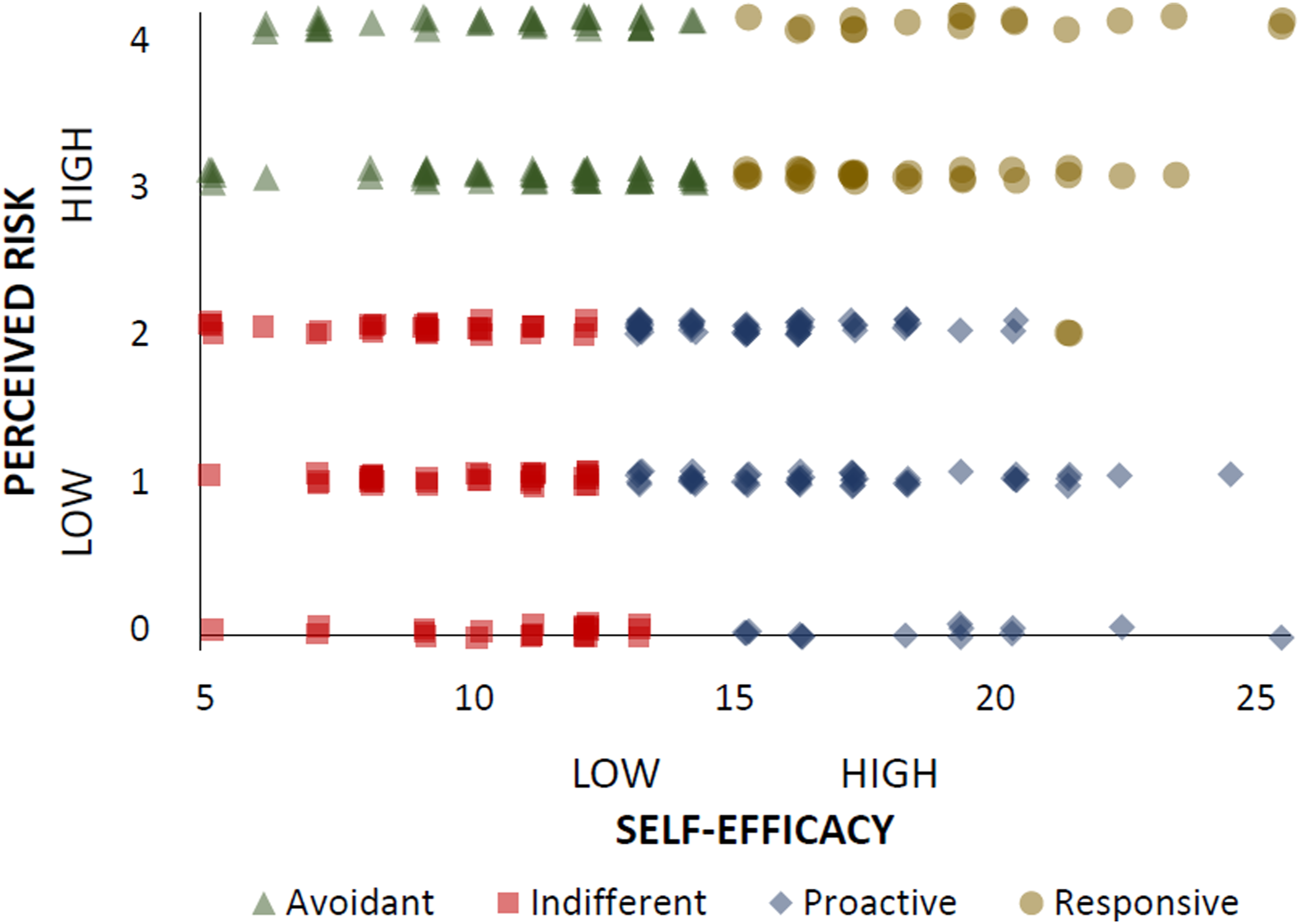
We hypothesized that those in the Responsive cluster will have the highest concordance between their risk awareness and actual risk, as well as between their self-reported and accelerometry-measured physical activity. Our underlying rationale for this was that the Responsive cluster’s engagement in preventive behaviors (which tend to be higher than that of the other clusters)17-19 is likely the result of high risk perceptions (which have motivated them to act) and strong efficacy beliefs (which have facilitated their behavior change). Similarly, we also hypothesized that the Indifferent cluster would also be accurate for the opposite reason: this group’s lack of action likely reflected low motivation (because of low risk perceptions) and low ability (because of low efficacy beliefs). We estimated that the other two clusters (Proactive and Avoidance) would display lower levels of accuracy because of the conflicting information from low efficacy and high risk or vice versa.
Methods
Study Population
Study participants (N = 459) were enrolled in the Healthy Body Healthy U (HBHU) randomized controlled trial that tested digital intervention strategies to promote weight loss and management among young adults between 2015 and 2018.23,24 Main eligibility criteria were: (1) 18–35 years of age and enrolled in a college or university in the District of Columbia or Boston area; (2) a body mass index (BMI) of 25 to 45 kg/m2; (3) an active Facebook user with regular text message access; and (4) generally healthy enough to participate in physical activity. Among the N = 459 randomized participants, N = 456 were included in the identification of RPA clusters as previously described. 25 In the current analyses, only participants with baseline self-reported physical activity and accelerometry data (N = 405), as well as complete baseline cardiometabolic risk factor data (abdominal circumference, blood pressure, fasting glucose, HDL-C, and triglycerides) were included, resulting in a final sample size of 343 participants. Study participants provided written informed consent and all study procedures were approved by the Institutional Review Boards of the George Washington University and the University of Massachusetts-Boston.
Cardiometabolic Risk
Detailed information on the measurement of the cardiometabolic risk variables is contained elsewhere. 23 Briefly, height, body weight, abdominal circumference, and blood pressure were measured according to standard clinical procedures. Following an overnight fast, a venous blood sample was collected for the measurement of total- and HDL-cholesterol and triglycerides concentrations. Samples were processed and analyzed according to standard procedures in the Medical Laboratory at the University of Virginia. A capillary blood sample was also obtained to assess fasting glucose (OneTouch® Ultra® 2) and hemoglobin A1c (HbA1c; A1cNow+, PTS Diagnostics). We then calculated a cardiometabolic risk score (CRS) 2 based on whether a standard risk cutpoint was exceeded (0 = no; 1 = yes) for abdominal circumference [>102 cm (men) or >88 cm (women)], HbA1c (≥5.7%), HDL-C [<40 mg/dL (men) or <50 mg/dL (women)], SBP (≥130 mmHg), and DBP (≥85 mmHg).26,27 Scores for each individual risk factor were summed to create the CRS, with scores ranging from 0 to 5.
Physical Activity
Physical activity was measured by both accelerometry and by self-report. Participants were instructed to wear an ActiGraph accelerometer (wGT3X-BT) for 7 days, with valid wear time counted as 4 days of 10 hours per day. 28 Established thresholds of accelerometer counts were used to define moderate-to-vigorous physical activity (MVPA), with MVPA defined as ≥1952 counts per minute. 29 To adjust for variability in number of days the ActiGraph was worn, the average daily total was multiplied by seven to obtain an average weekly total of MVPA. Participants also self-reported weekly physical activity using the seven-item International Physical Activity Questionnaire (IPAQ). 30 The IPAQ queries the frequency (days/week) and duration (mins/day) of vigorous- and moderate-intensity physical activity, as well as walking and sitting performed over the previous 7 days. Responses were processed and summed using the IPAQ guidelines to derive a measure of MVPA (min/week). 31
Cardiometabolic Risk Awareness Index
Four questions were used to assess metabolic risk awareness:8,32 (1) Have you ever heard of the term metabolic risk; (2) Do you know what your blood pressure is; (3) Have you ever had blood work to check for cholesterol; (4) Have you ever had blood work to check for high glucose? The RAI was calculated by summing responses (0 = no; 1 = yes) across the four questions. Scores ranged from 0 to 4, with higher scores indicating higher awareness of risk.
Physical Activity Self-Efficacy
Self-efficacy for physical activity was assessed by having participants rank on a 5-point Likert scale how confident they felt exercising under five distinct conditions (bad weather, poor mood, fatigue, on vacation, too busy). 33 Scores range from 5 to 25, with higher scores indicating greater self-efficacy.
Creating the RPA Framework
The four RPA Framework clusters then were created from the RAI score (range 0 to 4) and the physical activity self-efficacy score (range 5 to 25). Because the two variables were measured in different units and may have had unequal variances, they were standardized to a mean of 0 and a standard deviation of 1. A cluster analysis then was performed on the standardized data to create four RPA groupings based on these two variables (Figure 1).
Statistical Analysis
Univariate analyses (mean ± SD, frequencies [%]) first were generated on all study variables in order to determine their distributions within the study population and within the RPA clusters. The unadjusted association between device-measured and self-reported physical activity was determined using the Pearson Correlation Coefficient.
To determine the accuracy of participant cardiometabolic risk awareness vs their actual risk status, scores on the RAI and the CRS were categorized into tertiles (low, medium, high) based on their distribution in the study population. Participants then were categorized as Overestimating (RAI > CRS); Underestimating (RAI < CRS); or On Target (RAI = CRS). The frequency of these three categories was then compared among the four RPA Framework clusters using chi-square tests.
The accuracy of self-reported vs accelerometry-measured physical was determined by creating a difference score between the two measures (ActiGraph MVPA min/week—IPAQ MVPA min/week). A negative score would indicate that participants overestimated their actual physical activity, while a positive score would indicate an underestimation of their actual activity. Physical activity accuracy scores then were compared across the RPA Framework clusters using ANOVA. All analyses were performed using SAS (9.4) at an alpha level of .05 (two-sided).
Results
Participants were 23.3 ± 4.4 years and primarily female (78%). The majority of participants identified as Non-Hispanic White (49%), while 42% identified as Non-White and 9% were of unknown race/ethnicity. On average, the study sample had obesity (BMI = 31.0 ± 4.4 kg/m2) with a CRS of 1.63 ± .92. At baseline, participants performed 309 ± 161 min/week of MVPA based on accelerometry, but reported a substantially lower amount of MVPA on the IPAQ (128 ± 112 min/week). There was a weak, yet statistically significant correlation between the two measures of physical activity (r = .25; P < .001).
Accuracy of Cardiometabolic Risk Awareness by RPA Framework Cluster
Accuracy of Cardiometabolic Risk Awareness by Risk Perception Attitude Framework Cluster.
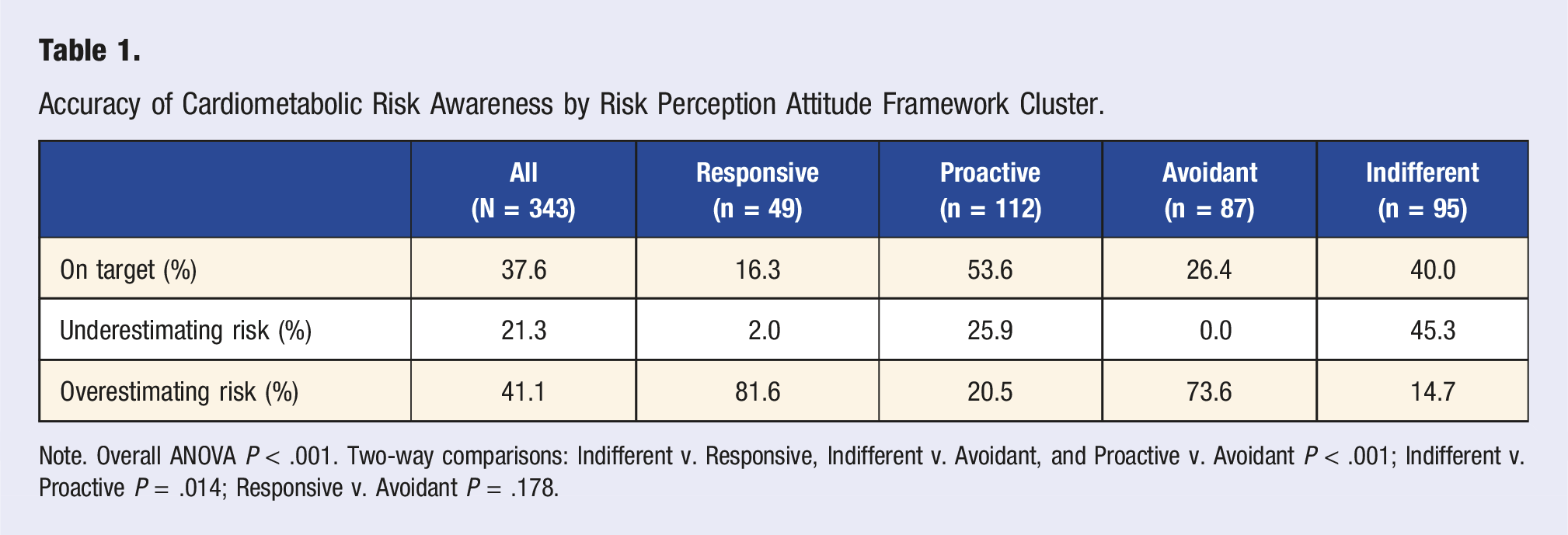
Note. Overall ANOVA P < .001. Two-way comparisons: Indifferent v. Responsive, Indifferent v. Avoidant, and Proactive v. Avoidant P < .001; Indifferent v. Proactive P = .014; Responsive v. Avoidant P = .178.
Accuracy of Physical Activity Reporting by RPA Framework Cluster
Accuracy of Moderate-to-Vigorous Physical Activity Reporting by Risk Perception Attitude Cluster.
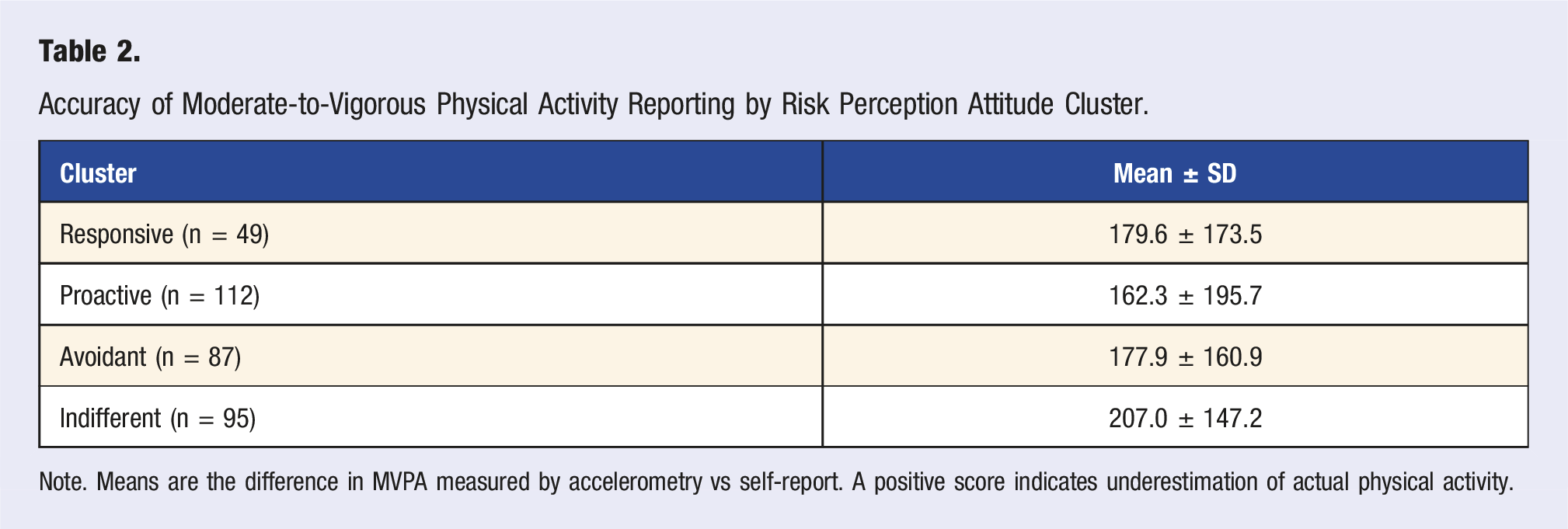
Note. Means are the difference in MVPA measured by accelerometry vs self-report. A positive score indicates underestimation of actual physical activity.
Discussion
We used the RPA framework to categorize young adults according to their perceived cardiometabolic risk, along with their level of self-efficacy in practicing a specific behavior (i.e., MVPA) to mitigate their risk. Contrary to what we hypothesized, the highest concordance between risk awareness and actual risk was observed within the Proactive cluster (low perceived risk/high self-efficacy), while the Responsive cluster (high perceived risk/high self-efficacy) had the lowest concordance. The Indifferent cluster was on target 40% of the time, which was the second most accurate cluster. The two clusters that displayed most accuracy are both defined by low risk perceptions. This suggests that, among young people (whose current levels of cardiovascular risks are, indeed, lower than that of older adults), roughly half of them accurately gauge their (low) risk. What was more difficult to explain, however, is the finding that the Responsive cluster had the lowest level of accuracy. This is typically the group that engages in most preventive behaviors, which, combined with the finding in Table 1 showing a systematic overestimation of risk, suggests that the Responsive cluster’s behaviors are driven by their overestimation of risks. One possible interpretation of this finding is that those who have high efficacy for performing a behavior might feel they have more agency over their health, and are more aware of the links between their behavior and health risk. Both the Responsive and Proactive clusters have high efficacy beliefs; however, they differ in their risk perceptions, as the Responsive cluster has high risk perceptions while the Proactive cluster has low perceptions. Those in the Proactive cluster likely had high accuracy of risk assessment because they were already engaging in risk-reducing behaviors and (correctly) inferred their risk on the basis of those behaviors.
The simple correlation between self-reported and accelerometer-measured MVPA was low, but statistically significant. A correlation coefficient of r = .25 is within the range of values typically reported between self-reported and device-measured measures of physical activity in young adults.14,15 What was striking, however, is that participants reported 181 fewer min/week of MVPA than what they actually performed, which is in stark contrast to evidence suggesting that MVPA is usually over-reported in this age group. 15 Accuracy in reporting MVPA was highest in the Proactive cluster and lowest in the Indifferent cluster, but these differences were not statistically significant. Again, those in the Proactive cluster, having high efficacy beliefs (regardless of their actual risk), may be more aware of what they do to mitigate their future risk of cardiovascular disease. In contrast, those in the Indifferent cluster (low risk perception/low efficacy beliefs) have neither the motivation nor the ability to act on behalf of their own health, and thus are less aware of their risk preventive behaviors.
The strengths of this investigation include both the self-reported and device-measured measurement of cardiometabolic risk and physical activity. Nonetheless, these were cross-sectional data and therefore, the temporal sequencing between risk knowledge and awareness and actual risk status is difficult to discern. The high risk awareness observed in the Responsive and Avoidant clusters could be an artifact of the questions we used to create the RAI, which were focused on risk awareness (i.e., knowledge of terms, and awareness of their own individual values) vs one’s own personal risk perception. The HBHU participants (those with overweight/obesity) may have been more likely to be screened compared with those of normal weight due to a family history of cardiometabolic disease. Indeed, Zhang and Moran 34 reported that more frequent health care visits were associated with greater awareness of hypertension risk. Participants in all four clusters recorded a high level of weekly MVPA with the ActiGraph. Although accelerometry is a precise and valid objective measure of physical activity, it may not have captured the participants’ typical level of activity. Also, self-reported physical activity from the previous 7 days on the IPAQ may not have been representative of typical behavior, thereby explaining the marked difference in device-measured vs self-reported physical activity among the RPA clusters. Finally, all participants had overweight/obesity and had enrolled in a weight management trial, suggesting some level of concern regarding their weight and/or health. We may have seen different results had individuals in the normal weight BMI category been studied. For example, the Responsive cluster might have higher accuracy in a sample of young adults with healthy weight status. Future research can explore this hypothesis.
Nonetheless, this study was the first of its kind to examine accuracy of perceived vs actual cardiometabolic risk status in young adults using the RPA framework. By identifying young adults who may misperceive their risk, our findings suggest that prevention programs targeted to young adults need to address not only health risk literacy, but also self-efficacy in practicing the behaviors that will mitigate their risk. The promotion of cardiometabolic screenings in the clinic, community, and university settings (advertised using social media or other digital messaging) can raise awareness of one’s individual risk profile and address the cognitive-bias of young adults believing they are not at risk. 35 Novel methods of risk communication using social norms-based messaging may be particularly effective in this age group. 36 Health education messages also are critical to raise awareness of the importance of physical activity for disease prevention, and commercially-based tracking devices can reduce the disconnect between perceived vs actual physical activity behavior. Given the growing prevalence of metabolic syndrome at younger ages, efforts early in adulthood to increase knowledge and awareness of one’s own cardiometabolic risk and the behaviors necessary to reduce that risk can have a substantial impact on future health and quality of life.
Footnotes
Acknowledgments
The authors recognize the project team members who contributed to the data collection especially Erika Blankenship, Catherine Cameron, Jamie Faro, Rachel Ingersoll, Meghan Maverdes, Benjamin Shambon, and Timothy Tsung. The authors also would like to acknowledge Jeanne Jordan, PhD, and her laboratory team.
Declaration of Conflicting Interests
The author(s) declared no potential conflicts of interest with respect to the research, authorship, and/or publication of this article.
Funding
The author(s) disclosed receipt of the following financial support for the research, authorship, and/or publication of this article: Research reported in this manuscript was supported by National Institute of Diabetes and Digestive and Kidney Diseases of the National Institutes of Health under award number R01DK100916 to MA Napolitano.
Ethical Approval
All study procedures were approved by the Institutional Review Boards of the George Washington University and the University of Massachusetts-Boston.
Informed Consent
Participants provided informed consent before taking part in this study.
Data Availability
Deidentified data from this study will be made available (as allowable according to institutional review board standards) to researchers submitting a specific request and data sharing agreement to the corresponding author.
Disclaimer
The content is solely the responsibility of the authors and does not necessarily represent the official views of the National Institutes of Health.
