







Abstract
The development of an ontology-based ecosystem suitable for interoperability and for the reliable exchange of data and information is a longstanding goal of the applied ontology community. The construction of such a system relies on the alignment of a variety of ontologies. The alignment can be vertical, that is, across systems in different ontological layers (foundational, reference and domain) or horizontal, that is, across systems within a single layer. While techniques for vertical and horizontal alignments among reference and domain ontologies have been continuously studied for more than 15 years; the development of techniques for the alignment of foundational ontologies and across foundational and reference ontologies has been scattered or hardly addressed. This paper aims to bring attention to this latter problem in several ways: Highlighting the motivations for the alignment across foundational ontologies; presenting a methodology to develop such alignments; implementing the methodology to the case of the ontologies Basic Formal Ontology and Descriptive Ontology for Linguistic and Cognitive Engineering; and showing how an alignment deepens our understanding of such systems. The paper discusses also some alternative types of alignments, and briefly compares advantages and difficulties.
Keywords
Introduction
In the 1980s the continuous improvement of storage and computational capacities made evident that interoperability across an increasing number of data and systems was becoming a fundamental problem in information science. In the early 1990s the research community started to focus on the hidden assumptions behind the generation and collection of data and the construction of information systems at large and, in a few years, this turned into a visionary research line, soon called applied ontology, that quickly became ‘the’ approach to solve interoperability problems. The roots of interoperability barriers were not yet clear but the growing availability and potentiality of large datasets, varying in both organisation and quality, drove attention to what one means by interoperability and how it could be achieved (Gardner, 2005; Ouksel & Sheth, 1999). A first source of problems, as it became clear later, was the lack of conceptual clarity and coherence in the internal organisation of datastores. Relational databases are powerful and successful tools but have important limitations (in particular when dealing with heterogeneous data) due to their rigidity and structural complexity. A second source of problems was the lack of a consistent methodology to merge databases and, more generally, to cope with the different structures of information systems. The fact that data were collected from different sources (each following its own purposes) using different approaches (relying on often implicit assumptions) hampered any attempt to develop such a methodology, and information sharing across data storage remained a problem.
The applied ontology vision relied on two tenets: (i) exploitation of formal semantics, and (ii) transparency of the assumptions. It followed that the process of data integration should be analysed at different levels: Syntactic, semantic, conceptual and structural. The focus on the semantics of data and on the conceptualisation of data organisation has brought a sharp change of perspective, and led to studying how to make explicit the viewpoint one takes on reality. In the following ten years, the idea that one has to make explicit the assumptions behind data collection and data management became popular, even though how to do it remained unclear (Ouksel & Sheth, 1999).
By focussing on semantics and hidden assumptions, applied ontology made possible to develop methodologies for data integration and systems’ interoperability. The idea was to study interoperability problems by separating interoperability levels, and to use formal logic to uncover semantic inconsistencies, and philosophical analysis to uncover conceptual inconsistencies. These distinctions allowed the clarification of the implicit choices on which a system or dataset relies, and to use logical and philosophical analyses to identify possible mismatches across systems. The next step was to harvest logical approaches to develop an alignment methodology among different semantic frameworks, and similarly to harvest philosophical approaches for an alignment methodology among different conceptual frameworks. This procedure gives, as one would expect, a general methodology whose outcome is a mapping across the systems at stake; mapping which is reliable both at the semantic and conceptual levels, and that explicitly shows the compatibility extension of those systems. This approach suggested that datasets and information systems should be shared together with their semantic and conceptual frameworks, now known as their ontology. Each system, augmented with its (explicitly documented) ontology, was then considered transparent and suitable for interoperability, if not for full integration. Admittedly, systems may rely on incompatible semantic or conceptual choices, the alignments one can find in such cases may be only partial. This, one would have argued, is the cost of the pluralistic approach in modelling. The community, with only limited exceptions, accepted this cost as needed to practically verify which modelling approaches were optimal and for which purposes.
Today we have a set of general methodologies (Euzenat & Shvaiko, 2013; Fernández-López et al., 1997; Jarrar & Meersman, 2009; Suárez-Figueroa et al., 2012) that help to develop and align datasets and information systems. While these approaches need time to be consolidated, they leave open the problem of aligning the most general ontologies, called foundational or top-level, aimed to be broadly applicable. How interoperability may work at this level is still unclear, mainly because of the complexity of these systems. Early works include a comparative study of Basic Formal Ontology (
The present paper is part of a larger effort to build an ontology ecosystem as described by the visionary OntoCommons European project.
1
Motivated by this line of research, the paper proposes an approach to align top-level formal ontologies and presents problems, advantages and limitations as elicited in the study of the alignment of two well-known systems, namely
The view underlying the work in this paper is known as ‘ontological pluralism’. It claims that science needs to remain open to different views, that is, to ontologies representing different conceptualisations of the world, and thus should allow the coexistence of possibly mutually inconsistent models.
2
Inconsistency can be at the conceptual as well as at the formal level. Interoperability across mutually inconsistent ontologies is obtained by (possibly partial) alignments via formal mappings. The OntoCommons ontology ecosystem is essentially a network of interconnected domain, reference and foundational ontologies, which is being built starting from an initial set of ontologies and a number of guidelines. The alignment presented in this paper is one of the results achieved by the project. The alignment (and underpinning conceptual and technical choices) is based on the first-order logic (FOL) versions of these ontologies. The
The aims of this paper are:
to report the theoretical and practical challenges one faces in aligning foundational large ontologies (these systems have more than 100 axioms); to highlight the most difficult and intertwined choices one might be confronted with during alignment processes; to discuss possible alignment strategies and their consequences on the alignment; and to provide an analysis of the main differences/similarities between
The paper is structured as follows: Section 2 introduces the two ontologies and the notation. Section 3 describes the adopted methodology and the software used to support and check the alignment. Section 4 presents the alignment strategy and discusses the main categories that form the core of the two ontologies. The two following sections, Section 5 and Section 6, form the technical core of the paper: They present the formal alignment as two distinct mappings: From
bfo : CL Version (as of November 12, 2021)
We start from the logical theory
To have more compact formulas, the
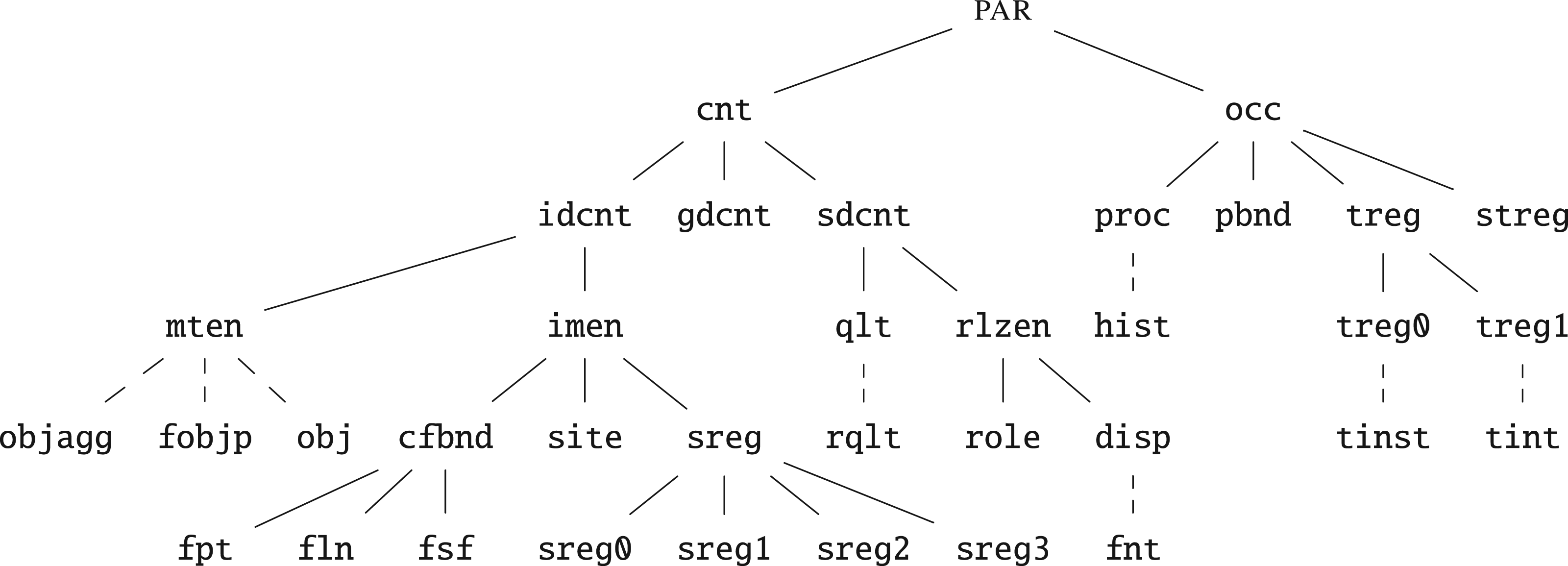
Taxonomy of Basic Formal Ontology (
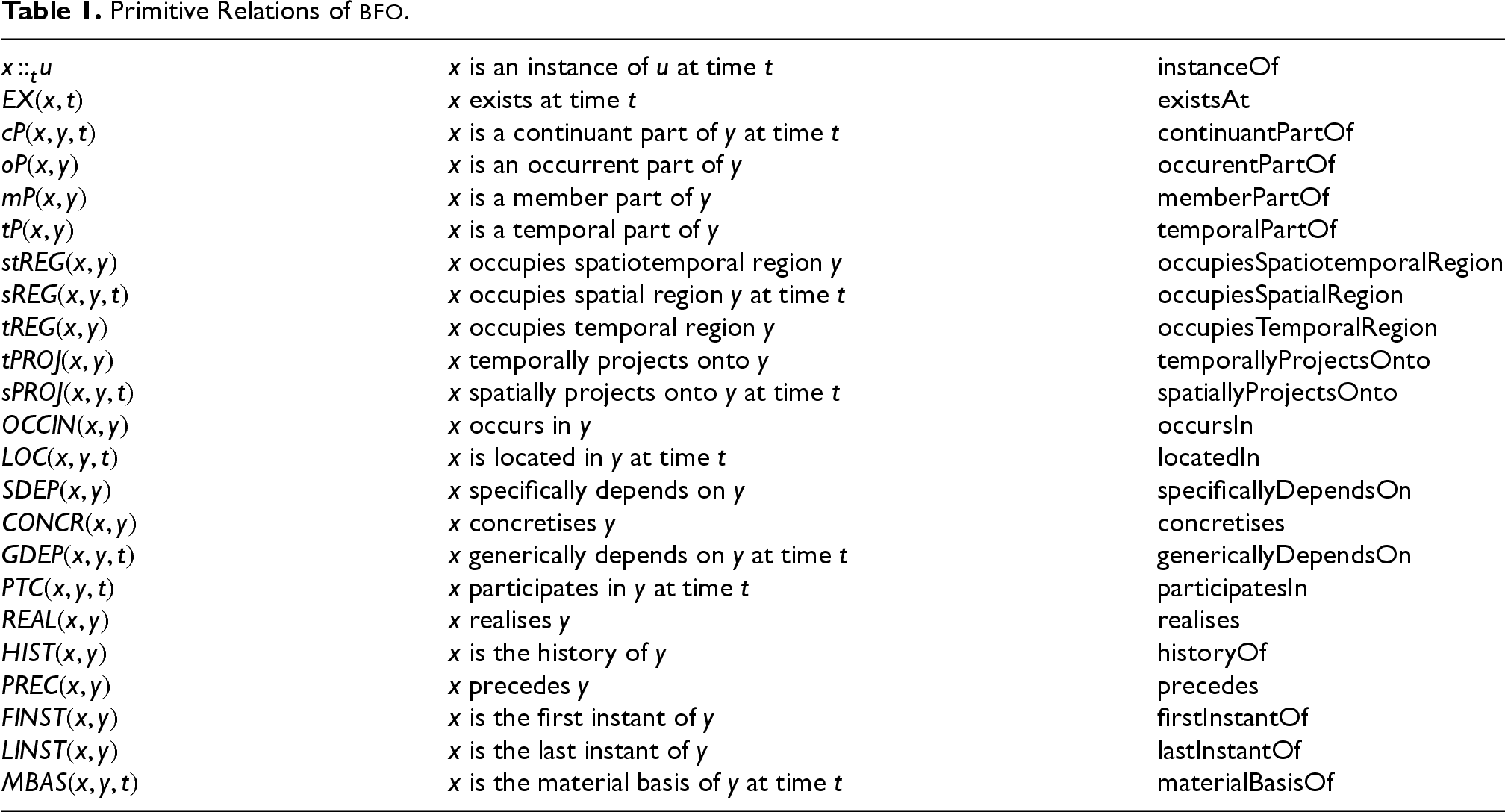
Primitive Relations of
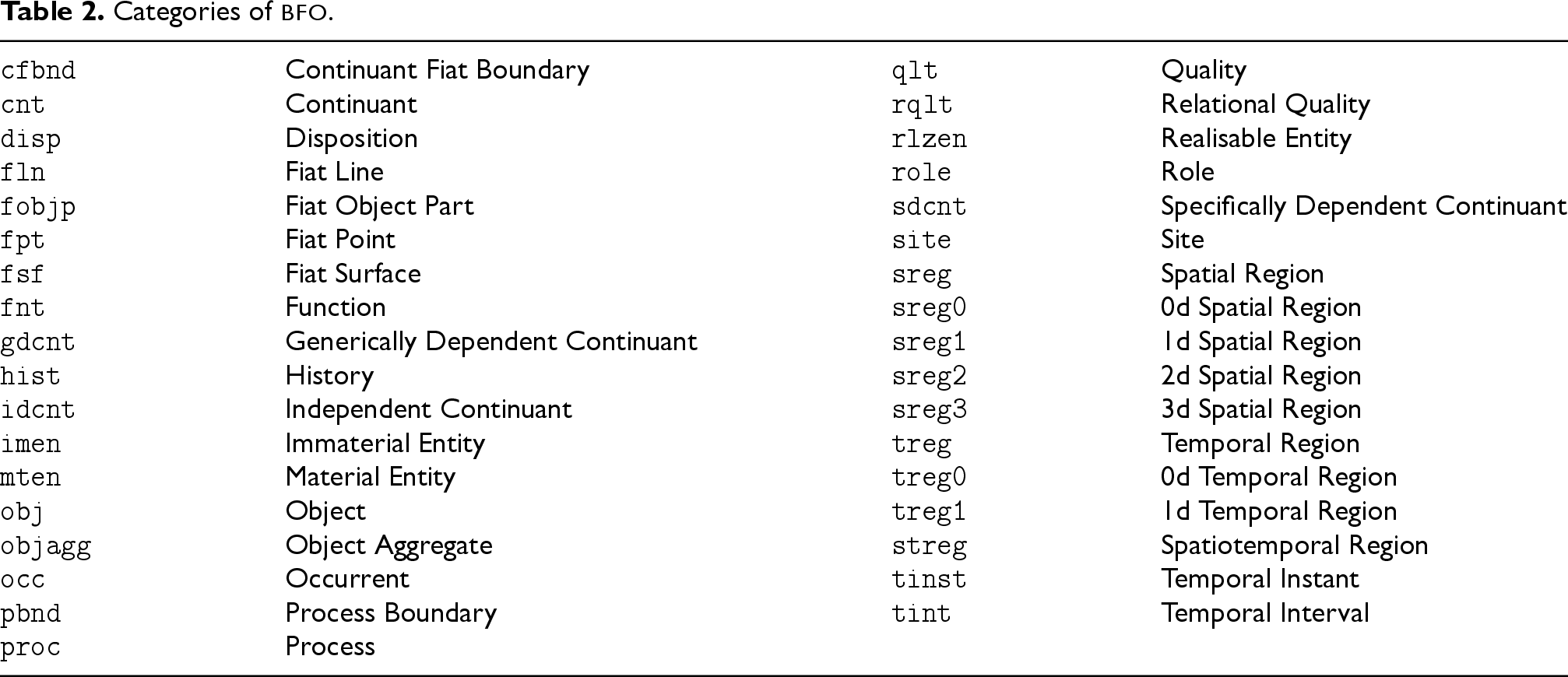
Categories of
The axioms considered in
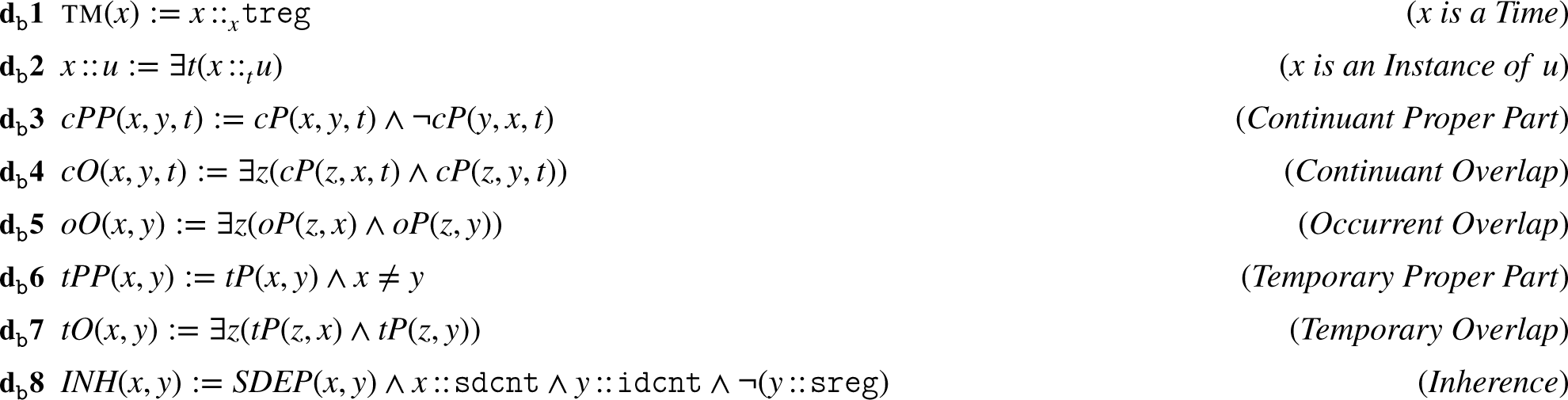
We write Modality operators are not used as they are not part of the language of CL (since The mereological fusion operator (operator
The first simplification weakens several notions of dependence which are strongly grounded on modality. To partially overcome this difference,
Concerning the second simplification,
Two additional simplifications, with respect to only direct qualities are considered ( the one-to-one link between quality types (e.g., temporal location, colour location) and quality spaces (e.g., time interval, colour region) assumed in
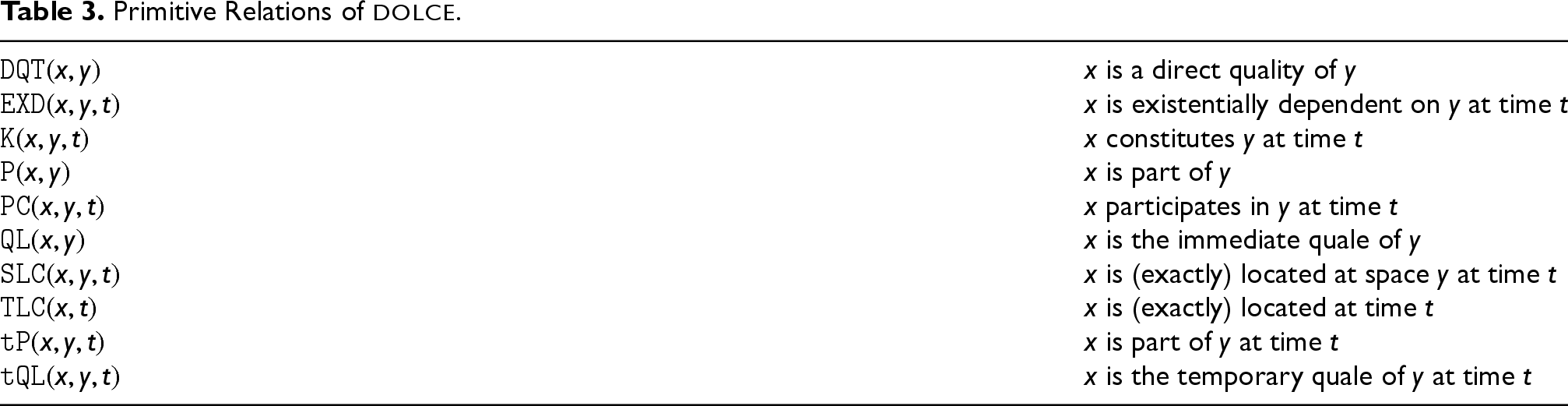
Table 3 lists the primitive relations of
Primitive Relations of
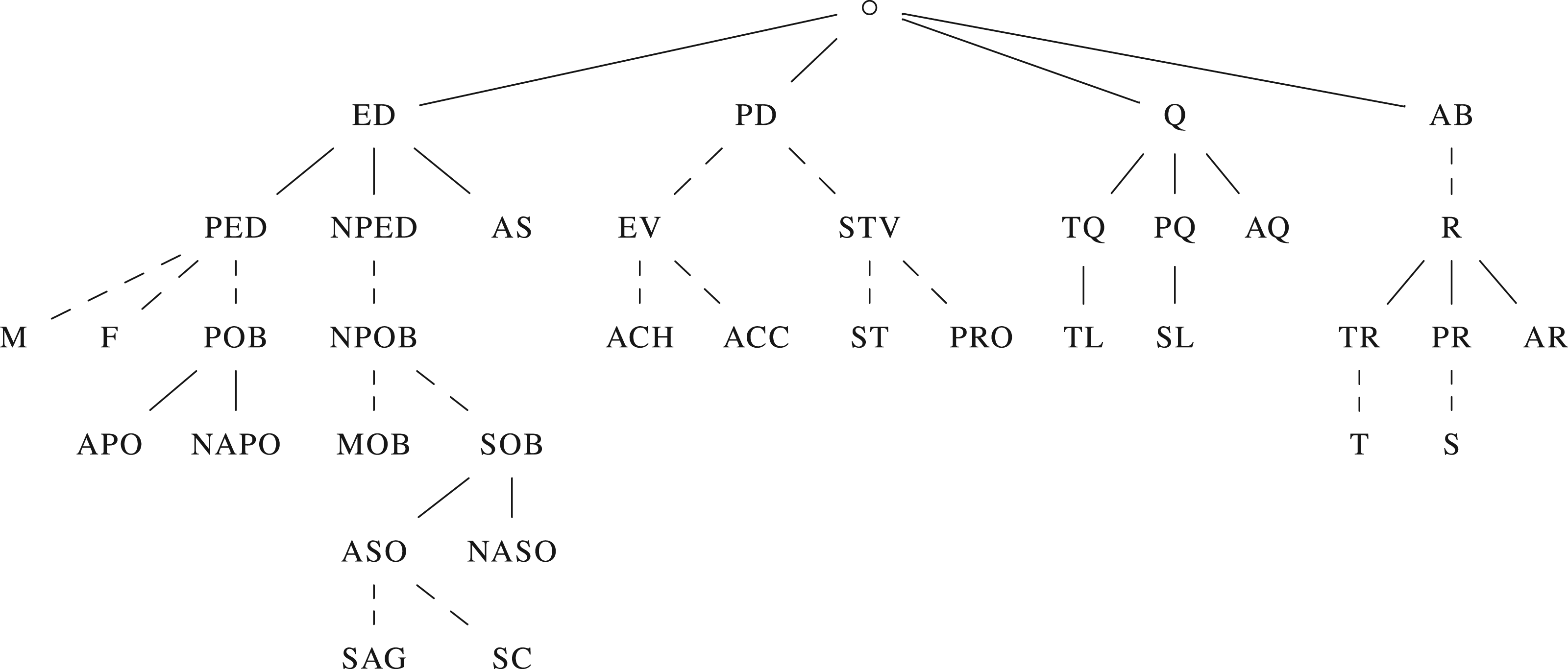
Taxonomy of Descriptive Ontology for Linguistic and Cognitive Engineering (
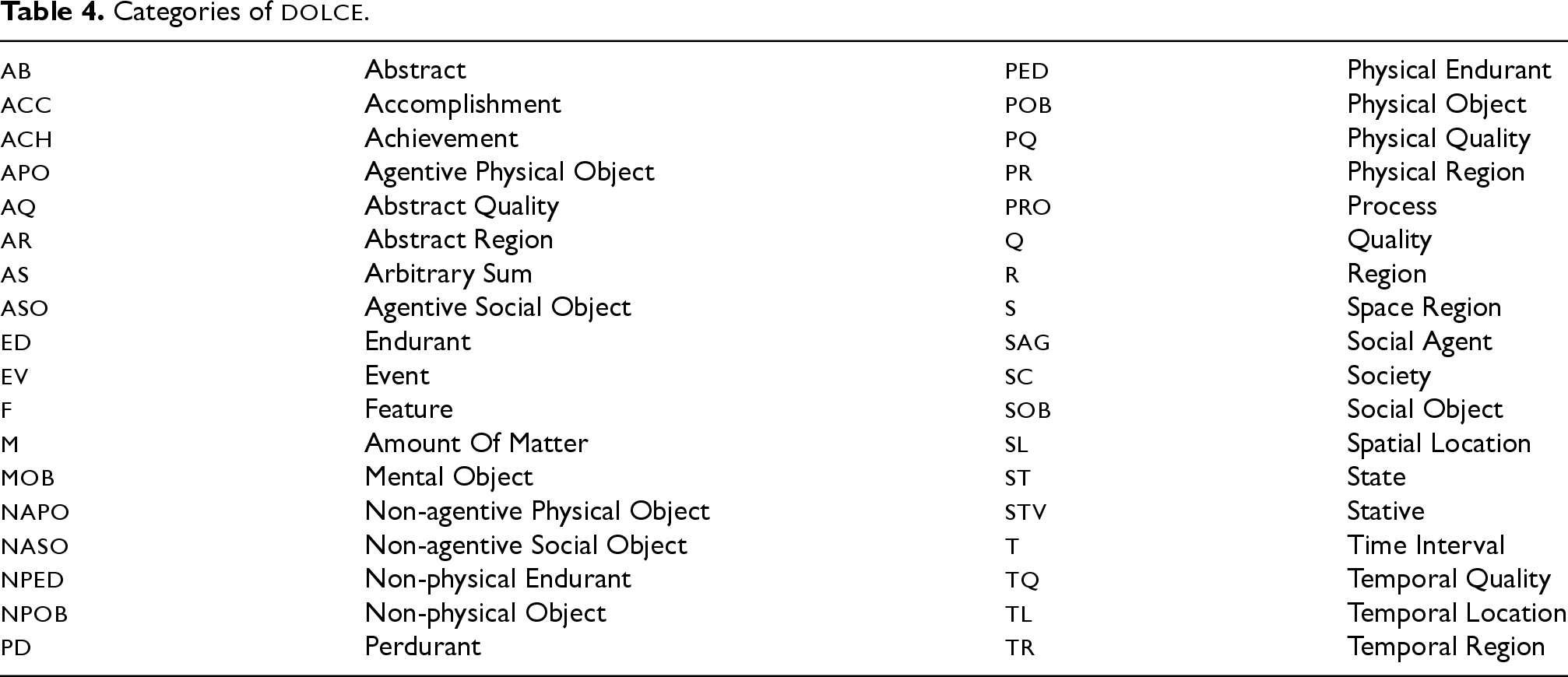
Categories of
The axioms considered in
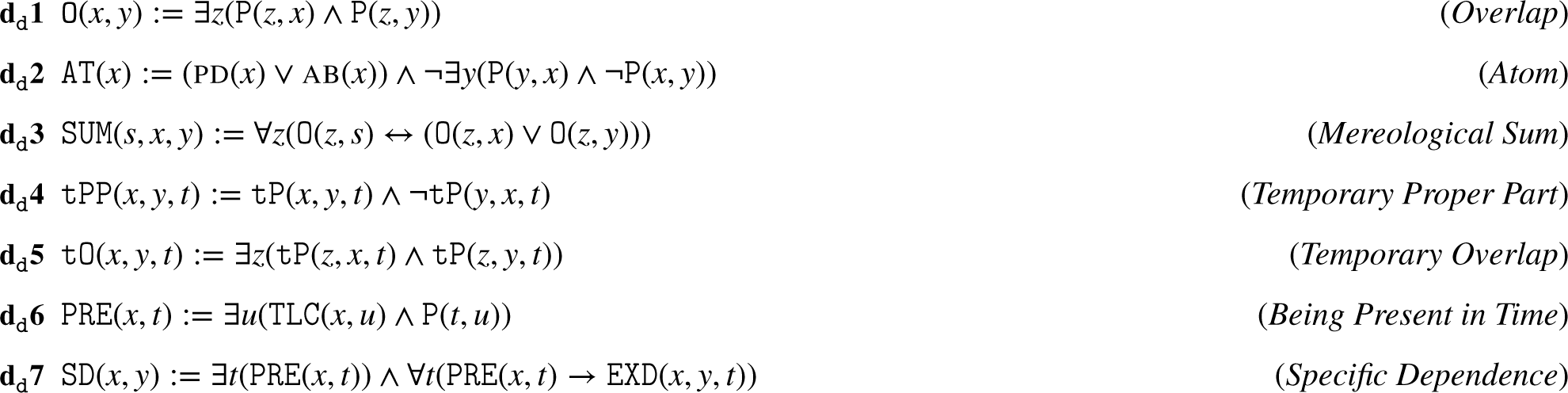
In the paper we adopt the following notation to referencing formulas: ( ( ( ( ( ( (
General Strategy and Role of Methodological Assumptions in Aligning TLOs
Before introducing the mappings and the difficulties we encountered, we provide the assumptions, strategy, and further considerations behind this work. These observations motivate the choices made in building the mappings and determine in which sense the result is correct.
The approach is centred on the CL-versions of the two ontologies. These, with their explanatory documentation, are taken as the primary sources of information on the ontologies and are considered in our strategy from the start. Here are the steps that characterise an alignment strategy
12
:
analyse the CL-axioms together with the available documentation
13
to ensure proper understanding of the overall ontologies and the intended interpretations of the primitives in each; establish and document the methodological choices; introduce formal mappings from one ontology to the other (and vice versa) with a description of what is covered; test (manual and with theorem provers) that the set of mappings is coherent and aligns what is intended; evaluate if the obtained set of mappings can be further generalised.
The strategy characterised by steps (S1)–(S5) is clearly underspecified. To become operative, one has to give the methodological choices which determine the kind of alignment sought (and how it can be verified). For instance, one may want to align the terminology, the primitives, the concepts, the inferences, the (intended) domains or even the whole models of the ontologies. This kind of choice leads to paying attention to some features of these systems, leaving aside others. Generally speaking, steps (S1)–(S5) may generate incompatible mappings when applied to preserve distinct features. In particular, one has to state what happens in case of inconsistencies across the available documentation. One may decide that the description in natural language is the most reliable of the authors’ intentions. Others may insist that the formal theory has priority since it is the only one that can be tested for consistency. Furthermore, the documentation might not be precise or detailed on aspects relevant for the alignment since the latter depends also on how the other ontology is developed. For instance, during the construction of the
Here are the assumptions adopted to align Given an analysis of the documentation and the examples in the ontologies, any elicited informal correspondence across the notions of the two ontologies is assumed to provide a basis for a mapping of categories and relations of one ontology into the other. For instance, occurrents are described and used, in the A mapping aims to embed all (or most of) the members of a category of the source ontology (e.g., Only direct mappings that can be formalised in FOL as syntactic definitions are considered, that is, a mapping is a FOL syntactic definition of a primitive of the target ontology in terms of the primitives of the source ontology. This choice allows us to use theorem provers to verify which axioms of the target ontology are preserved by the mappings. Meta-modelling techniques, like the application of abstraction processes or set-theoretical (second-order) constructions to enrich the domain of the source ontology with additional entities, are not considered. Analogously for embeddings of the target and source ontologies into richer ontologies that would serve as bridges between them, see (Chui & Grüninger, 2014). The analysis presented in this paper can be seen as a prerequisite to the application of these other techniques.
Note that the assumptions (M2) and (M3) are interrelated and are seen from the perspective of an interactive development of mappings that starts with the analytical step (M1). In particular, (M2) emphasises that the alignment is domain focussed in the sense that the goal is to maximise coverage of the entities of the source ontology by the domain of the target ontology.
The alignment between large ontologies presents a formal and a conceptual challenge: The formal challenge consists of the identification and the verification of the mappings; the conceptual challenge refers to the choice among alternative mapping options. For instance, in Sections 5.2 and 6.2 we discuss some alternative mappings which have not been adopted in our alignment. These mappings modify (by restricting or expanding the mappings proposed in, respectively, Sections 5.1 and 6.1) the way some notions of the target ontology are modelled in terms of the ones of the source ontology. In particular, these alternative mappings present possible solutions (or improvements) to the partiality of the alignments developed in Sections 5 and 6. Furthermore, formal constructions (definitely more complex) can be implemented to extend the domain of the source ontology to resemble more closely the domain of the target ontology, facilitating a richer mapping across these systems. This result can be achieved also by allowing for the definition of primitives of the target ontology in the source ontology, via reference to newly introduced entities. This case is not specific to the alignment of
Assumption (M3) may be better understood if we compare two approaches to extend a theory via definitions. Recall that the goal is to have formulas in the source ontology that capture (or best approximate) the concepts in the target ontology. In this example, we take
The first approach, which we adopt in this paper, is to extend theory
The second approach consists in adding these definitions as new formulas in the source ontology, obtaining a definitional extension of the source theory. It suffices to turn our syntactic definitions into biconditionals rather than syntactic definitions as described above. Syntactically, this means to use the symbol
Once
These observations hold beyond the
Use of Theorems Provers and Model Builders
The material presented in the next sections is tested using theorem provers, namely, Prover9 15 and Vampire 16 . For the generation of models and countermodels, the software Mace4 17 was used. According to the literature (Sutcliffe, 2016) and in our experience, Vampire is usually, but not always, faster than Prover9. The proofs produced by Prover9 are generally shorter and easier to read (not least because Prover9 offers the possibility of removing universal quantification from the start of formulas – Prover9 assumes by convention that any free variable in a formula is implicitly universally quantified). To take advantage of these differences, we used both theorem provers.
Our methodology is as follows. We rewrite all axioms and definitions of
To formally verify counterexamples of relevant sentences, we produce a counterexample by hand and then proceed in the following way: We write axioms (in the prover syntax) enforcing the existence of the exact number of individual constants required by the counterexample, as well as each and every relation holding among them. For the sake of brevity, some of the relations are skipped by exploiting taxonomical axioms. That is, once we add the axioms of the
Note that the standard way to generate counterexamples with Mace4, that is, by asking Mace4 to find a model of all the axioms of
All the proofs and models relative to our alignments are collected in Masolo et al. (2023).
Preliminary Considerations
This section focuses on points specific to the alignment of
Representation of Categories
In
In
These different representational choices raise an initial problem because, according to (M3), one should individuate to which kind of
A way to avoid this problem is to substitute
In this perspective,
Different Ontological Focus and Resolution
The informal presentations of
How the most general categories (endurants/continuants on the one hand, perdurants/occurrents on the other hand) are specialised diverges considerably in the two ontologies:
On perdurants vs. occurrents
In
On endurants vs. continuants
The spatial and material dimensions of these kinds of entities play a central role in both
On qualities
The branch of the taxonomy for qualities in
The Mapping From dolce to bfo
This section presents the technical results of the establishment of a mapping from
The first part of the section, Section 5.1, reports the elements covered by the mapping and the conceptual motivations for its limitations. This part makes technically clear the theoretical and formal barriers to completing the coverage of the ontology in the kind of mapping that our general strategy and related assumptions can generate. At the end, we list the primitive relations and the categories of
The second part, Section 5.2, provides an analysis of the achieved results, the limitations and possible alternative strategies.
The Definitions of bfo Primitives in the Language of dolce
According to our previous discussion and point (M3) of Section 3, our goal is to introduce syntactic definitions of
First of all, the subcategories of the distinction between the distinction between
Concerning (ii) we introduce a definition only for the disjunction of
As anticipated earlier, see also assumption (M1) in Section 3, the category of specifically dependent continuants (
A similar situation holds for the subcategories of material entities (
Other cases are more subtle. The primitive
However the effectiveness of this definition depends on the existential assumptions on perdurants. For instance, assume that
Spatiotemporal regions are compatible but not enforced in
The definition (
Finally, following the discussion in Section 4.1, instance-of (
Summing up, among the syntactic definitions for the primitive predicates: syntactic definitions of form
These syntactic definitions are given below together with a short informal description. (Once a definition has been introduced, it may be used only in definitions given later to avoid circularity.) A deeper analysis about these definitions and their impact on the preservation of the axioms of
This is the classical definition of temporal part or slice, that is,
A process boundary is a temporally atomic perdurant (
Processes are perdurants that are not process boundaries (all the perdurants are present at some time (
Temporal regions coincide with
As said, spatiotemporal regions are ruled out. An occurrent is any entity among process boundaries, processes and temporal regions (whose definitions are given above).
Temporal instants are atomic time intervals.
Temporal intervals are non-atomic time intervals (in
Material entities are non instantaneous (to match (
Both sites and continuant fiat boundaries are
Spatial regions coincide with
Specifically dependent continuants are
Concretisation is a form of
Generic dependent continuants are non-physical endurants (from (
According to (
At time
At time
Particulars are entities that
Universals are non-particulars (to match (
As said, some
The list of the
We begin our analysis by considering how the entities in the domain of
(
In the first case time intervals and space regions become
The second option excludes all abstracts, including time intervals and space regions, from particulars. Even in this case one could see the
In both these cases, the fact that (some) regions become universals is grounded on (
There are also more subtle correspondences to consider. Theorem (
For instance, in
There is a further difference concerning the ‘temporal behavior’ of
Similarly, in
These are not the only differences, of course. From
According to (
This alternative definition has some advantages: (i) it preserves antisymmetry as in the original
Another approach is to specialise the definition of
Note that the antisymmetry of
These examples suggest to follow a different approach, possibly closer to the original commitments of the two ontologies. Consider again the example of the statue and the clay, or the bricks and the wall. There are two different endurants that are spatially coincident at least at a given time. One can think that (
The analysis of more refined correspondences, like (
On the other hand, the imported entities do not necessarily cover all the categories of
One way to choose among the alternative approaches in developing the mapping, is to look at what the mapping optimises. For instance, strict and restrictive mappings, carefully set to not allow exchanges of entities that would be in the ontological ‘limbo’ of the target ontology, might be preferred in the context of data transfer, they are safer in this context. Mappings focussing on ontological significance and the maximisation of the number of imported entities are instead arguably better for the goals of comparing ontologies, highlighting core differences, and establishing general interoperability results.
The Mapping From bfo to dolce
The Definitions of dolce Primitives in the Language of bfo
In this section we introduce syntactic definitions of
As discussed in Section 4.2, in
We will see that physical endurants correspond to independent continuants that are not regions, see (
In Section 5.2 we have seen that one of the main differences between
Concerning qualities,
Regarding regions, there are time intervals and space regions. To locate entities in time and space we need to rely on
Finally, the categories for facts and for sets, that in the original taxonomy of
Summing up, in the following we discuss these syntactic definitions for the primitive relations: syntactic definitions for the categories:
Below we list these syntactic definitions providing just short informal descriptions, a deeper analysis about these definitions and their impact on the preservation of the axioms of
Perdurants coincide with the disjunction of processes and process boundaries (see (
We rule out from endurants spatial regions and specifically dependent continuant that are mapped, respectively, to space regions and physical qualities, see (
Physical endurants are independent continuants that are not spatial regions.
Features are the union of sites, continuant fiat boundaries, and fiat object parts.
Non-physical endurants coincide with generically dependent continuants.
Physical qualities coincide with specifically dependent continuants. Note that relational qualities and realisable entities, like roles and dispositions, are imported into physical qualities.
Only physical qualities exist (
Time intervals coincide with temporal regions. One could consider a stronger definition, that is, assume that
Among temporal regions there are only time intervals.
Space regions coincide with spatial regions.
Among physical regions there are only space regions.
Regions are temporal regions or spatial regions.
Among abstracts there are only time intervals and space regions.
The temporal location of
For perdurant and time intervals
For endurants
The relation of direct quality coincides with inheritance (see (
For independent continuants that are not spatial regions,
One may think that the mapping given by these definitions is too restrictive: In
Furthermore, notice that (
In the following,
The list of
From the opposite point of view, that is, analysing what happens to
Concerning the preservation of the axioms of
These difficulties may suggest that a different mapping technique could be preferred. Rather than encapsulating the relation between
In this way, entities that, for instance, exist at two times but not at their mereological sum would still lack a temporal location
The problems highlighted up to this point were discussed because of their impact on the mapping but are primarily of technical nature. The mapping highlights also genuine ontological differences. First, the defined
Grounding OWL Mappings on FOL Mappings
For both
In OWL, (c1) (c2)
Condition (c1) assures that
For instance, the holding of:
justifies a
A similar reasoning can be done for
The OWL-versions of
Conclusion
The construction of an ontology ecosystem for information classification and exchange requires formal alignments across ontologies. From the theoretical viewpoint, the most essential alignments are those across foundational ontologies. This paper has presented a general strategy and has motivated some methodological assumptions for such a construction. Furthermore, it has applied this approach to two well-known ontologies, namely
The applied ontology research community has not yet investigated in depth the formal alignment of foundational ontologies. One can imagine the development of a toolkit of strategies, assumptions and methodologies to guide the construction of formal ontology alignments depending on what one aims to preserve across the systems. Some alternatives have been already highlighted in the paper, including a discussion of their consequences. Yet, there are many alternatives and we lack even a general framework to systematically classify them, leaving aside comparing them. Overall, the study in this paper has made clear that the strong interactions existing across the notions used in a foundational ontology, let them be categories or relations, may turn even small changes in the adopted definitions into important changes in how much of the two systems the mapping may hope to align.
As foundational ontologies mature in terms of their formalisation and conceptual coherence, the exploitation of formal alignments across these systems acquires more relevance and gets the community closer to the construction of an ontology-based marketplace for reliable data and information exchange.
In the future, we plan to deepen the analysis here presented comparing what can be gained and lost depending on the strategy, assumptions and methodologies. The deliverable D2.7 of the OntoCommons project (Masolo et al., 2023) investigates formal alignments between
Footnotes
Acknowledgement
The authors thank the participants of the OntoCommons project for their support and in particular Emanuele Ghedini, Francesco A. Zaccarini, Luca Biccheri, Nicola Guarino, Daniele Porello, Emilio M. Sanfilippo, and Laure Vieu.

Funding
The author(s) received the following financial support for the research, authorship and/or publication of this article: This article has been developed within the OntoCommons project (GA 958371, ontocommons.eu) and in part within the project ERC Advanced Grant C-FORS (GA 101054836).
Declaration of Conflicting Interests
The author(s) declared no potential conflicts of interest with respect to the research, authorship, and/or publication of this article.
Notes
‘ ‘ ‘°’: non preserved axiom ‘ ’: axiom discarded because it contains non-mapped primitives
eto
qkp
ekp
[only for the universals considered in the mapping]
oap
bee
[only for the universals considered in the mapping]
°
mbf
nmq
zuw
[
]
°
nis
qaf
[only for the universals considered in the mapping]
vgn
bdd
mcd
plp
°
fyf
°
gzr
mqp
uns
glc
°
tab
yir
cez
[
]
°
adm
°
mic
dok
mjj
izr
kbr
fzg
hbn
wne
bfv
ixo
ysp
cwp
jgo
zmr
hbj
xlu
kad
°
hpc
ybr
°
csk
ccz
°
aff
ptm
°
hdk
gjl
myl
ruj
lyx
bvr
zdq
bfq
vbw
bal
jqz
cmy
njq
°
esh
atz
°
fzy
tao
jiv
aqu
mns
dvq
yip
ibd
uhs
evk
fsy
lzw
bge
zls
°
mud
uas
°
scr
°
put
°
xlm
evu
°
wty
bao
vvo
cvr
blj
tfw
qyy
uqt
iqe
kqv
fdb
geq
txf
dxv
°
jil
°
czc
yex
kkl
nfe
myu
iyu
ilw
akq
°
rog
ekp
ibk
nyz
otx
cik
°
fmm
ild
°
trl
yjm
cgn
rph
zek
woe
vvy
okt
lga
uzz
oot
grx
°
[
]
°
°
°
°
°
°
°
°
°
°
°
°
°
°
°
°
°
°
°
°
[
]
°
°
°
°
°