







Abstract
Foundational ontologies are usually developed in powerful logical languages, while they are often implemented in applications via their formalisations in the Web Ontology language (OWL). These OWL formalisations are in fact approximations of the original theories, to cope with the well-known limited expressivity of OWL. In this paper, we propose a novel modular approach to the OWL rendering of the Descriptive Ontology for Linguistic and Cognitive Engineering (
Introduction
Most foundational ontologies have been formalised in rich logical languages, such as quantified modal logic. While an expressive logical language enables the faithful expression of proponents’ ontological views and facilitates subtle analysis, the complexity of reasoning tasks often renders the practical application of such services infeasible. For this reason, computationally manageable versions of foundational ontologies have been proposed, in particular as fragments of first-order logic, that is, Description Logics (DLs), and particularly in OWL 2. 1
This paper focuses on the Descriptive Ontology for Linguistic and Cognitive Engineering (
The format of this version includes the rendering of
The objective of DOLCEsimpleFOL is to enable automated theorem proving and standard model finders (such as Mace4) to be capable of returning at least a ‘small model’ of
A number of OWL versions of
In this paper, starting from the OWL 2 version developed for the ISO 21838, we document our advancement in the project of approaching
In this paper, we introduce and discuss a core theory, here termed ‘DOLCEbasicOWL’, which includes the main taxonomy of
The remainder of this paper is organised as follows. Section 2 presents the overall approach to develop the OWL 2 version of
Approach
Goal
Our goal is to develop an OWL 2 version of
It is well-established that the expressive power of
Methodologies for approximating first-order theories with
Here, our aim is not to formally assess the proximity of our OWL 2 version to the original FOL-
In this article, we will systematically use a first-order syntax for all formulas, be they intended to be part of a first-order theory such as the original
A Modular Approach
An obvious constraint when approximating a first-order theory in OWL 2 is that all standard DL languages are limited to binary relations, so
In designing the module DOLCEnaryRelOWL, we follow the ‘reification’ guidelines advocated by the W3C 13 , inspired by the neo-Davidsonian approach to handling events and their arguments in natural language semantics (Parsons, 1990). Several other approaches, with and without reification, to deal with temporalised relations in OWL have been discussed (Garbacz & Trypuz, 2017). In particular, the ‘Temporally Qualified Continuants Pattern’ approach considers that the temporal argument can be embedded in the other arguments by considering their relevant ‘phases’, a sort of 4D approach to endurants. This approach had been proposed earlier for an ontology of ‘fluents’ in OWL (Welty & Fikes, 2006). Handling ternary temporalised relations directly as binary ones in OWL has the considerable advantage of enabling the expression of transitivity and other properties supporting reasoning, which is extremely limited with the standard W3C approach, as we will also see below. Unfortunately, the Temporally Qualified Continuants Pattern approach cannot be generalised in OWL to non-temporalised ternary relations, such as the mereological sum between abstracts, nor to temporalised relations of arity above 3, such as the temporalised mereological sum between endurants.
The approach to
The class
Ontology of Reified Relationships
An important ontological question regards the nature of these reified relationships: Whether this new category fits within the original
These two options have in common to view a reified relationship as some sort of ‘state of the relation holding’ aka ‘situation’
15
or ‘state of affairs’, or ‘facts’. Hence, the question is whether, in
In the first option, reified relationships as perdurants, the reification of a ternary relation
Furthermore, a delicate aspect arises when considering the axiom of
Suppose we intend to reify the participation of an endurant
One way to stop the regress is to force that the perdurant
The second option supposes that the reified relationships are abstracts of
However, consider the ternary relational statement
In case (ii), a regress is triggered again, given that in
But if there was a way without a deep modification of
For the sake of completeness with respect to the main categories of
Let us first consider the option of viewing reified relationships as endurants. For example,
Finally, reified relationships are not qualities of
We therefore conclude that integrating reified relationships as a subcategory in the original
Our conclusion is that there is no alternative to handling reified relationships as mere technical additions to the ontology, unrelated with the original rationale of the taxonomy. One is forced to introduce such technical devices in OWL versions of
Consequences on the Taxonomy of Reified Relationships
Since reified relationships cannot be seen in any way as a meaningful ‘state or fact of the relation holding’, they are to be seen as mere technical additions to circumvent expressivity limitations. They are then treated in this paper as purely syntactic devices, and thus appear in the hierarchy of classes in a completely separated branch from
Another important consequence is that a given reified relationship is uniquely related to a single atomic formula, that is, a given reified relationship instantiates a single subclass of
OWL 2 Formalisation
This section illustrates and motivates the main features of the core modules DOLCEbasicOWL and DOLCEnaryRelOWL formalised in OWL 2.
17
OWL entities (e.g., classes and object properties) are represented using their local IRI in typewriter style. To improve readability, long local IRIs may be displayed broken into separate lines in the figures. Prefixes are generally omitted unless required to avoid ambiguity. Table 1 lists the relevant prefixes along with their corresponding namespaces. Appendix A provides the complete lists of OWL entities with their prefix, label (
List of Namespaces with Prefix Names.
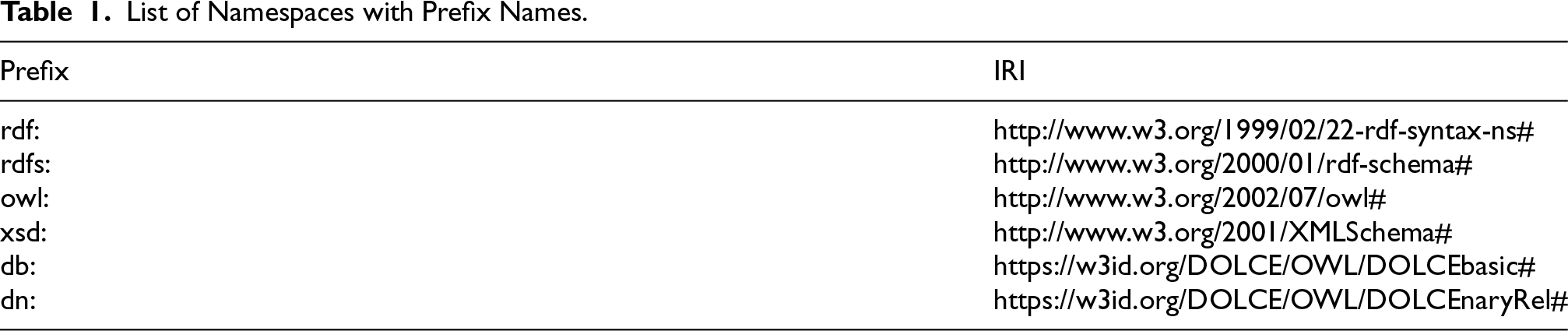
List of Namespaces with Prefix Names.
Figure 1 shows the two top classes of the DOLCEbasicOWL and DOLCEnaryRelOWL modules considered as a whole, that is
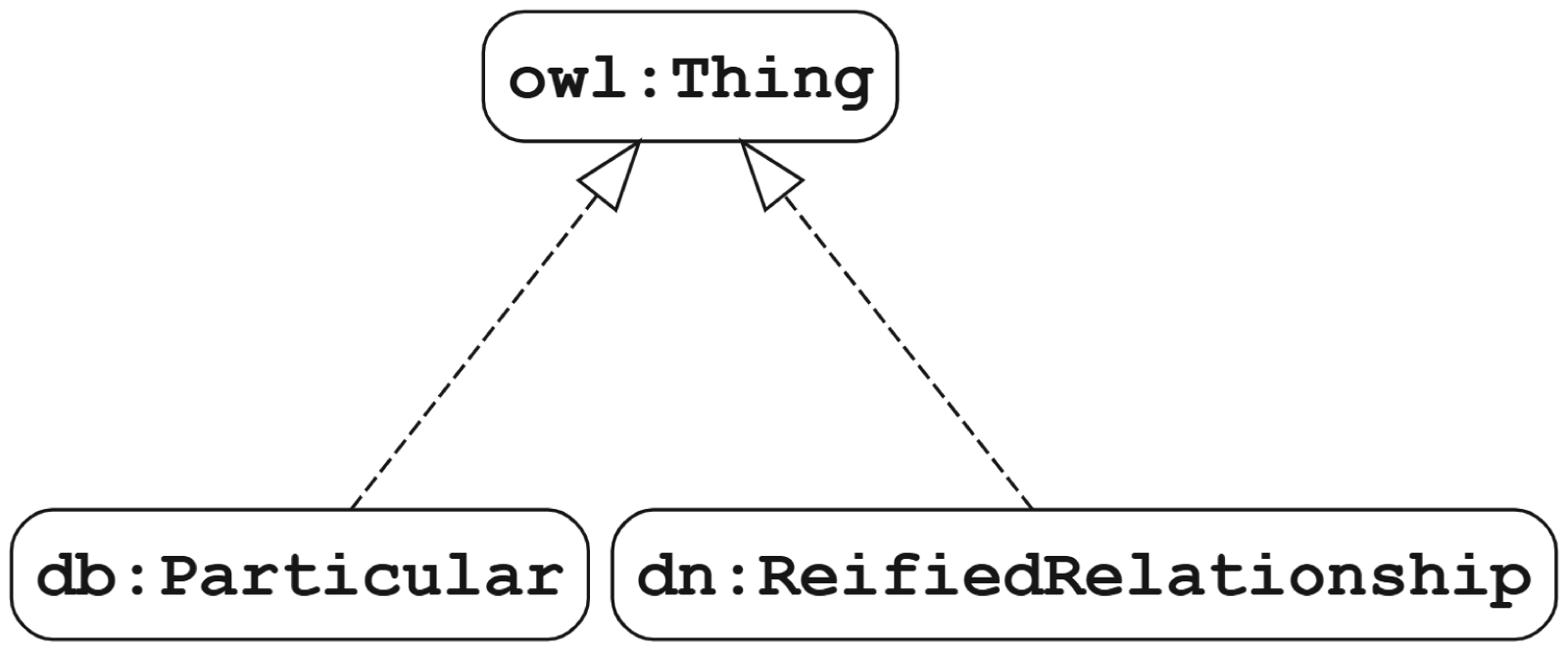
The two most general classes of DOLCEbasicOWL and DOLCEnaryRelOWL. Rounded boxes represent classes identified by their local IRIs with prefixes. Dashed arrows represent
The following subsections delve into the class and property hierarchies in DOLCEbasicOWL (Section 3.1), the modelling of endurants, perdurants, and qualities (Section 3.2), the modelling of time and mereology (Section 3.3), additional classes and properties in the hierarchies for DOLCEnaryRelOWL (Section 3.4), the argument structure of reified relationships (Section 3.5), and some axioms that can and cannot be expressed in DOLCEnaryRelOWL (Section 3.6).
The taxonomy of DOLCEbasicOWL is presented in Figure 2. There are only few differences with respect to the taxonomy of
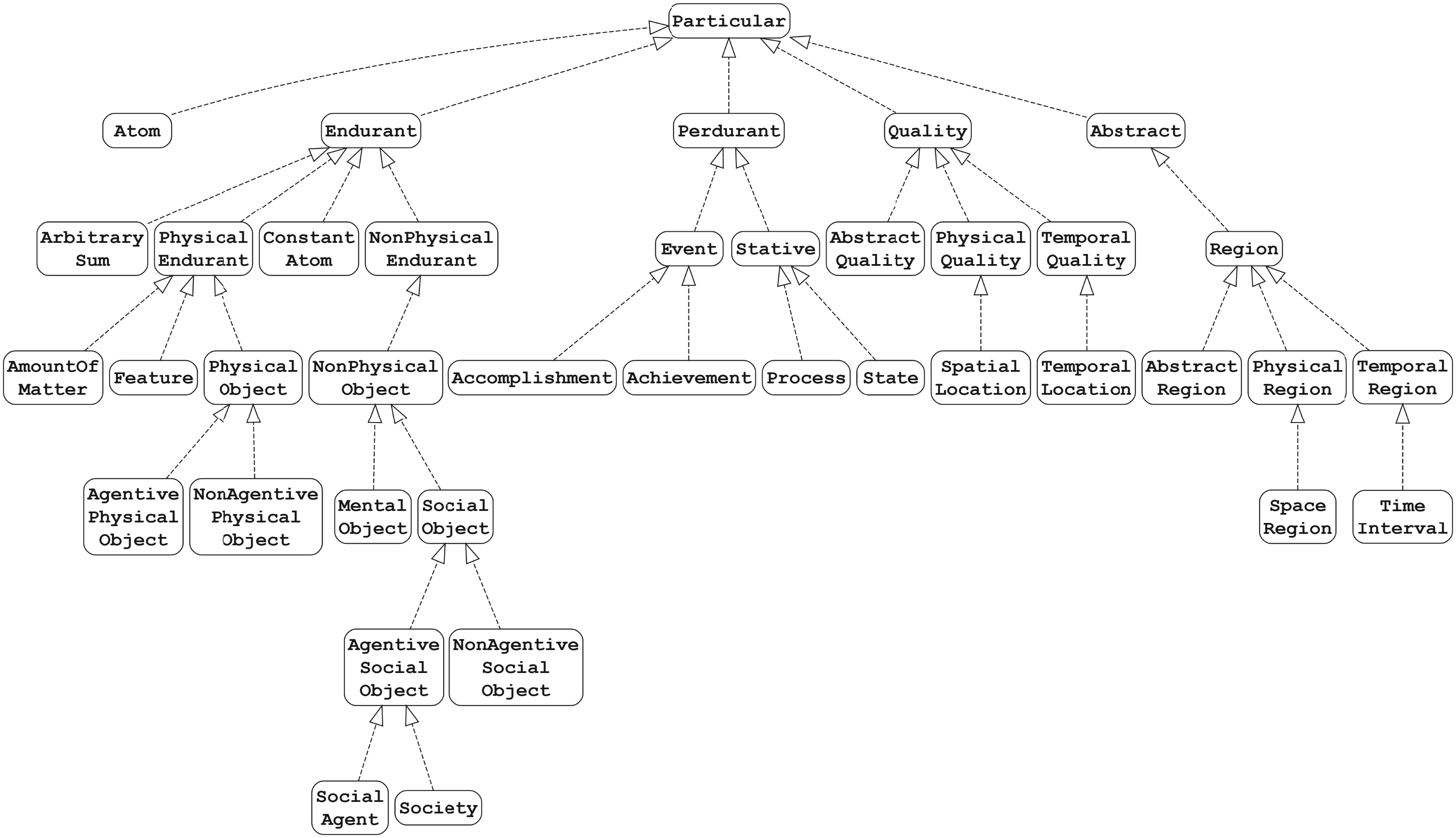
DOLCEbasicOWL class hierarchy. Rounded boxes represent classes identified by their local IRI. Prefix
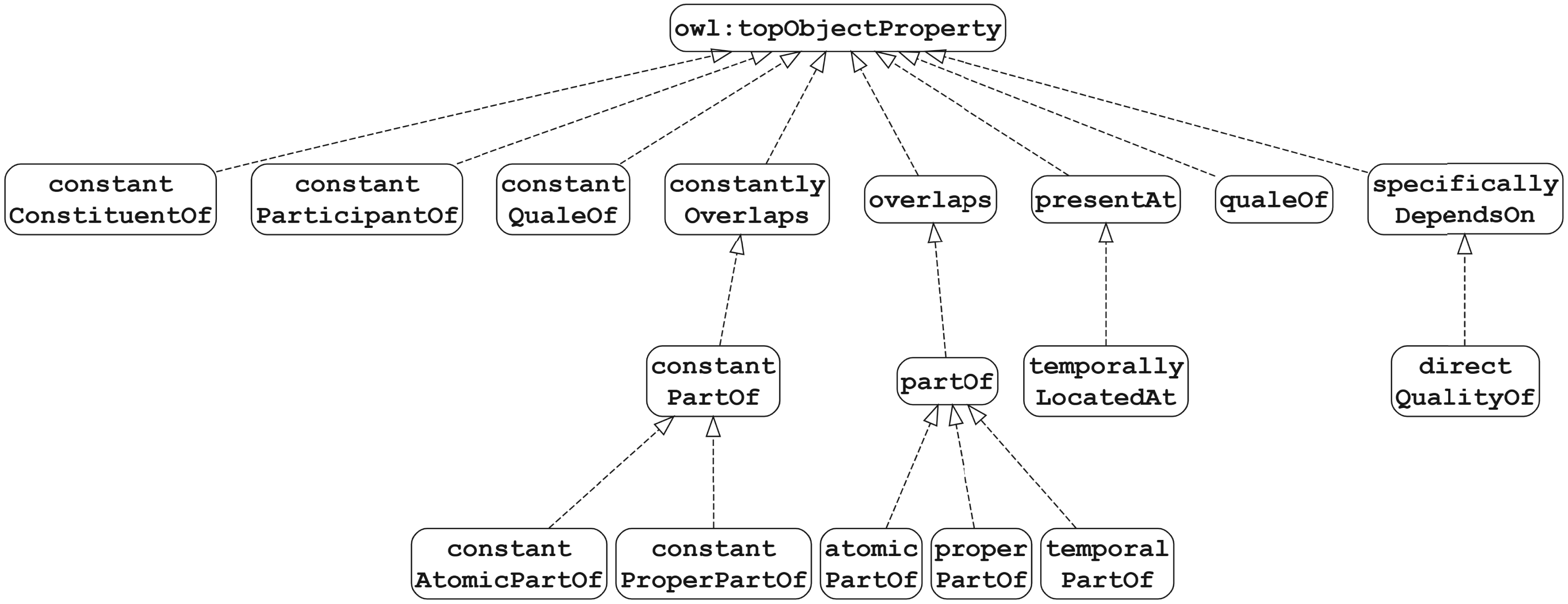
DOLCEbasicOWL property hierarchy. Rounded boxes represent object properties identified by their local IRI, while prefix
This definition implies that when
Figure 4 shows some of the object properties having classes
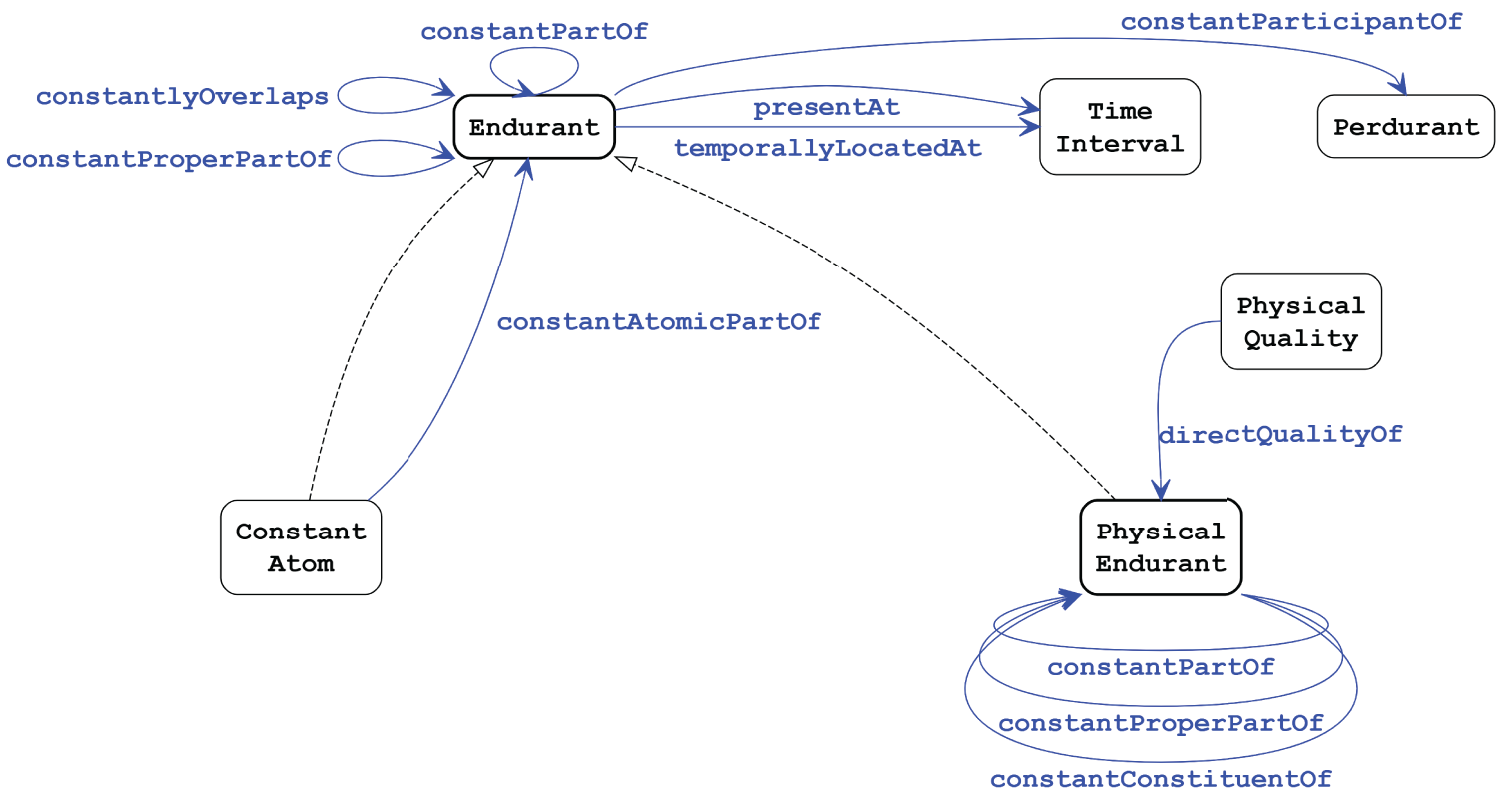
Object properties for
Figure 5 primarily illustrates the object properties having class
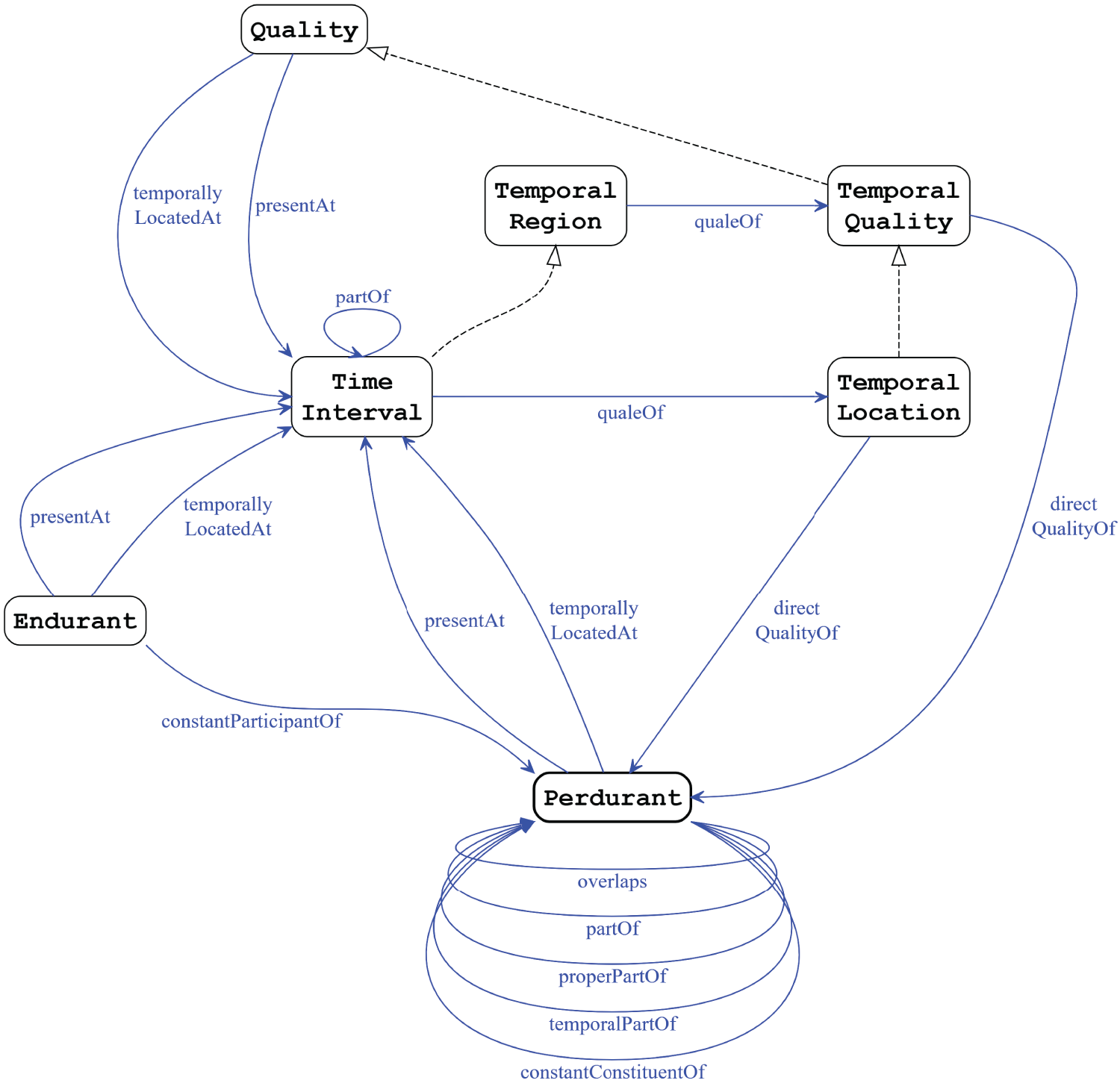
Object properties for
Figure 6 illustrates the important role individual qualities play in
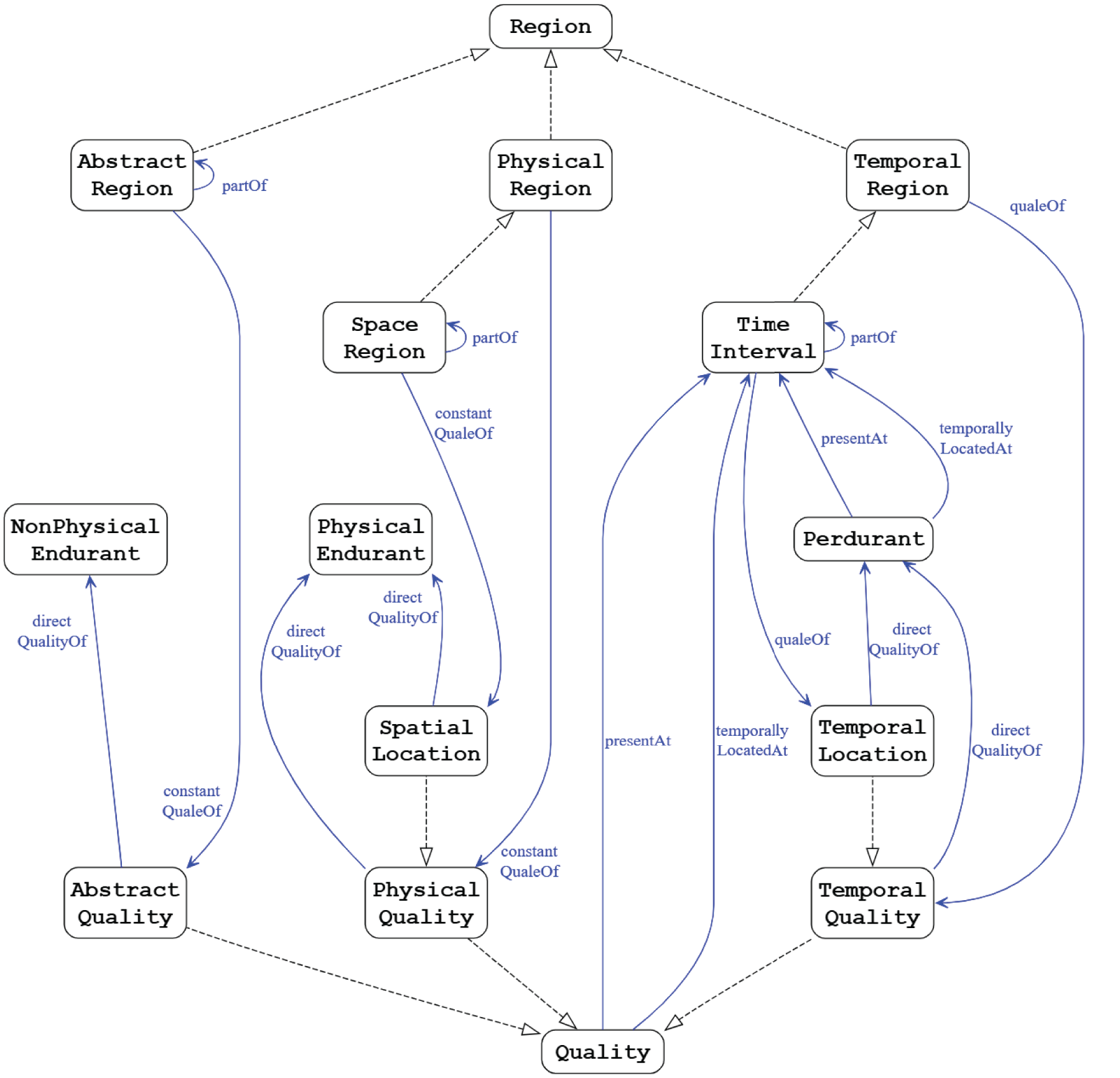
Object properties for
As sketched in Figures 5 and 6, a perdurant has temporal qualities (e.g. the duration of an event), among which a unique quality in the class
Although the expressivity of OWL 2 doesn’t enable a proper characterisation of mereological relations 20 and despite the simplicity and the regularity constraints on properties in OWL 2, we were able to make some choices and guarantee a few facts.
We opted to keep the transitivity of
Moreover, that the temporal extension is the maximal time interval at which an entity is present is somehow captured, not directly by an axiom on
As explained in Section 2.2, several constant versions of the temporalised relations defined in
Class and Property Hierarchy in DOLCEnaryRelOWL
The taxonomy of the proposed DOLCEnaryRelOWL ontology module is represented in Figure 7. Subclass relations are used to group reified relationships that have common behaviours, not to grasp inferences among
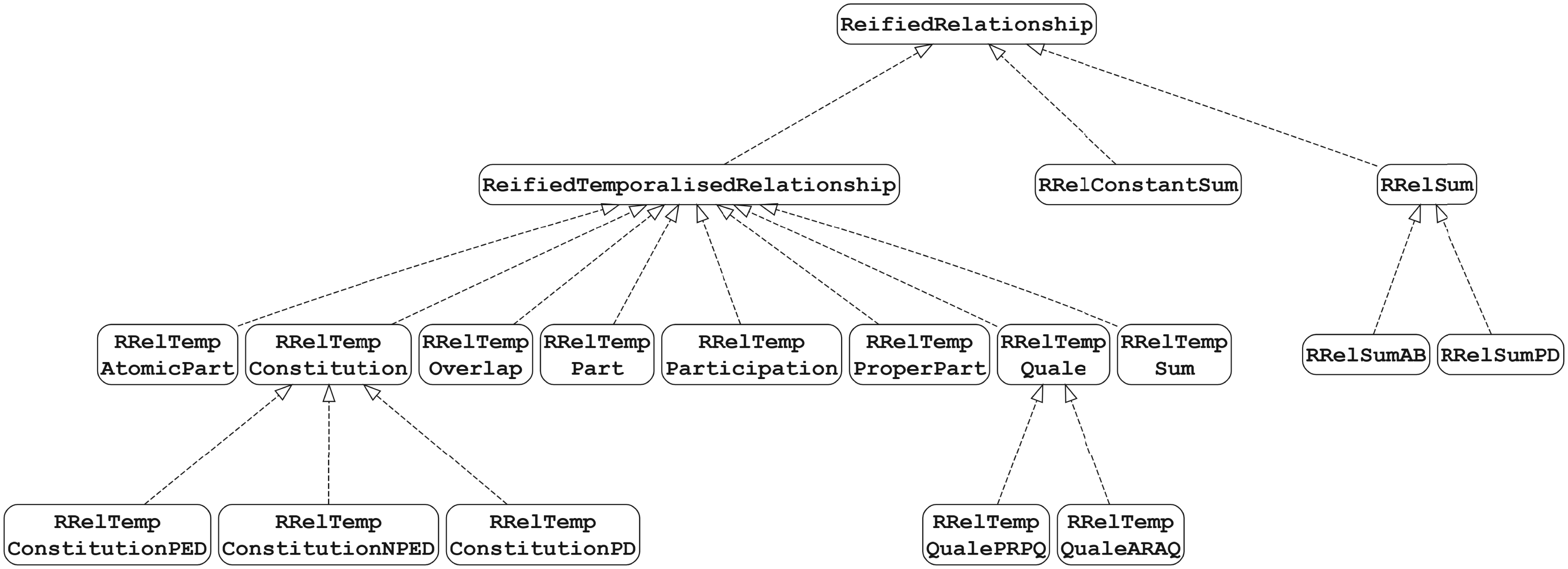
DOLCEnaryRelOWL class hierarchy. Rounded boxes represent classes identified by their local IRI, while prefix
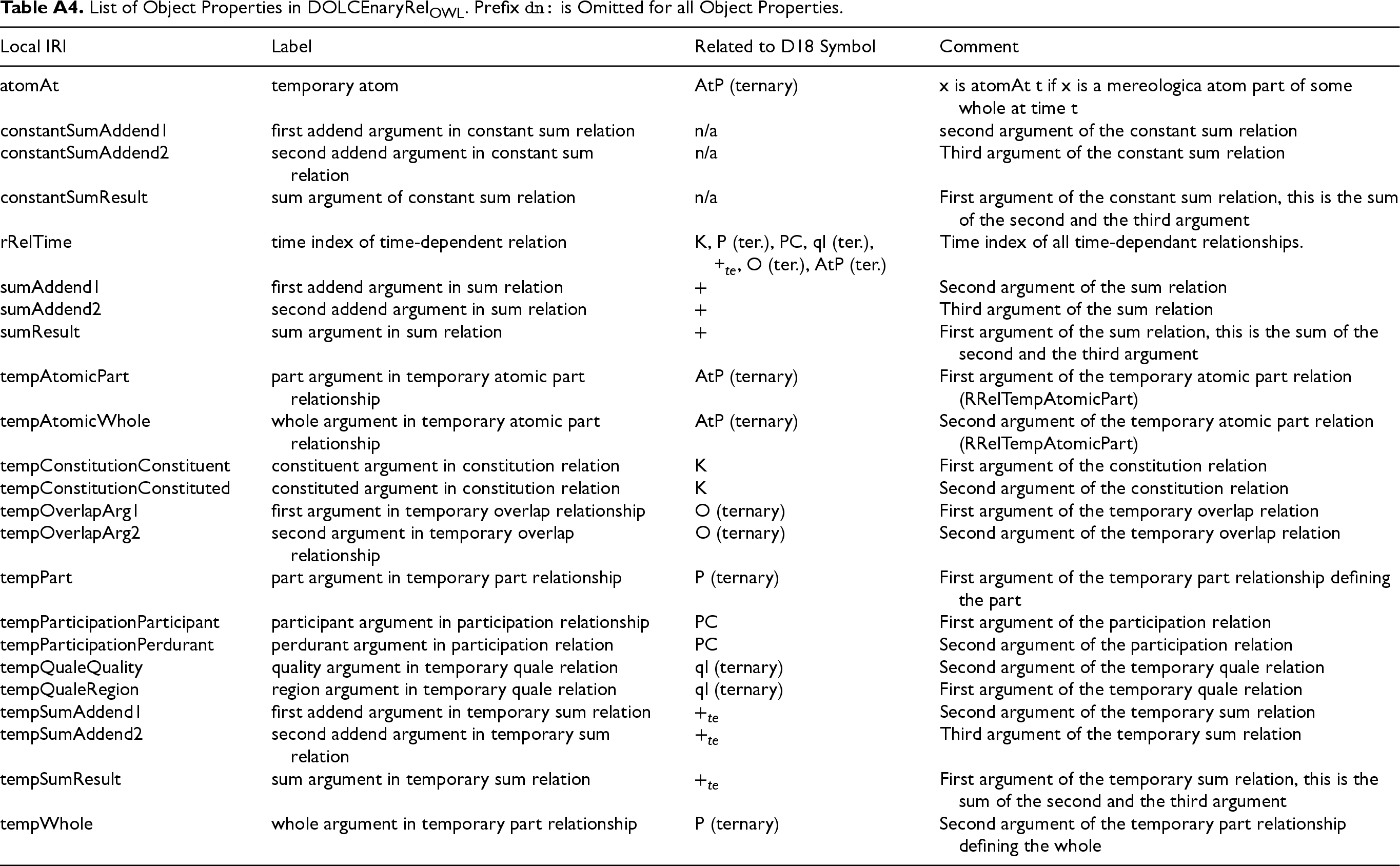
The set of object properties in DOLCEnaryRelOWL is represented in Figure 8. All properties, except for
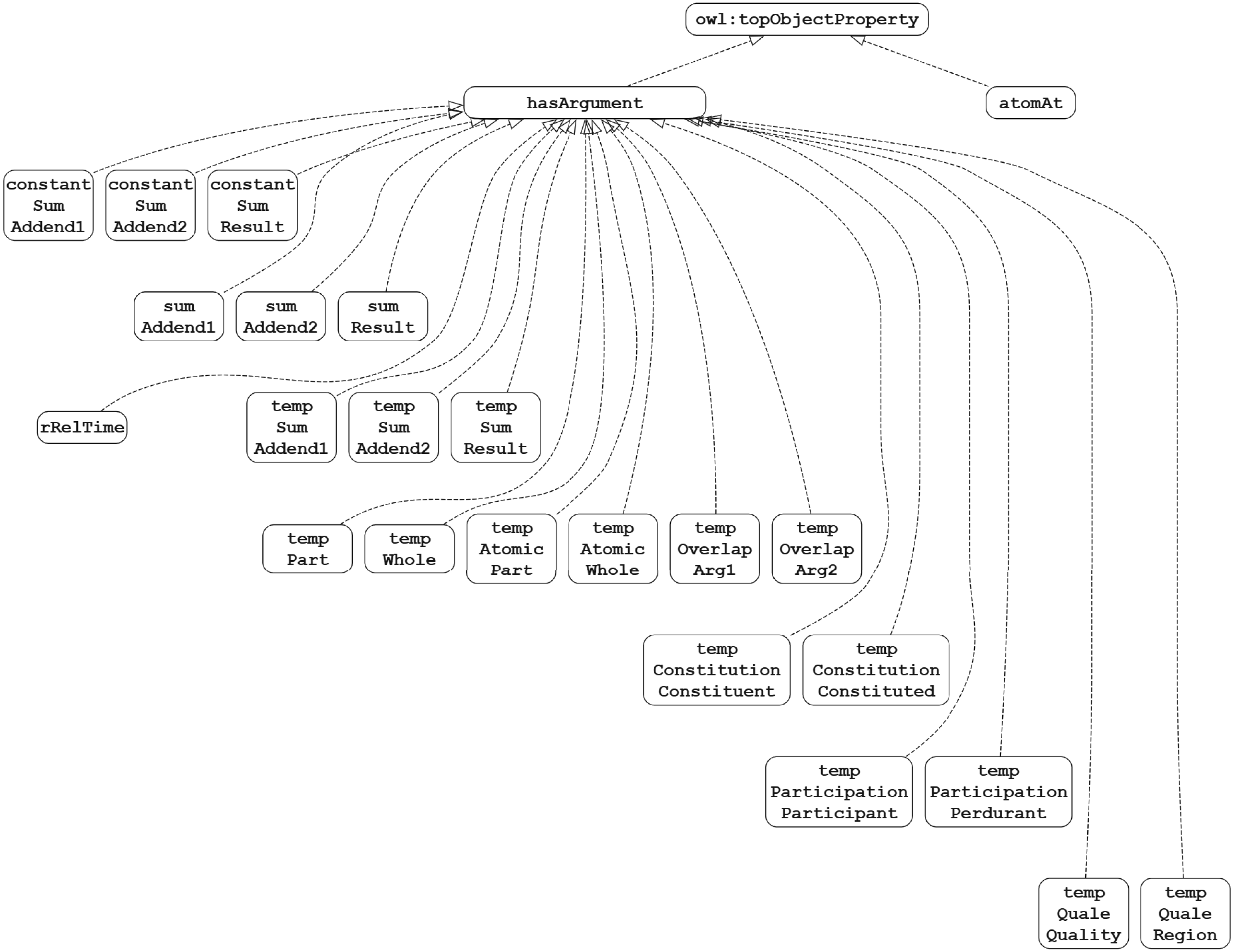
DOLCEnaryRelOWL property hierarchy. Rounded boxes represent object properties identified by their local IRI, while prefix
The property
The following figures further illustrate the argument structure of the reified relationships used to represent temporalised mereology among endurants—except for sum (Figure 9), as well as constitution (Figure 10), participation (Figure 11), and quale-of (Figure 12) relations of
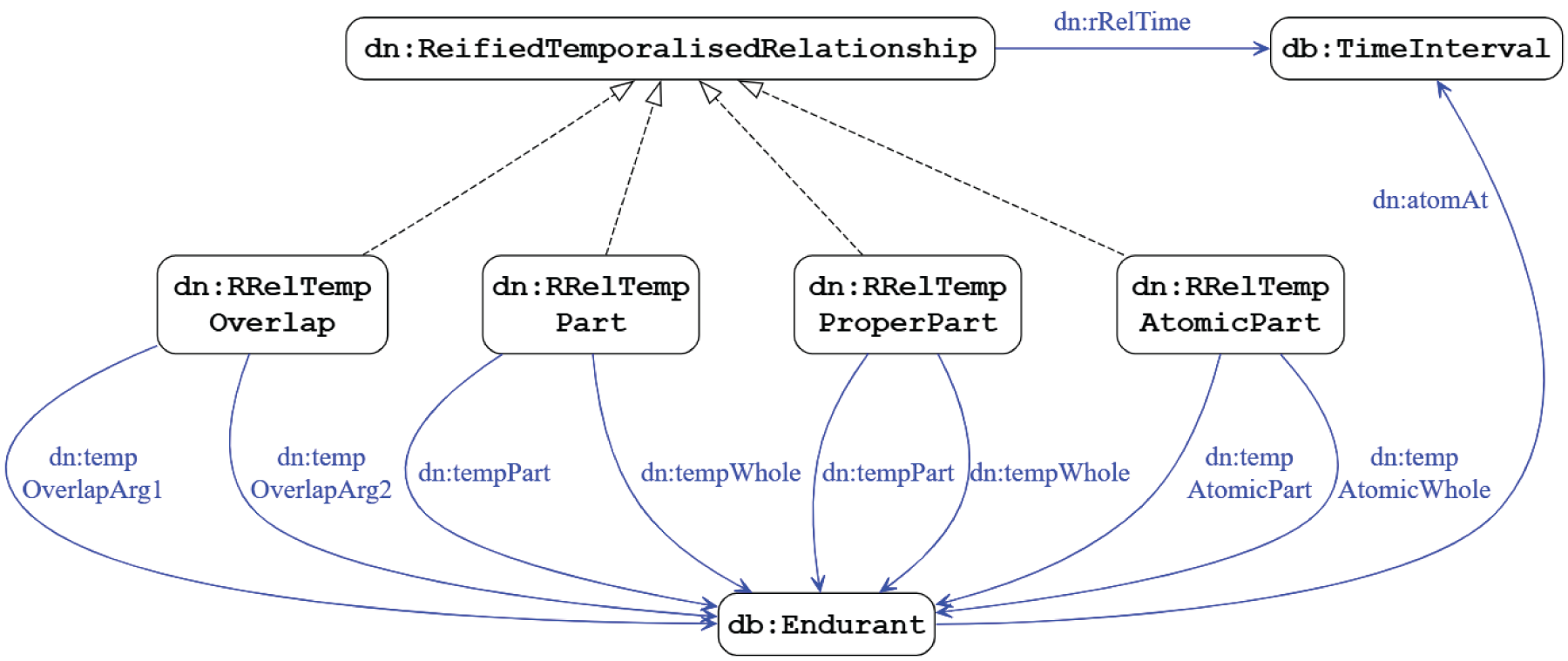
Reified relationships of DOLCEnaryRelOWL for temporalised mereology among endurants. The property
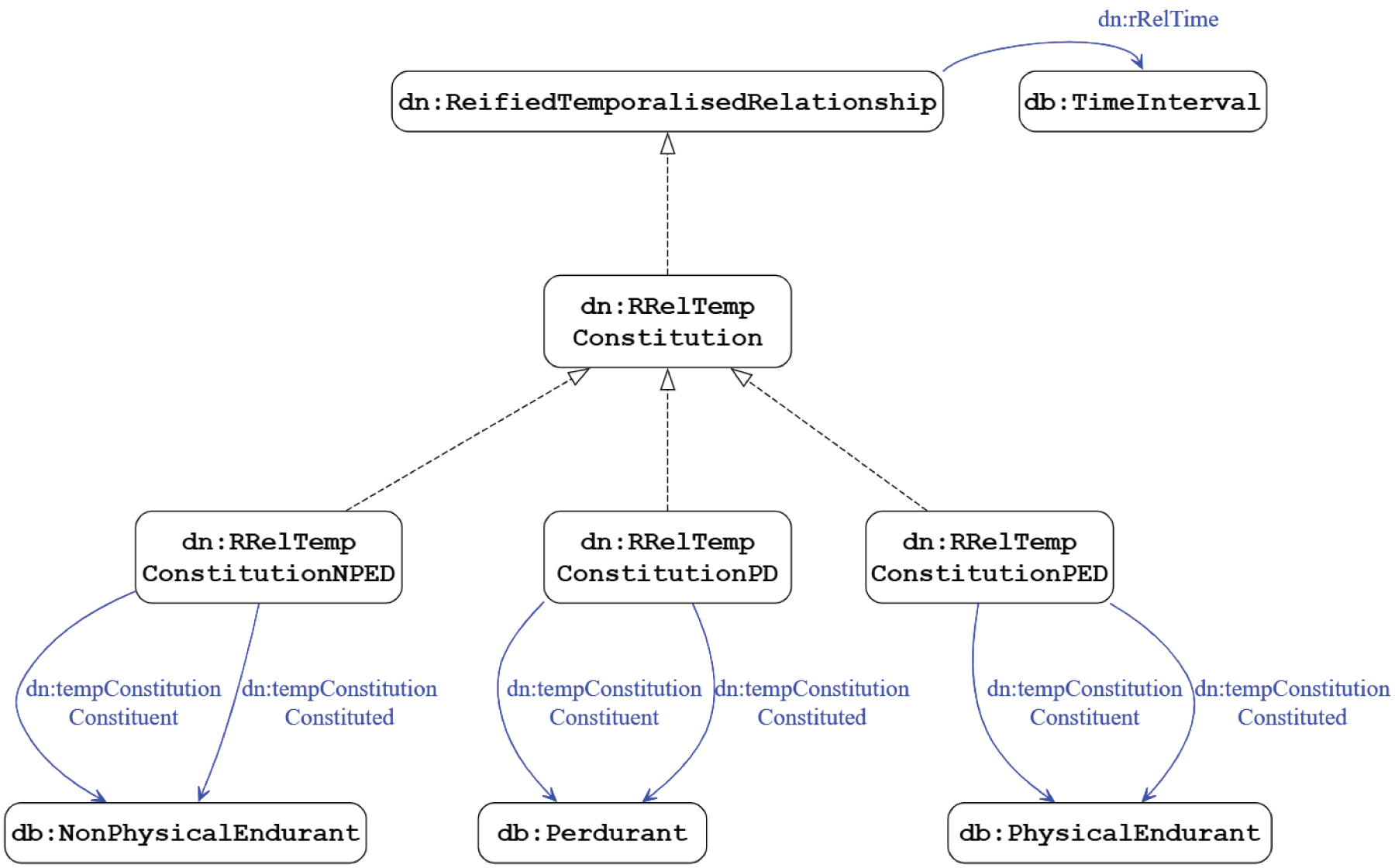
Reified relationtionships of DOLCEnaryRelOWL for constitution. Rounded boxes represent classes identified by their local IRI with prefix. Blue solid arrows denote object properties identified by their local IRIs with prefix, linking classes in their
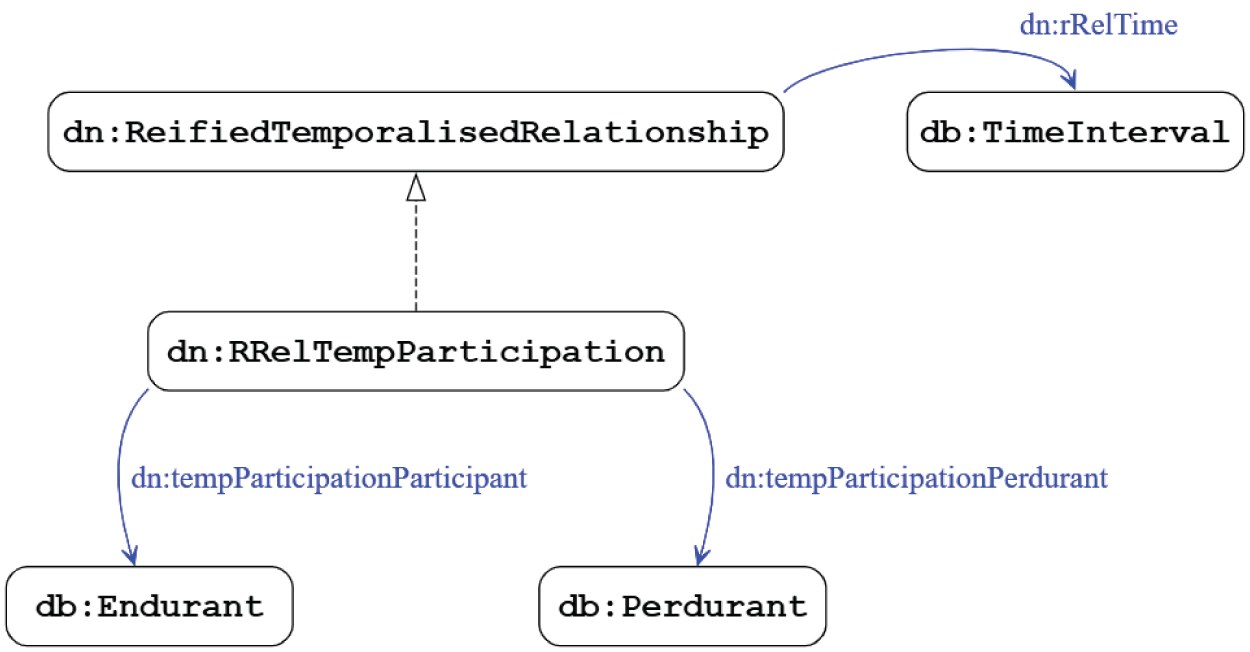
Reified relationships of DOLCEnaryRelOWL for participation. Rounded boxes represent classes identified by their local IRI with prefix. Blue solid arrows denote object properties identified by their local IRIs with prefix, linking classes in their
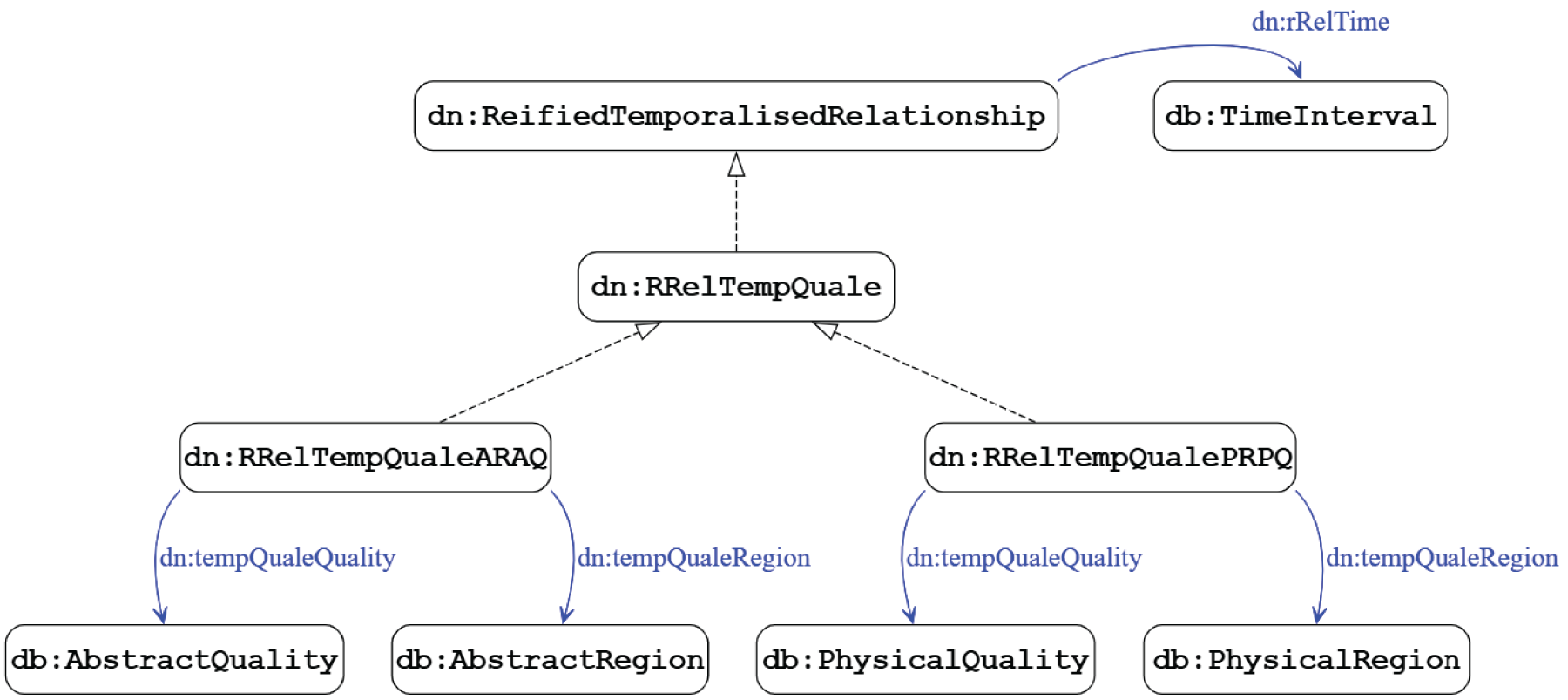
Reified relationships of DOLCEnaryRelOWL for quale-of. Rounded boxes represent classes identified by their local IRI with prefix. Blue solid arrows denote object properties identified by their local IRIs with prefix, linking classes in their
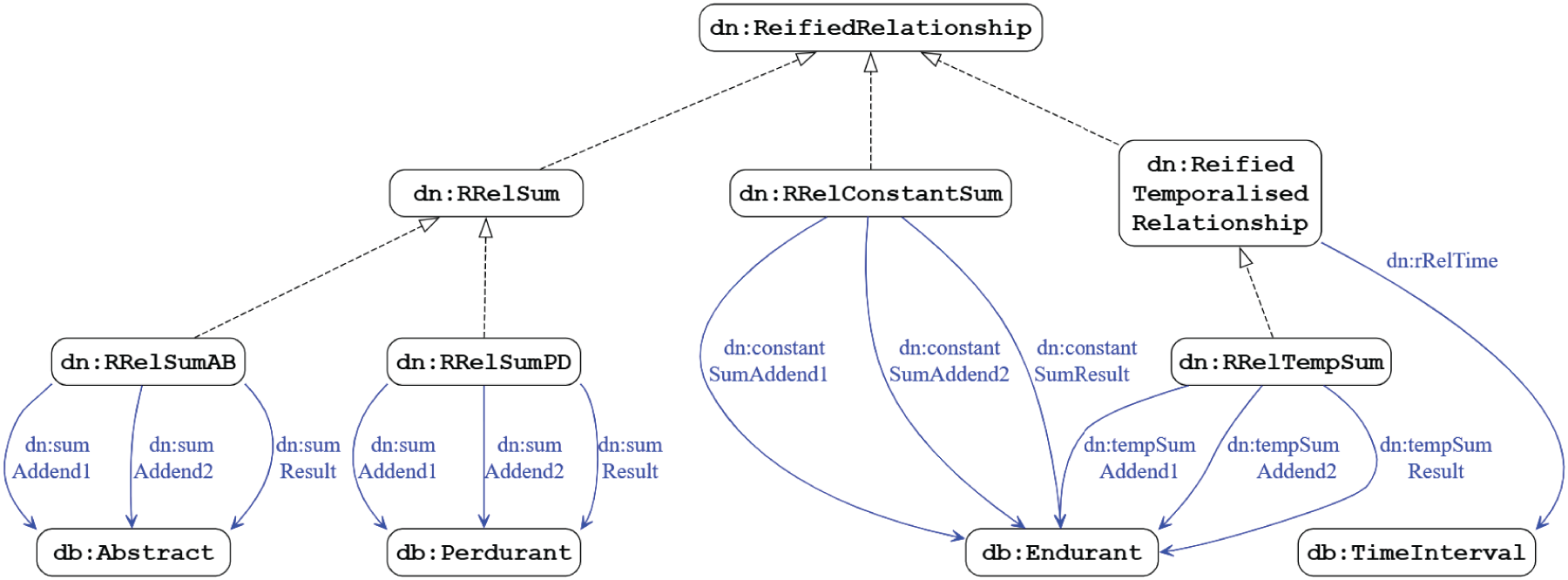
Reified relationships of DOLCEnaryRelOWL for sum. Rounded boxes represent classes identified by their local IRI with prefix. Blue solid arrows denote object properties identified by their local IRIs with prefix, linking classes in their
Figure 13 illustrates the different reified relationships for sum operators. Some of those correspond to binary operators, that is ternary relations, in
As anticipated above, the reified relationship approach doesn’t allow to characterise much of their inferential behaviour, as the expressivity of OWL 2 is limited. It is not possible, for instance, to ensure, from the existence of a reified relationship
Nevertheless, domain and range restrictions and class disjointness can be expressed in DOLCEnaryRelOWL. In addition, some property chains can be written to guarantee some interesting behaviour of the reified relationships in time. In particular, we can ensure that the endurants that are arguments of a
( (
Similar property chains also ensure the presence at the time of the relationship of the other (non-temporal) arguments of all instances of
Finally, some cardinality constraints have been imposed to enforce that reified relationships correspond to a unique tuple of arguments. For instance, constraints for
Adequacy to dolce
In this Section, we establish the adequacy of the OWL 2 modules by proving the following two facts. Firstly, we show that the first-order logic DOLCEsimpleFOL entails each axiom of DOLCEbasicOWL. Secondly, we enrich DOLCEsimpleFOL by adding the taxonomy of reified relationships and all the axioms that establish that, whenever a certain reified relationship exists, a corresponding relational statement of DOLCEsimpleFOL holds. We term this enriched version DOLCEsimpleNaryFOL. Then, we prove that DOLCEsimpleNaryFOL entails each axiom of DOLCEnaryRelOWL.
To prove such facts, we shall translate the OWL 2 axioms of DOLCEbasicOWL and DOLCEnaryRelOWL into first-order logic; then we apply automatic theorem proving (viz. Prover9 21 and Vampire 22 ) to verify each entailment.
The first fact shows that each model of DOLCEsimpleFOL is also a model of DOLCEbasicOWL, therefore, the intended models of
The proofs, the documentation, and all the required files are available online. 23 In particular, the repository contains: (i) the version of DOLCEsimpleFOL and DOLCEsimpleNaryFOL in the format of Prover9/Mace4 and the proof of their consistency; (ii) the translation of DOLCEbasicOWL and DOLCEnaryRelOWL into first-order logic, in the format of Prover9 and Vampire (i.e., in the tptp format), (iii) a report of the axioms of DOLCEbasicOWL and DOLCEnaryRelOWL proved from DOLCEsimpleFOL and DOLCEsimpleNaryFOL (respectively).
Adequacy of DOLCEbasicOWL
We prove that DOLCEsimpleFOL entails the axioms of DOLCEbasicOWL. To achieve that, our strategy is to translate DOLCEbasicOWL into first-order logic, then use Prover9 to automatically prove each axiom of DOLCEbasicOWL from DOLCEsimpleFOL. The translation of DOLCEbasicOWL into first-order logic was done automatically by means of the translation tool developed by Flügel et al. (2021).
24
A minor technicality is that DOLCEsimpleFOL uses the original abbreviated D18 labels of classes and relations (e.g.,
Prover9 is able to directly prove each axiom of DOLCEbasicOWL that does not involve the constant versions of the temporalised relations of
where
Notice that the definition of
In DOLCEsimpleFOL, we can also prove that the temporal extension of two constantly overlapping entities overlaps, however this fact cannot be enforced in OWL for the reasons discussed at the end of Section 3.3. 26
The constant versions of the participation, constitution, and quale relations follow a similar pattern.
Here,
To conclude, the theory DOLCEsimpleFOL, augmented with the constant version of the temporalised relations can be proved consistent with mace4. Moreover, we were able to find models obtained by mace4 where the classes are populated by at least one instance. Finally, Prover9 can prove that DOLCEsimpleFOL entails (the first-order translation of) each axiom of DOLCEbasicOWL.
Adequacy of DOLCEnaryRelOWL
The adequacy of DOLCEnaryRelOWL is less straightforward than the case of DOLCEbasicOWL, since the original
Axiom (
In our approach, we are assuming that, once a reified relationship is introduced in the theory, a corresponding statement of
Axiom (
We were able to prove that DOLCEsimpleNaryFOL is consistent by using mace4.
27
However, in this case, mace4 was not able to exhibit a model of DOLCEsimpleNaryFOL where each class of the ontology, and in particular each class of reified relationships, is populated by at least one element. The reason is that, by adding all the required reified relationships, we are forcing the domain to contain many elements, exceeding the resources that mace4 could handle. To circumvent this problem, we crafted a (finite) model of DOLCEsimpleNaryFOL and we tested that it verifies each axiom of DOLCEsimpleFOL. For the actual model and the details, we refer to our repository.
28
The strategy is briefly the following one. We start from a model
We populate each leaf of the taxonomy of relationships with the new elements and interpret the other relations of the signature of DOLCEsimpleNaryFOL accordingly. For instance, we illustrate the case of
This model verifies axioms of the type
In this case, Prover9 was not able to prove that DOLCEsimpleNaryFOL entails (the first-order translation of) each axiom of DOLCEnaryRelOWL, whereas Vampire succeeded. Therefore, every model of
We present in the following subsections two case studies with the goal of illustrating how to employ the OWL classes and properties of DOLCEbasicOWL and DOLCEnaryRelOWL. Both examples are based on the case studies presented by Borgo et al. (2022). 29 Table 2 lists the namespace prefix bindings for the two use cases, in addition to the definitions in Table 1.
List of Namespaces with Prefix Names of the use Cases.

List of Namespaces with Prefix Names of the use Cases.
The first use case, which is based on the Case 1 presented by Borgo et al. (2022), shows the modelling of the composition and constitution of a physical object like a table. The table and its components are artefacts, that is, intentionally produced products. For the sake of the example, it is assumed that a table is identified across time by its tabletop component, an essential part. Also, the existence of the table does not imply that it is made of the same matter throughout its whole life; thus, if one of the components of the table changes, the amount of matter in the whole table changes, too.
The table undergoes three lifecycle phases: During the time interval During the time interval During the time interval
To represent this case study, we need to take into account at least three aspects of the considered domain entities, namely, that the table consists of different components, that the table and its components are constituted by amounts of matter, and that all the entities are present at certain time intervals. From a modelling perspective, we therefore need to rely on the use of the relations of proper parthood, constitution, and presence. As we have seen in the previous sections, according to DOLCEbasicOWL and DOLCEnaryRelOWL, the first two relations can be considered as either constant (OWL object properties) or reified relationships (OWL classes), see Table 3. From a methodological standpoint, using one or the other approach requires making some choices from the modeler’s side. For instance, reified relationships are suited for application contexts where the focus is on the possibility that domain entities undergo changes, differently from constant relations which represent conditions holding for the entire life of the entities. As we will show in the following, one may also take a hybrid approach, where some conditions are represented in the constant way, and others in the reified manner.
Options for Constant and Temporalised Relationships of Parthood and Constitution.

Options for the Constant Relation and Reified Relationships of quale (Position in a Quality Space).

To instantiate this first case study, we assume that the tabletop
The diachronic representation of the table legs requires the instantiation of the temporalised reified relationship
The domain entities for the use case belong to the following classes:
Figure 14 shows the novel classes specialising DOLCEbasicOWL and the related instances. In addition, individuals
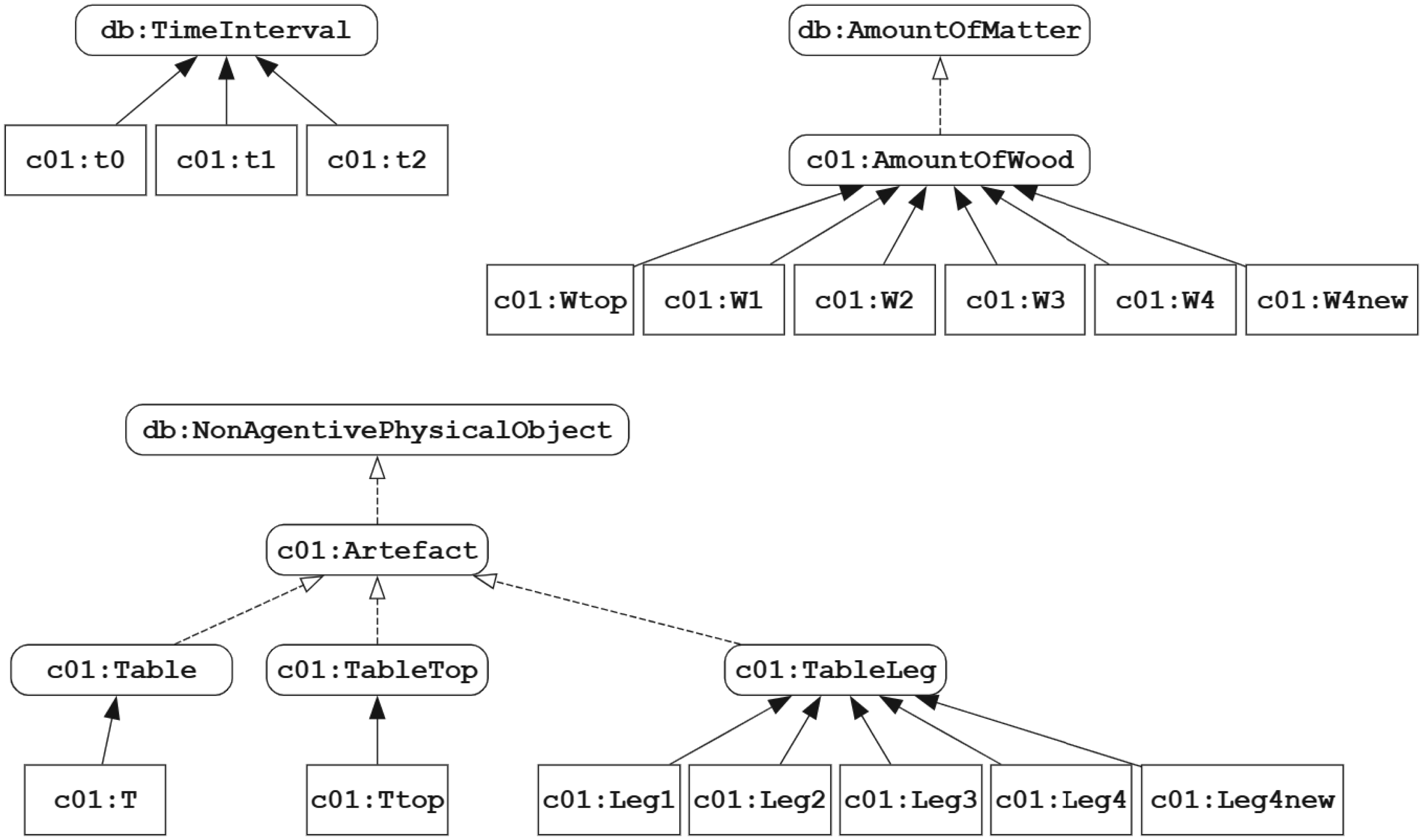
Graphical representation of individuals. Rounded boxes stand for classes, square boxes for instances, dashed arrows for
The constant parthood and constitution relations can be exemplified by looking at
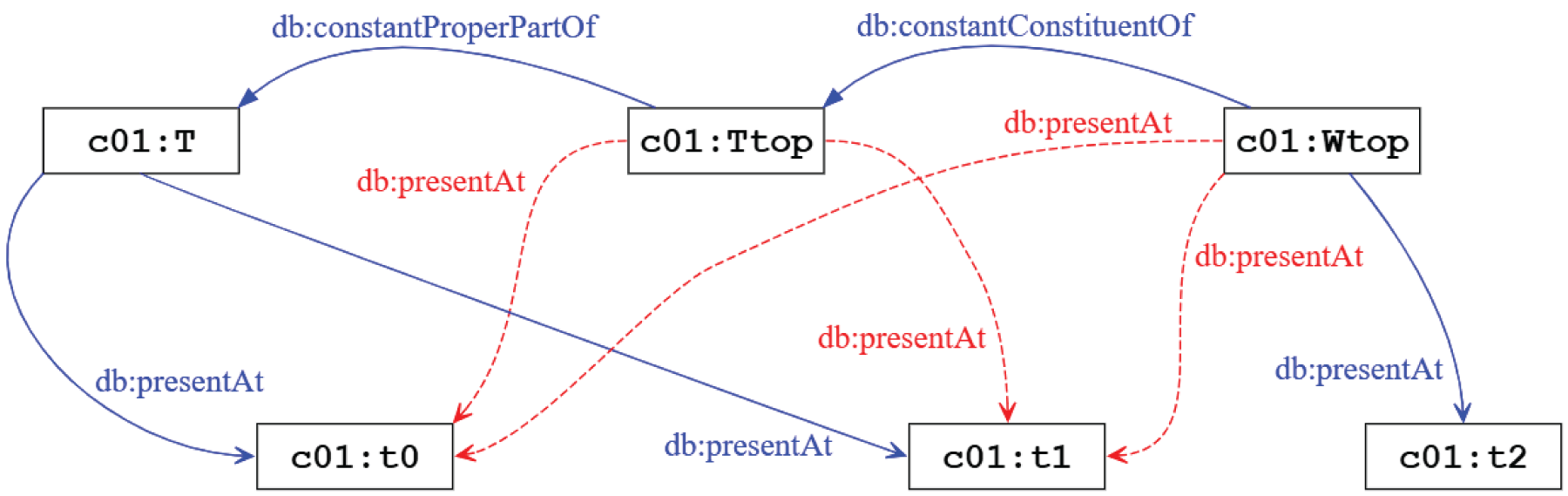
Graphical representation of constant relations. Square boxes stand for instances, blue solid arrows for relations labelled with the corresponding object property, and red dashed arrows for inferred relations.
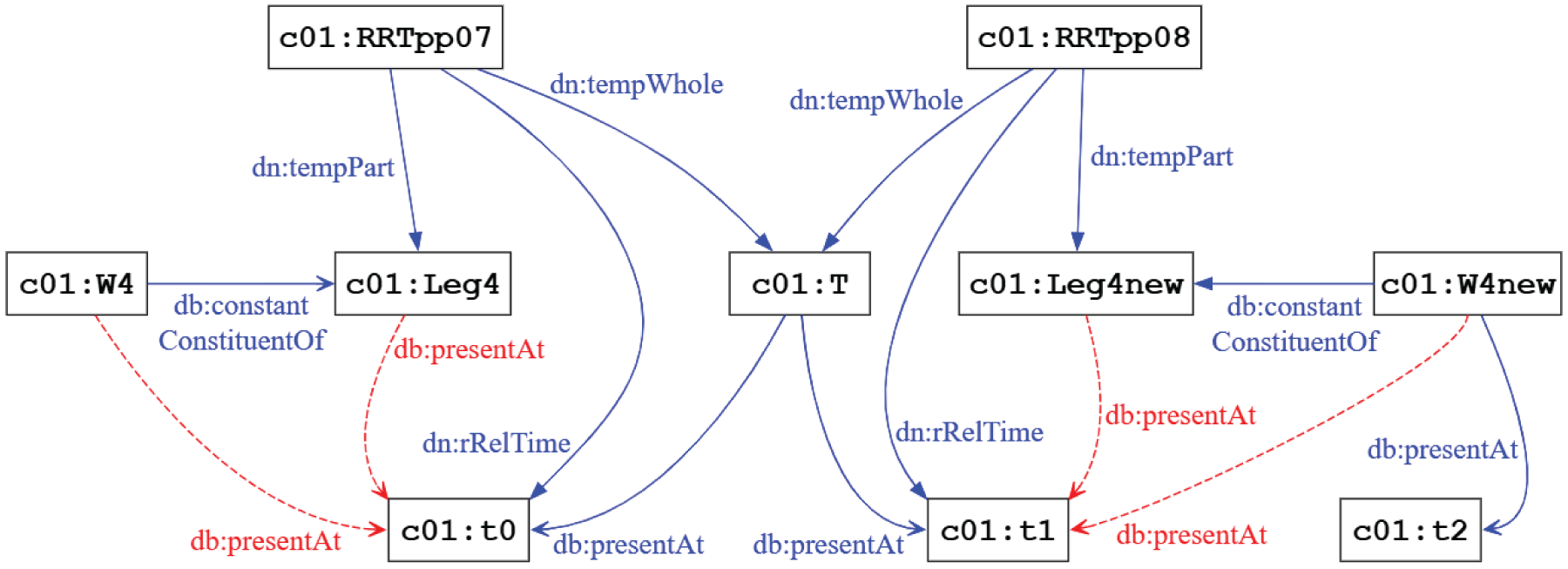
Graphical representation of temporalised relationships. Square boxes stands for instances, blue solid arrows for relations labelled with the corresponding object property, and red dashed arrows for inferred relations.
Considering Figure 15, the amount of wood
Looking now at Figure 16,
In addition, by reasoning over constant constitution one infers that
Finally, Figures 15 and 16 make explicit the presence of both
This second use-case is based on Case 3 presented by Borgo et al. (2022) and is relative to the modelling of individual qualities of endurants. For the sake of the discussion, we consider the location in space of a building and the colour of its facade in order to show, as for the previous case, the modelling of qualities in both constant and temporalised ways.
From a general perspective, recall that DOLCE distinguishes between physical, abstract, and temporal qualities depending on their inherence in physical endurants, non-physical endurants or perdurants, respectively (see Section 3.2). Also, the value (called quale in the theory) of a quality is represented as a region in a (abstract, physical, temporal) quality space (see Figure 6). Since we deal in our case study with a physical endurant like a building, we shall focus here on the representation of physical qualities and their values.
The object property
The following object properties relate the relationships in
As for the case study presented in the previous section, when addressing the representation of qualities, modelers must decide which approach to use depending on their requirements. In our example, it is reasonable to model the physical location of the building as being constant for the entire lifespan of the building, while the colour of its facade can undergo changes. For instance, let us assume that it is yellow during the time interval
The domain entities for the use case belong to the following classes: Bulding and Facade, two novel subclasses of NonAgentivePhysicalObject (a subclass of
The novel classes specialising DOLCEbasicOWL and the related instances are depicted in Figure 17. In addition, individuals
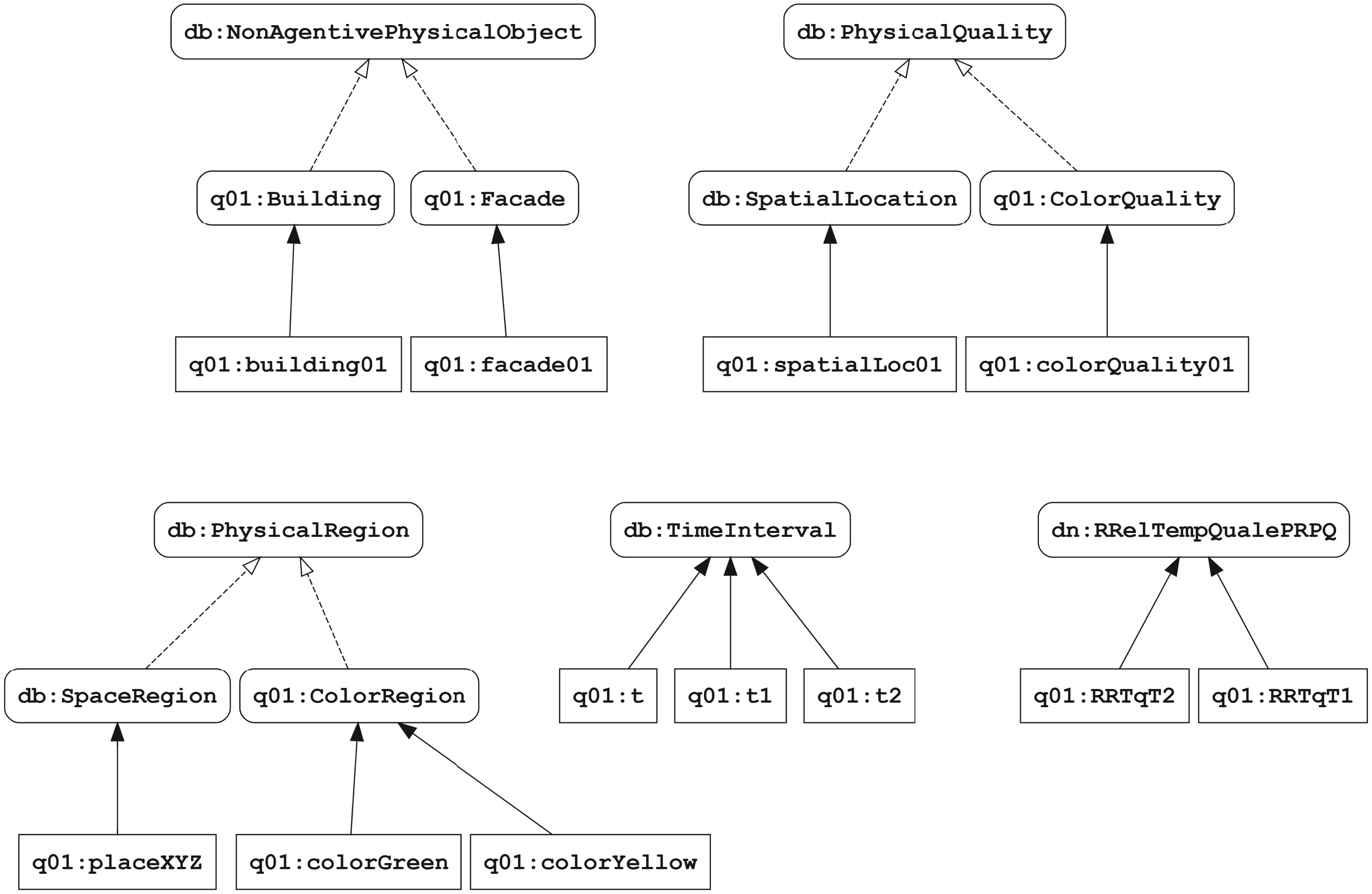
Graphical representation of individuals in the second use case. Rounded boxes stand for classes, square boxes for instances, dashed arrows for
Figure 18 shows that the spatial location
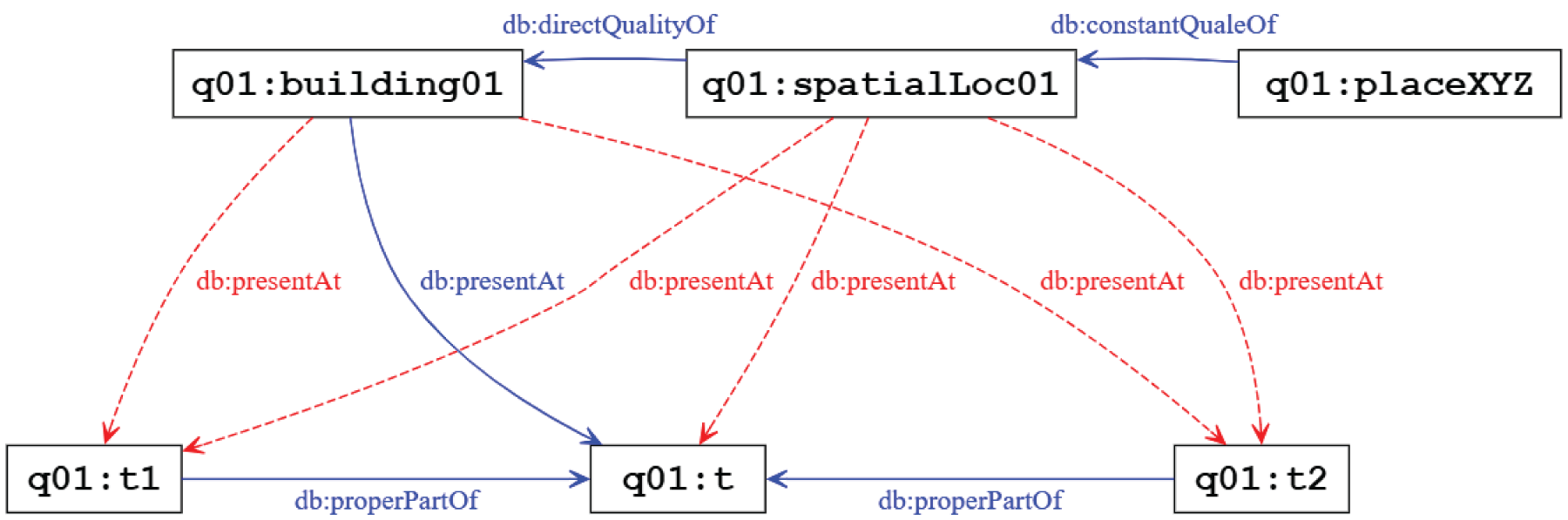
Graphical representation of constant relations. Square boxes stands for instances, blue solid arrows for relations labelled with the corresponding object property, and red dashed arrows for inferred relations.
Looking at Figure 19,
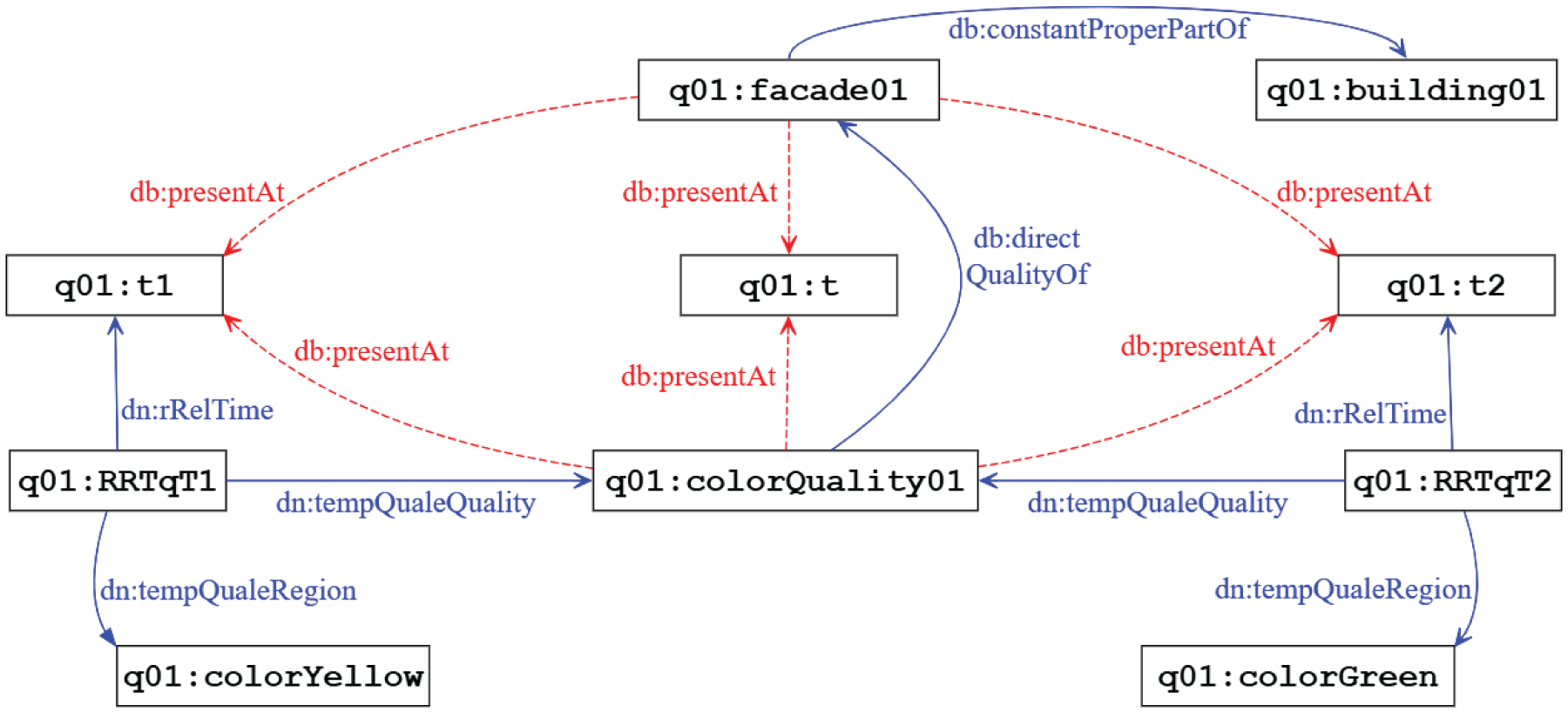
Graphical representation of temporalised relations. Square boxes stands for instances, blue solid arrows for relations labelled with the corresponding object property, and red dashed arrows for inferred relations.
Commenting on the examples, as a remark relative to the representation of qualities, in the case of the spatial location of a physical endurant like a building, one may wish to represent coordinates in space, that is by reusing geospatial data. Similarly, one may wish to represent the quantitative value of, say, the dimensions of an endurant along with the associated measurement system, that is, a numerical value of weight in kilos. For these purposes, one could explore and integrate existing work (Janowicz et al., 2019; Rijgersberg et al., 2013). Future work will address the introduction of modeling patterns for representing quantitative qualities values by exploiting the full capabilities of OWL 2, including the use of data properties.
With respect to the use of reified relationships, as said, the use of time indexes (with object property
Conclusions and Further Work
We presented the core aspects of our approach to
We view DOLCEbasicOWL and DOLCEnaryRelOWL as the first modules in a rich library of
From an ontology design perspective, the development of the
Footnotes
Acknowledgments
The authors would like to thank our colleagues at the CNR ISTC Laboratory for Applied Ontology for their valuable feedback and discussions, which led to the OWL version of DOLCE presented in this paper. The authors of this paper are solely responsible for any remaining errors.

Funding
The authors received no financial support for the research, authorship and/or publication of this article.
Declaration of Conflicting Interests
The authors declared no potential conflicts of interest with respect to the research, authorship, and/or publication of this article.
Notes
Appendix A. OWL Entities
List of Object Properties in DOLCEnaryRelOWL. Prefix
| Local IRI | Label | Related to D18 Symbol | Comment |
|---|---|---|---|
| atomAt | temporary atom | AtP (ternary) | x is atomAt t if x is a mereologica atom part of some whole at time t |
| constantSumAddend1 | first addend argument in constant sum relation | n/a | second argument of the constant sum relation |
| constantSumAddend2 | second addend argument in constant sum relation | n/a | Third argument of the constant sum relation |
| constantSumResult | sum argument of constant sum relation | n/a | First argument of the constant sum relation, this is the sum of the second and the third argument |
| rRelTime | time index of time-dependent relation | K, P (ter.), PC, ql (ter.), + , O (ter.), AtP (ter.) | Time index of all time-dependant relationships. |
| sumAddend1 | first addend argument in sum relation | Second argument of the sum relation | |
| sumAddend2 | second addend argument in sum relation | Third argument of the sum relation | |
| sumResult | sum argument in sum relation | First argument of the sum relation, this is the sum of the second and the third argument | |
| tempAtomicPart | part argument in temporary atomic part relationship | AtP (ternary) | First argument of the temporary atomic part relation (RRelTempAtomicPart) |
| tempAtomicWhole | whole argument in temporary atomic part relationship | AtP (ternary) | Second argument of the temporary atomic part relation (RRelTempAtomicPart) |
| tempConstitutionConstituent | constituent argument in constitution relation | K | First argument of the constitution relation |
| tempConstitutionConstituted | constituted argument in constitution relation | K | Second argument of the constitution relation |
| tempOverlapArg1 | first argument in temporary overlap relationship | O (ternary) | First argument of the temporary overlap relation |
| tempOverlapArg2 | second argument in temporary overlap relationship | O (ternary) | Second argument of the temporary overlap relation |
| tempPart | part argument in temporary part relationship | P (ternary) | First argument of the temporary part relationship defining the part |
| tempParticipationParticipant | participant argument in participation relationship | PC | First argument of the participation relation |
| tempParticipationPerdurant | perdurant argument in participation relation | PC | Second argument of the participation relation |
| tempQualeQuality | quality argument in temporary quale relation | ql (ternary) | Second argument of the temporary quale relation |
| tempQualeRegion | region argument in temporary quale relation | ql (ternary) | First argument of the temporary quale relation |
| tempSumAddend1 | first addend argument in temporary sum relation | Second argument of the temporary sum relation | |
| tempSumAddend2 | second addend argument in temporary sum relation | Third argument of the temporary sum relation | |
| tempSumResult | sum argument in temporary sum relation | First argument of the temporary sum relation, this is the sum of the second and the third argument | |
| tempWhole | whole argument in temporary part relationship | P (ternary) | Second argument of the temporary part relationship defining the whole |