






Abstract
The study aims to determine the type and extent of technical gaps faced by Chinese generic medicine manufacturers to achieve the standards of WHO Medicines Prequalification. The study was undertaken with four manufacturers producing anti-tuberculosis Fixed Dose Combinations (FDCs) in China from March 2010 to June 2011 and with 47 manufacturers producing anti-HIV/AIDS, anti-tuberculosis, and anti-malaria medicines in China in August 2011. The study assessed key elements required to comply with WHO Good Manufacturing Practices and completion of regulatory dossiers. For Good Manufacturing Practices, the study found technical gaps in quality management, validation and qualification, and calibration and maintenance. More technical gaps were identified in risk management and correction action and prevention action. For dossiers, the study found three technical gaps: bioequivalence testing, incomplete information from active pharmaceutical ingredients suppliers, and stability testing. The study indicates the need for technical assistance to Chinese generic medicine manufacturers, particularly for dossier preparation but also that technical gaps are attributed to differences between the standards of Chinese drug regulations and of WHO Medicines Prequalification Program.
Keywords
Introduction
Globally, the availability of quality assured generic medicines is a key enabler to put the concept of essential medicines into practice. Among the 307 essential medicines issued on the national list in China in 2009, this involves 205 kinds of chemical essential medicines produced by more than 2400 generic medicines manufacturers. 1 The production of quality assured generic medicines by a great number of Chinese generic medicine manufacturers benefits not only the Chinese population but also can meet the needs of the international community.
For medicines procured by international agencies or United Nation organizations, the procurement policies usually put World Health Organization Prequalification (WHO-PQ) as a criteria for sourcing suppliers. The WHO-PQ Program was initiated in 2001 and includes three major components: dossier assessment, inspection of manufacturing sites of finished pharmaceutical products and active pharmaceutical ingredients, and inspection of clinical sites. 2 The quality standards applied by this program are developed and updated through WHO Expert Committee Meeting on the Specifications for pharmaceutical preparations.3,4
While the WHO-PQ program provides a channel for Chinese pharmaceutical manufacturers to enter international market, it can also contribute to the implementation of Chinese pharmaceutical industry development by encouraging domestic pharmaceutical manufacturers to upgrade their quality standards. However, until now, only 4 manufacturers in China have 9 medicines prequalified by WHO-PQ program – despite more than 400 pharmaceutical manufacturers producing anti-HIV/AIDS, anti-tuberculosis (TB) and anti-malaria eligible for WHO-PQ.5,6 Given that the standards applied by the WHO-PQ program are different from the regulatory standards enforced by Chinese drug regulatory authority, it is probable that these differences prevented Chinese pharmaceutical manufacturers from achieving the standards of WHO-PQ.
This study aims to explore the technical gaps faced by Chinese generic pharmaceutical manufacturers for achieving the standards of WHO Medicine PQ. The study assessed key elements required to comply with Good Manufacturing Practices (GMP) and completion of regulatory dossiers for quality, safety, and efficacy.
Methods
The study is conducted in two parts. First, two rounds of assessment visits were conducted among four anti-TB Fixed Dose Combinations (FDCs) manufacturers from March 2010 to June 2011. One visit was to review the implementation status of Good Manufacturing Practice (GMP) against WHO GMP standards; the second visit reviewed the completeness and quality of regulatory dossier against the requirements of WHO-PQ.
Second, a survey among 47 manufacturers producing three kinds of medicines (anti-HIV/AIDS, anti-TB and anti-Malaria) was conducted in August 2011. The methods used in the assessment and the survey were developed by WHO based on the requirements of WHO Medicine Prequalification program in terms of GMP compliance and preparation of dossier.
Assessment visits
Four firms producing anti-TB FDC medicines were selected. Firms selected were registered by the Chinese State Food and Drug Administration (SFDA) to produce anti-TB medicines FDCs in China, and were in active production status during the past three years (2007–2010). In addition, the firms responded to the invitation of WHO PQ program (Expression of Interest (EOI)), and thus were willing to apply for WHO-PQ. Each firm was visited twice by an international expert accompanied by a local expert knowledgeable about Chinese drug regulations. In the assessment visits, a total of 16 technical items for GMP were selected and evaluated, including premises, equipment, documentation, materials, validation, sanitation and hygiene, production, quality control, and utilities. The results were scored into two categories with zero (0) means “reviewed and essentially compliant” and one (1) means “reviewed and major or critical deficiencies identified”.
For the regulatory dossier, a total of 15 items were selected based on Module 3 of the Common Technical Document (CTD) required by WHO-PQ. The 15 items were also reviewed (7 for drug substance and 8 for drug product), and the observations were grouped into three categories: Critical (C), Major (M), and Others (O) based on data availability and quality. The appropriateness and suitability of these technical items for GMP and dossier have been validated on three selected finished product manufacturers and three selected manufacturers of active pharmaceutical ingredients (API). For the safety and efficacy part, the bioequivalent (BE) testing of four manufacturers were reviewed and summarized.
Survey
Following the assessment visits among four firms, a survey was conducted among a larger number of generic pharmaceutical manufacturers of oral solid dosage forms (tablets and capsule) to confirm the findings from the assessment visits. Among more than 400 manufacturers producing anti-HIV/AIDS, anti-TB and anti-malaria, 47 pharmaceutical manufacturers were selected to be surveyed. Firms were carefully selected in terms of production volumes, location and product portfolio, with the aim to represent Chinese pharmaceutical industry for products and specific dosage forms eligible for WHO-PQ.
Questionnaires were developed by WHO experts based on the key elements in medicine production and GMP and preparation of the regulatory dossier for quality, safety, and efficacy. Respondents were technical staff in charge of GMP and regulatory dossier in each firm. The questionnaires were sent to participating manufacturers either by corresponding provincial Food and Drug administration where the manufacturers are located or by the China Quality Association for Pharmaceuticals and its branches in provincial level. All 47 manufacturers responded to the questionnaires. The data in the questionnaires were collated and tabulated using Excel spreadsheets.
Results
Assessment visits
Based on the selection criteria, three anti-TB FDC medicines produced by four manufacturers were studied. The three medicines are 2-drug FDC (Rifampicin (R) 300 mg/Isonizad (H) 150 mg) in both capsule and tablet form, and 4-drug FDC (Rifampicin (R) 150 mg/Isonizad (H) 75 mg/Pyrazinamide (Z) 400 mg/Ethambutol (E) 275 mg) in the tablet form. Two manufacturers produced the 2-drug FDC tablet, one produced the 2-drug FDC capsule and one produced the 4-drug FDC tablet.
Results of assessment visits in quality management of Good Manufacturing Practices (GMP)

: major or critical deficiencies identified; 0: essentially compliant.
Results of assessment visits in other 15 components of Good Manufacturing Practices (GMP)

1: major or critical deficiencies identified; 0: essentially compliant; NA: means that manufacturers A, B, and C have no complaints, product recall and contractual production and analysis at the time of assessment visits.
The four firms scored better in general for other 15 GMP components (Table 2). A common technical gap is the qualification and validation in terms of design, installation and operational qualification, balances calibration, process validation, and method validation. The common gaps for firm A and B lie in self inspection and quality audit with major observation indicating that the reaction on problems in production is to make immediate correction; while without long-term thinking for prevention. The common gap for firms A and D falls on the good practice in quality control, and the major observation is that method validation, verification of pharmacopeia methods are not put into place. The range was 16.7% to 60.0% across the four firms in terms of major or critical deficiencies among the criteria assessed.
Results of assessment visits in quality part of regulatory dossier
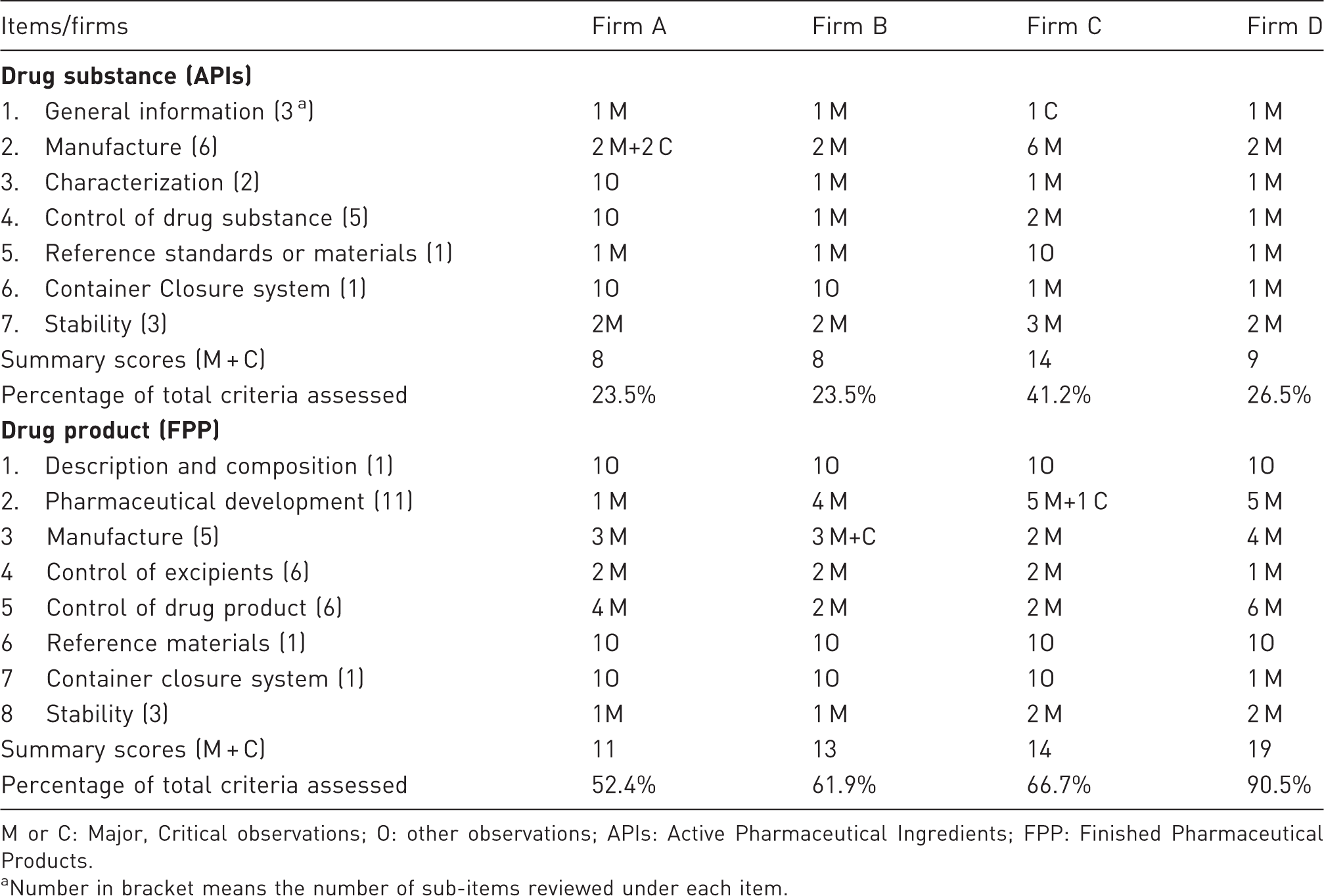
M or C: Major, Critical observations; O: other observations; APIs: Active Pharmaceutical Ingredients; FPP: Finished Pharmaceutical Products.
Number in bracket means the number of sub-items reviewed under each item.
For pharmaceutical development, the technical gaps were the technical transfer from one site to another site (Firm B), the compatibility between API-API and API-excipients (firm C), and the justification of pharmaceutical development process (firm D). For manufacturing, the technical gaps were: control of critical steps (firm A and B) and process validation (Firm C and D). For the control of drug product, all 4 firms faced problems in using the international pharmacopeia and corresponding validated analytical methods. In the control of excipients, for all four firms, the technical gaps are validation of analytical methods and justification for the choice of excipients. For stability testing, the common problem is that the condition of stability testing should comply with WHO requirements, which are stricter than the requirements of SFDA.
Regarding the safety and efficacy part of the dossier–BE testing, firms A, B, and C used comparators for domestic registration, which are not among those recommended by WHO-PQ. For firm D, the recommended comparator was used; however, the supplier for one API (Rifampicin) used for BE testing has changed.
Survey
A total of 47 pharmaceutical manufacturers were chosen and all of them responded to the questionnaires. Among the respondents, 27 (57.4%) manufacturers were producing anti-TB medicines; 10 (21.3%) were producing anti-malarial medicines; and 10 (21.3%) were producing anti-AIDS medicines. They were located in different geographic zones (36% in South; 28% in North; 32% in East and 4% in West), which generally represents the geographic distribution of Chinese pharmaceutical manufacturers.
Technical gaps among 47 manufacturers in the area of Good Manufacturing Practices (GMP) and regulatory dossier
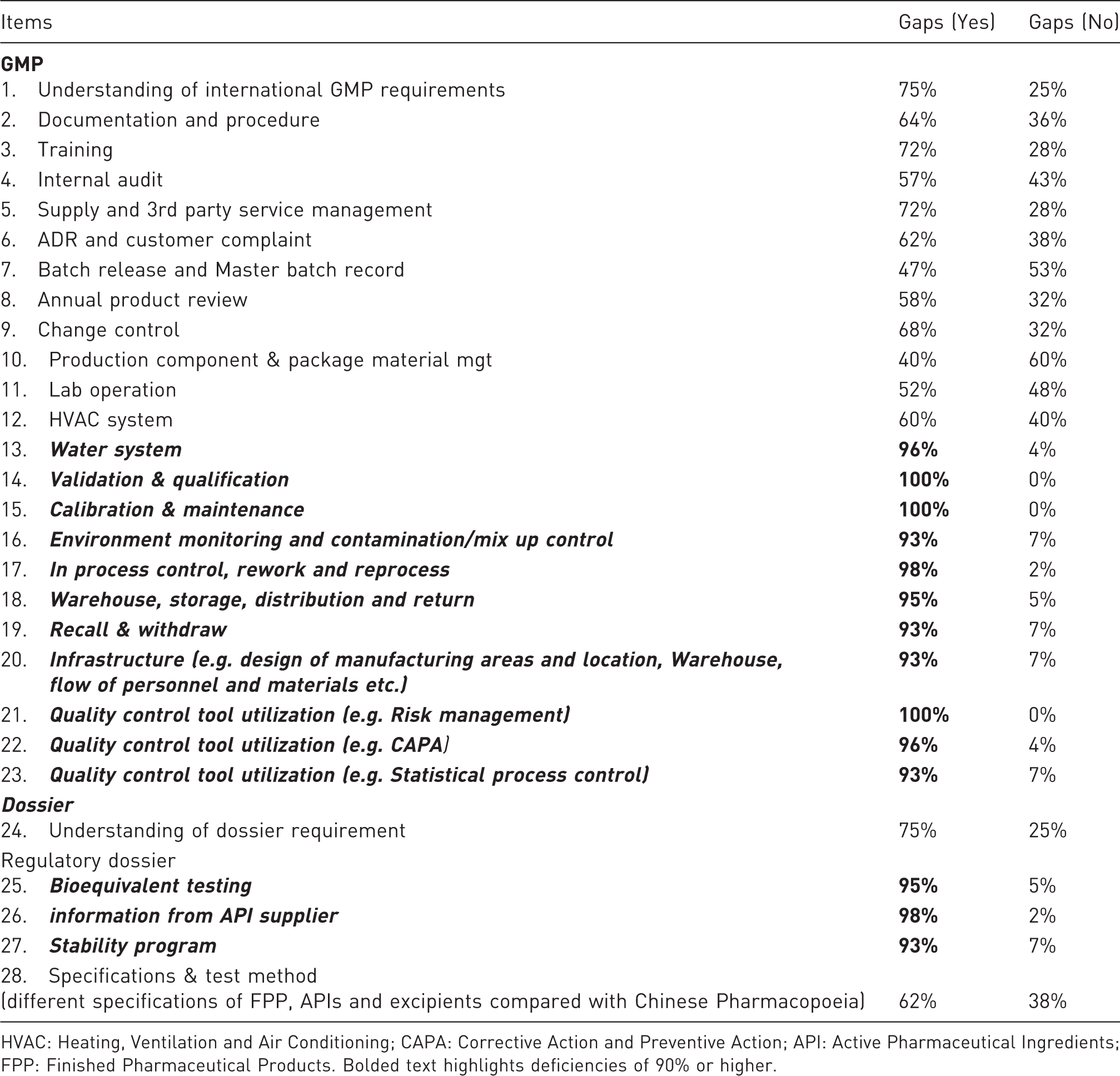
HVAC: Heating, Ventilation and Air Conditioning; CAPA: Corrective Action and Preventive Action; API: Active Pharmaceutical Ingredients; FPP: Finished Pharmaceutical Products. Bolded text highlights deficiencies of 90% or higher.
Discussion
To the best of our knowledge, this is the first study to review the technical gaps in terms of GMP and regulatory dossier faced by Chinese generic pharmaceutical manufacturers in achieving the standards of WHO Medicines PQ. A similar study was done by Wondiyfraw and colleagues to examine the deficiencies in generic product dossier for submission to WHO-PQ; however, this study specifically describes the situation in China and indicates the gaps in the area of GMP. 7
What underlies the technical gaps in the implementation of WHO GMP standards? It is the difference between Chinese GMP standards (issued in year 1998) and WHO GMP standards. A study comparing WHO GMP with the 1998 Chinese GMP reported that quality assurance systems were not reflected in the Chinese GMP and the key elements of validation and qualification were just briefly mentioned. 8
The newly revised Chinese GMP standards took effect since March 1, 2011, with the compliance deadline set by the end of 2015 for medicines classified as low risk (including tablet and capsule). The 2011 Chinese GMP standards are not significantly different from WHO GMP standards. 9 The assessment visits were carried out in the first half of 2011 when manufacturers had not yet upgraded their existing GMP status to new Chinese GMP standards; in another words, manufacturers were still operating under the 1998 Chinese GMP. Although a new chapter for quality management is added in new Chinese GMP and the requirements for equipment qualification and validation is strengthened, manufacturers will need to invest in human resources, infrastructure, and time to improve the awareness and know-how for implementation.
What is the problem behind the difficulties in APIs in China? In China, APIs are regulated as drugs with a similar registration procedure as the finished products. An API manufacturer needs to submit registration dossier independently to SFDA for evaluation and approval, and also needs to get drug production permission and GMP certificate. So the API manufacturers in China are totally independent from manufacturers of finished products, and their quality system and GMP status are supervised by SFDA rather than by the audit of finished products. As a result, finished products manufacturers usually do not have technical documents from API suppliers and do not have complete knowledge about the APIs that they are using. This situation results in information gaps faced by finished products manufacturers in procuring APIs from local market.
For all four firms in the assessment exercise, the APIs used for the production of finished products were purchased from external suppliers. As the requirements of WHO Medicines PQ are different from Chinese regulation on APIs, additional information needs to be obtained from API suppliers in terms of process validation, methodology validation, and impurity profile and stability research. Because most of these API suppliers do not hold Drug Master File (DMF) or Certificate of European Pharmacopeia (CEP), the information needs to be generated by API suppliers, which is additional work for API suppliers as compared to the provision of APIs for local registration. In addition, the quality standards for APIs need to be aligned with International Pharmacopeia (IP) or other pharmacopeias accepted by WHO Medicine PQ (i.e. European Pharmacopeia, US Pharmacopeia, and British Pharmacopeia) rather than the Chinese pharmacopeia standards.
Also, the dossier of APIs for domestic registration is not in CTD format and the requirements are different from that of ICH. There are usually insufficiencies in terms of process validation, methodology validation, and impurity profile and stability testing compared with the requests of ICH guidelines. Similar concern about the availability of qualified APIs suppliers has been stated in the survey on the reproductive products manufacturers to achieve the standards of WHO Prequalification Program. 10
What are the difficulties in BE testing of generic medicines? It has been found out that all 4 manufacturers have to re-do BE testing due to varieties of reasons, such as the adoption of international comparators, and the change of API supplier for the crystal form of Rifampicin. For choosing the comparators, there is a difference between the requirements of SFDA on BE testing and that of WHO. Chinese SFDA regulates that the comparator product is chosen from the innovator product or marketed product with national standard, while WHO PQ requires the selection of innovators or products from WHO list of international comparator.11,12 As per SFDA regulation, the comparators used for BE testing must have registration status in China. The comparators for 3 anti-TB FDC medicines have not yet been registered in China, and therefore, an additional approval needs to be obtained from SFDA for importing the product and for using it in the human body.
Prior to BE testing, manufacturers will need to submit clinical trial approval to SFDA, which requires 3 to 6 months for approval. It often occurs that a generic medicine developer reformulates the test product in order to demonstrate that it is identical to comparators statistically; therefore, after each reformulation, the BE testing needs to be done. Thus, the implementation of BE testing with those comparators not yet registered in China will be a time-consuming process, which becomes another barrier for Chinese generic manufacturers to achieve WHO-PQ.
Another issue related to BE testing is the crystal form of one API in all products of concern. It is known from the literature that one common API of anti-TB FDCs-Rifampicin is presenting polymorphism and the BE could be affected by the polymorphism. Both kinds of crystal forms-I and II are produced in China. The four manufacturers were using the crystal form I. From the viewpoint of WHO Medicine PQ, the dossier assessment experience more with API in form II. However, this does not mean form I cannot be accepted but requires evidence of BE testing. Manufacturers thus face the difficulty in choosing the crystal form. If they choose form I, they fear that it may influence behavior in BE testing. If they switch to form II, due to the fluidity characteristics, they will need to modify the manufacturing process and therefore re-do the BE study.
The survey carried out among 47 firms allowed a verification of the findings from the assessment visits, among manufacturers from a comparable segment of pharmaceutical industry (manufacturers of solid dosage forms) in China. The results of the survey confirmed the findings from the assessment visits. In the area of GMP, the validation and qualification and the CAPA plan were understood as the common gaps in quality management. In the area of regulatory dossier, the BE testing, additional information from API suppliers, and stability program are the three key technical gaps. This survey gives a unique picture of the quality barriers faced among Chinese generic pharmaceutical firms producing anti-HIV/AIDS, anti-TB, and anti-malaria medicines.
Some of the main limitations of this study include the medicine category and sites visited. The assessment visits only included anti-TB medicine manufacturers, rather than other categories of medicines such as anti-HIV/AIDS and anti-Malarials that are also eligible for the WHO-PQ program. Thus, the gaps in other categories of manufacturers could not be captured. In addition, only firms producing finished products are included, rather than APIs firms and clinical trials sites. Thus the gaps in the entire regulatory process are not reflected.
Conclusion
Chinese pharmaceutical manufacturers face technical gaps in achieving the standards of WHO Medicine PQ. The gaps are in two essential aspects of WHO Medicines PQ: the medicine production-GMP and the regulatory dossier for quality, safety, and efficacy. Major gaps in GMP could probably be attributed to the 1998 Chinese GMP that most firms currently comply with, that does not pay sufficient attention to quality management in GMP. Although it has been included in new Chinese GMP, it will take time for manufacturers to make improvements in this aspect.
In dossier aspect, the three main gaps include availability of information from qualified API suppliers, the regulation on BE testing, and the stability program. These technical gaps could mainly be attributed to the differences between the Chinese drug regulation standards and the international regulatory standards adopted by WHO-PQ. However, the Chinese drug regulatory authority is determined to become a stringent regulation authority in the future. Therefore, it is expected that gaps in drug regulation will be narrowed, and the generic pharmaceutical manufacturers will also be pushed to fill in these gaps.
Footnotes
Acknowledgements
This work was supported by Bill and Melinda Gates Foundation [Global Health Grant Number OPPGH5258].