







Abstract
The introduction of generic drug products from multiple sources into the health care system of many developing countries may lead to spread of substandard medicines. Post marketing surveillance is very crucial to ensure product quality and eliminate substandard medicines and consequently, ensure better patient clinical outcome. Hence, the aim of the present work was to assess the quality of six generic ciprofloxacin hydrochloride 500 mg tablets available in Dessie town, Northeast Ethiopia using in vitro quality control tests. Weight variation test, disintegration test, dissolution test and assay for the content of active ingredients were done as per the United States pharmacopoeia. All generic ciprofloxacin hydrochloride tablets were evaluated for conformity with United States Pharmacopoeial standards.The results of weight variation test indicated that all samples were complied with United States Pharmacopoeial specifications.The percentage content of generic ciprofloxacin tablets was within the range of 90–110% and the disintegration time was found between 2.375 and 6.31 min. In addition, generic ciprofloxacin tablets released more than 80% of the drug in 30 min. Hence, all generic ciprofloxacin tablets met the quality control parameters as per the United States pharmacopoeial specifications.
Introduction
Antibiotics are among the most frequently prescribed medications in modern medicine, and are used in the management of microbial infections. Ciprofloxacin is the most potent fluoroquinolone derivative having a broader spectrum of antibacterial activity against Gram-negative and Gram-positive aerobic and anaerobic organisms.1,2 It acts by interfering with microbial DNA synthesis.3,4 The quantitative analysis of antibiotics can be determined by methods such as microbiological assays, automated chemical assays (e.g. high performance liquid chromatography (HPLC)), immunological assays and radioimmunoassay. 5
Good quality medicines are a prerequisite for a successful treatment. Quality control is carried out to ensure a desired level of quality in a product and a pharmaceutical product should contain the appropriate amount of active pharmaceutical ingredient (API). 6 The purpose of quality control is to make sure that the public can avail of safe and therapeutically effective medicine. In Ethiopia, the weak regulatory system, lack of informal market control, weak port control, and long border with neighboring countries, may contribute to widespread of poor quality medicines in the market. 7
The prevalence of Counterfeit medicines is common in developing countries. 8 Counterfeit medicines may be brand and/or generic products. The use of poor quality antimicrobials can cause morbidity and mortality, health costs, loss of confidence in the health care system and drug regulatory authorities. Hence, evaluating the quality of drugs is crucial for delivering quality health services. 9
Generic medicines are those where patent protection has expired and which may be produced by manufacturers other than the innovator company. Expiration of drug patents leads to several companies producing generic forms of drugs. 10 The introduction of generic drug products from multiple sources into the health care delivery system of many developing countries may lead to widespread of fake and substandard medicines. 11 Hence, post marketing surveillance is very crucial to ensure product quality and eliminate substandard medicines and consequently, ensure better patient clinical outcome.
Several studies have been undertaken to assess quality of generic ciprofloxacin hydrochloride tablets available in the healthcare delivery system of various countries.. Igboasoiyi et al. 12 showed that 7 out of the 10 brands of ciprofloxacin tablets analyzed (70%) met the British Pharmacopoeia specification for tablet purity. Joda et al. 13 also studied 16 ciprofloxacin brands in Lagos, Nigeria and indicated that the four brands (25%) did not pass the chemical assay test. In addition, Adegbolagun et al. 14 reported that 40% of the brands tested in Ibadan failed the chemical test. Moreover, Osonwa et al. 15 studied 15 brands of ciprofloxacin tablets marketed in Anambra State, South eastern Nigeria and showed that all the brands complied with the Pharmacopoeial standards except one brand that failed the dissolution test. However, Fahmy et al. 10 studied six brands of ciprofloxacin available in the UAE and indicated that the tested ciprofloxacin generic products distributed in the UAE market were proven to be of good quality and could be used interchangeably with the branded ciprofloxacin product.
The increasing use of ciprofloxacin tablets nowadays is due to a broader spectrum of antibacterial activity 16 and necessitated the need to evaluate the quality of the products available in the market. Increasing pharmaceuticals industries in the world may introduce different brands of ciprofloxacin tablets in Ethiopian market. As ciprofloxacin is widely used antibiotic in Ethiopia, the present study was done to evaluate the quality of generic ciprofloxacin hydrochloride 500 mg tablets available in Dessie, Northeast Ethiopia.
Materials and methods
Materials and reagents
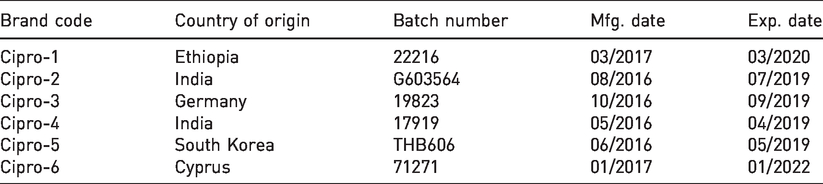
The following chemicals and reagents were used in the study: HPLC grade Acetonitrile, BDH (UK), HPLC grade methanol, phosphoric acid, and triethylamine (Sigma-Aldrich, Germany), hydrochloric acid (D.B.H Laboratory supplies, England) and distilled water. Standard ciprofloxacin was obtained from Addis pharmaceutical factory. Different generic ciprofloxacin hydrochloride 500 mg tablets available in community pharmacies of Dessie town were included in this study(Table 1).
generic ciprofloxacin hydrochloride 500 mg tablets included in the study.
Equipments
Equipments used in the present study are: HPLC (Agilent Technologies Corporation, stainless steel column (25 cm × 4.6 mm), Diode array detector) a Pharma test dissolution tester and disintegration tester (Germany), double beam UV/VIS spectrophotometer (Shimadzu, Japan), Electronic balance (Mettler Toledo, Switzerland).
Methods
Sample collection
The survey was conducted in Dessie town. Dessie town is 401 km far from Addis Ababa. There are 27 pharmacies officially operating in Dessie Town. Ten pharmacies were selected using simple random sampling method. generic ciprofloxacin tablets were purchased from randomly selected community pharmacies in Dessie town, Ethiopia. Generic ciprofloxacin tablets collected were kept in appropriate storage conditions. The experiment was done at Addis pharmaceutical factory, Adigrat, Ethiopia and the study was performed before the product expiration dates. The examined ciprofloxacin tablets were the most commonly used drugs in Dessie town, Ethiopia. Weight variation test, disintegration test, dissolution test and assay of ciprofloxacin tablets were done as per the United States Pharmacopoeia (USP). 17
Weight variation test
In weight variation test, 20 tablets of each brand were weighed individually using analytical balance and the mean tablet weight and percentage deviation from the mean were calculated.
Disintegration time
A 900 ml beaker was filled with 0.01 N HCl and the temperature was kept at 37 ± 0.5°C. Six tablets of each brand were used and the time no particle remained on the basket was measured.
Dissolution test
Dissolution apparatus type II (Paddle apparatus) was used to evaluate the dissolution of ciprofloxacin tablets; 0.01 N HCl (900 ml) at 37 ± 0.5°C was used as a dissolution medium. The rotation of the paddle was set at 50 r/min; 10 ml sample was withdrawn at 30 min and was filtered and was diluted with 0.01 N HCl. The absorbance of the diluted solution was measured using UV-Visible spectroscopy at 276 nm. The percentage release of ciprofloxacin was determined from the absorbance of the sample and standard solutions.
Assay of ciprofloxacin tablets
HPLC equipped with a 278-nm detector was employed for the assay of ciprofloxacin tablets. A stainless steel column (25 cm × 4.6 mm) packed with C18 was used. The flow rate is about 1.5 ml per minute.
Mobile phase
A filtered and degassed mixture of 0.025 M phosphoric acid adjusted (with triethylamine) to a pH of 3.0 ± 0.1 and acetonitrile (87:13).
Standard preparation
Ciprofloxacin (0.5 g) standard was dissolved in a filtered and degassed mixture of 0.025 M phosphoric acid adjusted (with triethylamine) to a pH of 2.0 ± 01 and acetonitrile (87:13) and made up to 100 ml. Then, 4 ml of the filtrate was transferred in 100 ml volumetric flask and was made up to volume to obtain a solution containing 0.2 mg of ciprofloxacin per ml.
Assay preparation
Five tablets of each brand were powdered and transferred to a 500 ml volumetric flask; 400 ml of a filtered and degassed mixture of 0.025 M phosphoric acid adjusted (with triethylamine) to a pH of 2.0 ± 0.1 and acetonitrile (87:13) was added to the sample and sonicated for about 20 min. The sample solution was made up to volume with phosphoric acid and acetonitrile (87:13) and was mixed. Then, 4 ml of the filtrate was transferred to 100 ml volumetric flask and was made up to volume with phosphoric acid and acetonitrile (87:13) to obtain 0.2 mg of ciprofloxacin per ml; 10 µL of the Standard and Assay preparation was injected into the chromatograph. The percentage content of ciprofloxacin was determined using peak areas of the sample and standard solutions. 17
Data analysis
The data were analyzed using the Windows SPSS Version 20 and were expressed as mean ±standard deviation (SD). Statistical significance was done using one-way analysis of variance and Tukey’s test. A probability of P < 0.05 was considered as significant.
Results and discussion
Evaluating the quality of medicines circulating in the market is important to reduce the risk of having poor quality medicines in the supply chain. generic ciprofloxacin tablets obtained from local market in Dessie, Ethiopia were subjected to a number of tests in order to assess quality parameters. Uniformity of dosage forms, assay, disintegration and dissolution tests are compendial standards used to assess the quality of commonly available generic ciprofloxacin tablets in Dessie town, Northeast Ethiopia.
Weight variation test
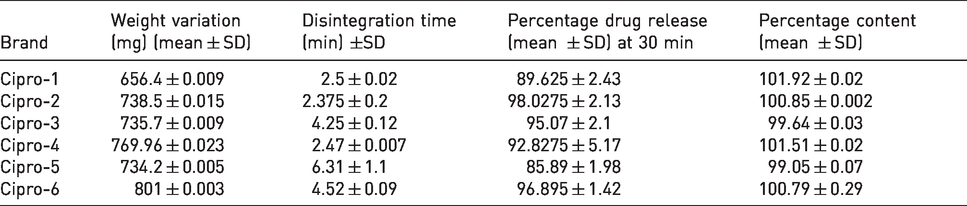
Weight variation test was done to check the uniformity of the dosage units for ciprofloxacin tablets. USP17 for weight variation test states that more than two tablets should not differ from the average weight by more than 5% and none deviates by more than 10%. As shown in Table 2, none of the tablets used in the study deviate from the average weight by more than 5% and hence all ciprofloxacin tablets fulfilled the pharmacopoeial specifications for weight variation test. For tablet dosage forms, any weight variation obviously reflects variation in the content of API. 14 Patients taking overdose or under dose medications will not have a desired therapeutic response.18,19
Results of in vitro quality control tests of generic ciprofloxacin hydrochloride 500 mg tablets.
Disintegration test
United States pharmacopeia specifies that the tablet dosage forms should disintegrate within 30 min. Hence, all brands of ciprofloxacin met the requirement as the disintegration time was found between 2.375 and 6.31 min (Table 2). Cipro-1, cipro-2 and cipro-3 had mean disintegration time of less than 3 min. Cipro-5 showed the longest disintegration time.
Disintegration test is very important for tablet dosage forms and dissolution rate of drug depends on the disintegration time, which ultimately affects the rate of absorption and subsequent bioavailability of drug. 20
Dissolution test
Dissolution test was performed to check the percentage of drug released from the tablet dosage forms and the test was done at pharmacopoeial specified time, 30 min. The amount of drug released was analyzed by UV-visible spectroscopy. Dissolution is an important quality control parameters directly related to the absorption and bioavailability of drug.
For ciprofloxacin tablets, drug release should not be less than 80% of the labeled amount in 30 min. 16 As shown in Table 2, all the brands of ciprofloxacin tablets studied released more than 80% within 30 min. Hence, all of the products complied with USP dissolution tolerance limits. The percentages of drug release for six brands of ciprofloxacin tablet in 30 min were in the resulting order: cipro-5 (85.89%) < cipro-1 (89.625%) < cipro-4 (92.8275%) < cipro-3(95.07%) < cipro-6 (96.895%) < cipro-2 (98.0275%). Among six brands, cipro-2 was the fastest (98.0275%) and cipro-5 was the slowest (85.89%) in terms of drug release. Slow drug release from cipro-5 is in line with the longest disintegration time profile observed. Dissolution study measures the rate and extent of drug release from any dosage form. The test usually reports the % of drug released at a specific period of time. 20
The result of one-way ANOVA statistical analysis performed at 95% CI for the pharamacopoeially specified time, 30 min, indicated that there is significance difference in drug release of cipro-1 with cipro-3 and cipro-6 (P < 0.05). In addition, drug releases for cipro-2, cipro-3, cipro-4 and cipro-6 were significantly different from cipro-5 (P < 0.05).
Assay of drug content
System suitability test
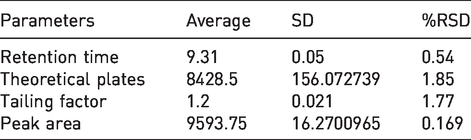
The system suitability was checked by analyzing the repeatability of peak area, tailing factor and theoretical plates of the column. The system is found suitable in respect of peak area (less than 1.5%), mean theoretical plate count (more than 2500), tailing factor (less than 2). 17 As indicated in Table 3, the chromatograms of standard ciprofloxacin showed an average peak area of 9593.75 ± 0.169 for six replicate injections. The tailing factor was found to be 1.2, which indicated the symmetric nature of the peaks. The number of theoretical plates was found to be 8428.5. This high number of theoretical plates suggests the efficient performance of the column. The relative standard deviation (RSD) of the peak areas of replicate injections (n = 6) of a 0.2 mg/ml solution of ciprofloxacin standard was found to be 0.169%. The RSD for replicate injections should not be more than 1.5% and accordingly, the RSD value (0.169%) was found to be within an acceptable range. This small RSD value indicates good precision under the same operating conditions.
Results of system suitability study of standard ciprofloxacin
Quantitative analysis of ciprofloxacin tablets was performed by HPLC. The averages of peak areas were used to calculate the percentage content of the ciprofloxacin tablets. Representative chromatograms of generic ciprofloxacin tablets and standard ciprofloxacin hydrochloride were shown in Appendix 1. The assay results of API showed that samples of all generic ciprofloxacin tablets were complied with the USP specification limit (i.e. 90–110% of stated amount). The percentages of the drug content of the six generic ciprofloxacin tablet were obtained in the stated sequence: Cipro-5 (99.05%) < Cipro-3 (99.64%) < Cipro-6 (100.79%) < Cipro-2 (100.85%) < Cipro-4 (101.51%) < Cipro-1 (101.92%). All of the brands met the USP-NF specifications for assay. The highest percentage content was obtained for cipro-1, while the least was obtained for cipro-5 (Table 2).
Quantitative analysis of pharmaceutical products can be used to determine the strength of APIs present in a sample. Thus, interchangeable use of drugs containing the same API will most probably result in a similar clinical efficacy. 6 Assay of pharmaceutical products is a critical test of quality and failure to meet the standard will result in poor quality.
From in vitro studies, it was shown that there are minor variations in physicochemical quality paramaters among generic ciprofloxacin tablets. Despite that, all the studied ciprofloxacin tablets distributed in the Ethiopian market are of good quality products. This might be as a result of strict adherence to good manufacturing practice, effective control of Ethiopian food and drug administration and proper storage of drugs by wholesalers, retailers and pharmacies.
Conclusions
The aim of the present study was to evaluate the quality of six generic ciprofloxacin hydrochloride tablets available in Dessie town, Northeast Ethiopia. This study revealed that all generic ciprofloxacin tablets fulfilled the quality control parameters as per the United States pharmacopoeial specifications. Hence, generic ciprofloxacin tablets available in the Ethiopian market meet the quality parameter to satisfy the therapeutic efficacy.
Footnotes
Acknowledgement
The authors would like to thank Addis pharmaceutical factory for donating standard and for providing laboratory facility for this study.
Data availability
The data used to support the findings of this study are included within the article
Declaration of conflicting interests
The author(s) declared no potential conflicts of interest with respect to the research, authorship, and/or publication of this article.
Funding
The author(s) disclosed receipt of the following financial support for the research, authorship, and/or publication of this article: This work was supported by Wollo University.

Authors’ biographies
Appendix 1. HPLC chromatogram’s obtained in the assay.
Chromatogram of cipro-1 tablets
Chromatogram of cipro-2 tablets
Chromatogram of cipro-3 tablets
Chromatogram of cipro-4 tablets
Chromatogram of cipro-5 tablets
Chromatogram of cipro-6 tablets
Chromatogram of ciprofloxacin standard