






Abstract
Orally disintegrating dosage forms (ODTs and ODFs) are an innovative solution for addressing challenges in drug administration, particularly for patients who have difficulty swallowing, such as pediatric, geriatric, and dysphagic populations. These formulations disintegrate quickly in the oral cavity without the need for water, making them a convenient alternative to traditional solid oral dosage forms. They improve patient compliance and offer a faster onset of action by allowing pre-gastric absorption. This review delves into the formulation strategies behind ODTs and ODFs, focusing on the role of key excipients such as superdisintegrants, taste-masking agents, and film-forming polymers. These components are essential in achieving rapid disintegration, enhancing palatability, and ensuring patient adherence. The article further discusses various manufacturing techniques, including direct compression, freeze-drying, and hot-melt extrusion, highlighting their advantages and limitations. Additionally, novel approaches like 3D printing and multi-channel tablet designs, which promise to enhance drug loading and disintegration efficiency, are explored. Despite their growing popularity, orally disintegrating dosage forms still face several challenges. Persistent hurdles are ensuring sufficient mechanical strength while maintaining fast disintegration, optimizing drug loading, and overcoming taste-masking issues. Moreover, advancements in packaging are needed to protect these fragile formulations and maintain their integrity during handling and storage.
Keywords
Introduction
Oral route continues to remain the most preferred route for dosage form administration despite the emergence of novel routes of drug delivery. Besides being patient-friendly and compliant, oral route is associated with numerous benefits including ease of administration, being safer and cheaper, amenability to self-administration, non-invasive nature, availability of multiple dosage forms, and being inexpensive since it does not require sterilization.1,2 However, the oral route is also associated with numerous drawbacks such as delay in onset of action, lower bioavailability, susceptibility to first-pass metabolism, non-feasibility in emergencies, need for taste-masking, inability to use in unconscious and non-cooperative patients, and poor absorption as seen in drugs belonging to BCS Class II and IV.3,4 Monophasic and biphasic liquid formulations, tablets, hard gelatin capsules, and granules continue to remain the mainstay of oral dosage forms. 5 Liquid formulations are commonly preferred for oral delivery to pediatric and geriatric patients, albeit they also suffer from drawbacks such as poor stability, bulky nature, and a shorter shelf-life. 6 Non-uniformity in the accuracy of dose measurement is another loophole. Moreover, the high development costs of new drug molecules compel the formulators to focus on the development of novel, cost-effective, and clinically efficient dosage forms. 7 Furthermore, the increasing dependence of the patients on the oral route necessitates the need to discover newer oral formulations that make this route as bioavailable as the parenteral routes. Mucoadhesive buccal/ sublingual tablets and films are the outcomes of such research efforts. A ground-breaking development in this area which shall be extensively discussed in this review article is the formulation of ‘Orally Disintegrating Dosage Forms’.8,9
Orally disintegrating formulations rapidly disintegrate in the mouth within a few seconds after administration and dissolve in the saliva. The dissolved drugs may be absorbed from the oral mucosa, pharynx, or any other section of the gastrointestinal tract as the saliva travels down thus offering further advantage of pregastric absorption.10,11 The rate of dissolution and absorption from such formulations is known to be significantly higher than that observed for conventional formulations. These formulations successfully tackle various drawbacks related to the oral route such as swallowing difficulties faced by pediatric and geriatric patients, delayed onset of action, discretionary use of water etc.12–14 Such formulations help alleviate the fear of choking in pediatric and geriatric patients associated with the administration of solid dosage forms. 15 Moreover, patients suffering from several clinical conditions such as schizophrenic patients, patients on reduced liquid intake, and patients suffering from dysphagia, motion sickness, and repeated emesis beseech the use of orally disintegrating formulations. 16 Dysphagia that is difficulty in swallowing caused due to neurological disorders, muscular disorders, structural abnormalities, or obstructions in the throat or esophagus afflicts more than five million adults worldwide with almost 40% of them suffering from it throughout their lifetime. 17 This technology can enable the formulation of oral dosage forms of drugs that otherwise may not be amenable for oral administration. Typical examples of orally disintegrating formulations being developed include orally disintegrating tablets, orally disintegrating films, orally disintegrating granules etc.12,18,19 The current article focuses on the critical characteristics of different types of ‘Orally Disintegrating Tablets’. The important excipients, production methods, and recent advances in such formulations are also explained. The cited articles were sourced from databases such as Google Scholar, PubMed, SciFinder etc.
‘Orally disintegrating tablets (ODTs)’
The European Pharmacopoeia defines ODTs as ‘uncoated tablets intended to be placed in the mouth where they disperse rapidly without being swallowed and as tablets that must disintegrate within 3 min’. 20 In comparison, FDA defines ODT as a solid dosage form that contains a medicinal substance or active ingredient that disintegrates rapidly within a few seconds when placed upon the tongue. 21 ODTs are also interchangeably referred to as ‘rapidly disintegrating’, ‘fast disintegrating’, ‘fast dispersing’, ‘fast dissolving’, ‘rapid dissolving’, ‘fast melting’, or ‘orodispersible tablets’.11,22,23 Following rapid disintegration, the formed suspension can be rapidly swallowed by the patient, which may also result in pre-gastric absorption through the mouth, pharynx or esophagus. 24 ODTs are distinguished from chewable tablets as they preclude the additional step of chewing the tablet. Buccal and sublingual tablets may sometimes be classified under ODTs, but they often require a longer time for disintegration compared to ODTs. Some ODTs formulated for sustained or controlled release are exceptions to the above definition. While such ODTs rapidly disintegrate in the oral cavity, they may not undergo rapid dissolution. 25 Technologies for formulating such sustained release ODTs have been developed; few commercially available examples are ‘Amphetamine extended-release orally disintegrating tablets’ (Adzenys XR -ODT) and ‘Dexlansoprazole’ (Dexilant) ODT. One such study conducted by Elwerfali et al. documents sustained release ODTs formulated using nano-engineered chitosan particles. 26 These nanoparticles were incorporated into the tablet matrix to achieve sustained release of promethazine. Evaluation studies performed using differential scanning calorimetry (DSC) confirmed the solubilization of promethazine into nanoparticles. The compressed ODTs revealed a tensile strength above 2.5 N/mm, friability of less than 1%, and a disintegration time within 40 s. The drug release was found to be sustained with the in vitro release profile extending over 24 h. In another study conducted by Cho et al. sustained release ODT of Tamsulosin HCl was manufactured, incorporating microparticles developed by melt adsorption method. 27 A suspension of ethylcellulose (Surelease®) and beeswax were employed as drug release retardant in combination with magnesium aluminometasilicate (Neusilin®) as the adsorbent. Beeswax provided high mechanical strength, while a 1:50 ratio of Surelease® to beeswax gave an optimal particle size with minimum burst release. The optimized microparticles allowed ODTs to have sufficient tablet hardness, rapid disintegration, and controlled drug release. Further analysis showed increasing the time of granulation improved sustained drug release, while a high compression force had a detrimental effect on release due to the crushing of coated granules. All these studies substantiate that sustained or controlled release of ODTs can be attained using various novel techniques, potentially expanding their application in multiple fields.
ODTs merge the benefits of oral solid and oral liquid dosage forms. One of the most important merits of ODTs is that it obviates the need for water to administer the dosage form. The formulation of ODTs is based on the ability to form a tablet matrix having maximum porosity, or incorporating suitable disintegrants, or freely water-soluble excipients that shall rapidly attract a high volume of water within the tablet matrix and enable their rapid disintegration in the meager volume of salivary fluid. ODTs are also suitable for the formulation of drugs that are prone to first-pass or presystemic metabolism, since the pre-gastric absorption of the disintegrated formulation bypasses presystemic metabolism. Some other advantages of ODTs that set them apart from conventional oral solid formulations include increased patient compliance in geriatric, pediatric, and dysphagic patients, pleasant mouth-feel, cost-effective, and facilitating product distinction, marketing strategies, patent term extension, and better pharmaceutical life-cycle strategy.24,26 An ideal ODT must facilitate increased drug payload, leave minimal residue on the oral surface, shall be insensitive towards and must not degrade at ambient humidity and temperature, and possess sufficient mechanical and physical strength to endure any mechanical shock. Since the ODTs completely dissolve on the surface of the tongue, taste-masking of such formulations is of critical importance. Formulators are required to judiciously choose from the various methods of taste-masking such as the use of flavoring agents, sweeteners, complexation, or encapsulation to select the most appropriate one without compromising the disintegration profile of the ODTs. Furthermore, the concentration and kind of flavoring and sweetening agents used must be vigilantly decided particularly if the ODT is designed for recurring use. 28 Another associated dosage form is Orally Disintegrating Mini Tablets which blend the merits of ODTs and mini-tablets and are preferred for pediatric patients.
Formulation components
An ideal active pharmaceutical ingredient (API) or drug candidate for the development of ODTs shall be one with no bitter taste, dose less than 50 mg, good solubility and stability in aqueous media that is saliva, an ability to easily diffuse and permeate the pre gastric mucosal tissue that is molecular weight lower than 500 Da and log P greater than 2, and pKa to ensure presence of undissociated form at the salivary pH. Numerous drug candidates belonging to the class of neuroleptics, antiallergics, cardiovascular agents, analgesics, anxiolytics, anti-epileptics, sedatives, hypnotics, etc. have been explored as orally disintegrating tablets. Formulating ODTs for bitter-tasting APIs is a considerable challenge and thorough emphasis must be laid on selecting a suitable method of taste-masking. In one such study, Musuc et al. explored the possibility of forming Captopril-Cyclodextrin inclusion complex ODTs to conceal the bitter taste of Captopril, an antihypertensive API. 29 Inclusion complexes have been proven to be a robust technology for improving the solubility and stability, or masking the unacceptable taste of an API. In the reported study, Captopril-cyclodextrin inclusion complex ODTs were prepared by paste method in a molar concentration of 1:2. The ingredients were thoroughly triturated in a mortar with vigorous grinding with 70% ethanol solution as a binder. The formed paste was then dried at room temperature to achieve a fine and consistent powder which was then combined with other excipients and compressed into an ODT. Solid state analysis such as FTIR, SEM, XRD, and thermal analysis such as DSC and TGA confirmed the formation of a Captopril-β-cyclodextrin inclusion complex. Taste evaluation was performed by administering the ODTs to healthy volunteers who noted a significant reduction in the bitterness of the drug relative to the conventional captopril tablets. In vitro release profile was studied in compendial media (0.01 N HCl) and simulated salivary media where the drug release kinetics were found to align with Noyes-Whitney drug release model. The ODTs were thus substantiated as an ideal formulation, possessing desirable properties such as rapid release, improved stability and offering significant advantages in terms of taste masking.
Formulation of ODTs involve several excipients that facilitate rapid onset of action of the tablet, while leaving a pleasant mouth-feel. Superdisintegrants are excipients that cause accelerated disintegration of the tablets when in contact with water or salivary secretions. Croscarmellose sodium, Crospovidone, Primellose are few of the commonly used superdisintegrants in ODTs. These superdisintegrants ‘burst’ on coming in contact with the salivary fluid resulting in rapid disintegration of the tablet. The instantaneous fragmentation of ODTs is owing to the incorporation of superdisintegrants, the mechanism of which can be attributed to three successive steps: swelling, deformation, and repulsion.
30
Swelling occurs due to the expedited ingress of water or saliva into the tablet lattice. Since the tablet is completely packed with superdisintegrant molecules throughout the tablet matrix, the aqueous media is promptly taken up by the superdisintegrants by the capillary action and the tablet matrix starts to swell up. Prompt uptake of water leading to immediate swelling of super disintegrants results in deformation of the tablet matrix. Some ingredients like starch are elastic in nature, meaning when compressed these ingredients would regain their normal state on removal of pressure. However, the high compression force used in tableting is believed to cause these grains to collapse more permanently creating a high-energy state. This high-energy state is released when the grains encounter water or saliva causing the deformation of the tablet matrix. The inter-particulate repulsive forces may also be responsible for the tablet’s disintegration, which results in the fragmentation of the tablets into fine particles forming a dispersion of the drug. Thus, it can be concluded that repulsion is secondary to swelling and the deaggregation process is more likely the outcome of interaction among the aforementioned key mechanisms.
31
The mechanism of disintegration has been schematically explained in Figure 1. Mechanism of disintegration.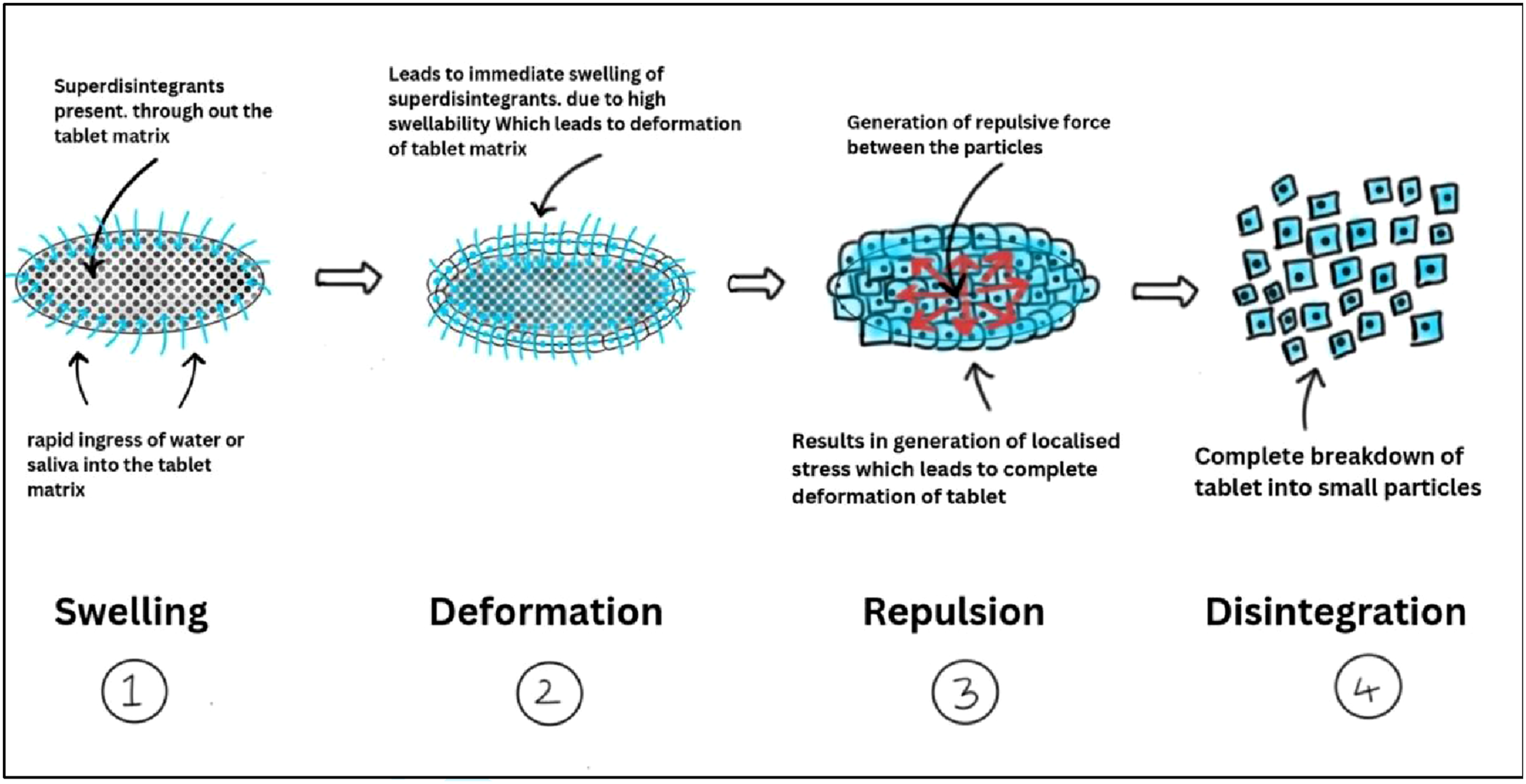
Superdisintegrants are either natural or synthetic in origin; the former being preferred over synthetic ones due to their low cost, biodegradability, and eco-friendly nature. Chitosan is an example of such naturally found superdisintegrants extracted from chitin found in the shells of crabs and shrimps. 32 The potential of chitosan as a superdisintegrants in ODTs was explored by Mengoni et al. using Meloxicam; an analgesic, antipyretic and anti-inflammatory drug as the model API. 33 Medium molecular weight chitosan was found to exhibit better performance compared to other grades due to its suitable rheological and mucoadhesive properties. Chitosan was then compared with other commonly used superdisintegrants including Croscarmellose sodium (CCS) and Sodium starch glycolate (SSG), where it was revealed that inclusion of chitosan refined the physical properties such as tablet hardness (crushing strength), weight variation, compact density, drug content uniformity and the flow properties of granules. Goel et al. similarly demonstrated that ODTs manufactured from an ionically modified glycine-chitosan complex, when subjected to enhanced compressive strength, exhibited a shorter disintegration time in contrast to those made with CCS and SSG. 34 Further, on subjecting the formulation to various other evaluation parameters, it was concluded that chitosan significantly improved the disintegration time and dissolution profile of the ODTs, demonstrating its effectiveness as a superdisintegrants. 35
Other excipients used in ODTs include bulking agents or diluents (e.g., mannitol, directly compressible lactose) and emulsifiers (e.g., alkyl sulfates, lecithin) to promote the bioavailability of poorly soluble. Natural and synthetic sweeteners are added to increase the palatability, and thus the patient compliance of the formulations. A suitable taste masking ingredient may also be incorporated into the ODT. Kazunori et al. developed ODTs of Memantine HCl (MTN). 36 MTN is used in treatment of Alzheimer’s diseases and is a very bitter tasting drug which was masked by coating it with a polymer solution. MTN-loaded taste-masked granules were manufactured in a Wurster granulation system using different polymers such as ethyl cellulose and different grades of Eudragit. A layer of approximately 10 μm was applied and the resulting tablet disintegrated within 20 s satisfying the criteria for ODTs independent of the type of polymer used. The evaluation tests revealed a balance between taste-masking and disintegration profile with mechanical robustness of the dosage form. X-ray CT results exhibited that scarce distribution of the tablet with the granules coated with polymer may be responsible for the faster disintegration. Results of electronic tongue evaluation showed suppression of bitterness of MTN in the ODTs compressed from the polymer-coated granules. Some co-processed excipients like ‘Ludiflash®’, ‘Pharmaburst®’, and ‘F-melt®’ are being used to enhance the quality of formulations, lower the amount of excipients incorporated, and mitigate issues such as poor compressibility, high hygroscopicity, and unsatisfactory flow properties.
Manufacturing of ODTs
There are various types of manufacturing methods which are used in the formulation of ODTs each having their own advantages. 24 The following sections brief on the different methods for fabrication of ODTs emphasizing upon their characteristics merits, and demerits.
The molding method of preparing ODTs is further classified as ‘heat molding’ and ‘compression molding’. In the former, a blend of the drug with sugars such as sucrose or xylitol and agar is added into blister packs. The solvent is evaporated under vacuum and ODTs are formed. The sugars here act both as a binder and a sweetener. The latter process of compression molding involves blending the powder mixture containing the API and solid excipients which is then hydrated using a hydroalcoholic solvent and compressed to form tablets. The solvent is then eliminated by drying. The ‘cotton candy process’ is a preferred technique for formulating bitter-tasting drugs, involving the use of a unique spinning mechanism to develop a crystalline network. Sugars are usually used as the candy floss matrix forming excipients that are exposed to synchronous rapid melting and centrifugal spinning. The prepared network is pulverized, mixed with API and other tableting excipients, and compressed to form ODTs. 37 Another method like ‘mass extrusion’ implies plasticization of powder mixture using water-soluble solvents such as methanol and polyethylene glycol, followed by extruding the deformed mass via a syringe or an extruder to form fine cylinders. 38 The solidified string gel is then crushed to granules which are then compressed to form ODTs. This method also facilitates the taste-masking of APIs by coating the granules with various polymers.
The ‘direct compression method’ is a straightforward process of compressing a blend of API and other solid excipients including superdisintegrants at a lower compression force. The compression force for ODTs is usually in the range of 3 to 8 kN to form a robust tablet while maintaining the required rapid disintegration time. 9 Since direct compression is one of the preferred methods for manufacturing of ODTs, use of co-processed or multifunctional excipients is widely prevalent to facilitate the fine balance of rapid disintegration and enhanced porosity of the tablets with robust mechanical strength. Fouad et al. formulated ODTs of Diacerein, a drug used for treating Osteoarthritis, using the direct compression method. An amorphous solid dispersion of Diacerein was prepared in polyethylene glycol 8000 and then blended with multifunctional excipients such as ‘Prosolv® ODT’, ‘Pharmaburst® 500’, and ‘F-melt®’ and compressed to form the final ODT. Of the three excipients used, ‘Prosolv® ODT’ had the most detrimental impact on the performance of the ODT as was evidenced by its prolonged disintegration time and attenuated wetting ability. The non-hygroscopic contents of ‘Prosolv® ODT’ such as mannitol, crospovidone, and colloidal silica maybe responsible for the delayed wetting of the tablet. Formulations prepared with ‘F-melt®’ and ‘Pharmburst® 500’, on the other hand, showed rapid wetting and disintegration due to their compositions containing crospovidone and sorbitol, respectively. 39 Co-processed excipients also facilitate the co-delivery of drugs to manage symptoms and adverse effects. Mahmoud et al. formulated Pitavastatin calcium (PTS), an antihyperlipidemic drug and Lornoxican (LRX) as a combined ODT by direct compression using various co-processed excipients. 26 This combination has the potential to minimize myopathy/ myalgia caused by statin overuse, thereby ensuring patient adherence. The tabletting parameters were found to be as per the respective specifications. In vivo evaluation revealed that the optimized formulation incorporating ‘Pharmaburst®’ disintegrated instantaneously (6.66 ± 1.52 s) and dissolved equally rapidly (79.07 ± 2.02% of the API dissolved within 10 min). In vivo pharmacokinetic studies revealed that the relative bioavailability of the optimized formulation was significantly attenuated. The relative bioavailability of PTS and LRX was found to be 286.7% and 169.73% respectively, relative to the marketed products ‘Lipidalon®’ and ‘Lornoxicam®’. Thus a single ODT could suffice the simultaneous delivery of two drugs with a substantially improved pharmacokinetic performance.
The ‘sublimation method’ under direct compression is a convenient and inexpensive method for the fabrication of ODTs. The method involves a blend of API and volatile excipients such as ammonium carbonate/ bicarbonate, urea, camphor, or menthol which are compressed. The pressure and temperature involved in the compression of this system results in the evaporation of the volatile excipients leaving behind a tablet with a highly porous and permeable network that enhances liquid absorption due to capillary action, resulting in rapid tablet disintegration. Solvents like cyclohexane/benzene were sometimes employed for further increase in porosity. 30 Mahmoud Mostafa et al. formulated an ODT of Captopril using Camphor as a sublimation agent based on this method. 40 These ODTs exhibited a faster onset of antihypersensive action, improved patient compliance, and were in general more effective and appropriate in acute hypertensive crisis management as compared to conventional captopril tablets which are given sublingually.
Optimization of multiple excipients and inter-related complex processes when done by conventional methods can often be challenging due to the large number of experiments required to be performed and inability to study interactions between the various factors. Statistical-based optimization is performed using various designs such as factorial, full-factorial, box-behnken, central-composite designs etc. The statistical-based optimization methods supported by software such as ‘DesignExpert’, ‘MiniTab’, ‘JMP’, ‘Statistica’ use ANOVA to enable simultaneous optimization of multiple numeric and categoric factors, while also enabling the formulator to understand in detail the effect of the individual factors on response outcomes. A 23 factorial design was employed to examine the influence of three factors such as: type of sublimation agent, concentration of sublimation agent, and concentration of superdisintegrant on three responses: hardness, disintegration time, and dissolution profile. The ‘Design Expert 9’ software was used for the statistical evaluation of the same. On the basis of the results obtained from the software, it was found that the formulation containing 10% camphor as sublimation agent and 5% Ac-di-sol as the superdisintegrant was estimated to be an ideal formulation exhibiting rapid disintegration (17.48 s), suitable hardness (3.425 kilopounds), and faster release (99.51% drug release within 8 min). When subjected to precompression and post-compression evaluations, it was found that the precompression characteristics of the blend and tablet parameters were within the specifications. Drug-excipient interactions using DSC and FTIR revealed no significant interactions and accelerated stability studies confirmed that the formulation remained stable under stress conditions. In vivo studies performed in hypertensive rats, demonstrating a faster reduction in blood pressure compared to conventional captopril tablets.
‘Lyophilization’ is a very critical method for the fabrications of ODTs since it can be conveniently used for thermosensitive drugs and it produces a porous structure that instantly disintegrates on contact with water. In this technique, the drug and excipients are dissolved in an aqueous system, which is then filled in blisters and subjected to lyophilization. The system is frozen below −18°C. following which the system pressure is lowered providing the heat for sublimation of water from the formulation. The drug thus gets entrapped in a water-soluble porous matrix with a large surface area. The tablets prepared by this method have a glassy amorphous structure. The drawbacks associated with lyophilization include the high cost of the process and hygroscopicity of the product. 37 The spray drying method involves drying dispersions of the API with other excipients to form micronized particles with a highly porous structure. The obtained particles are then compressed to form ODTs after blending with the other tableting excipients. Such tablets are highly porous and rapidly disintegrate in the mouth. High cost of operating and maintaining the lyophilizer and poor mechanical strength of the product are the only disadvantages associated with this method. Crystalline Transition Process of developing ODTs involves compression of the API with two saccharides; one with a high compressibility index (e.g., sorbitol, trehalose, and maltitol) and the other with a low compressibility index (e.g., sucrose, mannitol, and erythritol) to form ODTs with a rapid disintegrating property. Reports also suggest the use of microwave methods for the fabrication of ODTs loaded with drugs like Famotidine, Acetaminophen, and Ibuprofen. However, the disintegration and dissolution of APIs from these ODTs was found to be delayed. Hence, it was concluded that this method could only be used for formulation of ODTs loaded with APIs with melting point greater than 110°C. ODTs prepared based on Nanocrystal technology also showed rapid disintegration time.
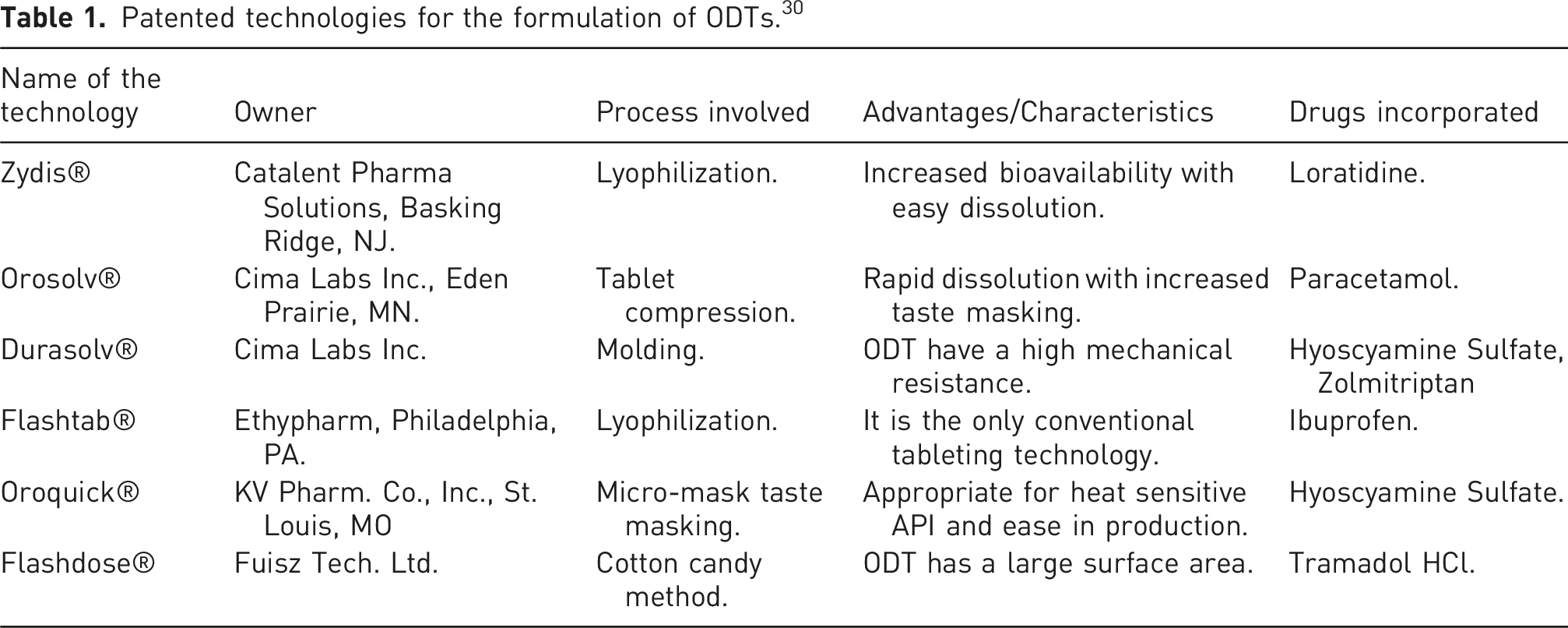
Patented technologies for the formulation of ODTs. 30
Evaluation of ODTs
Characterization of ODTs is necessary to ensure ideal performance and maximum clinical efficacy of the formulation. Precompression evaluation of granules is performed to assess the quality of granules and their suitability for compression. 8 The tests performed herein include angle of repose as a parameter for the flow property of the granules, and density as an indicator of the compressibility of the granules. The compressed tablets are subjected to organoleptic evaluation followed by the regular pharmacopoeial tests such as thickness and diameter, weight variation, hardness and friability, content uniformity. 42 In vitro disintegration is a crucial test performed for ODTs since this is the sole parameter which determines whether the tablet qualifies to be referred to as an ODT. ODTs are subjected to an in vitro disintegration test by placing the tablet in a beaker containing 50 ml of Sorenson’s buffer pH 6.8 or simulated salivary fluid. However, this method of evaluation correlates poorly with the in vivo disintegration of the ODTs and a novel biorelevant in vitro disintegration method for ODTs is the need of the hour. Some accessory evaluation tests specific to ODTs include: uniformity of dispersion, water absorption ratio and mouth/taste sensation and wetting time which are also performed in the case of ODTs to ensure the quality of an ideal ODT is maintained.43,44
Conclusion
ODTs have emerged as a groundbreaking innovation in drug delivery systems. These formulations are particularly beneficial for populations such as children, the elderly, and patients with dysphagia, who often struggle with conventional dosage forms. These formulations dissolve quickly in the mouth, offering ease of administration without water, which improves patient adherence and leads to faster therapeutic effects. The use of innovative excipients like superdisintegrants and taste-masking agents, alongside multifunctional materials, has enhanced both the performance and quality of these products. Technological advancements in production methods such as direct compression, freeze-drying, and hot-melt extrusion have enabled the creation of formulations with improved bioavailability and mechanical integrity. Nevertheless, challenges like optimizing drug content, maintaining the balance between durability and quick disintegration, and developing more robust packaging still exist. As research progresses, innovations like 3D printing and personalized medicine are expected to broaden the applications of ODTs and ODFs. These advancements will ensure more efficient, patient-friendly drug delivery solutions, ultimately shaping the future of pharmaceutical care.
Footnotes

Funding
The author(s) received no financial support for the research, authorship, and/or publication of this article.
Declaration of conflicting interests
The author(s) declared no potential conflicts of interest with respect to the research, authorship, and/or publication of this article.