






Abstract
In the Australian early childhood sector the role of educational leader emerged as part of a very large process of policy reform that began in 2009. The position of educational leader was established to drive the quality improvement requirements of the reform, but many organizations did not establish these positions until several years after the reforms were introduced. Lack of clear role descriptions and authority make it difficult for educational leaders to fulfil the expectations held of them. This study examines the sense leaders make of the policy reforms and the street-level bureaucracy they perform to translate the policy into action. This sense-making and street-level bureaucracy is taking place in a neoliberal context where, we argue, the demands for professional discretionary decision-making are in conflict with the top-down standardization inherent in neoliberalism. Educational leaders have the potential to challenge neoliberalism through their professional decision-making but, in the Australian context, many are currently focusing on compliance with their street-level bureaucracy.
Introduction
In Australia, the role of the early childhood educational leader (ECEL) emerged as part of a major policy reform agenda that began in 2009. ECELs are tasked with the responsibilities of implementing policy and mentoring other educators in their service to meet the policy definitions of good quality. In order to carry out these responsibilities, ECELs first have to make sense of the practices identified in the legislation, policy and curriculum documents before they can then model, assist with and insist on compliance from their colleagues at their centres. There is currently a lack of information and guidance for those in ECEL roles – their responsibilities, recommended qualifications and the expectations held of them. Role descriptions are developed locally and there is no state or national consensus of what these might contain. Lines of authority are also unclear and these factors all combine to make it difficult for ECELs to understand and fulfil the expectations held of them. The relative newness of the ECEL position, and the complex political and professional environments in which these roles are being enacted, all contribute to uncertainty and confusion. In this study, we set out to explore what sense ECELs make of the policy requirements and their understanding of their own roles and responsibilities, including their understanding of their work with other educators within their centres. Our aim is to contribute to ongoing clarification and evolution of the ECEL role in Australia by presenting findings from a national study. Sharing these findings with those working in early childhood contexts outside of Australia can enhance understanding of the contextual complexities of the ECEL role and assist in reshaping future policy reform.
Educational leadership
Leadership can take a variety of forms and in recent literature it has been positioned as instructional (e.g. Salo et al., 2015), pedagogical (e.g. Male and Palaiologou, 2012), leadership for learning (as identified in Bush, 2014) and an activity that conflicts with the need for management (Mertkan, 2014). What emerges from this plethora of work is that leadership is complex, and there is growing agreement that one person cannot do it all (Kangas et al., 2016). In the early childhood sector there is an additional complication, the reality that early childhood leaders lack the profile and status of school leaders (Coleman et al., 2016). Given the importance of contextual influences on leadership and the acknowledgement that leadership in early childhood impacts substantially on children’s outcomes (Male and Palaiologou, 2012), exploring how leadership operates in different early childhood sectors internationally supports the construction of a shared understanding of essential elements and their influence and effectiveness across different contexts. With this aim, the article examines the Australian context by sharing the findings of a national survey that set out to capture the experiences of ECELs in this country.
Contextualizing early childhood educational leadership in Australia
In the Australian early childhood sector the role of ECEL emerged as part of a very large process of policy reform that began in 2009 (Sims et al., 2015). Arising from this was the National Quality Framework (NQF) (Australian Children’s Education and Care Quality Authority, 2011b), the National Quality Standard (NQS) (Australian Children’s Education and Care Quality Authority, 2011c) and a curriculum document, the Early Years Learning Framework (EYLF - the national early years curriculum framework) (Department of Education, Employment and Workplace Relations, 2009). Early childhood organizations are required to participate in a quality assurance process, which gives rise to a rating of their performance. This information is freely available for public access and is supposedly useful for parents in choosing an early childhood service for their child.
Sanctions are put in place if organizations do not meet the required standards and the ultimate sanction is the forced closure of a noncompliant centre. The role of the ECEL was developed to oversee the ‘the development and implementation of the educational programme (or curriculum) in the service’ and the person in this role must ‘be able to guide other educators in their planning and reflection, and mentor colleagues in their implementation practices’ (Australian Children’s Education and Care Quality Authority, 2011a: 85). ECELs are tasked with ensuring that their organizations do not experience the ultimate sanction but, instead, do well in achieving a high rating during the accreditation process. It is important to note here that these Australian reforms positioned the role of ECEL as separate from that of service manager/staff line manager. In this sense, the development of the role of ECEL was clearly influenced by the idea of distributive leadership, an approach to leadership particularly popular in school education because of its demonstrated positive impact on student learning outcomes (Karadağ et al., 2015).
Implementation of these reforms was incremental and, in many cases, organizations did not appoint ECELs until around 2012 (Fenech, 2013). However, despite the vast literature relating to distributive leadership, the lack of guidelines and minimal reference to the ECEL role in policy (the statements quoted above are the only policy guidance provided), it is becoming evident now, five years later, that ECELs remain somewhat confused as to their role (Fleet et al., 2015; Sims and Waniganayake, 2015, Waniganayake and Sims, in press). It is important to emphasize for an international audience that there is currently a lack of information and guidance for those in ECEL roles – their responsibilities, recommended qualifications and the expectations held of them. Role descriptions are developed locally and there is no state or national consensus of what these might contain. Lines of authority are also unclear and these factors all combine to make it difficult for ECELs to understand and fulfil the expectations held of them (Rouse and Spradbury, 2016). Anecdotal evidence suggests that smaller centres often combine the role of ECEL and service manager/co-ordinator/director, creating further confusion in attempts to identify the elements of the ECEL role.
Enacting early childhood leadership in Australia in a neoliberal context
Further complicating the enactment of the ECEL role in Australia is the reality that this work is being performed in a context of increasing managerialism where the neoliberal emphasis on top-down compliance checking focuses the ECELs’ attention on what they need to do to obtain and keep their centre’s accreditation (Sims and Waniganayake, 2015).There is a growing literature questioning the efficacy of this neoliberal approach as it is applied in education (for example Furedi, 2017; Giroux, 2015), particularly given that the overarching impact of neoliberalism has been to sideline critical thinking and focus instead on learning pre-approved, standardized material (Giroux, 2015). Furedi (2017: 14) claims that neoliberalism assumes that ‘citizens cannot exercise independent judgement’ so governments and private institutions ‘are entitled to manage and influence the behaviours of individuals in order to ensure that they make the ‘right’ choices’. Ultimately, this has resulted in the loss of personal freedom and it is now evident that freedom of expression is considered less important than the need to protect people from feelings of discomfort or emotional pain generated through hearing ideas they don’t like or with which they don’t agree. This is identified as the most significant risk to democracy ever experienced in modern times (Giroux, 2015) and, according to Chomsky (2016), is responsible for the disappearance of democracy across Europe and, possibly more recently, in the USA. In Australia, this neoliberal climate is evident in the early childhood policy reforms that emphasize compliance to pre-determined standards of quality. ECELs, who are themselves products of the neoliberalist culture, are placed in a role where they are told they are responsible for monitoring compliance with the policy regime and, in doing so, are perpetuating the very neoliberal regime that produced the unthinking citizens who concern Furendi, Giroux and Chomksy.
Enacting early childhood leadership in a context of growing professionalism internationally
Another level of complication impacting on the role of ECELs is the growing desire internationally for the early childhood sector to become professionalized (Chalke, 2013; Cooke and Lawton, 2008; Sims and Pedey, 2015; Sims and Tausere-Tiko, 2016; Skattebol et al., 2016). Professionalization requires members of the in-group to have discretion in their decision-making in order to determine for themselves what they will accept as best practice (Evans, 2010). In other words, leadership goes hand in hand with the expectation of discretionary decision-making authority. In the early childhood arena, discretionary power is necessary, because the situations in which ECELs have to practise are complex, and best practice cannot be pre-determined in a one-size-fits-all approach (Lipsky, 2010).
Enacting leadership at the intersection of neoliberalism and professionalism
The professional requirement for discretionary decision-making powers is in conflict with the neoliberal requirement for increasing top-down control and compliance with pre-determined quality indicators designed to control professional practice. Evans (2011) for example, argues that the ability of professionals to exercise discretion in their decision-making may counter this neoliberal pressure for compliance, but that this ability is limited by their feelings of self-efficacy and competence. In Australian early childhood centres, where ECELs are occupying positions characterized by uncertainty with little or no authority, emerging research (e.g. Rouse and Spradbury, 2016) suggests that it is likely that their professional confidence is somewhat impaired and, we argue, this increases the risk that they will focus on compliance.
In summary, the early childhood sector policy documents and accompanying legislation driving early childhood sector reforms in Australia identify best practice, and appropriate performance of this defined best practice leads to service accreditation. ECELs are tasked with the responsibilities of implementing this practice and also mentoring other educators in their service to do so. In order to carry out these responsibilities, ECELs first have to make sense of the practices identified in the legislation, policy and curriculum documents before they can then model, assist with and insist on compliance from their colleagues at their centres. The relative newness of the ECEL position, and the complex political and professional environments in which these roles are being enacted, all contribute to uncertainty and confusion. In our research, we set out to explore what sense ECELs make of the policy requirements, their understanding of their responsibilities in performing best practice and their understanding of their work with other educators to enhance their performance of best practice. Our aim is to contribute to ongoing clarification and evolution of the role in the Australian context and create an opportunity for sharing findings with those working in ECEL contexts outside of Australia in order to increase understanding of the contextual complexities of the ECEL role.
Research approach
This is a mixed methods study using a pragmatist epistemology/ontology following the approach of Feilzer (2010). In order to explore the understanding ECELs have of their roles we use two theoretical frames of analysis: Lipsky’s (1980, 2010) concept of ‘street-level bureaucracy’ and the concept of ‘sense-making’ proposed by Weick and colleagues (Weick, 1979, 2012; Weick et al., 2005). The implementation of early childhood policy reforms designed to improve the quality of early childhood organizations across Australia depends on various groups interpreting the policy and enacting it, a process of sense-making. Sense-making is an ongoing process, so ECELs simultaneously interpret policy to shape their understanding of their roles and responsibilities, act upon the sense they have made, then re-interpret and act again. This process of making sense of their roles and responsibilities (i.e. developing their understanding) depends in part on their own beliefs (Henneberg et al., 2010), in part on the ways in which they have previously operated in the workplace (Coleman et al., 2010; Gong and Janssen, 2012) and, in addition, on being able to link or bundle what they have done before with what they think they are required to do under the new policy regime (Kostka and Hobbs, 2012). ECELs thus draw meaning from policy according to what is relevant for their contexts and their own practice. In turn, they use that sense-making to shape the way they work with other educators in their mentoring role and in the way they seek to shape staff performance into compliance with the policy. In this sense, they are working as street-level bureaucrats as defined by Lipsky (1980: xii), who argues that public policy: is actually made in the crowded offices and daily encounters of street-level workers…the decisions of street-level bureaucrats, the routines they establish, and the devices they invent to cope with uncertainties and work pressures, effectively become the public polices they carry out. Who are the ECELs? What sense do ECELs make of their leadership role? How do ECELs use their sense-making as street-level bureaucrats to shape their performance in this role?
Participants and methods
During 2015–2016, we recruited 164 early childhood educators who were employed as ECELs. Participants came from around Australia (from 107 different postcodes we identified 61 from NSW, 38 from Victoria, 12 from Queensland, 4 from Western Australia and 2 from Tasmania; the remainder were not provided) and were recruited via a range of online strategies: Email: Members of our research reference group circulated a recruitment email around their professional networks. E-newsletter: We placed a call for volunteers in a weekly e-newsletter released by a key national early childhood organization. Web page: We placed a call for volunteers on both the web pages of a key information-sharing children’s organization and those of a large corporate provider of early childhood programmes.
There is no national database of ECELs and we understand anecdotally (in the absence of any other form of information), that whilst many early childhood services have officially appointed a member of existing staff into the mandated ECEL role, not all of these services have provided an official job description. Not all those appointed into the role are given time release to perform the functions of the role and there is no official mandate requiring them to do so. Thus, we have specifically asked the first research question in order to describe the participants in the study. We have chosen to refer to the participants as ‘our ECELs’ to make it clear that we do not claim these participants are representative of all Australian ECELs or even any subgroup of Australian ECELs.
Potential volunteers were given the link to a website where full disclosure information was available and, with informed consent, they proceeded to answer an online survey. In addition to collecting standard demographic data, we asked participants to use rating scales and provide open-ended text answers. The survey was developed specifically for this study. Readers interested in the survey may seek a copy from the authors.
Analyses
Descriptive statistics were calculated for qualitative variables and cross-tabulations performed. Tests of significance used depended on the format of the variables (nominal or interval scaling). These were Somers’ D for ordinal x ordinal comparisons, and Uncertainty Coefficient for nominal x nominal, and nominal x ordinal comparisons (relevant statistics are reported for each analysis below). All quantitative analyses were performed using IBM SPSS Statistics 21.
We also used a process of constant comparison as initially described by Glaser (1965) to analyse the qualitative data from the open-ended questions. This involved reading and re-reading the texts, identifying themes, using quotes to delineate the boundaries between themes and using quotes to exemplify themes.
Ethical issues
The study was approved by the base university Human Research Ethics Committee which follows the nationally mandated NHMRC ethical guidelines (National Health & Medical Research Council et al., 2007 [updated 2015]). We had no direct contact with participants who were free to choose to participate or not as they wished. The survey was anonymous. We relied on participants’ self-identification of their position as ECELs. Although we asked for formal job descriptions very few of these were provided (more recent anecdotal experience indicates that a number of ECELs do not as yet have formal job descriptions). The survey was structured so that participants could choose not to answer certain questions and so that they could exit and return later or exit without completing. Because of this flexibility the numbers completing each question are identified in the analyses below. Participants could receive the results of the study by emailing a member of the research team separately from the survey.
Limitations
Recruitment was based on self-identification and it is evident from the data that some participants were not working directly with children in an ECEL role; we can only assume that these participants felt they had sufficient authority to present their views on this role. Due to the absence of a national database of ECELs there is no way to determine if those included in our study in any way reflect a representative sample or the diversity of ECELs in Australia.
Results
The following sections address each of the research questions in turn.
Who are the ECELs?
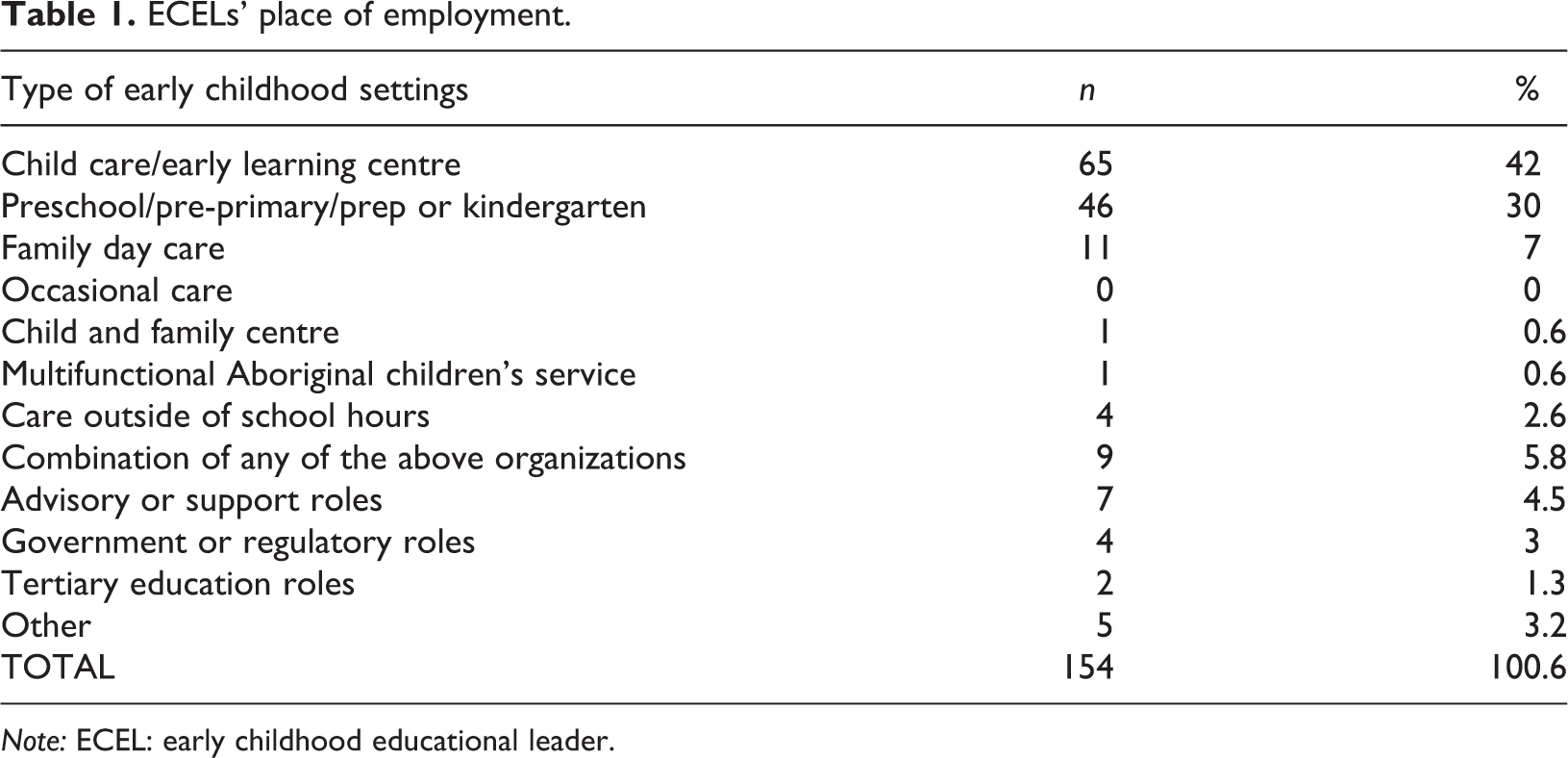
Most of our ECELs worked in child care centres, in family day care (provided within the educator’s family home) or in preschool/pre-primary/prep or kindergarten. Note that in Australia, terms can differ between states and territories, and the latter refer to the organizations attended by children in the years before compulsory schooling starts at six years of age. For ease of reference in this article, we use the term ‘early childhood settings’ when referring to all the different types of services being offered through the diverse organizations listed in Table 1.
ECELs’ place of employment.
Note: ECEL: early childhood educational leader.
Given that we had requested participants to self-identify (based on the definition given in the legislation), place of employment gave us the opportunity to examine the participants and determine how many were working directly with children. We note that the self-inclusion of those in advisory, support, regulatory and tertiary education roles (albeit small – 18 individuals or 11.7% of the sample) suggests that the definition of who is an ECEL is still unclear, and continues to encompass those who appear to be performing roles other than those which involve them in working directly with children. Nearly half the participants (i.e. n = 65, 42%) were employed in a child care centre catering for children from birth to 5 years, and open 5 days of the week for at least 48 weeks of the year. The second biggest cluster of participants (i.e. n = 46, 30%) were located in preschools attended typically by children of three to five years of age. If funded by governments, these are usually closed for 10 weeks of the year following the same timetable of primary schools. The majority of the early childhood settings were nonprofit (n = 122, 80.5%). Approximately two-thirds (n = 99, 65%) of our ECELs had worked in sectors other than early childhood at some point in their careers, and of these 32% (n = 49) had positive experiences of working with a leader in these settings.
ECELs were more likely to be female (n = 158, 97.6%) and to have worked in early childhood for at least 10 years, although a very small number (n = 2) were placed in leadership positions in the first year of their employment in early childhood settings. We found no relationship between the type of qualification and: the length of time people had worked in early childhood; the length of time they had worked as an ECEL; their previous early childhood experience (i.e. experience mainly working face to face with children, experience mainly in management or a mixture of these two); or if they had functioned as an ECEL informally before they were formally appointed. This was somewhat surprising because, anecdotally, there is a perception that degree-qualified graduates walk into leadership roles as ECELs and/or centre directors and are preferred in these roles over those with diploma qualifications. This was not the case with our participants.
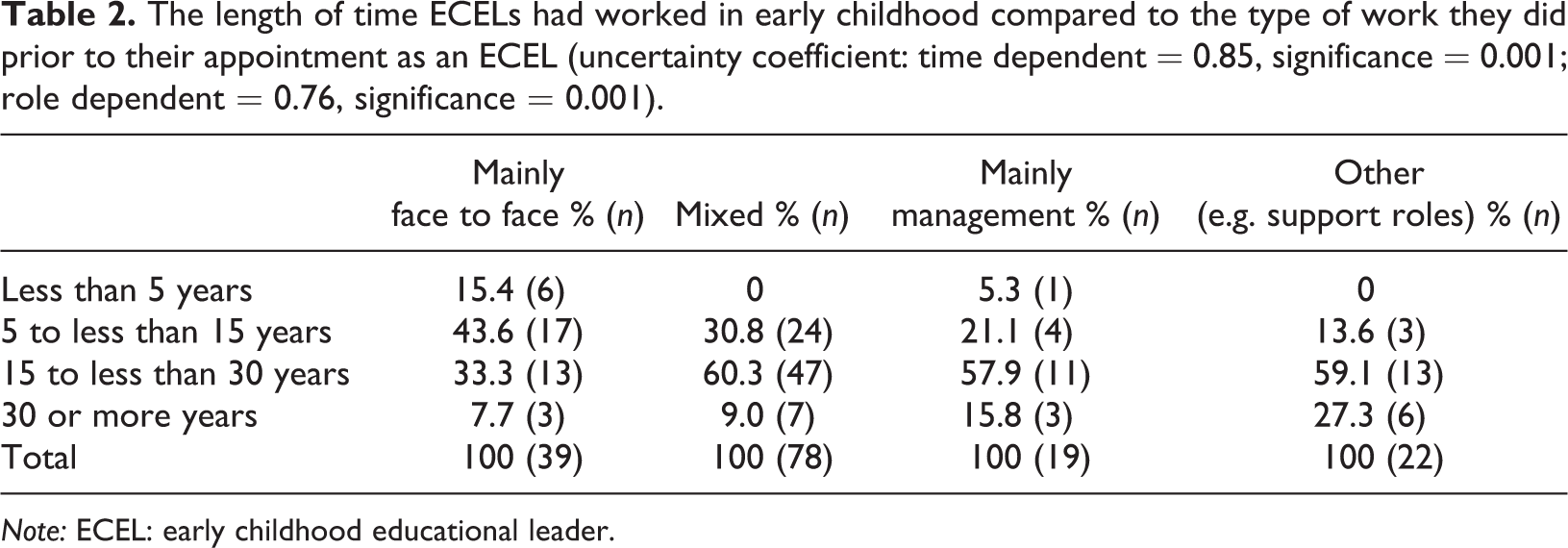
As can be seen in Table 2, with increasing experience, face-to-face contact with children decreased. The majority of our ECELs had worked face to face with children in the past, either in mainly face-to-face positions, or in positions where they mixed face-to-face experience with management. However, some had minimal face-to-face experience and came into the ECEL role with mainly management experience. This is interesting, because the ECEL role is about improving the quality of face-to-face work with children, and an ECEL with little experience of this work may struggle to offer appropriate mentoring. There was no significant difference between the qualifications held and the type of previous experience; however, when we compared the length of time our ECELs had worked in early childhood with the type of previous experience we see that management experience is significantly associated with a longer time in early childhood. Many of our participants appeared to have moved into mixed management/face-to-face or management only roles the longer they had been in the profession. Leaders who had less than five years’ experience in early childhood were more likely to be appointed if their past experience was in face-to-face work with children. In comparison, leaders who had many years of experience in early childhood were more likely to be appointed into an ECEL role if their experience was much broader, incorporating management and other experience (such as working in support roles).
The length of time ECELs had worked in early childhood compared to the type of work they did prior to their appointment as an ECEL (uncertainty coefficient: time dependent = 0.85, significance = 0.001; role dependent = 0.76, significance = 0.001).
Note: ECEL: early childhood educational leader.
The majority of the participants who answered our questionnaire had been in their leadership roles for 2–4 years (n = 69, 42%), reflective of the time lag between the reforms started in 2009 and the implementation of these progressively over the following years. Some (n = 24, 18%) had been an ECEL for 5 years or more and a smaller number for less than 12 months (n = 15, 11.4%). Just over half of the participants (n = 85, 59.4%) had been functioning as an informal ECEL before being formally appointed, although just over a third currently had a job description that identified what was expected of them as an ECEL (yes n = 56 or 38.4%, no n = 90 or 61.6%). This reflects the current state of uncertainty about the ECEL role and responsibilities.
What sense do ECELs make of their leadership role?
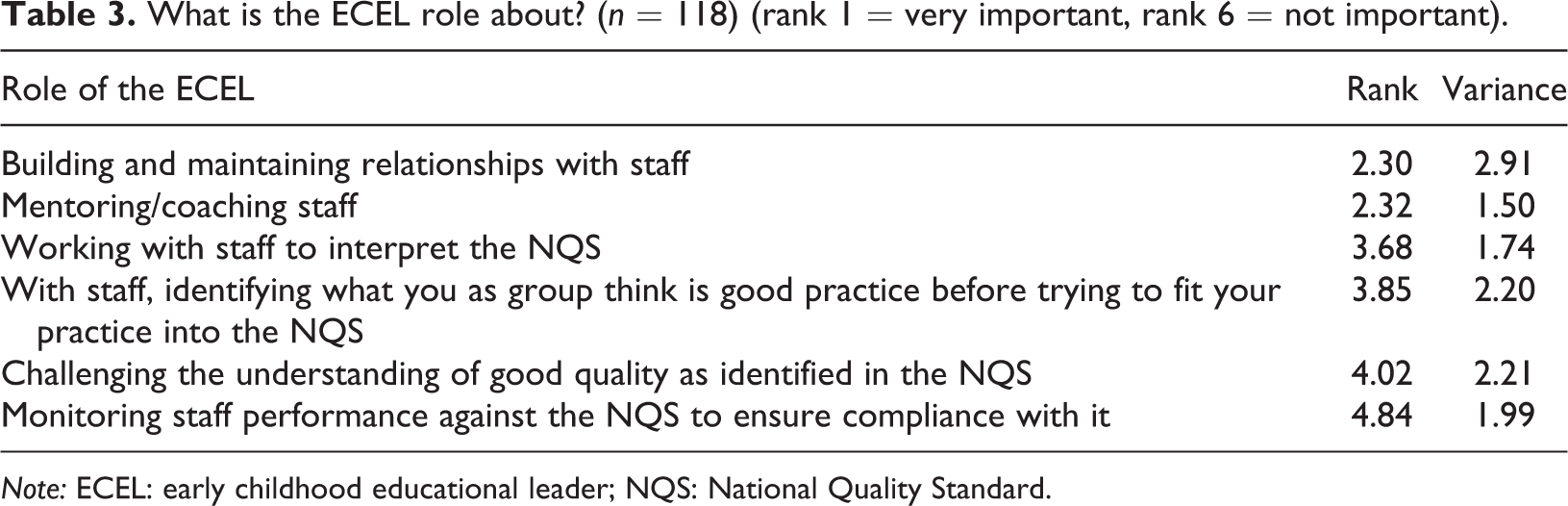
Table 3 demonstrates the average rankings given by our ECELs to different elements of their role. Overall, they rated the relationship work with staff and the mentoring they offered as really important. There were no significant differences in the way our ECELs perceived their roles on the basis of their age.
What is the ECEL role about? (n = 118) (rank 1 = very important, rank 6 = not important).
Note: ECEL: early childhood educational leader; NQS: National Quality Standard.
In the following tables we have combined categories in order to ensure appropriate numbers in each of the cells. Ratings of roles have been reduced from a 6-point to a 3-point scale (ratings 1 and 2, 3 and 4, and 5 and 6 are combined to reflect important, a middle ground and not important). Table axes identify the categories used in the analyses.
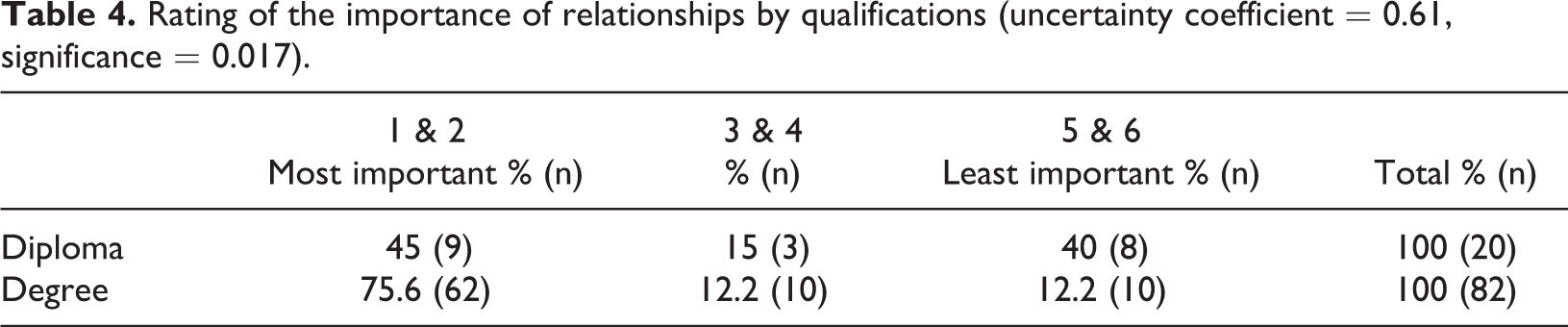
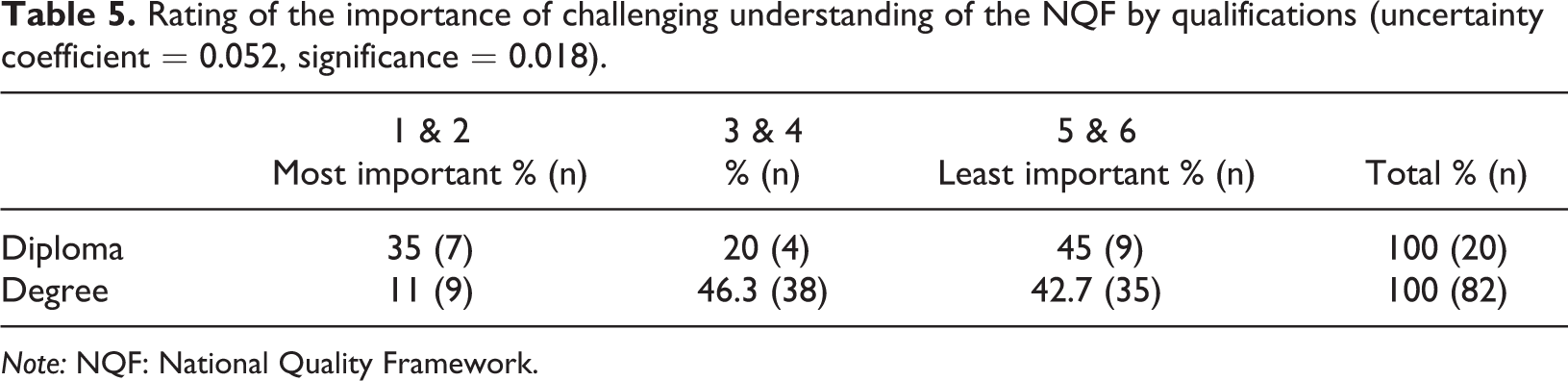
In terms of how their professional qualifications impacted on the way in which our ECELs perceived their roles (see Table 4 and 5), degree-qualified leaders were more likely to believe relationships were important and more likely to be ambivalent about their role in challenging the NQF than were diploma-qualified ECELs (note that numbers in other qualification groups – e.g. certificates, no qualifications, qualifications beyond degree level – were too small to include in the analyses). There were no significant differences between diploma- and degree-qualified ECELs in their reported valuing of monitoring compliance: most (91 out of 97) identified it as an unimportant element of their role (this idea will be explored further in the next section as there appears a disjunction between their sense-making and their acts of street-level bureaucracy in relation to compliance work).
Rating of the importance of relationships by qualifications (uncertainty coefficient = 0.61, significance = 0.017).
Rating of the importance of challenging understanding of the NQF by qualifications (uncertainty coefficient = 0.052, significance = 0.018).
Note: NQF: National Quality Framework.
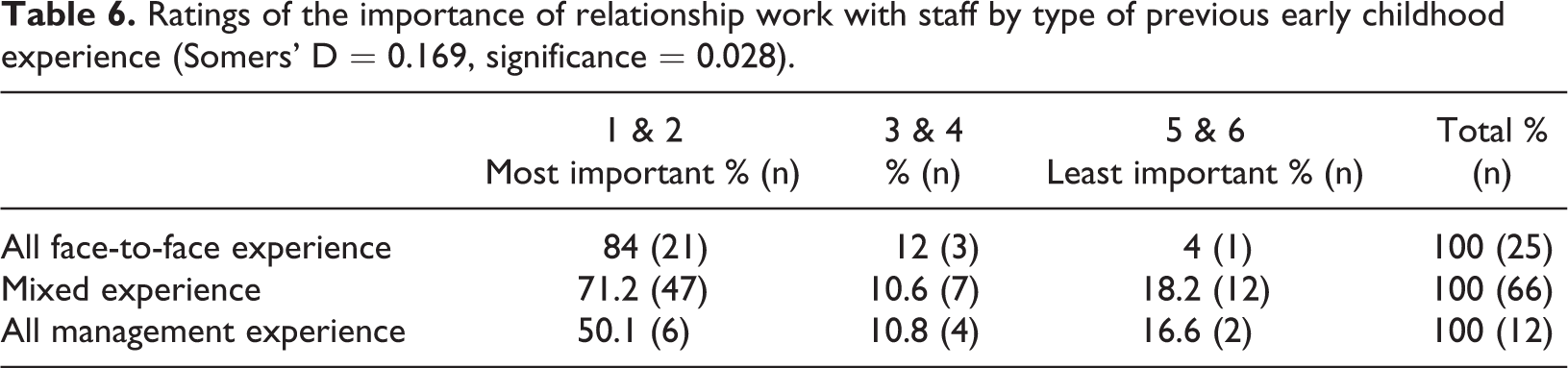
Our ECELs were generally likely to rate building and maintaining relationships as a very important part of their role irrespective of their experience in early childhood; however, those who had previously worked mainly face to face with children were more likely to consider this important (see Table 6). Those who rated building and maintaining relationships as not important were more likely to have had a mixed background of face-to-face work with children and management or a management background only. The differences were significant. It appears the more management experience our ECELs had, the more likely they were to devalue relationship work. There were no other significant differences between those with different background experiences in their rating of the importance of various elements of the leadership role.
Ratings of the importance of relationship work with staff by type of previous early childhood experience (Somers’ D = 0.169, significance = 0.028).
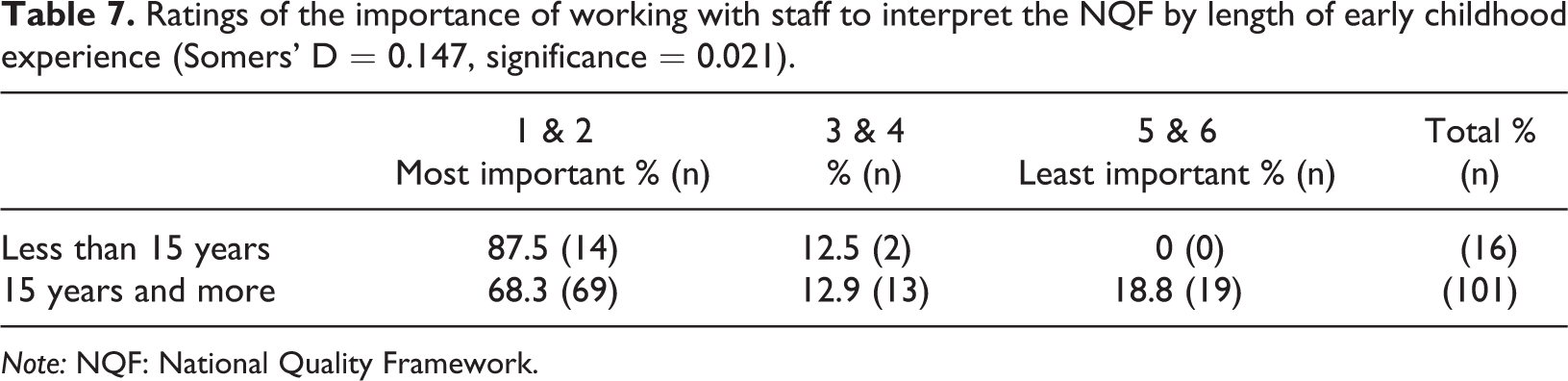
This is mirrored in the significant relationship found between the length of time our ECELs had worked in early childhood and their rating of the importance of relationships (given the small numbers in some of the groups we recoded length of experience in early childhood into two categories as below in Table 7). Our ECELs rated this as crucial or very important but the longer they had worked in early childhood the less likely they were to do so. This appears in contrast to the qualitative data discussed below and we will explore this issue further as we examine ECEL acts of street-level bureaucracy.
Ratings of the importance of working with staff to interpret the NQF by length of early childhood experience (Somers’ D = 0.147, significance = 0.021).
Note: NQF: National Quality Framework.
Thus, we see a shift in sense-making about the ECEL role over time, with our ECELs putting less emphasis on relationship work as their experience in the sector increased, and as they gained more experience in management roles. Degree-qualified staff were also more likely to rate the relationship element of their ECEL work as important and less likely to see their role as challenging interpretations of the NQF. In the following section we will use the qualitative data to explore how ECELs use their sense-making to shape their work.
How do ECELs use their sense-making as street-level bureaucrats to shape their performance in this role?
Examining the qualitative data gives a better understanding of the way our ECELs think about their roles and how their sense-making impacts on what they say and do. Whilst they indicated above that relationship work is a key part of their role, the qualitative data shows that this relationship work is positioned around aligning their practice with what is defined as high quality in the NQF (Australian Children’s Education and Care Quality Authority, 2011b). Here, they talked about monitoring practices to ensure they met the standards required of practice in the NQF. In particular, they noted the importance of monitoring pedagogical documentation. In the Australian context, pedagogical documentation refers to written observations, programme plans and evaluations developed for each child: Support educators in building their understanding of the NQF and EYLF, develop documentation systems, embed reflective practice, model pedagogical practices, reading and research, sharing information with colleagues, developing and implementing professional development plans for educators, monitoring LDCPLP funding, monitoring pedagogical documentation. (ECEL 47) monitoring and checking programming – ‘monitoring programming and planning and documenting of children’s learning that is done by all staff’ (ECEL 92), ‘oversee staff programmes and documentation’ (ECEL 78), ‘monitor how many observations the team are doing, inform management of their quality and quantity’ (ECEL 85); creating and managing the Quality Improvement Plan – ‘each year I am in charge of reviewing and putting together our QIP together with staff and families’ (ECEL 95); developing policies and procedures – ‘I work in partnership with the director to develop policies and procedures’ (ECEL 38); allocating workloads – ‘critically appraise practice, workloads, documentation’ (ECEL 6); making sure the service is compliant with the regulations – ‘ensure all regulations are being met’ (ECEL 80).
Our ECELs also took responsibility for a range of management/administration tasks which might in other circumstances be allocated to a line manager. These roles included: performance reviews – ‘performance reviews and identification of PD requirements and opportunities’ (ECEL 77); general administration – ‘I am also collecting the mail, checking the email, doing the shopping, paying the bills, organizing rosters for laundry and lawnmowing, it goes on and on’ (ECEL 65).
This overlap between the role of the ECEL and the service manager was identified by ECEL 76 who described herself as having a ‘shared leadership with the service manager’. This confusion is evident in the words of other of our ECELs: confusion around the delineation between the ECEL role and a line management role, and confusion (presumably because of the lack of clear guidance for the role) around what is expected of ECELs: My current understanding of educational leader is a little bit confusing. I supported students in my room but I don’t actually have to worry about students in other rooms because the other room leaders are supporting them. I have the meeting once with the room leaders but they think they already knew everything so I don’t push my own agenda. I only support my assistants and students in my room. (ECEL 67) general advocacy – ‘strong advocacy role’ (ECEL 120); advocacy for children – ‘advocate for children’ (ECEL 6); advocacy for better practice – ‘advocacy and better practice throughout our setting. I support educators with ideas, thought provocation, proofreading and support with their studies and also with resources.’ (ECEL 87); communicating with parents to support parents’ understanding of the educational programme and practice – ‘to support parents’ understanding of the educational programme and practice and to promote the role of early childhood education in the community and wider community’ (ECEL 90); community advocacy – ‘to be able to promote early childhood and communicate on all levels with other educators, director, parent committee, families and the wider community’ (ECEL 15, also see ECEL 90 above); networking with school teachers and principals – ‘We also liaise with our committee relating to our programme content, etc. We do, on occasions, utilize our local schools and have contact with principals and co-ordinators in relation to our students’ (ECEL 56).
Only two of our ECELs talked about challenging current understanding as a component of their role: ‘provoking thought about how we can extend and improve the experiences we provide which scaffold children’s learning’ (ECEL 69); and ‘To be an advocator of high quality. What do I do? To be the best role model I can be for the educators, children and families’(ECEL 15).
ECEL 19 is the only person who identified a social justice framework to his/her work: I mentor preservice teachers, supporting them to think critically about the work they do and the relationships they have with children and their families. I challenge them to think about the ways they can actively create a more socially just and inclusive environment for children and families. (ECEL 19)
Challenging the NQS was positioned by some as important in improving quality: ‘I believe it is our duty to challenge anything that is not working and contribute to finding solutions’ (ECEL 1); and ‘We challenge the NQS in many ways to ensure our practices occur because we believe them to be best practice rather than practice that is mandated by an outside authority’ (ECEL 6).
Our ECELs highlighted a range of strategies they used when indicating how they challenged the NQS (note that challenging appears to mean different things to different participants and that, for a lot of them, challenging was more about complying). For many, discussions with staff in their centres were very important in identifying where there were concerns (where things were not working) and these discussions were used to help them make their own decisions about what was best practice in their own context. Sometimes, this was done through professional conversations: ‘bringing up the NQS consistently, drawing out professional conversations, challenging educators’ way of thinking, their actions and working with reflection’ (ECEL 56). At other times it was done through professional reflection with the support of the leader: ‘Reflective practice, critical reflection, reviewing the quality improvement plan, being honest, having an attitude that it is okay if it did not work let’s rectify’ (ECEL 11).
Other of our ECELs talked about discussions held outside their centres. For example, ECEL 1 talked about committee roles with other early childhood organizations and her involvement in an educational leaders’ network as useful strategies to help her challenge the status quo: In regards the NQS I believe it is our duty to challenge anything that is not working and contribute to finding solutions. To that end I have been an active member on many organizational committees, including vice-chairperson of X, committee member of ECAX branch and convener of the newly formed educational leaders network X. I have contributed to many discussion forums both formal and social media based. Advocated for recognition of ECEC educators, and most recently tweeted and Facebooked Minister Simon Birmingham in relation to terminology and titles of people working within ECEC. (ECEL 1)
Some of our ECELs also mentioned that social media was a useful tool which helped them make these connections and have ‘discussions’: ‘In a personal capacity I actively participate in conversations to critically analyse these requirements – this mostly occurs on social media platforms’ (ECEL 70).
Discussion
In this section we present the results in terms of the two key theories we have used to conceptualize this study: sense-making and street-level bureaucracy. In doing this, we focus on two key elements of leadership work: that of building and maintaining relationships and the tension between compliance and resistance.
Sense-making and street-level bureaucratization of relationship work
The qualitative data suggest that despite indicating relationship work was held in high regard, this work is less valued the more time our ECELs spent in the early childhood sector. Their sense-making around relationship work, and the way in which they actually implemented this work, was focused around mentoring, guiding and shaping the work of educators to comply with their understanding of the policy directions. In other words, their acts of street-level bureaucracy were focused on attempting to comply with what they understood the policy to require. This is supported by their claims that key elements of their role were: monitoring pedagogical documentation (to make sure it was at the required standard for accreditation); monitoring and checking programming (for the same reasons); and developing and monitoring the quality improvement plan (an integral part of the accreditation process). They identified that nearly a third of their time as leaders was spent on these monitoring tasks.
All of these elements of work, whilst embedded in a relationship discourse, suggest that at the street level their focus was on ensuring compliance to the policy based on the ways in which they had made sense of what was required. The extent to which our ECELs are themselves aware of how their focus on compliance work is shaping their relationships with other educators is difficult to assess in our data. The fact that they tended to discount their compliance work and focus on relationships suggests that they may not be fully aware of this.
Many of our ECELs had worked for some time (at least 15 years) in the early childhood sector and, for most, this previous experience was in face-to-face work with children. The longer they had been in the sector the more likely they were to have had previous management (i.e. traditional management) experience. This background experience is likely to have impacted on how they made sense of the new policy agenda and, indeed, our data demonstrates that those of our ECELs who had had previous management experience were likely to rate relationships as less important.
Whilst the importance of relationships is present across much of the EYLF (Department of Education Employment and Workplace Relations, 2009) this is in the context of educator relationships with children and families, and children’s relationships with each other and the world around them, not in the context of educator to educator relationships. In contrast, the NQS (Australian Children’s Education and Care Quality Authority, 2011c) identifies leadership as ‘a relationship between people and the best leaders are those who are able to empower others. They listen to differing views, recognize and address areas of potential conflict, and engage and manage teams through change processes.’ In addition, Standard 7.1 states: ‘Effective leadership promotes a positive organizational culture and builds a professional learning community’ (Australian Children’s Education and Care Quality Authority, 2011c: 173), but the relationships to which it refers are those with children and families, not with staff. The discussion accompanying Element 7.1.4 (the element that specifically identifies the ECEL) implies interactions with staff. In relation to this standard, the assessors who visit early childhood settings for accreditation purposes are tasked to look for ‘what strategies and processes the educational leader uses to lead the development of the curriculum and set goals for teaching and learning’ and may cite ‘professional conversations’ (Australian Children’s Education and Care Quality Authority, 2011c: 178), but relationships with staff are not explicitly mentioned.
This is worth exploring because there is a clear disjunction between the concept of leadership as consisting of relationship work (a position held for many years by the ‘nice ladies’ who worked in early childhood), the literature that addresses the feminine aspects of leadership (Due Billing and Alvesson, 2000; Hard, 2005; Hard and Jónsdóttir, 2013; Vinkenburg et al., 2000) and the positioning of leadership in the policy documents (policy documents as identified above, with the implication of a distributive model but no clear guidance). We see ECELs struggle with this disjunction in their own sense-making, drawing on their experience in the feminized early childhood sector (Nupponen, 2006) where relationship work is valued, but at the same time undermined by the absence of this discourse in the policy documents, at least as far as relationships with staff are concerned. The study data suggested that previous experience in management roles seemed to negate the value of relationship work, presumably because these leaders were exposed to a managerial approach. We wonder, with increasing time, if the feminized positioning of leadership as relationship work will stand alongside, or be subsumed by, the managerial work performed by these ECELs.
Sense-making and street-level bureaucratization of compliance and resistance work
Challenging policy did not appear to translate into advocacy. In the past, advocacy about the importance of early childhood work, and about the need to increase the esteem in which the work is held, was considered an important part of early childhood work (Dalli, 2010; Rodd, 2012). The ECELs in our study, when they talked about advocacy, positioned it as advocacy for children and communicating with parents in attempts to have educators’ work with their child better understood. It appears that the majority of the advocacy arising from sense-making and street-level implementation of the policies remains within the centres where each leader works. Only two of our ECELs mentioned community advocacy, but this was more in terms of building networks (perhaps in the light of a policy requirement to develop a holistic approach). This suggests that the street-level actions arising from their sense-making are much more likely to impact on each local setting and not on the wider community. Advocacy is, thus, being limited to a local level (within employing organizations and the families accessing services) and is not, in the main, being enacted at community, social or political levels. This is of concern, because we believe the voices of leaders are essential contributions to the ongoing evolution of the early childhood sector, and the absence of such voices leaves the sector vulnerable to other influences. Such other influences, according to Chomsky (2016: 2), are much more likely to have the interests of the economic elite at heart, which results in the exclusion of ‘the large majority of the population, at the lower end of the income/wealth scale’ from the political system and from any form of decision-making. Chomsky argues it is the responsibility of those with privilege to accept the responsibility of addressing inequities in society, using their voices and their position to speak out against injustice and to advocate for positive changes, and we suggest that ECELs are in such a position of privilege given their tertiary qualifications (albeit somewhat impaired by the low status in which early childhood work continues to be viewed).
Advocacy not only needs to focus on issues of societal inequity, and the role of high-quality early childhood services in addressing these, it also needs to consider the understanding of what high quality looks like, and how this can be further developed. Given strong critiques of the neoliberal compliance agenda in the international literature (as discussed above), we were particularly interested in exploring if, in making sense of the new policy agenda, ECELs were engaging in this kind of critical thinking about the standards imposed upon them, and using professional critique to shape both how they understood these requirements and then implemented them. The writers of the EYLF (for international readers, this is the early childhood curriculum), for example, were anxious that this document was used to generate professional reflection, professional conversations and critique, not unthinking compliance (Sumsion and Grieshaber, 2012). Unfortunately, we found that only two of our ECELs referred to challenging current understanding as an element of their role, and only one identified the fact that she used a social justice framework – a framework incompatible with neoliberalism. (Giroux, 2015).
In reality, the sense-making activities of some of our ECELs led them to believe that challenging the policy framework was about how difficult it was for them to understand and comply with. However, others were able to identify the fact that they would challenge the policies if these led them to practices they did not think were working at street level. Again, we refer to Chomsky (2016: 21), who argues that ‘privilege yields opportunity, and opportunity confers responsibilities. An individual then has choices.’ At this early stage in the evolution of the ECEL role in Australia, in the main, our ECELs are not accepting the responsibilities for public advocacy that Chomsky argues accompany any position of privilege. Perhaps as the role evolves, leaders may move into enacting this responsibility.
Conclusion
Our data suggest that Australian ECELs, who are relatively new to their roles, are using past experiences to make sense of the extensive policy changes that have impacted on their work in recent years (a key contributor to sense-making). Perhaps given that the ECEL role is relatively new, it is not too surprising that the main focus of our ECELs’ sense-making and street-level implementation is on compliance with the new policy regime. There is no evidence in the data that our ECELs are aware of, or thinking about, the longer-term impacts of their compliance, either in terms of their own behaviour or of the learning opportunities compliance provides for the children they work with. Neither is there much evidence in the data to suggest that our ECELs are aware of the tension between the autonomous decision-making that is inherent in professionalization and the compliance with neoliberal expectations that they are, on the whole, enacting.
Will leaders who have been in their role for a longer period of time move past automatic compliance into critique and challenge of the status quo? Or, will sustained periods of compliance reinforce this as the behaviour that gets results: leadership that achieves and maintains a good quality accreditation? For ECELs to challenge the status quo, other information needs to impact on their sense-making, validating their right to challenge, whilst still ensuring that good accreditation results can be achieved in diverse ways. As long as the practices can be justified and supported to enable ECELs to satisfy management expectations for improving quality, they can simultaneously challenge themselves and their colleagues to think critically about their professional practice.
Footnotes
Acknowledgements
The authors acknowledge the support of those members of the early childhood sector who are part of the SIG (Special Interest Group) initiated at the AJEC Conference in Melbourne. We thank these professionals for their support, for their willingness to circulate information about the study and for encouraging their peers to participate.
Declaration of Conflicting Interests
The authors declared no potential conflicts of interest with respect to the research, authorship and/or publication of this article.
Funding
This research received no specific grant from any funding agency in the public, commercial or not-for-profit sectors.