






Abstract
The growing international literature on instructional leadership notes that its implementation often varies depending on cultural and contextual factors. Previous studies have indicated that while Turkish school principals demonstrate some instructional leadership behaviours, they frequently do not practice its key components such as shaping teacher professional development, goal setting, curriculum development and instructional supervision. This study used qualitative research methods, including interviews with 33 school principals, to identify and understand the major barriers hindering the implementation of instructional leadership in Türkiye. Factors such as a lack of authority, beliefs about the profession, workload, community context, inadequate resources and principal competency are key influences affecting the implementation and effectiveness of instructional leadership in Türkiye. The findings contribute to a broader understanding of the nature of instructional leadership in diverse cultural contexts.
Introduction
The school leadership literature has established a strong link between school effectiveness and the leadership practices of school principals (Grissom et al., 2021; Robinson et al., 2008). Research shows that the effects of such leadership are generally accrued indirectly by strengthening school culture and increasing the quality of teaching and learning (Leithwood et al., 2020). Therefore, the expectations of principals to improve the quality of teaching and learning in their schools have significantly increased across various contexts in recent years (Lee and Lee, 2020; Qian and Walker, 2019). Instructional leadership is one of the most relevant leadership models that can respond to these expectations, given its focus on effective leadership practices for improving a school's teaching and learning processes (Heck and Hallinger, 2014; Lee et al., 2012). As an instructional leader, the school principal emphasises setting a clear vision for student learning, collaborating with teachers to improve curriculum and instruction and creating an effective school learning climate (Hallinger et al., 2020; Murphy et al., 2016).
The literature argues that theoretical and empirical research from certain Western countries, particularly the US, has historically dominated and shaped the field of educational administration (Oplatka, 2014). However, there has also been wide recognition that context significantly influences leadership practices (Dimmock and Walker, 2005; Hallinger, 2018; Harris et al., 2016) and a call for additional research to contextualise the leadership theories and models that have emerged in Western cultures (Hallinger, 2011). Accordingly, with the increasing international popularity of the instructional leadership concept (Gümüş et al., 2018; Hallinger et al., 2020), researchers have begun to explore the extent to which the concept can be applied to different contexts. For example, recent studies in Asian countries indicate that centralisation, competitiveness, socioeconomic development and the cultural characteristics of a given society (e.g., Nguyen et al., 2017; Walker and Qian, 2022) influence the understanding and practices of instructional leadership.
Empirical research from Türkiye suggests that some of the core instructional leadership practices identified in the international literature – for example teacher professional development (Cansoy and Polatcan, 2018), goal setting (Kalman and Arslan, 2016) and instructional supervision (Birel and Erçek, 2019) – are infrequently practised in the Turkish context. However, existing studies have provided little insight into the role of contextual factors shaping such preferences. Revealing why instructional leadership behaviours are not prevalent in Türkiye may have important implications for Turkish policymakers, practitioners and researchers, and potentially for those in other non-Western countries with similar sociocultural contexts. First, such research would extend the knowledge base regarding the relevance of such practices in different contexts and the need to modify the common understanding of instructional leadership. In addition, studies will provide important insights into the barriers that can be removed to increase the effectiveness of school principals as instructional leaders.
This study seeks to answer the following research question: ‘What contextual factors prevent Turkish school principals from implementing common instructional leadership practices conceptualised in Western contexts?’ Therefore, it will contribute to the research that explores how instructional leadership practices interact with various national contexts and which contextual factors may restrict the implementation of instructional leadership (e.g. Ng et al., 2015; Shaked, 2023a).
Literature review
Instructional leadership
Instructional leadership is a school leadership model that pays particular attention to students’ academic development by focusing on schools’ teaching and learning processes (Glickman et al., 2017; Hallinger et al., 2020; Murphy et al., 2007). As instructional leaders, school principals should set clear goals and strive to achieve these goals. In achieving these goals, the most important priority of the school principal is to create an environment for developing effective curriculum and instructional practices (Neumerski et al., 2018; Stronge et al., 2008). In this respect, instructional leadership has been differentiated from other common leadership models and approaches in terms of its immediate focus on the direction of the leadership effect (Bush, 2003).
One of the most widely used instructional leadership frameworks in the literature was developed by Hallinger and Murphy (1985). Within this framework, three main domains form the principals’ role as instructional leaders: defining the school mission, managing the instructional program and developing the school learning climate. First, school principals are responsible for determining and communicating school goals to the school community. Second, principals take active responsibility for curriculum development and management, supervise and evaluate teaching, and monitor student learning. In the third dimension, school principals protect teaching time, ensure the professional development of teachers, maintain high visibility in the school and provide incentives for teachers and students (Hallinger and Murphy, 1985).
As described above, the original instructional leadership model has mostly task-oriented characteristics, focusing on control, supervision, monitoring and evaluation aspects of teaching and learning (Hallinger, 2003). However, such a hierarchical approach has been criticised in recent years. Consequently, it has begun to evolve into a collective leadership approach in which cooperation and sharing come to the fore. This change has emerged mainly due to increasing perceptions that school principals alone are insufficient to ensure school improvement and an understanding that leadership is an activity that significantly varies by context rather than a fixed position (Leithwood et al., 2020; Townsend, 2019).
Despite the changes regarding the conceptualisation of instructional leadership in recent years, the current literature shows that investigations into the instructional leadership of school principals are still prevalent in many contexts (Kim and Lee, 2020; Qadach et al., 2020; Zeinabadi et al., 2023). In the current study, we also chose to focus on the instructional leadership roles of school principals, given the centralised and hierarchical structure of the Turkish education system and the lack of shared leadership practices reported in the previous literature (e.g. Bilgivar and Yalçın, 2022; Gökyer, 2020).
Regarding the relevant practices and responsibilities of school principals, we largely rely on Hallinger et al.'s (2020) broad definition of instructional leadership: ‘School leadership intend[s] to influence school and classroom teaching and learning processes with the goal of improving learning for all students’ (p. 1632). Based on this conceptualisation, we aim to discover the barriers to principals’ efforts to improve student learning. However, given its broad usage both in research and policy framing across countries, including Türkiye, Hallinger and Murphy's (1985) above-mentioned instructional leadership framework also guided our study.
Challenges for implementation
Given the complexity of schooling, the related administrative tasks and the unique nature of instructional leadership, school principals may face many challenges when attempting to fulfil their instructional leadership role. Potential factors that hinder instructional leadership include role variety, lack of adequate expertise in curriculum and instruction, professional norms, expectations of the education system (Hallinger, 2012; Murphy et al., 2016; Wanzare and Da Costa, 2001), sociocultural context (Clarke and O'Donoghue, 2017; Hallinger, 2018; Shaked, 2023a) and various internal and external constraints (Wanzare and Da Costa, 2001).
Research shows that the variation and intensity of principals’ roles might limit instructional leadership practices (Gümüş et al., 2024; Murphy et al., 2016). Since school principals’ time is often interrupted by unplanned tasks, they have trouble improving instruction and curricula (Camburn et al., 2010). School principals also struggle to fulfil system requests and solve the non-educational problems of various stakeholders (Tamadoni et al., 2021). A recent review revealed that school principals’ workdays are more frequently interrupted by issues irrelevant to teaching and that, consequently, these leaders devote considerable time to administrative tasks (Hochbein et al., 2021). Therefore, the importance and priority given to administrative issues decrease the time principals can allocate for instructional leadership.
School principals’ knowledge and skills in certain areas may also play an important role in instructional leadership practices (Hallinger and Murphy, 2013; Murphy, 1987). For example, their expertise in curriculum, teaching and student development (Stein and Nelson, 2003) and instructional supervision strategies (Zepeda, 2014) could reinforce teachers’ professional development and instructional improvement. Lack of these competencies, however, restricts effective curriculum coordination, feedback and supervision processes (Cansoy et al., 2024; Brandon et al., 2018; Moswela, 2010), key components of instructional leadership.
Widely held beliefs that it is the teacher's role to make instructional decisions and that classrooms are the teachers’ domain alone may also hinder instructional leadership. In return for leaving instructional decisions to teachers, principals expect a problem-free environment at school (Cuban, 1988; Murphy, 1987). School principals with such beliefs visit classrooms less often and interact less frequently with teachers to improve teaching (Marshall, 2003). Such deep-rooted school norms can stifle principals’ effective intervention in curriculum and instruction (Goldring et al., 2015).
The policy context is another factor that affects instructional leadership. In most countries, principals are expected to implement education policy decisions and ensure smooth school administration. An overemphasis on managerial roles can lead to neglecting instructional leadership, which may result in downplaying instructional leadership expertise when selecting and hiring principals (Cuban, 1988; Hallinger and Murphy, 2013). The level of system centralisation and school competition can also influence the enactment of instructional leadership. For example, in the Greek context, which operates similarly to Türkiye, principals cannot set a school-specific vision or make curriculum changes because of centralised regulations and structures (Kaparou and Bush, 2015). In addition, since principals have limited authority to appoint and dismiss teachers in centralised systems, they must work with centrally appointed teachers (Hallinger and Truong, 2014).
Sociocultural factors and legal requirements undoubtedly influence school leadership practices (Clarke and O'Donoghue, 2017; Hallinger, 2018). For example, a study on Israeli principals showed that they were influenced by clan culture. In the study, principals rarely supervised or evaluated instruction, protected instructional time, or provided teachers with incentives because they were afraid of disrupting the friendly atmosphere in the school (Shaked, 2023a). This insight is supported by recent research into culturally sensitive instructional leadership models in different countries (Pan et al., 2015; Walker and Qian, 2022). Moreover, some legal requirements may limit the goals that school principals can set for their schools. For example, school principals in Vietnam are required to submit schools’ annual goals and associated plans to the Ministry of Education (MOET) for approval. These targets are only legally accepted and implementable if they receive approval from the MOET (Hallinger et al., 2017).
Other organisational, personal and contextual factors might also hinder instructional leadership. These include financial constraints (Kaparou and Bush, 2015), principals’ emphasis on non-academic outcomes (Shaked et al., 2021), expectations of low academic achievement in rural areas (Shaked, 2021), teachers’ incompetence, communication problems (Wanzare and Da Costa, 2001) and teacher union demands (Kaparou and Bush, 2015).
Turkish educational context and instructional leadership
Educational system
The Turkish education system is highly centralised; as such, the national Ministry of National Education (MoNE) is tasked with making reforms, strategic planning, appointing teachers, determining the curriculum, and monitoring practices in schools (Official Gazette, 1992). As a result of such a centralised structure, the primary responsibility of school principals is to implement the MoNE's policies, with a particular focus on administrative duties. In addition, school principalship is not considered an independent profession in Türkiye. Consequently, the basic requirements for the principal position include teaching experience and passing the exams organised by the MoNE (Official Gazette, 2021).
Despite this structure, the MoNE has taken several steps to increase the internal capacity of schools. A policy reform implemented in 2014 transferred the authority to supervise teachers from external inspectors to schools, making supervision a duty of school principals (Official Gazette, 2014). Thus, school principals are required to monitor teaching regularly and implement practices to provide feedback to teachers. Secondly, transitioning to a school-based professional development model has been designed to ensure teachers’ continuing personal and professional education. In this context, attention was drawn to the importance of principals’ roles in creating professional learning communities, supporting workplace learning and evaluating teacher performance and plans (MoNE, 2017).
While the expectations surrounding their roles have changed over the last decade, school principals still essentially prioritise administrative duties and do not see themselves as instructional leaders (Doğan and Sönmez, 2023; Kalman and Arslan, 2016). Therefore, revealing the various reasons for such perceptions and the specific barriers to relevant instructional leadership practices may offer notable implications for policymakers and practitioners.
Enactment of instructional leadership in Türkiye
An instructional leadership framework for Türkiye was previously developed based on existing research, including four dimensions and ten sub-dimensions (Gümüş et al., 2021). Although this framework is similar to Hallinger and Murphy's (1985) widely adopted model, it shows that most Turkish principals cannot implement certain practices included in the original model. These practices include:
Developing school-centred local goals. School principals in Türkiye see themselves as implementers of centrally set goals (Kalman and Arslan, 2016). Research shows that data-based student learning goals are not set (Bellibaş, 2015) and that the exam-centred education system prevents the setting of comprehensive school goals (Özdemir, 2020).
Curriculum development and improvement activities. Principals work to ensure that the curriculum is implemented according to legislation and, therefore, focus on coordination. Activities for developing or enhancing content are not among principals’ priorities (Bayırlı, 2022) since the curriculum in Türkiye is centrally determined.
Effective implementation of instructional supervision. Studies show that conducting regular classroom visits, administering evaluations of teaching and providing feedback to teachers are largely neglected by principals in the Turkish context (Birel and Erçek, 2019). Possible reasons include the framing of supervision as a bureaucratic exercise (Ağaoğlu and Selim, 2020) and a lack of knowledge about the process (Birel and Erçek, 2019).
Providing school-based professional development. Principals in Türkiye often leave professional development to the teachers in their schools. While most school principals encourage teachers to participate in in-service training activities organised by the Ministry (Kalman and Arslan, 2016), school-based professional development opportunities are lacking (Cansoy and Turkoglu, 2022).
Methodology
This study explores Turkish principals’ perspectives on factors hindering their instructional leadership practices. The study employs a qualitative research methodology to collect detailed information about contextual factors, varying participant perspectives and in-depth explanations of those perspectives (Creswell, 2020).
Participants and data collection
This study was conducted in a relatively large and cosmopolitan province in Türkiye, Karabük, including the city centre, its districts and surrounding rural areas. The province has developed based on industry since the foundation of the republic. In addition to industry, the city centre developed further with the opening of the university in the 2000s (Sarıköse, 2020). While the socioeconomic development level of the city centre is high on average (rated as 2nd out of 6 development levels), the province also has several underdeveloped districts with lower development levels (MoIT, 2017, 2022). In addition, the rates of people living in the city and rural areas are close to the country average (TUIK, 2022). The enrolment rates in elementary, middle and secondary schools are relatively high in the city centre but tend to be lower in rural and suburban areas. Overall, the province under the research has a cosmopolitan population structure, different socioeconomic groups and characteristics close to those of a traditional medium-sized Turkish city, as it has both agricultural and industrial zones.
We used purposive sampling to select participants for the study. We aimed to recruit as diverse a sample as possible (Merriam and Tisdell, 2016). To achieve a diverse sample, we purposefully included principals of different school types (i.e. elementary and middle schools), genders, educational backgrounds, levels of work experience, geographic areas (i.e. urban, suburban and rural), socioeconomic levels and performance in national exams. We excluded high schools since they are generally quite large and show high diversity regarding specialisations and tracks, creating different instructional leadership dynamics (Hallinger, 2012). Table 1 shows the demographic makeup of the diverse sample.
Demographics of participants.
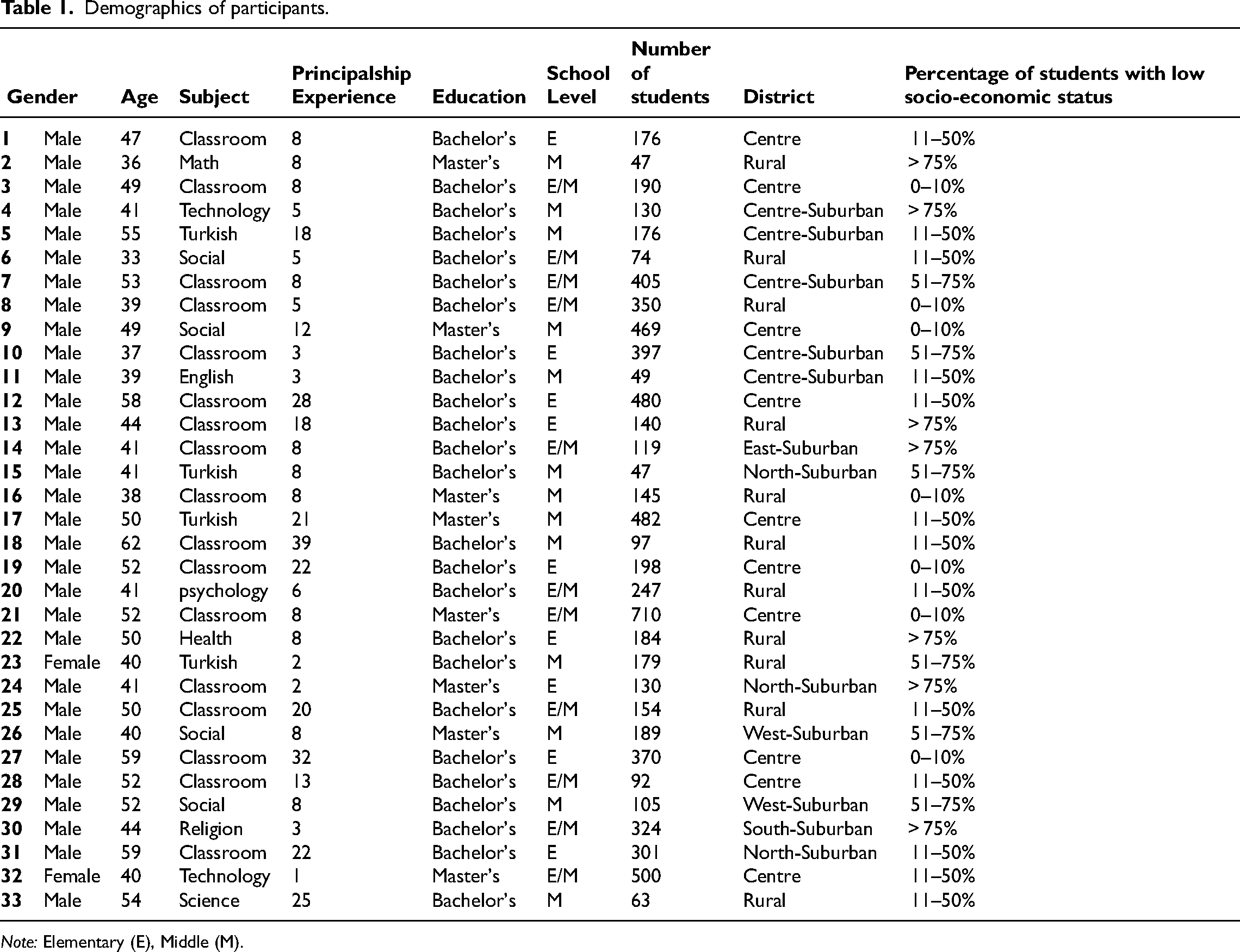
Note: Elementary (E), Middle (M).
When determining the study sample size, we aimed to include at least 20 participants to obtain various perspectives (Guetterman, 2015). Then, we continued recruiting new participants until the data reached saturation through adequate repetition of patterns (Creswell, 2020). Finally, 33 principals participated in the study, including 31 males and two females. The small number of female principals reflects the very low overall number of women principals in Türkiye (Ocak, 2021). The age of the principals ranged from 33 to 62 (with an average of 46 years old), with between 1 and 39 years of principal experience (with an average of 12 years of experience). Nine participants worked in elementary schools, 13 in middle schools and 11 in both elementary and middle schools. Ten schools were in the city centre, 11 were in rural areas and 12 were in the suburbs. The percentage of students belonging to low socioeconomic backgrounds within the schools, as perceived by the principals, was between 0% and 10% for seven schools, between 11% and 50% for 13 schools, between 51% and 75% for six schools and higher than 75% for seven schools.
Data were collected using semi-structured interviews. We extracted interview questions from the recent literature (Hallinger and Walker, 2017; Shaked, 2023a) but adjusted them for the study's context and purpose. The questions were organised mostly according to Hallinger and Murphy's (1985) framework. The main interview questions, which explored principals’ overall understanding of their instructional leadership roles and the relevant barriers to those roles, included: ‘As a principal, what is your vision for the school? How does it guide the mission and the goals of the school?’ ‘What usually takes most of your time during the day?’ ‘As a principal, are you responsible for ensuring classroom instructional quality? Why/why not?’ and ‘How do you fulfil this responsibility (examples)?’ Several sub-dimensions covered principals’ instructional leadership duties, including school vision, instructional improvement strategies, monitoring student learning and progress and professional development. Twenty-eight interviews were conducted face-to-face in schools, and four were conducted online using Zoom software. The interviews ranged from 22 to 120 min (with an average of 55 min) and were recorded with the participants’ permission.
Data analysis
We used MAXQDA qualitative analysis software to analyse the interview data (Consoli, 2021). Before coding the data and forming categories, the first author read all transcripts several times to familiarise himself with the data. This initial reading aimed to reveal common patterns within the data (Bogdan and Biklen, 2022). After this initial reading, the interview transcripts were imported into MAXQDA. The software was then used for data coding and the formation of categories.
The analysis followed three basic steps: sorting, coding and categorising (Miles et al., 2014). During sorting, we recorded comments (segments) that pointed to potential barriers to instructional leadership. Data segments were either sentences or paragraphs. Each data segment was then coded. The coding was completed when the research team decided that a data segment represented an idea or concept related to a barrier to instructional leadership (Gibbs, 2007). The inductive approach was generally employed in the coding stage (Saldaña and Omasta, 2018), while we borrowed concepts regarding barriers faced by principals from the previous literature (e.g. paperwork, norms, private space, lack of time) for the codes where appropriate. In the final stage, we combined similar codes and formed categories. Examples of themes, categories and codes are provided in Table 2. Hallinger and Murphy's (1985) instructional leadership framework and the relevant literature guided the interpretations.
Example of coding and creating descriptive themes.

We also took several measures to ensure the data analysis was trustworthy. To ensure trustworthiness in qualitative research, research-specific characteristics such as credibility, dependability, confirmability and transferability must be examined (Guba and Lincoln, 1982). In this context, the following steps were taken.
First, necessary ethical permissions were obtained for the study, and confidentiality was guaranteed to the participants. Purposeful sampling was used to increase the transferability of the study findings. The research team also kept reflective notes during interviews to provide additional context during the data analysis. After data analysis, all interviewees were provided with an opportunity to confirm initial themes identified by the research team (i.e. member checking); ultimately, 18 of the 33 participants participated in this process (Creswell, 2020). During coding and analysis, two researchers coded the data to ensure the validity of the common codes, categories and themes that were reached. When determining the themes, current studies in the literature were consulted. Direct quotations were included when reporting the study's findings (Lincoln and Guba, 1985).
All the researchers involved in the study had experience teaching at the K-12 level before pursuing careers in higher education. The findings were mutually examined and discussed, as the backgrounds and personalities of the researchers may influence their interpretations.
Findings
This study explores the barriers to principals’ instructional leadership practices in Turkish public schools. Our data analysis revealed six main themes: the education system, beliefs about the profession, workload, community context, lack of resources and principals’ competency. Each theme incorporated several categories explicitly connected to the barriers that participants discussed (see Figure 1).

Themes and categories of instructional leadership barriers.
Figure 2 shows the intensity of participants’ views regarding different themes and categories. Almost all participants mentioned the education system, beliefs about the profession and workload as significant barriers to instructional leadership. Most participants also suggested that community context, lack of resources, and principals’ competency were related to the lack of instructional leadership practices. The themes, categories and subcategories of barriers based on the views of school principals are explicated below.

Intensity of participant views on the main themes, categories and subcategories of instructional leadership barriers.
Education system
Participants mentioned several barriers linked to various components of the Turkish educational system. We grouped these under ‘lack of authority’ and ‘national exams’. Lack of authority includes two subcategories: ‘goal setting’ and ‘recruitment and rewarding’. Almost all the school principals mentioned being limited in ‘goal setting’ and ‘recruitment and rewarding’, regardless of location or school level. In addition, most participants expressed that barriers to instructional leadership resulted from the pressure to succeed in central exams.
Lack of authority
According to the data, bureaucratic expectations and legal barriers caused participants to see themselves as policy messengers and implementers of orders ‘from the top’. Therefore, principals in the Turkish context mainly function as managers who prioritise superiors’ formal expectations in schools and focus on managerial efficiency rather than educational effectiveness and student learning.
Goal setting
A strong theme suggested that most school principals believed that adhering to the common goals and curriculum prevented them from meeting students’ learning needs. This added to their perceived lack of authority in those areas and prevented them from setting unique goals for their schools. One school principal described this as follows: We were given guidance on goal setting…We are told what to do and what to achieve. And we go on repeating the same thing like a parrot. (P1) Here, we have a position associated with the Ministry. An order comes from the higher-ups, and we must implement it. There is a compelling reason for us…We are already managed from a central unit. (P8)
Recruitment and rewarding
Most participants also emphasised that they want the authority to recruit and reward qualified teachers but cannot because of the centralised system. Therefore, they feel powerless to develop teachers who demonstrate insufficient performance or reward successful ones. A principal said: We get stuck at some point while conducting school and classroom supervision. As school principals, we don't have much of a sanction against the staff. Otherwise, you do classroom supervision, and you give warnings, but they don't work very well. There's not much the principal can do about it. (P7) The school administration should be given the authority to develop the reward mechanism. Other cohort teachers would be encouraged when good classroom practice is financially rewarded. (P24)
National exams
Our data suggests that national exams limit the innovative execution of the curriculum and the implementation of practices sensitive to the student's individual needs. School principals’ primary goal is to prepare students to achieve better results on these exams, and generally, they end up focusing on those learners with the highest potential. This pressure is especially evident at the middle school level. As one middle school principal explained: You set a goal. You say three or four out of ten students should get into a science high school… Everyone must work on their subject matter and decide which sources they will use. The teacher must see which students have the potential and prepare accordingly. (P25)
The pressure created by the examination system was even reflected in the goals of some elementary school principals, particularly the ones working in the city centre. One such principal stated that due to societal pressures, exam-oriented practices had even infiltrated and predominated in their primary school: How many questions does the teacher assign, how much homework, and how many questions does s/he make them solve? These reflect on us as social pressure. For example, teachers who do not give homework, do not solve tests in class, or do not assign practice tests are perceived as bad teachers in our society. (P1)
The school principals’ lack of autonomy in certain areas and the pressure created by the national exams restricted these principals from setting school-specific goals and focusing on the learning of all students; thus, these factors created critical barriers to effective instructional leadership practices.
Beliefs about the profession
Regardless of their contexts, most participants believe their primary role is preparing the school and classrooms for teaching. They noted that it is vital that they provide all the materials that the teachers need and address deficiencies in the physical environment. One principal stated: Today, if there are no curtains in a classroom, the radiators do not work in winter, or if the windows and doors and other physical entities are lacking, it becomes difficult to teach in that classroom… For this reason, we improve the classrooms in every aspect so that education and training will progress. That is our main task. (P10)
The classroom as a private space
All the participants see classrooms as teachers’ private spaces. They believe that frequent visits to these private areas will disrupt the classroom's atmosphere and, in turn, limit teachers’ originality. A school principal stated: I can visit a class whenever I want. But, as I just said, just as you can't feel comfortable when a guest comes to your house, similarly, when you enter the classroom, the students and the teacher involuntarily behave differently. (P2)
Most of the principals in the study sample also tended to conduct supervision superficially since they feared disrupting their relationships with the teachers. One principal explained: I can say that I am not as harsh and strict during a classroom observation, but a bit gentler, in a manner that won't upset the teachers. (P31)
Personal responsibility for development
Most of the school participants also believe it is inappropriate to interfere with teachers’ professional development. According to them, professional development should be the teachers’ responsibility. One principal explained this further.
If teachers don't want to improve themselves professionally and do not realise their own weaknesses, whatever the school principal does is useless… Currently, in-service training is delivered through distance education. Since they don't want to do it, they fast-forward the videos. (P14)
Regardless of their contexts, most school principals cannot adequately implement the practices of monitoring and evaluating teachers and contributing to their professional development due to the various perceptions about their role in improving teaching and learning processes.
Workload
Another barrier frequently mentioned by the participants was their administrative workload. Most of them think they have too many things to do and need more time for instructional leadership activities. Their comments also reflect the perception that managerial responsibilities are the ‘primary’ components of the work of a school principal. Three specific categories come to the fore regarding the workload of school principals.
Paperwork
Excessive paperwork and official correspondence pressure principals by increasing their workload and forcing them to reorder their priorities, shifting from exercising instructional leadership to doing daily routine work. Such pressure was found to impact most of the participants. One principal emphasised: I mean, what we want most is to get rid of routine work, such as paperwork, to focus more on teaching. That is, how can we increase academic achievement, how can we improve students’ talents… (P32)
Non-Teaching related conversations
In some schools, particularly elementary schools, principals spend considerable time listening to parents’ requests and complaints. In addition, communicating with different stakeholders regarding student discipline problems takes significant time, particularly at the middle school level. According to one principal: There are many complaints from parents. They can complain about each other, about the teacher, or even about the assistant principal. We come across so many different complaints during the day. (P8)
Overwork in large schools
Some of the principals were leading both elementary and middle schools simultaneously. Some others explained that their schools had a high number of students. These principals must devote more time and effort to activities other than teaching in such schools. As one principal explained: Since there are three assistant principals responsible for a separate section [i.e., elementary, middle, religious middle], I must go to each of them separately and explain every issue…Something unearthly is sometimes expected from us! (P30)
This theme suggests that school principals, particularly those working at large or comprehensive schools with both elementary and middle levels, have difficulty allocating enough time to activities that will improve teaching and learning since they spend most of their time on administrative tasks during the school day.
Community context
Families with low socioeconomic backgrounds
In some schools located in districts largely populated by socioeconomically disadvantaged families, the priority of the school principals is to support disadvantaged students, help them to love and feel safe at school, ensure attendance, and minimise disciplinary problems. These principals focus more on socialisation and behaviour changes than academic achievement. This pushes principals’ priorities away from teaching and learning and toward addressing other issues related to local conditions and familial dynamics. For example, one principal stated: Other schools don't deal with disciplinary matters this much. If I worked 100 h, only 5 h were for academic studies. Our focus is ensuring moral values and maintaining discipline. (P24)
Some students in rural areas are transported to their schools by bus; when they return to their villages after school, many devote time to work. School principals in those areas mentioned that housework is more important than education for families in these regions. Therefore, this situation limits the efforts of school principals toward their goals to improve student learning. A school principal in a rural area stated that when a family's relationship with the school is weak, the principal and the school cannot achieve their goals for student learning: It cannot be achieved with a single teacher or a single administrator. We call it ‘trivet’, student-parent-teacher. Without this cooperation, this process will not work. (P33)
Refugee population and special education students
Several schools also taught refugees and special education students. Principals in those schools open adaptation classes to help refugee students adapt to the new culture, plan language learning courses and organise support classes for students who need special education. They also coordinate different partners to help students. As one principal stated: The teacher supports these students… After that, it is necessary to be in constant dialogue with the parent. It is also necessary to involve the guidance counsellor. Thus, we try to bring them closer to the level of others. (P12)
Despite efforts to improve the educational experiences of disadvantaged student groups, which are highly relevant to instructional leadership, principals working in such contexts also viewed having a high proportion of such students as a barrier to implementing instructional leadership. This was because principals perceived the official correspondence required about these students as additional work. In addition, they need to pay more attention to socialisation, adaptation and psychological support services. However, we also realised some lack of knowledge and understanding regarding inclusive education, which could also be a barrier to effective instructional leadership practices. A school principal stated: They get bored because they cannot learn when they are in the same class, and as a result, they start to disrupt the order of the lesson. Negative situations such as behavioural problems, psychological problems, and peer bullying arise. (P4)
Overall, we observed that most principals working in schools with high numbers of refugee or special education students emphasised the difficulties regarding the additional paperwork and disciplinary issues rather than strategies and practices implemented to improve their learning. Having more students with such backgrounds is generally seen as a barrier to instructional leadership. This perception might also stem from the tendency to focus more on improving high-performing students to achieve better results on national placement exams in the Turkish context.
Lack of resources
Insufficient budget
Regardless of the school level and location, principals often blame inadequate funds for limiting their efforts to improve the quality of instruction. For example, they had difficulty finding options for affordable extracurricular activities or purchasing learning enrichment materials. One principal explained the situation as follows: We only have school donations as financial income. The Ministry of Education does certain things; bills are paid, but we don't have any extra money… Otherwise, we would like to do different things in the classrooms. (P3)
One of the most common complaints principals had was that schools did not have a specific budget for school development. One of the principals emphasised: The school doesn't have the financial resources that can be shared and used. For example, you can only organise some professional development activities in your school if the parent-teacher association has a strong financial structure. (P15)
Lack of laboratories, workshops and equipment
Some schools need to improve their learning environments, such as laboratories and workshops. For example, several principals, both from elementary and middle schools but particularly in rural areas, stated that they could not create a positive learning environment due to the lack of free space in the school. One principal explained: We are very short on tools. We don't have a science lab. Some teachers can produce the tools, but not all teachers can do this. Due to economic reasons, we are having trouble procuring most of the tools we need. (P25)
Insufficient budgets of schools restricted school principals’ initiatives to provide professional development opportunities for teachers, made it difficult to provide additional teaching activities and limited the purchase of materials to differentiate instruction.
Principals’ competency
The interviews show that principals need more knowledge and skills to effectively fulfil their instructional leadership roles. Most participants did not see themselves as competent in different teaching practices and effective instructional supervision.
Lack of content knowledge and knowledge of teaching practices
The interview data suggests that principals’ feedback to teachers focused mainly on communication with students and classroom management practices. Most participants stated that monitoring and providing feedback on subject matter knowledge and teaching practices were not a priority. One principal explained: We supervise every subject, but I do not have knowledge of each subject… So, it's only superficial control. I supervise the science class as much as I can. I only supervise in theory and evaluate how the teacher explains things. (P28)
The perception of being unable to supervise different subjects also seems related to a need for greater knowledge about effective instructional supervision. Participants generally believe that they should be experts in a specific subject to be able to supervise the related instruction.
Lack of instructional supervision knowledge
While participants sometimes conducted structured instructional supervision, they usually did so informally without any rubric or structure. A few principals emphasised that they needed training on effective instructional supervision. One principal stated: The supervision system requires expertise. I think we should be given a separate training on this. But apart from these main topics, we're given seminars on every unnecessary topic or case we would encounter only once in five years. (P29)
Most principals mentioned that they mainly conducted classroom observations during inspections and rarely conducted pre- and post-observation interviews or feedback sessions. In addition, participants seldom mentioned school-based professional learning models or referred to in-service training. Therefore, they seem to have an inadequate understanding of how teachers learn, which is reflected in their instructional leadership practices.
Overall, principals’ insufficient content knowledge and knowledge of teaching practices and inadequate supervision skills constrain effective supervision practices that could support teachers’ professional development.
Discussion
This study contributes to the existing research on contextualising instructional leadership by identifying potential factors hindering the impact of such leadership practices in the Turkish context. The following sections discuss the research results within the study's limitations and implications.
Implications
Although the expectations of instructional leadership and the relevant research have increased globally over the last two decades (Hallinger et al., 2020), it is evident that principals in developing countries with centralised education systems tend to maintain the status quo and focus more on administrative duties. This can mainly be attributed to these school principals’ lack of autonomy in human resources, curriculum development and professional development decisions (Oplatka, 2004), which the principals in the present study lamented. This may suggest that centralised education systems should allow more school-level discretion to match these changing expectations. However, simply mimicking the choices available to principals in some Western educational systems without considering context is unlikely to bring the same outcomes. Therefore, informed and cautious modifications should be made based on the respective sociocultural and educational context(s).
Previous studies showed that Turkish school principals generally exhibit some instructional leadership behaviours but cannot perform certain practices due to the limitations of the centralised and hierarchical educational system (Gümüş et al., 2021). In this study, we aimed to explore the barriers to such practices. We found that the educational system, beliefs about the profession, workload, community context, lack of resources and principals’ competencies affected the practices of school leaders and presented key barriers to certain instructional leadership practices. Below, we interpret our main findings in light of existing literature.
First, Türkiye's centralised structure obliges principals, regardless of the school level or the location, to implement the curriculum within the central policy framework and to keep a careful eye on national exam requirements. Teachers are also employed and appointed within this system, so principals do not have the authority to select the teachers they want. Moreover, the limited autonomy of principals due to the centralised education system restricts efforts to enhance teacher professional development, which is one of the core practices of instructional leadership (Hallinger and Murphy, 1985). In the Turkish context, some policy changes regarding teacher professional development have recently been proposed, such as ‘school-based professional development’, which provides schools and teachers with autonomy in selecting the areas where they want to improve themselves (MoNE, 2010, 2018). However, in practice, it seems that the central government is still highly influential in such processes, and schools do not have much power or access to resources.
The structure of the system then prevents principals from setting school-specific goals or selecting and developing teachers who could support the principal's aspirations for the school. This finding coincides with barriers to instructional leadership in other countries with centralised, hierarchical education systems. For example, school principals in Greece cannot set school-specific targets due to the parameters set by their centralised system. Instead, they try to ensure curriculum coordination rather than enhancement (Kaparou and Bush, 2015). A study in Thailand, another centralised system, found that managerial leadership expectations on principals limited their opportunity to enact instructional leadership roles (Hallinger and Lee, 2014). On the other hand, research has found that principals in Iran consider school-based professional development efforts inadequate. This appeared to be related to the highly structured nature of teacher professional development within the centralised system, where principals have limited autonomy (Hallinger and Hosseingholizadeh, 2019).
The second barrier to instructional leadership in Türkiye is existing beliefs about the profession. Almost all participating principals emphasised their belief that the classroom is the teacher's and students’ private domain and that interventions in this space can disrupt the school's harmony. They also think that improving the quality of instruction is the primary responsibility of teachers and that professional development should flow from their initiative. Research in other contexts reinforces that principals may not engage in frequent class observations due to professional norms and delegate the responsibility for improving instruction to teachers (Cuban, 1988; Murphy et al., 2016; Shaked, 2021). For example, a study by Shaked (2021) on Israeli school principals showed that workplace norms restrict instructional leadership practices (e.g. supervising and evaluating teaching, protecting teaching time and providing incentives to teachers). In support of these findings, researchers have previously stated that established norms and beliefs can hinder instructional leadership (Goldring et al., 2015).
Other research suggests that when school principals care too much about teacher autonomy instead of collaborative problem-solving and decision-making, they may be less likely to participate in practices that support teachers’ learning and development (Cuban, 1988). Therefore, it seems essential to frame instructional improvement as a collective responsibility rather than the sole responsibility of teachers. In high-power distance cultures like Türkiye, concerns about damaging personal relationships or social cohesion in the school might need careful consideration. One suggestion is that both principals and teachers be trained in instructional leadership practices and persuaded that the classroom observation process is not about inspections and judgments but rather about working together toward improvement (Glickman et al., 2017).
The third barrier to instructional leadership is principals’ workload. Most of the principals in the present study argued that the amount of time spent on paperwork, school maintenance and repairs and meetings reduces the time available to monitor instructional quality, give feedback to teachers and monitor and evaluate students. The international literature supports that principals’ instructional leadership practices are limited by different tasks and contingencies that arise during the day (Camburn et al., 2010; Goldring et al., 2019; Murphy et al., 2016). This is difficult to manage across contexts internationally, but perhaps even more difficult in countries like Türkiye, given the ingrained bureaucratic and hierarchical structure where the Ministry expects principals to administer their schools following predetermined regulations and principles. Principals in Türkiye are thus considered school-level representatives of the Ministry (Beycioglu et al., 2019).
However, the efforts principals devote to administrative work should not be considered insignificant. When framed in parallel with instructional leadership practices, school principals’ focus on administrative affairs in the organisation could positively affect school improvement (Shaked, 2022). One method to address this dilemma could involve informally distributing some leadership roles, either administrative or instructional, to teachers since formal leadership roles are limited to the purview of the principal and vice/assistant principals. Such delegations may also create an environment of trust in the school and enable teachers to contribute more to school management. Principals then can spend more time developing a structure that prioritises teacher development and instructional improvement. At the policy level, formalising teacher leadership roles could also be a helpful strategy to improve instructional leadership.
Principals’ instructional leadership is also constrained by the community context in which they operate. Within the scope of this study, principals in schools with a high number of students with low socioeconomic status, immigrants, or special education learners have additional complaints regarding barriers to instructional leadership. Many such students demonstrate low school commitment, high absenteeism and intense behavioural problems. Therefore, school principals in these contexts make greater efforts to improve students’ moral, social, and emotional dispositions. On the other hand, most of these students and their families have low expectations of academic success, which are then reflected in the principal's priorities. Therefore, these principals may think that meeting the basics is sufficient and that there is no need to pay attention to improving teaching and learning. As our findings explain, this might also be related to the pressure of national exams, which can lead school principals to perceive their instructional leadership roles as more relevant to high-achieving students. While this does not mean that instructional leadership roles are less important or not applicable in such communities or for such students (Gümüş et al., 2022; Pietsch et al., 2023), various challenges and expectations seem to create this reality. This finding echoes the international literature, which shows that principals leading schools in communities of higher socioeconomic status display more instructional leadership roles than those in schools with lower socioeconomic status (Hallinger et al., 1996; Lee and Hallinger, 2012; Tan, 2014).
A lack of adequate resources also hindered principals’ instructional leadership. The absence of a school-specific budget prevents principals from creating new opportunities for teaching and learning, such as providing professional development initiatives for teachers, organising support classes for students and rewarding successful teaching. Furthermore, principals need more school learning spaces to incentivise teachers to experiment with different teaching strategies. Other research similarly reports that inadequate funding can make it difficult for principals to support instructional and curriculum innovation (Mason, 2013) or arrange supportive instructional activities for students’ academic development (Kaparou and Bush, 2015). Given the current centralised system, changing the common curriculum and national teacher appointment system is not a viable solution to this problem. However, granting more autonomy for the professional development of teachers and the design of learning spaces through allocating additional school-based funding could support specific aspects of instructional leadership.
Finally, principals’ instructional leadership appears limited by their competence. Due to principals’ insufficient knowledge of subject content, pedagogy and supervision processes, instructional supervision is either not conducted or does not provide the desired contribution to the teachers. This finding is consistent with the existing literature that states that principals’ supervisory skills and lack of pedagogical content knowledge hinder the effectiveness of the instructional supervision process (Brandon et al., 2018; Cansoy et al., 2024; Chapman and Burchfield, 1994; Shaked, 2023b; Wanzare, 2012). It may not be a realistic expectation for school principals to know subject content across all courses. However, these administrators must know about pedagogy and teaching in general and how to observe teacher practices and provide feedback to effectively implement instructional leadership practices (Bush and Glover, 2014; Shaked, 2023b). In this regard, the MoNE could include modules on effective instructional supervision in principal preparation programs (which are still not required for appointment to the principalship) and in-service training programs. In addition, the importance of planned and continuous supervision activities should be emphasised and required by educational policymakers (Zepeda, 2014).
Limitations
Although the present study revealed new insights into barriers to instructional leadership in Türkiye, it faces at least four limitations. The first is the limited number of participants. Only the 33 school principals who agreed to participate were included. Such restriction may have biased the sample. Therefore, it would be helpful in future studies to include different, more structured samples to allow greater generalisation and application of results.
Second, given the complexity of national and organisational contexts and our knowledge of how they shape leadership practices (Hallinger, 2018), the present study would have benefitted from a more in-depth definition of specific contextual factors. Given the centralised nature of education in Türkiye, replicating this study in other nations with centralised education structures may contribute insights into these factors and allow comparison with school leaders in similarly structured systems. Such studies would strengthen the validity of the findings.
Third, this study examined principals’ views only. While principals’ perspectives are valuable, they may be somewhat biased due to pressures related to system conformity and social desirability. One way to overcome this would be to collect the views of other stakeholders, such as teachers, assistant principals, parents and district leaders, and include direct observations of school leadership practices.
Lastly, collecting data from only one province poses an additional limitation for the present study. This may present potential issues regarding the overall representativeness of the research or the applicability of its results to a wider geographic area. Therefore, using more representative samples from more than one province or region may be a way to overcome this limitation in future research.
Conclusions
Overall, our study primarily supports the findings of several previous studies from different countries regarding the potential barriers to instructional leadership (e.g. Shaked et al., 2021; Wanzare, 2012) as well as provides some unique aspects, such as the national exam system and beliefs about teaching profession, emerging from the sociocultural context and educational system of the country. Our findings strengthen theoretical claims emphasising that instructional leadership is affected by contextual factors (Clarke and O'Donoghue, 2017; Hallinger, 2018) with ample evidence from a particular context. However, we understand that only identifying the barriers may not inform the relevant practices and policies. In future research, it would be beneficial to focus on possible strategies and successful implementations that can overcome the mentioned barriers and strengthen leadership practices that could improve teaching and learning for all. Again, the role of context deserves particular attention when identifying such strategies or practices.
Footnotes
Declaration of conflicting interests
The authors declared no potential conflicts of interest with respect to the research, authorship, and/or publication of this article.
Funding
The authors disclosed receipt of the following financial support for the research, authorship, and/or publication of this article: This work was supported by the Joseph Lau Luen Hung Charitable Trust Asia Pacific Centre for Leadership and Change (grant number RRG 001/202223).
