






Abstract
This study develops and validates a contextually grounded model of teacher leadership in Chinese higher education, addressing a gap in the literature dominated by school-based and Western-centric frameworks. Drawing on mixed methods, including grounded theory and confirmatory factor analysis, data were collected from 352 university faculty members across multiple Chinese provinces. This study employed an exploratory sequential mixed-methods design: (1) a qualitative phase (in-depth interviews) to generate context-specific dimensions and indicators of teacher leadership; and (2) a quantitative phase (survey) to test the emergent model via exploratory factor analysis/confirmatory factor analysis. The qualitative phase was conducted in October–November 2023; the quantitative survey took place from November 2023 to February 2024. The resulting four-dimensional model encompasses moral leadership, teaching leadership, research leadership, and team leadership. Findings reveal that moral and teaching leadership dominate faculty perceptions, reflecting the cultural importance of ethical conduct and pedagogical engagement in the Chinese academic tradition. Conversely, research and team leadership are less emphasized, suggesting structural constraints and potential tensions within performance-based evaluation systems. This study contributes both theoretically and methodologically by offering a replicable framework for analyzing teacher leadership in higher education and by highlighting the need for culturally responsive leadership development. Implications for faculty evaluation policies, institutional culture, and global academic leadership reform are discussed.
Introduction
In the context of rapidly evolving higher education systems, the role of university teachers has expanded beyond instructional delivery to encompass research productivity, curriculum innovation, and leadership within academic communities (Harris and Jones, 2019; Wenner and Campbell, 2017). Leadership development in higher education has emerged as a critical focus in global educational reform, particularly in Asian contexts, where universities are under pressure to align with international excellence frameworks (Neubauer and Collins, 2015; Xianguo and Amirrudin, 2025; Xing and Tian, 2022). In this study, leaders are university faculty who exert influence beyond routine instruction to shape professional practice and organizational priorities. Leadership is defined as a social influence process that mobilizes people and resources toward shared goals within academic departments, programs, and research groups (Bush, 2008; Leithwood and Jantzi, 2000; Spillane, 2005). Organisational management refers to the set of structures, processes, and routines through which universities coordinate work (e.g., workload allocation, evaluation, budgeting). While management emphasizes coordination and control, leadership stresses direction-setting, meaning-making, and capacity building; both interact in higher education but are analytically distinct in our model (Bush, 2008). This study, therefore, speaks to global conversations on leadership beyond school settings by testing a higher-education model in a non-Western context. Teacher leadership is increasingly recognized as a multidimensional construct that contributes to professional growth, institutional innovation, and the overall quality of education (Bush, 2008; York-Barr and Duke, 2004). In the context of China's “Double First-Class” initiative, which aims to build world-class universities and disciplines, cultivating leadership capacities among university faculty has become a strategic imperative to ensure academic excellence and competitive advantage (Xue et al., 2021).
The four-dimensional framework extends established accounts of teacher leadership in two ways. First, it elevates moral leadership—ethics, character, and integrity—to a core and measured dimension in higher education; international models often treat ethical aspects as antecedents or boundary conditions rather than a central factor. Second, by empirically distinguishing teaching, research, and team leadership in a single instrument, the model provides a higher-education-specific articulation that complements distributed and instructional leadership traditions. Thus, our framework should be read as a contextual elaboration that connects with, rather than replaces, canonical models.
Since the rise of teacher leadership theory in the United States in the 1980s, it has been widely concerned by education researchers in various countries, and the theoretical and practical research has been continuously developed, providing a new mode of thinking and perspective for education and teaching reform (Beck et al., 2023; Pan et al., 2023). However, a survey of the current research at home and abroad shows that the construction and verification of teacher leadership model is mainly based on the leadership of primary and secondary school teachers, and the research on teacher leadership of university teachers is relatively lacking. While extensive research has been conducted on teacher leadership in primary and secondary education (Angelle and DeHart, 2011; Wang and Ho, 2020), university contexts present distinct organizational structures, autonomy levels, and performance expectations. These differences necessitate the development of leadership models tailored to the higher education landscape, which remains underexplored, particularly in non-Western settings.
In order to further clarify the elements of university teacher leadership and establish a measurement tool for the development of university teacher leadership in China, this study addresses this gap by developing and empirically validating a theoretical model of university teacher leadership in the Chinese context. By integrating qualitative grounded theory and large-scale quantitative methods, the research identifies and tests four key dimensions—moral, teaching, research, and team leadership—thus providing a robust framework for future investigations and policy design.
We conceptualize leadership development as a career-long, longitudinal process involving identity formation, socialization into academic communities, and the accumulation of pedagogical, scholarly, and relational capabilities. Development unfolds through iterative cycles of experience, feedback, and reflection rather than discrete training events (Avolio and Gardner, 2005; Day and Dragoni, 2015). Our empirical model therefore focuses on relatively stable dimensions (moral, teaching, research, team) while acknowledging that individuals’ profiles evolve across career stages.
We adopted an exploratory sequential mixed-methods design in which qualitative results informed instrument development and subsequent confirmatory modeling. Qualitative research question (RQ-QUAL). What elements, practices, and meanings define university teacher leadership in the contemporary Chinese context? Quantitative research question (RQ-QUAN). Which latent dimensions constitute university teacher leadership and how well does the four-factor model fit the data?
Hypotheses.
Literature review
Origin of teacher leadership development
The theory of teacher leadership emerged during educational reform in the United States in the 1980s (Evans, 2022; Wright, 2022), primarily focused on primary and secondary education. Since then, it has evolved into a global research field exploring how educators can exert influence beyond their classrooms, contributing to school-wide decisions, curriculum design, and professional collaboration (Wenner and Campbell, 2017). Early investigations emphasized leadership in primary and secondary schools, particularly in Western countries, which shaped foundational models still referenced today (García-Martínez et al., 2018; Olmo-Extremera et al., 2024).
However, recent scholarship has emphasized the need to contextualize teacher leadership in higher education, where faculty engage in research, administration, and peer mentorship in ways that differ substantially from school-based settings (Damayanthi and Tukiran, 2025; Liu et al., 2025b). In the Asian context, leadership expectations for university teachers are increasingly shaped by global ranking pressures, research performance targets, and institutional reforms (Rhoads et al., 2014; Shin and Harman, 2009).
Teacher leadership as a distributed and developmental process
Teacher leadership has evolved through three overlapping stages, each reflecting shifts in educational reform and professional identity. First (1980s), leadership was largely positional, assigned to a minority of formally designated teachers. Second (1990s), leadership became associated with pedagogical excellence and peer mentoring, reflecting professionalization of teaching. Third (post-2000s), leadership is increasingly conceptualized as a distributed, collective process, embedded in learning communities and emphasizing collaboration, innovation, and shared responsibility. These stages demonstrate a progressive expansion from individual roles to systemic, collaborative practices that are crucial in higher education today. According to some research, the connotation development of teacher leadership can be summarized into three stages (Ahn et al., 2024; Hatch et al., 2005; Little, 2003):
In the first phase (1980s), teacher leadership was considered to be the ability of the few teachers appointed to formal leadership positions to take on the tasks of school management and supervision of their peers. At this stage, the research on the connotation of teacher leadership is mainly limited to the leadership role and individual leadership behavior of teachers. For example, Fullan believes that teachers with leadership status and roles should play an important role in six areas: teaching and learning, peer group, context, continuous learning, transformational school management, and the meaning of school moral purpose (Alexandrou and Swaffield, 2012; Brauckmann et al., 2023; Li and Liu, 2022).
With the increasing emphasis on teachers’ professional knowledge and authority in education reform, teacher leadership in the second stage (mid-1990s) is mainly regarded as the ability of some excellent teachers to play the role of curriculum leadership and peer development, the core of which is teaching leadership. The connotation research of teacher leadership at this stage highlighted the professional attribute of teacher leadership, which was specifically defined by some researchers as the “knowledge, skills and emotions” shown by teachers in their teaching work (Wang and Xia, 2022; Yuet et al., 2016). At this stage, empirical research on the effect of teacher leadership on improving students’ learning and promoting school development is quite prevalent.
With the transformation of schools into learning communities, teacher leadership is no longer limited to the concepts of “hierarchy” and “role orientation.” In the third stage (after the mid-1990s), teacher leadership is no longer regarded as a position, status and privilege of only a few people, but a positive interactive and purposeful interpersonal influence, which is a group process (Grant et al., 2010; Marshall and Marsh, 2022). It exists in every teacher who is willing to contribute to the professional community of teachers and take responsibility for achieving the goals of the school. The connotation of teacher leadership at this stage puts more emphasis on teachers’ collective responsibility and sharing, and on developing teachers’ teamwork ability such as collaboration and responsibility. York-Barr and Duke, for example, define teacher leadership as a teacher's ability to promote the development of teaching practices, to build trusting and constructive relationships with colleagues, and to interact through formal and informal influences (York-Barr and Duke, 2004). At this stage, what gives a more comprehensive and authoritative definition of the connotation of teacher leadership is the “Teacher Leadership Model Standard” formulated by the “American Teacher Leadership Explorer Alliance” in 2011 and the “Teacher Leadership Framework” issued in 2015. Based on the research and review of national and state teacher leadership programs in the United States, the consortium drafted a model standard consisting of seven areas, and on this basis constructed a leadership framework consisting of teacher leader literacy and leadership behavior. Teachers’ ability of self-development, driving innovation, coaching others and leading teams are regarded as the core components of teacher leadership (Luo et al., 2024; Supovitz and Comstock, 2023).
Conceptualization and dimensions of teacher leadership
Throughout the development of the connotation research of teacher leadership, although the researchers have different positions, angles and focuses on the definition of teacher leadership at different stages, the morality, professionalism and collectivity of teacher leadership are a common thread (Ding, 2024). Teacher leadership can be understood as a comprehensive ability of teachers to play an all-round leading role in school culture, teachers’ peers, teaching and research, promote teachers’ professional development and students’ all-round development, promote education reform and improve education quality through their own noble professional ethics, excellent professional ability, advanced teaching concept and collective cooperative behavior (Chen and Lai, 2023; Xuezhen, 2022).
Recent reviews advocate for more integrated models of teacher leadership that include research productivity, team coordination, and policy engagement, particularly in university settings (Myran, 2023). Furthermore, growing interest in Asian and Chinese educational contexts highlights the necessity of developing culturally resonant leadership frameworks that respond to localized values, institutional demands, and national reform policies (Liu et al., 2025a; Zhang et al., 2021).
Conceptual distinctions among moral, ethical, transformational, and authentic leadership
We treat research leadership as faculty influence that advances scholarly agendas through mentoring, agenda-setting, and the mobilization of resources for inquiry (e.g., shaping research groups, supervising projects, disseminating innovations). Team leadership denotes influence enacted in collaborative structures (program committees, curriculum teams, lab groups), aligning with distributed/collective leadership theory (Spillane, 2005; York-Barr and Duke, 2004). While these emphases emerged inductively in our QUAL phase, their operationalization was anchored in established leadership frameworks (Bush, 2008; Leithwood and Jantzi, 2000), supporting construct validity in the QUAN phase.
We distinguish moral leadership from adjacent constructs to clarify our usage in higher education. Ethical leadership typically emphasizes normatively appropriate conduct and fair decision-making grounded in explicit codes and procedures. Transformational leadership focuses on articulating vision, motivating followers, and reshaping organizational culture (Leithwood and Jantzi, 2000). Authentic leadership stresses self-awareness, internalized moral perspective, balanced processing, and relational transparency (Avolio and Gardner, 2005). By contrast, moral leadership in our model foregrounds character-based influence and the educator's responsibility toward students, peers, and society, an ethos salient in Confucian-influenced academic cultures. Thus, while all four perspectives involve values, moral leadership here denotes a culturally embedded, character-centric orientation that legitimizes influence through exemplarity and service. Our items operationalize this orientation (e.g., modeling integrity; prioritizing student growth) rather than organizational rule compliance per se (Bush, 2008; York-Barr and Duke, 2004).
Positioning within international scholarship. Beyond Chinese scholarship, research on teacher leadership underscores distributed expertise and instructional improvement across systems (Wenner and Campbell, 2017; York-Barr and Duke, 2004). Work on distributed/collective leadership and transformational/ethical leadership (Leithwood and Jantzi, 2000; Spillane, 2005) provides comparative anchors. Our model aligns with these streams yet foregrounds moral leadership as a primary axis in higher education—an emphasis often implicit rather than explicit in international frameworks.
Methods
Study design (mixed methods)
The study followed an exploratory sequential (QUAL → QUAN) design. In Phase 1 (QUAL), semi-structured interviews with recognized “excellent” faculty generated categories and indicators of leadership (open, axial, and selective coding). These findings informed them of item construction and the initial four-dimension framework. In Phase 2 (QUAN), an online survey across nine universities tested the model (exploratory factor analysis/confirmatory factor analysis (EFA/CFA)) and assessed reliability and validity. Qualitative data were collected October–November 2023; The survey ran from November 2023 to February 2024. To balance inductive category generation with theoretical parsimony, emergent QUAL categories were mapped onto four theoretically grounded dimensions (moral, teaching, research, team) using established leadership frameworks (Bush, 2008; Leithwood and Jantzi, 2000; Spillane, 2005). This abductive step ensured that item wording reflected both local meanings and constructs recognizable in the international literature, strengthening content validity prior to EFA/CFA.
Qualitative research methods
At present, the construction and verification of teacher leadership model are mainly based on the leadership of primary and secondary school teachers, and the research on the leadership of university teachers is relatively lacking. College teachers not only have the general characteristics of teacher groups, but also have the exclusive characteristics of senior intellectuals. Then, what are the core elements of university teachers’ leadership? How to interpret it? In order to find the answer to the above questions, this research adopts the qualitative research method of grounded theory, because this research method is more suitable for analyzing the immature theoretical phenomena with local characteristics (Xiangming, 2000).
Data collection
We used purposeful sampling of university faculty recognized for excellence in teaching, ethics, and institutional contribution. “Excellent” was defined through external evidence: national/provincial teaching awards (e.g., “National Teaching Model” and equivalents), documented institutional evaluations, objective indicators (e.g., teaching evaluations ≥75th percentile for ≥3 consecutive years; leadership of pedagogical projects/mentoring awards), and peer/departmental endorsements.
Sample size (QUAL). We interviewed 10 faculty members (n = 10), with theoretical saturation reached by interviews 9–10. We tracked theoretical saturation iteratively; no new codes or categories emerged in interviews 9–10, confirmed by memoing and consensus meetings among coders.
Inclusion/exclusion criteria. Inclusion: active undergraduate teaching; ≥5 years’ experience; documented recognition. Exclusion: exclusively administrative roles; temporary appointments <1 year.
Selection and recruitment. Identification via public award databases, institutional contacts, and snowball sampling stemming from conferences/symposia. Some of them are outstanding teachers in national colleges and universities who were selected as “National teaching Model.”
The other part is 10 outstanding university teachers who have made outstanding achievements in teaching, research and ethics. These teachers come from colleges and universities in different provinces, and they get to know and get in touch with each other and accept interviews through attending academic conferences, symposiums of researchers, peer recommendations, etc. The interviews of these 10 teachers were mainly conducted by semi-structured questionnaire interviews. Based on the purpose of empirical research, the interviews were designed as follows. Procedures (QUAL). Interviews were conducted online (Zoom/WeChat) in a single session of 60–75 min, audio-recorded with consent, transcribed verbatim, and returned to participants for member checking via email. Interviewee demographics. Sex (6F/4M); fields (Education, Engineering, Health, Humanities); career length (M = 14 years, range 6–28); rank (three full professors, four associate professors, three lecturers); institution type (public n = 7, private n = 3); regions (North, Central, East, Southwest). All interviews were conducted online (Zoom/WeChat) in a single session, led by two trained researchers using a standardized semi-structured protocol (briefing, consent, recording, debriefing).
How do you understand the leadership of university teachers? Please tell me about the aspects of your usual leadership for students. What kind of influence do you have on your students? How is it achieved? Can you tell me about your leading role in your colleagues? How is it achieved? Do you think teams are important? What role did the team play in your development? Can you tell me something about your role as a team leader?
Data analysis
The collected data were input into the qualitative analysis software Nvivo12, and the data were analyzed through the grounded theory. The analysis process mainly included three stages: open coding, axial coding and selective coding. We follow grounded theory terminology as open, axial, and selective coding. Coding under the framework of rooted theory is theoretical coding, which follows the process of “original data → labeling → concept formation → category determination,” and creates theories while coding. We implemented independent double-coding on 30% of the corpus (Cohen's κ = .82), maintained an NVivo12 audit trail, and used researcher triangulation; discrepancies were resolved by consensus.
Open coding
Combined with videos and detailed interview transcripts, the concept is formed by continuous comparison of the original data and word-for-word labeling. Conceptualized text can further structure the unstructured interview records, extract new concepts and ideas from empirical facts, find out the relevant sentences reflecting the leadership of university teachers, further clarify their meanings, and extract more accurate and valuable concepts. The concepts are taken as nodes for open coding. 65 native concepts were extracted and refined, and 14 categories were formed through systematic classification and combination.
Axial coding
Strauss and Cobin describe axial coding as a special high-level coding tool for establishing relationships between categories and extracting the main categories (Liu, 2025; Zhao et al., 2020). Axial coding focuses on a specific category and how it relates to other categories. Through axial coding, further reading, thinking and analysis of 65 localized concept contents obtained through open coding are made, and the conceptual contents are adjusted and merged to find out the commonality of these conceptual contents, and the 65 conceptual categories are summarized into 14 main categories, which are: Dedication, honesty, hard work, down-to-earth, care for students, help them grow, treat people equally, example; Teaching excellence, student recognition, promoting education reform, committed to innovation, focus on communication, encourage questions; Scientific research interest, scientific research innovation, scientific research will, scientific research guidance; Sense of cooperation, team influence (Table 1).
Axial coding structure of university teacher leadership dimensions derived from grounded theory analysis.
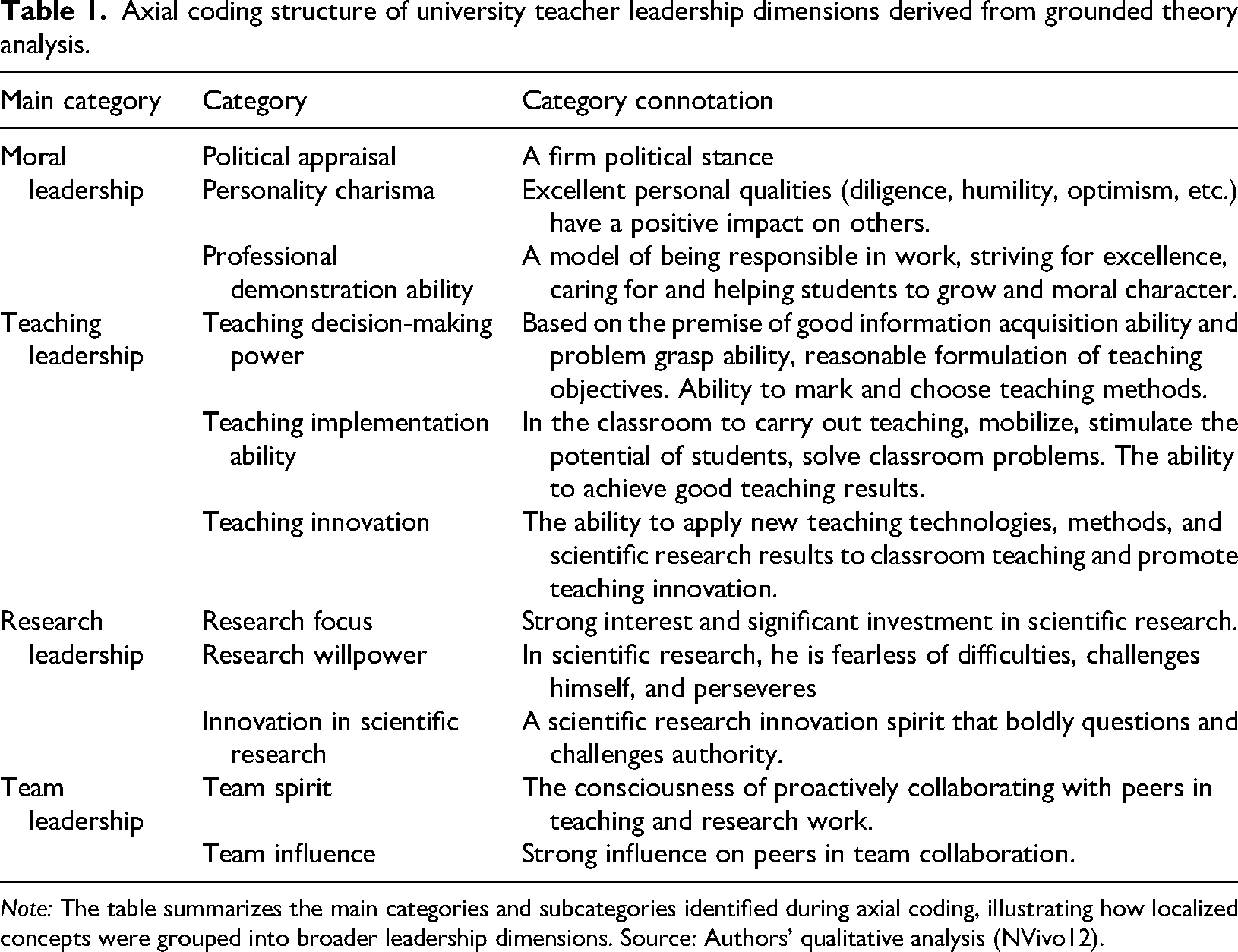
Note: The table summarizes the main categories and subcategories identified during axial coding, illustrating how localized concepts were grouped into broader leadership dimensions. Source: Authors’ qualitative analysis (NVivo12).
Selecting an encoding
After the axial coding is completed, according to the coding information, the axial coding can be summarized into four core categories, namely, moral leadership, teaching leadership, research leadership, and team leadership. Dedication, honesty, hard work, down-to-earth, caring for students, helping them grow, treating people equally, and setting an example are the four main axes that can be summarized as moral leadership. Teaching excellence, student recognition, promotion of teaching reform, dedication to innovation, focus on communication, encourage questions, these three main axes can be summarized as teaching leadership. The four main axes of scientific research interest, scientific research innovation, scientific research will and scientific research leadership can be summarized as scientific research leadership. The two main axes of cooperation consciousness and peer influence can be summarized as team leadership, as shown in the Table 2.
Frequency and proportional distribution of open codes across leadership dimensions.
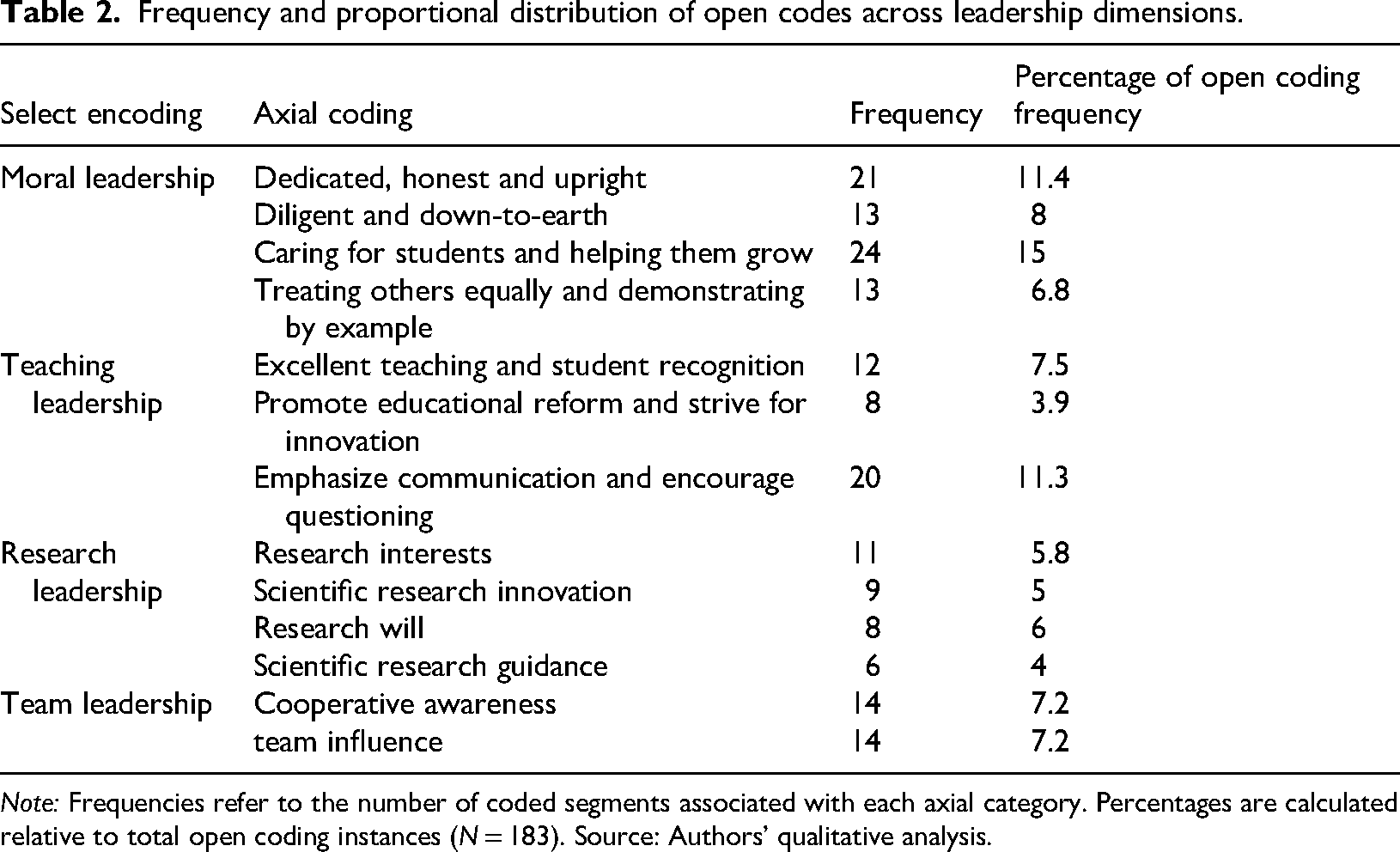
Note: Frequencies refer to the number of coded segments associated with each axial category. Percentages are calculated relative to total open coding instances (N = 183). Source: Authors’ qualitative analysis.
Model frame design
In terms of coding frequency, moral leadership accounted for 41.2% of all coding frequency, ranking first; Teaching leadership accounted for 22.7% of all selected coding frequency, ranking second; Scientific research leadership accounted for 21.7% of all selected coding frequency, ranking third; Team leadership accounted for 14.4% of all chosen coding frequency, ranking fourth. Notably, two leadership dimensions—moral (41.2%) and teaching (22.7%)—were far more frequent than research and team leadership. This asymmetry was explicitly recognized when refining the framework model, ensuring that the weight of these two dimensions was represented not only descriptively but also conceptually in the final version.
For Strauss, the process of coding within the framework of grounded theory is the process of creating theory. Through three steps of open coding, axial coding and selective coding, this study established a preliminary theoretical framework model for the leadership development of university teachers, as shown in Figure 1.
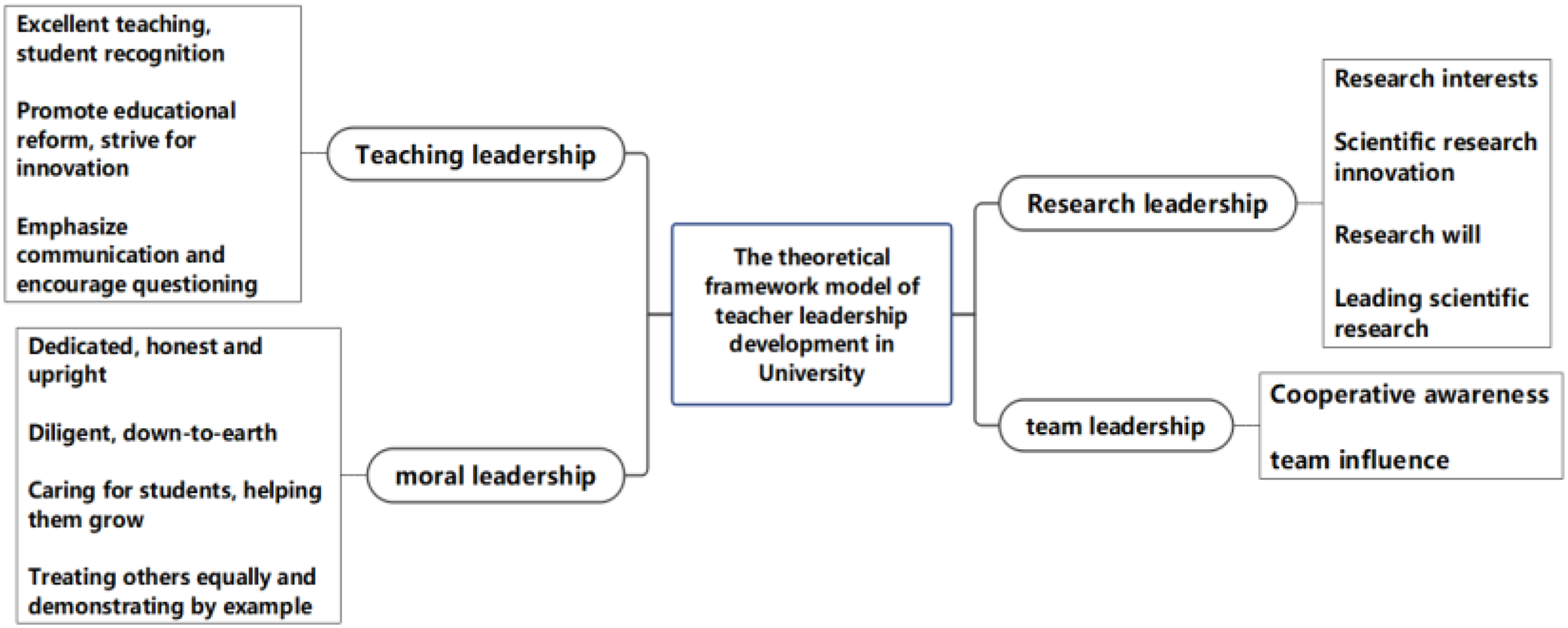
Theoretical framework of university teacher leadership development derived from grounded theory. The model integrates four interrelated dimensions (moral, teaching, research, and team leadership) identified through qualitative coding and subsequently validated quantitatively. Source: Authors’ conceptual model.
Quantitative research method
The purpose of this study is to build a theoretical model of teacher leadership in colleges and universities. Based on theoretical research and qualitative research, the researcher first constructed a theoretical framework model of young teachers’ leadership in colleges and universities to further verify the rationality of the theoretical framework and provide a measurement basis for the development of teacher leadership in colleges and universities. The research conducted a large sample empirical test of the designed model through quantitative methods.
Research object and sampling method
From November 2023 to February 2024, this study conducted a special investigation on random questionnaires issued by teachers in 9 colleges and universities in Henan, Hebei, Zhejiang, Sichuan, Hunan, Hubei, Chongqing, Guangzhou and Beijing. HEI selection strategy. The nine institutions were chosen using stratified sampling by region and institution type (comprehensive/normal; public/private) to ensure structural heterogeneity (size, disciplinary profile, and involvement in the Double First-Class program). Each HEI appointed a focal contact to distribute the survey link. Eligibility (QUAN). Tenured/contract faculty with ≥1 year of teaching; counselors with exclusively administrative duties were excluded. Sample and response. 350 invitations; 317 valid responses after quality checks (effective response ≈ 90.6% of respondents; 317/350). Data were collected via a secure online platform; invitations were disseminated by institutional focal points. Although participation was voluntary (non-probability), we stratified invitations by region and institution type to approximate structural heterogeneity. Quality controls included attention checks and listwise deletion of incomplete cases.
The network questionnaire has the advantages of low cost and all-weather. A total of 350 questionnaires were issued, 327 were recovered, and 317 were effectively asked after excluding incomplete questionnaires. The specific composition of the questionnaire sample is shown in Table 3.
Demographic characteristics of survey participants (N = 317).
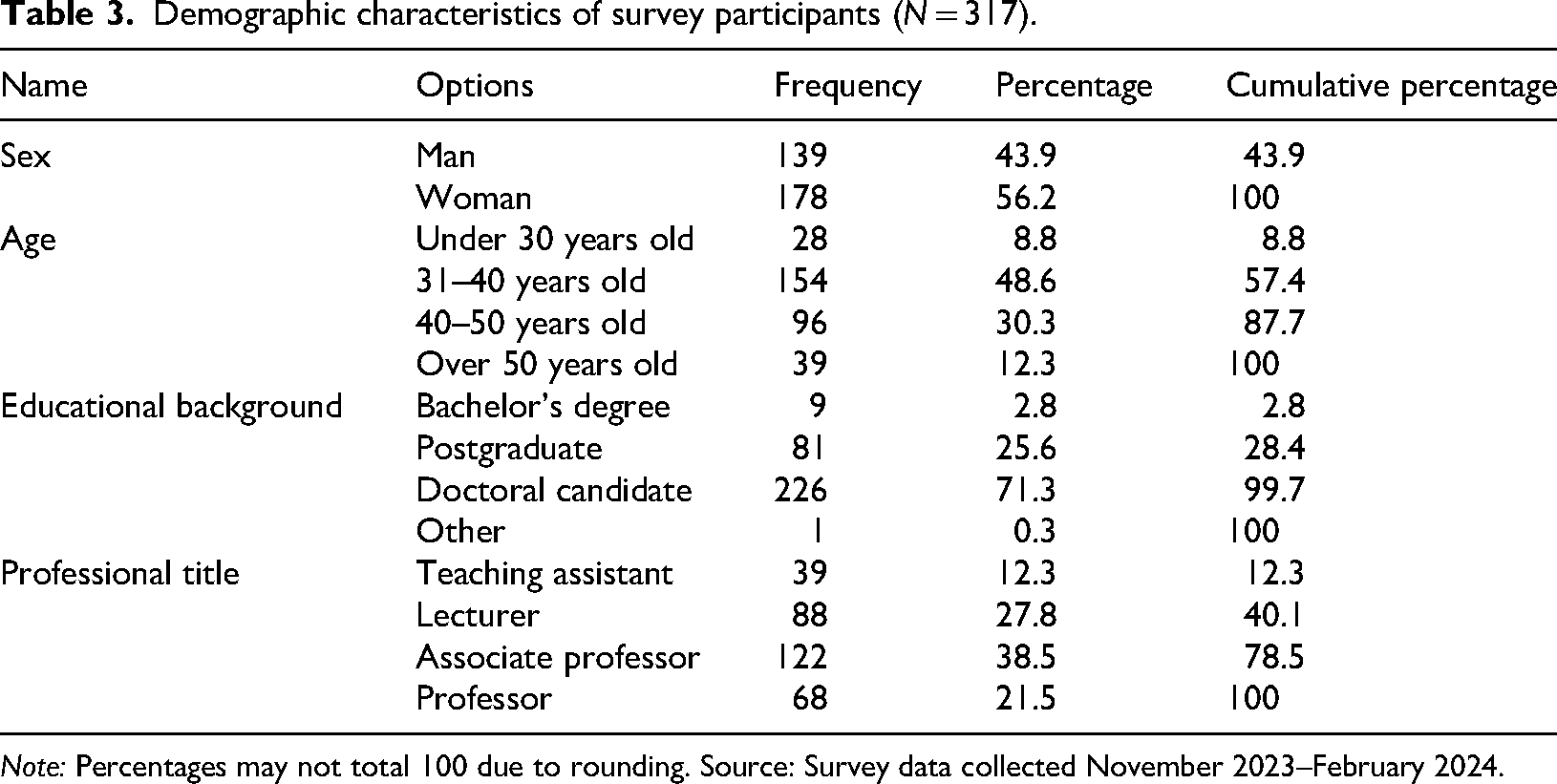
Note: Percentages may not total 100 due to rounding. Source: Survey data collected November 2023–February 2024.
Additional demographics collected. Beyond sex, age, degree, and rank, we recorded years of teaching, broad disciplinary area (Humanities, Sciences, Engineering, Health, etc.), employment status (full-/part-time), and leadership experience (program coordination, department chair). These variables supported descriptive summaries and robustness checks.
Questionnaire design
We conducted EFA using principal axis factoring with oblimin rotation (factors allowed to correlate). Factor retention was guided by (a) eigenvalues >1, (b) scree plot inflection, and (c) parallel analysis. We then ran CFA in AMOS (maximum likelihood), evaluating χ2/df, CFI/IFI/TLI, RMSEA, and SRMR. Items with standardized loadings <.50 or high cross-loadings in EFA were candidates for removal prior to CFA.
Based on the theoretical model of college teacher leadership development constructed in this study, the evaluation index of teacher informatization leadership proposed by Sun Zhenxiang (Li et al., 2022; Zhenxiang and Xiaocui, 2015), the teacher leadership model and leadership effectiveness scale proposed by Ying (2021); Xianghui and Jianmei (2018) and Ying (2021). The researchers designed two questionnaires, “University Teachers’ Leadership Development Questionnaire” and “University Teachers’ Leadership Development Environment Questionnaire.” The questionnaire mainly includes four dimensions: moral leadership, teaching leadership, research leadership and team leadership. Moral leadership specifically examines the ability of university teachers to have a positive impact on students, teachers’ peers and school administrators by virtue of their professional ethics, ability and emotion. Teaching leadership specifically examines teachers’ ability in teaching decision-making, teaching implementation and teaching innovation; Research leadership specifically examines the influence of teachers’ will, spirit and attitude on students’ and teachers’ peer demonstration and leadership, as well as their innovation and creation in the field of research on scientific and technological progress and economic development; Team leadership specifically examines teachers’ teamwork spirit and team operation ability. The questionnaire adopts Likert scale scoring method, and adopts a 5-point scale scoring method. “5” means complete agreement, “4” means relatively agreement, “3” means neutral, “2” means relatively inconsistent, and “1” means completely inconsistent. Respondents choose their own answers.
Results
Project analysis and reliability
Project analysis, reliability, and validity analysis
The main purpose of item analysis is to check the appropriateness or reliability of questionnaire preparation, and the results of item analysis can be used as the basis for item selection and modification (Wu, 2010). In this study, SPSS24.0 was used for item analysis of the questionnaire. First, the total score of the scale was ranked from low to high, and the first 27% was selected as the low group and the last 27% as the high group. An independent sample T test was conducted to investigate the differences between the two groups in each item. The results showed that the differences in T detection were all significant, indicating that the items in the questionnaire were discriminated against.
After the project analysis, to further understand the reliability and stability of the questionnaire, the reliability test of the questionnaire was carried out in this study. Reliability refers to the degree of consistency of measurement results after repeated measurement. Cronbach's alpha, also known as internal consistency reliability, is a common measure of the internal consistency of a measurement tool. In exploratory factor analysis, 0.5 is considered acceptable, in confirmatory factor analysis, 0.6 is considered acceptable, 0.7 is considered good, and 0.8–0.9 is ideal. The research results show that the “Leadership Development Questionnaire for University Teachers” has high reliability, as shown in Table 4. The internal consistency reliability of the environmental factors scale is also satisfactory (Table 5).
Internal consistency reliability (Cronbach's α) of the University Teacher Leadership Development Scale.
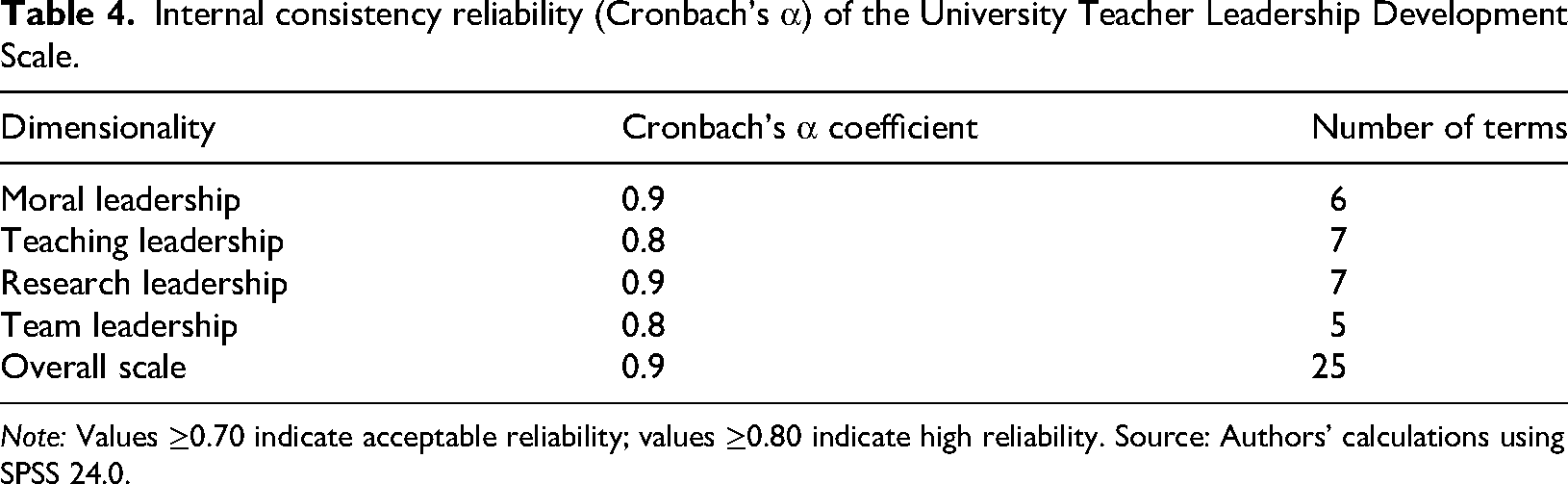
Note: Values ≥0.70 indicate acceptable reliability; values ≥0.80 indicate high reliability. Source: Authors’ calculations using SPSS 24.0.
Internal consistency reliability of environmental factors influencing university teacher leadership.

Note: Environmental factors assess perceived institutional support for leadership development. Source: Authors’ calculations.
Kaiser–Meyer–Olkin (KMO) measure and Bartlett's test of sphericity for factorability assessment.
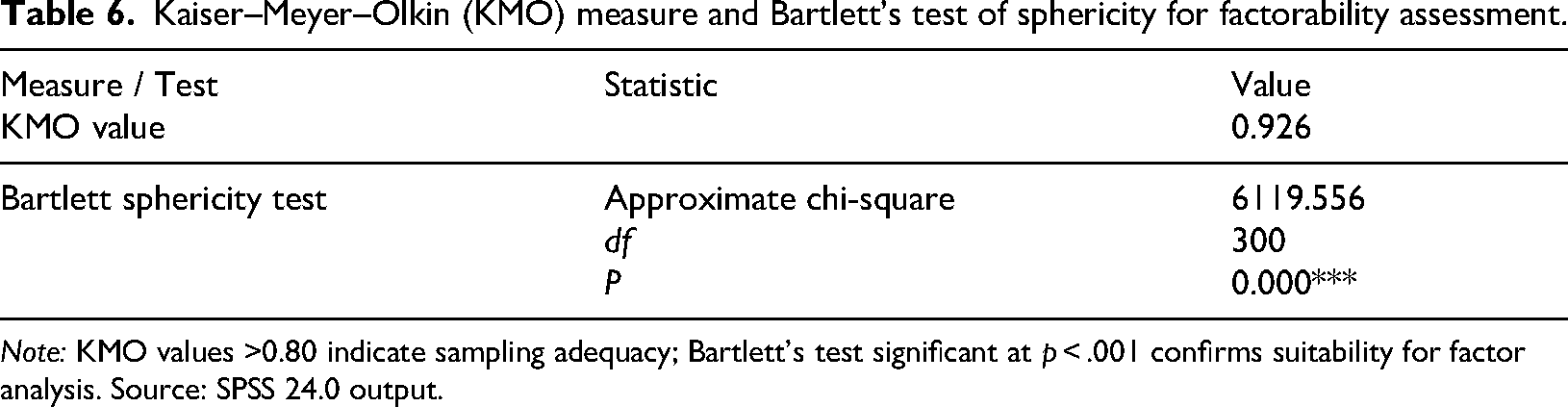
Note: KMO values >0.80 indicate sampling adequacy; Bartlett's test significant at p < .001 confirms suitability for factor analysis. Source: SPSS 24.0 output.
Model fit indices for confirmatory factor analysis of the four-factor leadership model.

Note: χ2/df < 5, CFI/TLI > 0.90, and RMSEA < 0.08 indicate acceptable model fit. Source: AMOS 22.0.
This study analyzes the exploratory factors of the Questionnaire on Leadership Development of University Teachers. KMO test and Bartlett sphericity test of the questionnaire, KMO value is 0.960, Bartlett sphericity test (P < 0.001), indicating that there is a very significant correlation between questionnaire items, more suitable for factor analysis (Table 6).
Confirmatory factor analysis
This study is an exploratory study on the components of university teachers’ leadership. Therefore, it is necessary to verify the relationship between the expected indicators of each factor preset according to theoretical analysis to ensure that the indicators can effectively reflect the factors. A confirmatory factor analysis was performed using AMOS22.0 statistical software.
In general, the fitting indexes of the four-factor model of university teacher leadership are good (Table 7). The research results can support the hypothesis of the theoretical model of university teacher leadership; that is, university teacher leadership consists of four dimensions: teacher moral leadership, teaching leadership, research leadership and team leadership.
Descriptive analysis
The descriptive statistics show that the mean values of moral leadership and teaching leadership are 4.36 and 4.16, respectively, which are at a relatively high level. The mean value of research leadership is 3.26, which is in the middle level, and the mean value of team leadership is 3.67, which is in the middle level. The overall average of leadership development of university teachers is 3.68, which is in the middle level. Age distribution and responses. Given that nearly 57% of participants were under 40 years old, age was considered as a potential influence. Preliminary analyses suggested that younger faculty emphasized moral and teaching leadership more strongly, while older faculty reported relatively greater emphasis on research leadership. These patterns indicate that career stage may shape leadership perceptions and should be examined in future research. These mean differences are consistent with institutional trade-offs in massified systems: teaching-related commitments are widely shared and proximal to everyday practice, whereas research and team leadership often depend on discretionary time, mentoring structures, and cross-unit coordination. This contextualizes the four-factor structure without reifying value hierarchies among dimensions, as shown in Table 8.
Descriptive statistics for leadership dimensions and environmental factors.
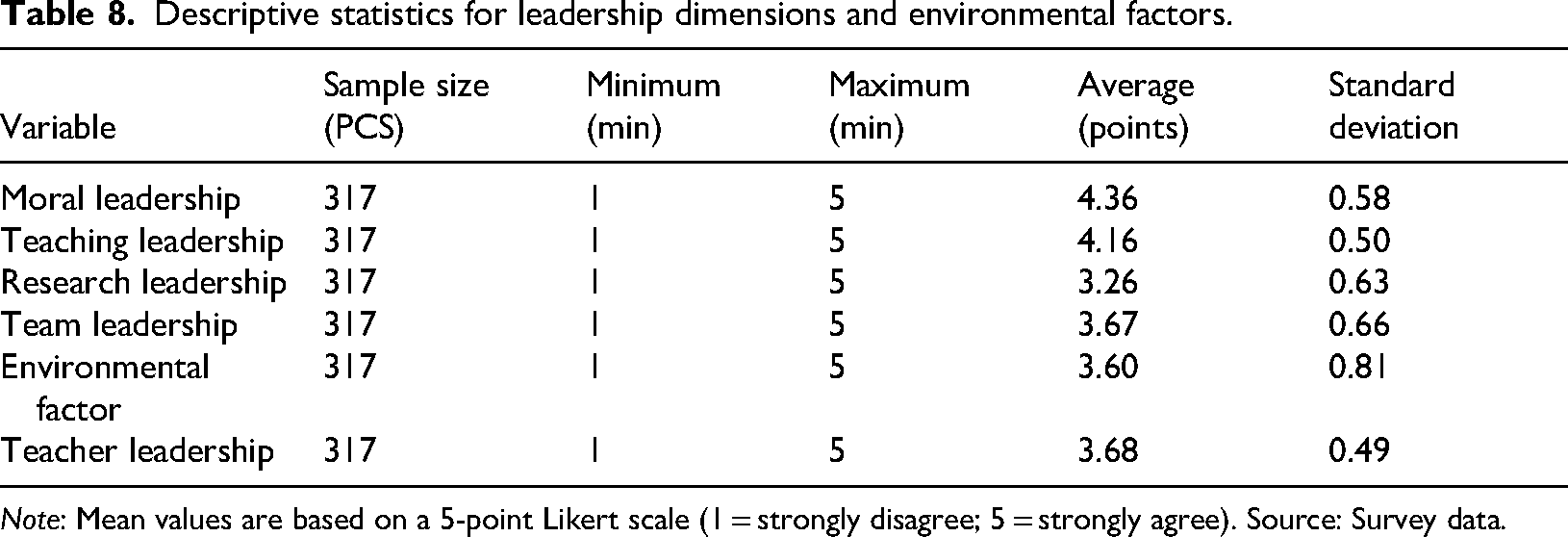
Note: Mean values are based on a 5-point Likert scale (1 = strongly disagree; 5 = strongly agree). Source: Survey data.
Outcomes of leadership (self-reported)
Although leadership was self-reported, we also asked interviewees and survey participants to indicate perceived outcomes of their leadership. These included:
− Student outcomes: enhanced motivation, improved engagement, and higher retention in academic programs. − Peer outcomes: stronger collaboration, mentoring of junior faculty, and dissemination of innovative teaching practices. − Institutional outcomes: participation in curriculum reform, contributions to accreditation processes, and leadership in research teams.
While not externally verified, these reported outcomes provide contextual evidence of how leadership manifests in practice, complementing the frequency data presented above.
These outcome reports map onto the dimension scores: higher reported student engagement and peer mentoring were most frequently associated with moral and teaching leadership, mirroring their coding frequencies (41.2% and 22.7%) and higher means (M = 4.36, M = 4.16).
Correlation analysis
The five factors of environmental factors, team leadership, research leadership, teaching leadership and moral leadership, respectively, show a significant level of 0.01, and the correlation value is greater than 0.3, indicating that these five factors have a significant positive correlation with the leadership of university teachers. These five factors are closely related to the leadership of university teachers, as shown in Table 9.
Pearson correlation coefficients among leadership dimensions and environmental factors.
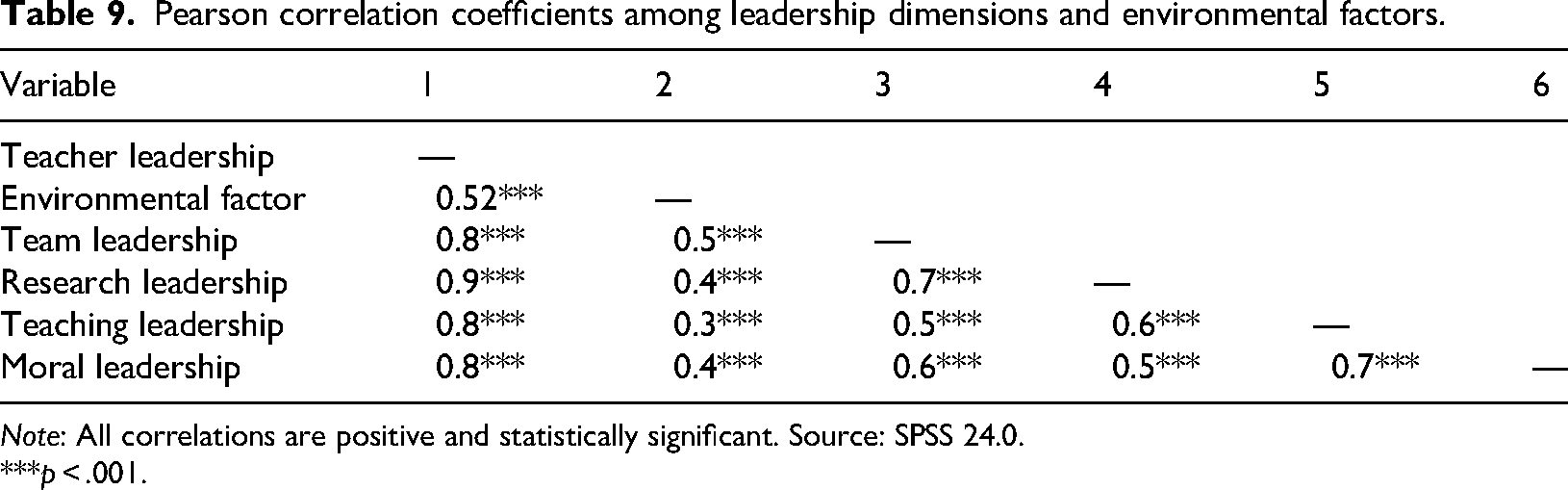
Note: All correlations are positive and statistically significant. Source: SPSS 24.0.
***p < .001.
Discussion
This study contributes to advancing the field of teacher leadership by offering a contextually grounded, empirically supported model tailored to the complexities of Chinese higher education. The four dimensions—moral leadership, teaching leadership, research leadership, and team leadership—not only reflect global conceptualizations of teacher leadership but also incorporate emerging priorities specific to contemporary academic environments.
The dominance of moral leadership highlights its enduring cultural importance, particularly in Confucian-influenced academic settings of ethical integrity and character in Chinese educational leadership. Rooted in Confucian philosophy, moral leadership functions as both a symbolic and practical pillar within university governance, reinforcing national narratives about the social responsibility of educators (Liu et al., 2025a; Zhang et al., 2021). This finding is particularly relevant at a time when higher education institutions in China are under pressure to balance global competitiveness with cultural continuity (Li, 2020; Marginson and Yang, 2022). The emphasis on moral and pedagogical dimensions is empirically grounded in our data: (a) qualitative coding showed moral and teaching leadership as the most salient categories (41.2% and 22.7%), (b) quantitative means were highest for these two dimensions (M = 4.36 and M = 4.16), and (c) self-reported outcomes most commonly referenced student motivation/engagement and peer mentoring. Consequently, discussions of digitalization and inclusion are not speculative; they contextualize why moral and teaching leadership are perceived as most consequential for daily academic practice. Universities are no longer insulated spaces; they are now deeply embedded in socio-political dynamics that require ethical reflexivity and adaptive leadership (Barnett, 2017; Marginson, 2016).
Teaching leadership's prominence reflects the traditional emphasis placed on instructional quality as a primary domain of academic legitimacy. However, our data also point to a redefinition of this leadership in terms of student-centered innovation, digital transformation, and reflective pedagogy—dimensions increasingly highlighted in global reform agendas (York-Barr and Duke, 2004). The prominence of teaching leadership may also reflect a rising awareness of the need for inclusive pedagogies that accommodate diverse learners, especially in rapidly massified university systems. Teacher leaders are increasingly expected to bridge gaps in equity, digital access, and academic preparedness (Harris and Jones, 2020; Stentiford and Koutsouris, 2021).
The more moderate emphasis on research leadership and team leadership warrants critical examination. While these dimensions are central to faculty evaluation in performance-based university systems, their weaker representation may reflect structural constraints such as heavy teaching loads, limited access to mentorship, or insufficient incentives for interdisciplinary collaboration. These observations corroborate previous studies identifying institutional culture and governance as critical barriers to the diffusion of distributed leadership in academia (Avolio and Benzaquen, 2024; Kezar, 2023). The moderate salience of research and team leadership dimensions may also reflect the unintended consequences of competitive academic environments. The rise of academic capitalism can create fragmented cultures where faculty prioritize individual metrics over collective development, hampering the growth of sustainable leadership communities (Slaughter and Rhoades, 2004).
The comparatively lower means for research and team leadership are consistent with structural and cultural features of Chinese HEIs: high teaching loads in massified systems, performance regimes privileging individual outputs, and limited time for cross-unit collaboration. These conditions may depress the visibility of research and team influence even when faculty contribute substantively (Kezar, 2023; Marginson, 2016). Our QUAL codes also indicate that mentoring and collaboration are often framed as moral duty or teaching-related service, which may shift respondents’ attributions toward the moral/teaching dimensions. This attributional pattern helps explain the asymmetry without implying lesser importance of research and team leadership.
Leadership in universities is inherently entangled with power and control, informal status hierarchies, resource gatekeeping, and evaluation systems shape who can influence whom, and on what issues. Our findings should therefore be read against institutional value regimes that privilege certain forms of contribution (e.g., publication metrics) over others (e.g., mentorship, inclusive pedagogy). Recognizing these dynamics clarifies why moral and teaching leadership, forms of influence legitimized by cultural values of educator responsibility, are perceived as most consequential, while research and team leadership may be rendered less salient by prevailing control systems (Bush, 2008; Slaughter and Rhoades, 2004; Spillane, 2005).
Methodologically, the integration of grounded theory with confirmatory factor analysis enhances the study's internal validity and external relevance. This approach enables both theory generation and empirical testing, responding to recent calls for leadership research designs that bridge exploratory and confirmatory paradigms (García-Martínez et al., 2018; Grimm, 2024).
Nevertheless, several limitations should be acknowledged. First, the reliance on self-reported perceptions may be subject to social desirability bias, particularly in hierarchical academic cultures. Second, while the sample encompasses a broad geographic range within China, its generalizability remains limited due to potential institutional and regional asymmetries. Finally, the cultural embeddedness of leadership constructions necessitates caution in extrapolating the model to different sociocultural or national contexts. While geopolitical narratives (e.g., internationalization and soft power) shape the institutional environment, our evidence pertains to perceived leadership practices captured by four dimensions. We therefore treat geopolitics as context, not as an outcome of our measures; the core contribution remains the validated dimensional structure and its distribution across faculty subgroups (e.g., age).Understanding how leadership models align with or resist these geopolitical narratives is critical for advancing a nuanced theory of academic leadership (Mok, 2016; Yang, 2014).
Future research should adopt comparative designs across institutions with varying governance models, disciplinary focuses, and internationalization levels. Investigating how faculty identity, career stage, and gender shape leadership engagement would also enrich the field. Furthermore, longitudinal studies tracking leadership development over time and its impact on institutional innovation would provide valuable insights into sustainable academic leadership practices. Finally, reconceptualizing teacher leadership through the lens of epistemic justice can enrich both theory and practice. As universities become sites of epistemological contestation, faculty leadership must engage not only with technical and administrative challenges but also with the imperative to value diverse knowledges and voices (Andreotti, 2011; Plaxton-Moore, 2019).
From a practical standpoint, the study offers actionable implications for policy and professional development. Universities should move beyond technocratic or bureaucratic models of faculty development and cultivate environments that recognize leadership in its diverse forms—ethical, pedagogical, scholarly, and collaborative. Institutional policies should incorporate leadership training that integrates mentorship, peer learning, and collaborative inquiry while ensuring alignment with local values and global standards.
Thus, this study not only fills a conceptual and empirical gap in teacher leadership research in higher education but also offers a flexible framework that can inform leadership development programs, faculty evaluation policies, and institutional transformation strategies. As global challenges reshape the purpose and practice of higher education, leadership rooted in ethical integrity, pedagogical excellence, scholarly inquiry, and collective action will be indispensable.
Conclusion
This study advances the conceptual and empirical understanding of teacher leadership in higher education by offering a four-dimensional model—moral, teaching, research, and team leadership—that is contextually grounded in Chinese academic culture. Its novelty lies in explicitly centering moral leadership alongside teaching, research, and team leadership, thereby offering a comparative lens for future cross-cultural validations. Rather than proposing a universal framework, the model emphasizes culturally embedded notions of ethics, pedagogical responsibility, and collective engagement shape leadership practices in non-Western educational systems.
One of the main contributions lies in bridging theoretical gaps between school-based leadership literature and the relatively underexplored domain of university teacher leadership. By integrating moral and teaching leadership as central dimensions, the study disrupts dominant performance-based paradigms and invites a broader reconsideration of what constitutes academic leadership in massified, digitized, and increasingly unequal higher education environments.
Furthermore, the framework should be interpreted with caution: the dominance of moral and teaching leadership in both qualitative and quantitative phases reflect not only cultural values but also the demographic profile of the sample, with younger faculty (under 40) disproportionately represented. Future research should test the model across career stages to verify the stability of these leadership dimensions.
The study also demonstrates a robust methodological contribution by combining grounded theory with confirmatory factor analysis, enabling both conceptual discovery and empirical validation. This hybrid approach provides a replicable model for future research seeking to balance qualitative insight with quantitative rigor.
From a policy perspective, the findings suggest that higher education institutions in China—and potentially other post-socialist or Confucian-influenced societies—must move beyond managerialist models of faculty development. Leadership programs should prioritize ethical formation, inclusive pedagogies, and scholarly mentorship that resonates with local academic values while aligning with global educational standards. These recommendations flow from convergent evidence: the frequency and mean dominance of moral/teaching leadership, the adequate four-factor fit, and age-related patterns, together point to development pathways that prioritize ethical formation and instructional leadership while strengthening research and team capabilities.
Nevertheless, some limitations must be acknowledged. The study relies on self-reported data, which may be influenced by social desirability biases. Moreover, although the sample captures institutional diversity within China, regional disparities and institutional hierarchies may still limit generalizability. Additionally, the cross-sectional design does not account for how leadership development evolves over time or interacts with career trajectories, policy reforms, or global academic networks.
Future research should adopt longitudinal and comparative designs across diverse institutional types, governance regimes, and national contexts. Particular attention should be paid to how leadership capacities are shaped by gender, age, academic discipline, and international exposure. Further inquiry into the relationship between teacher leadership and student outcomes—both academic and psychosocial—would deepen the understanding of leadership's systemic impact.
In a time when higher education is increasingly positioned within geopolitical, digital, and epistemic tensions, rethinking teacher leadership is not just an academic exercise—it is a strategic imperative. Models that foreground integrity, collaboration, cultural relevance, and pedagogical innovation are urgently needed to guide institutions through the complexities of twenty-first-century education.
Overall, this trajectory from positional to distributed teacher leadership underscores why university contexts—where collaboration, interdisciplinarity, and global competitiveness are central—require models that integrate both individual excellence and collective responsibility. Our findings contribute to this evolution by empirically validating a four-dimensional model that foregrounds moral and teaching leadership while still acknowledging the challenges of research and team leadership.
In sum, by situating university teacher leadership within both historical stages of development and contemporary Chinese higher education, this study provides a robust, context-sensitive argument for rethinking how faculty leadership is conceptualized, supported, and evaluated.
Footnotes

Funding
The authors disclosed receipt of the following financial support for the research, authorship, and/or publication of this article: Sichuan International Studies University's 2025 University-Level Research Project “Research on the Model and Path for Constructing Digital Literacy of Ideological and Political Course Teachers in Colleges and Universities from the Perspective of Digital Intelligence” (Project No.: sisu202531).
Declaration of conflicting interests
The authors declared no potential conflicts of interest with respect to the research, authorship, and/or publication of this article.