







Abstract
This study examined a moderated mediation model to explore the conditions under which instructional leadership (IL) is associated with teachers’ instructional practices through teacher efficacy for inclusive practices. Survey data were obtained from 884 teachers nested within 58 public primary schools in Türkiye and analysed using Bayesian multilevel structural equation modelling. The findings showed that IL was related to instructional practices both directly and indirectly via teacher efficacy for inclusive practices. Importantly, social justice leadership (SJL) functioned as a contextual moderator, strengthening the association between IL and teacher efficacy for inclusive practices and, in turn, the indirect link to instructional practices. In school contexts characterised by very low levels of SJL, the indirect effect was substantially weaker than in higher-SJL contexts. Overall, the results indicate that the effects of IL on instructional practices are psychologically mediated and context dependent. The study concludes by discussing implications for leadership research, policy, and practice in centralised education systems.
Keywords
Introduction
School leaders are widely recognised as influencing school effectiveness and student learning primarily through indirect pathways that operate alongside the direct influence of teachers’ classroom practices (Leithwood et al., 2004; Murphy et al., 2016). Among these pathways, it is particularly important that schools respond to expanding social and demographic diversity while maintaining instructional quality by supporting teachers’ efficacy for inclusive classroom practices (Shaked, 2025; Tschannen-Moran and Hoy, 2001). Although recent scholarship has highlighted persistent challenges in providing inclusive and high-quality instruction for students from diverse backgrounds (Hutchings, 2021; Shaked, 2024, 2025; Sinnema et al., 2025), these concerns are not new.
Indeed, the roots of this debate can be traced to early effective schools research, which drew attention to educational quality for children in poverty, the performance of schools serving historically marginalised students, and the cumulative nature of school-based disadvantage (Coleman et al., 1966; Edmonds, 1979; Lezotte et al., 1974). In response to arguments about the limited effects of schools, researchers examined ‘exemplary’ or ‘outlier’ schools that performed better than expected under disadvantaged conditions, highlighting the roles of school leadership, high expectations, and other school-level factors (Austin, 1979; Bossert et al., 1982; Mace-Matluck, 1987). Thus, while this literature acknowledged structural inequalities, it also suggested that some schools could produce stronger outcomes under similar conditions. This historical background underscores why school leadership should be reconsidered not only in terms of instructional effectiveness but also in relation to equity, inclusion, and responsiveness to diverse student needs.
Today, school leaders face intensified political and societal pressures shaped by policy-driven accountability systems, including teacher evaluation (Bartanen and Grissom, 2023), standardised performance demands (Hallinger et al., 2020), and expectations to address racial inequities and unequal access to resources (Neumerski et al., 2025). They must balance measurable student achievement with responsiveness to diverse, often competing, student needs. In centralised systems such as Türkiye, this balance is further constrained by centrally prescribed curricula, limited school-level autonomy, and strong bureaucratic regulation (Bellibas et al., 2021; Ozdemir et al., 2025). Nevertheless, empirical research examining how leadership approaches are configured to address these challenges remains limited (Shaked, 2024, 2026; Shen and Wu, 2024).
In this context, a substantial body of research relates school leadership to teaching and learning through multiple approaches, including transformational leadership (Leithwood and Jantzi, 2005; Moolenaar et al., 2010), distributed leadership (Harris, 2004; Kelley and Dikkers, 2016), instructional leadership (IL) (Hallinger and Murphy, 1985; Hallinger and Wang, 2015), and social justice leadership (SJL) (Szeto and Cheng, 2018; Zembylas and Iasonos, 2017). More recent research, however, has shifted attention from isolated leadership models to their combined operation. Studies integrating transformational leadership and IL (Bellibas et al., 2021; Kwan, 2019; Marks and Printy, 2003), distributed leadership and SJL (Woods and Roberts, 2016), and IL and SJL (Bellibas et al., 2026; Liu et al., 2026) suggest that leadership effects are interactive and context dependent. In line with this view, Shaked (2025) argues that IL and SJL are not mutually exclusive but may be complementary while remaining in tension, depending on how schooling's purposes are defined.
This relationship is important because IL and SJL address different yet related dimensions of school improvement. IL focuses on providing direction, structure, and support for instructional improvement by defining instructional goals, coordinating teaching and learning processes, and supporting pedagogical quality (Hallinger and Murphy, 1985; Hallinger and Wang, 2015). By contrast, critical leadership literature emphasises that school improvement requires attention to the social and contextual conditions in which instructional processes occur (Foster, 1986; Gumus et al., 2022). From this perspective, school leaders are change agents who recognise inequalities and assume ethical responsibility for addressing them (Arar, 2024). SJL extends this view by placing equity, inclusion, and responsiveness to structural inequalities at the centre of leadership practice and by interrogating the regulations, policies, and practices that reproduce exclusion (DeMatthews, 2015; Furman, 2012; Goldfarb and Grinberg, 2002; Theoharis, 2007). Taken together, IL and SJL suggest that improving teaching across diverse school contexts requires both a strong instructional focus and an explicit equity perspective.
From this perspective, the relationship between IL and SJL cannot be understood as merely additive. Rather, these orientations may reinforce one another and jointly shape school and instructional outcomes (Bellibas et al., 2021, 2026; Gumus et al., 2022; Liu et al., 2026; Marks and Printy, 2003; Shaked, 2024, 2025). More specifically, the effects of IL on teachers may depend on the normative framework within which instructional guidance is interpreted (Bellibas et al., 2026; Liu et al., 2026). Because social justice-oriented leadership frames leadership as an ethical and transformative practice rather than merely an administrative process (Arar et al., 2026), it may shape whether instructional guidance is understood as technical performance management or as support for inclusive and equitable teaching. This view is consistent with studies showing that SJL supports equity-oriented beliefs and pedagogical approaches, inclusive school structures, and socially just pedagogical practices (DeMatthews and Mawhinney, 2014; Furman, 2012; Rigby, 2014, 2016), thereby extending IL towards more equitable school processes (Bellibas et al., 2026; Shaked, 2025). Accordingly, the present study conceptualises SJL as a contextual moderator that shapes the conditions under which IL is translated into teacher efficacy for inclusive practices (TEIP) and, consequently, into teachers’ instructional practices (TIP).
This conceptualisation is important in contexts where schools are expected to improve measurable outcomes while addressing diversity and inequality (Furman, 2012; Hallinger et al., 2020; Shaked, 2024). It is also consistent with evidence that school leadership affects instructional outcomes mostly indirectly, through mediators such as teacher expectations (Rubie-Davies, 2007), professional learning communities and teacher collaboration (Vescio et al., 2008), collective efficacy and shared beliefs (Goddard et al., 2015; Ross and Gray, 2006), teacher self-efficacy (Thoonen et al., 2011), job satisfaction (Bellibas et al., 2021), and teacher capacity and motivation (Leithwood and Mascall, 2008).
Although previous research has shown that IL is positively associated with instructional practices (Bellibas et al., 2022; Demir and Kalman, 2025) and that SJL may support more inclusive and collaborative instructional processes (Theoharis and O’Toole, 2011), less is known about how these leadership orientations jointly influence instructional outcomes through indirect and context-dependent processes. In particular, it remains unclear whether TEIP, which is important for the quality and sustainability of inclusive instruction (Malinen et al., 2013; Soodak et al., 1998), explains how IL is translated into TIP and whether this relationship varies by perceived SJL level. The present study addresses this gap by examining how teachers’ perceptions of principals’ IL are related to TIP through TEIP, and whether this indirect relationship varies by SJL. In this respect, the study argues that IL may be more effective when situated within an equity-oriented leadership context and that leadership effects are both psychologically mediated and context-dependent. Accordingly, this study addresses the following research questions:
Is TEIP associated with TIP, and does TEIP mediate the relationship between IL and TIP? Is IL directly associated with TEIP and TIP? Does the level of SJL moderate the relationship between IL and TEIP (Figure 1)and, consequently, the indirect relationship between IL and TIP via TEIP?
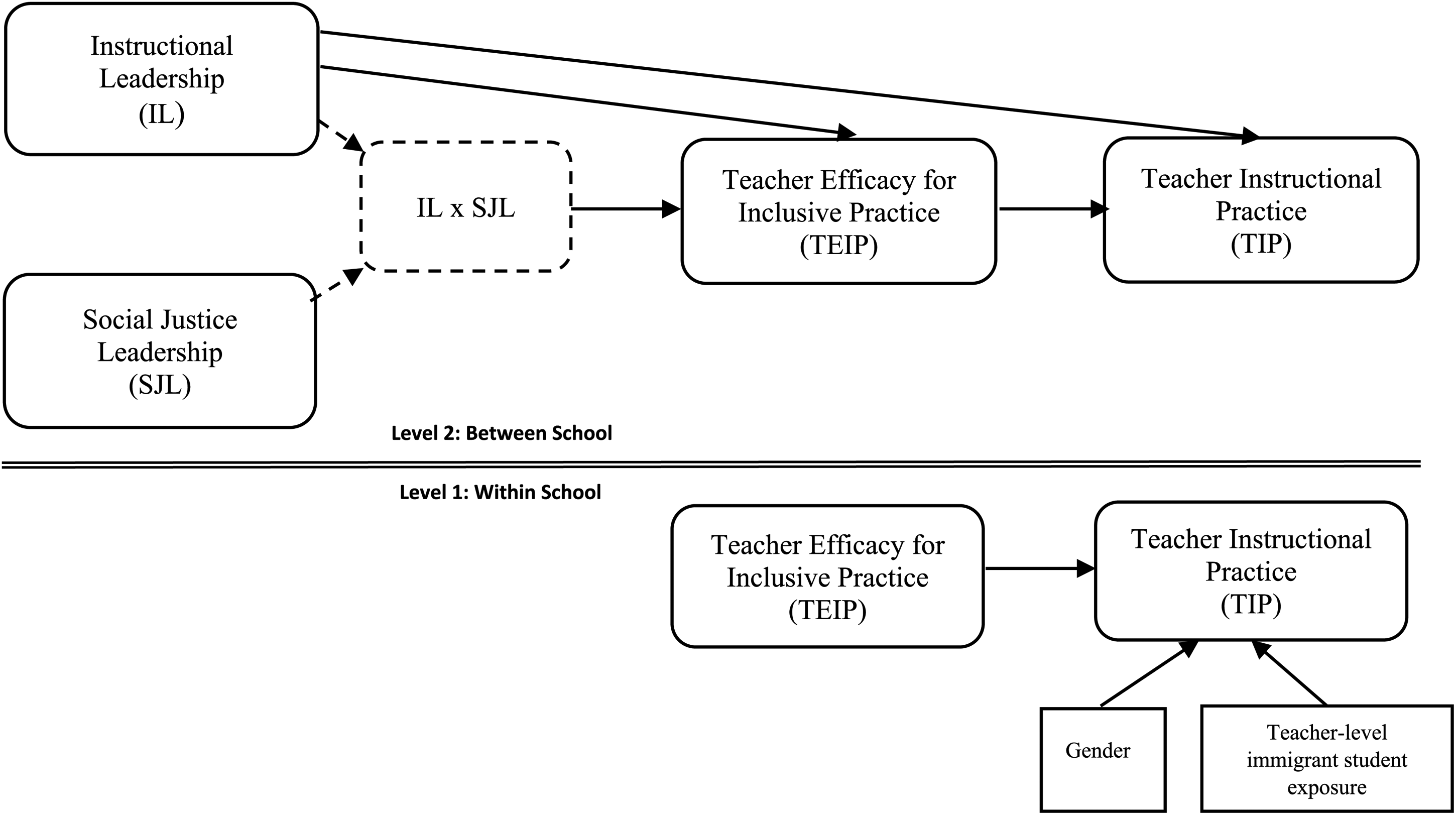
The theoretical model of the relationships among principals’ instructional and social justice leadership behaviors, teacher efficacy for inclusive practices, and instructional practices
Study context
This study was conducted in Türkiye, where education operates within a highly centralised system. MoNE regulates key areas such as principal appointments, curriculum, and teacher evaluation, leaving school leaders with limited discretionary authority (Bellibas et al., 2022; Gumus et al., 2021). Principals are appointed through standardised procedures, often without formal leadership preparation, and are primarily responsible for implementing centrally defined policies. In response to accountability pressures and persistent achievement gaps, recent reforms have emphasised strengthening IL at the school level. Notably, a 2014 MoNE policy reform transferred responsibility for teacher evaluation from inspectors to school principals (Official Gazette, 2014a). This reform expanded principals’ instructional role, a shift also noted by Karanfil (2021). In this policy context, IL is particularly relevant because school leaders are expected to implement national priorities while also supervising teaching, supporting teachers’ professional development, and maintaining coherence in instructional processes within schools (Official Gazette, 2013, 2014b).
The 2023 Education Vision further highlighted equity, inclusivity, and school-based development, positioning leadership as a mechanism for systemic improvement (MoNE, 2018). More recently, the Maarif Model has reinforced these priorities through a holistic education approach that integrates cognitive, social-emotional, and value-based development, while emphasising inclusive practices, differentiation, and moral responsibility in teaching and learning processes (MoNE, 2025). At the same time, increasing immigrant and refugee student enrolment has intensified demands for inclusive and culturally responsive practices, while bureaucratic norms continue to constrain ethical and inclusive leadership (Culha, 2023). In this context, SJL is particularly relevant because school leaders are increasingly expected not only to improve teaching, but also to address unequal learning conditions and ensure that instructional processes are responsive to student diversity (Bellibas et al., 2025, 2026; Ozdemir et al., 2025).
Taken together, these conditions suggest the simultaneous need for both IL and SJL rather than the primacy of either. In Türkiye, IL provides direction, coordination, and support for instructional improvement, reflecting the system's policy emphasis on IL under centralised governance (Bellibas et al., 2022; Gumus et al., 2021), whereas SJL is particularly relevant for ensuring that such improvement is interpreted and enacted in equitable and inclusive ways, especially in relation to disadvantage, diversity, and unequal learning conditions (Bellibas et al., 2026; Kondakci and Beycioglu, 2020). Under these conditions, instructional improvement cannot be treated separately from the equity-related demands under which it is pursued. This makes Türkiye a particularly relevant setting for examining how the two leadership orientations interact to shape teaching-related processes. Accordingly, examining how IL and SJL jointly shape teachers’ TEIP and TIP offers insight into how instructional improvement can be pursued alongside equity-oriented leadership in centralised education systems.
Theoretical and conceptual framework
The framework builds on evidence that leadership influences classroom outcomes primarily through indirect pathways (Hallinger and Heck, 1996; Leithwood et al., 2004). A central function of IL is to support instructional improvement by shaping teachers’ development and school conditions that sustain inclusive practice (Hallinger and Wang, 2015; Lee and Ip, 2023). When organised around a shared instructional vision, such efforts can foster collaborative norms and a learning-oriented culture supportive of inclusion (Pan and Chen, 2021; Shaked, 2025).
Drawing on Social Cognitive Theory, leadership orientations influence instructional practice through teachers’ cognitive interpretations rather than direct behavioural transmission (Bandura, 1986). Within this framework, self-efficacy functions as a key psychological mechanism linking contextual cues to action (Bandura, 1997). IL and SJL provide informational and normative cues regarding instructional priorities and equity-oriented expectations, shaping TEIP, a cognitive mechanism that translates leadership orientations into TIP. In this sense, Social Cognitive Theory provides the basis for explaining how leadership is translated into teachers’ instructional practices through efficacy-related processes.
In addition, Contingency Theory (Donaldson, 2001) helps explain why the effects of IL are not uniform across school contexts. Rather than assuming that IL has the same implications across settings, a contingency perspective suggests that its effects depend on the conditions within which it is enacted and interpreted. In the present study, SJL is conceptualised as one such condition. More specifically, IL is treated as the focal leadership orientation related to instructional improvement, whereas SJL is positioned as the normative and interpretive context within which IL is enacted and understood. This position is consistent with research on integrated leadership suggesting that leadership orientations may operate jointly rather than as isolated constructs in shaping school and instructional outcomes (Bellibas et al., 2021; Liu et al., 2026; Marks and Printy, 2003; Shaked, 2024). It is also consistent with studies indicating that SJL can shape teachers’ equity-oriented beliefs, pedagogical approaches, and inclusive school processes, thereby influencing whether instructional guidance is understood primarily as technical performance management or as support for inclusive and equitable teaching (Bellibas et al., 2026; DeMatthews and Mawhinney, 2014; Furman, 2012; Rigby, 2016; Shaked, 2025). From this perspective, the effects of IL are expected to vary depending on how teachers interpret instructional guidance. Accordingly, the IL–TIP association is conceptualised as an indirect, contingent process, mediated by TEIP and conditioned by perceived SJL, thus framing leadership effects as psychologically mediated and context-dependent.
In the present study, the multidimensional conceptualisation of SJL as support, critical consciousness, and inclusion is therefore not treated as a separate instructional pathway parallel to IL. Rather, these dimensions are understood as constituting the normative and relational context within which IL is interpreted. Support helps signal whether teachers perceive leadership as enabling equitable access to learning; critical consciousness helps shape whether instructional priorities are understood in relation to structural inequalities; and inclusion helps frame whether teaching is oriented towards participation and responsiveness to diverse learners. From this perspective, SJL is modelled as a contextual moderator because its multidimensional character is operationalised through its role in shaping the meaning and perceived purpose of IL practices, particularly in relation to inclusive teaching.
Teacher instructional practices
TIPs refer to teachers’ enacted approaches to planning, teaching, and responding to students’ learning needs in everyday classroom contexts. In contemporary student-centred approaches, inclusion is conceptualised not as a privilege but as a right (Fuller, 2012). Accordingly, teaching in heterogeneous classrooms requires practices that are responsive to diversity, promote equitable participation, and support learning for all students. Educational research has consistently emphasised the central role of teaching in improving student learning outcomes and highlights that effective classroom practices must be responsive to students’ diverse needs (Goddard et al., 2019). Prior studies identify a range of practices associated with effective teaching, including adapting instruction, supporting student motivation, and fostering collaboration (e.g. Marzano et al., 2001; Murphy et al., 2016). Building on this broader perspective, the present study follows the conceptualisation of Geijsel et al. (2009), which views teaching as an ongoing process in which teachers actively modify and improve their instructional practices. From this perspective, TIP is conceptualised as teachers’ efforts to enhance student engagement, diversify teaching strategies, respond to students’ academic and emotional needs, and support collaborative learning processes, reflecting the view of instructional practice consistent with that proposed by Geijsel et al. (2009).
While school leaders shape conditions that support instructional work, the enactment of inclusive instructional practices ultimately rests with teachers as the primary practitioners (Hallinger, 2003). Teachers’ capacity to implement inclusive teaching depends on their instructional responsiveness and their willingness to adapt pedagogy to provide equitable learning opportunities (Shaked, 2020, 2026; Theoharis, 2007). These competencies inform teachers’ instructional decisions and, consequently, their enacted practices in inclusive education settings (Liu et al., 2021). From this perspective, TIP is expected to be associated with teachers’ confidence in addressing inclusive teaching demands, positioning TEIP as a proximal mechanism in the model.
Teacher efficacy for inclusive practices
TEIP is widely recognised as a key psychological resource supporting teachers’ inclusive instruction in heterogeneous classrooms. TEIP reflects teachers’ confidence in their capacity to implement instructional strategies that support diverse learners and to sustain inclusive practices under challenging classroom conditions. Drawing on Social Cognitive Theory, efficacy beliefs shape whether individuals take action, the level of effort they invest, their persistence when encountering difficulties, and the ways they adjust their behaviour in response to changing conditions (Bandura, 1997). In instructional settings, this suggests that teachers’ efficacy beliefs influence their willingness to engage in complex and demanding teaching practices, particularly those required in inclusive classrooms.
Prior research on teacher efficacy indicates that such beliefs are associated with greater persistence in the face of instructional challenges, stronger adaptability in responding to students’ needs, and more responsive instructional behaviours (e.g. Holzberger et al., 2013; Tschannen-Moran and Hoy, 2001; Zee and Koomen, 2016). In inclusive classroom contexts, these demands are intensified, as teachers are expected to differentiate instruction, respond to diverse academic and behavioural needs, and create learning environments that ensure participation for all students (Florian and Black-Hawkins, 2011). Such practices often involve uncertainty, instructional risk-taking, and sustained effort, making them highly dependent on teachers’ efficacy beliefs (Sharma et al., 2012). Teachers with stronger efficacy for inclusive practices are therefore more likely to implement differentiated instruction, adjust pedagogical strategies in response to student diversity, and sustain inclusive practices even under challenging classroom conditions (Zee and Koomen, 2016). Research on school-level processes indicates that teacher-related psychological factors, including efficacy, operate as key mechanisms through which broader organisational and leadership influences are translated into classroom practice (Bellibas et al., 2026). In this sense, TEIP can be conceptualised as a proximal cognitive mechanism linking contextual conditions to teachers’ enacted instructional behaviours (Leithwood et al., 2004). Building on this reasoning, TEIP is likely to influence how instructional practices are enacted in the classroom. Accordingly, TEIP is expected to be positively associated with TIP (Hypothesis 1).
Instructional leadership
IL, conceptually grounded in the Principal Instructional Management Rating Scale (PIMRS), emphasises defining the school mission, managing the instructional programme, and promoting a positive learning climate (Hallinger and Murphy, 1985; Hallinger and Wang, 2015). Within this framework, principals are expected to articulate shared instructional goals, coordinate instructional processes, and foster learning environments characterised by high expectations and continuous improvement (Hallinger and Heck, 1996; Leithwood et al., 2004; Liu and Hallinger, 2024). Existing studies have examined how leadership orientations relate to TEIP, typically treating IL and SJL as separate predictors (e.g. Hallinger, 2011; Hart et al., 2025; Lambrecht et al., 2022; Theoharis, 2007). However, whether and how leadership orientations operate together, through indirect and conditional processes, to be associated with TEIP remains insufficiently clarified (Liu et al., 2021; Shaked, 2025). Empirical findings indicate that IL is associated with teachers’ professional development, classroom effectiveness, and inclusive efficacy beliefs (e.g. Bellibas and Liu, 2017; Sebastian and Allensworth, 2012), and that justice-oriented leadership supports inclusive pedagogy, particularly for disadvantaged groups (e.g. DeMatthews and Mawhinney, 2014; McKenzie et al., 2008).
From a Social Cognitive perspective, IL provides informational and normative cues that shape how teachers interpret instructional demands and evaluate their own capability to meet those demands. Through goal setting, feedback, and the organisation of professional learning opportunities, IL creates structured conditions that support teachers’ professional growth and confidence (Hallinger, 2011). As teachers engage in collaborative practices and receive instructional guidance, they are more likely to develop stronger beliefs in their capacity to implement inclusive instructional strategies (Sebastian and Allensworth, 2012). Accordingly, IL is expected to be positively associated with TEIP (Hypothesis 2).
When teachers’ instructional work is organised around such a shared vision and supported through leadership guidance, collaboration, and knowledge sharing, instructional practices may diffuse across the school and contribute to a learning-oriented culture that supports inclusive teaching (Pan and Chen, 2021; Shaked, 2025). By establishing clear instructional goals, coordinating teaching processes, and promoting consistency in instructional expectations, IL shapes the conditions under which classroom practices are enacted (Hallinger and Heck, 1996; Liu and Hallinger, 2024). Leadership practices such as monitoring instruction, providing feedback, and facilitating collaboration can directly influence teachers’ pedagogical decisions and encourage the use of teaching strategies responsive to student diversity. In this sense, IL contributes to the development and enactment of instructional practices aligned with inclusive teaching goals. Accordingly, IL is expected to be positively associated with TIP (Hypothesis 3).
In addition to its direct effects, the relationship between IL and TIP is expected to operate through TEIP as a mediating mechanism (Hallinger and Heck, 2010). Research on school leadership consistently suggests that leadership effects on classroom outcomes are largely indirect, operating through teacher-related factors such as beliefs, motivation, and professional capacity (e.g. Leithwood et al., 2004; Robinson et al., 2008). In this context, IL shapes teachers’ perceptions of their capability to respond to diverse instructional demands, while these efficacy beliefs, in turn, influence how teachers enact instructional practices in the classroom (Goddard et al., 2004). As teachers develop stronger efficacy for inclusive practices, they are more likely to translate leadership-supported instructional expectations into concrete pedagogical actions (Holzberger et al., 2013). Accordingly, TEIP is expected to mediate the relationship between IL and TIP (Hypothesis 4).
The moderating role of SJL
SJL emphasises creating inclusive school environments and equitable learning opportunities by addressing structural inequalities related to race, class, gender, disability, and sexual orientation (DeMatthews, 2015; Goldfarb and Grinberg, 2002). It centres on standing with marginalised groups and enacting leadership practices grounded in fairness, respect, and inclusion (Silva et al., 2021; Theoharis, 2007). Conceptually, SJL comprises three interrelated dimensions: support, critical consciousness, and inclusion (McKenzie et al., 2008). Support refers to proactive systems that promote academic success for disadvantaged groups (Furman, 2012); critical consciousness involves recognising and challenging institutional inequities (Shields and Hesbol, 2020); and inclusion emphasises equitable access to educational opportunities and resources (Szeto and Cheng, 2018). Through these dimensions, SJL facilitates systemic change and strengthens teachers’ capacity for inclusive practice (Ainscow, 2020).
Building on Contingency Theory, leadership effects are expected to vary depending on contextual conditions that shape how leadership practices are interpreted and enacted (Donaldson, 2001). In this study, SJL is conceptualised as a key contextual factor that shapes how teachers understand IL. While IL provides guidance related to instructional goals, feedback, and teaching practices, the meaning attributed to these signals may differ depending on the presence of SJL. When SJL is strong, IL is more likely to be interpreted as aligned with inclusive and equitable teaching goals, thereby reinforcing teachers’ confidence in implementing inclusive instructional strategies (DeMatthews, 2015; Shaked, 2024; Theoharis, 2007). By contrast, when SJL is weak or absent, the same instructional signals may be understood primarily as technical, performance-oriented, or evaluative, limiting their relevance for inclusive teaching (Grissom et al., 2021; Neumerski et al., 2025). In this sense, SJL functions as an interpretive lens through which IL is translated into teachers’ efficacy beliefs and, consequently, into classroom practice (Bellibas et al., 2026; Shaked, 2024).
Accordingly, from a contingency perspective, the strength of the relationship between IL and TEIP is expected to vary across school contexts depending on perceived SJL (Hypothesis 5). Extending this logic, IL is expected to be associated with TIP through conditional indirect pathways. Specifically, the IL–TIP relationship is expected to be mediated by TEIP, with the strength of this indirect effect depending on the level of perceived SJL. In contexts where SJL is strong, the mediating role of TEIP is expected to be more pronounced, whereas in contexts where SJL is weak, this indirect effect may be attenuated (Hypothesis 6).
Method
This study employed a cross-sectional survey design to examine the associations among IL, SJL, TEIP, and TIP.
Procedures and participants
In this study, data were collected from primary school teachers using a two-stage sampling procedure. This sampling decision was motivated by the suitability of primary school settings for examining the relationships among leadership, TEIP, and TIP, as primary schools provide a comparatively homogeneous and analytically appropriate setting for observing how leadership is associated with teachers’ efficacy beliefs and enacted instructional practices (Yli-Pietilä et al., 2024). In Türkiye, primary education is part of compulsory basic education (Eurydice, 2025), making inclusion a routine feature of everyday teaching. Moreover, because primary education is more teacher-oriented than later levels of schooling (OECD, 2025), teachers typically assume broader and more continuous responsibility for the same group of learners across the school day, making these relationships especially visible in routine classroom processes (Yli-Pietilä et al., 2024). This focus is also consistent with the study's conceptualisation of teaching as an ongoing process of adaptation and improvement in response to students’ diverse needs (Florian and Black-Hawkins, 2011; Geijsel et al., 2009; Sharma et al., 2012). Ethical approval was obtained from the Ethics Committee of Aksaray University (Protocol No. 2025-197). In the first stage, one province was selected from each of Türkiye's 12 Nomenclature of Territorial Units for Statistics (NUTS) Level 1 regions to ensure regional representation, following a stratified sampling approach in accordance with the NUTS classification (Eurostat, 2024) and considering regional distributions reported in national education statistics (MoNE, 2024). Accordingly, the selected provinces were Adana, Amasya, Ankara, Bursa, Edirne, Erzurum, Gümüşhane, İstanbul, İzmir, Kırıkkale, Malatya, and Şanlıurfa, representing diverse geographical and socio-educational contexts across the country. In the second stage, public primary schools were contacted through their Provincial and District Directorates of National Education, and principals distributed an online survey and consent form to teachers via official school communication channels (e.g. institutional email groups and messaging platforms). Participation was voluntary and anonymous, and teachers had three weeks to respond. A question-ordering strategy was implemented by presenting demographic items first, followed by the main study constructs, grouped into separate sections (IL, SJL, TEIP, and TIP), to reduce the influence of earlier questions on subsequent responses (Tourangeau et al., 2000). The final sample included 884 teachers from 58 schools, meeting recommended thresholds for multilevel analysis (Hox, 2010). Data screening indicated no duplicate, incomplete, or outlier cases.
Approximately two-thirds of the participants were female (n = 595, 67.3%). The average age was 41.37 years (SD = 7.33, ranging from 23 to 66), and nearly three-quarters of the participants were married (n = 684, 77.4%). About two-thirds had more than 15 years of teaching experience (n = 616, 69.7%), and roughly one-third reported having worked with their current principal for 2–4 years (n = 316, 35.7%). Additionally, approximately nine out of 10 participants were classroom teachers (n = 764, 86.4%). Among the schools included in the study, 15 had no students with disabilities (25.9%), while seven schools had 11 or more students with disabilities (12.1%). Similarly, 14 schools had no immigrant students (24.1%), whereas nine schools had 61 or more immigrant students (15.5%). The demographic characteristics of the participants reflect the national distribution of teachers across Türkiye (Organisation for Economic Co-operation and Development [OECD], 2019). Gender and immigrant student exposure were included as control variables in the model analysis, as gender is associated with differences in teacher-related beliefs and instructional processes (e.g. Klassen and Chiu, 2010) and is also linked to variation in educational outcomes across contexts (OECD, 2022), while exposure to immigrant students captures variation in classroom diversity and instructional demands (e.g. Ainscow, 2020; Florian and Black-Hawkins, 2011).
Data collection instruments
PIMRS-teacher form (PIMRS [IL])
Initially developed by Hallinger and Murphy (1985), the scale was adapted into Turkish by Bellibas et al. (2016). During the adaptation process, the ‘coordinating the curriculum’ sub-dimension (five items) and one item from the ‘communicating the school's goals’ dimension were excluded. While the original instrument consisted of 50 items distributed across 10 sub-dimensions within a three-factor structure, the Turkish short form, obtained directly from Hallinger via email, retains the exact three overarching dimensions in a shortened format of 18 items. These dimensions are: defining the school mission (five items, e.g. ‘The principal effectively communicates the school mission to staff, students, and parents’), managing the instructional programme (five items, e.g. ‘The principal meets individually with teachers to discuss student academic progress’), and promoting a positive school learning climate (eight items, e.g. ‘The principal coordinates or participates in in-service activities related to instruction’). The scale uses a five-point Likert format ranging from ‘almost never’ to ‘almost always’. To assess the structural validity of the instrument, a multilevel confirmatory factor analysis (MCFA) was conducted. The analysis supported the hypothesised three-factor structure, yielding acceptable fit indices (χ2/df = 6.63, CFI = 0.93, TLI = 0.91, RMSEA = 0.08, SRMRW < 0.05, SRMRB < 0.05, AVEwithin = 0.77, composite reliability (CRbetween) = 0.87). The CR coefficients indicated strong internal consistency at both levels. Additionally, omega reliability coefficients were satisfactory both within (ω = 0.90) and between (ω = 0.87) levels.
SJL scale
SJL is a multidimensional construct grounded in equity, fairness, and inclusion, and aims to eliminate structural barriers while fostering democratic school governance (Furman, 2012; Theoharis, 2007). Drawing on the theoretical framework articulated by McKenzie et al. (2008), the SJL scale was developed by Ozdemir and Pektas (2017) and consists of 23 items organised into three factors: support, critical consciousness, and inclusion. The dimensions are as follows: (1) Support, which reflects leaders’ proactive efforts to ensure equal opportunities and access to resources (11 items, e.g. ‘Provides equal opportunities in school to meet students’ needs’); (2) Critical Consciousness, which emphasises leaders’ awareness of and commitment to challenging structural inequities (nine items, e.g. ‘Enables students to express their opinions openly’); and (3) Inclusion, which captures leaders’ practices to foster an inclusive school environment where all voices are valued (three items, e.g. ‘Considers student opinions when setting school rules’). The scale uses a five-point Likert format ranging from ‘almost never’ to ‘almost always’. To assess the structural validity of the SJL, an MCFA was conducted. The analysis supported the hypothesised three-factor structure, yielding acceptable fit indices (χ2/df = 3.26, CFI = 0.93, TLI = 0.92, RMSEA = 0.06, SRMRW = 0.03, SRMRB = 0.07, AVEwithin = 0.76, CRbetween = 0.87). The CR coefficients indicated strong internal consistency at both levels. Additionally, omega reliability coefficients were satisfactory both within (ω = 0.90) and between (ω = 0.87) levels.
TEIP scale
The scale developed by Kielblock (2018) and adapted into Turkish by Demirkol and Kusca (2023) consists of 18 items. It has a unidimensional structure (e.g. ‘I can work collaboratively with school stakeholders to ensure every student in the classroom learns’). The TEIP uses a five-point Likert format ranging from ‘strongly disagree’ to ‘strongly agree’. To assess the structural validity of the TEIP, an MCFA was conducted. The analysis supported the hypothesised one-factor structure, yielding acceptable fit indices (χ2/df = 2.89, CFI = 0.95, TLI = 0.94, RMSEA = 0.05, SRMRW = 0.03, SRMRB = 0.08, AVEwithin = 0.75, CRbetween = 0.89). The CR coefficients indicated strong internal consistency at both levels. Additionally, omega reliability coefficients were satisfactory both within (ω = 0.91) and between (ω = 0.89) levels. The between-school standard deviation for TEIP was 0.15, consistent with values reported in the descriptive analyses.
TIP scale
The TIP scale, developed by Geijsel et al. (2009) and adapted into Turkish by Polatcan (2020), is a 17-item instrument designed to assess teachers’ instructional practices. It comprises three dimensions: staying up-to-date (four items, e.g. ‘I take responsibility for improving myself professionally’), reflection and observation (five items, e.g. ‘I observe my colleagues’ lessons to learn from them’), and instructional change (eight items, e.g. ‘I have recently begun to focus more on increasing student motivation’), which is used to directly reflect teachers’ enacted classroom practices. Items are rated on a five-point Likert scale ranging from ‘never’ to ‘always’. To assess the structural validity of the TIP, an MCFA was conducted. The analysis supported the hypothesised structure, yielding acceptable fit indices (χ2/df = 3.11, CFI = 0.94, TLI = 0.92, RMSEA = 0.06, SRMRW = 0.03, SRMRB = 0.07, AVEwithin = 0.74, CRbetween = 0.88). The CR coefficients indicated strong internal consistency at both levels. Additionally, omega reliability coefficients were satisfactory both within (ω = 0.91) and between (ω = 0.88) levels. The between-school standard deviation for TIP was 0.15, consistent with values reported in the descriptive analyses.
In the descriptive analyses, between-school standard deviations (SDbetween) were used for multilevel model estimation, while within-school (teacher-level) values are reported in the main correlation matrix (Table 1). This distinction ensures clarity when interpreting multilevel parameter estimates.
Descriptive statistics and correlations between study variables at teacher and school Levels.
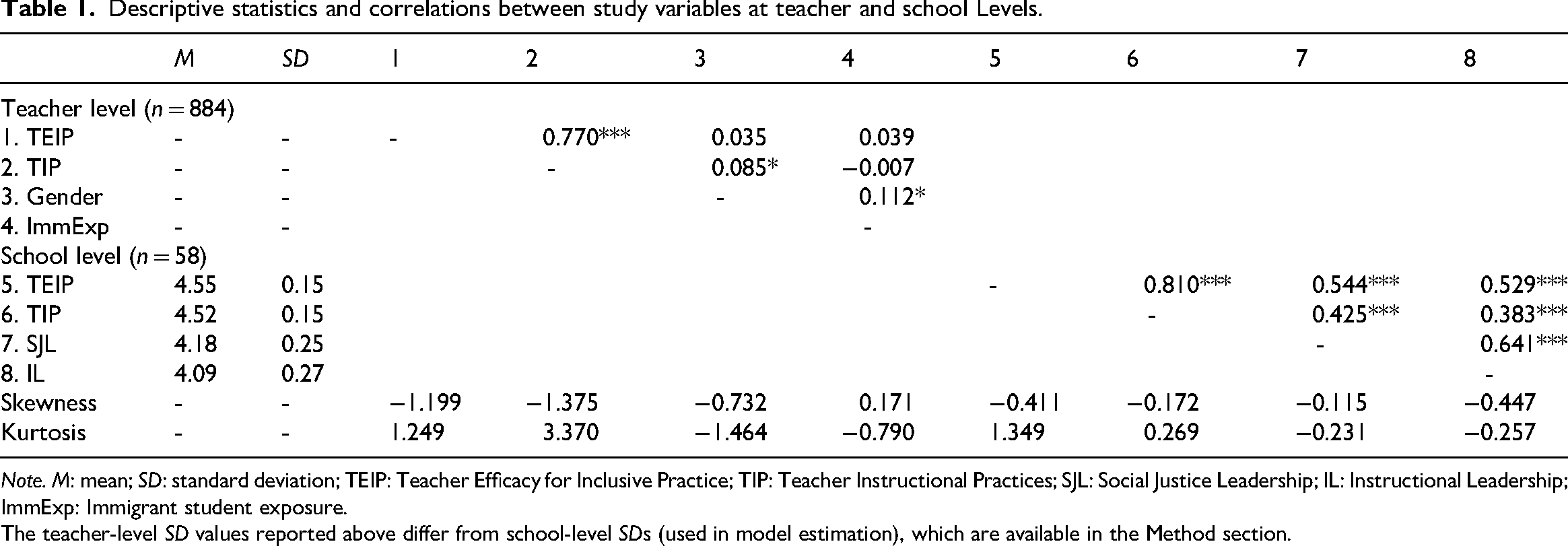
Note. M: mean; SD: standard deviation; TEIP: Teacher Efficacy for Inclusive Practice; TIP: Teacher Instructional Practices; SJL: Social Justice Leadership; IL: Instructional Leadership; ImmExp: Immigrant student exposure.
The teacher-level SD values reported above differ from school-level SDs (used in model estimation), which are available in the Method section.
Control variables
Gender and immigrant student exposure (ImmExp) were included as control variables in the multilevel analyses. Gender was coded 0 = male and 1 = female (67.3% female), consistent with national distributions in Türkiye (OECD, 2020). ImmExp was measured at the teacher level based on self-reported exposure (0 = none, 1 = 1–60 students, 2 = 61+ students). Although teachers were nested within schools, ImmExp was modelled at the teacher level because it reflects classroom-level experience rather than school composition. Correlations are reported in Table 1. Students with disabilities were not included as controls, as the focus was on inclusive practices in general classrooms rather than in special education contexts.
Analytical approach
To examine the hypothesised relationships between leadership, teacher efficacy, and instructional practices across nested data, we conducted a Bayesian multilevel structural equation modelling (MSEM) analysis using Mplus. Considering the nested nature of the data, with teachers grouped within schools, all analyses were conducted using a two-level modelling framework. Before estimating the models, multivariate normality was evaluated through Mahalanobis distance. Since the analysis revealed no significant multivariate outliers, all cases were included in the study.
Descriptive statistics (means, standard deviations, and zero-order correlations) were computed for all primary constructs. In addition, skewness and kurtosis values ranged from −1.375 to +3.370, which largely fall within the commonly accepted ±3 threshold for assessing univariate normality in large samples and structural equation modelling contexts (Kline, 2016). Although one kurtosis value marginally exceeded this guideline, such minor deviations are unlikely to bias parameter estimates, particularly in multilevel and Bayesian estimation frameworks (Curran et al., 1996).
To justify the aggregation of teacher responses to the school level, we evaluated within-group agreement (Rwg) as well as intra-class correlation coefficients (ICC[1] and ICC[2]) for the aggregated latent constructs (IL, SJL, TEIP, and TIP). As presented in Table 2, the Rwg values for all variables were above the recommended threshold of 0.70 (0.958–0.982), indicating high agreement among teachers within the same school (Bliese, 2000). ICC(1) values ranged from 0.142 (TIP) to 0.324 (IL), all exceeding the 0.05 threshold, demonstrating sufficient between-group variance (James, 1982). ICC(2) estimates ranged from 0.593 (TIP) to 0.842 (IL), which are considered acceptable indicators of the reliability of group means (Chen et al., 2005).
Reliability and agreement metrics for school-level aggregation of constructs.
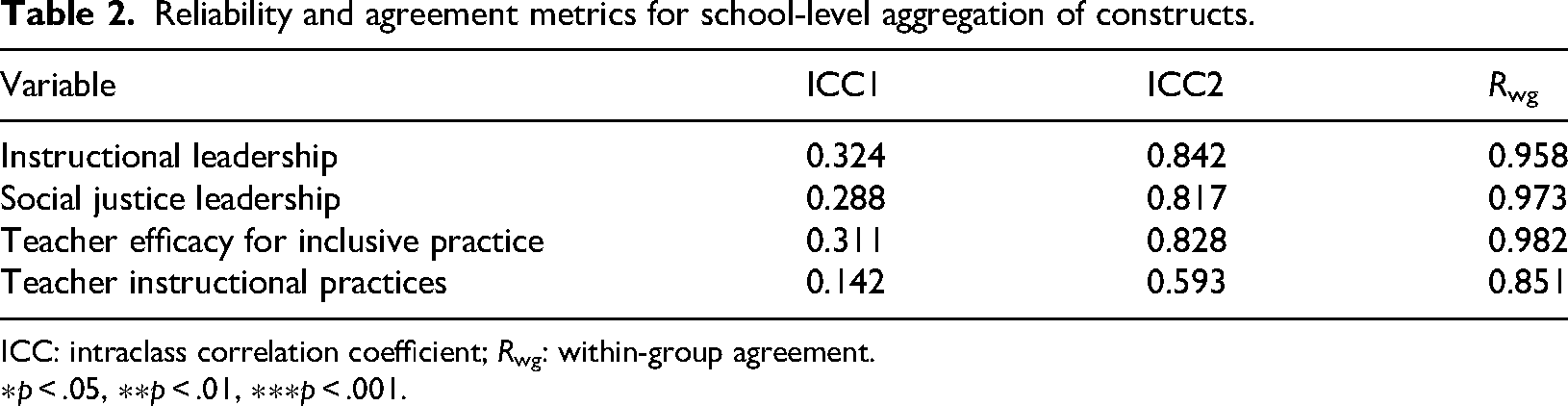
ICC: intraclass correlation coefficient; Rwg: within-group agreement.
∗p < .05, ∗∗p < .01, ∗∗∗p < .001.
Although IL and SJL are conceptually related and enacted by the same leaders, they were modelled as distinct but complementary constructs. Given their strong association, multicollinearity diagnostics were conducted prior to model estimation. Tolerance indices exceeded recommended thresholds (TI > 0.20), and VIF values remained below critical levels (VIF < 5), indicating that shared variance did not bias estimates. Following standard moderation procedures, IL and SJL were grand-mean centred before constructing the interaction term (IL × SJL), enhancing interpretability and reducing nonessential multicollinearity (Aiken and West, 1991). In addition, a common latent factor (CLF) test suggested that common method bias was unlikely to account for the observed associations.
Given the limited number of Level-2 units, Bayesian estimation was preferred over maximum likelihood estimation, consistent with prior recommendations for multilevel models with small cluster sizes (Gelman et al., 2013; McNeish and Stapleton, 2016). Model convergence was evaluated using PSR values, and model adequacy was assessed using χ2/df, LL, AIC, BIC, and SABIC, following Bayesian model comparison guidelines (Gelman et al., 2014).
Moderated mediation was tested using conditional indirect effect analysis, estimating the IL–TIP indirect effect via TEIP at varying levels of SJL (−2 SD to +2 SD). Statistical significance was determined using 95% credibility intervals excluding zero. A CLF approach further indicated that common method bias was unlikely to have materially influenced the results (Podsakoff et al., 2003).
Results
Descriptive statistics and correlations
We examined the means, standard deviations, as well as zero-order correlations among the study variables. As presented in Table 1, the mean scores for IL (M = 4.09, SD = 0.27), SJL (M = 4.18, SD = 0.25), TEIP (M = 4.55, SDwithin = 0.51, SDbetween = 0.15), and TIP (M = 4.52, SDwithin = 0.49, SDbetween = 0.15) were all above the scale midpoint, indicating generally positive perceptions among participants.
At the school level, IL was positively correlated with TEIP (r = 0.529, p < .001) and TIP (r = 0.383, p < .001). SJL was also positively correlated with TEIP (r = 0.544, p < .001) and TIP (r = 0.425, p < .001). IL and SJL showed a strong correlation at the school level (r = 0.641, p < .001). At the teacher level, TEIP demonstrated a strong positive association with TIP (r = 0.770, p < .001). In addition, school-level TEIP was strongly associated with TIP (r = 0.810, p < .001). This strong association is theoretically expected, as teacher efficacy reflects confidence in implementing instructional strategies, which closely align with classroom practices. Overall, these correlations provide preliminary support for the hypothesised relationships and justify the use of multilevel modelling to examine indirect and conditional processes.
Model evaluation
Bayesian MSEM was conducted in a stepwise manner, beginning with baseline models testing direct associations, followed by the incremental addition of mediation and moderation paths, culminating in the full moderated mediation model.
Model convergence was acceptable; the PSR value (1.012) was very close to the recommended threshold of 1.00, indicating satisfactory convergence for a complex Bayesian multilevel model with limited Level-2 units (Gelman et al., 2013). Model adequacy was evaluated using posterior predictive checks and information criteria. For comparability, the Wald chi-square statistic is reported (χ2/df = 3.981), indicating acceptable fit. Information criteria supported the final model, with lower AIC (18662.971), BIC (19234.627), and SABIC (18834.332) values and a higher (less negative) log-likelihood (LL = −8825.104) relative to earlier models, indicating improved parsimony-adjusted fit (Spiegelhalter et al., 2002). The final model is presented in Figure 2.
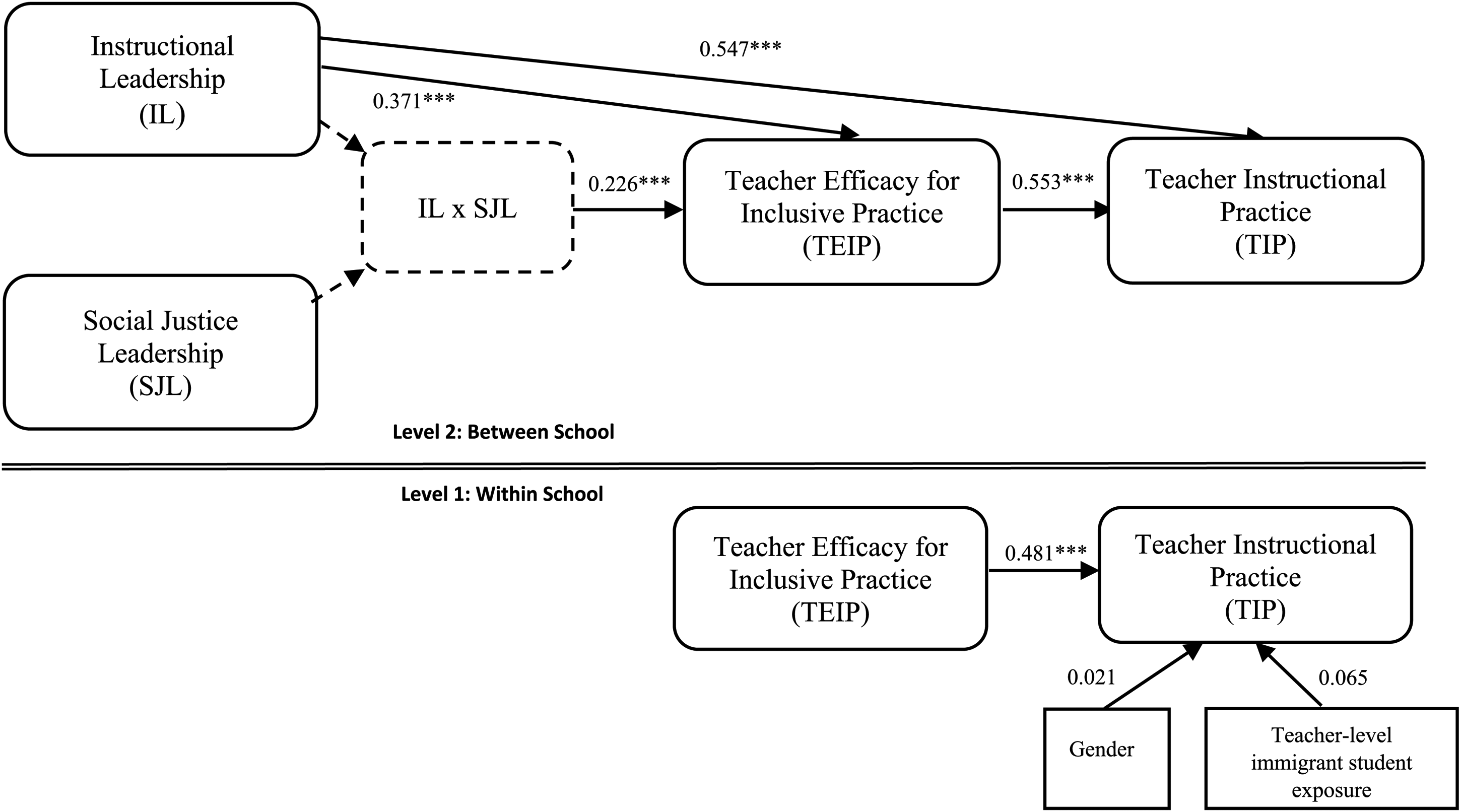
Bayesian multilevel SEM analysis results.
Testing the direct and mediation effects
Hypotheses 1 through 4 were tested within the Bayesian MSEM framework. Consistent with Hypothesis 1, TEIP was positively associated with TIP at both levels of analysis. At the teacher level, TEIP was positively related to TIP (γ = 0.481, 95% CI [0.343, 0.605]), indicating that teachers with higher inclusive efficacy reported stronger instructional practices. At the school level, TEIP was also positively associated with TIP (γ = 0.553, 95% CI [0.342, 0.753]), suggesting that between-school differences in inclusive efficacy were linked to stronger instructional practices.
Supporting Hypothesis 2, IL was positively associated with TEIP at the school level (γ = 0.371, 95% CI [0.258, 0.499]), suggesting that schools characterised by stronger IL foster higher levels of TEIP. In addition, IL exhibited a direct effect on TIP at the school level (γ = 0.547, 95% CI [0.389, 0.701]), supporting Hypothesis 3. This finding indicates that IL is directly associated with TIP beyond its indirect effects through psychological mechanisms.
Consistent with the proposed mediation model, the indirect association between IL and TIP through TEIP was statistically significant (γ = 0.141, 95% CI [0.072, 0.238]), supporting Hypothesis 4. Together, these findings indicate that TEIP functions as a partial mediator in the relationship between IL and TIP.
Testing the moderating role of SJL
Hypothesis 5 examined whether SJL moderates the association between IL and TEIP. Results indicated that the interaction term (IL × SJL) was positively associated with TEIP (γ = 0.226, 95% CI [0.113, 0.341]), suggesting that the strength of the relationship between IL and TEIP varied depending on the level of perceived SJL.
As illustrated in Figure 3, the positive association between IL and TEIP was stronger in school contexts characterised by higher levels of perceived SJL (+1 SD) than in contexts with lower levels (−1 SD). This finding supports Hypothesis 5 and indicates that IL signals are more strongly translated into teachers’ efficacy beliefs when leadership is perceived as equity-oriented.
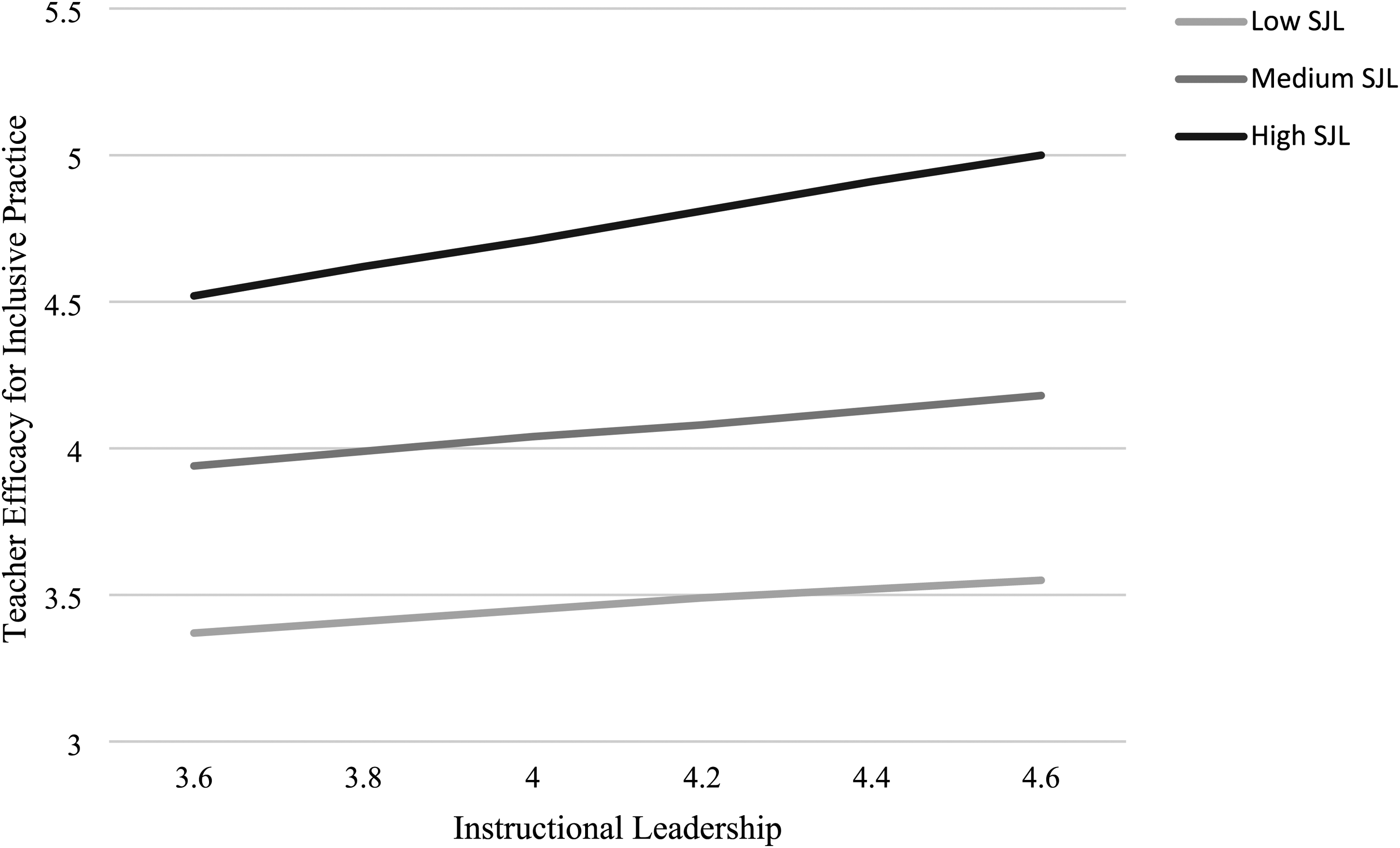
Moderating effect of social justice leadership on the relationship between instructional leadership and teacher efficacy for inclusive practice.
Testing the moderated mediation model
Hypothesis 6 examined whether the indirect association between IL and TIP via TEIP varied as a function of perceived SJL. Results indicated a significant moderated mediation effect (γ = 0.187, 95% CI [0.089, 0.306]). As shown in Table 3, the indirect effect strengthened at higher levels of SJL and weakened at lower levels, becoming nonsignificant at very low levels (−2 SD). These findings support Hypothesis 6 and indicate that the mediating role of TEIP in linking IL to TIP is contingent on the level of perceived SJL.
The indirect effects of instructional leadership on teacher instructional practices via teacher efficacy at different levels of social justice leadership.
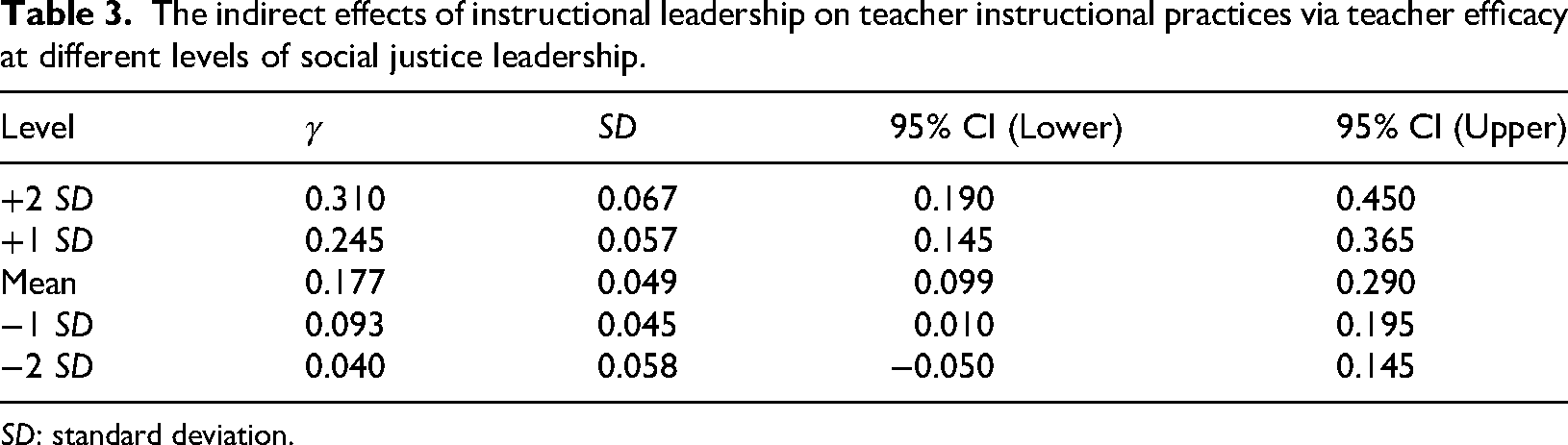
SD: standard deviation.
Discussion
This study addressed an important empirical gap in educational leadership by examining how principals’ IL and SJL operate jointly to shape teachers’ TIP through TEIP within a multilevel framework. Although IL has been widely examined in relation to instructional outcomes, research on SJL, particularly its link to TIP, remains more limited, and the two leadership approaches are most often treated separately, with little empirical evidence clarifying how they interact or condition each other. In response, the present study focused explicitly on the IL and SJL interaction, investigating how the combined enactment of IL and SJL shapes TEIP and how these efficacy beliefs are translated into classroom-level TIP. By empirically testing this integrated and conditional process, the study contributes to ongoing shifts towards more equity-oriented understandings of IL and to emerging work on the integration of different leadership approaches within a multilevel empirical framework.
First, the findings reveal that TEIP is positively and significantly associated with TIP. This result aligns with prior studies indicating that teachers with greater self-efficacy in inclusive education tend to employ more differentiated and inclusive instructional practices (e.g. Liu et al., 2021; Tschannen-Moran and Hoy, 2001). Furthermore, previous research has shown that teacher self-efficacy not only shapes instructional decisions but also affects school-level instructional practices (Chow, 2024; Ozdemir et al., 2025). Travers and King (2025) note that teachers with high efficacy for inclusive practices tend to consistently and effectively implement differentiated instructional methods and culturally responsive approaches across classroom contexts, support active participation, and remove barriers to learning. Building on this empirical evidence, the present study demonstrates that TEIP functions as a proximal psychological mechanism through which instructional practices are enacted within a multilevel context. Accordingly, our findings suggest that teachers’ efficacy for inclusive practices is not merely an individual characteristic but a critical factor associated with the enactment of inclusive instructional practices, influencing their willingness and capacity to adapt and innovate instructional strategies in response to classroom diversity.
Second, IL was positively associated with TEIP. This finding is consistent with evidence in the IL literature showing that principals’ focus on curriculum coordination, instructional supervision, and professional development strengthens teachers’ competencies for inclusive practices (Bellibas et al., 2021; Goddard et al., 2015; Karakose et al., 2024). Principals’ IL practices enhance teacher efficacy by guiding teachers in managing instructional programmes, organising the learning environment, and supporting professional development (Hallinger, 2011; Hallinger and Murphy, 1985). Thornton (2025) further emphasises that IL can systematically strengthen teachers’ competencies for inclusive practices by promoting participation-oriented teaching strategies and supporting the active engagement of all students. These findings align with prior empirical research linking IL to teacher-related psychological outcomes, including efficacy and professional capacity (Hallinger, 2018; Sinnema et al., 2025). From a Social Cognitive Theory perspective (Bandura, 1986, 1997), IL shapes teachers’ efficacy beliefs by providing instructional cues that influence how they interpret instructional demands and evaluate their capacity to respond to them. Building on this evidence, the present study refines this relationship by demonstrating that IL contributes to TEIP as a key psychological mechanism within a multilevel framework.
Third, IL was positively associated with TIP. This finding is consistent with prior research demonstrating that principals’ involvement in instructional processes, such as supervision, feedback, and coordination, can directly influence classroom-level practices (Hallinger and Heck, 1996; Liu and Hallinger, 2024). By establishing clear instructional expectations, coordinating instructional processes, and supporting pedagogical alignment, IL contributes to the enactment of inclusive and responsive teaching practices. This result aligns with a broader body of evidence indicating that school leadership plays a central role in shaping teaching practices and improving instruction across schools (e.g. Grissom et al., 2021). Against this backdrop, the present study provides empirical support for the direct effect of IL on TIP, indicating that leadership practices oriented towards instruction can influence classroom practices independently of mediating processes.
Fourth, the findings provide support for TEIP's mediating role in the relationship between IL and TIP. This pattern is consistent with a substantial body of research suggesting that leadership effects on instructional outcomes are largely indirect and operate through teacher-level psychological and organisational processes (Chow, 2024; Leithwood et al., 2004; Ozdemir et al., 2025; Robinson et al., 2008). In particular, prior studies emphasise that teachers’ professional learning, beliefs, and cognitive interpretations function as key mechanisms through which leadership is translated into classroom practice (Bellibas et al., 2021; Pietsch et al., 2019). From a Social Cognitive Theory perspective (Bandura, 1986, 1997), leadership influences behaviour by shaping individuals’ beliefs about their capabilities. IL provides instructional guidance, feedback, and professional support that influence how teachers interpret instructional demands and evaluate their capacity to respond to diverse student needs. In turn, these efficacy beliefs shape the extent to which teachers adopt inclusive and differentiated instructional strategies. This interpretation is further supported by research on inclusive pedagogy, which highlights that teachers’ beliefs about their capability to include all learners are central to how they design and enact instructional practices in diverse classrooms (Florian and Black-Hawkins, 2011; Florian and Spratt, 2013). Taken together, these findings indicate that TEIP functions as one important psychological mechanism through which IL is translated into TIP within a multilevel framework. At the same time, this pathway should not be interpreted as exhaustive, as leadership effects may also operate through broader organisational, relational, and motivational processes not examined in the present study.
Fifth, SJL was found to moderate the relationship between IL and TEIP. Specifically, the positive association between IL and teachers’ efficacy for inclusive practices was stronger in school contexts characterised by higher levels of SJL. This finding is consistent with emerging research suggesting that different leadership approaches can operate in an integrative manner rather than as isolated orientations (Shaked, 2024, 2025, 2026). In particular, prior studies indicate that leadership practices grounded in equity, inclusion, and ethical responsibility create conditions that enhance teachers’ professional learning and efficacy (Ainscow, 2020; Shields and Hesbol, 2020). When instructional guidance is embedded within a justice-oriented leadership context, teachers are more likely to interpret instructional expectations as supportive of inclusive goals rather than as purely technical demands. In this sense, SJL functions as a contextual condition that shapes how teachers interpret and respond to IL practices. The moderating role of SJL should therefore not be interpreted as a merely technical interaction effect. Rather, it reflects how the multidimensional character of SJL is expressed empirically, namely through the extent to which its equity-oriented, inclusive, and critically conscious dimensions shape the meaning teachers attribute to instructional guidance. Seen in this way, these findings suggest that IL's effectiveness in strengthening TEIP depends on the presence of SJL, underscoring the importance of leadership integration in supporting teachers’ inclusive efficacy.
Finally, the findings indicate that SJL moderates the indirect association between IL and TIP through TEIP. This moderated mediation suggests that IL is more strongly translated into TIP via TEIP in school contexts characterised by higher levels of SJL. When leadership emphasises equity, participation, and ethical responsibility, instructional signals are more likely to be interpreted as supportive of inclusive practice, thereby strengthening teachers’ efficacy beliefs and their instructional enactment. These findings are consistent with theoretical arguments that justice-oriented leadership shapes the moral and relational context of schools in ways that reinforce instructional priorities (Shaked, 2024, 2025; Theoharis, 2007). From a Contingency Theory perspective (Donaldson, 2001), this suggests that the effectiveness of IL is contingent on contextual conditions, specifically the presence of SJL. More broadly, the joint enactment of IL and SJL is likely to be most mutually reinforcing in school contexts where equity-oriented norms, professional collaboration, and supportive organisational conditions enable instructional goals to be interpreted in inclusive terms (Shaked, 2024, 2025). By contrast, their alignment may be more difficult in contexts characterised by strong accountability pressures, limited autonomy, bureaucratic constraints, or school cultures that privilege compliance and performance over responsiveness to student diversity (Neumerski et al., 2025).
This finding is particularly meaningful in the context of Türkiye, where education is governed by a highly centralised system that limits school-level discretion and positions principals primarily as implementers of centrally defined policies (Bellibas et al., 2022). Although recent reforms have expanded principals’ instructional responsibilities and emphasised strengthening IL, leadership practices often remain shaped by bureaucratic norms and accountability pressures, which may constrain their pedagogical depth and responsiveness (Culha, 2023; Karanfil, 2021). At the same time, national policy frameworks, including the 2023 Education Vision and the Maarif Model, place increasing emphasis on equity, inclusion, and value-based education, calling for leadership approaches that support holistic student development and inclusive teaching practices (MoNE, 2018, 2025). In such a context, leadership effects are less likely to operate through direct influence and instead depend on how instructional expectations are interpreted by teachers within existing structural and cultural constraints (Ozdemir et al., 2025). This suggests that IL alone may have limited influence unless it is supported by complementary leadership approaches that provide interpretive, relational, and value-based guidance. Consistent with empirical evidence from Türkiye, the effects of IL become more pronounced when combined with broader leadership orientations (Bellibas et al., 2021), and recent research further demonstrates that its influence becomes significant when integrated with SJL (Bellibas et al., 2026). From this perspective, the moderating role of SJL observed in the present study may indicate that, in the Turkish context, IL is interpreted through an equity-oriented, value-based lens, thereby strengthening teachers’ efficacy beliefs and facilitating the enactment of inclusive instructional practices. At the same time, this also suggests that instructional priorities and equity-oriented commitments may not always align seamlessly in practice. School leaders may therefore need to navigate ongoing tensions between pressures for measurable academic outcomes and the need to adapt teaching and school processes to diverse student needs, making the joint enactment of IL and SJL a contextually negotiated rather than automatically harmonious process (Ozdemir et al., 2025).
Limitations and future research
Several limitations should be acknowledged. First, the study relied on teacher self-report data collected via online surveys, which may be subject to common-method variance and social desirability bias despite procedural safeguards. Because perceptions of leadership, efficacy, and instructional practices were obtained from the same source, the observed associations may partly reflect shared perceptual tendencies rather than fully independent estimates of these constructs (Podsakoff et al., 2003). This approach is nevertheless theoretically appropriate given the focus on teachers’ cognitive interpretations of leadership, but it also limits the extent to which the findings can be separated from source-related bias. Second, although the sample spans 12 regions in Türkiye, the findings may be most applicable to similarly centralised education systems. Third, the cross-sectional design precludes causal inferences. These limitations point to directions for future research. Longitudinal or experimental designs could better capture the temporal dynamics of leadership effects on TEIP and TIP. Comparative cross-national studies may clarify whether the interaction between IL and SJL varies across governance and cultural contexts and how different system-level conditions shape leadership processes. Future work could also extend the model by incorporating additional psychological constructs, such as trust or professional identity, as mediators or moderators, as well as by examining a broader set of organisational, emotional, and relational pathways through which leadership effects unfold (Leithwood et al., 2004, 2020). In addition, identifying specific leadership practices that integrate instructional and social justice orientations would provide further conceptual and practical clarity. Qualitative or mixed-methods research may further illuminate how IL and SJL are enacted in practice and interpreted by teachers, while alternative analytical approaches, such as latent profile or cluster analyses, may offer new insights into how different configurations of leadership practices operate across schools (Bellibas et al., 2024; Bowers, 2020). Taken together, such efforts may contribute to a more nuanced and context-sensitive understanding of school leadership, advancing the global literature beyond universal models towards more process-oriented and contextually grounded explanations.
Implications for practice and policy
The findings have important implications for policy and practice, particularly in centralised education systems. At the policy level, the results suggest the value of strengthening principals’ instructional roles and more explicitly incorporating equity-oriented leadership considerations into leadership development and policy frameworks in Türkiye. Rather than treating IL and SJL as separate orientations, policy and leadership development frameworks should promote an integrated approach in which pedagogical coordination and equity-oriented values operate jointly. In contexts such as Türkiye, where formally articulated leadership standards are not explicitly defined, such integration may be supported through policy guidance and professional development initiatives. Leadership preparation and professional development programmes should cultivate justice-oriented competencies alongside instructional expertise. In this regard, recent policy developments such as the Maarif Model, which emphasises a holistic, value-based, and inclusive approach to education and integrates social-emotional learning with cognitive and domain-specific competencies, provide an important policy context for supporting the alignment of leadership practices with equity-oriented and instructional priorities. Structural constraints, including administrative demands, such as extensive bureaucratic procedures, reporting requirements, and accountability pressures, limit principals’ capacity to enact integrated leadership, although such demands are not unique to Türkiye and reflect broader challenges faced by school leaders across different education systems. Policymakers should therefore reconsider role definitions and provide greater autonomy and time to support practices that strengthen TEIP and inclusive instruction.
At the practice level, the findings suggest that school leaders should align IL practices with SJL principles and view them as complementary strategic resources. Professional development, including practice-based workshops, collaborative lesson planning, peer learning, and participation in professional learning communities, emerges as a key mechanism for strengthening teachers’ inclusive instructional capacity, particularly when embedded within professional learning communities. Such collaborative structures can support the dissemination of inclusive practices, reflective dialogue, and collective learning focused on differentiated instruction and culturally responsive pedagogy. However, in highly centralised contexts such as Türkiye, where principals’ roles are largely shaped by centrally defined governance and compliance requirements, the enactment of such practices may depend on the extent to which schools are provided with the necessary time, flexibility, and organisational support. Developing a shared instructional vision grounded in equity and inclusion may further strengthen teachers’ commitment to inclusive pedagogies and reinforce the translation of TEIP into classroom-level instructional practices.
Footnotes

Ethical approval and informed consent
This study was approved by the Ethics Committee of Aksaray University (Protocol No: 2025-197). Informed consent was obtained from all individual participants included in the study.
Funding
The authors received no financial support for the research, authorship, and/or publication of this article.
Declaration of conflicting interests
The authors declared no potential conflicts of interest with respect to the research, authorship, and/or publication of this article.
Data availability statement
The datasets generated during and/or analysed during the current study are available from the corresponding author on reasonable request.
Disclosure of AI use
In preparing this article, the generative AI tools Scopus AI and Grammarly were used exclusively for language editing and stylistic refinement. All intellectual content, data collection instruments, analyses, and conclusions are solely the work of the authors.