







Abstract
Subtropical climate is characterized by high solar altitude angle in summer which causes the roof get more heat through solar radiation. GR, DSR, and CR all can decrease solar radiation heat gain of the roof. However, few researches have been done to the comparison of the thermal performance of these three roofs, especially in subtropical climate. In this study, four rooms were built separately with GR, DSR, CR, and ordinary roof (OR). The experiment was done from July 23 to August 4. Results showed that stabilities of the indoor air temperature of the four rooms were: DSR room > GR room > CR room > OR room. The GR, CR, and DSR can reduce the external surface temperature by 13.7°C, 12.0°C, and 4.8°C during the day while bring a temperature rise of 2.3°C, 1.9°C, and 0.9°C at night. Correlation analysis results showed that the internal surface heat flux of GR and DSR were negative correlated with weather factors while internal surface heat flux of OR and CR were positive correlated with weather factors. This study can give support to the selection between GR, DSR, and CR.
Keywords
Introduction
Energy consumption by the building sector increases rapidly and accounts for 30%–40% of the world energy use nowadays (United Nations Development Program, 2009). However, energy consumption of the air conditioning occupies a large proportion in building energy consumption. Moreover, a major part of the heating/cooling load comes from the solar heat gain of the building envelope (Tong et al., 2014). For the envelopes of the building, the roofs play an essential role in energy efficiency because large part of solar radiation is absorbed by roofs in hot weather and large part of heat is lost through roofs in cold weather (Abuseif and Gou, 2018). Therefore, in order to reduce the building energy consumption and improve the indoor thermal environment, it is important to reduce the solar radiation heat gain through the roof. The common passive roof structures include the cool (or reflective) roof, ventilation roof, green roof, insulation roof (Tong et al., 2014), and PCM roof (Hou et al., 2021; Li et al., 2020). Among the four types of roofs, green roof, double skin roof, and cool roof are three with excellent sunshade performance which can effectively reduce the solar radiation heat gain and improve the indoor thermal environment (Zingre et al., 2015a). The thermal protection performance of the three roofs received many attentions in the past few years.
Green roofs (GR) are basically roofs with plants in their final layer (Cox, 2010; Parizotto and Lamberts, 2011). Green roofs can be classified as extensive and intensive, though some authors include a semi-intensive classification (Theodosiou, 2009). Green roofs reflect between 20% and 30% of solar radiation, and absorb up to 60% of it through photosynthesis. This means that a percentage below 20% of the heat is transmitted to the growing medium (Weng et al., 2004). Green roofs can reduce the fluctuation of indoor air temperature and decrease the level of building energy consumption both in warm and cold climates (Castleton et al., 2010; Jaffal et al., 2012). Ran and Tang (2018) simulated the passive cooling performance of green roofs in a subtropical climate of Shanghai. Three cases were studied: no ventilation, night-time ventilation, and night-time ventilation combined with walls insulation. Results showed the green roof room indoor average temperature reduced by up to 2.3°C as compared to that of building combined with night ventilation and walls insulation together. Yin et al. (2019) studied the outdoor spatio-temporal performance of a full-scale extensive green roof in a subtropical climate of Shanghai throughout a summer at three heights. Results showed that the average range of hourly air temperature difference at 30 cm between extensive green roof and a bare roof was 4.02°C (sunny day), 2.67°C (cloudy day), and 0.74°C (rainy day). Peng et al. (2019) compared the long term thermal and energy performance of extensive and intensive green roof in a subtropical city of China. Roof surface temperature, air temperature, roof heat flux, and cooling/heating load were analyzed over an entire year. They discovered that intensive green roof was not always better at providing the expected thermal benefits than extensive green roof. Lee and Jim (2018) investigated the thermal performance of a native-woodland intensive green roof in subtropical Hong Kong. Sunny, cloudy, and rainy were chosen from long-term monitoring data for comparison with a nearby bare control roof. Results showed that the green roof can reduce the maximum surface and air-cooling temperature by 19.80°C and 6.21°C in daytime sunny condition. Huang et al. (2018) compared the temperature reductions and heat amplitude reductions provided by four types of green roof that can cover bare rooftops. The results indicated that the bottom temperatures of the four types of green roof reduced by 17.75°C, 12.57°C, 11.55°C, and 9.31°C as compared to that of bare rooftop, while the heat amplitude reductions were 83.32%, 82.58%, 79.78%, and 74.88%. Simmons et al. (2008) stated that maximum green roof temperatures were 38°C lower than conventional roofs at the roof membrane and the inside air temperatures were 18°C lower with little variation in subtropical climate. He et al. (2016) conducted experiment on two full-scale rooms, one with green roof and the other with common roof, thermal and energy performance of the two rooms under passive and active condition in Shanghai was studied. Results showed that maximal difference of heat fluxes through both roofs was up to 15 W/m2. Indoor air temperature at night was about 2.5°C higher for green roof than common roof. Aboelata (2021) studied the effect of aspect ratio, building heights, and green roof types to the indoor air temperature and cooling energy demand in different urban densities. Results showed that intensive green roofs performed better in reduce indoor air temperature and cooling energy demand.
Double skin roof (DSR) which comprises of two solid roofs (secondary roof on the top and primary roof at the bottom) separated by an air gap (either open-ended or close-ended), has been a popular passive roof cooling method (Wong and Li, 2007). The heat gain can be significantly reduced by effectively applying this technique over the entire building envelope (Iosifides, 1996). Dimoudi et al. (2006a) tested a full-scale DSR under real climatic in Greece. The dimension of the roof was 2.43 m × 2.71 m. They conclude that the DSR can keep the insulation of the roof 14°C cooler than that of a typical roof during daytime. Yew et al. (2013) incorporated DSR with thermal insulation coating and used the new roof system for attic temperature reduction. The experiment was carried outside by using halogen light bulbs. Results showed that the new roof system with opened attic inlet can reduce the attic temperature from 42.4°C to 29.6°C as compared to the conventional roof system. Dimoudi et al. (2006b) investigated the thermal performance of a ventilated roof component in winter. The new roof consists of a conventional roof structure, reinforced concrete with a layer of thermal insulation and an air gap. The influence of the height of the air gap and the use of radiant barrier in the air gap to the thermal performance were analyzed. Results showed that a smaller air gap without a radiant barrier performed better during daytime but the opposite was valid during nighttime. He et al. (2001) built a solar house in Nanning China where the summer season occurs between April and November and the highest daily air temperature exceeds 30°C. A triple roof design was used. Forced and passive ventilation were employed to exhaust heat from the roof. They found that although the air temperature in the cavity immediately beneath the metal roof reached 75°C at midday, the ceiling temperature varied only slightly within 28°C throughout the day. The reason is that the heat in the roof was almost entirely dissipated. Tong et al. (2014) investigate the impacts of rooftop surface solar reflectivity and thermal resistance on the thermal performance of two types of concrete-based roofs, namely the unventilated and ventilated roofs. Compared with the unventilated roofs, the roof ventilation and 2.5 cm expanded polystyrene (EPS) foam insulation reduce the heat gain by 42% and 68% respectively, and the heat gain reductions reached 73% and 84% in the ventilated roofs incorporated with 2.5 cm EPS foam and radiant barrier respectively. Zingre et al. (2017) proposed a novel DSR heat transfer model and compared the annual heat gain trends of a DSR with an insulation roof for five different climates. Results showed the DSR performance in curbing annual heat gain increases with annual-averaged solar-air temperature. Omar et al. (2017) investigated the benefit of using DSR for reducing cooling load under the Djiboutian climate. Results showed that the use of DSR can reduce the inner surface heat flux from 116 W/m2 for the standard roof to 60 W/m2 for the ventilated but non-insulated roof. The efficiency of the roof is even better when an insulation placed in the inner slab in addition of the ventilated cavity.
Cool roofs (CR) refer to the passive building cooling technology that can reduce the solar radiation heat gain of the building envelope and prevent the indoor temperature from being too high by adding cool materials which was always with high reflectivity (Hernández-Pérez et al., 2018; Lei et al., 2017). The application of cool roof can greatly reduce the energy consumption of air conditioning in summer (Piselli et al., 2017), improve the indoor thermal comfort level (Pisello et al., 2016), and weaken the urban heat island phenomenon (Akbari and Kolokotsa, 2016). Fang et al. (2019) combined the spectrum selective method and the thermal mass effect of the roof structure to propose an improved cool roof heat transfer value model, which was experimentally verified in Laramie, USA. Through comparison, it is found that the improved cool roof can effectively reduce the radiant heat gain and air conditioning cooling load, and the annual electricity saving is significantly improved. Piselli et al. (2019) used EnergyPlus software to simulate the influence of solar reflectance and thermal insulation layer thickness on thermal behavior of cool roof under different climate conditions. The author found that in addition to extreme weather conditions, roof solar reflectance is more important for building energy efficiency. The best cool roof structure is represented by high solar reflectance (0.8) and low insulation thickness (0.00–0.03 m). Shi et al. (2019) comparatively studied the effect of natural weathering on energy conservation of cool roofs in hot summer areas in China. The natural aging characteristics of 12 kinds of roof coatings was investigated and the effects of aging of two typical buildings on roof energy consumption was simulated. The results of the study show that the application of the new cool roof can reduce building energy consumption in Chengdu and Xiamen by 24.2% and 26.3%, respectively. Saber et al. (2021) investigated the effect of dust/dirt accumulation on the solar reflectivity of the reflective coating material (RCM) of the cool roof. The test results showed that dust and dirt can significantly reduce the solar reflectivity of the RCM. Different cleaning processes were conducted on the RCM so as to increase its solar reflectivity. Results showed that conducting homemade cleaning for the RCM at different exposure times has resulted in recovering about 97% of the original value of its short-wave solar reflectivity. Ríos-Fernández (2020) studied the use of cool roof to avoid unnecessary energy consumption in 13 supermarkets in Australia, Canada, the USA, and Spain. Results showed that the cool roof can reduce the energy for heating, ventilating, and air conditioning by between 3.5% and 38%.
The summary of the references is list in Table 1.
Summary of the references.
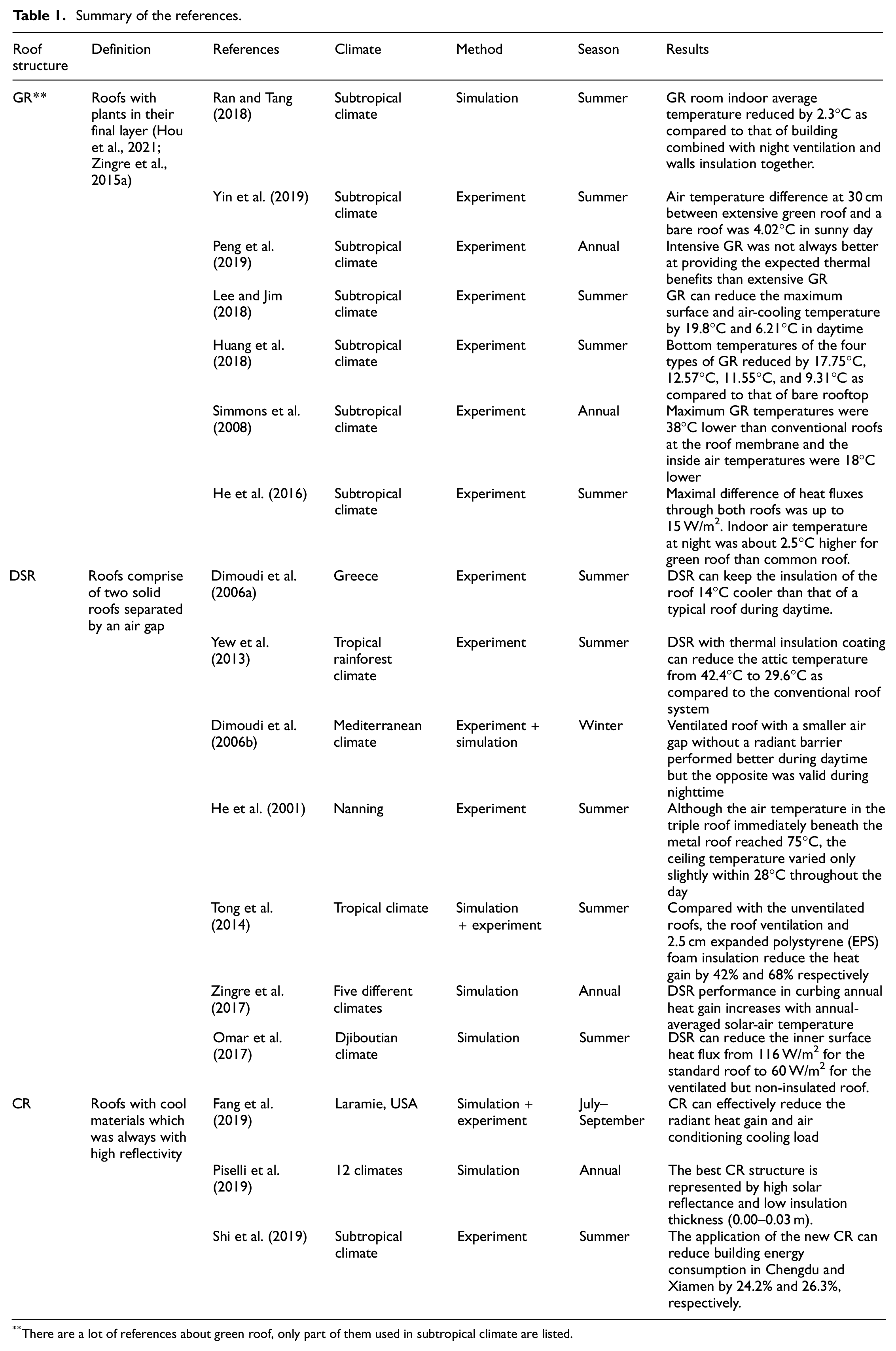
There are a lot of references about green roof, only part of them used in subtropical climate are listed.
It can be seen that the thermal performance of the roofs is greatly affected by the climate. So, comparison of thermal performance of different roofs in different climates has got many researchers’ attentions. Simmons et al. (2008) compared the performance of green roof and cool (reflective) roof and non-reflective roof under subtropical climate. Results showed that maximum green roof temperatures were cooler than conventional roofs by 38°C at the roof membrane and 18°C inside air temperature. Takebayashi and Moriyama (2007) compared the thermal performance of green roof and cool roof in Japan. They concluded that the sensible heat flux of the cool roof was small because of the low net radiation while the sensible heat flux of green roof was small because of the large latent heat flux by evaporation. Virk et al. (2015) compared the effectiveness of green roofs, cool roofs, and insulation roofs at reducing energy use for a typical office in London. Results showed that, as compared to insulation roofs, green roofs reduced annual energy use while cool roofs were more effective in the summer. Virk et al. (2014) assessed the effectiveness of green and cool roofs at reducing summertime overheating for a naturally ventilated, poorly insulated office roof in London. Results showed that a non-insulated cool roof was the most effective. While the non-insulated green and cool roofs were more effective than insulated roofs. Brito Filho and Santos (2014) investigated the use of white paints, selective coatings, and thermal insulation layers large metal roofs in subtropical and equatorial climate. Results showed that in cities with an equatorial climate, the roof with thermal insulation layer and selective coating was the best option for cities with equatorial climate. Otherwise, white paint roof without a thermal insulation layer is the best solution for cities with a subtropical climate. Many other researchers compared the urban heat island mitigation potential of green roof and cool roof in different climates such as Singapore (Yang et al., 2018), Italy (Costanzo et al., 2016; Gagliano et al., 2015; Zinzi and Agnoli, 2012), USA (Li et al., 2014), Australia (Coutts et al., 2013), Greece (Kolokotsa et al., 2013).
The thermal performance of the roofs is directly related to the climate. Comparison of the thermal performance of the roofs should be done in the same climate. It can be seen that much comparisons have been done to green roofs with cool roofs and insulation roofs. However, litter research about the comparison of green roofs, cool roofs, and double skin roofs was reported, especially in subtropical climate. These three kinds of roofs have many applications in subtropical climate. Therefore, the experimental comparison of the performance of the three kinds of roofs is helpful to choose a more suitable roof form in this climate. In this paper, four lightweight rooms with GR, CR, DSR, and ordinary roof were built in Suzhou, China. One with green roof, one with double skin roof, the other was common roof for comparison. Indoor air temperature, internal surface temperature, and internal surface heat flux were measured. Correlation analysis was done to the measured parameters to outdoor air temperature and solar radiation.
Experimental set-ups
The experimental system consisted of four small rooms as shown in Figure 1 each of which is 2 m × 1.5 m ×2.7 m in size. Each room has a 121 mm × 96 mm single-glazed window on the south wall. The wall material of the room is two layers 1.2 mm thick color plate with 75 mm rock wool in the middle. The thermal properties of the building materials were list in Table 2. The total heat transfer coefficient of the wall and roof is 0.49 W/(m2 K) (The convective heat transfer coefficients of the inner and external surface were assumed to be 7.8 W/(m2 K) and 18.7 W/(m2 K)). The experimental rooms were located in Suzhou which has a subtropical monsoon marine climate with abundant rainfall. The average annual precipitation is 1100 mm and the average temperature in July was about 28°C.
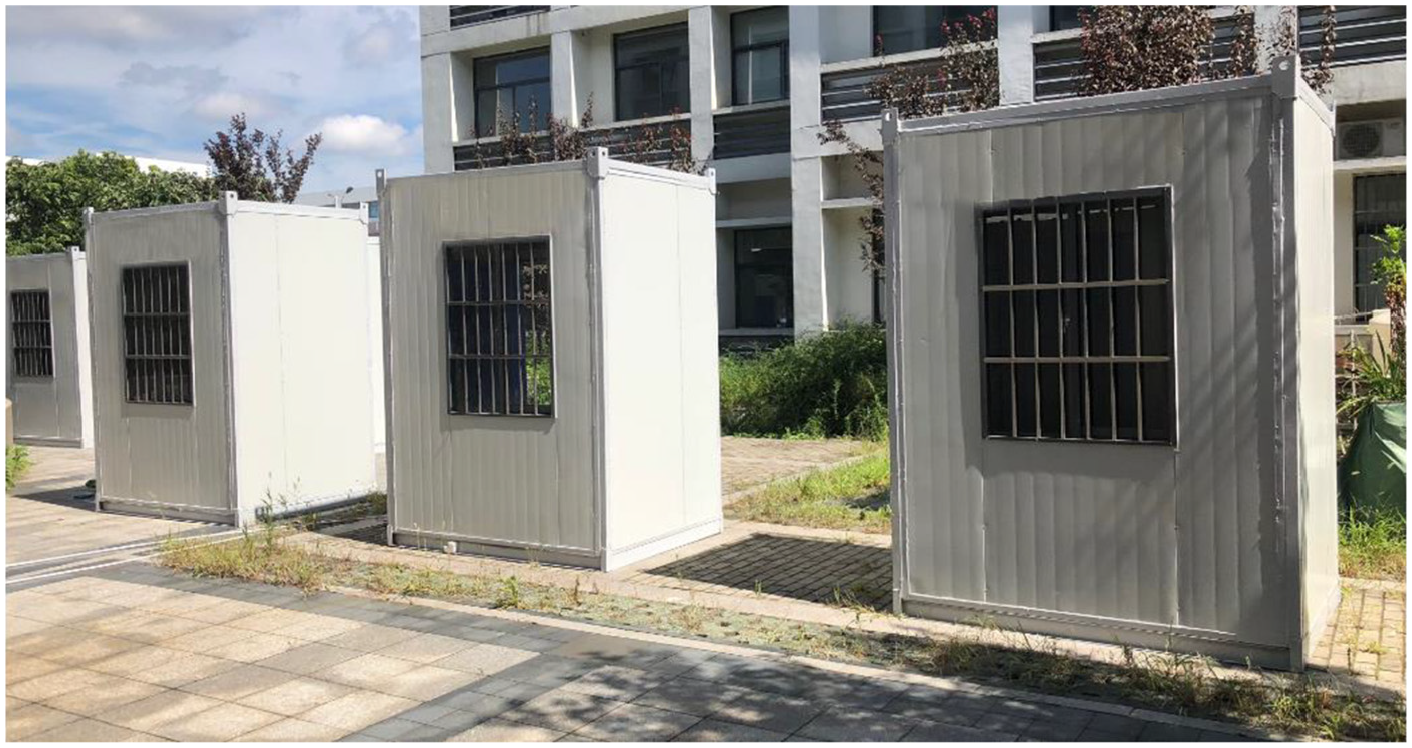
Experimental rooms.
Thermal properties of the building materials.
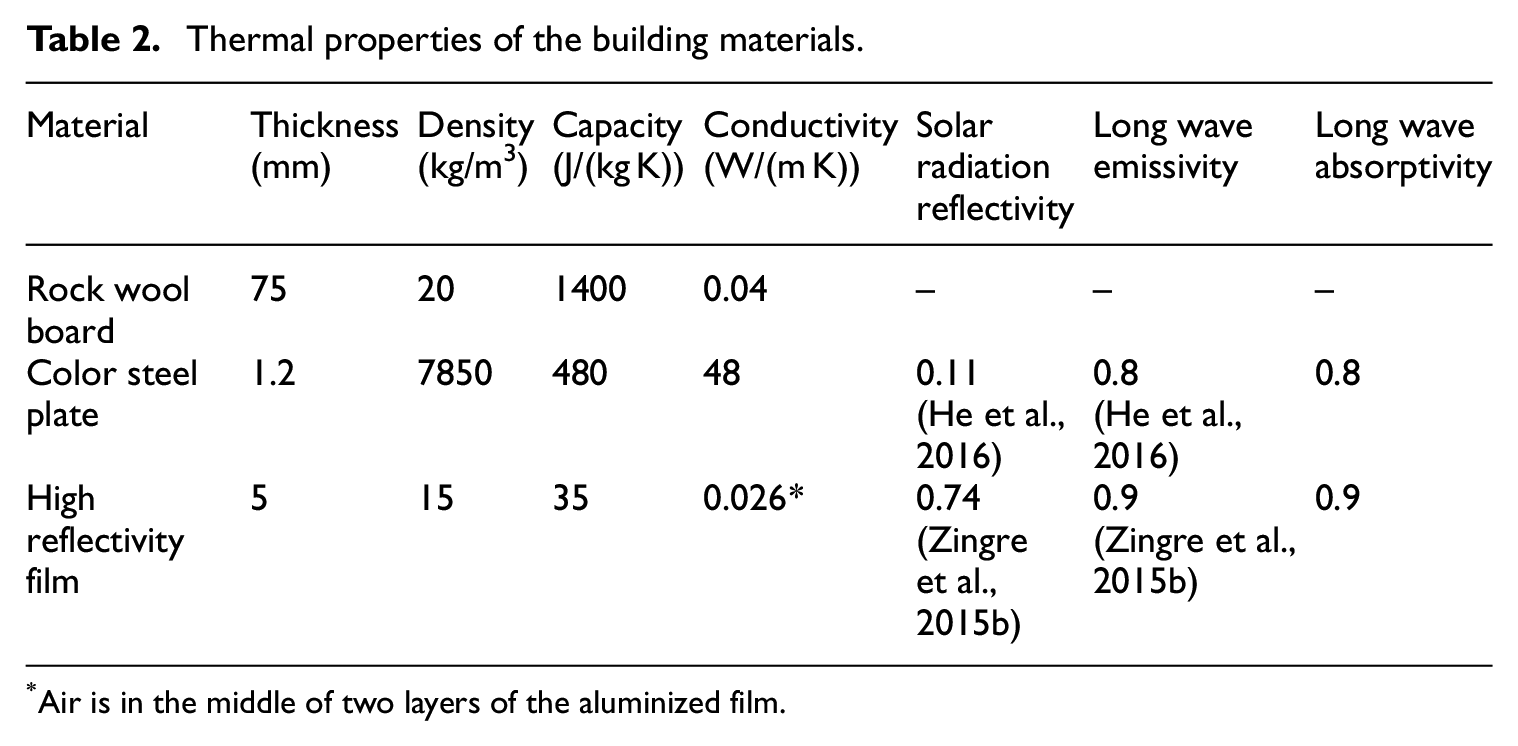
Air is in the middle of two layers of the aluminized film.
The green roof used in this experiment was to lay 40 mm soil on the ordinary roof first, then the grass was placed on the soil. The grass used in this experiment was Sijiqing. The green roof used in the experiment can be classed as extensive green roof according to references.
The double skin roof used in this experiment was to lay a secondary roof above the primary roof. The structure of the secondary roof was the same as the ordinary roof. The thickness of the air gap between the primary roof and the secondary roof was 10 cm.
The cool roof was to lay a piece of high reflective layer on the ordinary roof. The high reflectivity layer consists of an aluminized film on both sides of a polyethylene bubble layer. The structures of the four roofs were shown in Figure 2.
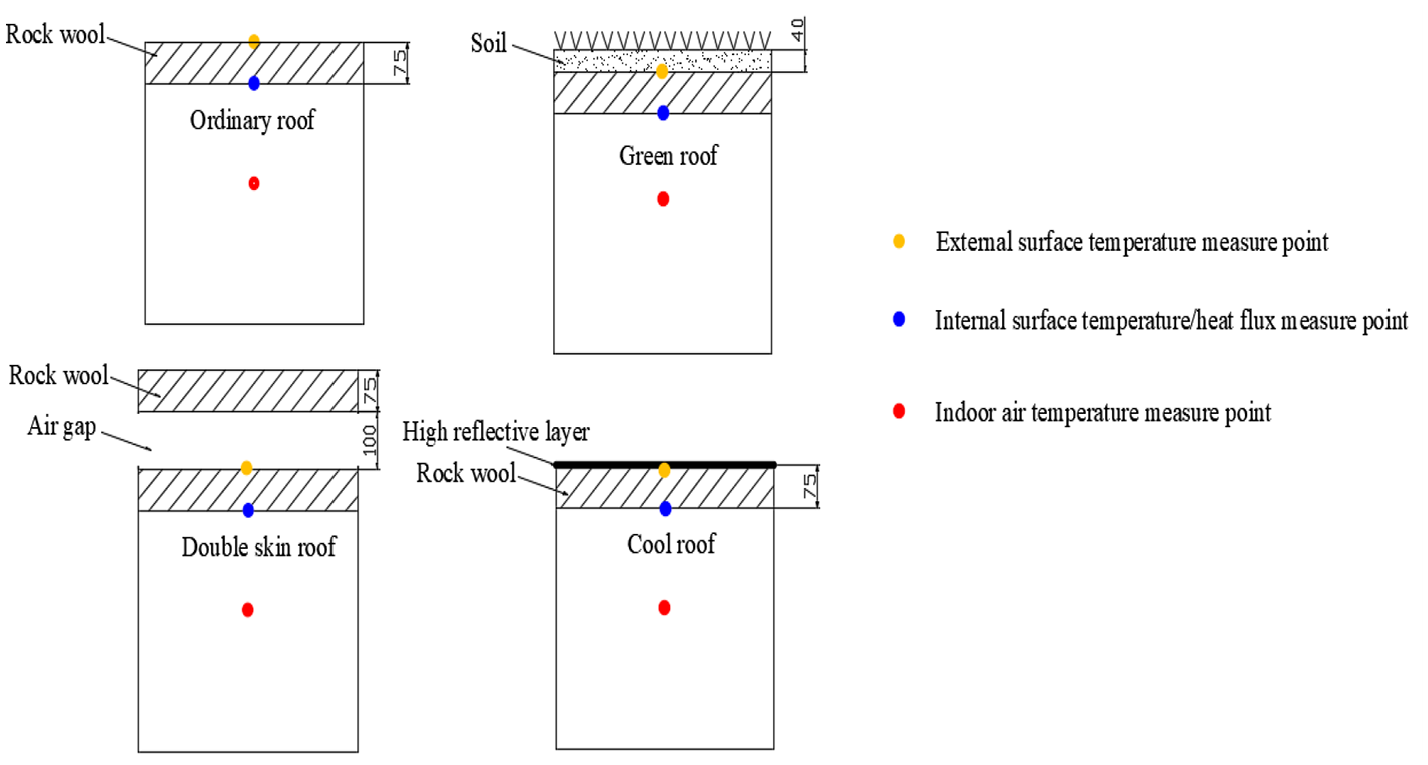
Structures of the roofs and temperature/heat flux measure points.
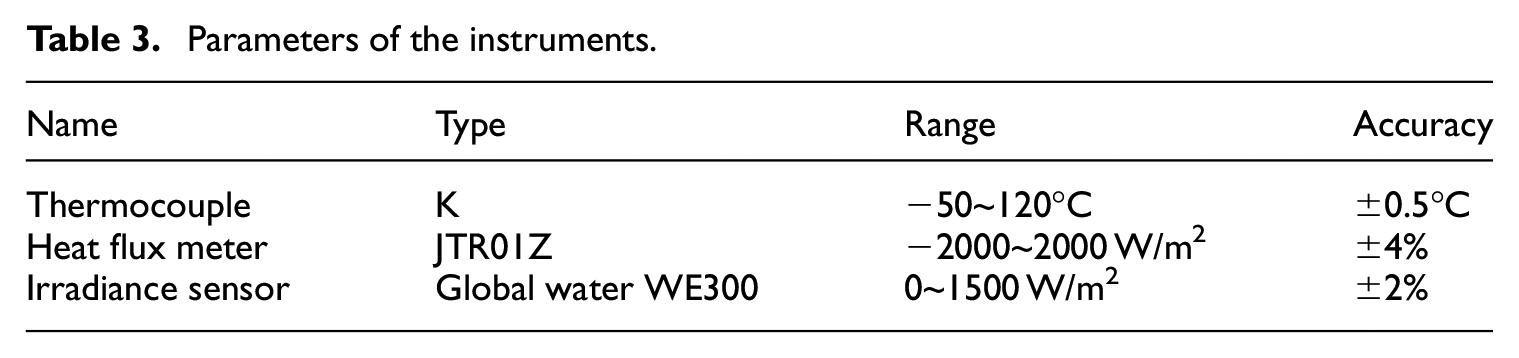
The experiment was done from July 23 to August 4. The meteorological parameters during the experiment were shown in Figure 3. There was only one rainy day (8.3) during the experiment. The surface temperature and heat flux measure points were arranged at the center of the surface, the indoor air temperature measure points were arranged at the center of the room. The temperature and heat flux were recorded every 10 minutes. The measure points were shown in Figure 2. The parameters of the instruments were list in Table 3.
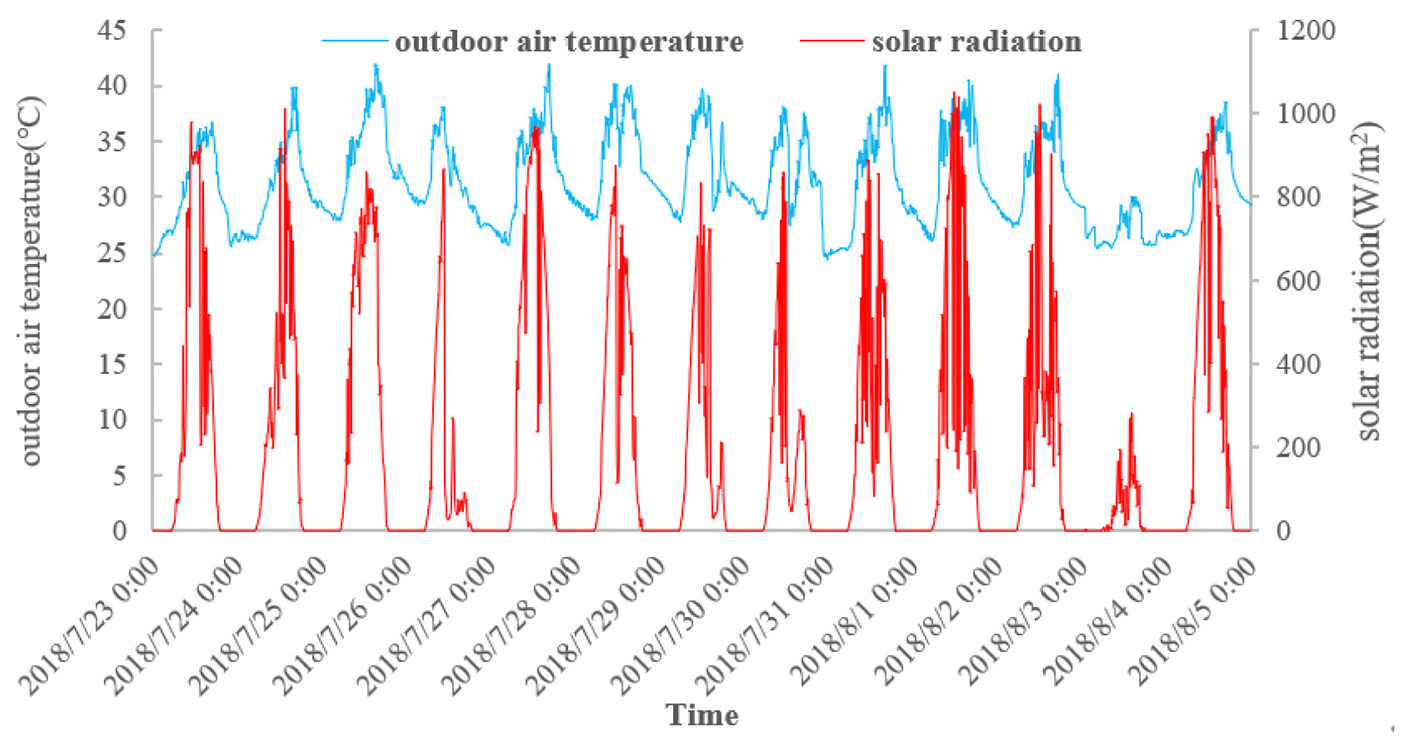
Meteorological parameters during the experiment.
Parameters of the instruments.
Results and discussion
Indoor air temperature
The variation of the indoor air temperatures of the four rooms are shown in Figure 4. It can be seen that the indoor air temperature of ordinary roof room was the highest while the indoor air temperature of the other three rooms were very close during the day. At night, the indoor air temperature of the ordinary roof room and double skin roof room were close to each other while the indoor air temperature of the green roof room and cool roof room were almost the same and lower than that of the other two rooms. That is to say that the indoor air temperature of the green roof room and cool roof room were lower than that of ordinary roof room during all the day. At night, the evaporation of the water in the soil which absorbed heat from the room led to a lower indoor air temperature of the green roof room. The high reflective layer can increase the heat exchange between the roof and the sky at night which increased the heat loss of the room and decreased the indoor air temperature of cool roof room. The air temperature in the air gap was similar to the outside air temperature which caused that the indoor air temperature of ordinary roof room and double skin roof room were almost the same. During the experiment, the green roof and cool roof can reduce the indoor average air temperature by 1.1°C while the double skin roof can reduce the indoor air temperature by 0.3°C as compared to ordinary roof.
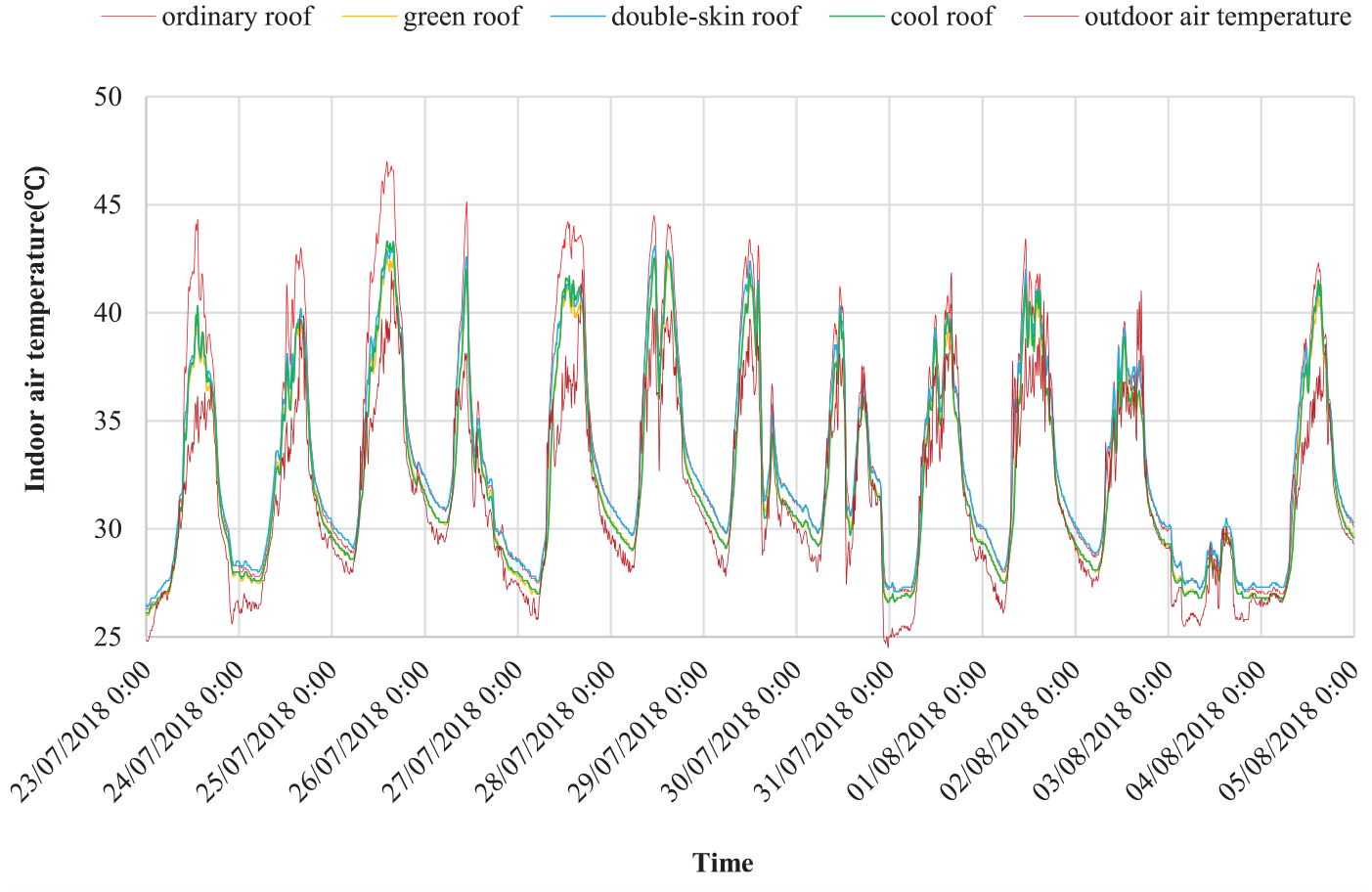
Indoor air temperature of the rooms.
The maximum and minimum values of indoor air temperature difference between the three rooms and the ordinary room are listed in Table 4.


Indoor air temperature difference between the three rooms and ordinary room.
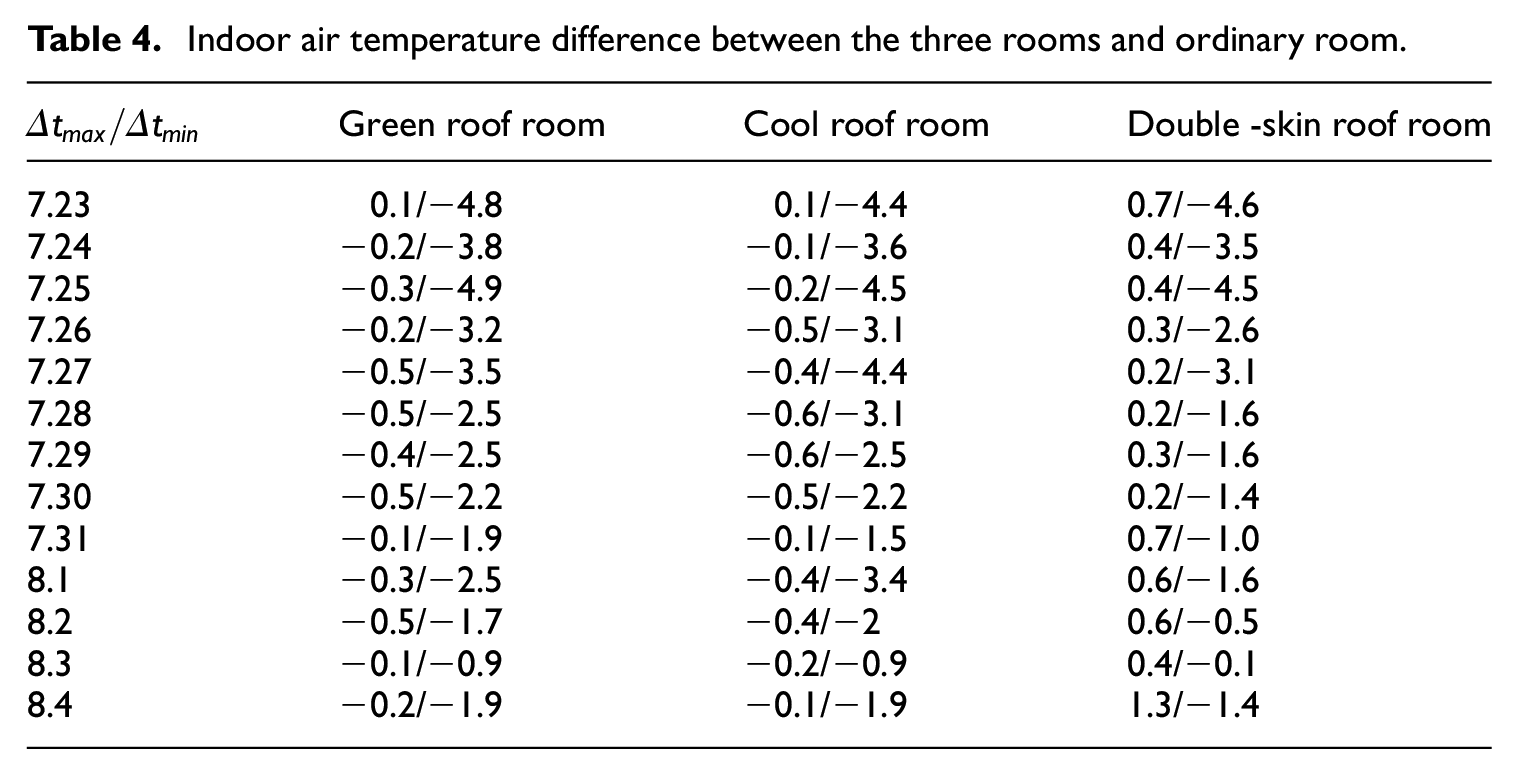
It can be seen from Table 4 that the
In summary, the green roof and cool roof performed more excellent performance in decreasing the indoor air temperature.
Thermal load leveling
It can be seen from Figure 5 that the indoor air temperatures of the three rooms varied greatly during the day because of small heat capacity of the envelops. In order to quantitative evaluation the fluctuation of the indoor air temperature. Thermal load leveling (TLL) was used. TLL was proposed by Berroug et al. (2011). The expression of TLL is:

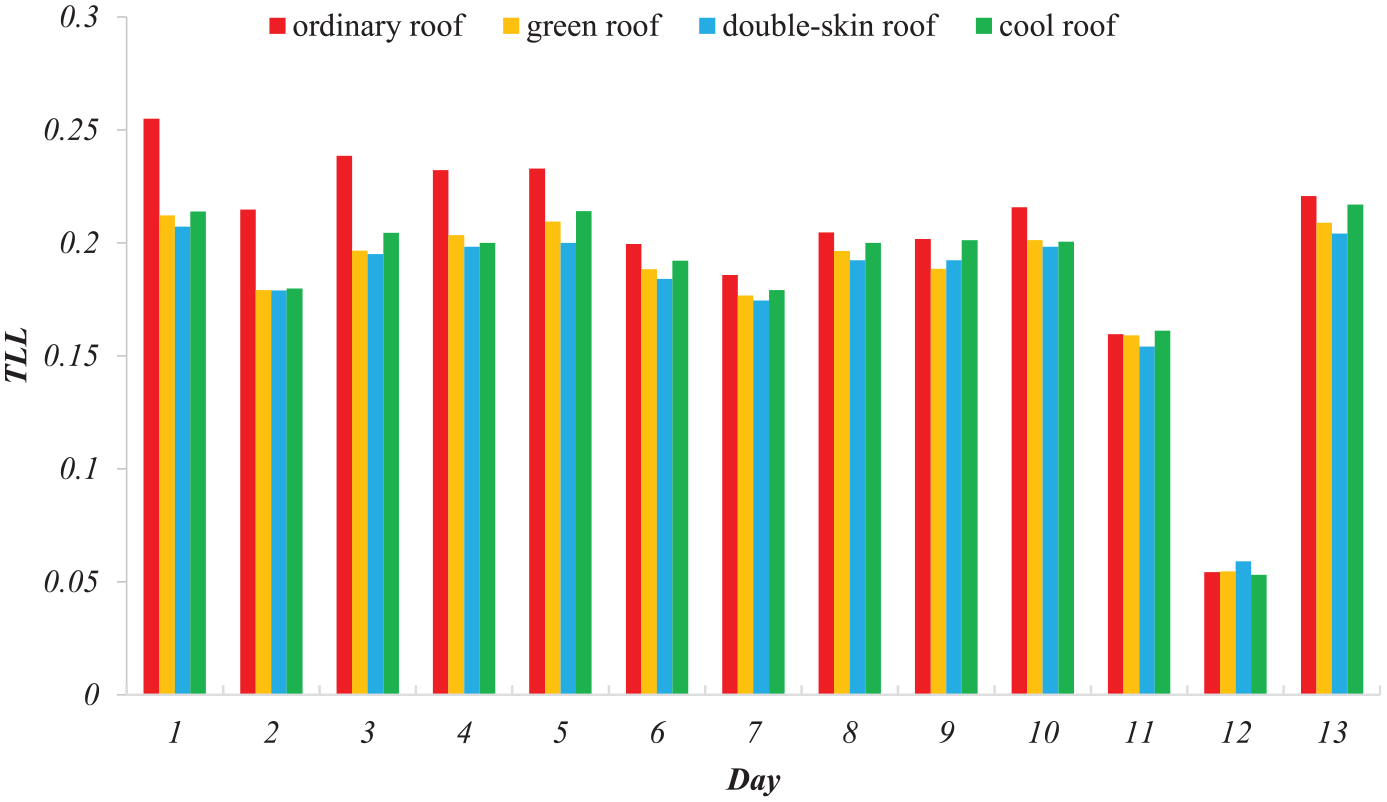
TLL of the rooms.
Where Tmax is the maximum value of indoor air temperature of the room. Tmin is the minimum value of the indoor air temperature of the room.
The results of TLL are shown in Figure 5. As can be seen from the figure, the average TLL of the green roof room was 8.2% lower than that of the ordinary roof room. The average value for the double skin roof room and cool roof room were 9.0% and 6.8% lower. The stabilities of the indoor air temperature of the four rooms can be described as: DSR room > GR room > CR room > OR room.
Internal and external surface temperature
Figure 6 is the variation of the internal and external surface temperature of the four roofs. It can be seen that the internal surface temperature of the green roof was the lowest and the value for the ordinary roof was the highest during the day. At night, the internal surface temperature of the double skin roof was the highest. However, the internal surface temperatures of the green roof, cool roof, and ordinary roof were very close. The reason was that the secondary roof of the DSR blocked the radiation heat transfer between the first roof and the sky which reduced the radiation heat loss of the roof.
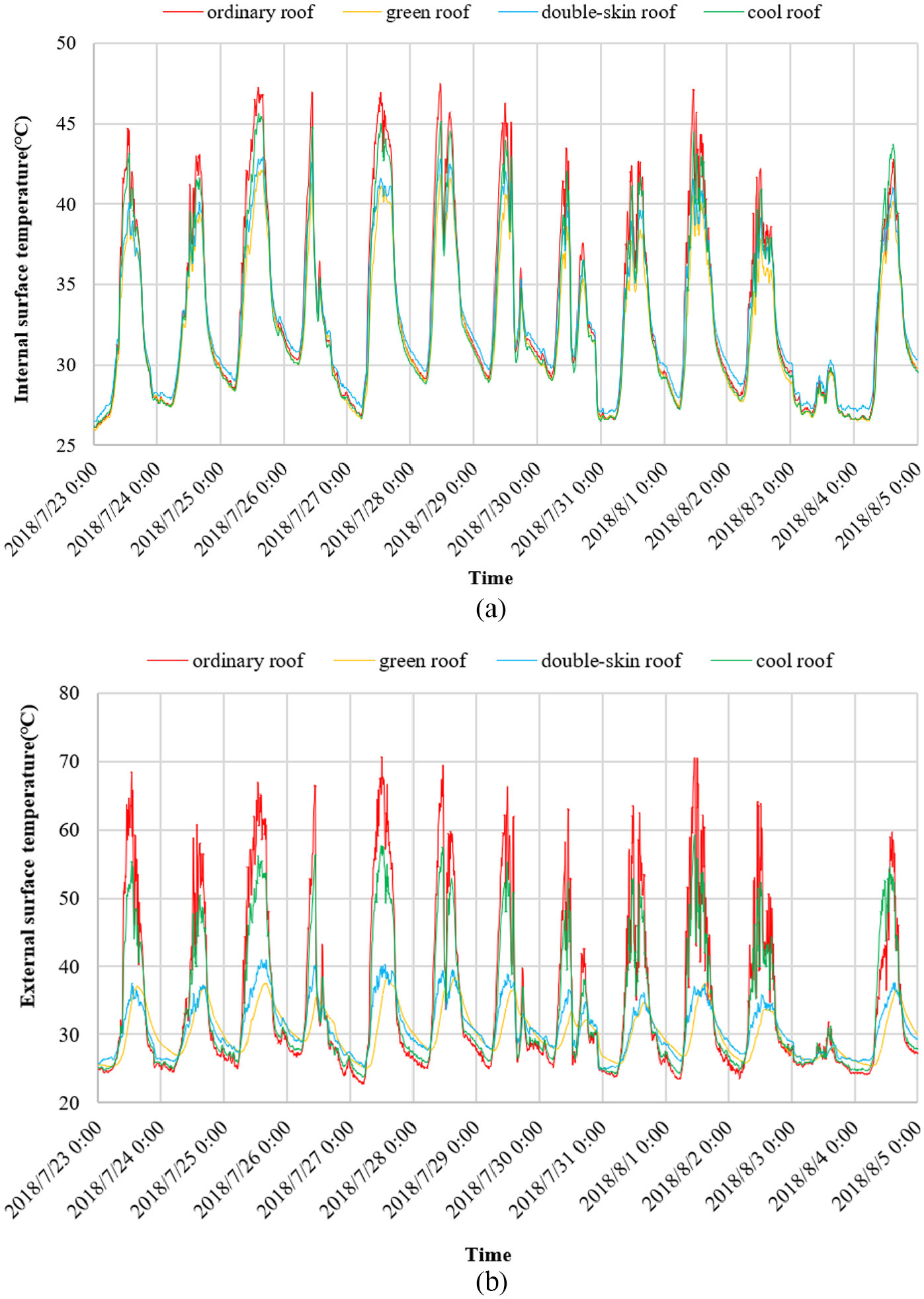
Internal (a) and external (b) surface temperature of the roofs.
The external surface temperature of the ordinary roof was the highest during the day and lowest at night. That is to say that all the other three roofs can reduce the external surface temperature of the roofs, but they also caused the external surface temperature to rises at night. Results showed that the green roof can reduce the external surface temperature by 13.7°C on average as compared to that of ordinary roof during the day, the values for double skin roof and cool roof were 12.0°C and 4.8°C. At night, the external surface temperature of the green roof, double skin roof, and cool roof rose 2.3°C, 1.9°C, and 0.9°C. It seems that the variation of the external surface temperature was similar to the heat capacity of the roofs. Roofs with large heat capacity can bring a larger reduction in the external surface temperature during the day while a larger rise at night.
In summary, the green roof had better performance in reducing the internal and external surface temperature during the day.
Internal surface heat flux
From Figure 4, we can see that the indoor air temperature was higher than outdoor air temperature for the four rooms. So, the rooms lost heat from walls which were not directly exposed to the sun. However, the rooms got heat from the windows and walls directly exposed to the sun during the day. The heat transfer of the four roofs were shown in Figure 7. It revealed that the ordinary roof released heat to the room during the day. Because the external surface of the roof was directly exposed to the sun and the surface temperature was much higher than the indoor air temperature. The maximum of the internal surface heat flux reached about 20 W/m2. At night, ordinary roof absorbed heat from the room and released heat to the outside. The minimum of the internal surface heat flux was about −5 W/m2.
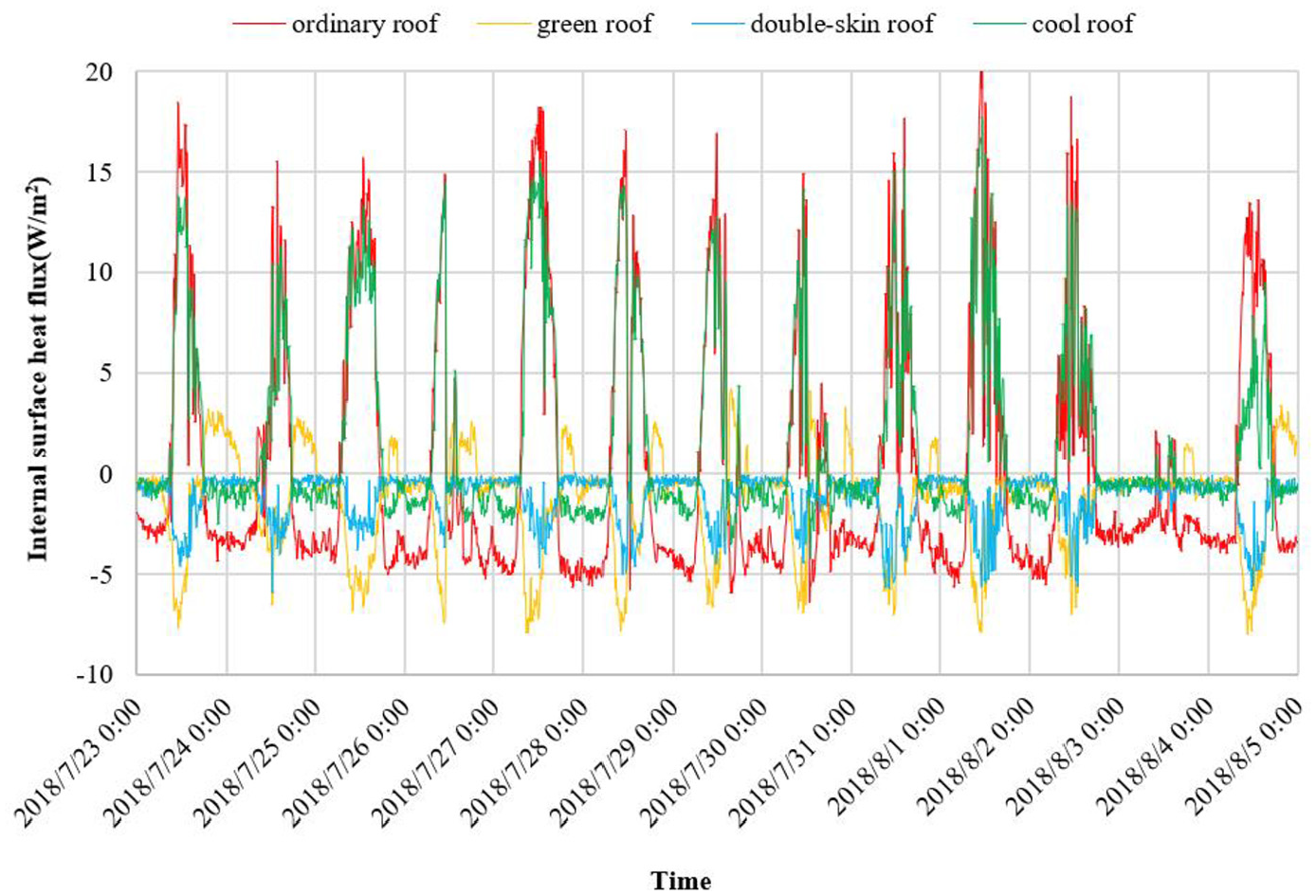
Internal surface heat flux of the roofs.
The variation of the internal surface heat flux of the cool roof was similar to that of ordinary roof. However, as compared to the ordinary roof, less heat released to the room through the cool roof during the day while less heat absorbed from the room at night. The reason is that the high reflectivity film whose solar radiation reflectivity was higher than that of color steel plate can decrease the solar heat gain of the cool roof.
Green roof absorbs heat from the room during the day due to the transpiration of the grass and the evaporation of water in the soil. The heat absorbing flux of the roof reached about −8 W/m2. At night, due to the drop of the indoor air temperature, the green roof released part of the heat stored during the day to the room, but the heat releasing time was very short.
For the double skin roof, as shown in Figure 2, the external surface temperature means the temperature of the external surface of the lower roof of the DSR. The external surface of the lower roof was not directly exposed to the sun. The upper roof acted like a sunshade plate. So the temperature of the external surface of the lower roof was not high and very close to the outdoor air temperature. However, the DSR room got heat from the window and walls which was directly exposed to the sun, so the indoor air temperature was higher than the outdoor air temperature as shown in Figure 4. So, the DSR absorbed heat from the room during the day. However, the heat absorbing flux was smaller than that of the green roof during the day. Because the heat capacity of the double skin roof was much smaller than that of green roof, the double skin roof absorbed heat from the room at night. The reason is that the outdoor air temperature decreased quickly at night. Because of the thermal inertia of the building envelopes, the indoor air temperature decreased slower than the outdoor air temperature, so the room lost heat from the roof at night. However, the heat absorbing flux was much smaller than that of ordinary roof because of the thermal resistance of the secondary roof and the air gap.
Overall heat absorbed and released
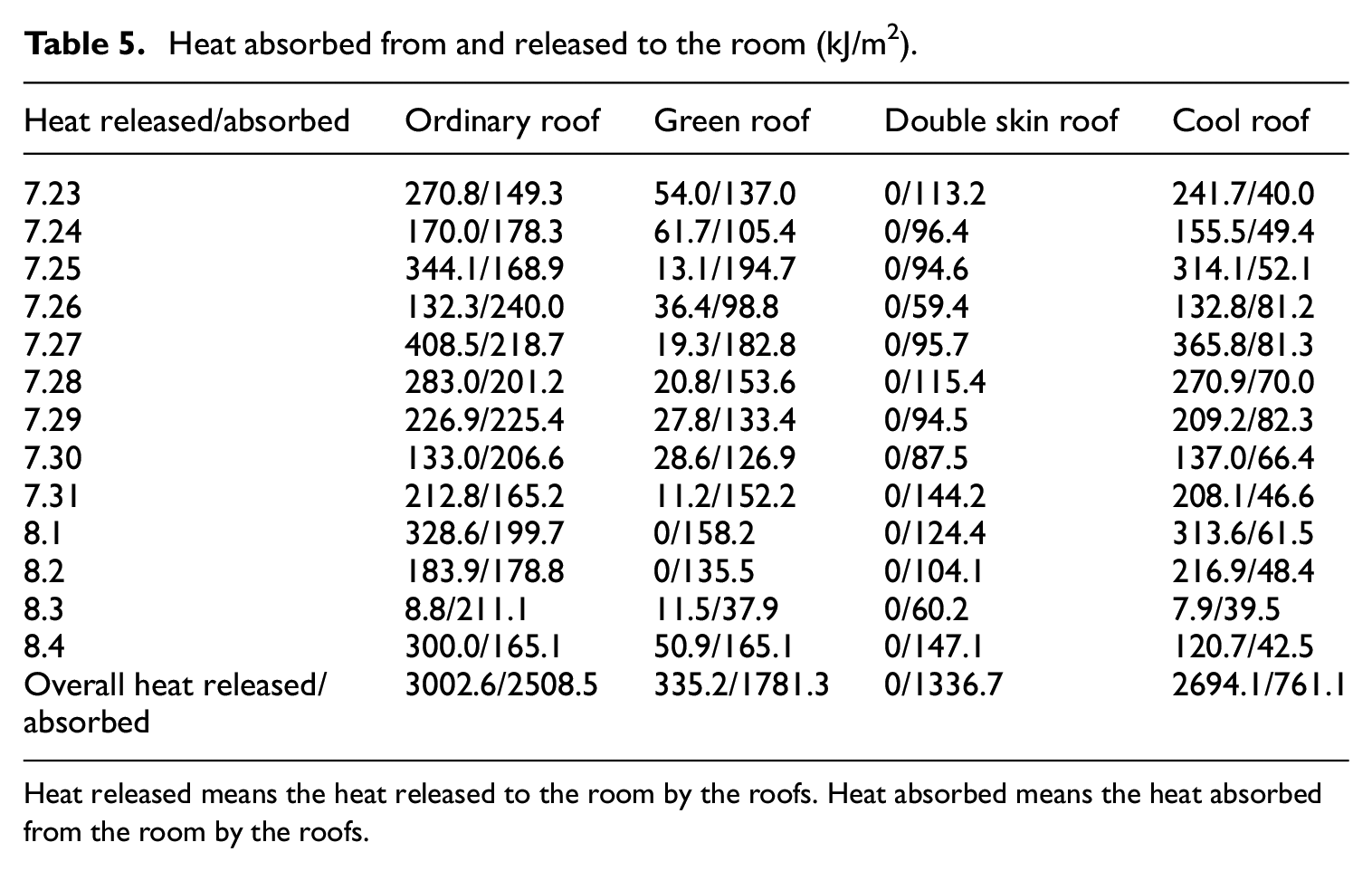
The overall heat absorbed and released by the roof during the experiment is shown in Table 5. The heat absorbed and released can be expressed as follow.


Heat absorbed from and released to the room (kJ/m2).
Heat released means the heat released to the room by the roofs. Heat absorbed means the heat absorbed from the room by the roofs.
Qabs is the overall heat absorbed. Qrel is the overall heat released. q— is the negative heat flux. q+ is the positive heat flux.
It can be seen that, although the overall heat absorbed by the green roof from the room reduced by 29.0% as compared to that of ordinary roof, the overall heat released to the room reduced by 88.8%. The green roof shows excellent thermal protection performance.
For the double skin roof, the overall heat absorbed decreased by 46.9% as compared to that of ordinary roof and 25.0% as compared to that of green roof. However, it released no heat to the room during the experiment.
For the cool roof, the overall heat absorbed decreased by 69.7% as compared to that of ordinary roof while the overall heat released to the room reduced by 10.3%. The cool roof performed worse heat releasing performance as compared to green roof and double skin roof. The reason was that the reflective of the aluminized film was not much higher than that of common roof which was white color steel plate.
In summary, green roof performed the best heat absorbing performance while double skin roof performed the best heat releasing performance.
Correlation analysis
The thermal protection performance of the roof was significantly affected by weather factors. In order to reveal the relation of the thermal protection performance with weather factors. Correlation analysis was done and the expression of the correlation of X and Y is as follow:

Results of correlation analysis were shown in Table 6.
Correlation analysis of the thermal performance with weather factors.
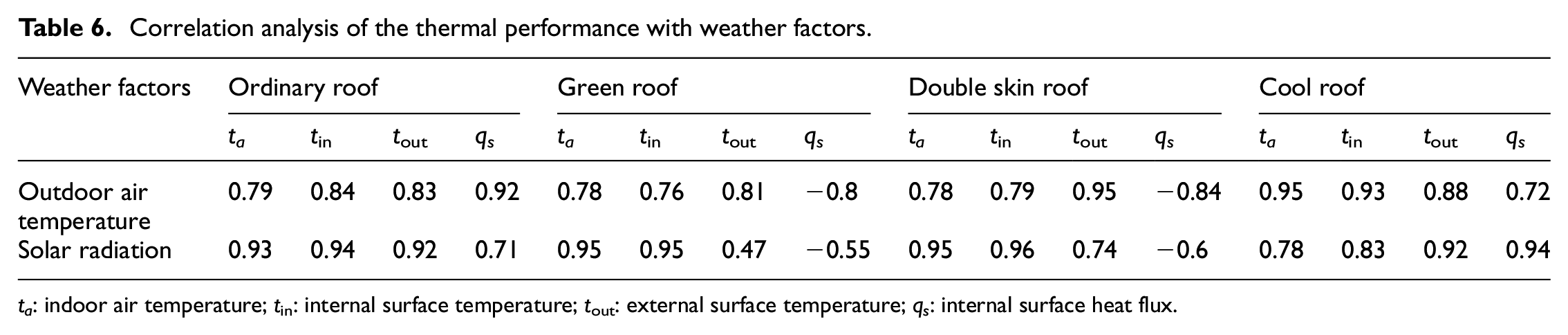
ta: indoor air temperature; tin: internal surface temperature; tout: external surface temperature; qs: internal surface heat flux.
It was found that ta and tin of the four rooms were all positively correlated with weather factors and they were more related to solar radiation. It means that ta and tin can be affected more significantly by solar radiation as compared to outdoor air temperature. The reason was that ta and tin were directly related to the indoor heat gain through the envelops in which solar radiation heat gain accounted for a larger proportion.
The external surface temperature tout of the ordinary roof and cool roof had stronger relationship with solar radiation. However, tout of green roof and double skin roof were all more related to outdoor air temperature. The reason was that the green roof and double skin roof all had excellent sunshade performance.
The internal surface heat flux qs of cool roof was more related to solar radiation while qs of other three roofs were more related to outdoor air temperature. However, qs of the ordinary roof and cool roof were positively correlated with weather factors and qs of the green roof and double skin roof were all negative correlated with weather factors. The reason was that qs of the green roof and double skin roof were negative during the day which means that the indoor air temperature was higher than the external surface temperature. The indoor air temperature increased significantly with the increasing of outdoor air temperature and solar radiation. Meanwhile, the temperature difference between the indoor air temperature and the external surface temperature increased. The positively correlation between qs and weather factors indicate that the green roof and double skin roof will absorb more heat from the room when the outdoor air temperature is high or the solar radiation is strong. This is very good for the thermal protection of the roofs in summer.
Conclusion
This paper tested the thermal protection performance of green roof, double skin roof, cool roof, and ordinary roof. It compared the indoor air temperature, TLL, internal and external surface temperature, internal surface heat flux of the roofs. Correlation analysis was done to the thermal protection performance with weather factors. The following conclusions can be drawn:
The green roof had better performance in reducing indoor air temperature, internal, and external surface temperature.
The green roof performed the best heat absorbing performance while the double skin roof performed the best heat releasing performance.
ta, tin, tout of the four roofs were all positively correlated with weather factors. qs of the green roof and double skin roof were negative correlated with weather factors while qs of the ordinary roof and cool roof were positively correlated with weather factors.
It can be seen that different roofs have their own advantages in thermal performance. So, the roof structure should be chosen according to the energy consumption characteristics of the building. Otherwise, structure parameters have great influence on the thermal performance of the roofs. Numerical study can be carried to the quantitative influence of the structure parameters. However, the experimental data in this paper can provide reference for the verification of numerical models.
Footnotes
Appendix
Declaration of conflicting interests
The author(s) declared no potential conflicts of interest with respect to the research, authorship, and/or publication of this article.
Funding
The author(s) disclosed receipt of the following financial support for the research, authorship, and/or publication of this article: This work was supported by Suzhou science and technology plan projects (SNG2017052).
