






Abstract
Traditional developmental science has often described child growth as a sequence of stages or linear progressions, yet many phenomena—abrupt spurts and regressions, idiosyncratic pathways, and widening individual differences—resist linear accounts. This article proposes chaos theory as a framework for quantifying developmental trajectories. Chaos theory, which addresses how complex patterns emerge from simple rules in deterministic yet unpredictable ways, aligns with observations of sensitive developmental periods, emergent behaviors, and divergent outcomes. I situate chaos theory alongside dynamic systems theory, neuroconstructivism, and developmental-cascade models and clarify how chaos might add mathematical precision to established insights: Bifurcation analysis identifies tipping points at which behaviors reorganize; Lyapunov exponents quantify stability and sensitivity to small perturbations; state-space methods reconstruct attractor landscapes from dense time series; and complexity metrics discriminate structured variability from noise. These tools convert powerful metaphors—soft assembly, attractors, cascades—into testable hypotheses about when and why qualitative change occurs. Such a framework also motivates microgenetic and high-density longitudinal designs, computational modeling of phase transitions, and interventions conceived as targeted perturbations delivered near sensitive windows. Finally, I discuss why adopting a chaos framework can be advantageous compared with (or in concert with) traditional linear models.
Keywords
Classical theories of child development, epitomized by Piaget’s stage model, envisioned development as a series of qualitatively distinct stages occurring in a fixed sequence (Blake & Pope, 2008; Brainerd, 1978; Miller, 2002; Piaget, 1952). Although insightful, such stage theories struggled to explain the mechanisms driving transitions or the irregular timing and variability observed in real children. Development is often nonlinear—small changes can have disproportionately large effects, timing can vary widely between individuals, and multiple pathways can lead to similar outcomes (Siegler, 1994; Vogler et al., 2008). These characteristics resonate with the realm of chaos theory and nonlinear dynamical systems (Thelen & Smith, 1998; van Geert & van Dijk, 2015; Witherington, 2007).
From Linear Stages to Nonlinear Dynamics
Chaos theory, a branch of mathematics and physics, deals with systems that are deterministic yet exhibit unpredictable and highly complex behaviors due to extreme sensitivity to initial conditions and nonlinear interactions (Boccaletti et al., 2000; Murphy, 2010). In a chaotic system, two entities that start almost identically can end up in vastly different states, a property famously nicknamed the “butterfly effect.” Such behavior is not random noise; rather, chaos generates underlying patterns and structured variability (often visualized by strange attractors or fractal patterns) even though precise outcomes are unforeseeable (Nityananda & Lorenz, 2015). The proposition of this article is that child development can be fruitfully viewed as a chaotic dynamical system—in effect, that developmental processes operate at the edge of chaos, where stable order and variability coexist in a delicate balance.
Viewing development through the lens of chaos theory aligns closely with existing ideas in developmental science, including neuroconstructivism (which emphasizes how cognitive development emerges from interactions of neural, bodily, and environmental constraints; Karmiloff-Smith, 2006) and developmental cascades (which describe how effects in one domain or level of function spread to others over time; Oakes & Rakison, 2019). However, such ideas have occasionally been described metaphorically. Chaos theory may offer a way to formalize these notions with mathematical models and empirical tools, enabling quantitative predictions and deeper theoretical integration (for chaos theory in other fields in psychology, see Ayers, 1997; Duke, 1994).
Historically, this places chaos theory within a broader lineage of nonlinear developmental thinking, from catastrophe models of stage change to contemporary neuroconstructivist and neuroemergentist accounts of developmental emergence (Hernandez et al., 2019; Raijmakers, 2007; Van der Maas & Molenaar, 1992).
In the following sections, I first introduce key concepts of chaos theory and then illustrate how they appear in developmental phenomena. I then examine how chaos principles intersect with the dynamic-systems approach, neuroconstructivist theory, and developmental-cascade models, grounding the discussion in real examples from cognitive, perceptual, and motor development. Next, I outline a road map for incorporating chaos theory into developmental research, including methodologies for detecting nonlinear dynamics in developmental data and experimental designs to test chaos-based hypotheses. Finally, I discuss why adopting a chaos framework can be advantageous compared with (or in concert with) traditional linear models. Throughout, my aim is to show that “embracing chaos” is not about introducing disorder into developmental theory, but rather about harnessing the inherent complexity of development in a rigorous, empirically grounded way.
Key Concepts and Relevance to Child Development
Chaos theory deals with nonlinear dynamical systems—systems that change over time according to rules in which outputs are not proportional to inputs (Murphy, 2010). In such systems, multiple components interact in feedback loops, often yielding emergent global behavior that cannot be predicted by analyzing any single part in isolation. Crucially, chaotic systems exhibit sensitive dependence on initial conditions (Glasner & Weiss, 1993). A classic example is the weather system: Two nearly identical atmospheric states can diverge exponentially over time, making long-term weather forecasts effectively impossible. This sensitivity means that very small differences in the starting state of a system (or tiny perturbations along the way) can cascade into dramatically different outcomes.
At a broad level, it is useful to distinguish ordered, chaotic, and edge-of-chaos regimes (see Fig. 1; top panel). In an ordered regime, perturbations are rapidly dampened and the system is highly predictable, but also relatively rigid; in a chaotic regime, perturbations amplify quickly, trajectories diverge, and stable organization is difficult to maintain. The edge of chaos lies between these extremes: a regime of flexible stability in which patterns persist long enough to be functional, yet remain sufficiently labile to reorganize when constraints change. This middle regime has often been invoked to characterize living systems because biological adaptation requires both robustness and responsiveness, not simply one or the other (Ito & Gunji, 1994; Lipsitz & Goldberger, 1992). For developmental science, this offers a deeper rationale for why chaos theory is conceptually useful: children must consolidate skills, but they must also remain plastic enough to explore alternatives and reorganize as bodies, brains, and environments change.
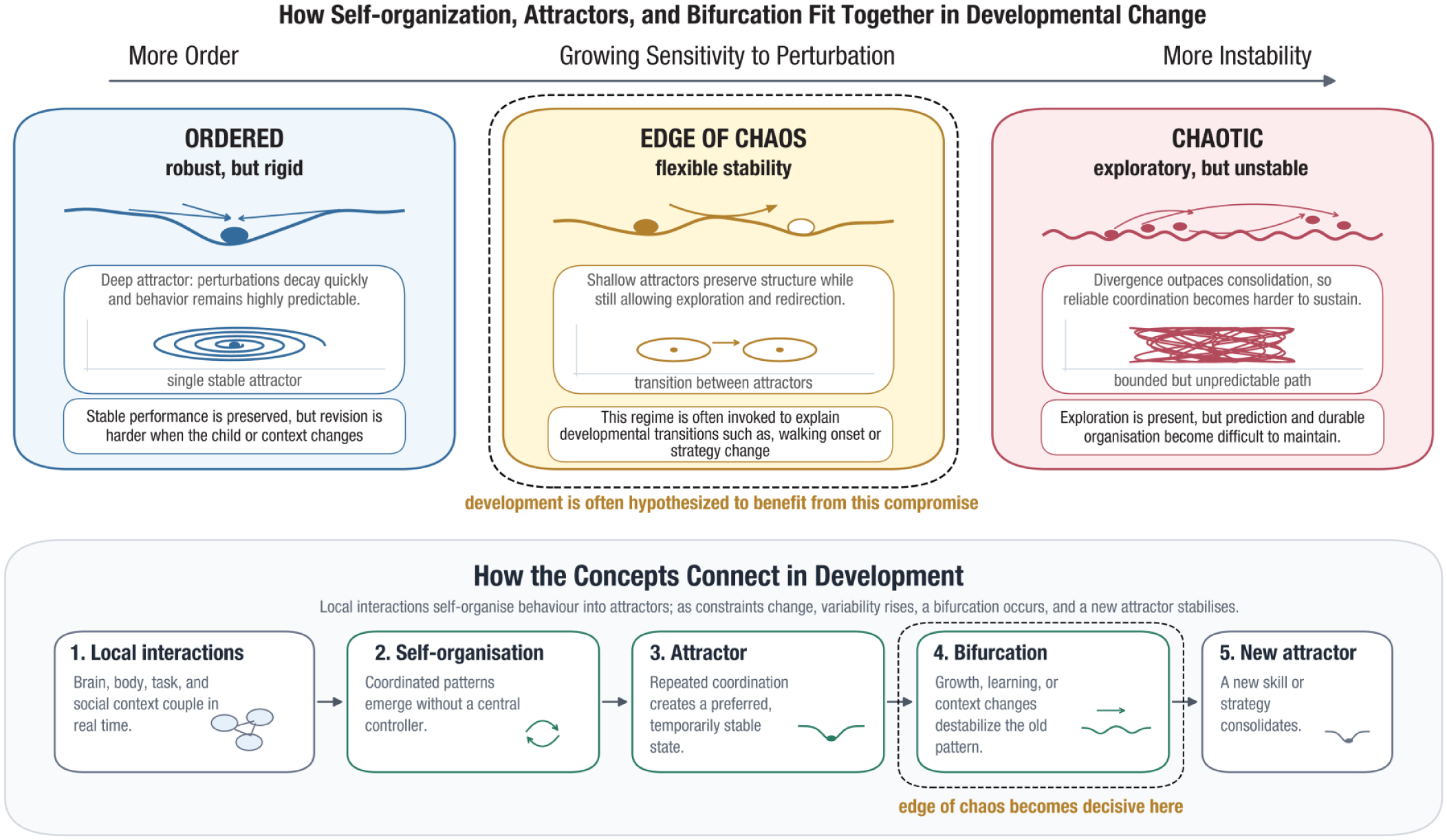
Developmental regimes from order to chaos. This conceptual schematic shows how self-organization, attractors, and bifurcation fit together in developmental change. The upper portion of the figure contrasts three regimes. In an ordered regime, behavior is organized around a deep attractor; perturbations decay quickly, performance is robust and predictable, but revision is more difficult when the child or context changes. At the edge of chaos, shallower attractors preserve structure while permitting exploration, heightened sensitivity to context, and transitions between coordination patterns; this regime is especially relevant to development because it offers a plausible balance between stability and adaptability. In a chaotic regime, variability becomes difficult to contain, prediction weakens, and durable coordination is harder to maintain. The lower portion of the figure integrates the core developmental sequence: local interactions among brain, body, task, and social context self-organize behavior into attractors, and as constraints change and variability rises, a bifurcation can occur, allowing a new attractor—and thus a new skill or strategy—to stabilize.
Put differently, adaptive development requires a system that can do two things at once: retain successful coordinations long enough for them to become reliable skills, and remain sufficiently variable to revise those coordinations when growth, experience, or context alter the problem the child is solving. A system that is too ordered would become efficient but brittle; a system that is too chaotic would remain exploratory but fail to consolidate learning. The appeal of the edge-of-chaos perspective is therefore not that development should be unstable, but that adaptive development may depend on a biologically plausible compromise between retention and revision (Fig. 1; Lipsitz & Goldberger, 1992; Thelen & Smith, 1994).
Developmental analogies are immediately apparent. Consider two infants who start with only minor differences in early brain connectivity or early experiences: over years, one might develop typical language and the other might struggle, potentially because of amplifying feedback loops in cognitive and social development. Developmental scientists have long noted that early differences can snowball (Iverson, 2010; Masten & Cicchetti, 2010), but chaos theory provides mathematical measures, such as Lyapunov exponents, to quantify divergence rates and describe them formally (Wolf et al., 1985; Young, 2013).
Another key concept is the attractor. In chaos theory, an attractor is a set of states toward which a system tends to evolve. Simple systems have fixed-point attractors (a stable state) or limit cycles (repeating oscillations). Chaotic systems have strange attractors—complex patterns in the system’s state space that the trajectory orbits in a sustained way (Taylor, 2010). Intuitively, we understand that an attractor represents a stable pattern of behavior that emerges from the system dynamics. In child development, we can think of attractors as common behaviors or skills that children exhibit. For example, in motor development, infants’ preferred crawling pattern or a stable gait during walking can be seen as attractors in the biomechanical-neurological system. A developing child might exhibit variability in movement but eventually settles into a coordinative pattern that is stable (until the next developmental reorganization). Cognitive development, too, might have attractor states: For instance, a characteristic strategy a child uses to solve problems could dominate for a period of time. Chaos theory encourages us to map these attractors and understand the landscape of possible developmental states (Thelen et al., 1989). Waddington’s famous epigenetic landscape metaphor from developmental biology (a marble rolling down a multivalley hill toward different outcomes) is essentially an attractor landscape view of development (Waddington, 1957). This concept directly translates to cognitive or behavioral development if we consider the developmental landscape of a child’s abilities—the child’s behavior may fluctuate, but it tends to organise around certain preferred states (skills or patterns of thinking), until some force (e.g., new learning, brain maturation) reshapes the landscape (Davila-Velderrain et al., 2015; Wang et al., 2011).
A third important concept is the bifurcation. A bifurcation is a qualitative change in the behavior or structure of a system that occurs when a parameter passes a critical threshold (Crawford, 1991). In a simple nonlinear model, increasing a parameter (such as growth rate in a population model) might first produce a stable equilibrium, then a periodic oscillation, and beyond a critical value, chaotic fluctuations. This progression is seen in the logistic map, a classic iterative model (Figueroa et al., 2020). In developmental terms, a bifurcation might correspond to a tipping point in a child’s development (van Geert, 1994): For instance, as a child’s neural capacity or vocabulary size reaches a certain threshold, the system might undergo a phase shift—a qualitative jump, such as the rapid onset of grammar in language (language explosion) or the integration of a new cognitive insight that reorganizes thinking (akin to a Piagetian stage transition; Ruhland & van Geert, 1998). Indeed, researchers have applied catastrophe theory (a precursor to chaos theory focused on discontinuous changes; Hartelman et al., 1998) to model stage transitions in cognitive development (Raijmakers, 2007; Wimmers et al., 1998). A notable example is van der Maas and Molenaar’s cusp model of Piaget’s stage transition in the balance-scale task, which demonstrated that children’s cognitive performance could shift abruptly, like a nonlinear phase change rather than a smooth progression (Van der Maas & Molenaar, 1992). Their model predicted telltale signatures of a bifurcation—transient increases in variability and bimodal distribution of responses during the transition. These patterns were observed empirically and are hallmarks of a system passing through a chaotic threshold.
A final concept worth introducing is self-organization. Complex dynamic systems often exhibit self-organization, meaning that coherent structure or patterns arise spontaneously from local interactions without a central controller (Collier & Hooker, 1999). Child development is characterized by self-organizing processes (Thelen, 1989): For example, the coordinated rhythmic kicking of an infant, or the way babbling in infancy gradually self-organizes into recognizable speech patterns (Thelen & Smith, 1994). Pioneering work by Esther Thelen and colleagues in the 1980s and 1990s demonstrated self-organizing dynamics in motor development (Thelen, 2005). They famously showed that an infant’s stepping movements (once thought to disappear at the age of 2 to 3 months because of cortical inhibition) could reemerge when the context changed (e.g., in water or on a treadmill), proving that the disappearance of stepping was not a hard-wired stage but rather an emergent property of changing leg weight-to-strength ratios and environmental support. Their dynamic systems theory explained motor milestones as products of multiple interacting components—neural patterns, muscle strength, body dimensions, environmental surface—coming together to yield new stable forms of behavior (Thelen et al., 1987, 1989, 2001; Thelen & Smith, 1998). Such multifactorial emergence is exactly what chaos and complexity theories address. Thelen described infant development as “more akin to a jazz improvisation than a scripted performance,” emphasizing the improvisational, emergent nature of skills—an apt metaphor aligning with chaos theory’s view that complex coordination can arise without a predefined plan (Spencer et al., 2006).
Critically, these concepts are interconnected rather than independent (see Fig. 1; bottom panel). Self-organization continually reshapes the attractor landscape; attractors describe the relatively stable coordinative states that emerge within that landscape; and bifurcations occur when gradual changes in a control parameter destabilize one attractor and allow the system to settle into another. The edge of chaos is therefore not an additional concept alongside the others, but the regime in which the balance between stability and instability makes such reorganizations possible. From this perspective, transient increases in variability before developmental transitions are not merely nuisance variance. They may be the observable signature that an existing organization is weakening and that a new one is beginning to form (Thelen et al., 1987; Van der Maas & Molenaar, 1992).
The above concepts not only enrich our descriptive vocabulary but come with quantitative and methodological tools. Researchers can calculate the fractal dimension of a child’s behavioral fluctuations to assess complexity, or compute Lyapunov exponents from developmental time-series data (such as successive-day measures of a skill) to test for chaotic dynamics. Already some applications have appeared: Measurements of infants’ postural sway have revealed higher dynamical complexity (suggestive of a chaotic control mechanism) as infants master sitting and standing (Harbourne & Stergiou, 2003), indicating a healthy degree of variability needed for flexible motor control (Deffeyes et al., 2009). Similarly, analyses of reaction-time variability or heart rate fluctuations in children have uncovered 1/f noise (a fractal pattern; Cysarz et al., 2011), hinting that developing cognitive systems might operate in a critical regime between order and chaos that maximizes adaptability (Lipsitz & Goldberger, 1992).
Chaos Theory Operationalizes Dynamic Systems Theory
So is chaos theory simply the dynamic systems theory (DST; Thelen, 2005; Witherington, 2015) of child development? Indeed, DST and chaos theory share a commitment to emergence, nonlinearity, and self-organization, but they operate at different levels of formalization. DST furnished a biologically grounded ontology—soft assembly, context-dependence, attractor-like stability—largely articulated through qualitative models and rich demonstrations. Chaos theory, by contrast, provides a rigorous calculus for similar ideas. It specifies the geometry and stability of change with explicit quantities.
Consider three commonplace research moves that DST motivates and that chaos theory makes testable. The first is locating tipping points: rather than describing a transition as “loss of stability,” chaos-based bifurcation analysis estimates the precise parameter range (e.g., task difficulty, strength-to-weight ratio, lexical density) at which an old coordination becomes untenable and a new one emerges, yielding actionable predictions about when qualitative change will occur (Liu et al., 2010; Zanone & Kelso, 1992). The second move is quantifying stability and flexibility: Lyapunov exponents convert DST’s shallow-versus-deep-attractor metaphor into numbers that discriminate exploratory, adaptive variability (marginal stability) from pathological rigidity (strong negative divergence) or uncontrolled fluctuation (positive divergence). The third move is recovering the real attractor landscape from data: Delay embedding and attractor reconstruction replace schematic landscapes with empirical ones, allowing researchers to see whether behavior occupies one basin, switches between basins, or grazes an unstable boundary—crucial for identifying sensitive periods and for comparing individuals or groups.
Crucially, this added precision changes design and inference. With tools from chaos theory (Ayers, 1997; Boccaletti et al., 2000; Murphy, 2010), dense time series (from motion, eye movements, learning curves, dyadic turn-taking) can be probed for early-warning signals of transition (e.g., variance inflation, critical slowing), guiding interventions as targeted perturbations delivered before the system settles. Parameter inference links observed dynamics to mechanistic levers (e.g., coupling strengths between subsystems). Thus, chaos theory does not replace DST; it operationalizes it—converting its central claims into estimable parameters, falsifiable predictions, and timing-sensitive prescriptions.
Integrating Chaos Theory with Neuroconstructivism
Neuroconstructivism is a modern theoretical framework in developmental cognitive neuroscience that explains cognitive development as a trajectory emerging from the progressive construction of neural representations, constrained by multiple interacting levels—genes, brain, body, physical and social environment (Karmiloff-Smith, 2009; Westermann et al., 2007). It stands in contrast to older nativist or purely empiricist views by emphasizing that what develops (brain and mind) and how it develops (process) are inseparable: the brain is wiring itself plastically in response to experience, under structural constraints, throughout development (Mareschal et al., 2007). Key principles of neuroconstructivism include (a) the experience-dependent nature of brain development, which involves interactive specialization (regions develop their functions through interaction with other regions and activities, not in isolation); (b) encapsulation and contextualization, meaning representations become progressively tuned and less context-general as they develop; (c) progressive modularization, in which functional modules emerge gradually from distributed interactions rather than being prespecified.
How does this relate to chaos theory? Strikingly well. Neuroconstructivism already employs the language of trajectories and constraints, which maps naturally onto a dynamical systems view. Cognitive development can be seen as the system (the child’s brain-and-body in context) moving through a state space, with constraints shaping the landscape of possible trajectories. Neuroconstructivists argue that early small biases (e.g., a slight preference for certain stimuli, or slight connectivity differences) can lead to substantial differences in outcome because those biases are amplified by learning and reciprocal interactions—essentially describing a sensitive dependence on initial conditions (Karmiloff-Smith, 2006, 2009).
A closely related metatheoretical development is neuroemergentism, which likewise treats cognition as arising from recursive interactions among neural maturation, behavior, and experience, and therefore emphasizes developmental trajectories rather than fixed, prespecified modules (Hernandez et al., 2019). Mentioning this framework makes explicit that the present proposal is not intended as a competing account, but as a more formal dynamical vocabulary for several already-converging developmental perspectives.
Again, as in the case of DST, tools in chaos theory can provide a formal handle on these ideas. For example, one can think of each level of constraint in neuroconstructivism (cellular, neural network, bodily, environmental) as a component of a high-dimensional dynamical system. The state of the system at any time includes neural-activation patterns, bodily context (posture, etc.), and environmental inputs. Development is the trajectory of this state through time. Notably, because of the massive interconnectivity, this trajectory can exhibit nonlinear behavior (Faghiri et al., 2019). An attractive aspect of neuroconstructivism is that it accounts for both typical and atypical development within the same framework—just with different initial constraints or different ongoing perturbations (Karmiloff-Smith, 2006). This resonates with chaos theory’s notion that qualitatively different outcomes (e.g., neurotypical vs. autistic cognition) can arise from the same deterministic rules given different initial conditions or parameter settings. Westermann et al. (2007) describe cognitive development as “a trajectory originating from the constraints on the underlying neural structures,” highlighting that multiple levels of constraints (from genes to environment) dynamically interact to shape learning. If we translate that to chaos theory terms, it implies that the developmental trajectory may be highly sensitive to slight variations in those constraints. For instance, a marginal genetic difference affecting synaptic plasticity could, through cascading interactions, result in a different cognitive developmental path—a scenario that chaos theory not only accommodates but expects when systems have many nonlinearly coupled elements.
Chaos mathematics can operationalize the neuroconstructivist claims. With dense longitudinal data (e.g., weekly observations, trial-by-trial decoding), researchers can (a) use delay embedding to reconstruct attractor structure and identify coexisting strategies; (b) estimate local Lyapunov exponents to quantify when learning becomes most sensitive (predicting transitions); (c) test for early-warning signals of bifurcation—variance inflation, increased autocorrelation (critical slowing)—and (d) treat interventions as targeted perturbations, timed to nudge the system out of a weakening attractor and into a more efficient one.
The same logic illuminates atypical outcomes. On a neuroconstructivist view, neurodevelopmental conditions are not single lesions but alternative attractors reached under slightly altered constraints (e.g., noisier input, reduced plasticity, atypical attentional priors). Developmental modeling shows how modest parameter shifts yield self-maintaining patterns resembling dyslexia or language impairment, and why later remediation often requires disproportionately strong perturbations to escape a deep basin of attraction (Thomas & Karmiloff-Smith, 2003). Chaos theory can supply a mathematical, quantitative language—initial conditions, coupling, attractors, bifurcations, stability—that turns neuroconstructivism’s process narrative into testable, timed predictions about when and how trajectories will reorganize.
Chaos and Developmental Cascades: Chain Reactions and Complex Trajectories
As detailed earlier, the term developmental cascades refers to the spreading influence of one developmental domain on another across time, often likened to snowball effects or chain reactions in development (Oakes & Rakison, 2019). This idea is inherently dynamic and cross-disciplinary. For example, in developmental psychopathology, a cascade might describe how early behavior problems lead to academic failure, which in turn fuels more behavior issues, creating a downward spiral (Burt & Roisman, 2010; Masten et al., 2005). Or in positive psychology, how early competence builds self-efficacy that leads to social success and further competence (an upward spiral; Maddux & Kleiman, 2016; Tsang et al., 2012). Such cascades are typically studied with longitudinal data and statistical models (like cross-lagged panel models; Zyphur et al., 2020). However, a limitation of many traditional analyses is that they assume linear additive effects—they will estimate that X at Time 1 leads to Y at Time 2 with some coefficient, and so on. Chaos theory urges us to consider that these effects might be nonlinear and state-dependent: The impact of an early skill on a later outcome might depend on the whole configuration of the child’s system at that time. For instance, a slight improvement in attention skills might have a small effect for children who already have strong self-regulation (because they are already in a good trajectory), but the same improvement could have a huge effect for children on the verge of a chaotic tipping point, perhaps preventing them from falling into a cascade of school failure. In other words, cascades could be moderated and mediated by the dynamic state of the system, not just direct links.
Chaos theory also highlights timing: Cascades might have critical windows in which a small redirect can lead to a very different long-term outcome, because the system is in a sensitive phase, whereas at other times the same push might do little, because the system is in a stable attractor. This resonates with the intuition behind early-childhood interventions: Intervening early often yields better long-term outcomes than intervening later (Kaur et al., 2006; Majnemer, 1998), presumably because early in development the pathways are more malleable, and small changes can accumulate (the landscape is softer, to use Waddington’s metaphor). After a certain point, a child’s trajectory might have deep inertia, requiring a far larger change to alter course. The mathematics of chaos—particularly Lyapunov exponents—could be applied to longitudinal data to quantify the sensitivity of a particular developmental period. If we find, for example, that divergence in outcomes accelerates most during adolescence for a certain outcome, that indicates that adolescence might be a highly chaotic period for that domain (which, interestingly, is plausible given the variability and instability often seen in adolescence).
Empirical support for nonlinear cascades has emerged decades ago. For example, a review by Granic and Patterson (2006) on the development of antisocial behavior used dynamical systems modeling to show how coercive family interactions can escalate nonlinearly into chronic aggression. A small increase in hostile parenting did not linearly increase child aggression, but beyond a threshold it caused a qualitative shift to a more aggressive interaction pattern that then self-perpetuated. They characterized it as the family system settling into a maladaptive attractor of conflict, illustrating a cascade that is better described by attractor dynamics than by linear cause-and-effect sequences. Another line of evidence comes from interventions that have disrupted expected cascades: For instance, high-quality preschool programs have been shown to deflect children from what risk factors alone would predict (children at risk for academic and behavioral problems end up doing much better if given early support; Burchinal et al., 2006; Jimerson et al., 1999). In chaos terms, these interventions likely work by perturbing the child’s system out of an emerging negative attractor and into a more positive trajectory. The earlier and more precisely targeted the perturbation, the more effectively it can redirect the cascade—consistent with a chaotic system in which timing and location of perturbation matter immensely.
In practice, integrating chaos theory with developmental cascades might involve constructing system-dynamics models that include variables for different domains (cognitive skill, social behavior, etc.) and calibrating them to longitudinal data. Already, some researchers use computational modeling to complement longitudinal studies, as it allows testing of counterfactual scenarios and identification of tipping points (Rubin, 1992; Zhuang et al., 2025). Paul van Geert’s work (1991, 1994) has been instructive here: he has built nonlinear growth models for vocabulary and cognitive development that recreate known cascade patterns (such as vocabulary growth fueling later literacy, which in turn fuels more vocabulary) and has explored conditions under which these patterns hold or break. His analyses often reveal that variability in individual developmental trajectories is not just noise but contains information about the system’s dynamics: Periods of high variability can foreshadow transitions, and similarly, cascade coupling strength can be inferred from synchrony between different skills’ growth spurts. Using chaos theory in cascade contexts will likely push researchers to collect dense, frequent measurements of children’s behavior across domains. Encouragingly, modern technology (wearables, experience sampling, learning apps that record performance; Cychosz & Cristia, 2022; de Barbaro, 2019; Ossmy et al., 2025; Serino & Ossmy, 2025; van den Heuvel et al., 2021) is making such dense developmental data more feasible, meaning that the time is ripe to apply chaos-theory analyses in developmental science.
How to Embrace Chaos Theory in Developmental Research
The theoretical promise of chaos theory in developmental science will only be realized with concrete research strategies. A reasonable concern is that a chaos-based approach might require prohibitively dense data and invite overfitting. In practice, the answer depends on the level of question. If the aim is to characterize a within-child transition, intensive repeated measurements around a narrow developmental window can be more informative than a very large but sparsely sampled cohort. If the aim is to generalize across children, larger samples become important, but the central safeguard is not size alone: It is whether nonlinear models outperform simpler alternatives, predict held-out data, and replicate across independent samples. For this reason, chaos-informed developmental research should proceed in stages, starting with bounded phenomena and low-dimensional models, and using null-model comparisons to test whether apparent nonlinear structure exceeds what linear or random processes could generate (Schreiber & Schmitz, 2000; Theiler et al., 1992). Here, I propose a road map for incorporating principles of chaos into developmental studies.
Identify candidate phenomena for nonlinear analysis
Not all developmental changes are chaotic; some follow roughly linear trends (e.g., an average increase in height). We should target phenomena that show hints of nonlinearity—for example, skills that bloom suddenly (walking, word spurts), behaviors with high individual variability or oscillations, or known transition periods (like the shift in attachment behaviors around age 1 year, the onset of adolescence, etc.). These are fruitful contexts in which to apply chaos analysis. Researchers can reexamine longitudinal data sets for signs of chaos: Do two children with similar scores at one time show divergent outcomes later (sensitive dependence)? Does the variance of a behavior temporarily increase at certain ages (a possible indicator of an impending bifurcation)? Are there periodic regressions and recoveries in certain skills (suggesting cyclic or chaotic dynamics)? Advanced statistical tools like state-space grids and recurrence quantification analysis (RQA; Webber & Marwan, 2015) can be applied to interaction data (e.g., parent-child emotion regulation cycles) to detect complex patterns that linear stats miss. For instance, RQA can quantify how a child’s behavioral state revisits previous states over time, identifying stable cycles versus chaotic wandering.
Previously collected microgenetic data sets may be especially informative here, because transitions in crawling, walking, and rapid lexical growth often reveal the very bursts, regressions, and temporary instability that chaos-based analyses are designed to capture (Abney et al., 2014; Ruhland & van Geert, 1998; Thelen et al., 1989).
Use high-density longitudinal designs
To capture dynamics, we need data at the scale of the processes. A microgenetic study that measures a child’s performance on a task daily or weekly during a transition period may reveal nonlinear progress (plateaus, sudden jumps) far better than pre-tests or post-tests. Similarly, recording continuous data (such as moment-by-moment motion tracking of infants learning to stand, or voice recordings of infants babbling over months; Abney et al., 2014) creates time series amenable to dynamic analysis. Modern sensors and apps enable the collection of such dense data in naturalistic settings. One exciting possibility is using wearable devices that measure physiological signals (heart-rate variability, for example, which has known chaotic properties) alongside behavioral observations, to see how physiological chaos relates to behavioral flexibility (Rachwani et al., 2020). A child with a healthy adaptive developmental trajectory might show certain chaotic signatures in physiology (such as robust heart-rate variability, indicating good autonomic flexibility), whereas one heading for difficulties might show either too little variability (an overly rigid system) or erratic, uncontrolled variability (pathological chaos). This could be a biomarker for identifying children in need of intervention before overt behavior problems emerge.
Microgenetic designs are particularly valuable because they intensify observation when the system is most likely to reorganize. The practical issue is therefore not maximal sampling at all times, but matching sampling frequency to the tempo of the phenomenon under study. Daily or session-by-session measurement may be appropriate during brief transition windows, whereas weekly sampling may suffice for slower-moving processes. Hybrid designs that combine short high-density bursts with lower-burden follow-up may also reduce attrition and make this approach more feasible for families.
Computational modeling
Embracing chaos theory means embracing models—equations or algorithms that instantiate theories. Developmental researchers should collaborate with mathematicians or physicists to create models of developmental processes. These can range from simple difference or differential equations representing idealized skills, to complex agent-based models simulating interactions of many microagents (e.g., neurons, or children in a social network). The goal is not to reduce the richness of development to math, but to test our intuitions about dynamics. For example, one might model vocabulary growth with a nonlinear growth equation that includes feedback (every new word slightly increases the rate of learning more words). By simulating this model, we can see whether it produces a vocabulary explosion like the explosion real children demonstrate, and under what parameter conditions (maybe if feedback is above a threshold, an explosion happens—connecting to a bifurcation insight). If the simulation matches empirical patterns, it strengthens the case that a chaos-based mechanism is at work. If not, we adjust the model or rethink the mechanism (López et al., 2025; Mattern et al., 2022; Ossmy et al., 2018). Computational models also allow us to test questions that require unethical or impractical experiments in real life: We can simulate dozens of virtual children with slightly varied initial conditions to see how widely they diverge, shedding light, say, on why some children in the same classroom thrive while others struggle despite similar inputs.
There are already modeling frameworks like dynamic field theory (DFT; Schöner et al., 2015) that are used in developmental robotics and infant cognition modeling; these frameworks are grounded in nonlinear dynamics. Researchers can adopt DFT to model things like spatial cognition, memory, or decision-making in children (Buss & Spencer, 2014; Schutte et al., 2003; Spencer et al., 2009), predicting not just final outcomes but the time course of reaching a decision and the possibility of systematic “revert-to-old-behavior” errors if the new attractor is not fully stabilized (as DFT has demonstrated in simulations of the A-not-B error, for instance; Schöner & Thelen, 2006; Schutte & Spencer, 2002). By integrating such models with neuroconstructivist principles (like building in neural constraints or learning rules), we get more biologically plausible accounts.
I acknowledge that not every developmental laboratory will have in-house expertise in nonlinear modeling. A pragmatic entry point is to re-analyze one existing dense measure with comparatively accessible tools—entropy measures, recurrence quantification, or simple state-space models—and to bring in modular collaborations only when more elaborate modeling becomes necessary. In practical terms, a lab can integrate chaos theory incrementally, first by applying one nonlinear metric alongside familiar growth analyses to an existing transition data set, next by adding short bursts of higher-frequency sampling around the hypothesized transition in a new cohort, and then by preregistering a small perturbation study targeting a plausible control parameter, such as task difficulty, caregiver scaffolding, or contextual support. For example, researchers studying early walking could begin with existing stepping or balance data, intensify sampling around walking onset, and later test whether brief changes in support conditions alter the stability of the transition. Embracing chaos theory, therefore, does not require every researcher to become a mathematician; it requires an analytic culture in which developmental questions and quantitative tools are brought into closer dialogue (Schöner et al., 2015; Webber & Marwan, 2015).
Testing for chaos in empirical data
Chaos theory comes with analytical techniques to determine whether a system is behaving chaotically. One method is to compute the Lyapunov exponent from time-series data, which indicates whether trajectories diverge (a positive exponent suggests chaos). For example, one could take sequential assessments of a child’s cognitive-strategy use in problem-solving (there are instruments that give a real-time trace of strategy shifts) and estimate whether small differences in initial strategy frequency lead to exponentially growing differences in later frequencies. Another approach is Poincaré plots or phase-space reconstruction from empirical data—essentially visualizing the attractor shape of a behavior. If we repeatedly measure two relevant variables (say, attention level and impulsivity level in a child) and plot the trajectory in a phase space, a chaotic system might reveal a strange attractor (a structured, fractal shape of points). If found, it is a hint that the underlying process has deterministic chaos rather than just random fluctuations.
The value of this example is not merely visual. If repeated observations remain confined to a bounded region of phase space despite local irregularity, that pattern suggests that the behavior is being organized by an underlying deterministic dynamic rather than by unstructured noise. Moreover, if the reconstructed trajectory begins to widen, elongate, or switch repeatedly between regions before an observed transition, that change can serve as an empirical sign that the system is losing stability and approaching reorganization rather than merely fluctuating randomly (Schreiber & Schmitz, 2000; Webber & Marwan, 2015).
For a more accessible application, even calculating entropy measures (like approximate entropy or sample entropy) on behavioral sequences can reveal complexity; a medium entropy (not too low, and not the highest possible) often corresponds to healthy complexity at the edge of chaos. Examples include movement studies in which children’s postural-sway entropy is tracked: Deviations from the typical moderate entropy range have been associated with developmental disorders. This infant postural-control work provides concrete examples, such as nonlinear measures of sitting sway, which differentiate typical development from delayed development and change systematically as postural control stabilizes (Deffeyes et al., 2009, 2011; Harbourne & Stergiou, 2003).
Interventional experiments as perturbation probes
Another element of a chaos-informed approach is to treat interventions as perturbations to a dynamic system. By systematically varying the timing, intensity, or type of intervention, and observing the system’s response, one can infer properties of the developmental dynamics. For example, delivering a small nudge intervention at different points in time around a suspected transition (perhaps a few sessions of training in some skill) could test whether there is a sensitive period; the system responds a lot if nudged at the right time, but little if nudged too early or too late. If development were linear, the timing should not matter much—but if it is chaotic, timing is crucial. Such experiments might require tight collaboration between developmental psychologists and educators or clinicians to implement, but they could be very illuminating. A real-world instance might be language interventions for late-talking toddlers: A chaos perspective might predict that just before the expected vocabulary explosion, a small boost could have an outsized effect (pushing the child into a faster growth trajectory), whereas after the explosion, the same boost might do less. Testing this could guide optimal intervention timing.
A sensible empirical progression is to begin with tightly controlled laboratory manipulations of a suspected control parameter and then ask whether the same dynamical signatures generalize to home, school, or clinical contexts. Such a scaffolded strategy reduces inferential ambiguity early on, while preserving the longer-term goal of ecological validity. It also makes collaboration more feasible, because not every program of research must assemble a large interdisciplinary team from the outset.
Interdisciplinary cross-pollination
Developmental researchers should also look at research in other fields where chaos theory is more established—for example, in cardiology (heartbeat dynamics) or ecology (population dynamics). There may be parallel insights, such as how systems recover from chaos (heart-rhythm resynchronization is akin to a dysregulated behavior pattern being brought under control), or how diversity in an ecosystem confers stability (like a child who uses diverse experiences or cognitive strategies to avoid getting stuck). Collaborations with complexity scientists could lead to the discovery of common laws or patterns that apply across domains. The concept of self-organized criticality—a system naturally evolving to a critical state in which minor events can cause cascades (consider a sandpile where adding one grain eventually triggers an avalanche)—has been applied to neural activity and might well apply to motor, perceptual or cognitive development. If so, we might find that children’s learning has an inherent stop–start pattern because the system self-tunes to criticality for optimal learning (this is speculative, but plausible under some theories). Verifying such ideas would require both fine data and theoretical modeling.
The ultimate vision of this road map is a framework in which theories of development yield testable dynamic models, data is rich enough to capture temporal patterns, and interventions are designed with an understanding of the nonlinear mechanics of change. Rather than replacing existing theories, chaos theory augments them by providing a unifying set of principles (nonlinearity, feedback, emergence) and methods that can tie together findings from brain development, behavior, and environment in one coherent dynamic story.
Advantages of the Chaos Framework
Why go through this trouble? What does chaos theory offer that existing developmental theories do not? Here are several reasons.
Mathematical rigor and testable mechanisms
Chaos theory compels explicit, dynamical specification of mechanisms (e.g., feedback functions, thresholds, coupling strengths). This yields falsifiable simulations and quantitative metrics—such as Lyapunov exponents for predictability and basin size for resilience—moving beyond verbal models to precise hypotheses about when small changes trigger qualitative shifts.
Holism with specificity
It captures the whole child in context via coupled variables and feedback loops while retaining parametric clarity about which interactions matter and how much. Unlike broad “everything-affects-everything” narratives, nonlinear models estimate escalation rates and tipping points (e.g., tantrums and parenting coercive cycles), directly guiding intervention targets.
Explaining developmental trends, not just age change
Nonlinear dynamics naturally generate S-curves, U-shapes, regressions, and sudden reorganizations. This accounts for qualitative shifts in strategy, insight, or coordination that linear-growth models treat as noise, thereby explaining how structure emerges, not merely how much it increases with age.
Individual differences as signals
Person-specific trajectories arise from sensitive dependence on initial conditions and state-dependent parameters. Rather than detailed variance, intraindividual fluctuation becomes theory-relevant, aligning with idiographic analyses and enabling identification of imminent transitions at the level of the individual child.
Interdisciplinary reach and translational value
Shared principles (attractors, bifurcations, criticality) connect developmental science to neuroscience, physiology, ecology, and control theory, allowing import of mature methods and export of developmental insights. This supports mechanism-based timing of interventions as targeted perturbations around sensitive windows.
Context made mechanistic
Sociocultural inputs reshape attractor landscapes and alter system stability. Classic constructs (e.g., the zone of proximal development) can be formalized as regions in which moderate support shifts the system into higher-level attractors, clarifying why timing and dosage matter.
Taken together, chaos theory supplies a unifying mathematical language, testable predictions about phase transitions, and actionable metrics for prediction and control—without discarding simpler linear findings where they suffice.
Conclusion
Child development is a paradigmatic complex system in which order emerges from fluctuation. By integrating chaos theory with neuroconstructivism and developmental cascades, we can explain qualitative reorganizations, the amplification of small differences, and cross-domain spillovers within a single, mechanistic framework. This perspective reframes variability as informative, predicts when trajectories will bifurcate, and specifies how context reshapes the developmental landscape. Practically, it motivates dense, multivariate measurement; dynamical modeling linked to empirical data; and interventions designed as precisely timed perturbations near sensitive points. Adopting this approach promises a more predictive and integrative developmental science—one that explains not only that children change, but how and why those changes unfold, and how we might steer them toward adaptive outcomes.
