






Abstract
Animation and games employ highly specialised terminology that can present linguistic access challenges for learners, professionals and interpreters navigating rapidly evolving industry language. This article presents preliminary findings from an exploratory study investigating potential gaps in British Sign Language (BSL) vocabulary within animation and games. Data were collected during a live interpreted animation-focused event where professional BSL interpreters submitted 122 terms they identified as unfamiliar, inconsistently signed, or potentially lacking established signs. A five-stage moderation process involving consultation with Deaf community members was used to assess whether widely recognised BSL equivalents exist for these terms. Approximately 60 percent were identified as potentially lacking commonly recognised signs, indicating areas where further vocabulary development may be required. The animated short New Signs for Animation: AnimSign (Mortimer, 2024) functions as a practice-based case study illustrating linguistic access challenges within educational and professional animation contexts. While the film did not generate the terminology dataset directly, it operates as a reflective and communicative tool supporting accessibility research. The study provides an initial methodological framework and preliminary evidence base to inform future Deaf-led terminology and glossary development. It contributes to wider debates on accessibility, inclusion, and practice-based research within the creative industries by positioning linguistic access as foundational to participation in animation and games.
Keywords
Animation and games are fast-moving creative fields shaped by specialised and continually evolving terminology, including digital tools, real-time rendering technologies, and interactive workflows. Shared disciplinary language plays a central role in enabling participation across studio practice, education, and interpreted settings. For students, educators, practitioners, and interpreters, familiarity with this terminology supports engagement in both learning and professional environments. Similar challenges surrounding specialist vocabulary have been addressed in other disciplines through British Sign Language (BSL) glossary initiatives in fields such as Chemistry, Biology, Astronomy, and Cyber Security (Scottish Sensory Centre [SSC], 2026).
These initiatives demonstrate the value of collaborative terminology development in supporting linguistic access and reducing reliance on fingerspelling in specialist domains (Bharadia, 2023). From a theoretical perspective, frameworks such as Communities of Practice (CoPs) and Pedagogical Content Knowledge (PCK) further highlight the role of shared disciplinary language in supporting learning, participation and knowledge exchange within specialist fields (Ball et al., 2008; Mavri et al., 2024; Shulman, 1986).
Despite these developments, there is currently no dedicated BSL glossary for Animation or Games terminology, indicating a gap in domain-specific linguistic resources available to Deaf and Hard of Hearing (DHH) learners and professionals. Research indicates that DHH students frequently rely on interpreters and/or other accommodations and may experience frustration where language support is inconsistent or insufficient. Such challenges can influence comprehension, confidence, engagement, and professional identity (Hendry et al., 2020; Smolen and Paul, 2023; Tannenbaum-Baruchi et al., 2025).
This article presents preliminary findings from an exploratory study examining potential gaps in BSL terminology within animation and games. Data were collected at a live interpreted animation-focused event in Scotland, where professional BSL interpreters submitted 122 terms they identified as unfamiliar, inconsistently signed, or potentially lacking established signs. Submitted terms were analysed using a five-stage moderation process involving initial term identification, collaborative sign discussion, Deaf community consultation, iterative review, and final validation. Approximately 60 percent of terms were tentatively identified as potentially lacking widely recognised BSL signs. The study does not propose new signs but provides a methodological foundation for future Deaf-led terminology development.
The animated short New Signs for Animation: AnimSign (dir. Mortimer, 2024) is included as a practice-based case study that accompanies the research. While not generating terminology data directly, the film contextualises the study by illustrating how BSL users encounter specialist vocabulary challenges in educational and professional settings. Together, these strands position linguistic access as a central dimension of inclusion within animation and games. By examining terminology challenges in animation and games, and situating them within practice-based research, this article contributes to emerging discussions on linguistic accessibility within the creative industries and offers a methodological foundation for future Deaf-led terminology development.
Sign language and its history in education
Sign language and the Deaf community have a long and complex history within education, shaped by shifting social and pedagogical attitudes. Historical accounts document persistent misconceptions regarding Deaf people’s capacity to learn. Aristotle (384–322 BC), for example, claimed that “deaf people cannot be educated”, a view that influenced educational thinking for many centuries (Deaf History, nd). In contrast, early philosophical observations recognised sign-based communication as a natural human behaviour. Socrates is credited with observing that, in the absence of speech, humans would communicate through bodily movement and gesture: “If we hadn’t a voice or a tongue, and wanted to express things to one another, wouldn’t we try to make signs by moving our hands, head, and the rest of our body?” (Newcross Healthcare, 2025). Later, Geronimo Cardano argued that Deaf learners could develop literacy without spoken language, while Dom Pedro Ponce de León (1520–1584) is widely regarded as one of the first educators of Deaf students – marking an important early shift towards more inclusive approaches to Deaf education (Deaf History, nd; Newcross Healthcare, 2025).
Thomas Braidwood (1715–1806), a Scottish educator, founded Britain’s first school for Deaf children in 1760 and developed a “combined system” of education incorporating sign language, speech, articulation, and lip-reading. His work influenced the development of what would later become British Sign Language (BSL), which received official recognition in 2003 (Deaf History, nd; Nordstrom, 1986). A pivotal turning point occurred at the 1880 International Congress on the Education of the Deaf (Milan Conference), where oral education was declared superior to sign language. This resolution led to the widespread suppression of sign languages in educational contexts, producing lasting consequences for Deaf learners. Hamilton and Egbert (2024) explain: . . . the Milan Conference of 1880 played a pivotal role in discrediting sign language, leading to a massive wave of anti-Deaf Culture in America . . . At this conference, educators declared that sign language hindered the development of spoken language and pushed for its eradication from educational settings. . .
This decision had lasting consequences, with Vieira-Machado and Rodrigues (2021: 23) reiterating this point and highlighting the impact on Deaf education: . . . reductionist narratives based only on the oppositions of deaf vs. hearing or sign language vs. oral language, for example, prevent us from thinking about other details about language teaching methodologies for deaf people.
The harm associated with these policies was formally acknowledged at the 21st International Congress on the Education of the Deaf (ICED) in Vancouver in 2010. The Congress issued a statement expressing deep regret and calling for the recognition and respect of all languages and communication methods within education (Deaf History, nd; World Federation of the Deaf, 2016).
In Scotland, BSL is officially recognised as one of the nation’s four languages and is protected through the BSL (Scotland) Act 2015 and the Equality Act 2010 (Scottish Government, 2010, 2015, nd) acknowledging the linguistic rights of DHH people. These legal frameworks aim to support equal access to education and public life. Despite these frameworks, DHH students continue to encounter barriers within higher education, particularly where linguistic access remains inconsistent. Alison Hendry, the University of Edinburgh’s BSL Development Officer, has described similar challenges during her own studies: Being a Deaf BSL user, I have been through university myself and found a lot of barriers . . . BSL is very much a minority language. BSL users have faced discrimination and exclusion, in a similar way to what Gaelic and Welsh speakers in the UK once faced.
Hendry recognises recent progress in improving linguistic access. Initiatives such as the Scottish Sensory Centre’s BSL Glossary and EdSign – a collaboration between the University of Edinburgh, Queen Margaret University, Edinburgh Napier University and Heriot-Watt University – have established partnerships to strengthen BSL and Deaf Studies education and research (Stapley, 2022).
This study is informed by teaching practice within 3D Modelling and 3D Animation modules, where Deaf students engage with animation and games terminology in BSL-interpreted environments. Observations from students and teaching staff highlighted recurring instances where specialist terminology required negotiation of meaning, extended explanation, or reliance on fingerspelling. These interactions suggest that gaps in domain-specific BSL vocabulary influence how knowledge is accessed and discussed within animation education. By identifying animation and games terms that may lack widely recognised BSL equivalents, the study establishes an initial framework for future Deaf-led research and contributes to broader discussions of accessibility, inclusive pedagogy, and participation within the creative industries.
Historical and contemporary engagement with the Deaf community in film and animation
Hamilton and Egbert (2024) draw on the work of John S. Schuchman, who described the era of silent film as a “Golden era” for the Deaf community. The absence of sound created a more level viewing experience, allowing Deaf and hearing audiences to engage with films on more equal terms: . . . Between the years of 1893 and 1929, Deaf people nationwide felt they had equal access and opportunity in the film industry. In this short period, the hopes that the Deaf could be represented in mainstream media seemed plausible for the first time in American history. For efficient contrast, note the near past when the Deaf were sent away to boarding homes and the use of sign was punished . . .
Schuchman explains that the inclusive period of silent cinema ended with the arrival of sound films, often referred to as “talkies.” During the silent era, Deaf performers were able to flourish, using expressive facial expression and body language as core storytelling tools. However, the introduction of sound fundamentally shifted film production and performance, leading to the widespread exclusion of Deaf people from the industry (Hamilton and Egbert, 2024: 2).
Schuchman highlights the example of Jane Wyman, a hearing actress who won an Oscar in 1948 for portraying a Deaf woman (Johnny Belinda, dir. Negulesco, 1948), noting that such performances often presented sign language in inauthentic ways. Schuchman identifies this as the beginning of a longer pattern of misrepresentation of Deaf people in film. This pattern continues in later works such as Hush (dir. Flanagan, 2016), where a Deaf character was central but Deaf creatives were not involved. Together, these examples highlight the continuing importance of authentic Deaf representation in film and media, particularly the inclusion of Deaf performers and creatives in roles that depict Deaf identity, language, and experience (Hamilton and Egbert, 2024).
Deaf representation in film and television has improved in recent years, marked by high-profile productions such as CODA (dir. Heder, 2021), which centre Deaf characters and involve Deaf performers and creatives in key roles (Tangcay, 2023). The National Research Group’s (NRG, 2022, 2023) study on ‘Representation of the Deaf community in media and entertainment–and why it matters for Deaf audiences’, indicates that 79 percent of Deaf audiences report an increase in representation in film and TV compared to previous years, suggesting a meaningful shift toward more authentic and inclusive storytelling.
However, industry voices, including members of Deaf West Theatre (nd), emphasise that progress remains uneven. Deaf representation continues to lag in animation, children’s television, and video games, where Deaf characters are scarce and opportunities for Deaf creatives are limited (NRG, 2022: 12, 17). ‘Spotlight on Deaf Representation: A Roundtable Discussion’ (NRG & Deaf West Theatre), featuring d/Deaf actress Shaylee Mansfield, highlights the importance of early representation for young audiences: ‘Child audiences out there are more open, receptive and welcoming. If they see deaf children are a part of our world, they will realize there’s nothing wrong with being deaf.’
The NRG panel mentions ongoing accessibility barriers, and the need for sustained inclusion both on-screen and behind the scenes to ensure lasting change across all media forms (Tangcay, 2023).
While animation has included Deaf or signing characters, such as the d/Deaf mermaid Gabriella in The Little Mermaid (1992–1994) animated television series, these characters are often minor or non-recurring. This contrast highlights the continued need for Deaf-led storytelling to achieve meaningful and sustained representation of DHH experiences in animated media. One such example is the animated short series El Deafo (dir. Fogg, 2022), written by DHH author Bell (2014) and adapted from her graphic novel of the same name, which draws directly on Bell’s lived experiences, offering an authentic portrayal of DHH identity.
Similarly, Tullis (2026) describes a forthcoming Peppa Pig (2004–present) storyline scheduled to air in March 2026 in which Peppa’s younger brother George is diagnosed as moderately deaf and fitted with a hearing aid. Developed in collaboration with the National Deaf Children’s Society (NDCS) and featuring Deaf athlete Jodie Ounsley as George’s audiologist, the storyline aims to present deafness accurately and positively for young audiences. Like El Deafo, this example highlights the growing importance of authentic representation in animation and children’s media. However, limited information is publicly available regarding the number of DHH artists involved in these productions or whether such initiatives support long-term progression into the animation industry. While individual Deaf animators, such as Mark Fisher – cited as one of the first successful Deaf animators (Deaf Art, 2026; Motley, 2016), were active in the animation industry – having worked on several well-known animated feature films such as: The Land Before Time (dir. Bluth, 1988), The Little Mermaid (dir. Clements and Musker, 1989), and The Swan Princess (dir. Rich, 1994), data on how many DHH professionals are currently working in, or pursuing careers within, the animation industry remains largely absent.
These challenges are particularly relevant for early-career animators in the UK, including DHH creatives, who face multiple structural barriers when entering the industry. Animation UK’s (2018) skills analysis of the UK animation industry, raised concerns about the effectiveness of training programs, noting that: Universities in the UK generally (but not always) do not teach or produce students with relevant animation skills or techniques to enter at an industry standard. More focus on animation principles and less on a full movie solely produced by an individual student means they could concentrate on better learning. TV animation is a team-based field and specific skill areas are required to fulfil each task . . . (p.33)
In addition, Lee (2019) observes that the UK animation industry has grown rapidly over the past 15 years, but domestic university programs cannot fully meet the demand for skilled professionals. As a result, the industry relies heavily on overseas talent, with at least 30 percent of professionals coming from abroad and some studios comprising up to 60 percent non-UK staff. Coupled with concerns about training quality and retention, this raises questions about workforce sustainability, and the comparatively high employment outcomes of European animation schools.
British Sign Language glossaries in specialist domains
The Scottish Sensory Centre (SSC, 2026) at the University of Edinburgh is developing BSL resources for specialist subjects. Established in 2010, the Scottish Government-funded team has created over 3,000 subject-specific signs across areas including Computing Science, Cyber Security, Data Science, and Environmental Science (Stapley, 2022). Rachel O’Neill, Senior Lecturer in Deaf Education, explains: We now work with a team of 34 Deaf scientists, mathematicians, computing scientists, teachers and sign linguists from all over the UK. We focus on developing BSL signs that are interlinked to aid understanding of complex scientific concepts.
The BSL Glossary Project, led by the Scottish Sensory Centre, focuses primarily on Science, Technology, Engineering and Mathematics (STEM) subjects, where technical vocabulary is both conceptually complex and essential for educational progression. Each entry provides a BSL sign, with a BSL-based definition and contextual examples, supporting deeper conceptual understanding rather than word-to-sign translation (Scottish Sensory Centre [SSC], 2026).
The project was initially supported by the Scottish Government, which funded the early science glossaries, and later by Learning and Teaching Scotland and the Scottish Qualifications Authority (SQA) to ensure curriculum alignment and assessment access. The Scottish Sensory Centre has developed BSL signs for environmental science, which were previously unavailable. Created in collaboration with Deaf community members, scientists, and BSL linguists, these signs align with GCSE and A-Level curricula, supporting both education and progression into STEM careers (Royal Society, 2026; SSC, 2026). Further funding was provided by the STEM Disability Committee, representing cross-sector organisations such as the Royal Society, the Royal Academy of Engineering, and the Institute of Physics (Scottish Sensory Centre, 2026), reflecting cross-sector recognition of the importance of accessible technical language for Deaf learners in specialist subjects. These initiatives demonstrate how collaborative glossary development can support linguistic access in specialist domains. However, comparable resources have not yet been developed for animation or games terminology.
Pedagogies of professional identity, language and learning
DHH students face multifaceted barriers to degree completion arising from the complex relationship between language, communication and academic achievement. These communication challenges shape educational experiences and underscore the need for institutional policies that support genuine inclusion (Tannenbaum-Baruchi et al., 2025). Similar challenges are highlighted by Alison Hendry, the University of Edinburgh’s BSL Development Officer: A lot of higher education institutions are not sufficiently equipped to support deaf people in attending. This could be translation into BSL of basic information, provision of communication support . . . For deaf people whose first or preferred language is BSL, this adds extra hurdles for education as they are not even able to access the curriculum through BSL. (Stapley, 2022)
Beyond structural barriers, educational environments also play an important role in shaping students’ sense of self: A healthy sense of self can result in positive outcomes in education, careers, and psychosocial development . . . One of the major goals of education should be to assist students in developing critical traits such as self advocacy, self-determination, and self-reliance as well as healthy interpersonal skills. (Smolen and Paul, 2023: 2)
Smith (2016) analyses professional identity as a coherent sense of self shaped by skills, abilities, experiences and identification with a profession, situated within a broader framework of multiple, context-dependent identities that influence behaviour (p.2). As individuals progress through their careers, this identity evolves, often shifting from skills-based roles towards positions that carry expectations of leadership and professional responsibility (p.10).
Smith’s discussion of professional identity draws on Mead’s (1934) concept of Symbolic interactionism, which proposes that group interactions are shaped by how individuals believe others perceive them and uses shared symbols – such as language, gestures, rules, and roles – to create common understanding. Building on this view, Communities of Practice (CoPs) provide a practical framework which, when integrated into design studies curricula in higher education, can support university–industry collaboration and help bridge the gap between the skills graduates are expected to have and those they actually develop. CoPs are groups who share a common interest and learn through shared practice, and this study shows that cross-organisational CoPs involving students and industry professionals can enhance creative skills, social learning, and pre-professional identity development (Mavri et al., 2024).
While Communities of Practice emphasise learning through participation and social interaction, effective teaching also depends on understanding how students learn the subject. Shulman’s concept of Pedagogical Content Knowledge (PCK) highlights how teachers’ understanding of both subject content and student learning shapes how they teach. Shulman’s (1986, 1987) concept of Pedagogical Content Knowledge (PCK), later discussed by Ball et al. (2008) has attracted strong and lasting interest since it was introduced in the 1980s. Research across disciplines suggests that teachers’ understanding of subject content informs their pedagogical approach, and that effective teaching requires awareness of how students typically interpret and misunderstand core concepts.
Studies in areas such as STEM education demonstrate that effective teaching requires more than subject knowledge, as teachers must explain ideas clearly, use suitable representations, and respond to students’ thinking. Despite widespread use of the concept, progress toward a clear and consistent theoretical framework for PCK has been limited. Definitions are often broad and unclear, making it difficult to distinguish PCK from other forms of teacher knowledge. Ball et al. (2008: 389–390) argue that Shulman’s insight remains valuable, but further progress depends on greater clarity and precision in defining and studying content knowledge for teaching.
Strong subject knowledge alone is insufficient for effective teaching. Teachers require a specialised form of content knowledge that allows them to interpret student thinking, choose effective representations, and apply their knowledge in the classroom. Research indicates that advanced study in a discipline does not automatically improve student outcomes, yet teacher education often focuses on academic content rather than its practical application. Building on Shulman’s work, clearly defining and measuring Pedagogical Content Knowledge (PCK) can help identify the aspects of knowledge that most impact learning, therefore guiding teacher training, professional development, and curriculum design to improve teaching and student achievement.
. . . Just knowing more advanced math will [not] satisfy all of the content demands of teaching . . . What seem most important are knowing and being able to use the mathematics required inside the work of teaching. (Ball et al., 2008: 404)
A Deaf-led BSL glossary for animation and games could improve access to specialist terminology and support learner progression. However, terminology resources represent only one dimension of inclusion. Sustainable participation requires broader attention to communication practices and workplace accessibility.
Research methodology, scope and rationale
This study explores potential gaps in BSL terminology within animation and games through qualitative analysis. The research focuses on a single animation-focused event in Scotland, where professional BSL interpreters identified terms they described as unfamiliar, inconsistently signed, or lacking widely recognised signs. This approach prioritises pattern identification rather than statistical generalisation.
Interpreters submitted 122 terms, which were analysed using a five-stage moderation process incorporating interpreter verification, industry review and Deaf community consultation. The animated short New Signs for Animation: AnimSign (2024) provided practice-based contextualisation rather than serving as a data collection tool. Submitted terms were analysed to support exploratory categorisation and pattern identification (see Table 1).
Five-stage moderation process for reviewing animation and games terms.
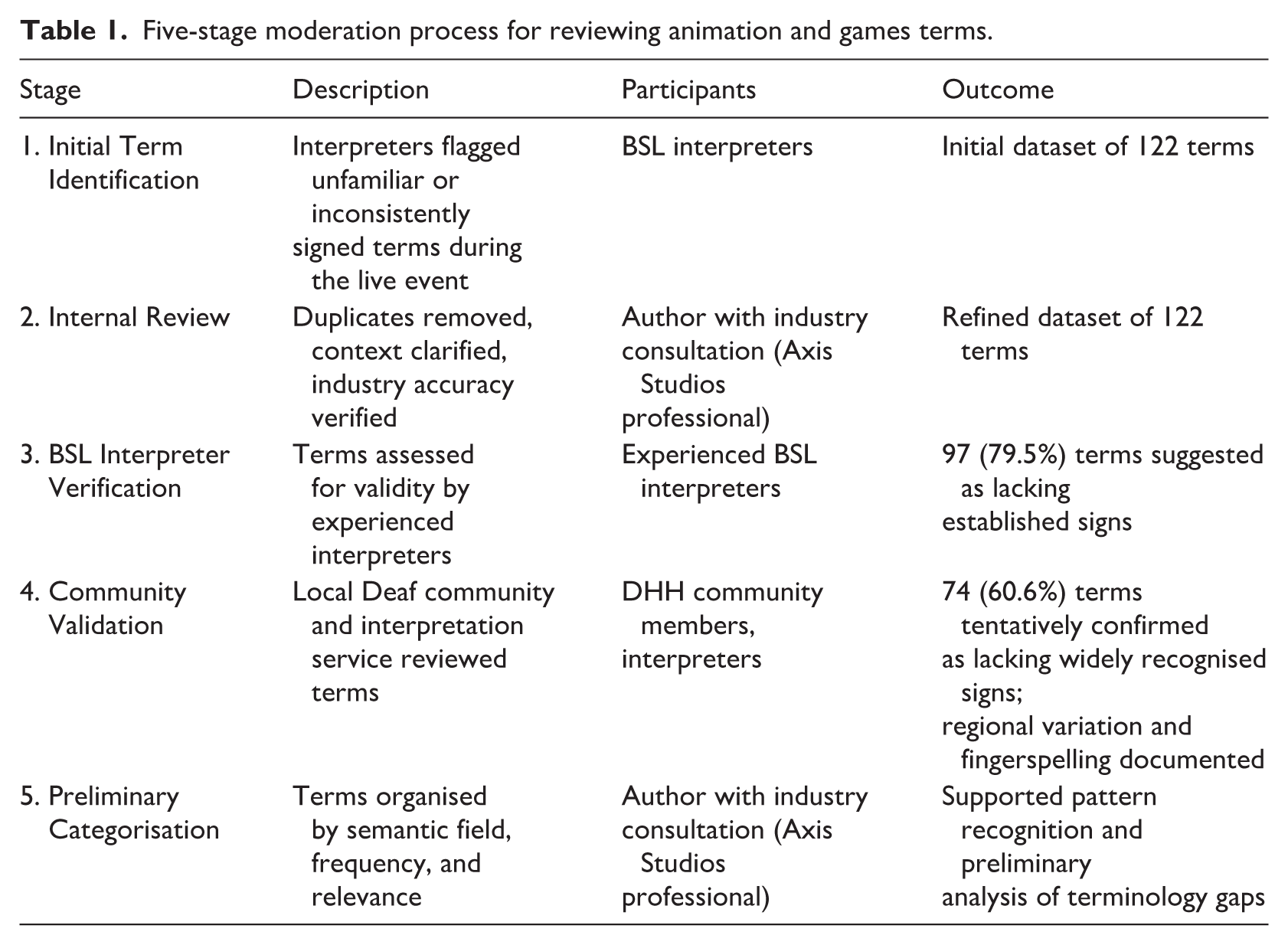
The study integrates empirical data collection, structured moderation and practice-based contextualisation, grounding the findings in observation and community-informed interpretation.
Practice-based case study: New Signs for Animation: AnimSign
The animated short New Signs for Animation: AnimSign (hereafter AnimSign) (dir. Mortimer, 2024, see Figure 1) forms a central artefact of this practice-based case study, situated within a research tradition in which making and critical reflection are inseparable. The film serves as a reflective and communicative tool, depicting the lived experiences of linguistic exclusion for DHH learners navigating specialist animation and games terminology. By highlighting moments of linguistic friction – such as reliance on fingerspelling, extended explanations, or additional effort required to follow specialist language – AnimSign illustrates the challenges DHH students face in both educational and professional contexts.
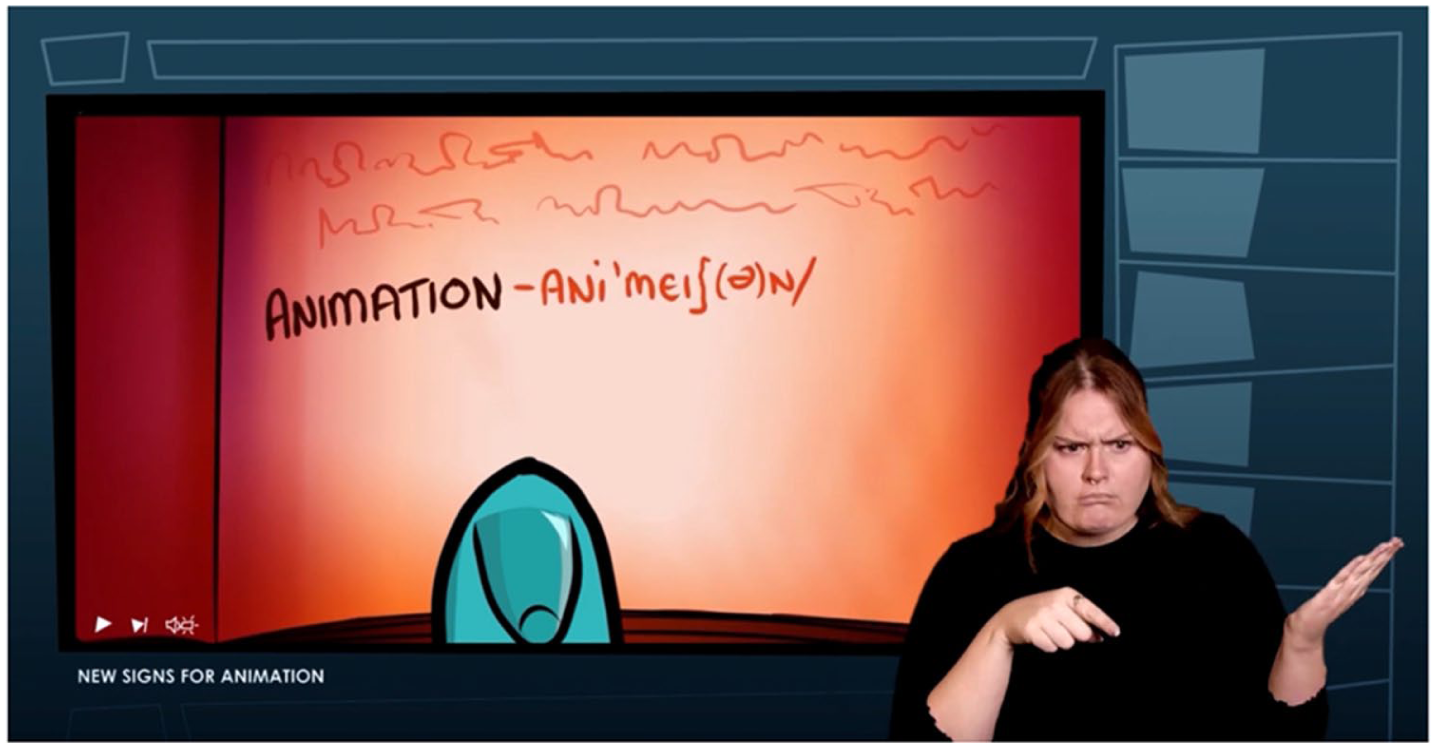
Screenshot from the BSL version of the animated film New Signs for Animation: AnimSign (dir. Jonathan Mortimer, 2024), featuring Amy Murray. © Jonathan Mortimer. Reproduced with permission.
As an animated artefact, AnimSign explores how animation can function as both research method and communicative medium within accessibility-focused practice.
This study responds to preliminary research identifying the absence of a dedicated BSL glossary for animation and games terminology and the resulting barriers to participation in studio-based education, Communities of Practice, and professional identity development within animation training environments. AnimSign is positioned as a practice-informed intervention, developed collaboratively with DHH artists to support linguistic access, inclusive pedagogy, and progression into animation-related professions. The rationale for AnimSign is grounded in Pedagogical Content Knowledge (PCK), which emphasizes that effective teaching requires not only subject expertise but also the ability to make specialist concepts and terminology accessible to learners (Ball et al., 2008; Shulman, 1986). In animation, specialist language is embedded within workflows, tools, and collaborative practices. Without consistent BSL terminology, DHH learners must rely on ad hoc explanations or negotiated meanings, increasing cognitive load and limiting participation. Developing clear, conceptually grounded BSL signs therefore supports learning and the acquisition of professional language used within industry-aligned Communities of Practice.
Building on the Scottish Sensory Centre’s methodology for specialist STEM glossaries, AnimSign adopts a structured, collaborative approach that integrates subject expertise, linguistic knowledge, and Deaf community engagement. Within the constraints of the preliminary research’s timescale and budget, the project proposes a selection of key animation and games terms from curricula and industry resources, which would benefit from further Deaf-led development into new or adapted BSL signs. By experimenting with visual definitions and contextual examples, AnimSign moves beyond word-for-word translation to support conceptual understanding, shared meaning, and the development of professional identity. The author also consulted with the Scottish Sensory Centre regarding the potential development of an animation and games BSL glossary. However, such an initiative would require additional funding beyond the scope of the initial grant provided by Edinburgh Napier University’s Public Engagement Fund.
The study reflects the author’s positionality as a Pracademic, combining over 15 years of animation industry experience with teaching in higher education. This perspective enables the research to address both pedagogical and professional contexts, ensuring that developed signs are relevant for education while aligned with industry practice. AnimSign is not intended to produce a fixed lexicon but to establish a replicable, Deaf-led framework for developing specialist BSL terminology within animation and related creative disciplines. This contributes to broader discussions of accessibility, inclusion, and participation in animation and games education.
Development, accessibility, and representation
AnimSign was developed within a practice-based research framework, using animation practice and visual storytelling to illustrate communication challenges. Rather than introducing new BSL signs, the film highlights moments where specialist terminology is potentially missing or inconsistent. Scenarios were informed by prior engagement with Deaf audiences, interpreters, and inclusive production practices – including the earlier short film New Signs for Animation (dir. Mortimer, 2021) – integrating both relevance and authenticity. Production involved DHH artists contributing to scene development and narrative ideas. Recruitment proved challenging due to terminology gaps and limited awareness of animation as a career path among both hearing and DHH participants. However, the collaboration enhanced inclusivity and provided practical industry experience, albeit requiring additional time for training and iterative feedback. Accessibility and representation were central considerations throughout the design process, with the main character deliberately depicted wearing visible hearing aids (see Figure 2) to reinforce DHH identity.
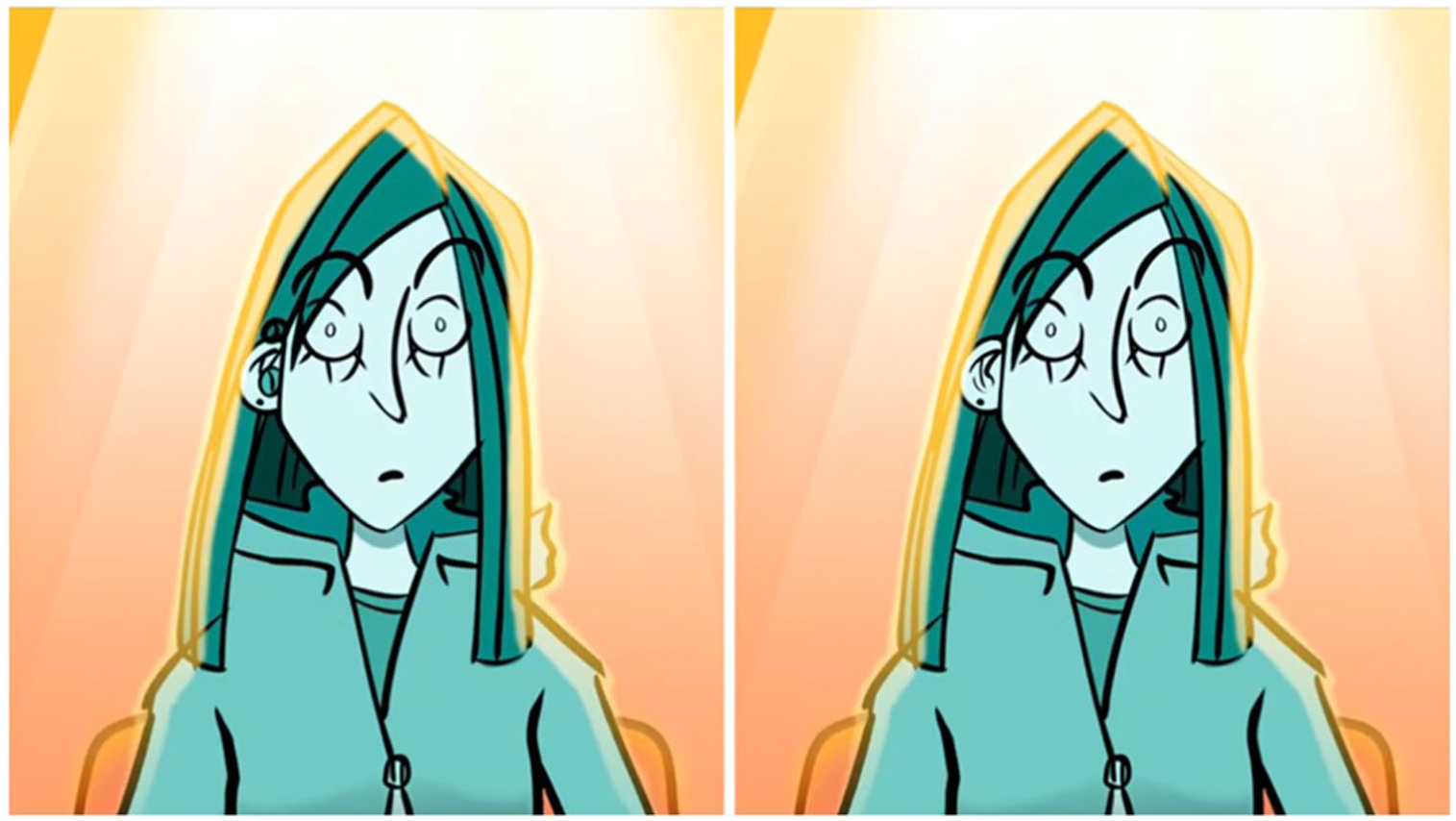
Screenshot from the animated film New Signs for Animation: AnimSign (dir. Jonathan Mortimer, 2024), showing the main character with (left) and without (right) a hearing aid visible. © Jonathan Mortimer. Reproduced with permission.
McCloud’s (1993) theory of abstraction, outlined in Understanding Comics, suggests that simplified character designs encourage broader audience identification by allowing viewers to project themselves onto less specific figures. Early design iterations of the DHH character in New Signs for Animation followed this principle, omitting visible hearing aids in an attempt to enhance universal relatability. However, feedback from Paul Smith, a Deaf animator and consultant involved in the project (Smith, 2024), indicated that this level of abstraction risked obscuring Deaf identity. Smith noted that, in the absence of visible markers, “the girl did not look deaf,” and recommended the inclusion of hearing aids to make the character’s identity immediately recognisable: I was commissioned as a consultant by Jonathan Mortimer for the project ‘New Signs for Animation–BSL’ . . . whilst looking through the storyboards, I spotted that the girl did not look deaf. I mentioned this, and suggested if the girl wore hearing aids she would become easily identifiable as a deaf person. (Smith, 2024)
In response, the design was revised to incorporate hearing aids (see Figure 2), prioritising authentic representation and recognisability over universal neutrality.
Beyond identity markers, the visualisation of sound was treated as a key accessibility strategy, enabling both Deaf and hearing audiences to engage with the narrative. Sound effects were visualised using comic-style graphics (see Figure 3), drawing inspiration from El Deafo (2014), in which Cece Bell uses visual sound cues to communicate auditory experiences based on her lived experience of growing up deaf. Together, these design choices foreground the role of visual language in inclusive animation, demonstrating how visual representations of identity and sound can broaden accessibility while enhancing narrative clarity for diverse audiences.
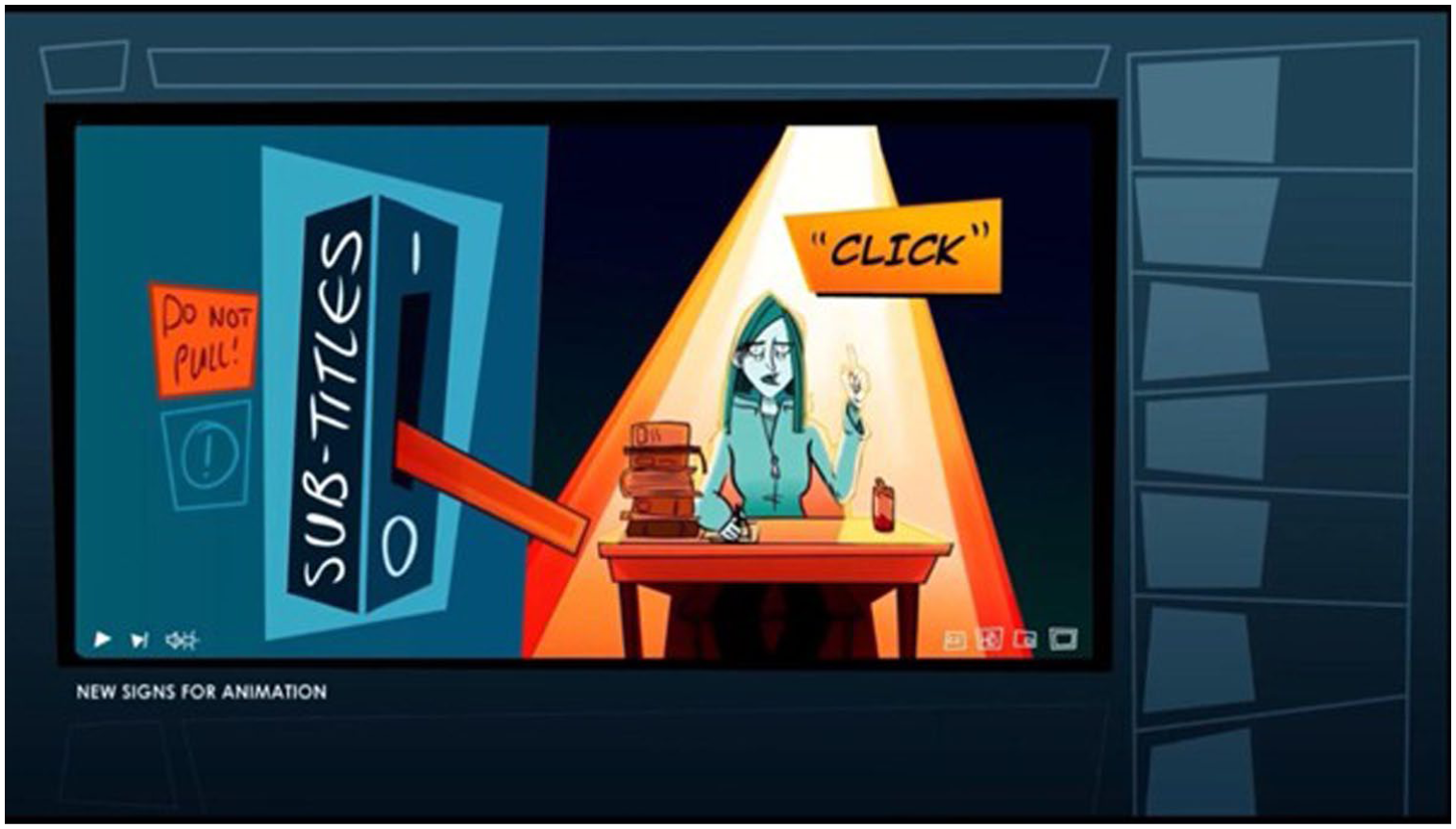
Screenshot from the animated film New Signs for Animation: AnimSign (dir. Jonathan Mortimer, 2024), demonstrating the use of graphic visualisations to represent sound effects. © Jonathan Mortimer. Reproduced with permission.
Signer performance in integrated animation practice
Within animation practice research, the integration of signer performance in AnimSign can be understood alongside established approaches to voiceover and character performance. As dialogue delivery shapes meaning and audience engagement, signer performance introduces expressive qualities that extend beyond translation. For example, a clear difference can be observed between the Genie’s lines in Aladdin (dir. Clements and Musker, 1992) performed by Robin Williams and the same lines delivered by a news presenter. While both may be technically accurate, the distinction lies in performance, timing, and expressive intent. In a similar way, signer performance in animation functions as an embodied form of storytelling, shaping tone, rhythm, and narrative engagement rather than serving as a neutral or purely informational layer.
In AnimSign, this understanding of signer performance as an embodied form of storytelling informed both performance direction and layout design. Animation timing and pacing were deliberately adjusted to ensure synchronous progression of animation and signing. This reciprocal relationship between movement, rhythm, and meaning required the signer to be treated as an integral part of the animated performance rather than a supplementary layer. Consequently, the BSL signer (Amy Murray) was embedded directly within the animation frame rather than placed in an inset box (see Figure 4), supporting visibility while maintaining narrative cohesion for both Deaf and hearing audiences.
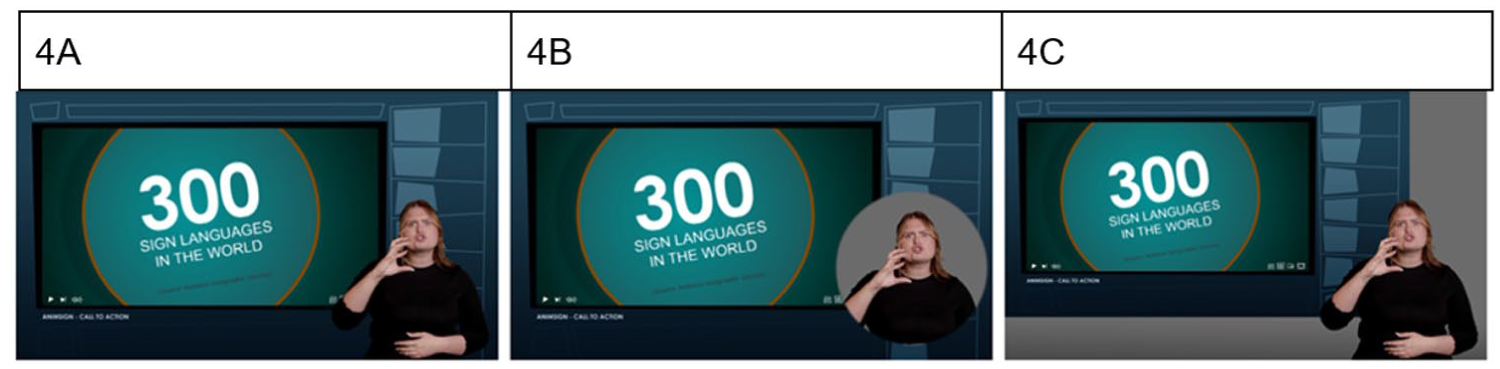
(a–c) Screenshots from the animated film New Signs for Animation: AnimSign (dir. Jonathan Mortimer, 2024), comparing alternative layout concepts for incorporating a BSL signer within the animated frame. © Jonathan Mortimer. Reproduced with permission.
Figure 4(a) illustrates the adopted approach, in which the signer is embedded within the scene composition and treated as a core visual element. This contrasts with conventional accessibility layouts shown in Figures 4(b) and (c). Figure 4(b) demonstrates the commonly used inset frame, or “Prisoner of the Bubble” approach (Schmitt, 2017: 131–134), where the signer is confined to a small, isolated frame separated from the primary narrative. Figure 4(c) shows an alternative strategy in which the main animation is reduced in scale to accommodate the signer, preserving visibility but diminishing compositional integrity of the animation.
AnimSign’s design approach challenges the limitations of the “Prisoner of the Bubble” (Schmitt, 2017: 131–134) model, which isolates sign language in inset frames and positions signing as secondary or an afterthought to the visual narrative, disrupting composition, eye-line, and visual hierarchy (Hamilton and Egbert, 2024; Schmitt, 2017). By embedding the BSL signer directly within the animation frame, AnimSign ensures clear visibility, maintains narrative cohesion, and promotes equitable engagement for both Deaf and hearing audiences. Signing is treated not as an afterthought but as a performative and spatial element integral to the animation.
Signer performance in AnimSign operates similarly to voiceover narration, shaping timing, rhythm, and expressive intent in coordination with visual elements. Emphasising meaning, gesture, and emotion rather than transcription enhances narrative clarity, visual coherence, and audience engagement, with animation and signing carefully aligned to ensure integrated storytelling. The involvement of Deaf actors and professional BSL interpreters was central to authenticity and cultural accuracy, mediating between performers and hearing crew while preserving linguistic and contextual nuances (Sign Solutions, 2021). This collaborative model supports Deaf representation, challenges stereotypes, and provides visible role models within the creative industries (Walker et al., 2022; Withey, 2016, 2023).
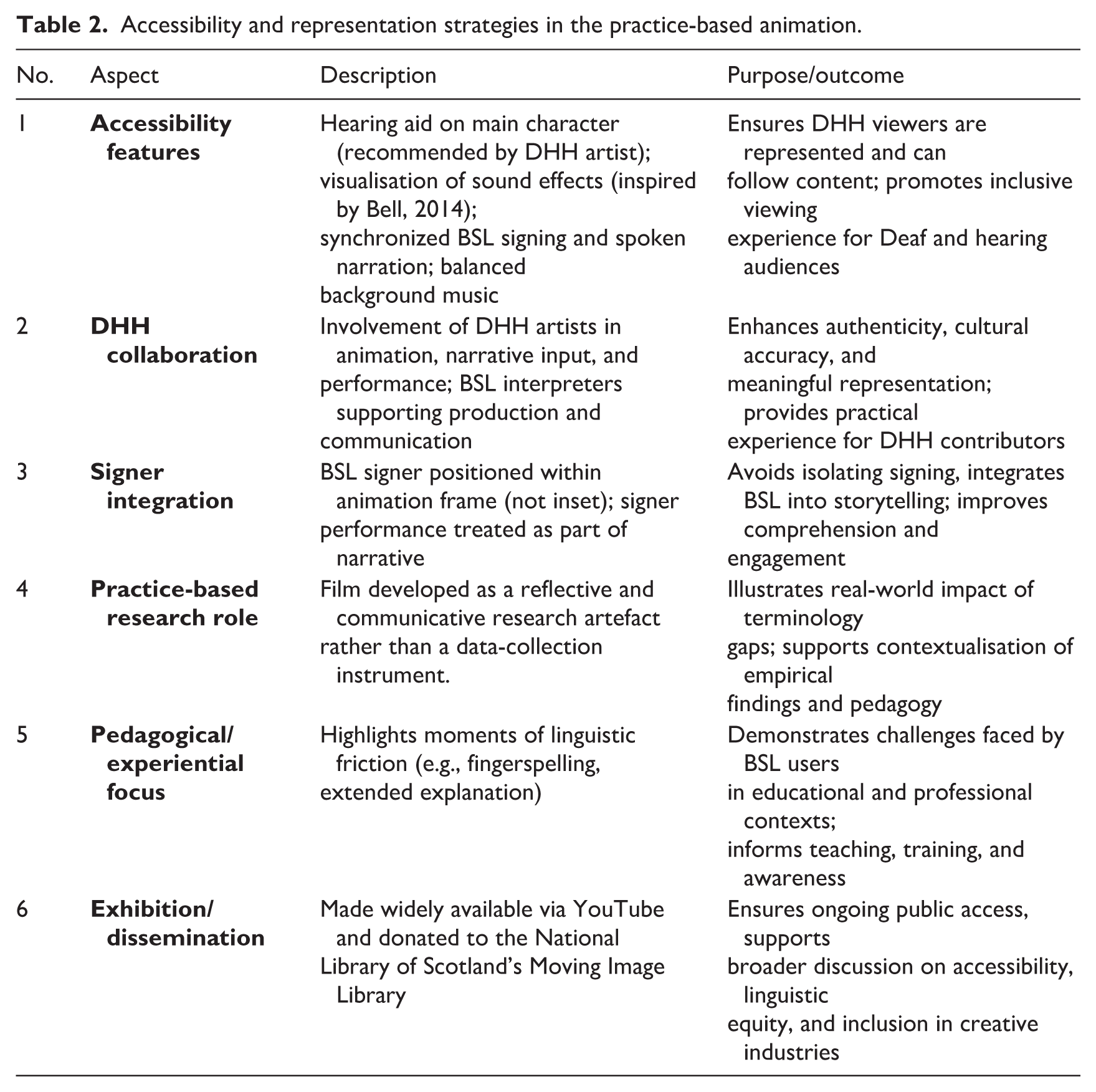
By positioning sign language as a generative element of the narrative, AnimSign demonstrates that accessibility features can be fully integrated into storytelling, advancing both inclusive animation practice and practice-based research. The production also highlighted potential gaps in specialist terminology and functioned as a reflective exploration of broader questions of accessibility and representation. Design decisions: depicting DHH identity through animated characters, integrating the signer within the frame, and visualizing sound illustrate how creative, collaborative practices shape who can access, engage with, and see themselves reflected in animated media. These considerations shaped the film’s approach to representation and reinforced the study’s focus on inclusion, pedagogy, and professional participation within animation and games (see Table 2). The following section examines how accessibility and representation were addressed in the case study and situates these design choices within broader debates on inclusive practice in the creative industries.
Accessibility and representation strategies in the practice-based animation.
New Signs for Animation: AnimSign dissemination and accessibility
New Signs for Animation: AnimSign (dir. Mortimer, 2024) builds on work first developed in 2021, offering a practice-based exploration of inclusive animation design. Both films were made available in multiple signed-language versions (British Sign Language [BSL], American Sign Language [ASL], and Irish Sign Language [ISL]) to support accessibility for a diverse range of DHH audiences. The films were disseminated through educational, professional, and festival contexts, including animation festivals and industry events, fostering dialogue on linguistic access, inclusive pedagogy, and participation within animation and games education.
These screenings provided opportunities for dialogue between Deaf and hearing communities and helped raise awareness of accessibility in animation. A notable presentation occurred at the Creative Talent Network Animation Expo (CTN) (nd), Animation Expo in Burbank, California (2024). For this event, CTN provided an ASL interpreter and English voice-over artists, enabling an adapted version of the film for a US-based audience. This underscores the importance of thoughtful linguistic and contextual adaptation when sharing accessibility-focused work internationally and demonstrates how industry partners can provide practical support for inclusive dissemination.
Beyond live screenings and festival entries, both short films are available on YouTube in BSL, ASL, and ISL versions, and have been donated to the National Library of Scotland’s (NLS, nd) Moving Image Archive, ensuring long-term access for educators, students, and researchers. Through these platforms, the films function as accessible animation resources and catalysts for discussion on inclusion, representation, and accessibility. Design choices – depicting DHH identity through animated characters, embedding the signer within the frame, and visualising sound – demonstrate how creative, collaborative practices can shape who can access, engage with, and see themselves reflected in animated media, contributing to both practice-based research and the ongoing development of inclusive animation practice.
Findings and analysis
This study explored potential gaps in BSL accessibility within animation and games by examining how specialist animation and games terms are encountered and interpreted in professional contexts. The research was informed by collaboration among professional BSL interpreters, native BSL signers, and animation industry experts. Its primary focus was to identify terms that may lack widely recognised BSL signs, rather than to propose new terminology.
Data were collected during a live interpreted animation-focused event, where professional BSL interpreters noted terms they found unfamiliar, inconsistently signed, or potentially lacking established BSL signs. An animation professional from Axis Studios (a UK-based animation and VFX studio, credited for Love, Death & Robots) supported the review of submitted terms to ensure industry relevance and accuracy.
In total, 122 terms were submitted and examined using a five-stage moderation process (see Methodology section), which incorporated ethical safeguards including informed consent, confidentiality, and institutional ethics approval. Further details on the moderation process are available through the New Signs for Animation project documentation.
The outreach strategy – which invited BSL interpreters to identify animation and games terms in advance of the event – proved effective in identifying animation and games terms. Rather than producing a small number of examples, the process generated a substantial dataset of 122 terms. The terms reflected the event programme and varied according to speakers and topics, with interpreters recording terminology as it arose across sessions. Presentations included both small independent studios and internationally recognised production companies, capturing a broad range of contemporary industry vocabulary. An animation professional from Axis Studios reviewed the submitted terms for accuracy and relevance as part of stage 2.
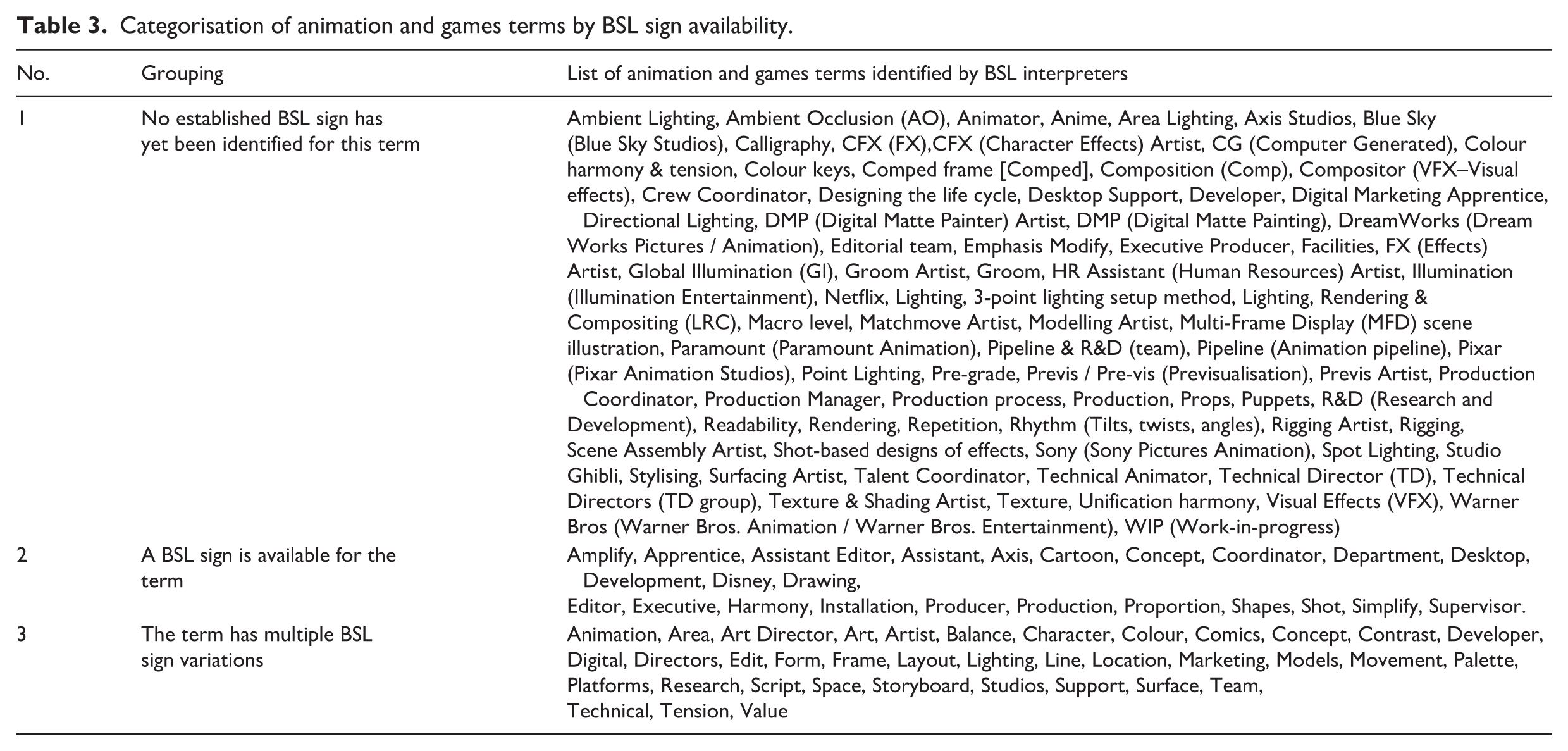
Following submission, the 122 animation and games terms were reviewed through the moderation process. This included comparison with existing entries in the BSL Sign Language Dictionary (SignBSL) and consultation with Deaf community members at stage 4. Through this process, the initial list was refined to 74 terms that were tentatively identified as lacking a distinct or widely recognised BSL sign. These terms were subsequently grouped into three categories, as outlined in Table 2.
The moderation process was designed to ensure that only terms genuinely lacking suitable BSL signs were identified, avoiding unnecessary duplication and recognising that existing signs may sometimes be appropriate but unfamiliar to individual interpreters. Findings also highlighted that, while SignBSL provides an extensive resource, some entries do not fully align with the specific meanings or professional uses of animation and games terms. In some cases, definitions were ambiguous or incomplete, potentially leading to inconsistency or confusion in interpretation. These findings provide a preliminary evidence base to support future Deaf-led sign development and consultation, rather than a comprehensive glossary.
Stage 3 of the moderation process indicated that 79.5 percent of the 122 terms lacked a clear corresponding BSL sign, while 20.5 percent either partially matched or aligned with an existing sign. Stage 4 consultation with a second moderator and Deaf community members broadly supported these findings, showing that 60.6 percent of terms lacked established signs, with 39.4 percent displaying partial or contextual alignment. Differences between stages reflect factors such as regional variation (e.g., Scottish vs. English BSL), reliance on fingerspelling, and use of informal or “home signs” within small groups. These variations suggest that the absence of a widely recognised sign does not necessarily indicate a complete absence of signed representation but rather a lack of shared consensus across communities and contexts.
The moderation process (see Table 1) was used to review animation and games terms identified by BSL interpreters, indicating how terms were progressively assessed for industry relevance, existing BSL representation, and community recognition. The process was designed to distinguish between unfamiliarity, partial alignment, and the absence of widely recognised BSL signs, rather than to propose new signs. Overall, the moderation process suggests that over 60 percent of the identified animation and games terms may lack widely recognised BSL signs. The involvement of multiple moderators strengthens the reliability of this assessment while reinforcing the need for caution in interpretation. The variation observed across moderation stages points to inconsistencies in both the availability of signs and awareness of existing resources.
Categorisation of reviewed animation and games terms based on the availability and consistency of BSL signs, following the moderation process. Terms are grouped according to whether no established sign was identified, an established sign was identified, or multiple sign variants were observed across regions or contexts.
Table 3 summarises the reviewed terms across three categories: terms with no identified BSL sign, terms with an established sign, and terms with multiple sign variations. This categorisation provides a tentative overview of the availability of BSL signs in relation to animation and games and helps identify areas where further investigation, refinement, or community-led development may be beneficial. Rather than presenting a definitive account, the findings provide an initial evidence base to support future Deaf-led consultation and the careful exploration of how animation and games terminology can be more consistently represented in BSL.
Categorisation of animation and games terms by BSL sign availability.
While the longer-term goal is to collaborate with the Deaf community to develop a digital, video-based BSL glossary, this article focuses on preliminary work to establish feasibility, scope, stakeholders, and methodological approaches for future community-led sign development. Future research should include Deaf-led workshops, focus groups, and collaborative sign creation to ensure proposed BSL terminology for animation and games is culturally appropriate, linguistically robust, and widely accepted. These findings provide an initial evidence-based foundation for the ongoing development of shared BSL vocabulary in the creative industries.
Table 3 reveals patterns in the availability and consistency of BSL signs for animation and games terminology. Highly technical, role-specific, and studio-focused terms – such as CFX Artist and Previs – largely lack established signs, requiring interpreters and learners to rely on fingerspelling, paraphrase, or improvised solutions, which may risk miscommunication or confusion. More general or frequently used terms, such as Cartoon, Concept, Drawing, and Production, tend to have consistent BSL representation. Several widely used terms, including Animation, Artist, and Storyboard, display multiple sign variants, reflecting regional differences, evolving usage, or interpreter familiarity.
These patterns reinforce the findings from the moderation process, illustrating potential gaps in terminology knowledge, inconsistent representation, and the need for structured, Deaf-led development of specialist BSL vocabulary to support clarity, consistency, and participation in both professional and educational contexts.
Comparison of Table 3 with the Axis Studios (2024) Education Outreach Booklet reveals a mismatch between industry-specific terminology and established BSL representation. Many specialised pipeline and professional role terms – such as Animator, Rigging Artist, CFX Artist, Groom Artist, Modelling Artist, Technical Director, Previsualisation, LRC (Lighting, Rendering & Compositing), Pipeline, and support roles like Digital Marketing Apprentice and Talent Coordinator – lack widely recognised BSL signs.
In contrast, more general terms, including Assistant, Editor, Coordinator, Producer, and Production, are consistently represented in BSL, reflecting their common usage and less specialised meaning. Foundational curriculum concepts, such as Animation, Artist, Character, Storyboard, Layout, and Lighting, often show multiple sign variants, highlighting regional and contextual inconsistencies. This pattern indicates that the most significant gaps in signed representation occur for specialised technical vocabulary and professional role descriptors –terms essential for learners engaging with both educational curricula and industry workflows. These findings emphasise the urgent need for a structured, Deaf-led BSL glossary that prioritises high-frequency, industry-critical terms to support linguistic access, facilitate professional identity development, and ensure equitable participation in animation and games education.
Inclusive animation and narrative form
The findings suggest that terminology challenges may create barriers for Deaf learners, interpreters, and educators. Where signs are inconsistent, unfamiliar, or absent, interpreters may face constraints in delivering fluid communication, while educators encounter difficulties conveying specialist concepts. These observations highlight the potential value of structured linguistic resources – such as hierarchically organised BSL glossaries – in supporting terminology access within rapidly evolving creative domains (Scottish Sensory Centre [SSC], 2026). Building on these observations, a more systematic approach to terminology development in animation and games warrants consideration. The methodology developed by the Scottish Sensory Centre for STEM subjects provides a useful model that could be adapted for creative domains. A Deaf-led specialist team comprising animators, game developers, educators, BSL linguists, and industry professionals could combine linguistic and domain expertise.
Key terminology could be drawn from educational curricula, industry documentation, and professional glossaries, followed by an audit of existing signs to identify gaps. Where necessary, new signs could be developed using principles of the BSL productive lexicon and refined through consultation with the Deaf community. Each term could include a BSL-based definition and contextual example, potentially supported by visual sequences reflecting professional contexts of use. Alignment with educational pathways and industry standards may further support learner progression and workplace communication. Pilot testing with students and early-career professionals could help refine such resources prior to wider dissemination. Funding opportunities may exist through governmental and sector-specific organisations, including the Scottish Government, the British Film Institute, ScreenSkills, Animation UK, the UK Games Fund, and Ukie (UK Interactive Entertainment). Taken together, this approach offers a Deaf-led framework for strengthening linguistic resources, improving accessibility, and supporting professional identity development within the creative industries.
The Scottish animation sector provides a useful lens through which to consider the scalability of initiatives such as AnimSign. While a broader UK-wide approach may support collaboration and resource development, regional variation in BSL remains an important consideration. Regardless of scale, Deaf-led research remains essential to ensure linguistic and cultural validity.
The future development of a BSL glossary for animation and games addresses only one aspect of a broader challenge – how DHH professionals communicate with hearing colleagues in workplace contexts. As Smith (2024: 7) notes: ‘Deaf workers have been requesting communication on the job that is comprehensive and on-going since the 1800’s, but have been powerless.’
Although multiple communication methods exist, workplace interactions often rely on demonstrations, written messages, and lipreading, each with its own limitations. Evidence from Tektronix (an electronics manufacturing company) shows that training hearing employees in sign language and providing interpreting support can significantly improve communication, reduce isolation, and foster a more inclusive workplace for Deaf staff (Smith, 2024).
As a practice-based project, AnimSign integrates accessibility, creative production, and research practice. The project illustrates how creative artefacts can function analytically, revealing linguistic challenges, terminology gaps, and accessibility considerations. Embedding sign language within animated narratives reinforces the importance of linguistic resources, community collaboration, and domain-specific vocabulary development in supporting inclusive participation. Ultimately, AnimSign offers a model for integrating accessibility, pedagogy, and creative practice within animation production and research, highlighting how meaningful inclusion of sign language can enhance storytelling while underscoring the need for sustained Deaf-led research and cross-sector collaboration.
This study is exploratory and preliminary, and several limitations should therefore be considered. It was designed to identify patterns and inform methodology rather than provide definitive or generalisable conclusions about BSL terminology in animation and games. The dataset comprises 122 animation and games terms collected from a single interpreted industry event, offering a useful snapshot of professional vocabulary rather than a comprehensive lexicon. Findings may not generalise across regions, educational contexts, industry sub-sectors, or international settings. Identification of terminology gaps relied partly on interpreter self-report. Terms flagged as unfamiliar or inconsistently signed may reflect individual experience, regional variation, or limited exposure rather than the absence of established signs. Multi-stage moderation and Deaf community consultation helped reduce this risk, though results remain indicative. Context also shapes the applicability of findings. Data were drawn from specific professional and educational environments, and experiences of Deaf and DHH users may differ across settings. Variation in BSL usage, including regional and home signs, further limits claims of universality. Practice-based outputs, such as the animated short New Signs for Animation: AnimSign (2024), provide insight into lived experience and accessibility challenges but should be understood as illustrative rather than empirical evidence of linguistic gaps.
Finally, practical constraints limited the study. Recruiting DHH contributors with industry experience was challenging, the study was conducted by a single researcher, and cross-linguistic comparisons were beyond scope. The primary audience for any future glossary remains under development. Overall, these limitations mean the findings should be viewed as indicative rather than definitive, providing a preliminary evidence base and methodological framework to guide future Deaf-led research, consultation, and validation processes.
Conclusion and avenues of future research
The animation and games industries are fast-moving, with evolving tools, workflows, and concepts continually shaping professional and educational practice. Preliminary evidence from this study indicates that BSL terminology in these fields remains underdeveloped. Of the 122 animation and games terms documented at a single interpreted event, around 60 percent were initially identified as lacking widely recognised or consistent BSL signs. Extended consultation with BSL interpreters, Deaf community members, and animation professionals over two months indicated that some terms could be clarified or refined, while also confirming the specialised nature of this vocabulary. These findings should therefore be understood as indicative rather than comprehensive.
The gaps observed span both technical and conceptual terminology. For BSL users, this may require a reliance on fingerspelling, paraphrasing, or improvised signs, which may increase cognitive effort and limit participation in educational and professional contexts. Interpreters and educators also face challenges when supporting communication in the absence of shared domain-specific signs. These patterns reinforce the importance of linguistic access as a central component of inclusive participation rather than an optional accommodation.
Practice-based outputs, particularly the animated short New Signs for Animation: AnimSign (dir. Mortimer, 2024), complements the empirical observations by providing a reflective and communicative tool. The film illustrates how BSL users encounter gaps in specialist terminology, highlighting moments of communication negotiation, improvisation, and cognitive load. By featuring the signer directly in the animation, the work promotes visibility, comprehension, and authentic representation, offering an accessible means for both Deaf and hearing audiences to engage with these issues. While not primary empirical data, practice-based artefacts can illuminate experiences that may not always emerge through interpreted events alone.
Scotland’s supportive legislative and educational context, including the BSL (Scotland) Act 2015, presents an opportunity to develop structured community-led approaches to improving terminology. Existing initiatives such as Raise the Game (nd) and ACCESS:VFX (nd) have made valuable progress in accessibility; however, the absence of a dedicated animation and games BSL glossary remains a barrier to educational inclusion, professional development, and broader DHH engagement.
Future work should prioritise Deaf-led development of a BSL glossary for animation and games through collaboration with industry and education partners, including:
Community-Led Validation and Development: Collaborative engagement with BSL users, interpreters, educators, and industry professionals to identify terminology gaps, prioritise concepts, and iteratively refine proposed signs.
Dataset Expansion: Collecting terms across multiple events, institutions, and regions to capture a broader and more representative sample of terminology.
Structured Taxonomy Development: Linking general animation principles (e.g., timing, squash and stretch, anticipation) with medium-specific workflows and tools to enhance glossary clarity.
Practice-Based Dissemination: Using animation, comics, and visual media to communicate findings, support bilingual–bicultural learning, and raise awareness of linguistic accessibility.
Educational and Professional Integration: Explore how community-approved terminology could be embedded into curricula, interpreter training, and professional workflows.
Cross-Linguistic Exploration: Explore existing signs in other sign languages, such as American Sign Language (ASL), to inform potential adaptation and international collaboration.
By foregrounding Deaf expertise, lived experience, and community authority, this exploratory study proposes a preliminary framework to inform future research and resource development. The findings indicate both the scale of the challenge and the potential advantages of collaborative, iterative approaches. Advancing this work will require sustained engagement with the Deaf community, careful empirical investigation, and complementary practice-based methods to support the development of robust, culturally appropriate, and widely accepted BSL terminology for animation and games.
Footnotes
Acknowledgements
Not applicable.

Ethical considerations
This study was approved by the Ethics Committee of Edinburgh Napier University (Application ID - 3221630).
Informed consent statements
Informed consent was obtained from all individual participants included in the study.
Funding
This research was supported by Edinburgh Napier University’s Public Engagement fund, awarded to Jonathan Mortimer.
Declaration of conflicting interests
The author declared no potential conflicts of interest with respect to the research, authorship, and publication of this article.
Data availability statement
All data generated or analysed during this study are included in this published article and its supplementary information files.
Other identifying information
Not applicable.