






Abstract
In 1976, the critic Roland Barthes wrote a manuscript in appreciation of the artist Saul Steinberg, ultimately published in 1983 as All Except You. In this article, the author argues that this little-known volume demonstrates the utility of Barthes for the study of animation. With a focus on pre-cinematic media, including panoramas and optical toys, the author emphasizes Barthes’ reflections on animation, metamorphosis, and perspective. Reliant upon archival materials accessible only at the Beinecke Library and the Bibliothèque nationale de France, and including new translations of passages from All Except You, it is further proposed that a single missing typographical mark helps us to better understand Barthes’ animatic understanding of Steinberg.
Keywords
Le monde de Steinberg
Ideas
How can an image alone give one ideas? Yet Steinberg’s images do. Or rather—even more precious—they give one a craving for ideas. (Barthes, 1983: 16)
In 1976, the critic Roland Barthes wrote a manuscript in appreciation of the artist Saul Steinberg titled All Except You. A keenly observed celebration of Steinberg’s drawing line and the paradoxes he produced with it, the text might seem an unlikely source for scholars of animation. Although Steinberg’s work crossed media forms, from drawing to painting to sculpture and beyond, he had comparatively little overlap with animation. Barthes, meanwhile, was famously ambivalent about the cinema in general and had a distaste for animation in particular, naming le dessin animé expressly, next to harpsichords and Renaissance dance, in a list he entitled, “Je n’aime pas” (Barthes, 1975a: 120).
This has not prevented animation scholars from using Barthes’ ideas in their analyses of animation. Many of Barthes’ major concepts—those that have had exported success in a variety of disciplines, from art history to comparative literature—have also been considerations in the study of animation. Whether it is the punctum and the semblance of life on screen in a Disney film (Jenkins, 2013), the vitality of a single line as an energon in the works of Len Lye (Johnston, 2014), or as a foil to his “ça-a-été” (“that-has-been”) in a Ken Jacobs film (Skoller, 2013), Barthes’ ideas have inspired new insights here just as they have elsewhere.
The sentiment these scholars of animation collectively intuit may be somewhat paradoxical, given Barthes’ nominal reputation as an author preoccupied with lamentation (Mourning Diary, 2009), elegy (Camera Lucida, 1981), and the funereal (“Death of the Author,” Barthes, 1977a). That is to say, the Barthesian readings of animation cited above share a focus on liveness, energy, and movement. It is a semiotic reversal Barthes might have appreciated.
In this article, I make the case that, as rich as Barthes’ concepts drawn from his study of (for instance) photography may be in their application to animation, in his study of Steinberg we find another vital toolkit of concepts that can be of use for animation studies, some familiar (metamorphosis, paradox), others less so (autonomy, impertinence). It is Steinberg’s animatic preoccupations that prompt these pertinent reflections, as I shall show. To do so, I use my own translations of Barthes’ All Except You, in addition to research in the archives of the Steinberg papers at the Beinecke Library at Yale University and the Barthes papers at the Bibliothèque nationale de France. 1 Cumulatively, I argue that these concepts from All Except You have direct pertinence to the study of film, animation, and optical toys, and provide a rare window into how Barthes thought about these media—and moreover, how he thought about Steinberg’s work: ultimately, as a kind of paper optical toy, an instrument that allows for a different and oblique way of looking at the world.
*
Barthes wrote the manuscript for All Except You in 1976, when both he and Steinberg were at the heights of their careers. The French critic was almost 20 years beyond the publication of his groundbreaking Mythologies (Barthes, 1957) and had recently published his autobiographical rumination Roland Barthes par Roland Barthes (1975a). The Romanian–American artist, meanwhile, was soon to have a retrospective exhibition that would travel from the Whitney to the Hirshhorn and beyond, and his work was routinely within and on the covers of The New Yorker (on this magazine work, see Smith, 2005; for the definitive overview of Steinberg’s life and art, see Schwartz, 2017). Barthes and Steinberg were in direct communication. In one letter held by the Beinecke Library at Yale University, Barthes offers Steinberg “un merci, un très grand merci pour l’album” (Barthes, 1978). Which of Steinberg’s six albums to date—or perhaps more accurately, compilations—he is referring to is unclear; however, the Barthes papers at the Bibliothèque nationale de France indicate that, as he wrote his Steinberg manuscript, Barthes relied largely on The Passport (1954), Dessins (1956), and The Inspector (1973), this last book being the most recent collection of Steinberg’s art.
Included in the final, published version of Barthes’ text were a series of drawings provided by Steinberg in 1982, six years after Barthes completed his manuscript. Steinberg was famously dilatory with publications and exhibitions, and he periodically complained about the collaboration: “And Barthes—what a headache” (Steinberg, 1976). As he noted to his friend, the author and screenwriter Aldo Buzzi: “the book includes a few drawings that I made specially in order to make it seem less like a monograph and more like a rare book, special VIP edition, French stuff” (Steinberg, 1982). But Barthes did not refer to these drawings, nor are they keyed to the entries in the manuscript. Barthes’ papers reveal that what he did refer to, beyond the compilations mentioned above, included Steinberg’s work published by the Parisian Galerie Maeght, including Le Masque (1966). Maeght would (under the imprint “Repères Éditions d’Art”) in 1983 finally publish Barthes’ Steinberg text in French with the English title All Except You. Steinberg was a favorite of the Galerie Maeght. They mounted exhibitions of his work beginning first in 1953, with five subsequent shows in the 1960s and 70s (Maeght and Maeght, 2007: 268). In their storied curation, Steinberg found himself amongst a who’s who of 20th-century artists—Braque, Giacometti, Miró (Prat, 1993). Barthes’ text on Steinberg coincided with another Steinberg exhibition at Maeght, this one a retrospective—or “une introspective,” as Le Monde called it at the time, referring to Steinberg’s wry and unique approach to the world (Michel, 1977). 2 (A full English translation of All Except You was published in 2023, sans the accompanying Steinberg drawings; see Barthes, 2023).
In this period, Barthes had a keen interest in American art. Jackson Pollock was a favorite (Barthes, 1975a: 120). He wrote a long appreciation of Cy Twombly, something of a study in contrasts with his Steinberg work: Twombly’s line he considered gauche; Steinberg’s, confident and masterly (Sylvester, 2004). Other well-known writers had put a hand to appreciations of Steinberg (including Italo Calvino, 1977) and still more would in the years to come (including Eugene Ionesco, 1980). But Barthes—and Steinberg in particular—seemed to share a simpatico vision of the world. Susan Sontag (1982: 122) wrote of Barthes as someone who has an “aphorist’s ability to conjure up a vivacious duality: anything could be split either into itself and its opposite”; this might apply equally to Steinberg, who indeed provided the cover art for the issue of The New Yorker in which she wrote these words. Sontag was echoed, years later, by Art Spiegelman, who assessed Steinberg as a “graphic aphorist” (Spiegelman and Mouly, 2018: np).
In Steinberg, Barthes found a fellow structuralist traveler, someone he felt he recognized. Steinberg’s art, for Barthes (1983), captured “a subtle but striking figure, one who seems drawn directly from my life” (p.7). Barthes was, as some have noted, at this stage of his career in an autobiographical phase (Watts, 2016: ix). Steinberg’s idiolect, he wrote, “is also my own” (Barthes, 1983: 7). Yet Steinberg was an elusive companion. In All Except You’s 50 themed entries, most about a paragraph in length, Barthes tries to get to the bottom of Steinberg, to “catch” him, considering elements of his artwork including anamorphosis, metaphor and metonymy, transgression, collecting, and, self-reflexively, the theme of “themes.” 3 Although Barthes spared no praise along the way (“the work is intelligent, precise, droll, amusing, varied, unyielding, ironic, tender, elegant, critical, handsome, attentive, open, piercing, inventive, refined, enchanting” [Barthes, 1983: 70]), he ultimately felt that his hunt for the essence of Steinberg was in vain, as one of his final entries in the book reveals.
Readings
The general idea that I have of Steinberg, then, is as follows: he is, to the letter, inexhaustible. I can roll out analyses, enumerate the attributes, try to apprehend the essence of his art, but I cannot capture it. Steinberg is always ahead of me. Far ahead? No, and that is his charm: his work is very clear, and so very close, and sometimes I have the feeling that my reading of it is never complete, there is no terminus. With a final paradox, Steinberg establishes a relationship that is at once illogical and undeniable: I doggedly approach the work (where there are many pleasures), but I never catch it (he is, in a word, an artist): I am Achilles, who cannot catch the tortoise; I am Zeno of Alea’s arrow “that flies and does not fly,” approaching its target by irreducible distances, fragmented ad infinitum. In sum, the work is a mirage, toward which, from reading to reading, I incrementally approach, but the truth of its deception is always deferred. Isn’t that the definition of reading, when philologists don’t meddle? I know now what Steinberg’s work is for me: a text. (Barthes, 1983: 70).
Much of the writing on Steinberg in the years before and since Barthes has focused on his unique union of writing and drawing. (Steinberg famously referred to himself as “a writer who draws” [Long, 2005: 198]). Certainly, Barthes also addresses this feature of the work, on the “marriage between text and image”; however, it is marginal in All Except You compared to his focus on other recurrent ideas, on less well-trod Steinbergian terrain (Barthes, 1983: 25). Part of Barthes’ interest in Steinberg was due to the latter’s capacity to panoramically capture the modern world and its follies; to have a caricaturist’s keen eye on an enormous breadth of subjects. (“Contemporaneity,” Steinberg once said, “is a complicity” with the reader [Vanden Heuvel, 1965: 59].) Those topics that Steinberg did not capture directly, notes Barthes, are captured by implication, in his use of et cetera; Steinberg’s paradoxical images suggest a complete, autarkic world in miniature. “In Nature, says Valéry, there is no et cetera: Nature says it all”; that may be, but Barthes continues: “Steinberg’s world is not Nature (not by a long shot!); it is full of ‘etc.’” (Barthes, 1983: 38).
“Le monde de Steinberg”—Steinberg’s world—would be a likely candidate for an alternate title to All Except You. Barthes uses the exact formulation twice in the text and refers to the concept on many more occasions. Steinberg’s world, per Barthes, is all-encompassing; “Steinberg catalogs the world—the objects of the world—as though he were an encyclopedist” (p.66). Yet within this catalog, Barthes returns again and again to certain media—namely, animation, cinema, and optical toys—and to certain concepts—the above-mentioned autonomy, impertinence, metamorphosis, and paradox.
Animatic, panoramic, metamorphic
Chaplin
A popular and refined artist (popularized by the “cartoons” that give access to a general public, and refined by the subtle mise en scène of a whole culture), that is what is needed today. For this difficult equation also frees the modern artist from two opposing hells: vulgarity and esotericism. To assume without constraint the freedom and peculiarity of my own view, and yet to communicate with all the world; to speak my own language (the one I made myself) and at the same time, speak the language of others; to please, without obsequiously pleasing. We could call this artist “democratic,” and hear in this word how such a position is threatened today: by the gregariousness that constrains, grasps, and stifles, or by the solitude that comes with great innovation. How many artists today escape this double danger? The past model of this success was of course Charlie Chaplin. (Barthes, 1983: 13)
For Barthes, Steinberg was a Chaplinesque figure. This entry (originally titled with the affectionate French pet name for Chaplin, “Charlot”) from All Except You does not refer to any specific artworks of Steinberg’s (whereas most entries do, quite expressly); rather, it is clearly describing Steinberg by implication. He, like Chaplin, straddled the “popular” and the “refined,” at once providing work for a host of popular American magazines of the midcentury, well beyond the New Yorker, while also maintaining a modernist pedigree, as his gallery exhibitions and literary acquaintances demonstrate. Chaplin, Barthes wrote elsewhere, split the difference between the “opposition in which we are imprisoned: mass culture or high culture” (Barthes, 1975a: 54). Per Barthes, this—this quality of “vernacular modernism,” as Mirian Hansen (1999) memorably called it—was the triumph of the Steinberg–Chaplin strategy.
Steinberg was clearly not unaware of these oppositions. It is worth emphasizing the great influence on cinema and animation that he had, “conceptually, indirectly, but profoundly,” as the animator George Griffin (2007a: 178) characterized it—as can be seen in great evidence in the design of mid-century United Productions of America (UPA) animation, in particular. Steinberg was widely credited as a key inspiration by artists at this studio, which had spun off from Disney initially as an industrial/advertisement producer, before achieving wider commercial success. Indeed, in one instance, Steinberg provided the initial drawings which would be animated by UPA. For the Jell-O commercial Busy Day (1953), UPA animators visited Steinberg to source the art (Figure 1). One of these animators was Gene Deitch, who began his career at UPA before leading Terrytoons (Deitch, 2008). He later remembered Steinberg as “the original graphic influence on UPA character design” (Deitch, 2011). This can be seen clearly in major UPA productions. Some have proposed that UPA’s most lauded film, Gerald McBoing-Boing (1950), shows the influence of Steinberg, but it can be seen more clearly in the animator John Hubley’s Brotherhood of Man (1945), in which the lead character shares a version of the chinless profile found on many of Steinberg’s male figures of the period. For this film, the animators cited Steinberg directly as their inspiration (Abraham, 2012: 65).
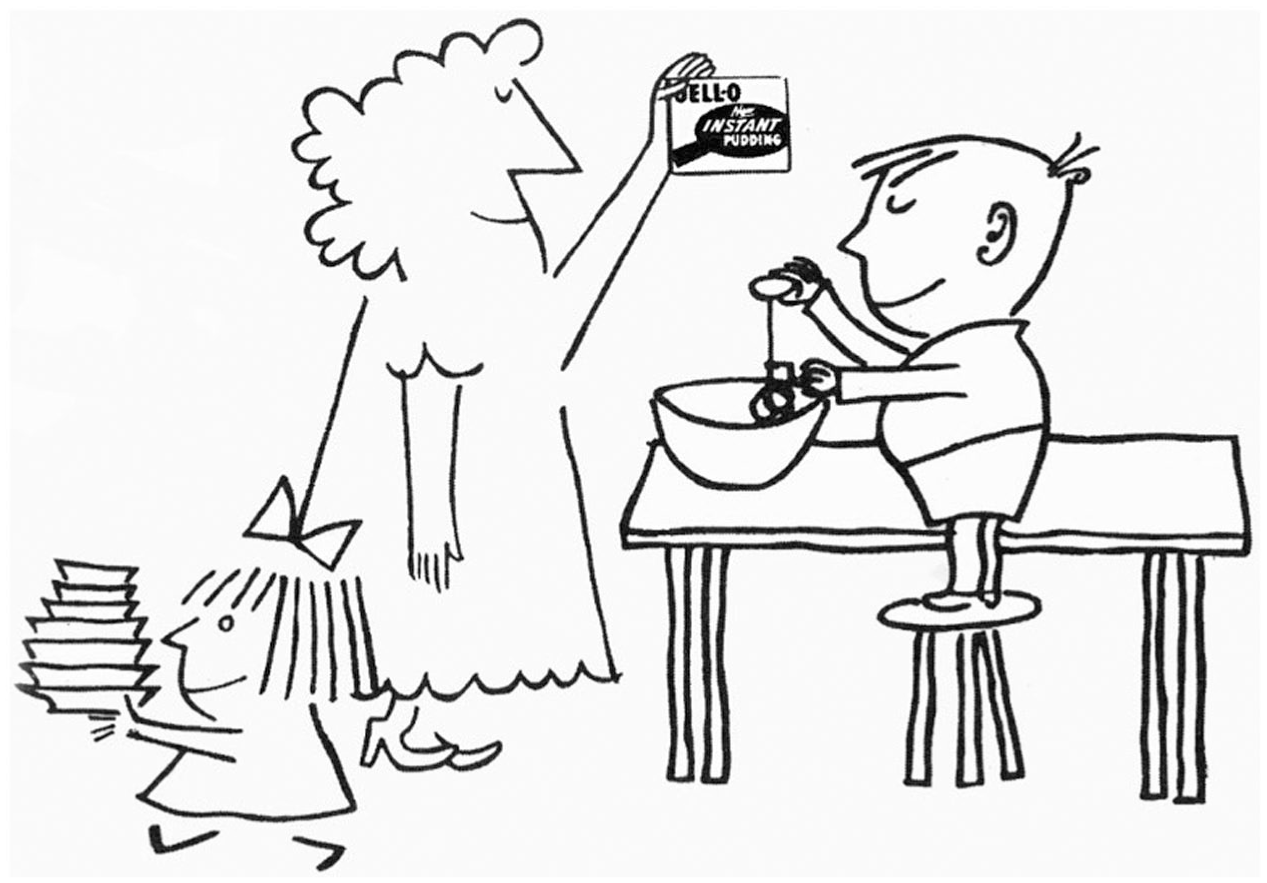
Frame from Busy Day (1953), commercial by Gene Deitch, commissioned by Young & Rubicam. Based on drawings provided by Saul Steinberg. © The Saul Steinberg Foundation/Artists Rights Society (ARS), New York. Reproduced with permission.
Beyond UPA studios, animators working more generally in the midcentury UPA-style also credited Steinberg. Leonard Glasser, a longstanding commercial animator who worked with and beyond UPA, cited Steinberg as one of his two principal influences (the other being the French cartoonist André François, see Amidi, 2006: 64). Some of this influence can be seen in his Safety Shoes (1965), in which he mimics, with a nod to Warner Bros., Steinberg’s experiments with words as objects; or indeed in The Interview (1960), for which Glasser provided a Steinbergian character design. The most widely seen engagement that Steinberg had with cinema, however, may have been in the drawings that he provided for the opening credits of Alfred Hitchcock’s The Trouble with Harry (1955); according to Steinberg (1986: 155), Hitchcock “showed up and begged” him to make these drawings directly.
Despite this influence, Steinberg seldom engaged with animation or the cinema as a direct topic in his art (Griffin, 2007a: 178). In one of the few examples in which he did so, the 1946 drawing Movie Palace, Steinberg captures a baroque picture palace of the 1920s or 30s, plaster-gilded to the pop-classical hilt (Figure 2). Hidden amidst the curlicue trappings are details that reflect the everyday bathos of the place—a standup ashtray with a line of people waiting to extinguish their cigarettes; a women’s bathroom; and, viewed through the entrance to the screening room, the cinema screen itself, with a close-up of a heavily made-up celebrity. The low–high class contradictions contained in the very title, with the vernacular Movie joined with an elite Palace, run through the drawing.
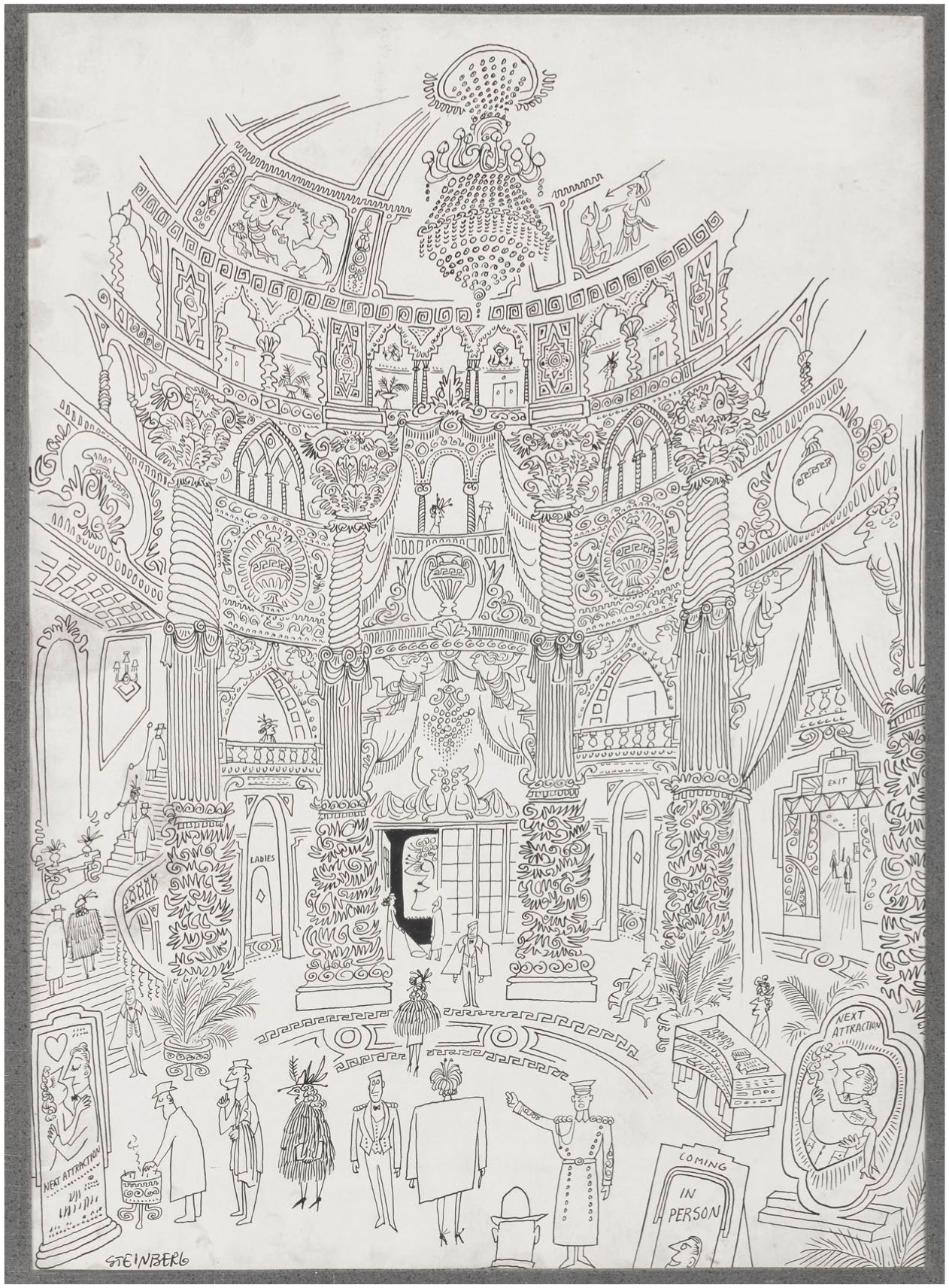
Saul Steinberg, Movie Palace. Original published in Architectural Forum, March 1946: 120; later included in Steinberg’s The Art of Living (New York: Harper & Brothers, 1949). Ink and pencil on paper, 19 ¾ × 14 in. Private collection. © The Saul Steinberg Foundation/Artists Rights Society (ARS), New York. Reproduced with permission.
Barthes’ use of the cinematic figure of Chaplin is perhaps surprising. Barthes was, as I noted in the introduction, ambivalent about cinema (forget animation), and, despite an abiding enthusiasm for Sergei Eisenstein (best distilled in his essay on Ivan the Terrible in Image Music Text, Barthes, 1977a: 52–68) and a syllabi-canonical piece, “Leaving the Movie Theater” (Barthes, 1975b: 61), across his oeuvre he wrote about the medium comparatively little (Watts, 2016). Nevertheless, that has not stopped scholars from extracting those insights Barthes’ did make regarding film over his body of work (and this article is no exception), whether in regards to his influence on the Institute of Filmology, his relationship with André Bazin, or his writings on photograms (Ffrench, 2021; Watts, 2016).
Despite the rarity of film analysis in Barthes’ work, what comes through in All Except You is not a cinematic, but an animatic celebration of Steinberg. One of Barthes’ complaints concerning the average movie theater experience was its limited horizon, its boxed-in aspect ratio that limits the “spectator’s gaze” to “that of a subterranean corpse ensconced in darkness and receiving cinematic nourishment in much the same way as an invalid does, passively through a catheter or a pipette” (Barthes, 1954: 116). Barthes preferred the “epic dimension” that was to be found in the widescreen technology of Cinemascope, where, as he wrote in 1954, one year after the technology’s debut, “the position is entirely different: I am on a huge balcony and move comfortably within the limits of the visual field, freely culling what interests me.”
Steinberg’s most famous work (beyond “View of the World from Ninth Avenue,” first published on the cover of The New Yorker in 1976, and soon reproduced in poster format and pirated for other cities) is likely The Line (1954), a 10-meter-long, panoramic drawing (see Figure 3). In it, the meaning of the horizontal line—a simple straight line across the center of the page—changes repeatedly: from x-axis, to waterline, to tabletop, to floorboard—all without breaking. Here, too, Steinberg’s vision is in keeping with “animation’s capacity to un-ground and manipulate the pictorial horizon, sending the observer’s visual field into a tailspin” (Gadassik, 2024); a perhaps intrinsic capacity of the form, and one that any consideration of aerial animation, from Plane Crazy (1928) to The Wind Rises (2013), would confirm. But Steinberg’s lines seem to suggest still more lines; each horizon borders another world, another side of the mirror, another page that cannot be viewed. His work, for Barthes, implies much more than it shows: “meaning overflows, the image (though graceful) is stuffed full of connotations” (Barthes, 1983: 18). It is no wonder that Barthes found in Steinberg a widescreen feeling.
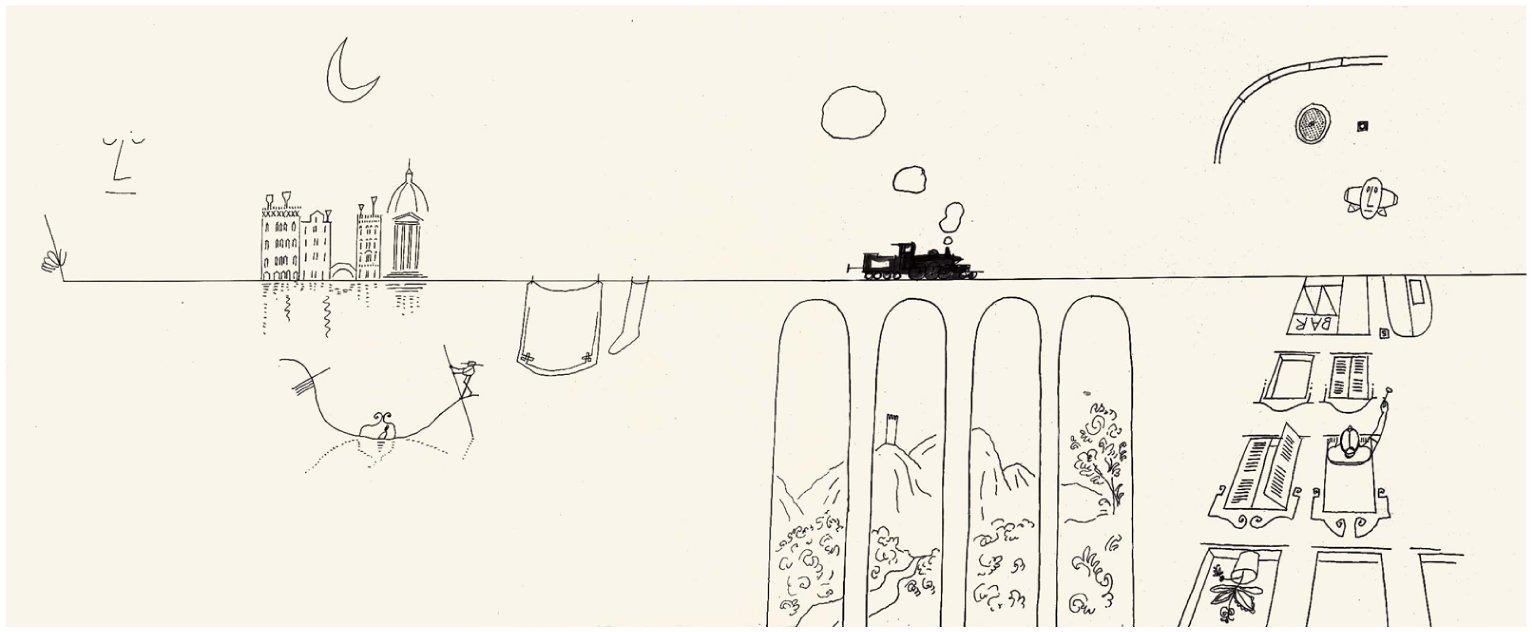
Saul Steinberg, The Line, 1954 (detail). Designed originally to adorn the walls of a maze for children at the 10th Milan Triennial. Barthes would have known the reduced version of the work reproduced in The Labyrinth (Steinberg, 2018[1960]). A moving panorama version may be viewed on the footer of the Saul Steinberg Foundation Website. Pencil, ink, and watercolor on folded paper, overall 18 × 404 in. Biblioteca Nazionale Braidense, Grande Brera, Milan. © The Saul Steinberg Foundation/Artists Rights Society (ARS), New York. Reproduced with permission.
If Barthes was ambivalent about cinema, he was hostile to animation. Nevertheless, Barthes’ very conception of the medium of the comic (be it book, strip, or panel) is informed ultimately by animation. Of course, Barthes would have been familiar with Steinberg’s work in the New Yorker (whether through its inclusion in published compilations or through his own time in New York City) for whom Steinberg completed not only covers, but inside work as well. Barthes focused on Steinberg’s play with the form of the medium, ranging over his “transgression” (not destruction) of comic panels and his creative, double-entendre use of word balloons: “assembled in a grand salon, a diverse cast smoke and talk: the speech is smoke, they are one and the same: they merge into a single word balloon” (Barthes, 1983: 41; see Figure 4). Above all, Barthes focused on Steinberg’s tendency toward metamorphosing his subjects.
Metamorphosis
Steinberg often pushes a metaphor to a state of metamorphosis: a woman is transformed (as in a fairy tale) into an armchair; her body is flattened, reduced to upholstery. A human head is transformed into a signature; before long, we see the same character mutate bit by bit, silhouette by silhouette, from his infancy to his dotage: these are the ages of life. For time, chez Steinberg, is an animating force; it proceeds with unsettling, mechanical jolts. Steinberg uses temporal effects as a sort of modern fantastic. (Barthes, 1983: 33)
Before / After
What, properly, is a “cartoon”? It is “each of the drawings destined to make up an animated film.” Put differently, the cartoon refers to an act taken from a sequence: there is a before and an after; there is a story that has begun and which will continue. Steinberg’s drawings always imply, in effect, a reserve of history: they make one want to hear what happened previously, and what will happen next. Each drawing is full of narrative, but this narrative, elegantly looping-the-loop, cuts short. This is not dissimilar to the brief (and supremely elegant) art of haiku. (Barthes, 1983: 26)
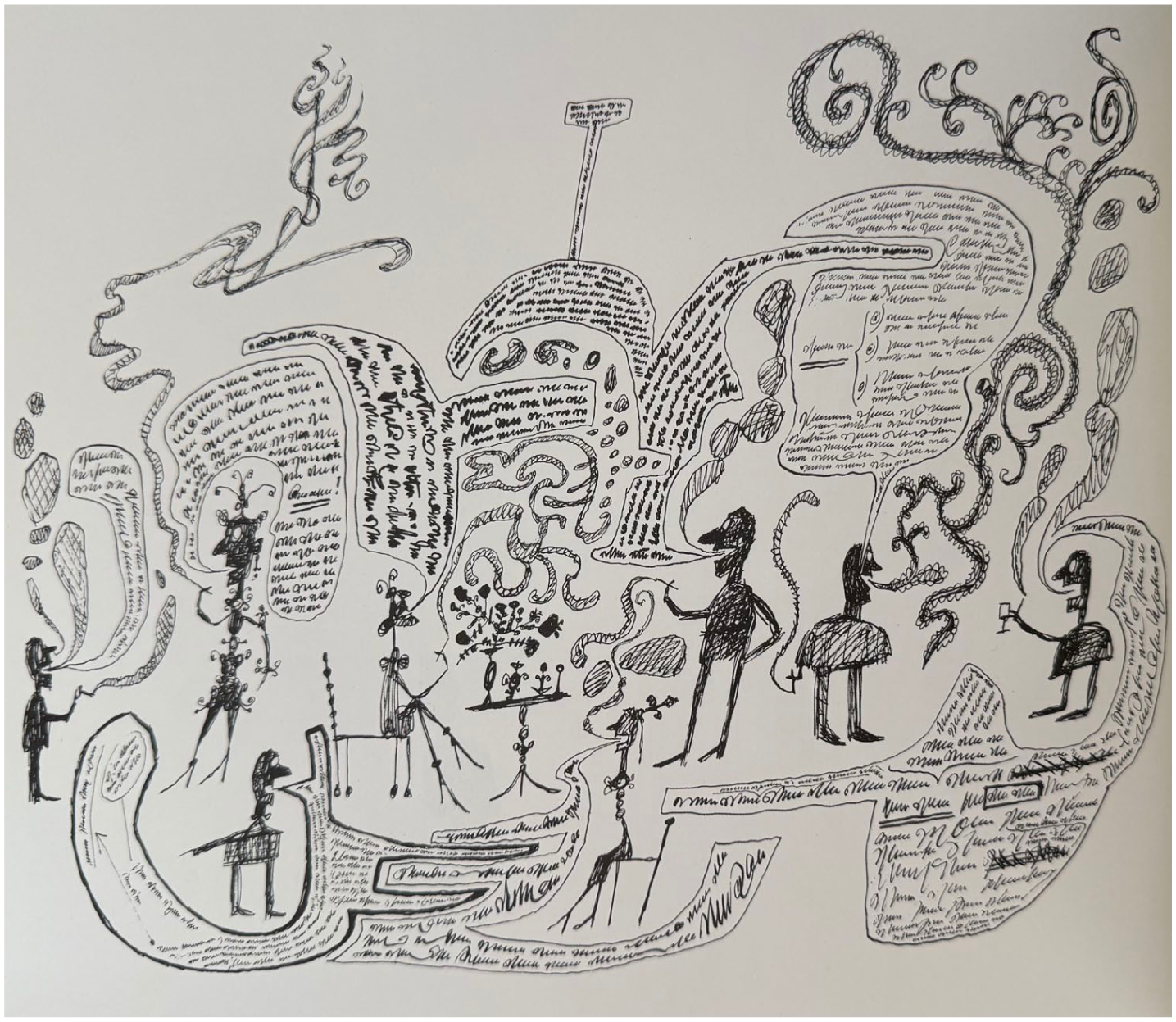
Saul Steinberg, Untitled, c. 1958, whereabouts unknown, as reproduced in The Labyrinth (Steinberg, 2018[1960]: 22). © The Saul Steinberg Foundation/Artists Rights Society (ARS), New York. Reproduced with permission.
Not for the first time, Barthes looks to Japanese culture as an explanation for the power of animation. In Image Music Text, he argued that the Bunraku puppet theater tradition reveals “the concept hiding behind all animation of matter, that, quite simply, of ‘the soul’” (Barthes, 1977a: 172). With his entries on “Metamorphosis” and “Before / After,” Barthes is not referring to “cartooning,” as such; rather he proposes that any individual Steinberg drawing seems a kind of fragmented animation, “an act taken from a sequence”; each drawing as though a still image from a lost feature film, implying much more than is contained on the page. As observed in a line from the Barthes manuscript that would ultimately not make it into the published book: “Everything repeats, even division” (Barthes, 1976: np). 4
What is more, Barthes proposes that this animatic quality of Steinberg is in turn metamorphic. In so doing, he is allied with Eisenstein’s famous conception of the “plasmatic,” which likewise focuses on animation’s metamorphic, “unfixed” property: a “primordial protoplasm, not yet having a stable form, but capable of taking on any and all forms of animal life” (Eisenstein, 2013: 117). Steinberg’s metamorphoses extend even to furniture, as in the “upholstered” body to which Barthes alludes (see Figure 5). But, unlike Eisenstein, who found in the plasmatic a capacity for revolt, a riot of color against the gray, Barthes found in the metamorphic capacity of Steinberg’s vision a whole new way of looking at the world.
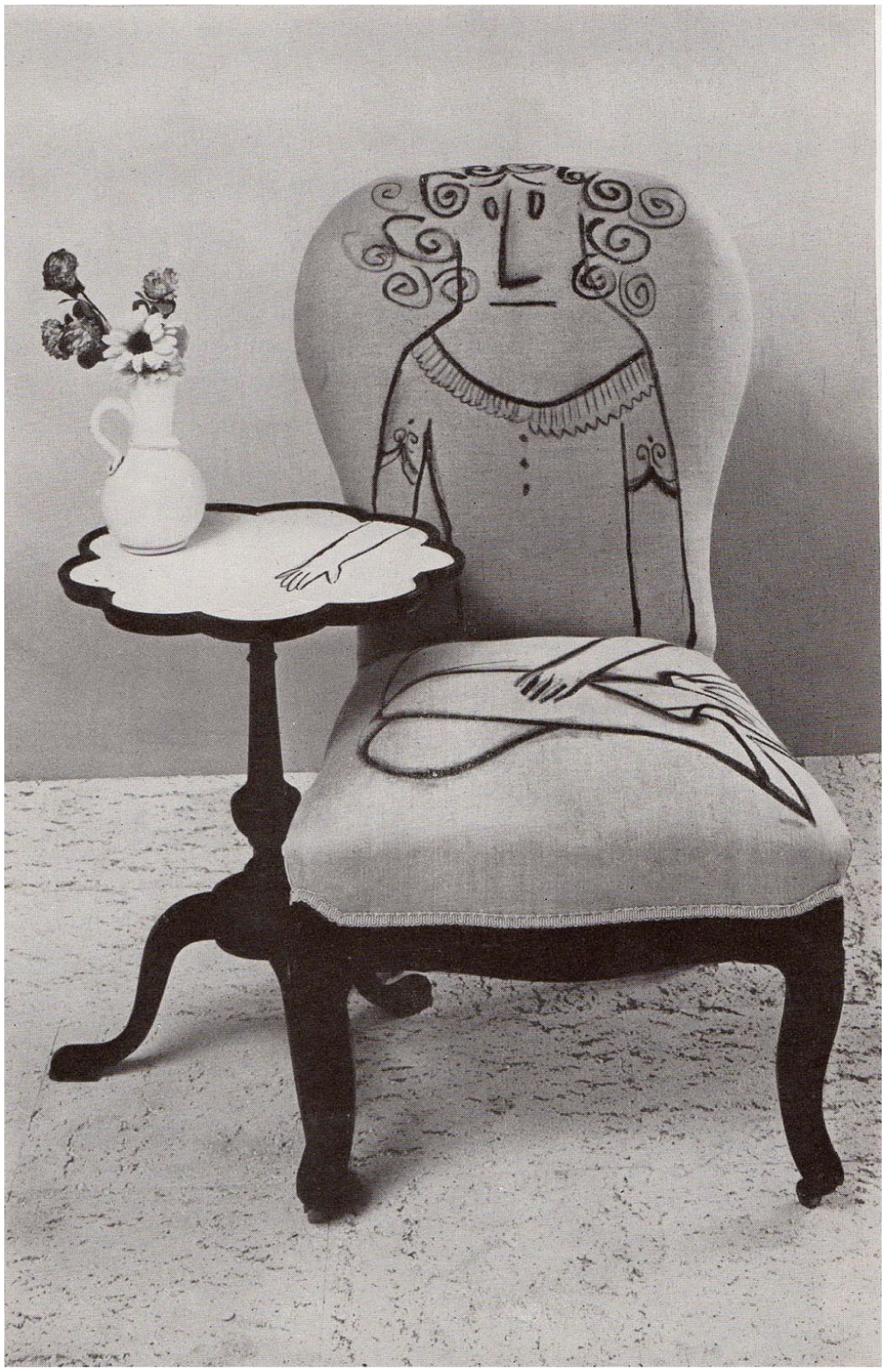
Saul Steinberg from Flair (March 1950): 88. Reproduced in The Passport and Dessins. © The Saul Steinberg Foundation/Artists Rights Society (ARS), New York. Reproduced with permission.
Optical toys, paper toys
Anamorphosis
Anamorphosis consists of changing proportions. Steinberg does this incessantly, because he knows that the intelligence of an image comes from its deformation (that which is exact is not intelligible) . . . Here, evidently, is an idée fixe of Steinberg’s: to demonstrate the power of the artist to alter the meaning of things we take for granted, as natural; and the method for this operation is nothing more than the changing of proportions (it is said that all of Nicolas de Staël’s work can be found in a few square centimeters of Cézanne, were they enlarged: meaning depends upon the scale of perception). (Barthes, 1983: 53)
Im-pertinence
People in the street are viewed (drawn) from above, at an absolute vertical. Steinberg describes (inscribes) to excess the deformations produced by this changed point of view. . . . A human body can be understood from differing pertinences, but the one that generally prevails (as all of figurative painting and photography can testify) is the frontal pertinence: the artist draws the bodies that I, an ordinary human, sees, which is to say: upright, and across from my own body. Any infraction of this universal pertinence is thus an im-pertinence. And this is what we find in Steinberg’s silhouettes: they are impertinent, deformed by the view from above, stretched and squashed to excess, now devoured by their own heads—enormous, monstrous spheres—now reduced to a line of shoulders, arms, feet. With this simple change in pertinence, the artist creates an improbable humankind, all the more impertinent because they seem to look down (if pensively) on their odd creator, who creates and then watches them from a great height. (Thanks to the work of certain psychoanalytic studies, we now know the importance of anamorphosis—a procedure well-known to certain painters—in the unconscious economy of the human subject.) (Barthes, 1983: 50)
Anamorphosis, as Barthes here uses the term, is at once a technique, a concept, and an artifact. As a technique, it refers to the practice of painting that flourished during the Renaissance, whereby if a so-designed image is looked at from an oblique or “impertinent” angle, the image reveals a new shape or previously hidden image. Holbein’s painting The Ambassadors (1533) is the textbook example, revealing as it does a concealed skull within a portrait. As a concept, it refers to Lacan’s use of the anamorphosis as an object lesson for (to paraphrase Valéry) the act of seeing oneself see; anamorphic paintings obliged the viewer to notice the act of vision and thus embodied a double-vision emblem of psychoanalytic self-awareness (Collins, 1992: 73–82). Finally, as an artifact, anamorphosis refers to the optical toys that miniaturized and domesticated the painterly techniques mentioned above, wherein small prints were sold with a cylindrical mirror that, when placed in the correct spot on the horizontal print and consulted, would reveal hidden (and sometime prurient) images for the domestic user.
Steinberg, for Barthes, captures all three of these meanings of anamorphosis. First, he produces images that oblige the viewer to apprehend them from odd angles. Turning a Steinberg image upside-down is a frequently necessary procedure, as in (to use an already included example) one pictured detail from The Line (Figure 2): the man at the base of the building can be viewed from either direction; the orientation of the vignette is up to the reader: which is up and which is down is a matter of perspective. Second, in Steinberg’s “impertinent” images in which his characters return the gaze of the viewer, the artist demands a double vision, an awareness of our own act of seeing. In a number of his drawings, the subjects are figured as though from above, and seem to look back at the viewer or indeed the artist (as also seen in Figure 2), a frame-breaking “metalepsis”—the hand of the artist is a frequent trope in Steinberg’s topsy-turvy work, as well (see Figure 6; on metalepsis, see Feyersinger, 2010). Third and finally, Steinberg’s artwork functions as a kind of optical toy.
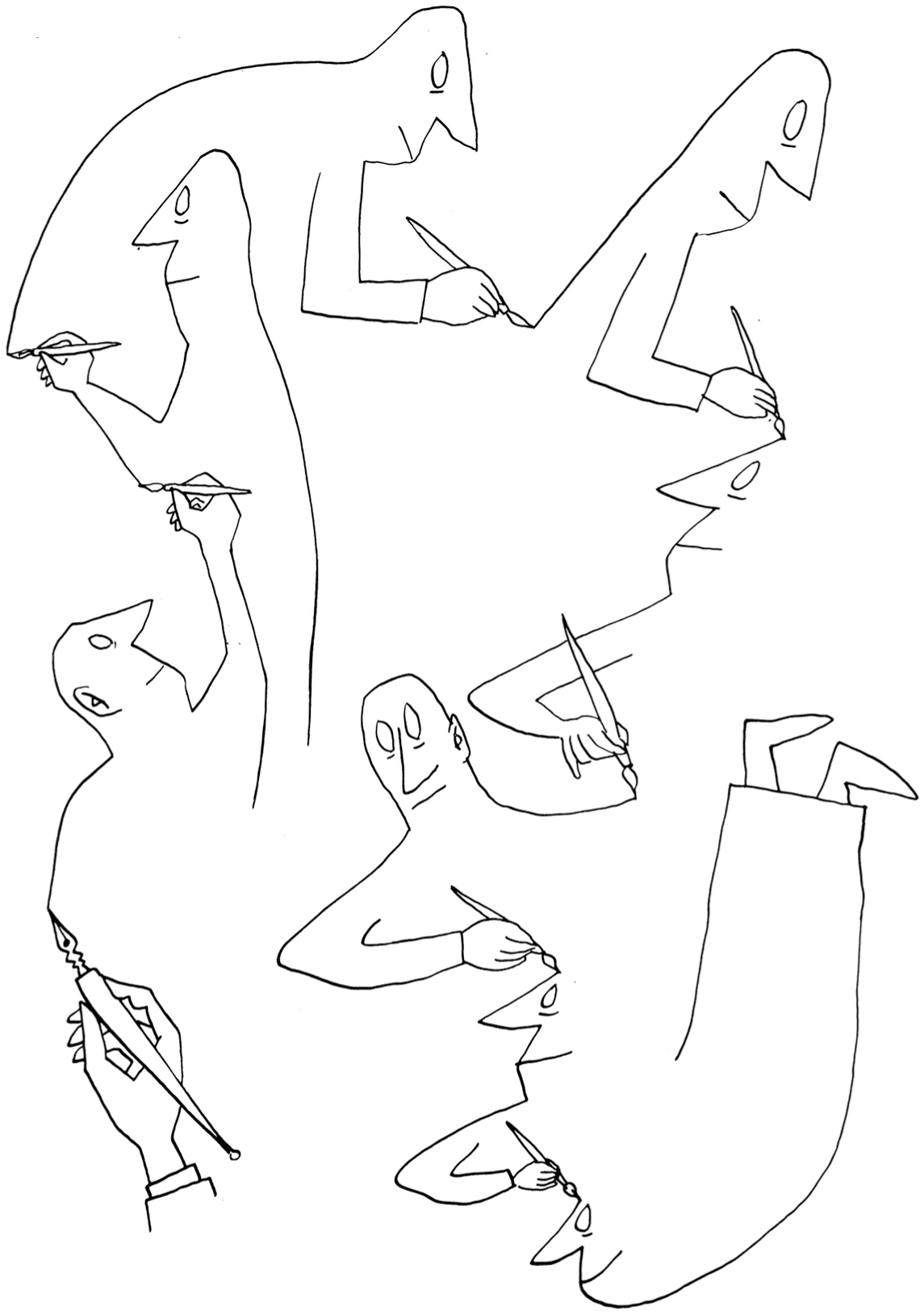
Saul Steinberg. Untitled, 1944. Ink on paper, 19 ½ × 14 ½ in. Beinecke Rare Book and Manuscript Library, Yale University. Originally published in The New Yorker, February 3, 1945. © The Saul Steinberg Foundation/Artists Rights Society (ARS), New York.
This term, optical toy, opens up an enormous category of viewing machines and scholarship, whether on fragmentary kaleidoscopes, immersive stereoscopes, projecting camera obscuras, or what have you (e.g., Crary, 1990; Huhtamo, 2014; Loader, 2018). Recent work has opened up a second domain of optical toys that existed on paper, whether these were newspaper cut-out zoetropes or moving-panoramic postcards (Bak, 2020; Ellis, 2020). These paper optical toys depict a world full of unusual, refracted spectacles, double visions, mirror images, and more. Repeatedly, Barthes uses the techniques and terminology of optical toys to explain Steinberg. Referring to the technology of lenticular animation, Barthes notes that Steinberg’s works are “like those optical illusions that change depending on one’s point of view” (Barthes, 1983: 8). Elsewhere, he compares Steinberg’s drawings to the “ungraspable,” “swift-moving and subtle” impact of a moiré effect—that phenomenon in which misaligned lines produce the appearance of movement, as in barrier-grid animation (p.54).
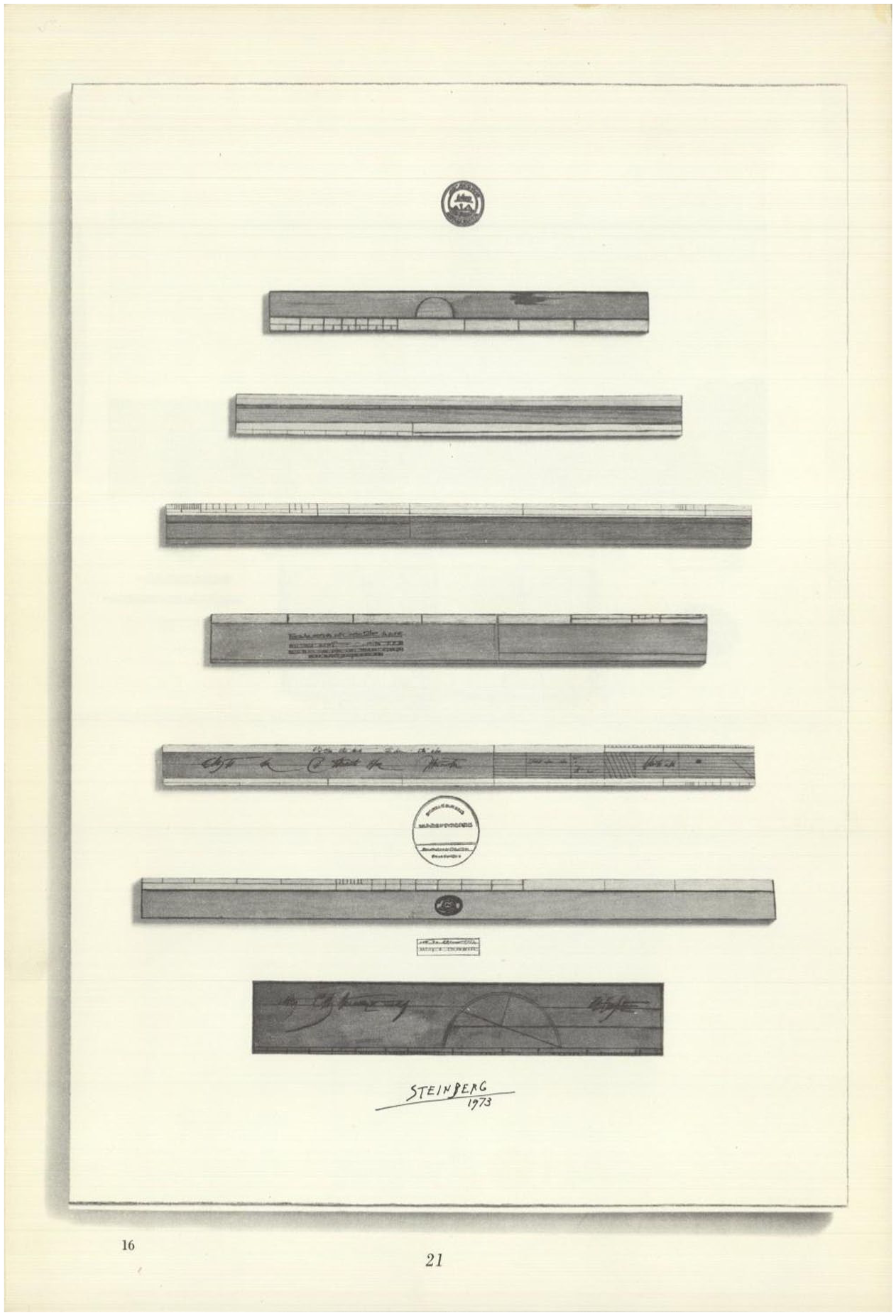
Then there is the interest in small, handheld artifacts as such, which Steinberg kaleidoscopically brings into his work, resurrecting the mundane as marvelous—a stamp becomes a cloud; a fingerprint, a portrait; a chair, enlivened as a pet. “Lo and behold he’s chosen an object (a desk ruler, for example) and sets to varying it interminably: he doesn’t stop until he’s reproduced it a thousand times with a thousand forms, in a thousand situations with a thousand different facets. He’s drunk on repetition” (p.17; see Figure 7). Steinberg ultimately ludifies every artifact he encounters; every object is also a toy; le monde de Steinberg is a Toy World. Per Barthes, this world captures the viewer and swiftly feels like one’s “own, natural habitat” (p.56; see Figure 8). Steinberg’s Weltanschauung is infectious; by the end of his reading of Steinberg, Barthes felt as though he’d “been taught, implicitly, to ‘do’ Steinberg,” and to look at the world as Steinberg does, as though through a cynical kaleidoscope, a critical camera obscura, a wry zoetrope (p.56).
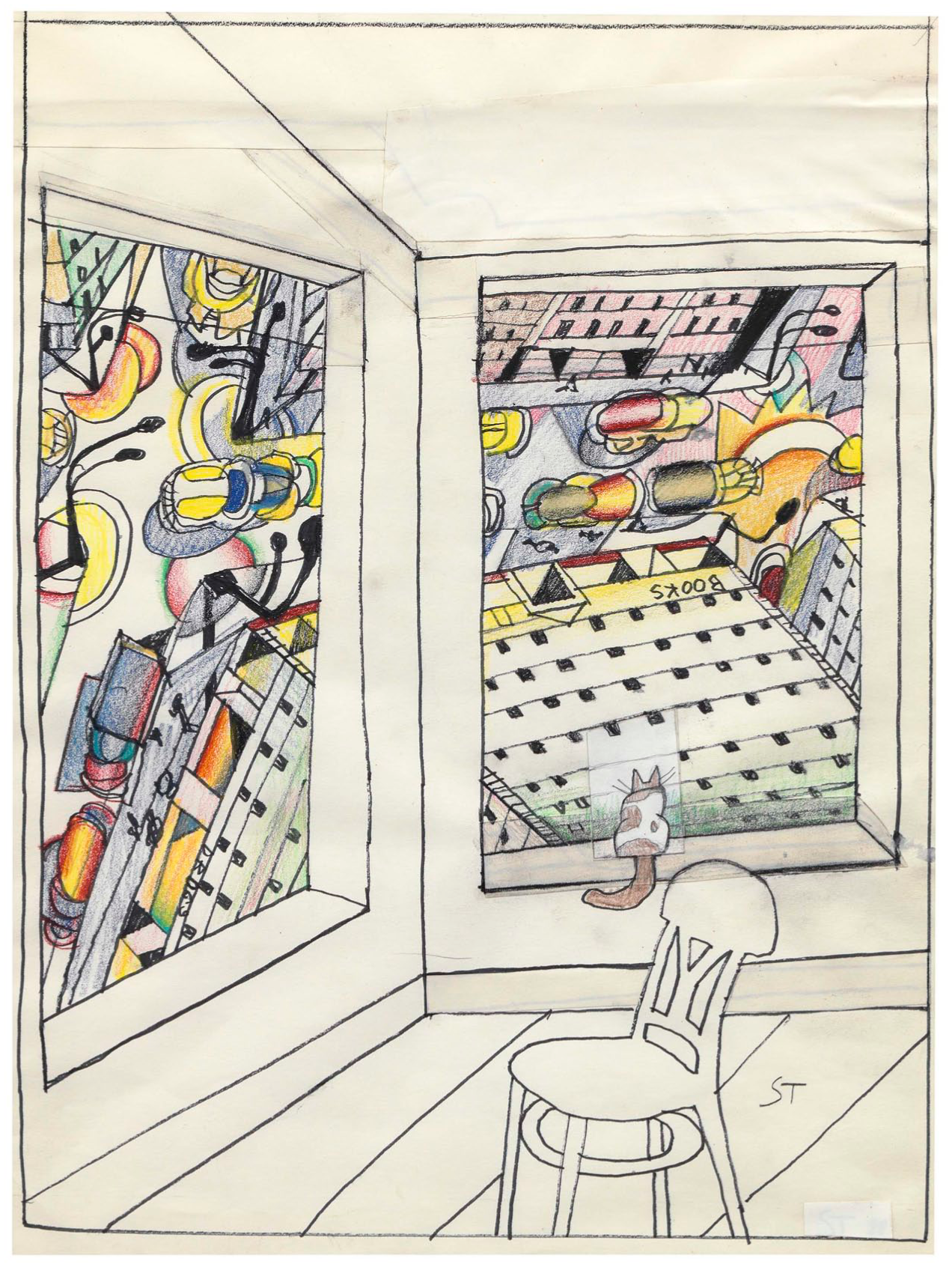
Saul Steinberg, Looking Down, 1988. Felt marker, crayon, colored pencil, and conté crayon with collage on paper torn from sketchbook, 20 × 14 in. Mint Museum, Charlotte, North Carolina. Gift of The Saul Steinberg Foundation. Cover drawing for The New Yorker, February 28, 1994. © The Saul Steinberg Foundation/Artists Rights Society (ARS), New York. Reproduced with permission.
This canted look at the world—this look askance—gave Barthes a feeling of disorientation, much as an aerial view can give one vertigo. To look at a familiar place from an unfamiliar position can change our sense of scale altogether—the birds-eye-view as nature’s first optical toy. Recall Barthes’ claim above, that De Staël’s painting is contained, in miniature, in a detail of Cézanne’s: “meaning depends upon the scale of perception” (Barthes, 1983: 53). This principle Steinberg would later demonstrate in Looking Down (1988), in which a simple black-and-white pencil drawing of a cat and chair at a window opens up to a colorful cubist funhouse-mirror image of what lies outside the window, as though seen from above (Figure 8). To add to the sense of impertinence, the view may depict that which the windowsill cat is seeing (another favorite theme of Steinberg’s, the cat, and one to which Barthes devotes an entry). In this disorientation, in this shifting meaning, there was a mystery to Steinberg that vexed and tantalized Barthes.
The Mise-en-Abyme of All, Except You
The Collection
What is a collection, but a show? It is something that I look at. And that which I look at is also that from which I am excluded. The spectacle at once attracts me and rejects me. On the one hand, I feel a sense of solitude as I watch the passing show; on the other hand I find, from a distance, a great peace in watching these repetitions, reassured that they are not alone. There is an incessant voice in Steinberg’s oeuvre; listen, it says: all except you. In this exception, I find both pleasure and pain. (Barthes, 1983: 17)
Autonymy III
Steinberg, to be sure, is quite conscious of the autonymic process and in his work he expresses the idea that “that which I draw is drawing”; and again, “the drawing derives from drawing.” (Barthes, 1983: 49)
WJT Mitchell (1994) once wrote that Steinberg’s drawings have “n-levels of nested representation”—a mise-en abyme of meaning (p.42). Barthes had found this as well: “There is always the air of a puzzle on the page, and one can’t help but say: there is surely another meaning that I must find” (Barthes, 1983: 18). In some passages, Barthes despaired at solving these puzzles, wondering if Steinberg was in fact “a maker of rebuses without solutions” (Barthes, 1983: 25). There is a sense of frustration in All Except You, as Barthes is repeatedly stymied in his hunt: Zeno’s arrow, once more. “Steinberg’s characters all resemble someone I know (I am sure of it) but whose name I can never remember. Who is it? Where have I seen this face, this apparition?”; “I can roll out analyses, enumerate attributes, try to apprehend the essence of his art, but I cannot capture it. Steinberg is always ahead of me.” Of course, this frustration is part of the conceptually rewarding “pleasure and pain” of Steinberg, as Barthes notes in his entry on “The Collection” (Barthes, 1983: 17).
“Rebus” is a key word above, referring to those coded images which translate to textual meaning, once the auditory cue is discovered or the pun understood. To give the name “Steinberg,” for instance, a rebus might show an image of a stone (stein), joined by a plus sign to an image of a mountain (berg). This ancient genre of pictogram survived in the 20th century as children’s play, whether in collected books or (frequently) on postcards, another favorite subject of Steinberg’s. Another paper toy.
In other passages, Barthes appears to describe, to his own satisfaction, the answers to the riddles of Steinberg’s world—he practices cryptography and finds the keys hidden in the line. Indeed, the title of Barthes’ text, All Except You, poses an interpretive puzzle that Barthes returns to often, and with which I will conclude. The title itself comes from a pen and ink drawing in which the extract phrase is depicted as a towering, architectural array of words, each in a separate style of font (Figure 9). “All” is offered as an endless parade, a line of a dozen As behind the A and Ls behind the L. “Except” is enormous, rendered in block letters that create a wall between the All and the You. “You,” finally, is comparatively minute, isolated, with neither the reinforcements of All nor the sturdiness of Except.
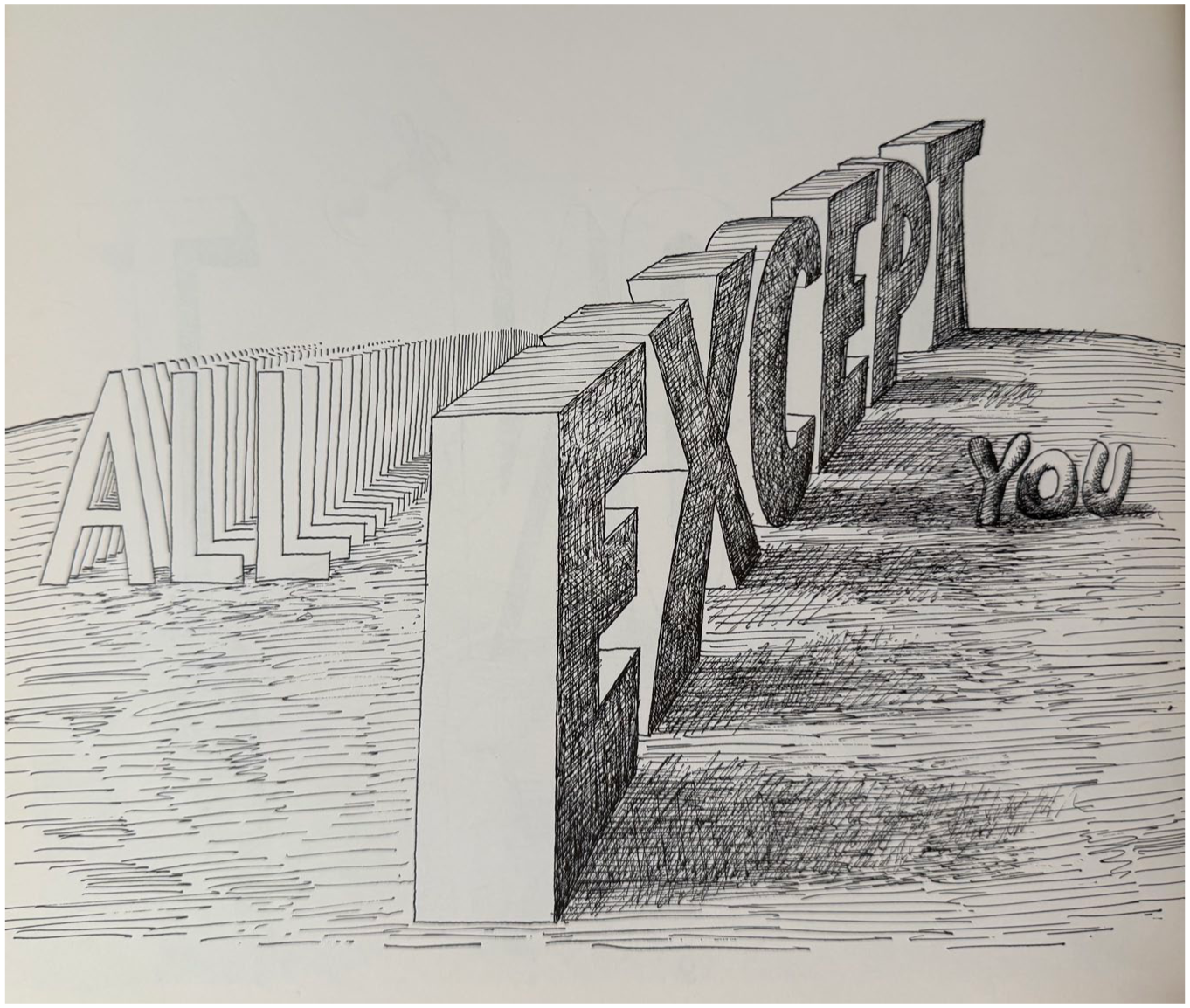
All Except You, 1969. Whereabouts unknown. Originally published in The New Yorker, November 8, 1969. Also included in The Inspector (New York: Viking: 1973):134 © The Saul Steinberg Foundation/Artists Rights Society (ARS), New York. Reproduced with permission.
Why is this image, this phrase—All Except You—of the many that Steinberg produced, so vital for Barthes? For one thing, it serves as an “autonym,” a self-referential word that “defines itself as a word”—the word All in Figure 9 implies a mass of “people”; it contains “all” of the Alls. This is the second-order awareness of image and text, the “breakdown of levels,” the structuralist savvy that Barthes appreciated in Steinberg—each of them great troublemakers for the line between signifier and signified (Barthes, 1977b: 49). Not just words, tout court, but their semantic implications, relations, and internal contradictions. “What he displays are not objects, but the display of these objects” (Barthes, 1983: 17).
This self-referential, artifactual reading of texts-as-objects has its analogue in animation, as well. George Griffin (2007b), again, writing in this journal, conceived of the idea of “concrete animation,” a self-referential form in which “each frame” of an animated film is treated “as a material object” by the animator—he uses Virgil Widrich’s cut-up, folded, paper-based Fast Film (2003) as an example of this, as well as strobe-based zoetropes (p.262). In such cases, viewers (in Barthes’ terms) anamorphically “sees themselves” seeing the surface of the film. They see the you in the all except. All Except You, the phrase, the drawing, is autonymic, yes; it is about each of the words “as singular unit, magic monad,” and their relationships to each other (Barthes, 1975c: 33). But it is also animatic, showing the repetition and sequentialism of the cartoon in a single image.
Barthes dwells, finally, on their direct meaning, on the address of the you as himself, Roland Barthes, in the phrase. On the one hand, Barthes feels excluded from “all”—everyone is invited, except you. You will never be privy to the secrets on the page. Riddles unsolved, toys unplayed. In the engagement between viewer and artist (between Barthes and Steinberg), the viewer is judged by the repetitive parade and rejected. On the other hand—and here Barthes finds the cumulative, consoling key to the book, hidden in the title—is not exclusion but complicity. In the Steinberg–Barthes rapport is a solicitation. All are merely stereotypes, a parade of repeated cliches; and in noticing that, we (artist–reader) are not of it.
This reading of Steinberg is confirmed by a single mark in the manuscript for the text held in the Bibliothèque nationale de France. Barthes’ hand-written pages for the book that would become All Except You were, with minimal exception, faithfully transcribed and adapted in the resulting Maeght publication. However, there is one exception. Barthes’ original title was rendered as “All, Except You.” This unique comma (following “all”) speaks volumes. Barthes, the author of S/Z (1970), one of the great examples of an expansive-text devoted to a small artifact (a short story), would agree; he elsewhere insisted that “the typo is never vague, indecipherable, but a legible mistake, a meaning” (Barthes, 1977b: 97). The comma attests to Barthes’ final reading of the title: Steinberg singles out the reader as compatriot. “Steinberg and I, we are laughing at someone we know in common” (Barthes, 1983: 7). Standing outside of the parade of uniformity, we mock the type. “They” may be like that, it is implied: but not you, reader. All, except you.
Footnotes
Acknowledgements
For their research funding and support, I thank the University of Tampa, which provided me with a Research Innovation and Scholarly Excellence Award to visit the Bibliothèque nationale de France among other sites. I am grateful to the archivists at the BnF, the Beinecke Rare Book and Manuscript Library at Yale University, and the Brooke Russell Astor Reading Room for Rare Books and Manuscripts at the New York Public Library. Finally, I owe a special debt to Dr. Sheila Schwartz, Research & Archives Director of The Saul Steinberg Foundation, for her insights, corrections, and kind help.

Funding
The author received a Research Innovation and Scholarly Excellence Award from the University of Tampa to visit the Bibliothèque nationale de France among other sites. The author otherwise received no financial support for the research, authorship, and publication of this article.
Declaration of conflicting interests
The author declared no potential conflicts of interest with respect to the research, authorship, and/or publication of this article.