







Abstract
Purpose
Strength and Conditioning (S&C) coaches play a central role in optimising performance and mitigating injury risk in elite football. Despite this key responsibility, limited research has examined the practical application of S&C within the daily realities of top-tier professional environments. This study explored applied S&C practices within a first-team department of an English Premier League (EPL) football club to generate context-specific insights relevant to practitioners and researchers.
Methods
A qualitative research design was employed using semi-structured interviews with five first-team performance and medical staff members. Interviews explored S&C training philosophy and delivery, testing and monitoring approaches, and operational and contextual constraints. All interviews were recorded, transcribed verbatim, and analysed using reflexive thematic analysis.
Results
Three overarching themes were identified: (1) Player profiling, (2) Injury prevention, and (3) Challenges in programme S&C delivery. Individualised S&C programming was primarily informed by player profiling and the positional demands. Strength and power were monitored regularly during the season, whereas comprehensive speed profiling was not consistently conducted during the season. Injury prevention strategies were systematic and individualised, integrating screening processes, targeted exercise selection, and load management. Enhancing player education and modifying exercises were key to improving player compliance, but staffing limitations and time pressures restricted the extent of individualised S&C.
Conclusion
This study provides novel insights into the applied realities of S&C practice within an EPL first-team environment. While practitioners adopted evidence-informed approaches, practical constraints necessitated ongoing compromise and flexibility. These findings highlight the importance of adaptable, context driven decision-making and demonstrate the value of qualitative inquiry for capturing the complexity of elite football performance settings.
Introduction
In recent years, the physical demands of elite football matches have progressively increased. For instance, high-speed running (5.5–7 m·s−1) and sprinting (> 7 m·s−1) distances significantly increased in the English Premier League (EPL) between 2015/2016 and 2024/2025.
1
These high-intensity actions are particularly relevant as they frequently occur in decisive match-play moments, such as goal-scoring, assists, and defensive actions, thereby influencing match outcomes.2,3 Consequently, strength and conditioning (S&C) coaches play a crucial role in modern football, developing the physical qualities that underpin players’ ability to repeatedly execute high-intensity actions during match-play, including high-speed running, sprinting, change of direction, accelerating, and decelerating.3–5 Nevertheless, how these physical demands are translated into training programme design, and how practitioners prioritise and sequence these qualities within congested competitive schedules, remains less well understood
As match demands have intensified, players are increasingly exposed to greater injury risks, particularly during high-intensity actions.6,7 Accordingly, S&C coaches have been tasked with reducing injury rates of players. 8 Research has shown that hamstring strain injuries (HSIs) have doubled from 12% to 24% over the past two decades, 9 negatively impacting team success 10 and club finances. 11 In response, professional football clubs have placed a greater focus on S&C practices throughout the competitive season to mitigate the negative effects of increasing injuries, 12 focusing on research-informed training interventions designed to enhance physical performance and reduce injury risk.13,14 However, how practitioners interpret injury risk, utilise testing and monitoring data to inform decisions, and adapt training strategies within the constraints of elite competition remains unclear. 15
Strength training interventions have been shown to reduce overall sports injuries by approximately one-third and overuse injuries by almost 50%, 14 emphasising the importance of S&C practices from an injury prevention perspective. In applied settings, S&C coaches employ various training methods, such as eccentric training, 16 high-speed running 17 and sprint conditioning, 18 to reduce non-contact injury rates. However, despite this strong evidence base, the persistence of high injury rates in professional football may imply that current S&C programmes alone may not effectively mitigate injury risks. 9 Evidently, although any soft-tissue injury is multifactorial, a failure of elite football clubs to implement injury reduction S&C 19 and poor player compliance 20 may be contributing factors to the current high rates of injuries. Therefore, greater insight is required into how S&C practitioners design training programmes, utilise monitoring data to inform decision-making, and adapt injury prevention strategies within the contextual demands of elite football.
Issues such as poor compliance and inconsistent implementation have been highlighted in previous research. However, these challenges are inherently shaped by practitioner decision-making, communication strategies, and the broader applied context. As such, understanding how S&C practitioners interpret, implement, and adapt injury reduction strategies in practice is critical to explaining why discrepancies between evidence and real-world outcomes persist. Recent studies have employed survey-based methodologies within elite football to examine S&C practices, aiming to better understand how players are physically prepared to cope with the increasing demands of match play and to reduce injury risk.21–23 Notably, these studies have demonstrated that S&C practices vary across regions and cultural contexts.21–23 For example, research investigating contemporary S&C practices in professional soccer across 18 countries found that practitioners are generally well-qualified and utilise a wide range of evidence-informed methods, including resistance training, plyometrics, and GPS monitoring. 22 However, key constraints, such as fixture congestion, limited time, and scheduling pressures, were consistently reported, often restricting optimal periodisation and implementation. 22 Similarly, Weldon, Wong 24 explored S&C practices and football coach and player perspectives within the Hong Kong National Football Association. Their findings revealed that, although S&C is widely recognised as important for both performance and injury reduction, its delivery is often inconsistent. Notably, a substantial proportion of S&C provision was delivered independently or by under-qualified personnel, with relatively few coaches holding formal S&C certifications. These differences across countries further emphasise the influence of contextual factors on S&C methodology and delivery. In addition, recent research by Jackson, Blagrove 25 examined sports science practices in English non-league football, focusing on stakeholder perspectives. The findings highlighted considerable variability in both resources and practice, largely driven by financial, logistical, and staffing constraints. While some evidence-based approaches, such as fitness testing and workload monitoring, were present, their application was inconsistent, and access to specialist staff and facilities was often limited. Collectively, these findings reinforce the importance of contextual and organisational factors in shaping applied practice. However, while existing studies provide valuable descriptive insights, they offer a limited understanding of how S&C is actually implemented in practice, particularly within specific high-performance environments.
This limitation likely stems from a reliance on survey-based quantitative methods, which, while useful for identifying general trends in S&C practice, do not account for each team's unique context.26,27 Given the highly contextual and dynamic nature of S&C practice in elite football, a more in-depth qualitative approach is warranted to better understand how practitioners navigate these complexities in real-world settings.23,27 Despite growing interest in S&C practices, no study to date has qualitatively examined S&C practices provision within a first-team environment in the EPL, despite the league presenting unique challenges due to its physical demands.1,28 Crucially, there is a lack of in-depth, qualitative research exploring the decision-making processes and day-to-day experiences of practitioners working within elite soccer environments. As such, the contextual factors underpinning applied practice, particularly within highly resourced settings such as EPL clubs, remain underexplored. Therefore, the current study aimed to address this gap by employing semi-structured interviews to provide a detailed, context-specific understanding of S&C practice within a single elite club, offering novel insight into how practitioners interpret and operationalise S&C within the realities of high-performance soccer. Specifically, the study sought to:
Explore how S&C practitioners conceptualise and justify training programmes within an EPL first-team environment. Examine how testing and monitoring practices are interpreted and integrated into decision-making processes in an applied setting. Investigate how contextual constraints shape the delivery of S&C practice in an elite football club.
Method
Methodological perspective
This study was guided by an interpretivist epistemology, which assumes that reality is socially constructed and that knowledge is co-produced through interaction between participants and researchers. 29 This positioning was appropriate given the study's aim to explore how S&C practitioners perceive and make sense of their practices within an elite club context, where meaning is shaped by individual experience and organisational culture.
Data were analysed using reflexive thematic analysis as outlined by Braun and Clarke. 30 This approach aligns with an interpretivist perspective, enabling exploration of participants’ experiences while recognising the active role of the researcher in interpreting meaning. An inductive approach was adopted, whereby codes and themes were primarily identified from the data rather than being solely deductively driven by pre-existing theories or assumptions, while also being informed by the researchers’ applied expertise.
The flexible yet systematic nature of reflexive thematic analysis supported the identification of meaningful patterns within the participants’ accounts, grounded in their experiential perspectives. The recruitment of participants with direct, first-hand experience within elite performance contributed to the credibility and authenticity of the research findings, ensuring rich, contextually relevant insights.
Researcher positionality and reflexivity
The principal investigator was employed within the football club at which the study was conducted, positioning them as an insider researcher. This facilitated access, rapport with participants, and a nuanced understanding of the applied environment, but also introduced the potential for pre-existing assumptions to influence data collection and interpretation.
To address this, reflexivity was embedded throughout the research process. This included maintaining reflexive notes, engaging in regular discussions with DK, JR, and RM, and explicitly challenging preconceptions during data analysis. In line with the interpretivist and reflexive analytical approach adopted, the research team acknowledged their active role in shaping the interpretation of the data.
To further enhance analytical rigour, the research team adopted a ‘critical friends’ approach, aiming to challenge the principal investigator's interpretations while providing reflective feedback throughout data collection and analyses. 31 This process was conducted during regular meetings with part of the research team, where the data were discussed, and the principal investigator was questioned on assumptions and challenged to consider alternative interpretations. This process of ‘critical friends’ was implemented to ensure the principal investigator had an awareness of personal and professional subjectivities throughout the research process. 32
Participants
A purposive sampling strategy was employed to recruit practitioners with direct, first-hand experience of S&C delivery within elite professional football. Data were collected within a single professional football club to enable an in-depth exploration of S&C practices within a specific organisational context. This approach aligns with qualitative research principles that prioritise depth, contextual richness, and situated understanding over breadth and generalisability. Focusing on a single club allowed for detailed insight into the interactions between organisational structure, practitioner decision-making, and contextual constraints (e.g., staffing, scheduling, and performance demands), which may not be captured through broader multi-site designs. This was particularly important given the study's aim to explore how S&C practices are operationalised in real-world settings.
The inclusion criteria required participants to be actively engaged in designing and/or delivering S&C programmes aimed at enhancing physical performance and reducing injury risks for first-team football players. Five practitioners (two S&C and three performance physiotherapists) met the inclusion criteria and were included in the study. Participants had an average of 12 years of experience in professional football (range: 8–16 years) and had been in their current roles for an average of 6 years (range: 2–10 years). While this inclusion criterion resulted in a modest sample size, this is consistent with qualitative research that prioritises depth of insight over sample size. The homogeneity of the sample and participants’ extensive experience enabled detailed, information-rich accounts of practice within the specific context.
All participants were provided with an information sheet detailing the objectives of the study and specific requirements. A consent form was also provided to all participants, and this was signed prior to the interviews being conducted. Official interview invitations were distributed to the selected practitioners via the club's internal email system by the principal investigator, and prior consent was obtained from all practitioners.
Data collection
A schematic diagram of the study overview is shown in Figure 1. The interview questions were initially developed by the principal investigator (DK) and refined following review by a member of the research team (RM). To ensure clarity, feasibility, and relevance of the questions, a pilot interview was conducted with an experienced S&C coach and member of the research team (JR) who had previously worked in professional football. Following the pilot interview, minor modifications to the wording and organisation of some interview questions were completed to enhance coherence and flow of the questions. The final interview guide covered the following topics: (1) S&C training philosophy and delivery, (2) testing and monitoring approaches, and (3) operational and contextual constraints. A copy of the final interview guide is available from the corresponding author on request. Data were collected through in-person semi-structured interviews over 4 weeks during the 2023/2024 season.
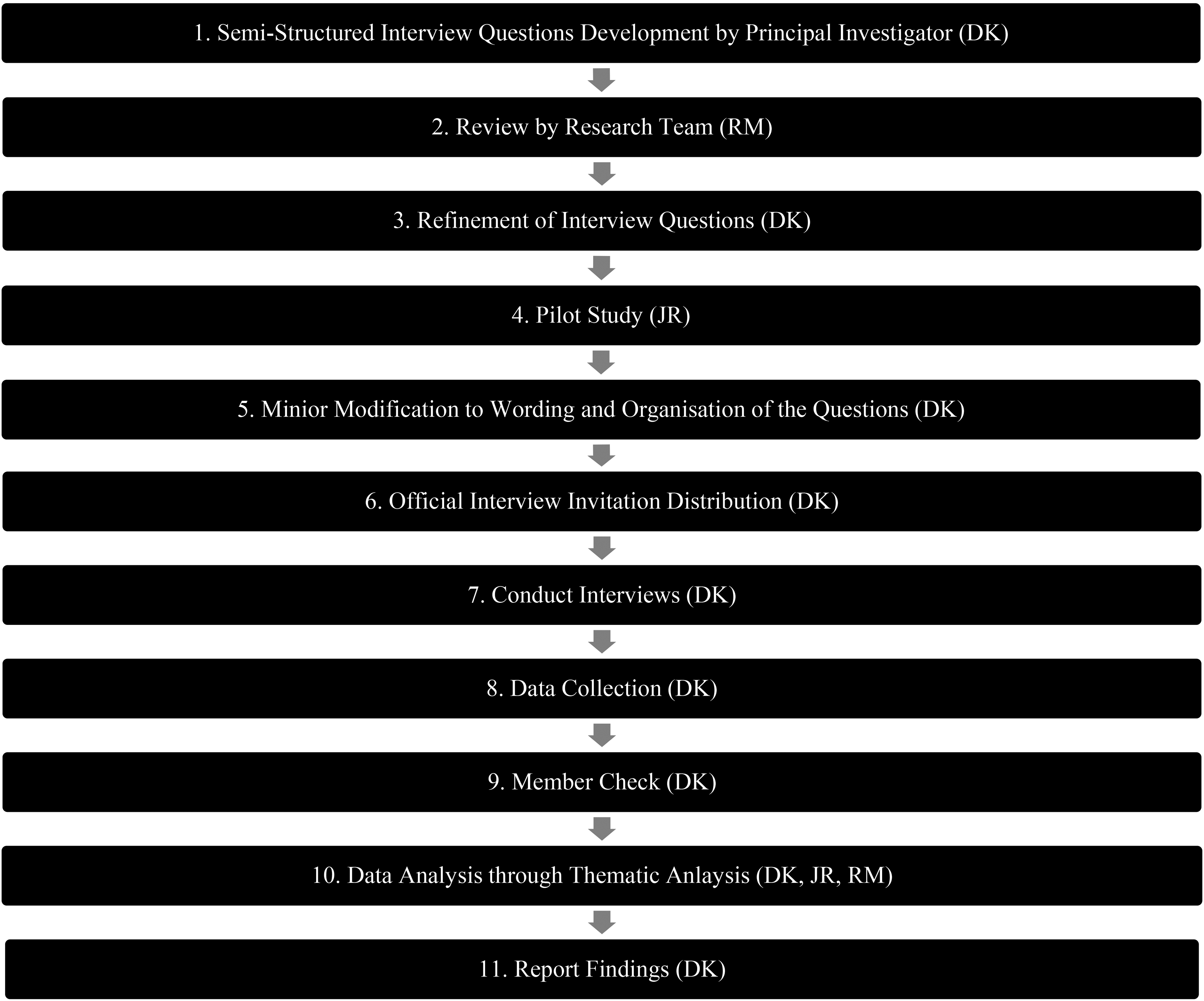
Schematic overview of this study.
To promote anonymity, interviews were conducted in a private meeting room at the club's training base and lasted approximately 60 ± 9 min in duration. All interview questions were open-ended, allowing practitioners to engage in a two-way discussion, sharing experiences and perspectives on each of the questions. 26 The interviews started with a clarification of the purpose, topics to be covered, expected duration, assurances of the confidentiality of the information, and how it would be used. The interviews were fully recorded using Microsoft Teams (Microsoft Corporation, Redmond, WA, USA). The principal investigator reviewed the transcripts against the original audio recordings to ensure the accuracy of the transcription. Following transcript completion, data were returned to all participants to verify the accuracy of the interview transcript, to establish data credibility and to obtain written consent for potential publication. Before conducting the interviews, the principal investigator underwent training in qualitative research methods outlined by various academic sources to ensure reliability. 33 Additionally, to enhance methodological rigour, certain strategies were employed throughout the research process. These included verifying the accuracy of interpretations through member reflections (where participants were sent a summary of findings and invited to provide feedback), 33 and ensuring the eight key markers of quality were considered, 34 including (1) worthy topic, (2) rich rigor, (3) sincerity, (4) credibility, (5) resonance, (6) significant contribution, (7) ethics, and (8) meaningful coherence.
Data analysis
Interview transcripts were organised using a customised Excel spreadsheet (version 16.83, USA) and analysed using reflexive thematic analysis, as outlined by Braun and Clarke. 30
An abductive approach was adopted, whereby coding was primarily data-driven but informed by the researchers’ applied expertise and existing literature. This facilitated an iterative movement between the data and relevant theoretical concepts to generate meaningful and contextually grounded interpretations.
Analysis was led by the principal investigator, who engaged in repeated reading of the transcripts to achieve familiarity with the dataset. Initial coding involved systematically identifying meaningful segments of data relevant to the research aims, generating a large number of descriptive, data-driven codes capturing practitioners’ experiences. One challenge at this stage was avoiding overly detailed coding, as this could obscure broader patterns of meaning. To address this, codes were iteratively reviewed, refined, and grouped while preserving the richness of the data.
Codes were subsequently organised into initial groupings based on shared meaning and conceptual similarity across participants. These groupings formed lower-order themes, which captured more specific patterns within the dataset. Lower-order themes were then further refined and integrated into broader, higher-order themes that represented broader patterns of meaning across the dataset. Theme development was iterative and non-linear; initial thematic structures were repeatedly revisited in relation to the full dataset, with some themes being merged, redefined, or discarded where insufficient supporting data or conceptual overlap was identified. A key challenge at this stage was avoiding over-simplification when developing higher-order themes, ensuring that themes captured the complexity of applied practice rather than reducing diverse experiences into overly broad categories. Decisions regarding theme structure and naming were guided not only by the prevalence of patterns within the dataset but also by their relevance to the research aims and their capacity to provide meaningful insight into applied S&C practice.
To enhance analytical rigour, a ‘critical friends’ approach was integrated throughout the data analysis process. Regular meetings were held with members of the research team, during which emerging codes, lower-order themes, and higher-order themes were discussed and critically evaluated. This process involved questioning coding decisions, challenging initial interpretations, and exploring alternative explanations for patterns identified within the data. In particular, the ‘critical friends’ approach supported the refinement of themes by ensuring that they reflected shared patterns across participants rather than isolated accounts, and that important nuances and divergent perspectives were retained. This iterative dialogue contributed to the development of a coherent and analytically robust thematic structure.
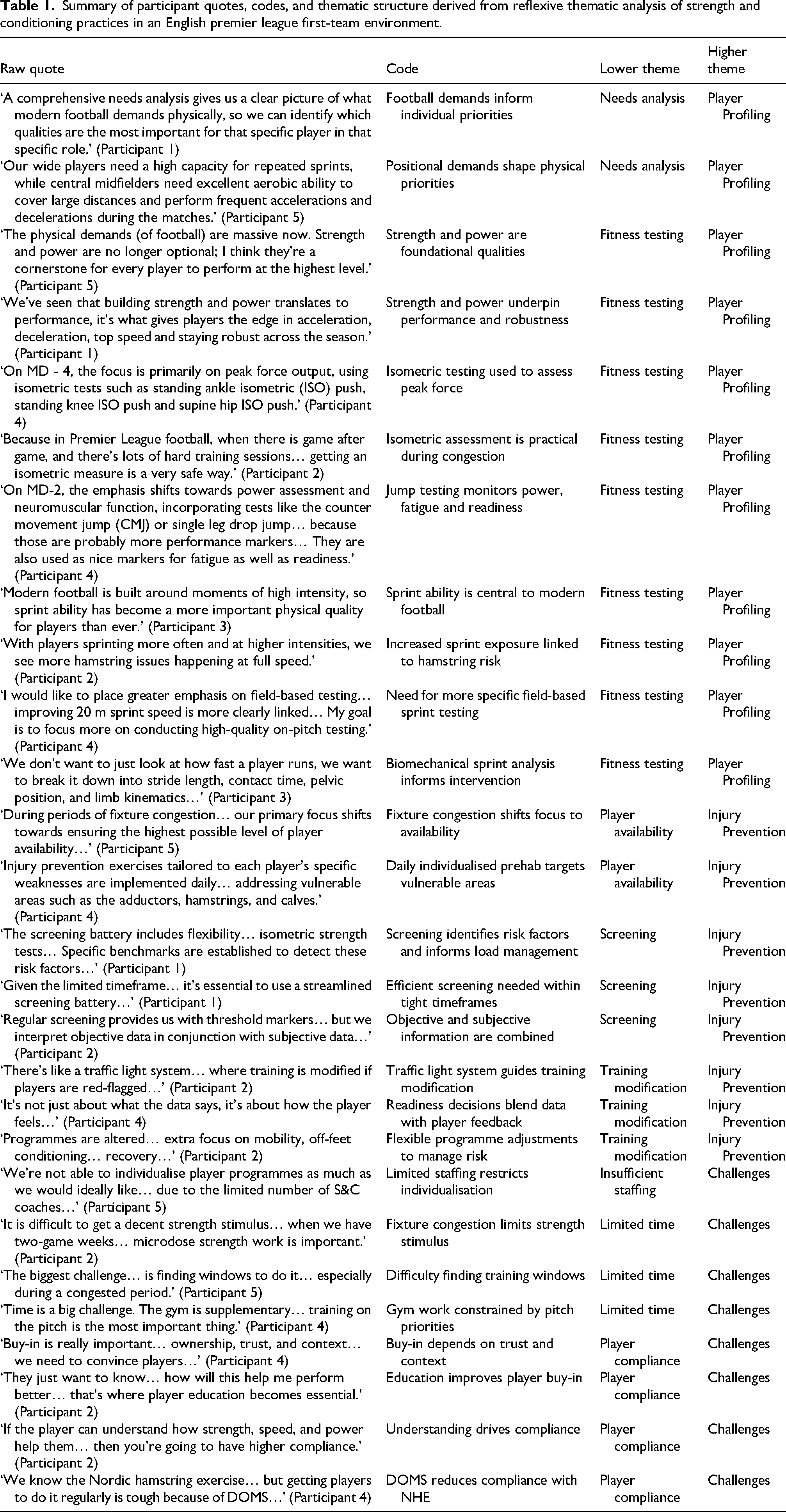
The reflexive analytical approach involved the generation of initial codes, which were subsequently collated into lower-order themes and further refined into higher-order themes (Table 1).
Summary of participant quotes, codes, and thematic structure derived from reflexive thematic analysis of strength and conditioning practices in an English premier league first-team environment.
Results and discussion
The findings are presented in relation to the study objectives, exploring how practitioners designed and delivered S&C programmes, how testing and monitoring informed decision making, and the contextual factors shaping applied practice within an EPL first-team environment. To preserve the primacy of participants’ accounts, the results are first presented empirically, before being interpreted in relation to the wider literature and the applied context.
Player profiling
This overarching theme reflects how practitioners view individualised player profiling as a central process for effective S&C programme design. Practitioners describe player profiling as a continuous and context-dependent process, used to inform decision-making and guide individual application. Two interrelated lower-order themes illustrate the multi-dimensional nature of player profiling: 1) Needs Analysis, which outlines how practitioners evaluate the specific physical and performance demands of football and individual playing roles and 2) Fitness Testing, which explores how practitioners select and interpret physical testing data to target key physical performance qualities. Together, these sub-themes demonstrate how player profiling functions as both an analytical and relational process, integrating data, experience, and collaboration to optimise player preparation.
Needs analysis
Our analysis shows that practitioners use the needs analysis as a practical starting point for programme design. Rather than treating all players similarly, they describe identifying the physical and positional demands of the game before determining which qualities should be prioritised for each individual.
35
As participants stated: ‘A comprehensive needs analysis gives us a clear picture of what modern football demands physically, so we can identify which qualities are the most important for that specific player in that specific role.’ (Participant 1) ‘Our wide players need a high capacity for repeated sprints, while central midfielders need excellent aerobic ability to cover large distances and perform frequent accelerations and decelerations during the matches.’ (Participant 5)
These practitioner accounts align with existing literature, demonstrating positional differences in high-speed running and sprinting.4,5,36 For instance, central midfielders have been shown to cover the highest overall distance (10.06 ± 1.4 km per match) and metres per minute (114.3 ± 7.4 m·min−1), while attacking midfielders achieve the greatest high-speed running (885.8 ± 204.4 m per match) and sprinting distances (97.8 ± 72.2 m per match). 37 This finding demonstrates that positional context dictates the external load characteristics of elite competitive match-play, underscoring the need for position-specific field and gym-based S&C approaches within professional football. While previous research has established positional differences in match demands, this has largely been reported descriptively,4,5,36 offering limited insight into how such information is translated into practice. The present findings extend this literature by demonstrating how practitioners actively interpret and apply these demands to inform individualised programme design within an elite football environment.
These findings reflect established principles of needs analysis, whereby practitioners link the specific physical demands of the game to individual performance goals. 35 By systematically evaluating movement patterns, energy system requirements, positional demands, and injury risk profiles, 38 S&C coaches can prioritise the most relevant physical qualities for each player. Previous literature has also consistently positioned needs analysis as a key component of S&C programme design, underpinning the identification and development of the physical qualities required for football performance.20,39
However, participants also emphasised that the needs analysis represented only the starting point of the profiling process. Identifying the physical qualities required for each player provided the foundation, but practitioners must then assess these qualities to understand an individual's current performance capacities and areas for development. This shift from determining what is required to evaluating what is present will be discussed in the following subsection, focusing on the role of fitness testing within the profiling process.
Fitness testing
While the need analysis shapes what practitioners aim to develop, the assessment of specific fitness components provides the data required to monitor progress and refine training priorities.
15
Our analysis indicates that practitioners identify strength, power, and speed as key physical qualities underpinning on-field performance, as participant 5 stated: ‘The physical demands (of football) are massive now. Strength and power are no longer optional; I think they’re a cornerstone for every player to perform at the highest level.’ (Participant 5) ‘We’ve seen that building strength and power translates to performance, it's what gives players the edge in acceleration, deceleration, top speed and staying robust across the season.’ (Participant 1)
Practitioners describe using a combination of periodic testing and ongoing monitoring to assess these qualities. This includes traditional testing at key time points alongside regular assessments integrated within the weekly microcycle. For example, participant 4 highlighted the use of run-specific isometric tests on four days before match day (MD-4): ‘On MD - 4, the focus is primarily on peak force output, using isometric tests such as standing ankle isometric (ISO) push, standing knee ISO push and supine hip ISO push.’ (Participant 4) ‘Because in Premier League football, when there is game after game, and there's lots of hard training sessions… getting an isometric measure is a very safe way.’ (Participant 2).
In addition to isometric assessments, practitioners use power-based assessments to evaluate neuromuscular function and readiness: ‘On MD-2, the emphasis shifts towards power assessment and neuromuscular function, incorporating tests like the counter movement jump (CMJ) or single leg drop jump… because those are probably more performance markers, how quickly you can apply forces. They are also used as nice markers for fatigue as well as readiness.’ (Participant 4)
Our analysis also indicates that practitioners consider sprint performance as one of the most critical physical qualities in football, as suggested by participant 3: ‘Modern football is built around moments of high intensity, so sprint ability has become a more important physical quality for players than ever.’ (Participant 3) ‘With players sprinting more often and at higher intensities, we see more hamstring issues happening at full speed.’ (Participant 2)
However, despite this recognised importance, practitioners suggest limitations in the systematic assessment of sprint performance within the applied setting. Participant 4 emphasised the importance of assessing sprint performance to support targeted interventions: ‘I would like to place greater emphasis on field-based testing to make our testing battery more specific. Increasing force output doesn’t automatically improve match performance, but improving 20 m sprint speed is more clearly linked, I believe. My goal is to focus more on conducting high-quality on-pitch testing (speed assessments) where we can measure, intervene, and show meaningful improvements.’ (Participant 4)
Participant 3 illustrated a further desire for more detailed analysis of sprint mechanics: ‘We don’t want to just look at how fast a player runs, we want to break it down into stride length, contact time, pelvic position, and limb kinematics… those details will give us what we need to reduce sprint-related injuries.’ (Participant 3)
In team sports, sprint performance is commonly assessed using photocell or timing gate systems to measure the time taken to complete set distances. 48 However, these tests offer limited insight into the biomechanical factors underpinning sprint performance and influencing injury mechanisms. 49 Conversely, biomechanical analysis of sprinting can provide practitioners with insights into individual players’ technical inefficiencies and potential running-related injury risk factors. 50 For example, suboptimal sprint mechanics identified through biomechanical analysis have been recognised as key contributors to HSIs in professional football.9,50 However, these sub-optimal mechanics improved following a six-week multimodal S&C intervention, potentially reducing injury risk. 51
Collectively, these findings demonstrate that fitness testing was embedded within the broader performance programme rather than treated as a discrete process. Strength and power profiling were prioritised, with testing methods selected to balance performance relevance with practical constraints such as fatigue and fixture congestion. Importantly, these findings extend existing literature by illustrating how fitness testing is operationalised in elite football environments, revealing that implementation is shaped not only by scientific evidence, but also by the practical realities of applied practice. This highlights a gap between theoretical recommendations and real-world delivery, providing a more contextually grounded understanding of S&C practice within an EPL setting.
Injury prevention
Our thematic analysis identified injury prevention as a central focus for practitioners, reflecting the dual aim of maximising player availability and safeguarding long-term performance. Participants described injury prevention not as a single intervention but as a multi-layered process integrating proactive monitoring, targeted screening, and adaptive training strategies to reduce injury risk. Three interrelated subthemes illustrated how practitioners approached this challenge: 1) Player Availability, which emphasised the importance of maintaining fitness to ensure consistent participation in training and match play; 2) Screening, which captured how assessments were used to identify individual risk factors and monitor musculoskeletal health; and 3) Training Modification, which highlighted the ways programmes were modified to manage load, address deficits, and mitigate injury risk. Together, these subthemes demonstrated that injury prevention was a dynamic, evidence-informed practice that balances performance optimisation with player welfare.
Player availability
Our analysis demonstrates that injury prevention is a central pillar of the club's S&C strategy, driven by the dual aims of improving player availability and minimising time lost to injury. Participant 5 described how this focus became particularly critical during congested fixture periods: ‘During periods of fixture congestion, when the physical and physiological demands on players are significantly heightened, and the risk of injury increases due to factors such as fatigue and inadequate recovery time, our primary focus shifts towards ensuring the highest possible level of player availability, prioritising injury prevention to maintain a fit squad.’ (Participant 5)
This perspective is supported by research demonstrating higher injury incidence during congested fixture periods and increasing match demands in elite football.28,52 EPL players are playing more matches, especially during overly congested periods (e.g., during Christmas), 53 increasing the likelihood of injury. Additionally, the absence of a winter break in English football has been associated with a higher incidence of severe injuries compared to leagues that incorporate scheduled rest periods. 54 The present findings extend this literature by illustrating how practitioners respond to these demands in applied settings, prioritising robustness and availability over continued physical development during high-load periods.
To operationalise this approach, practitioners describe embedding individualised injury prevention exercises into daily training routines. These exercises are tailored to each player's specific weaknesses and injury history, reflecting a proactive and targeted approach to minimise risk while maintaining readiness for competition. Participant 4 explained: ‘Injury prevention exercises tailored to each player's specific weaknesses are implemented daily… These interventions are highly individualised, particularly for players with a history of recurrent injuries, addressing vulnerable areas such as the adductors, hamstrings, and calves.’ (Participant 4)
This approach is consistent with the literature identifying previous injury as a well-established risk factor for reinjury in football. 55 For example, players with a history of HSIs are 2.7 times more likely to sustain another hamstring injury, highlighting the strong association between past and future muscle injury. 56 Our analysis also found that the team's injury prevention exercises targeted high-risk areas, including the adductors, 57 hamstrings, 9 and calves. 58 These regions are consistently identified as the common sites of non-contact injuries in football. 59 This represents a club's logical approach, given that 66% of injuries are non-contact and thus largely preventable. 60 The present findings provide further insight into how these principles are operationalised in practice, demonstrating that injury prevention is not only evidence-informed, but also embedded within routine training and individualised according to player-specific risk profiles.
Screening
Considering the importance of player availability, practitioners emphasised that screening played a crucial role in identifying players’ vulnerabilities and guiding targeted interventions. As participant 1 explained: ‘The screening battery includes flexibility, joint mobility, body composition assessment, and isometric strength tests (e.g., hip complex). Specific benchmarks are established to detect these risk factors, informing individualised programming. If a player is flagged, communication with the performance staff is prioritised to manage their load on the pitch.’ (Participant 1)
This approach is consistent with previous research highlighting the importance of screening and load management in reducing injury risk. 12 However, the present findings extend this literature by demonstrating how screening data are actively translated into day-to-day training decisions within applied settings, linking risk identification directly to targeted intervention strategies.
Practitioners also emphasised the importance of efficiency within the process, particularly given the limited time available between assessment and training. Participant 1 highlighted this constraint: ‘Also, given the limited timeframe, only an hour between individual screening and team training, it's essential to use a streamlined screening battery with performance and medical staff to have an efficient decision-making process.’ (Participant 1)
In addition to objective measures, practitioners highlighted the importance of incorporating subjective player feedback when interpreting screening data. Participant 2 explained: ‘Regular screening provides us with threshold markers and objectivity, but it is not the only factor to consider. I believe that players understand their bodies better than anyone else does. This goes beyond just a number. So, we try to interpret the objective data in conjunction with subjective data through communication with the players.’ (Participant 2)
The importance of communication skills in this process is supported by previous research, which has identified effective player-staff communication as a key determinant of successful S&C implementation. 20 However, the present findings extend this literature by illustrating how communication is operationalised within screening processes, demonstrating that effective decision-making relies not only on data collection, but also on the interpretation of that data through ongoing dialogue between players and staff.
Collectively, these findings demonstrate that screening within this context functioned as an integrated, context-sensitive process, combining objective assessment, subjective feedback, and collaborative decision-making to inform individualised training and injury prevention strategies.
Training modification
Practitioners described using screening data to inform training modifications aimed at managing individual workload, addressing physical deficits, and mitigating injury risk. For example, a traffic light system was implemented at the club, where medical and performance data were used to categorise player readiness. As participant 2 stated: ‘There's like a traffic light system… where training is modified if players are red-flagged. That information is given to the heads of department, who then speak with the head coach. Certain players then follow modified training based on how they were on that screen and how they subjectively reported feeling.’ (Participant 2) ‘It's not just about what the data says, it's about how the player feels. We try to blend both to get a clearer picture of whether someone's ready to push on or needs to pull back.’ (Participant 4)
The rationale for these modifications aligns with principles of training adaptation, where excessive or poorly managed load without adequate recovery may increase fatigue and injury risk. 63 However, the present findings extend this understanding by illustrating how these principles are operationalised in practice, with practitioners continuously adjusting training loads in response to real-time player feedback and monitoring data.
Participant 2 also described the range of practical strategies used to implement these modifications: ‘Programmes are altered, sessions are modified. There's extra focus on mobility, off-feet conditioning in the gym, recovery… there's a really good strategy in place for addressing concerns highlighted by screening.’ (Participant 2)
Collectively, these findings demonstrate that training modification functioned as a dynamic and responsive process, integrating objective data, subjective feedback, and flexible programming, enabling practitioners to maintain player readiness, optimise performance, and mitigate injury risk. This provides further insight into how practitioners translate screening and monitoring data into actionable interventions in elite football environments.
Challenges in delivering S&C programmes
While the club's injury prevention strategies demonstrated a highly individualised and evidence-informed approach, participants also highlighted a range of challenges in implementing these practices consistently. Our analysis found that participants highlighted that balancing objective screening, subjective feedback, and flexible training modifications required careful coordination among staff and players, particularly in the fast-paced, high-demand context of professional football. These challenges reflected the tension between evidence-informed practice and the practical realities of elite sport, where time, resources, and player compliance are often constrained.20–22 Three interrelated subthemes emerged from the thematic analysis data: 1) Insufficient Staffing, which limited the ability to individualise programmes; 2) Limited Time, particularly during congested fixture periods, which restricted opportunities for targeted training and adaptation; and 3) Player Compliance, which influenced the effectiveness of prescribed programmes and screening protocols. Together, these subthemes illustrated how logistical, organisational, and behavioural factors shaped the delivery of S&C interventions, highlighting the complex context in which practitioners operate.
Staffing
Participants discussed the challenges associated with limited staffing within the club. As participant 5 explained: ‘We’re not able to individualise player programmes as much as we would ideally like, primarily due to the limited number of S&C coaches available, which creates challenges in dedicating the necessary time and resources to thoroughly assess and implement individualised plans tailored to the specific needs of each player across the squad.’ (Participant 5)
This observation is consistent with previous research identifying limited staff availability as a common barrier for S&C coaches. 20 Lack of staff has been reported to profoundly impact the quality, effectiveness, and individualisation of training programmes. 27 However, the present findings extend this literature by illustrating how these constraints directly influence day-to-day programme design, limiting the extent to which evidence-based, individualised training can be implemented within elite environments. These findings highlight that staffing constraints represent a key organisational barrier to the implementation of fully individualised, evidence-informed S&C programmes, influencing both the quality and effectiveness of training interventions in applied settings.
Limited time
Participants described time constraints, particularly during congested fixture periods, as a significant challenge to delivering effective S&C programmes. As participant 2 explained: ‘It is difficult to get a decent strength stimulus into the squad when we have two-game weeks. Any window we can find to microdose strength work is important.’ (Participant 2)
Participants also reinforced the challenge of limited training windows: ‘I think the biggest challenge in the EPL now is probably finding windows to do it. I think, because I just spoke about how physically taxing the games become, especially during a congested period.’ (Participant 5) ‘Time is a big challenge. The gym is supplementary to what goes on the pitch, and training on the pitch is the most important thing.’ (Participant 4)
Previous literature has shown that limited time for S&C sessions was one of the most prominent challenges reported in elite football, 20 particularly during periods of fixture congestion. 21 The increasingly dense competition schedule in professional football, which often requires teams to play more than two matches per week, 53 leaves minimal recovery time between fixtures. 64 Research has shown that matches played with a 48-h recovery interval result in greater muscle inflammation and damage compared to those played after a 72-h recovery interval. 65 This suggests that shorter recovery periods between matches may elevate cumulative fatigue, which has been associated with an increased risk of injury. 66 In practice, scheduling decisions often prioritise on-pitch training over gym-based sessions, 27 reflecting the centrality of football preparation in elite environments. In this context, microdosing has become more common as a strategic approach to the time constraints inherent in professional football. This approach involves distributing the total volume of exercise into frequent, short-duration sessions across the microcycle, rather than relying on traditional strength sessions that require substantial time and recovery capacity. 67 However, while such approaches enhance feasibility, they may also limit opportunities for more substantial training stimuli typically associated with long-term physical development.
Collectively, these findings highlight that time constraints represent a key contextual factor shaping S&C programme delivery, requiring practitioners to prioritise efficiency and adaptability over traditional training structures. While such strategies may help maintain physical qualities during congested periods, they may also limit opportunities for long-term physical development.
Player compliance
Participants discussed how players’ adherence to prescribed training and willingness to prioritise gym-based work influenced the delivery and outcomes of S&C interventions. They highlighted the importance of contextualising training and developing player buy-in: ‘I think buy-in is really important. And one of the pillars we have is ownership, trust, and context. I think treating the players like adults is important… Giving them context about how it will help them on the pitch is very, very important. And I think trusting that they have the best intentions for themselves. So every player wants to be a better player. They wouldn't be here if they didn't. We already have that, and we need to help players, or we need to kind of convince players that what we think they should do in the gym is the best way.’ (Participant 4) ‘They just want to know a lot of the time, how will this help me become a better player? How will this help me perform better on Saturday? That's where player education becomes essential.’ (Participant 2)
These insights demonstrate that effective S&C delivery extends beyond programming and scheduling, relying heavily on communication, education, and fostering player ownership. By providing context and building trust, practitioners can enhance compliance, to ensure that prescribed training is both understood and prioritised, ultimately supporting individual development and team performance. Player compliance with S&C programmes continues to present a significant challenge in professional football environments. 19 Research has indicated that the effectiveness of S&C interventions is highly dependent on the extent to which players adhere to prescribed protocols. 68 Player compliance is also particularly relevant in injury prevention strategies, where adherence can directly affect the effectiveness of injury-prevention exercises. A systematic review by Ripley, Cuthbert 69 reported that a compliance rate exceeding 50.1% was associated with a significant reduction in future HSIs, and that the preventive effect increased by 139% when compliance surpassed 75.1%. The present findings extend this literature by illustrating how compliance is operationalised in practice, highlighting the role of communication and education in shaping player behaviour, rather than compliance being driven solely by programme design or prescription.
Practitioners further emphasised that education was critical in reinforcing both performance and injury prevention outcomes: ‘I think a key element is education. I think if the player can understand how those different elements of strength, speed, and power help them be more robust, help them become less at risk of injury, and also can actually influence their actual performance, then you're going to have higher compliance.’ (Participant 2)
Despite robust evidence supporting specific interventions, practitioners noted ongoing challenges with player adherence: ‘We know the Nordic hamstring exercise can help reduce hamstring strain injuries, but getting players to do it regularly is tough because of the delayed onset muscle soreness it causes.’ (Participant 4)
Collectively, these findings demonstrate that player compliance is shaped by a combination of educational, relational, and contextual factors. While existing literature emphasises the importance of adherence, the present study provides a more nuanced understanding of how compliance is achieved and challenged within elite football environments, highlighting the importance of communication, trust, and perceived relevance in translating evidence-based practice into effective implementation.
Taken together, these findings suggest that many of the practical challenges identified in this EPL environment are not unique but reflect broader issues previously reported across football settings. Similar constraints relating to staffing, time availability, fixture congestion, and inconsistencies in delivery have been highlighted in prior research involving professional and non-league football contexts.22,24,25 However, the present study adds important nuance by demonstrating that these issues persist even within a highly resourced EPL first-team environment. This reinforces the idea that the translation of evidence-informed S&C practice into daily application is shaped not only by knowledge and intent, but also by enduring organisational and contextual constraints, regardless of performance level.
Limitations & future research
To the author's knowledge, this is the first study to explore S&C practices in an EPL football club using a qualitative approach. While this study offers unique insights, findings should be interpreted with caution, considering certain limitations. Firstly, this study used convenience sampling to collect responses from participants, which could have introduced selection issues and potentially resulted in biased findings. 73 Secondly, the sample comprised only five practitioners from a single EPL club; despite their substantial experience (mean = 12 years), the findings from our analysis may not be transferable to other teams, leagues, or performance contexts.
While this study provides in-depth insight into S&C practices within a single EPL club, the findings also highlight the importance of context in shaping practice. The constraints identified (e.g., staffing, scheduling, and organisational structure) suggest that S&C delivery may vary across clubs and competitive environments. Future research should therefore explore a broader range of settings, incorporating multiple clubs and stakeholder perspectives (e.g., coaches, players, and medical staff) to better understand how contextual factors influence S&C practice. Additionally, longitudinal and multi-method approaches (e.g., observations, player perspectives) may provide further insight into how programmes are implemented and adapted over time.
Conclusion
This study aimed to explore how S&C practitioners conceptualise and deliver S&C programmes within an EPL first-team environment, how testing and monitoring practices inform S&C decision-making, and the contextual factors shaping programme delivery in elite football.
In relation to programme design and delivery, the findings demonstrate that practitioners adopt an individualised approach underpinned by player profiling. Needs analysis was used to identify positional and match-specific demands, which informed the prioritisation of key physical qualities within training programmes. This highlights that programme design was not uniform across the squad, but tailored according to the specific performance requirements of each player.
Testing and monitoring practices were embedded within the weekly microcycle and used to inform day-to-day decision-making. Strength and power profiling (e.g., isometric testing, CMJ, and drop jump assessments) were utilised to monitor player readiness and guide training adjustments. Importantly, testing was not implemented as a standalone process, but as part of an ongoing and context-sensitive system used to support performance and manage fatigue. These findings extend previous research by demonstrating how testing and monitoring are operationalised in practice, rather than simply identifying which methods are used.
The findings also highlight several constraints shaping the delivery of S&C practice. Limited staffing and time availability, particularly during congested fixture periods, restricted the ability to deliver fully individualised programmes. Additionally, while sprint performance was recognised as a critical physical quality, its systematic assessment was limited, illustrating a discrepancy between theoretical best practice and applied implementation. Player compliance further influenced programme effectiveness, with education, trust, and perceived relevance identified as key factors underpinning engagement.
Collectively, these findings provide a contextually grounded understanding of how S&C practices are adapted within elite environments. While previous research has identified key components of effective S&C programmes, the present study demonstrates how these components are interpreted, implemented, and constrained in real-world settings.
Practical implications
Figure 2 summarises the practical implications of the current study. Overall, these findings highlight the importance of integrating evidence-based practice with the contextual realities of elite sport, emphasising that effective S&C delivery relies not only on technical knowledge but also on the ability to adapt, communicate, and make informed decisions within applied environments.
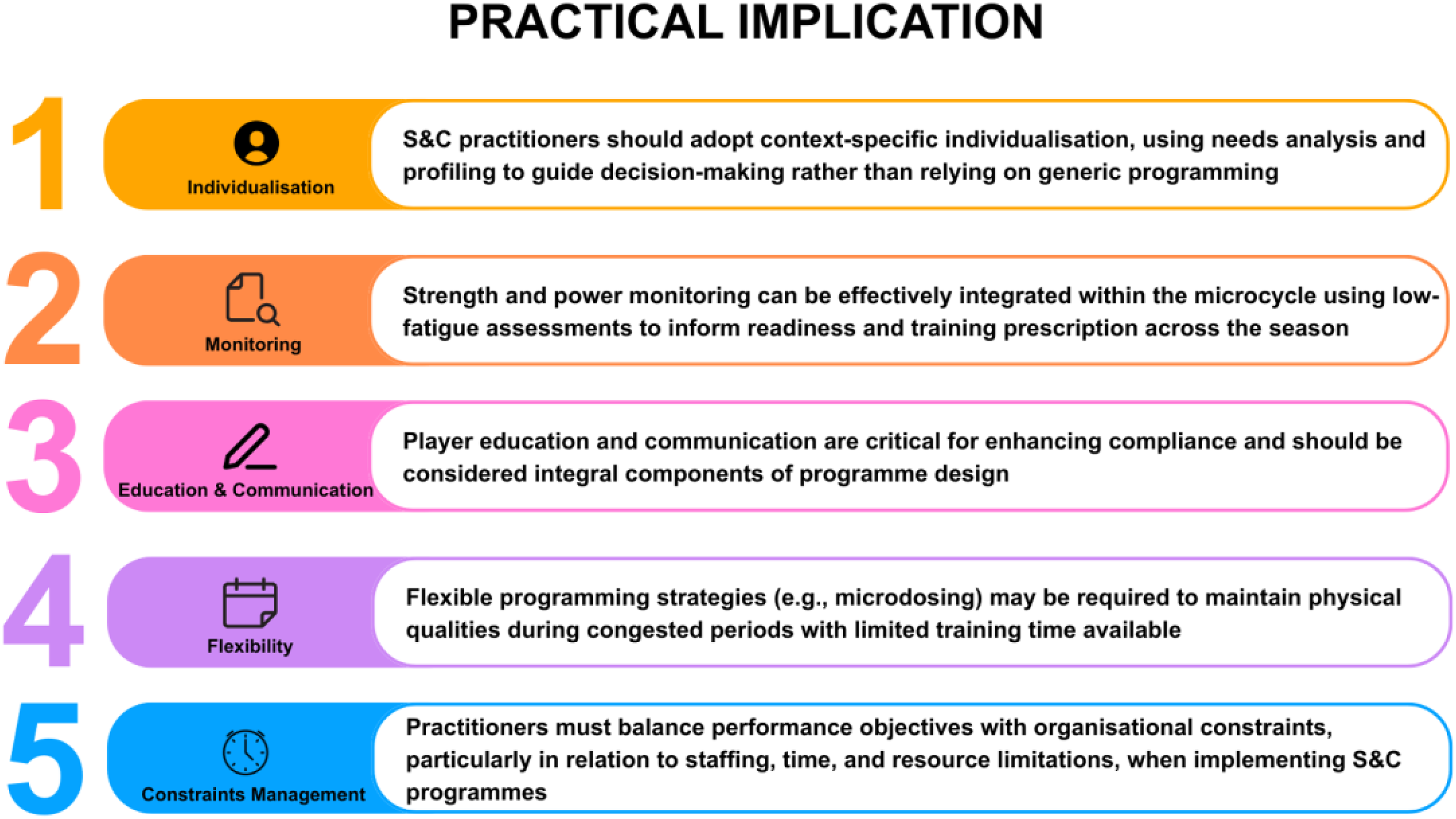
Summary of practical implications of this study.
Supplemental Material
sj-docx-1-spo-10.1177_17479541261457478 - Supplemental material for “Strength and power are no longer optional”: Contemporary strength and conditioning practice in an English Premier League first team
Supplemental material, sj-docx-1-spo-10.1177_17479541261457478 for “Strength and power are no longer optional”: Contemporary strength and conditioning practice in an English Premier League first team by Daeeun Kweon, Ryland Morgans, Owen Thomas, Jon Oliver, Rafael Oliveira, Ben Ryan and John Radnor in International Journal of Sports Science & Coaching
Footnotes
Acknowledgements
The authors would like to thank the practitioners who participated in the study.

Ethical considerations
The current study was approved by Cardiff Metropolitan University Ethics Framework, the Cardiff School of Sport and Health Sciences (Approval Code: PGR-9007). All participants were fully anonymised and provided verbal informed consent before taking part in the study.
Consent to participate
Written participant consent was gained before conducting the semi-structured interview. Participant information has been anonymised for the purpose of the current study.
Consent for publication
Written participant consent was gained before conducting the semi-structured interview. Club consent was also provided with the final draft of the manuscript.
Author contributions credit
Funding
The authors disclosed receipt of the following financial support for the research, authorship, and/or publication of this article: This study was funded by Brentford FC Football Club.
Declaration of conflicting interests
The authors declared the following potential conflicts of interest with respect to the research, authorship, and/or publication of this article: The Principal Investigator (DK) was embedded within the first team during the data collection of this study. The authors report no other conflict of interest.
Supplemental material
Supplemental material for this article is available online.
References
Supplementary Material
Please find the following supplemental material available below.
For Open Access articles published under a Creative Commons License, all supplemental material carries the same license as the article it is associated with.
For non-Open Access articles published, all supplemental material carries a non-exclusive license, and permission requests for re-use of supplemental material or any part of supplemental material shall be sent directly to the copyright owner as specified in the copyright notice associated with the article.
