







Abstract
The aim of this study was to examine the influence of biological maturation on physical capacities and competitive performance in young surfers by analyzing groups under and over 16 years of age during an official surfing competition. Twenty-six surfers were divided into two groups: under 16 years (n = 15) and over 16 years (n = 11). Maturity Offset (MO), Countermovement Jump (CMJ; height, relative power), Medicine Ball Throw (MBT), fat percentage, and Total Heat Score (THS; sum of the two highest wave scores) were assessed. Pearson's correlation and multiple linear regression analyses were used to examine associations between variables. Among surfers under 16, MO showed significant correlations with MBT (r = 0.66), CMJ height (r = 0.59), CMJ power (r = 0.90), and relative CMJ power (r = 0.75). THS correlated positively with CMJ height (r = 0.52) and relative CMJ power (r = 0.52). In surfers over 16, no significant correlations were found between variables. Biological maturation significantly influences muscle power in surfers under 16, indirectly affecting competitive performance. After this age, maturation effects appear attenuated as other factors such as technical-tactical abilities become decisive for success. Results suggest caution in talent selection based solely on competitive results.
Keywords
Introduction
Surfing, once primarily associated with leisure activity, has gained substantial scientific attention over recent decades, driven in part by its inclusion in the Olympic program. 1 This growing interest is reflected in an expanding body of research covering physiological demands, injury patterns, and technological developments within the sport.2–4 Among these determinants, physical capacities, particularly muscle strength and power, play a critical role, as they are essential for performing major maneuvers and achieving competitive success in surfing.5–7 These capacities develop progressively with chronological age and biological maturation, exerting a direct influence on the athletic performance of young surfers.8,9 With advancing maturation, substantial gains in these physical capacities are typically observed, enhancing performance in specific strength and power tests. Consequently, athletes in more advanced maturational stages tend to exhibit superior athletic performance. 10
Biological maturation, defined as the progression toward structural and functional maturity of the organism, 11 occurs nonlinearly among individuals of the same chronological age. This process involves hormonal, morphological, and neuromuscular adaptations that directly influence physical performance.12,13 It typically occurs in boys aged 10 to 18, with the greatest growth acceleration, represented by the peak height velocity (PHV), usually between 13 and 15 years of age.11,14,15 In sport, early maturation can confer temporary advantages in height, body composition, and muscle strength,8,16 often resulting in the prioritization of more mature athletes during the early phases of talent selection. Such favoritism, if not mediated, may compromise the talent development process and create disadvantages for late-maturing individuals.12,17 To address this, non-invasive anthropometric formulas, such as the maturity offset equation proposed by Mirwald et al. (2002), 18 have emerged as cost-effective and practical alternatives to radiographic gold standards methods for field-based assessments.11,19 While these predictive models are subject to inherent biases, current literature19,20 supports their use for categorical group stratification (e.g., pre-, circum-, or post-PHV) rather than as definitive individual markers of maturation.
Although consolidated evidence supports the influence of biological maturation on the athletic performance of young athletes, research examining its effects in competitive surfing remains limited. 9 The sport requires dynamic balance, strength, and muscle power combined with specific technical and tactical skills performed in a natural and unstable environment, which makes it difficult to extrapolate findings directly from other sports.6,9,21 As markers of biological maturation have been identified as predictors of muscle strength and power in adolescent athletes, 22 the lack of control over this variable may lead to biased interpretations of performance, favoring more mature athletes. This gap reinforces the need for studies that consider the effects of biological maturation on physical and competitive performance in young surfers. Evidence from other sports suggests that the effects of maturation on muscle strength and power are more pronounced up to approximately 16 years of age (especially in males), a period marked by wide variability among individuals in terms of maturation stage.16,23 Beyond this age, adolescents tend to show greater homogeneity, with reduced biological heterogeneity and consequent stabilization of physical indicators, leading performance to reflect training and experience more than the maturation stage.9,13
Previous studies indicate that, in surfing, lower limb muscle power is directly related to the ability to perform expressive maneuvers, 24 maintain wave-riding speed, 21 and achieve a higher competitive level. 25 Moreover, among young surfers, muscle power and lean mass percentage are greater in athletes selected for national teams, suggesting that these characteristics may help identify those with greater competitive potential. 26 Thus, considering that biological maturation influences the development of these capacities, athletes in more advanced stages tend to have competitive advantages, particularly when combined with technical and tactical skills. In this context, and given that the strength and power of major maneuvers are among the judging criteria in competitive surfing, 27 understanding the effects of maturation on physical and sport-specific performance is crucial for building a healthy trajectory in talent development. Accordingly, this study aimed to investigate the influence of biological maturation on muscle power, competitive performance, and body composition in young male surfers under and over 16 years of age.
Methods
Design
This cross-sectional, quantitative, and descriptive study was conducted during a stage of the São Paulo School Surfing Championship, held at José Menino Beach, in the city of Santos. According to the website https://windguru.cz, weather conditions on the day of data collection included waves between 0.8 and 1.0 m in height, winds of 5 to 7 knots, and air temperatures ranging from 21°C to 24°C. The research procedures were authorized by the São Paulo Surfing Federation. Athletes who volunteered for participation were those who accepted the official invitation announced by the event's technical staff through the beach announcer.
Physical testing, consisting of vertical jump and medicine ball throw assessments, as well as anthropometric measurements to collect data on body mass, height, sitting height, and body composition for biological maturation estimation, lasted approximately 45 min. The indicator of competitive performance was the total heat score (THS), defined as the sum of the two highest wave scores obtained in each athlete's best heat.
Subjects
Twenty-six male youth athletes were evaluated and divided into two groups: under 16 years of age (n = 15; 13.67 ± 2.07 years, 53.06 ± 13.82 kg, 160.91 ± 14.44 cm) and over 16 years of age (n = 11; 17.70 ± 0.94 years, 65.30 ± 6.31 kg, 173.93 ± 7.40 cm). The 16-year-old threshold was selected based on evidence suggesting that maturational variability is most pronounced up to this age,11,15 followed by a period of biological stabilization where performance is more influenced by training and experience.9,11 By using this cut-off, we aimed to capture the impact of maturational diversity in a real-world competitive scenario where surfers of different biological statuses are grouped together. To be included in the study, athletes had to be registered for the event, be free of injuries in the last 3 months and of any medical contraindication for performing high-intensity activities, and complete a medical history questionnaire to record information about health status, injury history, and training. All athletes were informed about the study procedures and, as they were minors, a legal guardian also signed the informed consent form, in accordance with Resolution 466/12 of the National Health Council. The study was conducted in accordance with the Declaration of Helsinki (2013) and approved by the Research Ethics Committee of the Federal University of São Paulo (CEP/UNIFESP n° 1027/2022, opinion n° 5.898.824).
Procedures
Anthropometric characteristics
Body mass and body composition were analyzed using a bioelectrical impedance scale (BC-558 Ironman Segmental Body Composition Monitor – Tanita Corp., Tokyo, Japan). Participants were asked to urinate approximately 30 min before the test, to be barefoot, to wear dry clothes, and to remove all metal adornments, procedures recommended to minimize possible errors in estimating body fat percentage.28,29 In addition, height and sitting height values were collected (SANNY® stadiometer; accuracy = 0.1 cm) according to Lohman, Roche, and Martorell (1998).
Maturation
The maturity offset (MO), defined as the distance in years from peak height velocity (PHV), was used to estimate biological maturation. It was calculated using the predictive equation proposed by Mirwald et al., (2002), which incorporates standing height, sitting height, body mass, and lower limb length: MO (years) = –9.236 + 0.0002708 × (leg length × sitting height) – 0.001663 × (age × leg length) + 0.007216 × (age × sitting height) + 0.02292 × (body mass / sitting height × 100). The MO represents the difference, in years, between the athlete's chronological age at assessment and the estimated age at PHV. Negative values indicate that the athlete has not yet reached PHV, whereas positive values indicate that PHV has already been reached. The age at peak height velocity (APHV) was then obtained by subtracting the MO from chronological age, representing the moment of greatest acceleration in growth during adolescence. 11
Lower limb power
Lower limb muscle power was assessed using the countermovement jump (CMJ) on a contact platform (Jumptest, Hidrofit Ltda., Belo Horizonte, Brazil; 50 × 60 cm), connected to the Multisprint software (Hidrofit Ltda.). The validity and reliability of this system have been previously established against a force platform, showing correlation coefficients of r = 0.82–0.83. 30
Before the evaluation, athletes performed a standardized warm-up protocol consisting of dynamic stretching and three submaximal jump attempts to familiarize themselves with the equipment and testing procedure. Each athlete then completed three CMJ attempts with a one-minute rest between repetitions, and the highest jump was used for analysis. During the test, athletes began from a standing position with their hands on their waist, avoiding arm movement, and performed a knee flexion movement immediately followed by a maximum vertical jump, using the stretch-shortening cycle spontaneously. 31 Jump height was determined from the flight time recorded by the platform, and absolute and relative power (W/kg) were automatically calculated by the software. To ensure standardization of execution, athletes were instructed to perform the squat phase continuously and without pauses, maintain hand position, and maximize the vertical jump using the stretch-shortening cycle. 31
Upper limb power
Upper limb power was assessed using a seated medicine ball throw with a 2-kg ball (21.5 cm in diameter). Athletes sat on the floor with their backs against the wall and performed a two-handed forward throw from chest height. The distance was measured from the wall to the first point of contact between the ball and the floor. Each participant performed three throws with a one-minute rest between attempts, and the best distance was used for analysis. The ball was covered with magnesium carbonate to improve grip and measurement precision, and athletes were instructed to maintain full back contact with the wall to prevent the use of hip momentum during execution.32,33
Competitive performance evaluation
According to the official surfing scoring system, judges assign scores from zero to ten for each wave surfed during a heat, based on criteria such as the degree of difficulty of maneuvers performed with speed, power and flow. 34 In each heat, the competitor's final result is determined by summing the two highest scores, defined as the Total Heat Score (THS). Recognizing that environmental variables such as tide, swell, and wind are inherent to surfing, each athlete's highest THS recorded across all rounds was used as the indicator of competitive performance. Rather than assuming perfectly standardized conditions, this approach was intended to represent the surfer's highest competitive performance within the ecological context of the event, reflecting the ability to achieve high-scoring maneuvers under varying competitive constraints, according to official judging criteria.27,34
Statistical analysis
Results are presented as mean ± standard deviation (SD). The sample size was calculated using G*Power software (version 3.1.9.6), adopting Pearson correlation coefficients reported by Perejmibida et al. (2023) 9 as reference values. Statistical power was set at 80%, and the significance level at α = 0.05. The calculation indicated a sample of 11 individuals per group. Normality was assessed using the Shapiro–Wilk test (p > 0.05), complemented by visual inspection of Q–Q plots to confirm adherence to the assumption of normal distribution.
The associations between variables were examined in both groups using the Pearson correlation coefficient (r), interpreted according to the following magnitude thresholds: trivial (< 0.10), small (0.10–0.29), moderate (0.30–0.49), large (0.50–0.69), very large (0.70–0.90), and almost perfect (> 0.90). 35 A multiple linear regression model was performed in the under-16 group to identify the combined contribution of physical performance variables to competitive performance. THS was entered as the dependent variable, while CMJ, body fat percentage, and MBT were included as independent variables. Model assumptions were verified prior to the regression analysis, including normality of residuals, absence of multicollinearity, and homoscedasticity. The level of significance adopted was p < 0.05. The statistical analyses were conducted using Statistical Package for the Social Sciences (SPSS) software, version 27, for Windows 10.
Results
The results of the descriptive statistics of the variables studied are presented in Table 1. Pearson's linear correlation analyses between biological maturation, physical abilities, anthropometric variables, and competitive performance are shown in Tables 2 and 3, separated according to the age group of the participants.
Descriptive statistics of all variables.
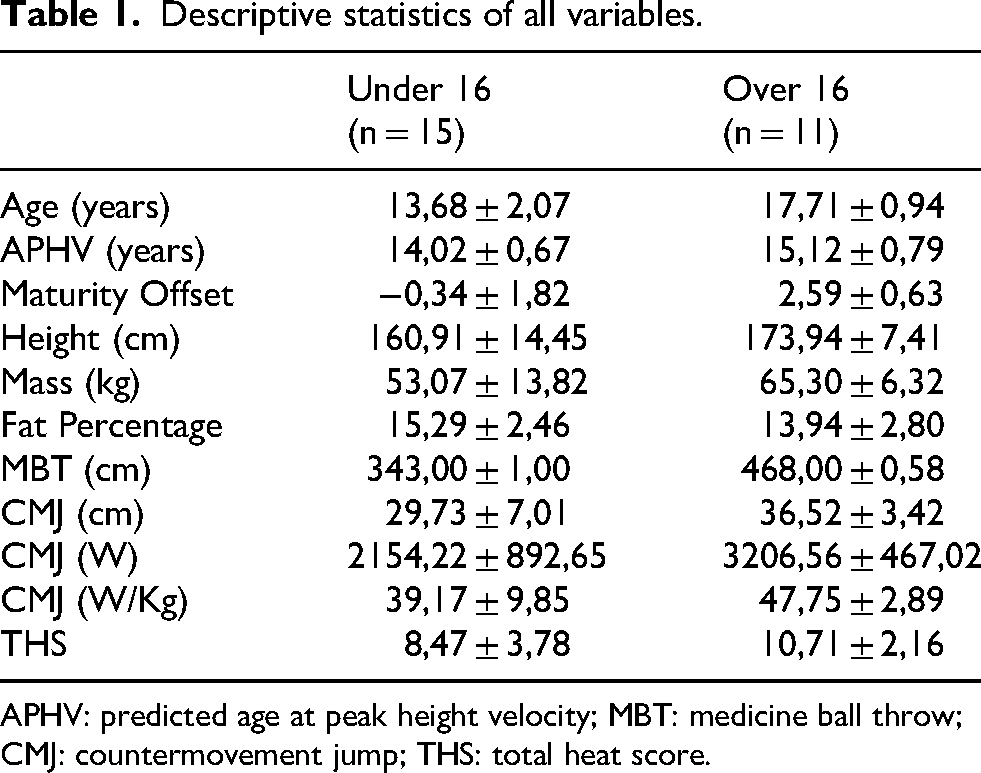
APHV: predicted age at peak height velocity; MBT: medicine ball throw; CMJ: countermovement jump; THS: total heat score.
Correlations between biological maturation, physical capacities, anthropometric variables, and competitive performance among surfers under 16 years of age.
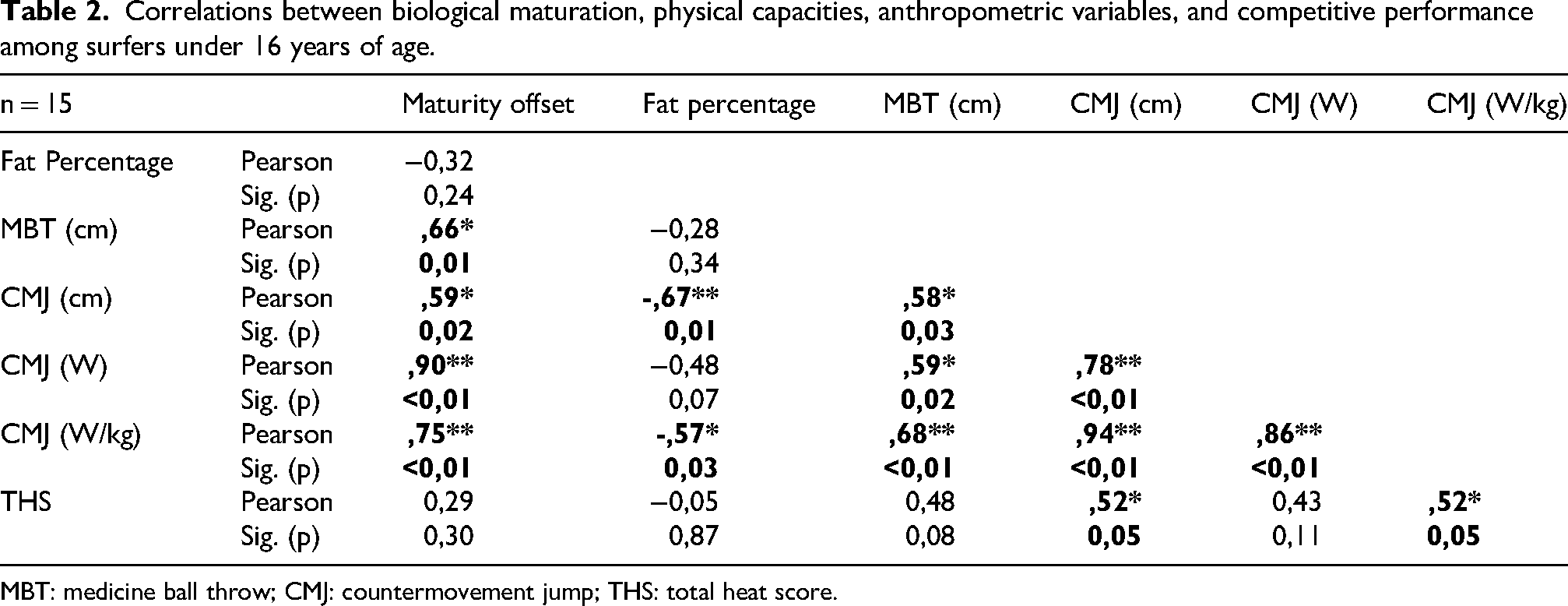
MBT: medicine ball throw; CMJ: countermovement jump; THS: total heat score.
Correlations between biological maturation, physical capacities, anthropometric variables, and competitive performance among surfers over 16 years of age.
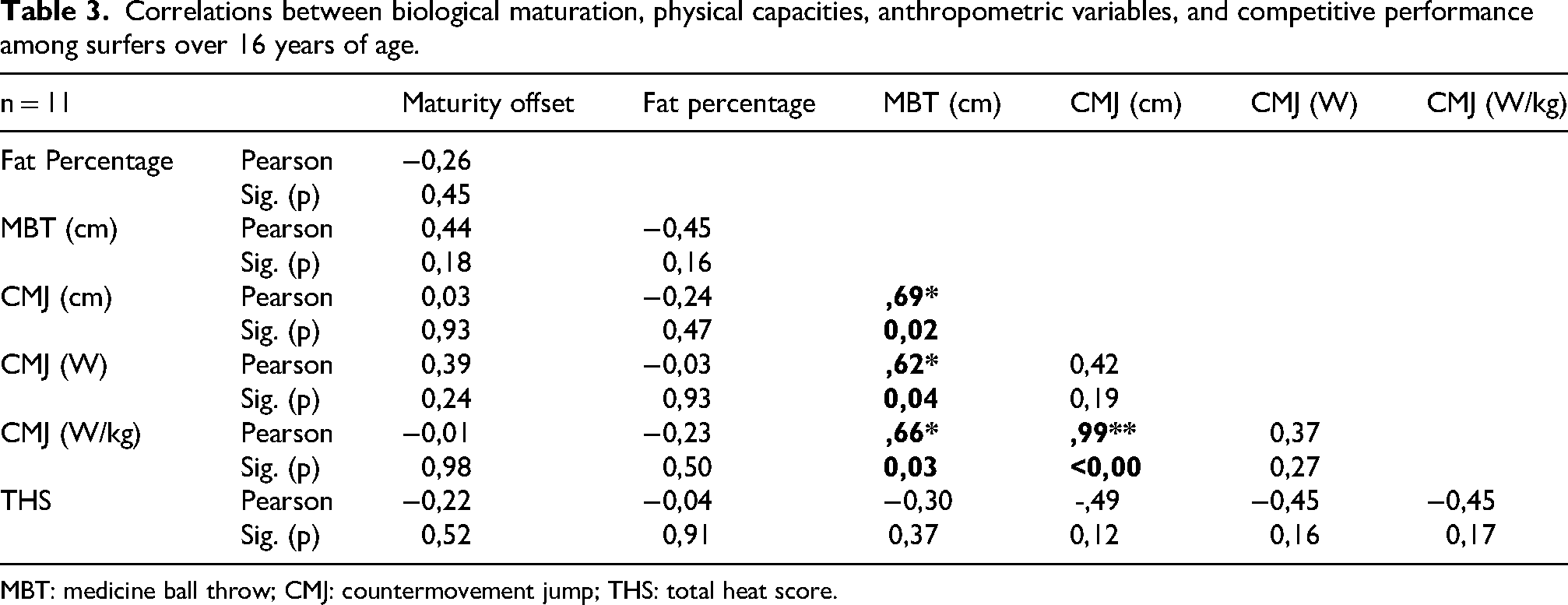
MBT: medicine ball throw; CMJ: countermovement jump; THS: total heat score.
Multiple regression model predicting competitive performance in surfers under 16 years of age (n = 15).
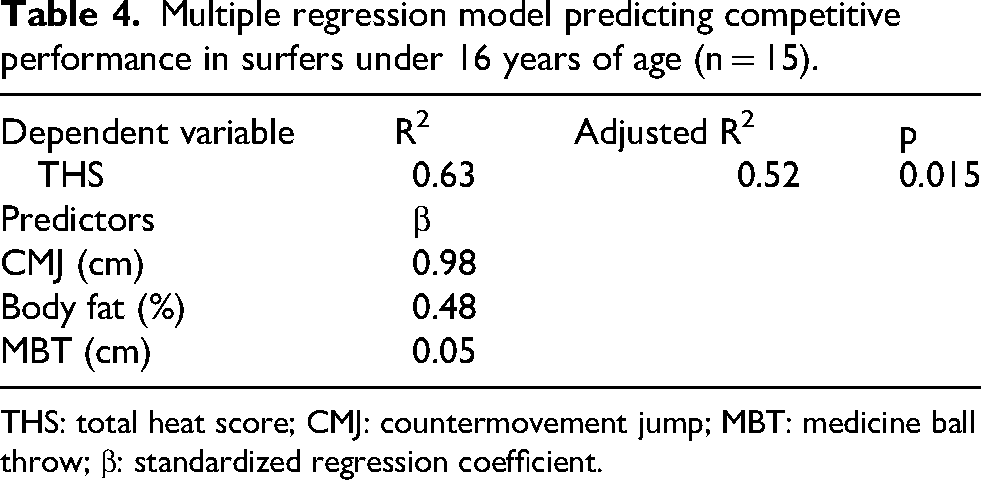
THS: total heat score; CMJ: countermovement jump; MBT: medicine ball throw; β: standardized regression coefficient.
Among surfers under 16 years old (Table 2), large correlations were found between MO and performance in the MBT (r = 0.66; p = 0.01) and the CMJ (r = 0.58; p = 0.03). Very large correlations were also observed between MO and absolute CMJ power (r = 0.90; p < 0.01), as well as between MO and relative CMJ power (r = 0.75; p < 0.01). Regarding competitive performance (THS), large correlations were identified with CMJ jump height (r = 0.52; p = 0.05) and relative CMJ power (r = 0.52; p = 0.05), although these values are at the lower boundary of the large magnitude classification (Figure 1).
Relationship between CMJ height and total heat score (A), and maturity offset (B) among surfers under 16 years of age. CMJ: countermovement jump.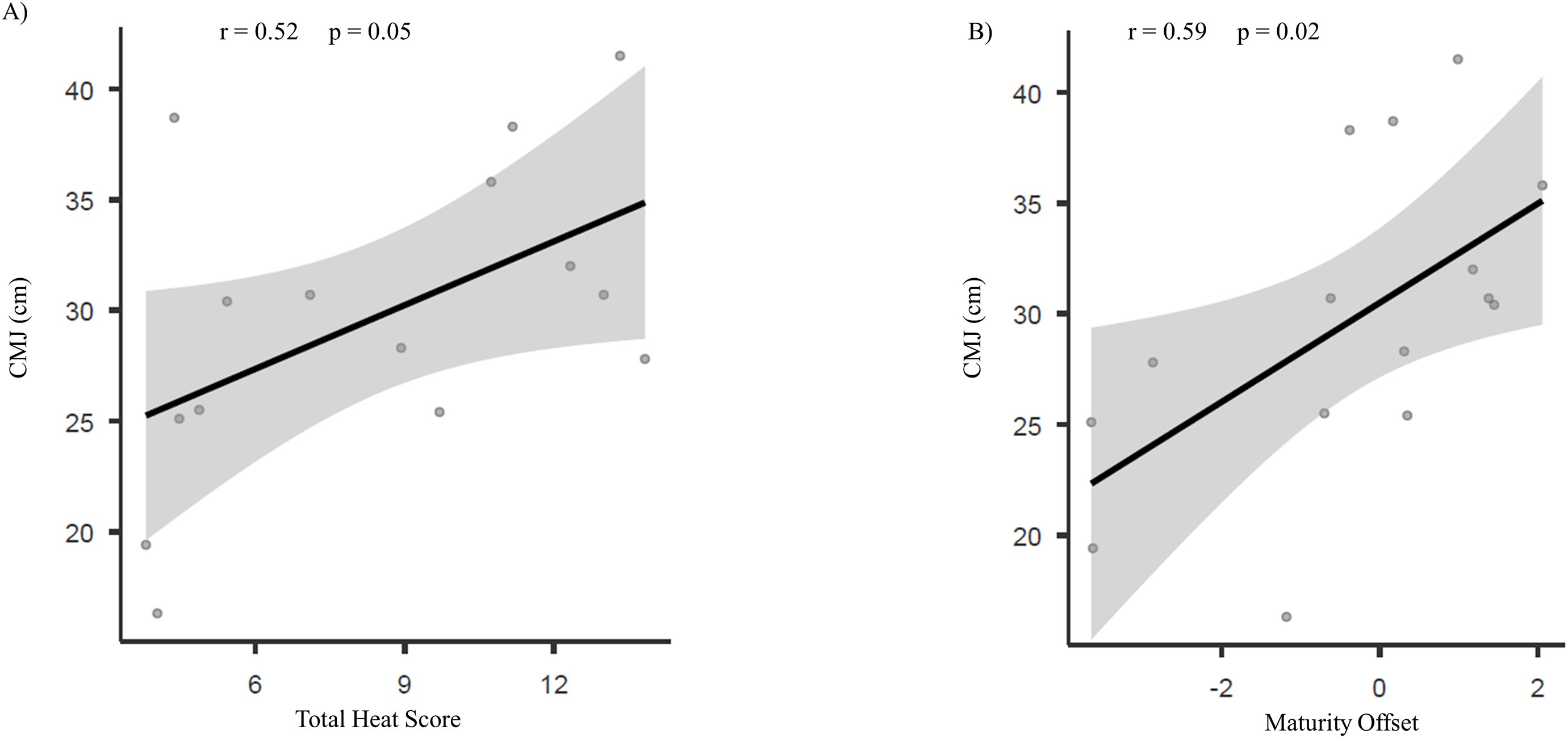
Among surfers over 16 years old (Table 3), no statistically significant correlations were found between biological maturation, physical capacities, anthropometric variables, and competitive performance. However, a significant correlation was observed between the CMJ and the MBT.
A multiple linear regression analysis was conducted among surfers under 16 years of age to verify the combined association of physical performance variables with competitive performance (THS), as presented in Table 4. The model was statistically significant (p = 0.015) and explained 63% of the variance in THS (R2), with an adjusted R2 of 52%. CMJ (cm) presented the highest explanatory contribution within the model, followed by body fat percentage. Although MBT did not demonstrate an independent contribution, its inclusion was associated with a higher overall model fit.
Discussion
The main findings revealed significant correlations between stages of biological maturation and muscle power indicators in the group under 16 years old, with associations ranging from the boundary between moderate and large to very large magnitudes, particularly for the lower-limb power. Additionally, significant correlations were observed between muscle power and competitive performance, suggesting that greater muscle power capacity is related to better heat results. This relationship was further supported by the regression model, in which lower-limb muscle power emerged as the primary explanatory factor for competitive performance. However, no direct association was found between biological maturation and competitive performance, indicating that maturation is positively related to muscle power, which in turn is associated with competitive performance, yet this does not imply a causal relationship between maturation and performance. These findings suggest that biological maturation exerts a modulating effect on physical capacities throughout adolescence, especially among athletes under 16 years old, a phase characterized by greater variability in maturation stages, as these correlations were not observed in the group over 16 years old.
It is important to note that while chronological age naturally progresses alongside biological maturation, the strong correlations observed between maturity offset and muscle power in the Under-16 group, and their absence in the Over-16 group, suggest that developmental status plays a particularly relevant role during the ‘turbulent’ phase of adolescence. This period is typically associated with proximity to peak height velocity (PHV), during which rapid growth and neuromuscular development may enhance the expression of strength and power.15,16 Notably, the Under-16 group in the present study presented a mean maturity offset of −0.34 ± 1.82 years (Table 1), placing these athletes within the ‘circum-PHV’ window, typically defined as ±1 year from the peak. This stage is characterized by high biological variability and heightened sensitivity to training adaptations,11,15 which may partly explain the stronger associations observed between biological maturation and muscle power.
The Under-16 group included athletes across a broad age range and, consequently, across different maturational stages, from early to late matures. This reflects the ecological reality of youth surfing competitions, in which athletes with different biological profiles compete within the same age-based categories. Furthermore, in Brazilian youth competitions, it is common for younger athletes, such as Under-14, to compete in higher age categories, such as Under-16, further increasing maturational heterogeneity within these groups. In this context, more biologically mature athletes may present physical advantages that contribute to performance differences, particularly in strength- and power-related tasks, which may influence talent selection if biological age is not considered.11,36 In contrast, athletes in the Over-16 group are more likely to have already passed the most turbulent stages of the adolescent growth spurt and are approaching biological stability. At this stage, maturational variability decreases, and the influence of biological maturation on performance appears attenuated. Consequently, technical and tactical skills, training age, and competitive experience may become the primary determinants of performance.11,14,15
Regarding fat percentage, negative correlations were observed with relative CMJ power in the under-16 group, indicating that individuals with lower body fat exhibit greater lower-limb power, a variable that was positively associated with competitive performance. Similarly, Barlow et al., (2014) 37 reported negative associations between endomorphy, sum of skinfolds, and surfers’ skill level, as well as positive correlations for mesomorphy. Furthermore, Fernandez-Gamboa et al., (2017) 25 identified lower fat percentage and higher CMJ values in surfers ranked higher in competition, and Tran et al. (2015) 26 found that junior athletes selected for the national team showed a higher lean mass-to-skinfold ratio compared to those not selected. Conversely, Perejmibida et al. (2023) 9 reported no significant associations between the sum of seven skinfolds and power variables among male adolescent surfers. Overall, these findings suggest that lower adiposity levels favor greater CMJ performance and may influence competitive success only indirectly, since, in this sample, fat percentage did not correlate directly with the THS. This interpretation was later evidenced in the regression analysis, in which body fat percentage contributed to the model explaining competitive performance.
In the present study, CMJ height and relative CMJ power correlated positively with competitive performance only in the group under 16 years old, while this relationship was not observed among surfers over 16 years old. This was further corroborated by the regression analysis, in which CMJ represented the main explanatory component of competitive performance in surfers under 16 years of age. Similar findings were reported by Secomb et al. (2015), 24 who found a large correlation between CMJ and the score attributed to the quality of maneuvers performed by elite surfers, and by Souza and Guerra (2024), who described associations between CMJ and speed achieved by professional surfers in simulated competitions. Other studies reinforce the relationship between power and competitive level, showing that surfers ranked among the top 50 record higher CMJ values compared with lower-ranked athletes 25 and that junior athletes selected for the national team exhibit higher CMJ than those not selected. 26 Although in the present study upper-limb power measured by MBT was related only to maturation stage, without a significant correlation with THS, Sheppard et al., (2012) 38 demonstrated that relative strength in the pull-up was very largely correlated with paddling sprint speed, indicating that upper-limb power may contribute to specific aspects of surfing performance, such as priority disputes and wave-entry speed. Therefore, these findings reinforce the idea that muscle power plays a relevant role in competitive success in both youth and high-performance categories, although its relative importance varies according to developmental stage and competitive level.
The results also revealed that biological maturation was largely to very largely correlated with lower-limb power among surfers under 16 years old. Similar results have been described in adolescents from different sports, where more mature athletes achieved higher CMJ values than their less mature peers.13,39,40 Evidence from systematic reviews and meta-analyses reinforces the effects of maturation on strength and power tests among athletes of the same chronological age.15,16 However, this advantage gradually declines after the age of 16, when biological maturation reaches its final stages and factors related to trainability become more influential.11,14 In adolescent surfers specifically, Perejmibida et al. (2023) 9 also identified significant correlations between maturation and CMJ (r = 0.75). However, they did not assess whether such gains in power were directly reflected in sports performance, although they emphasized the importance of developing these and other physical abilities in young surfers. Thus, by demonstrating that muscle power correlates with scores obtained in heats, the present study provides additional evidence suggesting that maturation indirectly affects competitive performance, mediated by lower-limb power. In other sports, this association between biological maturation and competitive performance has been consistently observed, with its relevance highlighted in several studies.10,23,41,42
The temporary nature of the maturational advantage observed up to the age of 16, particularly in males, raises questions about selection processes that are based on physical criteria or early competitive results without considering the multifactorial complexity of talent from a long-term perspective. A systematic review quantified the junior-to-senior transition and found that only about 30% of athletes competing internationally in youth categories maintain equivalent performance in adulthood, a proportion that drops to approximately 6% when focusing on younger age groups similar to the present sample. 43 A comparable result was reported by Barreiros et al., (2014), 44 who found that only one-third of pre-junior athletes progressed to senior teams. A meta-analysis by Güllich & Barth, (2024) 45 also showed that while elite junior athletes entered talent promotion programs earlier, elite senior athletes typically started later, suggesting divergent developmental trajectories. This pattern indicates that early selection does not necessarily identify those who will achieve superior competitive performance in adulthood, calling for caution regarding biases that favor biologically advanced athletes in youth stages.17,36 Furthermore, routine monitoring of biological age is recommended to prevent the exclusion of late maturers, as emphasized by Müller et al. (2015). 12
Despite the care taken in the design and execution of this study, some limitations should be acknowledged. The estimation of biological age through the maturity offset equation used in this study is subject to an estimated error of about 0.6 to 1.0 year.11,20 Furthermore, the use of predictive equations remains contentious due to inherent statistical limitations and systematic errors, such as regression to the mean.19,20,46 Additional methodological robustness may have been achieved through the inclusion of biological parental stature using the Khamis-Roche method, which would allow the assessment of both maturity offset and percentage of predicted adult stature, potentially enhancing prediction validity.47,48 However, obtaining accurate parental data was not logistically feasible during a single-day competitive event.
In addition, body composition was assessed by bioelectrical impedance, a method sensitive to hydration status, caffeine or carbonated beverage intake, and recent physical exercise.28,29 Although participants were provided with standardized pre-assessment instructions, these variables could not be fully controlled. Importantly, competitive surfing performance and THS are inherently influenced by dynamic environmental conditions such as swell, tide, and wind, which could not be fully standardized across heats during the competition. Furthermore, the sample included only male surfers from a single competition, which limits the generalization of the findings. Future research should include female athletes and adopt more rigorous protocols for assessing body composition, as well as longitudinal designs capable of examining trajectories that integrate maturation, body composition, muscle power, and sports performance.
Practical applications
This study indicates that surfers with earlier maturation, particularly those under 16 years of age, tend to exhibit greater muscle power, capacity positively associated with competitive performance. Therefore, coaches and surfing professionals should monitor biological age to prevent early talent selection that may compromise the long-term development of athletes with temporarily lower performance, since technical, tactical, and cognitive factors become increasingly decisive over time. Moreover, muscle power should be continuously monitored and developed through accessible tools such as the CMJ, which appears as a key physical marker associated with competitive performance, along with lean mass and technical–tactical performance assessments. In this context, talent programs should adopt a holistic approach, avoiding selection based solely on immediate competitive results, which do not ensure future success. Consequently, investing in coach development is essential to cultivate critical thinking and enable the identification of potential talents at different maturation stages, including late maturers. This process should avoid early exclusion and ensure continuous support for all young athletes, since it is not possible to predict in advance who will ultimately confirm themselves as sporting talent.
Conclusion
Biological maturation showed significant associations with muscle power, particularly in the lower limbs, among surfers under 16 years of age. This capacity, in turn, correlated positively with competitive performance, suggesting that maturation exerts an indirect influence on competitive outcomes through its effects on muscle power. These findings indicate that the impact of maturation is more pronounced at earlier ages and tends to diminish as surfers progress in their development, when technical–tactical skills, accumulated experience, and other physical and cognitive factors become increasingly decisive for competitive success.
Footnotes
Acknowledgments
The authors would like to thank all participants and the technical staff involved in the athletes’ preparation and the event, as well as the Paulista Surfing Federation, for their cooperation. No financial support was received for the conduct of this study, and the authors declare that they have no conflicts of interest relevant to the content of this research; additionally, during the preparation of this manuscript, the authors used ChatGPT (OpenAI, GPT-4.1) to assist in improving language clarity, grammar, and overall readability. The AI tool did not generate original scientific content, perform data analysis, or interpret results, and all content was critically reviewed, edited, and approved by the authors, who take full responsibility for the final version of the manuscript.

Ethical considerations
This study was approved by the Research Ethics Committee of the Federal University of São Paulo (CEP/UNIFESP n° 1027/2022, opinion n° 5.898.824) and conducted in accordance with the Declaration of Helsinki.
Consent to participate
Informed consent was obtained from all individual participants included in the study. Since the participants were minors, written informed consent was also obtained from their legal guardians.
Consent for publication
Not applicable.
Authors’ contributions
Substantial contributions to the conception and design of the study, analysis, and interpretation of data: Pedro C. Souza, Ricardo L. F. Guerra.Data collection: Pedro C. Souza, Kaio M. Hamad, Marcel F. Santos. Statistical analyses: Pedro C. Souza, Kaio M. Hamad. Drafting the manuscript or revising it critically for important intellectual content and final approval of the version to be published: Pedro C. Souza, Ricardo L. F. Guerra, Kaio M. Hamad, Marcel F. Santos.
Funding
The authors received no financial support for the research, authorship, and/or publication of this article.
Declaration of conflicting interests
The authors declared no potential conflicts of interest with respect to the research, authorship, and/or publication of this article.
Data availability
The datasets generated and/or analyzed during the current study are available from the corresponding author on reasonable request.