






Abstract
Sports participation offers many benefits to adolescents and is influenced by grit, which is defined as the passion and perseverance required to achieve long-term goals, and athletic identity (AI), which is defined as the degree of personal connection to sport. More specifically, evidence suggests that both AI and grit independently facilitate benefits, such as teamwork and long-term success, but little is known about how the interaction between AI and grit may impact adolescent athletes. The purpose of this study was to evaluate the relationship between AI and grit and examine how AI and grit varied by gender, sport participation, specialization, and injury status amongst adolescent athletes. Through a cross-sectional survey study, we examined the correlation between grit and AI, and compared grit and AI between gender, sport participation, specialization, and injury status. There was no significant relationship between AI and grit (rho = −0.09, p = 0.36). There were no significant differences between genders in AI and grit (U = 1214, p = 0.49; U = 1354.5, p = 0.82). Team sport and more specialized athletes had stronger AI than individual sport and less specialized athletes (U = 971, p = 0.02; H = 4.43, p = 0.04). Injured athletes and athletes who practiced 1–6 h per week had higher grit than those who were uninjured and practiced more (U = 637.5, p < 0.001; H = 11.28, p = 0.046). Collectively, these data can inform targeted interventions to cultivate and promote the benefits of AI and grit in adolescent athletes.
Introduction
Sports participation amongst youth and adolescents offers a variety of benefits, ranging from establishing exercise routines to developing strong leadership skills. 1 Some of these benefits are thought to be modulated, at least in part, by athletic identity (AI), which is defined as the degree of personal connection to sport.1,2 Originally defined in 1991, evidence suggests AI is associated with commitment to training and sport goal orientation, higher performance outcomes, and greater enjoyment of sports. 3 In adolescents specifically, AI protects against burnout, but amongst injured athletes, stronger AI may increase risk of depression. 4 Several studies have shown that AI is modulated by sport type, sports specialization, and injury status.5–7 Studies have suggested that athletes who play team sports, are more specialized, or are not injured have stronger AI than their counterparts.5–7
Grit, which is defined as the perseverance and passion to pursue long-term goals despite adversity and setbacks, has been associated with improved sports performance, less burnout, and higher optimism amongst athletes. 8 Grit can be measured via the Short Grit Scale 9 and has been shown to have high predictive power in determining who successfully completes Navy Seals Training, sales representatives remaining in their job, students graduating from high school, academic achievement, and recovery from burnout.10–12 A recent scoping review of grit in sport also demonstrated that grit amongst athletes is associated with greater sports performance, adoption of a growth-mindset, as well as decreased burnout and anxiety. 8
While both AI and grit have been shown to independently help facilitate success in youth athletes, little is known about how the interaction between AI and grit may impact athletes. Additionally, we do not know how factors like gender, sport participation, sport specialization, and injury status are related to grit and AI among adolescent athletes. Understanding these relationships allows for the identification of protective and threatening factors, as well as the development of tailored interventions to support vulnerable athletes. The primary aim of this study was to examine the association between AI and grit among adolescent athletes, while the secondary aims were to assess how AI and grit varied by gender, sport participation, sport specialization, and injury status. We hypothesized that (1) athletes with stronger AI would have higher grit, (2) AI and grit would not differ between genders, (3) highly specialized athletes and those who train and compete more hours per week would have higher grit and AI than unspecialized athletes and those who train less, (4) team sport athletes would have stronger AI but no differences in grit compared to individual sport athletes, and (5) injured athletes would have lower AI and grit than uninjured athletes.
Methods
Study participants
Eligible participants were 12–19 years old and actively participating in at least one organized sport at any level of play, including high school, club team, or recreational league. Participants were recruited via distribution of informational research flyers in sports medicine clinics and physical therapy gyms. The flyer included a QR code that patients could scan which would take them to the eligibility screening questions, electronic postcard consent form, and the study questionnaires. Local Institutional Review Board (IRB) approval was obtained. An IRB-approved electronic postcard consent form was used to obtain assent/consent from participants and a parent or legal guardian for those under the age of 18 years. Survey responses were collected from March 2024 to July 2025.
Study questionnaire
This was a cross-sectional study with data collection via an electronic questionnaire, and the survey is available in Appendix 1. In addition to obtaining demographic and sports participation data, the questionnaire completed by participants included several established and validated surveys within adolescent populations. These questionnaires included the sports specialization survey, 13 the Short Grit Scale (Grit-S), 9 the Athlete Identity Measurement Scale (AIMS),2,14 and the Oslo Sports Trauma Research Center (OSTRC) on Health Problems Questionnaire −2.15,16 The questionnaire was first piloted with 10 participants to verify that the length and combination of these surveys was still understandable and manageable for adolescents.
Sports specialization
Participants reported if they have a primary sport that is more important than other sports (yes/no), whether they quit other sports to focus on their primary sport (yes/no), and whether they train more than 8 months per year in their primary sport (yes/no). Those who responded “yes” to 0–1 questions were categorized as low specialized, “yes” to 2 questions were categorized as moderately specialized, and “yes” to all 3 questions were categorized as highly specialized. 13
Grit
The Grit-S is an 8-item questionnaire developed from the original 12-item grit scale, shown to be a more efficient and psychometrically stronger measure of grit than the original scale, and validated in adolescence. 9 Participants responded to how different statements about grit applied to them using a 5-point Likert scale, rating them from “Not like me at all” to “Very much like me”. Examples of statements include: “Setbacks don’t discourage me,” “I often set a goal but later choose to pursue a different one,” and “I finish whatever I begin.” Low grit is considered 1–2.99, normal grit is considered 3–4.3, and high grit is considered 4.31–5. 9
AIMS
AIMS includes 7 statements related to AI that participants rank on a 7-point Likert scale from “strongly disagree” to “strongly agree”. Examples of statements include: “I consider myself an athlete,” “Sport is the most important thing in my life,” and “I would be very depressed (sad) if I were injured and could not compete in sport.” A higher score (i.e., > 54) indicates a stronger degree of AI, with a lower score (i.e., <20) indicating low AI.1,14
OSTRC on health problems questionnaire-2
The OSTRC is a questionnaire that assesses the presence of injury or illness in athletes, and has been validated in adolescents.15,16 Participants reported whether they experienced an injury or health problem (defined as, “including, but not limited to, injury, illness, pain, or mental health condition”) in the past 7 days. For comparing injured vs uninjured athletes, uninjured athletes were those that reported “no” to this question. Injured athletes were all other athletes, and scoring was conducted as described previously. 16 The degree to which injured athletes reported difficulty training was also scored as described previously. 16
Statistical analysis
An a priori power analysis was conducted using G*power to determine that 84 responses were needed to detect a correlation between grit and AI with a correlation coefficient of 0.3, power of 0.80, and alpha of 0.05. Statistical analyses were completed via SPSS IBM Software V31. Statistical significance was defined a priori as p < 0.05, and all tests were 2-sided. Continuous variables are presented as mean (standard deviation) and categorical variables are presented as the number included within group (corresponding percentage). Descriptive statistics were performed to evaluate demographic, sport participation, sport specialization, and injury status among the study sample. Mann Whitney U tests were used to evaluate differences in outcomes with two groups, and Kruskal Wallis tests were used to evaluate differences in outcomes with more than two groups. An exploratory post-hoc analysis including multiple linear regression models examining the association between AI and grit, with ORTC injury status score, sports specialization, gender, and age as covariates was performed. Prior to running the regressions, we examined residual plots for linearity, homoscedasticity, and proximate normality as well as calculated variance inflation factors to assess multi-collinearity. All assumptions for statistical tests were validated prior to employment of the test.
Results
Descriptive statistics
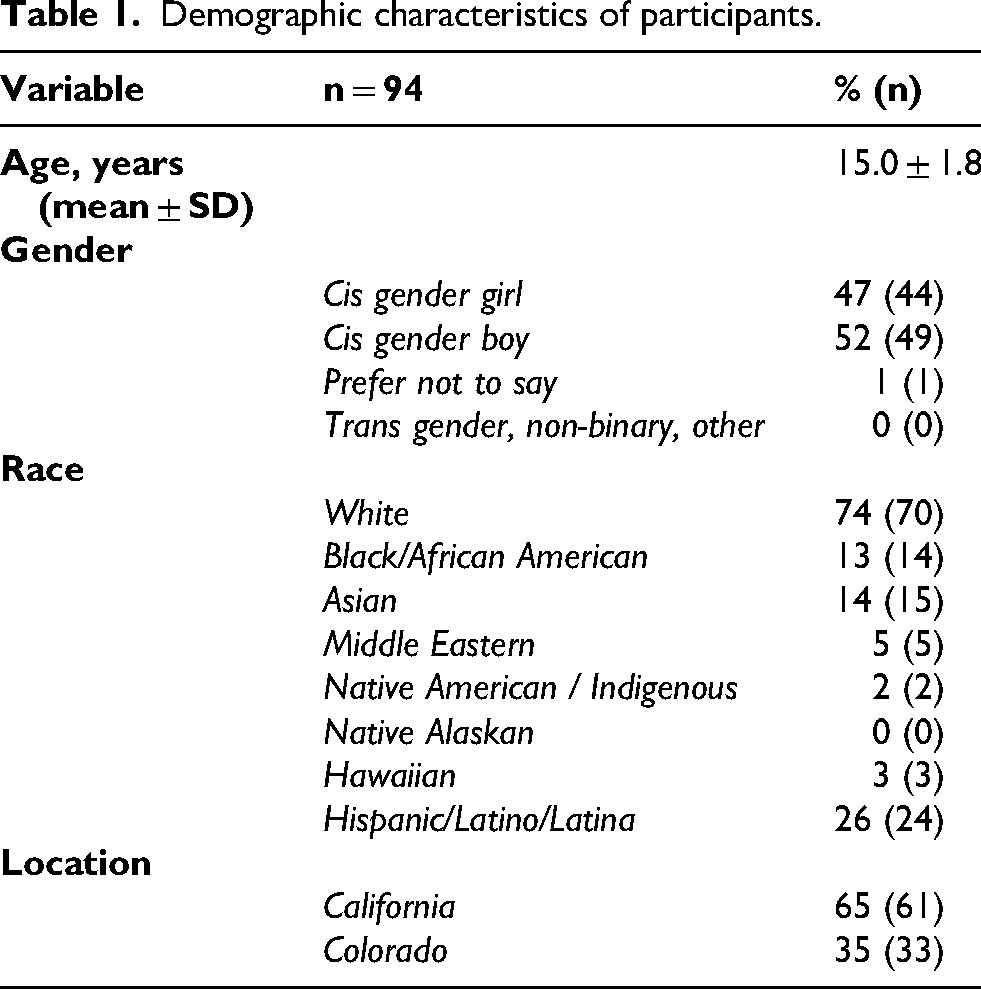
Of the 144 submitted responses, 94 met inclusion criteria and surveys were filled out to completion (
Demographic characteristics of participants.
Sport participation, sports specialization, and injury status characteristics of participants.
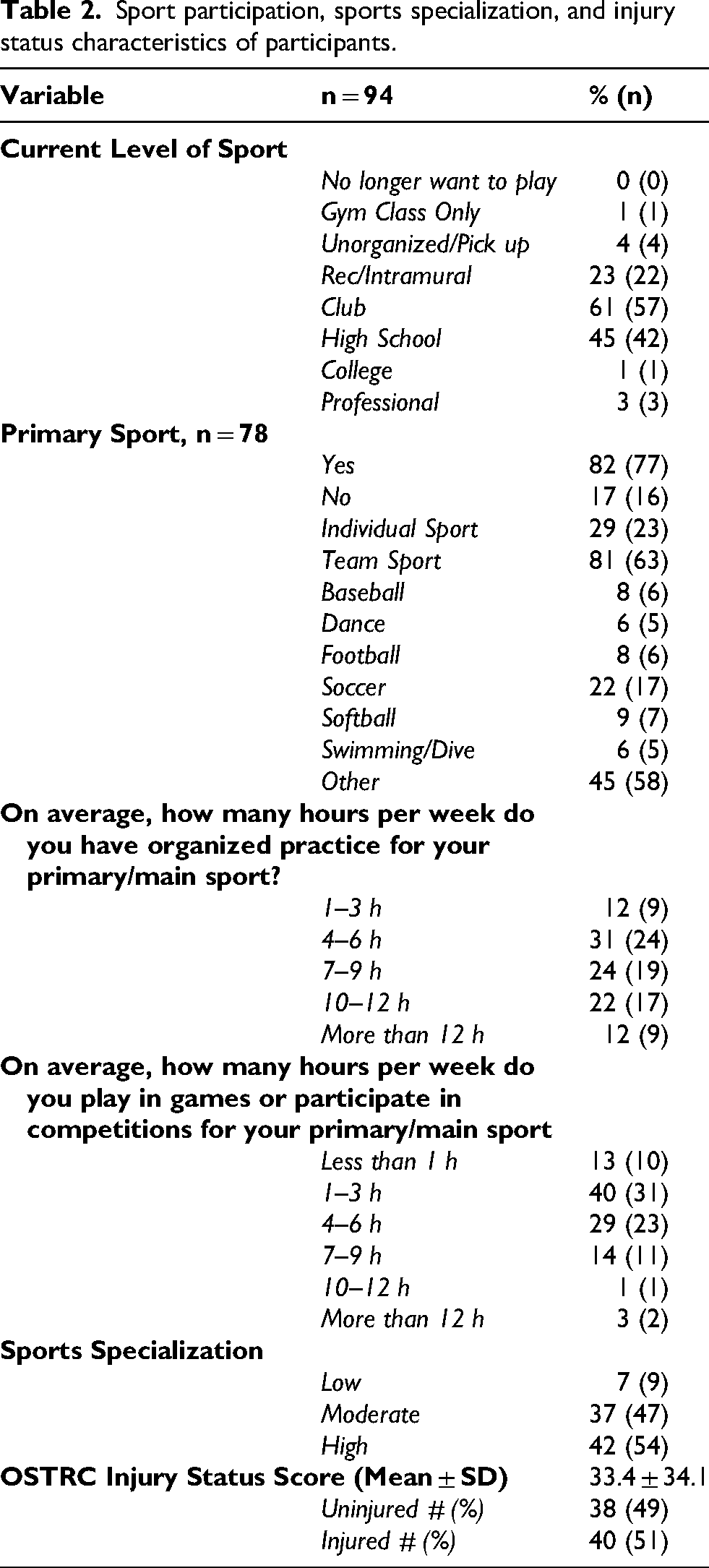
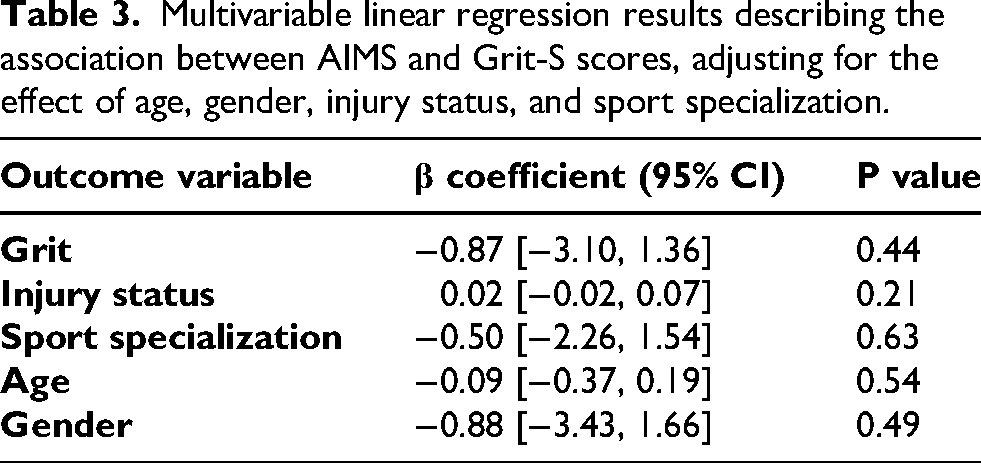
The average AIMS score of participants was 39.0 ± 6.3, which is considered a middle range score (>54 is considered high AI and <20 is considered low AI). 14 The average Grit-S score of participants was 2.47 ± 0.62, which is considered low grit. 9 Amongst all participants, we found no significant correlation between AIMS and Grit-S scores (rho=-0.09, p = 0.36, 95%CI [−0.28,0.11]). When we conducted an exploratory analysis of AIMS and Grit-S scores using a multiple linear regression model, while adjusting for injury status, sports specialization, age, and gender, we also detected no significant effect or relationship (r = 0.18, p = 0.21, 95%CI [−0.13, 0.34]) (Table 3).
Multivariable linear regression results describing the association between AIMS and Grit-S scores, adjusting for the effect of age, gender, injury status, and sport specialization.
There were no significant differences in AIMS score (U = 1214, p = 0.49) or Grit-S score (U = 1354.5, p = 0.82) between gender groups. When looking at primary sport played, we found athletes who played a team sport had higher AIMS scores than athletes who played an individual sport (U = 971, p = 0.02). However, there were no significant differences between team versus individual primary sport on Grit-S scores (U = 743, p = 0.85). When looking at injury status, we detected no difference in AI between injured and uninjured athletes (U = 1274, p = 0.11). However, athletes who were injured had higher grit scores than athletes who were uninjured (U = 637.5, p < 0.001).
When comparing sports specialization using a three-way comparison (high vs. moderate vs low), participants who were more specialized had higher AIMS scores (H = 4.43, p = 0.04), but there were no differences in Grit-S scores (H = 0.22, p = 0.80). We found no relationship between the number of hours practiced (H = 2.76, p = 0.74) or played in competitions (H = 4.47, p = 0.61) with AIMS scores. We found that athletes who practiced 1–6 h per week had higher grit scores than athletes who practiced more than 6 h per week (H = 11.28, p = 0.046), but we did not detect a relationship between the number of hours played in competition and Grit-S score (H = 4.11, p = 0.66).
Discussion
The purpose of this study was to evaluate the relationship between AI and grit and examine how AI and grit varied by gender, sport participation, sport specialization, and injury status amongst adolescent athletes. We found no significant relationship between AI and grit, even when adjusting for injury status, sport specialization, age, and gender in an exploratory post-hoc analysis. However, we observed that athletes whose primary sport was a team sport and those that were more specialized had higher AI compared to those who played an individual sport and to those less specialized, respectively. Additionally, athletes who practiced 1–6 h per week and those that were injured had higher grit than those who practiced more and were uninjured, respectively.
Recently, Christino et al. examined the relationship between AI and coping skills amongst adolescent athletes and similarly did not find differences between genders, but did find that team sport athletes reported higher AI than individual sport athletes. 5 These findings are in line with our data and suggest that team sport athletes may be more inclined to experience the benefits of strong AI as well as the potential risks (e.g., maladaptive responses to injury). 5 Bruner et al.'s study on social networks within team sports provided evidence for a mutually reinforcing bidirectional link between teammates, suggesting an active promotion of a sense of “us” contributes to identifying strongly with a team. 17 A similar mechanism may be at play with regards to AI. Additionally, stronger AI amongst team sport athletes may also be a contributing factor to “collective team collapse,” which is when an entire team underperforms significantly in an important competitive environment, 18 or may cultivate the “sporting mind,” which is when a team acts as a psychological buffer to stress in a high-stakes competition. 19 These examples highlight the potential benefits and risks of strong AI among team sport athletes.
The historical data on grit suggest grit is associated with more hours of training in one's craft. 20 Our data suggest that, at least within the context of adolescent athletes, there may be a threshold at which more training is not indicative of more grit, as those who trained less hours per week had higher grit compared to those who trained more. One challenge in deciphering this finding is that adolescent athletes often do not dictate their schedule, and therefore, the number of hours practicing may reflect what their parent or coach perceives as best for them versus self-driven, autonomous practice at their sport.13,21 Nonetheless, while the data suggest a positive correlation between hours practiced and increased grit, further psychological evaluation suggests this relationship is likely modulated by other factors such as the level of engagement in practice, not just quantity of practice. 22 More specifically, perseverance of effort (e.g., staying focused during training, not just going through the motions), small incremental changes (i.e., short, frequent practice), and the rate of accumulating practice (e.g., a more gradual increase in number of hours training) are important modulators to the relationship between grit and time spent at practice.23,24 It may be that those who trained more than 6 h per week were less engaged in their practice, and therefore had less grit, than those who trained less but were more engaged in their practice. The “less is more” paradox has also been discussed within other contexts, including decreasing burnout and injury risks,13,25–27 and our data further suggest that there may be limited benefits to training more than 6 h per week within the context of cultivating grit for adolescents.
Interestingly, we also detected higher grit scores amongst injured athletes relative to uninjured counterparts. We are not aware of other studies that directly compare grit between injured and uninjured athletes. However, when injured, higher grit scores are associated with better functional outcomes following anterior cruciate ligament (ACL) reconstruction among adolescent athletes. 28 There have also been studies suggesting that grit and resilience may have a bidirectional positive feedback loop. 29 Taken into the context of our data, one may postulate that athlete resilience and grit are amplified during recovery from injury and continually increase each other. Another study suggests that like any skill or trait, grit must be practiced to be improved and maintained. 30 Therefore, another explanation for this finding is that injured athletes have more opportunities to practice grit than uninjured athletes. Future directions could include assessing athletes after they are recovered from injury to see if elevated grit is sustained or only specific to their immediate recovery period. Of note, it is important to acknowledge that we specifically recruited from sports medicine and physical therapy clinics, and thus the proportion of injured participants, as well as our findings, may be skewed as a result.
The lack of a significant relationship between grit and AI may suggest that the two constructs are impacted by different biological and psycho-social mechanisms. Specifically, grit is currently understood as a personality trait that is inherent to a person, and neuroanatomical analyses suggest grit is associated with less regional gray matter volume in the dorsolateral prefrontal cortex and more regional gray matter volume in the right putamen. 31 Within the context of the aforementioned association of increased grit and injury, there are data suggesting that recovering from an athletic injury, such as ACL reconstruction, induces neuroplasticity of the visuo-motor cortex and structural changes in both the sensory and motor cortices. 32 Thus, a proposed theory for our findings is that grit can be modulated during situations or developmental phases where neuroplasticity is increased, such as when recovering from an injury or after a traumatic experience. In contrast, AI is thought to be psychologically and socially grounded, with structural identity theory and cognitive identity theory being the two leading identity development models utilized to conceptualize AI.33,34 Taken into the context of our findings, this suggests that grit may be more of an inherent trait of an individual, while AI may be more fluid and subject to an individual's surroundings, in this case, their specific sport environment. While both have protective and beneficial impacts specifically amongst adolescent athletes, they appear to be separate and independent entities and should thus be cultivated individually.
While this study adds to the body of literature aimed at understanding grit and AI among adolescent athletes, it has limitations. This study did not include any trans gender or non-binary individuals, the vast majority of participants were non-Hispanic white, and all participants were from California or Colorado, limiting the generalizability to more diverse populations and regions. Responses were self-reported and thus may be subject to self-report or recall bias, as well as selection bias. Although we were adequately powered for our main correlation of interest, we acknowledge that our exploratory, post-hoc linear regressions may have been underpowered.
In this cohort of adolescent athletes, we did not detect a significant relationship between AI and grit, suggesting that these two constructs may manifest independently. Team sport and more specialized athletes had higher AI than their individual sport and less specialized counterparts. Athletes who were injured and practiced less than 6 h per week had higher grit than those who were uninjured and practiced more. These results highlight that team sport and more specialized athletes may reap the benefits, but be more vulnerable to the risks, associated with stronger AI. We recommend that coaches, parents, and healthcare professionals who care for young athletes positively foster AI in ways that are beneficial to the athlete (e.g., building a collective, unifying team mentality that can help to buffer stress), while also monitoring for situations when strong AI could be harmful (e.g., when a team sport athlete is injured and feels loss of connection to their sport). Training more hours per week may not necessarily correlate to more grit in adolescent athletes, and coaches should consider optimizing the quality of their practices, such as fostering engagement in training, more than emphasizing quantity of training. A period of injury may be an opportunity to foster grit as an athlete recovers. Collectively, these data can inform targeted interventions to cultivate and promote the benefits of AI and grit in adolescent athletes.
Supplemental Material
sj-pdf-1-spo-10.1177_17479541261466075 - Supplemental material for Athletic identity and grit in adolescent athletes: Associations with gender, sport participation, specialization, and injury status
Supplemental material, sj-pdf-1-spo-10.1177_17479541261466075 for Athletic identity and grit in adolescent athletes: Associations with gender, sport participation, specialization, and injury status by Gabrielle Gilmer, Katherine Rizzone, Melissa Christino, Bianca Edison, and Aubrey Armento in International Journal of Sports Science & Coaching
Footnotes
Acknowledgements
GG is currently funded by NIH grant F30AG084163 and a member of the Medical Scientist Training Program at the University of Pittsburgh (NIH grant T32GM144300). AA has received funding from the National Center for Advancing Translational Sciences/Clinical and Translational Science Awards Program/Colorado Clinical and Translational Sciences Institute (K12 TR004412, UM1 TR004399).

Ethics approval
The Colorado Institutional Review Board reviewed and approved this study. COMRB #23-0746.
Author contributions
All authors made substantial contributions in the following areas: (1) conception and design of the study, acquisition of data, analysis and interpretation of data, drafting of the article; (2) final approval of the article version to be submitted; and (3) agreement to be personally accountable for the author's own contributions and to ensure that questions related to the accuracy are appropriately investigated, resolved and the resolution documented in the literature. The specific contributions of the authors are as follows:
Conceptualization: AA.
Methodology: KR, MC, BE, AA. Formal analysis: GG. Investigation: KR, MC, BE, AA. Resources: AA. Data curation: GG. Visualization: GG. Project administration: AA. Supervision: AA. Writing – original draft: GG. Writing – review and editing: GG, MC, KR, BE, AA.
Funding
The authors disclosed receipt of the following financial support for the research, authorship, and/or publication of this article: This work was supported by the National Institutes of Health, (grant number F30AG084163, K12TR004412, T32GM144300, UM1TR004399).
Declaration of conflicting interests
The authors declared no potential conflicts of interest with respect to the research, authorship, and/or publication of this article.
Data availability statement
Raw data from this paper are available upon request from the corresponding author.
Supplemental material
Supplemental material for this article is available online.
References
Supplementary Material
Please find the following supplemental material available below.
For Open Access articles published under a Creative Commons License, all supplemental material carries the same license as the article it is associated with.
For non-Open Access articles published, all supplemental material carries a non-exclusive license, and permission requests for re-use of supplemental material or any part of supplemental material shall be sent directly to the copyright owner as specified in the copyright notice associated with the article.
