







Abstract
This study draws on interactionist frameworks of sensorial communication to analyse product reviews on YouTube. Existing studies of YouTube review work have focused on how vloggers manage conflicting neoliberal identity discourses such as ‘authenticity’, ‘being entertaining’ and ‘selling’. I argue that this focus has been at the expense of the communicative work involved in constructing products in reviews, and I suggest that identity issues should be conceptually expanded through a much broader focus on communicative action and conventions of practice. In order to achieve a first step in this expansion, my analysis focusses on reviewers’ sensorial engagement with objects and explores the communicative processes through which they symbolically transform products into enlivened, sensorially rich phenomena. I argue that these communicative strategies are important for situating neoliberal discourses within ‘mundane’ actions of description and in broader cultural practices of reviewing.
Keywords
Introduction
Online consumer video reviews are a comparatively new phenomena that have emerged only in the last 10 years but that are already fundamentally changing everyday consumption practices (Alexander et al., 2018; Graham, 2018: 1). Scholars have been slow to turn analytic attention to video reviews (Blank, 2006), with researchers only recently taking an interest in the structures of these influential discursive forms (Bhatia, 2018; Jaakkola, 2018; Jorge et al., 2018). My particular interest in this article is in product reviews on YouTube, which, along with Amazon (Skalicky, 2013; Vasquez, 2016), has become one of the most important consumer platforms for finding out about products. More specifically, I am concerned with the ways that users produce objectified ‘symbolisations’ (Streeck, 1996) of products through descriptions that articulate/construct sensorial experience. YouTube reviews are a particular kind of ‘fractured ecology’ (Luff et al., 2009) where the presenter makes a video for a generalised other that can be responded to textually through comments and ‘likes’. There is no gestural ‘interaction’ between the participants, just a one-way sending of a multimodal message. Interactionism has a long-standing interest in how people manage technologically mediated actions (Heath et al., 2000, 2003) and I draw on these frameworks to explore the communicative practices of review work.
Existing research in this area has heavily emphasised that YouTube is not a neutral space of democratic citizenship, but a complex economic systems tied to capitalist consumerist ‘discourse practices’ (Jorge et al., 2018). The reach of consumption discourses can be found in the seemingly ubiquitous nature of ‘review work’ on YouTube, which can be found across a wide range of overlapping YouTube genres including parodies and re-hashes of existing videos (Burgess and Green, 2013; Leppänen and Häkkinen, 2012), room tours (Rebane, 2019), unboxing videos (Nicoll and Nansen, 2018), reaction videos (Kim, 2015), decluttering videos (Zappavigna, 2019) and tutorials (Bhatia, 2018). Reviewing may not be the central aims of all videos, but it is easy to find examples of vloggers commenting on the products they are engaging with. The majority of YouTube reviews – whether formally positioned as such or not – are not ‘institutional’ in that they are not produced by private companies, media outlets or other organisations (Jaakkola, 2018). However, review work is often connected to online or ‘bricks and mortar’ sales outlets, carefully staged and guided by production companies (Hou, 2018; Jorge et al., 2018; Nicoll and Nansen, 2018), with reviewers frequently paid or incentivised for their work (Gozegir and Gocer, 2018; Kong et al., 2018).
Following a similar emphasis in research on face-to-face and television shopping (Bucholtz, 2000; Cook, 2013; Niemi and Hirvonen, 2019; Soar, 2009), one of the dominant interests in YouTube reviews is with how reviewers manage sales as a discursive act. Jaakkola’s (2018) study illustrates how reviewers use humour and irony in ways that are, she suggests, reminiscent of theatrical ‘revues’ rather than conventional product reviews. Bhatia’s (2018) research on YouTube makeup artists also shows the complexity of discourse practices found in reviewing, illustrating how one vlogger shifted between traditional ‘teaching’ discourses – where viewers are shown how to achieve particular makeup techniques – to strategies that were directed to selling products. Jorge et al.’s (2018) study of one beauty vlogger also shows the difficulties of negotiating ‘discursive strategies that mesh intimacy and commercialism’ (p. 92). Such performative strategies have been characterised as part of ‘semiotic-capitalism’ and ‘digital-capitalism’ (Zappavigna, 2019), where discourses of consumption and materiality inform the ‘subject positions’ that people adopt.
These preliminary studies are valuable as they illustrate some of the tensions within YouTube review work. To date though, no research that I am aware of has examined closely the communicative practices of product description and the enactment of objectified accounts of products. My interest in this article is in drawing on sociological perspectives on the senses to explore how reviewers transform objects from ‘disembodied things’ into sensorially rich and interactionally embedded products.
The senses and communicative action: An interactionist perspective
The study of ‘sense’ or ‘somatic work’ is of growing interest in the social sciences (Howes, 2006; Pink, 2010; Vannini et al., 2011b), and scholars have drawn attention to the cultural ordering of sensory experience and the ways that conventions of action and communities/cultural contexts frame our experiences of the world. Through socialisation, people develop languages for describing the senses and knowledge for making sense of them, as well as habituating methods for making sense experiences visible to other people (Vannini et al., 2011b). However, the embodied nature of praxis means that sense experience often goes ‘unnoticed’ or unattended to (Merleau-Ponty, 1962) as many activities – such as reading a book or watching television – involve sensory engagement without a close attention to the experience of, say, ‘seeing’ or ‘hearing’. The theorisation of the relations between body, sensing, thought and action is beyond the constraints of this article (see Crossley, 1995, 2006; Shilling, 1993, 2007 for contributions to this issue); instead, I focus on the ways that people articulate sensorial experience to others in the process of reviewing products. The analysis draws on interactionist studies of the senses – particularly from Ethnomethodology and Conversation Analysis (EMCA) – which is an emerging sub-field of the sociology of the senses (Gibson and vom Lehn, 2019) that looks at how people make their senses ‘accountable’ to others in interaction (Mondada, 2019; Pillet-shore, 2019).
Sensory actions are frequently produced within shared contexts and, as such, should be understood as being embedded within interactional structures of action (Goodwin, 1994). Studies show that participants undertake interactional work to make their sense experiences available to others. Mondada’s (2018) video analysis of cheese tasting in shops illustrated the systematic organisation of tasting: consumers used touch and smell in highly routinised ways, breaking the cheese, smelling it and subsequently producing vocalisations of assessment to construct intersubjective understandings about the cheese.
In a similar vein, EMCA studies of health encounters have shown how patients use talk, gesture and other ad hoc resources to communicate their feelings and experiences to medical professionals (Heath, 2002; Heritage and Robinson, 2006; Robinson, 1998; Stivers, 2002). To take one example, Heath (2002) explores how patients used gestures to make their symptoms available to doctors, using a combination of gesture and talk to communicate pain, discomfort and other sensations. Through these resources, the patients were able to share with doctors the location of pain and to ‘enliven’ and ‘provide dramatic display’ of symptoms (Heath, 2002: 601). Studies such as these show that participants construct the ‘performance’ of their sensorial experiences in ways that are specific to the broader interactional context, using talk, gestures, gaze, posture and objects to turn their ‘private’ experience into something communicable and situated within the action at hand. An important point to emphasise is that communicating about sensorial experience involves more than just articulating to others what has been felt, seen, heard, smelt and so on: it involves producing an account in the context of the conventions of practice being worked within, in this case, YouTube product reviews.
My concern in this article is with how reviewers communicatively construct or transform objects into phenomena that possess certain characteristics that can be sensorially experienced – that is, how reviewers build accounts of their own sensory experiences with products and present these as intersubjective features of the object.
Methods
The initial sampling frame for this study involved identifying particular categories of sense work – smell, taste, hearing, vision and touch – and searching for examples of reviews that dealt with those categories. One of the key conceptual points in the sociology of the senses is that these conventional categories of sensing are cultural constructs that potentially over-simplify our lived experiences of the world, which may involve experiences that do not fit well into these rough categories (Howes, 2006; Paterson, 2007; Pink, 2010; Vannini et al., 2011a; Gibson and vom Lehn, 2019). However, perhaps because such categories are so culturally enshrined, most studies of the senses do use them as the basis of their work (Gibson and vom Lehn, 2019). In the case of this study, I am interested in how conventional categories are used, and I too use them to inform the sampling and the organisation of the analysis to come.
I decided to look at reviews in English and Spanish in order to include non-English data in the analysis, which is a common limitation of interactionist work. I chose to focus on channels of more experienced vloggers, defined here as users/channels that had uploaded more than 80 videos and that had been posting for at least 3 years. I focussed on reviews where the senses would be of relevance, choosing wine tasting, perfume reviews, musical instrument reviews and mobile phone reviews (see Table 1). Wine tasting is a complex and highly ritualised practice that involves visually assessing, tasting and smelling. Perfumery is closely focussed on aroma and on the visual appearance of perfumes and occasionally on the tactility of packaging. Musical instrument reviews tend to focus particularly on the sound and the feel of instruments but also on aesthetic qualities such as how they ‘look’. Finally, mobile phone reviews focus on the ‘feel’ of the products, as well as sound quality, usability and visual aesthetics. In each of these areas of review practice, multiple senses are at play (see Table 1) and my analysis looks at the ways that these are articulated in the process of reviewing the products. There are differences in the extent to which sensorial experience are the focus of attention in the reviews. In wine tasting and perfume reviews, for instance, the articulation of sense experience is central to the entire review, while in mobile phone reviews, senses experience only occasionally emerges as a topic, and usually in relation to very specific aspects such as the ‘feel’ of the product or the sound of the speakers. I decided to include mobile phones as a less obviously ‘sensory’ category of review work in order to avoid treating sense work as only being present in special types of reviews.
Sampling framework for the videos analysed.
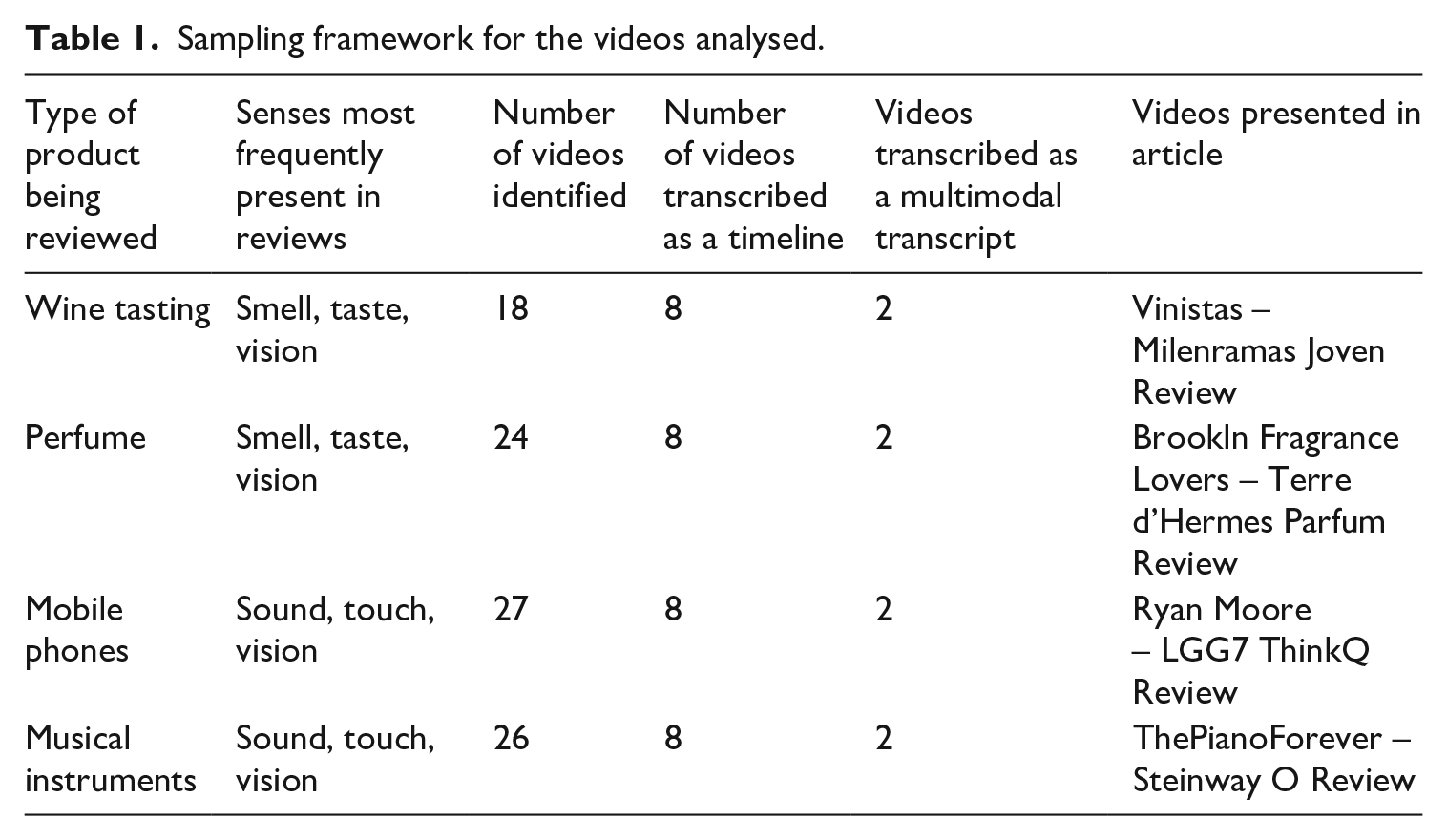
The first phase of analysis involved producing a timeline transcription to outline the general structure of each review. After this, I selected a subset of eight videos for detailed transcription through established techniques in EMCA (Heath et al., 2010; Jefferson, 1984) and wrote a narrative account of each. The narratives provided detailed analysis of the communicative work involved in the reviews, which I subsequently cross-checked with the wider data set, finding that they provided a sufficient elaboration of the interactional work across the data. The transcripts include screenshots of physical actions along with textual interpretations of the talk (see Appendix 1 for a description of the transcription symbols used in the data). Due to the restrictions of space and to avoid repeated descriptions of different contexts, the discussion here focusses on just one video transcript from each of the review types. The analytic points being made, however, relate to phenomena found across the data set.
Through the analysis, a basic distinction between types of sense work became evident and this informs the organisation of the data discussion to follow. I distinguish between ‘unavailable sense’, which the viewer has no access to (e.g. smelling and tasting) and ‘partially available senses’ where the viewer may have access to some of the sensory experience (e.g. hearing and seeing). As we shall see, this results in differences in the reviewers’ gestural and verbal accounts of the senses and how they epistemically position the viewer.
There are no clear guidelines regarding anonymisation in the analysis of publicly available data. I follow the examples of other work on YouTube where data are not anonymised (Bhatia, 2018; Jorge et al., 2018) because the facial expressions are relevant to the analysis and because the public availability of the videos means readers can visit the original data sources. However, non-anonymisation presents dilemmas for researchers as we re-contextualise content without users’ consent. While the risks of harm may be minimal, recontextualisation nonetheless raises questions about our relationship as scholars to participants and the unsolicited ‘parasitic’ nature of scholarly work (Gibson and Roca-Cuberes, 2019). While it is beyond the remit of this article to discuss such issues in depth, I hope that my analysis can inform reflection on these issues in the wider community.
The analysis pays particular attention to the intersection of talk and gesture in the production of reviews. Gestures are treated here as ‘improvised, hybrid devices for rendering aspects of the world visible and intelligible’ (Haviland, 2012: 228). A key focus of my analysis is on the use of gestures as communicative resource in the articulation of sensorial action. I draw on McNeill’s (1996) categorisation of five gesture types: iconic gestures (representing objects); metaphoric gestures (representing abstract concepts); deictic gestures (used for pointing); beats (as rhythmic movements for organising attention); and ‘butterworths’ (used in place of gestures). I also use elements of Streeck’s (2009) gestural framework which builds on a distinction between gestures that are used to describe the world and those that are used to find something about it (Haviland, 2012) (See Table 2 for an overview of Streeck’s framework).
Streeck’s (2009) framework of gestural analysis.
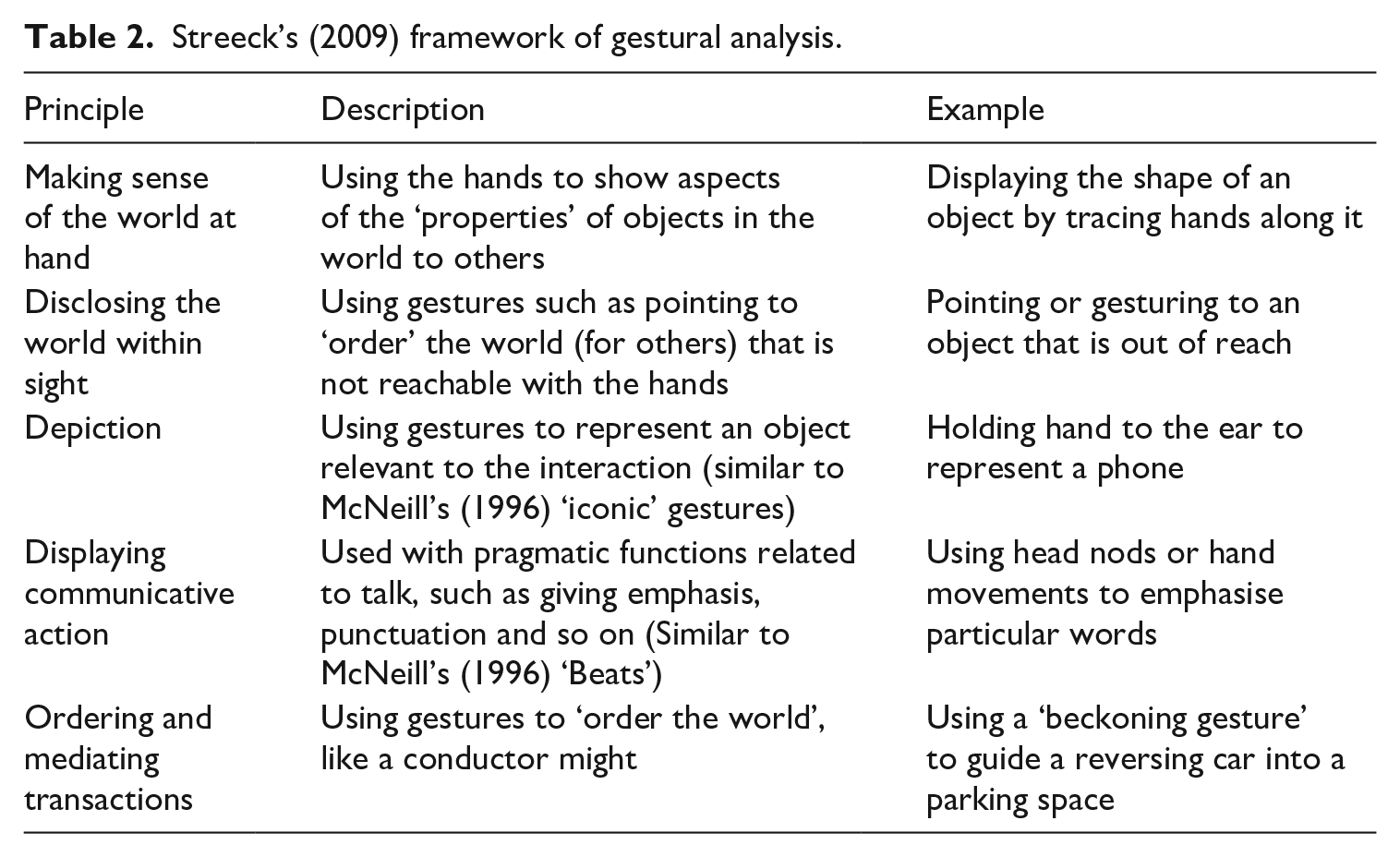
Critical to this study is the idea that, like spoken language, gestures can be employed by someone to show others what they are experiencing or to facilitate the sensorial engagement of others – that is, to make others experience the world in particular ways, drawing attention to specific features of the world. Licoppe (2017) shows how gestures are used as resources to facilitate the sensorial engagement of others by analysing the construction of joint attention in mediated environments through ‘showing sequences’, which make particular aspects of one person’s context visible and interactionally relevant. This article aims to expand on this analysis by exploring how other senses are shared and made accountable through communicative actions.
Analysis
This discussion is divided into two sections: (1) reviews that deal with senses that are not available to the viewer (smell, taste and touch); (2) reviews that deal with senses that are partially available to the viewer (sound and vision).
Part 1 – Unavailable senses
Smelling
The first extract is a review of Terre d’Hermes aftershave which comes from the channel Brooklyn Fragrance Lovers. Before the action shown in Extract 1, Carlos (on the left of the picture) has sprayed au de parfum onto a testing strip and the extract begins as he smells the fragrance (plates 1–4):
1 So this has: grapefruit orange flint (.) woodsy notes, oakmoss and benzoin 2 S okay 3 C And (.) >I believe< Iso E Super
1
(.) [Its not listed listed but (.h) theres definitely a 4 D [yeah
5 C very long lasting <woody: (.) base> [about this 6 S [I agree
9 C >it smells exactly like this to me< but (.) its not as: (.) 10 S Okay
11 C Its (.) 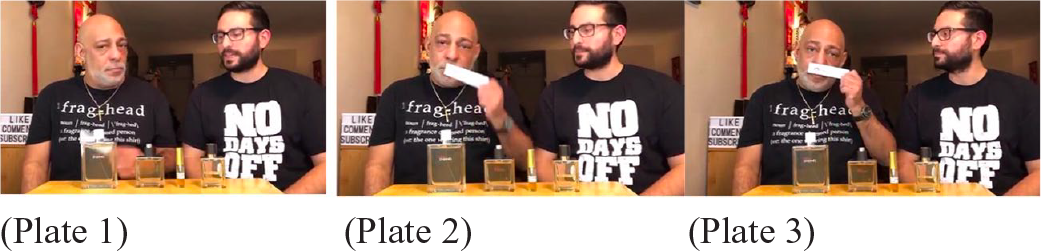
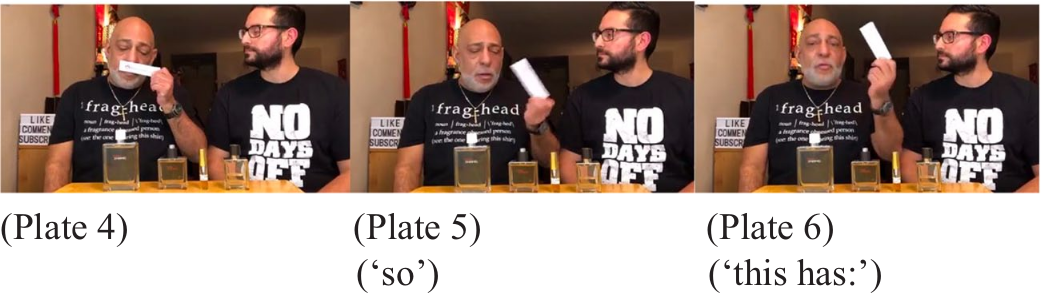
Carlos moves the paper to his nose, smells it, shifts his gaze down to the test strip while breathing in audibly, removes the test strip and holds it up and to the side (plates 1 to 5).
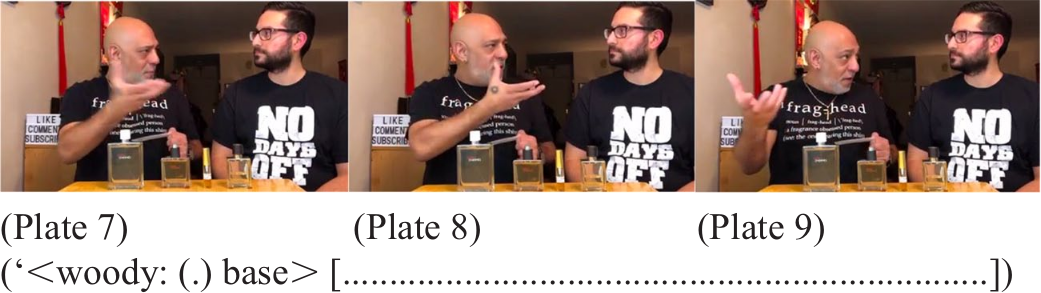
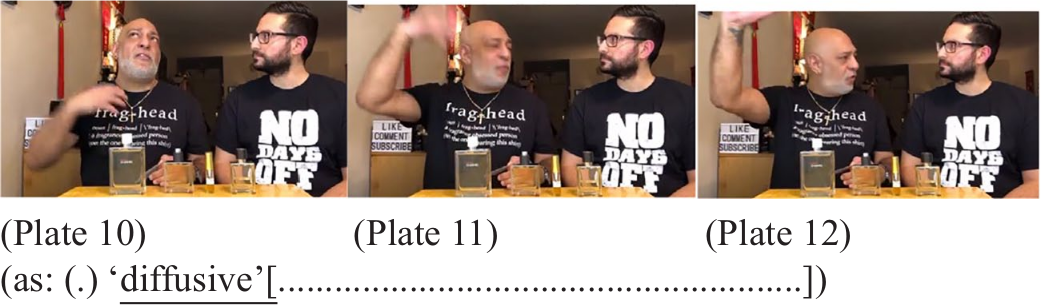
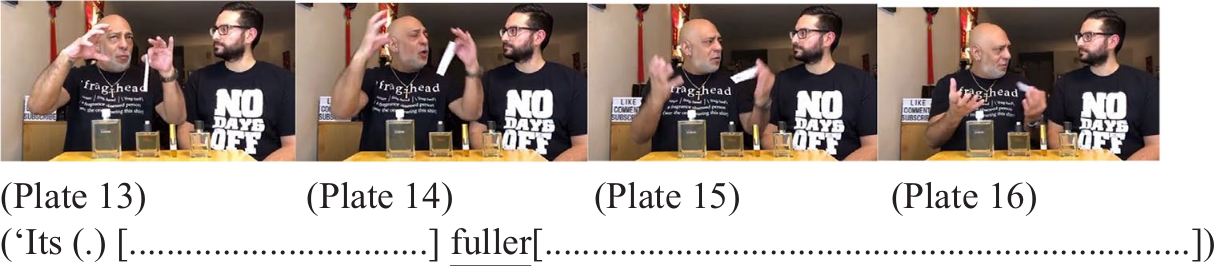
In continuation, he pushes the strip towards the camera in a deictic gesture (plates 5 and 6), which ties the indexical ‘this’ to the scent on the testing strip. After listing three odour characteristics (‘grapefruit orange flint’, line 1) there is a slight pause and then he lists three more (‘woodsy notes, oakmoss and benzoin’, line 1) using his raised left hand and head nods to give emphasis to each. All of these descriptors are standard part of the language in the pallet of scents used to characterise perfumes (Alač, 2017). Carlos goes on to say that there is another ingredient that he thinks is present ‘Iso E Super’ (also a standard descriptor), that is not formally ‘listed’ (implying that the other scents were the ones specified in the product information). The utterance ‘but there is definitely a very long lasting woody base’ (lines 3–5) acts as a justification for his rationalisation and is accompanied by a descriptive/iconic gesture with his left hand that depicts a horizontal structure (a ‘base’) by moving from (his) left to right (plates 8–9). Gesturing to the fragrance to his left, Carlos notes that the fragrance under review is not as ‘diffusive’ (line 9), and produces an iconic gesture moving upwards in a representation of outward movement (plate 10–11), and then characterises the sent being reviewed as ‘fuller’ (line 11), again using a rounding gesture with his hands to depict this fullness (plates 13–16).
There are four features of this sequence that I wish to draw attention to. First, the smelling was performed for the viewer through a sensorial act of ‘doing smelling’. While objects can be made visually available to others through showing sequences (Licoppe, 2017), characteristics such as smell cannot and participants need to find different techniques to make them available and accountable. The performative enactment of smell (as with that of ‘biting’ in Streeck’s 1996 work) is a significant part of this as it displays the type of interactional work that is required to identify the relevant characteristics, embedding these features in a real-world experiential praxis.
Second, the sensorial act is followed by a sensorial description which identifies particular object characteristics arising from the sense performance. This account relies on the professional vocabularies of perfumery – a highly codified structure used across the industry to label ingredients (Alač, 2017) – which provides a way of ‘reading’ perfumes. Third, this description is accompanied by iconic gestures that enact them as visual metaphors, physically depicting movement (‘base’) and shape (‘fuller’) in a multimodal representation that ‘enlivens’ (Heath, 2002) an unavailable sense into one that is visually accessible. Finally, this performance leads to a personal/professional evaluation which, in this case, involves articulating an assessment of the comparative qualities of the perfumes through the metaphor of ‘fullness’.
Tasting
In the next example (Extract 2) – which is a review of Milenramas wine by the Vinistas channel – we see these same four features at work. The extract begins as the presenter reaches for the glass, swills it (plate 5) saying ‘ok on the palette’, raises the cup, takes a sip, swills it in the mouth, sucks in air and finally swallows (plates 6–8):
11 (7.0) [tastes the wine, swills it in her mouth and swallows]
12 tp es un vino de cuerpo me:dio: es decir que es un vino (.h) que no es muy: tp it is a wine with a medium body which is to say that it is a wine that is not 13 ine:nso que no es muy musculo:so que no es muy pote:nte (.h) very intense not very muscular not very strong
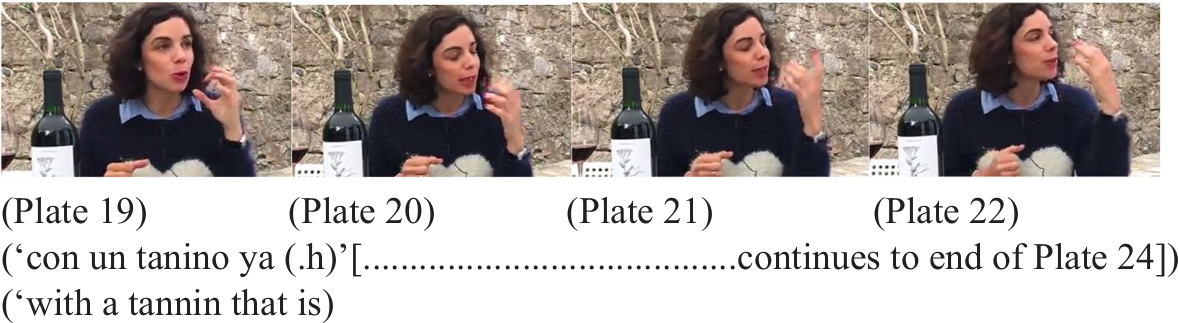
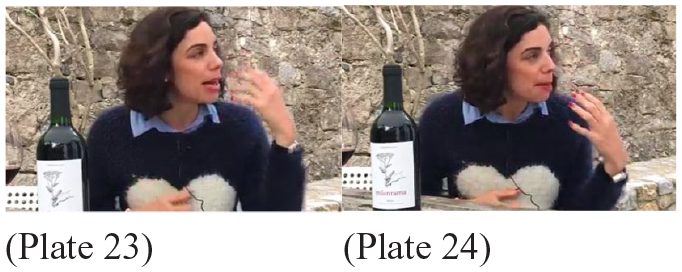
14 sino que es un vino mas bien su:ave aterciopelados con un tanino ya (.h)
15 bien lima:do y una sensación final casi como de regaliz (.h) que la verdad que Is well polished and a sensation in the end of liquorice which is 16 <es muy: agradable> (.h) es un vino: cien por cien satisfactorio eso es como yo: very nice it is a wine that is one hundred percent pleasing that is how I 17 (.) lo definiría would define it
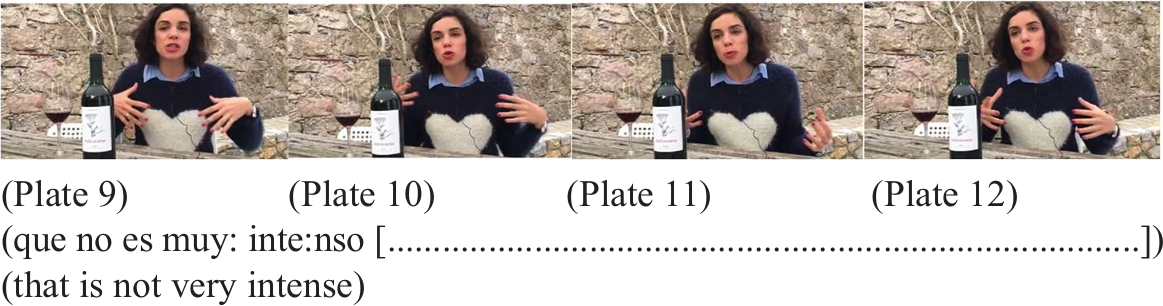
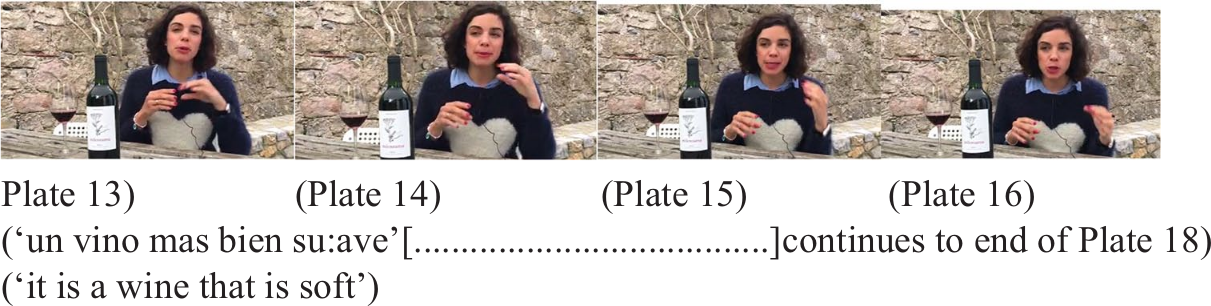
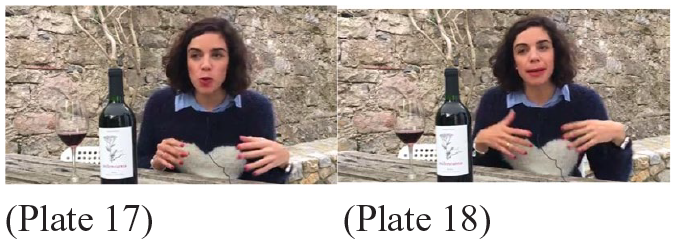
Here, we see another iteration of the performance of a sense through an action of ‘doing tasting’ that interactionally precedes the description of the product. Wine tasting is a highly professionalised and routinised practice with distinctive sequences of action (Giglioli and Fele, 2016), and the performance here – smelling the wine, swilling it, sucking in air – embodies typical characteristics of such work. As with Extract 1, the sensorial act is followed by a verbal description and, through ‘hyper specialist wine vocabularies’ (Inglis, 2019) she establishes a ‘contrast class’ of descriptive categories (Housley and Fitzgerald, 2009), by invoking characteristics such as ‘body’ (line 12), muscularity and strength (line 13) and ‘intensity’, which are set against the alternates of ‘soft’, ‘velvety’ and ‘polished tanins’ (lines 14–15) that are invoked to characterise the product under review.
Throughout this description, the presenter uses depictive/iconic gestures to visually represent certain features of the verbal account, including a ‘rounded’ gesture with her hands (plates 9–12) which enacts something like ‘largeness’ on each instance of ‘muy’ (‘muy intenso’ ‘muy mosculoso’, ‘muy potente’ – lines 12–13); a wave-like gesture with her left hand (plates 13–18) which accompanies the word ‘soft’ (line 14) and brings to mind the movement of something through the air; the movement of her left hand from her mouth (plates 19–24) as she says ‘with a tannin that is well polished’ (lines 14–15) which perhaps draws attention to or depicts a process of tasting. In these last two instances, the presenter seems to pay attention to her own gestural acts, looking at her hands as they perform these shapes, which, in Streeck’s terminology, gives the gestures a ‘sense making/finding’ quality (Streeck, 2008), constructing an analysis of the experience being reported on and building an embodied lived account of the sensorial experience. Finally, the example ends with a personal evaluation ‘a wine that is one hundred percent pleasing’ (line 16).
Touching
The example I look at is a review of an LGG7 ThinkQ mobile phone from the Ryan Moore channel. The framing of the video shows only the reviewer’s hands and the product being reviewed, constructing a visual orientation to the object that is shared with the viewer and which frames the reviewer’s tactile engagement with the phone.
Extract 3 begins with the reviewer noting that they are going to show the phone that they have talked about in previous videos (line 4):
4 !ahh so the gee seven’ (.) I I’ve shown you some pictures before so but here it is
5 <compared to the old gee six> (.H errm:: (.) *ahactually it is <slightly taller>’
6 but it <feels thinner> even though: its pro:bably the same: (.h) >just the way that< the:
7 the bendy part at the back here the glass at the back is (.) (.h) a little nicer” it just 8 doesnt feel as <blocky> as the gee six was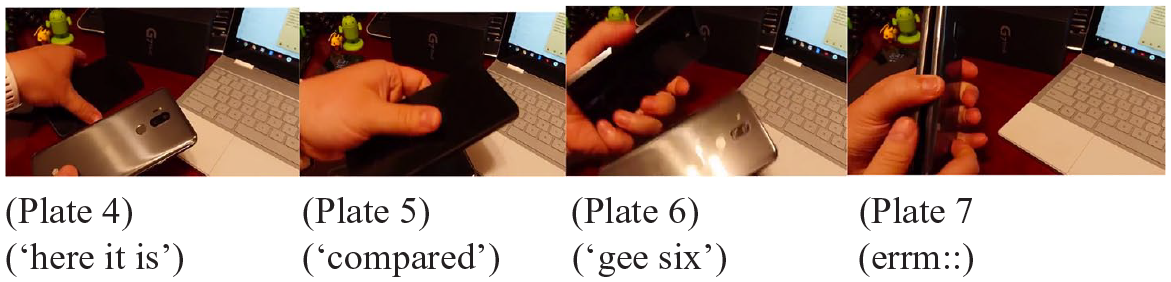
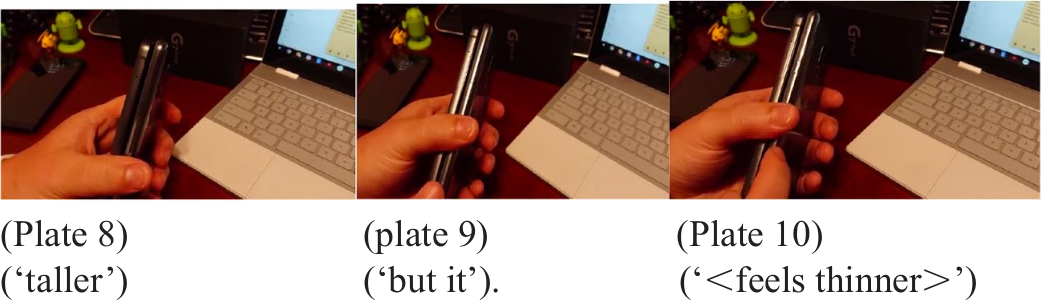
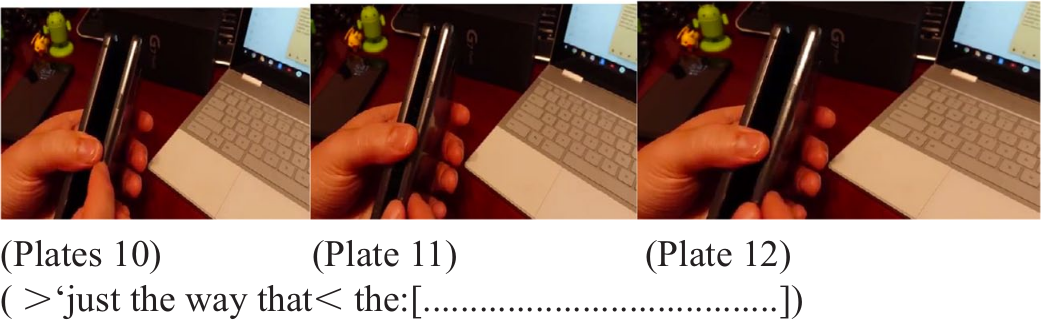
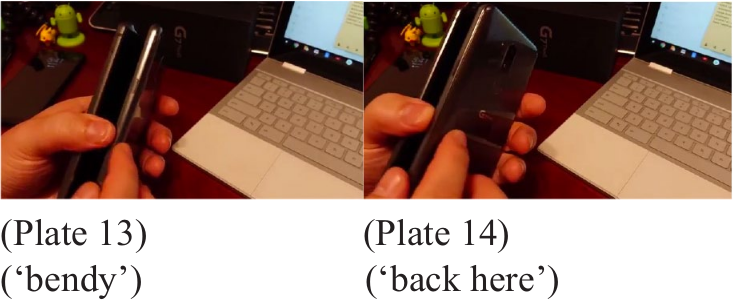
This review uses ‘showing sequences’ (Licoppe, 2017) to construct a comparison between two products (the new phone and the older G6), moving the G6 close to the camera (plate 5) and then placing the two phones back to back (plate 7), showing them next to each other from a side view to display their comparative thickness. The review describes the new phone as ‘taller’ (line 5 – plate 8) but as feeling thinner (line 6), which is accompanied by an action of ‘doing feeling’ as he rubs his index finger along the sides of the phones (plate 10). In spite of this report on the ‘feel’ of the thinness, he notes that they are ‘probably the same’ and suggests that the reason for the sensation of thinness may be due to the glass at the back being a little ‘nicer’ (line 7). This part of the action is also accompanied by gestures and manipulations, the first of which moving the phones apart and closer together as he talks (line 6 – plates 10–12), a ‘beat’ like (McNeill, 1996) or rhythmic gesture that can be used to bring other people’s attention to an object (Licoppe, 2017). Pointing to the curve of the side of the phone as the reviewer says ‘bendy’ (line 7 – plate 13) and then pointing to the back of the phone as he says ‘back here’ (line 7 – plate 14).
Throughout the extract, we can see how the vocalisation about the feeling of the phones is made alongside the production of ‘feeling action’. Unlike the previous two examples where the sense action was separated from the report, here the action and the report occur together. The talk narrates the gestural work as they occur, explaining to the viewer what he is feeling as he conducts these ‘finding out’ manipulations. While the sense work present in the sensory act is invisible at the moment of experience in Extracts 1 and 2, in this case, it is made available to the viewer through cross-modal actions of talk and manipulation. The gestures in Extract 3 have a ‘performative’ character in that they are showing the senses in action along with the talk, rather than used in place of talk as in Extract 2 (line 14, plates 19–24)
There is less technical language used here, with more everyday descriptors such as ‘bendy’, ‘tall’, ‘blocky’ which contrast with the highly specialist descriptors found in the previous examples. Similarly, there are no iconic or pragmatic gestures; instead, the hands are used to show features of the product through manipulation. Again, the extract ends with an evaluation of the phone (‘a little nicer’ ‘doesn’t feel as blocky’, lines 7–8) which is, like Extract 1, based on a comparison of the products.
Part 2 – Partially available senses
Hearing
In this section, I move to look at sensorial experiences that are available to the reviewer. The next example comes from a review of a Steinway O Piano from ThePianoForever channel. While the viewer can hear the piano, their sensory experience is mediated by recording/playback technology and they do not experience the sound in the same way as the reviewer. As we shall see, the reviewer undertakes substantial work to make particular characteristics of the sound available to the viewer. Extract 4 begins with the presenter gesturing to the higher notes on the keyboard and saying that he is going to ‘play a little thing up here’ (lines 14–15) to test the treble register of the piano:
13 the bass actually sounds pretty good %when you play it quietly like that (.h) now I’m 14 gonna focus on the 15 to test out how (.) that is er: I think its gonna be pretty good’
16 Definitely very bright and sparkly and I like it (err) I’m sure this piano has 17 great sustain:’
18 definitely has great sustain it sounds awesome [….]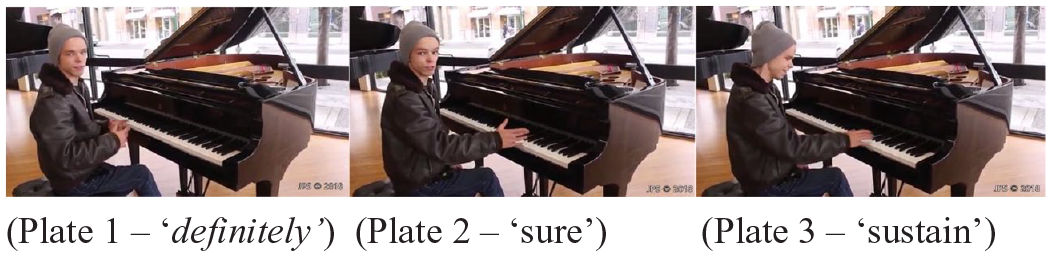
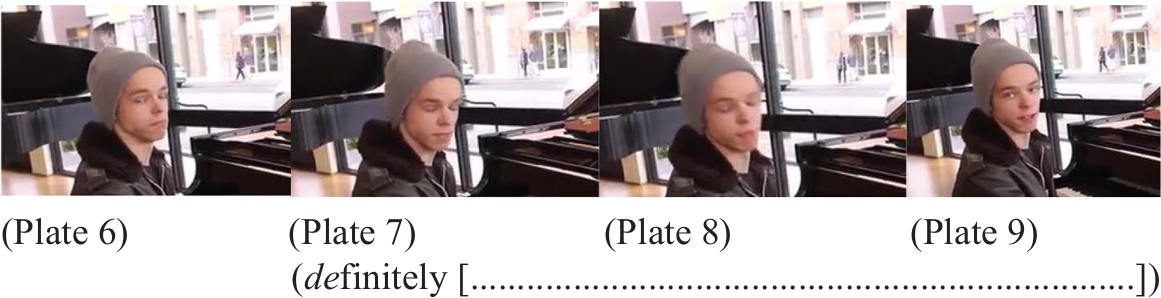
Having played the music, the presenter turns to the camera and says sound is ‘Definitely very bright and sparkly and I like it’ (line 16, plate 1). The word ‘bright’ is a cross-modal sense term commonly used as a characterisation of the ‘clarity’ or ‘sharpness’ of sound, and acts in opposition to ‘muddy’ sounds that are not ‘clear’. As with Extract 3, the description is more minimalistic than those found in Extracts 1 and 2, and there is no extra-linguistic or gestural work undertaken to objectify further the nature of this ‘brightness’. As such, the presenter treats the descriptive term as having an obvious relation to the sounds just played and, in their construction of this as intersubjectively obvious, creates a shared knowledge framework between themselves and the listener.
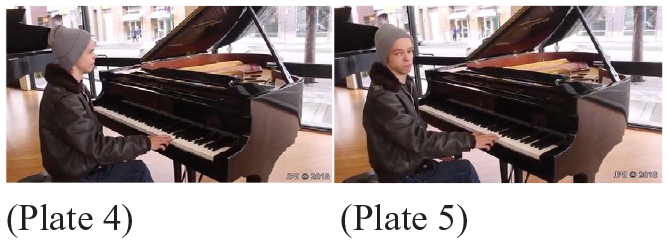
In continuation, the presenter undertakes evaluative work, going on to say ‘I’m sure the piano has great sustain’, using pragmatic gestures to emphasise the words ‘definitely’ and ‘sure’ (plates 1 and 2). He then turns to the piano and plays a single high E note which he lets ring, maintaining his gaze into the distance in a ‘listening pose’ (plate 4). After 3 seconds, he turns back and looks straight at the camera while the note continues to ring, gradually fading away in the background. At the point where the sound seems to disappear, he says ‘definitely has great sustain it sounds awesome’ (line 18) which is accompanied by a circular nodding gesture (plates 6–9).
As with Extracts 1 and 2, the reviewer’s own sense work is performed for the viewer as a gestural action where the body is placed in an alignment which displays ‘listening work’. The performance in both parts of the extract (treble test and sustain test) is set up as an experimental act which the viewer participates in. The viewer is positioned as able to participate in the assessment along with the reviewer. This involves creating an interactional moment in which mutual attention is placed on the sensorial phenomena to hand. Instead of a ‘showing sequence’ that might bring some feature of the sound to attention, the sequential organisation here creates a space where the sound is demonstrated, leaving a gap in the talk so that the viewer can listen to the piano (lines 15–16). The verbal and gestural account of this sound is minimal, and gestures are employed not to represent or ‘discover’ properties of the sense work, but pragmatically to accompany the verbal utterances.
Seeing
For the final extract, we return to an earlier part of the action in the wine review from Extract 2. The reviewer begins by saying she is going to tell the reader why she likes the wine (line 1), and starts her account while moving the cup into a parallel position (plate 2) verbalising a description (‘it’s a garnet red’ ‘bright colour with a middle layer’– lines 1–2, plates 2 and 3) and then moves it into a different position (plate 3) all the time looking at the wine:
1 os voy a contar porque: me gusta tanto’ (.h) bueno’ el color es: un: nhm rojo grana:te: I am going to tell you why i like it so much ok color is a garnet red 2 e:: bueno brillante: be:: (.h) e:: con una capa media en fin’ bien’ es un color er er bright with a middle layer and it is a good colour 3 correcto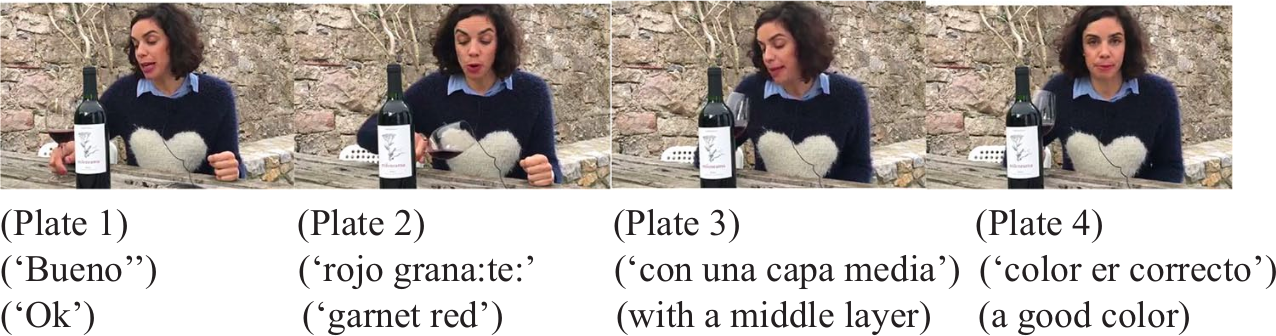
As with Extract 3, the account is performed while the ‘sense work’ is in process, inspecting the wine and talking at the same time. While the reviewer’s own sensory act of seeing is potentially sharable by the viewer, the presenter nonetheless performs the viewing in the routinised way characteristic of wine tasting, holding the wine glass in an almost parallel position (plate 2) that can be thought of as ‘professional gestures’ (gestures that are found in highly routinised types of work; Webb et al., 2013). The reviewer’s professional ‘seeing actions’ contrast strongly with the way that the viewer was implicated in the process of assessing sound in Extract 4 as the reviewer in Extract 5 does not share the act of seeing with the viewer by facilitating their view of the wine. Indeed, the viewers’ ability to see the glass is actually impaired by the organisation of the scene, with the wine bottle partially hiding the wine. Similar to Extract 3, the glass holding gesture is used to facilitate a ‘finding out’ about the world, enabling the practice of visualisation through a downwards gaze at the wine. The descriptive language used (‘garnet red’; ‘bright’; ‘middle layer’) are typical of wine accounts, involving highly specific iterations of colour tone and metaphors of structure that characterise differences in colour within the glass (Shapin, 2016). Yet again, the extract ends with a personal evaluation (‘a good colour’, line 2).
Discussion
At the start of this article, I showed that existing work on YouTube review practices has focussed on how neoliberal discourse inform rhetorical strategies of reviewers in mediating distinctive demands such as ‘authenticity’, ‘being entertaining’ and ‘doing selling’. While these distinctive discursive modes may be important, researchers to date have not paid attention to more ‘mundane’ but no less critical issue related to the production of product descriptions. I have argued here that interactionist approaches to the senses help to show how objects are symbolically transformed from lifeless, disembodied, decontextualised ‘things’ into enlivened and experientially rich products. In this final section, I review the interactional strategies through which this occurred in the videos and discuss the implications of the analysis for the theoretical and methodological study of YouTube product reviews.
Gestures and the sensory act
In the previous section, I used the term ‘sensory act’ to describe the performance of sense work and I showed that this took two distinct structural forms. The first form involved performing the senses for the viewer, so that they can see the reviewer ‘doing’ smelling, tasting and looking. In the examples of smelling and tasting, the reviewers performed the sensory act separately from the verbal/gestural articulation of the experiential display, while in the example of seeing, the reviewer spoke and gestured while ‘doing looking’. This difference reflects in part the difficulty of smelling/tasting while talking, but the separation of the talk from the action marked them as performative in character, which fits with previous research on the ritualistic nature of perfumery and wine tasting (Alač, 2017; Shapin, 2016). In all cases though, senses were presented as something the reviewers were experiencing and reporting to the viewer.
In the second form, the reviewer invoked the viewer as a participant in the sensory act, projecting shared epistemic relations between them. This strategy was only found in the piano review (Extract 4), where the reviewer treated the piano’s sound as intersubjectively shareable in spite of the mediated (and altered) nature of the sound. In contrast, we saw in the wine review that a sharable quality of the ‘colour of the wine’ was not produced, and instead the viewer was positioned as epistemically removed from the product. In both of its forms, the sensory acts transformed the object into something enlivened by situating it within an action sequence where sensory properties could be described/witnessed/experienced, and, in turn, ascribed as properties of the objects themselves.
Turning to the details of this communicative work, we saw that gestural actions were critical to the making of accounts about sensory experiences, with presenters using different types of gestures to draw attention to and to characterise aspects of the properties of objects. First, iconic gestures were used as metaphorical devices to enact qualities of objects that were also described verbally. This was particularly the case with the senses of smell and taste – intersubjectively unavailable senses – where the gestures performed physical enactments of verbal descriptions such as ‘shape’ and ‘direction’ (Extract 1). Second, sense making gesture achieved distinctive interactional work by attempting to display something that was not articulated verbally or not clearly tied to a description. In Extract 2, we saw how the gesture of movement in describing occurred during a pause in speech and had the character of ‘looking for’ a representation rather than ‘showing’ something already articulated.
Third, I referred to gestures that had a ‘performative character’ and that acted together with speech to show something of the products’ sensory characteristics. We saw this in Extract 3, with the reviewer’s manipulations of the mobile phone, such as rubbing a finger on a phone while describing the feeling of ‘thinness’. This involved indexical actions of connecting verbal descriptions through a kind of pointing, but also rhythmic gestures to bring awareness to particular features. Finally, we also saw the use of pragmatic gestures for the purposes of punctuating, emphasising and ordering (e.g. ‘definitely’ in Extract 4). While still implicated in the communicative act of ‘showing senses’, this type of pragmatic work is distinctive to gestural characterisations that depict or ‘enliven’ products as they form ordinary modes of ‘doing talk’ rather than for ‘showing sensory work’.
Through this analysis, we see the central role that gestures play in the articulation of sensory work. Streeck’s (2009) and McNeill’s (1996) frameworks are important resources for showing the diversity of interactional work that gestures can play, and my aim has been to build on this work by showing the uses of these gestural forms for the construction of sensorial action. Much more work is needed in this area to unpack the relationship between gestures and sense work in different contexts.
In addition to gestures, we saw other semiotic orderings used to draw attention to senses, such as by positioning objects in a particular way (e.g. placing different perfumes next to each other). Sometimes, the special organisation could be seen to hinder particular viewer experiences, such as how wine bottle obscured the wine glass in Extract 5. Although it has not been the focus of this study, such practices create an ordered visual field that is evidently an important component of how sensorial characteristics are structured, and I suggest that this is a useful area for further investigation in sensory scholarship.
Implications for the study of selling discourses
As a gloss, we might say that ‘selling’ and ‘endorsing’ both involve ‘talking up’ products and making them desirable by, for example, revealing particular properties of them, their utility or purpose and why they are better than other products. However, there are three points to emphasise about the contextually specific features of such selling.
First, from the analysis, it is clear that all of the repertoires of description and enlivening need to be positioned within established and emergent review conventions. While this article does not aim to make generalised claims about review practices, it is nonetheless evident that there were commonalities across the different genres of videos. A repeated feature of mobile phone reviews is that they use a camera frame that shows the reviewers’ hands manipulating a phone without a shot of their face. Wine reviews typically involved the performance of established wine tasting rituals in the context of a wine review. Both wine and perfume reviews used the same sets of enshrined descriptors to characterise the products. These examples show that communicating sensory experience is embedded in embodied cultural routines (Crossley, 1995; Merleau-Ponty, 1962) that are critical to understanding how reviews are structured.
Second, I suggest that understanding the more localised conventions of YouTube review practice are also critical to the analysis of the performance and negotiation of identity. The small amount of existing research on YouTube reviews has pointed to striking similarities between beauty vloggers (Bhatia, 2018; Jorge et al., 2018), but very little is known about other genres of YouTube reviews. The detailed analytic description of the orders of cultural practice is necessary to describe the interpretive frameworks that reviewers work within, and these are potentially much more expansive than the quite abstract political framings of neoliberalism.
Third, the intersubjective positionings of the viewer in reviews radically transformed the relation between the viewer and the product itself and it has clear implications for the theorisation of identity formation in YouTube vloggers. For example, the relation created between reviewer, viewer and product is central to the types of performance work implicated in ‘doing reviews’, and the types of relationships that reviewers can establish between themselves and viewers. So far, this aspect has been overlooked, largely, I suggest, because of the restrictive focus that has been placed on neoliberal discourse at the expense of a wider analysis of interactional practice.
Future work
This article has not focussed on the production of evaluations as a conversational action, but on the description of products themselves. However, it became clear through the analysis that there were remarkable similarities in the sequential placement of evaluations as emergent from descriptions. Conversation Analysis has a long held interest in evaluation in terms of the production of accounts around assessment (Goodwin and Goodwin, 1987; Heritage and Stivers, 1999), how people align in the production of making assessments (Pomerantz, 1984) and, in sales contexts, the production of customer affiliation following assessments by sellers (Clark et al., 2003). I suggest that online sales environments are an important area for developing this interest further. Similarly, interactionists’ interests in video-mediated communication can be expanded beyond the focus on identifying objects (Licoppe, 2017) to look at how gestural and verbal actions are used to communicate about the multisensorial features of material contexts.
The approach taken in this article involved using everyday sense categories as an analytic frame to explore how sense work is achieved. In much of the data it is clear that the participants themselves are concerned with exactly these sense categories and with finding ways to make them intersubjectively available. In the wine review, for instance, the reviewer described the senses of ‘vision’, ‘taste’, ‘smell’ separately, producing accounts of them as distinct categories of experience. By contrast, in the mobile phone review, while the articulation of touch and feel was evident as a communicative practice and concern, this was embedded in actions of characterising size and shape as a feature of usability. I suggest that a very important line of research will be to explore further how the senses become relevant to mundane actions, where dealing with the senses is an emergent concern, rather than the purpose of the action. A related concern is the exploration of how sensorial experience of phenomena is integrated into other kinds of accounting practices, including evaluations.
I noted earlier that a common starting point for studies of the senses has been an observation that conventional sense categories are problematic as they operate as culturally specific articulations of sense that may misrepresent people’s lived phenomenological experience (Gibson and vom Lehn, 2019). While this critique is useful for illustrating the cultural relativity of sense language and experience, in this article, my concern has been with how people use conventional language (including sense categories) to bring about accounts of their experiences and to order other people’s experiences. The strategies described above give some indication of how everyday sense work is managed, but this emerging interest needs much more work to explore empirically the ways that people handle sense work as an everyday activity.
Footnotes
Appendix 1
Declaration of conflicting interests
The author(s) declared no potential conflicts of interest with respect to the research, authorship and/or publication of this article.
Funding
The author(s) received no financial support for the research, authorship and/or publication of this article.