






Abstract
Over the last two years, the authors have noticed in CBS World News online an increased reliance on graphics inset into news articles in place of photojournalism, particularly in articles about Middle Eastern conflicts. What are the emergent patterns of this change? By analyzing the visual symbolism of these graphics, they discuss a number of distinct patterns, which they interpret by examining the following aspects: disconnections in the article between the visual and written text; the use of an image bank in composing these images; the de-contextualization of maps as out of place; the conflation of Islam and the Middle East through the juxtaposition of Islamic symbols with those of current military conflicts; the prevalence and influence of Arab exceptionalism; and finally the representation of Islam as monolithic.
Introduction
There has always been an intimate relationship between colonial/imperial ideologies and scholarship. The presentation of images and the construction of myths about the Other are closely linked to projects of exploitation, manipulation, and hegemony. Capitalist ideology is simply one form of this relationship, albeit a highly virulent, technologically enhanced, spatially diffused and, generally speaking, a globalized one. Contemporary globalized capitalist ideology carries the imprint of historical trajectories foregrounded by discourses of modernity, European civilization, the Enlightenment, and the Industrial Revolution, simultaneously underwritten by latent social realities of slavery and colonialism.
Capitalist ideology driving both classic and contemporary imperialism is founded on the construction of myths (Alatas, 1977). These myths pertain to societies, groups, and communities that have sprung up under capitalist forms of social relations, linked, of course, to a mode of production referred to by the same name (e.g. Harvey, 1990[1989]). In order to facilitate and sustain the spread of a particular ideology, a potent strategy is the construction of myths about ‘the other’ – understood here in a more narrow sense as those who are perceived to be outside the normalized social cosmos of contemporary capitalism. This is not to deny the broader, more detailed understanding of the Other as first explained by Edward Said (1979), nor are we in any way desiring to reduce the Other to ‘strangers/aliens to capitalism’. Rather, in this article, we aim to capture the potency of myths perpetuated through the use of mass media images by a major Western news website, which reinforce a belief in the pre-modern, uncivilized, violent ‘nature’ of Middle Eastern and Central Asian societies. These myths are critically important to those who seek to justify ‘civilizational projects’ against ‘Muslim terrorists’ and Arab societies, and perhaps to justify the violent imposition of neoliberal capitalist ‘development’ in the non-West. At the very least, this exercise in legitimization serves to promote international rights for intervention founded upon supposedly universal values (Hardt and Negri, 2000: 18). One major medium in which myths about these Others proliferate today is through news networks such as CBS.
Foreign news reporting and CBS
In its presentation of events in the Middle East, CBS News gained primacy in the 1970s with Walter Cronkite’s coverage of the Iranian hostage crisis (McAlister, 2001). Since the late 1990s, there has been a strong belief that foreign reporting has been on the decline, especially amongst media analysts and commentators (Riffe et al., 1994). In his book Bad News, Tom Fenton (2005), a former foreign correspondent at CBS News, laments this decline and cites poor leadership, improper use of technology, and rising costs as some of the contributing factors. This trend was highlighted in an article in The Guardian, which reported that between 1979 and 2010, foreign news reports in British newspapers had dropped by about 40 percent (Moore, 2010). The cause of this decline was also attributed to the number of foreign correspondents – specifically elite foreign correspondents – by Hamilton and Jenner (2004: 302). It is not a decline in access to foreign news. Sources of news have proliferated – Hamilton and Jenner (2004) suggest that transformations of the ‘media environment have led to systemic changes in how we receive news and information from foreign countries’. The way foreign news is produced and consumed has changed, entailing changes in not just quantity but also quality in ways that are not very easily measured. A corollary of these transformations is a proliferation in images and visual reporting, particularly online.
Our focus in this article is on how CBS Broadcasting Inc. (CBS), through its online news site, frequently and indiscriminately uses images to represent geopolitical arenas and societies that could be categorized in politics or the media as anti-US or anti-Western. These images proliferate in the international portion of CBS.com, under the aegis of ‘WorldWatch’, with its inherent power discourse and disciplinary implications. Taking the viewer as the theme of our article, CBS’s insignia of the ‘eye’ (CBS News, 2011a) is very appropriate (see Figure 1).

CBS’s insignia – the ‘eye’.
Our choice of CBS WorldWatch as a site for analysis stems from a somewhat coincidental observation of the use of stock graphics and images that refer to Middle East, Islamic or Arabic contexts. We recognize the presence of more ubiquitous news outlets today – CNN and Al-Jazeera, to name only two – that tend to be viewed as ‘better’ or more reliable sources of foreign news compared to CBS News. However, CBS News still dominates a significant portion of North American news readership: each trending news article registers an average of 100,000 views a day. CBS News (which is the parent subsidiary for the online website) is broadly networked worldwide – a version of Evening News is shown on Sky News in Europe and Africa, for example. Versions of CBS reports also appear frequently on Australian television. Taking this wide readership into account, we are concerned by the consequences of WorldWatch’s imprecise use of graphic symbols and imagery.
The images that we focus on are composites of a particular set of stock graphics, including de-contextualized maps of countries with almost no reference points, the recurring use of Islamic symbols, military symbols such as rockets, drones and firearms, as well as superimposed flags. We noticed a pattern emerging with the use of these stock images from early 2011, and this represented a major shift in WorldWatch’s previous tendency to use photography in their news articles and reports. This pattern largely (and almost exclusively) relates to news articles and reports on the Middle East, Central Asia, and North Africa. Earlier articles from before 2010 were predominantly reliant on photographic images, whereas from early 2011, the shift to using stock graphics was sudden and surprising.
While the question of why this shift to using stock images instead of photography is an interesting one, we limit our focus here to the stock images themselves and their potency as cultural objects in the construction of myths for imperialist projects. In a study of major newswires, including AP, Reuters and AFP/Getty, Shahira Fahmy and Rico Neuman (2012) reveal that the use of images is particularly invaluable to practices of ‘framing’ in the context of conflict. This framing normally takes on a ‘war versus peace’ format which either emphasizes conflict resolution or violence. In either case, the authors argue that gatekeeping in terms of visual communication is essential in shaping public opinion about war and conflict. The use of images in mass media, especially in the case of foreign reporting, is critical for understanding how conflict is presented to the public. McAlister (2001) describes how the complex realities of Middle East politics become distilled into easily recognizable symbols. In other words, much of that complexity was lost along the way.
Here we turn our attention not to the specific inception and production of images seen on CBS (who made them, why, and how) but instead to possible ways in which the images become, in McLuhan’s terms, ‘mass media’. Repetition, which we see prominently with the use of these stock images in WorldWatch, is a crucial element that complements Schudson’s (1989) typology of images.
Methodology
In this article, we examine visual symbolism within a series of graphics, looking at how they represent hegemonic images of a Middle East, resulting in the construction of an imagined and exceptional enemy place. These graphics are cultural objects that can be framed within five dimensions of cultural power (Schudson, 1989): retrievability, rhetorical force, resonance, institutional retention, and resolution. Within these five dimensions, we discuss the potency of these objects as mass media and the patterns in these graphics, leading to a construction of a typology of themes. We focus on creating the typology of symbols and discussing patterns, thereby gaining a greater understanding of the symbolism of this intersection of US empire and mass media within these frameworks of cultural power. The significance of mass media is not longevity (in fact, the shelf lives of these graphics are brief, only until the next article) but a shared timing in their release and audience participation. The term ‘mass media’ relates to the fact that the audience takes in the message at the same time (McLuhan, 1994[1964]: 349). We can discuss the hegemonic nature of these images in terms of Schudson’s five interrelated dimensions of power.
In the case of retrievability, the first of Schudson’s dimensions, the graphics are publicly available and archived on the website. The second of the five dimensions is rhetorical force, which contains several elements, such as the persuasiveness of the graphics (whether or not they help to make the presentation of the content convincing), the medium, and the message (Schudson, 1989: 165). The third dimension is resonance, or how the audience engages with the material presented (p. 167). This category is interrelated with rhetorical force as, in order for a cultural object to resonate with an audience, it must have rhetorical force. Alternatively, if a cultural object is to be rhetorically effective, it must have resonance. As for institutional retention, the fourth dimension, these graphics reflect dominant paradigms of thought about US involvement in Middle Eastern conflicts, both as observer and overt actor. Our last dimension is resolution, or how likely a cultural object is to influence action (p. 171). Action may take on affective forms, such as approval, fear, or relief. The symbols in these graphics work to construct a Middle East/North Africa that matches our fears and justifies conflicts.
Contemporary Orientalism
Since the shift to globalization in the latter half of the 20th century, representations of cultural, national, and civilizational Others have taken on new forms still bearing the same logics of imperialism. The banner under which these transformations occurred is often conceptualized as different phases of capitalism (industrial, advanced, late or neoliberal), as scholars such as David Harvey (1990[1989]), Hardt and Negri (2000), Karl Polanyi (2001[1944]), and others argue. Coupled with these transformations are new and more technologically advanced ways of constructing and perpetuating myths and images about Others of capitalism.
The construction of myths and representations of Others goes hand in hand with the production of knowledge, an enterprise that drove the colonial project (Said, 1979). Empire and European civilization was built on the premise of the superiority of Western culture – embodied through the ideology of race and the ‘White Man’s Burden’. Orientalist depictions of the Middle East and other non-Western societies were produced by scholars, scientists, explorers, travellers, and experts with the precise purpose of establishing hegemonic discourse about foreigners, the violent and unpredictable, and the strange and exotic (Alatas, 1977; Bayat, 2010; Said, 1979).
The use of Orientalist tropes has a long and deep history concerning knowledge production and the expansion of Western imperialism. This type of knowledge, about local cultures and natives in non-Western settings, is capable of creating long-term effects through what Alatas (1977) refers to as the building of ideological hegemony. The trick of ideology lies in distorting social reality and converting both ruling groups and the governed into believing in the ideology. Ideology impacts culture because it relies on the same symbols and values that are the vehicles of cultures, making everyday practices and common understandings of ‘nation’, ‘community’, and values possible.
The Middle East, North Africa, and Central Asia have long been identified as ‘problem’ areas in need of monitoring by the imperial eye of the West. The communities and societies of the region have been subjected to violent traumas of wars, authoritarianism of varying degrees, foreign exploitation and profiteering right up until today. Knowledge about the East is still being produced through Orientalist representations, as this article aims to show. Despite arguments about how globalization has brought about an intensification of connections and compressions of space–time (Harvey, 1990[1989]), the onset of neoliberal capitalism, financial capitalism and new global capital/labor restructuring have also enabled great divergences of spaces and disconnections (Ferguson, 2006; Tsing, 2000). Such divergences create greater opportunities for exploitation of foreign, ‘distant’, populations, via creation of ‘frontier cultures’ (Tsing, 2000) that make extraction of resources palatable to the transnational economic elites, even at the cost of the destruction of local cultures and traditions, as well as environments. These images of violent Others and distant frontiers are central to the maintenance of imperial hegemony. The hegemonic discourses proliferated by knowledge-producing organizations in the US and Western Europe about the Middle East still fall within essentialized, decontextualized, and baseless Orientalistic renditions.
CBS as a producer of knowledge is part of what Knorr-Cetina (2007) calls epistemic cultures and globalized knowledge society, where the production of knowledge is no longer limited to individuals or scholars, but is primarily the purview of intelligent organizations (Evers, 2000) embedded in markets of epistemic cultures (Knorr-Cetina, 2007). The use of the term ‘markets for knowledges’ is deliberate – it marks another shift under globalization in which knowledge production itself has become a commodity that constructs reality, influences values and judgments, and extends to far-reaching spheres of life (Evers, 2000). Such an analytical framework draws heavily from theories of social constructionism, originating from the work of Berger and Luckmann (1980[1967]). This idea stems from a tenet that all reality is socially constructed, which inevitably leads to a reflexive tendency to view knowledge as an epistemological phenomenon (Evers, 2000; Knorr-Cetina, 2007) where interests and politics play a crucial role in its production. The mass media are implicated in this process of knowledge production, especially in the manufacturing of ‘spectacle’ (Min-ha, 1993) and violence. This contention is different from earlier arguments concerning a shift in mass media which focused on relationships between state/government operations and freedom of information. For example, Jacqueline Sharkey (1995) draws links between US military interventions in the Persian Gulf and Grenada to restrictions placed upon news networks as factors impacting reporting. While her focus is on how media become restricted by external actors like the state, our contention is that news networks actively produce new knowledge by using easily digested stereotypes and symbols facilitated by rapid proliferation of images online.
CBS acts, in our contention, as a form of mass media (McLuhan, 1994[1964]) whose practice of using stock images – taken out of context and standardized with symbols and constructs –perpetuates myths about the regions of the Middle East, North Africa and Central Asia – about their peoples, communities, values, and belief systems. These stock images – maps, religious (Islamic) symbols, flags and military graphics – rely on the constant reproduction of the spectacle of war and violence (Min-ha, 1993), simultaneously displaying the inherently unstable ‘nature’ of non-Western societies while justifying the imperial hegemony of the US. Restrictions and censorship of news/information have much less to do with this process than the active production of knowledge indicative of a particular relationship of power.
Content and analysis
This brings us to our first major pattern – that of a drone over a map of a foreign Middle Eastern/North African country. This pattern brings to mind an implied weaponized omniscience, the drone as symbol of US technoscientific power, as well as the unreality of the land below the drone –and what is the significance of it being a map? The drone in this pattern often casts a shadow over the map below, and the shadow represents everything the drone represented but larger, more diffuse, and with more potential. We list graphics, with discussion of their contents, in chronological order, reflecting their changing uses as the pattern develops.
Dating from 21 April 2011, the graphic ‘Predator-drone2_110421_244x183.jpg’(Figure 2) is an early example of this pattern. It accompanies an article titled ‘Obama OKs use of armed drone aircraft in Libya’ (CBS News, 2011b) and has many elements in common with later graphics. Libya appears distant, submerged in the blurred red region, with the drone seemingly descending as it approaches its target. In this graphic, the shadow is not apparent – instead, there is an ominous red in motion below the moving drone.

A drone over a map of Libya (Predator-drone2_110421_244x183.jpg). (CBS News, 2011b).
The graphic ‘drone-over-pakistan_110506_244x183.jpg’ (Figure 3) is the first to have a title, ‘US Air Force MQ-9 “Reaper” drone over pakistan [sic] map’ (CBS News, 2011c, 12 May), in the article ‘U.S. drone strike kills 5 in Pakistan’. Pakistan, the country below the drone, is unlabeled, and again the map is topographical. The drone is the same, positioned at the same angle. The drone’s shadow covers much of the map. This graphic, untitled, accompanies two other articles, ‘Pakistan kicks U.S. off air base’ (Bokhari, 2011a, 30 June), and ‘U.S. eviction from Pakistan base a bad omen’ (Bokhari, 2011b, 1 July). As is clear from these three uses of the same graphic, these images are presumed relevant enough to be widely applied to articles concerning Pakistan –even when drones are not mentioned in the article, as is the case with the latter two examples. Although we could presume that the air base in Pakistan had been used for drone take-offs and landings, it is interesting to us that the same graphic could accompany articles about US killings of alleged militants in Pakistan as well as articles about air bases.
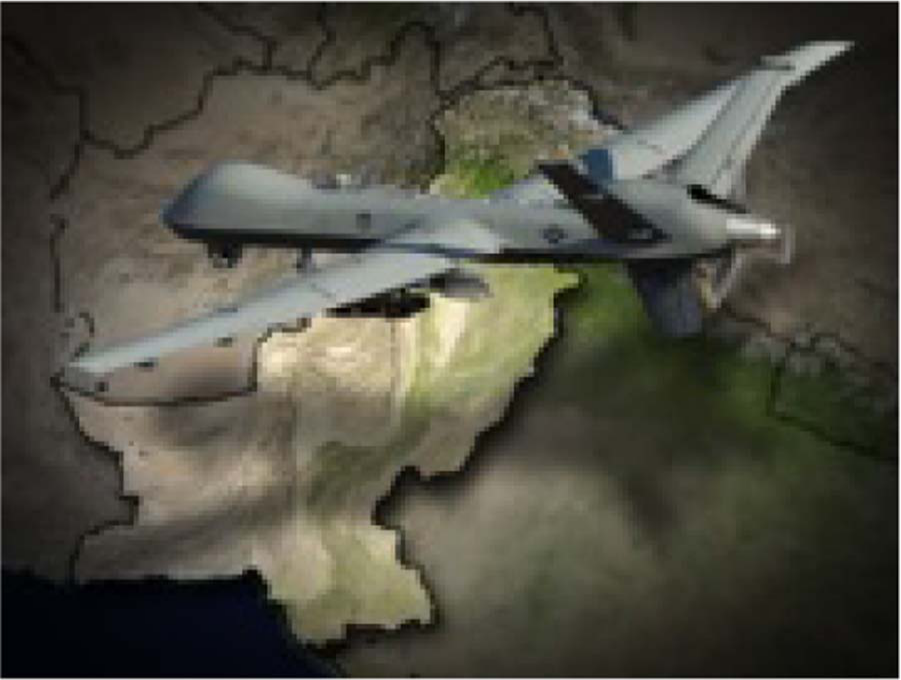
‘US Air Force MQ-9 “Reaper” drone over pakistan [sic] map’ (drone-over-pakistan_110506_244x183.jpg). (CBS News, 2011c).
The graphic ‘yemen_al_Awlaki_110930_244x183’ (Figure 4) accompanies the article ‘Justice memo authorized killing of Al-Awlaki’ (Morgan, 2011, 1 October). This was the graphic that sparked our interest. It constructs a narrative out of three primary elements: the drone, the map of Yemen, and the face of Al-Awlaki. Other elements include the shadow of the drone, the lit-up Yemen contrasted with the dull blues and greys of the ocean and surrounding land, and finally the border around Al-Awlaki’s photograph. The narrative is further detailed in the article: authorized by a Department of Justice memo, a US drone strike killed a US citizen in Yemen.
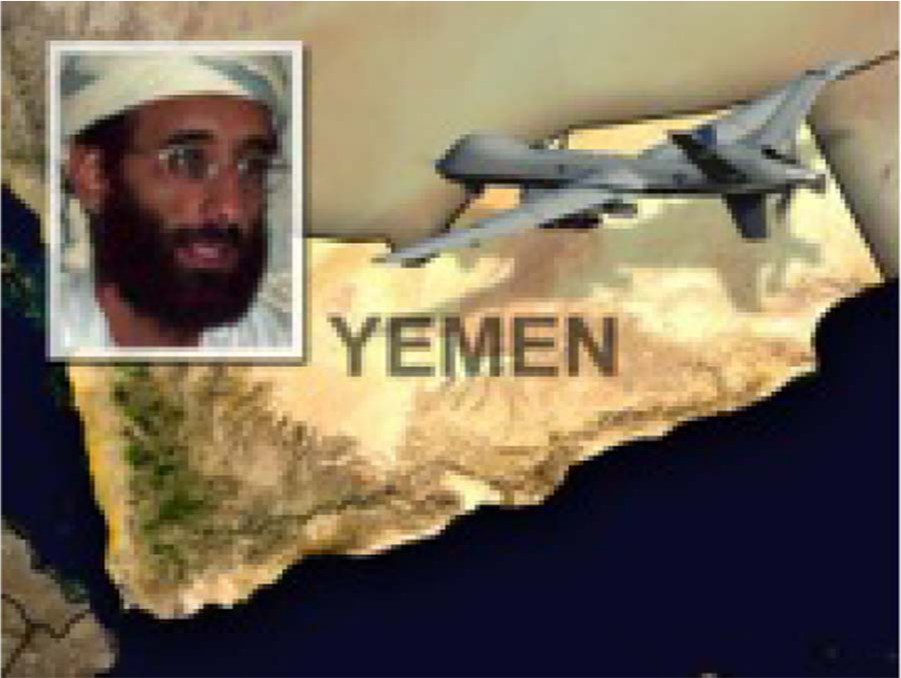
‘Yemen_al_Awlaki_110930_244x183’ from ‘Justice memo authorized killing of Al-Awlaki’(Morgan, 2011).
The graphic ‘Yemen_drone_244x183.jpg’ (Figure 5) accompanies three different articles: ‘Official: Al Qaeda bomb maker wasn’t killed’ (CBS News, 2011d, 2 October), ‘Report: Al Qaeda in Yemen still a large threat’ (CBS News, 2011e, 4 October), and ‘Drones kill another top Yemen al Qaeda figure’ (CBS News, 2011f, 15 October). This graphic is a basic variation of our drone/map pattern. While both graphics share the same pixel size, 244 x 183, and the underlying map and drone graphics appear the same, much less of the map of Yemen is visible this time. Significantly, this graphic postdates the previous graphic by a day and it is likely that this graphic is just a cropped version of the previous more detailed version.
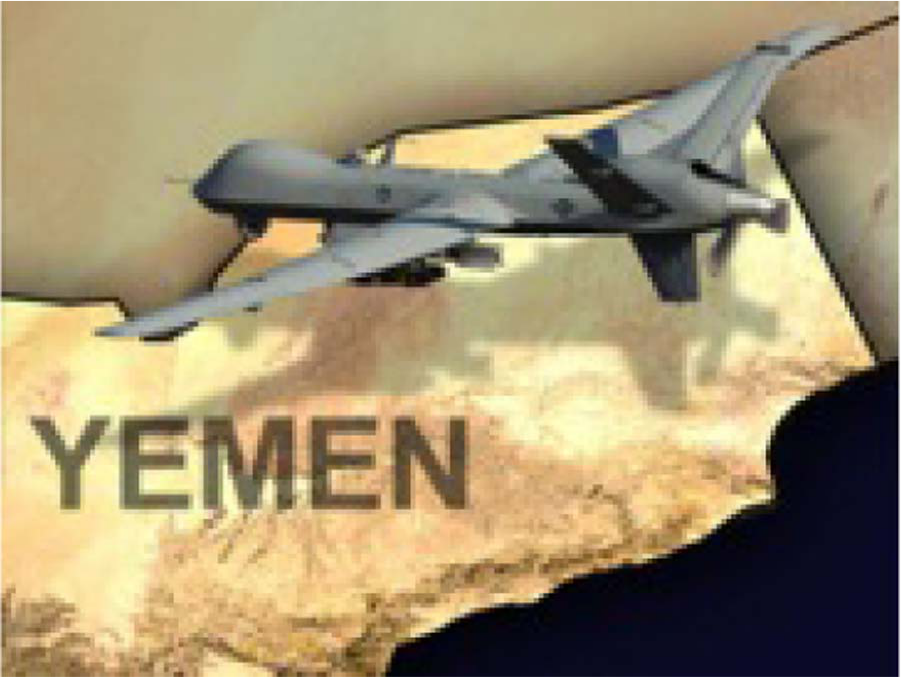
‘Yemen_drone_244x183.jpg’ (CBS News 2011d, 2011e, 2011f).
Over the course of 13 days, this graphic was chosen three times for a series of articles – only one of which dealt with drones at all. The three articles loosely shared a region, Yemen, and a subject, Al Qaeda. In these graphics, the drone seems to stand in for the United States; while the articles convey a threat against the United States, the graphics reverse this, with the drone holding power over the represented land below. Significantly, the cropping creates a narrower frame for vision, disembodying the map of Yemen from its surrounding regions, rendering useless a map’s primary purpose: to locate a region among other regions. This has several fascinating implications. First, by delocating Yemen, it is implied that Yemen’s location is irrelevant in the face of US military power. The maps are taken out of the context they were in and placed in the context of empire.
National boundaries are arbitrary but empire less so. While national boundaries are often reliant on mapping for their existence (Winichakul, 1996), empire has no boundaries. When empire overlaps with nations, the boundaries become contested in ways not necessarily dependent on mapped boundaries. It is not enough to say in the context of our graphics that the map is a tool for domination through its reification of borders and boundaries (Anderson, 2006[1993]: 171), or that mapping is an arm of imperialism. Instead, we must question why it is not necessary in the graphics for location to be considered at all. Although there are borders in the maps, they are not instructive or demonstrative. These maps are out of context and out of place. We suggest that this is a consequence of empire’s delocated and deterritorialized apparatus of rule (Hardt and Negri, 2000: xii).
Contrast these drone images with a related image from CBS WorldWatch concerning similar events (Figure 6). This graphic has been used twice to date in CBS WorldWatch, but months apart. The first instance accompanies the article ‘Suspected U.S. drone strike kills Taliban loyalists in Pakistan’ (Bokhari, 2011c, 27 October), and the second image ‘Key al Qaeda member killed in U.S. drone strike’ (CBS News, 2012, 19 January). Several key symbols stand out: first, there is a target over the map of Pakistan. Second, there is a missile in flight placed ambiguously in the foreground of the graphic. Third, there is yet again a map of Pakistan, with shadows, wartime smoke, and other rather simple image-editing tricks. Interestingly, the missile (presumably launched from the unseen drone) does not appear to be threatening Pakistan but seems to be exiting away from the target, which is misleading to the viewer on multiple levels, especially since the two uses of the graphic concern US drone strikes in Pakistan.
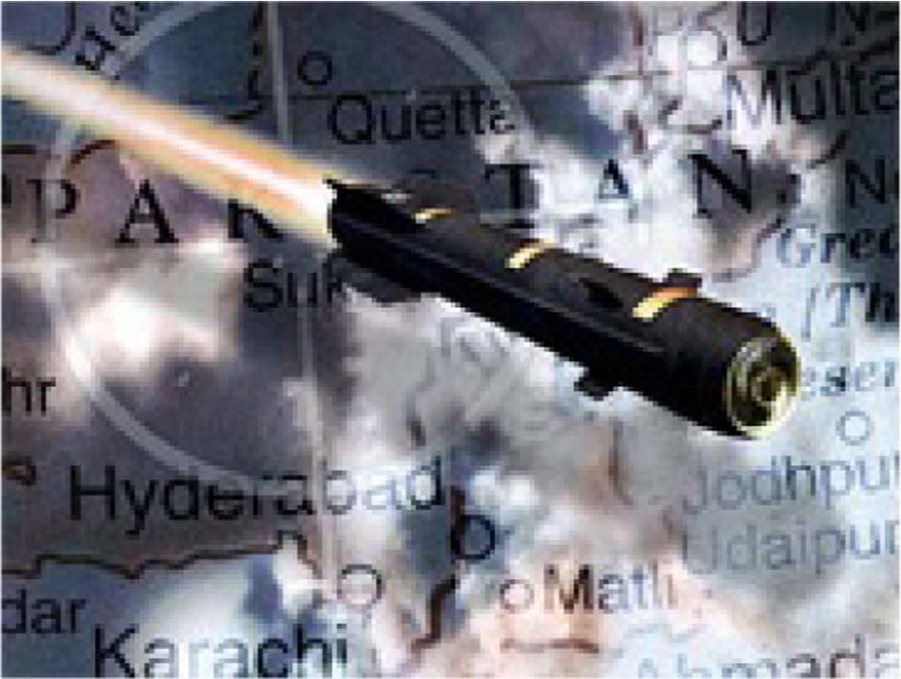
Image from CBS WorldWatch (Bokhari, 2011c; CBS News 2011g).
The graphic ‘Pakistan_Map_244x183.jpg’ (Figure 7) is an excellent example of this delocation at work. From an article ‘Pakistan army chief warns about Afghan incursions’ (Bokhari, 2011d, 6 October), this image is titled ‘Map of Pakistan’. The innocuous title implies that a loaded depiction of explosions and Islamic symbols is normal. Rather than a topographical map like previous maps of Pakistan, this graphic’s landscape is the surface of a distorted flag of Pakistan, and instead of a drone’s shadow there is a translucent duplicate of the star and crescent beyond the borders and into the surrounding regions. The duplicate star and crescent are fainter but larger. In addition, the graphic is surrounded by flames, echoing explosion and perhaps the perceived dangerous fluidity of its borders.
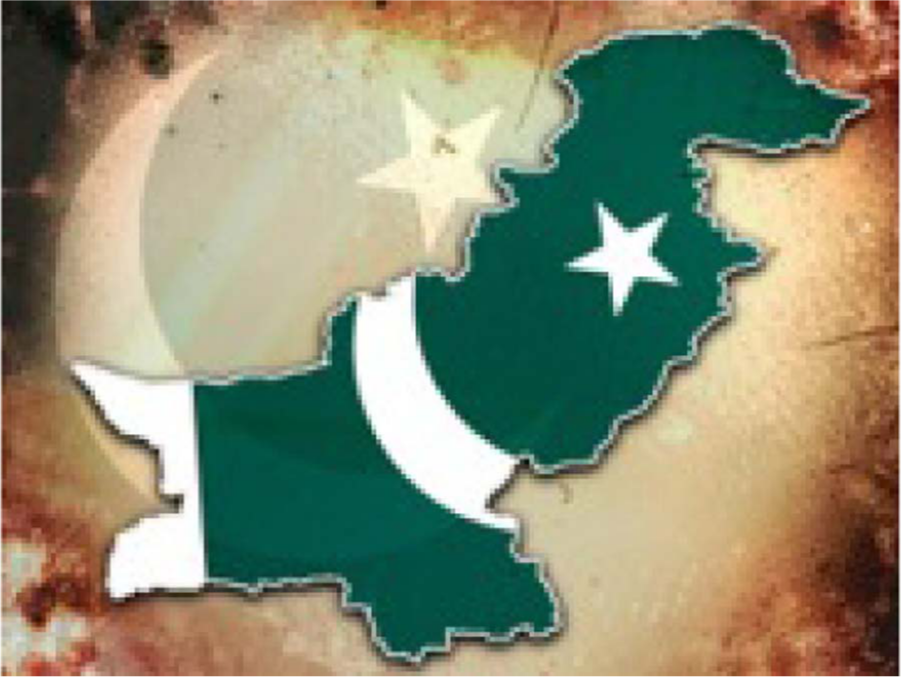
Map of Pakistan: ‘Pakistan army chief warns about Afghan incursions’ (Pakistan_Map_244x183.jpg). (Bokhari, 2011d).
In Figure 8, the map of Niger from the article ‘Post-Qaddafi West and Central Africa a powder keg’ (Global Post, 2011) from WorldWatch on 11 September 2011, is another illustration of a delocated map. Once again, there is no way of knowing where Niger is based from consulting this map alone. This is no small thing; while we are not arguing that a map must convey a sense of place, it is worth noting that there is no geographical reference – not even to surrounding nations. In addition, the image has been dramatized, with a shadowed boundary to an explosive center, signifying a ‘powder keg’.
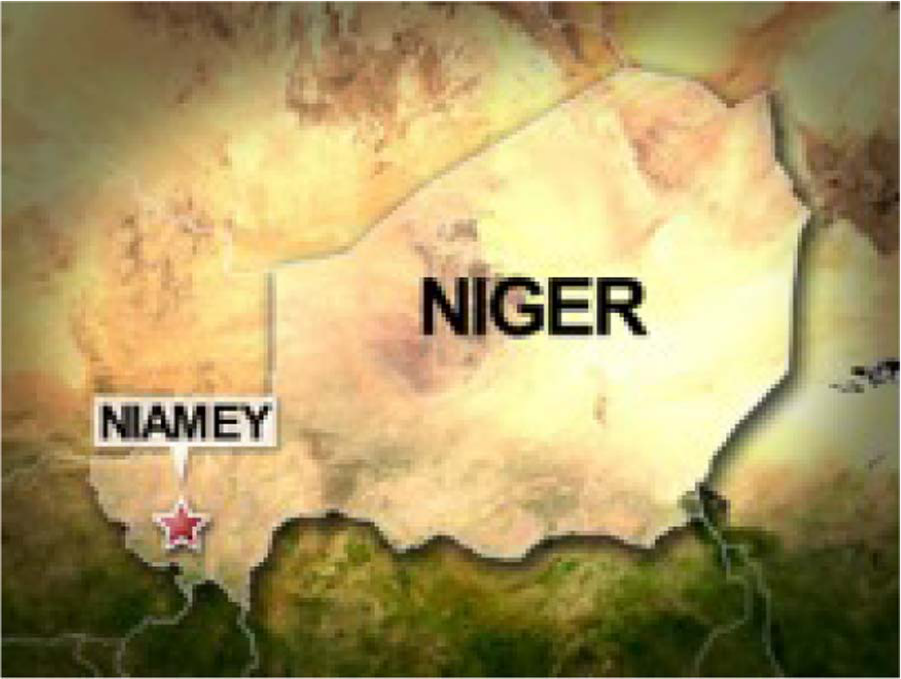
‘Post-Qaddafi West and Central Africa a powder keg’ (Global Post, 2011) from WorldWatch, 11 September.
In contrast to other graphics, ‘pakistan-map_244x183.jpg’ (Figure 9) is a fairly generic graphic, closely resembling a political/topographical map. Again there are subtle differences. First, the map is skewed at an angle implying the viewer’s descent into the land below. There is shadowing at the edges and the center is yellow and brightly lit. In itself, this does not necessarily carry the same connotations as the other graphics – after all, those at CBS WorldWatch could simply be attempting to make the graphic more interesting and therefore attract more attention. However, when paired with the article ‘Bin Laden kill spooks Taliban off cell phones’ (Bokhari, 2011e, 14 November), it is undeniable that there is more to this image than a map’s assumed primary purpose: locating a country. Like the other delocated maps in this article, it does not place Pakistan in a larger context, aside from visible fragments of Afghanistan, Kashmir, and India. This prompts us to ask the question: what purpose does this map serve if not location?
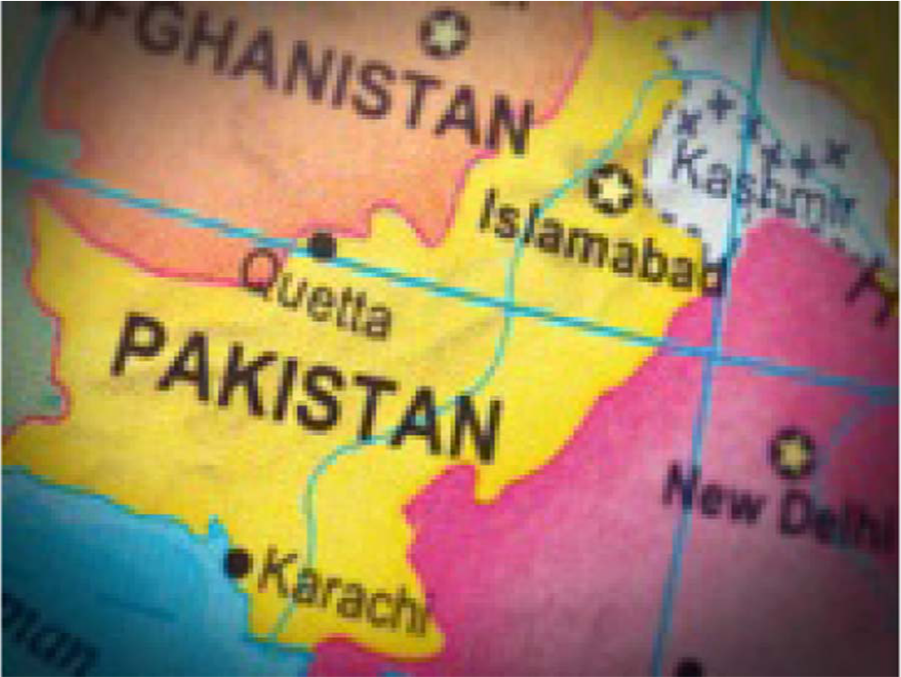
‘Bin Laden kill spooks Taliban off cell phones’ (pakistan-map_244x183.jpg). (Bokhari, 2011e).
The graphic ‘image2516782g.jpg’ (Figure 10) contains frequently occurring patterns: ambiguous silhouettes, two somewhat abstracted flags (French and Saudi Arabian), Islamic symbolism, and another bull’s eye/target/sight. This graphic accompanies the article ‘US warns of possible kidnap plot in Saudi Arabia’ (CBS News, 2011g), and warns of a possible ‘terrorist plot to kidnap Westerners’. Due to the ambiguous nature of the image – silhouettes threatened by a target sight in front of French/Saudi Arabian flags – it is difficult to decipher whether or not the silhouettes are the kidnappers or the potential kidnapped victims. The presence of the French flag is surprising. The article does not discuss France at all; in fact, it seems to be just the red, white, and blue that signify the threatened Westerners.
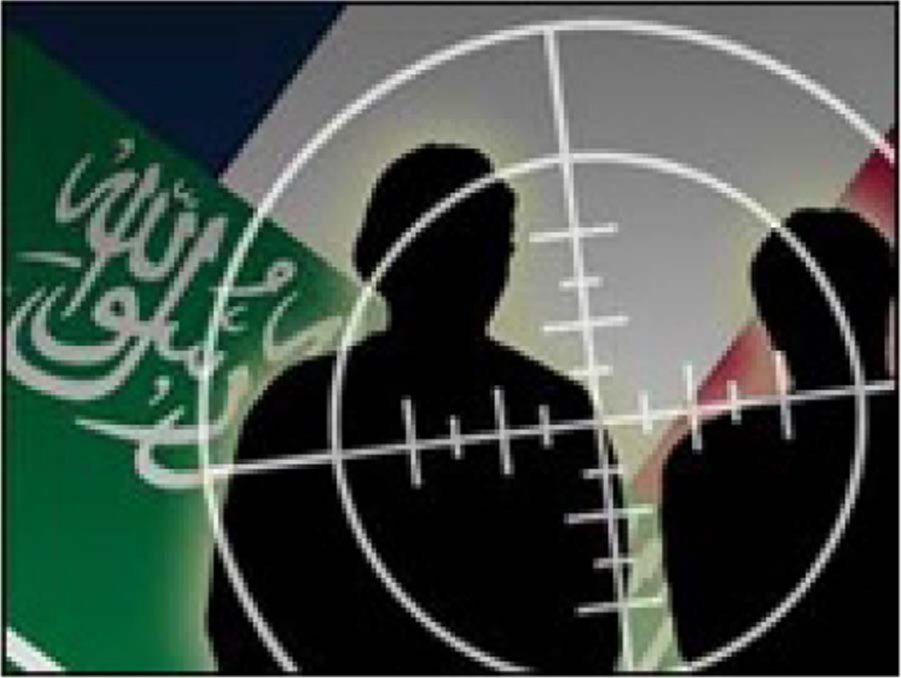
‘US warns of possible kidnap plot in Saudi Arabia’ (image2516782g.jpg) (CBS News, 2011g).
Figure 11 (‘image3754079g.jpg’) is a particularly melodramatic graphic, with two previously iterated patterns and a new dimension – gender. The first article containing this graphic is ‘Officials: Women bomber trend grows in Pakistan’ (Bokhari, 2011f, 27 June). The second instance, on 4 July 2011, occurs with the WorldWatch article ‘Ex-militant: Pakistan supports terror groups’ (Reals, 2011). Since the first instance of the graphic corresponds with an article about female suicide bombers, we can assume that the face behind the ripped flag is female. In addition, the face is made-up and with shaped eyebrows: common symbols of female fashion. The eyes confront the viewer in a manner that recalls a veil, recreating an Orientalist tableau. Again, we have the flag (with colors not quite like the flag of Pakistan) and a sight/target centered over the left eye of the woman behind the flag veil. Due to this once again ambiguous mix of symbols, the woman appears both threatening and threatened. We are unclear why this graphic was chosen for the second article – the only theme in common is the subject of Pakistan, if indeed the flag is the flag of Pakistan.
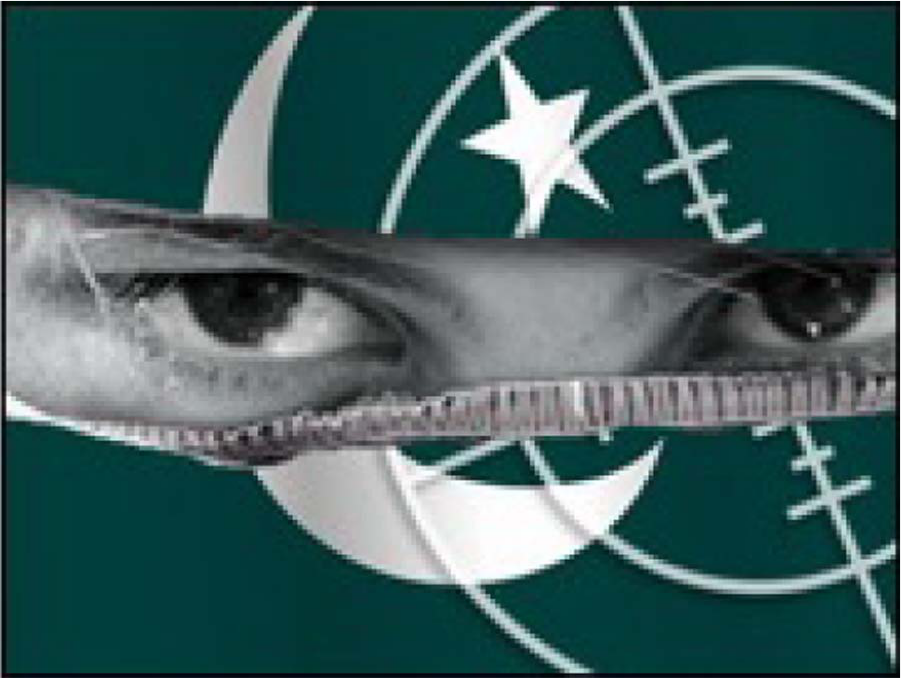
‘Officials: Women bomber trend grows in Pakistan’ (image3754079g.jpg) (Bokhari, 2011f); ‘Ex-militant: Pakistan supports terror groups’ (Reals, 2011).
Figure 12 (image4437502x.jpg) is a synthesis of three themes we have previously discussed: the flag, the target sight, and silhouettes. It first appears in ‘Bin Laden death could inspire future lone wolf attacks, feds say’ (CBS News, 2011h, 10 May). The next month, it appears in ‘Intel chair: Qaeda dead set on U.S. attacks’ (Sundby, 2011, 16 June). In both cases, the meaning is straightforward. The sight targets the United States flag, a definite threat. However, as usual, the silhouettes are less clear: are they threatening or is this up to the viewer to decide?

‘Bin Laden death could inspire future lone wolf attacks, feds say’ (image3754079g.jpg) (CBS News, 2011h); ‘Intel chair: Qaeda dead set on U.S. attacks’ (Sundby, 2011).
Figure 13 (image3758110g.jpg) is a concrete example of similar themes: a flag with Islamic symbols as a backdrop to a glowing silhouetted hostile man holding a large machine gun. It has little to do with the accompanying article ‘Pakistani army officer held on banned-group ties’ (Bokhari, 2011g, 21 June). The article informs us that a brigadier in the Pakistani army has been arrested for ties to a militant group. The graphic illustrates a distilled version of the opinion of the illustrator: instead of an incredibly complex intermix of allegiance, politics, and religion, the group is presumed to be exclusively Islamist. The flag appears to be the same as the flag in Figure 11.
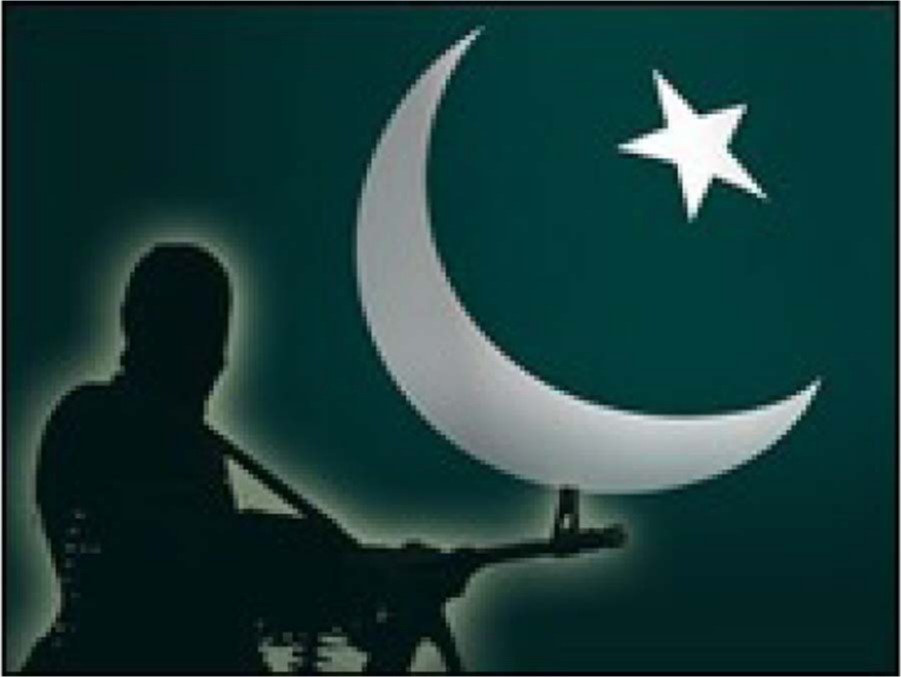
‘Pakistani army officer held on banned-group ties’ (image3758110g.jpg) (Bokhari, 2011g).
Is the flag in Figure 14 in fact a generic flag of Iraq? The file name of this graphic, ‘generic_iraq_flag_1111811_fullwidth_244x183.jpg’ appears to argue so. Although this rendition of the Iraq flag is not too complicated, at the very least it is a flag in motion, displaying turbulent unrest. The article it accompanies, ‘Deadly Baghdad blasts target army, responders’ (CBS News, 2011i, 10 October), supports this perception.
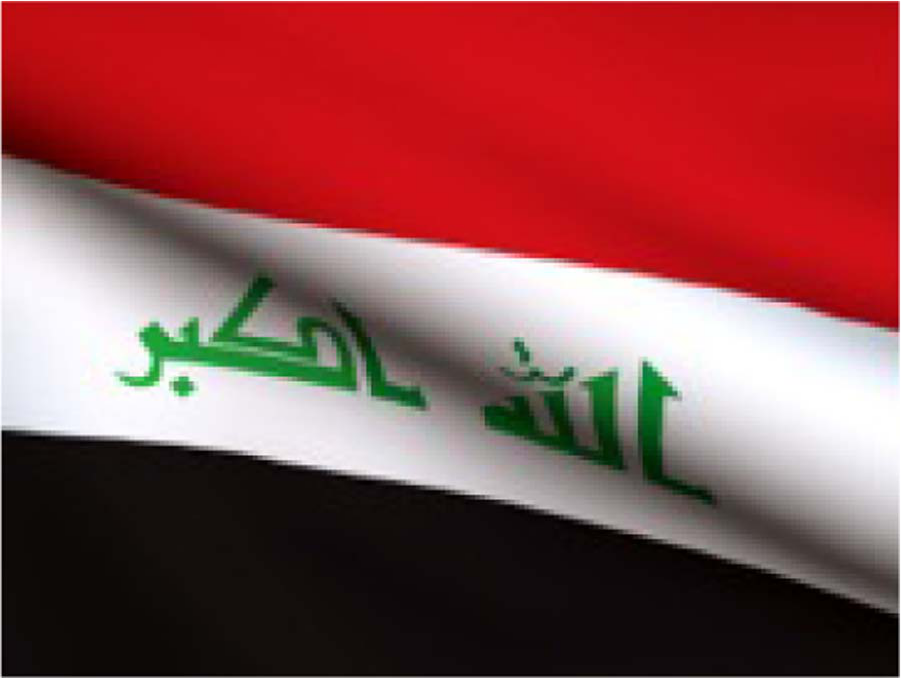
‘Deadly Baghdad blasts target army, responders’ (generic_iraq_flag_1111811_fullwidth_244x183.jpg). (CBS News, 2011i).
The graphic ‘Iran_nuclear_244x183.jpg’ (Figure 15) is a very clear example of the target motif. In this case it is a bombsight over a map of Iran. Since the article, ‘Saudi Arabia: If Iran builds nukes, so will we’ (Norman, 2011) concerns a potential nuclear arms race, on one level we can presume that the bombsight in question is delivering a nuclear payload – made apparent by the nuclear symbol in yellow. However, it is a two-way graphic. Just as the bombsight holds Iran at its center, it also pushes outward toward the viewer, presumably from the US. The author of the article somewhat condescendingly writes: ‘Mideast watchers probably could have seen this coming: A Saudi Arabian official has warned that his country will not tolerate losing a nuclear arms race to Iran’ (Norman, 2011). CBS WorldWatch is a sight for ‘Mideast watchers’, some of whom, by reading this article and engaging with this graphic, are watching through a bombsight.
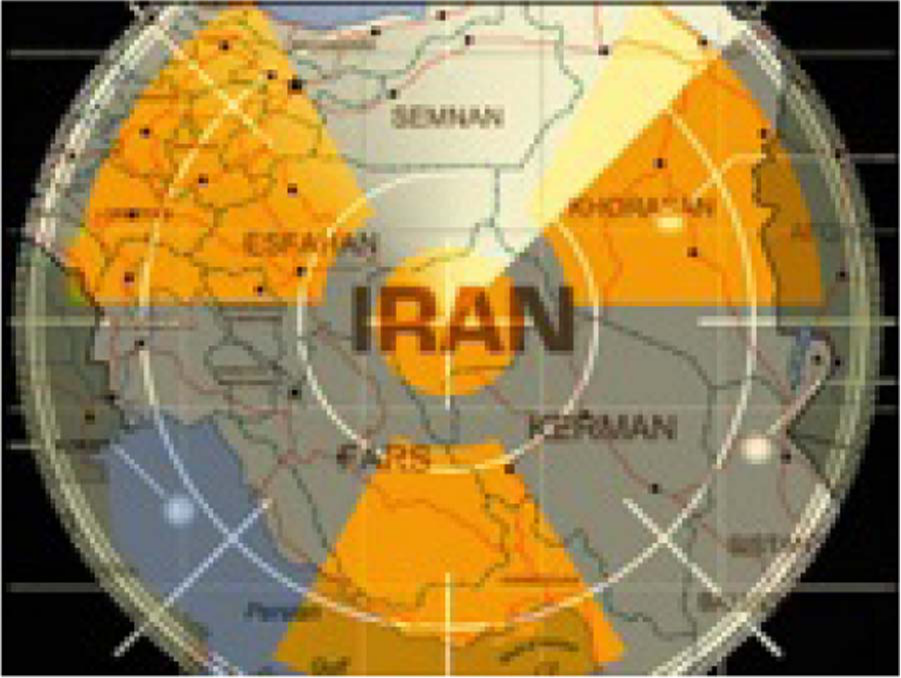
‘Saudi Arabia: If Iran builds nukes, so will we’ (Iran_nuclear_244x183.jpg) (Norman, 2011).
‘Libyan officials: Qaddafi is dead’ (CBS News, 2011j) reads an untitled flash graphic we screen-grabbed from the CBS News front page, 20 October 2011 (see Figure 16). It is perhaps the most dramatic graphic in our analysis – and also the one with the most prominence. According to Schudson’s typology, we can easily say that it carries the most weight with the five ‘R’s’: retrievability, rhetorical force, resonance, retention, and resolution. However, this image appeared only once and does not carry the weight of repetition. As we discussed earlier, this was not merely another WorldWatch graphic accompanying a minor news article. Instead, it was front-page news, plastered across the screen. It served to legitimize an institutional act: in this case the capture and killing of Muammar Qaddafi by Libyan rebels, condoned by the US and other Western nations.
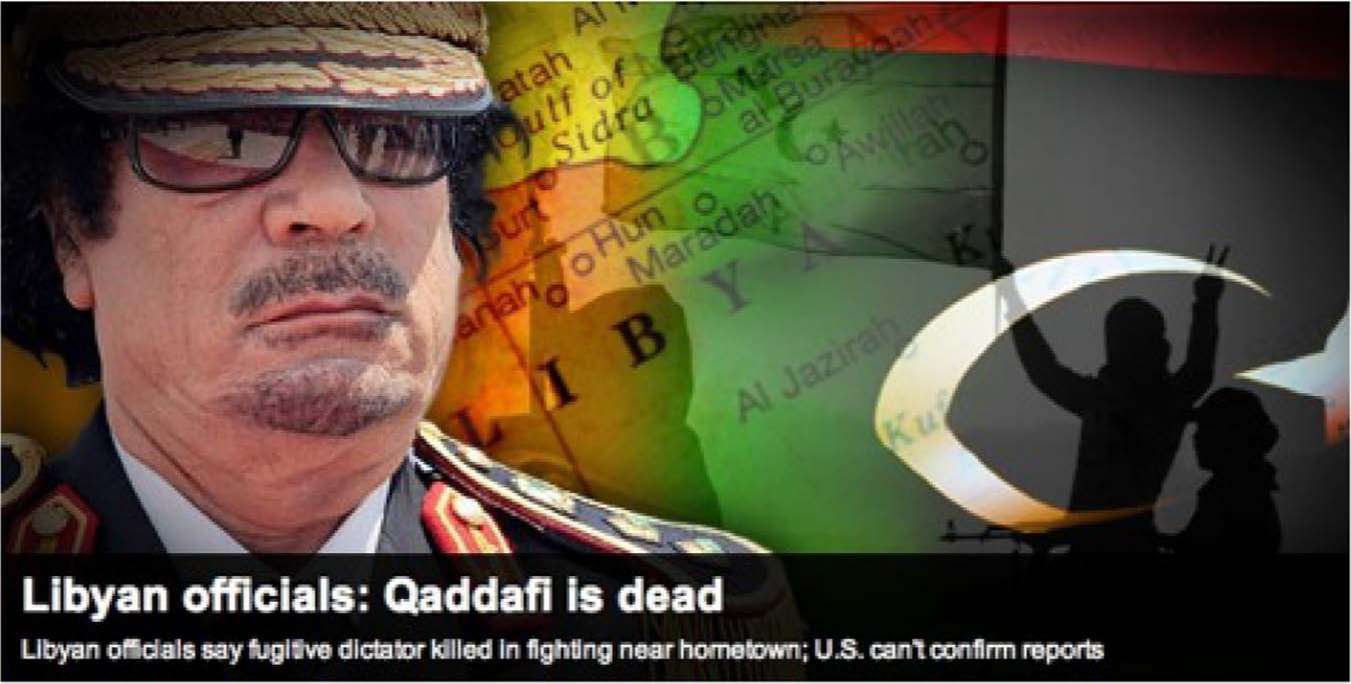
‘Libyan officials: Qaddafi is dead’ (CBS News, 2011).
This graphic contains many of our previously discussed elements: a map in the background, silhouettes waving a Libyan flag, a much larger transparent Libyan flag superimposed over the figures, and an iconic photograph of Qaddafi in the foreground. Here we find our patterns synthesized in a presentation meant to elicit a celebratory response. The role of the Islamic symbols is ambiguous: while they are presented triumphantly by the victorious silhouettes, the large transparent flag is on the same level as Qaddafi’s face.
This graphic did not exist beyond its moment. The banner was quickly removed, and with it the graphic. The image was in flash format and part of a rolling flash animation, not in common standards like .jpeg, .gif, or .tiff. A screen capture was required to archive the graphic. However, the propagandistic elements of the Qaddafi assassination banner are potent and, unlike the WorldWatch graphics spread across the CBS News front page, are there for all viewers to see, not just those concerned with Middle East politics. While this image was only displayed on the website for a short period of time (less than a day), it had mass media effect as well as the attention of a front page banner of a major news source.
Conclusion
We do not fully address the question of how these graphics are created and repeated, but this is an issue worth considering. Stock images are repeatedly used to construct a whole graphic; we posit that this repetition is due to the role of an image bank. Many of the graphics we have discussed in this article are reused in multiple articles – the repeatability of these graphics is noteworthy. Since these stock graphics are shown in multiple articles about the Middle East – the crescents, firearms, maps and drones – it is likely that a process of constructing and perpetuating an essentially different Other follows from these mass consumed images. For instance, the drone in many of the graphics is exactly the same. Regardless of the background or any added special effects, the image retains the same size, color, model, and angle. This repetition facilitates a process of myth-making.
Repeated images also construct a familiarity much like a branding effect, creating a feeling of the expected and the normal. If there is an article on drones in CBS WorldWatch, it is likely that it will be accompanied by a graphic much like the ones we discuss in this article. This is a form of myth-making, with a creation of narrative out of news: Myth expresses ideology in a narrative, rather than discursive or argumentative, structure. The movement of a mythic narrative, like that of any story, implies a theory of cause-and-effect and therefore a theory of history (or even of cosmology); but these ideas are offered in a form that disarms critical analysis. (Slotkin, 1998: 6)
In the case of the graphic concerning the killing of Anwar Al-Awlaki, for instance, this cause-and-effect narrative is clearly evident. The drone, paired with a map and a face, tells us a ‘whole’ story we are supposed to know.
The repetition of these graphics adds a feeling of predictability and ordinariness to something that is far from predictable and ordinary (US imperial involvement in the Middle East and North Africa). When a US citizen (Al-Alawki) is killed on foreign soil by a US drone, this is not depicted in the mass media as an event worthy of protest. What Lemert termed ‘mobilizing information’ (Schudson, 1989: 172) is especially important when the goal in informing the audience is non-response. After the killing of a US citizen abroad, WorldWatch folds the event into the repetition of the other patterns. Instead of seeming out of the ordinary and worthy of protest, it again becomes critically disarmed into the predictable pattern of drone, symbol, map.
When the US is not just an implied but a visual presence in the CBS graphics, it generally takes the shape of military technology. Out of all its icons, it is not the bald eagle or the American flag that we see but drones and targets. Even the maps alone could be regarded as part of the military project. Samir Amin (2004: 106) notes that the American media projects an unwitting popular notion that its military is but ‘the tip of the iceberg’, the iceberg being all the other aspects of which the US program is assumed to be the greatest in the world. Instead, Amin argues that the military is not just the stick but the carrot, too, because – like post-Soviet Russia – with the advent of transnational neoliberal capitalism, its military primacy may very well be the only might it has left. For this primacy to remain, it needs continued ideological backing.
A contradiction within these CBS texts is that the written articles display very little of the assumptions or preconception of the graphics. In other words, they are of legitimate interest to those of us who like to ‘watch the world’. However, this watching is not a one-way process. The world watches back, and there is much that is starkly evident from the graphics. While CBS WorldWatch does not overtly take sides on US involvement in the Middle East and North Africa, its watching is not without bias: ‘The media’s message may condemn war, violence, and bloodshed, for example, but its language fundamentally operates as a form of fascination with war; and war scenes persist in dominating the spectacle’ (Min-ha, 1993: 193). In this form of media, there are several messages within the medium but the messages are irrelevant to this fascination with war. Fundamentally, this discourse places its subjects into what Min-ha refers to as the ‘Master’s sphere of having’, or the institutionalized capitalist participation in mass media.
The insistence on maps as stand-ins for place echoes Harvey’s (1990[1989]: 252) critique of Enlightenment spatial thinking: The problem with Enlightenment thought was not that it had no conception of ‘the other’ but that it perceived ‘the other’ as necessarily having (and sometimes ‘keeping to’) a specific place in a spatial order that was ethnocentrically conceived to have homogeneous and absolute qualities. (emphases in original)
With the delocating and decentralizing apparatus of empire, these Enlightenment assumptions remain within these graphics, merely transposed into the present.
Perhaps the true purpose of these exercises in culture creation is legitimation (Berger and Luckmann, 1980[1967]: 94) and, more specifically, a legitimation of US empire at war, collapsing North Africa, the Middle East, and South Asia into one enemy place, justifying US involvement and rationalizing the rhetoric and action of preventative war. Why in these graphics is the drone a primary symbol of US involvement in the Middle East? Why targets and bombsights? These symbols recall Douglas Little’s (2002: 3) comment that there is an irony at work here: in American interaction with the Middle East there is ‘an irresistible impulse to remake the world in America’s image and a profound ambivalence about the people to be remade’. In these graphics, there are glimpses of the panopticon. A drone is a medium for a watcher; a sight is a medium for a watcher; even the graphics in an online news site are advertised as being, implicitly and explicitly, for watchers. The site, after all, is called ‘WorldWatch’.
Footnotes
Funding
This research received no specific grant from any funding agency in the public, commercial or not-for-profit sectors.
Author biographies
Address: as Cameron Riopelle [email: