






Abstract
There is empirical evidence of media influence on parliamentary agenda, especially when media coverage privileges conflict framing of reality and negativity. This article addresses the impact of media presence (traditional and social media) and NGOs on European parliamentary discussions about violent conflicts in the Middle East and their role during phases of escalation and pacification. The authors content analysed 7,633 minutes from debates involving the Syrian (from January 2011 to June 2015) and Israeli–Palestinian (from March 2006 to June 2015) conflicts, from the European Parliament (N = 2,541), the German Bundestag (N = 2,138), the UK House of Commons (N = 2,514) and the French Assemblée Nationale (N = 440). Conflict-related paragraphs were filtered and analysed. Using the multilingual and cross-validated dictionary adapted to conflict and media analysis created by INFOCORE, they measured the presence of media and actors as well as the inclusion of conflict-key concepts within parliamentary discussions. Findings revealed that social media (when compared to traditional media and NGOs) are the main actors quoted in parliamentary minutes when they refer to violent conflicts and that this attention varies over time and is driven by focusing events. The presence of traditional and social media as well as NGOs in the debates was significantly different depending on the parliament studied and the conflict under consideration. The authors found empirical evidence supporting the claim that such concepts as limited violence, crisis, assistance and pacification are correlated with the presence of media and NGOs.
Introduction
Violent conflicts are usually a matter of international concern. External political actors tend to devote attention to these situations as part of their responsibility to maintain world peace and harmony. European countries stand out because they play an active role in managing war tensions, making them priority issues in their debates and, sometimes, taking political or military actions that affect the ways conflicts develop. International political discussions about violent conflicts often take place in the parliamentary institution. There, government and opposition parties provide contrasting views on how to assess and react to different combat situations. Such debates reveal that the agenda of political actors is influenced by several agents and sources. Previous research has shown that parliamentary agenda is influenced by the media, especially during political elections or natural disasters. However, there are few studies focused on parliamentary discussions about violent conflicts that also address the influence of other actors beyond traditional media. Therefore, this article aims to analyse the impact of both traditional and social media and NGOs on parliamentary debates about two of the most violent wars of recent years, the Israeli–Palestinian and Syrian conflicts, in four European institutions (the European Parliament, Bundestag, Assemblée Nationale and House of Commons).
To measure the impact of these actors, we identified their presence in the symbolic parliamentary agenda, which consists of discussions and both oral and written questions. Thus, this study attempts to determine whether there are differences in the presence of the aforementioned actors, if this impact varies in each of the conflicts over time and whether there are differences between different parliaments. The research is based on the assumption that media will have a greater presence when the violent aspects of a conflict are addressed, whereas NGOs will play a more prominent role when the parliamentary debate is focused on issues related to the resolution and pacification of tensions in these two regions of the Middle East.
Parliamentary agenda, media, NGOs and violent conflicts
Parliament is a key institution of contemporary democracies. Issues that arise in this house can pursue different objectives, from criticizing the government to expressing MPs’ concerns and making their work visible to electors (Van Aelst et al., 2015). In such cases, it is difficult for initiatives to generate tangible consequences, which is why it is said that they provide parliament’s ‘symbolic agenda’ (Walgrave et al., 2008).
There are similarities and differences between parliamentary work and that of other political bodies. Indeed, the former operates according to strict rules determining the pace and actions of its members (Walgrave and Van Aelst, 2006; Vliegenthart and Walgrave, 2011). Moreover, unlike the executive, parliament tends to be more fragmented and diverse (Walgrave et al., 2008), located at the core of a complex network of strategic relationships with different actors outside the scope of politics.
This idiosyncrasy of the parliamentary institution explains why its political agenda is the result of many factors, forces and circumstances. The issues debated in the cabinet are varied in origin and, in order to receive attention, must go through a highly competitive selection process (Cook and Skogan, 1991). Parliament maintains a complex network of relationships with external actors who often exert a special influence on the issues that active MPs choose to promote in political debate (Walker, 1977). The public, media and political agendas influence and feed off each other, while also being affected by real world indicators in a process of reciprocal construction that many research studies have attempted to explain in recent years (Soroka, 2002; Vliegenthart and Walgrave, 2011).
The impact of media on MPs is a clear sign that politics have been mediatized over the last few years (Strömbäck, 2008; Strömbäck and Esser, 2014). According to studies on this growing trend, political actors have become increasingly subject to media logic (Davis, 2007; Strömbäck, 2011). In parallel with evidence supporting this phenomenon, research on agenda setting has gone beyond its traditional approach of verifying the relationships between media and citizen agendas and begun to question the role media play in shaping the political agenda. In the latter case, media would not only help determine a cognitive process but would also generate more complex and decisive reactions, since the response of political actors translates into behaviours involving the use of limited resources and, often, decision making (Walgrave and Van Aelst, 2006).
In this way, many studies have focused on analysing which actor manages to draw the attention of the other, mainly by examining the possible correlations that exist between the issues addressed by media and those addressed in the political arena, usually in the parliamentary institution. Such studies offer contradictory results (Walgrave and Van Aelst, 2006) that indicate a reciprocal influence between both actors (Davis, 2007; Vliegenthart et al., 2016). However, on many occasions, media exert a greater influence on the agenda of politicians (Edwards and Wood, 1999; Walgrave et al., 2008). Politicians’ decisions to react to media discourse are often motivated by circumstances that make such reactions strategic and favourable to their objectives (Vliegenthart and Walgrave, 2011; Sevenans et al., 2015). Thus, the response of MPs to what is published or broadcast by media, in addition to adopting various forms (Walgrave and Van Aelst, 2006), results from various circumstances that determine and modulate the scope of the reaction (Soroka, 2002; Walgrave et al., 2008; Thesen, 2013; Vliegenthart et al., 2016): the symbolic character of the political action, the political stance of the actor, the negativity of media discourse, the international nature of the coverage and the features of the issues addressed (obtrusive issues, level of concreteness, novelty, etc.), among others.
Taking the view therefore that issues matter a great deal in the tradition of agenda setting (Walgrave et al., 2008), numerous research studies in the field of foreign policy have theoretically and empirically analysed the role media have played in influencing political decisions. The results here are contradictory and confusing. Indeed, some research studies indicate that a high level of media coverage on an international dispute usually causes the crisis to escalate even further (Miller and Bokemper, 2016), while others refer to the so-called ‘CNN effect’, a term that ‘encapsulate[s] the idea that real-time communications technology could provoke major responses from domestic audiences and political elites to global events’ (Robinson, 1999: 301). Primarily during several humanitarian–intervention situations, the CNN effect was thought to have transformed the relationships between media, public opinion and foreign policy decision-makers, especially when the policy was unclear or when there was an absence of political leadership (Livingston, 1997; Robinson, 1999). In this way, politicians were forced to respond more rapidly to images of suffering and war broadcast by media to their stunned and appalled audiences. The quintessence of this CNN effect would be Operation Restore Hope in Somalia (Cohen, 1994). However, many authors believe that in this specific case of humanitarian intervention, the media in fact followed political leaders, rather than the other way around (Baum, 2004; Mermin, 1997). Similarly, the effectiveness of the CNN effect has been questioned as it appears to have radically affected US intervention in northern Iraq 1991, while not doing so in Rwanda (Moeller, 1999). Additionally, many research studies have tried to define the specific characteristics of the type of news coverage (Reuben, 2009) that empowers media to shape the response of Western governments.
When it comes to foreign policy and violent conflicts, the complexity of political agenda does not end here given there are several possible external factors influencing politicians and government institutions (Eilders, 1997; Liu et al., 2009; Marchetti and Tocci, 2009). For this reason, the present research broadens the focus in order to analyse the ways that different external actors might influence parliamentary debates. In particular, we focus on the presence of media, NGOs and social media in the parliamentary debates on two highly topical present-day conflicts in the same region, the Israeli–Palestinian conflict and the civil war in Syria, as they have taken place in four European parliaments: the Bundestag, the House of Commons, the Assemblée Nationale and the EU Parliament. There is very little literature available to date that actually analyses the influence of external actors on parliaments as they deal with external conflicts.
NGOs are regarded as an important influence on the formation of the public agenda as well as on the local, national and international political agendas (Joachim, 2007; Mathews, 1997; Teggen et al., 2004). This is mainly because NGOs have gained credibility as well as the confidence of institutions and the public (Brinkerhoff and Brinkerhoff, 2002; Thiel and Uçarer, 2014), and because they possess hands-on experience and updated information about what is happening in warring regions (Jordan and Van Tuijl, 2000). Although the influence of NGOs has been widely recognized at climate talks and is unparalleled in any other area (Mathews, 1997), its importance to issues involving violent conflicts seems assured, given that producing and disseminating conflict-related knowledge have become fundamental aspects of their mission (Meyer and Sangar, 2015).
Furthermore, if the arrival of new technologies defined by their immediacy and capacity to purvey non-stop information has fostered a change in the ways that politicians relate to media, it should be expected that the speed provided by online news coverage and the interactive characteristics of social media would also have a significant effect on both the symbolic parliamentary agenda and foreign policy (Miller and Bokemper, 2016). In fact, as Conway et al. (2015) have suggested, the effects of social media on political campaigns or on various types of agenda setting are already priority issues in the field of political communication. For this reason, we propose our first research question:
RQ1: Are there any differences regarding the presence of media, NGOs and social media in the symbolic parliamentary agenda when dealing with issues related to the Syrian and Israeli–Palestinian conflicts?
In the earlier stages of a violent conflict or a foreign policy event, when the available information given to the public is limited, the government’s political elites dominate the interpretative frameworks (Baum and Potter, 2008). However, over time the amount of available information increases as different actors develop divergent opinions and interpretative frameworks that compete with official sources. In the parliamentary arena, this can imply the presence of more feedback from different actors (Liu et al., 2009), enhancing the dynamics of the debate between the government and the opposition. Nevertheless, the opposite scenario is also plausible, in which several divergent opinions are raised at the beginning of a conflict followed by a process in which visions converge. Furthermore, the presence of an issue in the political agenda may be strengthened by the presence of focusing events (Cobb and Elder, 1971) which, in terms of foreign policy, can refer to man-made crises as well as symbolic events, such as international agreements or treaties, where the relevance of both media and NGOs is crucial (Liu et al., 2009, Joachim, 2001; Mathews, 1997). Therefore, given that the influence of these actors on parliamentary debates seems to have grown over the past few years (Strömbäck, 2008) and varies depending on the events and crisis of the different conflicts (Paletz, 1998), we propose our second research question:
RQ2: Are there any differences regarding the presence of media, NGOs and social media in the symbolic parliamentary agenda as each of the two conflicts analysed, the Syrian and Israeli–Palestinian conflicts, evolve over time?
In the same way, the specific parliament studied or issue debated can cause variations in the presence of the different actors that influence parliamentary debates. Thus, previous research studies point to variations that depend on the political model of the countries analysed (Strömbäck, 2008; Vliengenthart et al, 2016) or on the different formal procedures of each parliament (Van Santen et al., 2013; Walgrave and Van Aelst, 2006). Similarly, differences can be discerned between countries in the ways they prioritize and manage foreign policy (Walgrave et al., 2008) as well as in the relationships they establish with NGOs (Brinkerhoff and Brinkerhoff, 2002).
On the other hand, as already mentioned above, the CNN effect seems to have affected various violent conflicts differently. In this respect, Paletz (1998) links the most powerful media effects to events that can be portrayed as crisis situations. Each conflict, therefore, has a different news value and issue salience, generated not only by media but also by the capacity of NGOs to draw attention to each particular issue (Rutherford, 2000).
With this in mind, we propose our third research question:
RQ3: Does the parliamentary attention given to media, NGOs and social media vary depending on the parliament studied and conflict addressed?
Many authors claim that the media’s coverage of information, depending as it does on the logic of news value and news selection, is fundamentally negative (Lengauer et al., 2012; Vliengenthart et al., 2016). More specifically, given the matter at hand, some studies have suggested that negative coverage has a greater effect on political agenda-setting (Baumgartner et al., 1997) since, within the dynamics of parliamentary debate, MPs usually find that news items presenting negative information are more useful as tools with which to attack their opponents (Sevenans and Vliegenthart, 2016; Sevenans et al., 2015; Thesen, 2013). Accordingly, we now formulate our first hypothesis:
H1: The presence of media in parliamentary debates is negatively correlated with the appearance of positive conflict-key concepts and positively correlated with the appearance of negative conflict-key concepts.
Unlike media, NGOs are associated with the humanitarian aspects of conflicts: human rights, emergency relief, peacemaking and peacekeeping functions, assistance development and the provision of services in matters concerning education, health, and rural and urban development, among others (Joachim, 2007; Marchetti and Tocci, 2009; Mathews, 1997; Rutherford, 2000). Even during phases of violent or frozen conflict (Marchetti and Tocci, 2009), NGOs try to access institutions in order to promote social gain and/or mitigate negative spillovers (Teegen et al., 2004). In light of these factors, we formulate our second hypothesis:
H2: The presence of NGOs in parliamentary debates is positively correlated with the appearance of positive conflict-key concepts and negatively correlated with the appearance of negative conflict-key concepts.
Method
Sample and procedure
We content analysed 7,633 minutes from debates related to the Syrian (from January 2011 to June 2015) and Israeli–Palestinian (from March 2006 to June 2015) conflicts, which took place in the European Parliament (N = 2,541), the German Bundestag (N = 2,138), the UK House of Commons (N = 2,514) and the French Assemblée Nationale (N = 440). All the texts were web scrapped from official parliament websites in their original languages (except for multilanguage texts in the European Parliament, where English was selected when possible) by two previously trained researchers during June and July 2015. By means of Boolean search, we collected different types of minutes (Written Answers, Oral Answers, Parliamentary Debate, and Westminster Hall) 1 that included at least one mention (across 8 languages) of the countries where the conflict mainly developed.
We web scrapped texts in HTML, PDF, DOC and ODT formats including metadata (Conflict, Parliament, Date, Type of Document) in their titles. All these files were automatically converted to TXT (UTF-8) using specific scripts designed in Python 2.7. In the case of PDFs, we applied Optical Character Recognition (OCR) to some documents and checked the results to verify the quality. Metadata were extracted from titles and included as tags at the beginning of each document using another automated Python script that allowed implementing this procedure by batches. The surveyed minutes and resolutions were usually long and in most cases included different topics (not relevant to the conflict in question). To avoid this extra information, we also ran another Python automated script to identify the conflict-related paragraphs, thus filtering specific texts that included a key-country word and at least one key-conflict concept (from our main dictionary, explained below). Specifically, if a paragraph was relevant it searched in the next paragraph for any of the key-country words or the key-conflict concepts. If any of these words or concepts appeared, it marked the paragraph as ‘relevant’ and repeated the procedure with the next paragraph because this indicated that a discussion about the conflict initiated in one paragraph continued into the next paragraph/s. With this procedure, we obtained filtered documents in order to make the text analysis more accurate (see Table 1).
Distribution of analysed Parliamentary minutes.

All the files were uploaded and stored in the Jerusalem Server of the Amsterdam Content Analysis Toolkit (JAmCAT), where all the necessary scripts for the content analysis and computed initial indicators were run.
Measures
The INFOCORE team created a multilingual (English, French, German, Albanian, Macedonian, Syrian, Hebrew and Arabic) dictionary of 3,738 entities (semantics, actors, places and events) adapted to conflict and media analysis. This dictionary was collectively built by researchers from Germany, the UK, Israel, Greece, Belgium, Macedonia and Spain, who designed ontologies (type, class, subclass, dynamics) and created concepts in order to have a list of pertinent entities that might appear during the natural language processing of reports of any conflict. We used stemming to get the root of the word and included proximity rules for disambiguation. The dictionary was cross-validated after running a pre-analysis on real documents through qualitative inspection of native speakers of each language. All entities were designed to indicate their frequency of appearance in the documents.
Based on a priori categorization, we selected entities for seven constructed concepts and ran a reliability analysis to check their internal consistency. These constructed concepts were the mean of the entities’ appearance frequency and measured the presence of traditional media, social media and NGOs through specific indicators, as well as the inclusion of conflict-key concepts (assistance, pacification, crises and violence) within the texts. Specifically, we measured:
Media presence (αC = 0.67). This indicator groups terms related to generic media and specific media quoted in parliamentary documents, and includes 154 entities such as: media, local media, national media, popular media, or private media (generic); and Israel Hayom, Palestinian News Agency WAFA, or Syria Times (specific).
Social media presence (αC = 0.48). 2 This indicator groups terms related to generic social media and specific social media quoted in parliamentary documents, and includes 17 entities such as: social media, social network, online media or blogosphere (generic); and Facebook, Twitter or My Space (specific).
NGO presence (αC = 0.61). This indicator groups terms related to generic NGOs and specific NGOs quoted in parliamentary documents, and includes 198 entities such as: development NGOs, human rights NGOs or peace NGOs (generic); and the Israel Democracy Institute, the Palestinian Centre for Democracy and Conflict Resolution or the Syrian Observatory for Human Rights (specific).
Limited violence (αC = 0.87). This key concept groups terms related to the problematic phases of a conflict, where violence has no effects on the general population although it does affect a small section of people, and includes 47 entities such as: crime, aggression, torture, self-immolation or injury/wounded.
Crisis (αC = 0.67). This key concept means groups terms related to the chaotic phases of a conflict, where violence has massive effects on most of the population, and includes 34 entities such as: evacuation, massacre, civil war, diaspora or genocide.
Assistance (αC = 0.73). This key concept groups terms related to activities aimed at assisting during the emergency situations of a conflict in the short term, and includes 21 entities, such as: humanitarian intervention, rescue, rebuild/restore, liberation or amnesty.
Pacification (αC = 0.74). This key concept groups terms related to activities aimed at building lasting peace and stability in the medium or long term, and includes 32 entities such as: peace talks, disarming, diplomacy, state building or reconciliation.
Additionally, we created a timeline of escalation/pacification phases based on rated events (–3 to 3 scale). To this end, the most relevant events and milestones were selected in order to construct a timeline indicating the pacification and escalation of violence phases.
The selection of milestones was guided by the following sampling plan. It was deemed reasonable to establish a minimum of three important events for each month, with the goal of identifying six or seven, provided that the reality of the conflict allowed for it. Regarding the search for information, we comprehensively tracked media and the websites of international agencies, including the following: the BBC, the Associated Press, Reuters, The Guardian, CNN, The New York Times, Al Jazeera, Al Arabiya and Hawar News Agency. We also consulted the United Nations headquarters (and especially the Security Council Report) as well as the Local Coordination Committees of Syria and the Syrian Observatory for Human Rights (but only in the case of the Syrian conflict). Finally, we consulted the ‘Timelines of History’ (http://timelines.ws) database, as it provided a meticulously detailed account of events. The search terms introduced into the Google browser and into the different internal search engines were: ‘conflict’, ‘war’, ‘milestones’, ‘timeline’, ‘violence’, ‘crisis’, ‘attack’, ‘offensive’, ‘destruction’, ‘help’, ‘pacification’, ‘peace’, ‘humanitarian’, and ‘reconciliation’, among others.
Once the relevant events of the conflict were selected, they were coded following the ‘Escalation–Pacification Phases’ scale, with values ranging from ‘–3’ to ‘3’, where: –3 = peace phase; 3 = phase of generalized violence. The scale was built on indicators obtained from various theoretical contributions on phases that can be distinguished in the development of violent conflicts (Brahm, 2003; Kriesberg, 2010; Frère and Wilen, 2015). However, it is necessary to make the following clarification: since a timeline was used, the unit of analysis is the date, giving the value ‘0’ to days when there was an absence of relevant events. To check inter-coder reliability, we chose a sub-sample of n = 365 (10.7%) and events were rated by an independent coder. Using Krippendorff Alpha (Hayes and Krippendorff, 2007; Krippendorff, 2012), the average reliability of the scale is αK = 0.82; a very positive result if we take into account Krippendorf’s (2004) recommendation that when index αK ≥ .66, conclusions regarding the subject of the research can be established. The reliability of the scale was higher in the case of Syria (αK = 0.91) than for Israel and Palestine (αK = 0.73).
Analysis
In order to answer our research questions, we conducted exploratory and descriptive analyses, and ran independent and pair sample t-tests and a one-way and within participants ANOVAS to check differences between the groups. To test our hypotheses, we established the correlations of traditional media, social media and ONG presence with each conflict-key concept, and determined if they were positively or negatively correlated.
Findings
Our analysis of 7,633 minutes (see Table 2) revealed that there are significant differences (λW = 0.988; F(2, 7631) = 47.81; p < .001; η2 = 0.012) in the average presence of media (M = 0.0053, SD = 0.0331), social media (M = 0.0070, SD = 0.0526) and NGOs (M = 0.0025, DT = 0.0098) in parliamentary discussions (RQ1). Specifically, we confirmed that social media has a higher presence in parliamentary discussions. In this sense, the differences established between the indicator for social media and the indicator for traditional media are statistically significant (t(7632) = 2.904, p < .004, d = 0.038), although the size of the effect can be considered small (Cohen, 1988). On the other hand, the differences established between the indicator for traditional media and the indicator for NGOs are also statistically significant (t(7632) = 7.988, p < .001, d = 0.114).
Descriptive measures for the indicators of media, social media and NGO presence.

Moreover, our data reveals that the presence of media (traditional and social) and NGOs in parliamentary discussions does not increase evenly over time (RQ2), but rather exhibits different peaks as conflicts evolve. In order to address this matter, we designed two panels with time series graphs: 3 Figure 1 includes the variation of media/social media/NGOs along a time frame as well as the phases of pacification and escalation in the Israeli–Palestinian conflict while Figure 2 examines the same data for Syria.

Presence of media (traditional and social) and NGOs, and escalation/pacification phases of the conflict between Israel and Palestine.

Presence of media (traditional and social) and NGOs, and escalation/pacification phases of the Syrian conflict.
In order to detect driven events, for each conflict we analysed the months in which the presence of actors had high values (above or close to the 95th percentile). 4 In the case of the Israeli–Palestinian conflict, spikes in media presence (95th percentile = 0.019) were found in the months of January 2009 (M = 0.0253) and March 2010 (M = 0.0273); spikes in social media presence (97th percentile = 0.058) in January 2015 (M = 0.022); and spikes in NGO presence (95th percentile = 0.0101) in March 2007 (M = 0.01). In the case of the Syrian conflict, we found that media presence spiked (95th percentile = 0.032) in the month of January 2012 (M = 0.026); as did social media presence (95th percentile = 0.058) in October 2011 (M = 0.045); and NGO presence (95th percentile = 0.015) in November 2011 (M = 0.011).
As for the conflict between Israel and Palestine, we obtained high values (M = 2.8) of escalation during January 2009, a period marked by Operation Cast Lead, a full-scale Israeli invasion of Hamas-controlled Gaza. This escalation (first reported on 27 December 2008) coincided with the spike of media presence. The four parliaments under consideration devoted some of their discussion time to this specific focusing event. MPs referred to media as key sources of information, channels by means of which politicians express their views to the public, but also dangerous mechanisms capable of making constituents ‘angry’ by broadcasting ‘brutal scenes’ or even of radicalizing spectators, given the proliferation of ‘Islamic’ channels. This last perspective on media also appears in the parliamentary minutes with the highest values of media presence. Indeed, such minutes from the Bundestag address the ‘demonization of Jews’ on Palestinian television, a phenomenon that may give rise to ‘racist’ behaviours. We found a similar approach in those minutes with the highest values of social media presence in January 2015. During those minutes, even if we obtained medium values (M = 1) of escalation, the parliamentary debates do not focus on the driven events of the conflict but on the need to reduce the influence of ‘terrorist organizations’ through social media. As for the presence of NGOs in parliamentary debates in March 2007, we obtained low levels (M = 0.23) of escalation as well as very low levels of de-escalation (M = 0.038). During that specific phase, the conflict was experiencing a relatively calm period after the ceasefire declared at the end of November 2006, drawing Israel’s Operation Autumn Clouds to a close. There are no focusing events addressed in these minutes. Particularly relevant is the topic addressed in the Bundestag concerning demands made by Israeli women’s organizations to abandon ‘weapon deliveries from Germany to Israel’.
As for the conflict inside Syria, we obtained medium levels (M = 0.43) of escalation during January 2011 and minimum levels (M = 0.04) of de-escalation as clashes intensified between the rebels and Assad’s army, which coincided with the spike of traditional media presence. Specifically, on 20 January the Bundestag debated the focusing events that had taken place in Syria a month earlier. MPs condemned the violent response from Assad, referred to the newspaper archive to support their contention that there was widespread disappointment with Bashar al-Assad, who at first had been seen as a ‘glimmer of hope’ which by then had ‘been trampled’. During October (M = 0.4) and November 2011 (0.18) we found medium levels of escalation, and low levels of de-escalation (M = 0.04; M = 0.11), which coincided with the spike of social media and NGO presence, respectively. Specifically, on 12 October 2011, the National Assembly of France observed that the situation in Syria was ‘gradually starting to get out of control’ and emphasized the need to protect freedom of expression on social media by banning the export of surveillance, security and censoring technologies to countries such as Syria, where they are used for ‘violating human rights’. Moreover, we found the highest values of NGO presence in debates about the Syrian population’s human rights, particularly in the House of Commons on 28 November 2011. NGOs are referred to as independent sources of information and documentation about the ‘abuses’ committed in Syria.
On the other hand, we found that the parliamentary attention given to media (F(3, 7629) = 23.19, p < .001, η2 = 0.009), social media (F(3, 7629) = 43.06, p < .001, η2 = 0.017) and NGOs (F(3, 7629) = 29.45, p < .001, η2 = 0.011) varies significantly depending on the parliament studied (RQ3). More specifically, Dunnett’s T3 post hoc test shows that the largest differences arise between the British and German Parliaments regarding traditional media (tmedia(2920.26) = 6.96, p < .001, d = 0.195), and between the British and French Parliaments regarding social media and NGOs (tsocial(2946.72) = 7.92, p < .001, d = 0.24; tNGO(2371.65) = 7.66, p < .001, d = 0.25). The size of these differences can be considered medium (Cohen, 1988). As can be seen in Table 3, the British Parliament gives the most attention to traditional media (M = 0.0097, SD = 0.0518), to social media (M = 0.0167, SD = 0.0866) and to NGOs (M = 0.0039, SD = 0.0146).
Averages and standard deviations of the indicators for the presence of traditional and social media and NGOs based on the parliament and conflict.
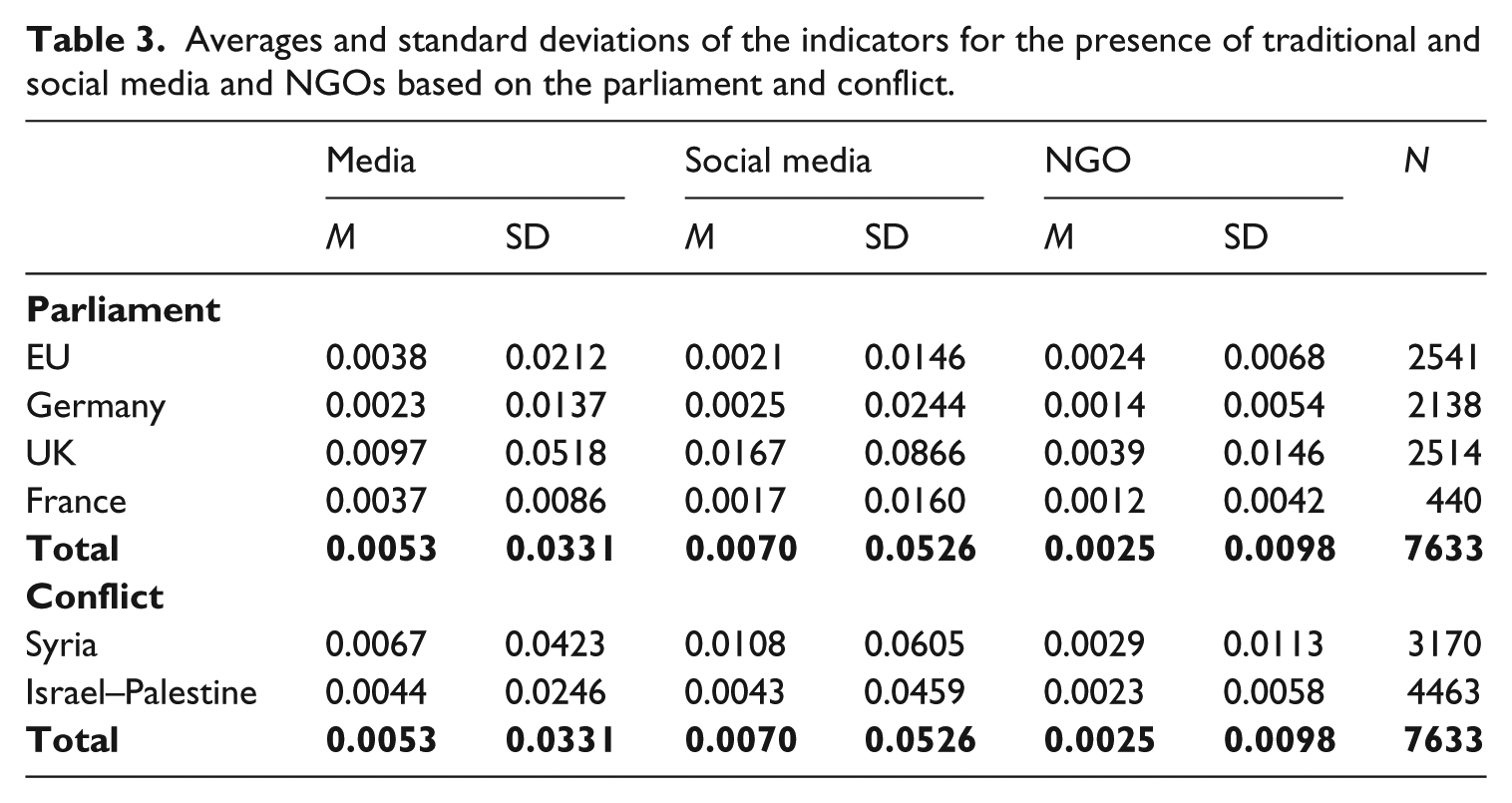
We also analysed whether parliamentary attention given to media and NGOs varied depending on the conflict quoted (RQ3). Given the data provided in Table 3, when comparing the two conflicts, it can be said that significant differences exist for the presence of traditional media (t(4678.74) = 2.78; p < .005; d = 0.06), social media (t(5620.91) = 5.11; p < .001; d = 0.12) and NGOs (t(5605.83) = 2.64; p < 0.008; d = 0.06) in parliamentary debates about the Syrian and the Israeli–Palestinian conflicts. In any case, depending on the effect sizes, these differences are small.
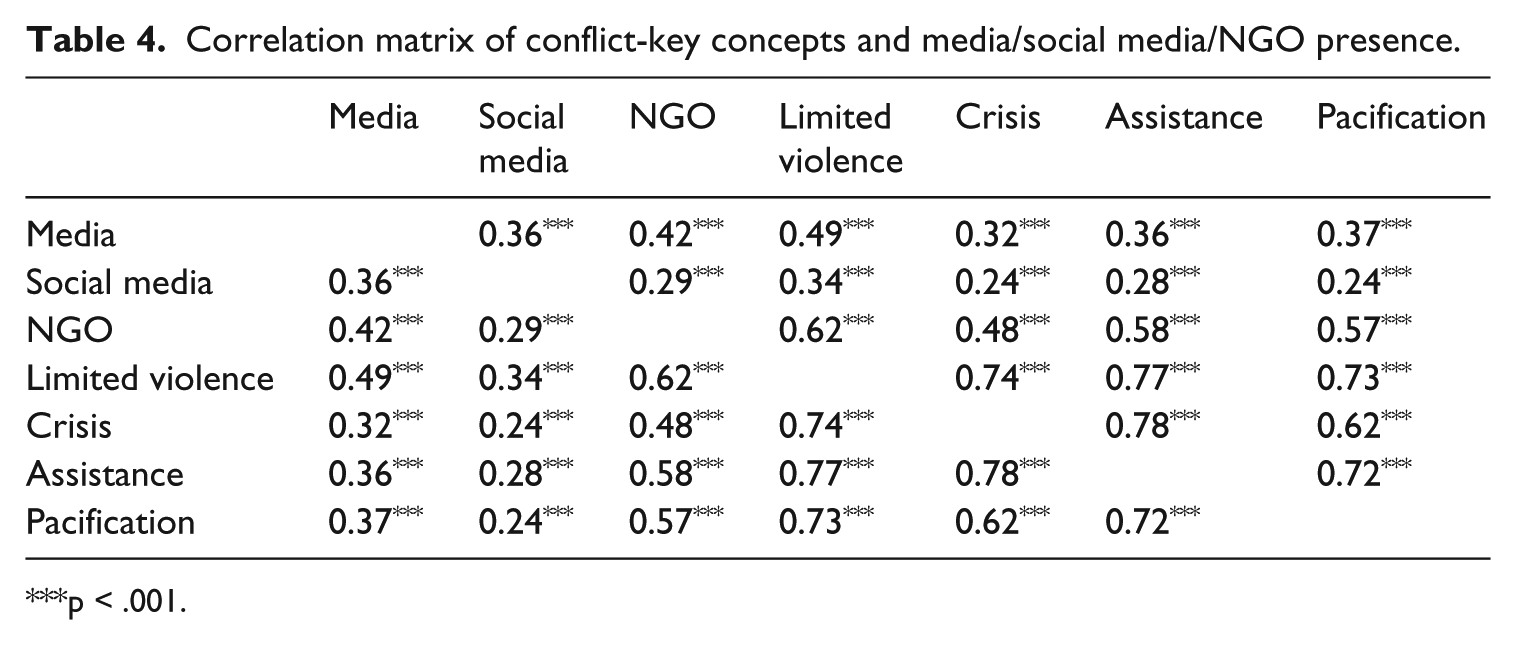
Finally, we measured the average presence of the following conflict-key concepts in parliamentary documents: limited violence (M = 0.085, SD = 0.348), crisis (M = 0.137, SD = 0.602), assistance (M = 0.180, DT = 0.65) and pacification (M = 0.122, SD = 0.43). As can be observed in Table 4, hypothesis 1 is partially corroborated, since although media presence does not negatively correlate with the appearance of positive concepts, it does positively correlate with both positive and negative concepts. This means that when traditional or social media are quoted in parliamentary speeches, there is a high probability that the following concepts will be quoted more often: limited violence (rmedia(7631) = 0.49, p < .001; rsocial(7631) = 0.34, p < .001), crisis (rmedia7631) = 0.32, p < .001; rsocial(7631) = 0.24, p < .001), assistance (rmedia(7631) = 0.36, p < .001; rsocial(7631) = 0.28, p < .001), and pacification (rmedia(7631) = 0.37, p < .001; rsocial(7631) = 0.24, p < 0.001).
Correlation matrix of conflict-key concepts and media/social media/NGO presence.
p < .001.
Something similar happens for hypothesis 2, which is partially corroborated, since although the presence of NGOs does not negatively correlate with the appearance of negative concepts, it does positively correlate with concepts both positive (rassistance(7631) = 0.58, p < .001; rpacification(7631) = 0.57, p < .001) and negative (rviolence(7631) = 0.62, p < .001; rcrisis(7631) = 0.48, p < .001). That is, the presence of NGOs is also correlated with the appearance of the four key concepts studied. Moreover, Table 4 offers evidence suggesting that there is a high correlation between the conflict-key concepts themselves, which indicates that these concepts tend to appear together, providing an interpretative framework for discussions about violent conflicts.
Discussions and conclusion
The significantly higher presence of what is known in this article as social media (digital media, blogs, Facebook or Twitter), when compared with the presence of traditional media in parliamentary debates on the Israeli–Palestinian and Syrian conflicts, can be understood in light of the changes produced in the field of communications, where the rise of the internet has triggered an increase in the number of media users and, more significantly, in the number of media producers (Mayer and Cornfield, 2008). It also seems reasonable to believe that MPs are becoming increasingly interested in views expressed on the internet insofar as they need to appear sensitive to messages that are more likely to have an impact on public opinion (Eilders, 1997; Walgrave and Van Aelst, 2006). This need is even greater in the context of the European Union, where the use of social networks has grown dramatically in recent years, so much so that in 2014 a third of the population used them every day or nearly every day (Eurobarometer, 2014: 18). This result indicates the need to explore the effects of social media on political agenda setting, a subject urgently requiring the attention of academic researchers. Even when our findings are limited to an agenda setting theoretical approach, the higher presence of traditional media over NGOs in the parliamentary agenda may also corroborate the thesis about the mediatization of political actors (Strömbäck, 2008) while also underscoring the difficulties NGOs still face accessing and influencing political institutions (Joachim, 2007; Thiel and Uçarer, 2014).
The fact that the presence of media (traditional and social) and NGOs has not increased over time and that their ups and downs throughout conflicts have been confirmed suggests less that the issue of public opinion has become increasingly relevant in parliamentary debates over time, and more that the presence of focusing events in conflicts (Cobb and Elder, 1971), particularly during phases of escalation, has become increasingly important. It seems logical that, during such phases when international public opinion is mobilized, these important actors from the public sphere would increase their presence in the parliamentary arena. However, the occurrence of focusing events can also be interpreted as a breakdown of normality and, therefore, as a novelty capable of reinvigorating flagging attention in the face of a prolonged debate over a situation that has not changed for some time.
Additionally, we observed that the attention given to the three analysed actors varies depending on the parliament studied, results which are consistent with those given in previous literature (Van Aelst and Vliegenthart, 2014; Van Santen et al., 2013). Thus, it is the British parliament that pays the most attention to traditional media, social media and NGOs. The higher attention given to social media (even greater than that given to traditional media) in the British parliament, when compared with the rest of the parliaments under consideration, might be related to the fact that the electorate uses them at higher rates (Eurobarometer, 2014: 17–20). These differences might also be explained by the parliaments’ internal rules of procedure (Walgrave and Van Aelst, 2006) as well as by the importance that each institution gives to international conflicts. In this sense, the UK’s involvement in attempts to resolve the conflict between Israel and Palestine has always been quite remarkable. For example, the British politician Tony Blair became the quartet’s official envoy on the same day (27 June 2007) that he resigned both as Prime Minister of the UK and as a Member of Parliament, the former of which was a position that he had held for almost 8 years, until 27 May 2015. In addition, the British parliament was among the first to request government recognition of the Palestinian state, doing so on 13 October 2014, two months before the Assemblée Nationale or the European Parliament did the same.
On the other hand, depending on the conflict, significant differences have been found in the presence of these actors. The presence of traditional media, social media and NGOs is always higher when parliaments are discussing the conflict in Syria. Since the beginning of the Syrian civil war, mobile phone videos uploaded to YouTube and Facebook have become ‘instruments of war’ by offering an alternative point of view to public discourses on the conflict, which has ‘added a new dimension to the notion of media publicity and visibility’ (Meis, 2016: 2–3) and provided a possible explanation for the higher presence of social media in parliamentary debates about the Syrian conflict. In addition, the fact that the Syrian conflict is more recent than the conflict in Israel–Palestine suggests that it possesses the news value of ‘novelty’, which could explain why media coverage of that war has been more continuous and intense, offering more data for MPs to discuss. Also, we can be sure that violent episodes recorded in Syria in recent years have also caused NGOs to increase their activity in the area, demanding the attention and resources of foreign governments. Thus, parliaments react to those demands, mentioning these actors in their debates.
Our first hypothesis has not been completely verified. The results show that the presence of media does not negatively correlate with the appearance of positive concepts although it does positively correlate with the appearance of both positive and negative concepts. Thus, while negative framing seems to mark the presence of media in parliamentary debates, this might also result from a type of coverage that points towards humanitarian relief and, ultimately, towards the search for solutions (Walgrave and Van Aelst, 2006).
Similarly, our second hypothesis has not been completely corroborated. Thus, we did not find a negative correlation of NGO presence with the appearance of negative concepts (limited violence and crisis) although we did verify the positive correlation of these actors with both positive concepts (assistance and pacification, constructs that by their nature could be closely connected with the search for solutions that NGOs aim for) and negative concepts (linked to the problems themselves: the violence and crisis of the conflicts). This can be explained precisely because of the above mentioned double-function of NGOs, which goes beyond humanitarian aspects and emergency relief by calling attention to and shaping the perception of problems as well as exerting influence upon matters related to corruption, crimes, terrorism and arms, among others (Mathews, 1997). Future research should consider testing these hypotheses again to verify or falsify their claims. In any case, the higher presence of positive rather than negative concepts in parliamentary debates can be explained by the fact that discussions about foreign policy and violent conflicts, for the most part, revolve around the search for solutions. In this way, for example, interventions into international conflicts tend to be humanitarian in nature (Robinson, 1999).
