







Abstract
We propose that emotion psychology would significantly gain from including narrative(s) and the conversational negotiation of appropriateness. Using the example of anger, we argue that narrators need to construct plausible narratives of emotional events to achieve validating responses by listeners. We argue first that narrators attempt to demonstrate that the appraisal conditions for their emotion are given so that the emotion fits the narrated events. Second, we argue that this in turn explains why narratives of specific emotions exhibit specific forms. Third, we argue that coping with emotional experiences is helped by narrating such that the fittingness of emotions is demonstrated. We conclude that narrative plays an important role for identifying, processing, communicating, and eliciting emotions.
In everyday life, the processing of emotional experiences frequently involves sharing them with others (Rimé, 2009). However, little attention has been paid to narratives in psychological emotion research to date. Therefore, we open the paper by making the general claim that emotion theory would profit from integrating narrative form and the interpersonal process of narrating. On that basis, we then make the first specific claim that narrators go to pains to demonstrate that their emotion reasonably fits the narrated episode to render the narrative plausible and, if also some additional conditions are met, elicit validating, affiliative responses. Then we claim two consequences of the need to demonstrate the fittingness of emotions. We argue, second, that the need to narrate how appraisal conditions are met explains the emotion-specific form of narratives and, third, helps reappraise events and cope with them by adding perspectives and finding a better fit between events and emotion.
We develop theoretical arguments based on informal observations and use two narratives as illustrations. The three specific claims are only partially based on past findings and are developed for future empirical testing. We make our arguments using the emotion of anger, for which they are most easily demonstrated, and leave the specifications for other emotions to future work. Although our theses focus on the form and content of narratives, we will rely on their communicative requirements to justify them.
Narrative Emotion Theory
To prepare the three specific arguments developed in the three ensuing sections, in this introductory section we argue for the need to introduce narrative into emotion theory, and then define narrative form using a first anger narrative. Finally, we contextualize narrating in conversation.
Contextualizing Emotions: Emotion Theory Needs Narrative
Recent constructionist approaches to emotions call for the contextualizing of emotions (Barrett, 2022). Narrative has mostly been left out of emotion theories. In a few exceptions only, narrative played a somewhat tangential role. Communicative theories of emotion, beginning with Darwin (1872), do not require a concept of narrative (e.g., Parkinson, 2021), but lay the basis for its role in the emotion process. Scherer and colleagues (1986) used proto-narratives to study appraisal conditions. Lazarus (1999; 2006) conceptualized appraisal templates as core-relational themes, such as being slighted or disrespected in the case of anger. He suggested using narratives to study these core relational themes (Lazarus, 1999). Pennebaker et al. (1997) used the activity of writing narratives to study coping processes. Although he analyzed word frequencies, he did suggest that narrative form plays a central role in coping (Pennebaker & Seagal, 1999). Oatley most explicitly attributed narrative form a role in emotion processing. Based on a plot-based conception of emotions which evaluate progress in action plans (Oatley & Johnson-Laird, 1987), he proposed fictional narratives as models for the everyday understanding of emotions (Oatley, 1992). Their fictionality allows readers to mentally play through various emotion plots, preparing them for real life (Mar et al., 2011).
However, philosophers offer the most explicit conceptualizations of the role of narrative in the emotion process. The prototypical case discussed by philosophers is an ill-defined affect which needs to be understood by embedding it in a narrative (De Sousa, 1987; Nussbaum, 2001; Voss, 2004). Goldie (2000; 2012) added that constructing such a story requires taking not only the protagonist's perspective, but even more importantly outside perspectives onto the events that evoked the affect.
When taking a temporally extended view on the emotion process, narratives take on the important role of the normative form with which to process and communicate emotional experiences. Psychological communicative theories of emotions typically focus on the immediate exchange and co-regulation of emotions (Parkinson, 2021) or on the fact of sharing emotion episodes with others (e.g., Lee et al., 2020; Rimé, 2009). Even proposals for a contextualist conception of emotions focus on the immediate emotion situation (Barrett, 2022; Hoemann et al., 2019). What is missing in psychological emotion theories and research is the role of narrative as a communicative means of retrospectively contextualizing emotions and re-presenting emotion episodes so that they can be shared, interpreted, and negotiated (Habermas, 2019; Rimé, 2020). In this paper, we focus on a detail of narrative emotion theory, the role of the appropriateness of narrated emotions.
Narrative Form: Anne's Inline Skating Story
We present two narratives to illustrate the general structure of narratives and particularly in narratives of anger. They were elicited by asking for an angering experience from the past weeks. Interviewers did not interrupt narrators, but only listened attentively and encouraged them non-verbally to continue. Audiotaped narratives were transcribed verbatim and divided into main and subclauses by the first author. The first narrative by Anna is taken from a study of narratives of a variety of emotions (Habermas & Berger, 2011; Habermas et al., 2009), for which two female psychology students elicited narratives of a variety of emotions from other students unfamiliar to them (translated from German):
I got into a fight with my boyfriend, ´cause we had actually agreed, that we would go inline skating together in the evening, we had agreed, that it will be at half past seven, ´cause really the weather was already pretty bad, and it had looked, as if it was going to rain at some point. And then, well, he just wanted to first go ride his bike alone in the woods and then he came late a full hour and then he just said, that he hadn’t taken his watch. But I am of the opinion, that you notice being late for an hour, even—well, that was actually pretty bad, ´cause then it was too late for me, and I wasn‘t in the mood anymore, and then I was angry, and then I just decided, in order to punish him, that we go running, ´cause I know, that he doesn‘t like that as much, and then we just went running for half an hour instead of inline skating.
Anna chose this everyday fight with her boyfriend. She goes to pains to narrate and argue what they had agreed upon and how he had violated their agreement, names her anger, and resolves it by punishing him.
Narrative is a text type that reports events by imitating their temporal sequence in narrative clauses, prototypically beginning with “and then …” (lines 9–11, 19, 24; numbers in brackets designate line numbers; Labov & Waletzky, 1967). Narratives thus retrospectively duplicate event sequences in language. In addition, they evaluate what happened from specific personal and temporal perspectives, including both own and others’ then-and-there evaluations in the original situation (narrated time) as well as at present (narrating time) or other evaluations such as hypothetical ones. Anna evaluates from her past perspective as a protagonist (“and I wasn’t in the mood anymore/and then I was angry,” 17–18) and from the past perspective of the other character (“and then he just said/that he did not have a watch,” 11–12) as well as from her present perspective as narrator (13–16). Evaluations vary in how explicit they are. Naming emotions (18) and global evaluations (15) are among the most explicit, whereas reported speech is embedded in the event sequence (12). In addition to narrative clauses and evaluations, oral narratives also contain other elements such as descriptions providing a background (23) and arguments providing explanations and justifications (13–14, 16, 20).
Labov (1997) suggested that oral narratives have a normative structure. The core elements are an orienting section providing the setting of events (who, where, when, and the events running up to the main event), which in Anna’s narrative mostly concerns the pre-history (2–8). In the complication section, the normal state of affairs is interrupted by an event that answers the question “And what happened?”—the boyfriend’s decision to go biking alone, risking to be late and then indeed coming late (9–10). This event is evaluated as special and therefore highly newsworthy (11–18). The ensuing attempts to solve the complication (19–23) may in turn be evaluated for their relative success. Finally, the result section contains the outcome, either a return to normality or not—Anna successfully took revenge (24)—and an evaluation of the result, missing in Anna’s narrative. In conversations, this core structure is embedded by an abstract which announces why it will be worthwhile for others to listen to the story (1), and a coda which leads from the past of the story back to the present of the narration (missing in Anna’s narrative).
The core of the normative narrative structure emulates the emotion process (De Sousa, 1987) in that a state of normality (orientation) is disrupted by an event that impacts an individual’s concerns and that needs to be dealt with (Frijda, 1986; Gross & Thompson, 2007; Lazarus, 1991). Thus, the evaluation of the narrative complication typically is one or more emotions (18). The results section may express happiness or sadness, depending on the outcome (Hogan, 2003), and may again dwell upon the main emotions of the complication section (Habermas et al., 2009)—Anna does not evaluate the result.
Narrating in Context
Labov focused on the expressive/evaluative and the semantic/referential aspects of narratives, neglecting their pragmatic functions (Hepburn & Potter, 2021). Narratives contextualize emotions, but they, in turn, are also embedded in a conversational context. Narrating is the form we use to share experiences with others, the more frequently the more emotionally intense they are (Rimé, 2009). The fundamental reason is that we thereby continuously co-construct an intersubjective reality and moral universe (Berger & Luckmann, 1966; Schütz, 1932), negotiating emotions (Rimé, 2020) and memories (Hirst & Echterhoff, 2012; Pasupathi, 2001).
Because narratives are themselves typical elicitors of emotions, they not only report an emotion episode, but narrating itself is part of an emotion episode in which narrators and listeners interact emotionally. Conversation analysis (Peräkylä & Sorjonen, 2012; Robles & Weatherall, 2021) and discursive psychology (Childs, 2023; Edwards, 1999) have studied how in conversations emotions are elicited by narratives and how they are negotiated.
Listeners’ responses vary depending on whether they had been part of the narrated events. When telling personal experiences to listeners who had been involved in the recounted episode, reciprocal empathic reactions may be shared to strengthen relationships and shared identity such as in the context of family dinners (Fivush, 2019). Controversially negotiating emotions is frequent in the case of anger because it is mostly about diverging assessments of rights and duties. Such settling of disagreements involves trying to construct an agreed-upon story of what happened and whose fault it was, thereby re-establishing a shared version of reality. When sharing emotional experiences with an uninvolved third party (Jefferson, 1988) such as when complaining about someone (Couper-Kuhlen, 2012), narrators hope that listeners will align with their evaluation of events by reacting with empathic emotions and will show affiliative responses (Fiehler, 1990; Parkinson, 2021).
Not always individuals’ motive for narrating personal experiences is to be validated and confirmed by others. Fear stories may also be told to alert someone involved (Parkinson et al., 2016). Anger stories may be told to blame the other and might even be used instrumentally to get one's way (van Kleef et al., 2006). However, even in these cases, we argue, achieving plausibility and being taken seriously as a narrator of personal experiences is at stake and defines successful storytelling. The major exception is storytelling for entertainment, which requires inducing suspense, surprise, and laughter. In the remainder of the paper, we focus on the non-instrumental sharing of emotional personal experiences. Based on the conversation analytic literature, we assume that like all narratives of personal experiences (Stivers, 2008; Voutilainen et al., 2019), angering experiences normatively evoke affiliative responses (e.g., Couper-Kuhlen, 2012; Rühlemann, 2022).
In the following three sections we use the example of anger to illustrate three theses. We first develop the thesis that narrators of emotional, and more specifically angering experiences tend to explicate that appraisal conditions are satisfied to demonstrate the appropriateness of their emotion to render it plausible; we also spell out additional conditions of narrative appropriateness for achieving affiliative responses. We then argue that such efforts at explicating the ways in which emotion-specific appraisal conditions are met by the narrated events shapes narratives of different emotions and provides them with their respective distinct forms. Finally, we argue that narrating emotional experiences such that emotions are deemed appropriate helps cope with them.
Narratives Specify the Appropriateness of Specific Emotions
Our first thesis is that when narrating emotional events, the story told needs to demonstrate that the emotions are appropriate for the event in order to be plausible which in turn is one of the preconditions for eliciting affiliative responses. This is crucial because in non-strategic interactions, narrators need listeners to validate their experiences both in order to establish a shared reality as well as to be accepted and validated as a trustworthy narrator and responsible person who merits being taken seriously (Berger & Luckmann, 1966). Accordingly, inappropriate emotions may lead to the labeling of individuals as insane (Thoits, 1985; 2004; cf. Scherer, 2015), and readers of autobiographical narratives doubt the sanity of narrators if they present inappropriate emotions and offer no alternative explanation (Habermas & Diel, 2010). Even if self-presentation is not at the forefront of narrators’ intentions, their standing in the eyes of listeners is always at stake. We first outline six conditions that narrators need to fulfill to be taken seriously and achieve an affiliative response from listeners (cf. Habermas, 2019). Then we specify the appraisal conditions for anger and show how they are highlighted in Anna's narrative.
Criteria for Autobiographical Narratives to be Judged as Appropriate
Listeners’ reaction align with the narrating process by ceding the time to narrate, maintaining the gaze on narrators, and nonverbal continuers (“uh-huh”), and they affiliate with the narrator's evaluations with nods and explicit assessments such as “Wow,” “Incredible,” and “I totally understand how you felt” (Bavelas et al., 2000; Voutilainen et al., 2019). Depending on the dominant emotion, correspondence rules (Fiehler, 1990) require listeners to respond affiliatively with compassion (sad stories) or, in the case of anger stories, with indignation and by adding justifications of narrators’ emotions (Couper-Kuhlen, 2012).
We propose that narratives need to meet emotion-specific as well as more general narrative requirements to successfully evoke listeners’ confirmation and solidarity (Table 1; cf. Habermas, 2019, ch. 7). To convince listeners that the protagonist's (past) and the narrator's (present) emotional evaluation of events are justified they need to point out how the events fulfill the appraisal conditions that define the emotion. Otherwise, their emotional reactions risk being seen as inappropriate. This kind of appropriateness has been termed the fittingness of emotions (D’Arms & Jacobson, 2000). If emotions fit the situation (and if they additionally are also helpful), they are deemed rational (Solomon, 2007) and reasonable (Parkinson, 1999).
Narrative conditions for evoking affiliative responses.
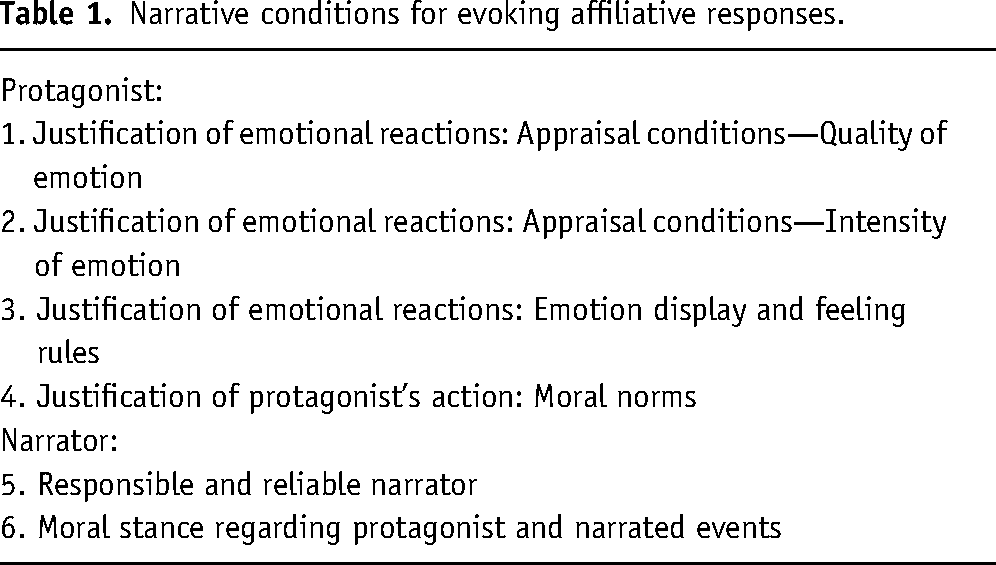
When looking closely at oral narratives of personal experiences, it is surprising how much effort narrators put into convincing listeners and themselves that their emotions are reasonable. Two aspects of emotional reactions need to be justified (Warner & Shields, 2009). One aspect is the specific quality of emotions with which protagonists/narrators evaluate events (condition #1, Table 1). To do so narrators need to highlight that the specific appraisal conditions for the emotion(s) they exhibit are given and that the situation does not require different emotions. Accordingly, Parkinson (1999) demonstrated that narrated experiences of reasonable anger and narrated experiences of reasonable guilt feelings differed more from each other than narratives of unreasonable anger and of unreasonable guilt feelings differed from each other. Thus, specifying how an experience appropriately elicited a specific emotion produced narratives that were more specific to that one emotion and distinct from appropriate narratives of a different emotion. Therefore, narratives of different emotions require demonstrating different aspects of events.
The other aspect of emotional reactions that narrators justify is their quantity or intensity by showing that the events impacted upon major concerns of the protagonist (condition #2). From a narratological point of view, this requirement concerns the tellability or reportability of the event (Labov, 2001). Rose et al. (2006) combined vignettes of crimes of varying severity with victim testimonies of varying emotional expressiveness, demonstrating that the appropriateness of the narrated intensity of emotions correlated with the severity of the crime. Similarly, Warner and Shields (2009) found that the appropriate intensity of anger expression in an angering event shown in a video clip correlated with the severity of the event. In addition, a video clip without emotion expression was judged most inadequate in the most severe event due to a lack of anger. Cheshin et al. (2018) demonstrated that exaggerated emotional expressiveness in salespersons led to customers’ judgments of inappropriateness and inauthenticity, compromising the relationship. Similarly, readers’ critical comments on three narratives of personal loss of varying severity and emotional expressiveness most often concerned the inappropriate exaggeration or lack of emotion and pointed to narrator's lack of authenticity and mental sanity (Habermas & Diel, 2010; for more evidence regarding judgments of the appropriateness of emotions, cf. van Kleef & Côté, 2022).
However, other aspects of narratives may counteract the effects of successfully demonstrating that the appraisal conditions of an emotion had been met. We therefore briefly suggest four additional conditions for narrators to succeed in conveying their experience and evoking affiliative responses. Narrators also need to take care that the protagonist is not judged negatively for violating norms. For one, the protagonist needs to follow regulatory emotion rules, that is what is conventionally deemed to be the right emotion to feel (feeling rules; Hochschild, 1983) and to exhibit (display rules; Ekman, 1984) for a given situation and social role in a given culture (condition #3). In addition, the protagonist needs to act in a morally unquestionable fashion in order not to be morally apprehended (condition #4) which might discourage listeners from validating narrators altogether (Zillmann, 1995). In anger narratives the conduct of the protagonist needs to be even more impeccable, because the blame needs to be placed squarely on the one who the protagonist is angry at to justify the anger (see below).
If emotions do not exactly fit the situation, then additional information about the context, the event's prehistory, or about the individual's specific concerns needs to be added to render the emotion appropriate. If this is not possible, an inappropriate emotion may still be deemed understandable if biographical information explains the protagonist's special sensibilities, for example referring to earlier traumatic experiences.
Whereas these four conditions regard the situation and actions of the protagonist, that is, the historical self of narrators, present narrators also need to demonstrate being a good narrator and a moral person. Good narrators are reliable and responsible for the process of narrating (condition #5). They are obliged to offer a comprehensible and internally consistent story that is in accordance with common sense. If it violates common sense, narrators are expected to explain these violations. If they do not offer convincing explanations, stories are judged to be implausible and narrators to be unreliable (Habermas & Diel, 2010; Vanaken & Hermans, 2021).
Finally, narrators have the responsibility to take a morally sensitive stance towards the actions and evaluations of the story-world (condition #6). If the narrator-as-protagonist had engaged in questionable actions and emotions, narrators need to retrospectively reappraise and correct their judgments.
In the case of autobiographical narratives, defined by the personal identity of narrator and protagonist, violations of the various emotion rules and basic narrative obligations lead listeners to refuse empathy and sympathy and to turn critically against narrators. They may be disliked, criticized as being inauthentic by exaggerating or downplaying, as deceiving themselves. At worst, they attribute enduring negative traits to narrators, having an irresponsible or cold personality or even an insane state of mind (Habermas, 2019; Habermas & Diel, 2010; Hareli & Hess, 2012; Thoits, 2004).
Narratives Need to Demonstrate the Fittingness of Emotions: The Case of Anger
We use the emotion of anger to detail narrative strategies for demonstrating the fittingness of an emotion. Because anger potentially motivates aggressive acts and interrupts social relationships, its appropriateness tends to come under special scrutiny (Bongard et al., 2011; Solomon, 2007). We follow a developmentally informed conception of anger. In infancy, anger is provoked by harm in the form of simple frustrations of intentions such as by restraining the infant's movements (Holodynski & Friedlmeier, 2006; Mascolo, 2020; Mascolo & Griffin, 1998). In adulthood, such frustration of actions, for example, a malfunctioning computer, remain annoying—they make up a substantial minority of angering everyday experiences (Averill, 1982; Weber, 1994). However, in adulthood most angering experiences require more complex appraisals that include normative judgments.
The first appraisal criterion is that the individual was harmed. The second criterion requires that the target of anger is responsible for the harm, causally and possibly intentionally, or at least responsible for not having prevented a harm. Third, that person's actions or inactions violated moral norms, conventional standards, or relationship-specific obligations. This third criterion distinguishes anger from most other emotions, because a judgment of norm conformity is an intrinsic element of the situation appraisal. Being treated unfairly by others, in turn, most frequently takes the form of disrespect or slight (Mikula et al., 1990), so that the typical anger eliciting situation in adulthood is a social act of non-recognition, that is, a disrespect (Miller, 2001) or slight (Averill, 1982; Hodapp & Bongard, 2009).
Anna's story illustrates how narrators highlight appraisal conditions. She first establishes an obligation, reporting that she and her boyfriend had agreed to go skating together at 6:30 pm (lines 2–5), repeating “we had agreed.” She also provides an argument why it was a reasonable agreement, naming the possible harm in case the undertaking would be postponed (getting wet; 6–8). The first complication is that the boyfriend first went on a similar undertaking all by himself (9), implicitly violating the spirit of togetherness. The second complication explicitly violated the agreement because the friend returned too late (norm violation, 10). The word “just” indicates that he had undertaken the bike ride lightheartedly, not taking the necessary care for upholding his part of the agreement. Anna repeats the word “just” when she reports his excuse in indirect speech (11–12) to underline that he did not provide valid reasons for why he was not responsible. Anna herself provides the argument (13–14) that invalidates his excuse. The harm inflicted on the protagonist was the careless breaking of an agreement and the resulting impossibility to pursue the planned joint inline skating (“too late”). Both indicate a lack of consideration of his girlfriend. Anna underscores the size of the harm (15–17). Anna's anger-driven successful solution was that she paid back the harm by changing the agreement to an activity that the friend dislikes (19–24). At the end harm is re-balanced, the reason for anger is resolved, and Anna does not need to dwell on her anger in the final evaluation. Thus, Anna addresses all three essential elements of anger appraisal: harm (6–8, 15–17), responsible actor (9–14), and a norm (2–5) that is violated by the harmful act (9–10). Indirect speech here serves to demonstrate the boyfriend's lack of sincerity regarding their agreement. Anna's narrative demonstrates the effort narrators put into highlighting the appraisal conditions for their emotions.
Demonstrating the Fittingness of Emotion Leads to Emotion-Specific Forms of Narratives
Our second thesis is that one consequence of the need to demonstrate the fittingness of emotions is that it tends to shape narratives in prototypical forms that differ between specific emotions because their appraisal conditions differ. First, we show that different emotions are indeed narrated differently. Then we exemplify the prototypical form of anger narratives with a second example.
Narratives of Specific Emotions Have Distinct Forms
Only few studies compared how different emotions are narrated differently. Hudson et al. (1992) contrasted children's narratives of happy, scary, and angering events. Narratives of happy experiences often lacked the typical complication-resolution structure, and narratives of fear typically produced suspense by a rising arc of tension culminating in a climax before an abrupt resolution. This pattern had been described by Labov and Waletzky (1967) as typical for all oral narratives of personal experiences. However, this structure, we argue, is not typical for all oral narratives, but specific to stories of fear like the near-death stories which Labov and Waletzky (1967) had analyzed. They showed how suspense is built up by interrupting action before the climax with an evaluation, often in the form of inner monologue reporting fearful thoughts.
In Hudson's study, angering experiences, in contrast, had both rising sections leading up to a high point and falling sections. Anger narratives focused on the conditions that provoked anger, that is the appraisal conditions, indicating the need to provide evidence for them. In addition, anger narratives focused on the expression and consequences of anger, indicating a longer time frame than fear narratives. These latter findings concur with those of Fivush et al. (2003) that both mothers’ and children's contributions to co-narrations of angering experiences contained more attributions of emotion to characters and fewer attempts to resolve the emotion. Wang (2001) found in mothers’ and children's contributions to co-narrations of angry experiences more references to moral and conventional norms than in sad and fear narratives, both in the U.S. and in China, pointing to the special relevance of normative justifications in anger. Finally, in a study with young women and children, Habermas et al. (2009) compared German narratives of angering, scary, sad, happy, and pride-inducing experiences. In adults, anger narratives had the highest ratio of (action-focused) narrative versus (static) descriptive clauses, they most often (with fear narratives) had the complete core narrative structural elements of orientation-complication-resolution (corroborating Hudson's findings), and they had by far the largest proportion of indirect speech. Fear stories, in contrast, had the largest proportion of inner monologue.
Thus, anger narratives, like fear stories, typically have all structural elements of orientation, complication, and result (sad narratives often lack the resolution). The most distinctive aspect of anger narratives is the high proportion of indirect speech. Often the dispute between the angering other and the protagonist is reported (a sequence of actions) to demonstrate what the other said and how the protagonist had done everything to calm the waters. The dominance of reported speech had been noted earlier in conversation analytic studies of complaint stories about angering events (Drew, 1998; Günthner, 1997). 1 Thus, the focus on actions in anger stories most often regards an exchange of arguments.
We claim that typical aspects of narratives of specific emotions result from the specific appraisal conditions. The aim of anger narratives is to prove that the blame is to be put on the angering other and that therefore the protagonist's and narrator's anger is justified. Reported speech does not just claim, but actually demonstrates how wrong others were. Also, protagonists’ own utterances are reported to demonstrate how they tried everything possible to rectify the situation and are therefore not to be blamed. An additional reason for reporting protagonists’ contributions is that narratives in which protagonists have the last word demonstrate their ability to deal with the situation (Heinrichsmeier, 2021). These disputes continue after the high point, the main offense, because narrators report the exchange of arguments to demonstrate the fittingness of anger.
The Form of Anger Stories: Tom's Work Story
We present a second, somewhat different anger narrative both to indicate the relative heterogeneity of anger narratives and to illustrate the role of reported speech for demonstrating that appraisal conditions for anger are fulfilled. In addition, we highlight means to emphasize the severity of the event. The narrative was elicited in the U.S. by a male student to be used in anonymized form in class, asking an unfamiliar young adult for the narrative of a recent angering experience. Tom recounts an episode at the bar where he works:
So, I was at work one day, it was probably 8:30, 9:00 o'clock and I was at work and I wasn't really having a good night because I wasn't making a lot of money and one of the people that Joe (my co-worker) usually takes care of came in and he sits down in my section. I started taking care of him and Joe was giving me an attitude, for no reason, and I don't really care I was gonna give the table to Joe after. But he was giving me an attitude and he goes over and says hi to the guy and he comes over to me and then he's giving me a weird vibe. I'm asking “Is everything OK? You fine?” and he said something like “F*** yourself,” he said something like….. man I don't even remember…. [pause] he said something really picky, like he said “F*** yourself” in so many words. I go up to the guy and ask him “Do you want Joe to take care of you?” and the guy said “No” he didn't even care at all, you know? So I go back to Joe and then he started cursing at me like “F*** yourself” and I said “Dude, I don't get” why you act like a little girl all the time” and then he started arguing at me… it wasn't even an argument, just cursing and then we didn't talk about it. He acts like a baby and he still hasn't come up and said “I'm sorry about the other time” and that really upset me because he's someone close to me. I felt lost if anything, I was upset because I was confused.
In contrast to Anna, who concludes with a triumph over the annoying boyfriend, Tom's narrative depicts the protagonist as relatively helpless, and anger is not resolved. The narrative corresponds more to the typical form of anger narratives by presenting an extended dispute with Joe. A sequence of four complications is offered, first by the customer sitting down not in his habitual spot (line 8), then Joe reacting aversively (14). Tom's first attempt to solve the complication (19–21) is met with an insult (22–23). Tom's second attempt to clarify the situation (30–36) is answered with a multiplication of insults (36–37). Tom then counterattacks (38–40), and Joe continues insulting Tom. This sequence of complications and attempts to solve them is interspersed with reported speech, beginning with Tom's first attempt to resolve the complication (19–21), followed by a repeated insult (22–23, 27–28), Tom's second attempt to solve the complication (30–33), again answered by an insult (36–37), but the final word is given to Tom himself (38–40), leading to a state of non-resolution (43).
Tom goes out of his way to point out the fittingness of anger, starting with mitigating circumstances on his side that explain a certain irritability right from the beginning (not making money, 4–5). The harm is the experience of being treated rudely by his colleague. However, who was violating norms is not quite clear. Tom serving Joe's customer is normatively ambiguous, because on the one hand he sat down in Tom's section, but on the other hand he was Joe's regular customer. This ambiguity is not clarified. Instead, Tom reports Joe giving him an attitude (10), stressing that this was unfounded (11), but at the same time maintaining that he would have passed the customer to Joe anyway (13). This appears to be inconsistent with saying that he had only started taking care of the customer (implying he would continue, 9) and with claiming that Joe had no rights over the customer (11). Therefore, Tom needs to put in an extra effort to convince listeners that his anger was justified. Joe's second reproach is still indirect (18), but Tom, in contrast, shows best intentions by inquiring how Joe is feeling (19–21). This contrasts again with Joe's ensuing verbal attack (22–29). In turn, this contrasts negatively with Tom's going out of his way to inquire the customer's wishes (29–34) to demonstrate that Joe had no valid reason to attack him, only to be met with another verbal attack (36–37), which Tom finally counters with a disparaging comment.
In addition to identifying elements that satisfy appraisal criteria specifically for anger (condition #1), narratives also need to justify the intensity of anger (condition #2). For example, Parkinson (1999) found that the fulfillment of appraisal conditions alone justified only the object of anger, the blame, but not the strength of an angry reaction. The intensity of emotional reactions must match the severity of the event for the protagonist to count as reasonable (Habermas & Diel, 2010; Rose et al., 2006; Warner & Shields, 2009). The intensity of anger and ensuing actions must be matched by the severity of the norm violation and of the ensuing harm.
Anna therefore indicates the severity of breaking an agreement (line 9) carelessly (11) by pointing out the intimacy of the relationship (boyfriend, 1) and stresses the size of the harm experienced (“pretty bad,” 15–17). Tom depicts himself as especially vulnerable (4–5) and stresses his closeness to Joe to explain why Joe's remarks had hurt him so deeply (48–49). Linguistic means that serve to underscore the severity of a norm violation and the size of harm are intensifiers like “pretty (bad), very, terribly” and the choice of strongly evaluative words like “dude” and swear words. Other devices are the contrasting of the narrated events with other factual (Tom's well-intentioned vs. Joe's aggressive acts), anticipated (Anna 8–9), hypothetical (Tom 46–48), or counterfactual events as well as negations (Tom 4–5, 11–12, 34, 39, 42–43, 45; Labov & Waletzky, 1967).
Narratives may succeed to be convincing in varying degrees. The more narrators fear or actually notice that they meet skepticism instead of the hoped-for validation, the more they may resort to rhetorical means for winning listeners over to their perspective (Drew & Holt, 1988; Pomerantz, 1986; Selting, 2010). This is illustrated by Tom who provides a less plausible case for the fittingness of anger and accordingly uses more rhetorical means than Anna: idiomatic expressions (10, 18), figurative speech (“acting like a little girl/baby,” 40, 44), absolutes (“all the time,” 40), repetitions (1 + 3, 10 + 14 + 18, 23 + 28 + 37, 36 + 41, 40 + 44). In addition, Tom draws listeners into his perspective by means of dramatic narration: historic present (8, 15–18, 29–31, 35), direct speech (20–21, 23, 28, 31, 33, 37, 39–40, 47), and by referring only to his own mental states (4, 12, 49, 50–52, except for 34). Using rhetorical means may be less effective in the long run than providing plausible evidence that appraisal criteria were indeed fulfilled, but for the immediate listeners it is effective to secure their validating responses (Habermas & Diel, 2010).
Tom's narrative demonstrates the extensive use of reported speech typical for many anger stories. It also shows that the less listeners might find the central emotion fitting, the more narrators tend to invest in providing evidence and using rhetorical means to convince listeners that their emotion is appropriate. More generally, the two anger narratives illustrate how the typical forms of narratives of specific emotions highlight the specific appraisal conditions. This in turn, we maintain, is motivated by the need to get other people to validate narrated emotions. As a methodological caveat we need to add that both our example narratives and the narratives in the quantitative studies demonstrating emotion-specific narrative forms were not only elicited by researchers, but they were prompted by specifically asking for experiences that elicited a specific emotion such as anger. Therefore, we can neither exclude that narrators felt the special need to stress that the appraisal conditions for this emotion was present in the narrated event nor that only this prompted need produced the emotion-specific narrative forms. However, the findings from ongoing conversations that anger narratives are characterized by reported speech speak against the possibility that our theses are valid only for prompted emotion narratives. Another objection to our theses might maintain that anger narratives may aim at different responses depending on the communicative situation, for instance at admissions of wrongdoing, getting one's way, receiving compensation, or also at repairing a relationship. However, we argue that to achieve any of these effects, a plausible story and being taken seriously as a narrator are a prerequisite, and thus narratives have to fulfill the conditions listed in Table 1. In addition, most often affiliative responses and validation of blame are also sought.
In some cases, the two kinds of validating responses may differ, such as when Anna's boyfriend may concede he had violated their agreement but that her anger was exaggerated, or, in turn, when a psychotherapist may feel with a client's anger without placing the blame on someone else (Muntigl et al., 2014). Even in situations in which narrators ultimately seek to receive alternative views such as in psychotherapy, they still justify their anger to only then be challenged by therapists (e.g., Muntigl, 2024).
To counter these possible objections, empirical testing of our theses will require analyzing both narratives prompted not for specific emotions as well as naturally occurring narratives in different kinds of situations. Also, the relation between highlighting appraisal conditions and validating responses may not be a linear one, because the amount of narrative effort invested in demonstrating the fittingness of the emotion may correspond to the degree that the story by itself fails to do so.
In the next section, we propose that fitting emotions to events may have another consequence, namely helping cope with them. Narrative is the normative form for understanding events and is therefore central for re-appraising problematic experiences. We therefore turn from how emotions are dealt with in narratives to how the activity of narrating may affect emotions.
Narrating Appropriately Helps Regulate Emotions
Emotions often last much longer than the specific situation that evoked them (Frijda, 2007), depending on the kind of emotion (sadness lasts longest), the importance of the event, the coping mechanisms used, and emotional dispositions (Verduyn et al., 2015; 2009). To cope with the emotional episode and regulate emotions, emotions may for example be suppressed or the experience may be mulled over to better understand or to reappraise it. Theories of interpersonal emotion regulation have complemented the traditional individualistic cognitive emotion regulation model (Gross & Thompson, 2007), first in infant (Bowlby, 1979; Trevarthen & Aitken, 2001) and childhood research (Holodynski & Friedlmeier, 2006), later in studies of adults, especially couples’ (Butner et al., 2007) and client-psychotherapist interactions (e.g., Soma et al., 2020). These studies focused on the immediate emotion regulation in ongoing interactions. However, a crucial means for long-term coping is narrative. Among emotion psychologists, Rimé (2009) established that people tend to share emotional experiences with others and that it helps with coping. However, he did not study in detail how the sharing proceeded, and which forms were more or less helpful. Rimé (2020) therefore called for research on the narrative forms of sharing.
Infant researchers have traced how developmental precursors to narrative help regulate affects (Gratier & Trevarthen, 2008; McGowan & Delafield-Butt, 2022). In adults, narrative is the means to return to emotion eliciting events, to relive, and to reappraise them. This may be done both in thinking and in telling a story to others. Often repeated narrative emotion regulation (Graneist & Habermas, 2019) and working through of the story may be required or even inevitable, because the emotional state will not go away. Thus, from a coping perspective, narrative is not only interesting as a product, but even more so as an activity of processing experiences that is crucial to re-appraising.
We first summarily describe how forming a story and reshaping it in repeated re-tellings may help cope with the experience (for more elaboration cf. Habermas, 2019). Then we review some studies, focusing on how narrating anger may be helpful.
Narrativizing Emotional Experiences
To narrativize an experience involves organizing it temporally and causally in a plot (Bruner, 1991; Ricoeur, 1988; Smorti, 2020), selecting starting and end points, all of which helps allocating blame (Labov, 2013). Narrativizing also adds personal and temporal perspectives. This is especially important for anger because the damage most often is not an objective loss of goods but rather the feeling of being disrespected or humiliated. Often enough such feelings are not obvious, neither to others nor to the individuals themselves. Therefore, increased perspective taking necessitated by narrative constraints and aided by listeners’ responses may improve understanding protagonists’ anger. However, also intentions, perceptions, thoughts, emotions, and utterances of other characters who participated in the event may be added, potentially rendering angering others’ own anger more comprehensible. Such an increased understanding of others’ anger may then decrease the fittingness of protagonists’ anger, reducing the blame that can legitimately be put on angering others, and thereby normatively reducing narrators’ anger.
Also, other temporal perspectives may be added, present, future, hypothetical (e.g., Tom lines 46–48), and counterfactual. The temporal context may be expanded by providing a background story. Anna needs to provide the background information that she was dealing with her boyfriend and what they had agreed upon earlier that day (lines 2–8) to understand why she became angry. This embedding of an emotion in an event sequence requires the narrative form. In other cases, stories need to go back further in time, for instance back in a couple's relationship history or in the narrator's life story (De Sousa, 1987; Rorty, 1980). If the couple has a history of Anna feeling disrespected by her boyfriend, then a strong anger reaction would be more comprehensible than if this was a first time. In addition, individual tendencies to react to specific experiences emotionally in a certain way not only reflect general affective dispositions like irritability but may be rooted in intense earlier experiences that had left emotional sensibilities (Tomkins, 1978). So even if the episode was atypical for Anna's relationship, she might have a history in which beloved others abused her trust and lightheartedly broke agreements, creating a sensitivity specifically to such experiences (although Anna's story does not call for such an additional biographical explanation). Also, the social context may be broadened or specified. For example, if listeners cannot be expected to share this knowledge, local rules may be added such as that waiters have a right to serve certain tables or specific clients, or that young German couples expect to do things together in their free time.
Most importantly, the perspective of narrators who look back at their experiences creates a duplicate temporal structure of narratives, that is, that of narrated and of narrating time. It allows to contrast past appraisals-with-emotions to present reappraisals-of-events-with-(changed-)emotions. Experiences may take on different meanings retrospectively, and therefore elicit other emotions than they had elicited originally. Narrative reappraisals of events may help to close an episode because they may change the fittingness of the quality and quantity of emotion. We suggest that in everyday life, narrating is the prime means for affecting the reappraisal of an emotional situation in terms of emotion-specific appraisal conditions, which is, in general, superior to more short-term strategies such as diverting attention or suppressing the emotion. Emotion regulation research to date has starkly neglected this means for processing emotions.
Narrating an event to others not only cognitively restructures the experience but may also help validate emotions and views of reality, reintegrating narrators in a shared universe that had been shaken by an emotional event. Narrating angering events increases arousal relative to mere remembering (Pasupathi et al., 2023), but finding empathic listeners who respond affiliatively, for example expressing indignation (Hechler & Kessler, 2018) lowers narrators’ physiological arousal (and raises that of listeners; Peräkylä et al., 2015).
Anger tends to lead to a narrowing of attention on the emotion-eliciting aspects of the situation (e.g., Gable et al., 2015) and to attributing intentionality to obstacles to one's wishes. Anger reduces the propensity for taking others’ perspectives (Yip & Schweitzer, 2019). Therefore, narrating anger may be especially helpful by adding perspectives. In addition, the need to demonstrate the fittingness of anger requires taking a variety of perspectives to plausibly attribute responsibility and blame. Adding perspectives to an anger story may lead to a reappraisal of events and consequently possibly to less anger, regretting having become angry and having acted accordingly, turning anger into sadness or even guilt feelings resulting in a motivation to make amends or at least to repair the relationship.
Circumstantial Evidence for how Narrating Emotion Appropriately Helps Coping
Whereas the sharing of troubling personal experiences (e.g., Pauw et al., 2022; Rimé, 2009) and nonverbal listener reactions to narratives (Hess & Bourgeois, 2010) have received some attention in experimental studies, the coping and emotion regulation potential of the means by which sharing is done, narrating, has not been studied extensively (Habermas, 2019; Pascuzzi & Smorti, 2017; Smorti, 2020). Many studies report correlations between qualities of narratives and self-reported well-being (Adler et al., 2016; Fishere & Habermas, 2023; Huang et al., 2021). In one study, narrating self-defining memories was associated with less sympathetic arousal if the experience was processed in terms of having learned something (Lavallée et al., 2019). However, far fewer studies have provided evidence on how narrating difficult experiences can help come to terms with them. Some hints may be taken from studies of how autobiographical narratives change over time. Narratives of everyday hassles become more condensed, more distanced, and have more narrative closure and positive reappraisal across three months (Habermas & Berger, 2011). Comparisons of narratives across many years suggest that they tend to be enriched by perspectives external to the narrated event (e.g., McVee, 2005) and to be more embedded in wider temporal and social context (e.g., Gülich & Lucius-Hoene, 2015; Habermas, 2019; Schiff et al., 2006; Schiffrin, 2003).
More direct tests are provided by experimental studies with control groups, most prominently by studies in the tradition of Pennebaker's writing paradigm. Repeatedly writing narratives about a most distressful experience often leads to improvements in physical health and sometimes mental health (Frattaroli, 2006). Beneficial effects showed for those who specifically used an increasing number of words indicating reflection and insight as well as a mix of positive and some negative emotion words (Pennebaker et al., 1997). Other studies using the same paradigm found an increased distancing from the distressing experience (Park et al., 2016).
Others studied the effects of oral narrating on a reduction of negative emotions with adolescents (Pasupathi et al., 2019; Wainryb et al., 2018) and young adults (Pasupathi et al., 2017). Narrating a recent angering experience was compared to mere remembering, distraction, and suppression. Narrating was less effective immediately and similarly effective after one week in reducing self-rated anger about the experience. However, a reduction in affect may not always be a good indicator of coping, because experiencing and expressing an emotion may initially be necessary for coping with an event (Pennebaker et al., 1997; Stiles et al., 1991). Better indicators might be a reduction of intrusive memories of the event, a sense of having come to grips with it, or an increase in associated complex emotions (cf. Fioretti & Smorti, 2015).
Other intricacies of studying narrative coping are the selection of the stressful experience and how long ago it happened, the spacing and number of measurements (coping may be a lengthy and non-linear process—Stiles et al., 1991; cf. Habermas, 2019). Also, ideally narrative coping should be studied with serious real-life events (e.g., Booker et al., 2020; Pennebaker et al., 1997, Study 2).
Given that narrating is a primary means for the social regulation of emotions (Fischer & Manstead, 2016), surprisingly few studies have been dedicated to effects of listeners’ specific co-narrative activities on narrating and narrators. Fioretti et al. (2017) demonstrated that narrating the story of a romantic break-up to an attentive, empathic listener compared to a relatively distracted listener and to mere remembering increased positive and decreased negative associated emotions. Pasupathi et al. (2022) found teens’ mothers to respond to anger narratives with more efforts to elaborate the story and resolve the emotion than peers, who were more playful and reciprocated with stories of their own. This appears to indicate that mothers tend to not only empathically validate their teens’ emotions, but also to challenge the narratives as a way of teaching them to be morally sensitive by including more perspectives and socializing their narrative emotion regulation skills (Graneist & Habermas, 2019). Rimé (2009) summarized two experimental studies showing that challenging responses were more effective in supporting emotional recovery than merely empathic soothing reactions. Psychoanalytic psychotherapists ideally combine both approaches by empathically validating emotional responses and then questioning how the story was constructed (Weiste & Peräkylä, 2013).
To sum up, we argue that the cognitive, linguistic, and communicative process of molding emotional experiences into narrative form and exposing them to perspectives contributed by listeners is a central pathway for coping with events and for regulating the corresponding emotions (for more detail cf. Habermas, 2019). In addition, we more specifically argue that narrating emotional experiences aims at convincing oneself and others of the fittingness and reasonableness of one's emotional responses, but may lead others to construct a better understanding and more plausible story that achieves this goal. This process requires adducing additional personal and temporal perspectives. This is especially the case with anger because its very appraisal conditions require taking perspectives and weighing claims. Whereas some evidence supports the notion that narrating and re-narrating emotional experiences helps coping with the event and regulating emotions, our thesis that narrating fitting emotions is helpful for coping awaits empirical testing. More specifically, we expect that it is the fittingness of present narrators’ emotions and not of those of past protagonists that help coming to terms with an emotional event. This leaves room for reappraisal and developing a more comprehensive understanding of experiences to possibly change emotions, leading to a better self-understanding and reintegrating the experience into shared reality.
Conclusion
We have made a general and several specific claims, using anger as an example. The general claim is that narrative plays an important role in the emotion process, and that emotion psychology lacks analyses of the form, functions, contexts, and effects of narrating (Rimé, 2020). The more specific claims take as a starting point the normative tendency for listeners to affiliate with narrators’ emotional stance (Stivers, 2008). Among the aspects of narratives that help achieve this, we focused on narrators’ explicating that appraisal conditions are fulfilled in order to demonstrate the fittingness of the emotion, thereby rendering the narrative emotion plausible, and inviting affiliative responses. This adds empirical criteria from emotion psychology to the study of conditions for successful narrating in the field of sociolinguistics.
We further argued that the tendency to demonstrate that appraisal conditions are met explains earlier findings that narratives of different emotions exhibit typical differences in form. For example, this implies that Labov's description of the typical form of oral narratives of personal experiences as leading up to a high point might be specific for fear stories.
Moving from narrative as a product to repeatedly narrating as a process that aims at understanding and coping with the experience and regulating emotions, we finally maintained that one condition for the success of the coping process is that narratives convincingly demonstrate the appropriateness of emotions, if not of those of the protagonist, then of the possibly revised emotions of the narrator. We argue that narrative is the normative format for reconsidering and changing the appraisal of a sequence of events. In addition to using people's potentially unreliable self-reports of the frequency of reappraisal, we suggest that reappraisal processes should also be studied in actu by analyzing narratives. This would allow going beyond the mere increase in positivity in positive re-appraisal by specifying the fittingness of narrated emotions and how they change depending on re-appraisals of the narrated events. We illustrated our claims using anger and anger narratives, thereby contributing specifically to our understanding of how anger is narratively processed.
The more general purpose of this contribution is to propose narrative form as a central element in the emotion process, especially when seen in an extended temporal frame. This is not a new proposal (e.g., Goldie, 2012; Oatley, 1992), but it has not been taken up by psychological research. Reasons may be a methodological preference for experimental manipulation and for measuring and a corresponding skepticism towards observation and interpretation (Bongard, 2012). However, the small but vibrant field of quantitative narrative psychology in developmental (Fivush, 2011) and personality psychology (McAdams & Olson, 2010) has demonstrated that narratives and narrating can be studied with methodological rigor and also quantitatively. Taking narrating and narratives seriously would significantly expand current cognitive and communicative psychological approaches to emotion.
Footnotes
Declaration of Conflicting Interests
The authors declared no potential conflicts of interest with respect to the research, authorship, and/or publication of this article.
Funding
The authors received no financial support for the research, authorship, and/or publication of this article.
