






Abstract
Despite advances in understanding emotion regulation (ER) flexibility (e.g., flexibly using ER strategies to meet situational demands), there is heterogeneity in conceptualizations. To address this, we provide a unifying operationalization for ER flexibility and a person-specific ER flexibility framework. We define ER flexibility as the ability to continuously monitor the effectiveness of chosen ER strategies to meet one's goals for a situation and to adjust strategies, as needed, in response to changes in internal states (e.g., affect, beliefs about emotions) and external contextual demands (e.g., regulatory goals, situational factors/demands). This paper discusses existing ER flexibility frameworks, their empirical research, and potential limitations. We then present our person-specific ER flexibility framework. We highlight methodological applications, future research directions, and limitations.
Keywords
Life is full of ebbs and flows, and managing and responding to these experiences is integral to effectively navigating life's journey. The ability to regulate emotional experiences is essential, as research has consistently shown that emotion regulation (ER), broadly defined as efforts to maintain or modify the course of an emotional experience, plays an important role in physical and mental health (Gross, 2015). ER theories (e.g., Gross, 1998, 2015; Thompson, 1994) underscore that ER is fundamentally dynamic (i.e., changes over time across contexts). However, researchers have tended to categorize ER strategies as either putatively adaptive (e.g., cognitive reappraisal, acceptance) or maladaptive (e.g., suppression, distraction) without considering the context (Gross, 2015). Over the past decade, investigators have shifted away from dichotomizing strategies and have begun emphasizing the flexible use of ER strategies and contextual factors that influence strategy implementation and efficacy (i.e., ER flexibility; Aldao et al., 2015; Bonanno & Burton, 2013). However, despite progress in the field, current models of ER flexibility offer distinct perspectives. For instance, Bonanno and Burton (2013) focus on situational demands (e.g., specific cues or challenges present in a situation) and feedback responsiveness (e.g., assessing whether adjustments should be made to selected ER strategies) as integral aspects of ER flexibility. Aldao et al. (2015) describe ER flexibility as variably using ER strategies to align with changes in the environment or one's appraisal of their environment. These frameworks have provided pivotal insights but have not fully discussed what can be considered adaptive ER flexibility, feedback loops, or the role of emotion beliefs in the regulatory process. By integrating the key components of previous models into a single framework, we aim to provide a comprehensive model that addresses the fragmentation in current ER flexibility research.
This paper presents an integrative framework that unifies these existing models (Aldao et al., 2015; Bonanno & Burton, 2013) and advances them by including emotion beliefs, feedback loops, and providing a person-specific lens that highlights individual differences in regulatory tendencies and ER goals. This framework of ER flexibility (Figure 1) is designed to apply across diverse populations, with the goal of advancing theoretical understanding of how ER flexibility operates in daily life. A person-specific framework offers a nuanced view of how individual traits (e.g., emotion beliefs, regulatory goals) interact with feedback loops to influence adjustments in ER strategies. This approach allows us to capture the dynamic interplay between internal states and contextual demands, providing a more comprehensive understanding of how flexibility may operate. This expands our understanding of ER flexibility beyond normative approaches (e.g., studying ER with individuals in a laboratory setting or only examining specific strategies such as cognitive reappraisal and suppression; McFall et al., 2015; McRae & Gross, 2020). To provide the necessary context for our framework and how it was conceptualized, we first review existing ER flexibility frameworks, the empirical research on these frameworks, and their potential limitations. Next, we introduce our person-specific ER flexibility framework and provide an integrative operationalization of ER flexibility. Finally, we discuss methodological applications and future research directions for our framework. We conclude by noting the limitations of this integrative framework and ways in which these may be addressed.
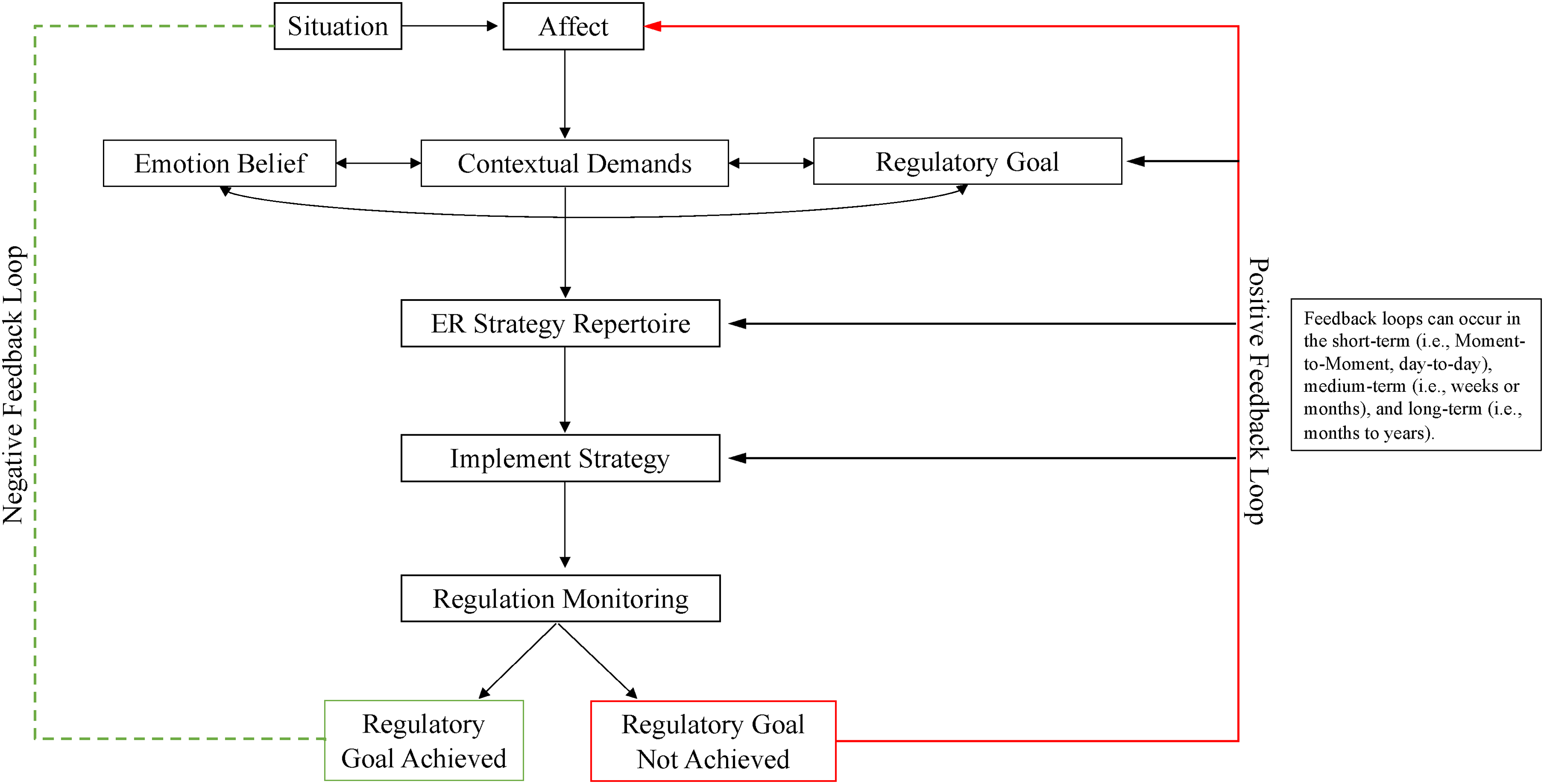
Person-specific emotion regulation flexibility framework.
Current Frameworks of ER Flexibility
The two predominant ER flexibility frameworks (Aldao et al., 2015; Bonanno & Burton, 2013) are discussed in the chronological order they were published, and then we discuss one recent integration of ER flexibility frameworks by Sanchez-Lopez (2021).
Bonanno and Burton’s (2013) Regulatory Flexibility Framework
Bonanno and Burton's (2013) regulatory flexibility framework takes an individual differences approach to understanding ER flexibility and highlights three sequential flexibility components. The first component of their framework is context sensitivity, defined as the ability to perceive incoming demands and determine the most appropriate regulatory strategy in response to those situational demands. As such, context sensitivity involves ongoing appraisal processes of goals and motivation, affect and mood, and social interactions. There is a vast literature on context sensitivity and use of ER strategies, also described as “situation-strategy fit” (e.g., Benson et al., 2019; Dixon-Gordon et al., 2015; Everaert et al., 2020; Goodman et al., 2021; Kozubal et al., 2023; O’Toole et al., 2017; Scherer, 2021; Socastro et al., 2022; Wang et al., 2023; Wenzel et al., 2022). This research highlights how implementing ER strategies in laboratory experiments and daily life is moderated by context sensitivity (e.g., intensity or controllability) appraisals, which also shift based on varying levels of internalizing symptoms (e.g., depression and anxiety). Further, findings indicate that individual differences in context sensitivity impact the subsequent ability to select an appropriate ER strategy from one's repertoire.
The second component in the regulatory flexibility framework is repertoire, defined as the ability to use various ER strategies that accommodate differing contextual demands (Bonanno & Burton, 2013). The framework includes three approaches to assessing repertoire: size (i.e., the total number of strategies individuals report), temporal variability (i.e., varying use of strategies across time and situations), and categorical variability (i.e., using diverse types of strategies). Several ecological momentary assessment (EMA) studies have found that individuals report using more than five ER strategies in one instance (i.e., polyregulation; Ford et al., 2019; Grommisch et al., 2020; Hartmann et al., 2023; Heiy & Cheavens, 2014), suggesting that perhaps individuals may select strategies through their repertoire to find the best fit. Notably, studies indicate that there is also comparable or higher within-person variation in ER strategy use across situations than between-person variation (e.g., Brockman et al., 2017; Catterson et al., 2017; Eldesouky & English, 2018; Haines et al., 2016). These findings highlight the importance of assessing multiple ER strategies when examining ER repertoire and not relying on global trait measures of dispositional ER use, as there may be more within- and between-person fluctuations in the use of ER repertoire that can vary from dispositional ER use.
The third component of the regulatory framework is responsiveness to feedback, which is the ability to use feedback about the efficacy of a chosen ER strategy to modify or maintain behavior (Bonanno & Burton, 2013). While context sensitivity involves evaluating the context and selecting an appropriate strategy, the feedback stage involves assessing whether the chosen strategy is effective. Further, the feedback stage is moderated by individual differences in a person's repertoire of possible ER strategies. That is, repertoire influences the feedback stage by informing whether an alternative strategy could better address the situational demands. Feedback responsiveness is often studied as the switching of ER strategies. For instance, switching from an ineffective to an effective ER strategy was associated with psychological well-being (Birk & Bonanno, 2016). However, switching ER strategies too often may contribute to ER deficits observed in psychopathology (Sheppes et al., 2015). For example, individuals with schizophrenia showed excessive ER strategy switching compared to individuals with no mental health diagnoses (Bartolomeo et al., 2022). Thus far, most studies have examined ER flexibility using the first two components (i.e., sensitivity to context and ER repertoire), with only a few studies examining all three components (e.g., Battaglini et al., 2022; Chen & Bonanno, 2021; Conroy et al., 2020). Specifically, using daily diaries, Battaglini et al. (2022) found that lower context sensitivity (assessed as perceived controllability of a stressor), lower ER strategy repertoire (assessed using five ER strategies: cognitive reappraisal, problem-solving, distraction, rumination, and suppression), and lower responsivity to ER feedback (i.e., change in ER strategies and affect from the previous day) were associated with increased negative affect.
A strength of Bonanno and Burton's (2013) framework is that it emphasizes investigating individual differences and takes an ability-based approach to understanding ER flexibility. However, some conceptual limitations should be noted. First, although their framework mentions that context sensitivity involves assessing ER goals (e.g., to feel pleasure, to maintain or enhance negative affect, to engage in an activity successfully) and motivation, it is not explicitly incorporated as its own distinct construct. That is, ER goals, which play a central role in how individuals appraise and respond to situational demands, are not included as a construct that investigators should measure alongside context sensitivity. ER goals, which are dynamic and context-sensitive, heavily influence individuals’ perceptions of what regulatory strategies are appropriate. In some cases, ER goals may override context sensitivity, leading to strategy choices that prioritize personal desires (e.g., avoiding discomfort) over situational demands (Bonanno & Burton, 2013). Without considering how shifting ER goals interact with context sensitivity and feedback responsiveness, the framework may oversimplify how individuals select and adjust their ER strategies. Hence, measuring ER goals distinct from context sensitivity can provide more nuanced information on how goals interact with context sensitivity and influence the feedback process. Second, the model does not account for the role of emotion beliefs, such as whether individuals believe they can control their emotions or whether they view emotions as harmful. These beliefs are crucial in shaping how people appraise their emotional context and how they engage in feedback processes (Ford & Gross, 2019). For instance, individuals with unhelpful emotion beliefs may struggle to implement effective ER strategies, limiting their ability to adjust strategies based on feedback. Incorporating emotion beliefs into an ER flexibility framework would provide a more comprehensive understanding of the factors influencing regulatory processes. Lastly, while the regulatory flexibility framework provides a valuable perspective by emphasizing the role of responsiveness to feedback, it stops short of incorporating feedback loops. The concept of responsiveness to feedback, as presented, focuses on the individual's ability to monitor and adjust strategies when initial attempts prove ineffective (Bonanno & Burton, 2013). However, this differs from the notion of feedback loops, which emphasize continuous and, at times, automatic adjustments in response to changes in internal and external states. Integrating a feedback loop perspective into the framework could offer a more dynamic understanding of ER flexibility, capturing how individuals’ regulatory actions and states influence each other in daily life and not solely through conscious reflection and adjustment. These conceptual gaps suggest that future frameworks of ER flexibility could benefit from integrating emotion beliefs, explicitly including ER goals, and building on the understanding of feedback.
Aldao et al.'s (2015) ER Flexibility Framework
Aldao et al. (2015) proposed a translational framework for ER flexibility. They posit that ER flexibility occurs when variability (i.e., using ER strategies variably across situations) is synchronized with changes in the environment (i.e., changes in the external world and/or the person's appraisal of their surroundings) and is adaptive if it facilitates pursuing personally meaningful ER goals. The authors proposed that ER variability involves within-strategy variability (i.e., when an individual uses an ER strategy on some occasions but not others) and between-strategy variability (i.e., the degree to which a range of strategies are implemented daily). A lack of variability (i.e., over-relying on specific ER strategies) could reflect a limited ER repertoire or context insensitivity (using the same strategy across situations with differing contextual demands). Importantly, Aldao et al. argued that measuring people at different times in changing environments is necessary to get a nuanced picture of ER variability and flexibility. Thus, their framework heavily relies on EMAs (i.e., studying individuals in their daily lives) to gather data at multiple time points in different contexts.
In the past few years, there has been a significant increase in using EMAs to examine ER variability and flexibility and its association with affect, well-being, and psychopathology (e.g., Battaglini et al., 2022; Blanke et al., 2020; Elkjær et al., 2022; Wang et al., 2021). Across these studies, researchers have found that between-strategy ER variability at the occasion level and person level (between individuals) is associated with lower levels of negative affect and internalizing symptoms. However, they have found inconsistent results as some studies found significant associations (Elkjær et al., 2022) while others did not (Blanke et al., 2020) for within-strategy variability and reduced negative affect and psychopathology. Further, Blanke et al. (2020) and Elkjær et al. (2022) did not examine how contextual demands or ER goals may influence ER variability. As mentioned, Battaglini et al. (2022) examined the three components of ER flexibility from Bonanno and Burton's (2013) framework. However, they also incorporated Aldao et al.'s operationalization of ER flexibility (specifically, examining the covariation between ER variability and changes in the external world). They found that the between-strategy and changes in the environment covariation was associated with lower negative affect, but within-strategy and environmental change predicted increased negative affect. These results suggest that between- and within-variability play an important role in determining affective well-being. Moreover, integrating Aldao et al.'s conceptualization with Bonanno and Burton's framework has provided a more nuanced picture of ER flexibility in daily life.
A potential limitation of Aldao et al.'s (2015) framework is that it may not capture how person-specific processes may influence ER flexibility. That is, the framework does not explicitly account for person-specific processes, such as individual differences in emotion beliefs or regulatory tendencies, which play a crucial role in shaping how people adjust their ER strategies across contexts. Further, this framework does not consider the role of feedback or monitoring, which is a key component when attempting to differentiate between ER variability and ER flexibility. Regulation monitoring and loops can explain why certain ER strategies are reinforced or abandoned, depending on their perceived effectiveness in achieving regulatory goals. This iterative process is important as it allows for adaptive shifts in strategy selection based on changing internal states or external demands.
Sanchez-Lopez’s (2021) Discussion on Integrating ER Flexibility Frameworks
Sanchez-Lopez (2021) asserted that the study of ER flexibility is nascent and needs an integrative conceptualization. To address this, they proposed that investigators study ER flexibility by integrating Aldao et al.'s (2015) operationalization and Gross’ (2015) extended process model of ER. Sanchez-Lopez further suggested that Bonanno and Burton's (2013) regulatory framework can be mapped onto Gross’ extended process model of ER (i.e., identifying, selecting, implementing, and monitoring ER strategies). Specifically, they posited that sensitivity to context is similar to the identifying (i.e., detecting current emotion, evaluating it, and deciding whether to regulate) and selecting (i.e., identifying available ER strategies and selecting a strategy) stages in Gross’ model of ER. Further, ER repertoire resembles the selecting and implementing stages (i.e., deploying the ER strategy chosen), and responsiveness to feedback reflects the monitoring (i.e., deciding whether to maintain or modify ER strategies) stage. Sanchez-Lopez asserted that a limitation of Bonanno and Burton's (2013) framework is the focus on individual differences in ER flexibility, as the focus should be on studying normative processes. However, this implied limitation is a strength of Bonanno and Burton's framework, as person-specific factors can reveal how individuals vary in ER flexibility. Indeed, investigators have increasingly emphasized a personalized science approach to understanding ER processes (e.g., Doré et al., 2016; Springstein & English, 2023b), underscoring the importance of individual differences in understanding ER flexibility.
A limitation of Sanchez-Lopez's (2021) discussion is that it does not discuss ER variability, which is necessary to understand flexible ER. Flexibility requires variable responding, as Aldao et al. (2015) argued, and without considering variability, it is difficult to capture the dynamics of how individuals implement their strategies across contexts. Further, although Sanchez-Lopez highlights the need to integrate ER goals to understand (in)flexible regulatory behaviors, they do not explicitly incorporate ER goals into their discussion of integrating frameworks. While Sanchez-Lopez provides an insightful review of existing frameworks and identifies key gaps in the field, their article does not propose a new, integrative model. Instead, they recommend using Aldao et al.'s operationalization of ER flexibility alongside Gross’ extended process model without providing an explicitly novel framework. Thus, although Sanchez-Lopez's proposal to integrate ER flexibility constructs is important and highlights the need for an integrative framework, we still lack an explicit, operationalized integrative ER flexibility framework.
Proposed Framework: A Person-Specific ER Flexibility Framework
We propose a person-specific ER flexibility framework that builds on and integrates the strengths of existing models while incorporating new constructs. We operationalize ER flexibility as the ability to continuously monitor the effectiveness of chosen ER strategies to meet one's goals for a situation and to adjust strategies, as needed, in response to changes in internal states (e.g., affect, beliefs about emotions) and external contextual demands (e.g., regulatory goals, situational factors/demands). We consider ER flexibility to be adaptive if: (a) feedback from monitoring aligns with the immediate regulatory goal and situational demands, reflecting short-term adaptiveness, and (b) this short-term regulatory goal aligns with the individual's long-term ER goals, reflecting long-term adaptiveness. Hence, ER flexibility is defined not simply by variability in strategy use but by goal-directed, feedback-driven adjustments that help individuals optimize their affective responses over time. Thus, at the core of this framework is the role of feedback loops. Feedback loops reflect the dynamic interplay of amplifying (positive) and dampening (negative) processes that influence ER outcomes over time. These loops are broader, ongoing systems that integrate repeated cycles of monitoring and adjusting as internal states, contextual demands, and regulatory goals interact. For instance, an amplifying feedback loop might occur when an individual believes that emotions are uncontrollable. This belief may intensify emotional distress, leading to disengagement strategies such as withdrawal or avoidance, which further reinforce the belief and escalate the emotional state. In contrast, a dampening feedback loop might involve using cognitive reappraisal to challenge this belief (e.g., “I can influence how I feel by reframing the situation”), thereby reducing the emotional intensity. Hence, these loops operate across multiple time scales, from short-term (i.e., moment-to-moment, day-to-day), medium-term (i.e., weeks to months), to long-term (i.e., months to years) regulatory patterns, which may unfold over days, weeks, or months.
Figure 1 visually presents the dynamic interplay between the components of the framework (i.e., emotion beliefs, contextual demands, ER goals, ER strategy repertoire, and regulation monitoring). This visual serves as a reference point as we delve into each core component of the framework. ER variability is not explicitly depicted in the framework as it needs to be assessed through several iterations of the framework process unfolding, allowing researchers to evaluate shifts in strategy use across different contexts. To better illustrate how the framework operates, we provide the example of a hypothetical individual named Sarah, whose beliefs, regulatory goals, and strategies evolve throughout the feedback process. As each component of the framework is introduced, Sarah's journey will highlight how flexibility can emerge through continuous monitoring and adjustments based on real-time feedback. Table 1 provides an overview of each component with definitions and suggestions for examining the construct.
Overview of each ER flexibility component.
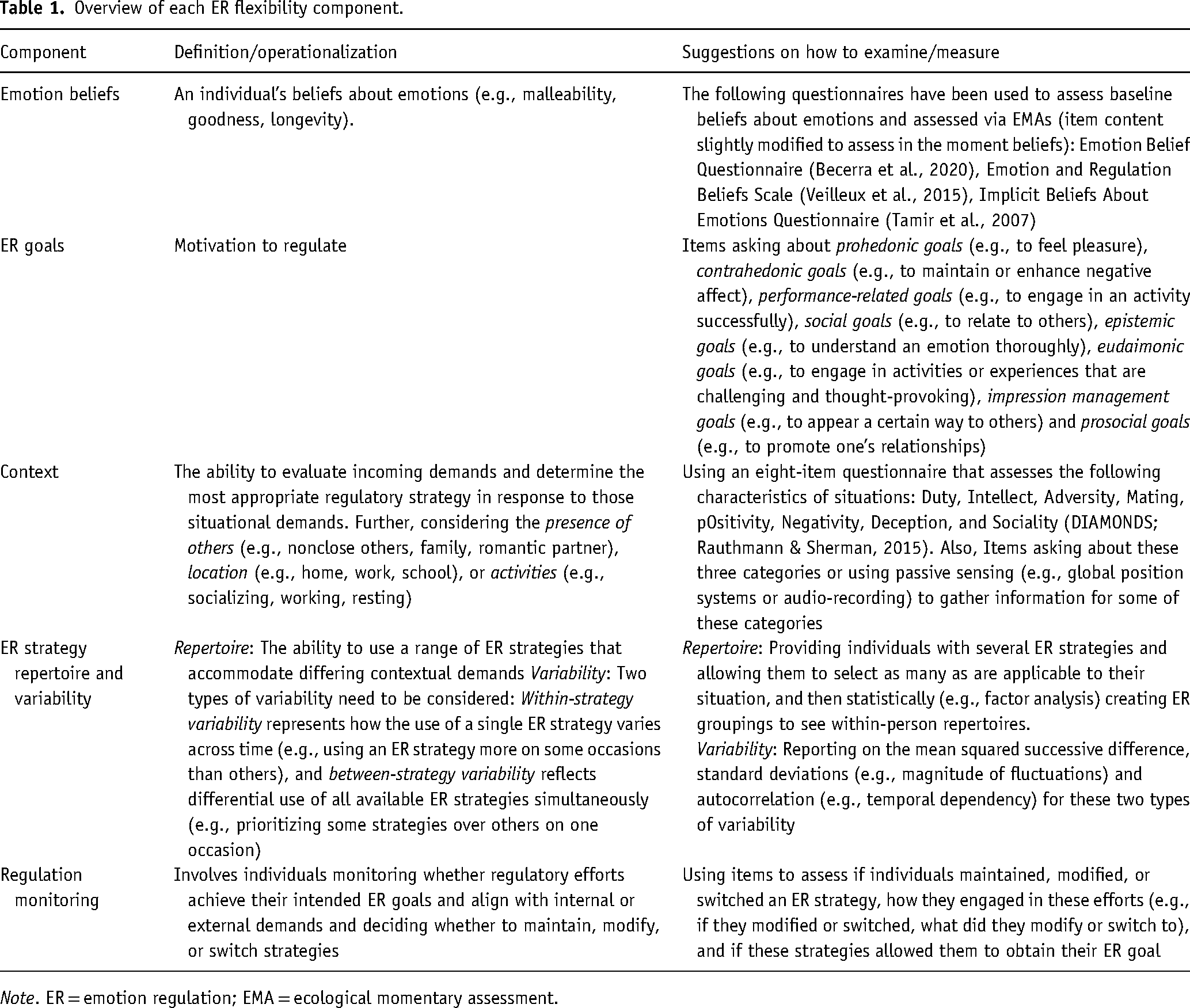
Note. ER = emotion regulation; EMA = ecological momentary assessment.
Emotion Beliefs
Beliefs that emotions are “bad” or unchangeable have clear, unhelpful consequences for ER and psychopathology, such as overusing ER strategies like avoidance or withdrawal and experiencing greater depressive and anxiety symptoms (Ford & Gross, 2019; Veilleux et al., 2021b; Waizman et al., 2023). Emotion malleability beliefs, or implicit emotion theories, are assumptions individuals have about whether emotions are changeable and can be influenced by individual effort or whether emotions are fixed entities outside personal control (Edwards & Wupperman, 2019). Although most empirical work on emotion beliefs has centered around malleability beliefs (De Castella et al., 2013; Kneeland et al., 2016a, 2016b), there are a variety of other beliefs people can hold about emotions (for an in-depth review, see Ford & Gross, 2019). For instance, some individuals may believe that emotions will last forever (Leahy, 2002), that emotions are useless (Manser et al., 2012), that they should not be expressed (Veilleux et al., 2021a), or that emotions may cause them to act impulsively (Trincas et al., 2016). Thus, emotion beliefs can alter the ER process, as they can impact the appraisal of a situation, the decision to regulate, ER strategy selection, and ER goals (Arbulu et al., 2023; Eldesouky & English, 2023).
Studies have found that individuals who believe emotions are malleable (or controllable) have lower levels of depressive symptomatology (Ford et al., 2018; Monsoon et al., 2022), lower levels of negative affect during a stressful life transition (Tamir et al., 2007), are less likely to use disengagement ER strategies (e.g., avoidance, procrastination distraction; De Castella & Bryne, 2015) and expressive suppression (Daniel et al., 2020), and are more likely to use engagement ER strategies (e.g., cognitive reappraisal, acceptance, seeking social support; Ford et al., 2018; Gutentag et al., 2017; Kneeland et al., 2016b; McRae & Gross, 2020). Beyond beliefs about malleability, people with more unfriendly beliefs (i.e., beliefs that emotions should be hidden from others and that emotions linger) are more likely to use disengagement ER strategies (Veilleux et al., 2021b). Further, when people believe their emotions are likely to last longer (i.e., longevity beliefs), they are more likely to use unhelpful ER strategies (e.g., escape, distraction, rumination; Veilleux et al., 2023). Not surprisingly, emotion beliefs have been associated with various emotional, interpersonal, and clinical outcomes (Ford & Gross, 2019; Kneeland et al., 2020; Kneeland & Kisley, 2023; Qu & Telzer, 2017). Notably, prior work examining culture's role in ER suggests that culture likely influences emotion beliefs (Ford & Mauss, 2015), particularly in cultures where emotional control is valued. Further, cultural differences in emotion beliefs have been shown to influence ER goals and decisions to regulate (Miyamoto et al., 2014). These associations suggest that investigating emotion beliefs can allow investigators to implicitly capture cultural influences instead of measuring race and ethnicity as a proxy for cultural differences.
On a related note, Dweck's (2017) overarching theory of personality and motivation suggests that beliefs can be situationally activated and guide ER goal selection. Moreover, contextual variations can influence momentary beliefs about emotions, indicating that emotion beliefs can be stable (e.g., formed throughout one's life) and be situationally activated in real time (e.g., having an intense emotional experience). For example, emotion malleability beliefs have been successfully manipulated in experimental studies (Bigman et al., 2016; Kneeland et al., 2016b), suggesting that beliefs may shift due to contextual features. Assessing emotion beliefs in real time can also represent a momentary appraisal of the world and the self, with environmental changes influencing these shifts (Veilleux et al., 2023). For instance, using EMAs, Veilleux et al. (2021b) found that individuals with borderline personality disorder (BPD) experienced greater shifts in emotion belief (assessed with the individual beliefs about emotion questionnaire using EMAs; Veilleux et al., 2021a) than individuals without BPD, which adversely influenced affect (positive and negative) and momentary self-efficacy to regulate and tolerate distress. Further, using EMAs, Veilleux et al. (2021c) found that individuals shift their beliefs about emotions when experiencing intense emotions, which was associated with greater trait emotion dysregulation, psychopathology, affective distress, and using withdrawal as an ER strategy. Lastly, using EMAs, Veilleux et al. (2023) found that changes in the environment (e.g., who one is around, what activity they are engaging in) influenced fluctuations in emotion beliefs, which impacted the type of ER strategy they employed (e.g., if momentary longevity beliefs were activated around others, they were more likely to use disengagement ER strategies).
Altogether, these findings suggest that unhelpful shifts in emotion beliefs may be a marker of psychopathology when experiencing intense emotions. Thus, investigating emotion beliefs and their implications for ER flexibility may help investigators understand the function of emotion beliefs in initiating or altering ER processes. By assessing how emotion beliefs dynamically change across time and situations, we can better understand how momentary shifts in beliefs influence ER goals, strategy selection, and regulation monitoring, which can potentially advance the field by providing insight into person-specific ER flexibility. As individuals monitor the effectiveness of their ER strategies, the feedback they receive, whether it be an affective shift or social cues, can influence their beliefs about emotions. Take Sarah, for example, who believes that her emotions are uncontrollable and tend to last forever. In the short term (i.e., moment-to-moment or day-to-day adjustments), this belief influences her immediate regulatory decisions, leading her to avoid emotionally challenging situations, often using disengagement strategies, such as withdrawal or distraction. Over the medium term (i.e., typically unfolding over weeks or months), repeated successes or failures in regulating her emotions begin to shape her emotion beliefs. For instance, if Sarah successfully uses cognitive reappraisal to manage her distress, her regulation monitoring might reveal a reduction in distress, gradually challenging her belief that emotions are uncontrollable. Conversely, repeated ineffective or unsuccessful efforts to regulate her emotions may reinforce her original belief that emotions are unchangeable. In the long term (i.e., months to years), these cumulative feedback loops create a dynamic interplay where Sarah's emotion beliefs, regulatory choices, and feedback processes continuously influence one another. By empirically understanding how feedback influences emotion beliefs, we can better understand the dynamic interplay between beliefs and regulation processes across time and context.
ER Goals
To understand the adaptiveness of ER flexibility, investigators have underscored that we must consider one's ER goals, as these goals influence which ER strategies are selected and how they are applied (Aldao et al., 2015; Bonanno & Burton, 2013; Hartmann et al., 2023; Millgram et al., 2019; Tamir et al., 2020). Unfortunately, the operationalization of ER goals has varied in ER literature, ranging from the act of regulating (Mauss et al., 2007) to using specific tactics (i.e., what people actually do; McRae et al., 2012) or the motivation for regulating (Eldesouky & English, 2019). Based on the extended process model of ER (Gross, 2015), the act of regulating or using specific tactics is not considered ER goals, as they are actions; however, the motivation to regulate is ER goals (Eldesouky & Gross, 2019). Thus, in line with the extended process model of ER, the person-specific ER flexibility framework will use the latter operationalization (motivation to regulate) for ER goals. Researchers have focused on why individuals are motivated to regulate their emotions via hedonic and instrumental domains (Tamir, 2016). Hedonic motives are broken into prohedonic (e.g., to feel pleasure) and contrahedonic (e.g., to maintain or enhance negative affect; Tamir et al., 2019). Instrumental motives include four aspects: performance-related (e.g., to engage in an activity successfully), social (e.g., to relate to others), epistemic (e.g., to understand an emotion thoroughly), and eudaimonic (e.g., to engage in activities or experiences that are challenging and thought-provoking; Tamir et al., 2019). Furthermore, Eldesouky and English (2019) proposed that social goals can be divided into impression management goals (e.g., to appear a certain way to others) and prosocial goals (e.g., to promote one's relationships). ER goals are important to understand as they activate behavior, and the ability to pursue and achieve goals is a critical aspect of one's capability to interact with one's environment.
For instance, English et al. (2017) and Eldesouky and English (2019, 2023) found that prohedonic goals were associated with greater use of distraction and cognitive reappraisal but lesser use of suppression, while impression management goals predicted greater suppression but not reappraisal. Wilms et al. (2020) also found that prohedonic and prosocial ER goals and perceived control of a situation were associated with using engagement ER strategies, while expressive suppression was important for impression management ER goals. Notably, impairments in ER and maintenance in psychopathology may be attributed to pursuing unhelpful ER goals (Brandão et al., 2023). For instance, compared to healthy individuals, individuals with clinical depression prefer to feel unpleasant emotions (e.g., sadness) and are more likely to choose contrahedonic ER goals (Millgram et al., 2015, 2019). Further, EMA studies have found that ER goals can fluctuate across situations (Eldesouky & English, 2019; English et al., 2017).
Thus, future research could examine ER goal stability and malleability across time and situations to understand how these shifts influence ER flexibility, which requires individuals to continuously monitor their regulatory goals and adapt these goals based on feedback regarding the effectiveness of their strategies. ER goals do not appear to be static; instead, they may fluctuate in response to immediate feedback from regulatory efforts, allowing individuals to adjust their efforts to align with evolving affective and contextual demands (Eldesouky & English, 2019). For instance, if Sarah believes emotions are uncontrollable, she may not adopt an ER goal or (unintentionally) adopt a contrahedonic goal (e.g., maintaining negative affect) because she does not think she can change it. In the short term, immediate feedback from her attempted regulatory strategies might influence whether she continues to pursue these goals or begins to consider shifting toward more helpful goals. Hence, Sarah's emotion belief that her emotions are uncontrollable can not only shape her initial goal of maintaining negative affect but also influence how she interprets feedback from her strategies. Over the medium term (weeks to months), if Sarah repeatedly uses disengagement strategies, such as suppression or avoidance, to maintain her negative affect and receives amplifying feedback (e.g., her affective distress persists or worsens), this feedback loop may reinforce her belief that emotions cannot be controlled. Conversely, if Sarah receives dampening feedback from successfully engaging in a strategy that does not align with her goal, such as acceptance to regulate her distress, this might challenge her belief and gradually lead her to adopt more helpful goals. In this way, feedback loops are central to ER flexibility.
This framework posits that ER goals and strategies are continuously adjusted through feedback that helps individuals re-evaluate the appropriateness of their goals and the effectiveness of their strategies. These dynamic adjustments underscore the importance of examining ER goals as integral to the feedback process rather than studying them in isolation. By integrating goals into the conceptualization of ER flexibility, the framework provides a more comprehensive understanding of how individuals regulate their emotions in response to changing demands. As Sarah's example shows, ER goals play a vital role in shaping how feedback is processed and how ER strategies are adjusted over time. Thus, this process not only informs strategy use but also prompts the evaluation of regulatory goals, creating a dynamic interplay between goals and feedback within the ER flexibility process. By empirically examining how ER goals fluctuate and how feedback alters ER goals, we can better understand the role of goals in promoting or hindering ER flexibility across various contexts. This deeper understanding highlights the importance of focusing on how person-specific ER goals interact with feedback to shape the ongoing regulation process. For instance, when ER goals align with contextual demands and feedback indicates that the chosen strategies are effective, this alignment may foster more effective regulation. Conversely, when feedback reinforces misaligned or rigid goals, it may hinder the regulatory process or lead to increased distress. Understanding this dynamic interaction offers deeper insights into how the effective alignment of goals and strategies through feedback may promote emotional well-being.
Context
As mentioned, context sensitivity involves successfully reading contextual cues and considering an ER strategy that aligns with these cues (Bonanno & Burton, 2013). This process refers to the perception of context rather than the response to it. Investigators have primarily studied two contextual features in ER flexibility: perceived controllability and emotional intensity (e.g., Battaglini et al., 2022; Benson et al., 2019; Goodman et al., 2021; Socastro et al., 2022; Wenzel et al., 2022). Although these studies have provided important insights on situation-strategy fit, other contextual characteristics should be considered (Aldao, 2013). To address this, we advocate using a taxonomy developed by personality and social psychologists to assess context sensitivity more comprehensively (Rauthmann et al., 2014). Specifically, they have identified eight fundamental characteristics of situations: Duty, Intellect, Adversity, Mating, pOsitivity, Negativity, Deception, and Sociality (DIAMONDS). This measure can be assessed with eight items (Rauthmann & Sherman, 2015), has been universally replicated (Lee et al., 2020), and has been successfully implemented in EMA studies to predict ER strategy use, behaviors, and interpersonal dynamics (e.g., Horstmann et al., 2021; Kashdan et al., 2020; Springstein & English, 2023b). For instance, Springstein and English (2023b) examined ER goals, context sensitivity using the DIAMONDS measure, and ER strategy use. The authors found that certain situational characteristics (e.g., sociality, perceived negativity, duty) were associated with performance-related ER goals and ER strategy selection (e.g., distraction). By broadening the scope of contextual characteristics, DIAMONDS offers a more nuanced understanding of how different types of situational demands influence regulatory choices, which allows for a more dynamic analysis of how feedback from context influences ER goals, emotion beliefs, and strategy selection.
Further, Aldao et al. (2015) proposed that ER strategies are used variably across situations, and when this variability is synchronized with changes in the environment (i.e., changes in the external world and/or the person's appraisals of their surroundings), it constitutes an instance of ER flexibility. Most investigators studying ER flexibility have examined the use of ER strategies with an individual's appraisal of their environment (i.e., situation-strategy fit) but have not always evaluated the demands of the environment with changes in social context (e.g., who is present), leading to an incomplete picture of ER flexibility. The present framework includes assessing environmental characteristics, such as the presence of others (e.g., nonclose others, family, romantic partner), location (e.g., home, work, school), and activities (e.g., socializing, working, resting). These characteristics allow for a broader investigation of how different social contexts influence the appraisal of a situation and ER strategy selection. Immediate feedback from these environmental characteristics then informs whether regulatory goals need to be adjusted or different beliefs should be enacted. Over time, these moment-to-moment adjustments contribute to broader feedback loops, where amplifying or dampening effects shape the ongoing interaction of regulatory goals, beliefs, and contextual demands, illustrating their central role in ER flexibility.
For example, when individuals enter unfamiliar social environments, such as being around nonclose others, they are more likely to use expressive suppression (Paul et al., 2023) but are more likely to use cognitive reappraisal when alone (Benson et al., 2019; English et al., 2017). Additionally, Paul et al. (2023) found that using more expressive suppression was associated with higher depressive symptoms when used around close others, but using suppression when alone was related to lower depressive symptoms. Further, Chen and Liao (2021) found that the type of person one interacts with (e.g., parent, romantic partner, supervisor) influences their controllability of the situation, impacting their selection of ER strategy. Thus, integrating the physical environment into investigations of situation-strategy fit may help explain the discrepant findings between laboratory and EMA studies. For instance, although studies have shown the effectiveness of cognitive reappraisal in the laboratory (e.g., Gross, 2015), a surprising finding in EMA research is that individuals use reappraisal less often than other ER strategies (e.g., Battaglini et al., 2022; Heiy & Cheavens, 2014).
Thus, integrating context is a key part of ER flexibility, as it influences how situational demands shape regulatory choices. For instance, Sarah has just received input about her work that upsets her and leads her to feel sad. She may pursue the belief that emotions should be hidden from others because she is in a work setting where she wants to adopt impression management or performance-related ER goals. This belief and pursuit of a performance-related goal may influence her to adopt ER strategies such as expressive suppression and distraction. In the short term, these strategies may help Sarah avoid immediate emotional discomfort, but her regulation monitoring might identify specific feedback, such as feeling unproductive or emotionally detached from her work. Over the medium term, repeated use of disengagement strategies, coupled with amplifying (positive) feedback (e.g., persistent feelings of unproductivity or detachment), may begin to reinforce her other emotion beliefs (e.g., emotions are uncontrollable), possibly perpetuating the cycle of disengagement and avoidance strategy use. This dynamic (see Figure 2 for a demonstration of this example) illustrates the central role of feedback loops in ER flexibility, as Sarah's ongoing responses to context-specific feedback guide her future regulatory choices, highlighting how beliefs, goals, and situational demands interact within the regulatory process.
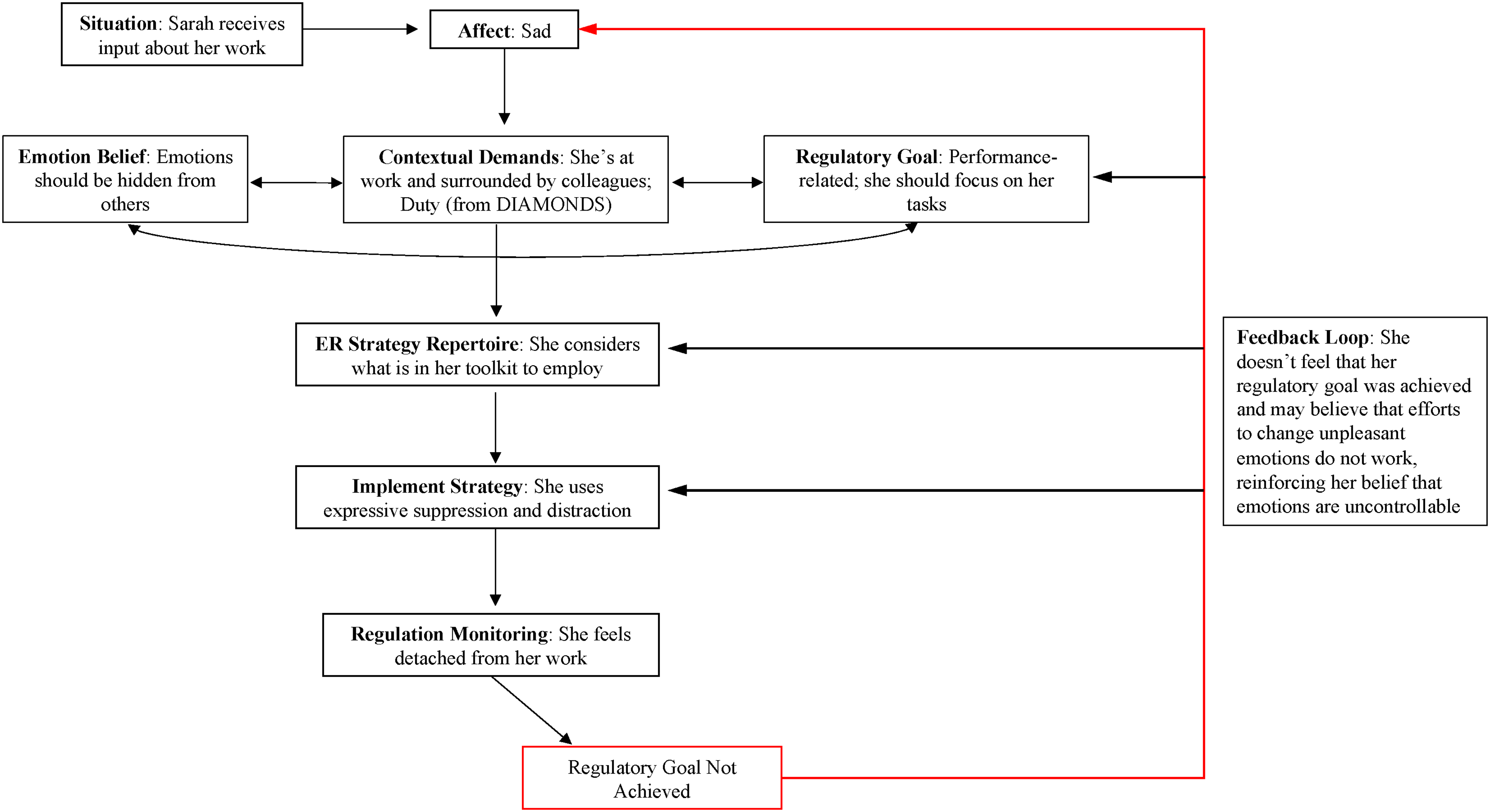
Person-specific emotion regulation (ER) flexibility framework for Sarah.
ER Strategy Repertoire and Variability
ER repertoire refers to the range of ER strategies in one's toolkit (Bonanno & Burton, 2013), representing the breadth and diversity of strategies an individual can deploy in different situations. It is important to note that ER repertoires are developed and refined over time through repeated regulatory instances across different contexts. Studying an individual's ER repertoire requires collecting data over multiple instances to observe how different strategies are deployed in varying contexts, revealing the strategies that form part of the person's regulatory toolkit. Recent research on ER repertoire has focused primarily on quantifying the size and composition of individuals’ ER strategy use (Aldao et al., 2015). When solely examining the size, findings have been mixed. For instance, having a larger ER repertoire was negatively associated with BPD symptoms but had no significant association with neuroticism, extraversion, or symptoms of depression (Southward et al., 2018). However, examining the size of one's ER strategy repertoire may not be the most influential aspect of ER. Instead, ER repertoire composition might provide more information than size alone. For instance, in an EMA study, broader repertoires focused on active regulation strategies (e.g., problem-solving) were associated with greater well-being than repertoires focused on suppression or avoidance strategies (Grommisch et al., 2020).
Thus far, research suggests that certain ER repertoires might be beneficial, but what such repertoires may look like is unclear. This ambiguity may be because ER repertoire is often assessed without considering situational or environmental characteristics. ER flexibility involves more than just having a wide range of strategies; it requires context-sensitive and goal-directed adjustments in strategy use. Simply having a larger or more diverse repertoire does not necessarily indicate that an individual will implement a certain ER strategy in a specific situation or adjust their ER strategies based on situational demands and feedback. Thus, examining profiles of strategy use without mapping whether those strategies are used in a contextually sensitive manner might be capturing variability instead of flexibility.
Aldao et al. (2015) asserted that ER variability, defined as the varying use of ER strategies across situations, is a necessary (but not the only) condition to capture ER flexibility. These authors operationalized ER variability as within- and between-strategy variability. As previously mentioned, within-strategy variability represents how the use of a single strategy varies across time (e.g., using an ER strategy more on some occasions than others), and between-strategy variability reflects differential use of all available ER strategies simultaneously (e.g., prioritizing some strategies over others on one occasion). Thus, while variability in strategy use is essential for ER flexibility, feedback loops can help determine whether these variations are helpful. That is, regulation monitoring allows individuals to assess whether their strategy choices are effectively meeting their ER goals and to adjust their strategies accordingly. Simply switching strategies (i.e., variability) without considering contextual demands or feedback may reflect ER difficulties rather than flexibility (Aldao et al., 2015).
For instance, Sarah's ER repertoire may include a wide range of strategies, from distraction to cognitive reappraisal. In her high-stress work environment, Sarah may initially use distraction when she feels overwhelmed, followed by reappraisal to help her regain focus. When feedback from her environment, such as feeling emotionally detached from her work or experiencing worsening stress, indicates that her strategies are not helping her reach her ER goals, she may continue to cycle through strategies (e.g., using procrastination, withdrawal) without aligning them with the demands of the situation. Although variability in her strategy use is present, the absence of feedback-driven adjustments suggests inflexibility. This example illustrates how variability alone does not guarantee flexibility; it is the feedback-driven adjustments in strategy use that allow for flexibility. Therefore, studying ER flexibility requires evaluating multiple instances of regulatory efforts across different contexts to capture ER repertoire and variability, allowing investigators to observe whether strategies are adjusted in a context-sensitive and goal-directed manner over time. The dynamic nature of ER flexibility requires not only a broad repertoire and variability in strategy use but also real-time adjustments based on feedback from internal and external demands. As individuals navigate shifting situational demands, regulation monitoring becomes the critical mechanism that determines whether strategy adjustments lead to adaptive outcomes over time.
Regulation Monitoring and Feedback Loops
Regulation monitoring plays a central role in understanding ER flexibility, as it involves individuals assessing whether their regulation strategies are effective and making adjustments based on the outcome (Bonanno & Burton, 2013). This process involves individuals monitoring whether regulatory efforts achieve their intended ER goals and deciding whether to maintain, modify, or switch strategies to achieve optimal well-being. The importance of regulation monitoring lies in its ability to inform goal-directed strategy shifts by providing individuals with crucial information about whether the chosen strategy aligns with situational demands and personal goals. Feedback processes include the information individuals receive from internal sources (e.g., changes in affective states, physiological responses) and external sources (e.g., social cues, contextual shifts) about the outcomes of their regulatory efforts. These processes also include evaluating whether regulatory goals are achieved and guiding subsequent regulatory decisions. Over time, repeated cycles of regulation monitoring and adjustments contribute to broader feedback loops, which represent the dynamic, cumulative interplay of regulatory efforts, feedback, and goal evaluations. Feedback loops can have amplifying (positive) effects, intensifying emotional responses or regulatory efforts, or dampening (negative) effects, reducing emotional intensity. In previous research, this concept has primarily been examined as strategy switching, with less attention on strategy maintenance, despite the conceptual emphasis on including maintenance (Birk & Bonanno, 2016). The present framework advocates for investigators to explicitly ask participants if they maintained, modified, or switched an ER strategy, how they engaged in these efforts, and whether these adjustments helped them achieve their ER goals. This explicit focus on regulation monitoring can help differentiate immediate evaluations of strategy effectiveness from the broader feedback loops that develop through repeated regulatory cycles. While regulation monitoring involves assessing individual strategy outcomes, feedback loops reflect the cumulative effects of these outcomes over time.
While ER flexibility enables individuals to adjust their strategies in response to regulation monitoring, these adjustments are not inherently adaptive (Aldao et al., 2015). Thus, we consider ER flexibility to be adaptive if: (a) feedback from regulation monitoring aligns with the immediate regulatory goal and situational demands, reflecting short-term adaptiveness, and (b) this short-term regulatory goal aligns with the individual's long-term ER goals, reflecting long-term adaptiveness. Short-term ER goals likely operate on a moment-to-moment or day-to-day scale and focus on addressing immediate affective states or situational demands, such as reducing distress during a difficult conversation or maintaining composure in a professional setting. In contrast, longer-term ER goals unfold over weeks, months, or even years and center on achieving broader emotional or psychological outcomes, such as improving interpersonal relationships or maintaining overall well-being. In our framework, regulatory goals and contextual demands are integral components with dual roles. On the one hand, these components act as dynamic, context-sensitive processes that directly influence the selection and adjustment of ER strategies. Hence, while they act as processes influencing strategy selection, their alignment is also evaluated during regulation monitoring to determine adaptiveness. In this way, regulatory goals and contextual demands are both inputs and evaluative criteria within the dynamic framework of ER flexibility.
It is important to note that ER strategies that are effective in the short term (e.g., distraction or suppression) may not be adaptive in the long term, particularly if they prevent individuals from addressing emotional challenges or meeting long-term goals. Conversely, strategies such as reappraisal or acceptance might be less immediately effective but provide long-term benefits, helping individuals adjust to stressors more sustainably over time. This distinction between ER flexibility and adaptiveness is crucial as flexibility provides the capacity for adjustments, while adaptiveness provides how well those adjustments lead to person-specific positive emotional outcomes in the short term and long term. One way to measure short-term ER flexibility adaptiveness is to consider the construct ER success. Springstein and English (2023a) define emotion regulation success as achieving one's ER goals, which can be measured by using direct measures (e.g., “How successful were you at managing your negative emotions” or “Have you attained your goal in this social interaction”; Wong et al., 2017; Wylie et al., 2022) or other measures (e.g., peer reports, ambulatory measures). We propose assessing ER success as a way to capture short-term adaptiveness, as this can highlight person-specific perspectives on what individuals deem successful. Understanding adaptiveness is also particularly important when considering clinical outcomes. In clinical contexts, individuals may exhibit rigid or unhelpful patterns of regulation (e.g., habitual avoidance or rumination) that provide temporary relief but lead to worsening well-being over time (Veilleux et al., 2023). Therefore, for ER flexibility to truly be considered adaptive, there must be synchrony between short-term and long-term adaptiveness.
To illustrate how regulation monitoring and feedback loops influence ER flexibility in practice, consider again Sarah, who believed that emotions were uncontrollable. Over the medium or long term, continuous regulation monitoring and receiving external feedback (e.g., from loved ones or clinicians) began to challenge this belief. After successfully using reappraisal to regulate her stress at work and observing through regulation monitoring that her emotional distress decreased, Sarah's emotion beliefs began to shift. As her belief in the controllability of emotions strengthened, her ER goals changed from maintaining negative affect to seeking emotional relief. This shift in goals, informed by feedback loops, led to more context-sensitive strategy use. Sarah's feedback from previous successes guided her to engage in strategies like reappraisal more frequently, reducing her reliance on disengagement strategies. This shift illustrates how changes driven by regulation monitoring and feedback loops can influence the adaptiveness of her ER strategies, contributing to short-term success and long-term emotional well-being. Moreover, research rarely examines all three domains (i.e., context, ER strategy repertoire, and feedback responsiveness) together, but integrating them is critical as research shows they have downstream effects on one another. The few studies integrating these dimensions suggest that sensitivity to context has a downstream impact on the other two domains (Battaglini et al., 2022; Chen & Bonanno, 2021). For example, Chen and Bonanno (2021) found that context-insensitive regulators showed more anxiety symptoms than those with narrow ER repertoire or low feedback responsiveness. These findings suggest that understanding the integrative links between these domains is an essential next step in understanding flexible regulation. Moreover, Chen et al. (2024) found that context-sensitive regulation and the breadth of ER repertoire were associated with reduced psychological distress, but the role of feedback was less consistent. That is, strategy switching helped decrease depressive symptoms but had a weaker effect on anxiety symptoms. These findings suggest that context-sensitive feedback is necessary for adaptive flexibility but may operate differently depending on the emotional state being regulated.
Therefore, regulation monitoring involves not only identifying when to switch strategies but also understanding when to maintain an effective strategy and aligning strategies with shifting goals. Feedback loops, which emerge from repeated cycles of regulation monitoring, provide crucial insights into the adaptiveness of regulation efforts by highlighting when strategies are effective and when they need to be adjusted. This deeper understanding of regulation monitoring, along with the cumulative effects of feedback loops, enhances our conceptualization of ER flexibility by underscoring the dynamic interplay between emotion beliefs, context, goals, and strategy use. With each component interacting dynamically, the framework not only addresses gaps in prior models but also expands the scope of ER flexibility research. In the next section, we outline how this integrative approach pushes the field forward, offering new directions for both theoretical development and empirical investigation.
Advancing the Field of ER Flexibility
Our person-specific ER flexibility framework advances the field of ER flexibility by integrating key components, such as emotion beliefs, ER goals, and contextual demands, within a cohesive model driven by regulation monitoring and feedback loops. While previous frameworks, such as Bonanno and Burton (2013) and Aldao et al. (2015), provided foundational insights into ER flexibility, our framework builds on these foundations by more explicitly incorporating certain constructions and emphasizing the dynamic role of feedback processes, including internal (e.g., affective states, emotion beliefs) and external demands (e.g., social cues or contextual shifts). This approach enhances our understanding of how individuals adjust their regulation strategies based on real-world demands. One of the strengths of this framework is its inclusion of emotion beliefs, which can vary across individuals and are likely shaped over time by cultural and social factors (Ford & Gross, 2019). By including emotion beliefs, we capture person-specific traits that may help explain how individuals interpret and regulate emotions in diverse contexts. This inclusion allows researchers to study the interplay between belief systems, personal interpretations, and regulatory processes, especially across populations with diverse cultural backgrounds.
Additionally, our framework accounts for time-invariant actors (e.g., stable emotion beliefs) that influence regulatory tendencies over time and time-variant factors (e.g., fluctuating internal and external demands) that drive moment-to-moment regulatory adjustments. These time-sensitive and stable components interact through continuous feedback loops, which emerge from repeated cycles of regulation monitoring and include amplifying (positive) or dampening (negative) effects that shape ER flexibility across various contexts. Another key advancement of our framework is explicitly including ER goals in operationalizing ER flexibility. While previous frameworks acknowledged ER goals, our framework emphasizes the role of ER goals in guiding regulation monitoring and influencing the broader feedback loops that emerge over time. By including ER goals, we address the crucial distinction between ER variability (i.e., shifts in strategy use across different contexts) and ER flexibility (goal-directed, context-sensitive regulation). ER flexibility involves purposeful adjustments in strategy use based on feedback processes, whereas variability refers more broadly to changes in strategy use without necessarily aligning with ER goals.
Moreover, our framework explicitly operationalizes the concept of adaptiveness in ER flexibility, which has remained an open question in previous frameworks (Aldao et al., 2015). While ER flexibility allows individuals to adjust their strategies based on regulation monitoring, these adjustments are not inherently adaptive. For ER flexibility to be adaptive, adjustments in strategy use should lead to successful outcomes that align with (a) immediate regulatory goals and situational demands, reflecting short-term adaptiveness, and (b) the individual's long-term ER goals, reflecting long-term adaptiveness. Both conditions must be met to ensure that ER flexibility fosters effective regulation over time. Hence, we view ER flexibility as a neutral process, and adaptiveness is only inferred when short-term and long-term adaptiveness align.
Notably, our framework emphasizes the central role of regulation monitoring in integrating different components of ER flexibility. Previous investigations have often examined constructs such as emotion beliefs, context sensitivity, ER goals, and ER variability in isolation, resulting in piecemeal findings. Our model resolves these issues by integrating these components within a unified framework that emphasizes their interactions over time, as regulation monitoring drives immediate adjustments, while feedback loops reflect their cumulative effects on ER goals, emotion beliefs, and strategy use. Regulation monitoring serves as the core mechanism linking emotion beliefs, ER goals, contextual demands, and strategy use, while feedback loops capture the dynamic interplay of these components over time. Together, these processes have the potential to advance the field by offering a more dynamic and systematic approach to studying ER flexibility.
Lastly, while our framework discussed real-time adjustments driven by regulation monitoring as central to understanding ER flexibility, it also raises important questions about how these processes unfold across different temporal scales. Although we focus on in-the-moment regulation monitoring and regulatory adjustments, ER flexibility likely operates over short-term and long-term periods. For instance, repeated real-time (i.e., in-the-moment) regulatory adjustments may contribute to broader feedback loops that shape longer-term patterns of ER. However, capturing real-time regulation monitoring remains a methodological challenge, as EMA prompts typically ask about ER processes for the past hour or several hours. Thus, integrating digital tools may offer new opportunities to track continuous affective and physiological changes more accurately, potentially triggering EMAs in real time (Bettis et al., 2022). By combining these emerging technologies with EMAs, investigators can be better equipped to explore how ER flexibility operates across different temporal scales.
Methodological Application and Future Research Directions
This person-specific ER flexibility framework offers several methodological and research avenues for investigating ER flexibility in a dynamic, feedback-driven context. Given the complex and temporal nature of ER flexibility, researchers must adopt advanced methodologies that allow for continuous tracking and analysis of these dynamic processes. To empirically investigate the feedback loops central to this framework, we propose using EMAs as the primary tool for capturing regulatory processes (English & Eldesouky, 2020). EMAs allow for real-world data collection over multiple time points, helping researchers assess how emotion beliefs, ER goals, and contextual factors shift and interact with ER strategies in everyday life. Within an EMA survey, individuals can report on their current affective state, physical environment (i.e., whom they are with, where they are, and what activities they are engaging in), emotion beliefs at the moment, goals for regulating (i.e., ER goals), situational characteristics using the DIAMONDS measure (i.e., context evaluation), which ER strategies they are employing (i.e., ER strategy repertoire), whether they maintained or switched strategies and how effective their regulatory efforts are in managing their emotions (i.e., feedback responsiveness). Specifically, investigators can examine regulation monitoring by asking individuals whether a given ER strategy helped or changed how they felt (e.g., Daniel et al., 2020) and whether they switched or maintained a strategy (e.g., Bartolomeo et al., 2022; Chen et al., 2024), providing insights into feedback-driven adjustments. EMA data can also capture how an individual varies in ER strategy use (i.e., ER variability) across assessment occasions (Blanke et al., 2020). Although EMAs allow for real-world data, some limitations exist (e.g., compliance concerns, participant burden, and self-awareness of regulatory efforts; Hasselhorn et al., 2022). However, investigators examining these limitations have suggested that such concerns may not significantly impact the quality of participant responses or within-person processes (e.g., Eisele et al., 2022; Hasselhorn et al., 2022; Vachon et al., 2016). Nonetheless, while EMAs are valuable, they are limited in capturing real-time (e.g., in-the-moment) regulation monitoring. To address this challenge, integrating wearable devices could enhance the ability to monitor continuous physiological changes that signal affective shifts. For example, real-time physiological changes could trigger EMA prompts, allowing investigators to capture how individuals adjust ER strategies in response to physiological feedback. This combination of digital tools, EMAs, and other ambulatory assessment tools (e.g., electronically activated recorder) can help track regulation monitoring and how these processes contribute to longer-term ER patterns (Mehl, 2017).
Using such methodology can allow for future research questions, such as examining (1) How do individual differences in emotion beliefs and regulatory goals influence the selection of ER strategies; (2) How does feedback from ER success or failure influence future strategy choices, and how does this evolve over time; (3) Will individuals with flexible emotion beliefs (i.e., those who believe emotions are malleable) demonstrate higher variability in strategy use aligned with ER goals; (4) Do individuals whose ER goals align with situational demands show more adaptive ER flexibility, as operationalized in this paper? To statistically answer these questions, investigators can incorporate dynamical systems theory (DST), which offers a powerful tool for understanding the continuous, nonlinear changes in ER flexibility (Hollenstein, 2015). DST views feedback as a dynamic, constantly evolving process rather than discrete events, capturing feedback loops. For instance, small affective shifts or situational cues can lead to cascading adjustments in ER strategies. This modeling allows for examining how interactions between emotional states and ER strategies unfold and stabilize over time, offering a deeper understanding of the underlying feedback processes driving ER flexibility. These continuous models are especially suited for understanding the feedback loops central to ER flexibility and how they influence long-term ER.
Additionally, time-series methods, such as autoregressive integrated moving average models and cross-lagged panel models, can be employed to study how regulation monitoring at one point influences subsequent regulatory decisions (Newsom, 2015). These approaches would help capture lagged effects, showing how feedback from one affective state influences future strategy use, and would provide empirical evidence for the long-term patterns of ER flexibility. By integrating time-series methods or DST, researchers can explore the patterns of strategy adjustments via regulation monitoring across different contexts. Moreover, regulation monitoring within ER flexibility can also be examined as internal (e.g., affective shifts, emotion beliefs) and external (e.g., social cues, environmental changes) demands. Investigating how these two types of monitoring operate allows for more nuanced studies of regulatory processes. For example, internal monitoring, such as emotion beliefs or affective changes, might prompt an individual to maintain a strategy, while external monitoring from social environments might necessitate a change in strategy. Studying these differing monitoring sources can help clarify the complex ways in which regulation monitoring influences flexibility in ER.
Another important aspect of future research will be addressing how to measure ER variability, given the differences in findings across studies for within-strategy variability (Battaglini et al., 2022; Elkjær et al., 2022). Thus far, investigators have used standard deviations (SDs) to capture the intraindividual variability (referred to as simply variability in this paper) of ER strategy use, asserting that this metric should reflect individual differences in the ability to start and stop an ER strategy (Aldao et al., 2015). However, a drawback of using SDs is that they only capture the amplitude of fluctuations (i.e., variability in the frequency of strategy use) and do not capture temporal sensitivity (Mun et al., 2019). Thus, some investigators have proposed using autocorrelation (i.e., measuring how previous observations can predict current observations) to assess ER variability, which can represent how much an ER strategy persists across occasions (Trull et al., 2015). We could interpret the autocorrelation as individual differences in persistent ER strategy use, where higher values reflect persistency in use and lower values reflect a pattern of starting and stopping ER strategy use over time (Blanke et al., 2022).
Moreover, it will be essential to consider how ER strategy use fluctuates from one time point to the next, as this has the potential to capture (in)flexible adjustments in ER strategy use across changes in contexts (e.g., who is present in a situation, ER goals, emotion belief variability). To capture this fluctuation, investigators can use mean squared successive difference (MSSD), which measures average change across successive time points, where higher values of MSSD reflect larger changes from one time point to the next (Mun et al., 2019). Hence, the MSSD can be used to make inferences about how much a person switches their strategy use and the optimal level of persistence and disengagement, given arguments that greater switching between strategies may reflect ER difficulties (Aldao et al., 2015). Due to MSSD combining the qualities of SDs (magnitude of fluctuations) and autocorrelation (temporal dependency), investigators have recommended reporting all three indices to assess ER variability to understand the dynamic nature of ER and provide more precise interpretations (Hamaker et al., 2015). Investigators can also use dynamical structural equation modeling or multilevel survival analysis to capture regulation monitoring and feedback loops (e.g., Koval et al., 2013; Lougheed et al., 2019).
By integrating these advanced methodological approaches (e.g., EMAs, DST, and time-series analyses), researchers can empirically test the dynamic and context-sensitive nature of ER flexibility proposed in this framework. These tools provide a pathway to measure how individuals adjust their strategies based on feedback and how these adjustments contribute to short-term and long-term adaptiveness. Future studies should aim to refine the measurement of ER variability, explore the differential impacts of internal and external feedback, and examine how adjustments in ER strategies promote short-term and long-term adaptiveness. As the field of ER flexibility continues to grow, applying this framework could generate new insights into individual differences in ER, helping to uncover the conditions that lead to flexibility versus inflexibility. Ultimately, these insights can guide interventions to enhance emotional resilience and well-being across various populations, offering practical tools for improving mental health and adaptive functioning in everyday life.
Limitations
Although the person-specific ER flexibility framework attempts to capture several facets that may influence the ER process, some limitations exist. First, the present framework does not completely capture implicit (often termed automatic) ER (i.e., any ER process that lacks explicit intention or conscious effort yet modifies an emotional response), which can include habitual ER and automatic ER goal pursuit (Gyurak et al., 2011). Still, explicit and implicit ER are not mutually exclusive processes, as they have permeable boundaries that vary in explicitness or implicitness over time or across situations (Braunstein et al., 2017; Gyurak et al., 2011). Indeed, investigators have proposed dual-process (Gyurak et al., 2011) or multilevel (Braunstein et al., 2017) frameworks for implicit and explicit ER, which could easily be examined alongside the person-specific ER flexibility framework, as they propose some overlapping constructs. For example, researchers have found that habitual use of ER is associated with emotion beliefs, and implicit and explicit ER goals and beliefs influence ER strategies selected (Ford & Gross, 2019). As such, future research could investigate whether ER variability (explicit) can capture habitual ER use (implicit) or whether explicit ER goals can capture implicit-controlled ER (i.e., characterized as an implicit ER goal and engaging in controlled processes; Braunstein et al., 2017).
Second, the person-specific ER flexibility framework only highlights a few individual difference considerations (i.e., emotion beliefs, ER goals) due to their role in ER strategy selection and psychopathology. Still, there are other individual differences, such as age, gender, cognitive abilities, personality, and executive functioning, that we have not discussed here, which play a role in the processes of this framework (Goubet & Chrysikou, 2019; Mikkelsen et al., 2023; Pruessner et al., 2020). Therefore, investigators should select factors that align with their research questions and advance our understanding of person-specific ER flexibility patterns. For instance, Pruessner et al. (2020) proposed a cognitive control framework for understanding ER flexibility, which highlights that the shifting mode (e.g., shifting ER abilities) of cognitive control is crucial for strategy stopping or switching, and the shielding mode (e.g., inhibiting and updating ER abilities) of cognitive control is important for strategy maintenance and regulation monitoring. Hence, a future research avenue can be to integrate this cognitive control framework for understanding ER flexibility with the person-specific ER flexibility framework. For example, researchers can examine how cognitive mechanisms can account for (in)flexible ER goals and beliefs within and across situations or how changes in the environment and emotion beliefs may influence cognitive control functions (e.g., inhibiting processing of distracting contexts, updating information in working memory). Moreover, although the framework defines real-time adjustments as occurring over seconds or minutes, the limitations of current methodologies, such as EMAs, often result in capturing these adjustments at a more granular level, typically over hours or days. Lastly, the present framework heavily relies on EMAs, which can be burdensome for some participants, particularly as there are multiple factors within the framework to examine. Therefore, investigators could consider using passive sensing technologies (e.g., ambulatory devices that capture heart rate, physical activity, global position systems, and acoustic and language data) to capture more precise monitoring of in-the-moment changes (English & Eldesouky, 2020).
Conclusion
While existing ER flexibility frameworks have provided foundational insights into the dynamic nature of ER, significant areas for advancement remain. The lack of an integrative, person-specific framework has led to fragmented investigations of ER flexibility. As such, we defined ER flexibility as the ability to continuously monitor the effectiveness of chosen ER strategies to meet one's goals for a situation and to adjust strategies, as needed, in response to changes in internal states (e.g., affect, beliefs about emotions) and external contextual demands (e.g., regulatory goals, situational factors/demands). This process involves context-sensitive, goal-directed feedback, allowing individuals to navigate dynamic affective experiences effectively. Moreover, we discussed what may be considered adaptiveness in ER flexibility. Short-term adaptiveness occurs when feedback from regulation monitoring aligns with the immediate regulatory goal and situational demands, while long-term adaptiveness is achieved when this short-term regulatory goal aligns with the individual's long-term ER goals.
This person-specific framework offers several pathways for future research to deepen our understanding of ER flexibility, including (a) assessing how ER goals, emotion beliefs, physical context, and ER variability may characterize ER (in)flexibility across time and contexts, (b) moving beyond traditional situation-strategy fit to include examining feedback loops that guide ER adjustments, and (c) using EMAs, wearable devices, dynamical systems theories, or time-series methods to capture momentary strategy use and feedback processing. By integrating these approaches, this framework aims to inspire investigations that address piecemeal investigations to ER flexibility and offer practical significance for understanding ER in real-world settings. While this theoretical framework advances our understanding of ER flexibility, many critical questions remain, particularly regarding how ER flexibility functions across different cultural contexts, developmental stages, and psychopathological conditions. Future research can use these insights to inform tailored interventions that promote adaptive regulation and emotional resilience across diverse populations.
Footnotes
Declaration of Conflicting Interests
The authors declared no potential conflicts of interest with respect to the research, authorship, and/or publication of this article.
Funding
The authors received no financial support for the research, authorship, and/or publication of this article.
