






Abstract
Urethritis is a clinical syndrome characterised by inflammation of the urethra. It is the most common condition diagnosed and treated in men attending genitourinary medicine (GUM) clinics in the UK, with 80 000 new cases diagnosed each year. Urethritis can be the result of an infectious or non-infectious cause with the majority of cases following sexually transmitted infections.
The GP curriculum and urethritis in men
Urethritis is listed as a common and important condition forming part of the knowledge-based Describe the central role of GPs and their primary care teams in the prevention, diagnosis and management of sexually transmitted and other genital infections Demonstrate a reasoned approach to the diagnosis of urethritis using history, examination, appropriate investigations and referral for specialist input Identify symptoms and signs thought to be due to urethritis Take microbiology and virology swabs from anogenital areas Understand the principles of treatment for common sexual health conditions diagnosed and/or managed in primary care Describe the principles of, and current guidance for, partner notification Promote sexual health well-being by applying health promotion and disease prevention strategies appropriately
The key role of the GP remains to identify and refer to GUM clinics those patients that require treatment or further assessment. GPs must also educate patients and prevent disease transmission through contact tracing.
Aetiology
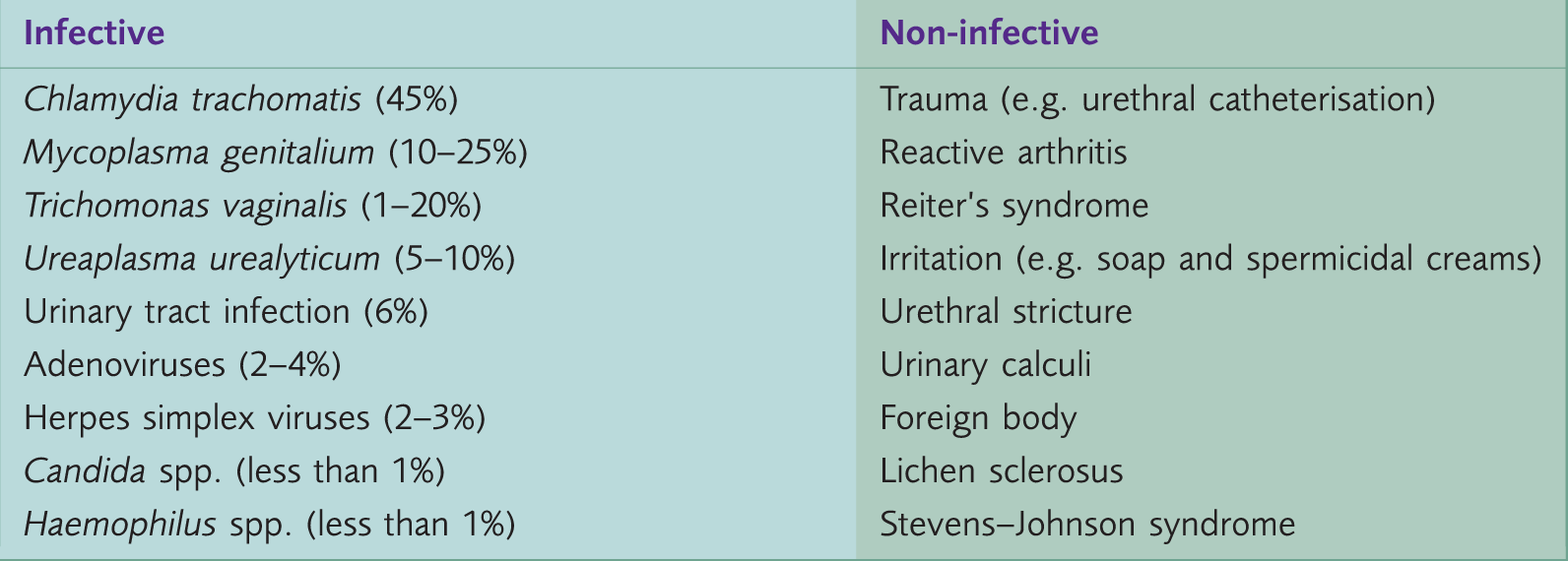
Causes of non-gonococcal urethritis
Risk factors
Risk factors for urethritis

Clinical presentation
Patients with urethritis are often asymptomatic with up to 50% of men with chlamydia (BASHH, 2008) and 10% of men with gonorrheal urethral infection being symptomless (BASHH, 2011). These patients are usually only diagnosed after contact-tracing. When symptomatic, patients mainly present with urethral discharge and dysuria. Urethral discharge starts 2–5 days after exposure, with purulent discharge indicating a urethritis of gonococcal nature whilst clear discharge suggests urethritis that is non-gonococcal in nature (Richens, 2004).Urethral pruritus, penile swelling and tenderness are also common complaints whilst patients may suffer with increased frequency of the urge to urinate, pain during sexual intercourse and haematuria or haematospermia. Painful ulcers should always be looked for as these may suggest herpes infection.
Simple urethritis does not cause fever or severe illness. The disease can, however, occasionally spread to other organs in the genital or urinary tract, or into the bloodstream. This can result in high fevers, nausea, vomiting, abdominal or back pain and swollen joints or testicles.
Diagnosis
If history-taking and clinical examination suggest a diagnosis of urethritis then immediate referral to a specialist GUM clinic should be made to confirm diagnosis. A urethral swab is the best investigation to do this (BASHH, 2008). Gram staining a urethral smear of men with urethritis will reveal more than five polymorphonuclear cells per high-power (×1000) field and this is the most sensitive and specific test for both gonococcal and non-gonococcal urethritis (Shahmanesh et al., 2009).
Although urethral swabs are the first line of investigation at GUM clinics they are often unavailable at GP practices and gram staining of a centrifuged sample of first-passed urine can be used instead. This sample should be obtained 1–2 hours after the last void, with the first 10–20 ml of the void collected. The sample should be sent to the laboratory as soon as possible and any delay in sending can be overcome by refrigerating the sample. A positive first-passed urine is seen when greater than 10 polymorphonuclear cells are present per high-power field (×1000) (BASHH, 2008). Some also recommend the use of a urine dipstick looking for leucocyte esterase or for the presence of urinary threads (strands of mucus/pus suspended in urine) on first-passed urine to diagnose urethritis, but this test is not very sensitive or specific (Brill, 2010).
All patients that are suspected of urethritis must additionally be tested for chlamydia and gonorrhoea. Both Chlamydia trachomatis and Neisseria gonorrhoea can be diagnosed from urine samples. This is performed by a dual chlamydia and gonorrhoea nucleic acid amplification test (NAAT) of a firstpassed urine sample. If the nucleic acid amplification test diagnoses gonorrhoea a urethral swab should be taken to confirm the diagnosis (BASHH, 2011). A urine dipstick test must be performed and a mid-stream urine sample sent for analysis if there is any suspicion of a urinary tract infection.
Taking a urethral swab
Inspection of the penis and urethral meatus is first performed. Two gloved fingers are then used to spread the meatus and allow further visualisation of the urethra. Next a cotton swab or 5 mm plastic loop is inserted 1–3 cm into the urethra and rotated once. To prevent contamination of the sample no lubricant is applied to the swab. The swab is then sent off to the laboratory where it is smeared on to a glass slide and examined under the microscope (Fig. 1). Microscopy of a urethral swab showing Neisseria gonorrhoea.
Management of urethritis
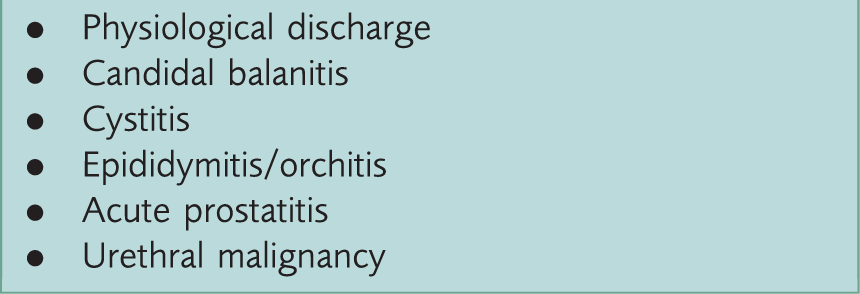
Differential diagnoses
Urethritis will resolve on its own given time, but as soon as the diagnosis of urethritis is made and before the results of gonorrhoea or chlamydia testing are back antibiotic treatment should begin. This is essential as it improves both symptoms in addition to preventing the transmission of the disease. Early treatment further helps to prevent spread of infection from the urethra to the testicles, prostate or kidneys. The most important causes of urethritis are Chlamydia trachomatis and Neisseria gonorrhoea and as a result initial treatment with antibiotics is directed at these pathogens.
The national guidelines for antibiotic use are described although local antibiotic policies may vary. Recommended optimal treatment for chlamydia and non-gonococcal urethritis is a single 1 g dose of azithromycin taken orally (BASHH, 2006) or seven days treatment with a tetracycline, usually 100 mg twice daily of doxycycline (Grabe et al., 2008). Other recommended treatments include either erythromycin 500 mg twice daily for 14 days or ofloxacin 400 mg daily or 200 mg twice daily for 7 days (BASHH, 2006).
If gonococcal urethritis is suspected or confirmed then the patient should be treated for both gonorrheal infection and chlamydia. Azithromycin 1 g orally as a single dose should be given in addition to a single intramuscular 500 mg dose of ceftriaxone (BASHH, 2011). It should be noted that only in very restricted geographical areas and under restricted situations are penicillins still reliable against Neisseria gonorrhoea. Furthermore, urethritis caused by chemical irritation or by injury should be treated by removing the cause.
Partner notification

Follow-up
Routine follow-up should be 2 weeks after treatment initiation. The objectives of follow-up include assessing treatment compliance and efficacy, reinforcing health education, following up partner notification, providing reassurance and considering repeat urethral smear and first-passed urine specimens on patients that have persistent urethritis suggested by ongoing symptoms or discharge (BASHH, 2008). Symptoms may, however, take up to 3 weeks to fully resolve after the completion of treatment. Test of cure is recommended in all cases of gonococcal urethritis but not in those that are a result of chlamydial infection. This should be performed via an NAAT of a urine sample at the 2-week follow-up appointment (BASHH, 2011).
If the patient is having ongoing symptoms then treatment failure, persistent urethritis and infection with an uncommon pathogen should be considered. In this situation repeat investigations and alternative antibiotics should be tried once completion of the initial course is confirmed (Schneede et al., 2003). Erythromycin 500 mg four times daily for 14 days in addition to 400 mg twice daily of metronidazole for 5 days is recommended but alternative diagnoses must also not be ruled out (BASHH, 2008).
Complications
Urethritis has a good prognosis. Inflammation caused by chemical irritation or by injury will nearly always resolve once the cause is avoided. Urethritis caused by gonococcal or chlamydial infection will also usually fully resolve if diagnosed and treated quickly with appropriate antibiotics (Shahmanesh et al., 2009). Urethritis can result in serious complications and the risk of this is increased if the infection is not treated or inappropriate antibiotics are given. These complications include persistent urethritis, Reiter’s syndrome, epididymo-orchitis, prostatitis, cystitis, pyelonephritis and urethral strictures.
Considerations in primary care
Patients with urethritis commonly present to GPs with concerns as to the cause of their symptoms. It is essential for GPs to understand the presentation and causes of urethritis as well as the importance of referring to GUM clinics. Patients who are unlikely to attend for further investigation and treatment must be identified and treated at the initial consultation. Patient education and obtaining consent for contact-tracing is imperative and complications must be examined for with referrals to secondary centres made when appropriate.
Key points
Urethritis in men is a very common problem.
Chlamydia trachomatis and Neisseria gonorrhoea are the two most common causes of urethritis but not all cases are a result of an infection. A large number of patients with urethritis are asymptomatic but classic presentation is with urethral discharge and discomfort. The optimal test to diagnose urethritis is analysis of a urethral swab. Prompt management with appropriate antibiotics is essential to treat infective causes of urethritis and prevent infection of sexual contacts. Contact tracing must be performed for all confirmed cases of urethritis.