







Abstract

As part of our ongoing continuing professional development (CPD), the General Medical Council (GMC) recommends that general practitioners should reflect regularly on their standards of medical practice. Dr Hana Patel, discusses the recent case of Dr Hadiza Bawa-Garba and how this has affected doctors in documenting reflections and mistakes in their ePortfolios and onward appraisals.
The ‘Bawa-Garba’ case
Dr Hadiza Bawa-Garba was a junior doctor and part of a clinical team looking after Jack Adcock, a 6-year-old boy who died of sepsis at Leicester Royal Infirmary in February 2011. In December 2014, almost 4 years after the events in question, Dr Bawa-Garba was charged with manslaughter on the grounds of gross negligence. She was convicted and given a 2-year suspended sentence in November 2015. In Dr Bawa-Garba’s case, some personal reflections – though not the ePortfolio statement – were shared with the panel to show her remediation efforts, as reflections can be used to mitigate a sentence in the latter sentencing stages of a trial. In fact, the duty consultants’ post incident discussion with Dr Bawa-Garba was referred to in his witness statement – even though these were his own thoughts and her ePortfolio was not submitted –putting a question mark over ‘reflecting’ in its wider sense and the confidentiality of the ePortfolio.
Following Dr Bawa-Garba’s conviction, the independent Medical Practitioners Tribunal Service (MPTS) ruled that she was a competent doctor, with a previously unblemished record, who made mistakes in the context of serious systemic failures and recommended that she should be allowed to continue to practise medicine. The General Medical Council (GMC) appealed the MPTS’s decision, in January 2018 the High Court allowed the GMC to permanently erase Dr Bawa-Garba from the medical register. However, in August 2018 she won her appeal against this decision.
Why is this case so important?
This case and its outcome affected all doctors working in a healthcare system operating under enormous stress in the UK. Because Dr Bawa-Garba was convicted of a criminal offence and permanently erased from the medical register, there might be an effect on patient safety with healthcare professionals reluctant to share knowledge openly or reflect on clinical errors, with a fear of criminal prosecution.
The RCGP released a statement on its website regarding the ‘Bawa-Garba’ case, commenting on the implications for general practice. General practitioners work in an independent manner, with the RCGP acknowledging that doctors do this without effective mechanisms to control an increasing workload. The RCGP is aware that GPs are increasingly working in challenging environments, dealing with uncertainty and managing risk on behalf of the NHS. In such an under-resourced and overstretched workplace, errors are more likely to be made, however the RCGP is keen to promote their advice: ‘reflecting openly and honestly is an essential part of GP training and continued professional development – as well as the best defence for doctors, if they do make mistakes. We will also be looking at our own processes, to make sure we are providing the best possible pastoral support we can for our members’.
Why should we reflect anyway?
GMC continuing professional development guidance.
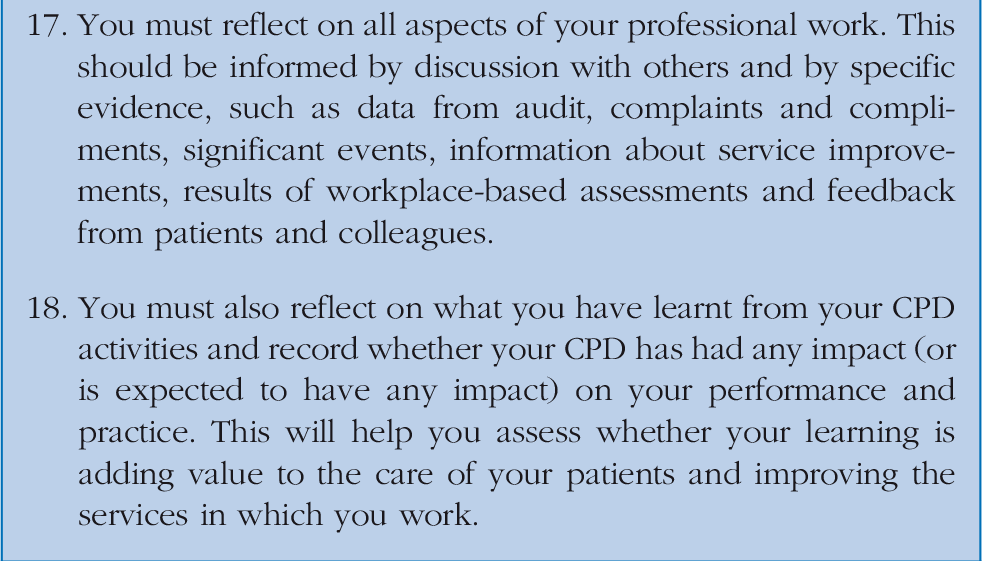
Reflection drives change in performance and is the key to effective continuing professional development (CPD). Good Medical Practice (General Medical Council, 2006) requires doctors to reflect regularly on their standards of medical practice. This recommendation is reiterated by Health Education England and the RCGP. It is also important to note that under the duty of candour it is an offence if this obligation is not discharged.
The RCGP curriculum states that GP trainees must: ‘Set your own learning objectives based on clinical experience’.
The Gold Guide, a reference guide for Postgraduate Specialty Training in the UK (General Medical Council, 2012), states that general practice trainees must:
Maintain a portfolio of information and evidence, drawn from the scope of their medical practice Reflect regularly on their standards of medical practice in accordance with GMC guidance on licensing and revalidation
It is important for trainees to realise that reflection is an essential part of training, an ethical and professional obligation and required for progress through a postgraduate training programme. Failure to record reflections honestly could, in theory, give rise to a GMC referral.
How should trainee doctors enter reflective notes in the ePortfolios?
The Academy of Medical Royal Colleges (AoMRC) has released guidance for trainee doctors recording reflective notes in their ePortfolios. It is important that ePortfolio reflections should be anonymised.
The GMC recognises that using information about patients is essential for education and training purposes and allows the use of anonymised data in these circumstances. Here are some tips on how to do this when writing reflective notes.
When referring to patients, use pronouns (such as they/their/theirs) and avoid referring to the patient’s gender if possible Use a broad indication of age (e.g. a patient in their 30s), instead of referring to a more specific age or date of birth Try to use a single letter that is unconnected with their name (e.g. Mr Wang is referred to as ‘Patient G'), instead of the patient’s or colleague’s initials, as this is not anonymisation If describing a very rare condition or unusual presentation, take care to anonymise details as this information can often be used to identify a patient Try not to be judgemental either to yourself or others; instead try to evaluate and analyse what was good and what could have been done better Try and focus on what has been learnt, and what steps you will take as a result
When writing reflective notes in ePortfolios, the AoMRC recommends wording the notes as follows:
Any final tips?
While it is important to acknowledge mistakes, lawyers who have represented doctors in fitness to practice cases emphasise that it is very important not to say, in any way, ‘I was negligent’. They also advise trainees to include any external factors that played a part in the outcome. If there is anything that contributed to the outcome, make sure that this is included in your ePortfolio reflection. In the case of significant events where harm to a patient resulted, doctors should discuss the recording of reflections with their defence organisation before committing to print.
Finally, the BMA has also issued a response to the Bawa-Garba case, emphasising that they are a source of guidance and support for doctors, working within a system that prevents them from providing safe, high-quality care. Their advice is that all doctors should use systems such as Datix or electronic communications with the heads of trusts and the equivalent in general practice, to protect themselves. The BMA has launched an ‘online space’ with an online form to report and share experiences and examples of how current unacceptable pressures in the NHS are impeding the provision of safe care.