







Abstract
Thermoacoustic analysis remains a key component during the development process of new combustion chambers. Whereas a vast amount of literature exists on the interaction of planar acoustic and propagation-stabilized flames, research on reheat flames, especially, on how they respond to transverse modes is scarce. With the study presented here, we show the isolated effect of transversal velocity perturbations on a reheat flame. This is done for two distinct flame stabilization cases occurring in a lab-scale reheat combustor. For the first, the flame is partly autoignition-stabilized but also has propagation-stabilized regions in the shear layer because of recirculation zones induced by a backward-facing step. The second features only a minimal step height and therefore only minor recirculation zones, leading to an almost purely autoignition-stabilized flame. The two different flame stabilization cases are investigated using Reynolds–averaged Navier–Stokes simulations integrating an in-house reheat combustion model. The analysis shows that transverse velocity perturbations have no effect on flames that are purely stabilized by autoignition. In the presence of propagation-stabilized flame regions within the shear layer, transverse velocity perturbations do induce heat release rate fluctuations, as expected.
Novelty and significance statement
To date three approaches1–3 exist to model the dynamic response of one-dimensional autoignition flames to longitudinal/planar acoustic waves. Recent studies4,5 showed for one of these models an adaptation and integration in an FEM-based framework to capture the thermoacoustic effects that the transverse acoustic eigenmodes of the combustion chamber have on non-compact autoignition flames. In this work, the dynamic heat release rate response of reheat flames perturbed by transversal velocity fluctuations was neglected. This paper addresses this gap by providing new insight into how autoignition flames behave when perturbed by transversal velocity fluctuations. The significance of this work is twofold: firstly, it provides a more profound understanding of the influence that transverse eigenmodes have on autoignition flames. Secondly, it constitutes a valuable contribution to research in this field. These findings can support the industrial development of novel low-emissions gas turbine combustion chambers.
Introduction
In order to comply with the Paris agreement, 6 the future energy landscape must be based on renewable energy systems to ensure low emissions.7–9 Gas turbines firing alternative carbon-free fuels can be an ideal asset to balance and stabilize the power grid.8,10–14 To fire a variety of fuels with very different combustion properties, extensive combustion chamber development is needed. When developing a new combustor, a critical challenge is a detailed thermoacoustic analysis to mitigate combustion instabilities. 15 Thus, the need for more detailed and sophisticated thermoacoustic analysis tools is apparent.
The thermoacoustic analysis of longitudinal/planar acoustic waves on propagation stabilized flames has been extensively studied in the past.16–24 Nicoud et al.
16
showed how the thermoacoustic stability of combustion chambers with propagation-stabilized flames can be assessed using the finite element method (FEM) and an
In general, propagation-stabilized flames and autoignition flames react very differently to acoustic perturbations. However, the differentiation thereof is not trivial. Reheat flames in industrial gas turbine combustion chambers are usually composed of different heat release rate (HRR) regions. Certain regions of a reheat flame are solely stabilized by autoignition, others are stabilized by propagation. The propagation-stabilized HRR regions of reheat flames are typically located in the shear layers, which form due to recirculation zones at geometrical area jumps or around bluff bodies. The core of the reheat flame is autoignition-stabilized within the bulk flow. The overall HRR distribution between the different zones is not fixed and can vary. With higher inlet temperatures in a sequential combustion chamber the overall HRR zone becomes more autoignition driven with characteristic shorter ignition delay times; and vice versa for colder conditions. While the propagation-stabilized HRR regions are governed by the balance of flame consumption speed and local flow velocity, the autoignition is governed by the balance between chemical and residence time scales. Acoustic fluctuations can have a large impact on both flame zones.
With respect to perturbations in transverse direction, transversal acoustic waves can significantly affect the flame shape and HRR. Close to geometric discontinuities, such as area jumps, transversal acoustic eigenmodes can induce vortex shedding and modulate the reactive shear layers. This leads to HRR fluctuations locally within the propagation-stabilized part of the flame.
34
The autoignition-stabilized HRR regions are sensitive to acoustic pressure and isentropic temperature fluctuations, which modify the local ignition delay time and therefore shift the flame back and forth.3,4 Heinzmann et al.4,5 developed a framework to model the dynamic effect that such modes have on reheat flames. They assessed transverse eigenmode stability and validated it with experiments. An assumption of the framework is that transverse velocity perturbations have negligible effect on a one-dimensional (1D) autoignition flame. This assumption is based on the fact that reheat flames react significantly weaker to velocity fluctuations in flow direction when compared to temperature and pressure fluctuations. This can be seen by the low value of the FTF with respect to velocity perturbations in Ref.
28
The mechanism responsible for the HRR response due to in-flow-oriented velocity perturbation is the modulation of the equivalence ratio.1,2,26,35 However, no equivalence ratio fluctuations are present in the case of transverse velocity perturbations in fully premixed conditions. A homogeneous premixed mixture upon entry into the combustion chamber was confirmed by a prior study for the investigated combustor.
36
In-house CFD simulations also concluded a good mixing of fuel and air before entering the combustor. Thus, the modeshape-dependent FTF

To the best of our knowledge, there is no literature to date stating whether transverse velocity perturbations have an effect on 1D reheat flames. In this paper, we identify the dynamic HRR response for two distinct cross-sections of a rectangular lab-scale reheat combustion chamber.
37
This is done by acoustically exciting the first transverse modes for both dimensions of a rectangular combustion chamber (i.e. in
Methodology
The methodology section describes how the RANS computation is set up. First, the geometry is shown. Second, the combustion model is introduced. Third, the numerical setup is discussed. Fourth, the mean fields are shown and lastly, the implementation of the transverse forcing is discussed.
Combustor geometry
The atmospheric combustor of the Technical University of Munich (TUM)
37
shown in Figure 1 consists of a vitiator followed by a reheat combustor. The vitiator is operated with a lean, perfectly premixed, preheated mixture of hydrogen and methane. The vitiated air enters the reheat combustor and passes through a mixing section where the fuel is injected into the hot gas in a jet-in-cross-flow arrangement. To improve mixing, delta wing-shaped vortex generators are placed upstream of the fuel injection. The mixture then passes through a convergent section before entering the reheat combustion chamber through a diffuser-shaped outlet. The rectangular combustion chamber mainly expands in
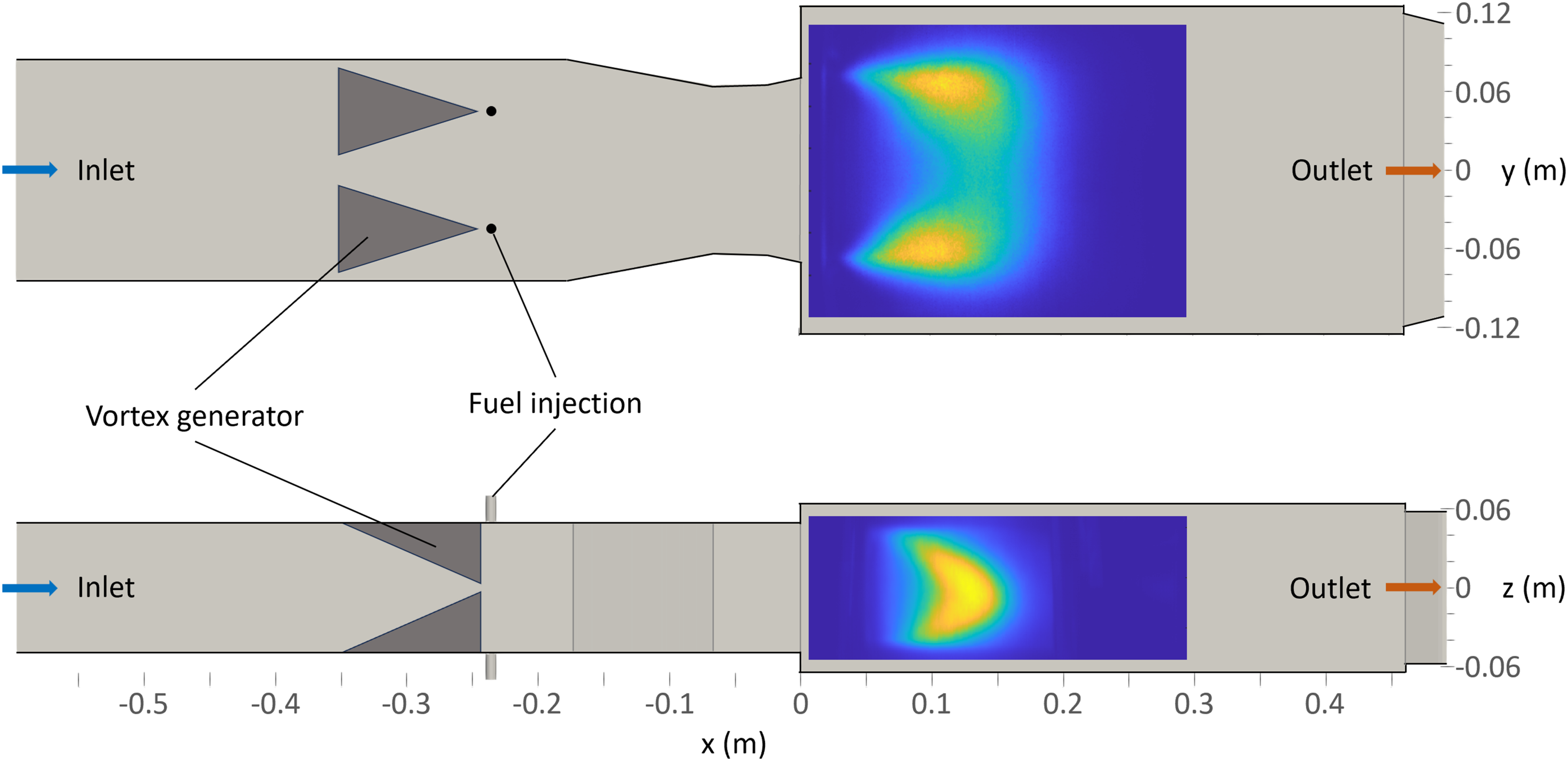
Geometry of the reheat combustion chamber at TUM. The
RANS computation
The RANS CFD computations are performed for the presented rectangular reheat combustion chamber (Figure 1) burning a mixture of 50% methane and 50% hydrogen by weight at lean and autoignitive conditions. The CFD is done using ANSYS Fluent 2024 R1
39
using the realizable
This combustion model is based on a transported normalized progress variable (

The

In their combustion models, Brandt42,43 and Kulkarni
40
assumed that the transport of energy scales the same as the transport of mass, and that the change of specific heat capacity

Assuming an isentropic correlation of pressure and temperature for acoustic waves,

To model the turbulence chemistry interaction (TCI) a PDF approach for the mass fractions

The HRR is then obtained by using the mixed is burned approximation and delaying it by multiplying the reaction rate with the PV.
The major advantage of this approach is that it is computationally cheap. The source terms, which can be computed using 0D reactors, and the integration can be done a priori and stored. Therefore, only the educts, products,
In this paper, the
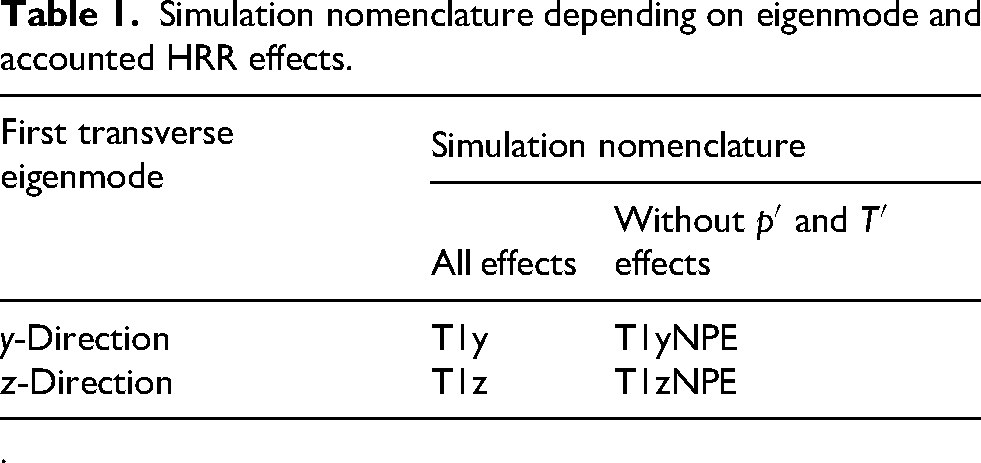
Four simulations are computed in total. Table 1 displays the naming convention, depending on the orientation of the first eigenmode as well as the HRR effects accounted for. The T1y- and T1z-simulations are computed for the first transverse eigenmode in
Simulation nomenclature depending on eigenmode and accounted HRR effects.
.
The computational domain (Figure 3) is half of the reheat combustor
37
making use of the symmetry planes
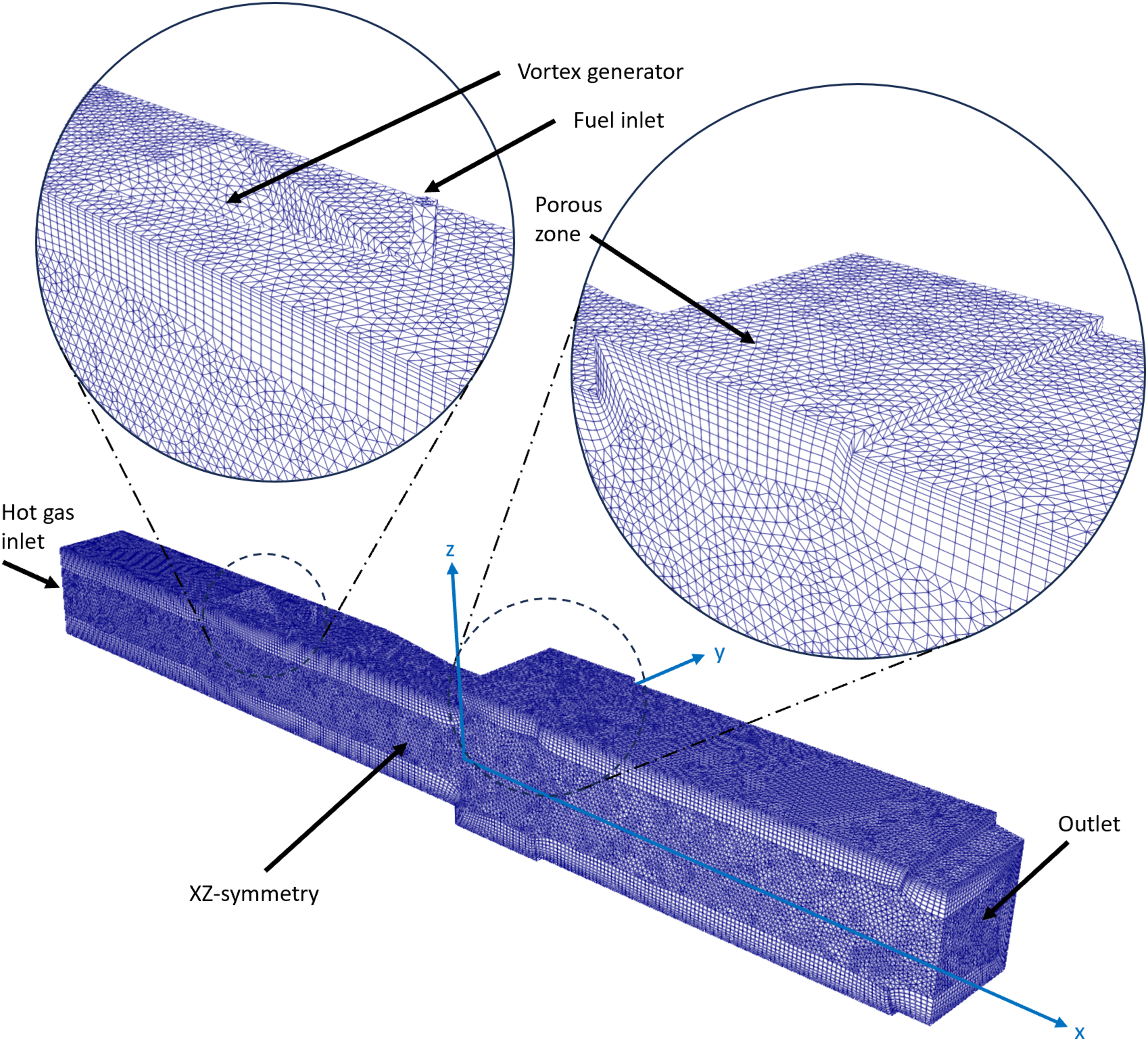
Half of the CFD mesh and computational domain.
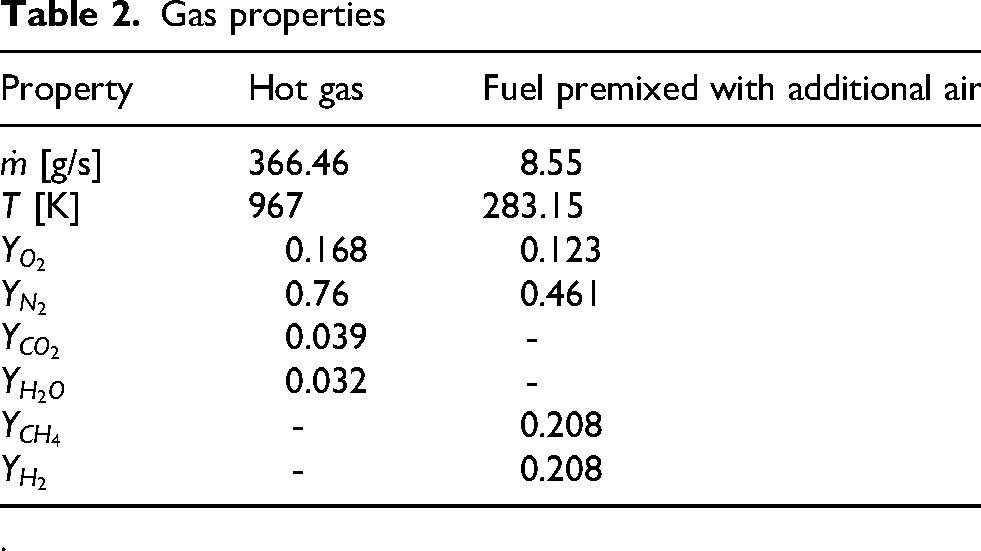
Gas properties
.
The excitation is achieved in a similar way as was shown by Zellhuber et al.
47
On the combustor walls, which coincide with the antinodes of the first transversal eigenmode, small porous zones with high resistance are added, Figures 2 and 3. Within these zones, sinusoidal momentum source terms are applied to force the fluid domain. Due to the high resistance, the gas motion within the porous zones is strongly restricted; therefore, the prescribed momentum fluctuations are converted into pressure fluctuations. The precise forcing frequencies of the T1y and T1z modes are calculated by solving the homogeneous Helmholtz equation Eq. (7) in COMSOL 6.2, where 
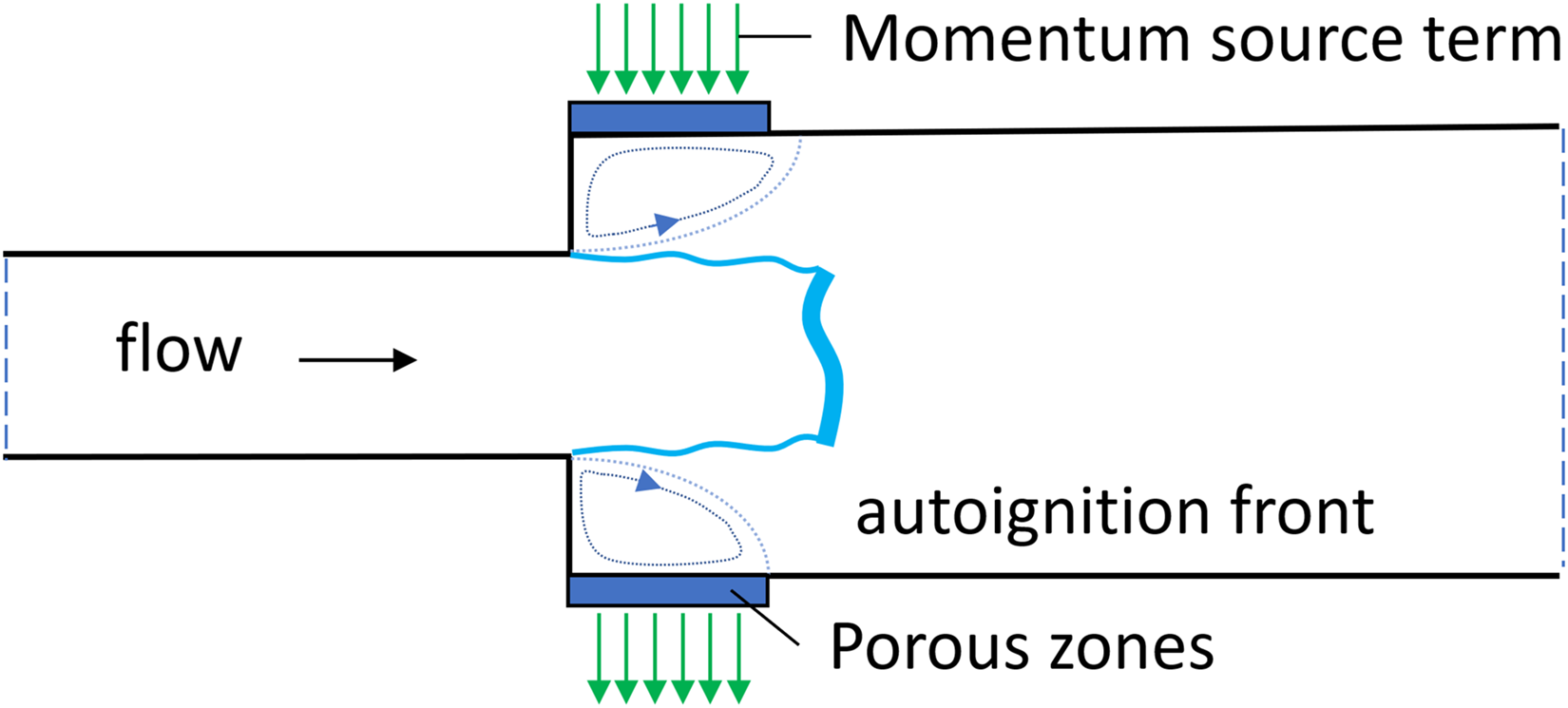
Porous zones and momentum source terms.
The time averaged flame is accounted for in the FEM study by inclusion of the time averaged temperature field in the combustion chamber, which is taken from the steady CFD computation.
Results
First the CFD mean field results are shown and the time averaged HRR field is validated for the
CFD steady HRR mean field validation
Figure 4 shows the temperature,
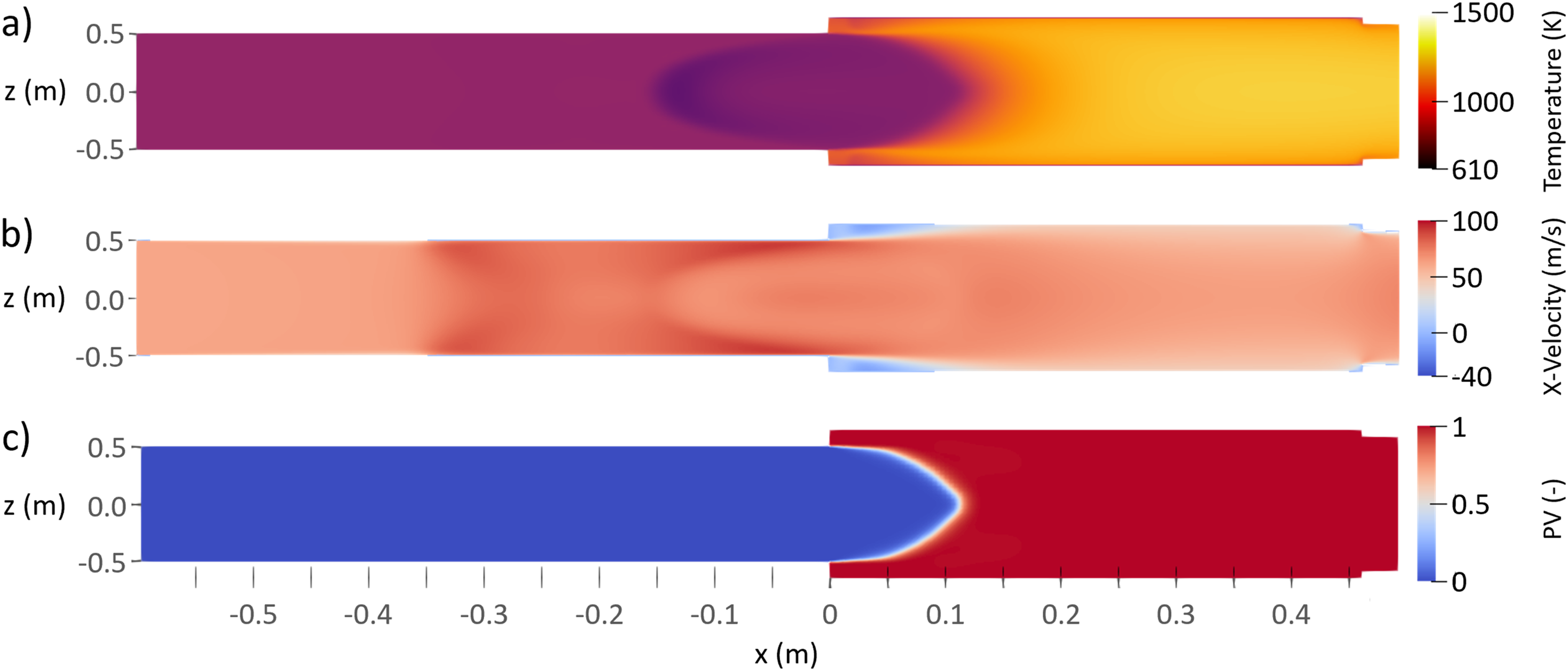
CFD mean fields for the
The time averaged flow field and flame shape of the CFD simulation is validated using experimental data.
37
Figure 5 compares the time-averaged HRR on the
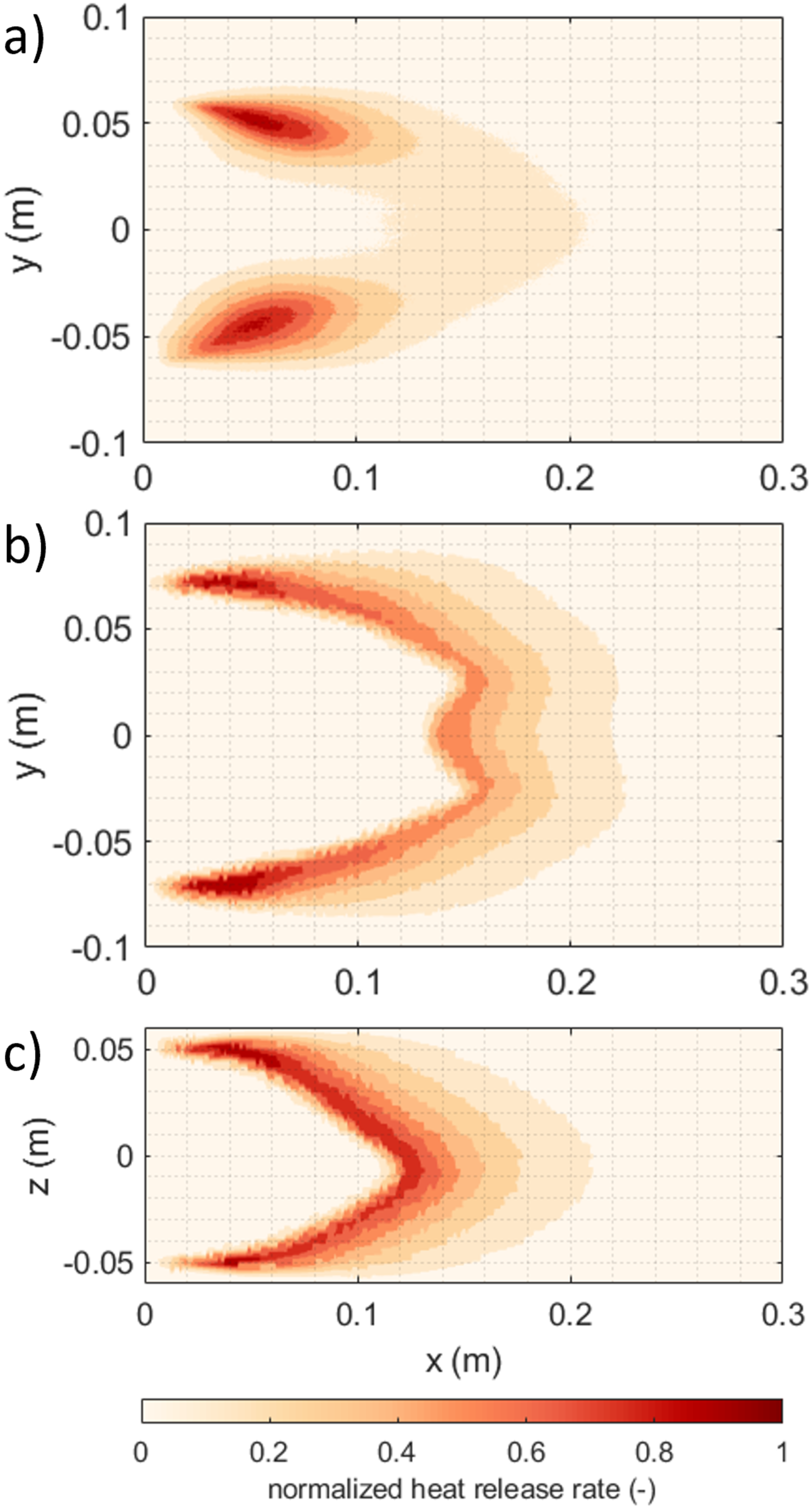
(a) Time averaged HRR mean field on the
The excitation frequencies were determined by solving Eq. (7) in FEM, analogously to Heinzmann et al.
4
The effect of the flame is accounted for by including the time-averaged temperature field in the combustion chamber. For the T1y-mode the forcing frequency is 1426Hz and for the T1z-mode 2660Hz. Figure 6(a) shows the first transverse eigenmode of the
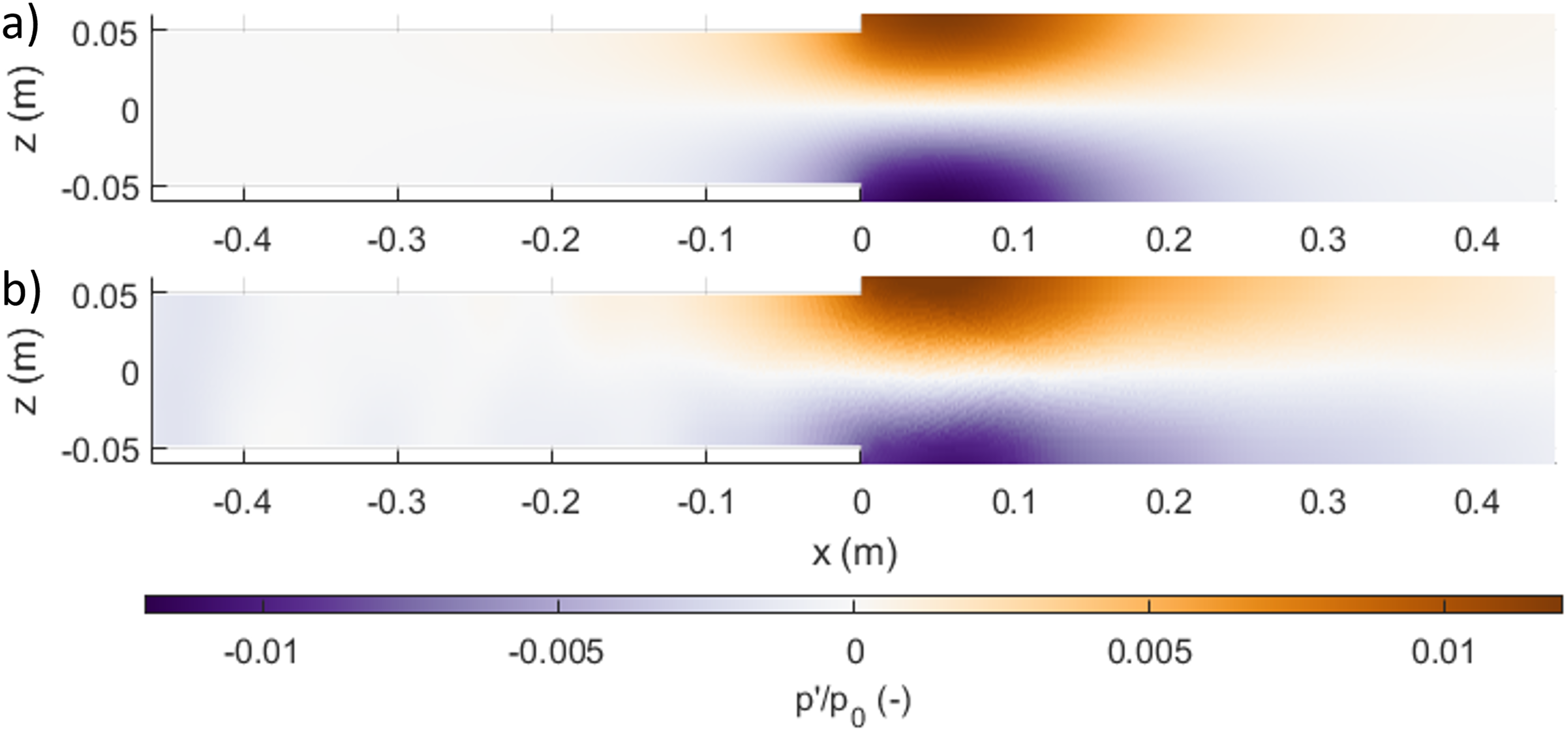
a) T1z acoustic eigenmode of the FEM computation, b) T1z acoustic eigenmode of the RANS computation.
Propagation- and autoignition-stabilized flame regions on the
-plane
Analyzing the flame response on the
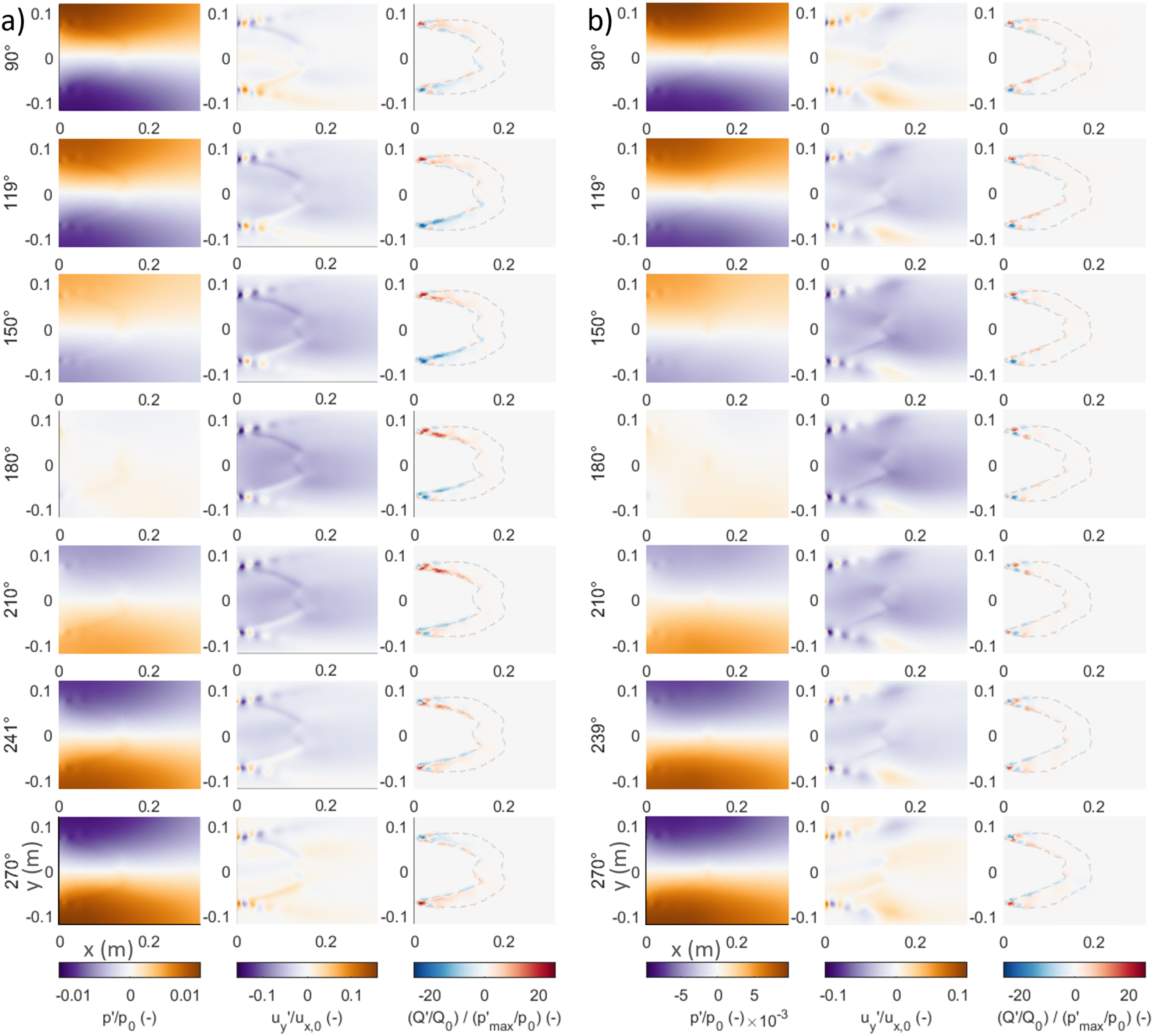
a) Pressure perturbations (first column), transverse velocity perturbations (second column), and HRR perturbations (third column) for the T1y-simulation and half an oscillation. The same variables are plotted in b) for the T1yNPE-simulation.
Quantitative comparisons between the simulations can also be made. By integrating the HRR for multiple cross-sections parallel to the The transverse velocity fluctuations do not induce HRR fluctuations at the center cross-section ( The phase of the T1y-HRR response in the shear layer flames oscillates around The peaks in the FTF gain coincide with the stronger shear layer HRR flame regions. The gain of the HRR-response of the shear layer flames is significantly higher in the T1y-simulation compared to the T1yNPE-simulation. This is due to the fact that no HRR-response due to pressure and isentropic temperature perturbations is accounted for in the latter. Further, the shear layer flames are located closely to the pressure antinodes, which suggests a pronounced HRR-response. Toward the combustor walls, the transverse velocity field has its nodes. Hence, as the
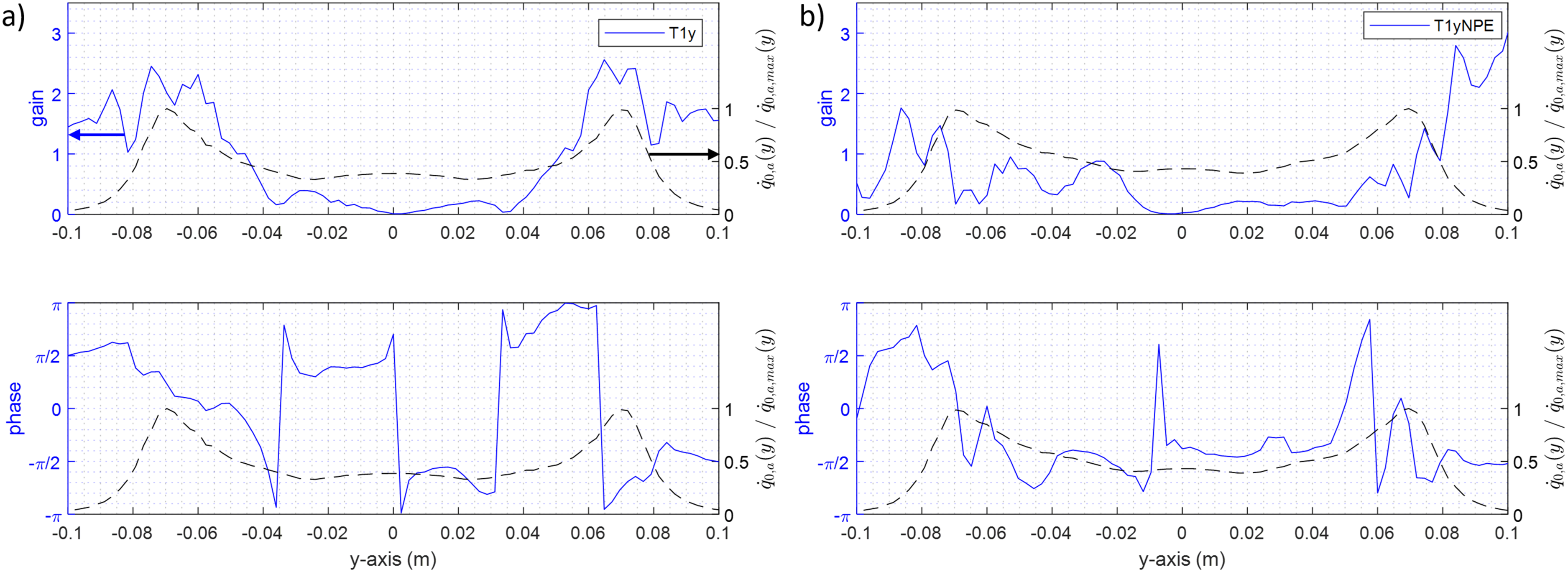
The local FTFs to velocity fluctuations for a) the T1y-simulation and b) the T1yNPE-simulation. The integrated HRR is plotted by the dashed black line.
Autoignition-stabilized flame regions on the
-plane
Similar comparisons as for the
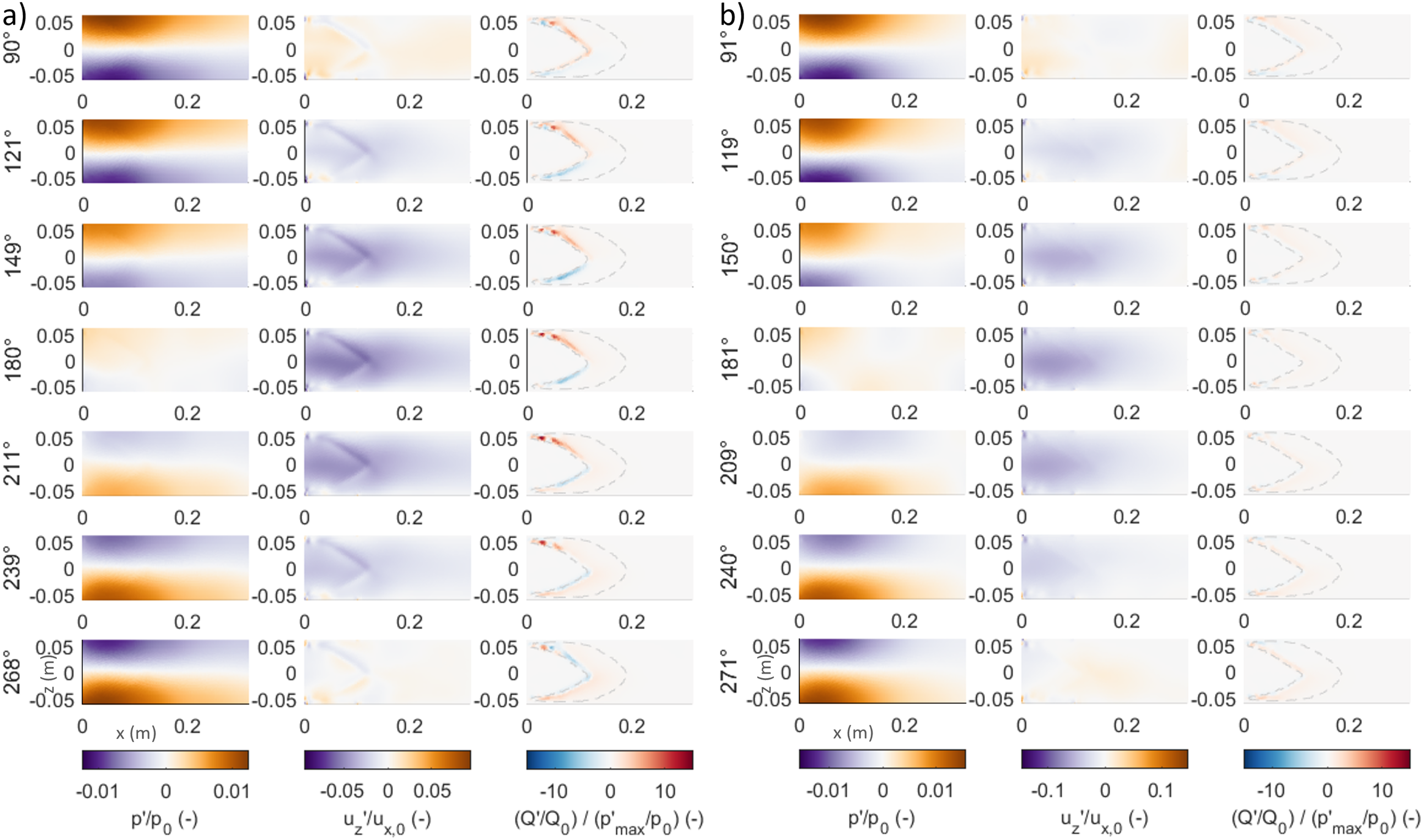
a) Pressure perturbations (first column), transverse velocity perturbations (second column), and HRR perturbations (third column) for the T1z-simulation and half an oscillation. The same variables are plotted in b) for the T1zNPE-simulation.
The local FTFs of the integrated HRR (integrated along the
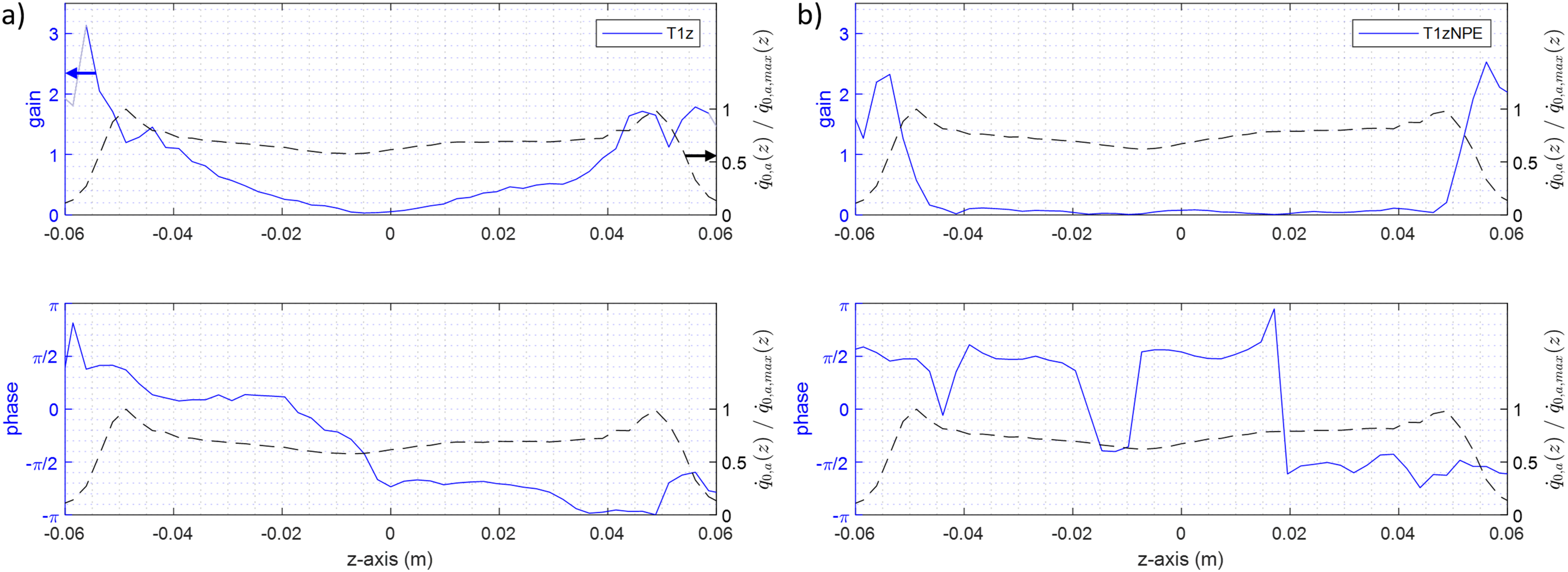
The local FTFs to velocity for a) the T1z-simulation and b) the T1zNPE-simulation. The integrated HRR is plotted by the dashed black line.
Conclusion
The effect of transverse acoustic eigenmodes on autoignition flames has been investigated in recent studies.4,33 In this paper, we specifically further analyze the effect that transversal velocity fluctuations have on fully- and partly- autoignition-stabilized flames. For this, unsteady forced RANS computations are performed in Fluent of a lab-scale reheat combustor 29 and the mean fields validated with experimental measurements. The analysis shows that transverse velocity perturbations have no effect on flames solely stabilized by autoignition. This was confirmed in all four simulations. Therefore, the initially stated hypothesis is confirmed. For partly autoignition-stabilized flames, where propagation-stabilized parts are present in the shear layer, transverse velocities can have an effect. Still, the local effects of pressure and isentropic temperature tend to have a significantly stronger effect compared to the transverse velocity.
Footnotes

Funding
The research work presented in this manuscript was carried out within the FLEX4H2 project. The FLEX4H2 project is supported by the Clean Hydrogen Partnership and its members European Union, Hydrogen Europe and Hydrogen Europe Research (GA 101101427), and the Swiss Federal Department of Economic Affairs, Education and Research, State Secretariat for Education, Research and Innovation (SERI). Views and opinions expressed are however those of the author(s) only and do not necessarily reflect those of the European Union or any other granting authority. Neither of them is liable for any use that may be made of the information contained therein.
Declaration of conflicting interests
The authors declare no potential conflicts of interest with respect to research, authorship, and publication of this article.