







Abstract
Intertemporal choices involve decisions that balance trade-offs occurring at different points in time. Previous research on self–other differences in intertemporal choice, often interpreted through a psychological-distance framework, has produced mixed findings. The authors propose that part of this heterogeneity reflects systematic changes in response randomness under greater psychological distance, which can alter observed choice proportions and recovered discounting indices even when underlying time preferences are not systematically shifted. To test this response-randomness hypothesis, they conducted a pre-registered within-subject eye-tracking experiment (N = 100), in which the participants completed the same set of monetary intertemporal choices for themselves and for an anonymous stranger. Behaviorally, the participants chose a higher proportion of the larger-later options when deciding for the anonymous stranger than when deciding for themselves. However, multiple analyses converged on increased response randomness when deciding for the anonymous stranger. The authors examined the intertemporal preferences using a standard hyperbolic discounting model and quantified choice errors as deviations from the model-predicted responses. In addition, they applied a hierarchical Bayesian implementation of dynamic decision field theory to estimate a decision threshold parameter indexing response randomness, and examined whether this parameter statistically mediated the self–other difference in choice proportions. Across the measures, the choices for others were consistently noisier. The participants produced more choice errors, and the decision threshold was lower when choosing for the anonymous stranger, indicating reduced response consistency. The differences in response randomness were strongly associated with differences in time preference across roles and mediated the effect of role on the proportion of larger-later choices. The eye-tracking results further showed reduced engagement and less systematic information search for others, indexed by shorter total dwell time, reduced information inspection, and lower systematicity of the search. Trial-level mediation further suggested that reduced information acquisition and less systematic search partially contributed to choice differences across conditions. Together, these findings indicate that socially distanced intertemporal choices are accompanied by noisier responding and altered information processing, helping to clarify why self–other patterns in the literature can appear inconsistent across tasks and analytic approaches.
Keywords
Introduction
Many everyday decisions involve choosing between outcomes that occur at different times. For example, individuals often decide whether to spend on immediate needs or save for greater future benefits (Dai & Busemeyer, 2014). Such decisions, known as intertemporal choices, require balancing trade-offs between costs and benefits at different points in time (Frederick et al., 2002). Importantly, intertemporal choices are often made under varying degrees of psychological distance. People make choices not only for themselves but also when advising, recommending, or deciding on behalf of others—circumstances that can increase psychological distance from the consequences of choice. For instance, when a friend asks whether they should hold onto stocks for potential gains or sell them immediately, the advice one provides may differ from the decision one would make for oneself. In many real-world settings, especially in financial and medical contexts, intertemporal choices are routinely made for others, making it crucial to understand how psychologically distanced decision contexts influence intertemporal choice (Ubel et al., 2011).
Accumulating evidence suggests that self–other differences in intertemporal choices may be better understood as an instance of a more general psychological-distance effect. Beyond social distance between the self and others, comparable shifts in discounting have been documented under other forms of psychological distance, including linguistic distancing, such as pronoun omission, and more abstract construal (Chen & He, 2014). In the present study, we focus on social distance operationalized through decisions made for oneself versus for a stranger. This paradigm is widely used in intertemporal-choice research and provides a relatively clean manipulation of psychological distance. It also helps minimize confounds related to relationship-specific knowledge or obligations (Albrecht et al., 2011; Jones & Rachlin, 2006). Conceptualizing self–other differences in this way also clarifies that the present framework is not limited to self–other comparisons and may be generalized to other psychological-distancing manipulations.
Psychological-Distance Effect in Intertemporal Choices
A substantial amount of literature has examined intertemporal choice under varying degrees of psychological distance, most commonly by comparing decisions made for oneself with decisions made for others, and the evidence is mixed across paradigms and operationalizations. Many studies suggest that greater psychological distance is associated with less steep discounting and a higher likelihood of choosing larger-later (LL) rewards. For example, Albrecht et al. (2011) compared choices made for oneself with choices made for a stranger and found that participants were more likely to select delayed rewards when deciding for others. Kim et al. (2013) also manipulated interpersonal distance and reported that greater interpersonal remoteness was associated with reduced discounting of delayed rewards. Similarly, Ziegler and Tunney (2012) reported that discounting was greatest when people decided for themselves and lowest when decisions were made for a stranger. Related work has also shown that intertemporal preferences vary with interpersonal distance and with other distancing manipulations (Chen & He, 2014; Wang et al., 2024; Zhang et al., 2023).
Conversely, some studies have reported patterns that appear to depart from this typical distancing-associated reduction in discounting. For example, Wang et al. (2019) showed that participants choosing for a complete stranger preferred more immediate rewards than those choosing for themselves or for an intimate friend. They further showed that this pattern was especially pronounced among participants with a prevention focus, indicating that the direction and magnitude of the decision target effect can be moderated by regulatory focus. O’Connell et al. (2013) used a perspective-taking paradigm in which participants made intertemporal judgments from another person's perspective rather than making choices on that person's behalf. In this setting, steeper discounting was observed when participants adopted another person's perspective, and the effect was stronger under empathy-related conditions such as higher trait empathy or empathy induction. Because this perspective-taking procedure differs from proxy decision-making, its results are not directly comparable to studies in which participants choose on behalf of another person.
In addition, some studies have found no significant difference in delay discounting between decisions made for oneself and those made for others. For instance, Weatherly and Ruthig (2013) presented evidence that the extent of discounting over time, measured by the discounting curve, was unaffected by the decision-maker’s role. Similarly, Sharma and Khan (2022) reported no significant variations in discounting rates when individuals made decisions on their own behalf rather than someone else.
Role of Response Randomness in the Psychological-Distance Effect
The mixed findings for intertemporal choice under psychological distance may partly reflect systematic differences in response randomness that are not captured by standard preference-based analyses. After carefully reviewing prior mixed evidence on self–other intertemporal differences, particularly studies reporting choice proportions, we observed that individuals’ choices tended to be dragged toward random levels (i.e., 50%) when deciding for others compared to when deciding for themselves (Albrecht et al., 2011; Chen & He, 2014; Wang et al., 2019). For instance, Chen and He (2014) reported that participants selected LL options more frequently for others than for themselves, and the proportion of LL options actually shifted from 24% for themselves to 43% for others, approaching randomness. In contrast, Wang et al. (2019) observed that participants with a prevention focus chose LL options less for others than for themselves, and the probability of LL choices decreased from 72% for themselves to 49% for others, also nearing randomness. In addition, Albrecht et al. (2011) identified a distinct pattern among strong discounters (47% for others vs. 39% for themselves) and moderate discounters (63% for others vs. 67% for themselves), while both groups consistently exhibited a tendency to approach randomness when deciding for others. Such changes in choice proportions due to response randomness may have been misinterpreted in previous research as evidence of changed impulsivity (Albrecht et al., 2011; Chen & He, 2014).
Building on these observations, in the present research, we propose the response-randomness hypothesis to explain the observed self–other intertemporal differences. The central motivation is that response randomness is not merely a measurement nuisance but a theoretically consequential factor in intertemporal choice, because the same underlying time preference can yield different observed choice proportions when responses become noisier, and this can bias inference about discounting and create apparent self–other differences even when preferences are unchanged (Franco-Watkins et al., 2006; Jiang & Dai, 2024). When individuals make intertemporal choices for themselves, the decision outcomes are typically more personally consequential, which is accompanied by greater emotional involvement and stronger motivational engagement. Such heightened engagement increases individuals’ willingness to invest deliberative effort in evaluating and comparing decision options (Peters, 2006), thereby promoting more stable and internally consistent choice patterns. In contrast, when individuals make decisions on behalf of others, the personal emotional relevance of the outcomes is often attenuated, which may reduce motivational engagement in the decision process. Reduced emotional and motivational involvement can weaken the precision with which preferences are constructed, resulting in greater variability across choices, lower decision consistency, and elevated response randomness (Franco-Watkins et al., 2006; Jiang & Dai, 2024). In addition, psychologically distanced decisions often involve fewer direct consequences for the decision-maker and a lower sense of personal responsibility for the outcome, which can further reduce incentives to integrate information carefully and thus increase choice variability (Lee et al., 1999). According to this hypothesis, increased inconsistency in other-regarding decisions may systematically pull choice proportions toward chance-level responding, thereby providing a parsimonious explanation for the mixed patterns reported in prior research on self–other differences.
Similar patterns of increased response randomness have been documented in decision-making under risk. For instance, Eriksen et al. (2020) reported that individuals sometimes took more risks and sometimes fewer risks when deciding for others compared to deciding for themselves, suggesting that risky decisions made on behalf of others are notably inconsistent. Likewise, Andersson et al. (2016) highlighted that failing to account for decision errors when assessing risk preferences can lead to incorrect inferences about an individual's level of risk aversion. Their findings demonstrated that task selection and calibration in risk assessments may produce misleading associations between risk-taking behavior and cognitive ability, whereas it is ultimately cognitive capacity that primarily influences choice-related errors.
To our knowledge, however, few studies have directly examined the response randomness when individuals make intertemporal choices for themselves or others. The current research aims to address this gap by explicitly proposing and examining the response-randomness hypothesis to better explain existing mixed findings in self–other intertemporal differences. We hypothesized that individuals will exhibit higher levels of response randomness when making intertemporal choices for others compared to themselves (Hypothesis 1).
Examining Response Randomness
Previous research has introduced valuable methodologies for assessing response randomness, with one primary approach involving the evaluation of choice consistency as an indicator of response randomness. This method originates in studies on the effects of cognitive load on intertemporal choices. Hinson et al. (2003) initially reported that increasing cognitive load, which taxed participants’ working memory, led to higher elicited discounting rates, suggesting increased impulsivity. However, a subsequent reanalysis by Franco-Watkins et al. (2006) revealed that differences in discounting rates between cognitive-load conditions were actually associated with an increase in erroneous responses. They concluded that the original findings were likely due to increased error rates and reduced response reliability under cognitive load, a hypothesis they later supported through an additional experiment (Franco-Watkins et al., 2010).
Inspired by the work of Franco-Watkins et al. (Franco-Watkins et al., 2006; Franco-Watkins et al., 2010), we also examined the relationship between differences in time preferences and choice inconsistencies. By exploring the correlation between inconsistencies in choice behavior and variations in time preferences, we aim to further clarify whether response randomness systematically contributes to the observed discrepancies in intertemporal choices for oneself versus for others. Because response randomness can distort the inference of time preference from observed choices, we also examine whether cross-condition differences in apparent time preference covary with differences in response randomness. If psychological distance increases decision noise to a meaningful extent, individuals who show larger increases in randomness when choosing for others should also show larger apparent shifts in estimated discounting or choice proportions. We therefore hypothesized that differences in response randomness will correlate with differences in time preferences when comparing intertemporal choices made for oneself to those made for others (Hypothesis 2).
Another method for assessing response randomness involves process-based computational modeling to estimate decision-noise parameters such as decision thresholds. Recently, Jiang and Dai (2024) used a model-comparison approach to examine the dynamic characteristics of intertemporal choices. Specifically, they fit and compared several widely used models, including decision field theory (DFT; Dai & Busemeyer, 2014; Dai et al., 2018), hyperbolic discounting (Dai et al., 2016), the intertemporal choice heuristic model (ITCH; Ericson et al., 2015), and the trade-off model (Scholten & Read, 2010). Within the DFT framework, they used the decision-threshold parameter as an index of response randomness and showed that it varied under cognitive load, thereby supporting earlier evidence that apparent changes in discounting can arise from changes in response reliability (Franco-Watkins et al., 2006; Franco-Watkins et al., 2010).
In the present study, we followed this strategy by fitting the same set of candidate models and selecting the best-fitting model via formal model comparison. We then used the decision-threshold parameter from the selected model to quantify individual differences in response randomness across decision targets. This approach provides a dynamic process-oriented perspective for assessing response randomness and enables us to evaluate whether the key conclusions are robust across alternative modeling assumptions.
Response Randomness and Eye-Tracking Measures
The eye-tracking technique may provide valuable insights into response randomness in self–other differences in intertemporal choices and offer further evidence regarding cognitive processes. Eye-tracking measures, such as total dwell time (TDT) and proportion of inspected information, have been validated as indicators of engagement and cognitive effort during decision-making processes (Barrafrem & Hausfeld, 2019; Su et al., 2013; Yang et al., 2022). Higher levels of engagement and deliberation in decision-making are associated with increased time spent searching for information and a broader scope of inspected information. Previous research has examined these cognitive differences in self–other decision-making contexts, particularly in risky choices. For instance, Liu et al. (2018) found that individuals making risky choices for themselves tended to seek more information than those deciding on behalf of others. Similarly, Barrafrem and Hausfeld (2019) used the eye-tracking technique to demonstrate that people exhibited longer decision times and more complete information inspection when making risky choices for themselves than for others, suggesting that self-directed decisions may require more deliberative cognitive effort. Based on this, we hypothesize that individuals making choices for themselves will exhibit longer dwell time and a higher proportion of inspected information compared to decisions made for others (Hypothesis 3a).
Furthermore, recent advancements in the use of eye-tracking techniques within judgment and decision-making have introduced an emerging measure that quantifies the randomness of information search patterns (Perkovic et al., 2018). This measure—the Systematicity of Search Index (SSI)—can capture the degree of organized versus random information search by calculating the ratio of alternative- and attribute-based patterns corrected for chance across all transitions made (Perkovic et al., 2018). Along with related measures like the Search Index (Payne, 1976) and the Strategy Measure (Böckenholt & Hynan, 1994), the SSI has been used to examine the systematicity of information search, a key factor in understanding response randomness. The SSI has been validated in various decision-making tasks and can effectively reflect the tendency toward random or unsystematic search behaviors (Perkovic et al., 2018). Given the relationship between systematic search patterns and response randomness, we hypothesize that intertemporal choices made for others will exhibit greater randomness in information search compared to those made for oneself (Hypothesis 3b).
The Current Study
In the current study, we conducted an eye-tracking experiment to investigate the role of response randomness in psychological-distance effects in intertemporal choices by operationalizing psychological distance as social distance via decisions for oneself versus for others. Previous research has identified various variables, such as regulatory focus (Wang et al., 2019) and date/delay framing (Sharma & Khan, 2022), which may have confounded the effect of the decision-maker role in intertemporal choices. To overcome these limitations, our experimental design exclusively manipulated the decision-maker role (i.e., decision for oneself vs. decision for others) as the sole independent variable, aiming to isolate its specific effect.
Beyond methodological variations, the inconsistencies in previous findings may also stem from differences in the definition of “others.” Some studies have operationalized “others” as strangers (Albrecht et al., 2011; Ziegler & Tunney, 2012), while others have examined social distance by assessing decisions made for friends or family members (Kim et al., 2013; O’Connell et al., 2013; Wang et al., 2019). To clearly delineate the relationship between our variables of interest, we defined “others” explicitly as complete strangers with no prior connection to the decision-maker, thus eliminating potential confounding factors related to social closeness or familiarity. This operationalization provides a relatively clean manipulation of psychological distance while minimizing relationship-specific confounds.
In this within-subject design experiment, the participants were asked to make intertemporal choices for both themselves and others, during which both their choices and eye movements were recorded. We analyzed the participants’ response randomness in these two conditions to test Hypothesis 1. Additionally, we examined the relationship between differences in response randomness and time preference across the two conditions to test Hypothesis 2. To further explore underlying cognitive processes, we used eye-tracking data to assess cognitive effort and the randomness of information search patterns in order to test Hypotheses 3a and 3b.
All of the experimental procedures, hypotheses, and analyses were pre-registered prior to the data collection on the Open Science Framework. The supplementary material, deidentified preprocessed data, and analysis scripts are available on the Open Science Framework platform.1 To comply with the anonymous review process, the pre-registration and data links have been concealed, and the full pre-registration document, along with all supplementary material, has been uploaded to the submission system.
Method
Participants
As detailed in the pre-registration, we performed an a priori power calculation with G*Power (version 3.1.9.7; Faul et al., 2009) to determine the required number of participants. Specifically, a paired t-test with an effect size of Cohen's d = 0.34 (the smallest reported in Jiang and Dai’s (2024) research), an α level of .05, and a power of 95% indicated a required sample size of 95 participants. Therefore, a total of 100 college students (Mage = 20.7 ± 2.1 years; 42 males) were recruited to participate in the study to minimize the potential impact of participant dropout. The participants reported no prior participation in similar intertemporal-choice (delay-discounting) experiments. Each participant received 20 yuan (renminbi, approximately 3.6 US dollars), and two participants received an additional immediate or delayed reward based on their performance in the experiment. All of the individuals had normal or corrected-to-normal visual acuity and provided informed consent before the study commenced, which was approved by the university's institutional review board.
Apparatus
We collected the participants’ eye-tracking data using an EyeLink 1000 Plus system from SR Research (Ontario, Canada) at a sampling rate of 1,000 Hz. The stimuli were presented on a 17 in. (43.18 cm) display operating at 60 Hz with a resolution of 1,024 × 768 pixels. A chin rest was employed to minimize head motion and maintain the eye-to-monitor distance at 60 cm. From this distance, the screen subtended a visual angle of 35° horizontally and 28° vertically. Although the eye tracking was binocular, only the right eye's data was recorded. The participants responded by pressing keyboard keys, and the experiment was conducted using the Experiment Builder software (version 2.3.38).
Stimuli and Experimental Task
Similarly to Albrecht et al. (2011), we used the stimuli comprising 80 pairs of intertemporal options developed by McClure et al. (2004). Each pair contained a smaller-sooner (SS) reward and a LL reward. The two options had delay times of either two or four weeks between them. The SS rewards were randomly drawn from a normal distribution (M = 20, SD = 10). The LL rewards were computed by applying one of eight predefined percentage increments (1%, 3%, 5%, 10%, 15%, 25%, 35%, 50%) to the SS amount (see Table S1 in the supplementary material). These increments follow prior intertemporal-choice paradigms (e.g., Albrecht et al., 2011; McClure et al., 2004) and were designed to span a wide range of relative reward differences, thereby creating a graded set of choice difficulties and reducing ceiling or floor responding. This range is particularly useful for reliably quantifying response randomness because it yields substantial within-subject variability in choice probabilities across trials. In the stimuli, any two of the four numbers were placed beyond the central 5° visual angle, ensuring that the participants had to shift their gaze to view more than one number at a time (Rayner, 1998, 2009).
The experiment included two conditions: the participants made intertemporal choices for themselves (SELF) or for another person (OTHER). In the SELF condition, the participants chose their preferred options between a pair of SS and LL options, with an unrestricted time to decide. In the OTHER condition, the participants made choices on behalf of a stranger. The participants were informed that both they and the other person would remain anonymous, and that the other person would not make choices for them. This method has been commonly used in previous research (Barrafrem & Hausfeld, 2019; Sharma & Khan, 2021). The order of the two conditions was counterbalanced across the participants. To further motivate the participants’ engagement, they were told that once the experiment had concluded, two participants would be selected at random and one of their trials from each task would be drawn, with the outcomes of the choices determining the extra payoffs.
Both conditions involved the same set of 80 option pairs. The order of presentation of each option pair was randomized within each condition. The outcomes and delays were vertically aligned, with one option on the left and the other on the right. In half of the trials, the outcomes appeared first (at the top for vertical alignment), while in the other half, the delays appeared first.
Procedure
On entering the laboratory and giving their consent, the participants received instructions about the experiment and a brief description of the apparatus. The chair was then adjusted for the participant’s comfort. The participants were calibrated to the eye tracker before each session, with recalibration performed whenever necessary—for instance, when the drift check was not satisfactory. The experiment used a 5-point calibration and validation process, allowing a maximum error of 0.5° of the visual angle. After this calibration, the participants completed two practice trials at the beginning of each session to familiarize themselves with the task. Each session of the formal experiment included 80 trials split into two sets of 40 trials each, followed by a 2-min break after each set. A 10-min intermission was provided after completing the first task. After completing the two sessions, the participants also completed the Inclusion of Other in the Self scale (Aron et al., 1992).
At the start of each trial, a fixation disc was displayed at the center of the screen. This disc also served as a drift check for the eye tracker. Once the participant’s gaze on the disc was confirmed, they pressed the space bar to initiate the choice stimulus presentation. The participants had unlimited time to select one of the two options, pressing “F” for the left choice or “J” for the right choice. After they had submitted their decisions, a 1,000 ms feedback screen was shown before the next trial began. Figure 1 illustrates the trial procedure and timing.
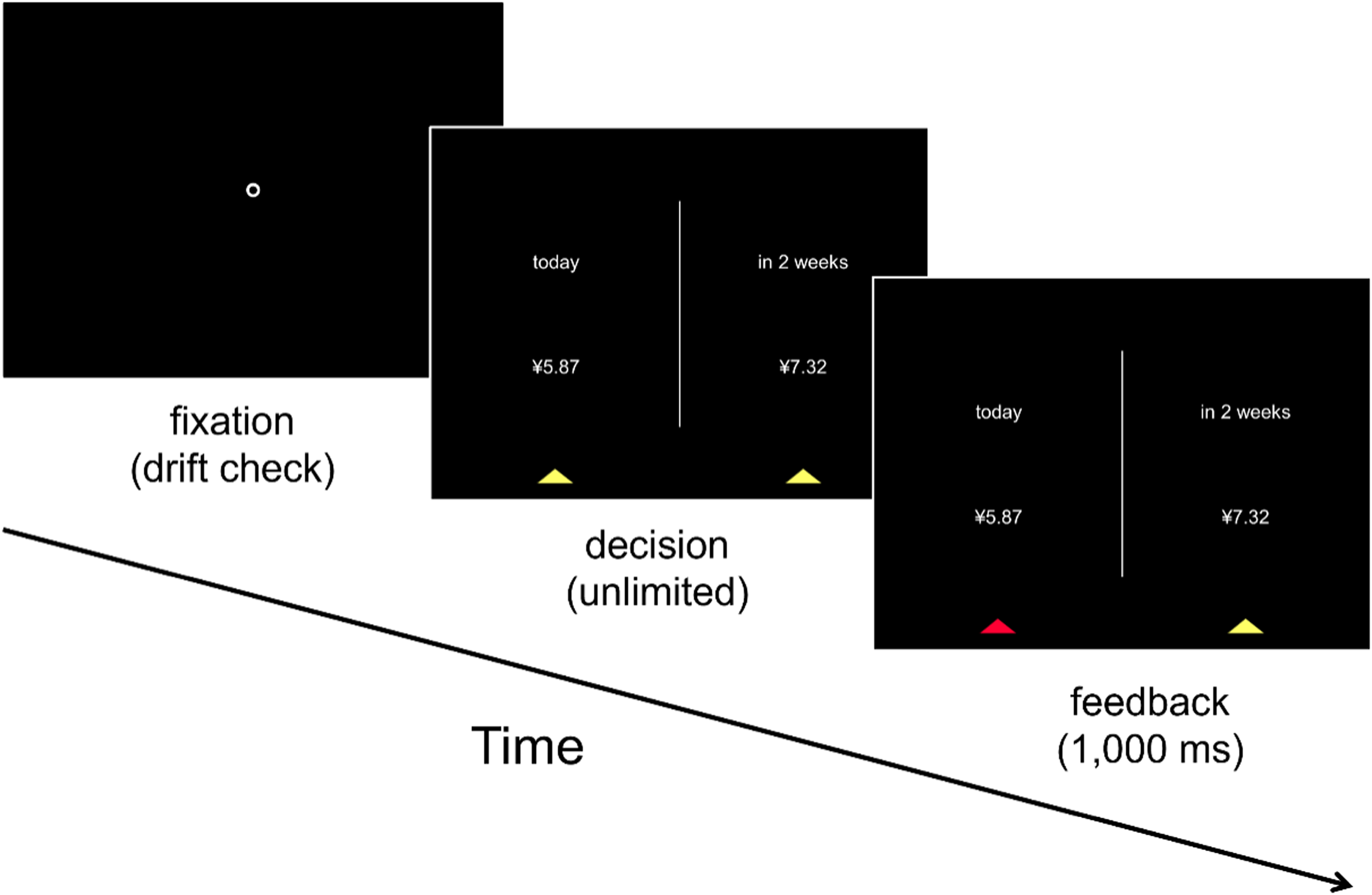
Trial procedure and timing.
Data Analysis
Preprocessing of the Eye-Tracking Data
We processed the eye-movement data using Data Viewer software (version 4.2.1). Fixations were identified as periods of a steady gaze occurring between consecutive saccades, and any fixations shorter than 50 ms were excluded from the analyses. Four non-overlapping, identically sized (18° × 8° of the visual angle) rectangular regions of interest were defined to encompass each piece of information (i.e., the outcome and the delay).
Estimating Discounting Rates and Erroneous Responses
Following the method outlined by Franco-Watkins et al. (2006), we employed the hyperbolic discounting model to estimate the discounting rates separately for the SELF and OTHER conditions. According to this model, the subjective value of a delayed reward is discounted as follows:

The hyperbolic model was chosen for its robustness in capturing intertemporal-choice behavior, with a single parameter (k) summarizing preference patterns (Green & Myerson, 2004; Rachlin et al., 1991; Rodriguez et al., 2014). Moreover, given that previous studies have used the hyperbolic model to examine self–other discrepancies in intertemporal choice (e.g., Albrecht et al., 2011; Ziegler & Tunney, 2012), employing this model allows for both the validation of earlier findings and a consistent basis for comparison across studies.
To estimate the likelihood of selecting the LL option, we applied a softmax function:

We then calculated the proportion of erroneous responses, defined as choices deviating from predictions based on the participant's best-fitting k value in each condition. A higher proportion of erroneous responses indicates more random choices (Franco-Watkins et al., 2006, 2010).
Estimating Response Randomness in the DFT Framework
Using the method developed by Jiang and Dai (2024), we applied the dynamic DFT of intertemporal choice, which was developed by Dai et al. (Dai & Busemeyer, 2014; Dai et al., 2018) to fit individual choice data through a hierarchical Bayesian approach. This model was selected due to its capacity to capture the dynamic characteristics inherent in intertemporal choices (Rodriguez et al., 2014) and its superior performance relative to alternative intertemporal models (Dai & Busemeyer, 2014; Dai et al., 2018). Importantly, this model also allows for estimation of response randomness (Jiang & Dai, 2024).
In the DFT model, intertemporal choices result from an evidence-accumulation process, wherein decision-makers intermittently shift their attention between the monetary and delay dimensions until the accumulated evidence exceeds a decision boundary for choosing an option. The drift rate within this stochastic accumulation-of-evidence process is calculated as follows:



We also fit a set of alternative intertemporal-choice models, including the random utility model assuming hyperbolic discounting (Dai et al., 2016), the ITCH model (Ericson et al., 2015), and the trade-off model (Scholten & Read, 2010). All of these models incorporate stochastic components and therefore permit the estimation of response randomness. We compared the model fit using the Widely Applicable Information Criterion. Consistent with Jiang and Dai (2024), the DFT model provided the best account of our data across both decision targets, as indicated by the lowest Widely Applicable Information Criterion values. Therefore, to maintain a single, internally consistent metric of response randomness across the participants and conditions, we report the DFT parameter estimates (including the decision threshold θ) in the main text. The complete Widely Applicable Information Criterion table and the corresponding results from the alternative models are reported in the supplementary material as a robustness check.
Eye-Tracking Measures
Three eye-tracking measures were employed to test Hypotheses 3a and 3b. The first measure, total dwell time, represents the cumulative duration of fixations throughout a trial. In the data analysis, TDT was log-transformed to normalize the distribution. Higher TDT values indicate that the participants spent more time fixating on a specific region of interest, suggesting a greater allocation of attention to that area. Thus, the TDT values serve as an indicator of task engagement or information-processing complexity (Malcolm & Henderson, 2010; Yang et al., 2022).
The second eye-tracking measure, the percentage of total information searched (PTIS), was employed to examine the extent of information acquisition in each task. PTIS is positively correlated with the thoroughness of information processing (Payne & Braunstein, 1978; Su et al., 2013), meaning that a higher PTIS score reflects a more comprehensive examination of information prior to decision-making, which is indicative of deeper cognitive engagement (Liu et al., 2022).
The third measure, the Systematicity of Search Index, quantifies the degree to which search patterns are random (Perkovic et al., 2018). The SSI was calculated as follows:

Statistical Analysis
As pre-registered, we conducted paired t-tests to evaluate the differences between the two conditions. Additionally, we reported the Bayes factors (BFs) using the BayesFactor package in R software (Morey et al., 2018). Specifically, we reported the BF10 values, which represents the likelihood of the data supporting the alternative hypothesis compared to the null hypothesis. To interpret the strength of the evidence, we followed Jeffreys’ guidelines: BF values between 1 and 3 were considered “weak,” values from 3 to 10 “moderate,” values from 10 to 30 “strong,” and values above 30 “very strong” evidence in favor of the alternative hypothesis. Additionally, we calculated Pearson's r to assess relevant correlations.
Results
Overall, 1 of the 16,000 trials was excluded from the analyses due to eye-tracking failures.
Proportion of LL Options Chosen
We calculated the proportion of LL options chosen by each participant in each condition. The results showed that, although the proportions were correlated between the SELF and OTHER conditions (Pearson's r = .70, p < .001), the participants chose a higher proportion of LL options when making decisions for others (M = 37.4%, 95% confidence interval (CI) = [32.2%, 42.6%]), compared to themselves (M = 28.2%, 95% CI = [23.8%, 32.6%]), t99 = 4.80, p < .001, Cohen's d = 0.48, BF10 = 2667 (see Figure 2a).2
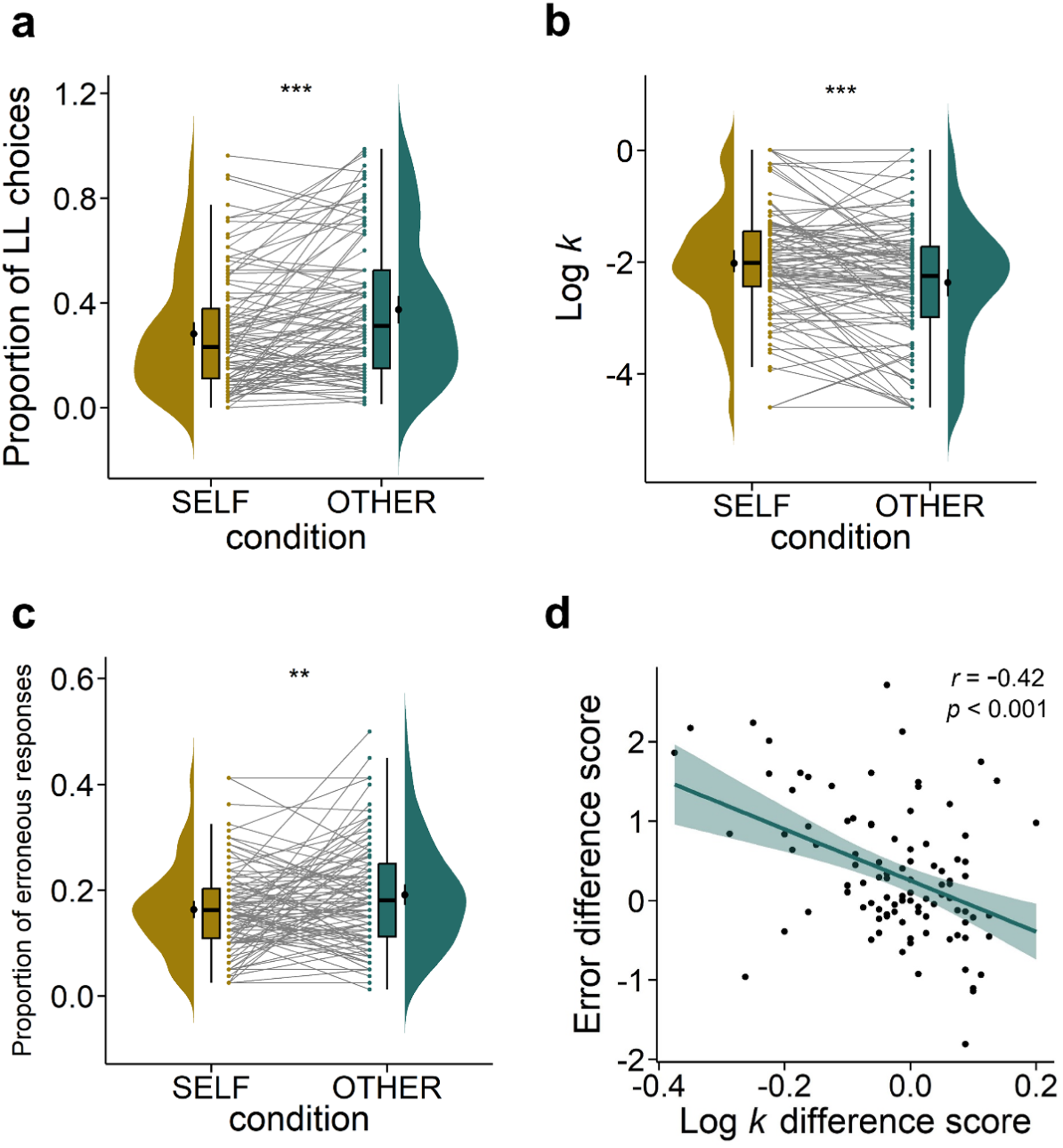
(a) Proportion of LL options chosen in the SELF and OTHER conditions; (b) Log k values in each condition; (c) Proportions of erroneous responses in each condition; (d) Correlation between log k differences and erroneous response difference scores between conditions.
Discounting Rates and Erroneous Responses
We examined the differences in the discounting rates (log k) and erroneous responses between the SELF and OTHER conditions. The results revealed that the log k values in the SELF condition (M = −2.02, 95% CI = [−2.21, −1.82]) were significantly greater than those in the OTHER condition (M = −2.36, 95% CI = [−2.58, −2.15]), t99 = 4.12, p < .001, Cohen's d = 0.41, BF10 = 232 (see Figure 2b). This finding is consistent with the results regarding the proportion of LL options chosen.
To examine our hypothesis concerning response randomness (Hypothesis 1), we compared the proportion of erroneous responses between the two conditions. The results revealed that the participants made more erroneous responses when deciding for others (M = 19.2%, 95% CI = [17.2%, 21.1%]) than for themselves (M = 16.4%, 95% CI = [14.7%, 18.0%]), t99 = 2.58, p = .011, Cohen's d = 0.26, BF10 = 2.53 (see Figure 2c), indicating weak evidence for the alternative hypothesis. This finding implies that the participants responded more randomly (i.e., less consistently) when choosing for others than for themselves, thereby supporting Hypothesis 1.
To test our hypothesis concerning the correlation between differences in time preferences and choice consistencies across the two conditions (Hypothesis 2), we calculated the differences in the discounting rates and erroneous response rates between the two conditions. A significant correlation (Pearson's r = –.42, p < .001) between the log k difference scores and the erroneous response difference scores was observed (see Figure 2d). These results suggest that the differences in time preference were correlated with the differences in response randomness between the two conditions, thereby supporting Hypothesis 2.
Response Randomness in the DFT Framework
In this study, we focused on the decision threshold parameter (θ), which reflects response randomness. Lower θ values indicate lower decision thresholds, leading to more random responses. We first analyzed the group-level posterior means of the θ parameter for the SELF and OTHER conditions (see Figure 3a). The mean of the group-level posterior distribution was higher in the SELF condition (M = −0.061, 95% highest density interval (HDI) = [−0.414, 0.311]) than the OTHER condition (M = −0.425, 95% HDI = [−0.716, −0.092]). The posterior distribution mean of the differences between the two conditions was −0.289 (95% HDI = [−0.508, −0.114]). For the individual-level parameters, a paired t-test showed that the participants’ θ values in the SELF condition (M = −0.06, 95% CI = [−0.16, 0.04]) were significantly greater than those in the OTHER condition (M = −0.43, 95% CI = [−0.56, −0.30]), t99 = 5.77, p < .001, Cohen's d = 0.58, BF10 = 136566, indicating very strong evidence for the alternative hypothesis (see Figure 3b for the individual posterior distributions of the θ parameters). Additionally, the reward sensitivity parameter (α) and time sensitivity parameter (β) also varied between the two conditions (for details, see Table S3 in the supplementary material). These findings suggest a lower decision threshold and thus a higher degree of response randomness when making decisions for others compared to oneself, supporting Hypothesis 1.
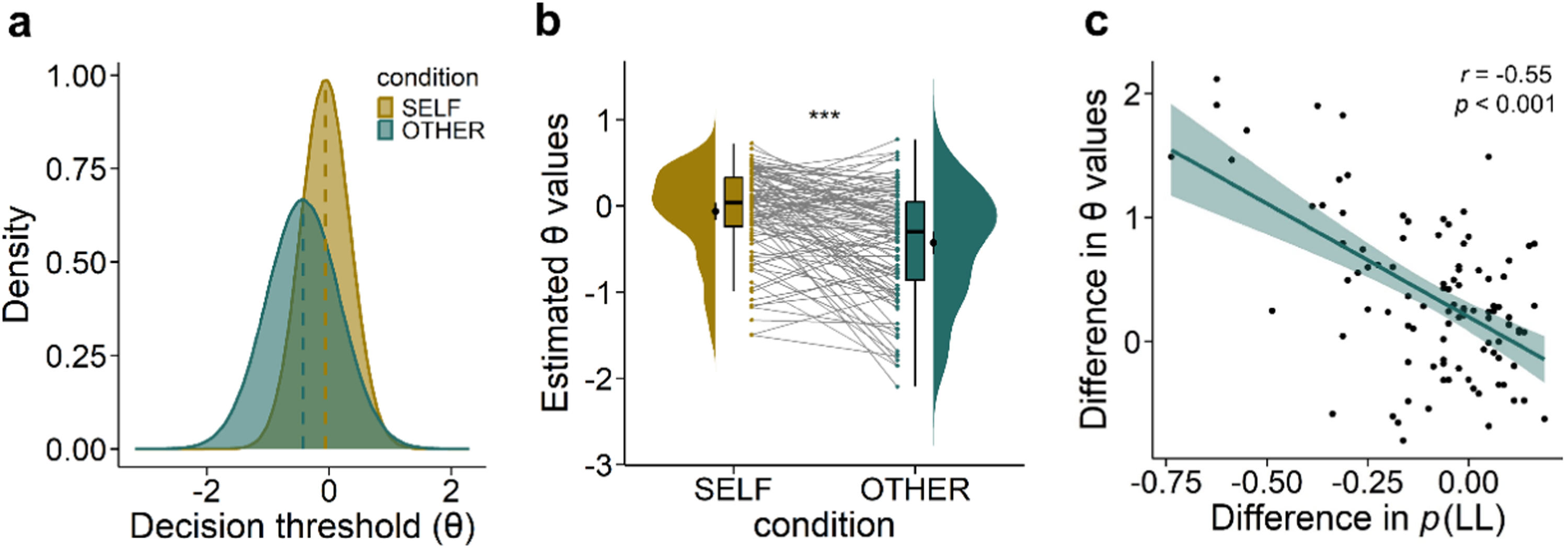
(a) Posterior distributions of the group-level mean for the DFT's decision threshold parameter (θ) in the SELF and OTHER conditions; (b) Differences in individual θ parameters between the SELF and OTHER conditions; (c) Correlation between differences in the proportion of LL options chosen and differences in θ between conditions.
To test Hypothesis 2, we calculated the differences in the proportion of LL options chosen and in the participants’ θ values between the two conditions.3 A significant negative correlation was observed between the differences in choice proportions and θ values (Pearson's r = −.55, p < .001; see Figure 3c). These results indicate a correlation between differences in time preference and response randomness across the two conditions, further supporting Hypothesis 2.
Considering the similarity between the correlation analysis of differences across the conditions and the within-subject mediation analysis, we conducted a post hoc mediation analysis. We applied the mediation testing procedure for repeated measures designs described by Montoya and Hayes (2017), which uses a bootstrapping approach, and conducted the analysis using the MEMORE 2.1 macro in SPSS (Montoya, 2019). We examined the effect of the condition (SELF vs. OTHER) on the proportion of LL options chosen mediated by the decision threshold parameter (θ). We computed 95% confidence intervals using 5,000 bootstrap resamples. The findings of the mediation analysis are shown in Figure 4. The mediation analysis revealed a significant indirect effect of the condition on the proportion of LL options chosen through the θ values (ab = −0.06, 95% CI = [−0.10, −0.03]). The total effect of the condition on the proportion of LL options chosen was also significant (c = −0.09, 95% CI = [−0.13, −0.05], p < .001), while the direct effect was non-significant (c’ = −0.04 [−0.07, 0.001], p = .056). These findings suggest that the effect of the decision-maker role on time preference is mediated by response randomness.
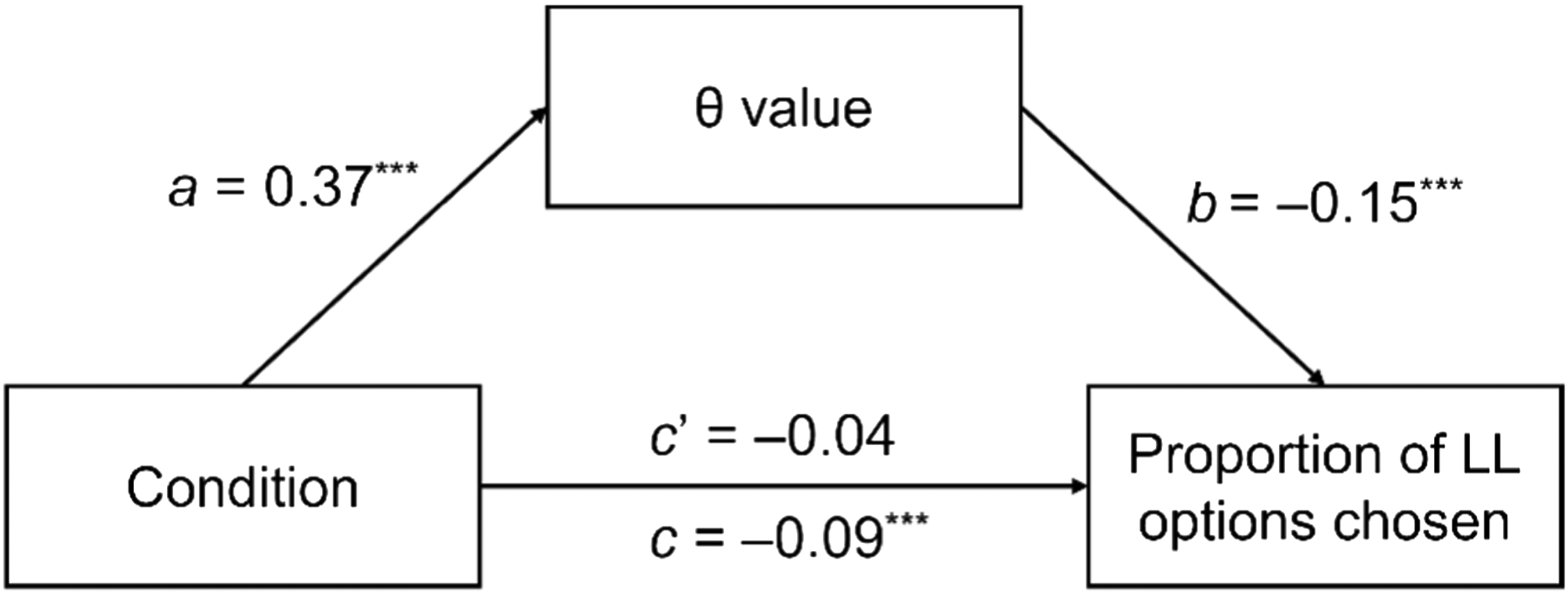
Mediation analysis results illustrating the role of the decision threshold parameter (θ) in the relationship between the condition and the proportion of LL options chosen.
Eye-Tracking Results
To test Hypotheses 3a and 3b, we examined the differences in the three eye-tracking measures between the two conditions. The results revealed that the participants’ TDTs (log-transformed) were significantly longer in the SELF condition (MSELF = 7.38, 95% CI = [7.32, 7.44]) than in the OTHER condition (MOTHER = 7.23, 95% CI = [7.16, 7.31], t99 = 4.85, p < .001, Cohen's d = 0.48, BF10 = 3240 (see Figure 5a). The results also showed that the participants’ PTISs were significantly higher in the SELF condition (MSELF = 72.6%, 95% CI = [71.8%, 73.3%]) than in the OTHER condition (MOTHER = 71.0%, 95% CI = [69.9%, 72.1%], t99 = 2.96, p = .004, Cohen's d = 0.30, BF10 = 6.60 (see Figure 5b). These findings suggest that the participants were more engaged when making decisions for themselves compared to when making decisions for others, supporting Hypothesis 3a.
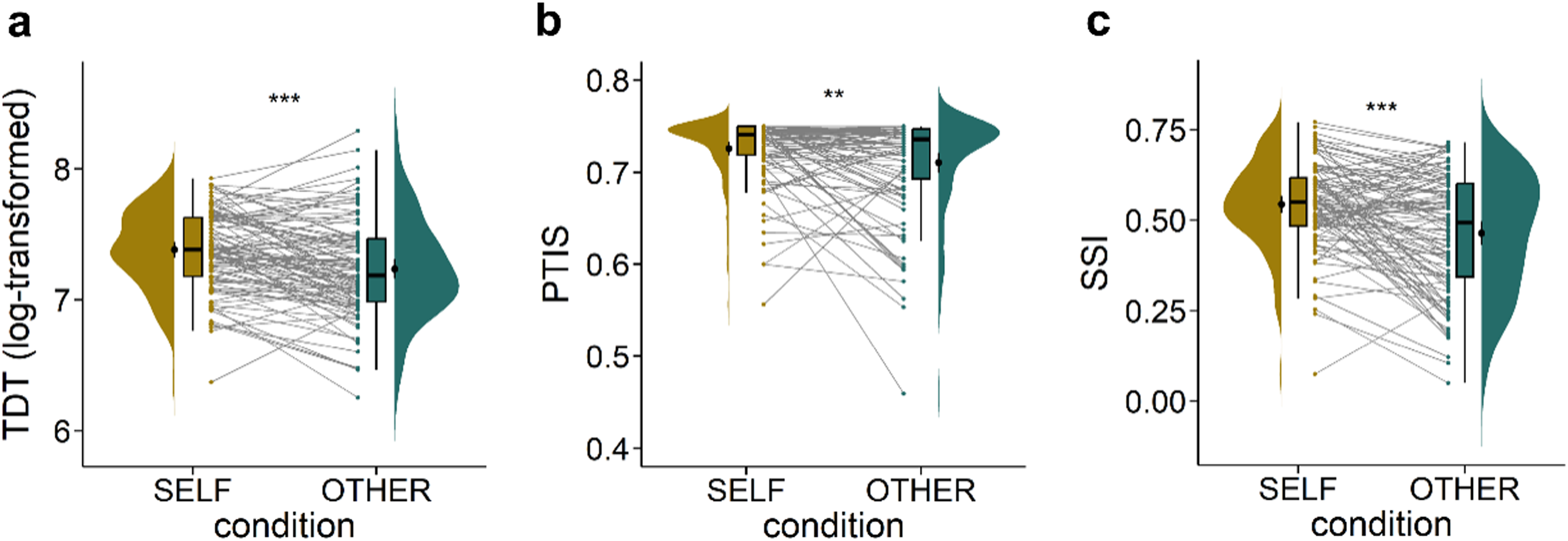
(a) The log-transformed TDT; (b) PTIS; (c) SSI across the SELF and OTHER conditions.
We also found that the SSI values were significantly lower in the OTHER condition (MOTHER = 0.46, 95% CI = [0.43, 0.50]) than in the SELF condition (MSELF = 0.54, 95% CI = [0.52, 0.57], t99 = 5.08, p < .001, Cohen's d = 0.51, BF10 = 7990 (see Figure 5c). These findings suggest that the search patterns were more random when making decisions for others compared to when making decisions for themselves, supporting Hypothesis 3b.
In addition, as a post hoc analysis, we examined whether the effect of the decision-maker role on LL choices was mediated by the aforementioned eye-tracking measures at the trial level. For this purpose, we used the GAMLj module in the jamovi software (Gallucci, 2019) to conduct a mediation analysis employing a parallel multiple mediator model, which supports the inclusion of dummy-coded dependent variables. This model allows for the estimation of the indirect effects of each mediator while controlling for the influence of others included in the model (Gallucci, 2019). The condition (independent variable) was coded as a dummy variable (SELF = 1, OTHER = 0), while the dependent variable (choices) was also dummy-coded (LL option = 1, SS option = 0). The mediators included TDT, PTIS, and SSI (normalized), and we controlled for participant number (a discrete variable) and trial index (ranging from 1 to 80) as covariates. To determine significance, the 95% CIs were calculated using 5,000 bootstrap samples.
Figure 6 illustrates the results of the mediation analysis. The results revealed significant indirect effects of condition on choices via PTIS (a2b2 = −0.0007, 95% CI = [−0.0013, −0.0004], z = −3.28, p = .001) and SSI (a3b3 = −0.002, 95% CI = [−0.003, −0.001], z = −4.61, p < .001). However, the indirect effect via TDT was not significant (a1b1 = −0.0004, 95% CI = [−0.0016, 0.0008], z = −0.70, p = .485). The total effect of condition on choices was significant (c = −0.046, 95% CI = [−0.053, −0.039], z = −12.50, p < .001). Furthermore, the direct effect of condition on choices, controlling for the mediators, also remained significant (c’ = −0.043, 95% CI = [−0.050, −0.035], z = –11.36, p < .001), indicating that it accounted for variance in choices beyond the effects of the mediators. We also investigated the mediation effect of each eye-tracking measure separately and found that all of these effects were significant (for details, see Figure S2 in the supplementary material).
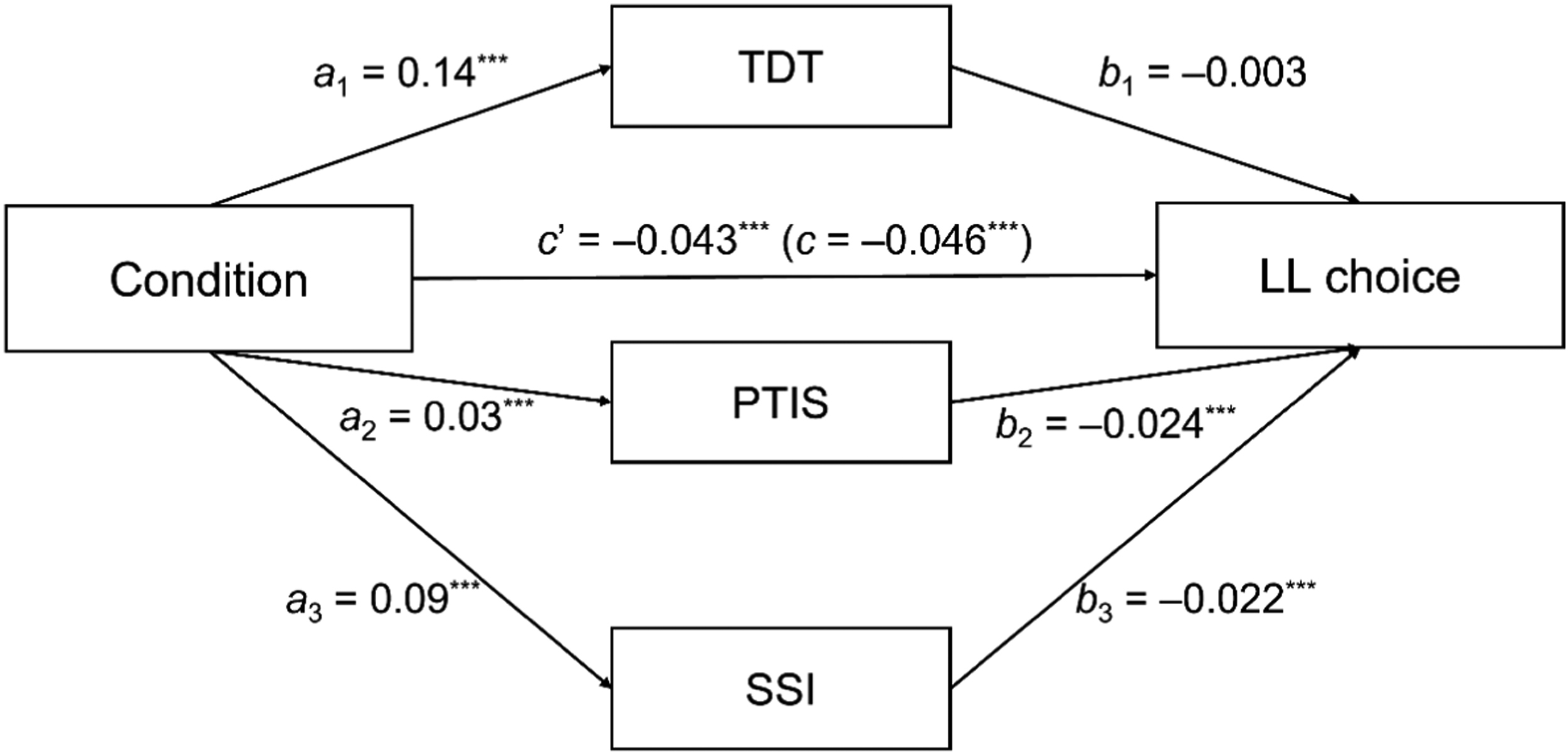
Results of the parallel multiple mediator model analysis of (a) TDT, (b) PTIS, and (c) SSI.
These results suggest that PTIS and SSI significantly mediated the relationship between condition and LL choices. Specifically, compared to the SELF condition, participants in the OTHER condition searched for less information and exhibited more random information searches, leading to an increase in LL choices.
Discussion
A considerable body of research has examined intertemporal choices under varying degrees of psychological distance, but the evidence remains mixed and no clear consensus has emerged. In the present study, we conducted a pre-registered eye-tracking experiment to examine one widely used operationalization of psychological distance by comparing decisions made for oneself with decisions made for an anonymous stranger. Consistent with most of the prior studies (Albrecht et al., 2011; Chen & He, 2014; Wang et al., 2024; Zhang et al., 2023; Ziegler & Tunney, 2012), we found that individuals showed a higher proportion of LL choices when making decisions for others compared to themselves. However, our findings indicated that the participants displayed higher response randomness when choosing for others, and these randomness differences were associated with differences in time preferences. The eye-tracking results revealed that the participants had shorter gaze durations, inspected fewer pieces of information, and engaged in more random information searches when making intertemporal choices for others compared to themselves.
Key Role of Response Randomness in Psychological-Distance Effects
Our findings highlight that neglecting how psychological distance can change response randomness can lead to misinterpretations of observed differences, potentially mistaking increased randomness for genuine shifts in time preference. According to the response-randomness hypothesis, greater inconsistency in intertemporal choices tends to shift choice proportions closer to 50% (the random level) when individuals make intertemporal choices for others. Supporting this hypothesis, previous studies on choice proportions (Albrecht et al., 2011; Chen & He, 2014; Wang et al., 2019) and our current research have demonstrated choice patterns consistent with this explanation. More importantly, we directly examined response randomness within both the traditional hyperbolic discounting model (Kirby & Herrnstein, 1995) and the dynamic DFT model framework. The results consistently revealed that decisions made for others elicit a higher level of response randomness compared to decisions made for oneself. These findings provide direct evidence supporting the response-randomness hypothesis.
To further examine the relationship between time preference and response randomness, we identified a significant correlation between differences in time preference and response randomness across the two conditions. Mediation analysis revealed that the decision threshold parameter, reflecting response randomness, fully mediated the effect of the decision-maker role on the proportion of LL options. These findings suggest that variations in response randomness could account for the observed self–other differences in temporal preferences. In line with studies focusing on the effect of cognitive load on intertemporal choices (Franco-Watkins et al., 2006, 2010; Jiang & Dai, 2024; Olschewski et al., 2018), we conclude that psychological distance can primarily affect choice consistency, at least in the self–stranger paradigm, rather than producing a clean shift in underlying time preference. Thus, our findings provide a potential resolution to previous inconsistent results in the literature.
Notably, studies examining self–other differences in intertemporal choices often consider moderating variables, such as regulatory focus (Wang et al., 2019) or framing effects (Sharma & Khan, 2022). According to our findings, an alternative explanation is that these moderators may primarily influence individuals’ overall time preferences, which in turn leads to a shift in choice proportions toward randomness when deciding for others. Future research should reconsider the interpretations in this field to avoid attributing self–other differences to changes in time preferences rather than increased choice inconsistencies.
In addition, our findings shed light on self–other discrepancies in risky choices, where evidence has also been mixed. For example, some studies suggest that individuals are more risk-seeking when making decisions on behalf of others (Beisswanger et al., 2003; Hsee & Weber, 1997; Stone et al., 2002; Wray & Stone, 2005), whereas others report that people take greater risks when deciding for themselves (Wallach & Wing, 1968). As both intertemporal and risky choices show comparable inconsistencies (Olschewski et al., 2018), future research could explore the role of response randomness in this domain to help resolve the conflicting findings.
Cognitive Processing Under Psychological Distance
Although some researchers have examined response randomness in intertemporal choices, its role has often been underestimated or treated as a peripheral methodological concern (Yang & Urminsky, 2024). We argue, however, that response randomness reflects more than mere statistical noise. It may index meaningful variation in how deeply individuals engage with the choice task when decisions are psychologically distanced from the self (Findling & Wyart, 2024; Wyart & Koechlin, 2016). Accordingly, examining response variability can provide a window into the motivational and cognitive asymmetries that characterize self- versus other-regarding decisions.
Our eye-tracking findings provide process evidence that supports our response-randomness hypothesis, suggesting that the decision-maker role influences response randomness through underlying cognitive processes. First, our findings indicate differences in engagement and cognitive effort between intertemporal choices made for oneself and for others. We found that the participants making intertemporal choices for others showed shorter gaze durations and inspected less information compared to when making choices for themselves. This pattern suggests reduced engagement and deliberation when deciding for others (Su et al., 2013; Yang et al., 2022). Similar trends in information processing have been observed in studies comparing deliberative and intuitive strategies (Barrafrem & Hausfeld, 2019; Horstmann et al., 2009). A plausible explanation is that individuals are less intrinsically motivated when deciding on behalf of others. From the perspective of adaptive decision-making (Payne et al., 1993), individuals may adopt simpler, less cognitively demanding strategies or heuristics in these contexts. By ignoring some information and using fewer integrative steps, this shift in strategy may systematically alter both information search and choice behavior (Olschewski et al., 2018).
Second, we found evidence for less systematic information searches when the participants decided for others. Specifically, the SSI values were lower when the participants made decisions for an anonymous stranger than when they made decisions for themselves, indicating a more random and less organized search process under greater psychological distance (Perkovic et al., 2018). This result complements the reduced-engagement pattern above: when participants inspect less information, their transitions across attributes and alternatives also become less structured. Together, these findings link response randomness at the behavioral level to unsystematic information acquisition at the process level, suggesting that eye-tracking indicators of search organization may be a useful complement to choice-based measures of response randomness in future research.
Third, mediation analysis involving eye-tracking measures suggests that these measures partially explain choice variability across conditions at the trial level. We found that, compared to deciding for themselves, the participants deciding for others searched less information and exhibited more random information searching, leading to an increase in LL choices. These results suggest that cognitive processing, including engagement and random information searching, is sensitive to the decision-maker role. Notably, the mediation effect observed in our study is comparatively modest, aligning with prior work (Liu et al., 2021; Wei et al., 2023; Zhou et al., 2021). This finding suggests that the eye-tracking measures we focused on cannot sufficiently explain the underlying mechanisms of self–other intertemporal differences. Future studies could further explore the mediation effect of other eye-tracking measures.
Practical Implications
Our findings suggest that psychologically distanced intertemporal choices can be noisier than self-focused decisions. This has practical implications for delegated decisions in domains such as finance and health, where advisors and representatives often decide for others. Over the past few years, nudges have garnered considerable attention from psychological researchers, policymakers, and international bodies (Hertwig & Grune-Yanoff, 2017; Thaler & Sunstein, 2008). Although prior research suggests that increasing psychological distance, such as making decisions for others, enhances patience, our findings indicate that delegated intertemporal choices may increase decision noise (i.e., decision errors) rather than promote patience. Decision noise is inherently undesirable and can sometimes have severe consequences. For example, previous studies have shown that decision noise in organizational settings can result in significant financial costs, amounting to billions of dollars, highlighting the urgent need to reduce inconsistencies in decision-making (Kahneman et al., 2016). Given our finding of increased unpredictability in decisions made for others, it is essential to encourage more reflective and deliberate processing among individuals tasked with making decisions on behalf of others.
Limitations
We acknowledge several limitations in this study. First, psychological distance was operationalized solely as social distance—namely, decisions made for oneself versus decisions made for a stranger. Although this self–other paradigm is widely used in intertemporal-choice research, psychological distance can also be instantiated along temporal, spatial, and linguistic dimensions (Chen & He, 2014). Accordingly, the present findings should be interpreted as specific to socially distanced intertemporal decisions, and future work should test whether the same increase in response randomness generalizes to other distancing manipulations.
Second, while our results suggest that increased response randomness can pull observed choice proportions toward chance-level responding and thereby produce aggregate patterns that may resemble reduced discounting, this mechanism does not necessarily explain all the findings in the literature—especially studies reporting less steep discounting under increased psychological distance based on parameter estimates (e.g., Kim et al., 2013; Ziegler & Tunney, 2012). More broadly, prior work shows that when stochastic responding is not modeled explicitly, choice noise can bias preference inference and generate apparent differences that are partly attributable to error processes rather than preference change (Dai et al., 2016; Franco-Watkins et al., 2006). In addition, cross-study heterogeneity in task materials (e.g., reward magnitudes, delay structures, and SS–LL ratios) and the frequent absence of the full reporting of discounting magnitudes or ranges can constrain how confidently a randomness-based interpretation can be evaluated across studies (Albrecht et al., 2011; McClure et al., 2004).
Third, all of the participants in the present study were university students, who typically possess limited financial independence. This feature may have shaped engagement with the task and the perceived consequences of the outcomes, which in turn could have influenced the level of response randomness observed in the laboratory (Henrich et al., 2010; Levitt & List, 2007). Future research should therefore recruit more diverse and economically heterogeneous samples to assess whether the present pattern holds when decisions have greater real-world relevance and higher stakes.
Finally, an important direction for future work is to test whether the present psychological-distance and response-randomness patterns are generalizable beyond monetary intertemporal choices. Prior research indicates that psychologically distanced decision framing can influence intertemporal preferences across domains (e.g., linguistic distancing), but intertemporal decisions in health and medical contexts often involve higher perceived stakes and stronger moral responsibility, which may increase deliberation when choosing for others and potentially attenuate randomness effects (Ubel et al., 2011). Conversely, in low-stakes or casual domains (e.g., leisure choices), engagement may be low even for self-directed decisions, which could compress self–other differences in response reliability. Future studies should jointly manipulate decision domains and stakes (e.g., monetary vs. health; low vs. high consequences) within the same design to identify the boundary conditions under which psychological distance amplifies or attenuates response randomness (Frederick et al., 2002; Levitt & List, 2007).
Conclusions
Overall, this study demonstrates that individuals exhibit greater response randomness when making intertemporal choices on behalf of others compared to decisions made for themselves. Interpreted within a psychological-distance framework, this self–other difference represents a socially distanced decision context, suggesting that greater psychological distance is accompanied by noisier and less consistent responding in intertemporal choices. This finding clarifies previously inconsistent evidence on self–other differences in intertemporal choices. Furthermore, cognitive processing differed between the two decision-maker roles, highlighting the role of underlying cognitive mechanisms in shaping intertemporal choices.
Supplemental Material
sj-docx-1-pac-10.1177_18344909261458628 - Supplemental material for Choose for Others More Randomly: Psychological Distancing and Response Randomness in Intertemporal Choice
Supplemental material, sj-docx-1-pac-10.1177_18344909261458628 for Choose for Others More Randomly: Psychological Distancing and Response Randomness in Intertemporal Choice by Yan Liang, Qian-Hui Wang, Zi-Han Wei and Hong-Zhi Liu in Journal of Pacific Rim Psychology
Footnotes
Acknowledgments
The authors thank Xing-Lan Yang and Jia-Wei Wang for their assistance with the preparation of the experimental stimuli and data collection.

Ethical Considerations
The study was approved by the Ethics Committee of Nankai University (ethical clearance reference number: NKUIRB2024207).
Consent to Participate
All of the participants provided written informed consent prior to participating.
Funding
The authors disclosed receipt of the following financial support for the research, authorship, and/or publication of this article: This work was supported by the Humanities and Social Science Foundation of the Ministry of Education, China (grant number: 25YJAZH105).
Declaration of Conflicting Interests
The authors declared no potential conflicts of interest with respect to the research, authorship, and/or publication of this article.
Data Availability Statement
Supplemental Material
Supplemental material for this article is available online.
Notes
References
Supplementary Material
Please find the following supplemental material available below.
For Open Access articles published under a Creative Commons License, all supplemental material carries the same license as the article it is associated with.
For non-Open Access articles published, all supplemental material carries a non-exclusive license, and permission requests for re-use of supplemental material or any part of supplemental material shall be sent directly to the copyright owner as specified in the copyright notice associated with the article.
