







Abstract
This article focuses on people’s perceptions of security in three Central Asian states—Kazakhstan, Kyrgyzstan, and Tajikistan. Using the data from WVS (wave 7, 2017–2022), we sought to find how being religious is linked to people’s perceived security. First, our OLS model showed that being religious is differently linked to perceived security across the three states. Religious people feel more secure in Tajikistan and Kyrgyzstan and not in Kazakhstan. In addition, the Oaxaca Blinder decomposition shows a statistically significant difference between religious and non-religious citizens in all three states.
Introduction
In the 1990s, many scholars challenged traditional approaches to security issues. They criticized the narrow interpretation of the concept of security focusing mainly on the survival of the state, use and control of military force, and type of threats (Walt, 1991, p. 212). Much scholarship on security in Central Asia has also used traditional approach examining state and regional security (Menon, 2003; Menon & Spruyt, 1999; Rumer, 2006). The critical security studies approach suggested “deepening” and “broadening” the scope of security issues by including non-traditional security threats such as terrorism, drug trafficking, pandemics, climate change, and others. Barry Buzan, the proponent of the critical security studies, emphasized non-military dimensions of security such as human, political, economic, societal, and environmental (Buzan et al., 1998). These new dimensions allowed scholars to zoom in issues and problems that have been often overlooked by the traditional security perspective. During the last decades, researchers also problematized how different actors, including policy makers and citizens, understand and interpret security. Human beings, organizations and other non-state actors have become important referent objects to explain and understand security.
One of the pivotal issues in security studies is human security. The definition of the concept of human security is rather broad. It can refer to “social actors who possess enough capabilities and freedoms and whose agency enables them to successfully operate in the public domain” (Wills-Herrera et al., 2012, p. 89). The main idea is that people should be free from fears about harm and consequent ill-being. Scholars also differentiated between objective and subjective security. Objective security is associated with traditional types of security related to state or national security. It implies that people are free from threats and danger and often includes objective indicators of crimes and events that could threaten communities. Subjective security is understood as feeling secure and being free from fear and anxiety (Janušauskienė, 2019). Jore (2019, p. 171) defines security as “the perceived or actual ability to prepare for, adapt to, withstand, and recover from dangers and crises caused by people’s deliberate, intentional, and malicious acts such as terrorism, sabotage, organized crime, or hacking.”
The scholarship on security mostly focused on objective security rather than on subjective or perceived security. One of the explanations is that security studies center on state-based understanding of security, while individual-based security issues, associated with everyday practices and feelings, have been ignored. At the same time, people’s perceptions (feelings) of security are important because they show how people feel about their environment. Perceptions of security are important because often people can feel insecure despite a low crime rate in a country. Security is not only about objective indicators or physical safety but also how people perceive it. It can be socially constructed and religion can play a crucial role by providing a sense of security. As Buzan (2009, p. 50) argued, “the referent threats are very vague, and the subjective feeling of safety and confidence has no necessary connections with actually being safe.” In other words, perceptions of insecurity might be different from the objective reality. Given the importance of perceived security, in this study, we are going to test the hypotheses on how being religious is linked to perceived security of people in three Central Asian states. We also include other variables to see how they are related to people’s perceived security.
Why is it important to understand how being religious is linked to people’s perceived security? First, the existing scholarly literature mostly focuses on traditional security and does not explain much how religion influences people’s perceived security, especially in Central Asia. However, religion is a powerful tool that can provide people with a sense of security by reducing anxiety, fears, and uncertainty. It can serve as a guideline for individuals to understand what is right or wrong. People can experience a sense of community if they belong to the same religion. It also helps people to overcome hardships and provide them with a sense of meaning in life. On the other hand, religion can also frame threats. Studies in other contexts show that religion can either increase or decrease people’s security. In this study we will provide new empirical insights on the religion-security nexus in the context of Central Asia.
Another important reason to focus on religion and its impact on perceived security are implications for society and policymakers. Previous research has demonstrated that feelings of heightened insecurity can lead to various negative outcomes, including more restrictive laws and regulations (Brooks & Manza, 2013; Davis & Silver, 2004; Huddie et al., 2005), higher levels of nationalism (Kosterman & Feshbach, 1989), authoritarianism, repression, and intolerance toward people with different ethnic, racial, religious or other backgrounds (Gordon & Arian, 2001). Evidence suggests that high levels of insecurity can also make people support war, militarization, and aggressive foreign policies as it happened in the USA and people’s support of the war in Iraq (Burke et al., 2013; Huddie et al., 2005). Other research on extremism has shown that some subgroups of vulnerable people become more extremist in the face of perceived threat (McGregor & Jordan, 2007). Insecurity is not only about fears today but also about worries in the future, including anxiety about the physical security of oneself and one’s family as well as concerns that a country can be involved in a war or conflict (Rothwell & Diego-Rosell, 2016).
Finally, the importance of religion has grown significantly in Central Asia during the last decades. This contrasts with other regions of the world where we observe the process of secularization (Norris & Inglehart, 2011). In Central Asia, more people have become religious due to different reasons. First, the repression of religion that existed in the USSR was lifted after 1991 and people could practice their religion freely. Second, the ideological vacuum that appeared after the failure of the communist ideology made people search for meaning of life and identity and religion provided people with such meaning and security. Third, in the 1990s, people experienced high levels of anxiety and uncertainty due to the collapse of the economy, which also instigated the resurgence of religion, particularly Islam. Central Asia has become exposed not only to traditional Islam but also to other religious influences, including radical Islamist thoughts. Some religious ideologies such as Salafism are recognized as destructive and are securitized by authorities in the region. This makes religion an important factor that can either increase or decrease individuals’ security. (We discuss this more in detail in the literature review section).
Therefore, the research on linkages between being religious and perceived security can contribute to our understanding how religion can mitigate insecurity and fears and thus can help the government to take measures to increase people’s security and improve their subjective well-being and trust (Gasper & Gómez, 2015). As such, it is crucial to understand how being religious contributes to subjective in/security in Central Asia.
The Central Asian scholarship on security has just recently started applying non-traditional security approaches to study various security issues in the region (Lemon, 2018). Several researchers focused on discursive practices and framing security issues and threats in the region (Lemon & Thibault, 2017; Lewis, 2016; Shaykhutdinov, 2020; Megoran, 2008a). Securitization of religion was one of the important trends in the application of critical approach in Central Asia (Bashirov, 2020; Khalid, 2014; McBrien, 2006; Rasanayagam, 2007). Other researchers have focused on non-traditional threats such as terrorism and violent extremism in the region (Lewis, 2014; Omelicheva, 2019; Sharipova & Beissembayev, 2023). Some research has been also done on everyday security and how Central Asians experience security in their everyday life (Ismailbekova, 2013; Reeves, 2014; Rasanayagam, 2007; Bekmurzaev et al., 2020; Von Boemcken, 2018). Scholars examined lived experiences of the LGBT community as well as researchers’ experience of (in)security in Kyrgyzstan (Bekmurzaev et al., 2020).
Despite these mostly qualitative ethnographic studies, not much research has been done on security perceptions and how being religious is linked to human security in Central Asia at the aggregate level based on quantitative data. Although a few scholars employed the non-traditional approach to study security, many researchers focusing on Central Asia use traditional state-centric approaches grounded in qualitative data to explain security, rather than focus on non-traditional or personal (in) security using quantitative data. In this study we use quantitative analysis to examine the effect of religion and other factors on security perceptions. Perceptions of security can be very contextual and dependent on external and internal threats. In Central Asian societies, religion has been securitized by the regimes. Under securitization we mean that some religious thoughts, groups, or practices are framed as security threats by the governments. As a result, they can be controlled, monitored or completely prohibited. In Central Asia, salafism is one of the religious trends that has been securitized by the authorities. As such, it will be important to explore if people feel secure or not.
At the same time, we know that even if there are no threats or danger, people still might feel insecure. This study is going to fill this gap by exploring the question: How being (non-)religious can influence perceptions of security? Do religious people feel more secure than non-religious people? Are there any differences across countries in terms of being religious and feeling (in)secure?
This article focuses on perceptions of (in)security in three states of Central Asia—Tajikistan, Kazakhstan and Kyrgyzstan. The choice of the countries is based on the data availability. We are using the World Value Survey, wave 7, (collected in 2017–2022) where only three Central Asian states are present at the moment. Drawing on the existing literature, using the Ordinary Least Squares (OLS) model and the Oaxaca-Blinder decomposition, we test the hypothesis on how being religious (or non-religious) contributes to people’s perceptions of security in the region. In addition, inter alia, we also examine how other socio-demographic factors are linked to perceptions of security in the region.
The article is structured as follows. In the next section, we review the existing scholarly literature on how religion contributes to the perceptions of security and derive from it the hypotheses that we want to test. We also define the main concepts employed in the article. In the section on methodology, we measure perceptions of security threats in the three Central Asian states. Next, we present our analyses, which assess how the main and control variables relate to perceived security. The final section concludes with a discussion of the broader implications of the findings.
Literature Review
Scholars of Central Asia mostly examine the issue of security from the state-centric approach focusing on state or national level. However, since the 1990s the concept of security has been “broadened and deepened” when new dimensions and actors were added, including human security, energy security, food security and others. It has been recognized that the concept of security should be more inclusive. The contemporary security paradigm focuses on everyday concerns that make humans and their security central to research (Kaldor, 2007). Human security approaches to these personal security threats have challenged established narratives of security by focusing on individuals and their emotions. Perceptions of security are related to subjective judgments about the level of security in a specific context. It can be also approached as the probability that a person perceives the habitat as secure (Curiel & Bishop, 2016). Scholars use the term to describe fears and vulnerability related to the feelings of hopelessness (Siro & Sundramoorthy, 2019). “Everyday insecurities are insecurities experienced, constituted as such, and sometimes resisted, by people in their everyday life” (Blanchot & Hanson, 1987, p.12). An emphasis on the psychological and the subjective makes it important to focus on the role of “framing” and the human biases in risk perception to obtain insights on security. Often, the perceptions of security are measured either via physiological indicators of fear (Castro-Toledo et al., 2017) or by asking people if they feel safe or secured in specific situations (Farrall et al., 1997).
Scholars investigated various factors that can influence perceptions of security, including individual and socio-economic factors. One important relationship to explore is how being (non-)religious is related to perceptions of security in Central Asia. Religion is at the core of human security and wellbeing and can influence perceptions of security and threats. Previous research on the relationship between religion and security is rather mixed. The relationship between the two concepts is complex (Wellman et al., 2012). On the one hand, religion decreases the level of fears and anxiety, thereby increasing the level of security among religious people. “Religion can act as a form of security” (Shani, 2016, p.2). Religious belonging, beliefs, and rituals can provide some relief of anxiety, fears, discomfort or insecurity. Religion helps people make sense of their lives in the situation of insecurity. Some research have shown that religiosity can be effective in dealing with life hardships (Pargament, 1997). As such religion serves as a coping mechanism and helps to manage anxiety and stress. It can be a buffer against anxiety and fear via praying, mediation, and support through communities (Beagan et al., 2011; Brandt & Henry, 2012; Gall et al., 2005). Therefore, based on the above literature, we hypothesize that H1: Religious people are more likely to feel secure than non-religious people in Central Asia
Other research, in contrast, demonstrates that religious people express more worries and fears about threats, including those of terrorism, than non-religious individuals (Dillon et al., 2019; Elmas, 2021; Haner et al., 2019; Onat et al., 2021; Shechory-Bitton & Cohen-Louck, 2020). According to the Insecurity Theory, the more people are insecure, the more they will be religious (Norris & Inglehart, 2004, 2011). Onat and his associates, for instance, found that religious people expressed higher levels of insecurity and fears of terrorism (Onat et al., 2021). Scholars also looked at the securitization of religion. For instance, religious identity can be activated and securitized not only during the crisis time but also by the autocratic elites if the latter consider religion as a threat to their power. Securitization of religious “other” is often framed through the mass media. For securitization, there should be “securitizing actors, appropriate speech acts, and responsive audiences” (Buzan et al., 1998, p. 268). After 9/11, we observe the rise in securitization of Islam, particularly, in the Western world where Islamism is portrayed as an existential threat to Western values. However, securitization of Islam is also taken place in societies where Islam is a dominant religion such as Central Asia (Thibault, 2022). The elites can feel threatened by the powerful religious authorities and religious groups and resort to restrictive measures. Alternatively, we can also assume that since religion in Central Asian states is securitized by the state (albeit to a different degree across the states), then religious people can feel more insecure than non-religious people. Thus, these mixed results invite us to test this hypothesis in the context of Central Asia where the role of religion has significantly increased over the last two decades. Therefore, we hypothesize that: H2: Religious people would feel more insecure than non-religious people in Central Asia
Other Socio-demographic Factors
We also included other socio-demographic variables in the model such as mass media, trust in police, age, urban residence, gender, experience with crime and violence, state of health, employment, and education as control variables.
Background
Kazakhstan
Kazakhstan is one of the developed countries in the Central Asian region with the GDP per capita of 9,812 USD. 1 Due to oil resources, Kazakhstan was able to raise the standards of living and reduce the poverty rate to 4.3% of population during the last two decades. In terms of the political system, it is characterized by a strong executive and weak parliamentary and judicial systems. Despite some minor institutional changes under Kassym-Zhomart Tokayev, including introduction of 30% quota for youth and women in the parliament, decreased the threshold for the registration of political parties and introduced the elections of local akims (governors), as other Central Asian states, Kazakhstan is categorized as an authoritarian state. According to Freedom House, it scored 23/100 in 2023 and was considered as not free. In terms of mass media, the government tightly controls freedom of expression and speech. The country has the score of 45.9/100 in terms of freedom of press, which is in between Kyrgyzstan and Tajikistan. 2 However, compared to Tajikistan, Kazakhstan has a softer version of authoritarian rule and is more authoritarian than Kyrgyzstan. The country has a major ruling political party Amanat (former Nur Otan) based on patron-client relations and is composed mostly from civil servants. Despite the efforts of the government to fight corruption, Kazakhstan is ranked 101/180 among all countries by Transparency International and has scored 36/100 in 2023. 3 Due to a high level of corruption and poor governance, citizens do not trust political institutions of the country, including the judiciary and the police. One of the recent violent events in Kazakhstan was the Bloody Qantarthat took place in 2022. The peaceful protests of people in the west of Kazakhstan started over the price on liquified gas and then quickly turned into violence. As a result, more than 230 people were killed and hundreds were injured.
In terms of religion, its role has increased significantly after the collapse of the Soviet Union. There are 3,816 religious organizations in the country (gov.kz, 2024). Although the research shows that two thirds of the population confess Islam, and every fifth is a Christian, 73% of the surveyed population reported that they do not actively participate in religious events. (WVS, 2018). This result was confirmed by previous research showing that only 18% of Kazakhstani people pray five times per day (Sharipova, 2020). In addition, only 10% of Kazakhstan’s Muslims support Sharia law compared to other Muslim countries. This low degree of support for Sharia contrasts significantly with Kyrgyzstan with 25% and Tajikistan and with 30% population supporting the Islamic law. 4 According to the WVS, the proportion of Muslim population increased from 52 to 70% between 2011 and 2018 and the number of those who attend religious services often has increased from eight to 18% during the same period (WVS, 2011; WVS, 2018). The growing role of religion in Kazakhstan, including Islamic fundamentalism, associated with religious extremism and terrorism, caused negative reactions from government authorities. Kazakhstani officials seek to control religious organizations in the country. One of the biggest concerns for authorities is the so-called destructive religious ideology Salafism. For instance, the new Law on Religion introduced restrictions for registration of religious organizations, missionaries and publication of religious literature. That law bans all unregistered religious activities and requires official examination of all religious materials. It also puts limitations and restrictions on religious education and religious events. The government controls and penalizes independent religious activity related to religion, especially if it is concerned Islam (USCIRF Annual Report, 2025). According to the US State Department reports (2022 and 2023) on religious freedom, the government conducts additional scrutiny and imposes restrictions on “non-traditional” believers. These include Salafi, non-Lutheran Protestant Christian groups and others. 5 State authorities arrest and detain people on the basis of their religious beliefs and affiliations. According to the Forum 18, an international religious freedom NGO, there were 143 administrative prosecutions for violations of the religion law in 2022 compared to 130 in 2021. 6 As the statistics show, the number of administrative prosecutions toward religious people has grown.
Kyrgyzstan
In contrast to Kazakhstan, it has no natural resources and its 2018 GDP income per capita was 1,308 USD according to the World Bank. 7 The population of Kyrgyzstan is 6.3 million with 22.4% living under the poverty line. Kyrgyzstan has been characterized as a democratic state in the Central Asian region. In 2021, the new president, Sadyr Japarov, however, increased the powers of the president, prosecuting independent mass media and NGOs. For instance, recently S. Japarov supported the Law on foreign representatives, which is similar to the Russian law on foreign agents, according to which all NGOs have to report on the source of their funding. The level of corruption is also high in Kyrgyzstan. The country ranks 140 out of 180 in 2023 and has index 27 out of 100 (Transparency International, 2023a, 2023b). 8 According to Freedom House, Kyrgyzstan has scored 27/100 and is also not free. Before S. Japarov came to power, Kyrgyzstan was known for its freedom of press; however, the incumbent has curtailed and has prosecuted independent media. Currently, freedom of press index is 49.9. 9 Since gaining independence, Kyrgyzstan experienced several protests and riots, particularly during the presidential elections in 2005 and 2010. One of the most tragic events during independence was the 2010 Osh conflict between ethnic Kyrgyz and ethnic Uzbeks when almost more than 400 were killed and thousands of people were displaced.
The role of religion has been also growing in Kyrgyzstan since the 1990s. According to the Pew Research Center, 88.8% of the population identify themselves as Muslims. 10 In Kyrgyzstan, there are more than 3,500 religious organizations, 2,600 mosques and 100 madrasa, and 10 Islamic institutions (Eraliev, 2023). In 1991, there were only 91 mosques. The percentage of those who attend religious services is twice higher than in Kazakhstan. The 2013 Global Per survey of Muslim’s attitudes illustrates that being Muslim in Kyrgyzstan means the stronger support for the Sharia Law in comparison with other Central Asian states, such as Kazakhstan (Engvall, 2020). Engvall (2020) also shows that the level of secularity is lower in Kyrgyzstan compared to Kazakhstan. Compared to other post-soviet states, Kyrgyzstan had a more liberal approach toward religious organizations than other states. It provided more freedom and space for the development of religious organizations, including the Tabligi Jamaat, which is prohibited in other states. More religious organizations are involved in political processes. 11 Since 2002, the issue to restrict the activities of religious organizations was raised. In 2008, the Law on Freedom of Religion and Religious organizations was introduced that restricted religious freedom. It became much more difficult to register a religious organization due to heavy requirements as well as proselytize and distribute religious literature. Religious organizations are obliged to obtain a state license to provide religious education (IRF, 2018). In addition, the state criminalized religious practices for those religious groups that did not follow the state-sanctioned policies regardless of whether they posed any real threat or not (Gamza & Jones, 2021).
In 2013, the Concept of State Policy in Religious Sphere for 2014–2020 years was adopted. According to the concept, the preservation of traditional values of Islam and traditional religious confessions was emphasized. In addition, the link between foreign religious education and radicalization of religion in Kyrgyzstan was also stated. “Upon completing their studies, some graduates of foreign educational centers become carriers and promoters of the ideology and mentality of the host country, imposing ways of life, culture, appearance, clothing, and standards of behavior that are alien to the people of Kyrgyzstan,” the Concept states. 12 Later, another concept on state policy on religion was adopted for 2021–2026. 13 The government emphasized the role of traditional Islam associated with the Hanafi madhab, which is compatible with national traditions. These measures are directed to “discourage ethno-religious heterodoxy and use religious regulation against populations” (Gamza & Jones, 2021).
Recently, the State Commission on Religious Affairs of Kyrgyzstan initiated amendments to the law “On freedom of Religion and Religious Organizations.” It was stated that followers of religious organizations must adhere to ethical norms of behavior and be easily identified. For this purpose, it was proposed a ban on wearing clothing that prevents the identification of people in public space. 14 This shows that in Kyrgyzstan we also observe some process of securitization.
Tajikistan
Tajikistan is the poorest country in Central Asia with a per capita GDP of 853.22 USD and 29% of the population living under the poverty line. 15 According to the Freedom House, Tajikistan is an authoritarian state and its score is equal to 5/100. On political rights, Tajikistan has 0/40 and on civil liberties 5 out of 60. Among the three states that we are discussing in this paper, it is the most authoritarian state. E. Rahmon, the president of Tajikistan, has been the longest Central Asian president who stayed in power for 33 years. The Rahmon’s family members hold key political and economic positions in the country thereby contributing to nepotism and kleptocracy. President Rahmon continues to crack down on opposition, including civil society, media, and religious groups, particularly in the Pamir region. Under his leadership, the country is recognized as one of the corrupt states in Central Asia. It ranks 150 out of 180 with the corruption index is 24/100 (International Transparency, 2024). 16 Tajikistan also has very restrictive laws in regard to freedom of press. The index is 33.3 in 2024 and it is ranked 155/180. 17
In terms of religion, the government of Tajikistan also exerts tight control over religious activities and expression.
18
There are 4,058
In 2019, more than 70 religious non-Muslim organizations are registered, which seek to increase the number of their followers. To find out the number and religious identity, the Tajik authorities decided to determine the number of followers of various religions during the population census. There were cases of prosecution of non-Muslims, such as representatives of Christianity, Ismailites, and others. For instance, in 2022 after the protests in Badakhshan, the Pamir area, the authorities continued repressions against Isamilites of Aga Khan in this region. The people were prohibited to have collective praying at homes. 20 As a result, many Tajiks conceal their religion from the authorities. According to the Minister of Internal Affairs, Ramazona Rakhimzoda, during the first half of 2023, 195 members of the alleged “extremist” and “terrorist” organizations were detained. 21
In 2017, the government passed a law, which limited and, in some cases, prohibited Muslim traditions and celebrations. It was not allowed wearing “non-traditional” religious clothing, including hijabs. As Lemon and Thibault argue, the Tajik government not only controlled “religious communicates and individuals but also how Tajiks should leave their lives” (Lemon & Thibault, 2017, p. 2). The authorities regulate the trips to Mecca, wearing hijabs for women and bearing beards for men. People who want to go to Mecca should receive permission from the government to visit the shrine. In 2015, all civil servants were prohibited to attend religious service on Friday, one of the most important prayer days in Islam (Ovsyannikov & Popov, 2017). These restrictions in terms of religious practices and everyday life were recognized as limiting people’ rights to confession.
Data and Methodology
We used data from the World Values Survey (WVS) wave 7 conducted in 2018–2020 for the three Central Asian countries: Kazakhstan (WVS, 2018), Kyrgyzstan (WVS, 2020), and Tajikistan (WVS, 2020). The number of observations for each country consists of 1276 households for Kazakhstan and 1200 for Kyrgyzstan and Tajikistan. The proportion of missing data is lower than 10 percent for Kyrgyzstan, Kazakhstan 22 , and Tajikistan; so this fact does not create issues of the serious biases of the evaluations (Allison, 2009; Little & Rubin, 2002). There are no duplicates in the data sets. We checked near duplicates separately for each country. The share of near duplicates that match above 85% as suggested by Kuriakose and Robbins (2016) is small and within an adequate scope.
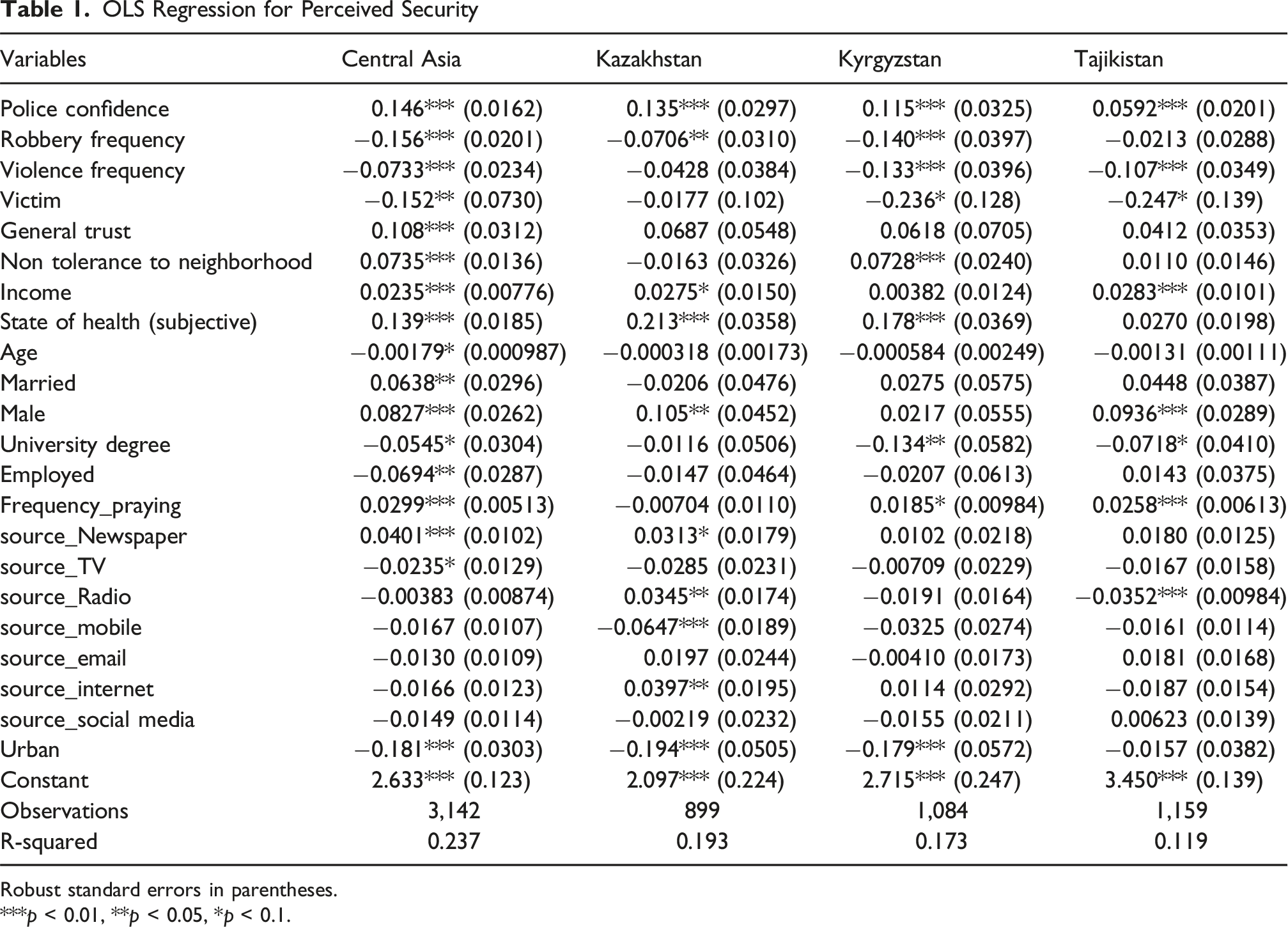
The main outcome variable is security derived from the following question of WVS: “Could you tell me how secure you feel these days?” The answers range from 1 till 4, where 1 means very secure and 4 means not at all secure, for the purpose of ease of interpretation, the answers reordered in opposite directions. First, we run OLS regressions for the polled data set for the whole Central Asia and then separately for each country to find the main associates for security.
Other variables that we included in our model are: Confidence in police based on the following question, “Could you tell me how much confidence you have in police?,” the answers range from 4 (is it a great deal of confidence), 3 (quite a lot of confidence), 2 (not very much confidence), and 1 (none at all), for the purpose of ease of interpretation, the answers reordered inversely. Robbery frequency and Violence frequency describe how frequent the robberies and street violence with fights occur in your neighborhood, it ranges from 1 (meaning not at all) till 4 meaning (very frequent). Usually these variables negatively affect individual security. We also include the
There are discussions of using unidimensional or multidimensional measures of religiosity in the literature (Cohen et al., 2017; Khraim, 2010; Zwingmann et al., 2011). Allport and Ross (1967) proposed two approaches to the measurement. The first one was based on intrinsic religious orientation (IR) meaning people living in harmony with the religious faiths and rules. The second approach is extrinsic religious orientation (ER) when people are willing to use religion for their private purposes. In addition, there are several WVS questions related to religion. Some studies use the principal component analysis or factor analysis to construct the religiosity index based on several variables, which measures the religiosity (Pearce et al., 2017). Due to limitations of the survey questions, we do not construct a multidimensional index of religiosity; instead, we use some proxies for the measurement of religiosity.
Therefore, we have employed the proxy to measure for religiosity, the following variable frequency praying. This variable is based on the following question: “Apart from weddings and funerals, how often do you pray?” Answers to these questions range from 1 (Never, practically never) to 8 (Several times a day), so that the larger values stand for more frequent praying. Moreover, we define religious and non-religious groups based on the following question: Independently of whether you attend religious services or not, would you say you are…?: (1) A religious person; (2) not a religious person; (3) an atheist.
Other control variables are the frequencies of using different sources of information, such as daily newspaper, TV news, Radio news, mobile phone, email, internet, and social media (Facebook, Twitter, etc.). The variables for the sources of information range from 1 (never) till 5 (daily). The cross-tabulations in Appendices illustrate that religious people use TV as a source of information more than non-religious people in Kazakhstan and Kyrgyzstan (see Appendix B, Table B1). Also, it indicates religious people more frequently use the Internet as a source of information, than non-religious people in Kazakhstan and Kyrgyzstan (see Appendix B, TableB3). The cross tabulations depict that urban people use more of the Internet as source information compared to rural people in Kazakhstan (see Appendix B, Table B4).
Moreover, in our model we have included General trust in people as one of the dimensions of social capital. It is considered that trust in people positively influences people’s security. This variable is based on answers to the following question: “Generally speaking, would you say that most people can be trusted, or that you can’t be too careful in dealing with people?” The binary variable is set to 1 if the respondent answers positively and 0 otherwise.
In our estimation, we involved control variables for the degree of non-tolerance toward the neighborhood. The dummy variable is set 1 for the “yes” answer and 0 otherwise. Factor analysis has been utilized to construct a composite index of the non-tolerance to the neighborhood. High values on the index imply a low level of tolerance. Finally, we also included a set of social-demographic controls such as age, gender, marital and employment status, reported health, education, and the location. Descriptive statistics for all variables in appendices (see Appendix A1 and A2). Also, we can see from appendices that more religious people in rural areas only in Kyrgyzstan (see Appendix B, Table B2).
The following figures illustrated the distribution of the security variable for each country. From Figure 1, we can observe that respondents feel more secure in Tajikistan and Kyrgyzstan compared to Kazakhstan. Distribution of the Respondents’ Answers on Security (in %).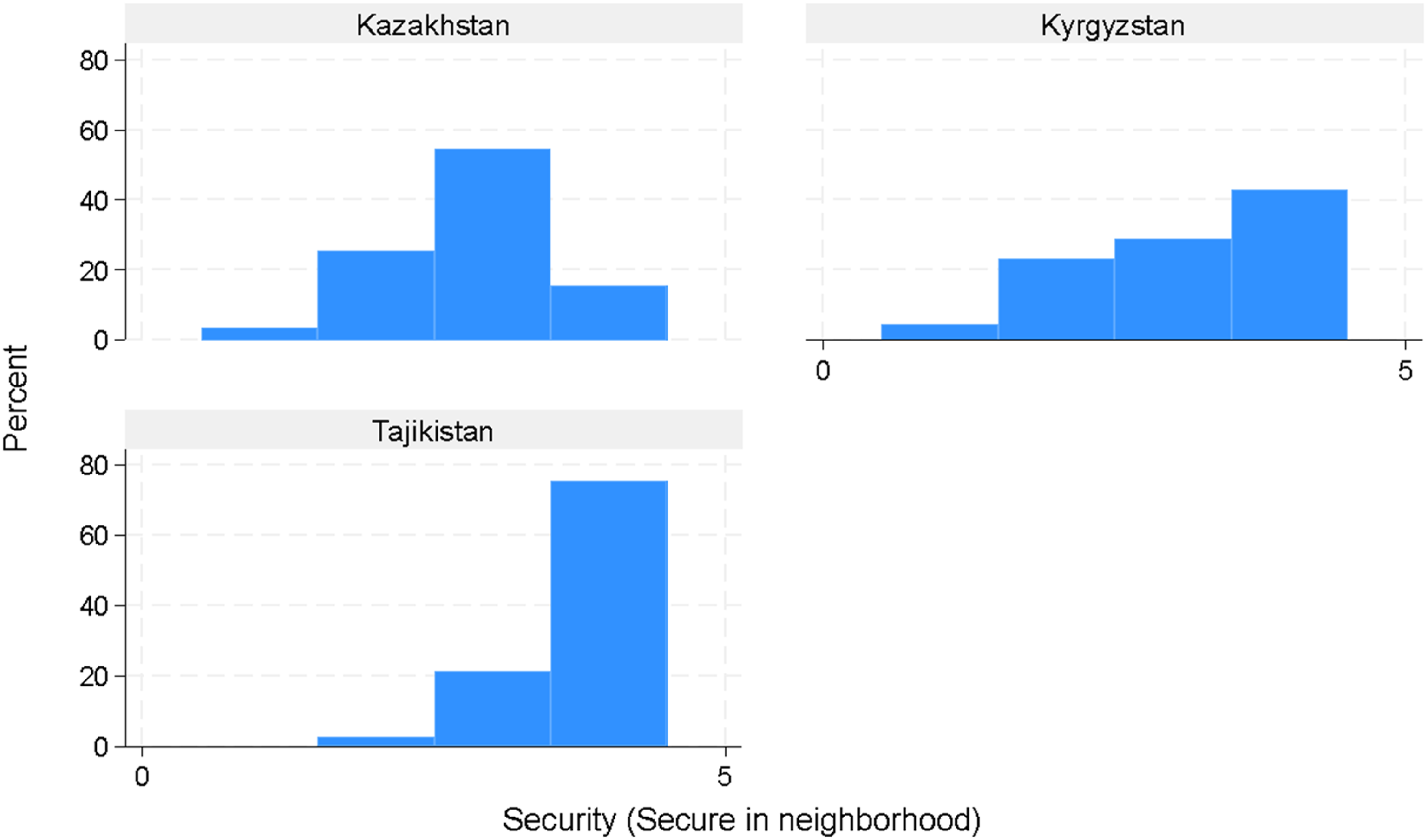
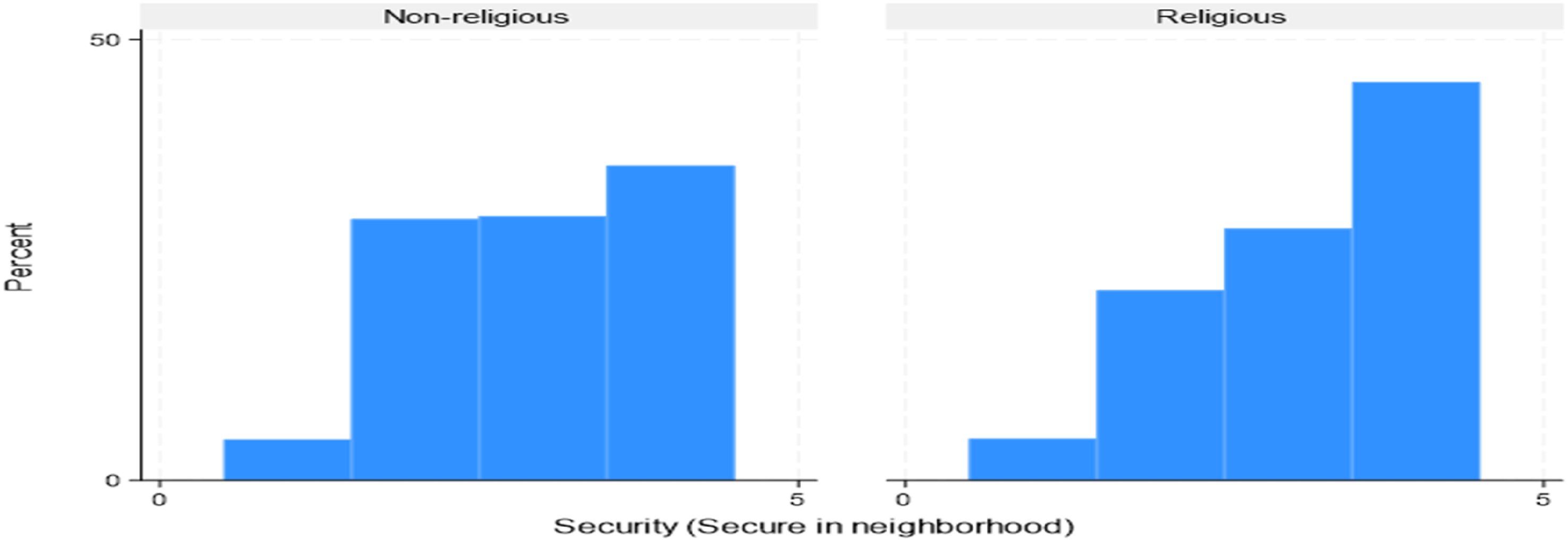
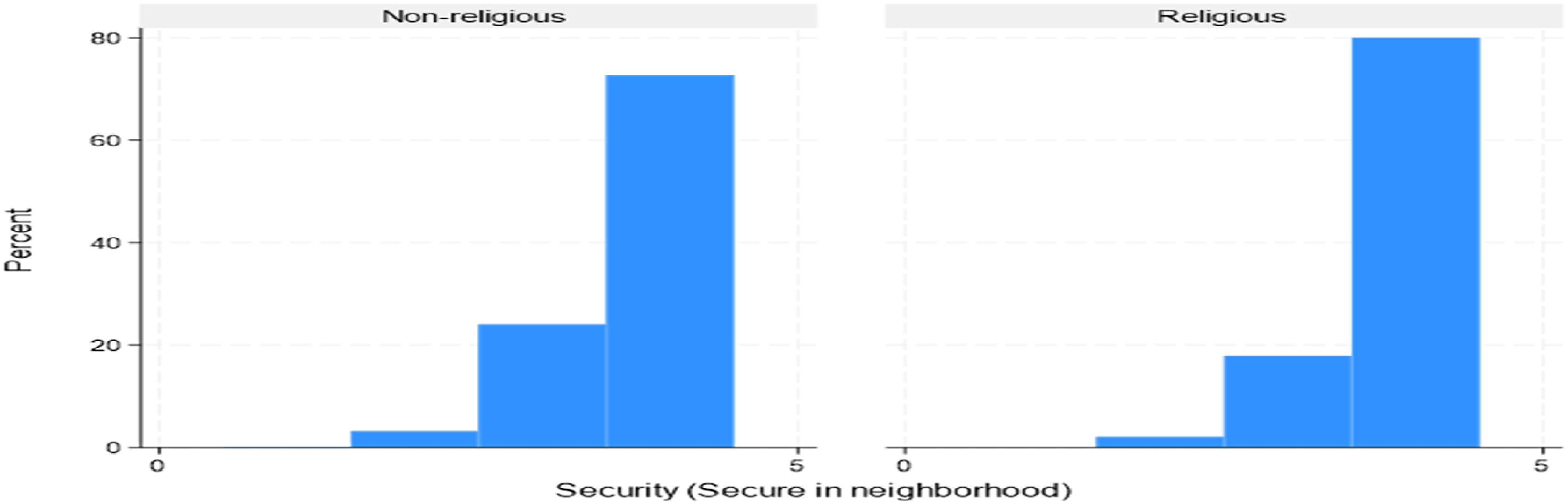
Figures 2–4 reveal that the more religious respondents feel more secure in Kyrgyzstan and Tajikistan; however the situation is opposite in Kazakhstan, where religious respondents feel less secure. Moreover, in case of less homogenous Kazakhstan, we also checked among different ethnic groups (ethnic Kazakhs and Russians). The graphs illustrate that both religious Kazakhs and Russians are less secure compared to non-religious people. Therefore, we employ Oaxaca-Blinder decomposition between religious and non-religious groups in order to evaluate what factors are main contributors to different perceptions of security between religious and non-religious respondents. Distribution in Percent of the Respondent’s Answers to the Question on Security by Religiosity and Ethnicity in Kazakhstan. Distribution of the Respondents’ Answers on Security Based on Religiosity in Kyrgyzstan (in %). Distribution in Percent of the Respondents’ Answer on Security Based on Religiosity in Tajikistan.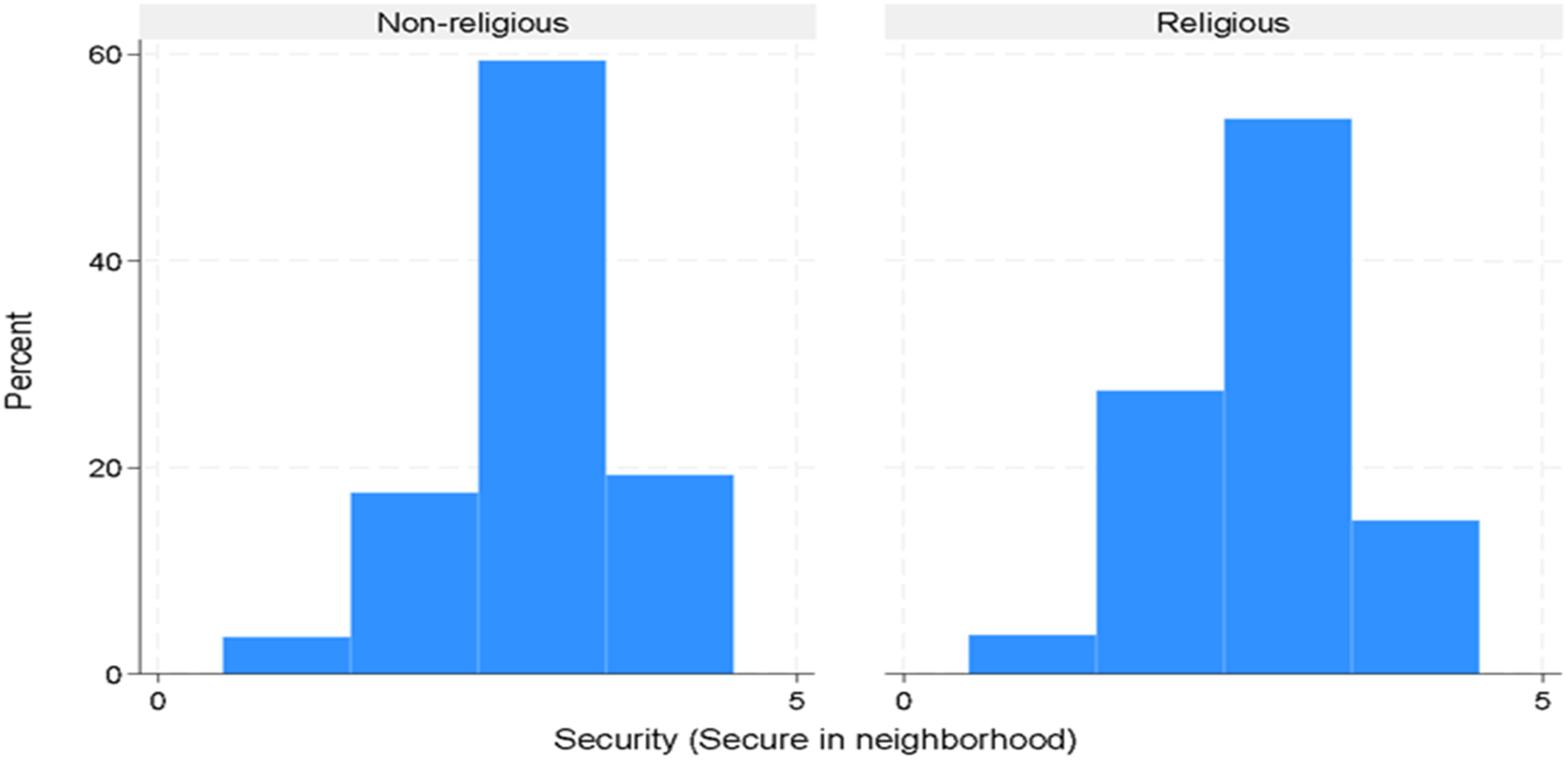
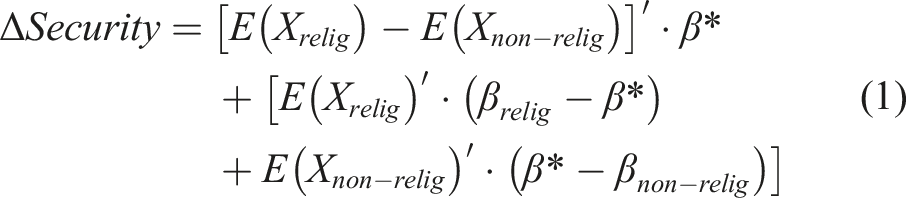
The Oaxaca-Blinder methodology enables us to decompose the changes in security levels between the religious and non-religious observations and to detect the extent to which changes between two groups in the levels and in the coefficients of security predictors explain the differences in security measures. The Oaxaca-Blinder decomposition was initially proposed by Blinder (1973) and Oaxaca (1973) to evaluate the gender pay gaps.
The Oaxaca-Blinder approach allows us to estimate group differences in perceived security variable by separating its differential in two parts; the explained one, accounting for variances in observed determinants of the population and the unexplained one, measuring the changes in the coefficients between groups. In our work, this methodology allows us to detect how much of the whole variance in the average security between two categories can be assigned to variances in the group of characteristics (the explained part) and to variances in how these characteristics are evaluated (unexplained part).
The Oaxaca-Blinder approach can be presented as follows:
Results
OLS Regression for Perceived Security
Robust standard errors in parentheses.
***p < 0.01, **p < 0.05, *p < 0.1.
Other variables are also statistically significant, including confidence in police, which is a strong predictor in all three Central Asian states. Individuals with higher income, good health, and education feel more secure than those who have poorer health, lower income and lower education. Gender is significant in Kazakhstan, Tajikistan, and at the regional level statistically significant in Kyrgyzstan. In terms of gender, the model shows that men are more likely to feel secure compared to women, which is one of the predictable results. The OLS model also showed that mass media is differently linked in the three states. For instance, newspapers and the Internet provide a positive association in Kazakhstan but have no association to security in other two states. At the same time, people who listen to the radio in Kazakhstan and Tajikistan feel more secure, while in Kyrgyzstan radio as a source of information is not important. People living in urban areas of Kazakhstan and Kyrgyzstan are less secure than people living in urban areas in Tajikistan are. At the regional level, we also see a negative relationship between, urban residence and perceived security. Previous experience with crime and violence has a negative impact on perceived security. In Kyrgyzstan and Tajikistan people are less secure if they were subject to violence or were victims of crime. This variable is not significant in Kazakhstan but the sign is in the predicted direction. If people think that their neighborhood is not safe, that is, violence and robbery, then they feel insecure. This is particularly evident in Kyrgyzstan and Kazakhstan. In Tajikistan, the variable is not statistically significant but the sign is in the predicted direction.
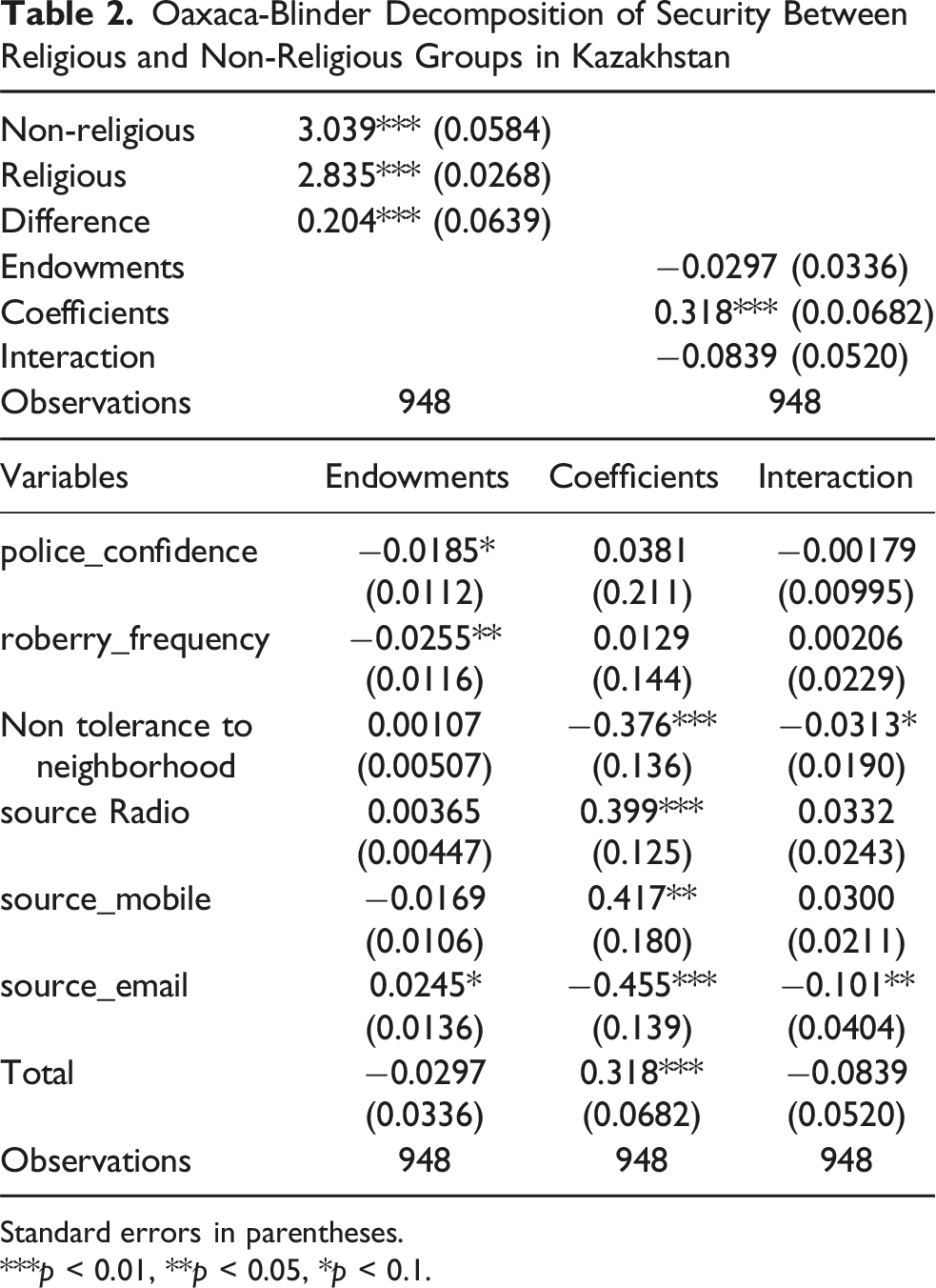
Oaxaca-Blinder Decomposition of Security Between Religious and Non-Religious Groups in Kazakhstan
Standard errors in parentheses.
***p < 0.01, **p < 0.05, *p < 0.1.
The difference in the security level between non-religious and religious is mostly due to the coefficients’ effect (mainly unobservable factors explain this difference). If the two groups had the same returns to their characteristics, the differential in the security value would be 155, 8% of the current difference of 0.204. The disaggregated results reveal that the largest contributors to the security differential are the returns to Non tolerance to neighborhood, sources of information radio, mobile phone, and email (see Table 2). As the model shows, non-tolerance to neighborhood returns, source of information email, are having a negative impact on the gap in security, which implies that—had non-religious and the religious the same returns to non-tolerance to neighborhood and the same returns to source of information email—the security differential would be negative, which means higher security for religious group.
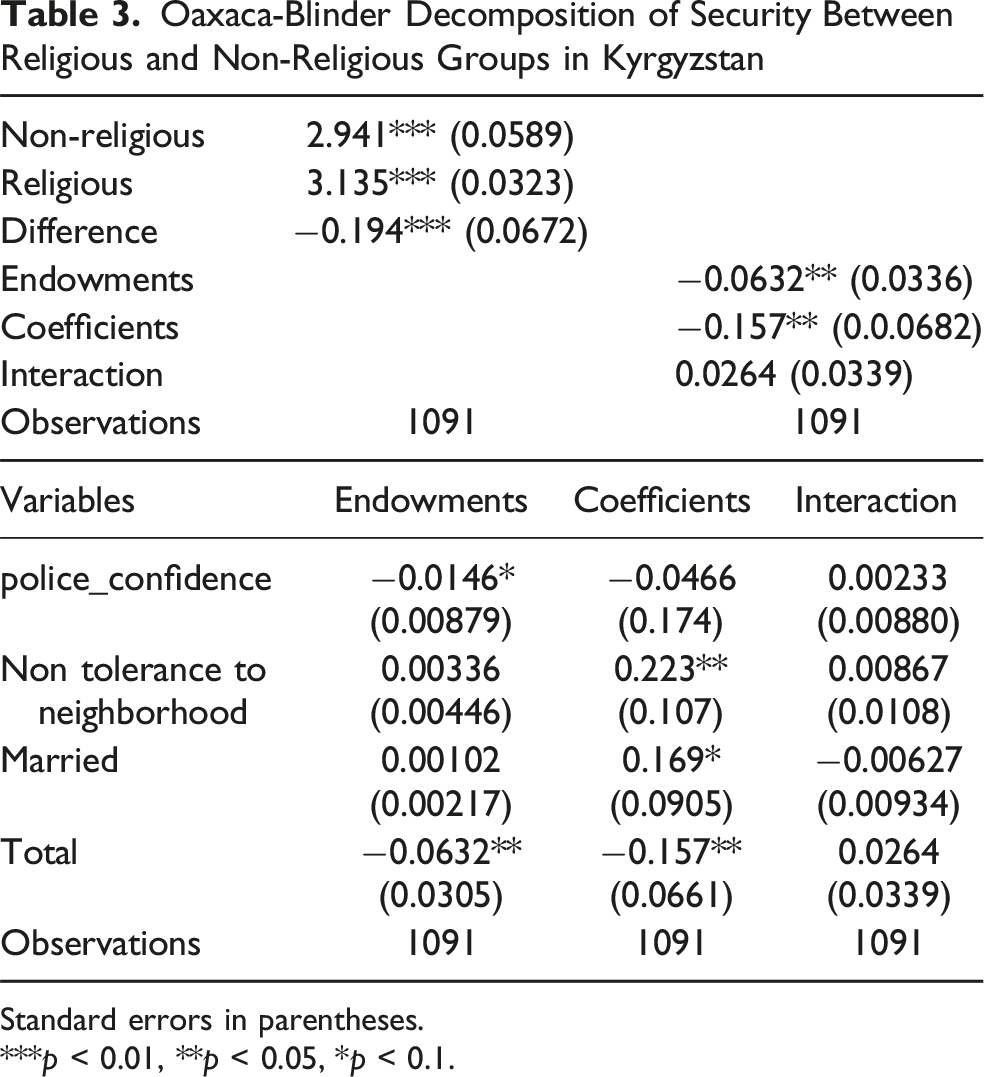
Oaxaca-Blinder Decomposition of Security Between Religious and Non-Religious Groups in Kyrgyzstan
Standard errors in parentheses.
***p < 0.01, **p < 0.05, *p < 0.1.
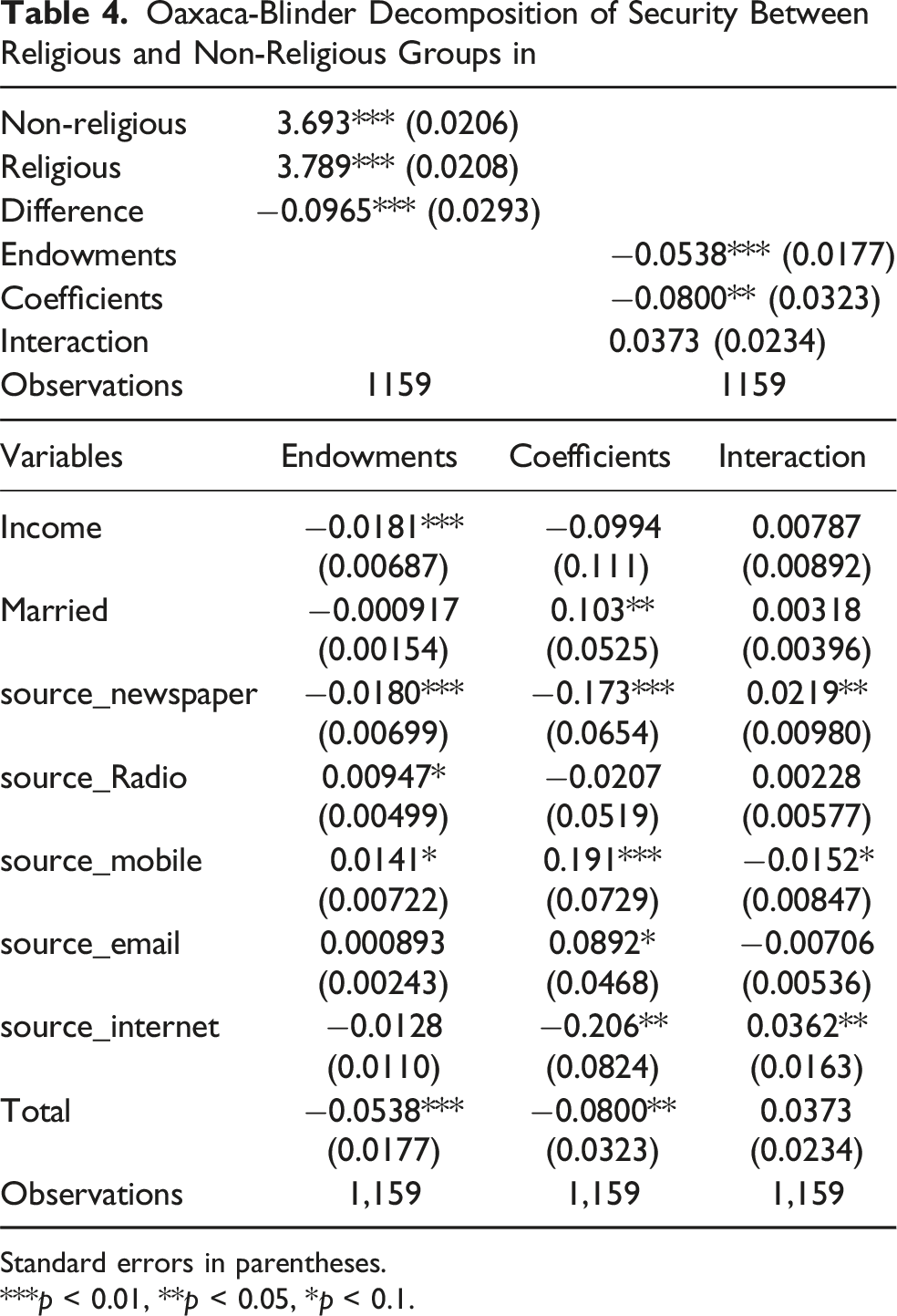
Oaxaca-Blinder Decomposition of Security Between Religious and Non-Religious Groups in
Standard errors in parentheses.
***p < 0.01, **p < 0.05, *p < 0.1.
The main predictors of this difference in security are the income, marital status, the use as a source of information newspaper, radio and mobile phones. The level of income for religious individuals is 8.7%, which is higher than for non-religious individuals, married individuals among religious compared to non-religious. Moreover the religious people are using more newspapers, radio and mobile phones as sources of information (see Appendix A2). So, religious people with higher income and married people can explain higher security levels among religious people in Tajikistan.
Discussion
The goal of this research is to test the relationship between being religious and perceived security in Central Asia. Our model shows that religious people feel secure in Kyrgyzstan and Tajikistan, while this variable is not important in Kazakhstan although it has a negative sign. Notably, the difference between religious and non-religious populations in terms of perceived security is statistically significant. The OLS model also showed the variation in effects of control variables, which we are also going to discuss.
As evidence suggests, being religious is an important predictor of perceived security in Central Asia. The level of religiosity is positively linked with perceived security in Kyrgyzstan and Tajikistan. In contrast, the variable is not statistically significant and the sign is in the opposite direction in Kazakhstan, that is, religious people are more likely to feel insecure than those who are non-religious. Religious people feel more secure in Tajikistan and Kyrgyzstan than in Kazakhstan. Notably, the Oaxaca-Blinder decomposition also clearly demonstrated a statistically significant difference between the two groups in all three states. We explain the different effects across the states in terms of the level of religiosity, which has been confirmed by previous research and secondary data. Despite the fact that the number of religious people is growing in all three states, the level of religiosity differs across the states. It is lower in Kazakhstan compared to Kyrgyzstan and Tajikistan. This has been shown by previous research Sharipova, 2020; WVS 2018). Many people are not deeply religious, meaning that they might celebrate religious holidays and call themselves as Muslims, but they do not pray five times per day and do not follow all the Islamic norms, rites, and rituals in Kazakhstan.
23
In contrast, in Kyrgyzstan and Tajikistan, people are more religious and follow the norms of traditional Islam (see Figure 5). As Figure 5 shows, there is a higher percentage of religious people who strictly observe the religious norms in Tajikistan, followed by Kyrgyzstan and Kazakhstan. Previous research has shown that people are more religious in poorer agrarian countries than in more developed wealthy societies (Norris & Inglehart, 2011). Scholars found that a high level of people’s religiosity can be linked to country’s characteristics or macro/contextual factors such as poor economic growth (or lack thereof), income inequality, and low human development (Molteni & Biolcati, 2022; 2024; Ruiter & Van Tubergen, 2009; Storm, 2015). Among the three states, Kazakhstan is the most developed, modernized and wealthy; it belongs to the upper middle income countries, which can explain why people are less religious compared to Tajikistan and Kyrgyzstan. Tajikistan is categorized as a lower income country, while Kyrgyzstan is a low-middle income country. Furthermore, Tajikistan and Kyrgyzstan had deeper ties to Islamic traditions during the Soviet period. They were then revitalized in the post-independence period albeit under tight control of the state. In addition, during the Soviet era, Kazakhstan was more secularized, urbanized and industrialized, which also contributed to a lower degree of religiosity in the population. Currently, Kazakhstan is more urbanized than Tajikistan and Kyrgyzstan. According to statistics for 2023, the share of urban population is 58.18% in Kazakhstan, 37.8% in Kyrgyzstan, and 29.13% in Tajikistan
24
. This can also explain why the population of Kyrgyzstan and Tajikistan are more religious than in Kazakhstan. Frequency of Praying for Religious Groups of Population. Note: The Graph has Been Constructed Based on WVS Wave 7.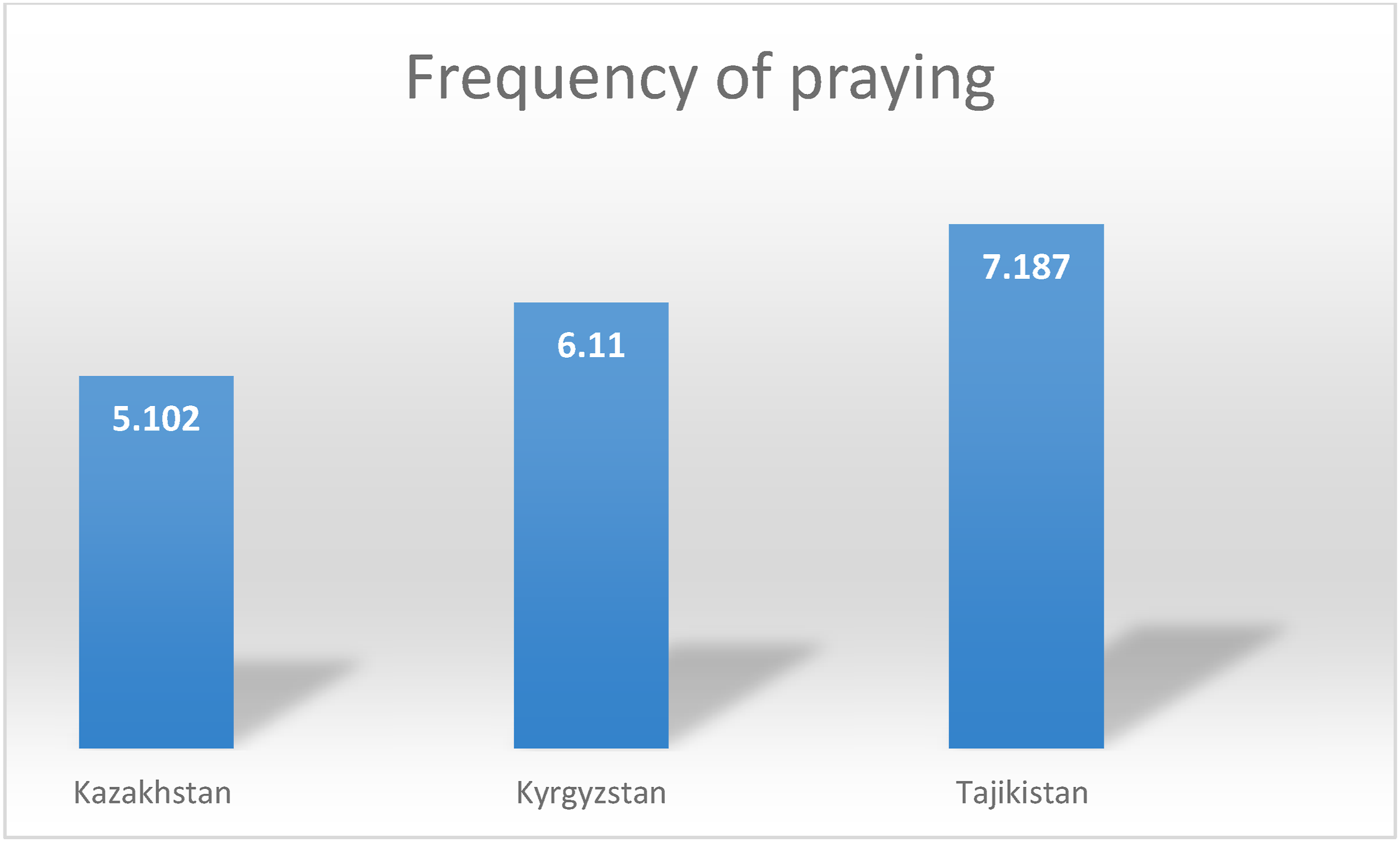
Furthermore, different levels of religiosity can be accounted for in terms of current nation building projects in the three states. In Kazakhstan, the authorities do not emphasize Islam and religion in general as part of national identity. The national identity project is rather based on secularism and multi-ethnic modern state. Islam is just part of Kazakh identity, while in Tajikistan and Kyrgyzstan Islam is central to national identity. For many Muslims in Uzbekistan and Kyrgyzstan, Islam is not merely about ideology or theology rather it is about everyday practices, social belonging to the community, and identity. Religion serves as a moral compass for people living under conditions of economic hardships and high levels of uncertainty (Loew 2007; McBrien, 2017; Rasanayagam, 2010; Thibault, 2018). Religiosity is also supported by the role of informal religious leaders. Svetlana Peshkova (2014), for instance, emphasized the importance of female religious leaders—otinchalar—who provide spiritual guidance to women beyond mosques in Kyrgyzstan. In religiously homogenous countries like Tajikistan and Kyrgyzstan, the sense of community based on religion and thus perceived security can be higher than in Kazakhstan. Based on extensive fieldwork between 1998 and 2004, Rasanayagam examines how individuals navigated official restrictions to shape their religious and moral identities.
Finally, as we mentioned before, the governments in three states have different degrees of tolerance toward religious freedom. In Kyrgyzstan, more liberal legislature and weaker state control contributed for greater religious expression, while in Tajikistan the role of religion increased after the Civil war in the 1990s. In contrast, in Kazakhstan, the government tried to promote a moderate version of Islam. Therefore, all these contributed to different degrees of religiosity across the three Central Asian states, thereby influencing their security perceptions.
Second, religion and some religious minorities have been securitized in Central Asia. Often Central Asian governments treat religious shrines, religious organizations, and informal religious networks and circles as security threats. Such activities are surveilled and strictly regulated (Zhussipbek et al., 2020). In Kazakhstan, the state strictly regulates the activities of religious organizations through the religious laws. The authorities state that the Islamic ideologies different from the Hanafi madhab (traditional to Central Asia) such as Salafism are alien and destructive to Kazakh society. The state regulates wearing religious clothes and bans the creation of religious political parties. In Kyrgyzstan, the percentage of religious people is higher than in Kazakhstan. According to the WVS, around two thirds of Kyrgyz population are religious. However, the state is less restrictive and more liberal toward people who follow other religious ideologies. There is no prosecution of people wearing religious clothes in Kyrgyzstan. According to the Annual Report on Freedom of Confession by the State Department, compared to the neighboring states, Kyrgyzstan supports religious freedom (USCIRF, 2023).
In Tajikistan, the percentage of deeply religious people is also high. However, the state is more restrictive toward religion than in Kyrgyzstan. For instance, in 2017 it passed a law that limited Muslim celebration and traditions, non-traditional religious clothing. Another law, which was adopted in 2018, increased the oversight of the state over religious education and made religious organizations accountable to the state (Gamza & Jones, 2021). The Tajik government persecutes the Muslim people, particularly religious minorities. For instance, it jailed a religious leader of the Isamili Shi’a Muslim population, closed religious schools and limited religious activities (USCIRF, 2023). Although the government is strict in terms of religious freedom in Tajikistan, we explain the link between people being religious and feeling secure by their level of religiosity. In addition, Islam serves as a basis for national identity and provides a sense of community. This is especially salient in ethnically and religiously homogenous Tajikistan and Kyrgyzstan (Louw, 2007; McBrien, 2017).
Despite the prosecution of religious minorities, the majority of the population finds their peace in religion. The level of religiosity is high due to the high rate of poverty, unemployment, and corruption in the government. In sum, religious people feel more secure than non-religious people in Kyrgyzstan and Tajikistan than in Kazakhstan.
The Effects of Control Variables
We also controlled for a number of factors based on the existing literature. One of the factors that can contribute to (in)insecurity in Central Asia is mass media. As evidence suggests people, reading newspapers feel more secure in Kazakhstan. This can be explained that the information in the newspapers might not be fear or anxiety triggering and is mostly positive. In contrast, TV as a source of information is not statistically significant but the sign is negative meaning that the more people watch TV the less secure they are. The effect of TV, however, is not significant. This is true for all three Central Asian states.
Findings on the radio as a source of information suggest different results across three states. If in Kazakhstan those who listen to the radio feel more secure, in Tajikistan listening to the radio causes insecurity. The variable is insignificant in the context of Kyrgyzstan; however, the sign is negative showing the inverse relationship between this source of information and security. The variation across the states can indicate the different content/news that can be conveyed via radio in the three states. The analysis of the content of different media resources is beyond the scope of this article but we can assume that the difference can be explained by the content of the news.
Another factor is that internet information has a positive relationship with security in Kazakhstan. This is the only country where the Internet variable is statistically significant. We can argue that in Kazakhstan, more people use the Internet than in Kyrgyzstan and Tajikistan, and thus they can have more access to different sources of information. As statistics shows, in Kazakhstan 91% of the population use the Internet, in Kyrgyzstan—78%, while in Tajikistan only 22%. 25 In addition, the government of Kazakhstan adopted the program “Cyber shield” that helps to reveal the threatening content and prevent cybercrimes. In 2022, Kazakhstan ranked 78th out of 176 countries on cybersecurity index 26 , Kyrgyzstan ranked 91 with 37.66 scores 27 , and Tajikistan was on the 153rd place with 10.39 scores 28 .
Trust in police is another strong predictor of perceptions of security in Central Asia. If people trust the police, they have a reduced level of insecurity. This finding corroborates with previous research (Reid et al., 2020). The context of Central Asia also confirmed that trust in police means higher perceptions of security. If the police have citizen’s trust, this is a good indicator of state-society relations. In general, a low number of people trust the police. However, among those who trust, the level of perceived security is high.
We found that gender, urban residence, and experience with crime are linked to perceptions of security. Gender is significant in Kazakhstan and Tajikistan. Women of Kazakhstan and Tajikistan feel less secure, while there is no difference between men and women in Kyrgyzstan. However, the sign is in the predicted direction in Kyrgyzstan. We also observe the regional effect of gender in Central Asia where men are more secure than women are. This is in line with previous research confirming that males are less fearful of various threats and feel more secure than women do (Hudson, 2005).
Living in urban areas also leads to lower levels of security. Big cities are full of dangers and unsafe neighborhoods where crimes can take place. Almaty and Astana are on the first place in terms of crimes in Kazakhstan. Each second crime takes place in Bishkek, the capital of Kyrgyzstan. Osh and Jelal-Abad also have high crime rates in Kyrgyzstan. As a result, urbanites feel more insecure than people living in rural areas in Central Asia. In Tajikistan this variable is not statistically significant, but it is in the predicted direction. It means that this variable is not that important for this country and the difference between rural and urban is not that salient. Tajikistan is not urbanized to the same degree as Kazakhstan or Kyrgyzstan, nevertheless, people living in urban areas are more likely to feel insecure than those inhabiting rural areas.
The experience with crime is another important predictor of perceived security in Kyrgyzstan and Tajikistan. In Kazakhstan, the variable is not statistically significant but it is in the predicted direction. Those people, who were victims of any crime or indicated that members of their families were victims, feel more insecure. As evidence suggests the rate of crime in Kazakhstan has decreased from 5% in 2017 to 3.2% in 2020. 29 The decline in crime rates in Kazakhstan is related to preventive measures taken by the government. For instance, the government introduced the program Korgau (Defense) which was quite effective to prevent crimes. It works in 12 cities of Kazakhstan. In addition, the use of technologies in everyday police work also helped effectively reduce the number of crimes in the country. 30 In Kyrgyzstan, there was an increase in crime rate in 2017 and then it declined from 2.2% in 2019 to 1.8% in 2020. 31 Similarly, in Tajikistan there was a slight decline in crime rate from 2011 to 2020 from 1.62% to 0.91%. According to the Crime Index for 2023, Kazakhstan has 46.4 index and is in 72nd place, while Kyrgyzstan has index 54 and is in 31st place. 32 No data for Tajikistan for that period was available.
The safety in neighborhoods is also associated with perceived security. If people live in a safe neighborhood and do not experience violence, thefts and robberies, then they would feel more secure. In contrast, frequent incidents of violence and thefts can decrease perceived security in the population. As the model shows, people are more concerned with thefts and robbery in Kazakhstan and Kyrgyzstan, while violence in the neighborhood brings more insecurity in Kyrgyzstan and Tajikistan. According to statistics, in 2017 out of 316, 418 crimes registered in Kazakhstan, half of them were thefts. 33 In 2018 in Kyrgyzstan, thefts were also on the first place—39% of all crimes (11,557) followed by fraud (4,362), hooliganism (2,426), economic crimes (2,163) and crimes related to narcotics (1,424), followed by robberies (955). 34 A high rate of thefts and robberies negatively affect people’s perceptions of security. The model has also shown that people who are in a good state of health and with higher levels of education are more secure than those who are not.
Conclusion
The goal of this paper was to test the hypothesis on the relationship between being religious and perceived security in Central Asian states—Kazakhstan, Tajikistan, and Kyrgyzstan. We found that being religious can increase people’s perceived security. It shows that religion is an important predictor of security since it can decrease the level of anxiety and fears. Religion provides people with a sense of community and belonging which also contributes to people’s feelings of security. Indeed, religion in general and Islam particularly is part and parcel of national identity that serves as a moral compass and helps people to navigate their everyday life in Central Asia (Louw, 2007; McBrien, 2017; Thibault, 2018; Zhussipbek et al., 2020). Under conditions of economic hardships and uncertainty, religion gives people an understanding of what is right and wrong, good and bad, just and unjust. In Central Asia, religion is more than just an ideology, doctrine, or theology; it provides people with a sense of stability, community and thus security. People use religion to navigate their everyday life and it gives them a sense of security.
The impact of religiosity, however, is not equal across the states. In Kazakhstan, religious people are less secure compared to non-religious people. In contrast, religious people in Tajikistan and Kyrgyzstan feel more secure than in Kazakhstan. We explain the difference in terms of the level of religiosity, which is higher in Tajikistan and Kyrgyzstan than in Kazakhstan. The difference in religiosity is explained in terms of different levels of development, urbanization, and soviet legacy as well as nation-building projects. Another possible explanation is based on the fact that Kazakhstan is a multiethnic and multireligious country compared to Kyrgyzstan and Tajikistan. This heterogeneity also could contribute to a lower level of perceived security in Kazakhstan than in other two states. Countries that have many religions and ethnicities are more prone to heightened tensions and this can negatively affect perceptions of security.
The variation across three states in terms of factors that are linked to perceived security demonstrate that scholars should develop a more nuanced approach to explain and understand perceived security in Central Asian states. Researchers should take into consideration both contextual and individual factors that influence people’s security. As our research shows, religion has been securitized in Central Asia. However, as Galym Zhussipbek and his associates have argued, although Salafism and other Islamic teachings received some influence in Central Asia, particularly among the younger generation, the dominant trend is still traditional Islam shaped by the local traditions and customs (Zhussipbek et al., 2020). In Central Asian states, the government imposed many restrictions on religious freedoms. As Johan Rasaganayam (2010) showed in his ethnographic research, individuals navigate state restrictions to pursue their religious identities. Religion helps them to feel secure through everyday moral reasoning. This is because religion is a powerful factor that provides people relief from anxiety, fear, and frustration. It also gives a sense of belonging to a religious community and society, which contributes to perceptions of security among the people.
As such our findings can have important implications for policy-makers. Higher levels of insecurity in a society can be associated with support for restrictions of civil rights and liberties. Although all Central Asian states are authoritarian, people with high levels of insecurity can favor even more restrictive laws and regulations as it happened in other contexts. As it was shown, people who feel insecure can also support nationalism (Kosterman & Feshbach, 1989) and intolerance toward people from other groups. Kazakhstan and Kyrgyzstan have multi ethnic societies where some ethnic tensions and clashes took place. Feeling insecure can lead to more hostility toward other ethnic groups.
Evidence suggests that high levels of insecurity can also make people support aggressive foreign policies (Huddie et al., 2005). Russia is a good example where heightened insecurity propagated by the current regime via mass media made many people supportive of its aggressive foreign policy. As such, it is important to understand what factors determine insecurity to prevent negative implications. Today Central Asia faces various challenges and the leadership should take all necessary steps to preserve and maintain security of their people. As our research suggests, religion is one of those factors leading to perceived security.
In terms of future research, scholars could focus on other factors in depth that can contribute to perceptions of insecurity. For instance, they could investigate to what extent religious minorities feel insecure and if there is a difference across Central Asian states. In addition, scholars can also focus on how ethnic and religious diversity can influence people’s sense of security in Central Asia. Such studies would offer a more nuanced approach to understand how different factors shape perceptions of insecurity in Central Asia.
Supplemental Material
Supplemental Material - The Role of Religion in Shaping Perceived Security in Central Asia
Supplemental Material for The Role of Religion in Shaping Perceived Security in Central Asia by Dina Sharipova, and Alma Kudebayeva in Journal of Eurasian Studies
Footnotes

Funding
The author(s) received no financial support for the research, authorship, and/or publication of this article.
Declaration of Conflicting Interests
The authors declared no potential conflicts of interest with respect to the research, authorship, and/or publication of this article.
Supplemental Material
Supplemental material for this article is available online.
Notes
Author Biographies
References
Supplementary Material
Please find the following supplemental material available below.
For Open Access articles published under a Creative Commons License, all supplemental material carries the same license as the article it is associated with.
For non-Open Access articles published, all supplemental material carries a non-exclusive license, and permission requests for re-use of supplemental material or any part of supplemental material shall be sent directly to the copyright owner as specified in the copyright notice associated with the article.
