






Abstract
Among the various types of asphyxial deaths, strangulation is one of the commonly encountered cases as structures in the neck make it vulnerable to fatality. In most such cases, ligature material, usually cloth, is used for the commission of the offense. Clothing may be associated with a wide range of both accidental and deliberately induced deaths. Accidental strangulation due to entrapment of the neck in clothing, especially in relation to vehicular accidents, has also been described in the literature, but these cases are mostly associated with long scarf-like clothing. Loose clothing and intoxication act as critical factors in entrapping the person in such an event. This case report highlights the rare occurrence of accidental strangulation due to the entanglement of clothing other than a long scarf consequent upon road traffic incident.
Introduction
Strangulation is a form of asphyxia caused by constriction of the neck by a ligature without suspending the body, and the constricting band is tightened by force other than the bodyweight (1). Deaths due to strangulation are usually considered homicidal unless proved otherwise. Accidental strangulation though relatively rare in occurrence but is occasionally reported in the literature (2 -5). Infants are sometimes accidentally strangled in their cots when the neck is caught inside bars, restainers, and braces. There are also instances reported when the neck of jackets/sweatshirts becomes entangled in gaps or projections on equipment such as slides (6, 7). Accidental strangulation due to entrapment of the neck in clothing, especially with vehicular accidents, has been characteristically defined in “Isadora Duncan syndrome” or the “long scarf syndrome” (8 -11). Similarly, it can occur if loose clothing around the neck gets entangled in industrial machinery or even farming equipment (12). Accidental deaths due to entrapment of the neck with clothes other than long scarfs/sarees find a rare mention in the literature. We are presenting a unique case of accidental ligature strangulation with the collar of the shirt consequent to the vehicular accident encountered under intoxication.
Case Report
A 52-year-old male had consumed alcohol along with his friends in a roadside restaurant, and thence he left for his home on his motorbike. The next morning he was found dead on the roadside slope about 5 km from the restaurant on the city’s outskirts. There was a steep slope of about 4 m on the roadside highway, and the body was in a prone position adjacent to the motorbike ( Figure 1A ). The deceased did not wear the helmet, nor was it found in the vicinity of the place of incidence. The motorbike showed abrasive damages and soil deposition at multiple places consistent with the sliding accident ( Figure 1B ). The body was shifted to the mortuary by police authorities for a medicolegal autopsy. On autopsy, the deceased weighed 65.6 kg, and length was 166 cm. The deceased had worn a pinkish full-sleeved formal shirt and black trousers. The clothes were dirty and soiled with dust. The shirt’s collar measured 40 cm in length and 7 cm in breadth on unfolding. The fourth and fifth buttons of the shirt were plucked out along with stitches. Buttonholes corresponding to the third and sixth buttons were torn ( Figure 1C ). These buttons were retrieved from the scene of incidence. Rigor mortis was present all over the body. Postmortem lividity was fixed and present over the anterior chest wall, anterior abdominal wall, and fronts of thighs. A reddish-brown ligature mark was present over the posterior and lateral aspects of the neck. It was 18 cm in length and showed a variable breadth maximum being 3.2 cm at the posterior aspect of the neck. The mark was situated 5 cm below occipital protuberance, 9 cm below the left mastoid, 10 cm below the right mastoid, and deficient over the front of the neck. The mark was dry, hard, parchmentized, and showed a near-transverse course ( Figure 2A and B ). There were multiple abrasions over the face over the left side of the forehead, left ala of the nose, and left cheek. Abrasions were also present over the right knee, anterior aspect of the right thigh, right leg, and anterior aspect left thigh. Multiple lacerations of size varying from 1 × 1 cm to 3 × 2 cm were present over the dorsal aspect of the great toe, second toe, and third toe of the left foot and the great toe of the right foot, along with abrasion. There were no petechiae or cyanosis. On internal examination of the neck, the tissue underneath the ligature mark was dry and firm. On further exploration, contusion was present over the epiglottis ( Figure 2C ). The hyoid bone, thyroid cartilage, and spine were intact. The stomach contained brownish semidigested food material with a strong fruity odor. All internal organs were congested. Toxicological analysis revealed an alcohol level of 120 mg% in blood and 102 mg% in viscera. After perusal of autopsy findings and toxicology report, the cause of death, in this case, was concluded as “Ligature strangulation with consumption of alcohol prior to death.”
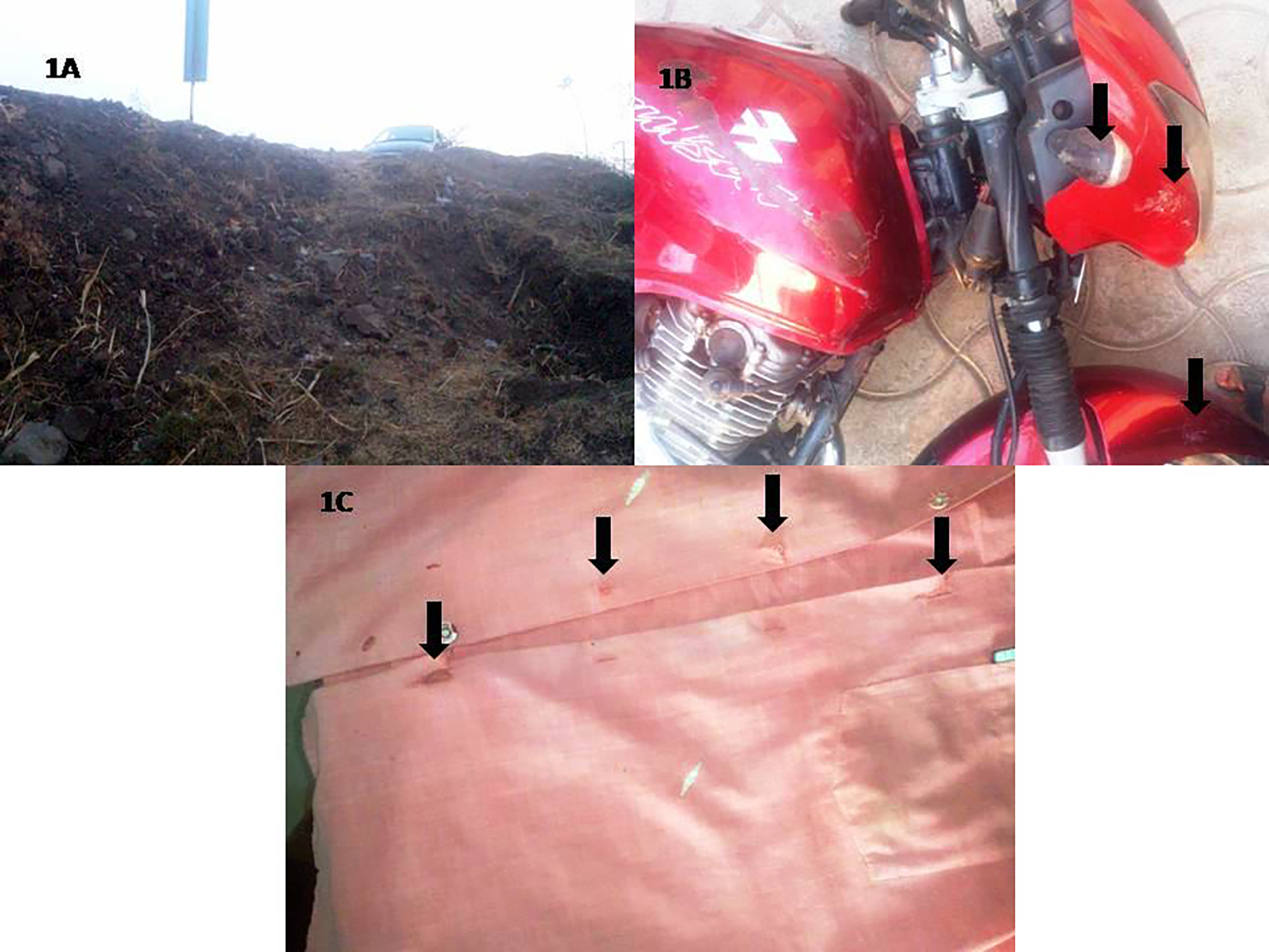
A, Scene of incidence with the steep slope. B, Motorbike with abrasive damage due to sliding and soil deposition (arrow). C, Torn buttons and buttonholes of the shirt (arrow).
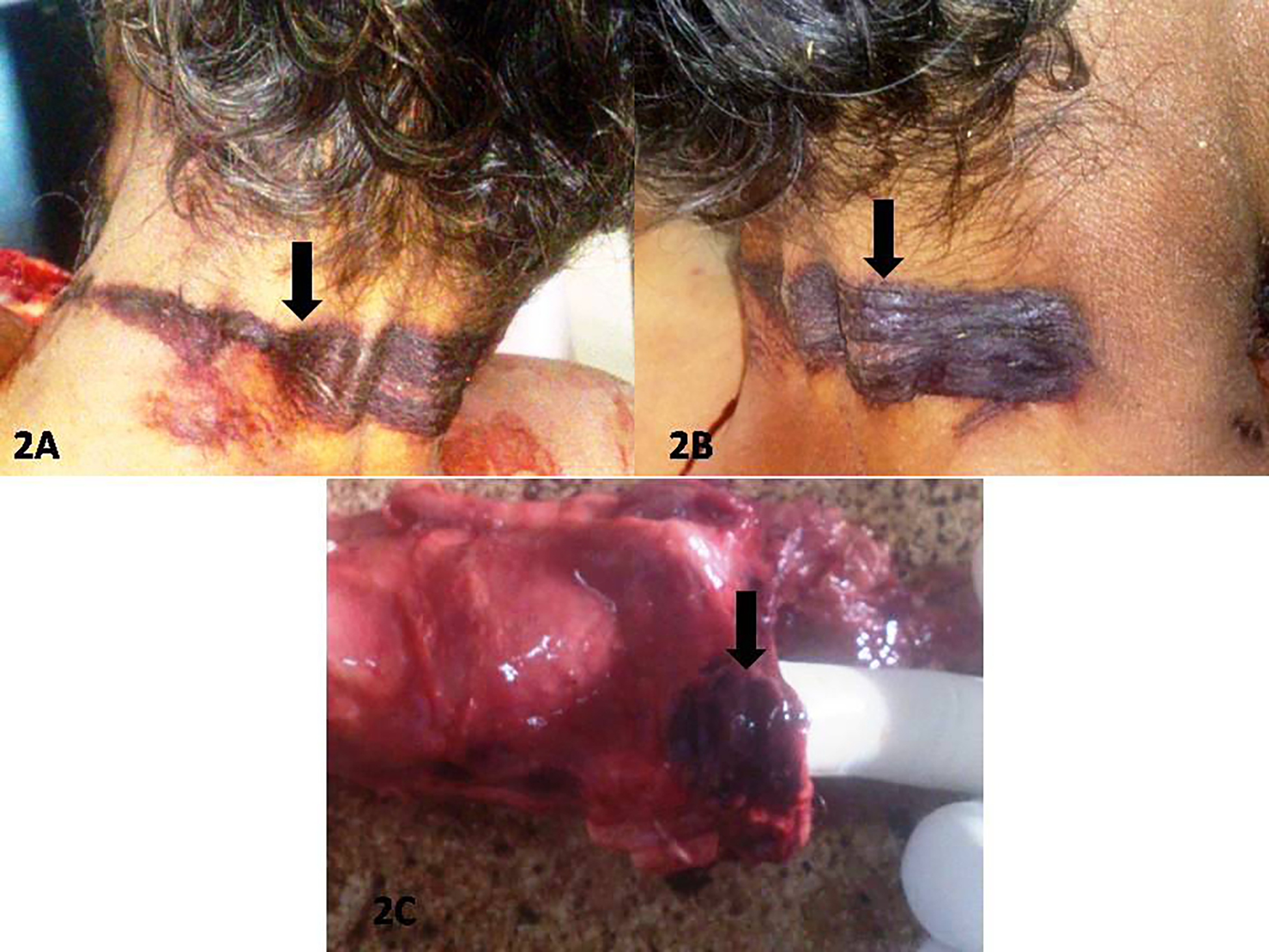
A, Ligature mark over the posterior and left lateral aspects of the neck. B, Ligature mark over the posterior and right lateral aspects of the neck. C, Contusion over epiglottis (arrow).
Discussion
Medicolegal practitioners often encounter deaths due to strangulation in their practice. Many of the strangulation deaths are homicidal. Deaths due to accidental strangulation are relatively rare and can be challenging to interpret. Circumstantial evidence often plays a pivotal role in such cases. Accidental ligature strangulation can occur in multiple scenarios. Strangulation deaths resulting from entrapment of the neck in clothing in moving wheels of vehicles, in industrial machinery, and farming equipment are reported in the literature (3, 4). These deaths are usually associated with long clothing like a scarf, dupatta, saree, and so on, classically described in “Isadora Duncan Syndrome” or the “long scarf syndrome” (8). Verma et al. in their study on accidental ligature strangulation deaths in East Delhi have described the cases in which one 28-year-old and another 50 years old female got accidentally strangled due to entangling of their dupattas/chunni in the wheels of a cycle rickshaw. In another case, a 40-year-old female died due to the entanglement of her dupatta in the pedal of the rickshaw (13).
Accidental ligature strangulation from clothing other than like long scarf found rare mention in the literature. In their study, Verma et al. have mentioned one case of a 25-year-old male accidentally strangled when his shirt got entrapped in the moving belt on the motor of a printing machine while he was trying to remove some paper that had got stuck (13). Hitosugi et al. also reported accidental strangulation in a mentally disabled patient by her cloth collar (5). A variant of homicidal ligature strangulation by constriction of the victim’s own shirt around the neck by twisting the collar is also described in the literature. In such cases, an arrowhead-shaped abrasion pointing downward or a zigzag-shaped pattern can be seen on the victim’s neck (14). In the present case, no such pattern is observed.
In the present case, a 52-year-old male was found dead lying in a prone position on the roadside slope adjacent to his motorbike. Lacerations present over the dorsal aspect of the feet and multiple abrasions over the anterior aspect of the body can be attributed to dragging the body along the slope. Parchmentized ligature mark and internal contusion over epiglottis were consistent with the application of ligature compression. The compression of the neck has occurred due to the entanglement of the shirt in the projected part of a motorbike like a handle which was evident by the tearing pattern of the buttons and buttonholes.
The mechanisms of road traffic accidents can be intricate. In a motorcycle accident, the motorcycle and rider typically become independent, each following their own path to final rest. In a low-side crash, the motorcycle will tend to slide further than the rider (15). In this case, as the bike skidded off along the slope, the motorbike and rider followed the same path relative to each other due to the entanglement of the shirt, and the momentum and weight of the motorbike acted as an exogenous force for ligature compression of the neck. This accident was contributed by the fact that the deceased had consumed alcohol before death.
In this case, typical findings of asphyxia death like petechial hemorrhages, cyanosis, or congestion of the face were absent. Hence the possibility of death due to asphyxia and venous congestion is ruled out. There was no injury to the spine or spinal cord. However, the possibility of pressure over the carotid body or sinuses still exists, considering the ligature mark’s lateral course. Additionally, the deceased had consumed alcohol, so the possible explanation to cause of death is reflex vagal inhibition following ligature compression of the neck. Pressure on the baroreceptors in the carotid sinuses, the carotid sheaths, and the carotid body can result in bradycardia or total cardiac arrest. Fear, apprehension, struggling, and possibly the effect of drugs such as alcohol may heighten the sensitivity of this vagal mechanism. The rapid onset of heart stoppage may antedate any evidence of congestive or “asphyxia” signs, causing death immediately or within seconds or thereafter (4). Kanchan et al. have described a similar mechanism in the case wherein ligature mark involved the back and lateral aspect of the neck and then over the face (16).
Conclusion
This case report highlights the rare occurrence of accidental strangulation due to the entanglement of clothing other than a long scarf consequent upon road traffic incident. Loose clothing and intoxication were critical factors in entrapping the person in such an event. It also emphasizes a detailed examination of clothing and scene of incidence to conclude the possible manner of death.
Footnotes
Acknowledgments
None.
Ethical Approval
N/A.
Statement of Human and Animal Rights
N/A.
Statement of Informed Consent
N/A.
Disclosures & Declaration of Conflicts of Interest
The authors, reviewers, editors, and publication staff do not report any relevant conflicts of interest.
Financial Disclosure
The authors have indicated that they do not have financial relationships to disclose that are relevant to this manuscript.
