






Abstract
Female homicide represents the most extreme manifestation of violence against women and requires a comprehensive approach for its detection and prevention. This study presents a retrospective medico-legal analysis of female homicides in the city of Barcelona between 1986 and 2020. A total of 205 cases were analyzed. The average homicide rate was 0.68 per 100,000 women (ranging from 0.24 to 2.01). Most victims were between 27 and 59 years (52%), and nearly half of the cases occurred in the victim’s home (49%). Information about the alleged perpetrator was available in a subset of cases (27%); among these, 62.5% were relatives, and 57% were current or former intimate partners. In 35% of these cases, the perpetrator died by suicide after the homicide. The most common mechanism of homicide was sharp-force trauma (37%). A higher proportion of cases occurred during the summer months (37.3%). Although the rate of female homicide in Barcelona is relatively low, these deaths represent a significant public health, social, and forensic concern, highlighting the need for interdisciplinary approaches to prevention and case analysis.
Introduction
The general term homicide refers to “acts in which one person takes the life of another or causes their death”. 1 Homicidal deaths among women can be considered the most extreme consequence of violence against women. It is a serious public health issue that profoundly affects the physical, psychological, sexual, reproductive, and social well-being of women and their families, 2 requiring a multidisciplinary approach for its reduction and eradication.
Two terms are often used interchangeably: feminicide and femicide. While both refer to acts in which the victim is a woman, they differ in the underlying motive behind the act. Femicide is understood as the killing of women without reference to the underlying causes, whereas feminicide more accurately captures gender-related motives and the social constructs underlying these acts. 3 It has also been described as a violation of women's rights to freedom and to life, driven by motives such as hatred, contempt, pleasure, or a sense of ownership. 4 From a medicolegal perspective, it is defined as a homicide committed due to the lack of recognition of the victim's right to self-determination, with this motive constituting a key element to be demonstrated in the crime. 5 To date, there is limited literature addressing common sociodemographic characteristics among these victims.
This study aims to analyze all cases of women's homicides (femicides) in the city of Barcelona between 1986 and 2020, with the goal of examining the circumstances surrounding these deaths, identifying common sociodemographic characteristics, and detecting potential trends over the 35-year study period.
Material and Methods
A retrospective analysis was conducted of all cases involving female homicides classified as such by the forensic pathologist responsible for the on-site examination or autopsy, within the jurisdiction of the city of Barcelona (Barcelona judicial district). All homicides that occurred between January 1, 1986, and December 31, 2020, were included in the analysis. During this period, a total of 634 homicides were recorded, of which 205 involved female victims.
The inclusion criterion for homicide was any violent death determined to have a medicolegal homicidal etiology—that is, cases in which a third party intentionally caused the death. The classification of homicide was based on the forensic assessment performed during the scene investigation and autopsy, taking into account autopsy findings, scene investigation reports, and available investigative information. Consequently, deaths resulting from motor vehicle accidents were excluded, as these are initially classified as accidental from a medicolegal standpoint and may later be reclassified legally as involuntary manslaughter. However, exceptions were made in cases where, at the time of the body examination or autopsy, there was evidence that the vehicle had been deliberately used to cause death.
Data were obtained from medicolegal case files archived in both historical and current legal medical records. Autopsies conducted prior to 2003 were performed at the Forensic Anatomical Institute (IAF), whereas from 2003 onward, they were carried out at the Forensic Pathology Service (SPF) of the Institute of Legal Medicine and Forensic Sciences of Catalonia (IMLCFC). The analysis included all available documentation, such as scene investigation reports, autopsy reports, and the results of complementary toxicological analyses conducted either by the Laboratory Service of the IMLCFC or by the National Institute of Toxicology and Forensic Sciences (INTCF). All cases were anonymized to prevent identification.
The variables analyzed included victim characteristics (age, presence of toxic substances, and type of substances), the nature of the victim-offender relationship (type of relationship or kinship), and homicide characteristics (month of death, body location—hospital, home, street, nursing home, prison, hotels or boarding houses, fields, forests, open land, sea, or rivers—district within Barcelona, type of homicide, and number of injuries). Information regarding the victim-perpetrator relationship was obtained from the medicolegal case files, based on the information available at the time of the forensic examination, including police reports, preliminary investigative findings, and information provided by law enforcement officers present during the autopsy. After identifying the case files from both institutions (IAF and SPF), we extracted the variable data and coded them into a database. We performed descriptive statistical analysis. To calculate the rate per 100,000 inhabitants, the registered female population for each year of the study period (1986-2020) was obtained from the Statistical Yearbooks of Barcelona. 6
Results
Female Victims
During the study period (1986-2020), a total of 39.033 forensic autopsies were performed on bodies originating from the city of Barcelona (
Annual Homicides and Female Victim Proportion.
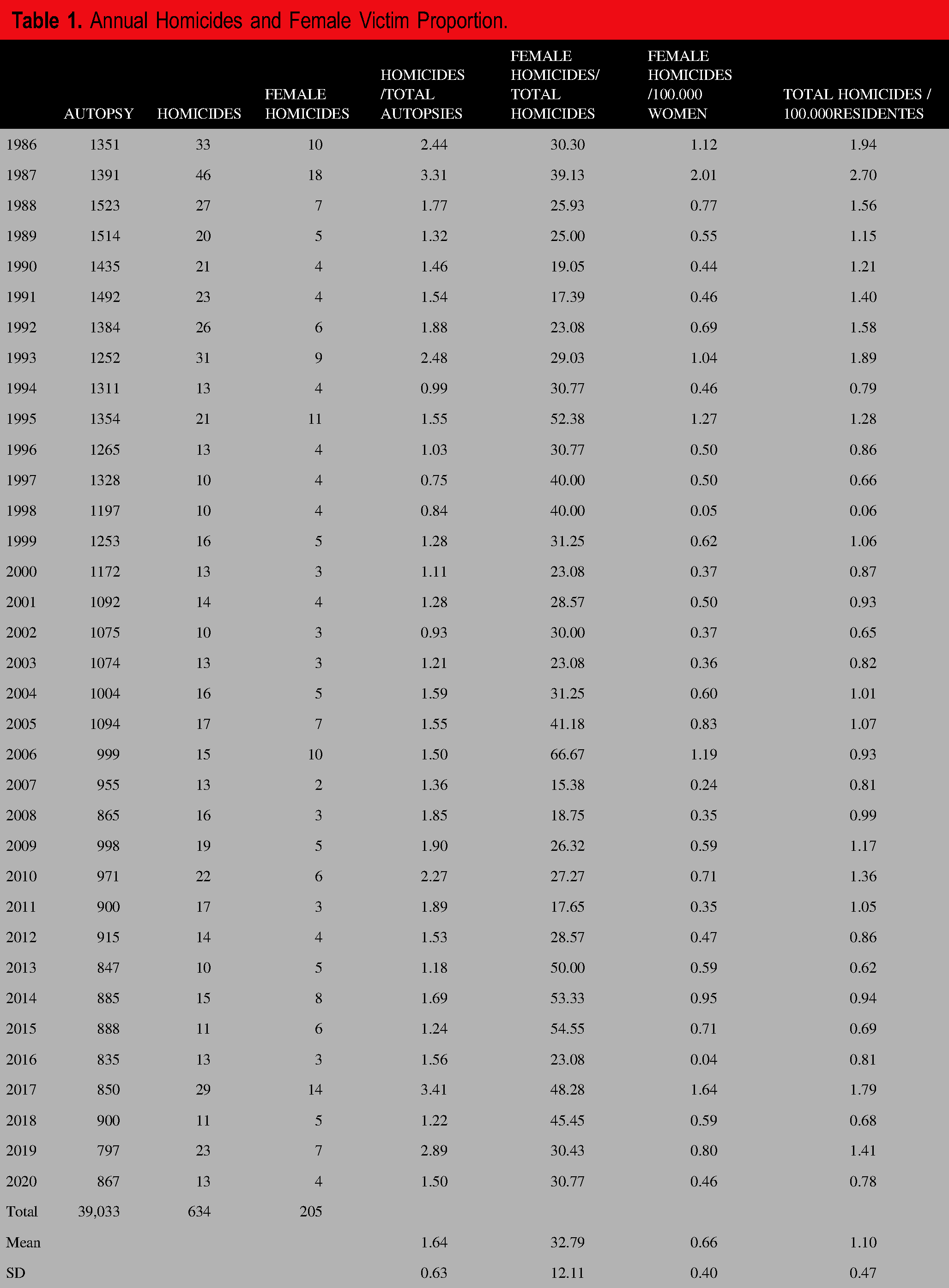
Based on the registered female population reported in the Statistical Yearbooks of the City of Barcelona, 6 the average female homicide rate was 0.66 per 100,000 inhabitants. The lowest rate was recorded in 2016 (0.04 per 100,000), while the highest was observed in 1987 (2.01 per 100,000).
Month
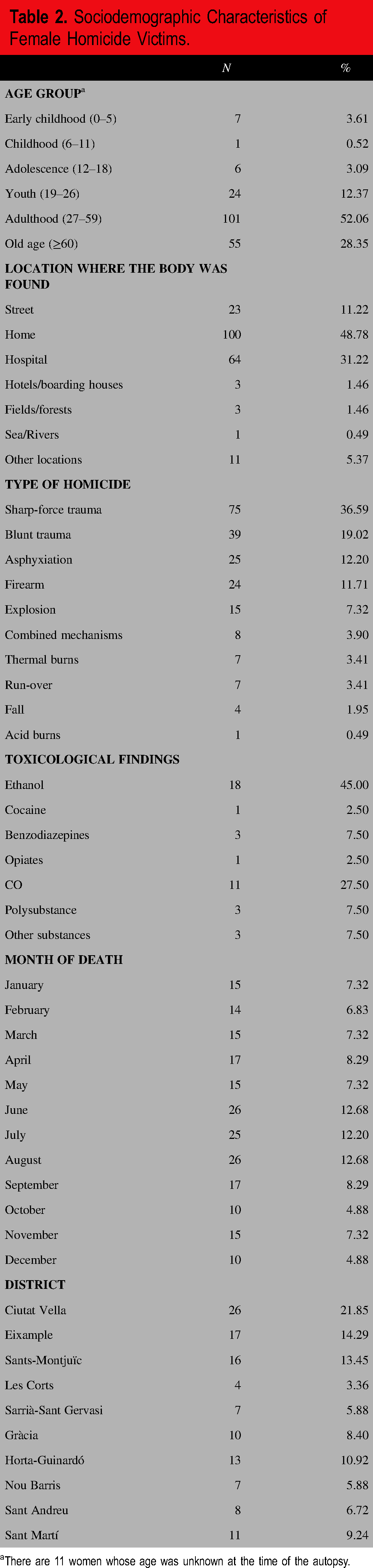
A higher proportion of female homicides was observed specifically during the summer months—June (26 victims; 12.68%), July (25 victims; 12.20%), and August (26 victims; 12.68%). In the remaining months, the number of cases ranged from 10 to 17, accounting for 4.88% to 8.29%, respectively (
Sociodemographic Characteristics of Female Homicide Victims.
There are 11 women whose age was unknown at the time of the autopsy.
Age
The average age of female homicide victims was 45.9, with ages ranging from 0 years (newborns) to 95 years. We categorized age into six groups based on the life cycle classification of the Ministry of Health.
7
These groups were: early childhood (0–5 years), childhood (6–11 years), adolescence (12–18 years), youth (19–26 years), adulthood (27–59 years), old age (60 years and older). Most cases corresponded to individuals in the adulthood group (
Scene of Body Discovery
The term “scene of body discovery” refers to the location where the deceased was found or where the victim died following an unsuccessful hospital transfer. This does not necessarily correspond to the location where the homicide occurred. However, in most cases—excluding deaths in medical settings and instances where the body was relocated to conceal the crime—the place of discovery typically coincides with the actual crime scene.
Most female homicide victims were found at home (48.78%), followed by hospitals (31.22%) and the street (11.22%). Infrequent locations comprised hotels or boarding houses (1.46%), natural areas like fields and forests (1.46%), and aquatic environments such as seas or rivers (0.49%). Other locations (such as sports centers, bars, shops, etc) accounted for 5.37% of the cases (
Districts
Barcelona is divided into 10 districts: Ciutat Vella, Eixample, Sants-Montjuïc, Les Corts, Sarrià-Sant Gervasi, Gràcia, Horta-Guinardó, Nou Barris, Sant Andreu, and Sant Martí. Of the 205 female victims, the origin of the body was unknown in 45 cases, and 41 bodies were transferred from hospitals. Among the remaining 119 cases, the highest concentration was recorded in the Ciutat Vella district (21.85%), whereas Les Corts accounted for the lowest proportion (3.36%) (

Color-Coded map Displaying the Absolute Number of Femicides by District. Green (<5 Homicides), Yellow (5–10 Homicides), Orange (10–15 Homicides), red (15–20 Homicides), Maroon (>20 Homicidios).
Type of Homicide
The most common injury mechanism was sharp-force trauma (stabbings) (36.59%), followed by blunt-force trauma (19.02%), asphyxiation (12.20%), and firearms (11.71%). Other less frequent mechanisms included explosions (7.32%), combined mechanisms (3.9%), thermal burns (3.41%), run-over incidents (3.41%), falls from height (1.95%), and acid burns (0.49%) (
We observed a mean of 22.53 stab wounds per victim (range: 1–132; median: 13.00). The distribution of these wounds was: 26% on the upper limbs, 25% on the chest, 25% on the head and neck, 11% on the back, 8% on the abdomen, and 4% on the lower limbs (data not shown). In firearm-related homicides, the average was 1.83 projectiles per victim (ranging from 1 to 10 bullets). Regarding wound locations, 60% were to the head, 12% to the chest, and the rest to the upper limbs, lower limbs, and abdomen. In deaths caused by blunt-force trauma, 83.5% of the injuries were located on the head, 13.5% on the chest, and 3% on the back. As for asphyxiation methods, 48% were manual strangulations, 28% were smothering of the airways, and 24% were ligature strangulations.
Toxicological Analysis
According to the available medicolegal records for the 205 female homicide cases, toxicological testing was not requested in 120 cases, requested in 60, and the testing status was unknown in 25. Among the 60 cases in which testing was requested, results were available in 40. Among these, 45% showed ethanol consumption, 27.5% tested positive for carbon monoxide (CO) (10 victims were from a bombing and 1 from thermal burns), 7% for benzodiazepines, 2.5% for cocaine, and 2.5% for opioids. In 7.5% of cases, combined substances were detected (eg, ethanol + tramadol; alcohol + benzodiazepines + opioids; opioids + Trankimazin; methadone + mirtazapine + cocaine). Another 7.5% tested positive for other substances such as digoxin, midazolam, lormetazepam, nordazepam, and ketamine (
Among the women with blood alcohol concentration, nearly half (44%) had levels between 0.3 and 1 g/L, 28% had <0.3 g/L, 17% had >2.5 g/L, and 11% had levels between 1 and 2.5 g/L (data not shown).
Known Perpetrator
Information about the alleged perpetrator was available at the time of autopsy in 56 of the 205 cases (27%). Among these, 35 cases (62.5%) involved a relative, while in 21 cases (37.5%) the alleged perpetrator was not a family member. When the perpetrator was a relative, 20 cases (57%) involved the partner or ex-partner (
Information About the Alleged Perpetrator.
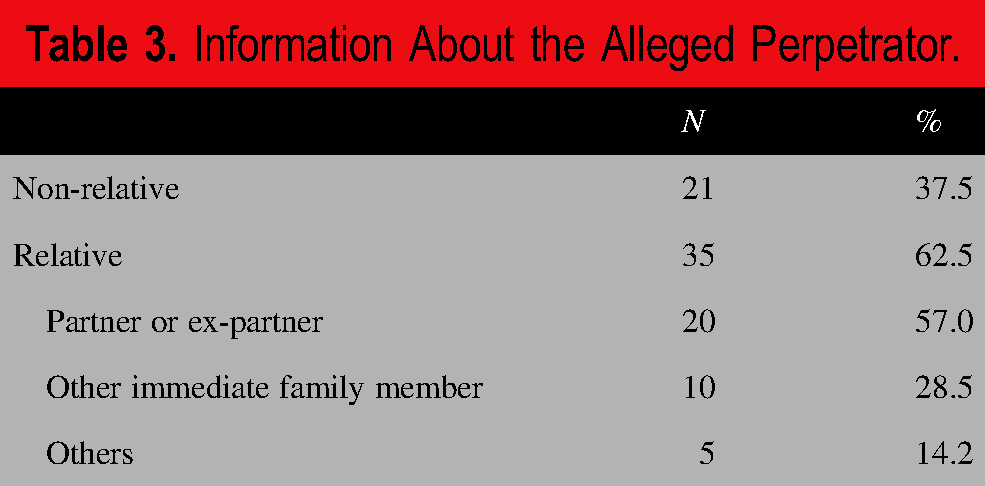
Of the 20 cases where the aggressor was the partner or ex-partner, 7 committed suicide after the homicide (35%).
Discussion
This study provides a descriptive analysis of female homicide cases in the city of Barcelona over a 35-year period (1986-2020). During this time, 1.62% of all autopsies conducted by the SPF were classified as homicides, with annual rates ranging from 0.75% to 3.41%. Of the total 634 homicides recorded, one-third (n = 205) involved female victims. The lack of information regarding the perpetrator or motive in many cases prvents the classification of all cases as femicide or feminicide in the strict sense.
This analysis shows an average rate of 0.68 female homicides per 100.000 female inhabitants, with annual variations ranging between 0.24 and 2.01. The results align with trends observed in other studies conducted in Spain and abroad, where the incidence of lethal violence against women generally remains stable, with occasional increases observed in specific years—albeit at relatively low overall rates. For instance, Brazil reported in 2019 a rise in female homicide victims during the COVID-19 pandemic, with 13 female homicides per day. 8 Europe is the region with the lowest rate at 0.6 homicides per 100,000 inhabitants, followed by Oceania with a rate of 0.9. In the Americas, the rate rises to 1.2 per 100.000, and Africa has the highest rate, with 1.7 per 100,.000 inhabitants. 9 Italy has one of the lowest rates in Europe, at 0.53 homicides per 100,000 inhabitants. 10 In Spain, the national rate in 2012 was 0.8 per 100,000. 11 Within Spain, Andalusia is the autonomous community with the highest absolute number of female homicides. 12 The rate varies by region: for example, the province of Almería has the highest annual rate at 0.65 per 100,000 inhabitants, while Huelva has the lowest at 0.13 per 100,000. 13 In absolute numbers of female homicides during the decade 2000–2010, Andalusia ranked highest with 189 cases, followed by Catalonia (152), Valencia (125), and Madrid (114). 12 A study conducted in Seville from 2004 to 2007 found a rate of 0.5 female homicides per 100,000 women 14 —lower than in the city of Barcelona. Another study found that homicide rates are lower in high-income countries compared to middle- and low-income countries, and that the greater the inequality rate, the higher the rate of violence. 15
In Barcelona, the summer months—June, July, and August—were when the highest absolute number of female homicides occurred, accounting for 37.36% of all cases. In another Spanish study, the month with the highest number of homicides was May, while the remaining months showed little variation. 12 In a separate study conducted in Seville, 14 the month with the highest number of homicides was October.
In our study, victims ranged in age from 0 to 95 years old. In Barcelona, the average age was 45.9 years. Eight women were under 11 years old (4.13%), 6 were between 12 and 18 years (3.09%), 24 were between 19 and 26 years (12.37%), 107 women were aged 27 to 59 (52.06%), and 49 women (28.35%) were over 60. This result closely aligns with existing literature, which identifies adult women (27-59 years) as the demographic group most frequently affected by lethal violence. In Spain, 50% of female homicide victims were between 25 and 45 years of age, while 13% were under 25 and 12.9% were over 65 years old. 12 In Andalusia, the average age of victims between 2021 and 2022 was 47 years. 16 An Italian study examining homicides from 2012 to 2018 reported that 53% of victims were over 55 years old, and 27.4% were over 75. 10 Another study found a mean victim age of 46.9 ± 21.4 years. 5 In Ireland, the average age was reported as 42 years, 17 while in a Chinese study, 79.47% of victims were between 21 and 60 years old. 18 In Bologna, the mean age of victims was 44 years. 19 Similar findings have been reported in other international studies. In Hong Kong, the mean age of female homicide victims was reported to be 48.83 years, 20 while a Taiwanese forensic autopsy study found that victims killed by intimate partners had a mean age of 40 years compared with 48.6 years in cases involving non-intimate perpetrators. 21 It should be noted that in these studies the minimum age of the victims included in the analysis was 18 years.
Nearly half of the victims (49%) were found at home, highlighting the home as a potentially dangerous setting for women, particularly in the context of gender-based violence. Furthermore, a considerable number of judicial autopsies originating from hospitals involved incidents that initially occurred at home, suggesting that the actual proportion of home-based cases may be even higher. These findings are supported by other studies: in Andalusia, 75% of homicides occurred in the home. 13 This trend is consistent with international literature, which identifies the domestic environment as the primary setting for gender-based violence. 22 In Bologna, 19 75% of the victims were also found at home. However, in China, 74.19% of injuries occurred in public spaces. 18 In Taiwan, the victim's home was also the most frequent location of homicide, accounting for 57% of cases. 21 Likewise, a study conducted in Hong Kong reported that 73% of female homicides occurred in the shared residence of the victim and perpetrator, 20 while research in Algeria identified the marital home as the most common location where these crimes took place. 23
In this study, there was a concentration of homicides in Ciutat Vella, representing 22% of cases. Ciutat Vella is characterized by high levels of socioeconomic vulnerability, dense population, and a large immigrant presence. In our study, it was not possible to determine the nationality of the victims. However, Italian studies have shown that foreign women are at higher risk of homicide. 10 The same study also found a clear association between educational level and homicide mortality in both men and women.
Regarding methods of homicide, our findings show that the most common was sharp-force trauma (37%), followed by blunt trauma (19%). The third most frequent mechanisms were asphyxiation (12%) and firearms (12%). Similar data have been described in the literature. In Spain, 46% of cases involved sharp-force weapons, followed by blunt trauma (15.9%), asphyxiation (12.6%), and firearms (11.6%). 12 In Andalusia, the most frequent mechanism was cutting instruments (52%), followed by firearms (16%) and asphyxiation (12%). 13 In contrast, in China the most common mechanism was blunt-force trauma, in 64.86% of cases. 18 The fact that 29% of cases involved asphyxiation or blunt trauma suggests a close and personal form of violence, typical of homicides in the context of intimate relationships, where the perpetrator seeks total control over the victim. According to the Spanish Observatory of Gender Violence, the use of sharp objects is related to domestic violence. 12 In Ireland, 42% of cases involved knives, 37% blunt trauma, and 35% asphyxiation. 17 A forensic autopsy study conducted in Taiwan found that sharp-force injuries were the most common mechanism of death, followed by bodily force, while firearm use was relatively uncommon. 21 Likewise, studies from Algeria and Hong Kong have also reported the predominance of sharp and blunt force mechanisms, with firearms representing a smaller proportion of cases.20,23
Toxicological analysis showed that ethanol was the most detected substance among the victims (45%). Ethanol is the most commonly consumed toxic substance both in Spain and internationally. In the Andalusian study, alcohol was also detected in 47% of homicide cases. 13 In the present study, more than half of the alcohol-positive cases had blood alcohol concentrations below 1 g/L (72%), and 17% had levels above 2.5 g/L.
In this study, information about the alleged perpetrator was available in only a subset of cases (27%). Among the cases in which perpetrator information was available, 62.5% of perpetrators were relatives, of whom 57% were current or former partners. This finding suggests that gender-based violence may represent an important component within the subset of cases. These findings are consistent with previous studies reporting that 60% of female homicides were committed by partners or ex-partners. 12 In Seville, 63.2% of cases were committed by intimate partners. 14 Another study conducted in Spain 24 found that between 2000 and 2010, 70.9% of homicide victims in a domestic context were women, and in 60% of cases the perpetrator was the partner or ex-partner. According to the United Nations Office on Drugs and Crime (UNODC, 2014),9,24 globally, 47% of female victims were killed by a partner or family member, compared to less than 6% of male victims. Furthermore, 35% of the homicides in which the alleged perpetrator was a partner or ex-partner ended in the perpetrator's suicide. A study conducted in Spain estimated that, in recent years, approximately one in three men who killed their partners either died by suicide or made a suicide attempt. 25 A study conducted in the Basque Country 26 found lower rates: 20% of perpetrators died by suicide after the homicide, and 10% attempted it. Similar patterns have also been described in other international studies. In Hong Kong, approximately 87% of female homicides were perpetrated by family members, 20 while an Italian nationwide forensic study reported that the majority of femicides were associated with intimate partner conflicts, particularly jealousy, rejection, or separation. 27 In contrast, cases that were not classified as femicide were more frequently associated with other factors such as perpetrator psychopathology, substance abuse, victim illness, economic motives, or criminal activity. 27 In addition, homicide-suicide events have also been frequently reported in this context, with one study from Hong Kong Indicating that 53% of perpetrators died by suicide after the homicide. 20
Due to the limited information available in the autopsy reports analyzed, our study could not assess additional risk factors across individual, relational, community, or societal domains, as explored in other investigations.8,28
In Spain, homicide offenses are regulated under the Spanish Criminal Code, 29 which establishes the legal framework for the prosecution of homicide and related crimes. In addition, specific legislative measures have been implemented to address violence against women, most notably Organic Law 1/2004 on Integrated Protection Measures against Gender Violence, 30 which introduced a comprehensive framework including legal, institutional, and social measures aimed at preventing gender-based violence and protecting victims. Although the present study does not specifically evaluate the impact of legislative changes, the long study period covered may reflect a social and institutional context that has evolved over time in response to this issue.
Conclusions
Despite the relatively low rate of female homicides in Barcelona (ranging from 0.24 to 2.01 per 100,000 inhabitants; mean: 0.66), such deaths expose a deeply concerning and complex reality. In cases involving intimate partners, these deaths may represent one of the most severe forms of gender-based violence.
Although victims were distributed across all age groups, the average age was 45.9 years, with adult women being the most frequently affected. Nearly half of the victims (49%) were found at home, underscoring the domestic setting as a potentially high-risk environment for women. The most common method of homicide was sharp-force trauma, followed by blunt-force trauma, asphyxiation, and firearm injuries. In many cases, the weapons involved were ordinary household objects.
Among the cases in which perpetrator information was available (27%), most were relatives (62.5%), with over half being current or former partners (57%), underscoring the significant role of gender-based violence in female homicide cases.
Over one-third of all female homicides in the city of Barcelona occurred during the summer months. This seasonal pattern should be interpreted with caution, as no statistical testing was performed to determine whether the observed distribution differs significantly form expected values. Although some authors have suggested that seasonal variations in interpersonal violence may be influenced by social or environmental factors, further research would be needed to explore these potential explanations.
Forensic-medical examination of female homicide victims is essential for identifying patterns and characteristics associated with these cases. However, effective prevention requires interdisciplinary collaboration among forensic medicine, the judicial system, law enforcement, and social services to enable comprehensive case analysis and to develop prevention and education strategies aimed at eradicating this most severe form of violence against women.
Limitations
One limitation we encountered was that some case files were incomplete or contained minimal information (particularly older files). In some cases, toxicological analyses were not requested, and in others the results were not available in the archived autopsy files. In addition, information regarding the perpetrator was available only in a minority of cases. These missing data limited the ability to explore potential associations between toxicological findings, perpetrator characteristics, and the circumstances of the homicide. Similar limitations related to the availability and completeness of forensic information have also been described in other studies, which highlight the need for more standardized forensic investigation and autopsy protocols to improve the comparability and systematic analysis of femicide cases. 27
Forensic autopsies are primarily intended to determine the cause and medicolegal manner of death. Consequently, they do not routinely include broader contextual information such as prior history of violence, previous complaints, or detailed characteristics of the perpetrator. Access to documentation from criminal investigations or court rulings could have provided additional information to better analyze potential risk factors or patterns among victims and perpetrators.
Additionally, including all homicide cases from the entire province of Barcelona could have been of interest. However, until 2015, autopsies were not fully centralized in the city of Barcelona, which made it very difficult to collect complete data for all cases. Furthermore, as this study focuses on a single urban setting, the findings may not necessarily be generalizable to other regions or populations.
Finally, the long study period (1986–2020) spans important social, legal, and forensic changes. Although forensic autopsy protocols have remained essentially consistent over time, variations in case archiving systems and in the information collected during the scene investigation may have influenced the amount and type of information available in the case files.
Footnotes
ETHICAL APPROVAL
This article does not report any studies involving human participants or animals. The project has been approved by the Teaching and Research Committee of the Institute of Legal Medicine and Forensic Sciences of Catalonia.
STATEMENT OF INFORMED CONSENT
This article does not involve any participants requiring informed consent.
DATA AVAILABLITY STATEMENT
Data will be available upon request.
DECLARTION OF CONFLITING INTERESTS
The authors declared no potential conflicts of interest with respect to the research, authorship, and/or publication of this article.
FUNDING
The authors received no financial support for the research, authorship, and/or publication of this article.
