






Abstract
Purpose:
The active engagement of those impacted by environmental decisions is foundational to environmental justice (EJ) movements. EJ advocates and state-level policy makers are crafting legislation using cumulative impact (CI) frameworks. We examine language in state-level CI legislation related to public participation, with a particular focus on the degree of public influence in environmental decision-making.
Methods:
We used legislative tracking sites to identify state-level CI legislation introduced or passed, 2017–2024. We extracted language describing mechanisms for public participation and agency accountability and coded each document using classifications based on the International Association for Public Participation (IAP2) Spectrum of Public Participation.
Results:
We identified 44 legislative documents using CI frameworks introduced or passed, 2017–2024. Four (9%) included no public participation language and two (5%) were coded at IAP2’s lowest level of public participation, “inform” (e.g., providing information). Twenty-four (54%) were coded in IAP2’s “consult” category (e.g., inviting comments), with six (14%) coded as “involve” (e.g., assuring public concerns and aspirations are understood and addressed). Seven (16%) were coded as “collaborate” (e.g., active engagement of the public as partners in decision-making) and one (2%) was coded in the “empower” category (e.g., community members making the decisions).
Conclusions:
Effective and just environmental governance requires collaborative and empowered decision-making. Language in most state policies using CI frameworks falls short of collaborative or empowered public participation. Those with collaborative and empowered approaches to public participation offer important models for expanding public influence in environmental decision-making.
Keywords
BACKGROUND/LITERATURE REVIEW
Emerging in the 1980s and 1990s, the environmental justice movement (henceforth EJ movement) redefined the focus of environmental research and action, shifting the focus toward the human environment, or the places “where we live, work and play.”1,2 In so doing, it brought into sharp focus the human patterns of production, consumption, and disposal responsible for generating pollutants, the maldistribution of those pollutants, and the adverse impacts along racially and economically defined geographic areas. 3 The EJ movement has maintained a focus on both distributive justice (the distribution of environmental harms and benefits) and procedural justice (the ability of disproportionately impacted communities to meaningfully influence decisions that affect their environments).4,5
Distributive justice and cumulative impacts
EJ movement participants’ descriptions of the disproportionate presence of multiple environmental toxins in Black and Brown communities as “a toxic soup,” “hotspots,” “fenceline communities,” or “sacrifice zones,” among other terms have been corroborated by a substantial body of scientific evidence6,7,8 documenting disproportionate exposures to environmental harms for Black, Indigenous, and People of Color (BIPOC) communities9,10,11,12,13 and, to a somewhat lesser extent, economically marginalized communities.14,15,16
EJ movement advocates and the scientific literature increasingly drew attention to historical and contemporary policies and practices such as race-based residential segregation, redlining, industrial zoning and land use, and economic disinvestment from predominantly Black and Brown communities that drove these distributive injustices, and their disproportionate impacts on BIPOC and economically marginalized communities.17,18,19 Growing recognition of the interconnected and combined impacts of multiple stressors in the physical, built, and social environment led to efforts to capture their combined impacts using multidimensional indices,20,21,22,23 described as “cumulative impacts” (CIs). These frameworks or measures attempt to capture the total burden associated with a constellation of emissions and exposures (e.g., air pollutants, proximity to hazardous land uses, poor quality housing, and low incomes) as well as characteristics of people living in the area that can make the health impacts of those exposures worse (e.g., young age, limited access to health care, and preexisting conditions such as asthma). 24 CI metrics can be particularly useful in visualizing or identifying hotspots or sacrifice zones whose residents experience the combined impacts of exposure to environmental hazards while simultaneously grappling with socioeconomic stressors and preexisting health conditions.
Increasingly, environmental advocates and state policy makers are applying CI frameworks to promote distributive justice by, for example, informing legislation that identifies and offers additional protections or oversight in communities experiencing high CI.25,26 Such legislation attempts to promote distributive justice by reducing new environmental emissions, providing resources (e.g., blue green infrastructure), and/or mitigating the adverse health impacts of those exposures, to assure that residents of areas with high levels of combined environmental stressors are able to thrive. 27
In this article, we turn our lens to the question of procedural justice as it appears in such legislation. 28 Specifically, we analyze state-level CI legislation introduced between 2017 and 2024 for language specifying the processes through which disproportionately impacted communities have opportunities to influence decisions about exposures within their communities.
Procedural justice and environmental decision-making
Procedural justice involves the active engagement of affected communities in making decisions that impact their environments. 29 Considered a necessary prerequisite for distributive justice, 30 it is among the guiding tenets of the Principles of Environmental Justice 31 specifying that “Environmental justice demands the right to participate as equal partners at every level of decision-making, including needs assessment, planning, implementation, enforcement, and evaluation.” 32
Central to procedural justice is fairness in opportunities for impacted communities to not only participate but also to influence decisions made about land uses that have environmental impacts. Influence can range from minimal input to full decision-making power by the public,33,34 with the latter goal attained by addressing power imbalances in the decision-making process. The 1946 Administrative Procedure Act (APA) institutionalized requirements that federal agencies notify the public and allow a comment period before enacting policies. 35 In 1969, the National Environmental Policy Act (NEPA) required additional public involvement in actions that could significantly affect the environment.36,37 The objectives of these policies have been described as assuring that public values are incorporated into environmental decisions, improving the quality of decisions made, resolving conflicts among competing interests, building trust in institutions, and educating and informing the public. Meeting these objectives requires both that the public participates in, and has opportunities to influence, environmental decisions. However, neither the APA or NEPA requires that public comment actually be incorporated in decisions that are made nor that regulatory bodies explain why input was or was not incorporated. 38 In other words, while procedures require that the public be informed about, and have opportunities to comment on, proposed decisions, mechanisms have not been established to assure that regulatory agencies integrate those comments into final decisions. 39
Despite interest in innovative approaches that offer greater public influence in environmental decision-making (e.g., study circles, citizen juries, roundtable discussion, and collaborative watershed management efforts), 40 the most common modes of public participation remain the provision of information and public meetings.41,42 These approaches offer few opportunities for meaningful influence in decision-making and limit the extent to which public values or community insights are incorporated to enhance the quality of environmental decisions. Community members and leaders who engage in public meetings often report experiencing them as confusing, perfunctory, discriminatory, and burdensome. 43 Scholars and advocates have described public participation without meaningful opportunity to influence the decisions as performative, rather than substantive. 44
A growing body of evidence supports the value of meaningful public participation in shaping decisions that can improve environmental outcomes and reduce environmental disparities.45,46,47,48,49 A 2023 meta-analysis of participation in environmental governing found that delegating decision-making power to the community was associated with improved environmental outcomes. 50 In contrast, participation without mechanisms that require agencies to incorporate or substantively respond to public comment has been linked to adverse mental and physical health outcomes. 51 Such performative mechanisms fail to protect communities from physical environmental harms, contribute to stressors associated with unsuccessful attempts to influence those decisions, and are associated with the erosion of trust in government institutions. 52
Research question
Based on the review of the literature above, we focus our attention on the overarching question of how procedural justice manifests in state-level legislation that uses CI frameworks. Specifically, we ask “to what extent does currently active and proposed state-level CI legislation that seeks distributive justice include language that emphasizes procedural justice, or the ability of communities to influence decisions about environmental harms in their midst?”
METHODS
Data sources
We used LegiScan, 53 a legislative tracking service, to identify state-level CI legislation introduced or passed prior to 2024 and the Cumulative Impacts Issue Page of the National Caucus for Environmental Legislators 54 to identify legislation introduced in 2023–2024. Through this process, 65 pieces of legislation were identified (Fig. 1). After excluding federal and municipal legislation, amendments that referenced previously passed CI legislation but did not amend those laws to extend protections or public participation in the decision-making process, and any previously introduced version of the same bill (we retained the language in the most recent version), 44 pieces of legislation remained. This final sample retained legislation that built on or amended existing legislation to add CI or overburdened community considerations or to enhance public participation in existing legislation. Of the 44 pieces of legislation that remained after the above process, we identified 14 that were enacted prior to May, 2024 and 30 that had been introduced but not yet passed (see here for spreadsheet).

Decision tree to finalize sample of legislation.
Data analysis
We extracted language from each CI legislative document, or any documents referenced in the legislation, that described public participation at any stage of the decision-making process. Extracts were placed in a spreadsheet that identified the source legislation (e.g., state abbreviation, bill number, and year introduced). We used the Spectrum of Public Participation from the International Association for Public Participation (henceforth, IAP2 Spectrum) (©International Association for Public Participation www.iap2.org) 55 as our initial coding rubric for public participation and influence in environmental decision-making. The IAP2 Spectrum builds on a large body of previous work (e.g., Sherry Arnstein’s Ladder of Citizen Participation)56,57 and includes five levels of public participation: inform, consult, involve, collaborate, and empower (Fig. 2). Categories of the spectrum that appear on the left side reflect lower levels of public participation and influence in the decision-making processes, whereas categories toward the right of the spectrum reflect increasing levels of participation and influence.
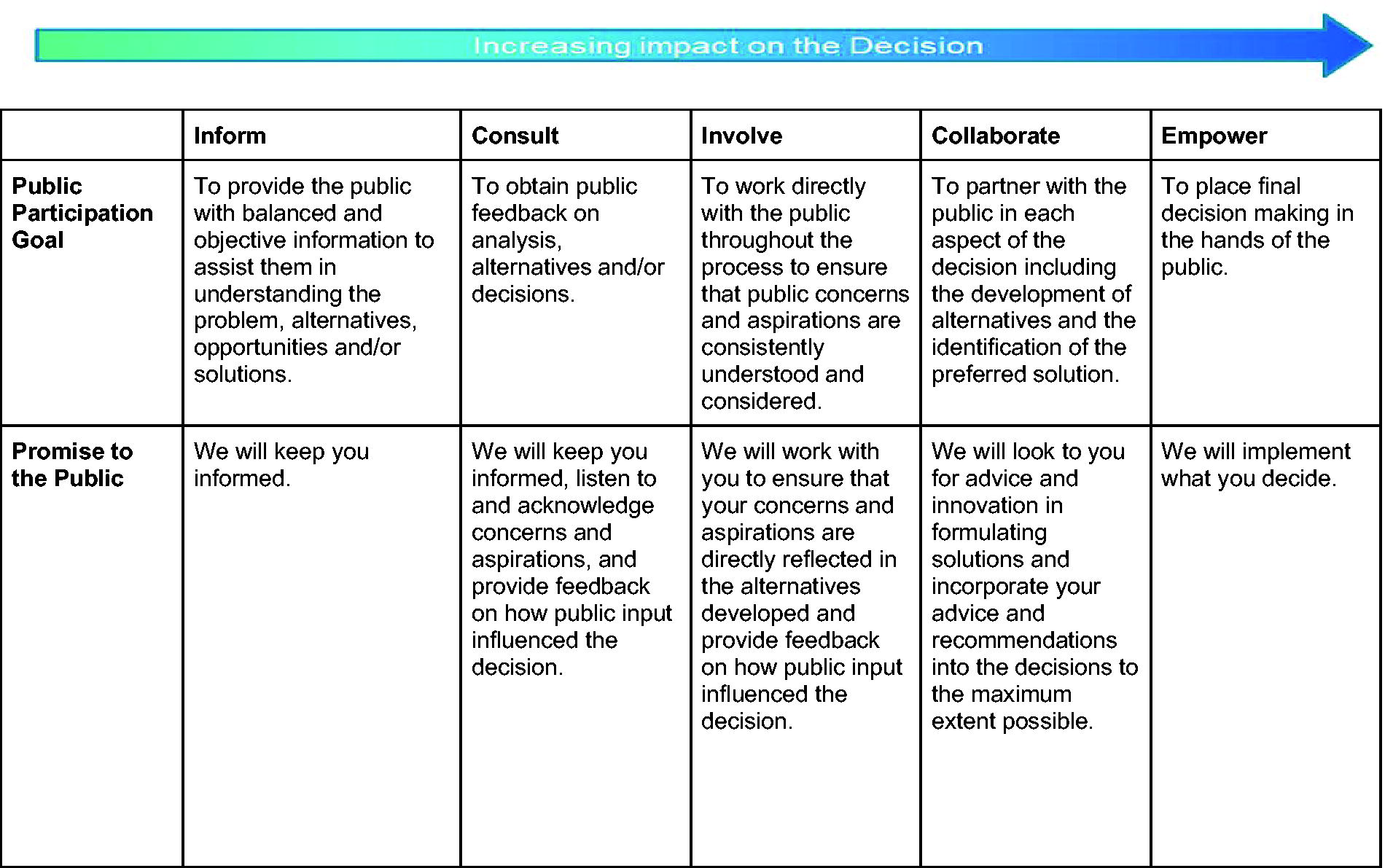
Spectrum of Public Participation, International Association of Public Participation [Reproduced with permission [©International Association for Public Participation www.iap2.org, August 12, 2024].
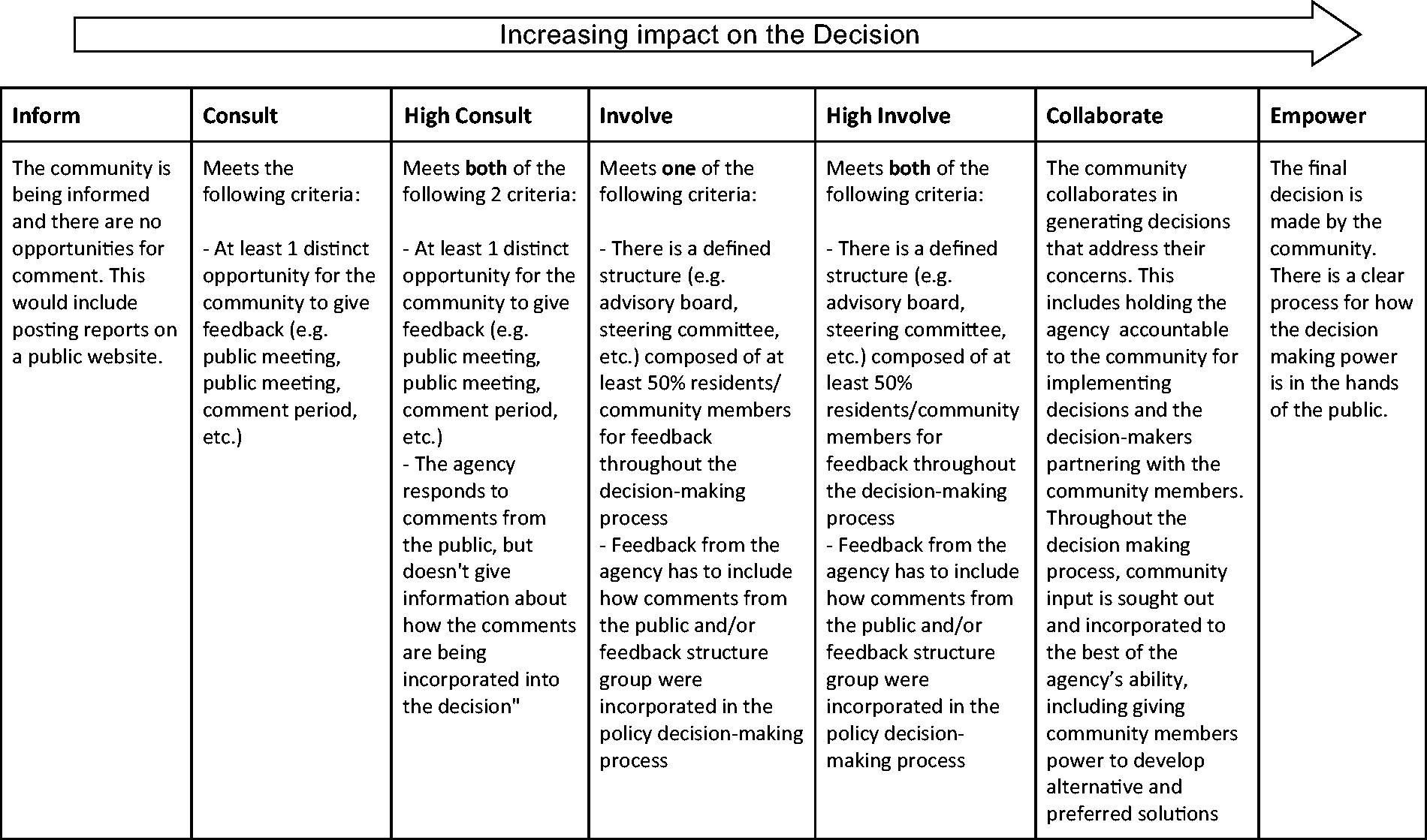
Two coders (G.M.R.F. and A.N.) independently coded each document included in our analysis. When multiple forms of public participation were mentioned in a single document, we coded the highest level of public participation described. If the legislation was an amendment and referred to existing law, we analyzed both documents and coded the highest level of public participation noted in either document. When CI legislation referenced existing state guidance for public participation, we examined and coded the language in the referent documents. We evaluated these pre-existing documents that were referenced in the CI legislation to gain a more accurate understanding of the public participation described and required according to each of the 44 CI legislative documents. The two coders then met to compare their independently determined codes for each document: inconsistencies in coding decisions were discussed by the two coders and a third member of the writing team with expertise in qualitative coding (A.J.S.). A fourth member of the writing team (B.A.I.) independently reviewed the codes and rationale.58,59 Differences were collectively resolved and used to refine the coding rubric until the coders reached agreement. The final coding rubric derived from this process, describing the parameters for each code category and used to determine the codes for each piece of legislation included in this analysis, is shown in Table 1.
Revised Spectrum of Public Participation, Based on Analysis of Public Participation Language in State-Level CI Legislation a Version 1
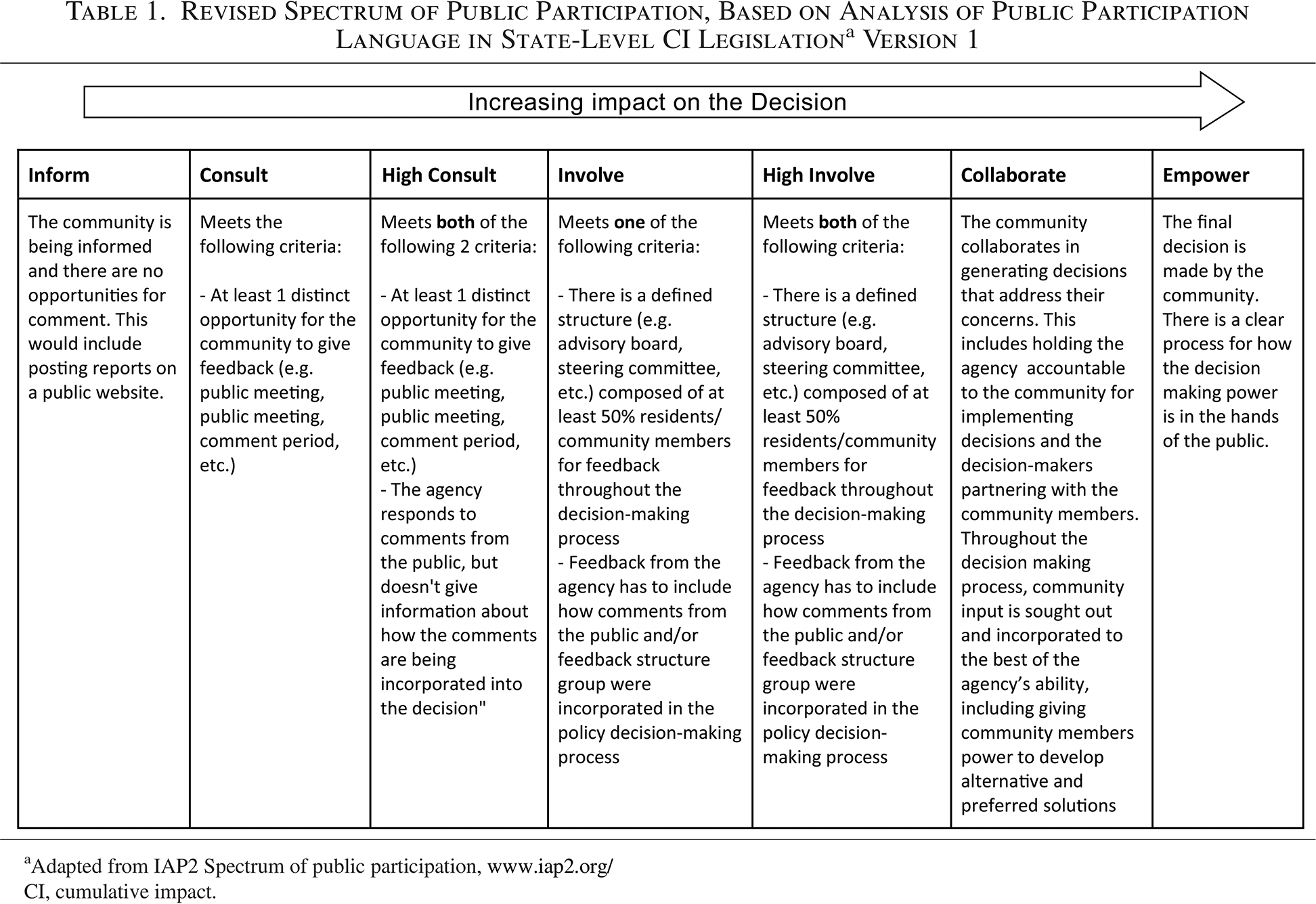
Adapted from IAP2 Spectrum of public participation, www.iap2.org/
CI, cumulative impact.
Our final coding rubric includes two additional categories beyond those included in the IAP2 Spectrum (Table 1). The categories of “consult” and “involve” in the IAP2 Spectrum each include two defining characteristics. In our expanded spectrum, legislation that included either characteristic was coded within that category (e.g., consult), whereas legislation that met both characteristics was coded as “high” (e.g., high consult). This distinction between characteristics recognizes CI legislation that included both public participation components for the “consult” or “involve” categories, as compared with those including only one characteristic.
RESULTS
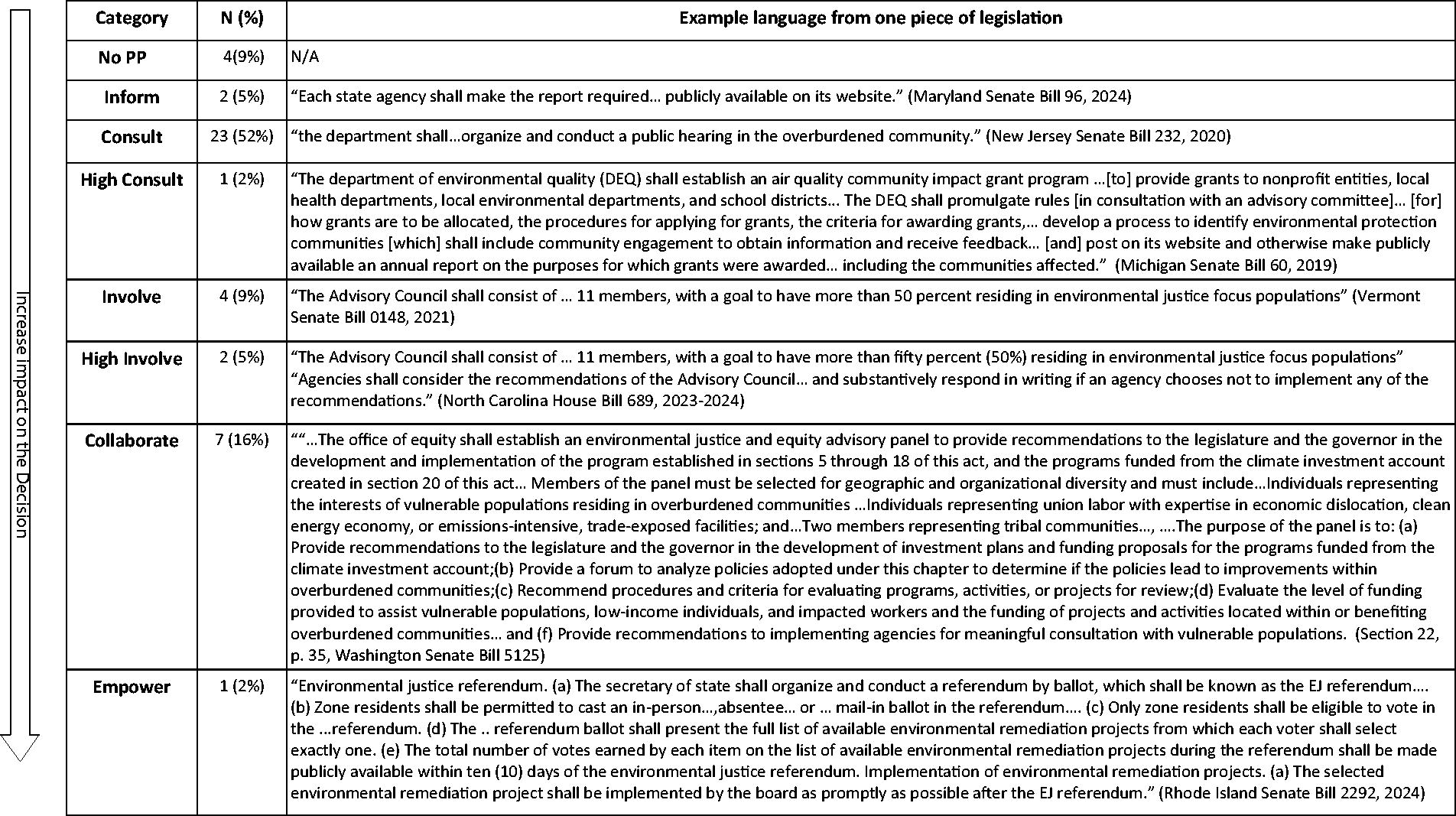
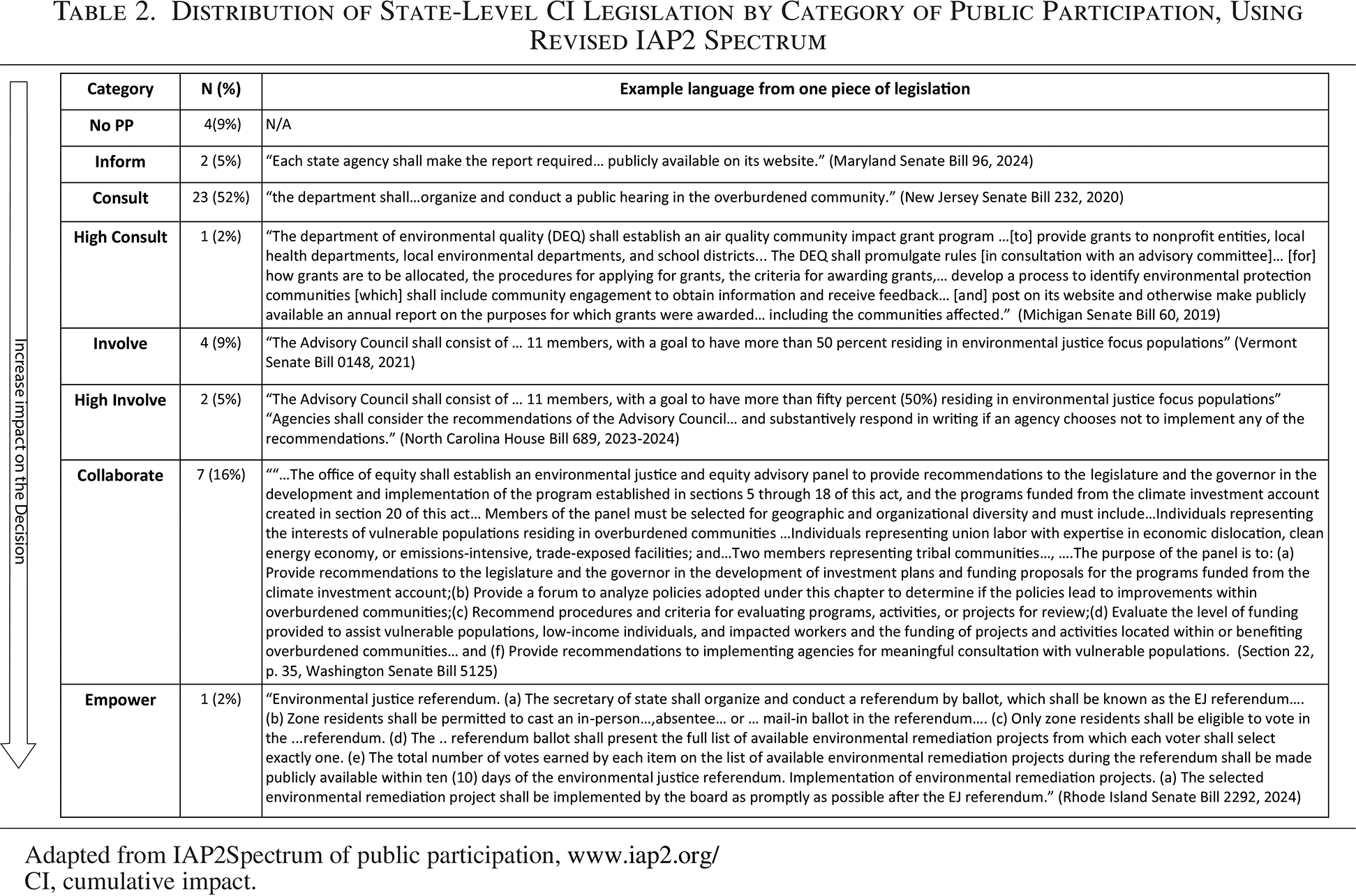
The results shown in Table 2 include the same categories listed in the expanded Spectrum (Table 1), rotated 90° to accommodate text examples extracted from legislative documents. Four (9%) documents reviewed did not include any language specifying public participation. Two (5%) described public participation that fell into the “inform” category, requiring only that information be shared with the public, without opportunities for public comment.
Distribution of State-Level CI Legislation by Category of Public Participation, Using Revised IAP2 Spectrum
Adapted from IAP2Spectrum of public participation, www.iap2.org/
CI, cumulative impact.
The most frequent classification, including just over half (n = 23, 52%) of the documents, was “consult.” Documents in this category included at least one opportunity for public feedback on a proposed decision. The New Jersey Senate Bill 232, passed in 2020, provides a clear example of “consult” language (Table 2). Another example, California Senate Bill 158, 60 passed in 2021, specified “no fewer than six public meetings,” and provided guidance regarding the locations of those meetings. This legislation did not include language requiring the agency to respond or indicate whether or how comments were incorporated into final decisions.
One (2%) document was coded as “high consult.” Michigan’s Senate Bill 60, 61 introduced in 2019, created at least one opportunity for community input or feedback and required the agency to post an annual report on its website that described communities affected and grants awarded. The advisory committee designated in this legislation included fewer than 50% of members who represented communities experiencing environmental challenges, and the agency was not required to indicate how feedback from the community was incorporated in the decision: Hence it did not meet the criteria for coding in the next category of the spectrum, “involve.”
Four (9%) of the documents reviewed included language that we classified in the “involve” category for public participation. To be coded in this category, the document needed to meet one of the following criteria: a defined structure, such as an advisory committee with more than 50% of members being community members, that can engage throughout the decision-making process; or the agency is required to provide a response that specifically indicates how feedback was incorporated into the decision (a level of accountability above and beyond the requirement of a “response,” reflected in the “high consult” classification). The Vermont Senate Bill 0148 (Table 2) met this criterion with an advisory council with the goal of having at least 50% of members residents of EJ focus populations. 62 Colorado House Bill 1266 was also coded in this category. 63 This legislation did not meet the criteria of having an advisory committee with more than 50% community representation but included a number of other features designed to promote opportunities for bidirectional communication between residents of overburdened communities and the Department responsible for environmental decision-making. These include an ombudsperson who reports directly to the Department’s Executive Director, is qualified in EJ by training or experience, and has either been a member of a disproportionately impacted community or who has worked to advance EJ. The ombudsperson is charged with: serving as an advocate for disproportionately impacted communities; serving as a liaison between disproportionately impacted communities and the Department; and collaborating with the Environmental Justice Task Force to promote EJ. Together, these elements of the bill led to its classification in the “involve” category of public participation.
Two documents (5%) met both criteria for the “involve” category: They created a structure for ongoing community participation and required a response from those responsible for implementing the decision indicating how that input was integrated into final decisions. These documents were coded as “high involve.” North Carolina’s House Bill 689 64 states the goal of having more than half of the Task Force members be residents of “environmental justice focus populations” and the requirement that the agency respond in writing if they choose not to implement any of the Task Force’s recommendations (see Table 2). Together, these elements offer a greater degree of involvement by, and accountability to, overburdened communities in the decision-making process.
Seven (16%) of the documents analyzed for this article included language coded in the “collaborate” category. Here we looked for evidence of clear mechanisms for members of the public to work collaboratively with decision-makers to generate decisions that addressed their concerns and for that collaboration to influence the preferred decision. Washington Senate Bill 5126 (see Table 2) met the first criteria through creation of an EJ and equity advisory panel that included representation from overburdened communities, for the purpose of making recommendations to the governor and the legislature, and further specified mechanisms, parameters, and funding for collaboration between community residents and state decision-makers. 65 Additional language in this bill specified that it was the responsibility of an EJ and equity advisory committee to evaluate funding provided to assist low-income or vulnerable communities and assure that funds allocated reflect a meaningful percentage of total investments authorized by the bill. Together, these mechanisms provide specific parameters and mechanisms for bidirectional collaboration and accountability in environmental decision-making.
Bills coded as “collaborate” specified, for example, processes by which communities could petition for designation as an EJ community (and thus be afforded protections granted to so-designated communities), evaluate the effectiveness of programs and policies in reducing disproportionate impacts, and provide recommendations to implementing agencies for improving the impact of programmatic efforts. They also specified the responsibilities of agencies responsible for implementing programs in language that offered clear metrics for evaluating their actions, for example, reductions in environmental burdens in overburdened communities, reducing disproportionate risk, supporting community-led project development, planning and participation, and meeting with community members. Additional language considered in identifying “collaborative” approaches included clear statements of expectations or responsibilities, for example, direction of benefits to vulnerable populations and/or overburdened communities, reductions or elimination of disparities, creation of environmental benefits, and/or elimination of health burdens and raising the quality of life in overburdened communities (e.g., Washington Senate Bill 5126, 2021; Massachusetts Senate Bill 1382; Illinois House Bill B4197).
Our search identified just one (2%) document that met the criteria for the highest level of public participation, “empower.” At this level, there must be clear evidence that the decision is to be made by the community and that the responsible agency will be accountable to the public in its implementation. Rhode Island’s Senate Bill 2292 established the first Green Justice Zone in the state, 66 including census tracts that experience CIs of multiple environmental burdens; have historically been disinvested; and include a majority of Rhode Island’s frontline community residents, disproportionately low-income communities of color. 67 The processes for public participation are multilayered and begin with election of a five-member board by registered voters who have lived for a minimum of 5 years within the area designated as a Green Justice Zone (see Table 2). The board is responsible for appointing an employment administrator who is accountable to the board and hiring additional employees or contractors to complete zone-related activities. They have considerable power, including the ability to issue (or deny) permits for industrial activities within the Green Justice Zone, and are responsible for organizing no fewer than six community meetings in which Zone residents can discuss options for remediation projects to be conducted within the Zone. Final decisions about remediation projects are made by a vote of residents who have lived for at least 5 years in the Green Justice Zone.
The Green Justice Zone legislation and the processes instantiated within it emerged from decades of organizing by community leaders from frontline communities, working in collaboration with elected officials, to create the foundation for this legislation. 68 Language included in this legislation specifically seeks to retain the influence of the affected community in future decisions under this legislative action.
We conducted two additional analyses to examine (1) whether there were differences in the distribution of code categories between legislation that has passed/been enacted, and legislation that has been introduced, but not yet passed and (2) whether there were differences in the distribution of code categories between legislation that embedded public participation language in the legislation itself and CI legislation that reference existing legislation for public participation. Results are shown in Table 3 and described briefly below.
Distribution of Public Participation Codes for State-Level Legislation by Status (Passed, Not Yet Passed) and Location of Public Participation Language (Within the Legislative Document, in an External Document)
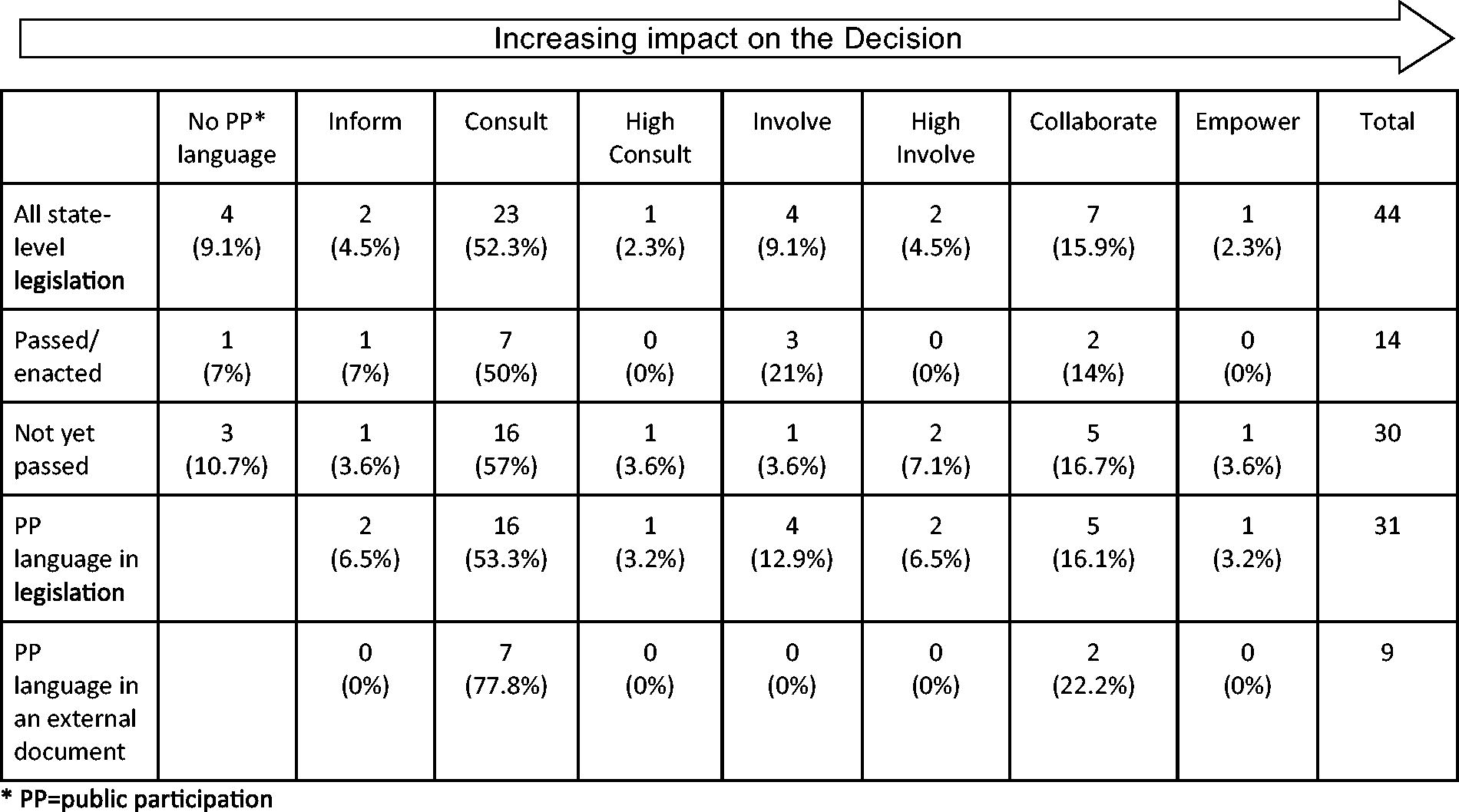
Legislation that has passed and been enacted constitutes about 32% of the legislation included in this analysis, and legislation introduced but not passed constitutes about 68% of our sample. As shown in Table 3, minor differences are observable in the distribution of codes, with somewhat more enacted legislative documents in the “involve” (middle) category compared with those introduced but not passed, and slightly greater proportions of introduced but not passed legislation in the low (“consult”) and high (“collaborate” and” empower”) ends of the spectrum. Due to small numbers, these descriptive patterns should be interpreted with caution: small differences can appear as large differences in percentages.
Table 3 also shows results from comparison of legislation using CI frameworks that include public participation language within the legislation itself compared with legislation that refers to other (external) documents for public participation language. About 70.5% of CIs legislation reviewed for this analysis included specific language about public participation in the decision-making process compared with about 20.5% of legislation that referred to other documents to define public participation procedures (9.1% did not include language about public participation).
The distribution of public participation codes for legislation with public participation language included in the bill was comparable to the overall distribution described above. In contrast, legislation that referenced external documents to define public participation was bifurcated, with a majority coded as “consult” (77.8% compared with 54.6% of all legislation) and the remainder as “collaborate” (22.2% compared with 15.9% of all legislation). Notably, the two documents coded as “collaborate” each referenced stand-alone state-level documents that spell out Best Practices for working with EJ communities,69,70 whereas those coded as “consult” referenced existing state laws that were not specific to EJ or cumulative risk. For example, Oregon House Bill 2488 refers to the following language regarding public participation that appears in the Oregon Environmental Justice Best Practices manual: “Agencies strive to ensure all stakeholders—especially those from communities of color and low-income communities who are most potentially impacted by a decision—are at the table with capacity to meaningfully participate. Agencies commit to not moving forward with a process until those partners are at the table with capacity… Collaborative governance models can transform traditional public/private roles and partnerships by focusing on building trust, identifying and addressing shared problems, being flexible, and working toward consensus rather than compromise.” Where available, such Environmental Justice Best Practices manuals can provide important and consistent language to guide collaborative and empowered environmental decision-making.
DISCUSSION
There is substantial evidence that meaningful public engagement that provides real opportunities for the public to influence environmental decisions is linked to improved environmental and health outcomes and to trust in government. In this article, we examined language in state-level CI legislation that describes opportunities for public participation and mechanisms for incorporating public values, knowledge, and priorities in environmental decisions. Our findings suggest that, despite substantial evidence that effective and just environmental governance requires collaborative and empowered public participation, only a minority of state-level legislation currently includes language requiring such participation. There are, however, emerging examples of such language that can be considered as models. Below we discuss each of these three themes in greater depth.
In a democracy, effective and just environmental governance requires collaborative or empowered public participation. The emergence of state-level legislation that uses CI frameworks reflects long years of organizing on the part of representatives from EJ communities, as well as collaboration with researchers, agency personnel, and legislators to introduce and pass legislation. 71 The very existence of such legislation reflects the skill, capacity, and tenacity of EJ leadership. A central focus of much of this legislation is that of distributive justice, addressing injustices in the distribution of environmental exposures and harms. EJ principles argue that distributive justice cannot be attained or sustained without procedural justice. 72 This occurs in the form of collaborative or empowered public participation in effective and just environmental governance. This principle is supported by a burgeoning literature that documents the specific benefits of collaborative or empowered public participation in the form of improved environmental decision-making, reduced inequities in environmental exposures, improved public health outcomes, and trust in government institutions. Despite this evidence base, findings presented here suggest that only about one in five (18 of 44) state-level legislative documents using CI frameworks includes language that explicitly codifies collaborative or empowered public participation in decision-making.
Most state policies using CI frameworks include public participation language that falls short of collaborative or empowered public participation. Findings reported in the preceding section indicate that over half of state-level legislation that has been passed/enacted or introduced falls short of the goal of assuring public participation that is collaborative or empowered: these distributions were not substantially different when comparing legislation that has been passed/enacted and legislation that has been introduced but not yet passed. At these levels, decision-makers are required to inform the public, invite comment (consult), and—in the higher levels of the consult category—respond to those comments. Notably, within these categories, specific mechanisms for integration of comments into the decisions made are absent. As noted in the introduction of this article, such forms of participation have been linked to declining trust in government as well as to poorer mental and physical health outcomes for those who participate. 73 They also fail to reach the stated goal of public participation, that of improving environmental decision-making through the incorporation of public perspectives, experience, and values. 74
A smaller, but not inconsequential (13.5%, n = 6) number of documents fell into the “involve” categories in the middle range of the spectrum. These documents specified opportunities and structures to support ongoing participation, required decision makers to provide a response to public recommendations, or both. While such mechanisms increase the public’s influence in environmental decisions, they fail to describe mechanisms for incorporating or addressing those comments in the final decision, allowing regulatory agencies to retain decision-making power. Two legislative documents were coded as “high involve” category because they specified that decision-makers must respond to public comments and indicate what additional actions will be taken to address those comments. Legislation that falls into this category offers promising examples of the types of mechanisms that can help assure that decision-makers are more responsive to the values, desires, and priorities of community residents who will be impacted by the decisions.
Emerging examples of state-level legislation that includes more meaningful public participation and influence in environmental decision-making
There were several examples of state-level legislation using CIs frameworks that included innovative and thoughtful examples of what truly “collaborative” or “empowered” public participation can look like. Legislative documents coded as “collaborative” for this analysis offered multiple opportunities for members of affected communities to generate recommendations and strategies, with specific tools or mechanisms described to assure shared power and accountability of agency decision-makers in engaging with the participating public to determine acceptable solutions. They included evaluable criteria, specifying, for example, processes for petitioning for designation protected status, evaluating effectiveness specifically in reducing inequities, and provision of recommendations for improving programmatic impact. They were reciprocal, in also specifying the responsibilities of implementing agencies in language that offered clear metrics for evaluating their actions, for example, reductions in environmental burdens in overburdened communities; reducing disproportionate risk; supporting community-led project development, planning, and participation; and meeting with community members. They also clearly specified expected outcomes, including provision of benefits to vulnerable populations and/or overburdened communities, reductions or elimination of disparities, creation of environmental benefits, and or elimination of health burdens and raising the quality of life in overburdened communities (e.g., Washington Senate Bill 5126, 2021; Massachusetts Senate Bill 1382; Illinois House Bill B4197). Such language provides clear metrics for evaluating both public participation and expected outcomes, offering models for others crafting legislation that builds in specific metrics, mechanisms, and measures that can be used to support and evaluate meaningful collaboration between communities impacted by environmental decisions and the agencies responsible for enacting policies and programs.
Finally, one document reviewed for this analysis met the criteria for the highest level of participation and decision-making power captured in the IAP2 spectrum: Empowerment. At this level, the communities impacted by the decision make the final decision. The example of the processes used within Rhode Island’s Green Justice Zone legislation potentially offers a model for strengthening procedural justice within legislation that uses CI frameworks toward the end of distributive justice. It would be worth further investigation of what such a model looks like in practice and if/how procedural justice leads to distributive justice in this example. Notably, this legislation, which has been introduced but not yet passed, includes this language within the context of the CI legislation itself, rather than referring to public participation language included in existing legislation.
Strengths and limitations
As with any analysis, this one has both strengths and limitations. Among its strength is the focus on newly emerging state-level legislation that attempts to promote distributive justice and address environmental inequities. Our search identified a wide range of legislative efforts at some stage of consideration or implementation at the state level, thus offering multiple examples of ways that CI frameworks are informing state-level legislation. As such it has the potential to inform new legislation that is in development or that has been introduced but not yet passed at the state level. In addition, our specific focus on procedural justice, including a focus on the degree of decision-making influence held by public participants, allows systematic interrogation of procedural justice language built into such legislation.
There are also a number of limitations of this analysis. Our cutoff date of May 2024 excludes state-level legislation introduced following that date. Our analysis was also limited to a document review and thus to the printed words in the legislation. Conversations with the advocates who pushed for legislation to be passed within any given state, as well as with legislators and researchers who may have been involved in those processes, would have yielded additional rich insights into the types of public participation discussed in those processes. Our use of the IAP2 Spectrum of Public Participation was also limiting in that it was sometimes challenging to determine which category a given piece of legislation fell into, resulting in our decision to expand the spectrum somewhat to encompass seven categories, rather than the initial five. We also found the spectrum somewhat limiting in terms of an explicit analysis of power. While the arrow at the top of the original spectrum indicates a directional increase in decision-making influence in moving from left to right, the text describing each level did not offer metrics for determining levels of power or influence within each category. Finally, our analysis raises important questions about the factors that lead to the inclusion of language that spells out mechanisms and metrics for assuring meaningful public participation within the context of state-level environmental legislation. It is plausible that such language may be incorporated in response to the active mobilization of empowered EJ advocates working with sympathetic legislators, as is described in the emergence of the Green Justice Zones in Rhode Island (Rhode Island Senate Bill 2292, 2024). 75 Additional research to examine the factors that contribute to the integration of collaborative and empowered public participation processes in CI legislation is warranted.
Despite these limitations, we believe that this analysis makes important contributions to our understanding of opportunities for meaningful public participation in environmental decision-making that is grounded in CI frameworks. State laws have critical opportunities to expand the minimal requirements for informing and consulting the public that are spelled out in federal legislation. While a majority of the documents reviewed do little to expand beyond those requirements, several offer greater opportunities for involvement of the public in shaping decision-making, and a subset offer models of collaborative and empowered decision-making that afford disproportionately burdened communities greater power over decisions that affect the distribution of environmental toxins in their midst. These include models of truly collaborative decision-making (e.g., Washington Senate Bill 5126, 2021; Massachusetts Senate Bill 1382; Illinois House Bill 4197) that demonstrate strategies through which agency decision-makers and the public work together to come to mutually agreeable solutions that protect the health of the public. The Rhode Island legislation models what empowered public participation can look like, offering multiple opportunities for community residents to make decisions through voting, hiring practices, and collective decision-making.
CONCLUDING COMMENTS
As residents of overburdened communities continue to mobilize and work with state legislators to introduce and implement legislation grounded in CI Frameworks, there are important opportunities to introduce innovative strategies that increase public participation and influence in environmental decision-making. Documents reviewed for this article, while largely reflecting lower levels of the spectrum of public participation, include several diverse and innovative strategies that reflect heightened community power. Opportunities for environmental advocates and decision-makers to share those models, learn from each other, and develop best practices are important to advancing creative approaches for more collaborative and empowered decision-making models.
Recognizing that there is no “one size fits all” when it comes to state-level environmental decision-making, even mandated approaches to public participation generally require political will and changes in organizational culture for appropriate implementation. Agency staff and legislators are often not trained in facilitation, plain language communication, restorative justice, or other skills needed to navigate the challenges of meaningful public participation in what are often heavily invested decisions. As presented here, given evidence that performative public participation is harmful to public health and undermines trust in government, it is imperative to see what is possible and to use those possibilities in creating the vision—and the legislation that supports it—for a more equitable and just future.
AUTHORS’ CONTRIBUTIONS
A.J.S.: Conceptualization, methodology, writing—original draft preparation, reviewing and editing, supervision, and funding acquisition. G.M.R.F.: Methodology, visualization, formal analysis, data curation, and writing—reviewing and editing. A.N.: Methodology, visualization, formal analysis, data curation, and writing—reviewing and editing. K.S.: Conceptualization, writing—reviewing and editing, and funding acquisition. B.A.I.: Validation, writing— reviewing and editing, and funding acquisition. T.L.: Conceptualization and writing—reviewing and editing. N.S.: Conceptualization, validation, writing—reviewing and editing, and funding acquisition. E.S.: Conceptualization and writing—reviewing and editing.
Footnotes
AUTHOR DISCLOSURE STATEMENT
No competing financial interests exist.
FUNDING INFORMATION
This research was supported by the National Institute of Environmental Health Sciences (NIEHS) (#RO1ES022616, #R01ES032389) and the Fred A. and Barbara M. Erb Family Foundation, with additional support provided by the Michigan Center on Life stage Environmental Exposures and Disease (M-Lead) (NIEHS #P30ES017885).