







Abstract
Carbon capture and storage (CCS) technologies are increasingly promoted as essential for mitigating global climate change. However, their implementation often lacks transparency and local engagement. This article explores community resistance to a proposed CCS project, Coda Terminal, in Hafnarfjörður, Iceland, focusing on issues of procedural justice and community consultation. The study draws on ethnographic fieldwork conducted between May 2024 and February 2025, including 13 in-depth interviews, participant observation at town hall meetings, and monitoring of a Facebook group used for grassroots mobilization. Interviews were thematically analyzed to identify patterns in how residents experienced the planning and consultation process. Findings indicate that local opposition was driven less by CCS technology itself than by widespread dissatisfaction with how the project was introduced and approved. Key concerns included lack of transparency, exclusion from decision-making processes, and perceptions of top-down governance. Grassroots mobilization, especially through social media, enabled residents to assert collective agency and demand democratic accountability. The Coda Terminal case highlights how procedural injustice can emerge even in affluent, democratic contexts when climate technologies are introduced without adequate public consultation. Resistance took the form of “refusal,” challenging the legitimacy of imposed decisions and reframing climate governance as a democratic concern. Technological legitimacy alone is insufficient for successful climate action. Climate interventions must also be democratically legitimate and procedurally just. CCS projects must be developed with transparent, inclusive, and participatory processes. The case underscores that procedural justice is not optional but foundational to the long-term viability of climate solutions.
Keywords
INTRODUCTION
Carbon capture and storage (CCS) is a climate mitigation technology that captures carbon dioxide (CO2) emissions from industrial sites and stores it underground to prevent its release into the atmosphere. 1 Iceland is widely regarded as climate forward, with high public awareness of climate change and general support for climate mitigation measures. 2 In fact, Iceland’s leading role in CCS development, combined with its position in the rapidly warming Arctic region, makes it an important site for testing climate solutions while ensuring democratic legitimacy in their implementation. 3 Environmental decision making in Iceland typically combines strong state oversight with expectations of municipal-level consultation, where local councils often play a decisive role in land-use and permitting processes. 4
This article examines CCS through the lens of environmental justice (EJ) scholarship, with particular attention to the procedural dimension that emphasizes democratic engagement, transparency, and community involvement in decision-making processes. Although projects such as Carbfix’s Coda Terminal 5 aim to mitigate climate change, their implementation can neglect meaningful community consultation. 6 Using the case of Coda Terminal, which was to be located in Straumsvík, Hafnarfjörður, Iceland, this article explores how the governance of CCS technologies, often framed as globally beneficial, can overlook the social, political, and ethical dynamics affecting local communities. 7 The proposed project sparked significant local opposition and calls for a public referendum driven by concerns about transparency, democratic oversight, and proximity to residential areas. 8 Although existing CCS research focuses primarily on technological feasibility and emissions reductions, 9 CCS is also a deeply contested climate mitigation strategy. Scholars critical of CCS infrastructure highlight its risks and governance challenges, 10 and others argue that carbon management strategies may reinforce systemic injustice rather than resolve it. 11 Against this backdrop, the article underscores the importance of governance frameworks and community responses that shape public legitimacy. 12 It argues that the urgency of climate action does not, in itself, confer democratic legitimacy on climate interventions. It also shows that procedural injustice can emerge even in relatively affluent communities when residents are excluded from meaningful participation in environmental decision making.
Although much EJ literature has focused on marginalized communities of color and low-income groups in the United States 13 and more broadly on systemic inequalities in the Global South, 14 this article draws on the procedural justice dimension of EJ to analyze how democratic deficits can also surface in the Global North. 15 In Iceland, a wealthy and technologically advanced nation, the Coda Terminal case illustrates how exclusion from environmental decision making can generate resistance, even in communities not typically understood through conventional EJ categories of structural marginalization. In this sense, the case demonstrates how communities may become procedurally marginalized through exclusion from decision making, even when broader democratic institutions are comparatively strong.
Theoretical frameworks
Traditional EJ frameworks have primarily focused on racial and socioeconomic disparities, particularly in the United States, where communities of color and low-income groups disproportionately bear environmental harms. 16 Although the term “environmental justice” has been taken up in other global contexts, 17 EJ theory itself is grounded in critiques of systemic inequality. 18 Within this literature, procedural justice highlights the role of inclusive and transparent decision making, 19 closely tied to deliberative and environmental democracy, 20 a dimension especially relevant to contested climate technologies such as CCS. Governments worldwide, including Iceland’s, are increasingly turning to climate technologies such as CCS to meet global emissions targets. 21 Justice frameworks emphasize fair distribution of CCS-related risks and benefits. 22 Here, public trust in these technologies is closely tied to transparent governance and participatory decision making. In the Netherlands, 23 Germany, 24 the United States, 25 and Denmark, 26 CCS projects have been delayed or canceled due to strong local opposition. These conflicts highlight the critical role of public trust in shaping climate policies and the importance of aligning climate mitigation with local democratic processes.
Although NIMBY (“Not In My Backyard”) sentiment is often cited to explain local opposition to renewable energy projects, 27 the concept has faced criticism in academic literature for being reductive and unhelpful. 28 Scholars argue that the NIMBY label risks dismissing legitimate concerns and “tarnishes” opposition as irrational or selfish. 29 Anthropological approaches offer a more nuanced lens. Rather than seeing opposition solely as resistance to siting, it can be understood as “refusal,” a withdrawal of consent that challenges the legitimacy of imposed decisions. 30 Refusal does not necessarily take the form of direct confrontation, but it can also be expressed through more subtle acts, such as rejecting projects by questioning their legitimacy.
Research setting
Coda Terminal, developed by the Icelandic carbon management company Carbfix, is a large-scale CCS project in Iceland that aims to permanently store CO2 by injecting it into basaltic rock formations. 31 The project was intended to reach a capacity of up to three million tonnes of CO2 annually. Although the technology has received strong international support, 32 its proposed implementation sparked significant local resistance. 33 Residents of the Vellir neighborhood, located in Hafnarfjörður, raised concerns about site selection, lack of consultation, and the project’s proximity to homes. Vellir is a relatively new residential neighborhood in Hafnarfjörður and is not generally understood as a structurally marginalized area. 34 In Iceland, society has often been shaped by ideals of egalitarianism and relative classlessness, which makes sharper neighborhood-based class distinctions less pronounced than in many larger urban contexts. 35 In this context, Vellir is better understood as a relatively stable residential neighborhood than as a classical EJ site associated with structural marginalization.
Figure 1 maps the proposed drilling pads (2, 8, and 4), each with an 800-m radius, showing their proximity to residential areas in Vellir, Hafnarfjörður.
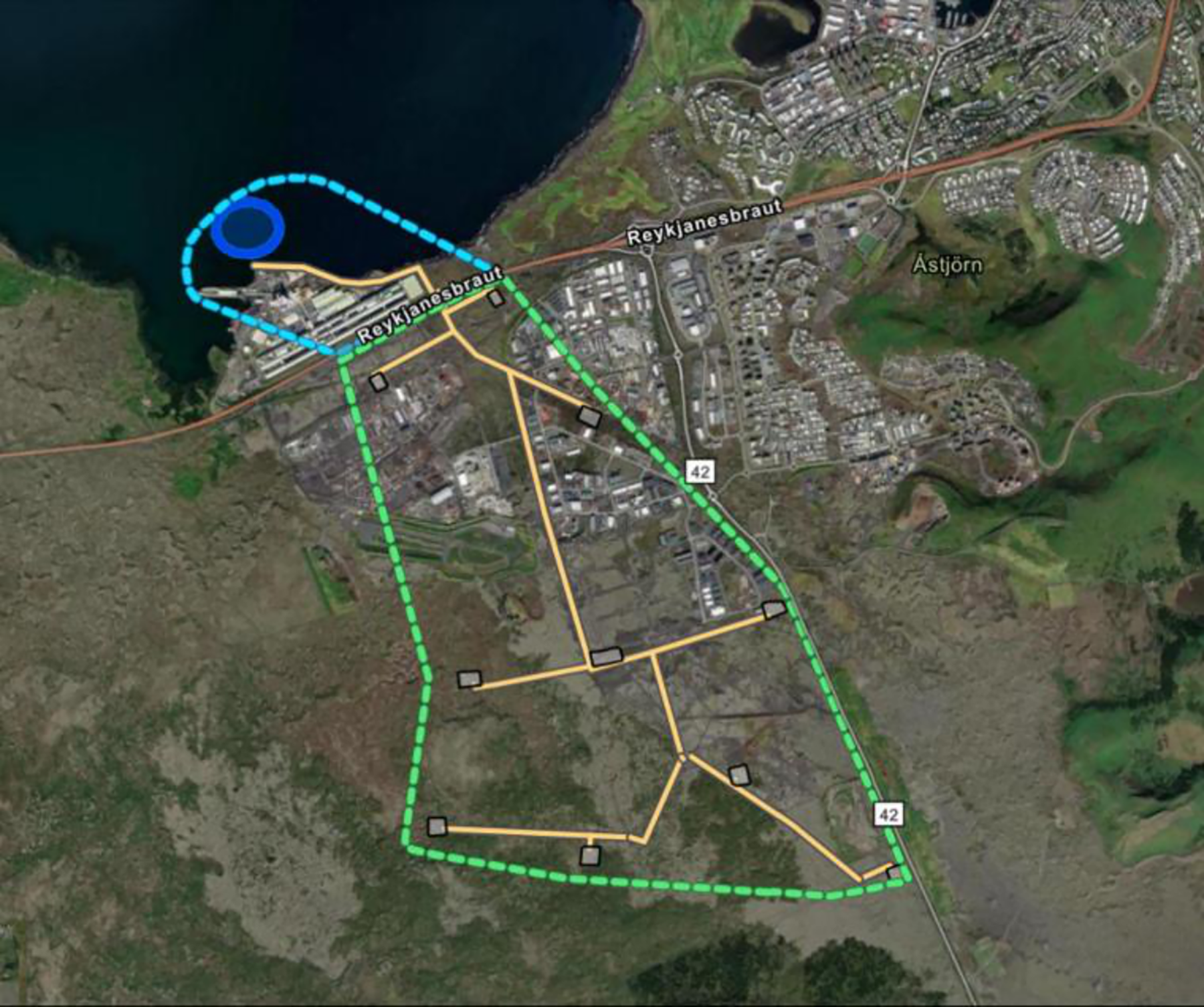
Map of proposed drilling sites for Coda Terminal in Vellir, Hafnarfjörður. The image shows drilling pads 2 and 8 with an 800-m radius, illustrating their proximity to the residential neighborhood. Source: Skipulagsstofnun. Coda Terminal—Móttöku- og geymslustöð fyrir koldíoxíð: Umhverfismatsskýrslur og gögn. https://island.is/s/skipulagsstofnun/gagnagrunnur-umhverfismats/Coda-Terminal-mottoku-og-geymslustod-fyrir-koldioxid-27-1-2023 (Last accessed on May 16, 2025).
Public opposition culminated in town hall debates, calls for a referendum, and grassroots mobilization via the Facebook group Mótmælum staðsetningu Coda Terminal (e.g., Protest the location of Coda Terminal). 36 The associated petition gathered 6090 signatures, amounting to nearly 20% of Hafnarfjörður’s population of ∼31,500, demonstrating the scale of public concern and widespread local opposition. 37 In the petition, residents objected to the siting of an experimental project within the town’s limits. They called on the Hafnarfjörður municipality to either abandon the project or, at a minimum, submit the decision to a public referendum. 38
Following the project’s cancellation in March 2025, 39 Carbfix announced plans for a new facility in Þorlákshöfn, Ölfus (South Iceland, population ∼2100), with operations projected to start in 2029 40 and signed a memorandum of understanding for a prospective site in Húsavík, Norðurþing (North Iceland, population ∼2300), in May 2025. 41
MATERIALS AND METHODS
The lead researcher, a native Icelander, followed the Coda Terminal debate from its early stages. The study draws on ethnographic fieldwork conducted in Hafnarfjörður, in the greater Reykjavík area, between May 2024 and February 2025, to examine how community consultation, or the lack thereof, shaped responses to the proposed CCS project.
A total of 13 in-depth, semi-structured interviews were carried out with residents of Hafnarfjörður, all in Icelandic. Interviews focused on individuals living in or near the Vellir neighborhood, which bordered the proposed Coda Terminal site. Participants were identified through purposive and snowball sampling, including outreach via social media and referrals through local networks. 42 The aim was to gather diverse perspectives, from active participants in the protests to those who were more skeptical or unsure. Interviews, lasting 45–90 minutes, were conducted in person or online, covering awareness of the project, key concerns, and experiences of information sharing and consultation. With informed consent, interviews were recorded, transcribed verbatim, and analyzed thematically using qualitative software. 43
In addition to interviews, participant observation played a key role. 44 The study involved attending multiple town hall meetings in Hafnarfjörður, where Coda Terminal was presented and debated. Observation extended into online spaces as well. The Facebook group Mótmælum staðsetningu Coda Terminal ([e. stands for the english translation to “Mótmælum staðsetningu Coda Terminal”] Protest the location of Coda Terminal), which was established on June 8, 2024, was closely followed throughout the research period. 45 With ∼4700 members at its peak, the group served as a key site of community mobilization and information sharing. Observations from the group informed the interview process and helped situate individual narratives within broader patterns of digital activism and grassroots resistance. 46
Together, semi-structured interviews, participant observation, and online monitoring enabled triangulation across multiple data sources, as illustrated in Figure 2.
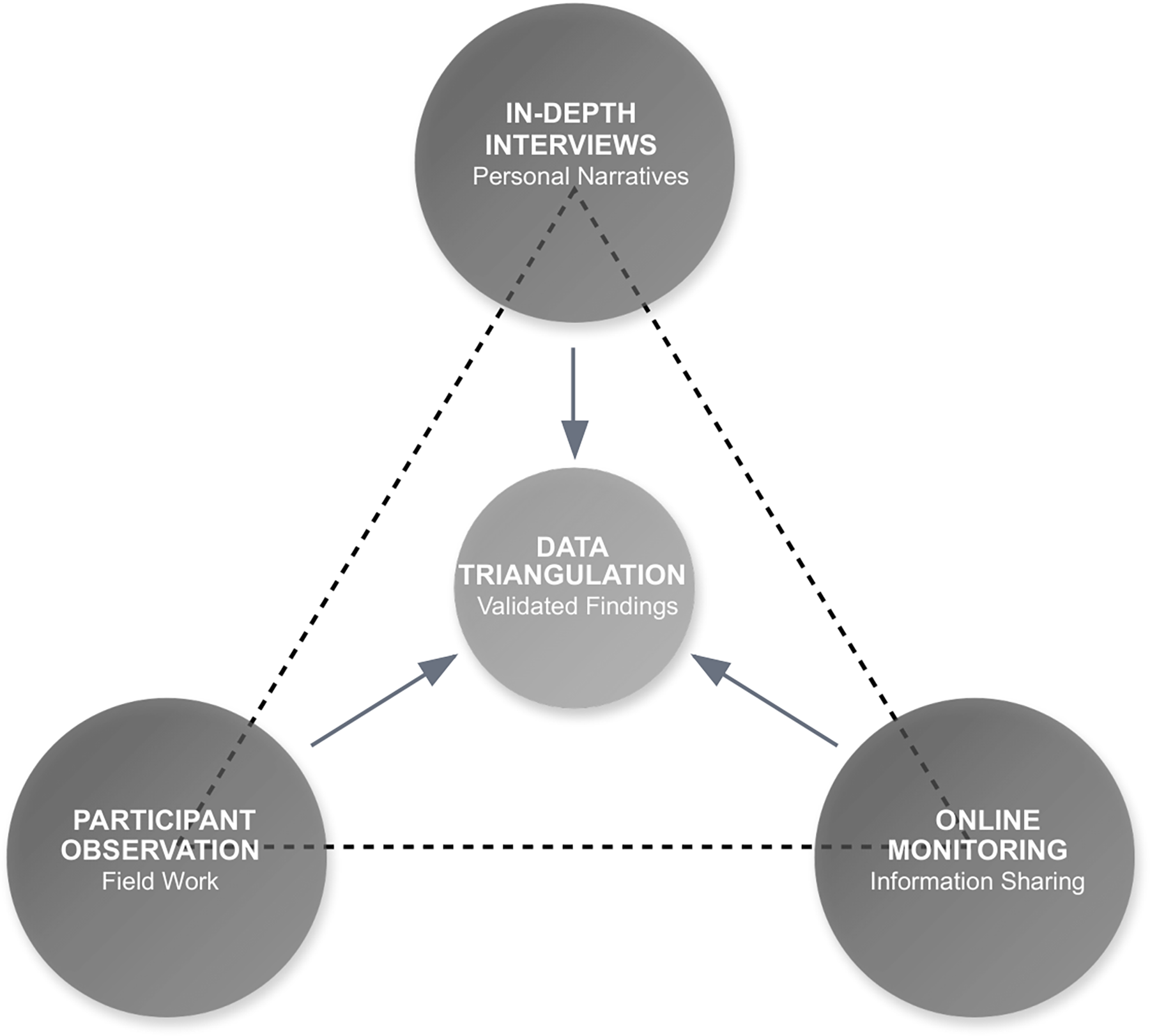
Overview of data triangulation strategy used in the study, combining in-depth interviews, participant observation, and online monitoring.
RESULTS
Local resistance to Coda Terminal was driven by frustration over the lack of transparency, procedural exclusion, and the absence of meaningful community consultation (Fig. 3).
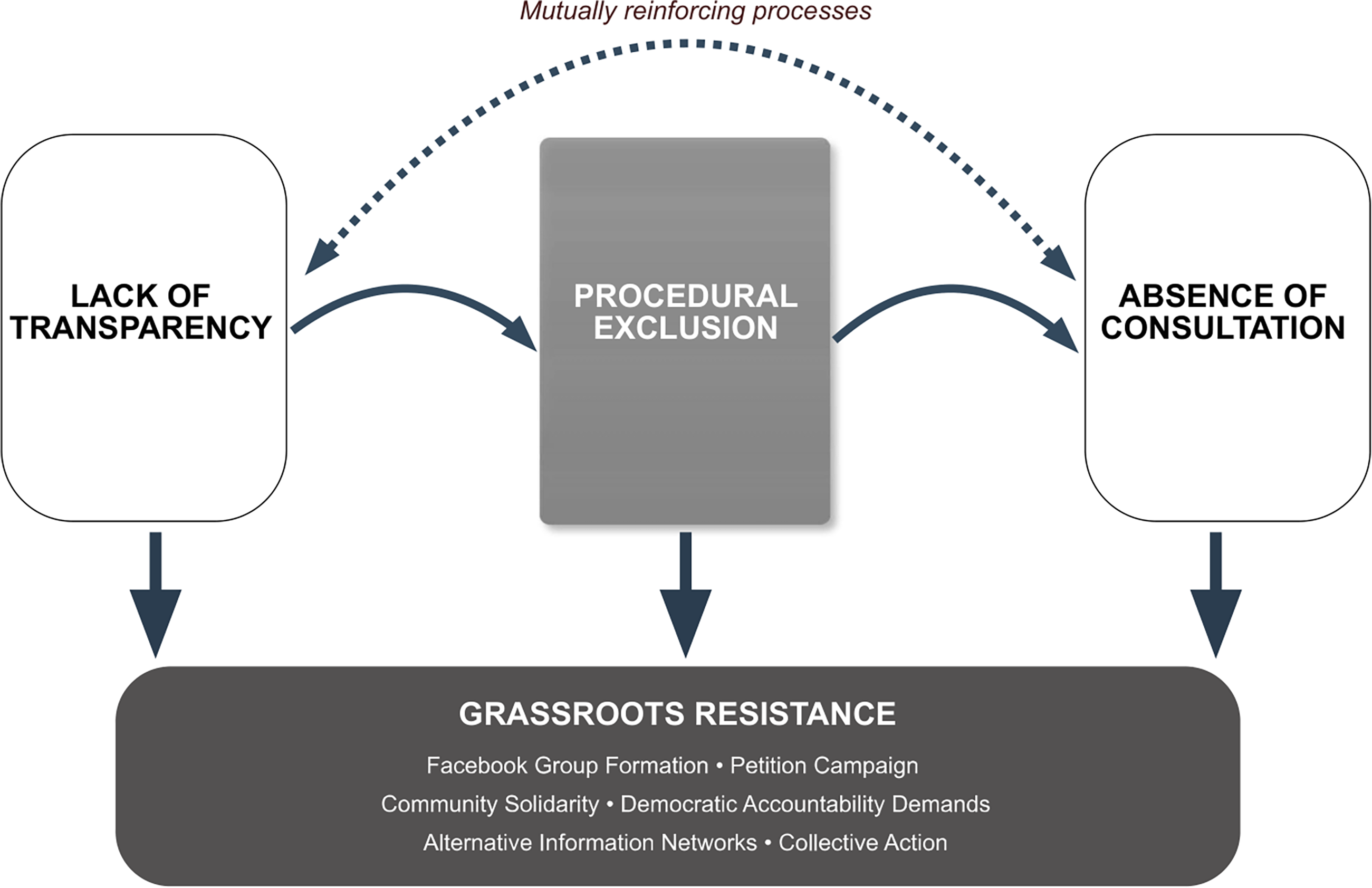
Three-pillar framework illustrating key dimensions of community resistance: lack of transparency, procedural exclusion, and absence of consultation.
Lack of transparency
Participants expressed dissatisfaction with Carbfix and Hafnarfjörður municipality over limited transparency, noting that they were informed about site selection and CO2 storage plans only after decisions had already been made.
One resident remarked: Proper presentations did not occur until April 2024 … that made it really difficult to follow what was happening or to voice concerns in time.
Another expressed frustration about the lack of early consultation: This [Coda Terminal] was approved long before the public knew about it …. There was no real consultation, just announcements that it had already been decided. This isn’t democracy; it’s executive rule.
Moreover, there was widespread distrust toward the communicative practices of Carbfix, with several interviewees describing the information presented as overly technical or selectively framed to highlight benefits while minimizing concerns. One participant explained: We basically just had this dropped in our laps … [n]o one explained to us why this was supposed to come here, or how much CO2 was going to be injected into the ground. It was like they just wanted to avoid the discussion. I don’t even know who approved this or when—it just suddenly became a fact.
Others described needing to search for reliable information themselves: I had to find the information myself … ask neighbours, check the Facebook group or search public records. No one ever clearly explained it.
These statements reveal not only a gap in information but also a breakdown in trust. Residents were expected to accept a large infrastructure project on vague terms, with little clarity about its implications. This lack of early and clear communication fostered suspicion and undermined confidence in both Carbfix and local authorities.
Procedural exclusion
Many participants reported feeling excluded from meaningful participation in decision making around Coda Terminal. Residents overwhelmingly described town hall meetings as mere formalities rather than genuine opportunities for dialogue.
One interviewee described the tone of the meetings: It felt like everything had been decided for us. We were just invited to listen … not participate. They spoke to us, not with us.
Several described these sessions as top-down and structured around presentations, often using technical language and visuals, with little space for open discussion or critical engagement: There was no real dialogue. Just shiny presentations and nonsense. When someone asked if they [representative from Carbfix] would drink the water they planned to inject underground, they just changed the subject.
This reinforced the perception that residents were not viewed as legitimate stakeholders. As one interviewee noted: You couldn’t say your piece in an open forum … this was just a presentation. No conversation. No consultation.
These frustrations were particularly strong among residents of the Vellir neighborhood in Hafnarfjörður, who lived closest to the proposed site. Despite their proximity, many felt their concerns were dismissed. One resident noted: I asked at the meeting about safety assessments or risk analysis, but the answer was just something about following international standards … that tells me absolutely nothing.
Such responses left participants feeling excluded from meaningful dialogue. Others felt the meetings were merely symbolic: We had already geared up for a real debate … but it turned out to be more of a performance than a meeting. It felt like they just came to tell us what was happening, not to ask us what we thought.
In addition to formal limitations, participants described a broader atmosphere of constrained discourse, both offline and online. One participant noted: They are lobbying everywhere. At the Rotary Club, at the old folk’s home. Their presentations are slick, but no one’s allowed to ask questions.
The experience of pushback extended to online spaces, where some participants reported being silenced or framed as troublemakers for expressing dissent. I was told I couldn’t post in a climate group [on Facebook] because I was critical of Carbfix. I wasn’t rude … I just questioned things. There’s this atmosphere, where if you’re critical, you’re the problem.
These patterns contributed to a broader feeling of alienation and procedural injustice. Although the project was framed as a public good, the decision-making process was experienced by many as top-down, exclusionary, and lacking legitimate avenues for public input.
Grassroots resistance
In response to perceived procedural exclusion, grassroots organizing emerged as a powerful form of community resistance. Many residents began mobilizing to challenge the project’s implementation.
Mobilization was initiated by local residents of Hafnarfjörður through the Facebook group Mótmælum staðsetningu Coda Terminal,
47
whose administrators coordinated updates and launched the petition calling for a referendum. The campaign was directed primarily at the Hafnarfjörður municipal council, which residents viewed as the key decision-making body with authority over the project. One participant described the role of the Facebook group: I found out about this [Coda Terminal] through Facebook. I got more information there than from the municipality … [and] I saw that I wasn’t alone.
Interviewees frequently highlighted the petition for a public referendum, which served as a focal point of public pressure.
48
The petition became a symbol of community solidarity. As one resident stated: This isn’t just a handful of people … thousands signed. That says everything that needs to be said.
Another echoed the sense of collective strength: It was truly incredible to see how many people took part. This petition showed that it wasn’t just a small group complaining … these were residents from all over town who were unhappy. We weren’t asking for anything unreasonable, just a vote.
Several participants emphasized that the issue was not opposition to climate action or even the CCS itself, but the democratic principles in which environmental decisions should be made. One participant clarified: It was never about opposing climate action … [but] democratic processes must be respected. Otherwise, all trust is lost.
Another reflected on the local precedent: We’ve had referendums before in Hafnarfjörður, like when the aluminium plant was going to expand. Why not now? This isn’t about causing a fuss, it’s about democracy.
Despite feeling excluded by formal processes, community-led organizing helped many participants feel a renewed sense of agency and solidarity. As one interviewee explained: I had never taken part in anything like this before. But when you see there’s a group of people fighting for the same thing, it gives you courage.
Another expressed hope in the collective momentum: It was amazing to see how many people got involved. That sense of solidarity … people coming together and saying, “This isn’t how things should be done.” That gave me hope.
In the absence of formal avenues for participation, the community forged its own space for democratic engagement. Residents asserted not only their right to be heard but also their vision for how climate action must be pursued, with transparency, inclusion, and accountability.
Community interpretations of the cancellation
In March 2025, Carbfix officially canceled the proposed site of Coda Terminal in Straumsvík, Hafnarfjörður. The company attributed this decision to project delays and the lack of a strong collaborative foundation with municipal authorities. However, many interviewees believed that local resistance, including the petition, sustained online mobilization, and media attention, may have contributed to the decision. 49
A group of administrators from the Facebook protest site described the cancellation as “a partial victory,” noting that they were aware the final decision likely had economic motivations but still felt that “the public pressure tipped it over the edge.” As one Facebook group administrator explained: We know it probably came down to money, but I also think they didn’t want the bad press. I think they saw how strong the resistance was and decided it wasn’t worth it.
Several participants pointed to stalled economic negotiations between Carbfix and Hafnarfjörður municipality, particularly over harbor fees and local infrastructure costs, as contributing factors. However, they also emphasized the political weight of the community organizing. One resident stated: It all stalled because Hafnarfjörður didn’t want to pay what Carbfix asked for…harbor fees, utility fees, and so on. But our pressure made it politically difficult to push forward.
Another reflected on the role of media and public opinion: The backlash in the media and from the town [Hafnarfjörður] absolutely had an effect. I’m sure the economics mattered most, but the resistance made it politically inconvenient to push it through.
Many participants described the cancellation as a form of validation, proof that collective action could influence high-level decisions. As one person recalled: We were fully geared up for a campaign … we even made leaflets for a referendum. So … when the project was cancelled, it felt like all that work had made a difference.
Another added: We felt like we had done something. Like, even if we weren’t the main reason, they heard us.
Although Carbfix publicly cited procedural and logistical issues as the basis for their decision, the belief among participants that their efforts mattered reinforced the perceived legitimacy of their resistance. 50 It demonstrated how local mobilization can challenge top-down climate decisions and create a new space for democratic engagement.
DISCUSSION
The case of Coda Terminal in Hafnarfjörður shows how climate mitigation initiatives, when implemented without transparent governance and democratic legitimacy, can provoke grassroots resistance, even in countries widely regarded as environmental leaders. 51 More importantly, the findings demonstrate that the urgency of climate action does not automatically render specific interventions publicly legitimate. Climate mitigation projects cannot rely on their environmental purpose alone to justify how they are introduced, governed, or imposed upon local communities. Despite Iceland’s reputation for progressive climate policy, 52 this article highlights how democratic deficits in decision making can generate mistrust and mobilization. Most participants did not oppose CCS itself but resisted the process by which the project was introduced. At the same time, some expressed unresolved concerns about the risks and efficacy of CCS itself. These concerns were not necessarily a wholesale rejection of the technology, but rather reflections of the absence of a trusted venue in which they could be deliberated. These dynamics reflect broader debates on procedural justice and deliberative democracy, 53 where democratic legitimacy depends not merely on consultation but on opportunities for meaningful influence and shared authority in decision making. 54
This case underscores tensions between global climate goals and local priorities. 55 Many participants experienced the process as exclusionary and technocratic, with international climate ambitions appearing to take precedence over local concerns. This illustrates a broader risk that “green” solutions may replicate top-down governance practices, sidelining local knowledge, participation, and accountability. 56 The findings also support anthropological perspectives that interpret resistance not simply as rejection but as “refusal.” 57 In Hafnarfjörður, opposition was not primarily directed at climate action itself but at a process perceived as undemocratic.
Finally, this case demonstrates the relevance of EJ debates beyond traditionally studied contexts. Although much EJ research has rightly focused on racialized or impoverished communities, 58 the Hafnarfjörður case shows how questions of procedural justice and democratic legitimacy can also emerge in relatively affluent democratic settings. These findings suggest that even communities not conventionally understood as structurally marginalized may become procedurally marginalized when they are excluded from meaningful participation in environmental decision making. At the same time, the Hafnarfjörður case also differs in important ways from many more conventionally recognized EJ struggles. Residents in this case may have had relatively stronger institutional, political, and social resources through which to contest the project, including access to municipal channels, media visibility, and established democratic mechanisms such as calls for a referendum. This does not diminish the procedural injustice identified here, but it may help explain why local resistance was able to generate public pressure and political consequences. Rather, the case suggests that a more meaningful distinction may lie not only in whether procedural marginalization occurs but also in the kinds of outcomes communities are able to secure in response.
CONCLUSION
This article has examined Coda Terminal as a case study to show how democratic deficits in decision making and community consultation can generate resistance, even when projects are aligned with global climate goals. Although CCS is increasingly presented as a key climate mitigation strategy, its success depends not only on technological feasibility but also on social legitimacy. 59 In this case, resistance focused not on climate action itself but on how decisions were made and who had the right to participate. Residents called not for the abandonment of climate action but for accountability, transparency, and democratic inclusion. The findings demonstrate that access to information, meaningful public engagement, and procedural fairness remain essential for building and maintaining public trust, even in nations like Iceland that are often praised for their progressive climate policies. 60
Taken together, the Coda Terminal case shows that procedural marginalization can emerge even in affluent democratic settings. 61 This makes it a cautionary case: If such deficits can arise under relatively favorable conditions, the risks may be even greater in contexts with weaker democratic safeguards or fewer institutional resources. If future CCS projects are to gain and maintain public support, they must be developed in consultation with local communities rather than imposed upon them. As Iceland and other nations pursue ambitious climate strategies, the Hafnarfjörður case serves as a reminder that climate action must be not only effective but also legitimate, inclusive, and accountable.
Footnotes
AUTHOR’S CONTRIBUTIONS
E.V. led the conceptualization and design of the study, conducted all data collection, including interviews and fieldwork, analyzed the data, and prepared the first draft of the article. J.G.R. and H.Ö. were responsible for project management and supervision. All authors reviewed and provided comments on the article. All authors contributed to the interpretation of results, critically revised the article, and approved the final version for submission. The authors declare no competing interests.
AUTHOR DISCLOSURE STATEMENT
No competing financial interests exist.
FUNDING INFORMATION
This was funded by The Eimskip University Fund/ The University of Iceland. Grant number HEI2025-96510.