







Abstract
Involving residents in meaningful participation in heavily polluted regions faces many obstacles. This study focuses on the conditions that enhance individual involvement in civic initiatives against environmental hazards in one of the largest cities in the United States, facing chronic and heightened air pollution exposure. The work is based on a large-scale representative survey of 1950 residents in Fresno, California. The survey was carried out by a multiracial coalition of community-based organizations. The findings suggest that those individuals with ties to capacity-building organizations and with civic engagement experience were the most willing to attend local meetings about air pollution. In addition, days with higher levels of air pollution also acted as an environmental threat, motivating civic action. The study suggests that increasing public participation in pollution mitigation begins with investing in the types of civic organizations that specialize in capacity building for public engagement in order to advance the environmental justice principles of procedural justice.
INTRODUCTION
Employing a civic capacity framework, this article examines public participation in addressing major environmental hazards such as air pollution. Understanding participation in disinvested communities is a core principle of environmental justice in terms of procedural justice—the inclusion of communities in the decision-making processes that impact their health and well-being.1,2 Often, the starting place for community-engaged policies on pollution mitigation begins with local meetings. Local meetings create spaces for community-led voices and strategies for solutions (i.e., community air monitoring or developing alternative transportation routes) and compensation for past environmental harms.3,4 Moreover, in states such as California, new programs have institutionalized governmental investments in environmental protection, including air pollution. 5 Nonetheless, these investments are most effective with substantial participation and involvement of frontline communities. 6 This study focuses on the civic capacity conditions that encourage individuals to participate in local meetings, whereby environmental change is initiated at the grassroots level. We examine these civic engagement processes in the city of Fresno, located in the heavily polluted San Joaquin Valley region of California. The findings support a capacity-building perspective and indicate that people are more interested to engage in air quality when they are involved in civic organizations and behaviors and exposed to environmental threats from air pollution.
Theoretical perspectives on civic capacity and engagement over environmental harms derive from two bodies of literature: studies on social movements and research on environmental justice. Social movement participation research at the individual level addresses the cultural, social, and economic differences between those willing to participate in civic action and those who are not.7,8 Among the factors that could explain these differences, extant literature highlights biographical availability, membership in organizations, and past engagement in civic action.9,10,11,12 The combination of affiliation with a civic engagement organization and past participation can be considered as a definition for civic capacity, or the skill sets that increase the probability of individuals to become involved in public issues such as air quality.13,14 In addition, scholars of social movements emphasize threats or “bad news” as mobilizing individual participation,15,16,17 especially for environmental movements.18,19
Literature on environmental justice examines the uneven distribution of environmental hazards and how they disproportionately impact disadvantaged communities.20,21,22 Environmental justice calls attention to environmental threats (such as air pollution) as the core motivating factor for civic engagement.23,24 Environmental justice communities are also more likely to mobilize individuals with organizational affiliations and civic engagement experience than those lacking such social resources. 25 Environmental justice perspectives also call for procedural justice in decision making in polluted communities in terms of active decision making and participation by the people most impacted by environmental harms. 26 Based on these bodies of literature, we propose a multidimensional approach to individual participation addressing environmental hazards such as air pollution. This involves (1) civic organizations, (2) civic engagement experience, and (3) level of environmental threat.27,28
Civic organizations
Research analyzing civic organizations and capacity building in fostering individual participation against environmental harms is an incipient area of study. 29 The type of civic organization with which actors in a given community affiliate is often a factor in involvement in local issues. Among them, those organizations oriented to capacity-building principles may be the ones that positively relate to one’s willingness to participate in meetings and public forums against environmental hazards such as air pollution. Capacity-building organizations focus on increasing the civic capacity of individual residents in nearby communities, which can be used to encourage public engagement over multiple issues, including environmental conditions. 30 These outward-oriented organizations that build the capacity of populations within their localities include labor unions and community-based organizations (CBOs). In the case of labor unions, recent research underscores the nexus of grassroots labor organizing and environmental outcomes, for instance, the coalitions searching for a Just Energy Transition or the Green New Deal have overcome narratives that depict a conflict of jobs versus ecological protection.31,32,33,34 These conflicts often take place when environmental advocates fail to consider the impacts on workplaces and working-class communities. At the same time, CBOs have usually constituted the backbone of environmentally based collective action, particularly of those following environmental justice principles.35,36 Both labor unions and CBOs provide training sessions, workshops, and campaigns involving how to be an effective advocate for a range of civic issues, from electoral registration to participatory budgeting and environmental risks.37,38,39 These types of organizations build civic capacities in participants through their everyday functioning: identifying community problems, speaking publicly, circulating key information, exercising social accountability, attending local civic meetings, communicating with elected officials, and putting forth their demands. 40
Civic engagement experience
Besides organizational membership in capacity-building collectivities, the frequency of prior civic experience is also a potential facilitating factor in future civic engagement. This dimension refers more to the quality of civic capacity in terms of the actual use of civic skills, including an increasing sense of efficacy from past civic engagement activities. 41 Such skills and dispositions motivate involvement in community initiatives. If such previous involvement includes an enhancement of “strategic capacities,” 42 such as organizing a petition or volunteering for a phone banking/text banking drive, then it is very likely that they could encourage the same individuals to join campaigns over additional local concerns. For example, many participants in the community struggles against air and water pollution in Louisiana’s “Cancer Alley” had previous active engagement in civil rights advocacy. 43
Level of environmental threat
Environmental threats refer specifically to the expected negative impact—in terms of health, socioeconomic status, and well-being—of an environmental hazard, such as air pollution.44,45 When an environmental threat is perceived to worsen environmental health, then we can expect an increase in the likelihood of one’s interest in acting to prevent it. Willingness to participate in civic events addressing environmental quality would be especially strong when the environmental threat is visible 46 and severe, 47 such as periods with excessive smog, agricultural dust, or wildfire smoke in the case of air pollution. In this study, we empirically examine the multiple dimensions of civic affiliations, civic engagement experience, and environmental threat, along with several structural controls on interest in participating in local air pollution abatement. Such an understanding enhances strategies of expanding procedural justice and community involvement in highly polluted regions.
BACKGROUND
According to the American Lung Association’s 2022 State of the Air rankings, California’s San Joaquin Valley is home to three of the “most polluted cities” of over 200 metropolitan areas in the United States, which include Bakersfield, Fresno-Madera-Hanford, and Visalia. 48 Fresno ranks the highest for short-term particle pollution and second highest for year-round particle pollution (see Fig. 1). Moreover, MIT’s air pollution inventory reports that Fresno County exhibited the highest risk of exposure to airborne particulate matter out of 3100 counties in the United States. 49 High concentrations of particle pollution are associated with increased hospitalizations, asthma attacks, cardiovascular disease, lung cancer, COPD, heart attacks, vulnerability to COVID-19, and premature death.50,51,52 The region has also been negatively impacted by the mounting climate crisis with wildfire smoke, extended heat waves, and drought, which environmental justice communities call cumulative health impacts. 53
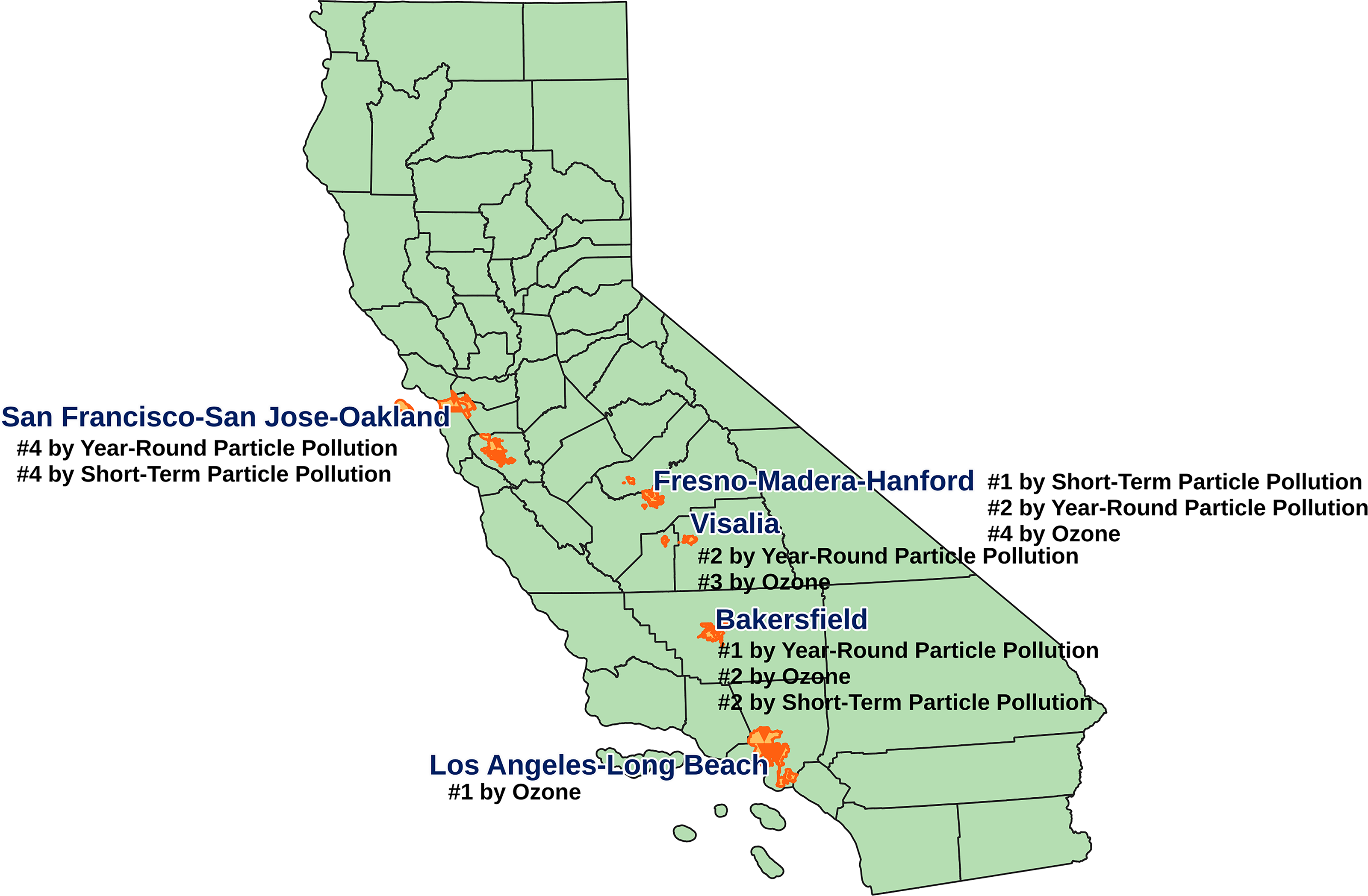
2022 National Air Pollution Rankings by the American Lung Association’s State of the Air report.
The State of California has committed to investing funds into air pollution reduction programs, especially for designated disadvantaged communities (DACs). For example, Assembly Bill 617 institutionalizes local community participation in developing plans to reduce air pollution while providing funds and technical assistance. 54 Assembly Bill 617 calls for the California Air Resources Board to focus on vulnerable populations and involve community participation in the planning process. This bill established the Community Air Protection Program, which administers the Community Air Grants. 55 Under environmental justice principles, this program disburses resources, assistance, and support for communities to foster participation in the “community emissions reduction program.” 56 Funding for these grants comes from California’s $30 billion cap-and-trade program as part of the Greenhouse Gas Reduction Fund, one of the largest global carbon offset markets.57,58 At the federal level, since 1981, the U.S. Environmental Protection Agency has been implementing a public participation policy. The participation policy has been continuously revised to enhance greater community engagement in the agency’s programs, including those related to reducing pollution and other hazards. In 2024, the policy was updated as the EPA Meaningful Engagement Policy. 59 Both state and federal programs require community involvement in addressing environmental hazards in heavily polluted regions, including the city of Fresno, the site of this study.
The state of California has designated nearly half of the census tracts (46%) in the city of Fresno as Disadvantaged Communities (DACs)—communities experiencing high pollution levels with lower median household income. 60 Out of California’s 1800 DACs, 5 of the 10 most polluted census tracts are located in the city of Fresno. A majority of the city’s residents identify as Latino, with an additional 14% identifying as Asian American and 6% as Black. Regions with a majority of non-White residents experience disproportionate levels of air pollution.61,62 Understanding the correlates of civic engagement on pollution issues is critical in developing shared governance over local policy development to mitigate environmental hazards and seek solutions for equitable economic development, especially for the populations residing in the most vulnerable communities who suffer more from health hazards associated with air contamination.63,64,65
METHODS
The study is based on a representative survey sample of registered voters in the city of Fresno, CA, the fifth-largest city in the state. 66 Between August 18 and September 14, 2020, the Fresno County Civic Engagement Table (FCCET), in partnership with the University of California-Merced Community and Labor Center, carried out a community needs survey. The composition of FCCET incorporates a multiracial coalition of six CBOs—Hmong Innovating Politics, Communities for a New California Education Fund, the Fresno Metro Black Chamber of Commerce, Faith in the Valley (affiliate of Faith in Action), Jakara Movement, and Leadership Counsel for Justice and Accountability. The FCCET participated in the construction of the survey design. The FCCET also conducted a random sample phone survey of 1950 Fresno registered voters with landlines and cell phones. Those registered voters without a phone line, underage groups, and the adult population with only a work permit (temporary or permanent), nonresident, or undocumented status were not included in the sample. 67 The overall response rate was 33% once contact was made with a respondent. These are standard response rates for representative phone surveys in recent years. 68 The representative sample was stratified with random selection from each of Fresno’s seven city council districts. Considering the ethnic composition of the population of Fresno, as a Hispanic majority city (50.5% Hispanic or Latinos, according to the 2020 census), the questionnaire was available in English or Spanish. The survey asked several questions regarding civic engagement and demographic background characteristics. The dependent variable in the study is individual interest in participation in meetings regarding air pollution. The variable was measured in a dichotomous format, asking respondents if they would be willing (yes/no) to participate in a local meeting about air pollution; yes was coded 1 and no was coded 0. Despite the limitation of “hypothetical bias error” (alignment of attitudes and actual behaviors), 69 the variable was an appropriate measure of the potential for involvement in public action about air pollution, even when respondents had not had the opportunity to act on it yet.
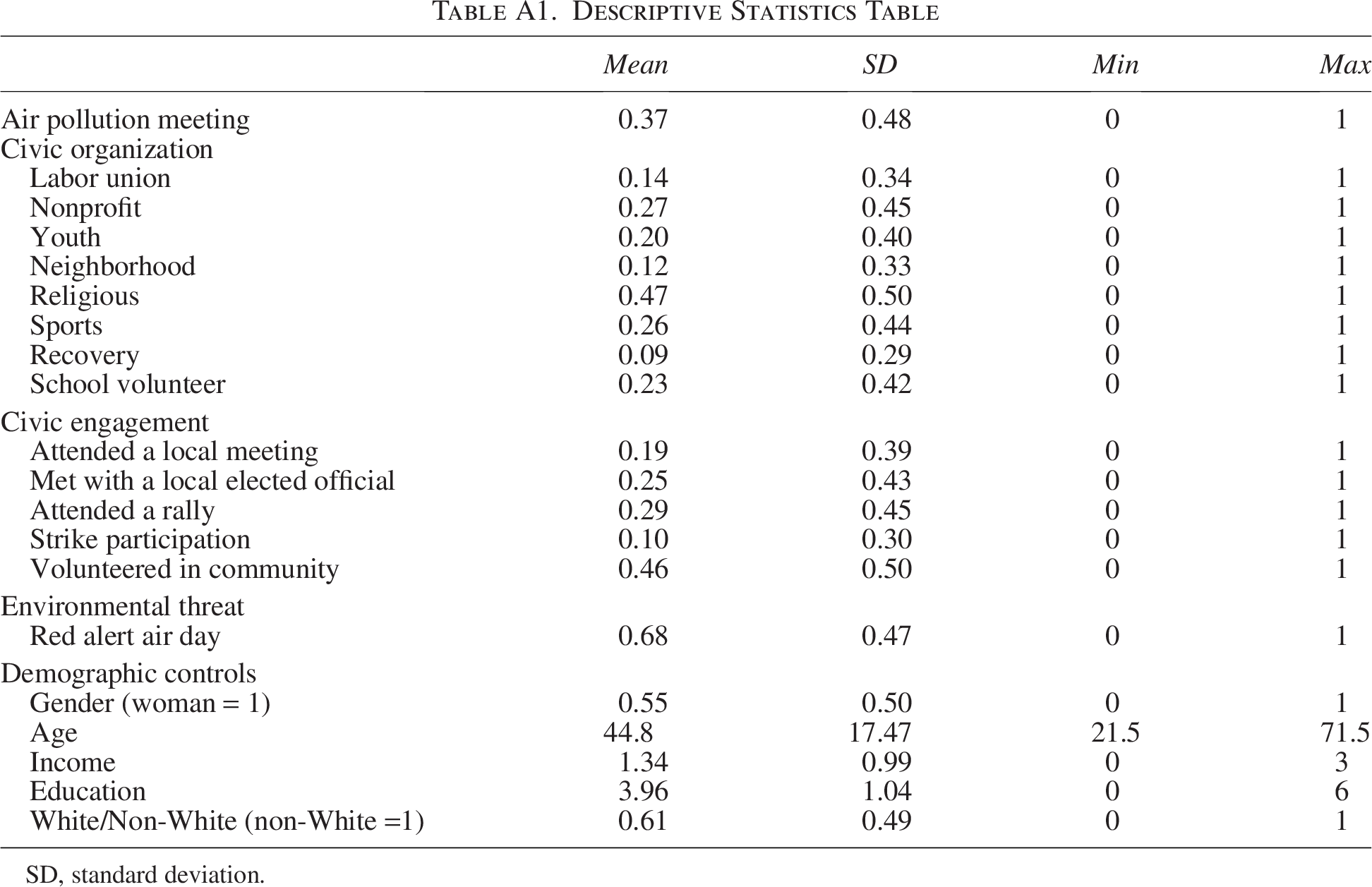
The independent variables include a range of civic organizations, civic engagement experience, and demographic items (see Table A1 in the Appendix). Respondents were queried about which types of civic organizations they were affiliated with as a binary measure of no affiliation (coded as 0) or affiliated (coded as 1). The question asked was, “Are you currently or have you previously been involved in any of the following local organizations?” The local organizations included: labor union, nonprofit, youth, neighborhood, religious, sports, self-help/recovery, and school volunteer. Another set of independent variables measured past civic engagement experience. Respondents reported yes (coded 1) or no (coded 0) if they participated in the following civic activities: attended a local meeting about quality-of-life issues, met with or contacted an elected official, attended a rally, participated in a strike, or volunteered in the community. For environmental threat from air pollution, the study measured if there was a “red” alert for air quality the day before the survey was conducted. This alert is generated by the San Joaquin Air Pollution Control Districts, according to their daily forecast of air quality in the region. These forecasts are based on an index from 0 (Good Air Quality) to 500 (Hazardous Air Quality), based on the presence of air pollutants, such as ozone, particulate matter (10), fine particulate matter (2.5), nitrogen oxides, sulfur oxides, hydrocarbons, and carbon monoxide. When the index surpasses the threshold of 151, a red alert is publicly issued because the air quality is considered unhealthy for all groups. 70 These variables are grounded in an objective measure of environmental threat in air quality. Nonetheless, how the circulation of the alerts (publicly available online and potentially shared from mouth-to-mouth, in social media or news outlets) affected the “threat perception” of the survey respondents goes beyond the study goals.71,72
A set of demographic controls incorporated gender, age, income, education, and race. We coded gender as 1 for female and 0 for male. 73 Age was measured as an ordinal variable with the following age classifications: age 18–25, age 26–35, age 36–45, age 46–55, age 56–65, and age over 65. To estimate with more precision the effects of age on participation in air pollution meetings, we recoded the age cohorts at their midpoints of 21.5, 30.5, 40.5, 50.5, 60.5, and 71.5. Income was measured as a four-category ordinal variable at the current household level as $0–24,999 (0), $25,000–49,999 (1), $50,000–74,999 (2), and $75,000 and above (3). For education, a seven-level ordinal classification was used for the highest level of education completed: none/incomplete primary (0), primary/elementary (1), junior high/middle school (2), high school (3), AA/community college (4), bachelor’s degree (5), and master’s degree or more (6). Race was measured as a dummy variable with those identifying as White coded 0 and those identifying as non-White coded 1. 74
Because the dependent variable is dichotomous (“yes” or “no”), a multivariate logistic regression model is used to predict the likelihood of Fresno residents participating in an air pollution meeting (Table 1). The results are presented as logit coefficients. Figure 1 shows the predicted probabilities of the effects of statistically significant covariates on local participation in meetings about air pollution.
Multivariate Logistic Regression Models Predicting Participation in Local Air Pollution Meetings, Robust Standard Errors in Parentheses (N = 1950)
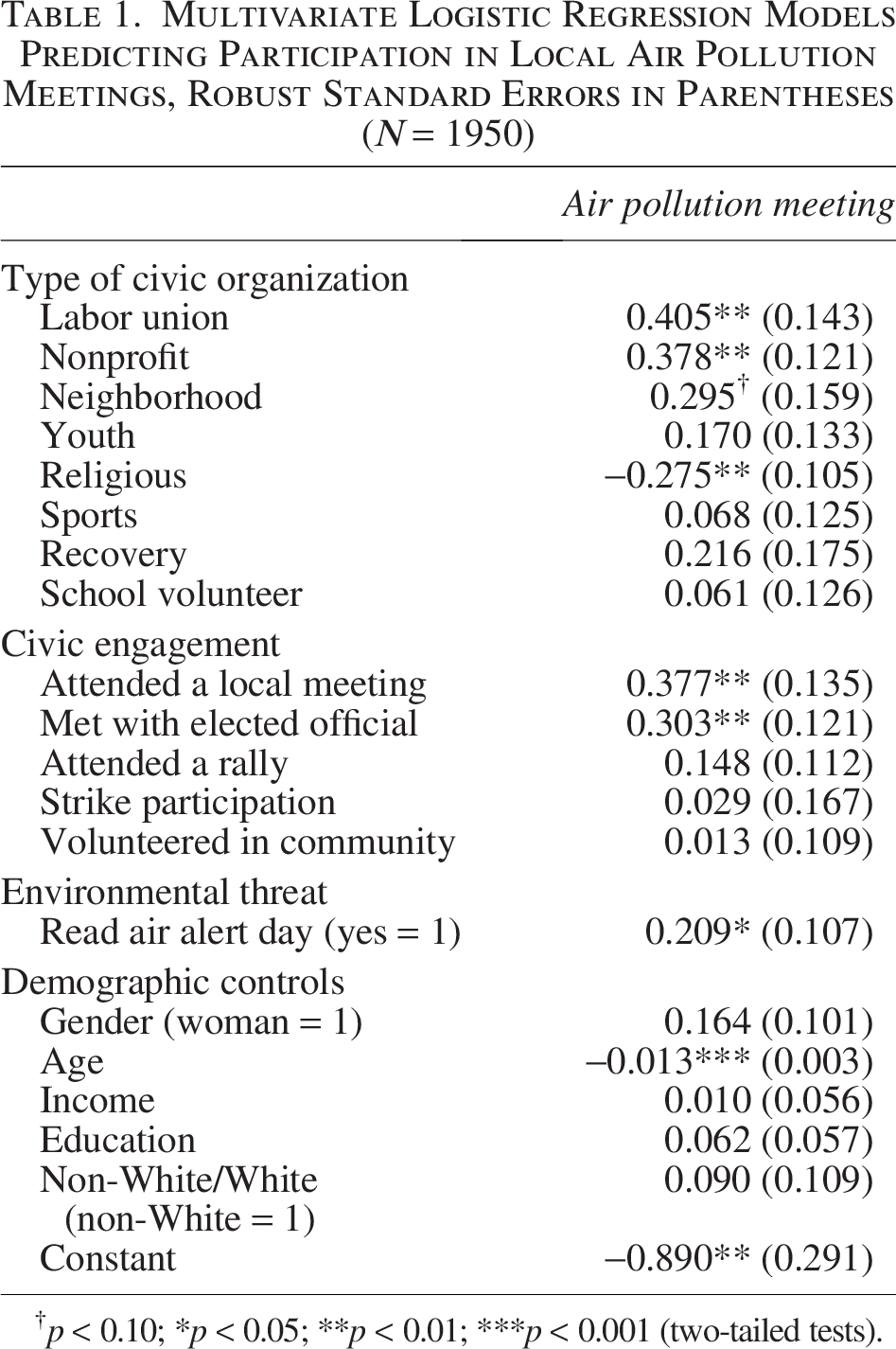
†p < 0.10; *p < 0.05; **p < 0.01; ***p < 0.001 (two-tailed tests).
RESULTS
In terms of the univariate statistics (Table A1 of the Appendix), more than one-third (37%) of the respondents expressed a willingness to attend a meeting regarding air pollution. The results of the multivariate logistic model for civic engagement in meetings about air pollution in Fresno are consistent with the expectations of the study (Table 1). Capacity-building organizations, such as labor unions and nonprofit organizations, are positively associated with an increase in the willingness to attend an air pollution meeting. Neighborhood organizations also present a similar relationship of increasing willingness to attend an air pollution meeting, although with a marginal degree of association. In addition, organizations not generally oriented to outward civic capacity building, such as sports, recovery, and school volunteer, are not associated with an interest in air pollution meeting attendance. Moreover, membership in religious organizations decreases one’s interest in partaking in this type of civic action against environmental harms. It should be acknowledged that a segment of the religious community plays a key role in community organizing and capacity building, 75 especially in the environmental justice struggles via the Black Church and the civil rights movement. 76 This study was drawn from a representative sample of the entire adult population and does not capture the civic work of some religious-based organizations.
Two forms of past civic engagement are also positively associated with willingness to attend local forums about air pollution. Specifically, attending a past local meeting and meeting with an elected official were positively related to the disposition to attend a meeting on air pollution. The more nonconventional social movement strategies of participating in rallies and strikes were not related to air pollution participation. This provides some evidence of the importance of everyday and routine organizing and capacity building by CBOs and labor unions in terms of teaching skills in civic participation, of attending city council meetings, and how to communicate with state and elected officials (vs. one-time protest events).
The presence of the environmental threat of air pollution at extremely unhealthy levels (red alerts) related positively to an interest in attending a local gathering. The visibility and severity dimensions of potential bodily harm were associated with more openness to act on the threat. For the demographic controls, only age was significant, with younger adults more interested than older adults in participating in local forums on air pollution. This finding is consistent with the growing participation literature on environmental advocacy, whereby participation decreases with age. 77
Figure 2 shows the change in predicted probabilities of the significant independent variables for willingness to attend a local meeting about air pollution. The number is the difference in the favorable response for joining a meeting on air pollution after a one-unit change of each covariate, holding the rest at their means. The greatest impact on motivating attendance at an air pollution meeting was being affiliated with a labor organization. Joining a labor union increases the probability of willingness to attend an air pollution meeting from 0.35 to 0.44, which is roughly a 28% increase. Affiliation with a nonprofit organization moved the probability by 9 percentage points (moving from 33% to a 42% probability of participation, a 26% increase), in contrast to those who do not hold such an affiliation. Regarding prior experiences of civic engagement, meeting with an elected official and attending a past local meeting had a significant impact on the favorable disposition to be part of a local air quality meeting. In the first case, having contacted an elected official increases the probability of joining an air pollution meeting by 7 percentage points. In the second case, the likelihood of attending a local meeting on air quality increased; the probability changed from 34% to 43%. The environmental threat of a red air alert also increased the probability of attending a meeting by 5 percentage points (from 33% to 38%).
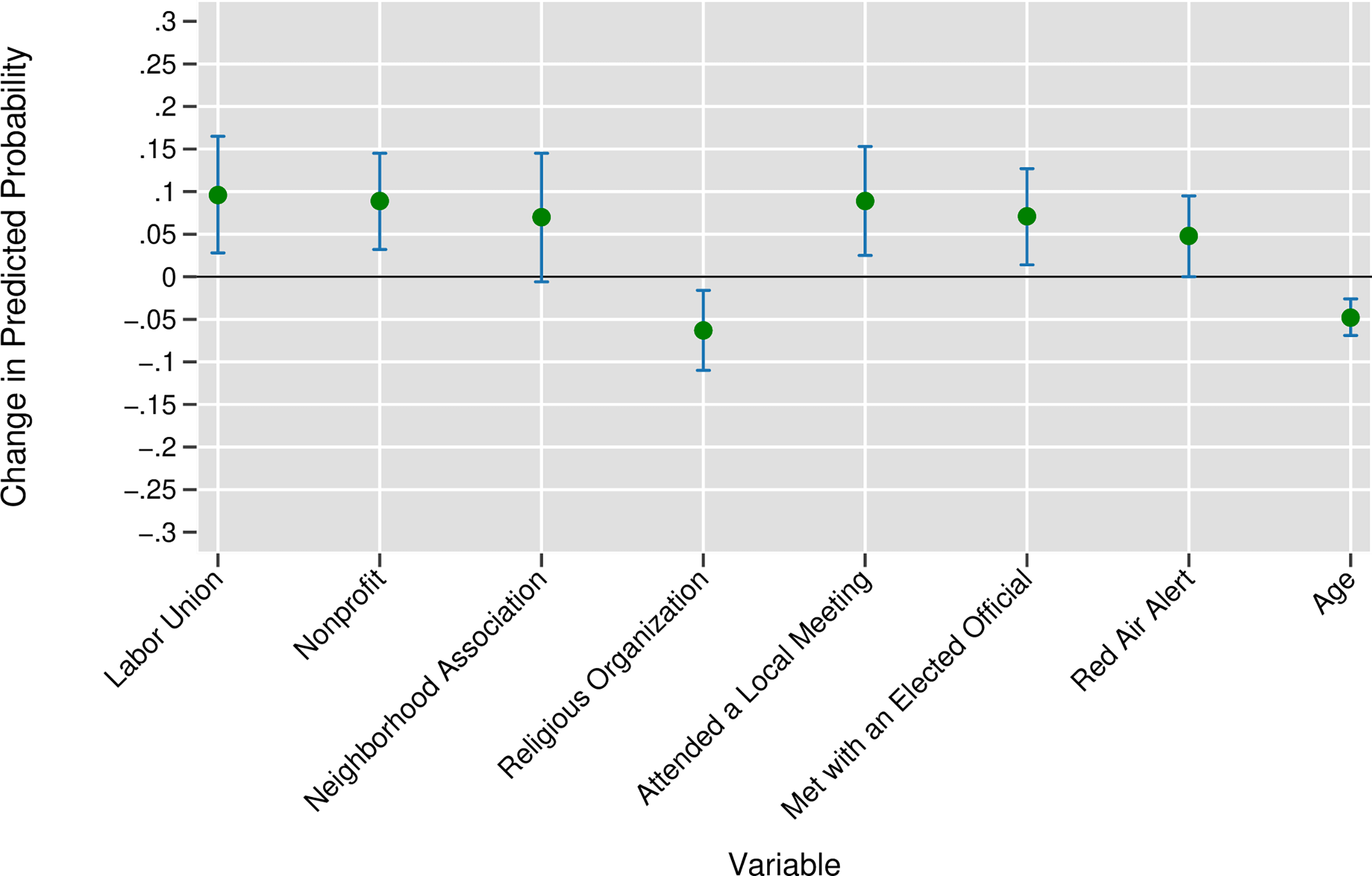
Change in predicted probabilities of air pollution meeting attendance.
Past interactions with government officials appear especially promising in developing long-term ties between the state and communities to build local partnerships. All of the above civic engagement activities found to be associated with attending meetings about air pollution are similar to those encouraged by labor unions and CBOs in their local capacity-building campaigns (e.g., neighborhood meetings and reaching out to local elected officials). State environmental and economic investment programs that collaborate directly with local civic organizations provide the types of novel coalitions that have been found to produce major environmental policies that benefit excluded groups. 78
The findings support deepening state partnerships with local community-based and labor organizations to enhance public participation. It is important to take into account the different relationships of capacity-building organizations with municipal/district levels of governance and state agencies versus foundations. State agencies often have programs and policies where they are required to partner with community organizations. However, in some cases, they may partner with non-capacity-building CBOs. In other cases, the interests and goals of state actors may vary dramatically from labor and community groups, such as focusing only on pollution mitigation strategies without considering other pressing needs of low-income populations.79,80 Hence, the articulation of environmental state agencies with these organizations comes with its own perils, given the diverse array of strategies, spheres of action, and needs with which each of them enters the partnership.81,82,83,84 Nonetheless, state collaborations with community and labor organizations may provide effective public investment for engaging communities (and widening participation) around action on initiatives addressing air quality in the most polluted regions, such as Fresno and the greater San Joaquin Valley. In the case of philanthropic foundations, they must make difficult decisions in terms of funding civic groups, both in terms of selecting CBOs with a track record of expanding civic engagement and not alienating other community organizations also deserving of funding.85,86 The type of state and philanthropic intervention in civic capacity could be critical in highly polluted cities to develop inclusive policy solutions addressing the epidemiology of air pollution and health hazards.87,88
DISCUSSION AND CONCLUSION
The civic capacity perspective and the research design allow an assessment of the differential contributions of civic organizations in motivating public engagement about air quality. Among them, experiences in labor organizations stand out in the study findings. In the United States, the first Earth Day in 1970 focused partially on the passage of the Clean Air Act. Labor unions played a major role in mobilizing the massive turnout for the historic event, including the United Auto Workers. 89 This study also showed the role of labor union affiliation in increasing interest in addressing air pollution at the individual level. Labor unions advocate for occupational health and safety, which also includes air quality in the workplace. 90 Regions such as the San Joaquin Valley of California count large numbers of outdoor workers in agriculture and construction-related industries who are impacted by air pollution. As labor unions are already working on issues related to air quality, they are able to add this issue to their civic advocacy training.
The current study measured nonprofits at a general level. 91 The positive association between both nonprofit organization and neighborhood organization affiliation and one’s willingness to attend local air quality forums would likely be even stronger with a more direct measure of CBOs. CBOs connote community organizing more than generic nonprofits and neighborhood associations (which could also be interpreted as neighborhood watch groups). The community organizing of CBOs also goes beyond formal membership to offering educational and training workshops on civic engagement in the communities where they are active (without formal membership). In the greater Fresno area, several CBOs work directly on the air pollution issue, including the Central Valley Air Quality Coalition, Central California Asthma Collaborative, Leadership Counsel for Justice and Accountability, Central California Environmental Justice Network, Concerned Citizens of West Fresno, and the Center on Race, Poverty, and the Environment.
Labor unions and air quality-focused CBOs can increase the capacity of local participation around air pollution issues through both their memberships and the civic engagement skill sets they offer to the wider public. Attendance at local meetings encouraged by such organizations is the starting point for longer-term strategies to improve air quality. Such strategies that begin with municipal meetings include community and workplace-based monitoring with air quality sensors, 92 placing air filters in worksites and households, developing alternative trucking routes, and advancing agricultural harvesting and burning policies less detrimental to human health. Focused state and philanthropic investment in labor and community organizations may act as a central pathway to improving procedural justice in heavily polluted communities in terms of expanding meaningful participation in decision making among the populations most impacted by environmental harms. This could be a critical strategy to enhance civic engagement in the context of environmental harm, by itself a difficult task due to trust erosion in highly contaminated regions. 93 The mobilization appeals to participate in these local gatherings will likely be enhanced in periods of visibly poor air quality, such as during agricultural harvesting season, the occurrence of nearby wildfires, and heavy traffic periods, acting as an environmental threat to move people into action.
AUTHORS’ CONTRIBUTIONS
P.A., E.O.F., and V.C. worked on conceptualization. P.A. and V.C. worked on data curation. P.A. and L.R.G. carried out formal analysis, data validation, and visualization. P.A., A.P., and V.C. worked on funding acquisition, project administration, and supervision. P.A., L.R.G., and E.O.C. worked on writing and editing.
Footnotes
AUTHOR DISCLOSURE STATEMENT
No competing financial interests exist.
FUNDING INFORMATION
No funding was received for this article.
Appendix
Descriptive Statistics Table
| Mean | SD | Min | Max | |
|---|---|---|---|---|
| Air pollution meeting | 0.37 | 0.48 | 0 | 1 |
| Civic organization | ||||
| Labor union | 0.14 | 0.34 | 0 | 1 |
| Nonprofit | 0.27 | 0.45 | 0 | 1 |
| Youth | 0.20 | 0.40 | 0 | 1 |
| Neighborhood | 0.12 | 0.33 | 0 | 1 |
| Religious | 0.47 | 0.50 | 0 | 1 |
| Sports | 0.26 | 0.44 | 0 | 1 |
| Recovery | 0.09 | 0.29 | 0 | 1 |
| School volunteer | 0.23 | 0.42 | 0 | 1 |
| Civic engagement | ||||
| Attended a local meeting | 0.19 | 0.39 | 0 | 1 |
| Met with a local elected official | 0.25 | 0.43 | 0 | 1 |
| Attended a rally | 0.29 | 0.45 | 0 | 1 |
| Strike participation | 0.10 | 0.30 | 0 | 1 |
| Volunteered in community | 0.46 | 0.50 | 0 | 1 |
| Environmental threat | ||||
| Red alert air day | 0.68 | 0.47 | 0 | 1 |
| Demographic controls | ||||
| Gender (woman = 1) | 0.55 | 0.50 | 0 | 1 |
| Age | 44.8 | 17.47 | 21.5 | 71.5 |
| Income | 1.34 | 0.99 | 0 | 3 |
| Education | 3.96 | 1.04 | 0 | 6 |
| White/Non-White (non-White =1) | 0.61 | 0.49 | 0 | 1 |
SD, standard deviation.
1
5
6
7
9
10
12
13
14
16
18
19
22
26
First National People of Color Environmental Leadership Summit, “The Principles of Environmental Justice (EJ)” (EJnet.org: Web Resources for Environmental Justice Activists, October 1991),  .
.
27
31
32
33
34
37
38
40
41
47
48
49
Fresno County scored 100 in a measure of 0 to 100, with 0 as the lowest risk to airborne particulate matter exposure and 100 the highest risk. This measure is based on “gridded concentrations of fine particulate matter (PM 2.5)” from 2021 in combination with “population data” from 2018. Thus, it provides “an estimate of the annual average level of PM2.5 experienced by the population of each county in the US.” MIT Joint Program on the Science and Policy of Global Change, “Exposure to Airborne Particulate Matter,” STRESS Platform, Massachusetts Institute of Technology, 2020, .
50
51
52
57
64
65
This is clearly a case of environmental injustice considering that Fresno County was not a major producer of air pollutants. In six measures of air contamination sector (industry [SO2], energy [SO2, NOx], agriculture [NH3], commercial [NOx], residential [particulate organic carbon], and road transportation [NOx]) Fresno never reached the highest percentage level of emissions between 1920 and 2010. Yanelli Nunez et al., “An Environmental Justice Analysis of Air Pollution Emissions in the United States from 1970 to 2010,” Nature Communications 15, no. 1 (January 17, 2024): 268, .