






Abstract
Undetected hearing loss in school-aged children can impact academic and social functioning and have a life-long impact on the student. The prevalence of hearing loss increases as children reach school age, which highlights the importance of regular, evidence-based hearing screening. This article identifies the barriers to screening that school nurses may face, reviews the two evidence-based methods for childhood hearing screening, and reinforces the need for school nurses to conduct and advocate for regular hearing screening for all students.
One of the many roles that add to the demands on school nurses is conducting annual hearing screenings (Council on School Health, 2008). Conducting health screenings and referring for follow-up is delineated as a component of the School Nursing Practice Framework within the principle of Community/Public Health, reinforcing its significance in the support of student health and learning (National Association of School Nurses, 2024). This important task may not always receive the full support from administrators or teachers it deserves (Steed et al., 2022). The main reasons are the disruptions caused by pulling students out of class and a general lack of understanding of how undiagnosed hearing loss can impact a child’s academic success and school experience. In addition, the number of children who could benefit from these screenings is often underestimated (Gracy et al., 2018).
Approximately 3 out of every 1,000 babies are born with permanent hearing loss (American Academy of Audiology, 2011). This prevalence and the significant impact of childhood hearing loss highlight the nationwide commitment to universal newborn hearing screening. Currently, 98% of all newborns in the United States receive a hearing screening within the first few days of life (Centers for Disease Control and Prevention, 2024). While newborn hearing screening is essential and effective in improving the developmental outcomes for children with permanent hearing loss, it cannot identify all children who will eventually develop permanent hearing loss. By school age, the prevalence of permanent hearing loss doubles to about 6 in 1,000 (American Academy of Audiology, 2011). The prevalence continues to increase throughout the school-age period, with approximately 4%–5% of all children estimated to have permanent hearing loss; this translates to 4–5 children out of every 100 (Su & Chan, 2017). See Box 1 for causes of early childhood hearing loss.
The Invisible Condition
Depending on the type and severity of unidentified hearing loss, a developing child can face challenges in various areas, including speech and language development, literacy, overall academic achievement, and social-emotional growth (Lieu et al., 2020). Often referred to as an invisible condition, the possibility of hearing loss is frequently overlooked when a child struggles in school. A hearing loss, especially one that gradually develops over time, may not be evident to others. Without realizing it, children may compensate for hearing loss by using visual cues like lip reading, relying on contextual clues to guess what is being discussed, appearing agreeable even when they do not understand, and mimicking their peers.
Unfortunately, these strategies may disguise a hearing loss and delay its identification while the child struggles and falls behind. A child’s ability to moderately compensate for hearing loss can cause parents to be reluctant to complete follow-up evaluations following a failed hearing screening based on their perception that the child hears normally.
In some cases, children with unidentified hearing loss may be misdiagnosed as having learning disabilities, behavioral disorders, mental health issues, or even autism spectrum disorders (Dedhia et al., 2013). Parents and teachers of children with late-identified hearing loss often reflect that the possibility of hearing loss had never occurred to them. In addition, many parents and professionals erroneously assume that health care providers are routinely conducting hearing screenings as a part of well-child visits.
Despite the profound commitment to identifying hearing loss during the newborn period, system-based dedication to identifying hearing loss diminishes in subsequent years even though the prevalence of permanent hearing loss significantly increases. While 38 states currently require periodic hearing screenings in schools, each with varying schedules, not all states have such mandates (Gracy et al., 2018). Furthermore, states with hearing screening mandates often lack the necessary support to ensure the implementation of evidence-based practices and requirements for reporting the processes or outcomes of these screenings (Johnson & Seaton, 2021). As a result, the school nurse must take the initiative to advocate for and implement quality evidence-based hearing screening and follow-up practices regardless of whether there is an existing mandate. With the assistance of speech-language pathologists, other professionals, and volunteers who may be in a position to support screening within a school system, it is crucial that children with permanent hearing loss be identified and receive appropriate accommodations and interventions.
When Should Hearing Screenings Occur?
When setting a periodicity schedule for universal hearing screenings, school nurses should consult current state, district, or school regulations (Johnson & Seaton, 2021). It is important to remember that these regulations are often minimum standards and that their absence should not be seen as prohibiting screenings. A widely adopted screening schedule found in many state regulations may serve as an effective model and include screenings at Pre-K; Kindergarten; first, second, and third grades; and every other year after that (Johnson & Seaton, 2021).
Recommended Methods
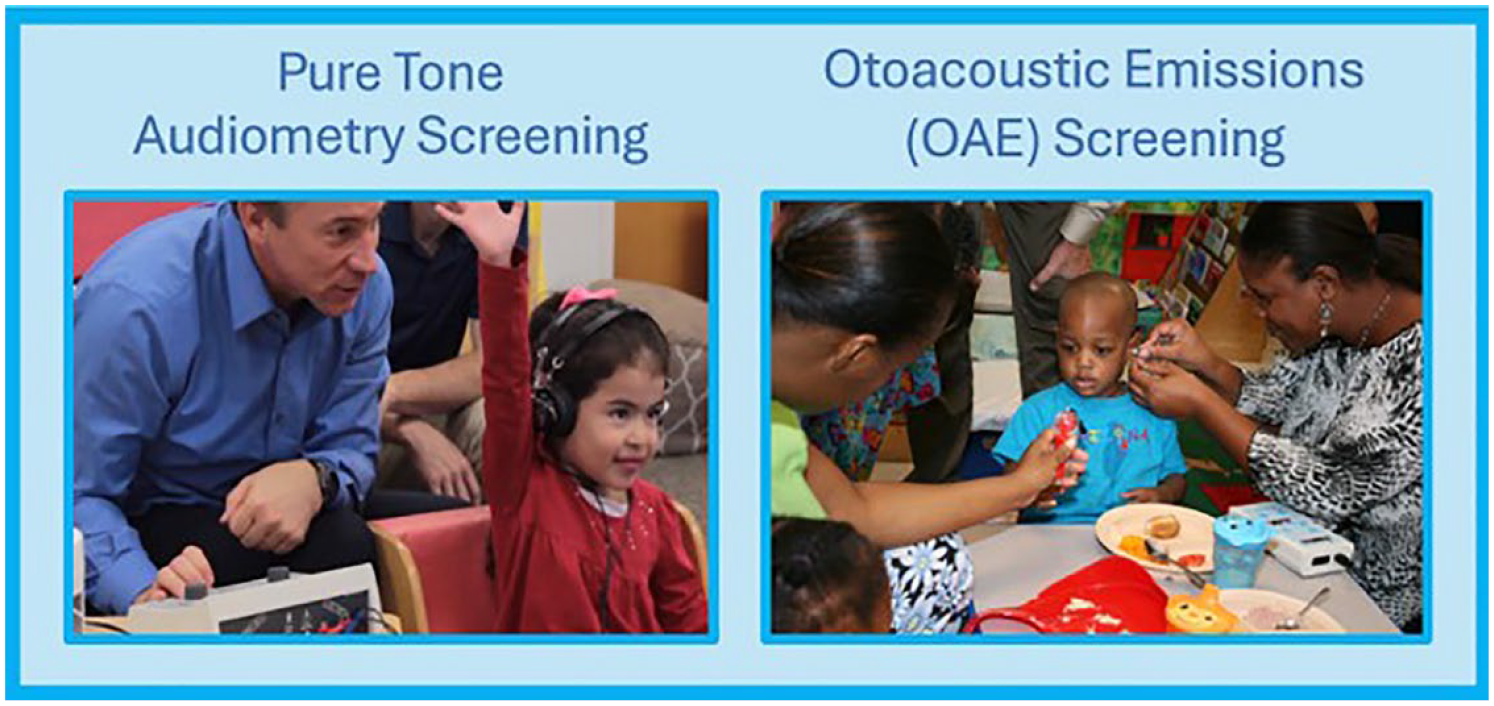
Pure-tone audiometry is the recommended evidenced-based hearing screening method for children aged 3 years or older. The screening must be conducted in a quiet environment, using a calibrated audiometer and headphones to present a series of tones at different frequencies (1,000 Hz; 2,000 Hz; and 4,000 Hz) at a specified intensity level (20 dB HL; American Academy of Audiology, 2011). Before initiating the actual screening, the child must be instructed to respond (e.g., by raising a hand or performing another simple task) whenever they hear a tone. Once the screener determines the child is responding reliably, the actual screening is conducted. As the tones are presented sequentially to each ear (up to four times at each frequency), the child must respond at least two times at each frequency, on both the right and left ears, to pass the overall screening. The child is referred for further diagnostic evaluation when this is not observed.
Due to their developmental abilities, some children cannot be taught to reliably respond to sounds as required in the preliminary step of pure-tone screening. These children must be referred for further evaluation as well or, alternatively, may be screened with another method called otoacoustic emissions (OAE) screening, which does not require children to provide a behavioral response (American Speech-Language-Hearing Association, n.d.).
When conducting an OAE screening, a small probe is placed in the child’s ear canal that delivers a low-volume sound stimulus into the ear. A cochlea (the snail-shaped portion of the inner ear) that is functioning normally will respond to this sound by sending a signal to the brain while also producing an “acoustic emission.” This emission is analyzed by the screening unit, and in approximately 30 seconds, a result appears on the screening unit’s display screen as either a “pass” or “refer.” These emissions typically indicate normal hearing function, while their absence may suggest hearing loss, in which case follow-up diagnostic evaluation is indicated.
OAE screening is a rapid, automated, and advantageous method for screening newborns, young children, and those with developmental delays. Outside of the newborn period, OAE screening is the only evidence-based screening method recommended for children under the age of 3 years. Furthermore, due to its automation and ease of use across a broad spectrum of children, OAE screening is also increasingly used as an alternative primary method for school-age children (American Speech-Language-Hearing Association, n.d.).
Figure 1 shows the use of these two screening methods. When selecting a hearing screening method for school-age children, it is essential to consult state, district, and school regulations (Johnson & Seaton, 2021). It is important to note that no other evidence-based hearing screening methods are recommended for children. Although evidence-based hearing screenings like those highlighted here are reliable, they are not infallible. Therefore, if a parent or teacher has concerns about a child’s hearing, the child should be referred for a comprehensive audiological evaluation, regardless of whether they passed the screening.
Evidence-based Hearing Screening Methods for School-age Children
Implementing Effective Hearing Screenings
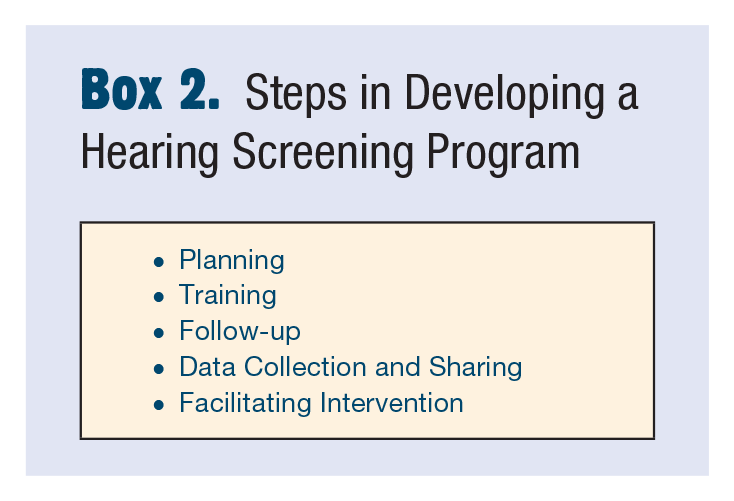
Box 2 includes the main steps in developing and implementing evidence-based hearing screening practices. Conducting either pure-tone or OAE screening requires comprehensive training to ensure that screeners develop the skills to conduct the processes under various conditions and for children at different developmental levels. Appropriate training also includes establishing a follow-up protocol to ensure that children who do not pass or cannot be successfully screened receive timely follow-up, a critical element of a screening program. School nurses or others involved in the hearing screening program must actively monitor the follow-up process to ensure it occurs and that the outcomes of follow-up testing are collected and communicated to key school personnel. This information is essential for guiding subsequent educational support and planning for the child.
Locating Helpful Resources
A broad array of resources for developing, implementing, and monitoring evidence-based hearing screening practices are available at www.kidshearing.org or by using the following QR code.

Footnotes
Correction (February 2025):
Article updated to include country names in author affiliations.
Dr. Eiserman serves as the Associate Director of the National Center for Hearing Assessment and Management (NCHAM) at Utah State University, which has been a National Technical Resource Center on Early Hearing Detection and Intervention for over two decades. Throughout this period, Dr. Eiserman hasalso led the Early Childhood Hearing Outreach (ECHO) Initiative, providing training and technical assistance to develop evidence-based hearing screening and follow-up practices across the United States and internationally.
Lenore Shisler is an educational consultant for the National Center for Hearing Assessment and Management (NCHAM) at Utah State University. For over 20 years, Lenore served as a research scientist at NCHAM, where she was a key member of the Early Childhood Hearing Outreach (ECHO) Initiative team. In this role, she developed training and technical assistance resources, provided training, and oversaw data collection and analysis of the outcomes of periodic childhood hearing screening activities.