






Abstract
Frequent residential moves in childhood may be stressful. Because introverts find making new friends in a new town more difficult than extraverts, the authors predicted that residential moves would be more negatively associated with well-being among introverts than among extraverts. To test this hypothesis, the authors collected salivary cortisol samples from morning to evening for two consecutive days, in addition to self-reports of well-being. In general, the authors found support for this prediction among European American participants but not for African Americans or Asian Americans. Extraversion seems to buffer the stress of residential moves among European Americans, whereas it does not seem to play as important a role to this end among African and Asian Americans.
For many residents of mobile societies like the United States, the pursuit of happiness often entails relocation (Oishi, 2010; Sell & DeJong, 1983; Tocqueville, 1841/2003). Residential moves can afford growth opportunities, new perspectives on life, and progress toward lifelong dreams, yet they also involve drawbacks, especially for some individuals. In particular, introverts who move frequently in childhood exhibit lower self-reported subjective well-being and higher rates of mortality in adulthood, whereas this is not the case for extraverts (Oishi & Schimmack, 2010). This provocative finding suggests a more general possibility: for introverts, frequent residential moves can introduce a variety of social stressors that may impact physiological stress systems. In the present research, we explored this possibility by comparing the daily outputs of cortisol (indicative of hypothalamic-pituitary-adrenal axis [HPA] integrity) of introverts and extraverts; we also considered culture as a possible moderator in our findings.
Consequences of Childhood Residential Mobility
Moving is widely recognized to be a stressful experience for adults. For instance, it is ranked 28th out of the 43 stressful life events listed by Holmes and Rahe (1967). It is bound to be even more taxing—and possibly even traumatic—for children, who typically lack control over moving. Children who find themselves frequently “uprooted” are likely to encounter difficulties establishing new relationships, negotiating new social situations, and/or tackling academics or extracurricular activities in unfamiliar territory. Indeed, previous work has found that children who move frequently are likely to underperform in school and exhibit behavioral problems (Adam, 2004; Jelleyman & Spencer, 2008). In another, even more troubling set of findings, adults who moved more than three times between the ages of 6 and 9 were 1.62 times more likely than less frequent movers to die by the time of follow-up 25 years later (Juon, Ensminger, & Feehan, 2003). Just as the stressors from adverse childhood environments (e.g., poverty) accumulate and have long-term negative effects on physical well-being (Miller et al., 2009; Repetti, Taylor, & Seeman, 2002), these studies suggest that frequent residential moves could exert a similar long-term effect on physical well-being.
Personality as a Moderator of Mobility’s Effects on Well-Being
Although certain logistical aspects of moving are likely to be universally stressful, the experience of navigating a novel social environment may ultimately confer either distress or stimulation, depending on the individual. Oishi and Schimmack (2010) found that trait extraversion moderated the association between residential mobility and physical well-being: whereas introverts who had moved frequently as children were about twice as likely to have died within the 10-year follow-up period as introverts who had never moved as children, childhood residential mobility was unrelated to adult mortality risk among extraverts. These findings suggest that frequent childhood residential moves pose a chronic threat to the well-being of introverts, who are less outgoing and more socially inhibited than extraverts and may thus experience additional or prolonged discomfort in the face of new social situations after moving.
Cortisol Secretion and Well-Being
The two aforementioned studies demonstrate a connection between childhood residential mobility and mortality (Juon et al., 2003; Oishi & Schimmack, 2010). One factor that has not yet been explored concerns the physiological consequences of residential mobility for introverts and extraverts. As a first step in this direction, we examined total daily cortisol secretion, a major output of the HPA axis, a hormonal response system activated by a wide array of stressors. A meta-analysis by Miller, Chen, and Zhou (2007) showed that chronic stress was associated with afternoon cortisol output (d = .18) and daily output (d = .31), but not morning output (d = –.08). That is, elevated levels of afternoon cortisol output and daily cortisol output may be indicative of compromised HPA functioning. It is also noteworthy that previous research showed that individuals whose socioeconomic status (SES) was low in childhood showed higher levels of afternoon and daily cortisol outputs in adulthood (when participants were mostly in their 30s) than individuals whose childhood SES was higher, despite the fact that the current SES was not different between these two groups (Miller et al., 2009). That is, although the relation between adverse life events and cortisol outputs is generally stronger when the adverse life events and the assessment of cortisol are closer in time, some life circumstances such as adverse childhood family situations can have a long-term effect on the functioning of the HPA axis, a physiological system with implications for health.
Miller et al.’s (2009) findings on early SES and elevated levels of cortisol then suggest that frequent residential moves in childhood could have a long-term effect on HPA function. Because introverts are especially likely to perceive residential moves as socially threatening and isolating (Asendorpf, 1998), we hypothesize that residential mobility will be associated with elevated cortisol production among introverts. In contrast, because extraverts are likely to perceive new social situations as exciting rather than threatening and are less prone to extended social isolation, the experience of moving may not have significant detrimental social or physiological consequences for extraverts.
The existing literature also links emotional experience to cortisol secretion. Positive affect (PA), for example, has typically been associated with lower levels of total cortisol output (e.g., Wirtz et al., 2007; see however, Munafò et al., 2006 for null results) and a smaller awakening increase in cortisol (Brummett, Boyle, Kuhn, Siegler, & Williams, 2009). Negative affect (NA) and neuroticism, on the other hand, have been associated with higher levels of cortisol (Portella, Harmer, Flint, Cowen, & Goodwin, 2005; Wirtz et al., 2007; however see Riese, Rijsdijk, Rosmalen, Snieder, & Ormel, 2009 for null results).
Recently, researchers have also shown that specific situations are associated with cortisol secretion. For instance, social threats caused by an unfavorable evaluation are likely to increase cortisol output (e.g., Dickerson & Kemeny, 2004; Rohleder, Beulen, Chen, Wolf, & Kirschbaum, 2007). Both trait and state loneliness are associated with elevated cortisol output (Adam, Hawkley, Kudielka, & Cacioppo, 2006). Given that a residential move often involves a period of social isolation and potentially exposes individuals to socially threatening environments, it is likely that individuals who move frequently will have elevated cortisol output.
Culture, Mobility, and Well-Being
Although cortisol has been used extensively as an index of physical well-being for the past three decades (Miller et al., 2007 for a review), very few studies have examined racial or ethnic differences in cortisol output (but see Cohen et al., 2006; DeSantis et al., 2007). Even less information is currently available regarding possible cultural differences in (1) the effect of residential mobility on well-being, and/or (2) how particular personality traits may protect against these effects. Kliewer, Reid-Quifiones, Shields, and Foutz (2009) examined the moderating role of emotion-regulation skills among low-income African American youth and found that among those low in emotion-regulation skills, there was an association between risk factors and cortisol levels after waking; this was not the case among those high in emotion-regulation skills. If we treat residential mobility as one such risk factor, we may expect to see a similar effect of the interaction between extraversion and childhood moves on cortisol output across various cultural groups.
On the other hand, if we take cultural differences in social behaviors into account, we may expect cultural differences in the moderating role of extraversion. For instance, European Americans are more willing to seek social support from friends and acquaintances than Asian Americans (Kim, Sherman, & Taylor, 2008). Likewise, previous research found that African Americans are more likely to draw social support from their kin than European Americans (Peek & O’Neill, 2001). If the main source of social support comes from the social network one creates (e.g., friends) as opposed to the network one was born into (e.g., kin), then personality traits like extraversion may be more instrumental for coping with residential mobility among European Americans than among Asian or African Americans (see also Fulmer et al., 2010). Thus, the buffering effect of extraversion on the link between residential mobility and well-being could be present among European Americans but not among Asian or African Americans.
The Present Study
Our goals in conducting the present research were twofold. The first goal was to test whether residential moves in childhood are negatively associated with subjective and physical well-being as indexed by cortisol secretion among introverts but not among extraverts. To our knowledge, no previous research has examined extraversion as a moderator of the link between residential mobility and HPA functioning. This research thus represents a critical step toward greater understanding of how personality traits might temper (or exacerbate) the effects of mobility on HPA functioning. The second goal was to extend the existing literature by examining possible cultural variations in the moderating role of personality in HPA functioning.
Method
Participants were 147 students at the University of Virginia (41 European Americans, 33 African Americans, 10 Hispanic Americans, 46 Asian Americans, 7 self-identified as “other,” and 10 did not provide this information; 34 men, 105 women, and 8 did not provide this information).
Participants first completed the Satisfaction with Life Scale (SWLS; Diener, Emmons, Larsen, & Griffin, 1985; α = .87). They then indicated how often they had felt each of the following positive and negative emotions during the past month on a 7-point scale (1 = not at all, 7 = a lot): happy, cheerful, excited, enthusiastic, content PA, α = .85); and sad, upset, nervous, guilty, bored, sluggish, angry, worried, fearful, irritated (NA, α = .88). Participants also completed the Rosenberg Self-Esteem Scale (α = .90), the University of California, Los Angeles Loneliness Scale (Russell, 1996; α = .86), and a 25-item Big Five personality trait measure (Brody & Ehrlichman, 1997; extraversion α = .77; neuroticism α = .85; agreeableness α = .77; conscientiousness α = .71; openness α = .69).
As in Oishi, Lun, and Sherman (2007), we asked participants to indicate where they were born, the names of each city/town in which they had lived (until college), and how old they were when they moved to each new location. We counted each move participants reported after the age of 5 in our measure of residential mobility. To avoid extreme skewness in the distribution, we capped the variable at five moves. Among the 136 participants who provided residential mobility information, 68 (50%) reported never having moved before entering college (M = .96, SD = 1.16; Skewness = 0.98, Kurtosis = 0.06).
After collecting the self-report packet, the experimenter distributed the salivary cortisol kit and instructed participants on how and when to collect cortisol samples. Participants collected six saliva samples per day for two consecutive days, using the HS-Cortisol High Sensitivity Salivary Cortisol Enzyme Immunoassay Kit (Salimetrics, LLC, State College, Pennsylvania). The first three samples were taken in the morning: immediately after waking (Time 1), 30 min after waking (Time 2), and 60 min after waking (Time 3). The fourth, fifth, and sixth samples were taken 4, 9, and 11 hr after waking, respectively. Following the guidelines for cortisol data collection created by the John D. and Catherine T. MacArthur Research Network on Socioeconomic Status and Health, participants were instructed not to brush their teeth, smoke, or consume caffeinated drinks during the 1st hour after waking, not to eat anything until after the collection of the second sample (30 min after waking), not to eat or drink 15 min prior to any sample collection, and to avoid alcohol consumption starting 24 hrs prior to the 2-day period of sample collection.
Upon their return to the lab, the saliva samples were frozen and shipped to Salimetrics, State College, Pennsylvania for assay. The assay was highly reliable, as indicated by the small intra-assay coefficient of variability of 7.3% and the small inter-assay coefficient of variability of 5.1% (less than 10% typically indicates an acceptable range of variability). The measurement unit for cortisol level was microgram per deciliter, or µg/dl. The total daily cortisol output was calculated by estimating the area under the curve. We also computed the mean morning cortisol output and the mean afternoon cortisol output.
Results
There were no gender differences in total cortisol, mean morning cortisol, mean afternoon cortisol, or in the strength of the association between each of the five subjective well-being indicators (i.e., life satisfaction, PA, NA, self-esteem, and loneliness) and each of the three cortisol indices (total cortisol, mean morning cortisol, and mean afternoon cortisol), | ts| < 1.75, ps > .08. We thus exclude gender from the analyses below. 1
As seen in Figure 1, European Americans, African Americans, and Asian Americans all showed the typical diurnal pattern of cortisol output: an awakening response (a rise over the first 1 hr) followed by a sharp decline in the afternoon. Table 1 presents the descriptive statistics and correlations among key variables separately for European Americans, African Americans, and Asian Americans. There were no differences across the three groups in total cortisol output, F(2, 119) = .18, ns; loneliness, F(2, 119) = 2.93, p = .06; neuroticism, F(2, 119) = 1.77, ns; agreeableness, F(2, 119) = .05, ns; openness, F(2, 119) = 1.58, ns; or residential moves, F(2, 119) = .46, ns. Consistent with previous research (e.g., Oishi, Diener, Choi, Kim-Prieto, & Choi, 2007), our European American participants reported being more satisfied with their lives, experiencing more PA and less NA, having higher levels of self-esteem, and being more extraverted and conscientious than our Asian American participants. Our African American participants also reported higher levels of self-esteem and less NA than our Asian American participants. Our African American and European American participants did not differ on any of the variables.
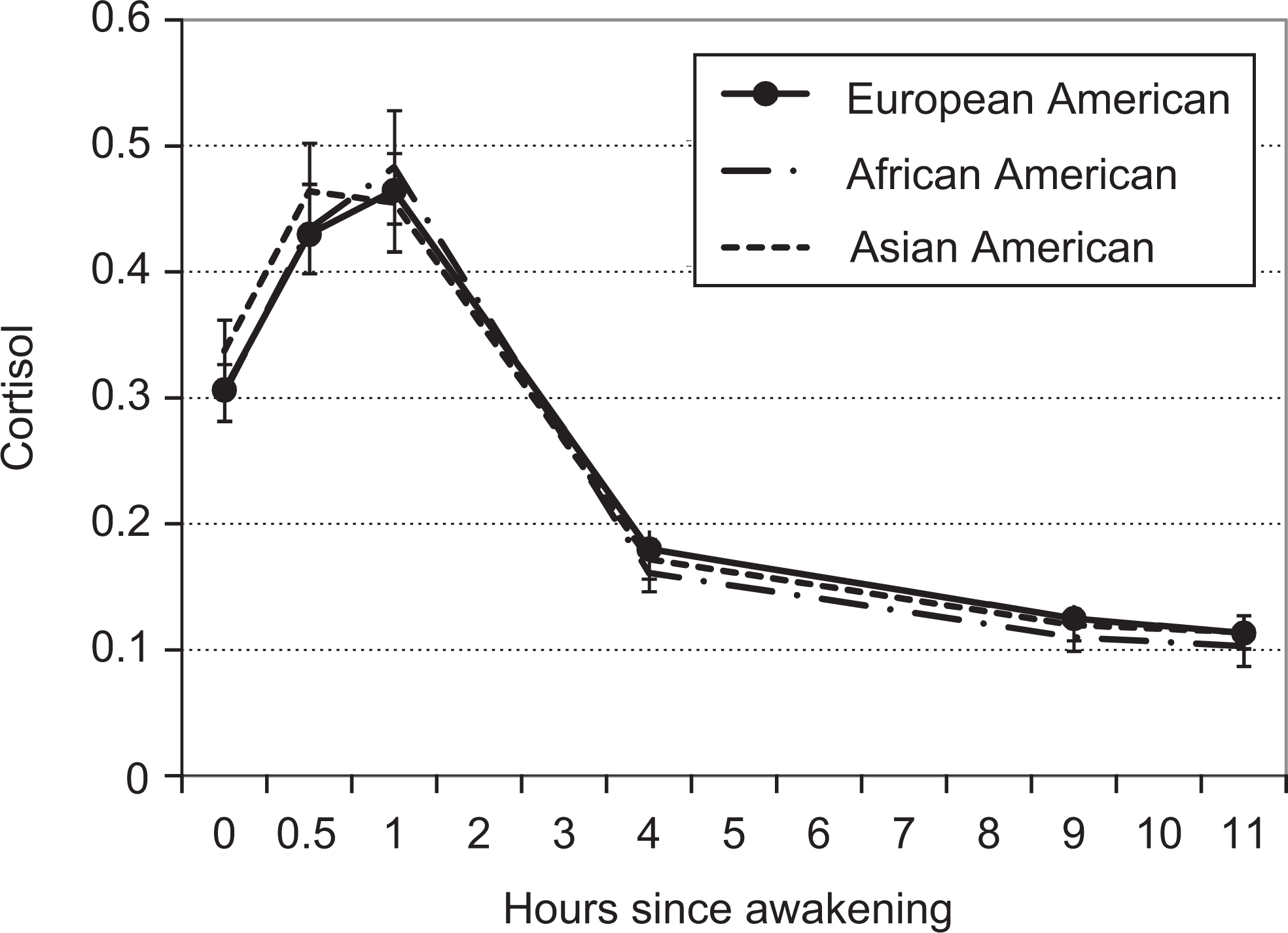
The diurnal pattern of cortisol output in μg/dl for European Americans, African Americans, and Asian Americans, respectively. The error bars indicate the standard error of mean for each data point for each group.
Descriptive Statistics of and Correlations Among Key Variables

SWLS = Satisfaction with Life Scale; PA = positive affect; NA = negative affect.
*p < .05.
**p < .01.
Consistent with previous research (Portella et al., 2005; Wirtz et al., 2007), total daily cortisol output was positively associated with NA and neuroticism among out European American participants (Table 1). In addition, total daily cortisol output was negatively associated with self-esteem and conscientiousness among our European American participants. Total cortisol output was negatively associated with self-esteem, agreeableness, and openness among our African American participants. Among our Asian American participants, daily cortisol output was not related to any of the self-report variables.
Hypothesis Testing
In order to test the two-way interaction between residential mobility and extraversion on well-being, we conducted a series of regression analyses separately for each cultural group, treating cortisol output and each of the well-being constructs (i.e., life satisfaction, PA, NA, self-esteem, and loneliness) in turn as outcome variables. Following Aiken and West (1991), we standardized extraversion and residential moves before forming the interaction term.
As predicted and replicating the results from Oishi and Schimmack (2010), we found a significant two-way interaction between residential moves and extraversion on NA among European Americans (see Table 2). Simple slopes analyses (Aiken & West, 1991) indicated that more frequent childhood moves predicted NA among introverts (1 SD below the mean extraversion score), B = .660, SE = .21, t(35) = 3.19, p < .001, but not among extraverts (1 SD above the mean extraversion score), B = –.26, SE = .19, t(35) = –1.37, ns (see Figure 2). Similarly, a significant interaction emerged between residential moves and extraversion on loneliness. Whereas residential moves were positively associated with loneliness among introverts, B = .405, SE = .15, t(35) = 2.67, p < .01, they were negatively associated with loneliness among extraverts, B = –.253, SE = .12, t(35) = –2.14, p < .05.
Regression Analyses: Predicting Well-Being From Extraversion, Moves, and Extraversion × Moves

SWLS = Satisfaction with Life Scale; PA = positive affect; NA = negative affect.
*p < .05.
**p < .01.
***p < .10.

The moderating effects of extraversion on the relation between residential moves and negative affect among European American Participants. X-axis indicates frequency of residential moves (z-scored). The simple slope for extraverts is as follows: 2.98 – .260 × move. The simple slope for introverts is as follows: 3.13 + .660 × move.
Most importantly, we obtained the predicted extraversion-by-mobility interaction on total cortisol output (see Table 2). Childhood residential mobility was positively associated with total cortisol output among introverts, B = .754, SE = .164, t(35) = 4.60, p < .001, but not among extraverts, B = –.316, SE = .221, t(35) = –1.44, ns (see Figure 3). Thus, the previously established tendency for residentially mobile introverts to experience more NA and loneliness also involves greater daily output of cortisol, at least among European Americans. As seen in Table 2, the two-way interaction between residential moves and extraversion did not emerge among African Americans or Asian Americans. 1 In other words, the relation between residential mobility and well-being was not moderated by extraversion among African Americans or Asian Americans.

The moderating role of extraversion in the relation between residential moves and total cortisol output among European American participants. X-axis indicates frequency of residential moves (z-scored). The simple slope for extraverts is as follows: 1.97 – .316 × move. The simple slope for introverts is as follows: 2.49 + .754 × move.
Because Miller et al. (2007) found an association between chronic stress and afternoon cortisol output but no association between chronic stress and morning cortisol output, we next separately examined morning and afternoon cortisol output. As above, we found the predicted interaction between moves and extraversion on morning cortisol output among European Americans, B = –.108, SE = .039, β = –.410, t(36) = –2.77, p < .01. The simple slopes analyses showed that residential moves were positively associated with morning cortisol output among introverts, B = .141, SE = .055, t(35) = 2.56, p < .05, but unrelated to morning cortisol among extraverts, B = –.075, SE = .055, t(35) = –1.36, ns. A similar move-by-extraversion interaction emerged for afternoon cortisol output in this group, B = –.031, SE = .015, t(35) = –2.07, p < .05. The simple slopes analyses showed that residential moves were positively associated with afternoon cortisol output among introverts, B = .048, SE = .011, t(35) = 4.36, p < .01, but marginally negatively associated with afternoon cortisol among extraverts, B = –.014, SE = .008, t(35) = –1.75, p < .10. Once again, there were no interactions between residential moves and extraversion among African Americans or Asian Americans for morning cortisol, | ts| < 1.53, ps > .13, 2 or for afternoon cortisol, | ts| < 1.02, ps > .31. 3
Discussion
Previous work has shown that introverts who experienced frequent childhood moves had lower self-reported well-being and higher rates of mortality in adulthood but this was not the case among extraverts (Oishi & Schimmack, 2010). The present work sought to better understand the physiological processes underlying the relationship between residential mobility and well-being among introverts and extraverts by examining HPA activity. Among European Americans, our results were consistent with previous research (Oishi & Schimmack, 2010); there was a generally negative relationship between residential moves and subjective well-being among introverts. Furthermore, we found that the negative effects of childhood mobility for introverts extended to HPA functioning as measured by daily cortisol secretion. Extraversion, on the other hand, appeared to buffer participants from the negative effects of childhood mobility, both in terms of subjective indicators of well-being and cortisol output.
Interestingly, this pattern of results did not extend to African Americans or Asian Americans, suggesting that they may have different ways of responding to or coping with the challenges presented by childhood residential mobility. Although purely speculative, two possibilities may account for this divergence. First, as described above, European Americans tend to gain social support from friends and acquaintances more than Asian or African Americans (Kim et al., 2008; Peek & O’Neill, 2001). To the extent that extraversion is helpful in creating one’s own friendship network, it may be more instrumental for coping with residential mobility among European Americans than among Asian or African Americans. Second, it is also possible that the factors prompting cortisol secretion differ for European Americans, African Americans, and Asian Americans (see however, Lai et al., 2005).
Despite the discrepant findings between European Americans and African and Asian Americans, the moderating role of extraversion in the relationship between residential mobility and daily cortisol output has a number of important implications. Cortisol is a key hormonal signal the body uses to regulate the inflammatory response (Segerstrom & Miller, 2004). Abnormal levels of cortisol are associated with chronic stress, compromised immune functioning (Miller et al., 2007), and depression (Van den Bergh & Van Calster, 2009). Chronic HPA activation—as indicated by elevated cortisol levels—may have serious downstream effects, including decreases in the immune system’s sensitivity to glucocorticoids and subsequent increases in the release of pro-inflammatory cytokines (Hawkley, Bosch, Engeland, Marucha, & Cacioppo, 2007). Chronic release of pro-inflammatory cytokines can, in turn, increase the risk for various health problems, most notably cardiovascular disease (Kiecolt-Glaser & Glaser, 2002). These risk factors are even more alarming when considered alongside previous findings showing that introverts who had moved frequently as children showed a higher level of mortality risk than introverts who had not moved (Oishi & Schimmack, 2010). Future research could directly assess cytokine levels as well as other related systems (e.g., the metabolic system) in order to further probe the health implications of the interaction between personality and mobility.
The significance of the present results notwithstanding, the current investigation suffers from several limitations. First, the precise timing of the saliva collection relied on self-report, and it is possible that some of the samples were collected slightly early or late. Second, our sample size for each of our three cultural groups was relatively small. Considering that the key hypothesis concerned a statistical interaction, our study likely did not have sufficient power to detect such effects. For instance, in order for our sample (N was roughly 40 for each group) to be able to detect the interaction effect with statistical power of .80, the effect size f 2 needs to be .30. Our sample size was small due to the high cost associated with salivary cortisol assay. In interpreting our null findings, therefore, it is important to keep in mind this limitation. Third, our participants were all college students. Although the college setting provides the advantage of roughly equal living conditions across the three groups, our use of this convenience sample limits our ability to generalize to the population at large. Fourth, we did not assess mediators (e.g., social support) for the link between residential moves and cortisol output. It is critical to identify them in the future. Finally, we have focused on extraversion. It is important to identify the specific aspects of extraversion that are most directly related to the link between personal history of residential mobility and HPA activity. In a similar vein, it is important to examine personality traits beyond Big Five traits that might moderate the relation between personal history of residential mobility and HPA activity.
Conclusion
Moving to another city allows individuals to seek out a better education, job, or lifestyle. Residential mobility is thus a critical means of pursuing the inalienable right of happiness. However, moving may also have detrimental effects for introverts, upsetting both psychological and physical functioning many years later, at least among European American college students. Extraverts, on the other hand, appear to possess the necessary social skills needed to take such social stressors in stride. Further investigation of the specific interpersonal and physiological phenomena associated with the experience of moving is surely warranted, as it may help reveal strategies for residentially mobile individuals to buffer themselves against the psychological and physical costs of moving.
Footnotes
Acknowledgment
We would like to thank Greg E. Miller for his invaluable advice on cortisol data collection.
The author(s) declared no potential conflicts of interest with respect to the research, authorship, and/or publication of this article.
The author(s) received no financial support for the research, authorship, and/or publication of this article.