







Abstract
It is a hitherto open and debated question whether the belief in conspiracies increases or attenuates the willingness to engage in political action. In the present article, we tested the notion, whether (a) the relation between belief in conspiracies and general political engagement is curvilinear (inverted U-shaped) and (b) there may be opposing relations to normative versus nonnormative forms of political engagement. Two preregistered experiments (N = 194, N = 402) support both propositions and show that the hypothetical adoption of a worldview that sees the world as governed by secret plots attenuates reported intentions to participate in normative, legal forms of political participation but increases reported intentions to employ nonnormative, illegal means of political articulation. These results provide first evidence for the notion that political extremism and violence might seem an almost logical conclusion when seeing the world as governed by conspiracies.
Conspiracy theories play a prominent role in various political campaigns or movements, particularly those of political extremists. The conspiracy theory of the Elders of Zion has long been a central reference for antisemitic demagogues, culminating in National Socialist propaganda but continuing until today. In its founding charter of 1988, the Hamas (1988) did not only blame the Jews for such prominent events like the French or the Communist revolution (Article 22) but cited the Protocols of the Elders of Zion as evidence for this (Article 32). Such anecdotal associations of radicalized political ideas and conspiracy belief notwithstanding, psychological research on conspiracy belief has not yet established consensus regarding the role of conspiracy beliefs in political extremism. Quite on the contrary, there seems to be an open debate whether and what kind of association exists between conspiracy beliefs and any kind of political engagement. Whereas some point to motivating aspects of conspiracy narratives to change the status quo and become politically active, others emphasize the effect these narratives have in the form of political disengagement and lethargy (see Imhoff & Lamberty, in press). Aiming to resolve this puzzle, the present article reports two preregistered experiments in support of the notion that adopting the worldview of a conspiracy believer makes people more prone to engage in nonnormative but less prone to engage in normative political engagement.
Over the past decade, there has been an increasing scholarly interest in the psychology behind conspiracy theories and several propositions have achieved considerable consensus among scholars. One of the most replicated finding seems to be that endorsement of specific conspiracy theories is largely determined by people’s general readiness to accept or reject the very notion of conspiracies at play. The relatively high intercorrelations among the agreement with conspiracy theories that are largely independent in content (e.g., Bruder et al., 2013; Goertzel, 1994), even if they entail logically contradictory propositions (Wood et al., 2012) has led several authors to postulate a more general worldview as the general factor behind specific conspiracy belief, a conspiracy mentality (Imhoff & Bruder, 2014). Such a mentality can be best understood as a mind-set of suspecting conspiracies behind virtually any event, which will then translate into endorsement of specific conspiracy theories. Scholars have gathered converging evidence for some associations with such a tendency to see secret plots behind the scenes (Douglas et al., 2017). As likely the most prominent example, different manipulations of feelings of control (Sullivan et al., 2010; van Prooijen & Acker, 2015; Whitson & Galinsky, 2008) and correlational findings (Imhoff & Bruder, 2014; Imhoff & Lamberty, 2018; van Prooijen, 2016; van Prooijen & Acker, 2015) point to an association of lack of control with increased beliefs in conspiracy theories. As another example, scholars from France (Lantian et al., 2017) and Germany (Imhoff & Lamberty, 2017) have independently gathered support for the notion that conspiracy theories are particularly appealing to those who have a high need to see themselves as particularly unique. Despite these emerging agreements, one aspect of the consequences of conspiracy beliefs has enjoyed less consensus: The question of whether adopting a conspiracy worldview leads to political disengagement or—on the contrary—to political activism. Both sides have arguments and empirical support on their side.
Conspiracy Beliefs as Engines of Political Disengagement or Fuel for Political Engagement
Conspiracy theories confront people with the “fact” that high power agents (e.g., intelligence agencies, the government, and corporations) do not comply with the rules and laws but behave lawlessly to promote their own interest. If that is true and governments are either actively involved or complicit by omission (from preventing such going-ons), the very core of legitimacy of a ruling body is obsolete. In this light, it makes sense to assume that conspiracy believers remove themselves from political engagement because supposedly “political participation is a waste of time if the world is run by conspiracies and democracy is an illusion” (Wood, 2016: 516). Accordingly, people with a stronger conspiracy mind-set are more likely to endorse feelings of political alienation and cynism (e.g., Swami, 2012; Swami et al., 2011; Vitriol & Marsh, 2018) and anomia (e.g., Abalakina-Paap et al., 1999; Goertzel, 1994) and feel less satisfied with democracy in general (e.g., Swami & Furnham, 2012). Exposure to information supporting conspiracy theories decreases intentions to engage in politics and civic behaviors (Jolley & Douglas, 2014a, 2014b) but increases intentions to engage in everyday crime (Jolley et al., 2019), a finding interpretable as a quid pro quo reaction to the perceived legal noncompliance on the side of the powerful.
Somewhat at odds with this view is the observation that conspiracy rhetoric seems to be part and parcel of virtually any radical political organization—from Al Quaeda to Aum Shinrikyo or anti-abortion groups like “Lambs of Christ” (Bartlett & Miller, 2010). Convincing their followers and sympathizers of such conspiracies would seem ill advised if that led to political lethargy, passivism, and a retreat into privacy. Instead, it seems to follow the assumption that pointing to conspiracies increases outrage and political engagement, thereby increasing followers’ engagement. This is in line with the portrayal of conspiracy mind-sets as inherently political attitudes, intrinsically tied to distrust in political institutions (but not common people), a lack of political (but not personal) control, and a motivation to become politically active (Imhoff & Lamberty, 2018). In line with this, conspiracy mentality has been shown to be positive predictor of people’s intentions to engage in protesting behavior after a nuclear disaster (Imhoff & Bruder, 2014).
Resolving the Puzzle
Although there may be many ways to reconcile these views by pointing, for instance, to contextual factors or specifics of the respective samples, we want to put forward two theoretical propositions that might help attenuate the apparent paradox. First, the connection between conspiracy beliefs and the degree of political engagement per se may not be linear. Even though psychological research typically assumes and only tests for linear relationships, most actual associations are not (e.g., Imhoff & Koch, 2017). For people who do not see any conspiracies at play, who accept the official versions of how things are, and who trust the democratic process, there is little reason to protest or alter the status quo to begin with. That is not to say that this needs to go along with political passivity, but merely that there might be less of a pressing need (Cichocka et al., 2018). This is drastically different if one fears that plots hatched in secret threaten our society and aim at undermining democratic principles. Accepting the scandalous possibility that some elected politicians do not represent their voters but follow the interest of a secret agenda should increase the willingness to get this person fired to protect democratic principles. Going extreme on this continuum of conspiracy mentality, however, one might end up in a position where virtually everything is controlled by conspiracies and there is little reason to trust anyone. In such a situation, so we argue, one would not lack the pressing motivation to change the status quo but lack trust in the perceived system responsiveness and thereby one central ingredient of collective action motivation: collective efficacy (e.g., Van Zomeren et al., 2008). How can one even change a situation that is under almost total control of secret societies?
We thus closely align our reasoning with recent research that showed that political engagement follows a curvilinear relation of confidence in the social system as engagement follows a multiplicative function of system responsiveness and need for change (Cichocka et al., 2018). Extremely low levels of system confidence (i.e., high levels of conspiracy mentality) have zero trust in the fact that political engagement is effective and extremely high levels of system confidence (i.e., low levels of conspiracy mentality) perceive zero need for change, effectively predicting an inverted U-shaped relation between conspiracy mentality and general political engagement. 1
Thus, looking at the overall motivation and readiness to become active to change the status quo should be maximal at intermediate levels of conspiracy beliefs (as low levels see less need for change, high levels perceive less opportunities to change a corrupt system). Additionally, however, these different worldviews hold different implications regarding the choice of means to become politically active. Political opinions and interest can be expressed by means that are in accordance with social and legal norms, often referred to as normative political action (Wright et al., 1990). If, however, there is a skepticism regarding the effectiveness of such legal means and people have only low hopes that they can change the status quo, they might resort to extreme, illegal, and nonnormative means (Tausch et al., 2011). This differentiation may also allow a more fine-grained look at the proposed curvilinear relation between conspiracy beliefs and political action, as exemplified below.
Being low in conspiracy mentality translates into not at all being suspicious about the governing system being corrupt and those in power just serving their own goals. Quite on the contrary, such perspectives reflect a deep trust in the legitimacy and orderly functioning of this system (potentially to the point of naivety when approving statements like “There is no good reason to distrust governments, intelligence agencies, or the media”; Imhoff & Bruder, 2014). If the political system is functioning as it should, it makes a lot of sense to express any motivation to improve society through officially endorsed, legal means. This may take many forms from rallying in a legal way, participating in elections, or expressing one’s opinion. Trusting the democratic process of an open competition between ideas of how to solve social problems mandates these normative forms of participation in precisely this process.
Such normative political engagement within the confines of a democratic system should seem futile from the perspective of a conspiracy theorist. If institutions who betray the allegedly official rules govern the world, playing by the rules seems unlikely to change anything about that. If elections or legal demonstrations had the power to change anything, those in power would have declared them illegal. This is again different for nonnormative engagement outside of the democratic process and outside of legal norms. Such actions may not only seem more likely to be effective but also seem more legitimate. If the secret elite does not play by the rules that are allegedly binding, there is no strong mandate to confine oneself to these limitations (for a similar prediction regarding a negative linear effect of system confidence on nonnormative action, see Cichocka et al., 2018; Study 3). We sought to test the plausibility of these two propositions.
The Present Research
We conducted two preregistered experiments to test the notion that adopting a conspiracy worldview will increase one’s (hypothetical) readiness to become politically active, but only up to a certain extent, an extreme conspiracy mentality should reduce political readiness again (inverted U). More specifically, conspiracy worldview should be associated with an increase in nonnormative, illegal political engagement, but not with normative, legal. As legal, ethical, and practical aspects make it impossible to manipulate participants’ worldviews directly, we opted for a scenario-based approach. Specifically, participants imagined perceiving a society they lived in from a perspective of either a low, intermediate, or high conspiracy mentality. As a validation study (see Online Supplement) showed, the vignette indeed had the intended effects on system confidence, perceived system responsiveness, and the identified need for change (but also affected other variables; Dafoe et al., 2018). Our studies thus do not provide a direct test of whether holding a conspiracy mentality of a certain degree has an effect on political engagement. Instead, they test how unselected participants would decide under the condition that they shared certain central premises with conspiracy (dis)believers. For both studies, we added an actual measure of conspiracy mentality to be able to test differential effects of our manipulation contingent on conspiracy mentality. All materials, raw data and analysis scripts available at https://osf.io/czupe
Study 1
We tested the hypotheses in the German context. We conducted a scenario experiment with three conditions (low, intermediate, and high conspiracy mentality; preregistered at https://aspredicted.org/jx6z2.pdf. 2 We expected an inverted U-shaped effect of the assigned perspective on the overall tendency to become politically active (independent of the normativity) with intentions for political engagement peaking at intermediate levels of conspiracy mentality. We preregistered a planned contrast (−1, 2 −1) with a one-way analysis of variance (ANOVA) to test this. Despite an overall greater endorsement of normative (vs. nonnormative) political intentions, we expected this effect to attenuate or even reverse for participants in the high conspiracy mentality condition, implying an interaction of normativity and assigned perspective.
Method
Sample and Design
A total of 194 participants recruited via social networking sites completed an online study with a chance to win one of the two available online vouchers worth 20 euros (for power considerations, see preregistration). Of these, 59 participants were excluded from data analyses based on preregistered criteria: self-reporting not having responded seriously (n = 1), not having completed the questionnaires from the experimentally assigned perspective (n = 24), failing the attention check (n = 11), taking more than double the median time to complete the study (n = 20), or extreme values (>3 SD) on one or several scales (n = 1). The remaining sample consisted of N = 138 participants (94 women, 39 men, 5 other, or missing) with an average age of 27.2 years, SD = 7.1, who were randomly allocated to the three experimental cells of low (n = 46), intermediate (n = 47), and high conspiracy mentality (n = 44).
Independent Variable
Participants were randomly assigned to imagine living in a society that they perceive as low, intermediate, or high in the extent of conspiracies. Specifically, they were instructed to read a brief scenario and imagine this as vividly as possible. For the High Conspiracy Mentality condition, we rephrased items from the Conspiracy Mentality Scale (Imhoff & Bruder, 2014 available on project page at https://osf.io/czupe) and told participants that they felt confident that a few powerful groups decided about the fate of millions of people and that politicians were nothing more than marionettes controlled by disguised powers (full text). In the Intermediate Conspiracy Mentality condition, they were asked to imagine that they sometimes wondered whether politicians and the media were trustworthy and could not exclude that secret organizations and certain political circles might have a manipulative influence on the population. In the Low Conspiracy Mentality condition, it was stressed that governments, media, and secret services were trustworthy overall, and decision-making was democratic and transparent. After reading and imaging these perspectives, participants were asked to respond to scales of powerlessness and political engagement from the assigned perspective.
Measures
After the manipulation of the independent variable, participants completed measures of powerlessness and political engagement from their assigned perspective, some items on manipulation check and data quality before completing demographic information (age, gender, education, religiosity, and political orientation) and a measure of conspiracy mentality (Imhoff & Bruder, 2014; e.g., “There are secret organizations that have great influence on political decisions”) for exploratory purposes. We only describe central measures below, full information is available at OSF.
Political engagement
A list of 20 statements regarding the readiness to become politically engaged were generated to reflect a spectrum of conventional and unconventional, nonviolent and violent, passive and active, and legal and illegal options (Pickel, 2012). Some of these were inspired by existing propositions in the literature (Marsh, 1974; Moskalenko & McCauley, 2009; Pattie et al., 2003; Pickel, 2012; Tausch et al., 2011), others were purpose created. To have a maximally objective criterion of what constituted normative versus nonnormative options, we relied on legal actions as normative and clearly illegal actions as nonnormative. All items were formulated in future unreal conditional and participants indicated the likelihood of using these means (given they had the necessary resources and abilities) on a scale from 1 (under no circumstances) to 5 (certainly). Table 1 lists all items and the internal consistencies of the scales.
Items Tapping Into Two Forms of Political Engagement (Full-Scale Reliability in Study 1: α = .70; Study 2: α = .89).
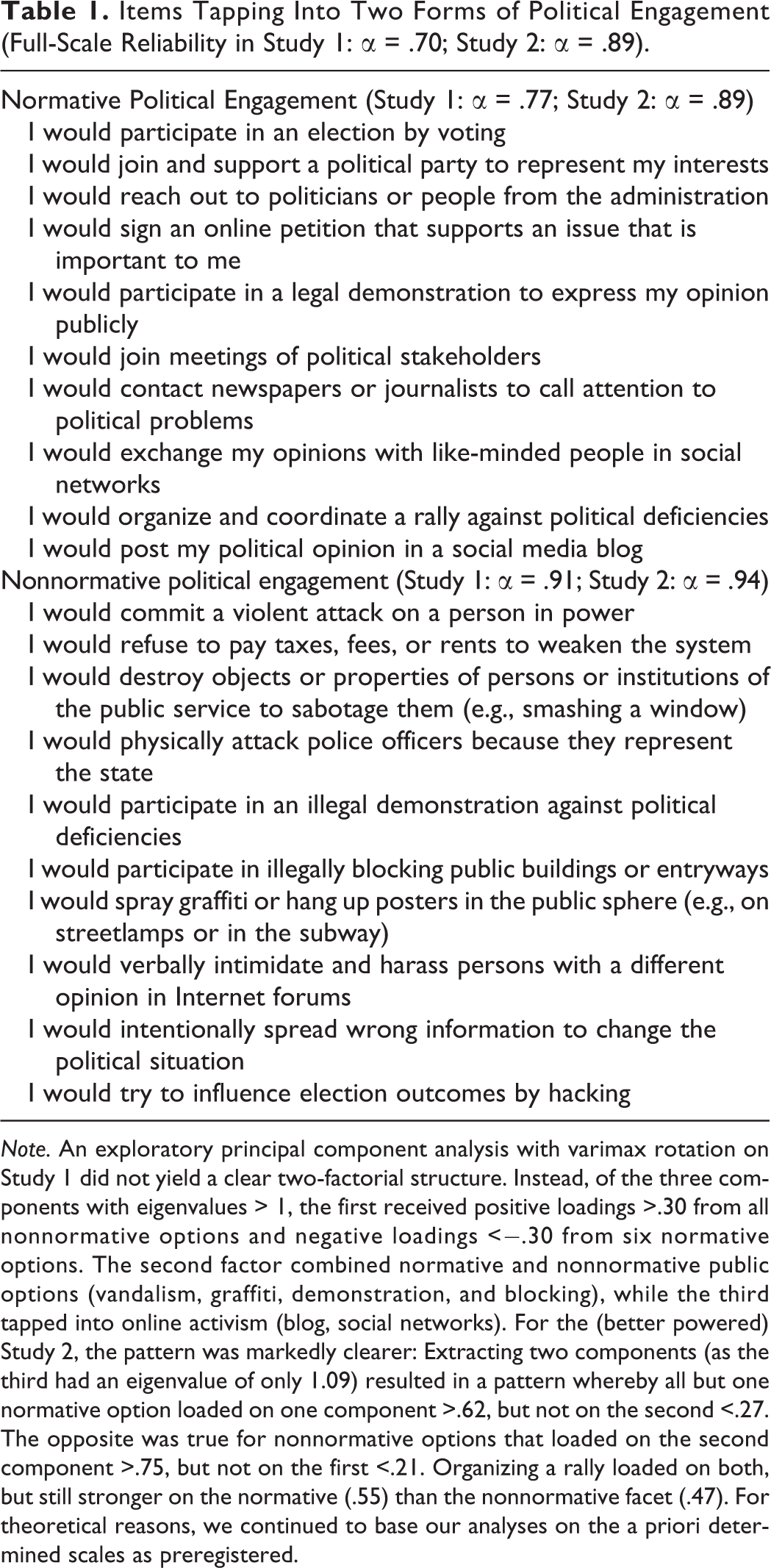
Note. An exploratory principal component analysis with varimax rotation on Study 1 did not yield a clear two-factorial structure. Instead, of the three components with eigenvalues > 1, the first received positive loadings >.30 from all nonnormative options and negative loadings <−.30 from six normative options. The second factor combined normative and nonnormative public options (vandalism, graffiti, demonstration, and blocking), while the third tapped into online activism (blog, social networks). For the (better powered) Study 2, the pattern was markedly clearer: Extracting two components (as the third had an eigenvalue of only 1.09) resulted in a pattern whereby all but one normative option loaded on one component >.62, but not on the second <.27. The opposite was true for nonnormative options that loaded on the second component >.75, but not on the first <.21. Organizing a rally loaded on both, but still stronger on the normative (.55) than the nonnormative facet (.47). For theoretical reasons, we continued to base our analyses on the a priori determined scales as preregistered.
Manipulation check and data quality
A number of precautionary steps aimed at securing high data quality and participants who failed these quality checks were excluded as preregistered. First, mixed in the questions on political engagement was an attention check requiring a specific response. (“For this investigation, it is important that you read the statements carefully. Please select rather yes next to this statement”.) Second, after the dependent measures, participants were asked to indicate whether they completed these from the assigned perspective, their own or neither with only the first being an appropriate response. At the very end of the study, participants indicated whether they had completed the study in a serious manner and read all questions and response options.
Results
We first tested the inverted U-shaped relation between assigned conspiracy perspective and overall political engagement (independent of normativity). To this end, we conducted a one-way ANOVA with a planned quadratic contrast (−1, 2, −1). As predicted, the quadratic contrast was significant, F(1, 134) = 6.09, p = .015, whereas the orthogonal linear one (−1, 0, 1) was not, F(1, 134) = 2.54, p = .114. Specifically, participants who adopted a worldview of intermediate conspiracy mentality indicated overall higher (hypothetical) political engagement than those with low conspiracy mentality, t(91) = 2.99, p = .004, d = 0.62, 95% confidence interval (CI) [0.20, 1.03], but had only descriptively higher scores than the high conspiracy mentality condition, t(89) = 1.31, p = .192, d = 0.27, 95% CI [−0.14, 0.69] (Figure 1, left half). This speaks to the motivating power of conspiracy thinking but does not fully support the demotivating aspect of overly strong conspiracies.
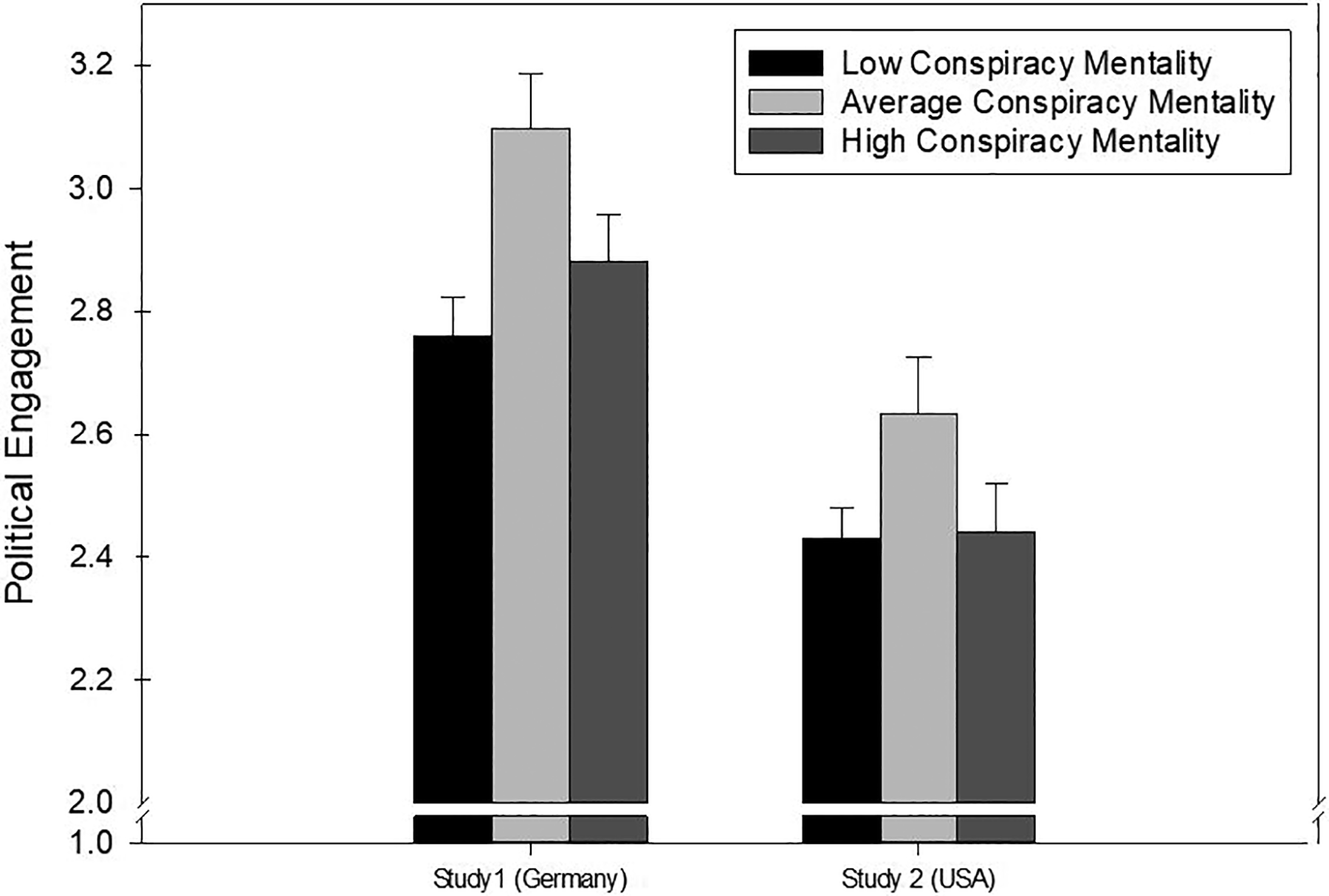
Overall intentions for political engagement (+SE) as a function of experimental condition in Studies 1 and 2.
As we had distinct predictions regarding normative and nonnormative engagement, however, we dissected these and conducted a 3 (between: low vs. intermediate vs. high conspiracy mentality) × 2 (within: normative vs. nonnormative political engagement) mixed-model ANOVA. As predicted, there was an overall main effect of more support for normative over nonnormative forms of behavior, F(1, 134) = 207.10, p < .001,
Participants in both the intermediate, t(91) = −4.44, p < .001, d = −0.92, 95% CI [−1.35, −0.49], and high conspiracy mentality conditions, t(88) = −4.83, p < .001, d = −1.00, 95% CI [−1.44, −0.57], exhibited a decreased interest in normative action compared to the low conspiracy condition, with the former two not differing significantly, t(89) = 0.53, p = .602, d = 0.08, d = 0.11, 95% CI [0.30, 0.52] (Figure 2). The presence of conspiracies had the inverse effect on nonnormative political engagement. Participants in both the intermediate, t(88.11) = 7.07, p < .001, d = 1.46 95% CI [1.00, 1.92], and high conspiracy mentality conditions, t(88) = 4.83, p < .001, d = 1.01, 95% CI [0.57, 1.44], endorsed such action to a greater extent than in the low conspiracy condition, with again no significant difference between the former two, t(89) = 1.07, p = .288, d = 0.22, 95% CI [−0.19, 0.64].
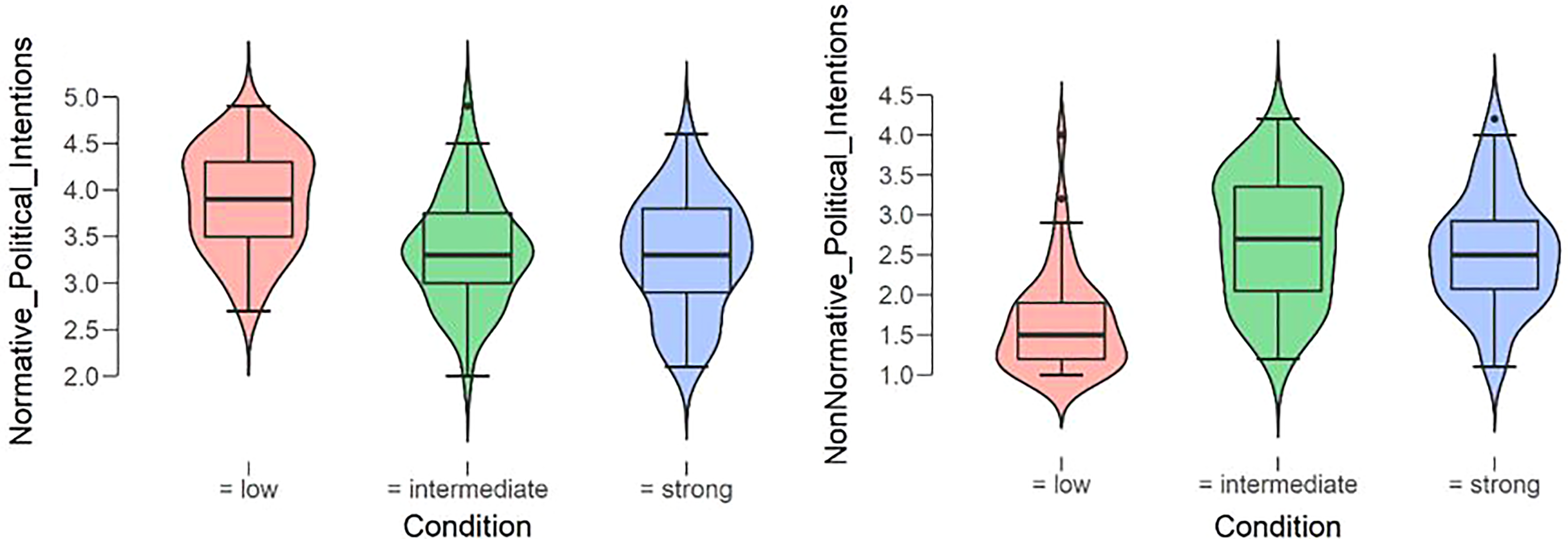
Violin plots of intentions to engage in normative versus nonnormative political engagement as a function of experimental condition in Study 1. Boxplots depict median and quartile range, outline the density distribution.
On an exploratory note, we had also inquired participants’ individual conspiracy worldview with the Conspiracy Mentality Scale (α = .89). The three conditions did not significantly differ in conspiracy mentality, F(2, 134) = 1.28, p = .298, and including the standardized scale and the interaction between the (dummy-coded) experimental conditions in regressions predicting the two forms of political engagement did not increase the explained variance, thus not providing any evidence for a moderating influence.
Discussion
Study 1 corroborated our general reasoning and supported two propositions. First, hypothetical political action in general followed the predicted inverted U-shaped relation with political action peaking at intermediate levels of conspiracy mentality. Although this is exactly as predicted, it is important to stress that this quadratic effect was not reflected in significant decreases to both sides of the continuum. Participants in the low conspiracy mentality condition showed less intentions (speaking to a reduced desire to change the status quo), but participants very high in conspiracy mentality did not have significantly (albeit descriptively) lower scores on intention (which could have been indicative of a reduced perceived efficacy).
More relevant, however, the data also exemplified the importance of differentiating between normative, legal forms of political engagement and nonnormative, illegal forms. Bifurcating political engagement along those lines showed a clear dissociation. Whereas the self-reported likelihood of engaging in normative actions decreased with a conspiracy-prone worldview, the engaging in nonnormative actions increased. Before further discussing the nuances of our findings, we sought to replicate these and bolster their generalizability by moving to a different national context (United States).
Study 2
We replicated the Study 1 in a different language and a sample from a different cultural context (U.S. American workers on Amazon's Mechanical Turk crowdsourcing platform) to bolster its generalizability. We had no expectations that these two different cultural and political contexts would produce different results but wanted to put our reasoning to a critical test by exposing it to a context that arguably has a radically different history in terms on both political protests in general (Rucht, 1996) and violent extremism in particular (Parkin et al., 2017). Except for the changed national context, Study 2 was a direct replication of Study 1. Preregistration is available at https://aspredicted.org/t6u5q.pdf
Method
Sample and Design
Due to the high exclusion rate in Study 1, we selected to recruit 400 U.S.-based participants (in order to have a final cell n of 100) from Amazon MTurk for a small monetary compensation. As typical for this recruitment strategy, we received a few more responses (N = 402). We applied the preregistered criteria and excluded all participants who indicated their data should not be used (n = 35), who admitted to have answered the questions not from the assigned but their own perspective (n = 70), who wrongfully remembered what the scenario stated (n = 20), and who failed an attention check (n = 18). This left a final sample of N = 255 (110 women, 144 men, and 1 missing) between 19 and 75 years of age, M = 37.48, SD = 10.96, that were randomly allocated to the three experimental cells of low (n = 83), intermediate (n = 79), and high conspiracy mentality (n = 93).
Procedure and Materials
The procedure was identical to Study 1. We translated the vignette scenarios, instructions, and all measures from Study 1 in a dual-forwards method and resolved inconsistencies by discussion and consultation of a native speaker.
Results
The predicted quadratic contrast (−1, 2, −1) of condition on overall political engagement was just significant, F(1, 252) = 4.27, p = .040, whereas the orthogonal linear one (−1, 0, 1) was not, F(1, 252) = 0.01, p = .917. Unlike Study 1, none of the simple comparisons were significant, ps > .053, even though the overall pattern showed remarkable resemblance to the one in Study 1 (Figure 1, right half).
Dissecting political engagement in normative and nonnormative forms and subjecting these to the same a 3 (between: low vs. intermediate vs. high conspiracy mentality) × 2 (within: normative vs. nonnormative political engagement) mixed-model ANOVA again yielded more support for normative over nonnormative forms of behavior, F(1, 252) = 563.48, p < .001,
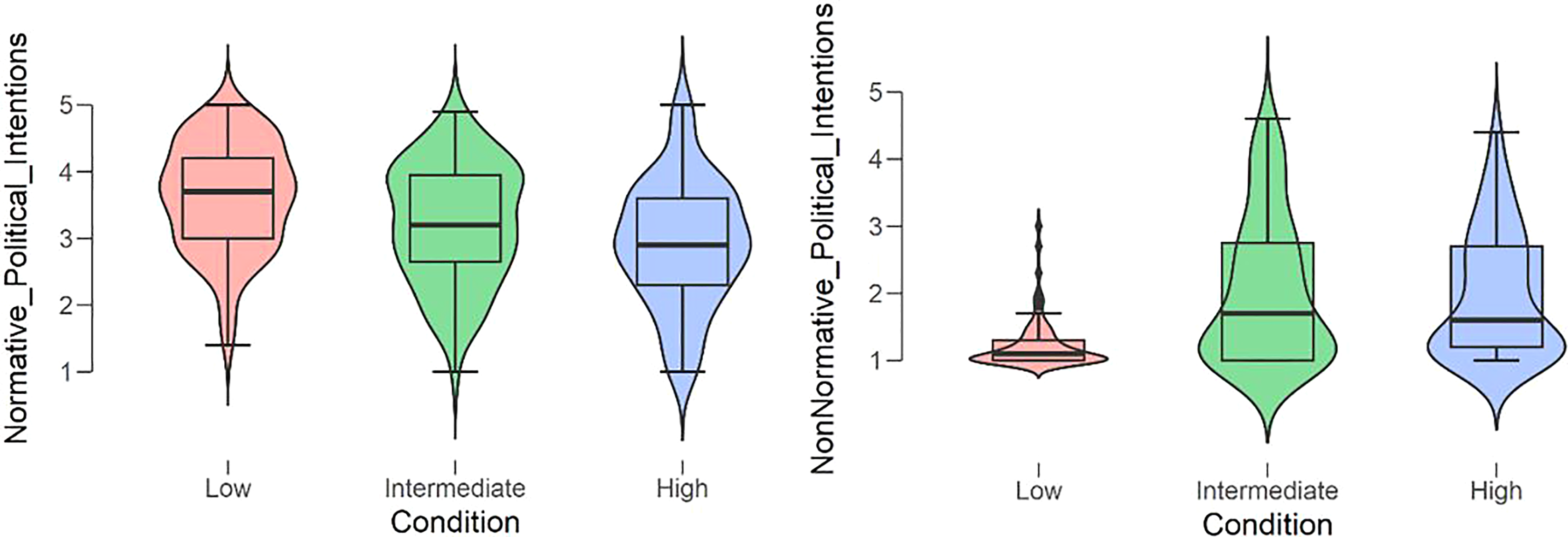
Violin plots of intentions to engage in normative versus nonnormative political engagement as a function of experimental condition in Study 2. Boxplots depict median and quartile range, outline the density distribution.
There was a steady decrease in normative political engagement from low to intermediate: t(160) = −3.05, p = .003, d = −0.48, 95% CI [−0.79, −0.16]; from intermediate to high conspiracy mentality: t(170) = −2.15, p = .033, d = −0.33, 95% CI [−0.63, −0.03]; and from low to high: t(174) = −5.32, p < .001, d = −0.81, 95% CI [−1.12, −0.50]. Nonnormative action in contrast increased for intermediate, t(95.42) = 6.34, p < .001, d = 1.01, 95% CI [0.66, 1.33], and high conspiracy mentality, t(122.80) = 6.92, p < .001, d = 1.02, 95% CI [0.73, 1.38], compared to low conspiracy mentality with the latter two not differing significantly, t(160) = 0.53, p = .595, d = 0.08, 95% CI [−0.22, 0.38].
As in Study 1, there was no indication of a moderating effect of personal responses on the conspiracy mentality scale (α = .92), but the three conditions differed slightly in the mean score of conspiracy mentality, F(2, 252) = 3.21, p = .042. Controlling for conspiracy mentality as a covariate in the critical mixed-model ANOVA reported above yielded neither a main effect nor an interaction with the other factors, ps > .523, whereas the critical interaction remained intact, F(2, 251) = 49.96, p < .001,
Discussion
Study 2 largely replicated Study 1 in the overall pattern but provided somewhat weaker evidence for the curvilinear relation (as the simple effects were not significant). More importantly, as predicted, there was a clear dissociation of the effect on conspiracy mentality condition on normative versus nonnormative political actions. As the results were impressively consistent, we will not discuss Study 2 separately but move to the combined discussion of the results.
General Discussion
Two preregistered studies in two different national contexts (Germany, United States) converge in showing a curvilinear relation between experimentally assigned (hypothetical) conspiracy worldview and the general tendency to become politically active (independent of the means). Further, a more fine-grained differentiation into normative and nonnormative means resolved this by showing that with an increase in conspiracy worldview, intentions to engage in normative, legal means decreased, whereas the willingness to commit illegal, nonnormative political acts was higher for any condition that involved any conspiracy worldview.
Both findings may provide a solution for an apparent lack of consensus in the literature as to whether conspiracy beliefs decrease or increase political intentions. Our findings suggest that they initially do (conceivably, as they increase perceptions of injustice and a perceived need to change the status quo), but only up to a certain point of conspiracy beliefs after which intention to engage politically decrease (particularly for normative forms) or stagnate (for nonnormative forms). The latter stagnation is not fully in line with a nothing-to-loose phenomenon by which nonnormative actions become more attractive, the more desperate one is and the lower one’s perceived efficacy is (Saab et al., 2016), a finding that deserves further scrutiny in future research.
Overall, our findings point to a real danger of conspiracy worldviews. Once people are convinced of them, there is no need to pay allegiance to any form of social contract, as codified in laws and regulations or implicitly agreed on in forms of trust in epistemic authorities like quality media or university scientists (Imhoff et al., 2018).
The current studies have clear limitations, the most obvious one being that participants gave hypothetical responses to a hypothetical scenario. This method allows for strict experimental control, and thus causal interpretations, but it has clear costs in terms of ecological validity and generalizability to real-life situation. The causal link we provide only speaks to the fact that taking the perspective of a conspiracy worldview makes people see violent extremism as a plausible option. At the same time, even if the effect is currently restricted to hypothetical worldview, it points to an interesting insight. Once people accept a basic belief of conspiracy believers, adopting nonnormative violent means to pursue one’s political goals becomes—if not inevitable—certainly a seemingly logical decision to ordinary people.
This important lesson notwithstanding, future studies should provide additional evidence for the effect of conspiracy worldviews in the real-world and actual radicalization processes. Ideally, scholars could follow individuals from populations with pronounced vulnerability to radicalization longitudinally and thereby trace trajectories of conspiracy worldview and political radicalization. We know from historical and current political movements that conspiracy rhetoric plays a pivotal role in prominent terrorist organization and other political movements who endorsed the use of violence (Bartlett & Miller, 2010). Our study is the first to establish experimentally: Under the impression that the world is governed by conspiracies virtually anyone would see it as more likely to engage in nonnormative political acts.
Supplemental Material
Supplemental Material, VignetteValidatoin. - Resolving the Puzzle of Conspiracy Worldview and Political Activism: Belief in Secret Plots Decreases Normative but Increases Nonnormative Political Engagement
Supplemental Material, VignetteValidatoin. for Resolving the Puzzle of Conspiracy Worldview and Political Activism: Belief in Secret Plots Decreases Normative but Increases Nonnormative Political Engagement by Roland Imhoff, Lea Dieterle and Pia Lamberty in Social Psychological and Personality Science
Footnotes
Declaration of Conflicting Interests
The author(s) declared no potential conflicts of interest with respect to the research, authorship, and/or publication of this article.
Funding
The author(s) received no financial support for the research, authorship, and/or publication of this article.

Supplemental Material
The supplemental material is available in the online version of the article.
Notes
References
Supplementary Material
Please find the following supplemental material available below.
For Open Access articles published under a Creative Commons License, all supplemental material carries the same license as the article it is associated with.
For non-Open Access articles published, all supplemental material carries a non-exclusive license, and permission requests for re-use of supplemental material or any part of supplemental material shall be sent directly to the copyright owner as specified in the copyright notice associated with the article.
