






Abstract
Background:
Malnutrition is high in hospitalized COVID-19 patients, influencing disease severity and progression. It is therefore important to identify nutritional status markers.
Objective:
The aim of this study was to investigate, in patients affected by COVID-19, the relationship between body composition, assessed by bioelectrical impedance analysis, inflammatory state, and risk of malnutrition.
Methods:
Between November and December 2020, patients hospitalized for COVID-19 at the low-intensive care unit of Policlinico in Milan were enrolled. Anthropometric data, complete blood count, albumin, and body composition parameters were collected. The Malnutrition Universal Screening Tool was used to identify the risk of malnutrition.
Results:
Twenty-seven patients (74% males), with age of 63 ± 14 years, were included. The length of hospital stay (LOS) was 34.5 ± 31.5 days. All patients lost weight, with a mean of approximately 8%. Fat free mass was negatively correlated with LOS (r2 = 0.222; p = 0.013), as well as neutrophils to lymphocytes (NLR) ratio was negatively correlated with albumin (r2 = 0.215, p = 0.017) and positively correlated with body weight loss (r2 = 0.194; p = 0.022).
Conclusion:
Nutritional screening and NLR assessment helped identify COVID-19 patients at high risk of malnutrition, allowing them to receive the necessary nutritional support.
Introduction
In 2020, the Severe Acute Respiratory Syndrome (SARS), caused by SARS-CoV-2 infection, led to the coronavirus disease 2019 (COVID-19) pandemic. 1 The infection presented itself with a numerous symptoms, also requiring hospitalization for the need for mechanical ventilation. 2 Comorbidities, including hypertension, diabetes, cardiovascular diseases or respiratory syndromes, or advanced age, or male gender increased the likelihood of developing severe disease.3,4 Malnutrition is common in hospitalized patients and is associated with prolonged hospital stays, high mortality rate, and high healthcare costs in elderly patients. 5 A high prevalence of malnutrition has also been recorded in patients hospitalized for COVID-19, suggesting that early identification and intervention may be useful to prevent a worsening of the patient's clinical conditions. 6 The risk of malnutrition further increases if a person is hospitalized for more than 48 h, regardless of the initial body mass index (BMI), or in case of significant reduction in physical activity. In addition, COVID-19 infection has been associated with reduced levels of albumin and impaired organ function, 7 which may contribute to the further development of sarcopenia. Nutritional risk can be easily evaluated by simple and non-invasive tools, such as Nutritional Risk Screening 2002 (NRS-2002) and Malnutrition Universal Screening Tool (MUST). The MUST tool, often underused in clinical practice 8 has recently been highlighted as having high sensitivity and specificity in detecting patients affected by COVID-19 at risk of malnutrition, 9 while NRS-2002 has been shown to be useful in predicting the length of hospital stay (LOS) when applied to the same type of population.
Bioelectrical impedance analysis (BIA) is a non-invasive method used to determine body composition, based on the measurement of the electrical impedance of an electrical current passing through the body. Phase Angle (PhA) is a variable based on reactance and resistance obtained from BIA that has been shown to predict survival and is reduced in subjects with sarcopenia. 10 PhA is also independently associated with negative outcome in patients with COVID-19. 11
COVID-19 infection promotes systemic inflammation. Some blood parameters, such as C-reactive protein (CRP) and neutrophils to lymphocytes ratio (NLR), can predict disease progression and severity 12 and can be used as an early marker in critical illness.
The aim of the present study was to investigate the relationship between body composition, inflammatory state, and risk of malnutrition in patients with COVID-19 and admitted to the low-intensity care unit of the IRCCS Ca’ Granda – Ospedale Maggiore Policlinico, in Milan.
Materials and methods
Study design and procedures
The study was conducted at the De Palo Unit of the IRCCS Ca’ Granda – Ospedale Maggiore Policlinico (Milan, Italy), enrolling patients hospitalized for COVID-19 infection between November and December 2020.
Baseline laboratory variables, including complete blood count (CBC), NLR, CRP, and albumin were retrieved, where available. 13
The last reported body weight before hospitalization was recorded. Anthropometric data (height and body weight) were measured using SECA 700 instrument and BMI was calculated. Additionally, BIA (BIA-Dex MASCARETTI) was performed to assess the body composition of participants. The MUST screening tool was also used to assess participants’ malnutrition. Data on therapy used to treat COVID-19 infection were collected. Of note, no one received albumin replacement therapy.
The study was conducted in line with Good Clinical Practice and the Declaration of Helsinki. Approval was provided by the Ethics Committee of the Ospedale Maggiore Policlinico – Area B Ethics Committee (approval number 342_2020). Written informed consent was obtained from all participants prior to enrollment.
Statistical analysis
Continuous variables were summarized using mean ± standard deviation (SD) or median [interquartile range], as appropriate. Categorical variables were summarized using frequency distributions and percentages. Paired t-test was used to assess the change in body weight and BMI. A linear regression model was used to investigate the correlation between the variables examined. All statistical analyses were performed using Jamovi version 1.6 (Jamovi project, 2021) and p-value ≤ 0.05 was considered statistically significant.
Results
Twenty-seven (20 males) patients were enrolled in the present study and their characteristics at hospital admission are reported in Table 1. The average age of patients was 63 ± 14 years and the mean days of hospitalization were 34.5 ± 31.5 days. Since there are differences between males and females in Covid-19 disease, we considered the variables both in our general population and by gender. The most commonly used therapy to treat COVID-19 infection were the administration of corticosteroids and the application of continuous positive airway pressure (cPAP), individually or simultaneously. As for blood analysis, a NLR value of 10.9 ± 12.7 was recorded, while 8.71 ± 7.43 mg/dL and 3.52 ± 0.46 g/dL were the levels of CRP and albumin, respectively. No difference was found between males and females in blood tests, although the women were found to be much older (59.5 ± 12 years vs 76 ± 8.5 years, p = 0.004). After approximately 27 days of hospitalization, participants underwent anthropometric assessment. Body weight decreased from 79.0 ± 12.8 kg, recorded at admission to the ward, to 73.0 ± 13.0 kg (p < 0.001). The reduction was 8% in just one month. As a result, BMI decreased from 26.5 ± 4.56 kg/m2 to 24.5 ± 4.32 kg/m2 (p < 0.001). The bio-impedance evaluation showed free fat mass (FFM) and fat mass of 56.1 ± 10.1 kg and 16.9 ± 8.88 kg, respectively, while PhA was of 5.6 ± 1.3°. On average, the MUST screening tool showed that patients were at high risk of malnutrition. Since there are differences between males and females in Covid-19 disease, we have divided according to gender. In females, body weight decrease from 72.2 ± 12.2 kg to 65.8 ± 11.7 kg (p = 0.003), while the change in males was from 81.4 ± 12.4 kg to 75.5 ± 12.7 kg (p < 0.001). No difference was found between males and females in weight reduction, either in mass or percentage (all p > 0.05).
Characteristics of the patients at the time of hospital admission.

Data are presented as the mean ± SD, median [interquartile range] or number (percentage).
Corticost: corticosteroids; cPAP: Continuous Positive Airway Pressure; LF-O2 therapy: Low-flow oxygen therapy; HF-O2 therapy: High-flow oxygen therapy; NRL: Neutrophils/Lymphocytes ratio.
At the same time, BMI decreased from 26.3 ± 5.5 kg/m2 to 23.8 ± 5.0 kg/m2 in females (p = 0.004), whereas in males the change was from 26.6 ± 4.31 kg/m2 to 24.7 ± 4.20 kg/m2 (p < 0.001). Comparing BIA values, males showed a greater PhA and FFM, while other parameters were comparable, including MUST. Anthropometric data after 27 days are summarized in Table 2.
Anthropometric characteristics evaluated after 27 days of hospitalization.
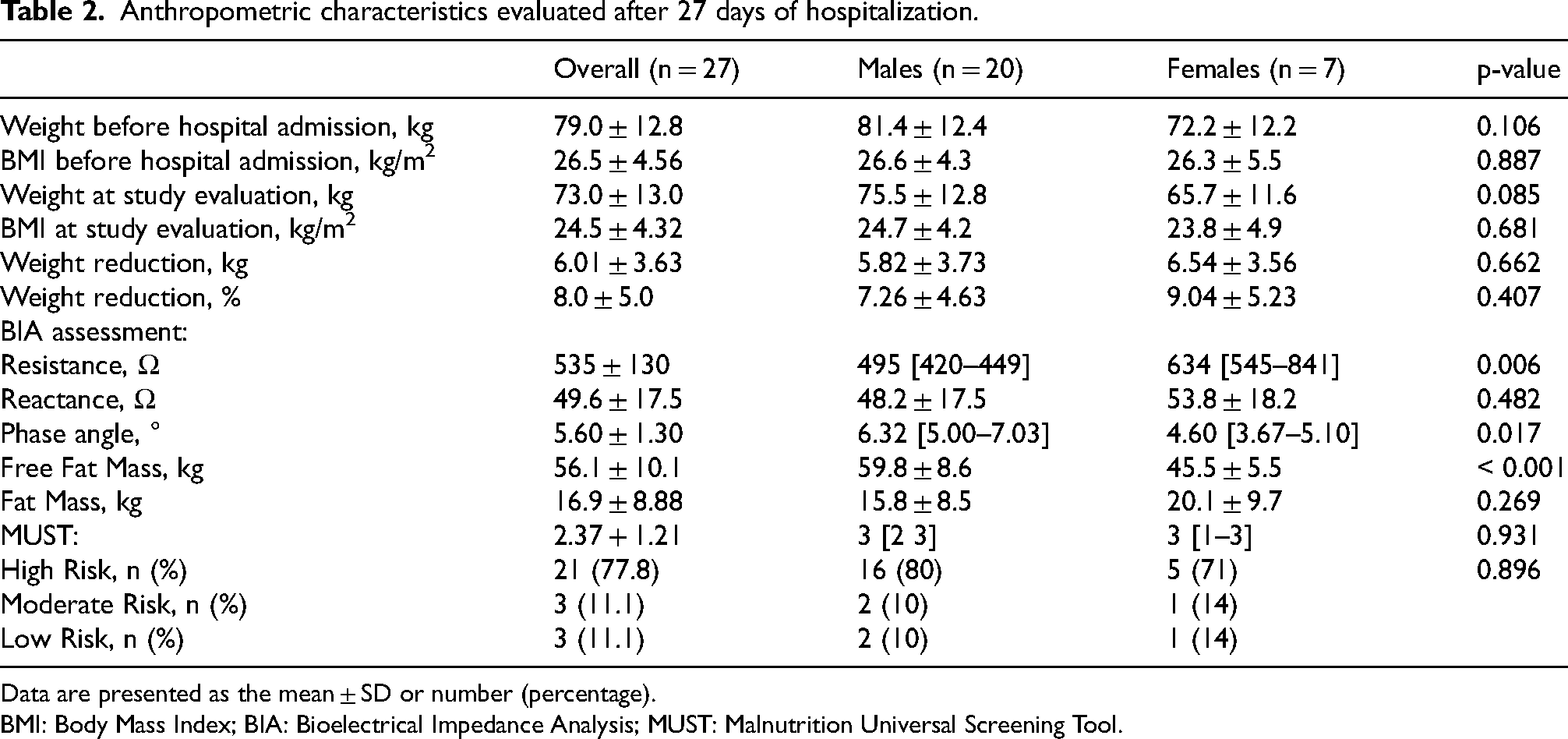
Data are presented as the mean ± SD or number (percentage).
BMI: Body Mass Index; BIA: Bioelectrical Impedance Analysis; MUST: Malnutrition Universal Screening Tool.
A significant negative correlation was found between FFM and LOS (r2 = 0.222, p = 0.013) (Figure 1), as well as between NLR and albumin levels (r2 = 0.215, p = 0.017) (Figure 2). A significant positive correlation was found between NLR and percentage of weight loss (r2 = 0.194, p = 0.022) (Figure 3) during hospitalization. No association was observed between the LOS and PhA (r2 = 0.047, p = 0.277).
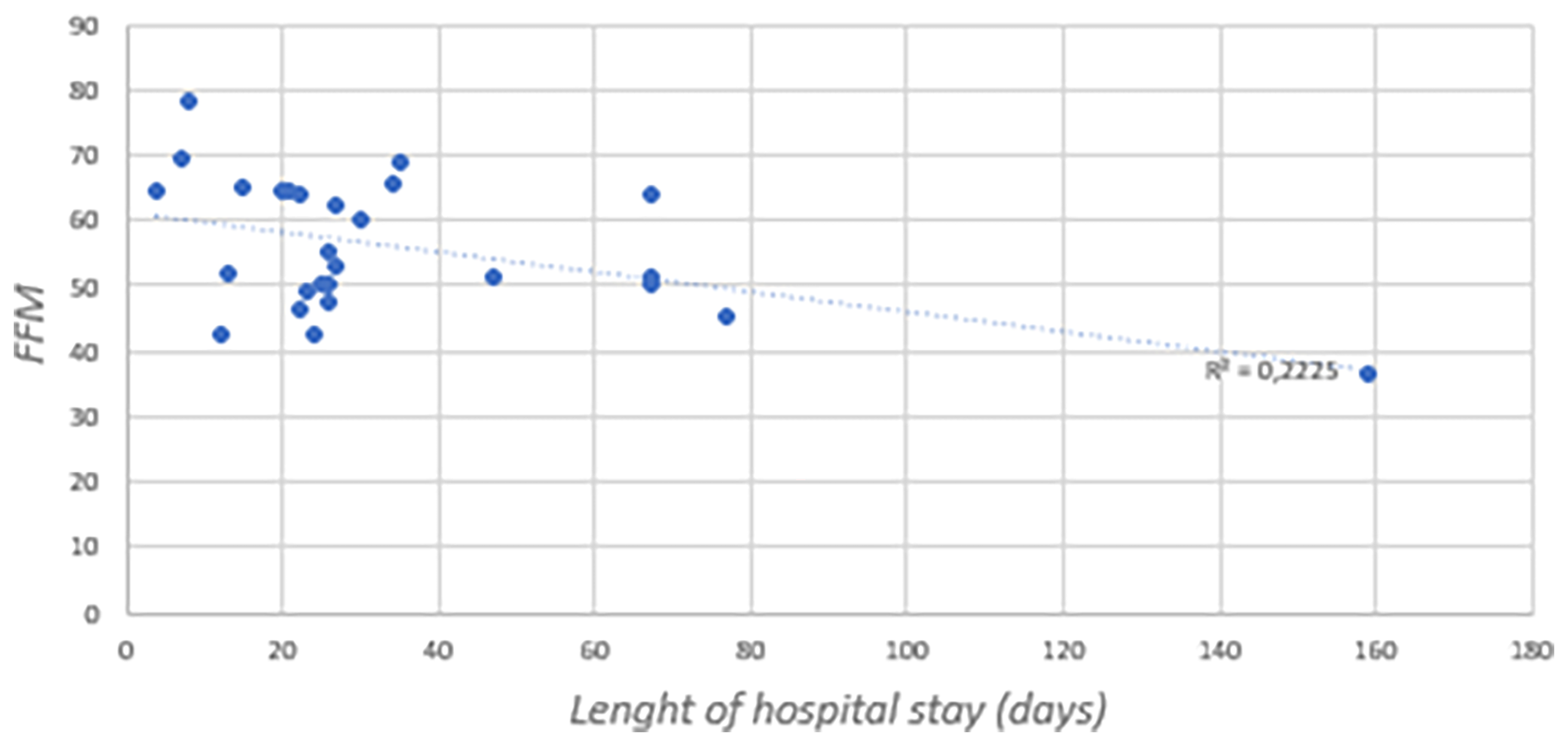
Correlation between fat free mass (FFM) and length of hospital stay. p- value = 0.013.

Correlation between albumin and neutrophils to lymphocytes ratio (NRL). p- value = 0.017.

Correlation between weight loss and neutrophils to lymphocytes ratio (NRL). p- value = 0.022.
Discussion
SARS-CoV-2 infection has manifested itself in various ways: from asymptomatic carriers to flu-like symptoms, such as sore throat, cough, fever to lung infections, and, in the most severe cases, with acute respiratory distress syndrome, sepsis, and death. Moreover, COVID-19 seems to increase the malnutrition risk in hospitalized patients.14,15
Fifty percent of patients reported at least one comorbidity at the time of hospital admission. The most frequently reported were chronic obstructive pulmonary disease, obesity, diabetes, hypertension, and cardiovascular diseases. The presence of comorbidities is known to contribute to the prognosis disease and to increase the severe symptoms risk. 16 Approximately 70% of patients requiring intensive care had comorbidities. 17 Globally, the most common disorder identified in COVID-19 patients was hypertension, followed by diabetes, and cardiovascular disease. 4 Many studies have investigated the link between nutritional state and presence of COVID-19, focusing on obesity and nutritional support or specific supplementation need. A recent study on nutritional assessment and therapy administered in hospitalized COVID-19 patients highlighted a high risk of malnutrition, up to 50% of the subjects. Moreover, the prevalence of nutritional risk, malnutrition, disease/inflammation burden, and decrease intake of hospital diet differed among the intensity of care setting. 18 A meta-analysis showed that the overall malnutrition prevalence among hospitalized patients affected by COVID-19 was 49.11%, significantly higher than the prevalence reported before the SARS-CoV-2 pandemic. This may be due to the impact of the virus on the gastrointestinal and immune systems, along with the higher metabolic rate and reduced oral intake. 6 However, only a few studies have investigated actual body composition or included specific screening tools to detect malnutrition among COVID-19 patients. 19 In this study, we therefore assessed the relationship between body composition, inflammatory state, and malnutrition risk in the general population and by gender.
According to previous studies,8,18 MUST and NRS-2002 scores used in hospitalized patients for COVID-19 have detected a higher risk of malnutrition. Our data confirmed this finding, with 77.8% of patients at high risk of malnutrition. This was demonstrated by the weight loss measured in all our patients, although without differences between males and females. An average weight loss of 8% was observed in just one month and this was in line with other studies reporting patients’ risk of losing from 5% to 10% of their body weight, during acute infection.20,21 This was mainly due to loss of appetite, gastrointestinal problems, and increased energy expenditure caused by infections, fever, and respirator effort, as highlighted by Pironi and colleagues, 18 who found a global protein and energy intake lower than the necessary quantities. Due to inadequate nutritional intake, combined with infections and reduced physical activity during hospital stays, physical deterioration and muscle strength loss—key components of sarcopenia—are common. 22 This condition can significantly affect the prognosis of patients during hospitalization, as well as vulnerability to functional and physical deterioration after discharge. 23 Many Authors have shown that COVID-19 survivors have an increased risk of developing sarcopenia,24,25 as well as decreased in muscle strength and function. 26 A recent study highlighted a high prevalence of sarcopenia among elderly patients affected by COVID-19 even 3 months after hospital admission and a negative correlation between FFM and LOS. Furthermore, a negative correlation was found between muscle strength, frailty, and comorbidities, and an increase in post-infection symptoms and lymphopenia.22,27
Recently, there has been an increased interest in BIA. BIA is a non-invasive method, applied in the nutritional field to assess body composition.28,29 Altered body composition, characterized by low measured or estimated muscle and lean body mass, is a predictor of poor clinical outcomes in COVID-19 infection. 30 In particular, PhA measured by BIA in non-Intensive Care Unit (non-ICU) patients 31 was associated with inflammation, longer LOS, and higher 3-month mortality. Moreover, PhA also predicted COVID-19 severity with a composite score of morbidity in a mixed non-ICU and ICU population.11,32
In this study, we aimed to assess BIA parameters (PhA and FFM) and their correlation with hospital stay. The role of PhA as an indicator of nutritional and health status is well-known, while its contribution to prognostic and clinical outcomes is more recent and still debated. A systematic review found that severe sarcopenic patients with cirrhosis, chronic obstructive pulmonary disease or renal transplant recipients had lower PhA. Therefore, the available data support the idea that a reduction in PhA is an index of sarcopenia. 10 Some authors, trying to define PhA cut-offs to detect sarcopenia, have identified values ranging from a minimum of 3.55° to a maximum of 5.05°. A recent study found that a value of PhA ≤ 4.0° was associated with an increased LOS and risk of hospital readmission and falls in-hospital. 33 Another study, 19 conducted on patients with COVID-19, showed that a mean PhA of 5.6 ± 1.4° was a good predictive factor for all the outcomes explored. We calculated PhA both in the general population (5.60 ± 1.30°) and in relation to gender (males: 6.32 [5.00–7.03] ° vs females: 4.60 [3.67–5.10] °, p = 0.017). Although in our cohort we found results in PhA values (5.60 ± 1.30°) comparable to those present in the literature, 19 no association with LOS was found. These results could be explained by the small population included in our analysis. Anyway, our data showed that patients with a higher percentage of FFM had a shorter LOS, suggesting that in the hospital setting BIA analysis could be an useful tool to stratify risk and identify patients who may require specific nutritional support. Males always have a higher PhA value than females. 34 Malnutrition is a determining factor in COVID-19 and specific score and markers pose a challenge for clinician and caregivers, although the impact of nutritional status on disease prognosis is often underestimated. Recently, mini-nutritional scores, such as the controlling nutritional status, nutritional risk index or NLR have been increasingly used as surrogate markers to describe the nutritional status of patients. 35
Patients immune and nutritional health are associated with susceptibility to and severity of infectious diseases. Albumin levels are a marker that may decrease in proportion to systemic inflammatory response, as occurs in malnourished patients, and are associated with poor clinical outcomes in acutely ill patients. Recent observational studies on patients with COVID-19 have highlighted that a reduction in plasma albumin levels may be associated with increased severity disease. Moreover, both decreased production and increased loss of albumin can be observed in patients with renal disorders and liver damage, which are common pathologies in these patients. 36 Lymphocytopenia is a frequent clinical manifestations in subjects with acute viral infection and patients who died from COVID-19 had statistically lower lymphocyte count than survivors. 36 Patients with severe COVID-19 had hypoalbuminemia and lymphocytopenia compared to patients with non-severe COVID-19. This evidence was confirmed by our data, as a higher NLR value corresponds to a lower level of albumin. Furthermore, in our patients, NLR calculated at hospital admission was correlated with the percentage of weight loss during hospitalization, suggesting that it could be used to predict weight loss, representing an early marker of malnutrition. Taken together, the MUST screening tool, BIA analysis, and NLR could be useful markers to evaluate nutritional status in patients with COVID-19, identifying those in whom it would be appropriate to use a nutritional support to reduce the duration of hospitalization and improve post-infection recovery.
The present study has some limits. Firstly, the small sample size prevents generalization of results. Secondly, it was not possible to determine the initial body weight specifically, for example by BIA. Therefore, a comparison before-after hospitalization was not possible, even if this was not the aim of this study. Thirdly, unfortunately, we could not take into account many aspects in our analysis, such as prealbumin or serum protein levels, type of nutritional support, or screening for sarcopenia, because the medical records were incomplete. The patients enrolled in this study were hospitalized during the second wave of COVID that hit Italy. Many data were therefore lost because they remained incomplete, given the state of emergency in which we found.
Conclusions
In conclusion, our results suggested that nutritional screening and NLR assessment are useful tools to identify patients at risk of developing malnutrition and they may be used to decide if and when a nutritional support is needed.
Footnotes

Ethical considerations
The study was performed in line with the Declaration of Helsinki (1964) guidelines and its amendments and the general principles of ICH Harmonized Tripartite Guidelines for Good Clinical Practice (ICH Topic E6, CPMP/ICH/135/95). At enrollment, written informed consent was obtained from each participant and reviewed by the ethics committee of our hospital, in accordance with ICH-GCP, the ethical principles deriving from the Declaration of Helsinki and the regulatory and legal requirements in Italy.
Author contributions
Conceptualization: VL, IMR, and PA; Methodology: LV, MP, and AL; Formal analysis: BIM, and LT; Data curation: PA, and D'OV; Writing—original draft preparation: VL, TL, AL, and D'OV; Writing—review and editing: VL, TL and FG; Supervision: BA, MA, and MP. All authors have read and agreed to the published version of the manuscript.
Funding
The author(s) received no financial support for the research, authorship, and/or publication of this article.
Declaration of conflicting interests
The author(s) declared no potential conflicts of interest with respect to the research, authorship, and/or publication of this article.
Data availability statement
Data may be made available for collaborative studies upon reasonable request to the corresponding author.