Sarcopenia, characterized by a reduction in skeletal muscle mass and function, is a prevalent complication in the Intensive Care Unit (ICU) and is related to increased mortality. This study aims to determine whether muscle and fat mass measurements at the T12 and L1 vertebrae using chest tomography can predict mortality among critically ill COVID-19 patients requiring invasive mechanical ventilation (MV).
Methods:
Fifty-one critically ill COVID-19 patients on MV underwent chest tomography within 72 h of ICU admission. Muscle mass was measured using the Core Slicer program.
Results:
After adjustment for potential confounding factors related to background and clinical parameters, a 1-unit increase in muscle mass, subcutaneous, and intra-abdominal fat mass at the L1 level was associated with approximately 1–2% lower odds of negative outcomes and in-hospital mortality. No significant association was found between muscle mass at the T12 level and patient outcomes. Furthermore, no significant results were observed when considering a 1-standard deviation increase as the exposure variable.
Conclusion:
Measuring muscle mass using chest tomography at the T12 level does not effectively predict outcomes for ICU patients. However, muscle and fat mass at the L1 level may be associated with a lower risk of negative outcomes. Additional studies should explore other potential markers or methods to improve prognostic accuracy in this critically ill population.
Research article
Available accessResearch articleFirst published May, 2025pp. 95-105
Mohammed A Abdel-RasolORCID, Nadia M El-Beih, Wael M El-SayedORCID
Abstract
Background
Hypercholesterolemia is a global health concern and a risk factor for metabolic disorders due to its association with oxidative stress.
Objective
This study aimed to evaluate the therapeutic potential of ginger ethanolic extract (GE) and ginger water suspension (GS) against hypercholesterolemia-induced oxidative stress in cystine-fed rats.
Methods
Rats were randomly assigned to seven groups. Control, dimethylsulfoxide (DMSO) group, groups three and four received orally 150 mg/kg of GE or GS for two weeks, respectively. Group five was fed a diet with 5% cystine for two weeks. Groups six and seven were fed cystine for two weeks, followed by two weeks of ginger ethanolic extract (GE) or GS treatment, respectively.
Results
Rats fed a cystine diet exhibited significant increases in serum alanine aminotransferase and alkaline phosphatase activities, hepatic malondialdehyde, and serum levels of total cholesterol, malondialdehyde, triacylglycerols, low density lipoprotein cholesterol, and total lipids. They showed significant decreases in serum high density lipoprotein cholesterol levels, alpha-1 and -2 globulin, beta-globulin levels, hepatic reduced glutathione content, and activities of hepatic glutathione peroxidase, superoxide dismutase, catalase, glutathione reductase, and glutathione S-transferase. Administration of GE or GS significantly mitigated these effects.
Conclusions
GE and GS attenuated hypercholesterolemia-induced oxidative damage by modulating the lipid profile and boosting the activity of hepatic antioxidant enzymes with GE showing superior efficacy to GS.
Research article
Available accessResearch articleFirst published May, 2025pp. 106-117
Mohammed A Abdel-RasolORCID, Nadia M El-Beih, Wael M El-SayedORCID
Abstract
Background:
Acetaminophen (APAP) overdose, common during pandemics like COVID-19, causes liver injury through oxidative stress. Ginger, known for its antioxidant properties, is suggested as a potential natural remedy.
Objective:
This study aimed to evaluate the therapeutic and prophylactic efficacy of ethanol ginger extract (GE) and ginger suspension (GS) on APAP-induced hepatotoxicity and dyslipidemia in rats.
Methods:
Rats were assigned to ten groups: a control group, dimethyl sulfoxide group, and groups receiving either GE or GS (150 mg/kg) for two weeks. A group given a single high dose of APAP (2500 mg/kg), groups pre-treated with GE or GS before a single dose of APAP, a group receiving three repeated doses of APAP (500 mg/kg), and groups co-administrated GE or GS along with APAP over two weeks.
Results:
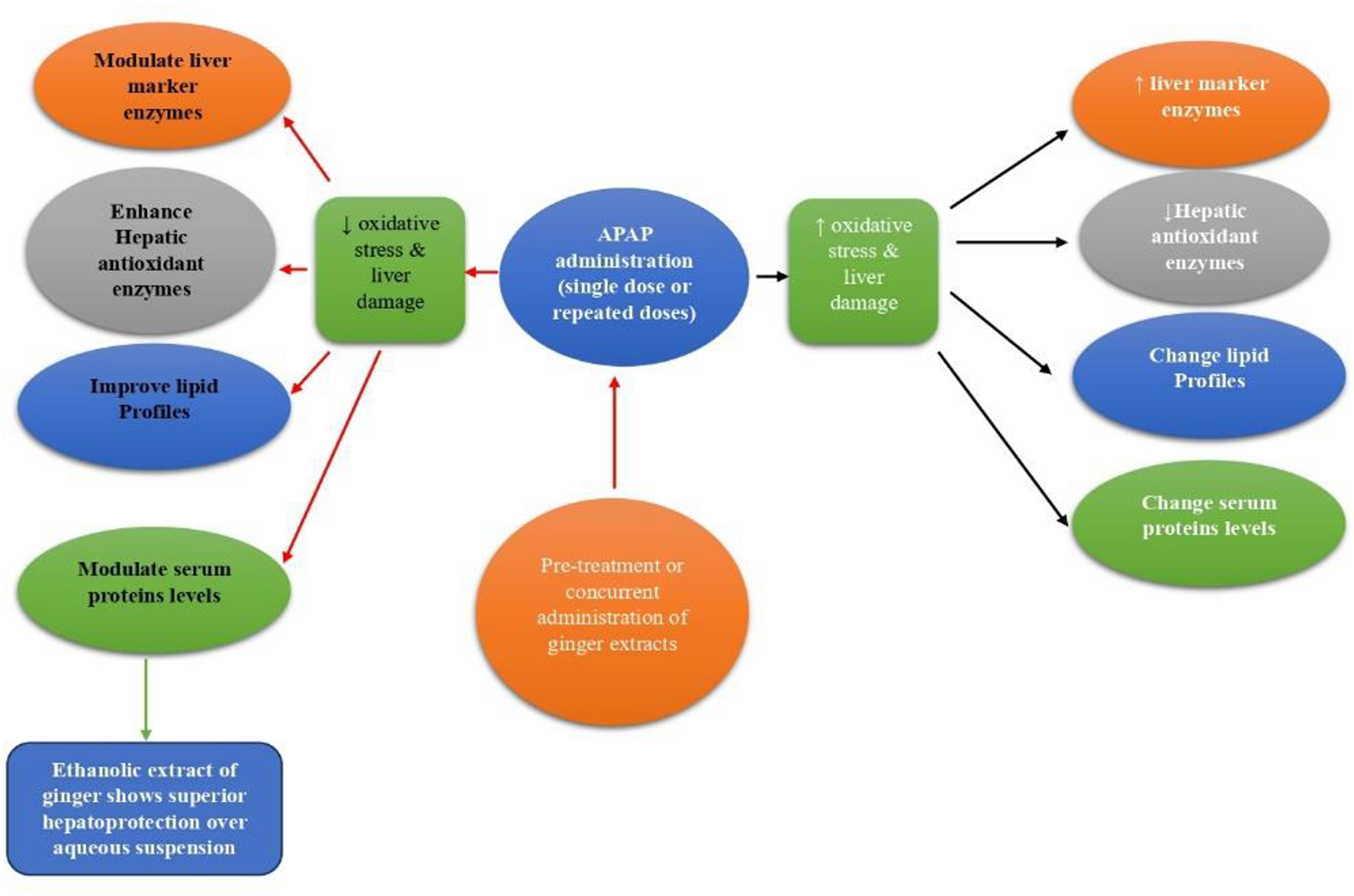
APAP administration at the two regimens significantly impaired liver function, antioxidant defenses, and lipid metabolism. These disruptions included reduced levels of antioxidant markers such as reduced glutathione (GSH), catalase (CAT), superoxide dismutase (SOD), glutathione S-transferase (GST), glutathione reductase (GR), glutathione peroxidase (GPx), and glucose-6-phosphate dehydrogenase (G6PDH). Lipid metabolism alterations were evident from increased triacylglycerols (TAGs), total cholesterol (T-chol), low-density lipoprotein cholesterol (LDL-chol), alongside decreased high-density lipoprotein cholesterol (HDL-chol). The high dose of APAP resulted in severe damage, indicated by elevated malondialdehyde (MDA), alanine aminotransferase (ALT), alkaline phosphatase (ALP), and altered protein fractions. Both GE and GS treatments significantly alleviated these APAP-induced changes, particularly in MDA, ALT, GPx, and LDL-chol levels. GE demonstrated superior protective effects compared to GS, particularly in restoring levels of GSH, ALP, CAT, SOD, GST, GR, G6PDH, HDL-chol, albumin and alpha-1 globulins. In contrast, GS showed slightly greater effects on reducing TAGs and T-chol levels.
Conclusions:
Ginger extracts offer significant protection against APAP-induced liver damage and dyslipidemia, with GE providing more pronounced therapeutic effects.
This is a visual representation of the abstract.
Research article
Available accessResearch articleFirst published May, 2025pp. 118-126
Mostafa A ArafaORCID, Horeya M IsmailORCID, Karim H FarhatORCID , [...]
View All
Abstract
Background
Despite Saudi Arabia's sunny climate, vitamin D deficiency is prevalent. We aimed to utilize several machine learning algorithms to predict Vitamin D deficiency among Saudi men and identify correlated features.
Methods
We collected data from the records of King Khalid University Hospital in Riyadh between 2019 and 2021. Variables included health conditions, race, blood pressure, BMI, blood glucose, lipid profile, and total 25-hydroxyvitamin D (25OHD) levels. Six ML algorithms (Support Vector Machine, decision tree, linear regression, gradient boosting, XGBoost, and random forest) were employed to construct models for both cutoff points of <75 nmol/L and <50 nmol/L. The dataset was randomly divided into the training set and validation set at a ratio of 8:2. The accuracy of the algorithm was tested using the ten-fold cross-validation method. Performance metrics such as accuracy, precision, recall, F1 score, and area under the precision-recall curve (PRC, AUC) were assessed and compared between the models for both categories.
Results
Among 1700 Saudi men, 76.1% exhibited vitamin D deficiency (<75 nmol/l), with 52.5% deficient using an alternative cutoff (<50 nmol/l). Gradient boosting algorithm exhibited superior predictive accuracy, especially at the <75 nmol/L cutoff, outperforming the discrimination power of other algorithms for both classes. BMI emerged as the strongest predictor of vitamin D deficiency, followed by age and blood sugar results. The PRC, AUC for the <50 cutoff varies between 0.59 and 0.63 for the four classifiers (SVM, Linear regression, XGBoost, and Gradient boosting), whereas it reached 0.83 for the <75 cutoff.
Conclusion
Vitamin D deficiency is prevalent among healthy Saudi Arabian men. ML algorithms have proven effective in identifying correlated features within this highly impacted population, enabling tailored interventions and appropriate preventive strategies to address vitamin D deficiency and insufficiency. This model's high accuracy can help identify individuals at risk without the need for costly and time-consuming blood tests.
Research article
Available accessResearch articleFirst published May, 2025pp. 127-138
Parents’ reports are frequently utilized to evaluate children with eating difficulties. To forecast a child's eating pattern, information on feeding skills is crucial. The Children's Eating Behavior Inventory (CEBI) is a valuable questionnaire addressing child-parent behavior during mealtimes.
Objective
This study intended to validate the Greek version of CEBI by the Greek Cypriot parents, of preschool and school-aged populations with or without feeding difficulties.
Methods
100 Greek Cypriot parents of children with typical eating behaviors (c-teb) and 100 parents of children with non-typical eating behaviors (c-nteb) participated in this study. All participants completed the Greek-translated version of the CEBI questionnaire. RESULTS: Statistically significant differences were found between the c-teb and the c-nteb groups [t (198) = −1.628 p < 0.005] for the CEBI total score. The instrument has strong internal consistency with Cronbach-a 0.854, intraclass correlation coefficient (ICC) = 0.843–0.859), strong test-retest reliability (r = 0.999, p < 0.001), and good external criterion validity [MCH-FS (r = −0.712, p < .001) and the AYCE r = −0.660, p < .001)]. The Receiver Operating Characteristic (ROC) analysis estimated a cut-off = 83.00 (sensitivity of 0.870 and a 1-specificity of 0.250) with Area Under the Curve, AUC = 0.848, (95% CI: 0.792–0.905), p < 0.001.
Conclusions
The Greek CEBI revealed excellent sensitivity, reliability, and clinical validity, which can support healthcare providers in Greek Cypriot settings.
Research article
Available accessResearch articleFirst published May, 2025pp. 139-146
Malnutrition is high in hospitalized COVID-19 patients, influencing disease severity and progression. It is therefore important to identify nutritional status markers.
Objective:
The aim of this study was to investigate, in patients affected by COVID-19, the relationship between body composition, assessed by bioelectrical impedance analysis, inflammatory state, and risk of malnutrition.
Methods:
Between November and December 2020, patients hospitalized for COVID-19 at the low-intensive care unit of Policlinico in Milan were enrolled. Anthropometric data, complete blood count, albumin, and body composition parameters were collected. The Malnutrition Universal Screening Tool was used to identify the risk of malnutrition.
Results:
Twenty-seven patients (74% males), with age of 63 ± 14 years, were included. The length of hospital stay (LOS) was 34.5 ± 31.5 days. All patients lost weight, with a mean of approximately 8%. Fat free mass was negatively correlated with LOS (r2 = 0.222; p = 0.013), as well as neutrophils to lymphocytes (NLR) ratio was negatively correlated with albumin (r2 = 0.215, p = 0.017) and positively correlated with body weight loss (r2 = 0.194; p = 0.022).
Conclusion:
Nutritional screening and NLR assessment helped identify COVID-19 patients at high risk of malnutrition, allowing them to receive the necessary nutritional support.


 Available accessArticle commentaryFirst published May, 2025pp. 83-86