






Abstract
Background
Patient activity (PA) has been demonstrated to predict all-cause mortality. However, the association between PA and cardiac death is unclear.
Aims
The aims of this study were to determine whether PA can predict cardiac death and what is the cut-off of PA to discriminate cardiac death, as well as the mechanism underlying the relationship between PA and survival in patients with home monitoring.
Methods
This study retrospectively analysed clinical and implantable cardioverter-defibrillator/cardiac resynchronization therapy defibrillator device data in 845 patients. Data regarding PA and PP variability during the first 30–60 days of home monitoring were collected, and mean values were calculated. The primary endpoint was cardiac death, and the secondary endpoint was all-cause mortality.
Results
The mean PA percentage was 11 ± 5.8%. Based on receiver operating characteristic curve analysis, we determined that a PA cut-off value of 7.84% (113 min) can predict cardiac death. During a mean follow-up period of 31.1 ± 12.9 months (ranging from three to 60 months), PA ≤ 7.84% was associated with increased risks of cardiac death in an unadjusted analysis; after adjusting in a multivariate Cox model, the relationship remained significant between PA≤7.84% and cardiac death (hazard ratio = 3.644, 95% confidence interval = 2.424–5.477, p < 0.001). Moreover, a significant correlation was observed between PA and PP variability (r = 0.601, p < 0.001).
Conclusions
A baseline PA ≤ 7.84% was associated with a higher risk of cardiac death in patients who have survived more than three months after implantable cardioverter-defibrillator/cardiac resynchronization therapy defibrillator implantation. PA had a sizable effect on heart rate variability, reflecting autonomic function.
Keywords
Introduction
Cardiovascular death is the leading cause of death worldwide despite optimal medical and device therapies. Previous studies have found that exercise capacity is an important prognostic factor in patients with cardiovascular disease.1,2 Patient activity (PA) has been demonstrated to predict outcomes in different diseases.3–5 PA information can be continuously and automatically collected by implantable cardioverter-defibrillator (ICD) and cardiac resynchronization therapy defibrillator (CRT-D) devices. Conraads et al. demonstrated that baseline PA can predict heart failure-related hospitalization and all-cause mortality in heart failure patients, 6 and Whellan et al. observed that PA integrated with other diagnostic information can predict heart failure-related hospitalization. 7 However, these studies did not evaluate patients without heart failure, nor did they evaluate the extent to which baseline PA can predict cardiac death. In addition, they did not elucidate the mechanisms underlying the correlation between PA and survival. Heart rate variability (HRV) has been demonstrated to predict outcomes in patients with cardiovascular disease.8–10 However, whether a correlation exists between PA and HRV is unclear.
Home monitoring technology allows the instantaneous transmission of stored device data and enables the continuous acquisition of long-term PA and HRV data. Previous studies evaluated PA only at baseline or just before follow-up visits; however, home monitoring allows the evaluation of PA and HRV at any time. The present study used home monitoring-based PA data to determine whether baseline PA can predict cardiac death, to identify the baseline PA cut-off value that can be used to predict cardiac death, and to elucidate the relationship between PA and HRV.
Methods
We retrospectively analysed archived home monitoring transmission data from a Biotronik SUMMIT registry study in China (Study of Home Monitoring System Safety and Efficacy in Cardiac Implantable Electronic Device-implanted Patients (SUMMIT)–ICD and CRT-D). The SUMMIT protocol was approved by the appropriate hospital ethics committee, and all patients provided written informed consent before entering this study, which complied with the Declaration of Helsinki.
Patient population
Patients who underwent ICD or CRT-D implantation between February 2009 and August 2014 and met the inclusion criteria were enrolled in this study. All devices were programmed to provide continuous patient monitoring data.
Demographic and clinical characteristics
Information regarding patient demographic characteristics, including age, gender and body mass index, and baseline clinical characteristics, including electrocardiograph parameters, echocardiographic characteristics, New York Heart Association (NYHA) class, ischaemic cardiomyopathy history, myocardial infarction (MI) and valvular disease history, comorbidities (hypertension, pre-implantation syncope, atrial fibrillation, stroke, diabetes mellitus) and medications (beta-blockers, amiodarone, diuretics and angiotensin-converting enzyme inhibitors or angiotensin receptor blockers), were obtained from patients' medical records before ICD/CRT-D implantation.
Patient activity
PA recording was undertaken using Biotronik devices and was measured as the time during which the devices' motion sensors delivered rates higher than the devices' basic rates. The PA resolution was 2 s, and the data were converted into % per 24 h. Consequently, 2.4 h of PA are indicated as 10% per day in the trend. PA data were collected during the first 30–60 days after ICD/CRT-D implantation, in accordance with the recommendations of a previous study, 11 after which mean 30-day PA data were calculated for each patient.
Inclusion criteria
The following patients were included in this study: (i) patients with ICD/CRT-D devices (Biotronik, Germany) equipped to process daily home monitoring transmissions after ICD/CRT-D implantation, (ii) patients between 18 and 95 years of age, and (iii) patients who survived more than three months after ICD implantation.
Endpoints
The primary endpoint of this study was cardiac death, and the secondary endpoint of this study was all-cause mortality. Routine follow-ups were conducted, and patients' statuses were confirmed via phone calls in the events their transmissions were disrupted. Deceased patients' dates of death were confirmed by contacting their families.
Relationship between HRV and PA
We performed analysis to assess the relationship between HRV and PA. We selected enrolled patients whose ICDs/CRT-Ds recorded HRV and whose first 30–60-day average atrial pacing percentages were <5%. The HRV recorded by the Biotronik ICD was designated as PP variability and was recorded in beats/min – according to the SDANN algorithm – for as long as 240 days, with a resolution of one day.
Separate analysis
We performed separate analyses involving patients with preserved left ventricular ejection fraction (LVEF) (LVEF ≥ 45%) and reduced LVEF (LVEF < 45%) to examine the predictors of PA further, as well as separate analyses involving patients with ICDs and CRT-Ds.
Statistical analysis
Continuous variables are expressed as the mean and standard deviation and were compared between the two groups using Student's t-test, and categorical variables are expressed as numbers and percentages and were compared between the two groups using Pearson's χ2 test or Fisher's test. Global p values were calculated when comparing the two groups, and statistical significance was established as p < 0.05. Receiver operating characteristic (ROC) curves were plotted to identify a PA cut-off value that can be used to predict cardiac death. Kaplan–Meier survival curves were used to evaluate survival time, which extended from the date of ICD or CRT-D implantation to the date of cardiac death and all-cause mortality. Univariate binary Cox regression analysis was used to evaluate the relationship between baseline characteristics and the study endpoints, and hazard ratios and 95% confidence intervals (CIs) were calculated for each variable for the endpoints. All variables having a statistically significant effect at the 0.05 level were included in a multivariate Cox proportional hazards model with the Enter method, which was utilized to analyse the effects of PA on cardiac death and all-cause mortality. Degrees of association between PA and PP variability were calculated using Spearman's correlation coefficient. All statistical analyses were performed using IBM SPSS Statistics 22.0 (SPSS, IBM, USA) and Graph Pad Prism Software (version 6.0; GraphPad Software, La Jolla, CA, USA).
Results
Patient characteristics
A total of 845 patients from a group of 1008 patients were included in this study, the majority of which (73.7%) were men. The average age was 60.4 ± 14.4 years. The median follow-up period was 31.1 ± 12.9 months (ranging from three to 60 months). The average LVEF was 42.6 ± 14.9% (ranging from 15% to 80%). The primary endpoint, cardiac death, occurred in 99 patients (11.7%) during the follow-up period. Forty-nine of those patients (49.5%) died of heart failure, 43 (43.4%) died of sudden cardiac death (SCD), six died of acute coronary syndrome (6.1%) and one (1.0%) died of aortic dissection. The second endpoint, all-cause mortality, occurred in 134 patients (15.9%).
Baseline PA
Baseline characteristics according to PA.
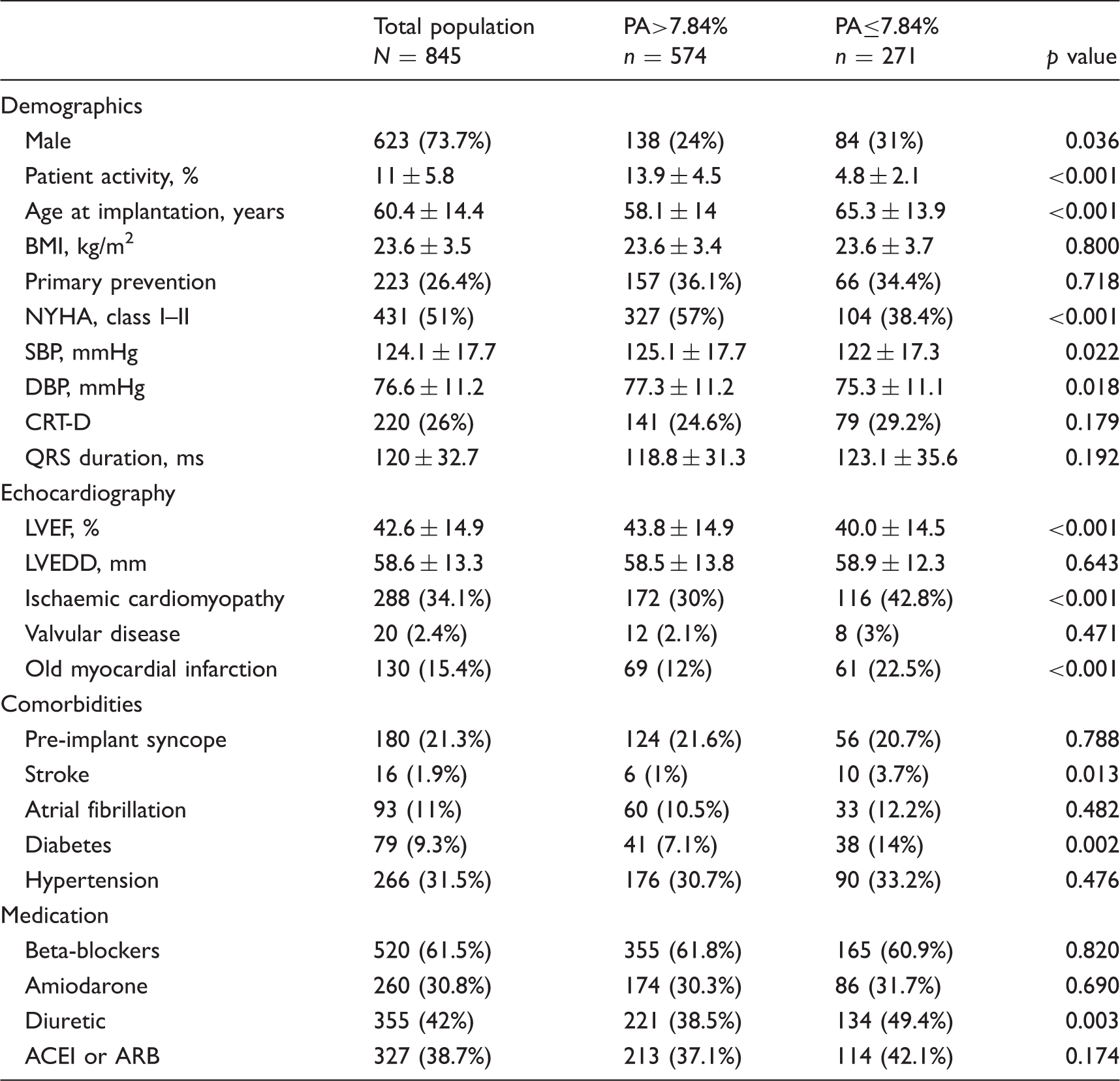
PA: patient activity; BMI: body mass index; NYHA class: New York Heart Association functional class; SBP: systolic blood pressure; DBP: diastolic blood pressure; CRT-D: cardiac resynchronization therapy defibrillator; LVEDD: left ventricular end-diastolic diameter; LVEF: left ventricular ejection fraction; ACEI or ARB: angiotensin-converting enzyme inhibitor or angiotensin receptor blocker
Baseline PA and long-term outcomes
The incidences of cardiac death in patients with PA values ≤7.84% and PA values > 7.84% were 22.9% and 6.4% (p < 0.001), respectively. Moreover, all-cause mortality was higher in patients with PA values ≤7.84% than in patients with PA values >7.84% (30.6% vs. 8.9%, p < 0.001).
Estimated Kaplan–Meier survival curves were plotted to determine the probabilities of cardiac death and all-cause mortality among the patients, according to PA. Univariate analysis demonstrated that both the cumulative incidence of cardiac death and all-cause mortality were higher in patients with PA values ≤7.84% than in patients with PA values >7.84% (Figure 1).
Kaplan–Meier estimates of the cumulative incidence of (a) cardiac death and (b) all-cause mortality. ICD: implantable cardioverter-defibrillator; CRT-D: cardiac resynchronization therapy defibrillator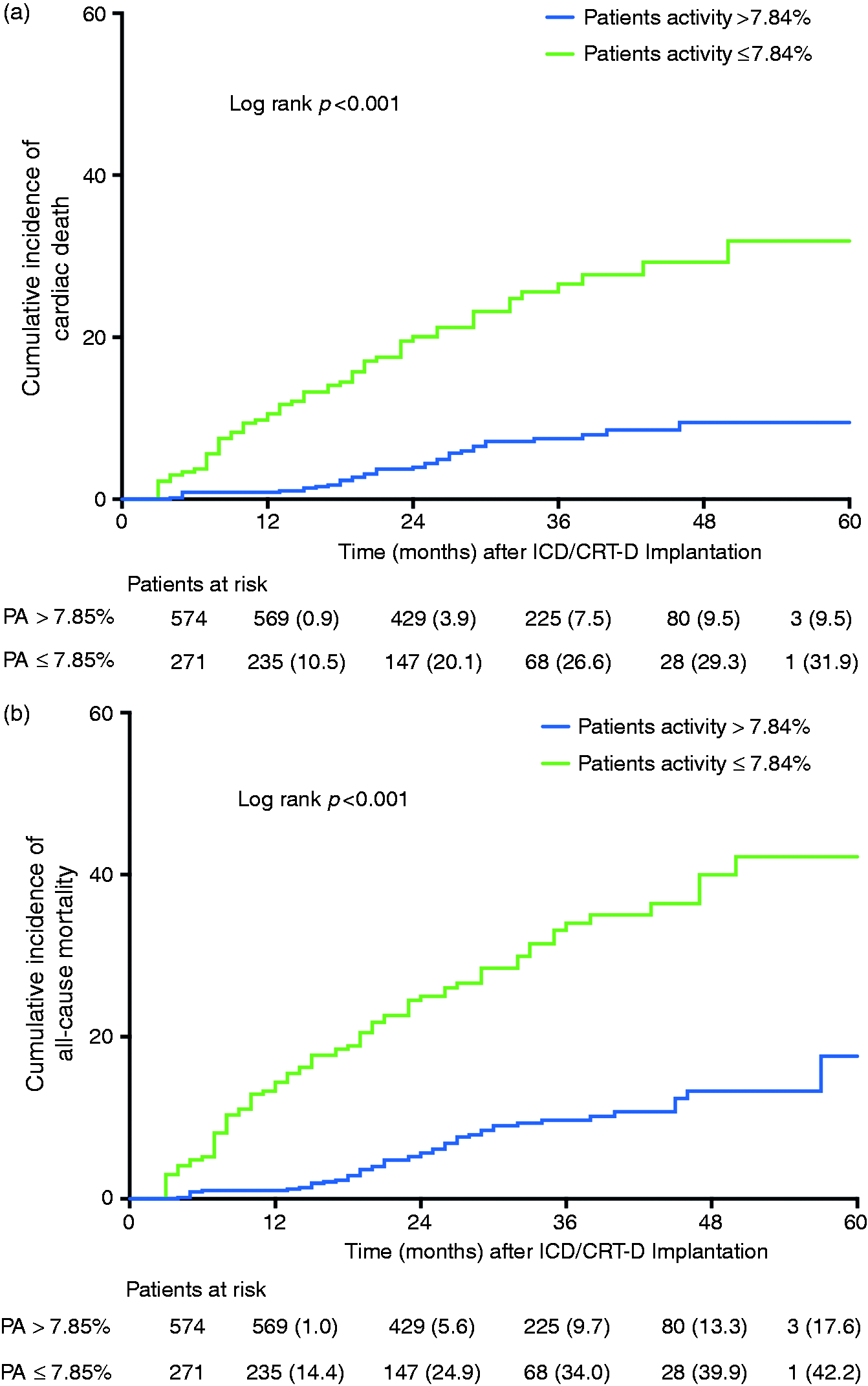
Predictors of cardiac death and all-cause mortality according to PA (categorical and continuous variables).
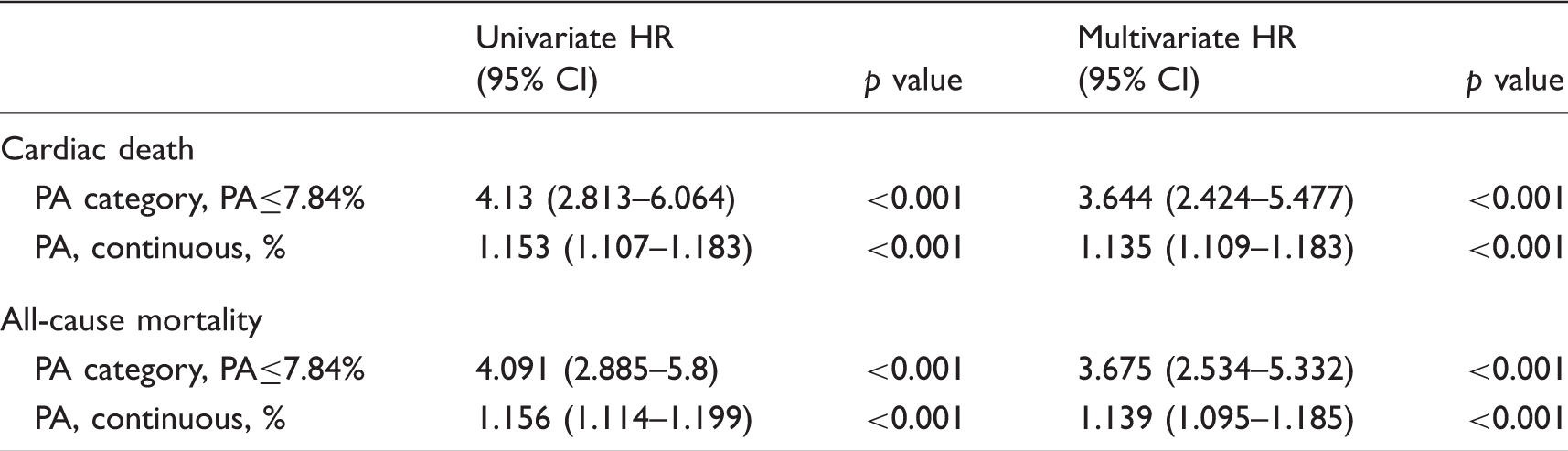
PA: patient activity; HR: hazard ratio; CI: confidence interval
Relationship between PA and HRV
A total of 220 patients who met the inclusion criteria were selected for analysis. The average 30-day PP variability, which correlated significantly with PA (r = 0.601, p < 0.001), was 86.7 ± 27.6ms.
Baseline PA and long-term outcomes in patients with reduced LVEFs and preserved LVEFs
Separate analyses involving patients with ICDs/CRT-Ds and reduced/preserved LVEF according to PA (categorical variables).
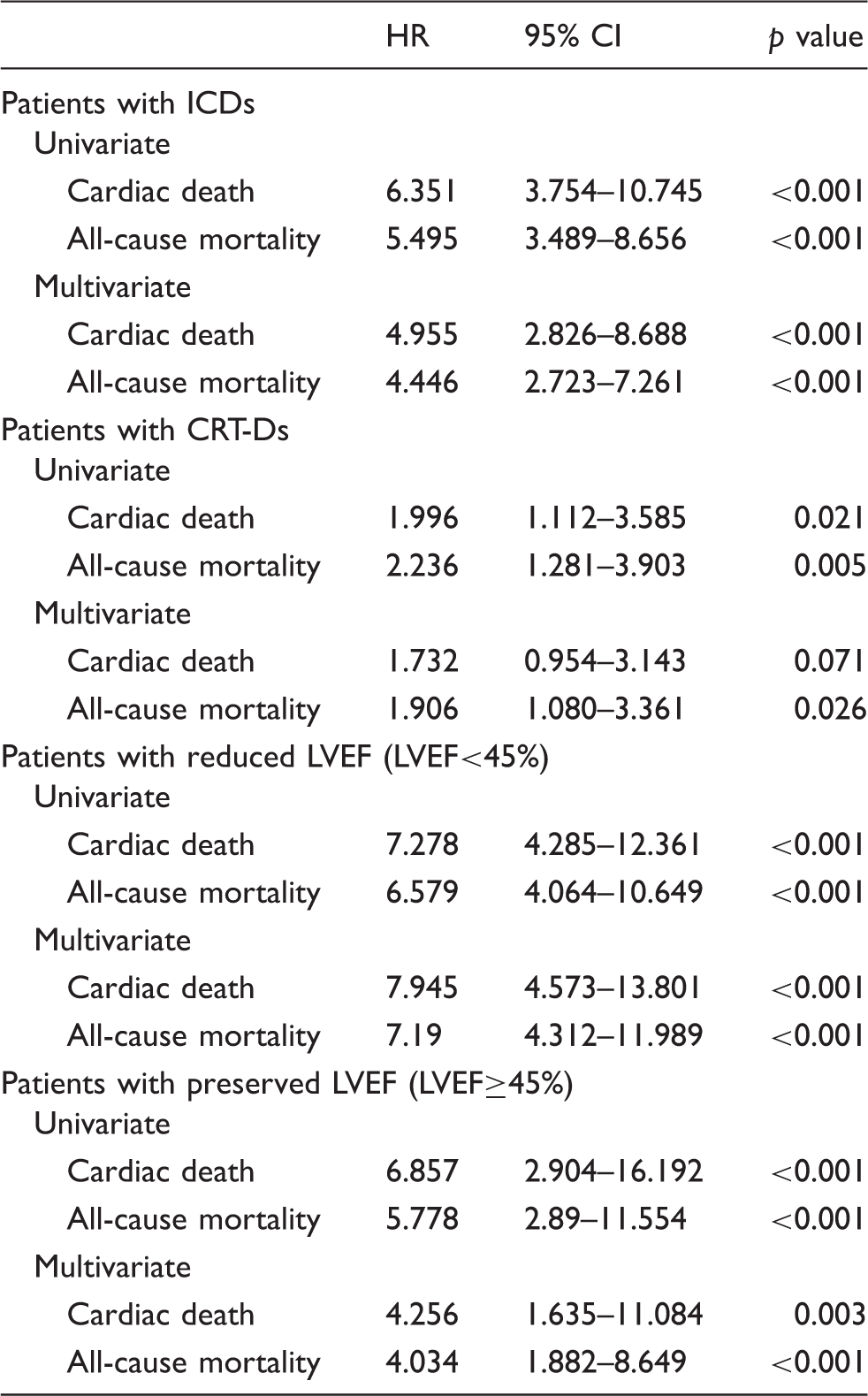
ICD: implantable cardioverter-defibrillator; CRT-D: cardiac resynchronization therapy defibrillator; LVEF: left ventricular ejection fraction; PA: patient activity; HR: hazard ratio; CI: confidence interval
Baseline PA and long-term outcomes in patients with ICDs and CRT-Ds
There were 625 (74%) patients implanted with ICDs and 220 (26%) patients implanted with CRT-Ds. In patients with ICDs, baseline PA values ≤7.84% were associated with an increased risk of cardiac death (hazard ratio = 6.351; 95% CI = 3.754–10.745, p < 0.001) and all-cause mortality (hazard ratio = 5.495; 95% CI = 3.489–8.656, p < 0.001) in a univariate Cox regression model (Table 3). PA ≤ 7.84% remained an independent predictor of cardiac death (hazard ratio = 4.955, 95% CI = 2.826–8.688, p < 0.001) and all-cause mortality (hazard ratio = 4.446, 95% CI = 2.723–7.261, p < 0.001) when adjusted in a multivariate model (adjusted for age, hypertension, diabetes, MI, ischaemic cardiomyopathy, NYHA, LVEF, LVEDD, primary prevention and patients using diuretics). In patients with CRT-Ds, baseline PA values ≤7.84% were at increased risk for cardiac death (hazard ratio = 1.996; 95% CI = 1.112–3.585, p = 0.021) and all-cause mortality (hazard ratio = 2.236; 95% CI = 1.281–3.903, p = 0.005) in a univariate Cox regression model (Table 3). PA ≤ 7.84% was an independent predictor of all-cause mortality (hazard ratio = 1.906, 95% CI = 1.080–3.361, p = 0.026), but not cardiac death (hazard ratio = 1.732, 95% CI = 0.954–3.314, p = 0.071) when adjusted in a multivariate model (adjusted for age, NYHA, LVEF and AF).
Discussion
The most significant findings of the present study were as follows: first, a baseline PA value ≤7.84% was associated with a higher risk of cardiac death and all-cause mortality than a baseline PA value >7.84%, and second, a significant correlation was observed between PA and HRV (r = 0.601, p < 0.001).
We found that patients whose baseline PA value was ≤7.84% had a higher risk of cardiac death and all-cause mortality than patients whose PA value was >7.84%. This study was based on previous works evaluating PA in ICD/CRT-D patients. For example, Conraads et al. demonstrated that, compared with high 30-day PA, low 30-day PA was associated with a higher risk of hear failure-related hospitalization and all-cause mortality in patients with systolic heart failure. 6 Similarly, Gula et al. observed that low PA integrated with other risk factors was associated with a high risk of heart failure-related hospitalization. 12 In addition, Vegh et al. compared PA with the six-minute walk test with respect to predicting clinical responsiveness to CRT. 13 However, none of these studies provided baseline PA cut-off values with which to predict clinical outcomes. In contrast, we determined that a PA cut-off value of 7.84% can predict cardiac death in patients with home monitoring. In addition, our further analysis involving patients with preserved LVEFs (LVEF ≥ 45%, n = 484) also indicated that a PA cut-off value of 7.84% can predict cardiac death and all-cause mortality. Kramer et al. performed a more recent study evaluating baseline PA and time-varying PA and survival in ICD patients with home monitoring. They found that time-varying PA, as well as baseline PA, was associated with a higher risk of all-cause mortality. 11 However, they adjusted only for age, gender, CRT versus non-CRT devices and de novo versus replacement ICD in their survival model. Moreover, they did not elucidate the mechanisms underlying the correlation between PA and survival. We observed that NYHA class, LVEF, comorbidities and medications were also significantly different in patients with different levels of PA. All these clinical factors should be taken into consideration when using a multivariate Cox model. Also, we focused on different outcomes from those of the authors of the previous study.
Daily PA has been demonstrated to predict outcomes in different diseases in previous studies.3–5 However, these studies were often based on qualitative subjective patient interviews and questionnaires, 14 as well as short-term measurements with external accelerometers and pedometers that may have been affected by noncompliance. 6 Accelerometer hardware in ICD/CRT-D comprises micro electro-mechanical systems and is made of silicium. So PA values determined based on ICD/CRT-D are more sensitive and accurate as predictors of clinical outcomes than PA values based on the above data. In addition, PA values collected by implanted devices can be continuous and avoid noncompliance.
Physical activity is widely believed to be capable of beneficially modifying autonomic balance. 15 We analysed the correlation between PA and HRV to ascertain the relationship between PA and autonomic nervous system balance. In this study, HRV was represented by PP variability, an HRV parameter recorded by ICD/CRT-D. Our results indicate that a significant correlation exists between PA and PP variability, with a correlation coefficient rho = 0.601. In a previous study, Bernardi et al. demonstrated that physical activity can influence HRV recorded by 24-h Holter monitor, and their results indicated that HRV is increased by physical activity. 16 Similarly, Osterhues et al. demonstrated that HRV calculated from 24-h recordings was significantly influenced by PA level. 17 Patients enrolled in these studies were strictly instructed to perform different behaviours, such as staying in bed, walking, light work, as well as their usual activities. Strenuous work and sports activities were forbidden. 17 In contrast, we evaluated the relationship between PA and HRV in a 30-day window. Patients were allowed to participate in daily activities of their choosing, and their PA percentages were recorded by their ICDs/CRT-Ds. HRV has been established as a non-invasive tool for studying cardiac autonomic activity 10 and has been demonstrated to predict SCD and all-cause mortality in various studies.8,10 In this study, patients with PA values >7.84% had a low risk of cardiac death and all-cause mortality, and higher PA values were a sign of efficient autonomic function, as represented by HRV. Thus, the relationship between PA and HRV may underlie the ability of PA to predict cardiac death and all-cause mortality. However, unlike HRV parameters, PA can be used in a wide range of conditions, including conditions in which HRV parameters may be of limited usefulness, such as in patients with ectopic beats and artefacts. 18
Limitations
First of all, we performed correlation analyses for only a portion of our study population, as most of our patients' devices did not allow HRV recording. Second, this was a retrospective and multi-centre study. Due to the limited availability of information pertaining to other variables, such as orthopaedic, neurologic and musculoskeletal variables, as well as left ventricular end-diastolic and end-systolic volume, and left bundle branch block, we could not adjust for certain confounders; therefore, a prospective study may be necessary to validate our results. Third, we could not obtain information pertaining to the timing of ICD implantation after MI and therefore could not adjust for timing as a risk factor. Finally, all patients in this study were implanted with Biotronik devices; therefore, our results are limited to patients with these devices.
Conclusions
A baseline PA cut-off value of 7.84% (113 min) can predict cardiac death and all-cause mortality in patients who survived more than three months after ICDs/CRT-Ds implantation. Patients with low baseline PA values are more likely to die from heart disease than patients with high baseline PA values and should be given timely attention.
Footnotes
Author contribution
SZ and SZ contributed to the conception or design of the work. KPC, YGS, WH, SLC, ZGL, WX, YD, ZML, XHF, CHH contributed to the acquisition, analysis, or interpretation of data for the work. SZ and SZ drafted the manuscript. KPC critically revised the manuscript. All gave final approval and agree to be accountable for all aspects of work ensuring integrity and accuracy.
Declaration of conflicting interests
The author(s) declared no potential conflicts of interest with respect to the research, authorship, and/or publication of this article.
Funding
The author(s) disclosed receipt of the following financial support for the research, authorship, and/or publication of this article: This work was supported by the National Science & Technology Pillar Program during the 12th Five-Year Plan Period (2011BAI11B02).