







Abstract
This commentary calls for scholarly attention to mobile AI (AI systems embedded in smartphones, apps, and mobility infrastructures) that has been overshadowed by the dominance of PC-based, work- and productivity-focused AI discourse. It argues that such discourse, shaped by technological determinism and U.S.-centrism, limits our understanding of AI’s, especially mobile AI’s, sociotechnical diversity, open-endedness, and deep entanglement with everyday life. To address this gap, the article develops an assemblage-centered lens that foregrounds the contingent and contextual trajectories of AI’s development, application, and social implications. Through three analytical parameters—associated milieu, lock-in, and detachment—and drawing upon the cases of ByteDance’s Doubao and Tencent’s Yuanbao, the article shows how an assemblage-centered lens to mobile AI invites scholars to rethink AI beyond the PC-based, work- and productivity-centered paradigm and to recognize mobile AI's distinctive potential pathways of infrastructuralization in everyday life.
Artificial intelligence (AI) mediates an expanding range of human activities. Yet, the dominant discourse after the rise of generative AI (GenAI) is largely anchored in the development, applications, and social implications of primarily PC-based and work- and productivity-focused AI. This tendency risks obscuring other diverse and rapidly evolving AI forms, especially those embedded in mobility technological systems, represented by but not limited to mobile internet, smartphones, wearable devices, and mobile apps (hereafter “mobile AI”).
This commentary proposes a three-parameter lens that provides heuristic and analytical sensitivity in understanding mobile AI. It highlights mobile-AI-related characteristics, research questions, and approaches that differ from those prompted by PC-based and work- and productivity-focused AI. It urges scholars to transcend dominant framings—such as geopolitical competition or labor impacts—and explore mobile AI’s diverse existing and potential roles in everyday life. It further shows the importance of situating mobile AI development, applications, and social implications within different technological, historical, social, cultural, and political realities, thereby challenging deterministic and U.S.-centric narratives about AI.
The commentary utilizes several China-originated mobile AI forms as revelatory cases. As a global digital technology and AI powerhouse that “leapfrogged” the PC era and became a mobile-dominated society, China provides a vantage point from which to observe AI development that transcends the dominant U.S.-centric, PC-based, and productivity-focused narratives. However, the focus of the commentary is heuristic and methodological rather than regional. It offers a toolkit applicable across diverse technological, historical, social, cultural, and political realities.
Limitations of Current AI Discussions and Their Impact on Mobile AI Studies
Recent scholarly attention to AI has concentrated on PC-based GenAI and their work- and productivity-related applications and implications. In earlier stages of AI development, scholarly discussions had a diverse empirical focus, covering social and ethical implications of AI development and applications ranging from medical AI to autonomous driving (Avnoon & Oliver, 2023; Stilgoe & Mladenović, 2022). While such discussions are still vibrant, the field has become centered on a narrow subset since the rise of GenAI.
This narrowing reflects a form of technological determinism, that is, the underappreciation of technology’s contingency and open-endedness. Focusing on a single, currently dominant form, this narrowing reinforces the assumption that this particular form of AI development, applications, and social implications is inevitable. This assumption marginalizes the role of other technological, historical, social, cultural, and political elements (Latour, 2005; Pinch & Bijker, 1984) in shaping AI, as well as the situated choices, failures, unintended consequences, and diverse reuses (Edgerton, 2011) in the shaping process.
This narrowing also reflects a form of U.S.-centrism, that is, the lack of attention to AI less relevant to the PC-based, work- and productivity-focused forms (e.g., GenAI) originating from the United States. Even when non-Western subject matters are addressed—in the DeepSeek case—the focus is largely geopolitical, which again is central to U.S. concerns. Critical efforts to decenter U.S. perspectives often examine the production side of AI, such as labor issues in data labeling (Smart et al., 2024; Xia & Wu, 2025), without the ambition to reveal a broader picture of AI’s applications and social implications.
Such techno-determinism and U.S.-centrism limit our understanding of AI, especially mobile AI. First, mobile devices and systems have extremely diverse development trajectories, shaped by technological, historical, social, cultural, and political realities of different societies, and thus are hypercontextual. Second, compared to the primarily PC-based and productivity-focused AI, the potential applications of mobile AI are highly open-ended and contingent. Based on and enacting intimate, embodied use scenarios and a complex network of hardware and software, mobile AI can become generative tools that intertwine with unexpected aspects of everyday lives. Third, the development and applications of mobile AI are easily shaped by users’ creative needs and agency (Oudshoorn & Pinch, 2003) inherent in mobile communication. Because mobile devices are close extensions of users, mobile AI applications are far more prone to users’ contingent reconfiguration. By imposing a linear, deterministic, U.S.-centric, and productivity-focused logic, one risks erasing these major features of mobile communication, decontextualizing this fundamentally hypercontextual technology, and overlooking the very sociotechnical diversity of mobile AI development, application, and social implications.
An Assemblage-Centered Lens to Mobile AI
We need heuristic analytical lenses that foreground the sociotechnical diversity, hypercontextuality, intimate everyday life embeddedness, and contingency and open-endedness of the past and future development trajectories of mobile AI. Treating AI as an assemblage—an approach informed by actor-network theory (ANT) and critical infrastructure studies—offers a productive way. First, a form of AI is not self-contained, but is developed and applied as associations between its core technological configuration and various other society-specific technological, historical, social, cultural, and political constituting elements (Anand et al., 2018; Larkin, 2013). Second, these associations are contingent, dynamic, and open-ended. They contain and condition possibilities for further associations, make the development trajectories of a form of AI as contingent as planned (Latour, 2005; Li, 2007), and contribute to its success, failure, delayed success, unintended consequences, and future potential.
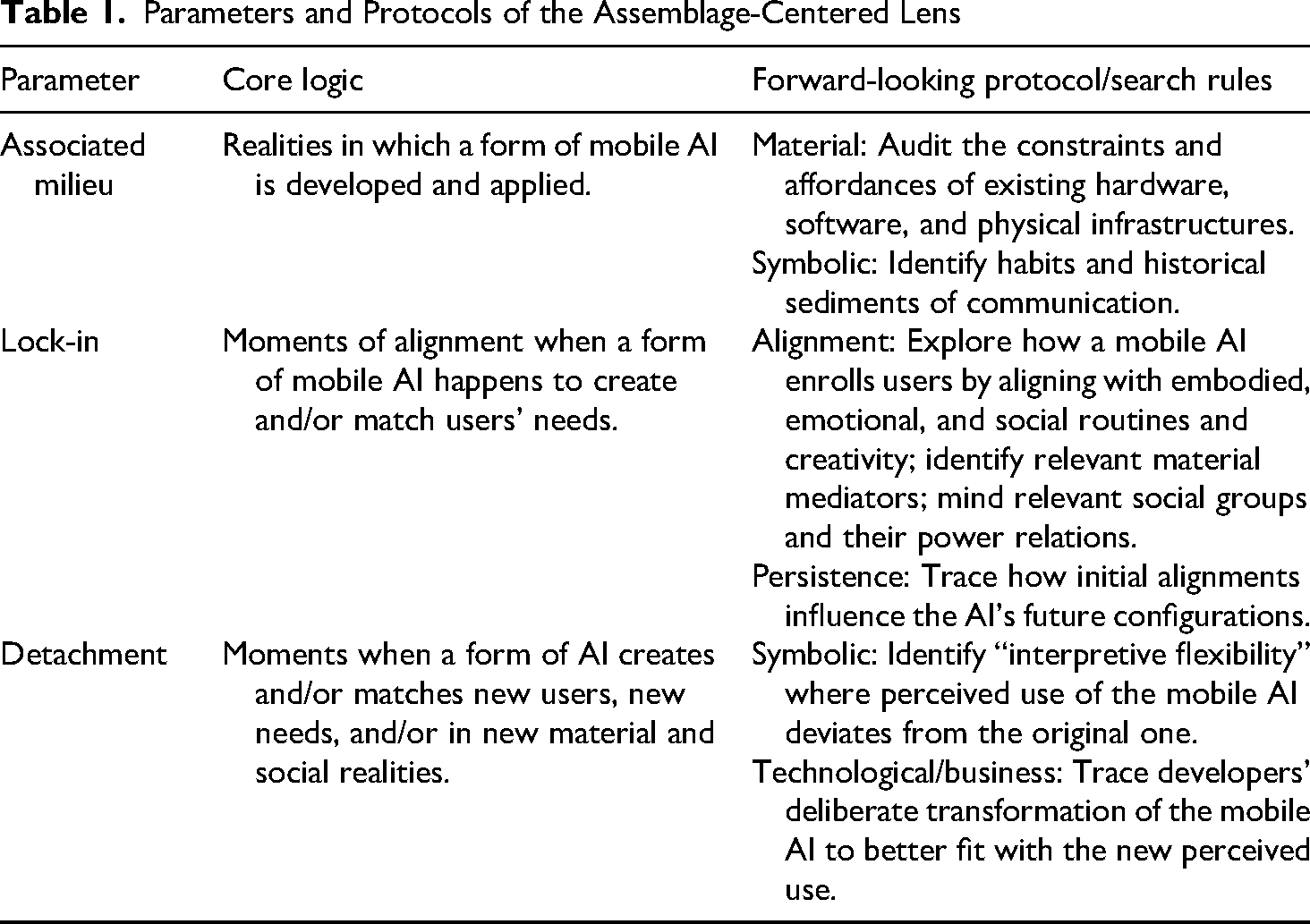
To operationalize this lens, I propose three analytical parameters that provide heuristic and analytical sensitivity in understanding mobile AI. Based on Michel Callon's “market-in-the-making” approach (2021) inspired by ANT, rather than the matching of preexisting and stable demands, the development and application of AI, especially mobile AI, is viewed as a process through which developers (entrepreneurs, firms, etc.) actively create and situatedly respond to a series of associations between the core technological configurations and other society-specific technological, historical, social, cultural, and political elements. In this process, attachments to certain social groups are generated and maintained. While originally designed to attach certain groups through associations with a planned set of elements, a form of AI can constantly and contingently go through attachments and detachments with various groups, in various ways, by associating with various unplanned elements. Therefore, a form of AI, especially mobile AI, does not unfold through a linear or predetermined logic of developers, but through open-ended translation, adaptation, and reconfiguration shaped by distributed agencies.
Prioritizing heuristic sensitivity over predictive certainty, these parameters do not provide a deterministic roadmap or universal predictions, but can be operationalized into three forward-looking protocols. Together, they help researchers shift the analytical focus from treating mobile AI as linearly evolving, “black-boxed” artifacts confined to PC-based and productivity-focused trajectories and discourses to treating them as dynamic constellations of associations rooted in society-specific realities. This lens facilitates and compels an empirical “thick description” (Geertz, 2017[1973]) of the associated milieus and the shifting moments of lock-in and detachment. To illustrate the three parameters, I primarily utilize cases of China-originated mobile AI, though the focus lies on heuristic and methodological takeaways.
Associated Milieu
Associated milieu is the technological, historical, social, cultural, and political realities in which a form of AI is developed and applied. Such realities are often reduced to mere “contexts” or “backgrounds” that constitute a panoramic view of macro trends without sensitivity to the exact associations going on (Latour, 2005). On the contrary, the associated milieu should be viewed as an aggregate structure consisting of heterogeneous actors that may associate with the form of AI and impact future associations.
In principle, researchers need to identify all these elements, which is unfeasible. To further operationalize the parameter, I raise an example about how trajectories of internet penetration in a society strongly shape the relationship between mobile and PC-based AI. When PCs had a widespread influence across Euro-American societies in the 1980s and 1990s, they were quite new and rare in China. Correspondingly, PC-based internet use achieved quite a limited rate and scope of penetration in China before the 2010s (Zhang & Xing, 2025). Afterward, China leapfrogged into the mobile internet age, with the number of netizens growing from 457 million in 2010 to 1.067 billion by 2022, of which 99.8% accessed the internet via smartphones (CNNIC, 2011, 2023). This divergence of internet development trajectories offers distinct associated milieus for any digital technology afterward, including AI.
While U.S. GenAI originated from the PC end, Chinese tech giants like ByteDance and Tencent focused on mobile AI to fit the uniquely strong mobile-dominated milieus. In November 2023, ByteDance launched one of the earliest GenAI tools in China, Doubao, but only on smartphones. Unlike the work and productivity focus of its U.S. equivalents, Doubao initially targeted smartphone users, emphasizing conventionally smartphone-embedded functions, including personified chatting, idea and emotion exchanges, everyday life problem-solving and companionship (Zhaibo, 2025). Through advertisements and application programming interfaces (APIs) in Douyin (the Chinese version of TikTok, developed by ByteDance), Doubao rapidly became the most popular mobile AI in China. It was not until September 2024 that ByteDance launched Doubao’s PC version. In comparison, Tencent launched its mobile AI tool, Yuanbao, as late as May 2024, and its PC version, as late as March 2025. This lag significantly limited Yuanbao's user population. However, through advertisements and APIs in Tencent's highly infrastructuralized super-app, WeChat (Chen et al., 2018; Zhang & Xing, 2025), Yuanbao’s monthly active user population managed to grow explosively from 2.1 million (compared with Doubao’s 75.5 million) in late 2024 to 20 million by mid-2025. Most of Yuanbao’s functions focus on chatting, emotion exchanges, and synthesizing materials published within WeChat’s mobile ecosystem (Lanmeihui, 2025). In short, China’s leapfrog to the mobile internet era enabled a different AI development paradigm from the U.S.-centered one.
The role of associated milieus can be seen in cases far broader than the mobile AI in China. As revealed by Edwards (2021), unreliable internet connections and a lack of PCs still constitute the associated milieu of many African societies, where mobile AI development is bound to present distinctive patterns. As another example, many multilingual societies with underdeveloped basic education may offer associated milieus suitable for the development of voice-based AI due to widespread difficulty in spelling. This might facilitate the development of mobile AI tools, given that voice-based communication devices are predominantly mobile.
These cases illustrate how, by foregrounding the associated milieu, the assemblage-centered lens helps researchers shift the focus from a “universal” AI model to the roles of specific historical, material, and social realities, thus directly addressing the hypercontextual nature of mobile systems.
These cases help further operationalize the parameter of associated milieu by offering the first forward-looking protocol, which compels researchers to focus on two major types of interlinked structures in shaping a form of mobile AI. The first, primarily material, is the constraints and affordances of the existing technological environment and infrastructure, that is, specific hardware and software configurations, in a society. 1 Searching for this type of structure requires comprehensive audits of the existing landscape. The second, primarily sociocultural and symbolic, is the habits and historical sediments of communication in a society, that is, how developers and users understand, recognize, and approach the affordances of new communication tools—mobile AI—based on their experiences of developing and using existing tools (see the concept “technological frame,” Bijker, 1995). Searching for this type requires historical and ethnographic data. While these two types constitute primary search rules, researchers must remain open to other emergent elements to embrace the contingency of mobile AI development.
Lock-In
Lock-in concerns when, how, and why a form of AI happens to make “appropriate” associations (i.e., create and/or match users’ needs, thus attaching users). The process that leads to lock-in is a sociopolitical one full of contingency, power struggles, and institutional frictions, in which different social groups for or against a particular development and diffusion trajectory of a form of AI compete in shaping it. During the process, a form of AI can stay in an open-ended, or “liminal” status for a long time (Ling, 2023). Therefore, Lock-in is neither an imagined economic process in which certain preexisting demands are automatically and naturally satisfied by certain supplies, nor a “winner-takes-all,” final economic outcome of monopoly caused by path dependence (David, 1985). Instead, it represents a contingent or planned moment of alignment between the core technological configuration of a form of AI and various elements—including users—in the associated milieu in the open-ended evolution process of the form of AI.
While lock-in results from power struggles, in cases of highly open-ended technologies like mobile AI, different forms of the technology can simultaneously lock in one group of users in diverse scenarios, exemplified by those used in various digital platforms or embedded in various mobile devices like glasses and watches. Therefore, lock-in is not necessarily about the “vox populi” seeking one technical solution over another based on technological merit (as widely seen in the discussions of ChatGPT versus DeepSeek), but more about the generative capacity of various groups of developers and users to coconstruct diverse sociotechnical attachments.
Compared to the primarily PC-based, work- and productivity-focused AI, mobile AI is less likely to lock in users in workplace scenarios, but more because of diverse everyday-life needs. Since user needs in different societies vary widely, lock-ins by mobile AI are hypercontextualized and contingent. To illustrate, Doubao, with its smartphone-embedded app, initially aligned with typical smartphone users’ needs for chatting. Whereas young people who feel awkward in real-world social activities were keen to have chatbots as companions, Doubao also attracted middle-aged and elderly users who have difficulty finding real-world communities and do not share a common language with younger family members.
The influence of such lock-in is persistent and crucial, illustrated by the divergent trajectories of Doubao’s mobile and PC versions. Even after Doubao expanded into knowledge-, work-, and productivity-related domains, both developers and users preferred to keep mobile Doubao’s interface design, system settings, and tone of conversations close to those of casual chatting and emotional companionship; in comparison, those of Doubao’s later-launched PC version radically leaned toward work- and productivity-related functions and styles. This divergence provides strong evidence against the assumption that mobile AI is merely a “smaller version” of PC-based AI.
Doubao is not and unlikely to be the sole winner among forms of mobile AI in China. Other forms, such as Yuanbao, are also dynamically attaching users in other everyday life scenarios, such as summarizing diverse content posted within Tencent's social media and news ecosystem. Yuanbao has thus partly turned itself into a personal secretary for daily information processing.
Examples of mobile AI lock-in are also widespread beyond the Chinese context. The success of voice assistants like Alexa in Western households represents a lock-in based on embodied practices of everyday home life. As a negative example of ignoring lock-ins through everyday life, the cut of emotional intelligence in GPT-5, as a result of developers sticking to the PC-based, work- and productivity-centered assumption of AI, encountered strong backlash from users who used ChatGPT as emotional companions (Smith, 2025).
These cases help further operationalize the parameter of lock-in by offering another forward-looking protocol to analyze mobile AI development and applications, which compels researchers to transcend the “wait and see” trap of deterministic forecasting and outcome-oriented narratives, but focus on the processual moments of alignment between a form of mobile AI’s core technological configurations and users’ most granular and creative daily needs, thus identifying the generative potential of mobile AI forms while they are still in the liminal and elastic stage of development (Ling, 2023). Specifically, this protocol first requires exploring how a form of mobile AI aligns with users’ daily, embodied, emotional, and social routines and creativity. This entails, on the one hand, identifying users’ routines and creativity, and on the other hand, identifying existing or potential material mediators—smartphones, digital platforms, automobiles, wearables, and so forth—of such alignment. 2 Secondly, it requires tracing the persisting effects of initial alignments, that is, how they continue to constrain the future configurations of the form of AI in question, even as it expands into new domains (see the next section on detachment). Thirdly, this protocol requires researchers to pay attention to relevant social groups’ (Pinch & Bijker, 1984) power relations (Klein & Kleinman, 2002; Ling, 2023), which mediate a form of mobile AI’s possible directions of evolution and results of lock-in.
Detachment
Detachment concerns when, how, and why a form of AI happens to undergo associations in other associated milieus beyond the initial one (i.e., create and/or match new users and new needs in existing or new material and social realities). Similar to lock-in, it is also a process through which a liminal technology is shaped by power struggles between different relevant social groups (Ling, 2023). Crucially, detachment does not mean the market failure, obsolescence, or replacement of an assemblage—a form of AI—by another, though such phenomena do occur. Nor does it refer to the outcome of monopolization or stabilization dominated by one form of AI. Instead, it highlights the processual moment when the core technological configuration happens to align with elements in associated milieus far beyond its original intent. Such moments can be planned by developers, but are more often and more easily initiated by the creative agency of users out of their daily, embodied, emotional, and social routines and creativity.
After a form of AI’s lock-in with its initial users, each detachment acts as the prerequisite for a new lock-in in an expanded or newly associated milieu. Meanwhile, the lock-in in the original associated milieu can persist or gradually disentangle. Therefore, lock-in and detachment are not opposing ends of a timeline, but coconstitutive moments in a form of AI’s development process characterized by constant adoption, transformation, and expansion. When the AI undergoes successive rounds of detachments and lock-ins and gains many functions, it can possibly aspire to a level of ubiquity in users’ lives, making itself an infrastructure that mediates a wide array of human activities. This process can be particularly vibrant and accelerated in the case of mobile AI, given its unique sociotechnical diversity, open-endedness, and everyday embeddedness.
Raising Doubao’s case again, based on its initial lock-in as a simple chatbot, ByteDance explicitly promoted it as a long-term, comprehensive life assistant that can accompany users (Zhaibo, 2025), that is, a ubiquitous everyday infrastructure. Informed by this mission, the Doubao team created a partly open-source digital ecosystem that allows the team and, especially, users to create chatbot agents serving different roles and fulfilling different everyday functions. The team or users can use the simple toolkits and prompts to design agents and publish them on Doubao’s platform for other users’ choice and use. Thanks to users’ creativity and endless needs in everyday life, Doubao now carries all kinds of chatbots in the roles, including but not limited to English teachers, mock interviewers, life hack providers, fortune tellers, virtual intimate partners, psychiatrists, etiquette consultants, riddle writers, and photo editors. Similar cases of detachment can be widely seen in the platformization and infrastructuralization of digital apps (Zhang & Xing, 2025) in various societies. Such apps are increasingly becoming carriers of AI functions.
These cases suggest that since most mobile applications are oriented toward everyday life, it is easier for mobile AI—compared to the PC-based AI—to undergo various open-ended detachments and lock-ins based on everyday needs and users’ creative reuse (Oudshoorn & Pinch, 2003). The cases also help further operationalize the parameter of detachment by offering a third forward-looking protocol, which compels researchers to focus on moments when a form of mobile AI is recognized or used in new material and social occasions, by new groups, and for new needs, beyond initially planned ones. There are two types of such moments, which are not necessarily mutually exclusive. The first is when the perceived use of the mobile AI starts to deviate from the original one. This type is primarily symbolic and sociocultural; even if the technological core remains stable, detachment is evidenced when users or developers no longer treat the tool as being limited by its original intent. Searching for this type of moment requires identifying the mobile AI’s interpretive flexibility (Pinch & Bijker, 1984) through tracing users’ everyday discourse and practices. The second type is when users and—more often—developers deliberately transform the core technological configurations of the form of mobile AI, so that it better fits with the new perceived use. Searching for this type of moment requires tracing users’ or developers’ technological and business strategies in transforming the mobile AI. By following these search rules and being mindful about the transformation of power relations and relevant institutions that govern all relevant social groups, researchers can observe detachment as a coconstitutive moment alongside lock-in.
Conclusion
The article argues that mobile AI deserves special scholarly attention that transcends the dominant, PC-based, and work- and productivity-focused discourses of AI. An assemblage-centered lens that emphasizes the heterogeneity of constituting elements and the contingency and contextuality of the development trajectory is particularly suitable for understanding mobile AI, because it captures mobile AI’s hypercontextuality, sociotechnical diversity, open-endedness, and everyday embeddedness. Via three analytical parameters—associated milieu, lock-in, and detachment—and the corresponding three protocols that guide scholarly exploration (Table 1), it highlights how society-specific technological, historical, social, cultural, and political realities, planned and contingent alignments with users’ everyday needs, and the constant expansion and re-creation of such alignments shape mobile AI’s development, applications, and social implications. The lens, parameters, and protocols also urge scholars to rethink the currently dominant, PC-based and work- and productivity-focused AI discourses and transcend the determinism and U.S.-centrism in them. It highlights the need to contextualize AI development, pay attention to the social implications of AI embedded in everyday life, and take users’ contingent and creative role in shaping AI seriously.
Parameters and Protocols of the Assemblage-Centered Lens
The assemblage-centered lens allows us to move beyond treating mobile AI as linearly evolving, black-boxed artifacts confined to the technological and discursive trajectory of PC-based and productivity-focused AI. Rather than offering a deterministic set of generalized empirical predictions, such as the inevitable association between a form of AI and a specific local element, this lens prioritizes methodological and heuristic sensitivity over predictive certainty, steering clear of the essentialization of mobile AI or a given society. It facilitates and compels researchers to situatedly identify specific heterogeneous actors, material and sociocultural associated milieus, and contingent moments of lock-in and detachment based on in-depth, empirical “thick description” (Geertz, 2017[1973]), producing regionally embedded knowledge. Only through this lens of informed sensitivity—which acknowledges the role of situated choices, unintended consequences, and creative reuse—can we engage in nuanced discussions regarding the diverse and as-yet-unwritten roles of mobile AI in various societies.
Footnotes
Acknowledgements
The author wishes to extend their heartfelt thanks to the journal editor, Dr. Jeffrey Boase, and the guest editors, Dr. Adriana de Souza e Silva and Dr. Yifan Xu Miller, for offering the opportunity to include the article as part of the special issue on mobile AI. I would like to gratefully acknowledge the feedback from the two anonymous referees for their valuable comments and suggestions that helped improve the paper significantly. I would also like to thank Dr. Chuncheng Liu and Dr. Jun Zhang for helping with the formation of the initial idea in the paper.

Funding
The author disclosed receipt of the following financial support for the research, authorship, and/or publication of this article: The work described in this paper was substantially supported by a grant from the Research Grants Council of the Hong Kong Special Administrative Region, China (Project No. CityU 11600724).
Declaration of Conflicting Interests
The author declared no potential conflicts of interest with respect to the research, authorship, and/or publication of this article.