






Abstract
The aim of this article is to understand how objects circulate between people who deposit them on the sidewalk (disposers), especially on “bulky item” collection (BIC) days and those who retrieve them (gleaners). Analysis of representations of 17 disposers and/or gleaners reveals three forms of sociality: (1) charitable donation (or disposing of items out of a wish to pass them on to other people), (2) balanced reciprocity (in which disposers and gleaners both view BIC as a system for the circulation of objects), and (3) generalized reciprocity (in which the desire to pool possessions is augmented by the wish to combat waste). The findings also reveal that the anonymity of the context leads disposers and gleaners to intersecting interpretations of what the other party is doing (for whom and why), which fuel and sometimes temper these forms of sociality. The findings add to the existing literature on disposition/gleaning by uncovering the forms of sociality at work between strangers in public space and the distinctive and anonymous circulation of objects resulting from them. The findings are also of relevance to public actors regarding the issues arising for waste management.
Keywords
Introduction
How do objects circulate anonymously between strangers in public space? This is the question that this article answers by analyzing the practices and representations of those who put things out on bulky item collection (BIC) days and of those who retrieve them. Many municipalities organize the periodic collection of items that are too large or heavy to be put in the trash. People disposing of these items generally view them as rubbish (Parsons, 2008; Thompson, 1979), things of no value (Strahilevitz, 2009), and from which they are in principle physically and symbolically detached (Lucas, 2002; Young and Wallendorf, 1989). For those who retrieve them, these finds may be viewed as “treasures” recovered for hedonic or utilitarian, personal or altruistic reasons (Brosius et al., 2013). In practice, these now-ownerless items 1 can be recovered by anyone, especially people who glean them 2 and thereby divert what was originally intended for recycling by the local authorities (Rollot, 2013).
Yet, in existing work on disposition and gleaning behavior, these practices are viewed in a disjointed way. On one hand, researchers study the decision-making processes, trade-offs, motivations, and social contexts that lead people to dispose of things (Hanson, 1980; Harrell and McConocha, 1992; Jacoby et al., 1977; Paden and Stell, 2005), and, on the other hand, they explore the motives and self-interest of those who retrieve them (Brosius et al., 2013; Fernandez et al., 2011). None of these authors, however, examine the mutual understanding of the two populations, which are nonetheless linked by a context (BIC), a place (the sidewalk), and the objects themselves. Regarding the last, Arnould and Rose (2015) note that joint ownership of a good is not sufficient to define the nature of the links between those who “share” them. Similarly, we advance the idea that the surrendering of ownership of these “bulky” items by depositing them in a public space does not thereby entail a lack of sociality among those who do so and those who retrieve them.
Few studies, however, shed any light on this question. Türe (2014: 61) shows that people who leave things in the street, intended for the least well-off, view this gesture as having a moral and relational value because it allows them to help others, while at the same time extending the life of the items concerned. However, this author does not elaborate on the type of sociality existing between disposers and gleaners, who for the most remain anonymous, if not strangers to each other (Bajde, 2012). Similarly, Cherrier (2009) notes that the followers of voluntary simplicity derive psychological benefits from selling, donating, or depositing their possessions to/for strangers, without symmetrically investigating what the latter perceive in return. In the context studied here, objects are abandoned in public places and anonymously recovered by people who appropriate them, thus raising two questions. What form or forms of sociality does BIC create in this particular space/time, and how does it do so? How are these expressed? In answering these questions, we seek to analyze the social dimensions of this distinctive and temporary flow of objects in public space. Accordingly, in the first section, we look at work on how objects circulate between strangers in public space, in which we point out the frequent disjunction of the behaviors studied – selling/donating/throwing away versus buying/receiving/gleaning. In the second section, we detail the method used to understand how disposers and gleaners give meaning to their practices and reciprocally represent each other. In the third section, we show what forms of sociality are in practice observed between strangers: those who dispose of bulky items, those who retrieve them, and in some cases, those who do both. Finally, we discuss the theoretical and managerial implications of this practice, in particular for public decision makers.
Disposition and gleaning behaviors and their separation in the literature
Despite the extensive literature on the biographical trajectories of objects (Appaduraï, 1986; Kopytoff, 1986) and their forms of transmission between strangers (Lastovicka and Fernandez, 2005), few researchers have addressed contexts where this process takes place (1) in public space, (2) between people who do not know each other, and (3) without involving “classic” forms of exchange and sociality such as sale, donation, or barter. The bulky item system brings together these three characteristics, but so far, the practices of disposition and gleaning have not been simultaneously addressed in the literature. Four reasons for this disjunction may be put forward.
The first is that, from a motivational standpoint, the reasons for getting rid of items and the reasons for retrieving them follow radically different theoretical logics. Disposing of things for municipal BIC contributes to an identity project aimed at disburdening oneself materially or morally (Cherrier, 2009), whereas gleaning is viewed as a form of provisioning motivated by financial, social, ecological, and critical considerations, which are closely intertwined (Brosius et al., 2013; Donovan, 2012; Fernandez et al., 2011). Researchers have thus been particularly interested in the raising of awareness of waste undertaken by freegan activists (Edwards and Mercer, 2007) or the redistribution behavior of gleaners within their immediate circle (Brosius et al., 2013), without addressing the question of the sociality that might link them to disposers. Yet, in practice, the BIC system brings together these two populations through the objects deposited in public spaces.
The second reason is related to the way the literature views the items being deposited. On one hand, although Türe (2014) has shown that their value – monetary in the case of resale or legal in the case of the gift – may be considerable, it attributes little value and pays little attention to them. On the other hand, researchers implicitly assume that they are always someone’s property or belongings: they are acquired (free of charge or against payment), sometimes shared (Belk, 2010), and possibly put back into circulation outside the family circle by being sold or given away (Arnould and Rose, 2015; Bardhi and Eckhardt, 2012; Le Gall-Ely, 2013). But in the present context, the items deposited in public space for BIC are deemed legally abandoned. And because they no longer belong to anybody, they can potentially circulate among people who do not know each other, a process made possible by the BIC system established by the municipal authorities.
The third reason for the failure to consider this possible circulation is that depositing items in public space and gleaning both suffer from a negative social image, whose determinants refer to distinct theoretical frameworks. On the one hand, leaving something on the sidewalk is commonly associated with the idea of waste and the generation of rubbish (Dolan, 2002; Kilbourne et al., 1997), even if done for legitimate psychological motivations, such as getting rid of painful memories (related to divorce or bereavement) attached to the item (McAlexander, 1991; Strahilevitz, 2009). This practice is still generally viewed as incompatible with sustainability, when other possibilities – sale, donation, or exchange (Albinsson and Perera, 2009, 2012; Hanson, 1980; Jacoby et al., 1977; Türe, 2014) – are available. Although subject to various constraints, these alternatives have the advantage of at least putting the items back into circulation rather than in principle consigning them to destruction. On the other hand, gleaning is just as much stigmatized, but for very different reasons (Deutsch, 2006). While cultural works 3 have traditionally associated it with extreme rural poverty, recent studies reveal it be growing in urban environments too (Chris et al., 2009; ObSoCo, 2012, 2013). This practice is evidently widespread, since 40% of informants admit having retrieved items thrown out or deposited on sidewalks in the last 12 months (ObSoCo, 2013). Gleaning is part of a set of “emergent behaviors” for provisioning, pooling, or the exchange of goods (renting, car sharing, shared ownership, and systems of lending between neighbors), the development of which have been recently analyzed by research firms; it is, moreover, a practice that is “far from confined to people in financially difficult circumstances” (ObSoCo, 2012: 22).
In summary, the practices of getting rid of and gleaning objects in public space continue to suffer from a negative social image. Furthermore, current representations do not contribute to bringing together the people involved in these two practices or de facto the goods that circulate between them.
The final reason accounting for the disjunction of studies on disposition and gleaning is that, unlike other practices, these activities do not fall within the categories usually identified in the literature, such as the buying/selling, giving/receiving, or sharing of objects. 4 The practices studied here are made possible only by their spatial co-presence in the period of time between the disposition of items on the sidewalk and their retrieval by gleaners prior to the arrival of the municipal collection vehicle. Moreover, unlike garage sales or swap meets in the public domain that been sporadically flourishing in recent years, 5 this circulation of goods does not benefit from the social labeling that would allow it be acknowledged as a voluntary exchange between strangers (Albinsson and Perera, 2009; Türe, 2014).
Focusing on an individual and motivational approach to the individuals concerned, such research thus sheds no light on in the forms of sociality linking them. We therefore carried out a qualitative study of the practices and representations of disposers and gleaners, the details of which we present below.
Method
The research was conducted in France, specifically Paris and the Paris region, where most municipalities operate a BIC system. 6 To capture gleaners’ and disposers’ practices and representations, 17 long interviews were carried out, with 10 women and 7 men, aged from 22 to 75 years, reflecting the different gleaning and depositing practices with regard to bulky items (Table 1). Of the people interviewed, five were exclusively disposers, nine were disposers and gleaners, and three were exclusive gleaners or occasional disposers. Because of our focus on the forms of sociality between “ordinary” individuals, we decided to exclude from our sample gleaning professionals, who sell the items they collect and are therefore mainly guided by financial considerations.
Respondent profiles.
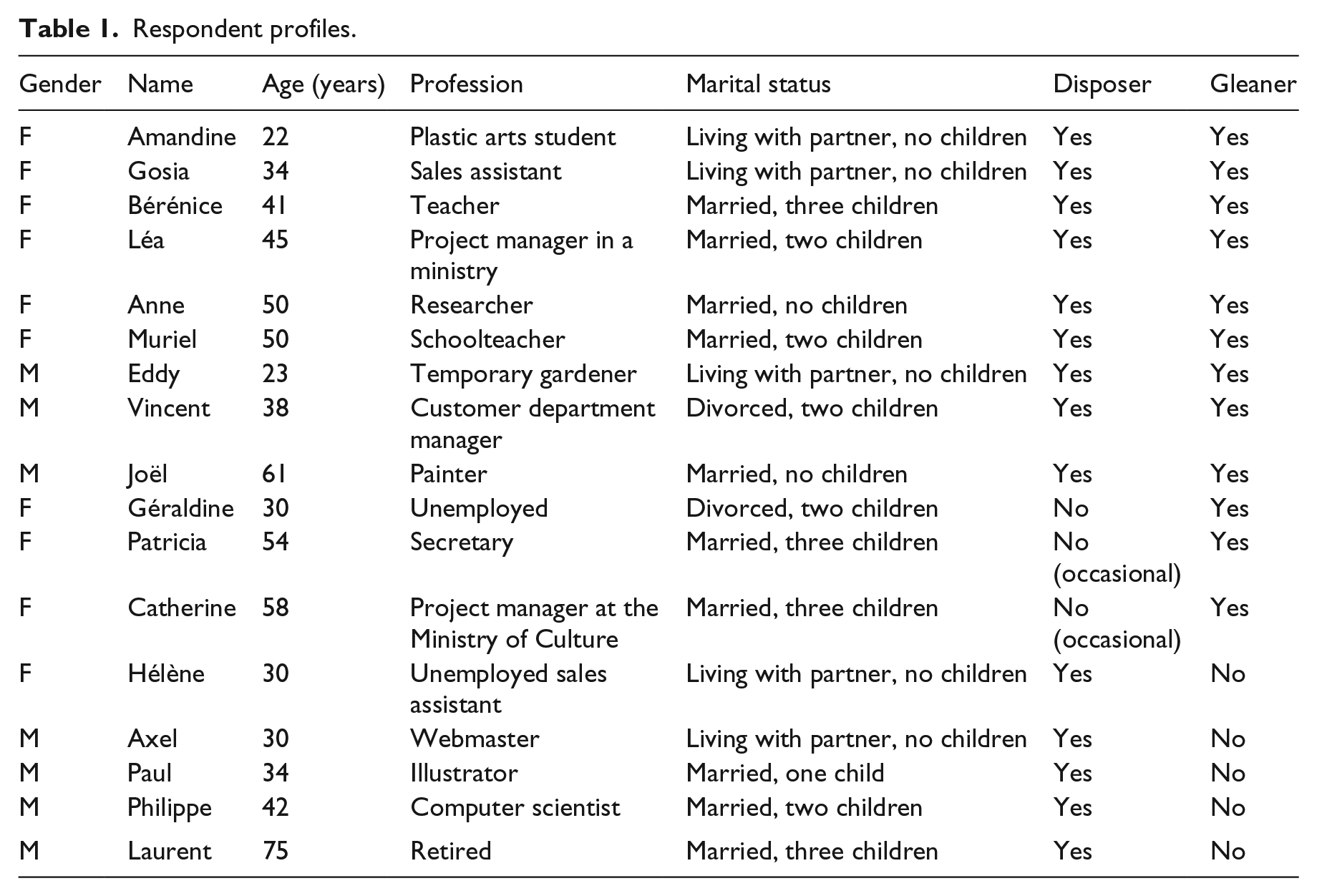
Informants were recruited progressively by means of a “snowball” technique, with a view to finding contrasting profiles in terms of age, gender, socio-professional level, and their enthusiasm for, familiarity with, and motivations regarding these practices, the length of time they been engaging in them, and their frequency of doing so. Based on initial discussions with our potential informants, we looked for “information-rich cases” (Patton, 1990) capable of delivering detailed and varied representations of their practices. Following a sequential coding process, we stopped it at the point of information saturation, that is, when the last interview no longer enriched the analysis grid, and new data collected could be “correctly summarized” using the existing categories (Bernard, 2008: 115).
The interviews were conducted in the homes of the gleaners and disposers or at the university. They lasted on average 1.5 hours (ranging from 45 minutes to 2 hours 15 minutes) and were fully transcribed. Each interview began with a “grand tour” of questions (McCracken, 1988) on their disposition and retrieval practices: What? Where? When? In what context? By what procedures and how often? With whom? Since when? (Appendix 1). We also discussed possible trade-offs with other behaviors such as selling and/or donating when these were mentioned by informants. The interview then explored more deeply the emotions experienced in depositing or gleaning these items but also imagining or observing (in the case of disposers) that the objects had been (or could be) retrieved by others or imagining being observed retrieving items (in the case of gleaners). On this point, a number of accounts of encounters and verbal exchanges between disposers and gleaners (Türe, 2014) were collected.
The interviews were then coded separately by the authors by comparing the discourses to the motivations for disposing and gleaning (Brosius et al., 2013) and to the forms of sociality described in the literature, such as donation, barter, and sharing (Albinsson and Perera, 2009; Arnould and Rose, 2015; Bajde, 2009; Lastovicka and Fernandez, 2005; Le Gall-Ely, 2013; Moody, 2008). Through an iterative process, coding units were aggregated, analyzed, and classified with a view to defining and recognizing the phenomena observed. We sought to identify them and to specify the elements that characterize and match them with the “analysis categories” to which they belong (Arnould and Rose, 2015). As these authors emphasize, empirical phenomena never purely and perfectly reflect the forms of sociality that they seem to evoke. For example, terms such as “gift” and “giving,” used by some informants within an emic perspective, 7 do not necessarily reflect the meaning and content of the analytic categories corresponding to an etic analysis of the phenomena. We therefore examine the forms of sociality revealed by our informants’ discourses, of which three stand out: charitable donation, balanced reciprocity, and generalized reciprocity (Arnould and Rose, 2015; Moody, 2008). The context, which does not allow informants to know other people’s real intentions – because of the anonymity that exists between disposers and gleaners – sometimes leads to negative forms of sociality that we clarify. Because it is not socially institutionalized for the circulation of goods, this context is subjected to important requalification tasks that allow these forms of sociality to emerge. We analyze this below.
From clearing out possessions to leaving them for others
The BIC system is primarily designed to enable people to dispose of unwanted large items, which are theoretically destined for destruction or recycling. For the items to be put back into circulation, it is necessary that those who deposit and/or retrieve them redefine the system and give it another meaning, as described above. This requalification concerns the nature of the objects, the times when they are deposited, and the intentions behind their being placed on the sidewalk. Our informants showed that the bulky item system serves not only to get rid of possessions but also to make them available to other people.
With regard to the objects, informants refer to the loss of utility and emotional value that motivates their decision to discard them (Lucas, 2002). Their comments show, however, that the things they get rid of are not necessarily broken or damaged and may not strictly conform to the weight and volume criteria by which the municipalities define “bulky.” Thus, one informant explained that she deposited bags of “still wearable” clothing in the street because she “landed up with this stuff, not knowing what to do with it” but hopes they are taken:
I live in Puteaux [Paris suburb] and was looking for the appropriate bins. Everywhere there are bins for glass and paper, but nothing for clothes. I sometimes used to see Relais [clothing collection charity] containers, but they’re not there any more. I don’t know anyone who might want them, so I left them in the street, in a bag so it could be easily seen, clothes that could be used. I thought: “Maybe someone will take them, otherwise they’ll go in the trash,” but at least … maybe someone will take them … people who are short of money, they could benefit from these things. (Gosia)
With regard to the time when these items are deposited, some informants say they take them out on days and at times that do not necessarily conform to the rules set by the municipalities. These rules not only specify what may or may not be deposited, at which locations (in front of the residence or in dedicated places), and in what manner (not obstructing movement on sidewalks and sometimes with pre-arranged appointments for their removal, as in Paris), but also when (late at night or early in the morning, in accordance with a previously established timetable). Yet, disposers may ignore these time requirements, arguing that the items rapidly disappear through people retrieving them:
I don’t stick to set times. I know very well that doing it is illegal but I don’t think it’s actually punished. I know people who do it discreetly because they are afraid of being fined, but in the end, the stuff left in the street doesn’t usually stay there for long. People take it pretty quickly. So I don’t see why it bothers the authorities that we leave things on the street which don’t even stay there 24 hours. (Paul)
Finally, the informants redefine their intention in depositing items in the public space, especially when they deliberately break the rules. Placing things on the sidewalk rather than throwing them in the trash demonstrates their commitment to “passing them on” to other people and extending their useful life. “It also allows some people to recover things before the collection truck comes” (Axel). “If I didn’t care, I’d put everything in a bag and throw it into a large trash can” (Amandine).
However, this desire to put things back into circulation by making them available to others does not chime with the usual forms of sociality, where people meet, get to know or “imagine” each other, particularly through a charity (Bajde, 2009: 2012). What then is the basis for this orientation toward “distant others” (Bajde, 2012)? What is the nature of it? And how does the system operate among people who only occasionally meet? We address these questions in what follows.
From charitable donation to sharing: Three steps toward understanding the forms of sociality between strangers around the circulation of objects in public space
Informants who explicitly say they want their belongings to benefit other people testify to a desire to pass them on and extend their useful life (Türe, 2014). However, this intention is not necessarily subject to the same forms of sociality (Arnould and Rose, 2015), of which three forms need to be distinguished (Figure 1):
First, exclusive disposers and disposers who glean occasionally want to put their belongings back into circulation among people they view as socially disadvantaged. Such action may be seen as form of charitable donation oriented by representations of an “imagined community” of gleaners whom they hope to help from a feeling of common humanity (Anderson, 1991; Bajde, 2009). However, not all gleaners perceive the “meaning of the act” (Godbout, 2000: 16), and may even sense hostility, whether real or imagined, on the part of some disposers.
Second, disposer–gleaners see the BIC system as conducive to barter. They view it both as a way to get rid of what they no longer want and as a provisioning channel with multiple benefits (Brosius et al., 2013). In this form of balanced reciprocity, a give-and-take view of the circulation of goods prevails, which does not, however, exclude forms of negative sociality.
Third, exclusive gleaners (or gleaners who deposit occasionally), independently of any need to do so, view the bulky item system as a way of sharing goods, combating waste, and easing tensions related to environmental issues. In this generalized form of exchange (Arnould and Rose, 2015; Lévi-Strauss, 1958) or “serial reciprocity” (Boulding, 1973; Moody, 2008), what is deposited by some people and then taken by others is intended to be once again given, in an extended process of circulation without any direct expectation of return. We now successively detail these three forms of sociality.
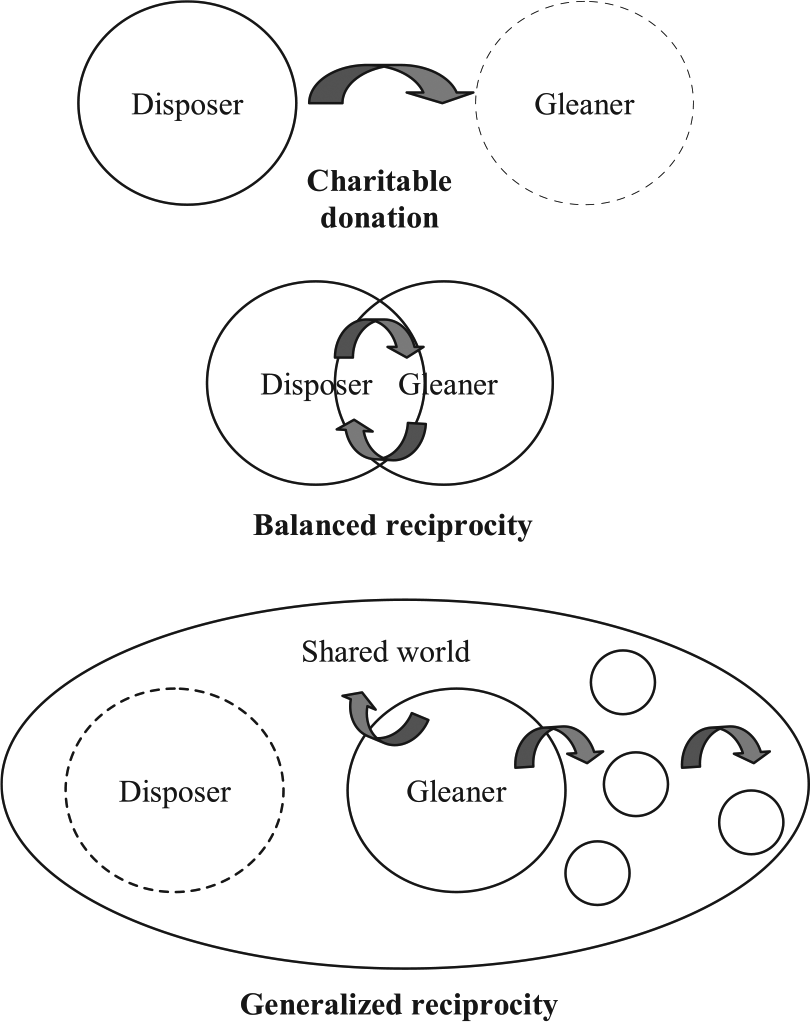
Three forms of sociality between disposers and gleaners.
From charitable donation by disposers to the perception of their actions by gleaners
Representations on the part of exclusive disposers basically stem from the image they have of an “imagined community” of socially disadvantaged gleaners whom they wish to help (Bajde, 2009). These representations may be fed by what they believe they know about them – “people who retrieve things in the street are not necessarily beggars, they are also people who have a home but whose income does not allow them to buy furniture,” (Philippe) – or by what they have directly observed – “people who are ‘in permanent crisis’… I see them in the evening, I don’t stare at them through my window, but I’ve already seen a few people” (Axel). Because disposers do not, in general, directly encounter gleaners and categorize them only on the basis of a widely stigmatized practice (Becker, 1963), their representations reflect an “imagined community” of “poor people” who can be helped in a practical way. Disposers do not need to meet them; it is more important that they construct an adequate image of them. These imaginaries of charitable donation serve as a justification: using the BIC system – a quick and convenient way of getting rid of things – allows them, under cover of a charitable act, to free themselves of any guilt associated with doing so. For some exclusive disposers, such charitable giving fuels justifications in terms of putting goods back into circulation by means of a direct redistribution system that corrects inequalities (Bajde, 2012). “For me, when I leave something in the street, I’m always giving it to people in need” (Paul); “I deposit things for free, to enable people, especially those in difficulty, to benefit from things I no longer want” (Philippe). The BIC system thus facilitates the re-acquisition of items that, even if not in pristine condition, some gleaners may find of interest or of use (Türe, 2014), thereby easing any anxieties about wastage (Gopaldas, 2014):
I think it’s important to pass on to those with limited financial means furniture or other worn items that are no longer of use to us, and that, instead of ending up in the trash, can go to certain disadvantaged people. When I put something out, I’m pleased to be doing it, because I know that someone will benefit from it. This frees me from the feeling of waste … (Paul)
However, while charitable intent is commonly seen among exclusive disposers, it is also found, but to a lesser extent, among informants who occasionally glean. For example, Muriel says that putting things out is not a meaningless gesture for her. Her actions are subject to the obligations of Christian charity based on a “sentimental” representation of gleaners, to whom “we cannot not give” (Bajde, 2012: 9):
I tell myself that it can help someone in need. For example, when I put out clothes, I tell myself they’ll always be of use to the most disadvantaged … I feel compelled to put things out from time to time, it’s something I can’t help. I feel obliged to help my neighbor. Yes, I’m very much a believer, that’s why I think that depositing represents a gift, a gift for the person who takes it. (Muriel)
Yet, is the intention behind the charitable act perceived by gleaners? Direct encounters between these two populations are rare, and it is difficult for those who recover items to know in what spirit and with what aim they were placed on the sidewalk. Their interpretation of the disposer’s intention sometimes derives from notes left by disposers, urging them to take the item concerned (see Figure 2). But in general, these representations are largely fantasized and nourished by a socioeconomic background that affects how they make sense of the items found.
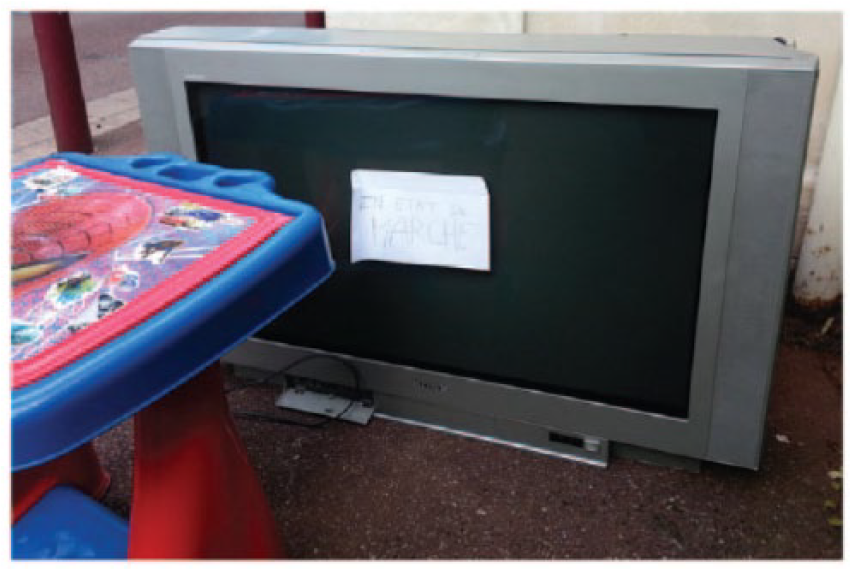
An example of explicit labeling on items intended for retrieval.
The feeling of being given something is, for instance, very noticeable among those informants in financial difficulty, to whom the things deposited seem like an offering from “good people” (Géraldine) that is gratefully acknowledged:
I often thank people for the gesture they’re making. Yes, I take it as a gift from someone who is anonymous. How do I describe this act? Well, for me it’s hope. Yes, I feel I’m receiving a gift of life, because it’s not easy for everyone. (Géraldine)
Similarly, the unexpected nature of certain objects and their consonance with the gleaner’s tastes make them seem like a gift, as illustrated by Eddy: “I found some old vinyl records that I gave to a friend who does scratching. They were old Bob Marley records … It’s great to find stuff like that. It’s almost magical, I could say.”
Provoking disbelief on the part of the gleaner, these encounters call for an interpretation of what might look like pure prodigality (Bataille, 1991 [1949]). But because such things cause such intense pleasurable surprise, the gleaner gets the impression that the disposer has acted out of generosity:
My father found a belt with two little pistols in it, just like that, and they’re real guns that fire. Except there were no bullets inside. And he found it among the bulky collection stuff. Yeah, it’s incredible! When my father found that belt with the little pistols in it, yes, it was a gift. Because the guy must have thought, Someone’s going to find this. (Eddy)
In contrast, other gleaners, in response to these same questions about the disposer’s action, do not necessarily view it as a gift, but rather as a sign of incompetence. For example, Léa, who found a microwave in perfect condition on a Paris sidewalk, criticizes this abandonment of a new product:
I obviously thought it was broken. But sometimes … I put it in the car on the off-chance, so my husband could check it. Well, it was brand new! Brand new, with the user manual inside. I asked him [my husband], “Why did they throw out it then?” He said: “It’s rather complicated to use. They must have been unable to make it work, then they threw it out.”
Because she had no particular need for this item at the time and because she is very concerned about waste, Léa views this act a sign of fecklessness, which did not incline her to attribute a charitable intent to the disposer.
More generally, these difficulties of interpretation may be viewed as stemming from a problem of social characterization of the context. Although it is legally accepted that items deposited on the sidewalk are abandoned (Strahilevitz, 2009) – etymologically, “leaving to someone else’s attention” – their destination is codified: they are implicitly destined for the municipal department responsible for collection and recycling. In fact, as illustrated by Patricia, “One is in doubt, there is nothing written like, ‘help yourself’, ‘if it can be of use, enjoy it, we’re getting rid of it.’” Such ambiguity gives this informant the feeling she is “pinching” things.
These comments in fact introduce another form of sociality, in which disposer–gleaners wonder about the balance of the exchanges. Convinced of the merits of the system that allows them both to get rid of and to retrieve things, some of them conceive of it along the lines of an imagined community, that is, based not on mutual acquaintance, but on sharing through give-and-take, where what is taken (as opposed to given) is offset by what is given (as opposed to retrieved). However, this system of balanced reciprocity does not necessarily exclude other forms of negative sociality, as described below.
Balanced reciprocity and negative sociality in the disposer–gleaner community
Among informants who both deposit and glean, the idea of belonging to an imagined affinity community (Cova, 1995) sharing, in a geographically defined area, the same feeling (Maffesoli, 1988: 248) for the recovery of objects, is prominent in their comments. As a disposer, it is not a matter of “giving” things to a gleaner who is less well-off than oneself, but of exchanging with an alter ego who believes in the same way that items no longer wanted may be of interest to others:
Those amazing bulky item collection evenings when I throw stuff out, they’re like a free flea market. I put out what I have to give. And so when I throw out these things, I see what other people have to offer me. (Amandine)
The metaphor of the neighborhood flea market emphasizes the “between ourselves” nature of such practices. One deposits with neighborhood gleaners in mind, and they too are expected to get rid of things that will be of use in return. As illustrated by Amandine, she puts things out on BIC days so as to share with others the pleasure of discovery that she herself experiences when gleaning (Brosius et al., 2013):
It would make me very happy seeing the delight of someone who came across it. And what if this item was just what the person was dreaming of? And who missed it because I’d thrown it in the trash can? It’s really this magic I find in putting things out, that I’ll offer to others also. (Amandine)
This respondent transmits the vision of a system based on the principle of give-and-take:
It’s as if the street was a large self-service store and everyone gives each other what they don’t need, which isn’t worth selling. At the same time you tell yourself that on your side, if you put things out too, you’re part of it … well, you’re giving in return anyway, so there’s no guilt in thinking that you could take it all to other people.
Similarly, Eddy sees the bulky item system as one of balanced exchanges, despite the possible time lag between what is deposited and what can be taken in return: “It’s a barter in a way, one could say almost, because one day I’ll need something, and I’ll walk along the sidewalk, and wow!, it’ll be there. And when that happens, well, it’s cool” (Eddy).
The feeling of balanced reciprocity between disposers and gleaners is nevertheless largely fantasy. In the few encounters mentioned, disposers hand things over directly to gleaners, without being able to observe a direct reciprocity in which the gleaners offer them something in return. Such reciprocity is limited to a form of shared understanding of the benefits of the system, through which gleaners, by retrieving things, offer disposers the satisfaction of giving a second life to the items concerned. As Eddy says, “When you see someone putting something out, he prefers it to be taken directly and if it’s of interest to someone, that’s why he’s put it out too.”
However, alongside the image of the gleaner who likewise uses this collective system in which goods circulate, there are also negative images of certain social groups, in this case, undesirable gleaners (Bergadaà, 2006). Informants thus refuse to leave things for professional retrievers, because they are not driven by the same disinterested motives, and it is difficult to imagine a “shared self” with them (Lastovicka and Fernandez, 2005). For example, Léa says,
Sometimes I’m irritated by people who stop with their trucks and arrive like raptors, they almost take the stuff out of your hand. And I wait until later and they’ve gone before taking things out. It is a rapacious, self-interested approach. They make money from it, and I, at that point, it bothers me. It’s like a business, here, right under my window. And they do it like that, they have no respect for you. They take your stuff unceremoniously. It calls for a little tact to take possession of other people’s things. After all, five minutes previously it belonged to you. A residue of the property instinct, I don’t know. (Léa)
This extract reveals the strength of attachment and possessive individualism that persist with regard to former belongings, despite their having been abandoned in the public space (Arnould and Rose, 2015; Lucas, 2002). Also evident in this discourse is a highly ambivalent attitude toward those, often at a certain social distance from the disposer, who seek to appropriate the items (Sahlins, 1965).
Apart from these negative representations of professional gleaners, most informants are not comfortable either with the idea that their objects are taken by people in the neighborhood who “are well off”: “my neighbors, in this area, they all have SUVs and I’d say they’re not hard up” (Bérénice). The acceptable schema is one in which it is desirable to put back goods into circulation and give them a second life by freely passing to people like oneself, who are neither rich nor motivated solely by monetary advantage, and thus not reintroducing forms of self-interest, calculation, and utilitarianism borrowed from the market (Arnould and Rose, 2015). Accordingly, anonymity and the generally asynchronous nature of the system help to obscure these situations of negative sociality.
The feeling of reciprocity in a community opposed to waste
Going further than the vision of a balanced exchange of goods, some informants glean (and occasionally deposit) objects with the idea that it is shameful to destroy them and that they should be put back into circulation. These informants embody the principles of generalized exchange (Lévi-Strauss, 1958) or the exchange economy (Boulding, 1973), in which what is given by one person to another is not for him or her directly but is passed on to someone else who will in turn pass it on (Moody, 2008: 135). With their common view of the harmful effects of consumer society, and particularly waste, these informants thus see themselves as stakeholders in a community guided by the sharing of goods (Arnould and Rose, 2015) and citizens of a finite planet whose resources must be preserved. Their belief that there are good reasons to put products back into circulation is fueled by environmental concerns and doubts about the sustainability of consumption practices (Kilbourne et al., 1997): “It’s so obvious that we’re heading for disaster if we continue to consume without restraint, to prolong this process of producing waste” (Vincent). This particular respondent gleans regularly with his family even though he is not in any financial difficulty. For him, it is deep conviction that makes gleaning a responsible practice:
I very often wear clothes that I find thrown into the trash. There’s a couple in my father-in-law’s building where I go every week who regularly throw out clothes in perfect condition, shoes too. Most of the time they’re in perfect condition. We sort through them as a family. If they’re not our size, we recycle them at Red Cross collection points. The rest, we keep.
This desire to share things is in no way accompanied by an expectation of reciprocity. What is recovered is mostly passed on to other people:
I also recover old computers that I dismantle for spare parts: a fan or just a diskette reader, things like that, in short, everything I see passing. I repair them if necessary and give them to people I know. It’s a matter of principle. I’m a recycling expert. (Vincent)
Similarly, Joel makes a point of rescuing items that he sees as having aesthetic or functional value and makes them available to his circle:
I feel that people throw things away because they have no value, many things that aren’t very expensive and they soon get tired of. But people can get rid of extremely valuable things out of ignorance. They throw them out because they’re outdated … My problem is storage. It’s a fact that my reserve is full of stuff, everyone knows that and everyone comes. I’m happy to give things away, I don’t keep them.
Indeed, paradoxically, this greater fluidity toward “liquid” possessions (Bardhi et al., 2012: 511) leads these informants to accumulate things more often than they dispose of them, waiting sometimes, once they have restored them, to find a satisfactory destination for them (Guillard, 2014).
Similarly, Catherine deposits very little and gleans frequently, not out of necessity but because she views the items as individual products in which labor is embodied. When she collects them, she feels that she is “paying tribute to past generations, out of respect for what they have left us.” Catherine says she distances herself from consumer society and asks why would she “add to the masses of people who don’t understand that we’re messing up the planet by engaging in this spiral of consumption.” By gleaning and saving things from destruction, Catherine feels she is acting responsibly in relation to the past, as well as to future generations: “What will we bequeath to our children?” These feelings illustrate what Gopaldas (2014) theorizes as a series of collective affective orientations present in “ethical consumerism”: contempt, because of anger and disgust toward all forms of irresponsibility, concern for the victims of the system, and celebration of the individual heroism embodied in enlightened decisions. With this regard, wishing to act in a useful way, Catherine campaigns against how BIC is organized in Paris, based as it is on an appointment principle she finds absurd:
You have to fight and try to change things. What I wanted someone to tell me in Paris, is that bulky item collection is pooled. I proposed pooling the collection procedure. I even wrote to the mayor to complain. How about recycling old computers, what is being done there? Apart breaking them up and stacking them? That should at least be organized at a regional level.
Instead of encouraging the pooling of items that disposers might want to pass on to gleaners, the appointment system hinders this circulation and prevents it being organized freely. A responsible and sustainable approach would therefore, in her opinion, leave disposers free to make their things available to those who wish to retrieve them – insecure sections of the community, but also handymen, artists, or simply “citizen consumers,” as Vincent says. The discourses also show that these orientations have been shaped by a habitus and family transmission processes geared toward the preservation of resources. “In our house, we didn’t throw things away. We didn’t have much money. So we made things and repaired them. We were not brought up with an attitude of waste” (Vincent).
The comments by Catherine, Joël, and Vincent thus seem to reflect a broader context in which institutional discourses attempt to make consumers more responsible (Askegaard and Linnet, 2011; Giesler and Veresiu, 2014). Their suggestions for a generalized system of exchange show that, since the Brundtland Report 8 and the Grenelle 1 and 2 of the Environment, the environmental crisis has influenced reports on consumption and ways to recover and circulate goods. These developments also appear to be encouraged and strengthened by a “radical de-institutionalization of reciprocity” in accordance with which “giving and taking something against nothing is not only possible, but commonly practiced” (Gouldner, 2008: 80). One reason given by Card (1988) is that the notion of generalized reciprocity does not so much favor returning something that was initially given, as supporting the activity to which this practice contributes. For example, after being given a ride by a stranger, one’s more likely to pick up hitch-hikers so that the system endures (Moody, 2008).
These various comments show that the BIC system provides a spatial framework whose social use is only imperfectly codified and that it is through a process of representation, elaboration, and learning that gleaners and disposers participate (or do not) in putting goods back into circulation. The theoretical and managerial implications of these findings are now discussed.
Discussion, limitations, and future research
To date, research on gleaners has focused on their economic, psychological, and ideological motivations (Bellagamba, 2013; Brosius et al., 2013; Donovan, 2012; Fernandez et al., 2011; Piedallu, 2013), leaving to one side the social dimension of the practice and the role of disposers. Our results show that three forms of sociality connect them (Table 2): charitable donation (which motivates exclusive disposers with regard to “poor” gleaners), balanced reciprocity (between disposers and gleaners with a shared preference for forms of give-and-take exchanges), and generalized reciprocity (where gleaners view municipal BIC as a general system for the circulation and sharing of goods). Breaking with the silo character of previous approaches – in which disposition and gleaning and are not jointly addressed – our results reveal how the circulation of goods is shaped by disposers’ and gleaners’ tactical use of a particular space and time – the public BIC system.
Summary of different forms of sociality and their characteristics.
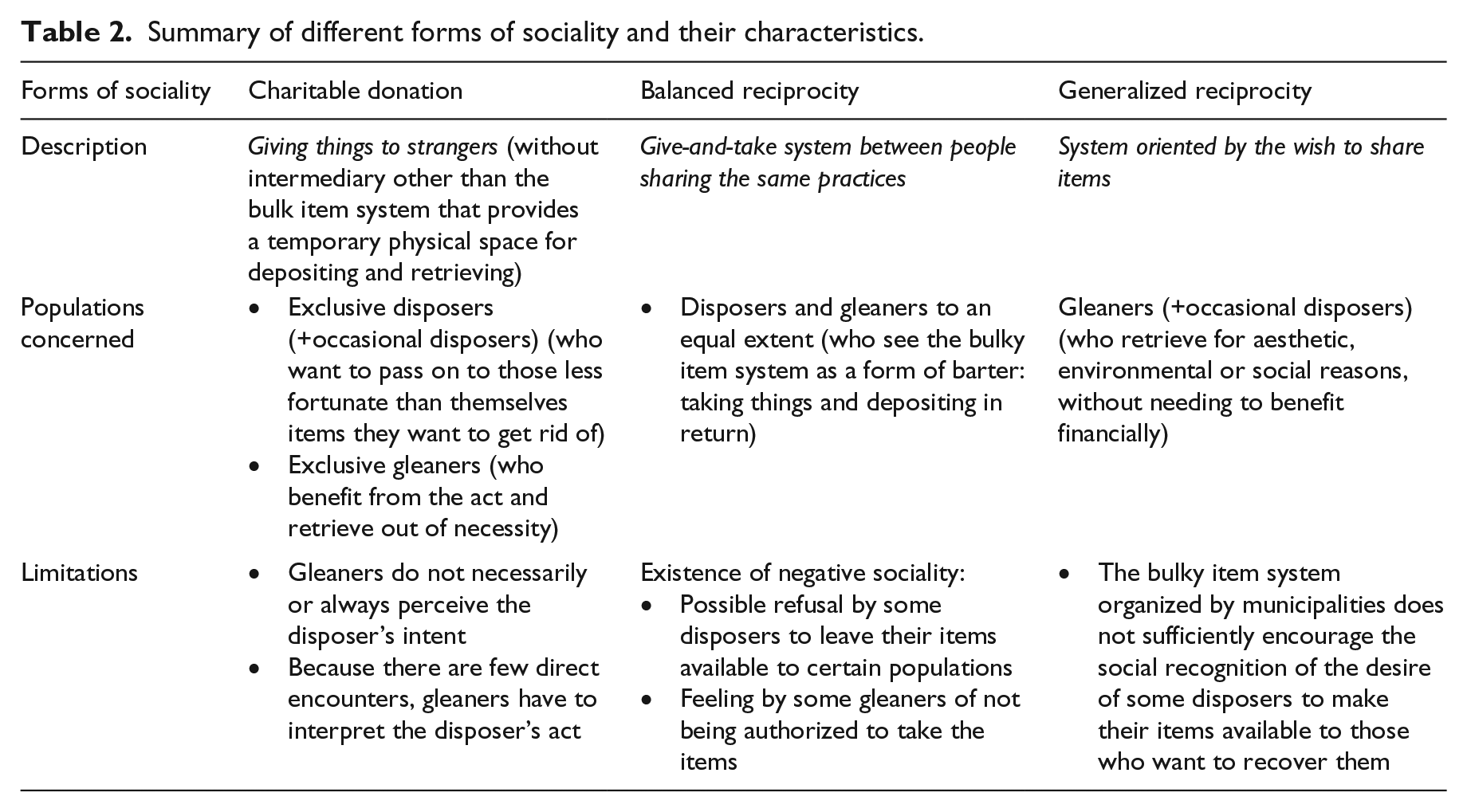
In addition to these observations, what are the implications of these three forms of sociality for the socio-moral logics that shape and guide markets (Fourcade and Healy, 2007)? What do they illustrate with regard to the transformation of modes of exchange, among which the emergence of new forms of sharing (Belk, 2010) and access (Bardhi and Eckhardt, 2012) raises the question of the meanings and the boundaries of consumption? (Graeber, 2011)
New ways of moralizing markets?
The markets are sites for the expression of projects saturated with normativity (Fourcade and Healy, 2007: 20), arenas where different systems of feelings (Gopaldas, 2014) and of antagonistic values (Luedicke et al., 2010) confront each other. From this standpoint, our results show that the circulation of goods between strangers in public places is a counterpoint to the market system, certain dysfunctions of which it mitigates. Indeed, it seeks to be a mechanism for the alleviation of the poverty, real or imagined, of the most vulnerable populations through charitable donation (Bajde, 2012). By making goods freely available, it thus remedies the scarcity that the market creates through prices. It also aims, through sharing, to offset the effects of hyper-consumption on the environment – the proliferation of waste and the destruction of resources (Kilbourne et al., 1997). It thus counteracts the selfishness of homo economicus, guided solely by self-interest (Smith, 1991 [1776]), who purchases, uses, and gets rid of products regardless of others. In short, it puts into practice, pragmatically, through charitable donation and sharing, forms of “non-economic” economies (Polanyi, 1983) or “anti-economies” (Mauss, 1989: 239), where what circulates (goods) is first placed in the service of others (Godbout, 1992).
Despite this orientation toward others, it should be noted that the absence of links and direct encounters between disposers and anonymous gleaners contrasts sharply with the traditional economies of the gift or sharing. Indeed, the charitable donation observed here points to a “modern form of giving to strangers” (Bajde, 2012; Godelier, 1996) that “no longer serves solely to cement and stabilize primary relationships between individuals (family and community relationships), but feeds potentially infinite open networks, far beyond concrete acquaintanceship” (Godbout, 2000: 12). Similarly, although sharing in the context of the BIC system has three points in common with the definition provided by Arnould and Rose (2015) – “inclusion” in a common humanity (where people and things must be preserved), “mutual inscription in a common sociality” (where everyone can expect others to act in the same way in the same circumstances), and the transformation of “strangers” into people with common interests – there is, given the absence of direct interactions between the individuals, no “closed group” logic.
Moreover, these two forms of sociality coexist with a third which, although non-market, is clearly calculative. In the give-and-take of balanced reciprocity, the object takes precedence over the link with other people. The debt is extinguished after an exchange viewed as barter, although in practice, it is almost never bilateral.
In sum, we need to pay attention to the important differences in the three forms of sociality observed. Revealing the existence of distinct social logics, this research also enriches the concept of “hybrid economies” (Scaraboto, 2015). It goes beyond the classic interweaving of market logic and that of the spirit of giving (Garcia-Bardidia, 2014; Herrmann, 1997) and emphasizes the variety of socialities that also interpenetrate each other in a non-market context.
Every form of sociality shows that markets can never isolate the moral consequences of what they offer for individual citizens, who evaluate them in return (Stehr and Adolf, 2010). Thus, these forms of sociality participate in the cultural dimension of markets and reflect their “moralized” and “moralizing” character (Fourcade and Healy, 2007).
Yet, although these forms of sociality are not new phenomena sui generis (Durkheim, 1983 [1897]), they present two types of distinctive features. First, they create a “circumstance” economy that is deployed in a “tactical” way (De Certeau, 1980), using the BIC system as an opportunity (for depositing and taking items) and the sidewalk as a space/time conducive to being put to an alternative use. For example, in contravening municipal rules, disposers seek to put their belongings back into circulation, and gleaners, by pre-empting them before they are collected by the municipality, manage to give them a second life. The second distinctive feature of these forms of sociality is political. The purloining of items left on the sidewalk certainly makes use of the system in an active and creative way. However, it does not manifest the type of engagement characteristic of ethical activist movements (Gopaldas, 2014). On the contrary, these practices constitute a kind of political infrastructure (Scott, 1990) implemented silently and invisibly in an anonymous urban world. By invisible, we mean that although depositing items on the sidewalk is implicitly tolerated, the intentions of those who do so and of those who retrieve the items remain fundamentally indistinguishable. However, our interviews reveal the “meaning of the act” (Godbout, 2000) and with it the magnitude of the need to institutionalize micro-practices that lack social recognition.
Indeed, despite their secretive nature, these micro-practices resonate with initiatives that we try to make visible and identifiable. Le Grand Don, Gratiferias, Giveboxes, and “stores for nothing” 9 have in recent years helped institutionalize the circulation of goods between strangers. They testify to the growing awareness, first by charitable organizations, then by the political sphere, of the social and environmental values of this process (Guillard and Roux, 2015). Because they are fully consistent with the energy transition bill introduced by the French Ministry of Ecology, Sustainable Development and Energy and with the “zero rubbish, zero waste territory” project, 10 these practices are growing in terms of visibility, permanence, and institutionalization. In this respect, the political impact of these micro-practices is considerable. All the more so because in helping to make them visible, researchers also provide public actors with frameworks for analyzing and interpreting the moral feelings that drive them (Fourcade and Healy, 2007; Gopaldas, 2014; Guillard and Roux, 2014).
New forms of sharing and access economies?
Situated within mechanisms for putting used goods back into circulation, the forms of sociality analyzed in this research call into question their inclusion in collaborative consumption and the concept of the “sharing economy,” with which the latter is often associated or confused (Borel et al., 2015; Botsman and Rogers, 2011). Despite a lack of consensus on the nature of its scope and its main defining elements, the collaborative economy or “sharing economy” (Belk, 2010) mainly refers to ways of pooling various types of material and immaterial resources (Perret, 2015). Insofar as goods are made available to others outside the disposer’s immediate circle, the circulation system we have described seems to fit into this conception (Botsman and Rogers, 2011). However, three reservations – systemic, institutional and social – need to be noted regarding the inclusion of these practices in collaborative consumption.
First, with regard to the nature of systems of collaborative consumption, our context concerns solely the realm of “redistribution,” that is, the temporary or permanent transfer, either free of charge or paid for, of goods that someone else can use (Botsman and Rogers, 2011). The circulation observed involve the permanent transfer of the ownership of goods to strangers. The items concerned follow a biographical trajectory (Kopytoff, 1986) whereby they become waste that “must” be got rid of and will perhaps re-acquire life under a new owner (Thompson, 1979). In this respect, our context in no way illustrates the concept of shared objects as defined by Belk (2010), any more than consumption based on access (Bardhi and Eckhardt, 2012), because there is neither a formal transaction, nor market mediation, nor physical sharing of the goods. However, while this movement is clearly inscribed within a search for utility of unused resources (“the power of idling capacity,” Botsman and Rogers, 2011), it nevertheless does not constitute a collaborative system. Indeed, the principle of critical mass sought through linking devices is completely absent from our context. These practices are not coordinated by platforms, as may occur with many collaborative initiatives. From this there arises the second, institutional, reservation, which is discussed below.
The second reason to be cautious about including the observed circulation in the collaborative economy is that it is neither formalized nor institutionalized. Indeed, it uses a mechanism – BIC – and a place – the sidewalk – where people do not (or rarely) meet and do not know each other’s intentions (which they therefore attempt to interpret). Hence, the space is “lived” (imagined) and “practiced” (perceived) (Lefebvre, 1974) as a space of exchange, despite the absence of any explicit corresponding social meaning. The forms of sociality observed are admittedly based on an institutionalized system that, however, does not say that the objects are to be taken or who may take them, unlike other contexts such as BookCrossing 11 (Dalli and Corciolani, 2008). Given the type of social and institutional formalizations of the place – the sidewalk being a space for the disposal of belongings that the municipality will collect, rather than a space for socially “conceived” exchange as such – forms of negative sociality may also arise.
The third and final reason, extensively discussed in this study, for not situating our observations in the field of the collaborative economy is the social dimension of the context. Admittedly, not all the forms analyzed up until now necessarily depict strong, positive, and non-discriminatory sociality (Schor et al., 2016), but they are sometimes based on real interactions and/or encounters. As with car sharing (Bardhi and Eckhardt, 2012), there are few encounters, other than by accident, between disposers and gleaners. The system functions through largely fantasized imaginaries that feed the desire for charitable donation, reciprocity, and sharing, and more rarely, negative sociality. From this perspective, this system of anonymous circulation constitutes an original form that refers neither to primary sociality (family or relatives) (Le Gall-Ely, 2013), nor to secondary sociality (the market or the domain of public action), nor to tertiary sociability (remote exchanges in a virtual world) (Borel, 2011). In our context, circulation is facilitated by an absence of friction between the parties that protect the imaginary from the potential abrasiveness of actual contact.
This work, however, needs to explore other geographical, cultural, and social contexts that would allow possible differences in the circulation process to be explored, especially with regard to how collection systems are organized, how people define their relationship to public space, and how society in general views the practice of deposition and retrieval of goods. In particular, since this study was conducted in an urban context, its findings are not necessarily indicative of behavior in rural areas, where solidarity mechanisms may be stronger (Beaudry and Dionne, 1996) and where disposal at waste collection sites is often the only solution offered by municipalities for getting rid of unwanted bulky items.
This work also has major implications for public policy. At an economic level, first of all, the appropriation of objects by individuals prior to their collection by the municipal services may eventually undermine the economic model of collection procedures (Cavé, 2015; Wilson et al., 2006). Indeed, because some of the items are retrieved by gleaners, the collection vehicles may sometimes go out needlessly for very small volumes and/or non-recyclable items. This situation results in significant costs for the municipality and a loss for organizations in charge of waste treatment (Rollot, 2013). This is not to say that gleaning should be prevented. Indeed, taking items on the sidewalk is an environmentally helpful act that improves the circulation of goods prior to their destruction. Our results and their discussion emphasize, on the contrary, the need to better institutionalize these practices so as to make gleaning a valued rather than stigmatized activity.
Finally, this work opens the way to thinking about space, and in particular, how the sidewalk has become a space for provisioning (Duneier, 2000; Whyte, 1943). How these “other spaces” (Foucault, 2001) are constituted needs to be more fully addressed, not for analysis in isolation, but as “counter-sites” within market society, in which they contribute to redefining physical and moral boundaries.
Footnotes
Appendix
Interview guide
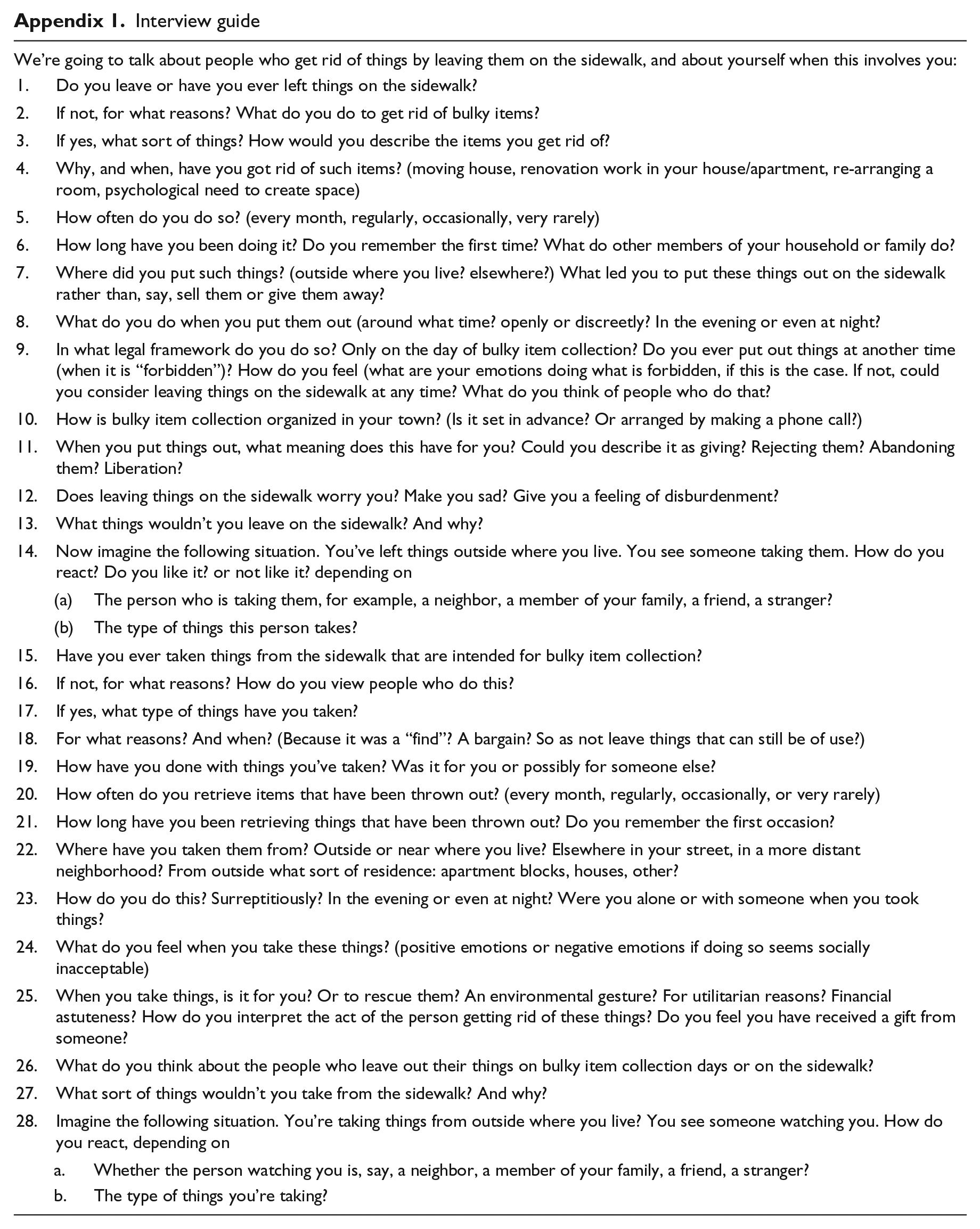
| We’re going to talk about people who get rid of things by leaving them on the sidewalk, and about yourself when this involves you: |
| 1. Do you leave or have you ever left things on the sidewalk? |
| 2. If not, for what reasons? What do you do to get rid of bulky items? |
| 3. If yes, what sort of things? How would you describe the items you get rid of? |
| 4. Why, and when, have you got rid of such items? (moving house, renovation work in your house/apartment, re-arranging a room, psychological need to create space) |
| 5. How often do you do so? (every month, regularly, occasionally, very rarely) |
| 6. How long have you been doing it? Do you remember the first time? What do other members of your household or family do? |
| 7. Where did you put such things? (outside where you live? elsewhere?) What led you to put these things out on the sidewalk rather than, say, sell them or give them away? |
| 8. What do you do when you put them out (around what time? openly or discreetly? In the evening or even at night? |
| 9. In what legal framework do you do so? Only on the day of bulky item collection? Do you ever put out things at another time (when it is “forbidden”)? How do you feel (what are your emotions doing what is forbidden, if this is the case. If not, could you consider leaving things on the sidewalk at any time? What do you think of people who do that? |
| 10. How is bulky item collection organized in your town? (Is it set in advance? Or arranged by making a phone call?) |
| 11. When you put things out, what meaning does this have for you? Could you describe it as giving? Rejecting them? Abandoning them? Liberation? |
| 12. Does leaving things on the sidewalk worry you? Make you sad? Give you a feeling of disburdenment? |
| 13. What things wouldn’t you leave on the sidewalk? And why? |
| 14. Now imagine the following situation. You’ve left things outside where you live. You see someone taking them. How do you react? Do you like it? or not like it? depending on |
| (a) The person who is taking them, for example, a neighbor, a member of your family, a friend, a stranger? |
| (b) The type of things this person takes? |
| 15. Have you ever taken things from the sidewalk that are intended for bulky item collection? |
| 16. If not, for what reasons? How do you view people who do this? |
| 17. If yes, what type of things have you taken? |
| 18. For what reasons? And when? (Because it was a “find”? A bargain? So as not leave things that can still be of use?) |
| 19. How have you done with things you’ve taken? Was it for you or possibly for someone else? |
| 20. How often do you retrieve items that have been thrown out? (every month, regularly, occasionally, or very rarely) |
| 21. How long have you been retrieving things that have been thrown out? Do you remember the first occasion? |
| 22. Where have you taken them from? Outside or near where you live? Elsewhere in your street, in a more distant neighborhood? From outside what sort of residence: apartment blocks, houses, other? |
| 23. How do you do this? Surreptitiously? In the evening or even at night? Were you alone or with someone when you took things? |
| 24. What do you feel when you take these things? (positive emotions or negative emotions if doing so seems socially inacceptable) |
| 25. When you take things, is it for you? Or to rescue them? An environmental gesture? For utilitarian reasons? Financial astuteness? How do you interpret the act of the person getting rid of these things? Do you feel you have received a gift from someone? |
| 26. What do you think about the people who leave out their things on bulky item collection days or on the sidewalk? |
| 27. What sort of things wouldn’t you take from the sidewalk? And why? |
| 28. Imagine the following situation. You’re taking things from outside where you live? You see someone watching you. How do you react, depending on |
| a. Whether the person watching you is, say, a neighbor, a member of your family, a friend, a stranger? |
| b. The type of things you’re taking? |
Acknowledgements
The authors thank the Editor and the three anonymous reviewers for their comments and suggestions, which enabled us to improve this paper. We also extend our sincere thanks to Michelle Bergadaà for her comments on an earlier version of the paper, to Philippe Mérigot for his valuable linguistic and grammatical advice, and to our informants, whose participation in the study contributed greatly to our thinking on the subject. This paper was written in the context of the Rechange research agreement (Waste and Society call for projects) funded by ADEME (Agence De l’Environnement et de la Maîtrise de l’Energie, no. 11 10 C 0043) between 2010 and 2015.