







Abstract
This research sets out to understand the process of identity negotiation undertaken by older people. The limitations associated with the ageing process are increasing. Older people must also negotiate with regard to the social image of ageing. They encounter this identity negotiation in an emblematic manner in mobility contexts. The research, conducted on the basis of an ethnographic methodology of train journeys, identifies four identity-negotiation strategies for older people, based on stoic fatalism, opportunistic acceptance, empowering appropriation and similar adequacy. These four strategies may be adopted by a single person during the same journey. They are then discussed in relation to the concept of successful ageing.
Introduction
The ageing process is a source of anxiety and fear for contemporary Western societies that worship youth (Debray, 2004, 2013). No-one wants to grow old anymore; on the contrary, people strive to remain young (Finkielkraut, 1989). Ageing is not only related to an irreversible physical phenomenon (getting old). It is associated with a social image that fluctuates between the figure of positive wisdom and the contrasting figure of the marginalised person in increasingly unstable societies (Bauman, 2000; Rosa, 2010).
Barnhart and Peñaloza (2013) distinguish between ‘ageing’ and ‘getting old’. In this view, ageing is not a fixed process and is manifested by an identity negotiation (Am I an elderly person? Who am I as an elderly person?). It is subjected to constant readjustments (Arnould and Thompson, 2005). However, there has been little research on how this identity negotiation is carried out. Certain studies have revealed the processes underlying the rejection of this identity by sufficiently young people (the above 50s) (Tepper, 1994), but little attention has been paid to this negotiation process among older people confronted with irrefutable evidence of their physical ageing.
Spatial mobility is an important marker of ageing-related tensions in elderly people, because they continue to travel despite the growing difficulties (physical and cognitive) they may face (Dumas, 2012). During their potentially difficult journeys, they evolve in a socio-material environment shared with other people. They cannot deny their ageing and must find the resources (physical, cognitive and social) required to enable them to travel. These are not exclusively practical resources. These journeys trigger identity-negotiation mechanisms employed by older people in relation to their environment.
In this research, we study these mechanisms in a mobility context. We consider the following research questions: What type of identity-negotiation strategies do older people adopt when travelling? How do the mobility-related difficulties they have to overcome transform their identity as elderly people?
We conducted this research via an ethnographic survey and semi-directive interviews in railway stations and on trains. The train is less popular than the car 2 as a mobility choice. It requires older people to manage their identity with others in a public transport context. Our results provide a detailed description of the identity-negotiation strategies they employ when travelling. We then discuss these results in light of the traditional ageing adaptation mechanisms (Baltes and Carstensen, 1996; Freund and Baltes, 1998, 2002; Guiot, 2006). While these studies analysed individual adaptations, they did not focus on the identity-negotiation process employed by people seeking to maintain their mobility. We also identify managerial recommendations for marketing campaigns targeting older people.
Ageing as an identity-negotiation process
Ageing reflects a social image that is evolving in Western societies (Gullette, 1997; Kuypers and Bengtson, 1973). Whereas ageing used to be associated with negative connotations (Kuypers and Bengtson, 1973), research has revealed the emergence of a positive, successful perception of ageing (Tornstam, 1997). Older people negotiate this social image of ageing (Barnhart and Peñaloza, 2013; Carstensen et al., 2003; Tornstam, 1997), but these mechanisms identified by the research are essentially based on individual discursive strategies that do not take account of the identity reconfiguration experienced by older people. Because it puts them to the test of ageing (being able to move around is a sign of activity), mobility is a manifestation of these negotiations.
The social image of ageing: From marginality to successful ageing
The social consciousness associated with older people still has connotations relating to regression or degeneration and to physical and physiological decline (Crockett and Hummert, 1987; Ferraro, 1992; Gilleard and Higgs, 2013; Guiot, 2006; Gullette, 1997; Higgs and Gilleard, 2014). For example, advertisements aimed at elderly people exaggerate the detachment of syllables and use simplified vocabulary, syntax and grammar (Carrigan and Szmigin, 2000; Yoon and Cole, 2008; Yoon et al., 2009). They are considered to be vulnerable people (Baker et al., 2005; Pavia and Mason, 2014) who need to be protected (Hébel, 2010; Kang and Ridgway, 1996; Wells and Gubar, 1966).
This categorisation of ageing as a handicap is specific to Western cultures (Lamb, 2009). Kuypers and Bengtson (1973) advanced the ‘social breakdown syndrome theory’ to characterise the discrepancy between the values of Western society revolving around productivity and success, and the image of ‘frail’ and marginalised older people. Research on the anthropology of ageing illustrates how the representations associated with this process have evolved. Ageing has been transformed from a natural and logical change into a weakness that must be managed by medicine. Gron (2016), revisiting the research of Lamb (2009, 2014), illustrates differences in perception between Western (American) societies and Indian society. In India, ageing is considered to be a normal and expected process, whereas in the United States, it is seen as a phenomenon that must be treated by medicine. The emergence of the cult of youth holds sway for the social representation of the elderly person in the West. The ideal image of the old person is no longer embodied by the wise elder, but rather someone who remains open to change and never really grows old (Ahmadi, 2001). Ahmadi (2001) shows that experience and maturity were held in high esteem at the start of the 20th century; young people tried hard to appear older than they actually were. In societies that prize youth and flexibility, this process is reversed; elderly people do everything in their power to appear young. This defence mechanism can be illustrated by a difference between objective age and subjective age in elderly people (Barak and Gould, 1985; Barak and Schiffman, 1981; Guiot, 2001), who perceive themselves as being younger to avoid being categorised as elderly people.
However, ageing-related representations are changing in the West. The baby-boom generation is starting to retire and the growing numbers of older people in society are helping to change ageing-related perceptions (Duyck and Guérin, 2006; Gergen and Gergen, 2000). The ‘baby-boomers’ would appear to have sufficient demographic weight to transform negative representations. Older people are no longer exclusively perceived as being frail and isolated people. The perception of ageing is also characterised by the growing empowerment of elderly people, and the maintenance of their health, their pleasure and their well-being (Gron, 2016). Research projects have examined these changes in representations of ageing. More and more research is being carried out on successful ageing (Baltes, 1991; Bülow and Söderqvist, 2014), in a marked contrast to the ‘care-centric’ vision focusing on the frailty of elderly people. The research places the emphasis on the process of successful ageing in elderly people, as opposed to the phenomenon of physical degeneration (Guiot, 2006; Reed and Carstensen, 2012; Senges et al., 2014; Tornstam, 1997, 2005). Successful ageing is measured by the attainment of physiological, psychological and social goals (Baltes and Carstensen, 1996; Senges et al., 2014). Although this process may be desired, it is accompanied by normative dimensions imposed upon elderly people, who must continue to be autonomous, active and socially integrated (Senges et al., 2014).
The definition of elderly people illustrates the tensions in the social consciousness associated with ageing in the West. Guiot and Urien (2012) consider that people are defined as belonging to the category of elderly people according to their age (starting at 60) and status (retired), but these two criteria, which may or may not be combined in different studies, do not take account of ageing-related connotations. Tréguer (2007), when revisiting the age-based classification, mentions the ‘liberated elderly’ (60–74 year olds), the ‘serene elderly’ (75–84 year olds) and the ‘oldest old people’ (above 85s). In this type of segmentation, a conflict becomes apparent between ageing-related difficulties and successful ageing. More specifically, the difference between ‘senior’ and ‘elderly person’ is symptomatic of the tensions relating to the social consciousness of ageing. The epithet ‘senior’ has become a norm that condenses notions of honour (Ruaux, 2007). The term ‘senior’ is supposed to underline the competences possessed by the older person. It could be considered a characteristic of the successful ageing dictate (Gron, 2016). Conversely, the term ‘elderly person’ could be said to characterise the frailty associated with ageing.
Representations of ageing are therefore pervaded by tensions between devaluation vis-à-vis the productivity of Western societies and the positive image associated with successful ageing. Older people negotiate their identity on the basis of this social consciousness.
The identity negotiation of elderly people
People who are still young enough and unburdened by physical and cognitive disabilities can adopt avoidance strategies in relation to the negative social image of ageing. They may refuse to consider themselves to be ‘elderly’ (Tepper, 1994). However, people of a more advanced age cannot deny the visible effects of ageing. They undergo identity upheavals following the decline in their physical faculties but must also take account of the social image of ageing, particularly when they experience it in their interactions with others.
Identity negotiation with themselves
Older people develop strategies with themselves to confront these identity-related doubts. By experiencing the effects of ageing, they negotiate their identity (Billaud and Brossard, 2014). Ageing leads to a series of physiological impairments associated with sensory faculties, in addition to losses of a cognitive nature, especially concerning their episodic memory (ability to remember specific events in a given context; Giffard et al., 2001; Guiot, 2006). Older people develop mechanisms that enable them to accept these physical problems. They distinguish between the fact of being old (attached to disruptive infirmities) and the fact of feeling old. As they feel themselves ageing, they experience difficulties which, while disrupting their daily lives, are not totally disabling (Balard, 2011). They learn to live with these difficulties and keep them at bay. Gourmelen et al. (2016) also underline this detachment strategy. They show that ageing is characterised by a perception of having a limited amount of time left to live, which leads to a process of looking back over one’s life. As they point out, ‘the aim is to understand one’s life in order to accept one’s death’ (p. 3). Older people find a unity in their life history (Guillemot and Urien, 2010). They create an identity-ipseity based on narrative consistency (their self-history gives a unity to their identity). The experience they acquire enables them to exert better control over their emotions in daily life and focus on emotional goals to which they are particularly attached (Carstensen et al., 2003). They become more selective in their choices of interactions and turn towards their friends and family as a priority (Guiot, 2006). Tornstam (2005), when developing his gerotranscendence theory, also postulates that older people move away from a rational and material perspective to embrace a spiritual, cosmic and transcendental dimension (Moal-Ulvoas, 2014; Tornstam, 2005). Certain studies have even shown that their feelings of well-being and satisfaction with life can compare to those of younger populations (Doyle and Forehand, 1984; Herzog and Rodgers, 1981). This identity negotiation is a subjective acceptance of an ageing process that is seen as irrevocable.
Negotiation with the social image of ageing and others
Identity negotiation requires the consideration of ageing at the macro-social level. Older people may adhere to this image through a desire to conform. According to the Terror Management Theory (Greenberg et al., 1986; Solomon et al., 1991; Urien and Guiot, 2007), elderly people experience feelings of terror originating from the discrepancy between the instinct for self-preservation and the prospect of dying. They cope with this identity-related anxiety by adhering to the world view promoted by their culture (Greenberg et al., 1986; Solomon et al., 1991; Urien and Guiot, 2007). In this way, they can conform to the positive social image of ageing that corresponds to the values of contemporary society. They continue to maintain a process of desire and personal accomplishment (Dowd, 2012). However, as Guiot (2006) points out, these adaptations become more superficial once the difficulties start accumulating for the older person. And the social image of successful ageing may become a burden. Recent research on ageing reveal the extent to which the perceptions of successful ageing oblige people to conform to this ideal (Gron, 2016; Lamb, 2014). Paradoxically, the transformation of ageing into successful ageing becomes a dictate and exacerbates the stigmatisation of elderly people who cannot conform to this ideal. This research underlines the discrepancy between the dictate of successful ageing and the reality experienced by older people. However, they do not explain how to manage these contradictions.
Another strategy may consist in conforming to the social consciousness of vulnerability and frailty, with older people accepting that they have lost their place in an empowering and productivist society. They can then choose to retire from it. Caradec (2004) illustrates that the ageing of older people can be likened to a gradual withdrawal from society. This withdrawal is carried out by three mechanisms (a withdrawal from material things, a gradual detachment in relation to worldly things and a more radical disengagement from the feeling of belonging to society). In contrast to what happens when people reach adulthood, the elderly people in question would seem to be engaged in a process of identity closure. Their growing difficulties could lead to the development of an identity based on feelings of being marginalised in relation to an evolving society. However, this research excludes older people who are keen to carry on participating actively in society despite the problems affecting them.
Identity-negotiation strategies that take account of the social image of ageing are also reflected at a micro-social level in relations with others. Elderly people are not solely responsible for the image they project. Barnhart and Peñaloza mention an identity that is co-constructed within an ‘elderly consumption ensemble’ (ECE) comprising the older people, their family members and the carers who work in elderly people’s homes (Barnhart and Peñaloza, 2013). Being considered ‘old’ is a negotiable status. Certain people may refuse to consider themselves in this way while being identified as such by their entourage, and vice versa. This identity negotiation also extends beyond their entourage.
The identity of older people may also be negotiated with unknown people. Identity-negotiation strategies are then incorporated into social interactions. These interactions are like scenes of a play in which everyone plays a role (Goffman, 1973). Older people adopt an image (face) in their interactions with other unknown people (Goffman, 1973), who may or may not give them the right to use this social ‘face’.
Negotiation with possessions
The identity-negotiation process also implies a negotiation with socio-material settings. Possessions may be ‘mirrors’ in which older people deposit their identity (Belk, 1988), but socio-material settings also influence people’s identities, in return. These settings guide individual practices (Orlikowski, 2007). Ultimately, it is the interweaving of physical and human elements that also makes the identity a concrete reality (Paring et al., 2017). Using possessions, older people must adapt to ways of operating that confront them with identity negotiation.
The identity negotiation takes place in contexts in which the elderly bring competences into play in view of other people and use socio-material settings. Spatial mobility can be considered to be one such environment.
Mobility as a context for the identity negotiation of ageing
Mobility becomes an essential value in the ‘liquid societies’ that characterise current Western civilisations (Bauman, 2000). These societies are at odds with ‘solid’, established structures. ‘Solid’ societies are self-perpetuating and ensure the predictability of individuals’ social lives. The quickening pace of social life (Rosa, 2010) accentuates the role of mobility in liquid societies. It becomes a social integration value and a key identity issue. It can then be defined in terms of competence and capital (Kaufmann, 2005; Kaufmann et al., 2004).
There tends to be a gradual reduction in mobility among older people (Dumas, 2012). The physical ageing process makes journeys more difficult and reduces the desire to leave one’s home (Lord et al., 2009). The inability to travel accentuates the image of the older person as frail and marginalised, given the importance of mobility as a social issue in which everyone must demonstrate their competence. There seems to be a discrepancy between the high status afforded to mobility and the growing difficulties experienced by older people.
Studies have examined the individual adaptation strategies implemented by older people. The Selection, Optimisation and Compensation (SOC) theory classifies these different mechanisms (Baltes and Carstensen, 1996; Freund and Baltes, 1998, 2002; Guiot, 2006). In general, older people choose the goals they want to attain. They will then display motivation and perseverance in an effort to optimise their resources and the means at their disposal to attain these goals. If these means fail to work, they may compensate for these losses. This compensation consists of replacing their declining resources with abundantly available resources.
The car is considered to represent the optimum level of mobility for older people, combining choice, accessibility, opportunity and freedom (Alsnih and Henser, 2003), who optimise their resources to continue to drive. In this way, Lord et al. (2009) identify adaptations to their journeys, travelling times and locations. However, if they can no longer drive, elderly people facing mobility difficulties may mobilise other technical, family or societal resources, notably using public transport (Alsnih and Henser, 2003; Lord et al., 2009; Shunway-Cook et al., 2003).
The SOC theory underlines individual mobility adaptation practices, which rely primarily upon discursive strategies that do not necessarily reflect the reality experienced by the people involved in the mobility situation. In addition, these strategies do not provide an insight into the identity negotiation in operation during their journeys. Due to their growing difficulties, elderly people delegate a proportion of their mobility (e.g. using public transport instead of their cars). They are part of a shared mobility environment with other people, in which they interact with collective socio-material settings. Mobility is no longer an exclusively individual practice. It engages their identity and confronts them with their social image. Our research focuses on the identity-negotiation strategies adopted by older people to maintain their mobility.
Methodology
Our aim is to analyse how older people mobilise their identity when they are in mobility situations. We opted to study a research setting in which they cannot settle for making practical adaptations to maintain their mobility and in which they are engaged in an identity negotiation.
We chose the train as our research setting (TER (regional rail service run by the regional councils of France) and TGV (intercity high-speed rail service)). The train is a difficult means of public transport for elderly people (Chapon, 2015). It draws attention to their difficulties, especially because the socio-material properties (stairs and booking terminals) are not specifically adapted to older people. The considerable difficulties associated with train journeys require elderly travellers to engage in identity negotiations. Older people share their mobility with others (other passengers at the station, in the train and acquaintances). They must also master a specific socio-material system (ticket reservations, journey to the station and choice of seats) which is shared with the other travellers.
The journeys are rarely recollected in discourse, especially by people who may have impaired cognition or memory deficit. We wanted to identify the strategies they deploy in space, their actions, the micro-decisions they make and their state of mind during the journey, while striving to understand the identity negotiations of older people. That being the case, we decided to adopt an ethnographic approach (Arnould and Wallendorf, 1994; Badot et al., 2009; Robert-Demontrond et al., 2013). The aim of this method was to understand the experiences of older people during their journeys. It combined in situ observations with comprehensive interviews conducted in elderly people’s homes. The observations enabled the focus to be placed on what the elderly people do rather than on what they say. They may find it hard to express themselves on these identity-related subjects, particularly when the emphasis is placed on issues such as death (Gourmelen et al., 2016). The collection of data took place according to a schedule authorised by the SNCF (France’s national state-owned railway company). The company gave us limited periods (February–March 2014 and May 2014) of access to TER trains (February–March 2014) in two regions of France (Brittany and Rhône-Alpes), and then to TGV services (May 2014) between Paris and both these regions. Throughout the entire field study period, we were also authorised to conduct observations freely in stations. Two other researchers specialising in ethnography supported the author of this article with the collection of data during these journeys. The participation of these researchers made it possible to carry out a greater number of observations. Above all, they were able to perform a monitoring function. In addition to their observation notes, each of them was present at the same time as the main researcher and they were able to compare their observation notes at the end of each day.
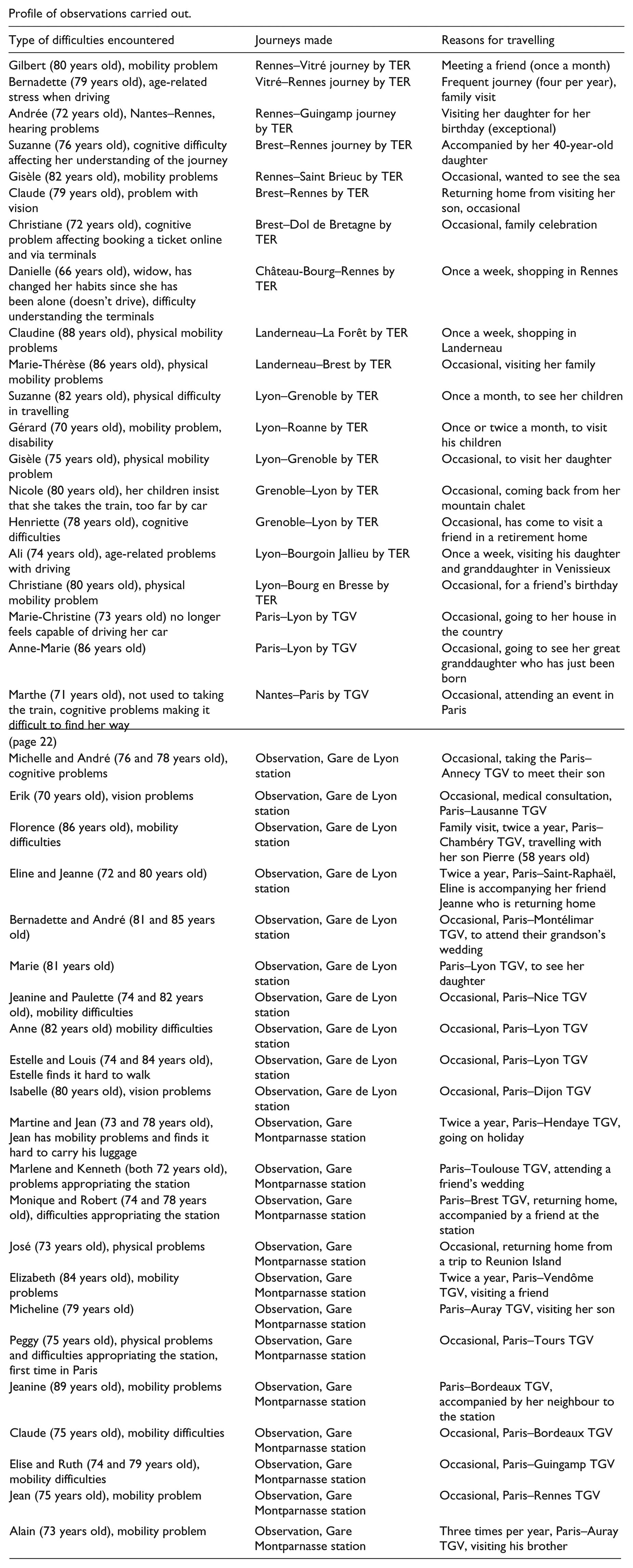
For the TER journeys, the consumers were selected at the Rennes and Lyon train stations. The aim was to recruit individuals who could not deny their status as elderly people. The selection criteria of physical difficulty (walking constraints) and even of cognitive impairment (impression struggling to find their way in the station and frequent consultation of displays) were adopted. After giving their consent, the older people were then accompanied on their journeys by a researcher. The observations covered a combination of long journeys (over 30 minutes for TER journeys) and short journeys (under 30 minutes) during the months of February and March 2014 (Appendix 1). In total, 17 TER journeys were observed (with informal interviews and photographs taken) (Appendix 3). To reduce the specificity of the TER, we also conducted three observations of high-speed TGV journeys (Paris–Lyon and Paris–Nantes) made by older people selected in advance. At the same time, day-long observation sessions were performed at Lyon and Paris Montparnasse stations during the month of May 2014 (22 observations of journeys at stations). The three researchers who participated in the field study always adhered to the same framework for their observational note-taking (execution of the observed journey, difficulties encountered and solutions employed to overcome the difficulty).
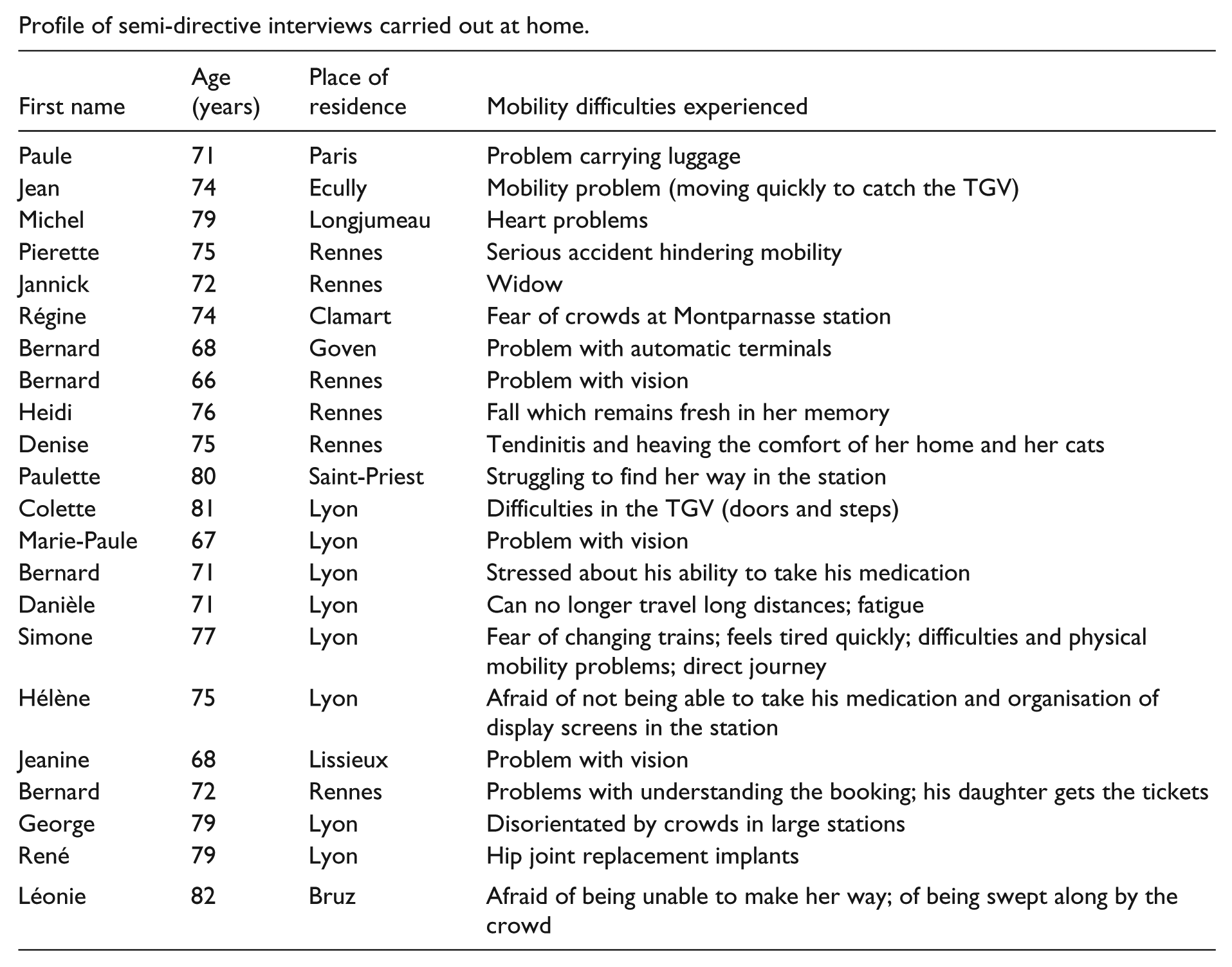
A total of 22 semi-directive interviews with older people in their homes were also conducted by the three researchers (Appendix 2). They were chosen according to the same criteria as for the observation phases (perception of an impediment to mobility). Socio-demographic variables (age, place of residence and income) were also added. The people selected for the interviews were different from those who had been observed. These interviews enabled mobility to be situated in a more global context (not associated with a specific journey). The interviews followed a guide. The questions examined issues including the changes in the subjects’ mobility and their representations of the journey by train. They then focused on the last journey undertaken and the difficulties encountered by examining a chronology of their journey (the idea of travelling, booking, the trip to the station, getting seated on the train, the journey itself and arrival at the destination).
The three researchers who participated in the collection of data entered their field notes into an Evernote database to which transcripts of the interviews were also added. A form clearly describing the field notes was completed for each person observed (Appendix 4). The data were analysed by the researcher and author of this article. We conducted an analysis based on the qualitative principles of ‘grounded theory’ (Strauss and Corbin, 1990). We first distinguished between different types of difficulties experienced by older people and solutions to these difficulties. Each of these difficulties was analysed according to the type of identity negotiation (negotiation with oneself, social image and others and relationship with inanimate objects). The results obtained were presented to the researchers who had carried out the field study to prevent the risk of over-interpretation of the data. Four identity-negotiation strategies were identified and categorised. Word-for-word transcripts and observation notes from log books are presented in the results for illustrative purposes.
Results: Identity-negotiation strategies of older people in mobility contexts
When travelling, elderly people face age-related difficulties. These difficulties require them to implement identity-negotiation strategies (Table 1), which vary according to the perception of the mobility-related difficulty (its degree of severity). They also vary according to role played by their identity as an older person. This identity may be considered to be irreversible. In this situation, it is perceived as being consubstantial with the older person who is unable to dissociate himself or herself from it or modify it. Conversely, the identity may be considered to be an evolutive and modifiable process. The presentation of the results is explained in Table 1. However, these different strategies are not compartmentalised. They may be cumulative for a single person and during the same journey, as we illustrate in Part 2.
The four identity negotiation strategies relating to the mobility of older people.
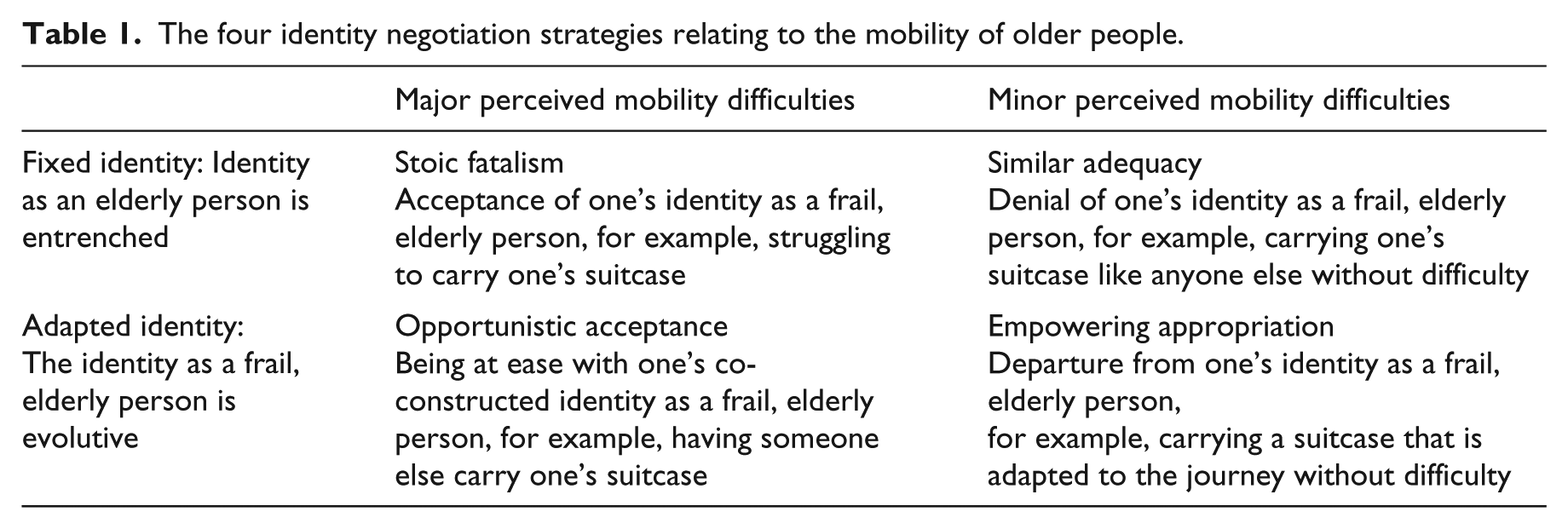
The three strategies of stoic fatalism, opportunistic acceptance and empowering appropriation are identity-negotiation strategies in mobility contexts. We analyse these strategies via the negotiations with oneself, others and socio-material settings. The final strategy – similar adequacy – is a strategy that avoids identity negotiation. We present it briefly at the end of our results.
Stoic fatalism
This first strategy corresponds to the tacit acceptance by older people of their growing mobility-related difficulties. The older people ‘accept’ the social image of frailty associated with their identity. They consider this to be a natural development. They experience a decline in their abilities while travelling. These difficulties confirm their identity as a frail, older person. The negotiation is especially apparent in their discourse and corresponds to a gradual lowering of their expectations. The main lexical field is that of the ordeal, as in Denise’s case: If I take the train, I have to put my dog in the bag. And now I struggle to carry it because I’ve got tendinitis in both shoulders. I’m not allowed to let him walk on his own. And the journeys are always chaotic, the seats aren’t comfortable; it’s hard. (Denise, 75 years old, Rennes)
Train journeys expose their weaknesses and identity as an elderly person.
The older people interviewed show a stoic acceptance of their frailty, which enables them to travel: they accept that they ‘are obliged’ to travel (to visit their families and see their friends) instead of ‘wanting’ to.
They are confronted with the fact that they are ageing during their journey and accept it. The strategy of stoic fatalism consists of people adopting their own pace and routines for travelling in the knowledge that they will face difficulties due to their limited competences (physical and cognitive). They settle for attaining this ultimate goal (continuing to travel) and arriving at their destination without having any higher expectations.
In this strategy, the older people studied do not want to disturb their loved ones or the other people present during their journeys. They observe their difficulties but do not want to be helped. They know that they are frail and are aware that other people perceive them as such, but do not want to take advantage of the situation.
In this manner, Pierrette (Table 2) is reluctant to agree to an employee coming to fetch her in a wheelchair.
The stoic fatalism strategy.
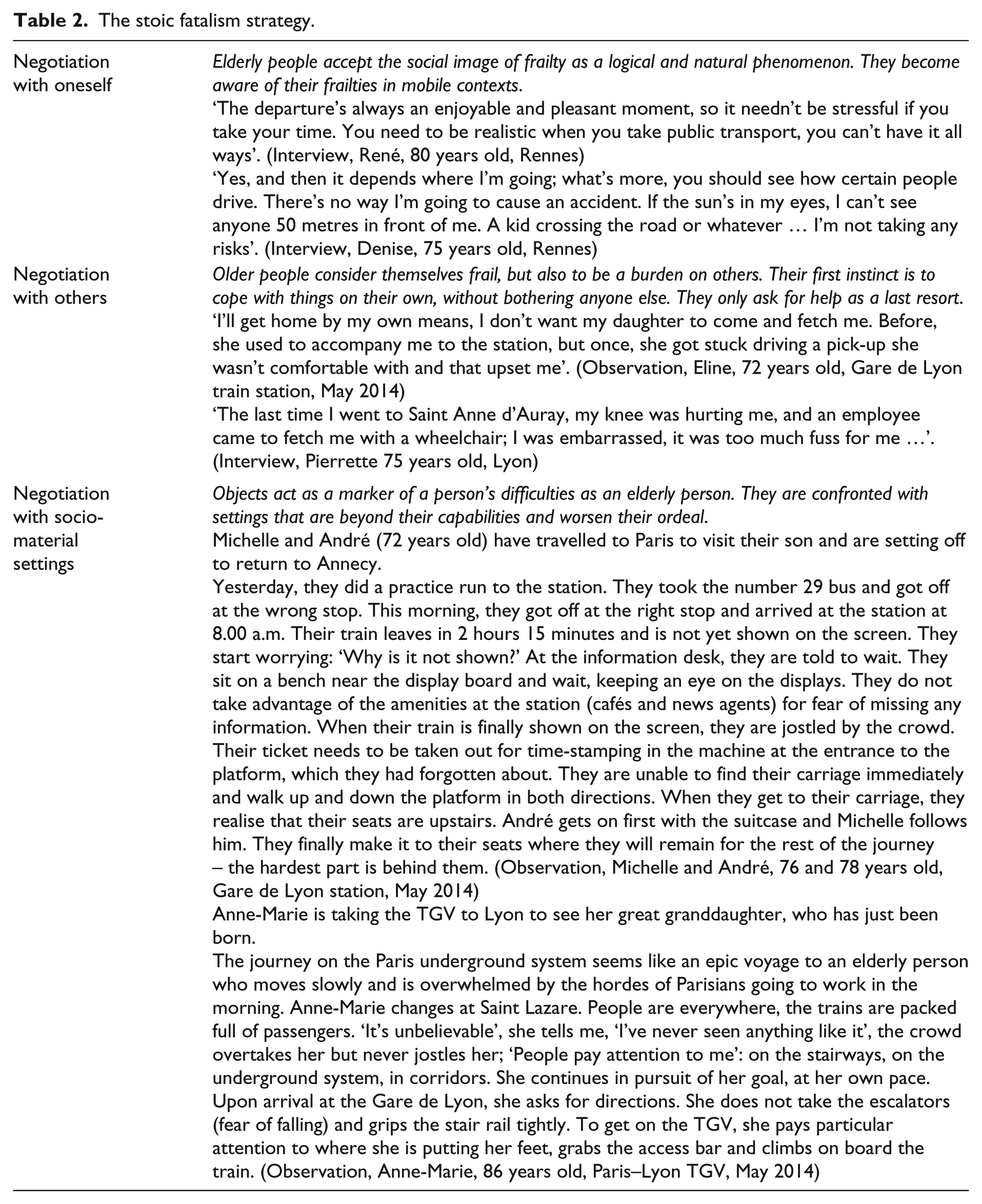
The stoic fatalism strategy essentially implies a discursive acceptance of one’s identity as a frail older person (without modifying these practices). They find it difficult to appropriate socio-material settings because of their growing cognitive or physical difficulties. Their failure to appropriate digital devices (touch-screen terminals and dynamic display screens) and technological fixtures (escalators) exacerbate the feeling of being out of their depth, as illustrated by Michelle and André (Table 2). These older people no longer manage to optimise the chosen resources (Baltes and Carstensen, 1996; Freund and Baltes, 1998, 2002). They can be compared to the figure of the ‘solitary survivor’ (Wells and Gubar, 1966). This identity associated with frailty is not appreciated, but it is a natural consequence of the difficulties endured.
A vicious circle may be established in which older people find it difficult to travel due to the increase in physical and cognitive problems; they decide to face up to the situation alone, armed with their competences which prove to be insufficient and experience even more problems when travelling, which causes them to accept their identity as frail, elderly people. This vicious circle may lead to their gradual relinquishment of mobility because they no longer feel capable of travelling (fatalism is no longer sufficient to accept the difficulties effectively encountered). For example, Denise no longer wants to drive her car for fear of causing an accident (Table 2). She accepts her status as an individual older person on the margins of society.
Opportunistic acceptance
The second strategy uses the social image of frailty associated with ageing as a tool to facilitate mobility. The older people in question negotiate their identity by exaggerating it. They do not accept their difficulties stoically, but rather exploit the image of the older person in a mobility context, as illustrated by Colette: ‘The conditions need to be right when you’re travelling. People need to take pity on you; you have to arouse sympathy’ (Colette, 81 years old, Lyon).
Their negotiation with themselves corresponds to a tacit acceptance of the social image of ageing, but they distinguish between the difficulties they actually experience and the role that other people attribute to them. They approach mobility as if it were a scene in a play in which they internalise the social role that is assigned to them (Goffman, 1973).
Negotiation with others is the key component of this strategy. Older people instinctively rely on other people’s support when travelling. They use the social image of ageing for opportunistic ends. Even if it is not delegated to others, the journey is always collective. They resolve the problems encountered by relying on a network of people mobilised during the course of their journeys. This opportunistic acceptance strategy is pressed into service at different stages of the journey (booking the ticket, support in the station, during the journey and arrival at destination). The older people prefer reassuring sources of support (family, friends or official authorities) but may also accept assistance from strangers when their problems become insurmountable. Their identity as frail, elderly people is a resource which they exploit by empowering other passengers. This can be considered to be a conscious and deliberate strategy, as in the case of Andrée (Table 3). By appearing to be older than she actually is, Andrée uses this social status in an opportunistic manner (Table 3).
The opportunistic acceptance strategy.
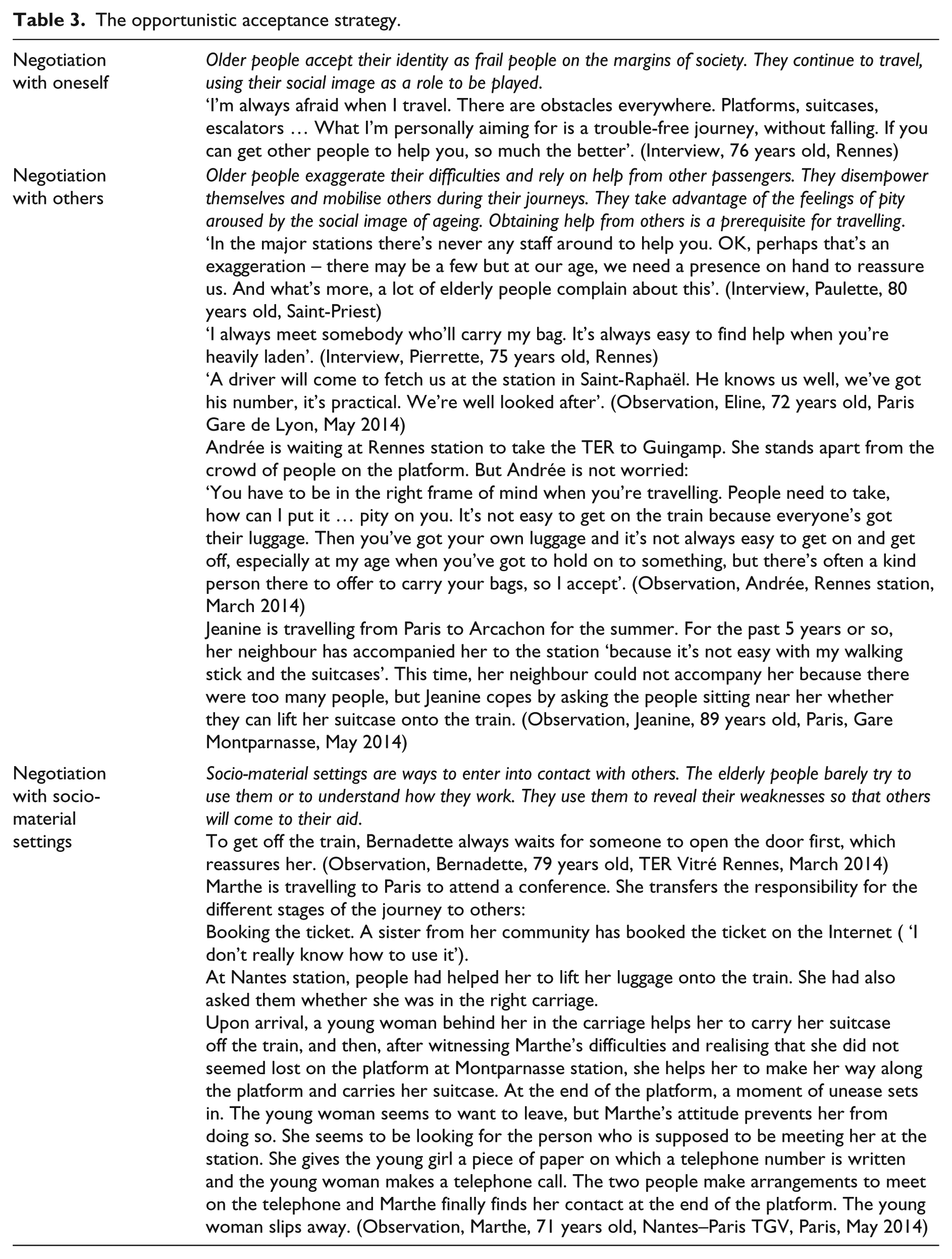
In this strategy, the older people transfer their difficulties to other people. Help from others compensates for their mobility problems (Baltes and Carstensen, 1996; Freund and Baltes, 1998, 2002).
Interactions with the socio-material settings enable them to involve other people. Indeed, it is during these moments of vulnerability that elderly people can arouse pity, as in the case of Marthe who asked other people for help at each stage of her journey (Table 3).
Empowering appropriation
The third strategy is characterised by a reinforcement of the identity of older people, who do not consider themselves to be marginalised or frail. On the contrary, they want to distance themselves from this social image, and this approach prompts them employ cognitive resources to prepare for a journey in which they are not in difficulty. Their identity as dynamic older people is reinforced by their adaptation to mobility (the successes they enjoy in adapting to the requirements of travel enhance their identity and encourage them to be mobile), as in Heidi’s case: Yes, I find it hard to walk. But I’ve found the solution: when I go to visit my daughter, I take my handbag, and then I’ve got something on wheels which is meant for shopping, and that’s what I put my belongings in. That means I’m pulling, not carrying. It’s easier for me and I can continue to travel and see my grandchildren and my daughter. (Heidi, 75 years old, Rennes)
Older people take pride in these adaptations and perceive themselves as being sensible and wise. They enhance their specific identity as older people who are not frail. This enables them to experience new forms of mobility that are compatible with their abilities. It gives them an impression of behaving wisely and they derive an enjoyment that is detached from this society in which they believe they still have their place, albeit on the fringes. Some of them become judges of values, expressing their ‘astonishment about people who spend all their time on their mobile phones when travelling instead of enjoying the countryside’ (interview with Hélène, 75 years old, Lyon).
Older people reinforce their identity by travelling with people who suffer from the same problems. They may travel as couples or with friends, and sociability networks may be created on the train, as illustrated by Nicole and Henriette who start chatting (Table 4). Bookings are often made via the counters at agencies. Connivance links are established with the vendors who offer them the best prices.
The empowering appropriation strategy.
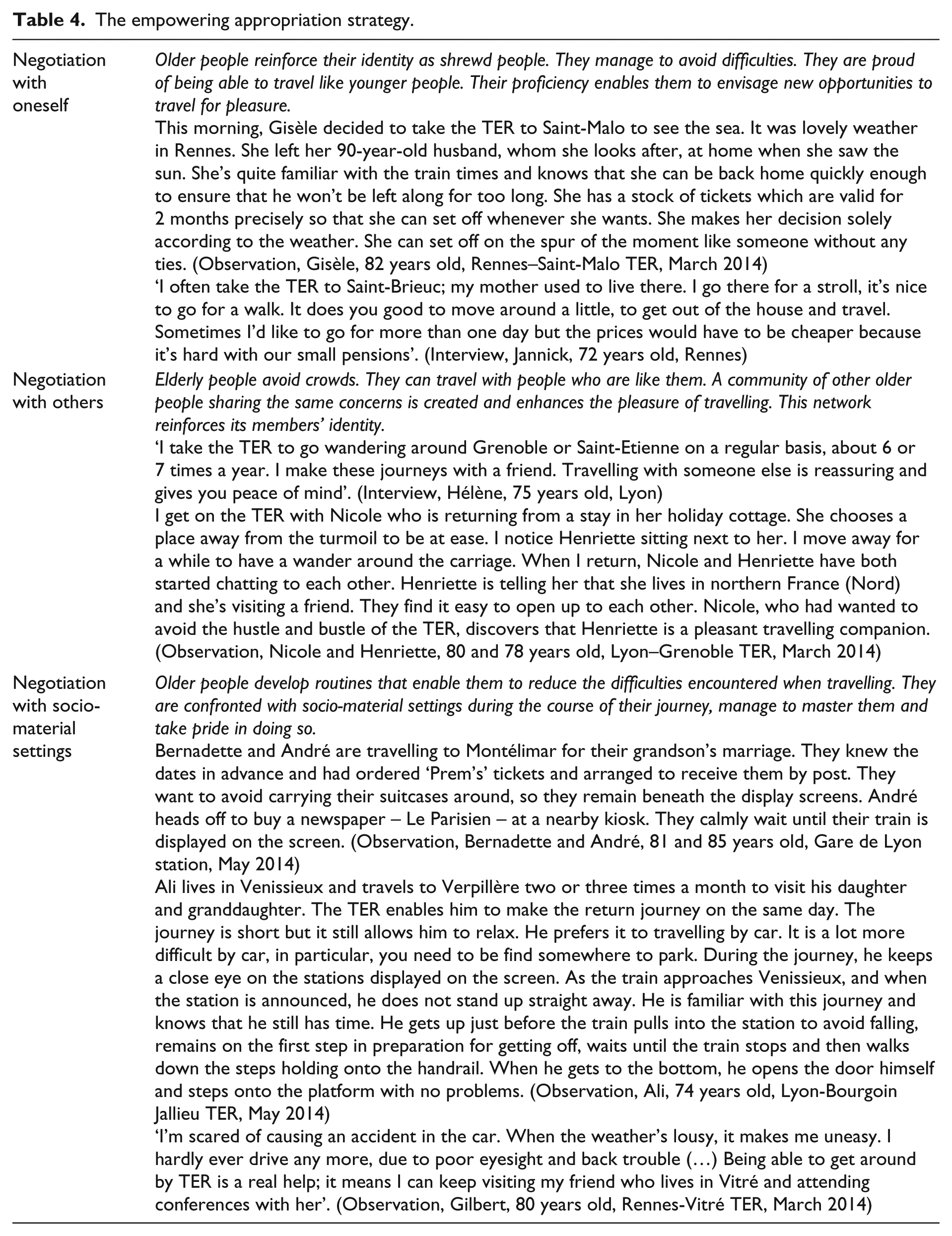
Socio-material settings enable them to test the reinforcement of their identity. They twist the difficulties encountered with inanimate objects to their own advantage. This activity is a source of cognitive stimulation and creativity. They optimise their resources (Baltes and Carstensen, 1996; Freund and Baltes, 1998, 2002) and look for socio-material settings they can appropriate. Older people develop new routines for more efficient travel.
For example, Gisèle accumulates a stock of tickets she can use whenever she wishes (Table 4). They also adapt their physical capacities to the constraints of their journey. Ali (Table 4) stands up just before the train enters the station to avoid falling. He is familiar with the pace of the train and knows when to stand up at the right time to avoid being jostled when the driver brakes. Gilbert (Table 4) takes pride from being able to travel and visits his friend in Vitré despite his growing driving difficulties. Elderly people try to avoid the busiest periods and crowds which put them under pressure due to their slower pace. They create a specific space and time for their mobility which shields them from excessive passenger flows and commotion. They choose tickets that are valid for off-peak periods, on less popular routes. They sometimes pass through remote villages on buses or TER trains, like Léonie (82 years old) who ‘enjoys looking out on the countryside from the TER, which brings back childhood memories’. Their mastery of socio-material settings gives rise to new opportunities for consumption and travel. By anticipating and organising their journeys, older people can continue to travel for pleasure, when they desire, as illustrated by Gisèle (Table 4).
Finally, a final strategy (similar adequacy) concerns older people who manage to deny and deviate from the fixed identity assigned to frail elderly people. They consider themselves to be no different to any other travellers. However, this final strategy is hard to manage for elderly people who cannot conceal their physical or cognitive limitations for very long. Few cases of this strategy were documented during our field study observations although such situations may occasionally arise at certain stages of the journey (booking and walking to the platform). Certain older people appreciate being able to obtain their tickets on the Internet. They take pride in their ability to have succeeded in joining the modern ‘liquid’ society, like George: ‘I always book online through Voyagessncf.com. Like everybody else. Then I print out the tickets. There’s no point going to the ticket counters; the vendors are all the same, just like automatic terminals. And you often have to queue’ (George, 79 years old, Lyon). Older people can also feel that they belong to the modern ‘liquid’ society like any other traveller when they help people who are even frailer than they are. Eline (72 years old), who is returning to Saint-Raphaël, enjoys helping an Englishman to find his way (‘He needed to find carriage 13; everyone else told him to go farther along the platform but I took him right to his carriage’). However, this strategy is only occasionally used by elderly people.
Processes employed to restructure the different strategies
A logical cycle appears to emerge from these different strategies: when confronted with their growing difficulties, elderly people seem to be powerless and accept their difficulties with a stoic fatalism. They may transfer some of their difficulties to others (opportunistic acceptance) and negotiate their image as elderly people by appropriating their journeys (empowering appropriation). The fourth strategy (similar adequacy) may be adopted by older people who are still young, but also as an extension of the empowering appropriation strategy, when older people manage to remain in control of their journeys and can conceal the effects of ageing.
When new difficulties hamper the mobility of older people, a new cycle may be initiated: they seem to manage these problems through stoic fatalism and then through opportunistic acceptance or empowering appropriation. This interweaving of different strategies continues even when the difficulties increase.
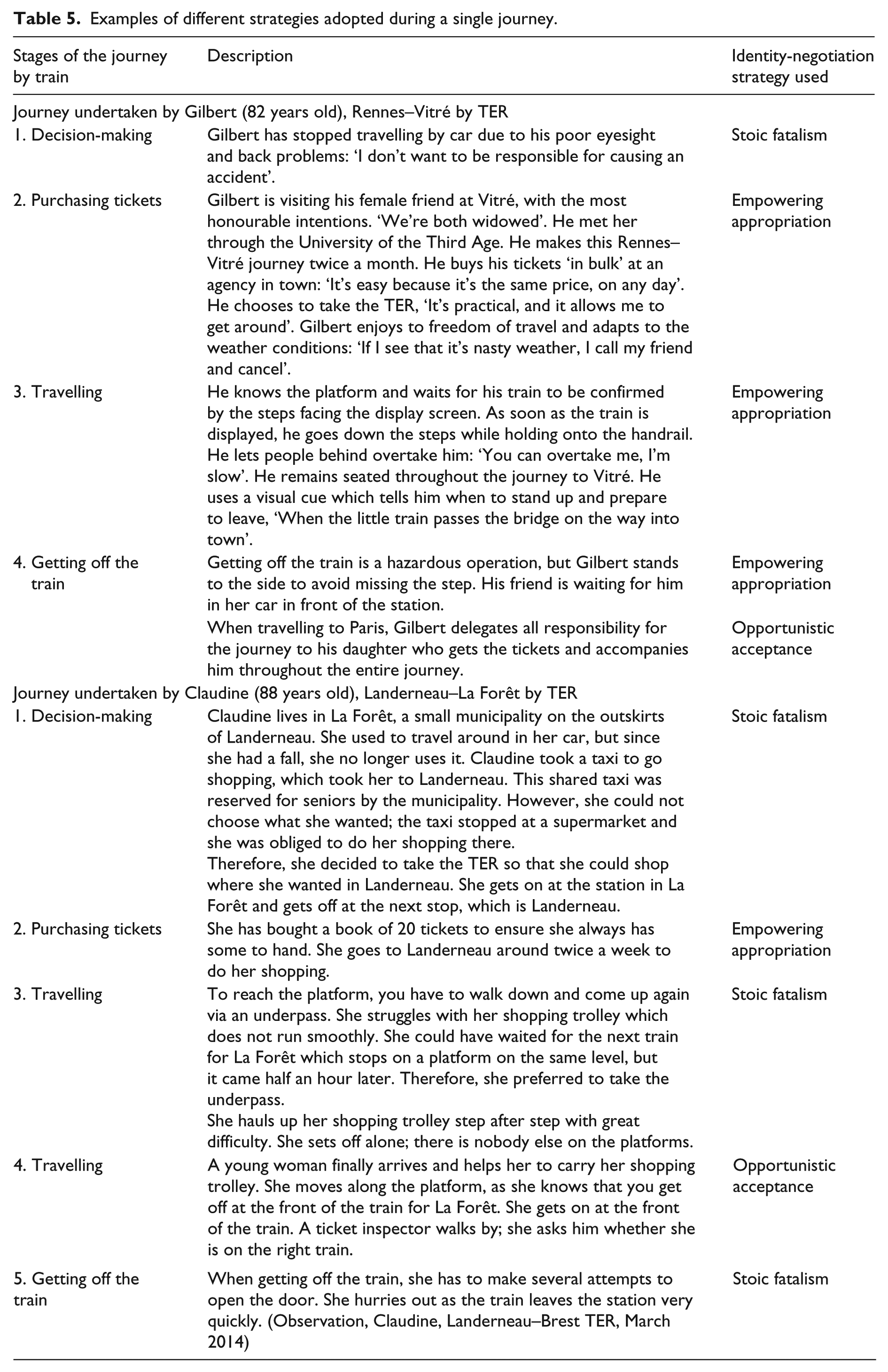
It also seems possible for a single person to adopt the different strategies in a successive, interconnected, superimposed or interchangeable manner, at different times and in a variety of contexts. As a consequence, the identity of the elderly people changes during the course of a single journey. This is illustrated by the two examples in Table 5. Gilbert accepts that he can no longer drive (stoic fatalism) but develops new appropriation strategies for travelling by TER trains (buying his tickets in bulk, following visual cues, waiting near the display screen and choosing the best time to travel). For other journeys, he adopts an opportunistic acceptance strategy (e.g. travelling to Paris with his daughter). In Claudine’s case, different processes are also combined during the course of a single journey (Table 5).
Examples of different strategies adopted during a single journey.
Theoretical discussion
Our results contribute to the research on the identity-negotiation processes of older people. First, our research illustrates the active identity dynamics apparent in older people who refuse to perceive ageing as a condition that must be passively endured. This process is characteristic of the opportunistic acceptance and empowering appropriation strategies in particular.
Our studies follow on from the findings of Barnhart and Peñaloza (2013) who described these dynamics. Their research had emphasised the existence of a collective identity negotiation process (ECE). In addition to reflecting a social process that is shared by several people, in accordance with the ECE, our results illustrate that identity negotiation corresponds to a process of reconfiguration over time. This dynamic process is constantly adapted. It is not linear; it is shaped by the toing and froing that occurs between a fatalistic acceptance of the ageing process and the restructuring of this identity. The driving force for identity negotiation may even be generated by a dialectical tension (the rejection of a growing incapacity, especially for the empowering appropriation strategy). Consequently, and in contrast to the research characterising the identity closure of elderly people (Caradec, 2004), our results illustrate that an active identity-defining process may come into play for older people. Despite their growing physical difficulties (Giffard et al., 2001; Guiot, 2006), their identity is shaped by a constant dynamic negotiation process.
Furthermore, our research underlines the role of socio-material settings in the identity-negotiation process of older people. These settings confront them with their difficulties on two levels (first, because they used to manage them in the past, and second, because they are designed for the majority of the population). This makes elderly people aware of their limitations and their marginalisation. Our results show that socio-material settings can make identity a concrete reality (Paring et al., 2017). However, inanimate objects also underpin the restructuring of their identity (empowering adequacy strategy). They manage to adapt to these objects and find solutions that correspond to them. Whereas the research tends to bear witness to a certain fatalism among disabled people regarding their consumption offerings (they are unable to access standard offerings, and special offerings stigmatise them; Nau et al., 2016), our findings, which relate to the situations of elderly people, show that they can find solutions that correspond to their situation without being stigmatised. They manage to reinterpret offerings that were not designed for them and adapt them to their needs. They take pride in doing so.
Second, our results enable the extension of the SOC model (Baltes and Carstensen, 1996; Freund and Baltes, 1998, 2002; Guiot, 2006). This model is used to understand how elderly people manage their difficulties. In our research, we illustrate the dynamics of these mechanisms. Older people experience difficulties in attaining the goals they have set themselves. They implement mechanisms to extricate themselves from these difficulties in accordance with the SOC model. However, this model is primarily designed from the perspective of the resolution of practical difficulties at the individual level. It does not take the social and identity-related dimension of ageing into account. Our findings illustrate that managing the social image of ageing (e.g. in the opportunistic acceptance strategy) can help elderly people to maintain their mobility. The individual and practical dynamics of SOC are integrated into a more global identity-negotiation process combining practical solutions with the management of the identity of elderly people.
Third, our findings question the logic of successful ageing. For seniors without physical constraints, it can be likened to a logic of empowerment. Conversely, successful ageing is perceived as a dictate by elderly people who are made aware of their frailty by this social norm (Gron, 2016; Lamb, 2014).
Our research reveals mechanisms that are used by elderly people to reinterpret this social norm (especially by adopting the opportunistic acceptance strategy). Instead of assuming personal responsibility for ageing successfully, they may take the opposite approach by accepting their vulnerability and transferring the responsibility to other people. The successful ageing process seems to place the emphasis on self-realisation (Guiot, 2006; Reed and Carstensen, 2012; Senges et al., 2014; Tornstam, 1997, 2005). The opportunistic acceptance strategy brings to light a successful ageing process in older people that revolves around their own disempowerment. This strategy considers successful ageing not to be a question of conforming to the codes of a ‘youth-worshipping’ society, but rather of accepting the need to manage one’s frailty. In contrast to passive elderly people who may have no other choice than to let themselves be looked after, they choose to accept this social image.
Moreover, whereas previous research tends to reflect a struggle to maintain one’s social integration in compliance with the codes of society (Barnhart and Peñaloza, 2013; Greenberg et al., 1986; Solomon et al., 1991; Urien and Guiot, 2007), our research shows that the elderly people interviewed in a mobility context may approach this integration in a different manner. They adapt and reconfigure the standard for successful ageing, which is not assessed according to the same normative empowerment criteria as for the non-elderly population. They define themselves as being integrated into society (being confronted with the same situations) but emphasise their specificities. They put the emphasis on the shrewdness and adaptability that are characteristics of elderly people (as in the empowering adequacy strategy).
Conclusion: Managerial implications, limitations and avenues of research
This research proposes managerial possibilities that are worthy of exploration for marketing policies targeting older people. The limitations to the research on the identity-negotiation process are identified, along with avenues of further study.
Managerial implications
While ‘young senior’ consumers do not want to be included in the same category as elderly people too soon (and therefore do not wish to benefit from specific advantages), there are more disparities in the situation concerning older people. In the mobility sector, the SNCF markets targeted travel cards for seniors (while focusing their marketing campaign on seniors and successful ageing) and also markets offers for very elderly people who can be placed in the same category as mobility-impaired people. These offerings correspond to established categories (from healthy seniors to totally disempowered elderly people) and do not take account of the tensions experienced by elderly people when travelling.
Our research, by revealing the identity negotiations that take place during the journey, illustrates the risk of stigmatisation associated with offerings that target elderly people as vulnerable travellers in an overly simplistic manner. Two aspects can be managed by transport organisations: the staff in contact with customers and the means of transport. The contact staff are a reassuring presence for older people (especially in the opportunistic acceptance strategy). This human presence can be called upon for support during the journey according to the travellers’ wishes. On board a train, older people appreciate the visible presence of the train manager who can answer their questions during the course of journeys. This human presence, while essential, is not imposed. They are responsible for initiating it and can easily avoid it (in contrast, air travel assistance services are proposed before departure upon request, but the elderly people assisted are dependent on their helpers’ workload).
In addition, the type of transport offering can be designed to suit older people. The socio-material properties of certain modes of transport can be more easily adapted to meet the needs of older people. As TER trains are slower, smaller and more accessible (no booking required and seats situated near doorways) and make numerous stops in peri-urban and rural areas, they are easier to appropriate (than the more intimidating TGV trains). Specific offerings reserved for these modes of transport (all-inclusive prices, special offers and promotion of certain destinations) could be developed to encourage older people to travel. Multiple intermodal schemes (coaches, TER and TGV trains and car sharing) could also facilitate a more flexible approach to identity negotiation.
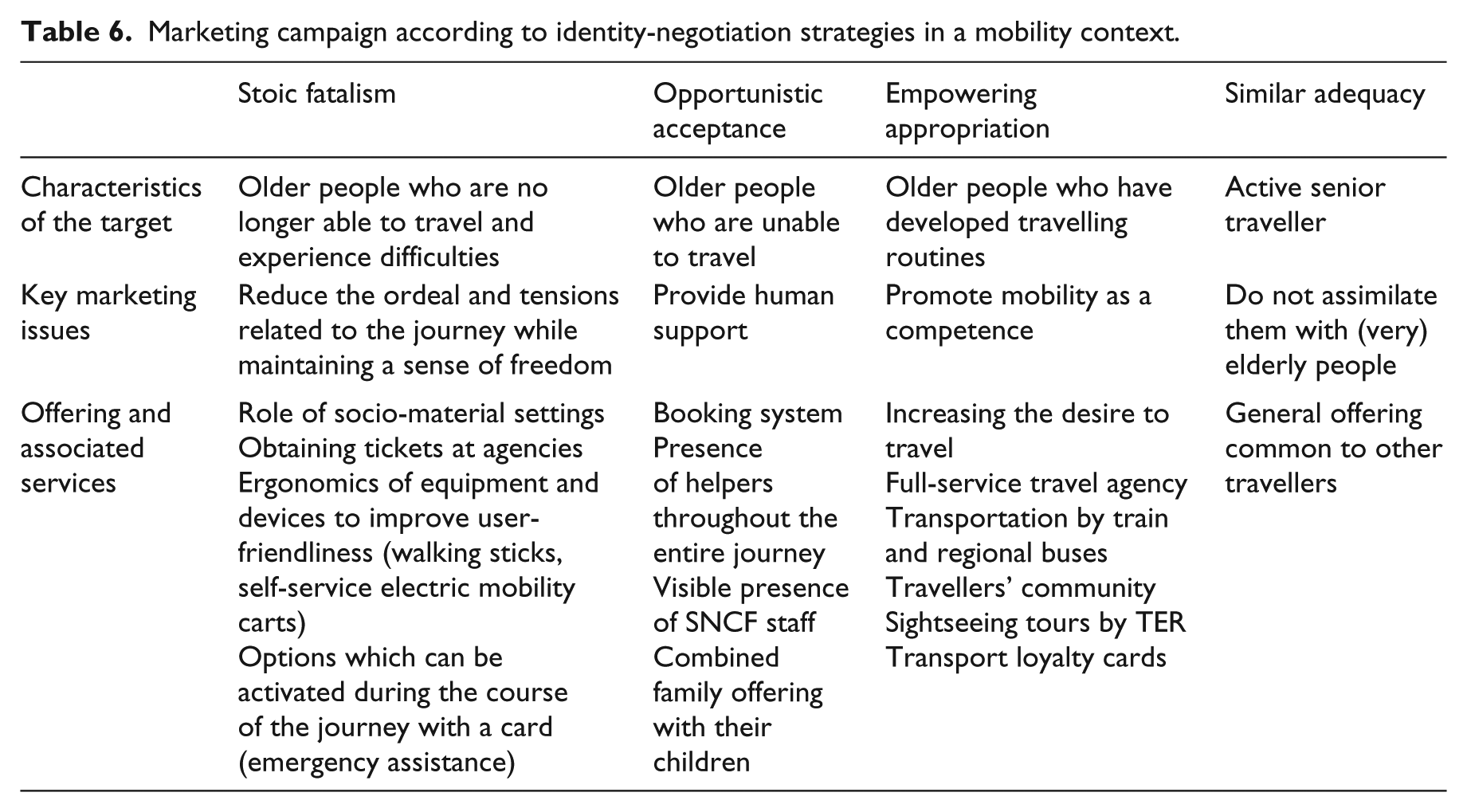
Table 6 sets out marketing proposals corresponding to the different strategies identified. The marketing rationale is no longer solely based on determined characteristics (physiological, in particular) of the ageing process but rather on a situation experienced by the passenger. This situation changes for a given passenger (who may switch from one strategy to another according to the journey being made, or even during the course of a single journey).
Marketing campaign according to identity-negotiation strategies in a mobility context.
Limitations and avenues of research
This phenomenological research sheds light on identity-negotiation mechanisms among a group that is rarely the subject of research on consumption: the above 75s. It faces several limitations: it is restricted to one context (mobility) for characterising the difficulties experienced by elderly people and their identity negotiation processes. Moreover, it focuses on the observation of these groups without taking account of other stakeholders’ perceptions of their mobility (helpers and transport organisations).
This research could be combined with quantitative mechanisms enabling the measurement of the identity-negotiation strategies used by elderly people in more generic consumption contexts (food, leisure, health, distribution channels, etc.). In addition, future research could focus on the sequentiality of identity strategies to further develop the cycle notion mentioned in this research. Protocols based on verbalised observation could identify the tipping points that cause people to switch between the different strategies. They could also analyse the links between these different strategies according to the difficulties (cognitive and physical) encountered and the available resources (social and material). Favoured standard combinations could be identified. More generally, these studies could analyse the interactions between the identity-negotiation strategies and the marketing campaigns launched by transport companies. For example, our findings underline the role of a human presence for older people (particularly in the opportunistic acceptance strategy), and yet, many companies – including in the transport sector – transmit information via electronic platforms and mobile applications. Further research could study the mechanisms used by elderly people to adapt to these constraints. Do they use them instead of relying on a human presence? Do they facilitate their appropriation of the journey? Or on the contrary, do they reduce their mobility? How?
Our results also illustrate the role of socio-material settings in the environment of older people, which may facilitate their acceptance of their identity, but the conditions for their appropriation by older people have not yet been investigated. Future research projects could focus on the tools that facilitate this consumption role, whose design and ergonomics can shape the responses to identity-related issues and provide support for people approaching the end of their lives. Like the transitional objects that facilitate the development of children, they have considerable potential in terms of enabling elderly people to manage the final stage in their lives.
Finally, this research on older people opens up interesting avenues of research on the end of consumption. The ‘opportunistic acceptance’ strategy is a means of gradually abandoning the logic of empowerment by delegating one’s consumption capacity to other people. These strategies progressively shift the emphasis away from the means of consumption as the attention is focused exclusively on the final outcome (being transported). The mechanisms underlying this gradual withdrawal from the consumer society could be an interesting topic of study. These avenues of research may apply to people at the end of their lives, older people, people with disabilities or anyone who is at odds with the values of the consumer society. By transferring the responsibility for their personal consumption to other people, they engage other consumers in these interactions and generate new forms of negotiation.
Footnotes
Appendix 1
Profile of observations carried out.
| Type of difficulties encountered | Journeys made | Reasons for travelling |
|---|---|---|
| Gilbert (80 years old), mobility problem | Rennes–Vitré journey by TER | Meeting a friend (once a month) |
| Bernadette (79 years old), age-related stress when driving | Vitré–Rennes journey by TER | Frequent journey (four per year), family visit |
| Andrée (72 years old), Nantes–Rennes, hearing problems | Rennes–Guingamp journey by TER | Visiting her daughter for her birthday (exceptional) |
| Suzanne (76 years old), cognitive difficulty affecting her understanding of the journey | Brest–Rennes journey by TER | Accompanied by her 40-year-old daughter |
| Gisèle (82 years old), mobility problems | Rennes–Saint Brieuc by TER | Occasional, wanted to see the sea |
| Claude (79 years old), problem with vision | Brest–Rennes by TER | Returning home from visiting her son, occasional |
| Christiane (72 years old), cognitive problem affecting booking a ticket online and via terminals | Brest–Dol de Bretagne by TER | Occasional, family celebration |
| Danielle (66 years old), widow, has changed her habits since she has been alone (doesn’t drive), difficulty understanding the terminals | Château-Bourg–Rennes by TER | Once a week, shopping in Rennes |
| Claudine (88 years old), physical mobility problems | Landerneau–La Forêt by TER | Once a week, shopping in Landerneau |
| Marie-Thérèse (86 years old), physical mobility problems | Landerneau–Brest by TER | Occasional, visiting her family |
| Suzanne (82 years old), physical difficulty in travelling | Lyon–Grenoble by TER | Once a month, to see her children |
| Gérard (70 years old), mobility problem, disability | Lyon–Roanne by TER | Once or twice a month, to visit his children |
| Gisèle (75 years old), physical mobility problem | Lyon–Grenoble by TER | Occasional, to visit her daughter |
| Nicole (80 years old), her children insist that she takes the train, too far by car | Grenoble–Lyon by TER | Occasional, coming back from her mountain chalet |
| Henriette (78 years old), cognitive difficulties | Grenoble–Lyon by TER | Occasional, has come to visit a friend in a retirement home |
| Ali (74 years old), age-related problems with driving | Lyon–Bourgoin Jallieu by TER | Once a week, visiting his daughter and granddaughter in Venissieux |
| Christiane (80 years old), physical mobility problem | Lyon–Bourg en Bresse by TER | Occasional, for a friend’s birthday |
| Marie-Christine (73 years old) no longer feels capable of driving her car | Paris–Lyon by TGV | Occasional, going to her house in the country |
| Anne-Marie (86 years old) | Paris–Lyon by TGV | Occasional, going to see her great granddaughter who has just been born |
| Marthe (71 years old), not used to taking the train, cognitive problems making it difficult to find her way | Nantes–Paris by TGV | Occasional, attending an event in Paris |
| (page 22) | ||
| Michelle and André (76 and 78 years old), cognitive problems | Observation, Gare de Lyon station | Occasional, taking the Paris–Annecy TGV to meet their son |
| Erik (70 years old), vision problems | Observation, Gare de Lyon station | Occasional, medical consultation, Paris–Lausanne TGV |
| Florence (86 years old), mobility difficulties | Observation, Gare de Lyon station | Family visit, twice a year, Paris–Chambéry TGV, travelling with her son Pierre (58 years old) |
| Eline and Jeanne (72 and 80 years old) | Observation, Gare de Lyon station | Twice a year, Paris–Saint-Raphaël, Eline is accompanying her friend Jeanne who is returning home |
| Bernadette and André (81 and 85 years old) | Observation, Gare de Lyon station | Occasional, Paris–Montélimar TGV, to attend their grandson’s wedding |
| Marie (81 years old) | Observation, Gare de Lyon station | Paris–Lyon TGV, to see her daughter |
| Jeanine and Paulette (74 and 82 years old), mobility difficulties | Observation, Gare de Lyon station | Occasional, Paris–Nice TGV |
| Anne (82 years old) mobility difficulties | Observation, Gare de Lyon station | Occasional, Paris–Lyon TGV |
| Estelle and Louis (74 and 84 years old), Estelle finds it hard to walk | Observation, Gare de Lyon station | Occasional, Paris–Lyon TGV |
| Isabelle (80 years old), vision problems | Observation, Gare de Lyon station | Occasional, Paris–Dijon TGV |
| Martine and Jean (73 and 78 years old), Jean has mobility problems and finds it hard to carry his luggage | Observation, Gare Montparnasse station | Twice a year, Paris–Hendaye TGV, going on holiday |
| Marlene and Kenneth (both 72 years old), problems appropriating the station | Observation, Gare Montparnasse station | Paris–Toulouse TGV, attending a friend’s wedding |
| Monique and Robert (74 and 78 years old), difficulties appropriating the station | Observation, Gare Montparnasse station | Paris–Brest TGV, returning home, accompanied by a friend at the station |
| José (73 years old), physical problems | Observation, Gare Montparnasse station | Occasional, returning home from a trip to Reunion Island |
| Elizabeth (84 years old), mobility problems | Observation, Gare Montparnasse station | Twice a year, Paris–Vendôme TGV, visiting a friend |
| Micheline (79 years old) | Observation, Gare Montparnasse station | Paris–Auray TGV, visiting her son |
| Peggy (75 years old), physical problems and difficulties appropriating the station, first time in Paris | Observation, Gare Montparnasse station | Occasional, Paris–Tours TGV |
| Jeanine (89 years old), mobility problems | Observation, Gare Montparnasse station | Paris–Bordeaux TGV, accompanied by her neighbour to the station |
| Claude (75 years old), mobility difficulties | Observation, Gare Montparnasse station | Occasional, Paris–Bordeaux TGV |
| Elise and Ruth (74 and 79 years old), mobility difficulties | Observation, Gare Montparnasse station | Occasional, Paris–Guingamp TGV |
| Jean (75 years old), mobility problem | Observation, Gare Montparnasse station | Occasional, Paris–Rennes TGV |
| Alain (73 years old), mobility problem | Observation, Gare Montparnasse station | Three times per year, Paris–Auray TGV, visiting his brother |
Appendix 2
Profile of semi-directive interviews carried out at home.
| First name | Age (years) | Place of residence | Mobility difficulties experienced |
|---|---|---|---|
| Paule | 71 | Paris | Problem carrying luggage |
| Jean | 74 | Ecully | Mobility problem (moving quickly to catch the TGV) |
| Michel | 79 | Longjumeau | Heart problems |
| Pierette | 75 | Rennes | Serious accident hindering mobility |
| Jannick | 72 | Rennes | Widow |
| Régine | 74 | Clamart | Fear of crowds at Montparnasse station |
| Bernard | 68 | Goven | Problem with automatic terminals |
| Bernard | 66 | Rennes | Problem with vision |
| Heidi | 76 | Rennes | Fall which remains fresh in her memory |
| Denise | 75 | Rennes | Tendinitis and heaving the comfort of her home and her cats |
| Paulette | 80 | Saint-Priest | Struggling to find her way in the station |
| Colette | 81 | Lyon | Difficulties in the TGV (doors and steps) |
| Marie-Paule | 67 | Lyon | Problem with vision |
| Bernard | 71 | Lyon | Stressed about his ability to take his medication |
| Danièle | 71 | Lyon | Can no longer travel long distances; fatigue |
| Simone | 77 | Lyon | Fear of changing trains; feels tired quickly; difficulties and physical mobility problems; direct journey |
| Hélène | 75 | Lyon | Afraid of not being able to take his medication and organisation of display screens in the station |
| Jeanine | 68 | Lissieux | Problem with vision |
| Bernard | 72 | Rennes | Problems with understanding the booking; his daughter gets the tickets |
| George | 79 | Lyon | Disorientated by crowds in large stations |
| René | 79 | Lyon | Hip joint replacement implants |
| Léonie | 82 | Bruz | Afraid of being unable to make her way; of being swept along by the crowd |