






Abstract
This paper introduces YSocial, a new-generation virtual twin designed to replicate an online social media platform. Digital and virtual twins are virtual replicas of physical systems that allow for advanced analyses, control, experimentation, and scenario simulations. In the case of social media, a virtual twin such as YSocial provides a powerful tool for researchers to simulate and understand complex online interactions. YSocial leverages state-of-the-art large language models (LLMs) to replicate sophisticated agent behaviors, enabling accurate simulations of user interactions, content dissemination, and network dynamics. By integrating these aspects, YSocial offers valuable insights into user engagement, information spread, and the impact of platform policies. Moreover, integrating LLMs allows YSocial to generate nuanced textual content and predict user responses, facilitating the study of emergent phenomena in online environments. To better characterize YSocial, we describe the rationale behind its implementation, provide examples of the analyses that can be performed on the data it generates, and discuss its relevance for multidisciplinary research.
Keywords
Introduction
Online social media (OSM) have revolutionized the way we exchange information. From the user’s perspective, these digital ecosystems are largely effortless (Siddiqui and Singh, 2016), enabling convenient ways of exchanging personal content (Abramski et al., 2024), seeking information, and synchronizing with others (Dávid-Barrett and Dunbar, 2012). This convenience has catalyzed a massive digital shift in social and information exchanges from offline to online settings, which has provided novel access to massive amounts of online data regarding human behavior (Stella et al., 2023). Complexity in social media strongly relates to the motto “more is different” (Anderson, 1972): the co-occurrence of many, even similar, interactions within the same context can lead to unexpected phenomena. Examples include acts as simple and seemingly insignificant as following another user or re-sharing content. Taken individually, these actions can be understood in terms of a user’s activity, psychology, and engagement (Stella et al., 2023), but when repeated by vast amounts of users, they can determine the unexpected rise and fall of a massively followed account (influencer) or can create cascades of information re-sharing. Artificial intelligence (AI) also influences online interactions since social media actions such as following, re-sharing, posting, and commenting can also be performed by non-human users. For instance, social bots can contribute positively to social media pluralism by automatically diffusing news and links external to social media platforms (Stella et al., 2019). However, they can also act by broadcasting biased content or diffusing misinformation, which exposes human users to a wider variety of harmful content (Cresci, 2020). Moreover, unlike in-person interactions, online users’ experiences are often reinforced by platform-specific algorithmic curation (Fabbri et al., 2022), that is, embedding recommender or ranking systems in social media for bolstering user engagement. These algorithms ultimately guide the attention of vast audiences toward specific trending topics, influencers, or conversations with leanings similar to one’s own (Brown et al., 2022; Cinus et al., 2022). Algorithmic curation can reinforce users’ biases while preventing healthy discussions, thus contributing to users’ fragmentation across cognitive or social groups (Morini et al., 2021). These aspects raise crucial technical and ethical questions about balancing possibilities and risks concerning the role of human–AI interactions on social dynamics regarding information diffusion, opinion formation, and mental health (Morini et al., 2024).
These challenges highlight the need for complementary data sources that offer completeness, algorithmic control, and independence from third-party access policies. To such an extent, social media digital/virtual twins (Barricelli et al., 2019; Chinesta et al., 2020) represent a promising step in this direction. Digital twins are digital replicas of physical objects, systems, or processes. Their core function is to capture real-time data from sensors, IoT devices, online platforms, and other sources in order to reflect what is happening in the physical world. Because of this continuous two-way data exchange between the real entity and its twin, they enable real-time performance monitoring, predictive maintenance, and system optimization. Virtual twins, in contrast, are models that do more than mirror an existing asset: they can also simulate alternative scenarios, supporting “what–if” analyses of conditions that may not yet exist in reality. This makes them particularly valuable for designing and testing new systems and configurations, even though the connection to a specific real-world entity may be weaker or absent. Collectively, we can therefore see twins as reference models—tools that can provide valuable insights about a physical counterpart (Schluse et al., 2018) while testing hypotheses in controlled settings: in our applicative scenario, mimic OSM dynamics by modeling those variables that open-ended data studies cannot fully capture. While not a substitute for data-driven studies, digital/virtual twins support in vitro experiments grounded in real-world data, which can enhance our understanding of social phenomena.
Developing a platform such as YSocial offers several key benefits:
In the subsequent sections, we first review the research literature that has been pivotal in developing YSocial. Then we present a technical overview of the system and illustrate its capabilities through a case study to provide better context for its behaviors. Subsequently, we explore the potential impacts of an OSM twin on computational social science and conclude with a brief discussion of the project’s future evolution.
Related works
This section provides an overview of the relevant literature concerning the development of YSocial. Focusing on simulation studies (Pappalardo et al., 2024), we delve into agent-based simulations and discuss recent advancements since the advent of LLMs.
Coarsely defined, social simulations (Squazzoni et al., 2014) are computational models designed to replicate the behavior and interactions of individuals or groups within a social system. Simulations can be implemented using different frameworks, agent-based modeling (ABM) (Bianchi and Squazzoni, 2015) being one of the most commonly employed. In ABM, humans—and other individual elements, such as institutions, technologies, etc.—can be seen as software entities called agents, which can be part of an environment and can be embedded in an interaction space, influencing their decisions and behaviors. As the latter is often represented as a graph—being fully connected (Sîrbu et al., 2019) or having a more complex configuration (Pansanella et al., 2022)—agents can have a set of edges, representing their relationships, which can be static or dynamics and may hold attributes representing specific characteristics, for example, strength, trust, or influence. For example, it may be that the network of interactions evolves as a simulation progresses as a consequence of a pre-defined rule of the model, as in the Barabasi–Albert model (Barabási and Bonabeau, 2003) of network formation, or of the evolution of other agents’ attributes, as in adaptive networks models (Pansanella et al., 2022). Agents can, in fact, be enriched with attributes, such as demographic factors or cognitive biases (Deffuant et al., 2000), which are mainly static during a single simulation and with states, that is, dynamic attributes dependent on social influence, representing factors such as infection (Lorig et al., 2021), adoption (Serrano and Iglesias, 2016), opinions (Deffuant et al., 2000), or emotions (Schweitzer and Garcia, 2010), generally modeled as simple numerical variables and often the core element of the social simulation study. To execute the social simulation, each agent follows a set of rules—algorithms dictating when an agent becomes active, the actions they can take, and the impact of these actions on themselves and the population—which can be more or less strict, giving the agent different degrees of autonomy. Social simulations have been used to study epidemics (Lorig et al., 2021), diffusion of information (Guille et al., 2013), belief and emotion dynamics (Deffuant et al., 2000), economics and finance (Axtell and Farmer, 2025), urban dynamics (Cornacchia and Pappalardo, 2021), political sciences (Epstein, 2002), and other phenomena.
Despite having advanced social simulations with generative agents, recent works are still far from creating a social platform twin. Digital/virtual twins are already vastly employed in different fields, from engineering (Tao et al., 2018) to healthcare (Sun et al., 2023) and Smart Cities (Grubel et al., 2022). Having a social platform twin would allow researchers to perform different social experiments, investigate feedback loops between social and technical components of such systems, test different what–if scenarios, and use insights to inform policymakers in a more cost-effective and ethically compliant way. However, creating such a twin is not a trivial task for the additional complexity of the system society. LLM-enhanced agents have been extensively explored in their ability to autonomously replicate human characteristics when prompted and/or fine-tuned. However, to date, there has been no social platform twins mirroring characteristics of one or more platforms and enriched with agents that mimic human behavior—which is the core of our proposal.
YSocial—virtual twin
YSocial is meant to allow for profound flexibility in simulation scenario development.
To fulfill such a goal, we designed our social media platform twin to be composed of four interacting modules:
a REST API server designed to expose all those primitives describing the actions implemented by the social platform and to store the simulation data; an LLM server that serves requests related to agent interrogations (e.g., simulating decision-making protocols, text generations, etc.); a simulation client that implements the agent logic and acts as a middle layer that interfaces the REST API server with the LLM one; a zero code web interface allowing to configure, deploy, and interact with the social simulation.
Given its modular design, YSocial allows the deployment of multiple clients—each handling its own agents’ population—on each simulation, thus distributing the computational load needed to simulate agents’ behaviors and supporting scalability. Moreover, it is worth underlining that YSocial makes it possible to leverage both commercial LLMs (i.e. OpenAI) and self-hosted ones 3 (e.g. served through Ollama, LM Studio, or similar services).
In the following, we discuss the REST API server (i.e. y_server), the simulation client (i.e. y_client), and the zero code web interface modules, describing their rationale and the implementation choices performed.
y_server: Social media platform primitives
To properly describe a social media twin, we start by specifying the primitives that the agents are allowed to use to execute their social actions. YSocial’s primitives are intended to resemble the key actions offered by platforms such as X/Twitter, Mastodon, and BlueSky Social to their users. To such an extent, the y_server exposes the following REST endpoints:
/read: returns a selection of posts/articles as filtered by a specified content recommender system; /post: registers a new post on the database; /comment: registers a comment to existing user-generated content; /reply: provides a recommender system-curated list of posts that mention a given agent, thus allowing the formation of stable discussion threads; /news: allows the publication of news gathered from an online resource; /share: allow agents to share previously published posts/news articles; /reaction: registers the reactions (e.g. like/dislike) of a given agent to a given content; /follow_suggestions: provides a recommender system-curated selection of potential contacts for a target agent; and /follow: allows agents to establish new social connections (follow) or break existing ones (unfollow).
Aside from agents’ actions, the y_server exposes additional endpoints to handle system authentication, client synchronization, and agents’ updates (e.g. handling agents’ interests’ dynamics).
Introducing algorithmic bias: Recommender system(s)
One of the main limitations of data-driven studies focusing on social media dynamics lies in the impossibility of explicitly evaluating the effects of an important latent variable: the recommendation system(s) users are subject to. YSocial addresses such a limitation by allowing the definition and selection of different classes of recommendation systems (both for contents and friendship suggestions) to be deployed on each simulation (at the granularity of the individual agent).
Random: suggests a random sample of agents’ generated contents; ReverseChrono: suggests generated contents in reverse chronological order (i.e. from the most recent to the least recent); ReverseChronoPopularity: suggests generated contents ordered by their popularity score computed as a function of likes/dislikes received; ReverseChronoFollowers: suggests recent contents generated by the agent’s follower; and ReverseChronoFollowersPopularity suggests recent contents generated by the agent’s followers ordered by their popularity.
Recommender systems in YSocial are configurable regarding the number of suggested contents. Additionally, the Follower variants allow for specifying the ratio of contents recommended from an agent’s followers versus other agents. To support the analysis of recommendation impacts, YSocial records all recommendations received by agents for each action involving them.
Random: Suggests a random selection of Common neighbours: Ranks and suggests the top Jaccard: Ranks and suggests the top Adamic Adar: Ranks and suggests the top Preferential attachment: Suggests the top
Each of these recommenders, derived from classic unsupervised link prediction scores (Liben-Nowell and Kleinberg, 2003), enables agents to expand their local neighborhoods by adopting different strategies, each influencing the overall social topology of the system. For instance, certain strategies may produce a heavy-tailed degree distribution (Barabási, 2009; Barabási and Bonabeau, 2003), while others may promote triadic closure. Additionally, YSocial allows for configuring whether follower recommendations should be biased toward agents with the same political leaning and the degree of such bias, enabling the simulation of homophilic connectivity behaviors.
y_client: Simulating social agents
As discussed, the primary function of y_server is to expose those primitives that LLM agents can use to implement their social actions. If y_server can be seen as a “light” interface toward the database storing the simulation data, the y_client is the module that implements most of the business logic involving LLM interactions. In particular, it controls the agents and their characteristics, implements the agents’ actions selection process (i.e. the strategy used to select which endpoint exposed by y_server to connect to and how to interpret the obtained responses), and defines the simulation loop for the handled agent population. In the following, we review the main facilities offered for each task—starting from the most important component of a social media digital twin: the agents that populate it.
LLM-powered agents
YSocial’s main peculiarity lies in the synthetic agents that populate its simulations. Conversely, from a classic mechanistic simulation environment, where action selection is often implemented as a sampling from a given probability distribution—that implicitly fixes their expected volume distribution—YSocial leverages LLMs as chaos engines, delegating to each agent the choice on the actions to take when activated. Moreover, to increase the heterogeneity of agents’ behaviors—and generated contents—it leverages the ability of LLMs to role-playing different users’ profiles (i.e. persona).
- Agent name and ownership: Name is the unique identifier for the generated agent, while ownership links the agent to the client execution that generated it. This latter information is useful for checking the simulation status while multiple clients (having different configurations) are active. - LLM model: This field identifies the model for interpreting the agent’s actions. A different model can role-play each agent. - Age, spoken language, education level, nationality: Demographic information has been shown to affect the content generated by LLMs. In particular, age and education can be used to tune the expected writing styles of agents. - Political leaning, toxicity level, and activity level: These dimensions are crucial for social simulations to: (i) generate social interactions centered on sociopolitical themes, (ii) have a predefined level of contents’ toxicity, and (iii) integrate agents with heterogeneous posting/interacting behaviors. - Topic(s) of interest: The list of interest topics represents the background of the agent and acts as a starting point for the generation of posts and to make consistent contributions to discussion threads. Specifying a reasonable set of topics per agent increases the heterogeneity of produced texts. Agents’ interests evolve as a consequence of their actions. - Recommender system(s): As previously described, each agent is assigned the content/follow recommendation algorithms that regulate its platform experience. Curation strategies can be updated during the simulation. - Psychological traits: The big five personality traits, also known as the five-factor model (FFM) (McCrae and John, 1992) describe five broad dimensions of human personality. FFM is used to fine-tune the agent’s expected behavior while interacting with other users’ contents (and generating its own).
Agents’ profiles concur with the description of detailed and consistent traits that the LLM can interpret in its role-playing. It is important to underline that the simulated agents do not have a specific goal other than participating in social dynamics. However, in an online social environment, some users have their own agenda (promoting specific content, doing propaganda, etc.), an example of such a behavior being news pages.
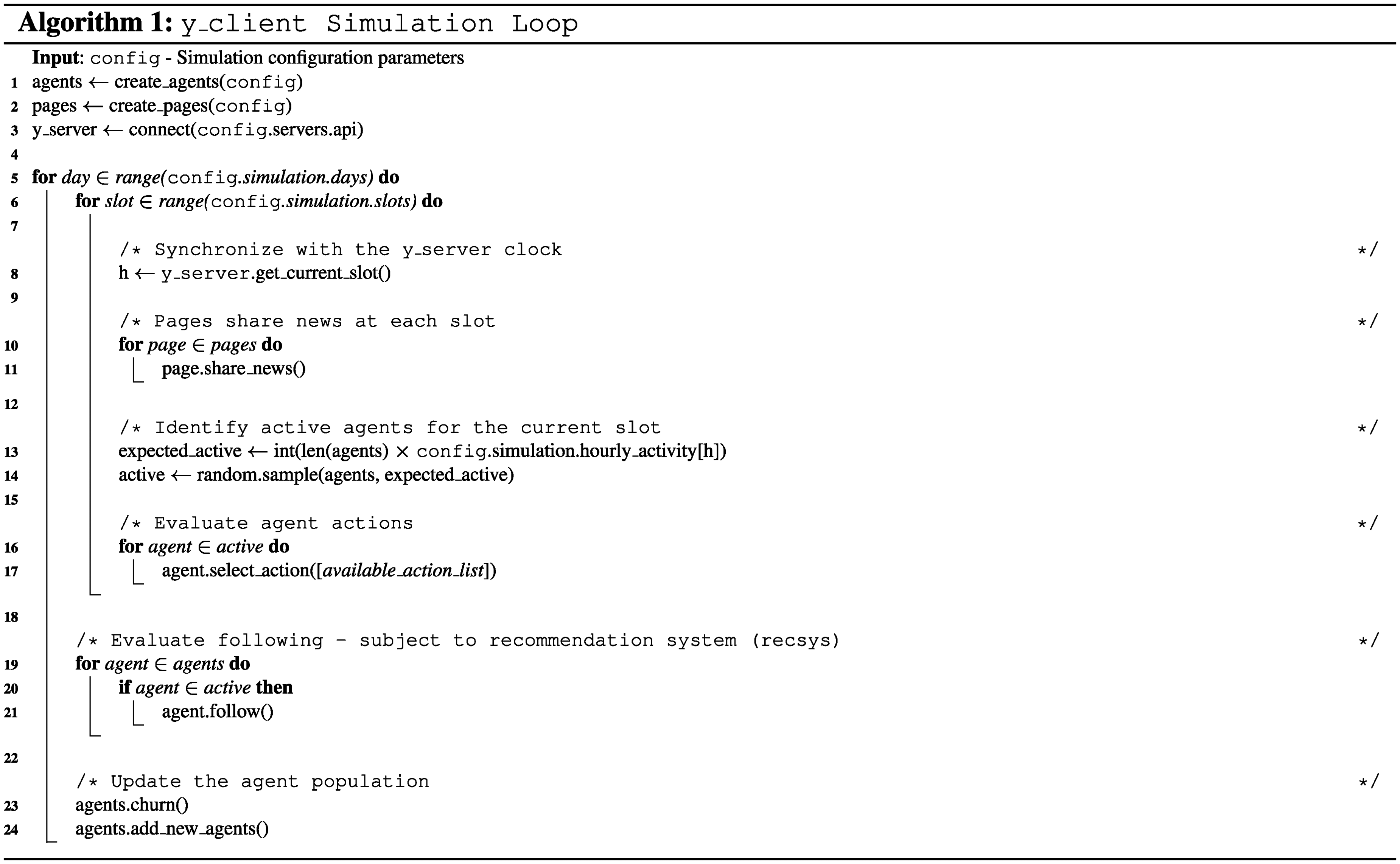
Pseudocode of the Simulation Loop.
Other agents can share and comment on page-produced content, thus replicating information cascading processes. Moreover, RSS feeds are also used to gather contextualized images that YSocial agents can use to generate multimodal posts.
The VADER (Valence Aware Dictionary and sEntiment Reasoner) sentiment scores (Hutto and Gilbert, 2014); The perceived toxicity (Google’s Perspective API) (Lees et al., 2022); The elicited emotions (GoEmotions taxonomy) (Demszky et al., 2020); (In case of RSS gathered news) the topics expressed by the article.
4
In YSocial, generated posts, articles, and shared images are associated with specific topics: posts inherit the topics used in the LLM prompts, articles have topics identified through topic modeling, and shared images adopt the topics of their related articles. This enables YSocial to track agent–topic interactions throughout the simulation. Topic annotation plays a key role in updating each agent’s interests by recording the topics they interact with, the frequency of these interactions, and their timing.
On the one hand, news pages introduce new topics to the discussion. Conversely, agents’ interactions build dynamic profiles that leverage their activity history. This history, subject to a forgetting window to simulate fading interests over time, is used to sample topics for generating new content. Agents select topics in proportion to their recent interactions, increasing the consistency of their behavior. To further maintain coherence, YSocial combines selected topics with the agents’ recent sentiments toward them when crafting new posts—either computed via VADER or inferred from the agents’ reactions to content on those topics, ensuring the generated content aligns with the agents’ established attitudes.
Simulation loop
Once the rationale behind the agents’ characterization and the rules that govern their behavior is defined, we discuss how (each instance of) y_client orchestrates the agents’ activities. To such an extent, we review the configuration variables exposed by y_client and briefly discuss how the simulation loop unfolds.
Such a pipeline—that can be extended and refined to better match specific needs—along with agent populations segmentation over multiple y_clients allows the description of complex experimental settings addressing topic-specific simulations.
Zero-code experimental platform
The primary goal of YSocial is to serve as a tool for supporting computational social science research. Given the multidisciplinary nature of such a research field, an important dimension to consider while developing a twin lies in implementing strategies to lower those technological barriers that might hinder non-technical researchers from using it. To such an extent, YSocial integrates a fundamental component: the zero-code platform, consisting of two modules: the admin panel and the simulation interface.
Manage user accounts, including both super users and regular users—the former with experiment creation capabilities, the latter being only authorized to take part in, specific, hybrid simulations. Create, edit, delete, import, and export agent populations. Create individual agents. Create news pages. Create, configure, run, and import/export experiments.

YSocial admin panel. (a) Dashboard to control experiment execution and manage deployed large language models (LLMs). (b) Ad-hoc agent creation form. (c) News page details with content previews. (d) y_client details and advanced configuration panel.
To each experiment, the platform associates a y_server instance—implemented as an independent application that can be spawned and terminated when needed. Populations abstract agents’ segmentation: each one of them can be configured to follow specific characteristics (demographic, agents’ temporal activity patterns, LLM server to use, recommendation systems deployed, LLM prompts to adopt, etc.) and can be associated with multiple experiments. News pages and ad-hoc agents can be deployed to multiple populations simultaneously. Moreover, ad-hoc agent creation allows the description of very specific agents (i.e. politicians and journalists) by providing a dedicated pre-prompt to override the standard persona based one. Once a population is associated with an experiment, a y_client is created. Such a client can be fine-tuned by specifying additional information—such as the initial social network connecting the agents it controls—and, once executed, will follow the simulation loop described in Algorithm 1. Experiments’ simulations can be run, stopped, and resumed from the admin dashboard. Finally, the admin panel allows the loading of the simulation interface (for running/stopping experiments) to allow inspection and hybrid human–agent interactions.

YSocial simulation platform: (a) Agent timeline with a recommender system-curated feed and contact suggestions. (b) Agent’s profile page displays demographic information, generated content, and interactions. (c) Agent’s follower–followee details with individual activity summaries. (d) News page profile.
Case study: Political debate arena
To briefly showcase the data a YSocial simulation makes available, we describe a simple case study involving a relatively small number of LLM agents debating general politics-related themes.
Simulation configuration
The simulation involved an initial population of 1,000 agents, running over 60 days (i.e. 1,440 hourly rounds), with a daily influx of new agents at a rate of 0.02% and a daily churn rate of 0.01% of the active agents. For simplicity, all agents are simulated by the same LLM model (llama3.1-8b), hosted via ollama 6 on consumer-grade hardware, and were configured to use the same content (ReverseChronoFollowersPopularity) and follower (CommonNeighbors) recommender systems. The content recommender was tuned to ensure that up to 60% of the recommendations came from content generated by already followed agents.
To keep the discourse focused on political debates, agent interests were sampled from a predefined list of topics (e.g. education, minority discrimination, economics, healthcare, welfare, justice, etc.). The simulation began with two populations of 500 agents each, one with Republican and the other with Democrat leanings. Agent characteristics, such as age, education level, and big five personality traits, were randomly assigned from predefined ranges or lists and automatically generated using the faker 7 Python library. Each population was initialized with a synthetic social network topology, generated using the LFR (Lancichinetti–Fortunato–Radicchi) (Lancichinetti et al., 2008) benchmark to ensure a long-tail degree distribution and community structure. Two news pages were deployed: CNN for the Democrat population and Fox News for the Republican population. These news pages served as the central hubs for their respective populations. Agent-generated content was made available as recommendation candidates 36 slots (or one and a half days) after being originally published, the interests “forgetting window” set to 5 days.
Generated data
To provide compelling insights on the properties of simulated data, we now focus on three analytical dimensions: (i) global characterization of observed trends, (ii) comparison of Democrat/Republican generated contents, and (iii) generated social structure.
Figure 3(a) shows the LLM agents’ hourly activity rates as fitted by a data-driven observation made on the full dump of a similar service, BlueSky (Failla and Rossetti, 2024). That choice was made to better simulate agents’ activities’ circadian cycles and realistically modulate the expected number of online users.

Simulation statistics. Top row: Percentage of active users at the hourly level. Middle row: Cumulative decreasing probability of the number of posts per user, number of comments per user, number of hashtags per user, number of mentions received by users, and distribution of discussion thread size. Bottom row: (c) Distribution of the number of comments per post and (d) the number of recommendations per post.
Figure 3(b) shows the cumulative decreasing distributions of content types (posts, comments, hashtags, mentions, and threads) in agents’ activities. Plotted on a double logarithmic scale, all distributions span multiple orders of magnitude, revealing rare elements with extreme values. Hashtags and mention frequencies highlight trending topics and a right-skewed probability of tagging, reflecting influencer-driven engagement patterns. The long-tailed distribution of posts per user indicates a few users drive most discussions, while the distributions of comments per post and thread lengths suggest the presence of viral content, where rare posts trigger widespread interactions.
Finally, Figure 3(c) and (d) delves deeper into the analysis of viral content, focusing on the distributions of comments and recommendations per generated item (post or comment). These distributions reveal a highly heterogeneous pattern of interactions, aligning perfectly with the expected outcomes of the imposed recommendation system. The

Comparisons between Democratic (blue) and Republican (red) agents. Top row: Interactions ((a) comments and (b) reactions) with news page contents. Bottom row: (c, d) Most frequent emotions elicited in generated textual content.

Comparisons between Democratic (blue) and Republican (red) agents. Top row (a, b): Most common agent interests. Bottom row (c, d): Most frequently used hashtags.
Figure 4(a) and (b) unveils an unbalanced information diet, with each population predominantly commenting on/reacting to content published by their preferred news outlet. Particularly, a notable pattern emerges when considering agents’ reactions to the content promoted by these pages: each population tends to support the narrative of its affiliated broadcaster while reacting negatively to content from the opposing side. Figure 4(c) and (d) depicts two populations that exhibit only slight differences in the overall ranking of their top-10 most frequently elicited emotions, with no clear patterns distinguishing the content based on political leaning.
Similarly, Figure 5(a) and (b) shows that the top 10 discussed topics remain consistent across both populations, suggesting that the content published by news pages sparks conversations that transcend political boundaries. However, the hashtags generated by the agents, shown in Figure 5(c) and (d), reveal a stronger connection to political leanings. While agents from both sides discuss similar topics and express comparable emotions, they contextualize their contributions with hashtags that align closely with their political beliefs, reinforcing their stances even when interacting with news pages’ content. For example, when discussing economy, Democratic agents use hashtags such as #RenewableEnergy and #GoGreen, which are entirely absent from the Republican discourse. Conversely, Republican agents, reflecting their political perspective, employ election-related slogans such as #AmericaFirst and #Trump2024.
The two recommendation systems influence topological evolution differently: the follow (CommonNeighbors) model strengthens existing communities by reinforcing connections among agents with mutual links, while the content model fosters cross-population interactions by allowing agents to follow or unfollow peers based on content engagement. The former densifies ideologically homogeneous groups, whereas the latter promotes content diffusion and the emergence of a single connected component.
Figure 6 illustrates the social topology shaped by the two recommenders at the end of the 60-day simulation. As expected, the two agent populations merged, generating a cohesive network topology while maintaining a certain degree of polarization—and a scale-free degree distribution. The network statistics—reported in the table for four different stages of the simulation at 15 (A), 30 (B), 45 (C), and 60 days (D)—reveal a consistent pattern in the system’s growth. The social graph’s density and diameter remain almost constant, even considering agents joining and leaving the system daily. Degree assortativity tends to maintain neutral to slightly negative values. Interestingly, label assortativity (computed on political leaning) decreases as the simulation progresses, indicating a global increase in heterophilic mixing. This trend aligns with expectations given the initial topological conditions. However, the populations remain predominantly clustered by political leaning, reaching a final assortativity score of

(a) Social graph visualization: colors identify agents’ political leanings (red Republican, blue Democrat). (b) Network statistics for consecutive observation slots (from 15 days to the simulation conclusion).
Discussion
In this section, we discuss the potential impact of digital/virtual twins of OSM, such as YSocial, across various research fields—namely Network Science, Social AI, Natural Language Processing, and Human and Machine Psychology.
YSocial offers the opportunity to explore how different parameters influence the emergence of such phenomena. Another key area is information diffusion, which is crucial for understanding topics such as fake news spread, social contagion, and influencer identification.
In this context, YSocial provides a controlled environment to study user–algorithm interactions and test interventions. It allows researchers to model diverse scenarios—from social clustering to content exposure—and quantify their impacts on polarization, echo chambers, and misinformation. YSocial also supports integrating real-world data, enabling more realistic simulations of phenomena such as news spread and moderation strategies.
YSocial could address two major issues: generating synthetic datasets to supplement scarce annotated data (Hardalov et al., 2022) and integrating network features with language cues to improve detection. Similar benefits extend to argumentation mining (Lippi and Torroni, 2016), which examines argumentative structures in the text. Another key application is sentiment and emotion analysis, where transformer-based models have shown promise (Krugmann and Hartmann, 2024). YSocial facilitates this by generating annotated text on the fly, simplifying the process. Additional NLP tasks such as named entity recognition (Li et al., 2020) could further enrich the synthetic datasets. In natural language generation, YSocial provides a playground to test LLMs’ abilities in social contexts, such as maintaining coherence across long discussions or showcasing creativity and reasoning in responses. This opens new avenues for understanding LLM behavior in dynamic, multi-agent environments.
YSocial offers a unique environment for exploring human and machine psychological patterns. Social media significantly impacts emotions: positive interactions boost mood, while negative ones, such as cyberbullying, can cause distress (Valkenburg et al., 2006). Online disinhibition, where users behave more aggressively due to perceived anonymity (Suler, 2004), could be studied with YSocial by simulating topic-driven conversations, identifying behaviors such as trolling or offensive language (Moor et al., 2010). Another key phenomenon is social comparison. Festinger’s theory suggests people evaluate themselves relative to others (Festinger, 1954), a process amplified on social media, often leading to negative self-assessments (Vogel et al., 2014). YSocial could simulate scenarios where LLMs undergo social comparisons, helping researchers identify protective interventions that mitigate negative effects—insights that could be applied to safeguard human users from harmful comparisons. Finally, YSocial could aid in combating misinformation, which often spreads due to cognitive overload, not just lack of understanding (Pennycook and Rand, 2021). LLMs, less prone to these limitations, could simulate environments to test how belief formation affects misinformation spread. Investigating when LLMs fail to detect misinformation would provide crucial insights for designing AI-assisted tools to reduce exposure to false information. Despite lacking human cognitive biases, LLMs might still amplify misinformation due to limited reasoning capabilities, a critical area for further research.
Conclusion and future works
In this work, we introduced YSocial, an LLM-powered virtual twin of OSM platforms. YSocial enables the design and execution of complex agent-based social simulations, avoiding mechanistic or deterministic solutions while allowing researchers and practitioners to conduct controlled what–if scenario testing. To address the limitations of existing solutions, YSocial integrates social interactions and content generation into a unified process, ensuring these dimensions naturally co-evolve during data generation. To complement our discussion of YSocial’s platform design, we presented a case study simulating social media dynamics in a two-party political debate. Our analysis highlighted the platform’s ability to replicate emergent social patterns influenced by AI agent characterization and recommender system curation, further supporting its application for studying diverse social scenarios.
YSocial represents a first step toward defining a mature tool to support computational social science studies. As its current stage YSocial can be classified, due to its limited data ingestion from the real world (restricted to RSS news feeds), as a virtual twin. However, we plan to gradually move toward a digital twin by strengthening the link toward online platforms (i.e. X and Reddit), integrating a more structural data ingestion pipeline to better anchor simulations to real settings. Considering AI agents’ sharp evolution and complexity, validating a social media twin and assessing its limits in replicating human behaviors are crucial tasks to be addressed (Taillandier et al., 2025; Wu et al., 2025). To such an extent, as future work, we plan to apply YSocial to multiple multidisciplinary research endeavors to empirically validate our platform across various use cases with domain experts’ support. Additionally, we plan to enhance YSocial by introducing new simulation layers and features, such as goal-oriented agents (e.g. moderators, bots, and gatekeepers), expanding agent actions and consistency (e.g. integrating individual temporal-evolving knowledge graph representation of the world), and enabling users to select between different platforms—for example, integrating forum-like dynamics and developing full multimodal simulation environments allowing image/video generation and sharing. Finally, our work conceptually aligns with the aims of broader social mining frameworks, that is, PNS (Planetary Nervous System) (Giannotti et al., 2012), where privacy and ethical safeguards are central to large-scale data analysis. In this context, the role of prompting in YSocial is critical. While the current version deliberately relies on generic prompts to simulate general personae and avoid privacy risks, we acknowledge that more specific prompts (e.g. imitating real individuals or highly detailed profiles) could raise serious privacy concerns—especially while moving toward a full digital twin. Exploring how YSocial might handle such scenarios, possibly through mechanisms for anonymization, abstraction, or controlled role design, represents an important direction for future research.
Supplemental Material
sj-wav-1-bds-10.1177_20539517261431576 - Supplemental material for YSocial: An artificial intelligence powered social media virtual twin
Supplemental material, sj-wav-1-bds-10.1177_20539517261431576 for YSocial: An artificial intelligence powered social media virtual twin by Giulio Rossetti, Massimo Stella, Rémy Cazabet, Katherine Abramski, Salvatore Citraro, Erica Cau, Andrea Failla, Virginia Morini and Valentina Pansanella in Big Data & Society
Supplemental Material
sj-pdf-2-bds-10.1177_20539517261431576 - Supplemental material for YSocial: An artificial intelligence powered social media virtual twin
Supplemental material, sj-pdf-2-bds-10.1177_20539517261431576 for YSocial: An artificial intelligence powered social media virtual twin by Giulio Rossetti, Massimo Stella, Rémy Cazabet, Katherine Abramski, Salvatore Citraro, Erica Cau, Andrea Failla, Virginia Morini and Valentina Pansanella in Big Data & Society
Footnotes
ORCID iDs

Funding
The authors disclosed receipt of the following financial support for the research, authorship, and/or publication of this article: This work was supported by (i) SoBigData.it, which receives funding from the European Union—NextGenerationEU—National Recovery and Resilience Plan (Piano Nazionale di Ripresa e Resilienza, PNRR)—Project: “SoBigData.it—Strengthening the Italian RI for Social Mining and Big Data Analytics”—Prot. IR0000013—Avviso no. 3264 del 28/12/2021; (ii) EU NextGenerationEU programme under the funding schemes PNRR-PE-AI FAIR (Future Artificial Intelligence Research).
Declaration of conflicting interests
The authors declared no potential conflicts of interest with respect to the research, authorship, and/or publication of this article.
Supplemental material
Supplemental material for this article is available online.
Notes
References
Supplementary Material
Please find the following supplemental material available below.
For Open Access articles published under a Creative Commons License, all supplemental material carries the same license as the article it is associated with.
For non-Open Access articles published, all supplemental material carries a non-exclusive license, and permission requests for re-use of supplemental material or any part of supplemental material shall be sent directly to the copyright owner as specified in the copyright notice associated with the article.
