







Abstract
A substantial body of research has examined the public's perceptions of the police, typically showing that Black Americans, and to a lesser extent Hispanic Americans, hold less favorable views than White Americans. This tendency toward a racial gap also extends to estimates of police procedural justice, but the literature has not assessed whether racial differences are more pronounced in some situations than in others. The current study analyzed data from a large national survey of U.S. residents about their encounters with police officers to test whether the type of contact between police and citizens affected the racial gap in public perceptions of procedural justice. We found that Black and Hispanic respondents were more likely to report police procedural injustice than White respondents, and these differences were larger when contact had been initiated by the police than when an encounter had been initiated by the citizen.
Introduction
A substantial body of research has examined the public's perceptions of the police, including satisfaction, effectiveness, confidence, trust, and other evaluative dimensions. This literature has been largely consistent in showing that Black Americans, and to a lesser extent Hispanic Americans, hold less favorable views than White Americans about the police (Bolger et al., 2021; Peck, 2015). Over the past few decades, the public's perception of whether the police act in procedurally just ways has emerged as a primary consideration of this literature (Mazerolle et al., 2013). Briefly, Tyler (2004) contends that the police need the support of the public to effectively do their job, members of the public are more likely to cooperate with the police when they see the police as legitimate, and procedural justice is a key determinant of legitimacy. As a result, it is critical to empirically examine when the public perceives police behavior as just or unjust, whether these perceptions vary across racial groups, and under what conditions racial differences are most pronounced. The current study addresses the question of whether the type of contact between police and citizens affects the racial gap in public perceptions of procedural justice. To provide context, we briefly discuss the concept and importance of procedural justice and review the existing literature on types of police–citizen encounters and racialized assessments of the police.
Race and Police Procedural Justice
Procedural justice refers not to the outcome of an encounter but to the processes and behaviors that people consider as they evaluate whether they were treated fairly. Tyler (2004) highlighted four “elements as key to people's procedural-justice judgments”: participating and being heard before a decision is made; use of objective, neutral criteria to reach a decision; being respected and treated with dignity; and trust that the decision-maker considers their needs and well-being (p. 94). As a theory of legitimacy, procedural justice contends that fair treatment and fair decision-making are essential because of broadly held expectations about police behavior, and because “fair treatment signals respect, inclusion, and social standing” (Jackson et al., 2024, p. 4). A recent meta-analysis revealed strong evidence that when people believe the police act appropriately, police legitimacy increases and people are more likely to cooperate with the police (Bolger & Walters, 2019).
Regarding racial differences, the evidence suggests that, compared to White Americans, Black Americans perceive greater procedural injustice from the police. Hispanic Americans’ views appear to fall between these groups. Drawing on a national sample of 210 people who had been stopped by the police, Henry and Franklin (2019), for example, reported that 80% of White respondents believed the police had behaved properly; by comparison, only 45% of Black respondents perceived proper behavior. Henry and Franklin's (2019) analyses also revealed that Whites were significantly more likely than Blacks to perceive a street stop by the police to have been legitimate, even after controlling for income, age, sex, and whether the stop resulted in an arrest. Engel (2005) and Carmichael et al. (2021) analyzed data from the Police-Public Contact Survey (PPCS) from 1999 and 2011, respectively. Multivariate models in both studies controlled for other covariates and showed significantly greater odds of perceived injustice among Black respondents during traffic stops (Engel, 2005) and for traffic and street stops combined (Carmichael et al., 2021). More recently, Kuen et al. (2025) matched citizens on demographic characteristics, prior experiences with the police, victimization, offending, and perceptions of their neighborhood to produce equivalent groups of Black and White Baltimore residents. They found that Black residents reported significantly less favorable perceptions of police procedural justice than their White counterparts.
Fewer studies have examined the views of Hispanics, and the literature provides mixed evidence. Some studies have found that the opinions about the police held by Latino and Hispanic citizens do not differ significantly from those held by Whites (Bolger et al., 2021). Other studies have shown, however, that Hispanics tend to hold less positive views of police procedural justice (Finkeldey et al., 2023; Schuck & Martin, 2013; Skogan, 2005; Tyler & Huo, 2002). Based on a sample of Chicago residents interviewed in 2002, Schuck and Martin (2013), for example, reported that Latino respondents were significantly more likely to perceive procedural injustice during an encounter with the police. More recently, Finkeldey et al. (2023) analyzed data from the 2016 to 2018 wave of the National Longitudinal Study of Adolescent to Adult Health, finding that Latinos were significantly more likely than Whites to report having “been unfairly stopped, searched, or questioned by the police” (p. 7). Notably, the likelihood of perceiving unfair police contact was highest among Latinos with darker skin.
Encounters between citizens and the police can occur for a variety of reasons, but scholars often group them into those initiated by the police and those initiated by citizens. These contacts are qualitatively different, with those initiated by citizens expected to be “more positive in style and substance” (Skogan, 2005, p. 299; also see Decker, 1981). Citizen-initiated contacts with police officers are voluntary and are characterized by seeking support, assistance, or the services of the police. In contrast, encounters initiated by police officers—such as street and traffic stops—are involuntary from the citizen's perspective, are intrusive, and may be confrontational and imply suspicion of criminal behavior.
In the current study, we test the hypothesis that racial differences in perceptions of police procedural injustice are more pronounced in police-initiated encounters compared to citizen-initiated encounters. Several observations motivated this prediction. Najdowski (2023) summarized the literature showing that Black Americans have a higher expectation of being stereotyped as criminals than White Americans, including during their interactions with the police. This expectation, or stereotype threat, manifests in emotions and body language. Najdowski (2023) explains that “crime-related stereotype threat may cause police officers to misperceive Black people as dangerous because threat-induced affect and behavior may appear similar to fight-or-flight responses that officers think precede interpersonal violence” (p. 701). We are unaware of research testing whether stereotype threat is experienced differentially by the type of police–citizen encounter. Because of the inquisitorial nature of police-initiated contacts and in light of recent evidence that these types of encounters are more likely to result in an arrest (Bussey & Huff, 2026), it seems likely that involuntary contact would generate a greater sense of stereotype threat. If so, minority citizens may perceive greater injustice in these situations compared to voluntary police encounters.
In a similar vein, Black Americans are more fearful of the police. In an analysis of recent national data, Pickett et al. (2022) found fear of police to be much more widespread among Blacks and people of other races compared to Whites. They also noted differences in the intensity of fear, where the modal answer to questions about fear of being punched or kicked, pinned down, pepper-sprayed, tased, or shot by the police was “very afraid” among Blacks but “very unafraid” among Whites. Fear is likely to be provoked among Blacks and other minorities more so by police-initiated encounters than when a citizen approaches the police, which may affect evaluations of police behavior. Finally, police-initiated encounters could activate perceptions of overpolicing. Proactive policing practices have been experienced as racialized oppression and harassment among American minority groups, particularly African Americans (Cobbina-Dungy & Jones-Brown, 2023). Moreover, Boehme and his colleagues (2022) analyzed data from nearly 7500 residents of Chicago and found that Black and Hispanic respondents were significantly more likely to perceive overpolicing to be a problem in their neighborhood.
Our hypothesis is further informed by previous research documenting racial disparities in perceptions of police procedural justice during different types of interactions. Skogan (2005) reported the results of telephone interviews conducted in 2001 with more than 2500 adults in Chicago. Half had proactively contacted the police in the past year, and 20% had been stopped by the police on the street or while driving. For both types of contact, citizens rated the police on promptness, politeness, and communication during the most recent encounter. Police-initiated stops were also rated on fairness, and citizen-initiated contacts were rated on police helpfulness. Skogan (2005) reported substantial racial differences in ratings of police behavior for contacts initiated by the police and minimal differences for citizen-initiated contacts. Specifically, in citizen-initiated encounters, more White respondents (81%) rated the promptness of the police favorably than did Blacks (67%), Spanish-speaking Latinos (63%), or English-speaking Latinos (70%), but racial differences for all other police behaviors during this type of contact were negligible. In contrast, smaller percentages of racial minorities than Whites rated the police favorably on all types of behavior in response to police-initiated contacts, with Black–White differences ranging from 24 to 32 percentage points and the gap between Latinos and Whites averaging 19 and 22 percentage points for English-speaking and Spanish-speaking respondents, respectively.
While Skogan's (2005) results suggest that the type of contact interacts with race to influence perceptions of procedural justice, two limitations are notable. First, his data were drawn from a single city with a large Hispanic population, raising questions about generalizability. Second, Skogan (2005) presented only bivariate analyses of race and perceptions of police behavior. The current study provides a more robust test of our hypothesis by drawing on a large, nationally representative sample of Americans and estimating multivariate models to control for other variables that might affect the relationship between race and perceptions of injustice.
Methods
Data and Sample
The current study used data from three waves of the PPCS. The PPCS is a supplement to the National Crime Victimization Survey (NCVS) and interviews nationally representative samples of U.S. residents 16 years of age and older. Initiated as a pilot study in 1996, the PPCS was intended to be administered every three years, but administration has become less regular. For the current study, we analyze pooled data from the 2018, 2020, and 2022 waves of the PPCS, which fielded identical questions about contacts and perceived injustice (U.S. Bureau of Justice Statistics, 2021, 2022, 2024). We limited our analyses to cases of police-initiated or citizen-initiated contacts, as described below. We also deleted 133 cases with missing values on our dependent variable. As a result, our final analytic sample was 55,184 respondents. All analyses were conducted in Stata (Version 19.5), used weighted data, and estimated cluster robust standard errors to account for the clustered sampling design used in the NCVS.
Independent Variables
The primary independent variables were race and type of contact with the police. In the PPCS, race is allocated from prior responses to NCVS questions into White non-Hispanic, Black non-Hispanic, Asian non-Hispanic, Hispanic, and non-Hispanic other. We recoded race into three dummy variables (no = 0, yes = 1) for Black, Hispanic, and other to contrast with White. Regarding police contact, the PPCS asked respondents about several reasons they had encountered the police in the past 12 months. If someone reported more than one type of contact, he or she was subsequently asked which was the most recent, which serves as the basis for our measure of type of contact. Police-initiated contacts included being stopped by the police while driving, being stopped while riding in a vehicle but not driving, being stopped in public but not in a vehicle, and any police-initiated contact not already mentioned. Citizen-initiated contacts included reporting a crime to the police, reporting a noncrime emergency, approaching the police for nonemergency assistance, and other citizen-initiated contacts not already mentioned. 1 In our combined dataset, citizen-initiated contacts (N = 30,608) were more often reported as the most recent encounter with the police than police-initiated contacts (N = 24,576).
Dependent Variable
As noted above, perceptions of procedural injustice concern the behavior of police officers during an interaction with a citizen rather than the outcome of an encounter. We operationalized procedural injustice with the same measure used by previous scholars who analyzed prior versions of the PPCS (Carmichael et al., 2021; Engel, 2005; Henry and Franklin, 2019). After informing each respondent that there were “just a few more questions about the characteristics of your (most recent) contact with the police,” the PPCS interview asked, “Looking back on this contact, do you feel the police behaved properly?” Valid responses included “yes,” “no,” and “don’t know.”
Control Variables
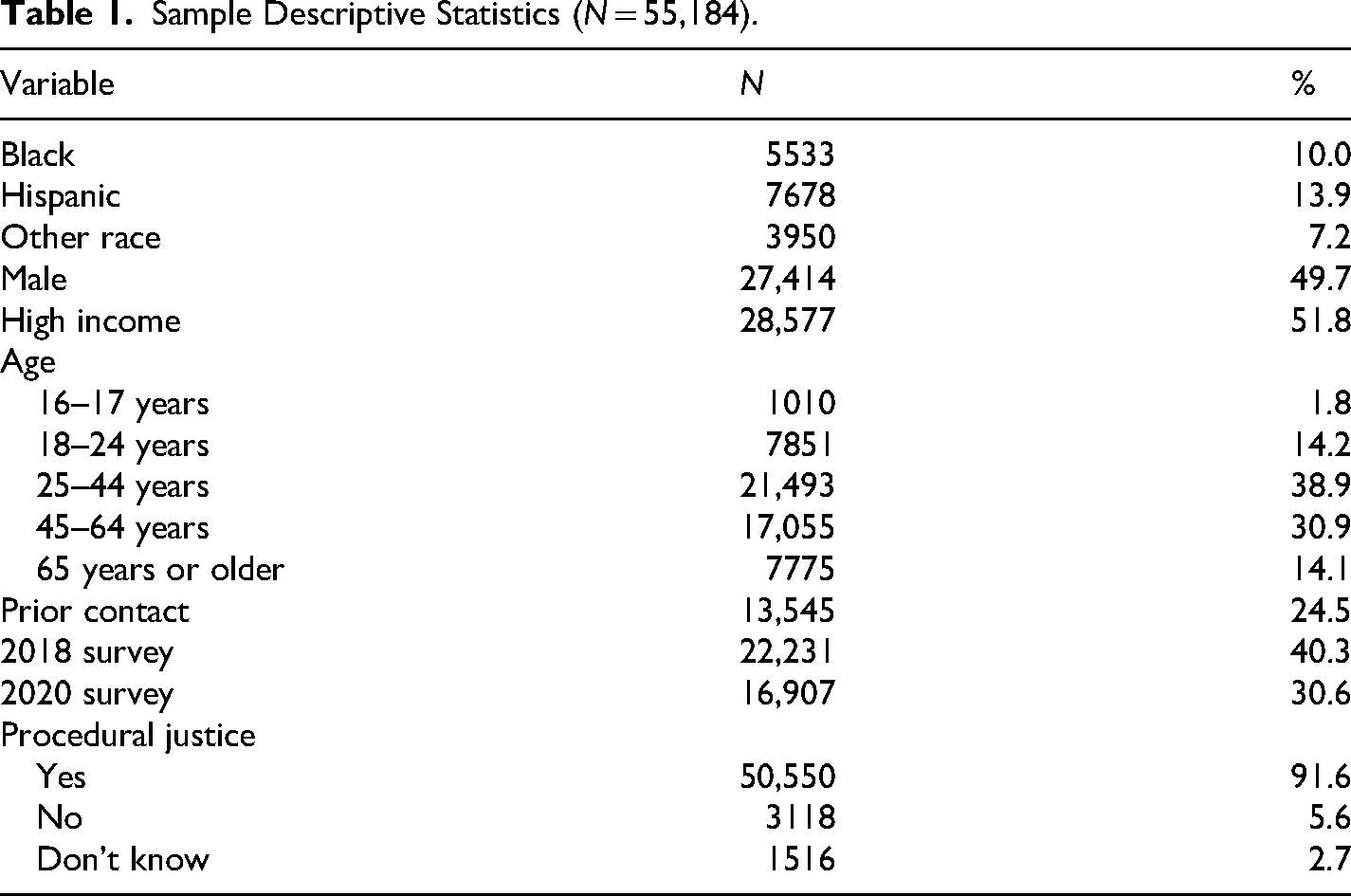
Our multivariate models controlled for all variables that previous research has shown to be related to citizens’ perceptions of the police (Bolger et al., 2021) and that were available in the PPCS regardless of type of contact. The PPCS dichotomized sex into male (=1) and female (=0). Income was also dichotomized. Although the two earlier waves of the PPCS provided additional categories, the 2022 PPCS distinguished only two levels of household income. We applied the 2022 coding scheme to the 2018 and 2020 respondents, so high income (=1) denoted a household income of $75,000 or more and $74,999 or less reflected low income (=0). Age was an ordinal variable grouped into the five categories shown in Table 1. In our multivariate models, we treated age as continuous. Prior contact with the police was also a dummy variable based on whether a respondent had reported more than one contact in the past 12 months (no = 0, yes = 1). Finally, to control for possible broad trends in public feelings about the police, we included two dummy variables indicating the year of data collection; 2022 served as the comparison category. The distribution of these sample characteristics is shown in Table 1.
Sample Descriptive Statistics (N = 55,184).
Analytical Strategy
Analyses for the present study proceeded in two stages. In the first stage, we computed perceptions of procedural justice for each racial group of respondents. We began by documenting differences in perceptions regardless of type of contact, then we estimated procedural justice by race separately for police-initiated and citizen-initiated encounters. In these bivariate analyses, procedural justice perceptions are reported for all three potential responses—“yes,” “no,” and “don’t know.”
In the second stage, we collapsed “no” and “don’t know” into a single category (=1) and contrasted these responses with “yes” (=0) to indicate perceived injustice. Whether someone explicitly reported improper behavior or was unsure whether the police behaved properly both indicate the absence of affirmative procedurally just behavior. To provide a more robust analysis of racialized perceptions, we included the control variables noted above in logistic regression models to predict perceived injustice. Following the same process as with the bivariate analyses, we began by analyzing all responses, regardless of the type of contact. To assess whether the relationship between race and procedural injustice varied across types of contact, we subsequently estimated separate logistic regression models for those who had experienced a police-initiated contact and those who had encountered the police because they had initiated contact themselves. We then tested whether the coefficients estimated for race differed significantly between these two models (Brame et al., 1998). This stratified analysis of subgroups is a common approach to assessing relationships under different conditions for criminal justice issues (e.g., Applegate et al., 2002; Paternoster et al., 1998; Strange et al., 2022). Although stratified analysis is criticized for reduced statistical power, the results are easier to interpret than an alternative approach using multiplicative interaction terms (Cotter et al., 2023). Testing our predictions for the current study would have required adding three interaction terms—Black × contact type, Hispanic × contact type, and other race × contact type—to the model. Given our large sample, statistical power is not a concern, so we opted instead for the ease of interpretation provided by a stratified analysis.
Results
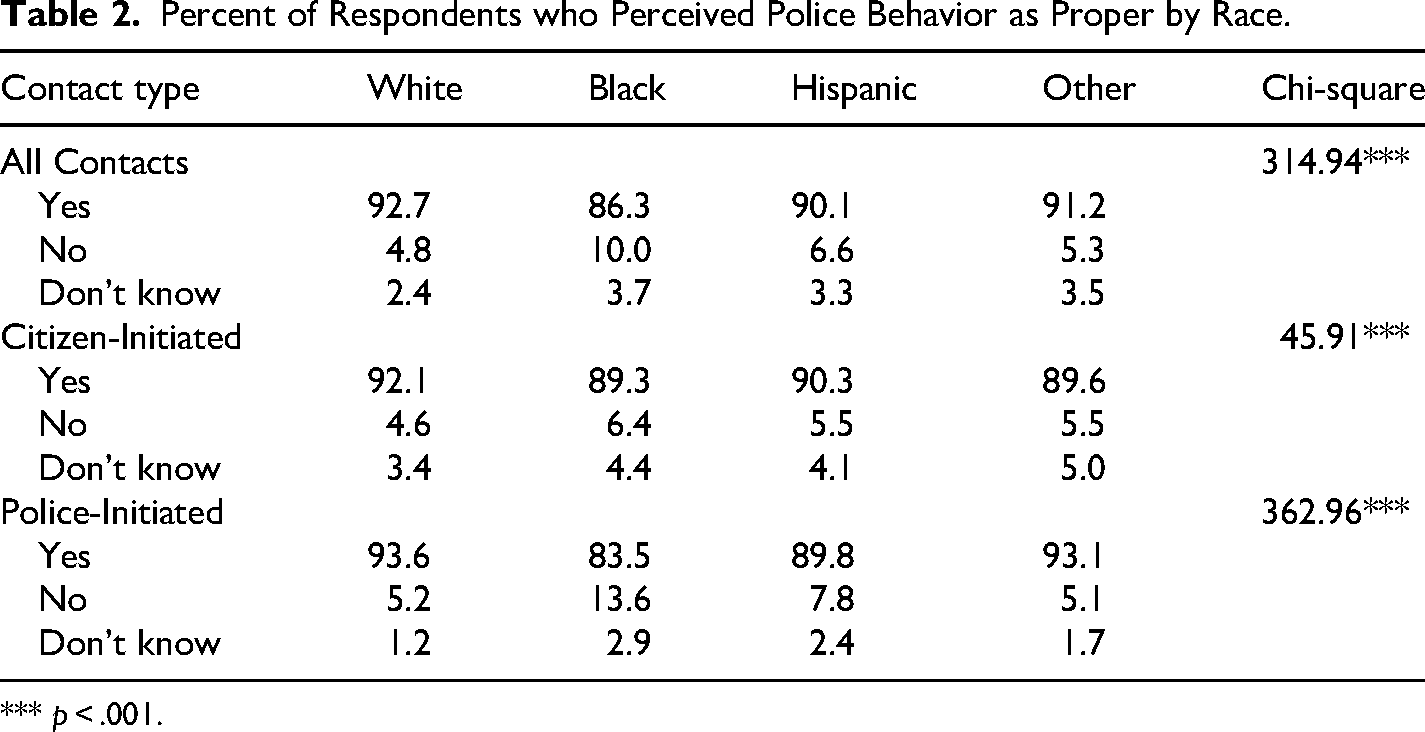
We begin by considering overall perceptions of procedural justice and views disaggregated by race. Results presented at the bottom of Table 1 show that people who had contact with the police in the past year largely felt the police acted in a procedurally just way. Nearly 92% of respondents reported that the police behaved properly during their most recent encounter. The top rows of data in Table 2 present results for respondents separated into four racial groups. The tendency to perceive procedurally just police actions predominated across race, but a difference in perceptions is notable for Black respondents. Ten percent of Black citizens perceived that the police did not behave properly, more than twice the proportion of White citizens, which was a statistically significant difference (p < .001). Results shown in the lower portion of Table 2 speak directly to the focus of the current study by separating perceptions of procedural justice by race and by type of contact. Notably, differences across race were small for contacts initiated by the citizen, varying by less than 3 percentage points. Even so, the differences were statistically significant (p < .001). In contrast, police-initiated contacts showed substantially greater differences in perceptions across racial groups. Whereas 93.6% of White respondents reported procedurally just police behavior in encounters initiated by the police, this figure dipped to 83.5% for Black citizens and 89.8% among Hispanic respondents. These differences also reached statistical significance (p < .001).
Percent of Respondents who Perceived Police Behavior as Proper by Race.
*** p < .001.
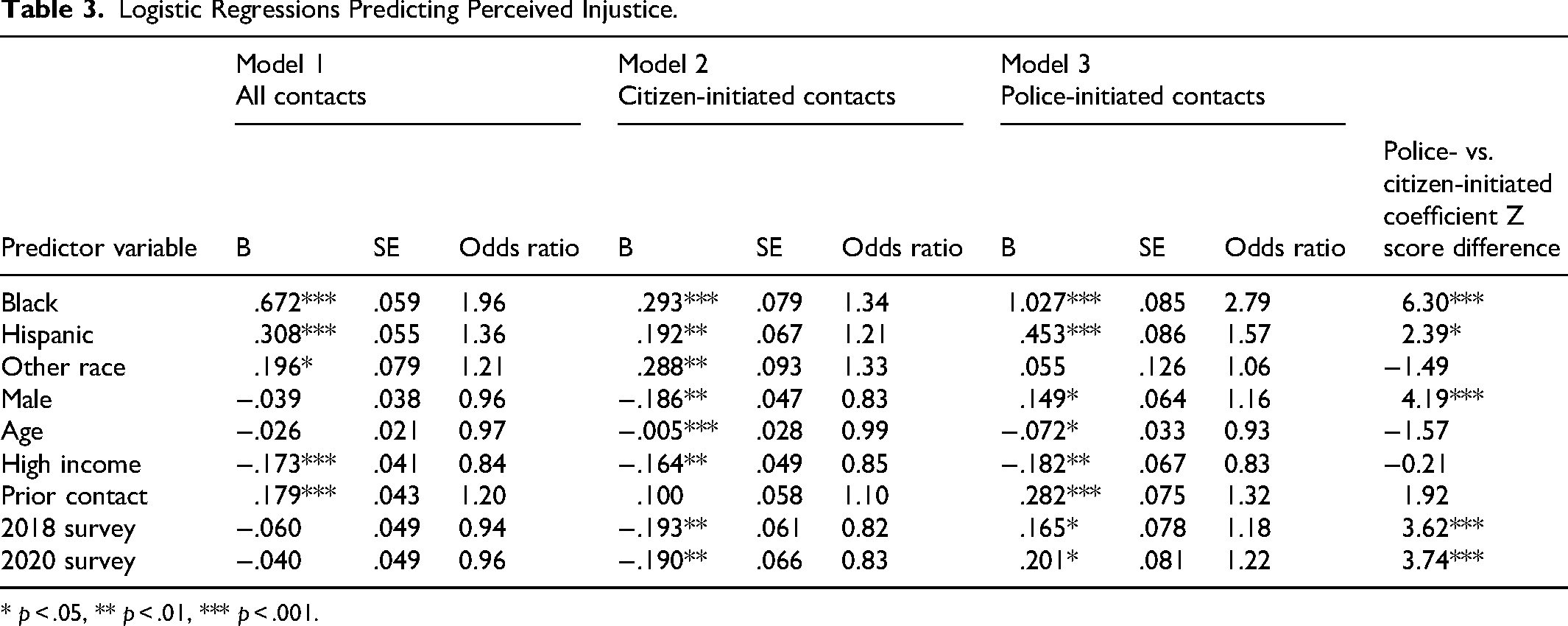
We extended our analyses to assess the independent relationship between race and perceived injustice, controlling for other potential covariates, by estimating logistic regression models. Model 1 in Table 3 included all respondents without differentiating the type of police contact. As shown, all racial minorities were more likely to perceive injustice than their White counterparts, and these differences were statistically significant (p < .05). Models 2 and 3 estimated perceived injustice for each type of contact separately. For both citizen- and police-initiated contacts, the direction of racial differences remained consistent, with minorities more likely to perceive injustice than White respondents. The magnitude of the racial gap, however, differed significantly across models for Black and Hispanic respondents. To test the equality of coefficients across models, we applied the equation for computing z-scores recommended by Brame et al. (1998) for use with maximum likelihood models. As shown in the right-hand column in Table 3, the coefficients were significantly larger for Black and Hispanic citizens when the contact was initiated by a police officer (p < .05). For citizen-initiated contacts, the odds of perceiving procedural injustice were 34% higher for Blacks than Whites. Among those whose most recent contact had been initiated by the police, however, the odds of perceived injustice climbed to 179% higher for Black compared to White respondents. The difference for Hispanic citizens was smaller but still rose from a 21% to a 57% differential in the odds of reporting procedurally unjust police behavior.
Logistic Regressions Predicting Perceived Injustice.
* p < .05, ** p < .01, *** p < .001.
Beyond racial differences, other results across models are notable. Three characteristics maintained consistent relationships with perceived injustice, regardless of the type of contact. Younger respondents, those with lower reported income, those who had prior contact with the police, or who were classified as “other” race, were more likely to report procedural injustice. 2 In contrast, men and women tended to respond differently depending on who initiated the encounter with a police officer. For citizen-initiated contacts, men were less likely than women to perceive injustice, but men were more likely than women to perceive injustice among police-initiated contacts. Finally, perceptions varied across time and type of contact. Compared to the most recent responses, gathered in 2022, the two earlier waves of the PPCS showed significantly lower odds of perceived injustice for citizen-initiated encounters but significantly higher odds of injustice when a citizen was approached by the police.
Discussion
The current study sought to test the hypothesis that the racial gap in perceptions of police procedural injustice is larger when police initiate an encounter compared to contacts initiated by citizens. Drawing on a national sample of more than 55,000 Americans who had experienced at least one contact with the police in the past year, we found support for this prediction. Black, and to a lesser extent Hispanic, citizens were significantly more likely to perceive police injustice than White citizens, and this differential was significantly more pronounced for police- compared to citizen-initiated encounters.
Before we discuss the implications of these results, it is important to acknowledge the limitations of our research. First, the PPCS provides only a single measure of perceived procedural justice for all types of police encounters. While other scholars have also analyzed this measure (Carmichael et al., 2021; Engel, 2005; Henry and Franklin, 2019), it is important to consider that procedural justice is a multifaceted concept (Graham et al., 2025). Future research should seek to unpack the dimensions of procedural justice—fairness, participation, impartiality, trust, and so on—to understand differences in perceptions by race and type of contact more fully. Second, our multivariate models are likely underspecified. Data were not available on several variables that other research has shown to be essential to predicting perceptions of the police, including neighborhood context, the nature of prior police contacts, and prior victimization (Bolger et al., 2021).
Finally, our data included a period of particularly racialized police–citizen interactions. On May 25, 2020, George Floyd, an unarmed Black man, was murdered by then-Minneapolis police officer Derek Chauvin, touching off a surge in antipolice protests and media coverage of the “Black Lives Matter” movement (Buchanan et al., 2020; Reny & Newman, 2021). Two longitudinal studies suggest that the public's global opinions of law enforcement plummeted as a result. Reny and Newman (2021), drawing on weekly national surveys conducted between July 2019 and September 2020, found a sharp decrease in overall favorability toward the police corresponding with Floyd's death. Notably, while attitudes tended to rebound to previous levels among White respondents, diminished favorability ratings of the police among Black and Latino respondents were “more durable” (Reny & Newman, 2021, p. 1502). Fine et al. (2025) found that American's global perceptions of procedural justice among police officers declined significantly in the month after George Floyd's death based on surveys fielded in four states. Although global and contact-specific attitudes are distinct, Brandl et al. (1994) demonstrated more than 30 years ago that global attitudes toward the police predict later citizen satisfaction in response to direct contacts. We encourage additional analyses, drawing on different periods, to assess the robustness of our results showing an interaction of race and type of contact with the police on assessments of procedural justice. 3
Turning to consideration of the results of the current study, it is notable that, consistent with the majority of the prior literature, minority respondents in our analyses tended to hold more negative views than Whites of the police. The broad literature on attitudes toward the police typically shows this racial gap (Bolger et al., 2021; Peck, 2015). Moreover, public assessments of the police based on direct encounters also reveal less satisfaction, less perceived procedural justice, and less legitimacy among minorities (Carmichael et al., 2021; Engel, 2005; Henry & Franklin, 2019; Schuck & Martin, 2013; Skogan, 2005). Our findings similarly showed that Black and Hispanic respondents were less likely than White citizens to report that the police behaved properly during an encounter. Our results also extend these prior findings. Prior research has focused on reactions to traffic and street stops; we included these types of encounters and contacts that were initiated by citizens, such as reporting a crime, reporting some other emergency, and seeking assistance. In these encounters as well, the racial gap persisted.
The central purpose of the current study was to empirically evaluate the expectation that Black–White and Hispanic–White differences in perceptions of police procedural injustice would be larger for encounters initiated by the police compared to encounters initiated by a citizen. We based this hypothesis on observations that minorities tend to be more fearful of the police (Pickett et al., 2022), experience greater stereotype threat (Najdowski, 2023), and are sensitive to a long history of minority mistreatment by the police (Cobbina-Dungy & Jones-Brown, 2023). Moreover, Skogan's (2005) bivariate analyses of Chicago residents’ contacts with the police suggested nearly equal views of procedurally just police behavior across racial groups in citizen-initiated encounters. In contrast, there was a deep racial divide in perceived injustice when he analyzed encounters initiated by the police. Our results are consistent with these earlier findings and show that racial differences by type of contact persist even after controlling for other relevant variables.
Our and Skogan's (2005) results are not the only research to illuminate this issue. The knowledge base is quite small, and it is noteworthy that Schuck and Martin (2013) reported contrary evidence. In their analysis of interviews with 233 people who had experienced contact with the police, there were no significant racial differences in reports of unjust behavior for police-initiated encounters. Among citizen-initiated encounters, however, Schuck and Martin (2013) found significantly different views by race. White respondents were the least likely to report unjust behavior (37.2%), with higher rates among Black (46.2%) and Hispanic (60.8%) citizens. It is not immediately apparent why our results regarding the interaction of race and type of contact would be opposite from Schuck and Martin's (2013) but a few methodological differences should be noted. Their results derive from a small sample of residents of a single city—Chicago—and are drawn from an earlier time—2002. Furthermore, they measured unjust police behavior by asking their respondents to report any of seven experiences. Three of the indicators seem just as likely to capture views other than procedural justice, including satisfaction with the outcome of the encounter—“the police were not helpful” or “the police did not handle the situation well”—or legitimacy—“the individual was stopped for no good reason” (p. 225). We urge additional research on the interplay between race and type of encounter on public perceptions of the police.
Conclusion
The U.S. Bureau of Justice Statistics reported that, in 2022, an estimated 49 million Americans aged 16 or older had experienced contact with the police in the past 12 months (Tapp & Davis, 2024). This figure represents nearly 19% of the U.S. population of older teens and adults, and it suggests ample opportunities to foster perceptions of procedurally just police behavior during encounters with citizens. A decade ago, the President's Task Force on 21st Century Policing (2015) recommended that police departments “adopt procedural justice as the guiding principle for internal and external policies and practices to guide their interactions with the citizens they serve” (p. 11). Departments have responded by initiating a multitude of interventions aimed at enhancing procedural justice and police legitimacy, and the evidence suggests these efforts are beneficial (Mazerolle et al., 2013). Training can improve police–citizen interactions, citizen satisfaction and cooperation, and ultimately support police fairness and effectiveness (Mazerolle et al., 2013; Weisburd et al., 2022). A recent randomized experiment analyzed by Weisburd et al. (2026) suggested that procedural justice training increased procedurally just behaviors among police officers, and the effects did not differ across citizen racial groups. The results of the current study, in light of Weisburd et al.'s (2026) findings, suggest that training efforts should continue, and greater improvements might be achieved with communities of color if training underscores interactions initiated by the police for enhanced procedural justice.
Footnotes

Funding
The authors received no financial support for the research, authorship, and/or publication of this article.
Declaration of Conflicting Interests
The authors declared no potential conflicts of interest with respect to the research, authorship, and/or publication of this article.