







Abstract
This study revisits public support for the use of body-worn cameras (BWCs) in policing, with a specific focus on examining the multifaceted role of race and ethnicity. We test two models in which race and ethnicity shape attitudes toward BWCs by contextualizing two prominent factors: instrumental concern and procedural justice. Using a nationally representative sample of 3,306 U.S. adults, we examine the indirect effect of race and ethnicity through path analysis (generalized structural equation modeling [GSEM]) and their moderating effects with OLS regression. Compared to Whites, African Americans expressed greater skepticism about BWCs’ ability to reduce police use of excessive force, which in turn lowered their support for BWCs. Both African Americans and Hispanic/Latino respondents viewed the police as less procedurally just, further reducing BWC support. Moreover, the positive association between procedural justice and BWC support was weaker among African Americans than among Whites. Our findings highlight the significance and multifaceted role of race and ethnicity in shaping public perceptions of police reforms such as BWCs. In this context, building trust in minority communities requires open communication, genuine collaboration, and a clear acknowledgment of past injustices.
Introduction
Incidents of police violence against racial minorities—once largely invisible to the public—have become increasingly visible with the widespread use of video recording technology (Sandhu & Haggerty, 2017). Often captured and disseminated by bystanders, the vivid images of police brutality catalyzed a national reckoning with the ways policing practices have dehumanized minority communities (Graham et al., 2019), igniting national outrage and protests to end police violence (Francis & Wright-Rigueur, 2021). In response to this growing public demand, a wide array of proposals emerged, ranging from calls to defund the police (Cobbina-Dungy & Jones-Brown, 2023) to diversifying the police force (Gaston et al., 2021). While these initiatives were regarded as promising, they were also met with concerns about feasibility—for instance, whether any institution could realistically replace the broad scope of services currently provided by police (Lum et al., 2022), or whether minority officers would assimilate into dominant police cultures rather than represent communities of color (Benton, 2020).
Amid these debates, body-worn cameras (BWCs) emerged as a particularly promising reform strategy, rooted in the belief that video documentation would enhance visibility and accountability (Graham et al., 2019; Nix et al., 2020). Critics cautioned, however, that officers’ fear of scrutiny might hinder professionalism and job performance (Jennings et al., 2014). Nonetheless, the technology gained momentum and was institutionalized in 2014 through the President's Task Force on 21st Century Policing, which recommended the nationwide adoption and provision of federal funding for implementation (President's Task Force on 21st Century Policing, 2015). By 2016, 47.4% of U.S. law enforcement agencies reported using BWCs, rising to 61.8% by 2020 (Goodison & Brooks, 2023; Hyland, 2018). This rapid dissemination occurred alongside broad public support for BWCs, as documented in both national and regional public surveys (e.g., Miethe et al., 2019; Williams, 2021).
Given the racialized context in which BWCs were introduced, one might presume minority communities to express unequivocal support (e.g., Graham et al., 2019). BWCs were publicized as offering a tangible means to address racial disparities in policing. Nonetheless, minority support appears to be more nuanced than anticipated. Some communities continue to doubt the effectiveness of BWCs, believing that BWCs primarily benefit police officers rather than citizens, do little to reduce racial/ethnic disparities, or will eventually fail to ensure officer accountability (Huff et al., 2023; Park, 2018; Ray et al., 2017; Williams, 2021). Public opinion surveys find mixed results on the relationship between minority status and BWC support (Kopp & Gardiner, 2021; Miethe et al., 2019; Pew Research Center, 2014; Sousa et al., 2018; Thompson et al., 2020; Williams, 2021).
Against this backdrop, the current study explores the multifaceted role of race and ethnicity in shaping public perceptions of BWCs. Rather than treating minority status merely as a statistical correlate, we take a step further by exploring how race and ethnicity contextualize broader frameworks of instrumental concerns and procedural justice. Special attention is devoted to distinguishing Hispanic experiences from those of African Americans, given their unique historical experiences (Coleman & Kocher, 2011; Hartman et al., 2014; Lim & Bontcheva-Loyaga, 2024). Although BWC adoption has expanded substantially, implementation remains incomplete. The most recent data from the Bureau of Justice Statistics indicate that, as of 2020, more than one-third of U.S. law enforcement agencies had yet to adopt BWCs (Goodison & Brooks, 2023). Moreover, unanticipated costs—particularly staffing and data repositories—pose ongoing challenges (Kindy, 2019). These realities highlight the importance of understanding public support for BWCs. Because favorable public opinion is essential for the long-term institutionalization of BWCs, understanding how race and ethnicity shape support offers valuable insights into the dynamics that facilitate or hinder reform. To this end, we analyze data from a nationally representative survey (N = 3,306) to explore the nuanced ways in which race and ethnicity influence public support for BWCs.
Literature Review
Public Support for BWCs
With the increase in police agencies acquiring and mandating officers to wear BWCs, researchers have examined public responses to their use. Between 2014 and 2018, numerous public surveys consistently reported high support—ranging from 82% to 91.4%—across different time periods, locations, and sampling frames (e.g., Crow et al., 2017; Kopp & Gardiner, 2021; Miethe et al., 2019; Pew Research Center, 2014; Sousa et al., 2018; Thompson et al., 2020; White et al., 2018; Williams, 2021). To identify the factors underlying strong public support for BWCs, prior studies have examined demographic and attitudinal correlates using a range of survey designs (Kopp & Gardiner, 2021; Miethe et al., 2019; Sousa et al., 2018; Thompson et al., 2020; Williams, 2021). These studies vary considerably in terms of sampling strategies, recruitment methods, and analytic approaches, which have implications for the generalizability and comparability of their findings.
For instance, Miethe et al. (2019) collected a nationwide sample of U.S. adults between June 2017 and June 2018 using Qualtrics’ online opt-in panel. Respondents were post-stratified by gender, race/ethnicity, household income, and age to approximate national representativeness (N = 3,051; response rate = 17.2%; see also Lawrence et al., 2023). Their analyses identified statistically significant associations between BWC support and factors such as age, residential tenure, participation in social institutions, and perceived costs and benefits of BWCs. Sousa et al. (2018) also constructed a nationwide sample of U.S. adults, recruited through Amazon MTurk in May 2015 (N = 599; response rate not reported). Although post-stratification weights were constructed, the authors relied on unweighted analyses, as weighting did not substantively alter their estimates. Their findings indicated that perceived benefits of BWCs and race (Black vs. White) were statistically significantly associated with BWC support. At the municipal level, Thompson et al. (2020) created a citywide sample of Milwaukee residents between August 2017 and July 2018 using an online panel administered through SurveyGizmo and post-stratified by age, gender, and race/ethnicity (N = 1,527; response rate not reported). They found that support for BWCs varied by sex, income, race (Black vs. White), comfort with being recorded, willingness to assist police, and perceptions of procedural justice and legitimacy.
Race, Ethnicity, and Support for BWCs
Despite the substantial body of research examining public support for BWCs, the role of race and ethnicity has often remained peripheral in empirical analyses (e.g., Kopp & Gardiner, 2021; Miethe et al., 2019; Thompson et al., 2020; Williams, 2021). In these studies, race and ethnicity are typically included as sociodemographic control variables rather than treated as focal constructs, thereby overlooking their potential indirect effects or their capacity to condition the influence of other key predictors. One possible explanation for this pattern is that even the direct association between race, ethnicity, and support for BWCs has proven inconsistent across studies. Some studies report statistically significant yet directionally mixed effects (Miethe et al., 2019; Sousa et al., 2018; Thompson et al., 2020), while others find no statistically significant associations (Kopp & Gardiner, 2021; Williams, 2021), which may have led researchers to view race and ethnicity as analytically secondary.
Nevertheless, inquiring into the role of race and ethnicity in shaping support for BWCs remains important. African Americans’ historical experiences of discrimination, racial profiling, and exposure to police violence have contributed to distinct worldviews toward law enforcement (Brunson, 2007; Han et al., 2026; Unnever & Gabbidon, 2011). Latino communities, while less frequently studied, also face disproportionate legal sanctions, often tied to their growing economic and political visibility (Blalock, 1967; Coleman & Kocher, 2011; Han et al., 2026; Hartman et al., 2014). Recent research highlights the complexity of Latino perspectives, where Latin Americans tend to hold positive attitudes toward police yet experience feelings of being targeted at the same time (Lim & Bontcheva-Loyaga, 2024). In contrast, White individuals are more likely to benefit from preferential treatment within the legal system, shaping more favorable attitudes toward its institutions, including the police (Clair, 2020; Du Bois, 1935/2017; Ilchi et al., 2024). These differences highlight the need to consider whether race and ethnicity—though sometimes subtle in quantitative models—play a meaningful role in shaping public support for BWCs.
Two studies provide important exceptions to this general pattern. Sousa et al. (2018) conceptualized racial and ethnic minority status (Black, Hispanic, and Other, compared to White) as antecedents shaping perceptions of BWC benefits, thereby implying an indirect relationship between race/ethnicity and BWC support. Although the study did not formally test variable-specific mediation effects, it advanced the literature by moving beyond a purely control-based treatment of race and ethnicity. Lawrence et al. (2023) further extended this line of inquiry by explicitly modeling race as a moderator. Focusing on Black and White respondents, they examined whether race conditioned the effects of procedural justice and crime-reporting behaviors on BWC support. While the exclusion of Hispanic respondents limits the generalizability of their findings, this study illustrates the analytic value of treating race as a moderating factor that shapes how other key determinants influence public support for BWCs.
Instrumental Concerns, Procedural Justice, and the Role of Race and Ethnicity
The previous discussion suggests that race and ethnicity may not exert direct or uniform effects on public support for BWCs but may interplay with other key variables. Two theoretical frameworks are particularly relevant in this regard: the instrumental model and the procedural justice model. Drawing upon the instrumental model (Unnever & Cullen, 2010), one important dimension of public support involves the perceived costs and benefits of BWCs. This perspective emphasizes utilitarian considerations, such as perceptions of risk and fear of crime (Metcalfe & Pickett, 2022). In the context of BWCs, the public is concerned with whether the technology reduces police use-of-force, provides reliable evidence for court proceedings, or carries the risk of infringing upon citizens’ privacy rights. Empirical research consistently finds the role of instrumental concerns as key predictors of BWC support (Miethe et al., 2019; Sousa et al., 2018; Kopp & Gardiner, 2021). For instance, Kopp and Gardiner (2021) found that perceived benefits of BWCs (e.g., reducing excessive force) substantially increased the likelihood of support, whereas the perceived costs (e.g., privacy intrusions) significantly decreased it.
In addition to the instrumental concerns, procedural justice provides a second framework for explaining public perceptions regarding BWCs (Tyler, 2006; Sunshine & Tyler, 2003). Procedural justice theory posits that people's attitudes toward legal authorities are shaped less by utilitarian calculations than by normative evaluations of fairness and justice. Applied to BWCs, citizens who view the police as procedurally just are more likely to support their use, perceiving the camera as a commitment to transparency and accountability. Conversely, those who view the police as procedurally unjust may regard BWCs as serving the interests of officers rather than citizens or as being vulnerable to manipulation (Kopp & Gardiner, 2021; Williams, 2021). Empirical evidence supports the positive association between procedural justice and BWC support (Thompson et al., 2020).
Taken together, existing literature suggests that instrumental concerns and procedural justice are central to understanding public support for BWCs. The next step is to consider how these factors interact with race and ethnicity. One conceptualization positions race and ethnicity as antecedents that shape both instrumental concerns and perceptions of procedural justice (e.g., Sousa et al., 2018). From this framework, racial and ethnic minority status indirectly influences support for BWCs by shaping how individuals evaluate costs, benefits, and police fairness. This aligns with prior research documenting that minority communities, due to cumulative experiences of discrimination and disproportionate policing, often hold more negative perceptions of the police (Brunson, 2007; Unnever et al., 2016). Therefore, although BWCs are frequently promoted as reforms that benefit minorities, members of these groups may perceive their advantages as limited and rhetorical (Crow et al., 2017; Ray et al., 2017; Sousa et al., 2018). Moreover, previous studies suggest that minorities are more likely than Whites to question police motives and doubt that officers act in the best interests of their communities (Atkin-Plunk et al., 2019; Johnson et al., 2017).
Another conceptualization frames race and ethnicity as moderators of instrumental concerns and procedural justice. In this view, race does not operate through these mechanisms but rather conditions their strength. Research on public perceptions of policing suggests that such considerations may be more pronounced for Whites than for minorities. For White Americans, for whom policing tends to be less central in daily life, instrumental concerns and procedural justice serve as important heuristics in shaping policing-related attitudes (Lerman & Weaver, 2014). For Black Americans, by contrast, direct experiences with police discrimination may make such heuristics less influential, as law enforcement is viewed primarily as a symbol of racial subordination (Thompson et al., 2025; Unnever & Gabbidon, 2011). This reasoning can also extend to Hispanic communities, which have historically experienced unfavorable treatment and more recently been targeted within the “crimmigration” system (Coleman & Kocher, 2011). However, because their attitudes toward the police tend to fall between those of Blacks and Whites (Peck, 2015), the moderating effects of race and ethnicity on instrumental and normative concerns may be less pronounced for Hispanics.
The Current Study
Our review of the literature suggests that minority communities’ experiences with the police likely play an important role in bringing BWCs into national discourse and eventually institutionalizing them within law enforcement agencies nationwide. Yet, previous studies have largely treated race and ethnicity as demographic controls rather than examining the deeper role in shaping public support for this technology. This study addresses this gap by raising two research questions: (1) Does race/ethnicity shape public support for BWCs indirectly through perceived utility of BWCs and procedural justice? (2) Do the effects of perceived utility of BWCs and procedural justice on support for BWCs differ across racial/ethnic groups?
To answer these questions, we test two models: first, a mediation model, where race/ethnicity affects perceptions of BWC utility and procedural justice, which, in turn, shape public support; second, a moderation model, where the effects of perceived utility of BWCs and procedural justice vary by race/ethnicity. We note that while these models are theoretically informed, their empirical applications remain limited. Thus, our analyses remain exploratory.
Our hypotheses are stated as follows. Compared to Whites, Black and Hispanic individuals will report less favorable perceptions of the utility of BWCs, which in turn will decrease their support for BWCs (Hypothesis 1). Compared to Whites, Black and Hispanic individuals will report less favorable perceptions of police procedural justice, which in turn will decrease their support for BWCs (Hypothesis 2). The effect of perceived utility of BWCs on support will be weaker for Black individuals than for Whites; differences between Hispanics and Whites are expected to be smaller (Hypothesis 3). The effect of procedural justice on support for BWCs will be weaker for Black individuals than for Whites; differences between Hispanics and Whites are expected to be smaller (Hypothesis 4).
Data and Method
Sample
This study draws on secondary data from Perceptions of Trust and Procedural Justice as Sources of Receptivity and Resistance to Video Surveillance, United States and Las Vegas Metropolitan Area, 2017–2018 (ICPSR 37341) (Miethe & Lieberman, 2020). The survey was designed to explore the sources of public support for and opposition to police use of video surveillance technologies, including BWCs and aerial drones, across various areas of policing. Participants completed an online questionnaire assessing their support for police use of video surveillance, perceptions regarding their local police, confidence in key social institutions, and standard sociodemographic characteristics. The original data collection consisted of three waves of repeated cross-sectional surveys administered to two distinct samples: a nationally representative sample of U.S. adults (N = 3,306) and a local sample of residents from the Las Vegas Metropolitan Area (N = 2,031). The current study draws exclusively on the national sample to align with its focus on racial and ethnic patterns in public support for BWCs at the national level. Although the Las Vegas sample provides valuable contextual insights, the national sample offers greater analytic leverage for examining population-level disparities. All three waves of the national sample were included in the analysis (wave 1: June 1 to June 15, 2017; wave 2: October 25 to December 20, 2017; wave 3: April to June, 2018). Prior analyses indicate that variation in BWC support across waves was modest and substantively small (Miethe et al., 2019).
Within each wave, the sampling frame for the national survey was stratified by gender, race/ethnicity, and household income. Surveys were administered online through Qualtrics’ opt-in panel, with more than 1,000 respondents recruited per wave, yielding a combined sample size of 3,306 and an overall response rate of 17.2%. Although the sample was not probability-based, post-stratification weights were applied to approximate national representativeness by adjusting for the stratified sampling design. These weights were constructed utilizing the 2017 U.S. Census benchmarks for gender, race/ethnicity, and household income, with additional weighting by age to further align the sample with national population distributions (Miethe et al., 2019). This dataset represents one of the most comprehensive publicly available nationwide surveys capturing public attitudes toward BWCs during the period of their rapid diffusion across U.S. law enforcement agencies. While the data were collected between 2014 and 2018, their value for the current study lies not in estimating the absolute levels of public support, but in examining how race and ethnicity are associated with instrumental concerns and perceptions of procedural justice that structure support for BWCs. As such, the dataset remains well-suited to the study's analytic objectives.
Measures
Dependent Variable. BWC support, the dependent variable, was measured in a manner consistent with prior studies that utilized the same dataset (Lawrence et al., 2023; Miethe et al., 2019). Respondents were asked to indicate on a 4-point ordinal scale (1 = strongly oppose, 4 = strongly support), how strongly they support police use of BWCs in the six situations: (1) routine traffic stops, (2) neighborhood police patrols involving stop and questioning, (3) crime scene investigations, (4) crowd management in public areas, (5) interviewing crime victims, and (6) all areas of police work. While much of the existing literature on single-item measures to capture a general support for BWCs (Kopp & Gardiner, 2021; Pew Research Center, 2014; Sousa et al., 2018; Thompson et al., 2020; Williams, 2021), such approaches do not allow formal assessment of measurement reliability. In contrast, the current measure captures both situational support for BWCs (Items 1‒5) and overall support (Item 6) and demonstrated strong internal consistency (alpha = .91). Item-level missingness ranged from 6.53% to 12.58%. 1 An average score was computed for participants who answered at least four of the six items, reducing the final missing portion to 6.75%. Higher scores indicated greater overall support for BWCs in policing.
Independent Variables. Race/ethnicity, the primary independent variable, was measured with three dummy variables: White (non-Hispanic; reference), Black (non-Hispanic), and Hispanic/Latino. These variables served as antecedents in the first research question and as moderators in the second.
Perceived utility of BWCs was captured across three domains: (1) whether BWCs reduce excessive use of force (EUOF) and other misconduct by the police (BWC reduces EUOF), (2) whether BWCs violate the personal privacy of crime suspects (BWC violates privacy), and (3) whether BWCs provide an accurate account of the chain of events that occur in police-citizen interactions (BWC enhances objectivity). To measure each domain, respondents were asked three domain-specific questions (e.g., “Do you think BWCs provide an accurate account of the chain of events that occur in police-citizen interactions?”) on a binary scale (1 = Yes, 0 = No). Rather than aggregating these measures, each domain was analyzed separately to uncover the domain-specific effects. Instrumental concerns functioned as mediators in the first research question and as antecedents in the second.
Perceptions of police procedural justice were measured using items aligned with established approaches in prior research (Roche et al., 2024). Respondents indicated their level of agreement, on a 4-point ordinal scale (1 = strongly disagree, 4 = strongly agree), with six statements assessing whether their local police: (1) treats citizens with dignity and respect, (2) treats people fairly, (3) takes time to listen to people, (4) provides the same quality of service to all citizens, (5) makes decisions only on the facts of the case, and (6) explains decisions to the people they deal with (e.g., citizens, suspects). Item-level missingness ranged from 8.47% to 15.52%. An average score was calculated for respondents who answered at least four items, resulting in a final missing rate of 10.74%. Higher scores indicated greater perceived procedural justice. The scale demonstrated strong internal consistency (alpha = .94).
Control Variables. To mitigate concerns about omitted variable bias, we included several additional control variables that may influence public support for BWCs. Personal police contact was measured with a binary indicator coded 1 if respondents reported at least one face-to-face contact with a police officer, and 0 if none. Vicarious police contact was measured similarly, but referred to hearing about police encounters experienced by family, friends, or neighbors. Respondents reported their confidence in five institutions: the police, the criminal justice system, the federal government, the local government, and economic institutions (e.g., banks). Responses were recorded on a 3-point ordinal scale (1 = no confidence, 3 = a great deal of confidence). A mean index was created for respondents who answered at least three of the five items (alpha = .83), with higher scores reflecting greater institutional trust. Two binary variables captured prior victimization. Personal victimization was coded 1 if respondents reported being a victim of serious property or violent crime within the past three years. Vicarious victimization was coded 1 if a family member or friend had been victimized. Neighborhood disadvantage was measured using respondents’ assessment of seven neighborhood characteristics (e.g., amount of crime, frequency of residential turnover, and ethnic/racial diversity), each rated on a 3-point ordinal scale (1 = low, 3 = high). These items capture multiple dimensions commonly associated with structural disadvantage and are broadly consistent with the constructs used in social disorganization literature (Sampson & Groves, 1989). A mean index was created for respondents who answered at least five of the seven items, yielding acceptable internal consistency (alpha = .70). Higher scores indicated greater perceived neighborhood disadvantages. Although conceptually related to social disorganization, this measure incorporates perceived crime as part of the construct and is therefore more appropriately characterized as neighborhood disadvantage. Respondents answered five questions about concern with crime victimization (e.g., being robbed, burglarized). A mean index was calculated for those answering at least three items (alpha = .91). Higher scores indicated greater fear of crime.
We also controlled for key demographic characteristics. Sex was measured as a dummy variable, coded 1 for male. Age was measured as an ordinal variable with six categories ranging from 1 (19 or under) to 6 (60 or older). Education was another ordinal variable, with five categories ranging from 1 (less than high school) to 5 (post-graduate degree). Urbanicity was measured as a dummy variable, coded 1 for respondents living in an urban area and 0 for those in rural areas. Political orientation was measured with four categories, which were transformed into dummy variables: Democrat, Republican, independent, and no party affiliation. Democrat was set as the reference category to facilitate direct comparison with Republicans, where theoretical and empirical work suggests the clearest partisan differences are likely to arise. Although Independents and respondents with no party affiliation were retained to capture the full range of political orientations, prior research suggests that these groups do not form cohesive political identities (Rempala & Okdie, 2023). Supplementary analyses using alternative reference categories yielded substantively identical results. Income was measured on a 4-point ordinal scale ranging from 1 (less than $30,000) to 4 ($100,000 or more). Finally, we included a control for survey wave to account for any period-specific effects.
Analytic Strategy
To test the mediation hypothesis, we adopted a two-step approach. First, we estimated a path model using generalized structural equation modeling (GSEM). This approach accommodates the binary nature of the mediators (i.e., perceived utility of BWCs) and allows the specification of all hypothesized relationships within a unified model. Paths involving perceived utility of BWCs as the outcomes were modeled using a binomial distribution with a log link, while those involving procedural justice and BWC support were modeled with a Gaussian distribution and identity link. Second, we formally tested path-specific indirect effects by using nonparametric bootstrapping (Preacher & Hayes, 2008). Bias-corrected confidence intervals were constructed from 500 bootstrap replications, providing a robust test of indirect effects without assuming normality of their sampling distribution. To test the moderation hypothesis, we ran two OLS regression models. The first estimated the main effects of perceived utility of BWCs and procedural justice on BWC support. The second added eight multiplicative interaction terms (e.g., Black × procedural justice). Missing data were addressed using multiple imputation using chained equations (MICE), producing 35 imputed datasets (White et al., 2011). Little's (1988) test indicated that the data were not missing completely at random. Following best practice, all 3,306 cases were included in the imputation process, but cases missing on the dependent variable were excluded from final analyses (n = 223). To incorporate MICE with bootstrapping, we followed the procedures recommended by Little and Rubin (2002). The adequacy of 35 imputations was verified by inspecting the highest fraction of missing information (FMI). Univariate and multivariate models were estimated with survey weights applied. Because weighted bivariate analyses are not supported in Stata, unweighted results are reported for descriptive purposes only. Variance inflation factors indicated no evidence of multicollinearity (VIFs < 1.68). All analyses were conducted using Stata/MP version 18.0.
Results
Univariate and Bivariate Results
Table 1 presents the univariate and bivariate statistics for the study variables. Overall, the public expressed strong support for BWCs, with a high average score (M = 3.492, SE = .018, range: 1–4). By racial and ethnic composition, the sample was 67.3% White, 20.2% Hispanic/Latino, and 12.5% Black. Attitudes toward BWC utility were also favorable: 86.4% agreed that BWC reduces excessive police use of force, and 91.6% agreed that BWCs enhance objectivity. At the same time, concerns about privacy were evident, with 33.8% agreeing that BWC may infringe upon personal privacy. Perceptions of police procedural justice were moderately high (M = 3.07; range = 1–4), suggesting general agreement that local police behave in a procedurally just manner.
Univariate and Bivariate Statistics, N = 3,306.
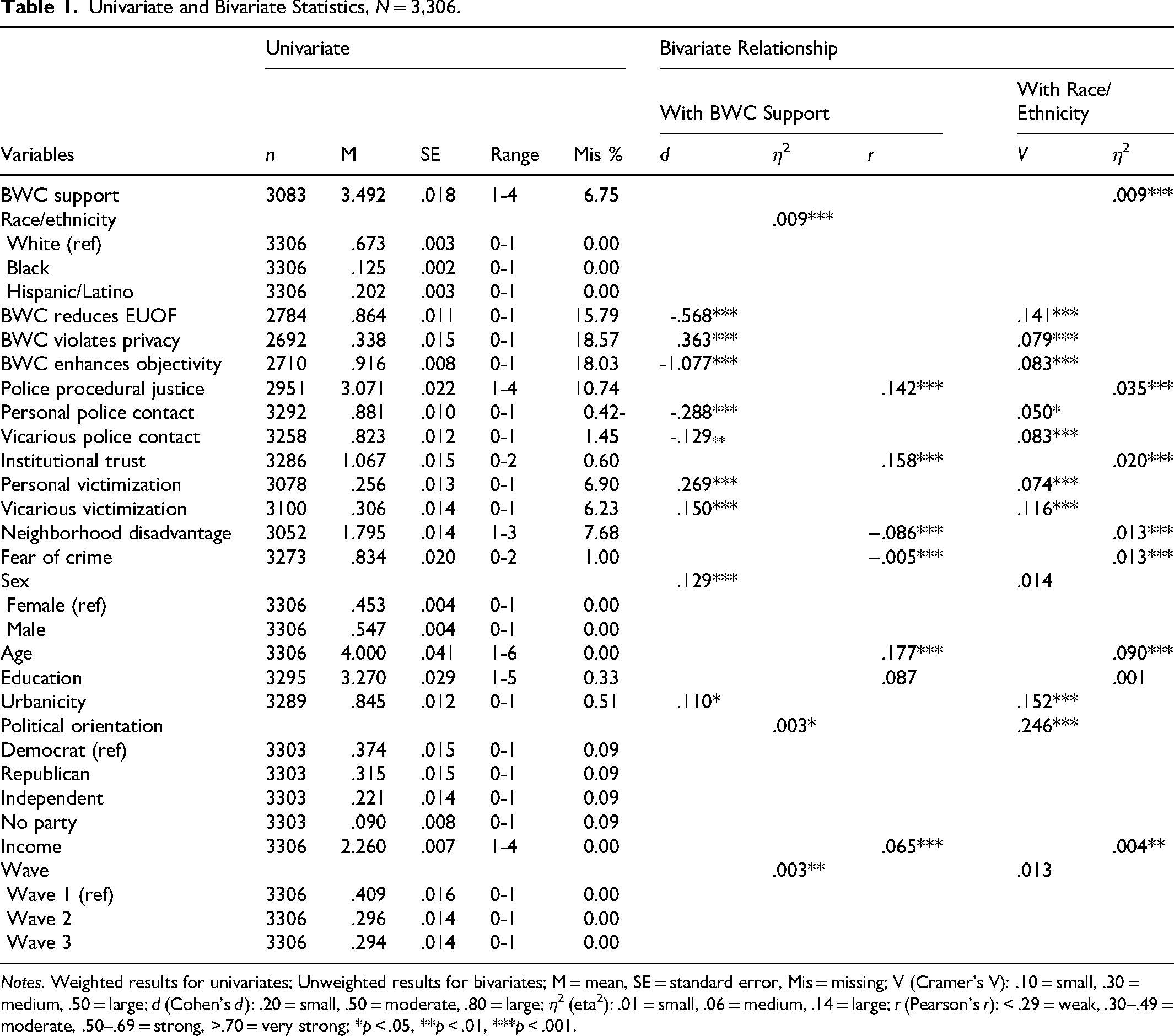
Notes. Weighted results for univariates; Unweighted results for bivariates; M = mean, SE = standard error, Mis = missing; V (Cramer's V): .10 = small, .30 = medium, .50 = large; d (Cohen's d): .20 = small, .50 = moderate, .80 = large; η2 (eta2): .01 = small, .06 = medium, .14 = large; r (Pearson’s r): < .29 = weak, .30–.49 = moderate, .50–.69 = strong, >.70 = very strong; *p < .05, **p < .01, ***p < .001.
Unweighted bivariate analyses indicated that all independent variables—except education—were statistically significantly associated with BWC support, though effect sizes varied from weak to large (Cohen, 1988; Gau, 2018). Additional examinations revealed that most variables, except for sex, education, and wave, were statistically significantly associated with race and ethnicity, generally with small effect sizes but larger in some cases (e.g., procedural justice, age, and political orientation). Notably, we found statistically significant disparities in BWC support across the racial and ethnic groups (η2 = .009, p < .001). Bonferroni multiple-comparison tests revealed that both Black and Hispanic/Latino respondents expressed lower support compared to Whites, whereas no significant difference was observed between Black and Hispanic/Latino respondents (Supplementary file, Table A1). These bivariate results should be interpreted with caution, as they do not adjust for the effects of covariates.
The Mediated Effects of Race and Ethnicity in BWC Support
Table 2 presents the path analysis results estimated via GSEM. The direct effects of race and ethnicity on BWC support were statistically non-significant. By contrast, several paths from race/ethnicity to the mediators were statistically significant. Black respondents were less likely to perceive that BWC reduces excessive use of force (b = −.439, SE = .165, p = .008) and less likely to view the police as procedurally just (b = −.170, SE = .039, p < .001). Hispanic/Latino respondents also reported weaker perceptions of procedural justice (b = −.085, SE = .035, p = .014). Turning to the mediators, all hypothesized effects on BWC support were statistically significant. Respondents who believed BWC reduces excessive use of force (b = .183, SE = .057, p = .001) or enhance objectivity (b = .444, SE = .071, p < .001) expressed greater support, while those who believed BWCs violate privacy were less supportive (b = −.212, SE = .037, p < .001). Similarly, higher perceptions of police procedural justice predicted greater support (b = .092, SE = .031, p = .003). Table 3 presents the formal tests of indirect effects. Three path-specific effects were statistically significant. Black respondents were less supportive of BWCs because they doubted their effectiveness in reducing excessive force (b = −.080, SE = .038, 95% CI (BC) = [−.168, −.023]). Their weaker perceptions of police procedural justice also decreased support for BWCs (b = −.016, SE = .006, 95% CI (BC) = [−.031, −.007]). Hispanic/Latino respondents were also less supportive of BWCs due to their weaker perceptions of procedural justice (b = −.008, SE = .004, 95% CI (BC) = [−.019, −.002]). A visual summary of the path analysis and corresponding tests of indirect effects is presented in Figure 1.
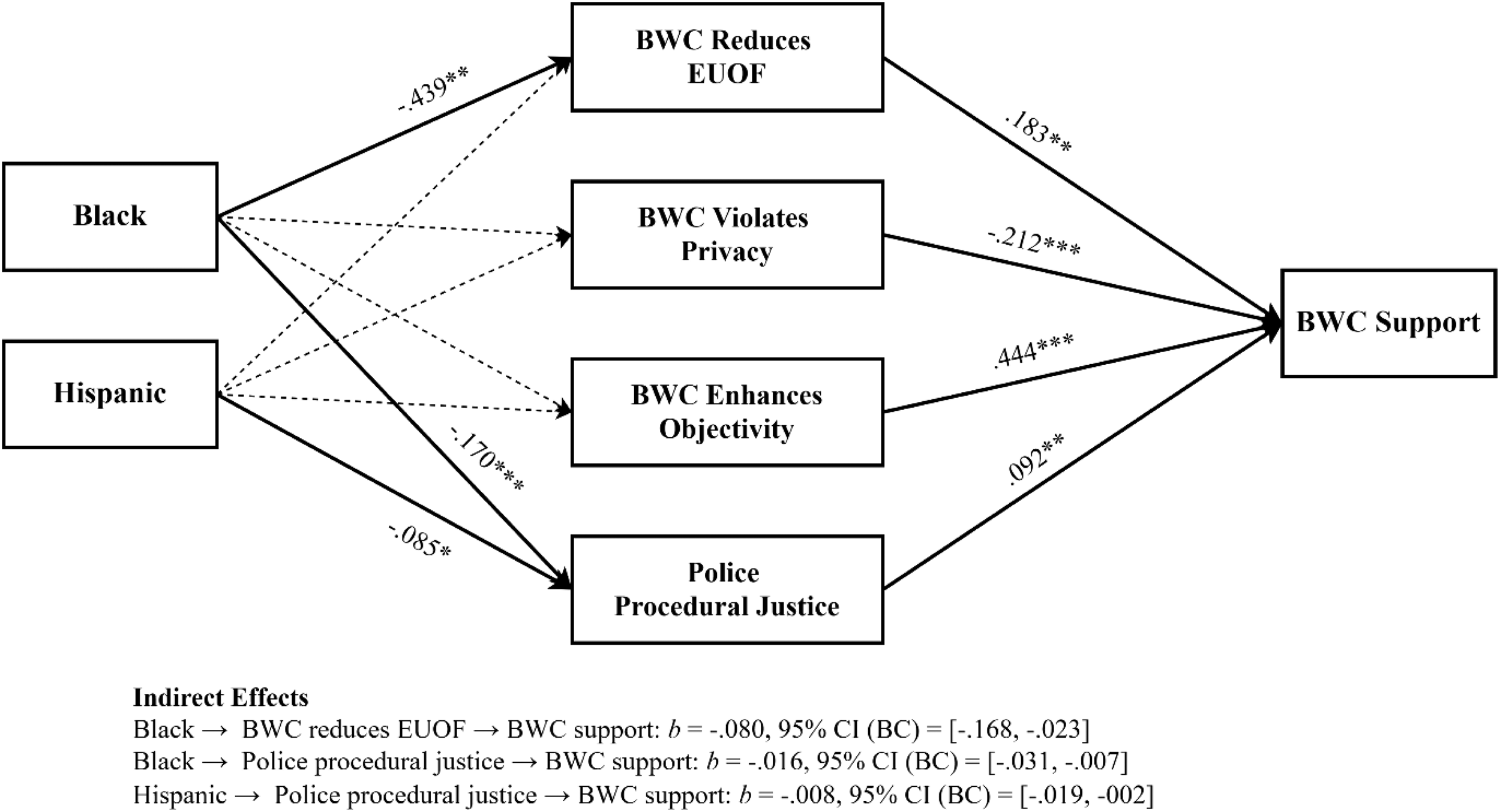
Indirect effects of race/ethnicity on BWC support via instrumental concerns and police procedural justice.
Path Analysis Predicting Instrumental Concerns, Police Procedural Justice, and BWC Support via GSEM, N = 3,083.
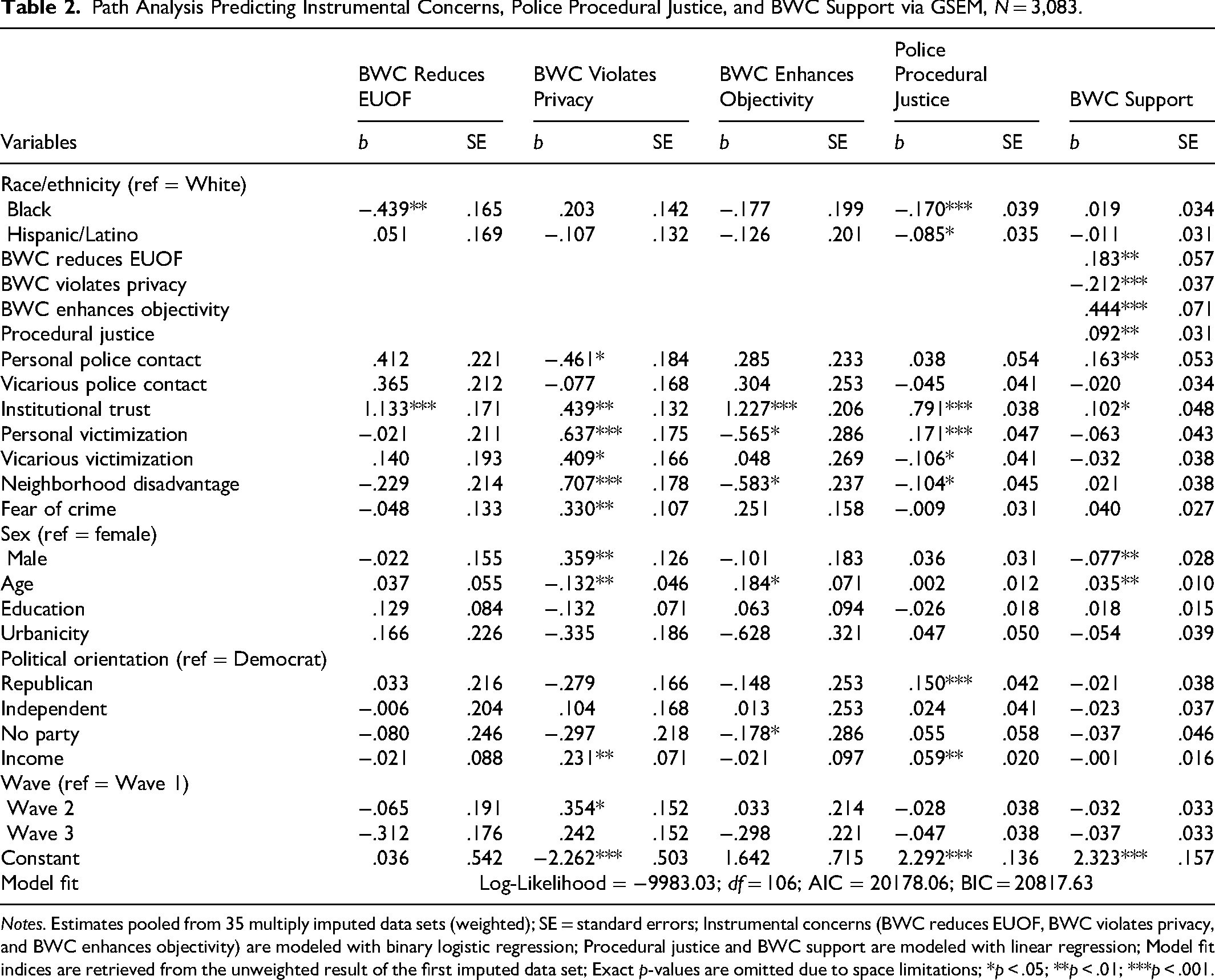
Notes. Estimates pooled from 35 multiply imputed data sets (weighted); SE = standard errors; Instrumental concerns (BWC reduces EUOF, BWC violates privacy, and BWC enhances objectivity) are modeled with binary logistic regression; Procedural justice and BWC support are modeled with linear regression; Model fit indices are retrieved from the unweighted result of the first imputed data set; Exact p-values are omitted due to space limitations; *p < .05; **p < .01; ***p < .001.
Indirect Effects of Race/Ethnicity on BWC Support Through Instrumental Concerns and Police Procedural Justice.
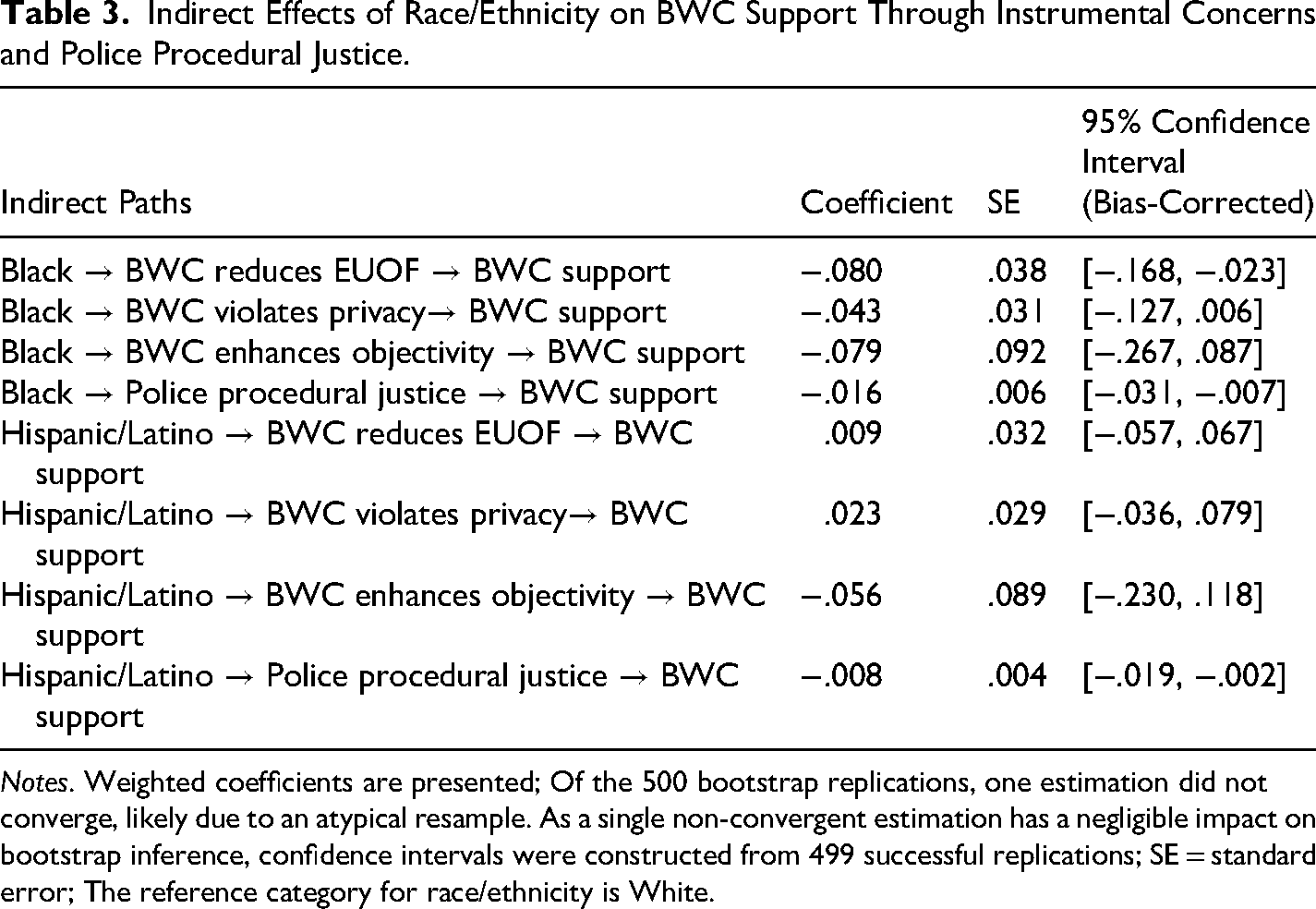
Notes. Weighted coefficients are presented; Of the 500 bootstrap replications, one estimation did not converge, likely due to an atypical resample. As a single non-convergent estimation has a negligible impact on bootstrap inference, confidence intervals were constructed from 499 successful replications; SE = standard error; The reference category for race/ethnicity is White.
The Moderating Role of Race/Ethnicity in Shaping BWC Support
Table 4 presents two OLS models testing whether race/ethnicity moderates the effect of perceived utility of BWCs and procedural justice on BWC support. Consistent with the path analysis, Model 1 displays that all main effects were statistically significant. Respondents who believed that BWCs reduce excessive use of force (b = .183, SE = .057, p = .001), enhance objectivity (b = .444, SE = .071, p < .001), or perceived their local police as procedurally just (b = .092, SE = .031, p = .003) reported greater support for BWCs. In contrast, concerns about privacy violations predicted lower support (b = −.212, SE = .037, p < .001). Model 2 adds eight interaction terms to test the moderating effect of race/ethnicity. Only one interaction reached statistical significance: the effect of procedural justice was weaker for Black respondents than for Whites (Black×procedural justice: b = −.086, SE = .043, p = .045). Although higher perceptions of police procedural justice generally increased BWC support (b = .092, SE = .031, p = .003), this relationship was attenuated among Black respondents (see Figure 2). Note that the conditional effect of being Black is also statistically significant; however, we caution readers against interpreting this effect. 2
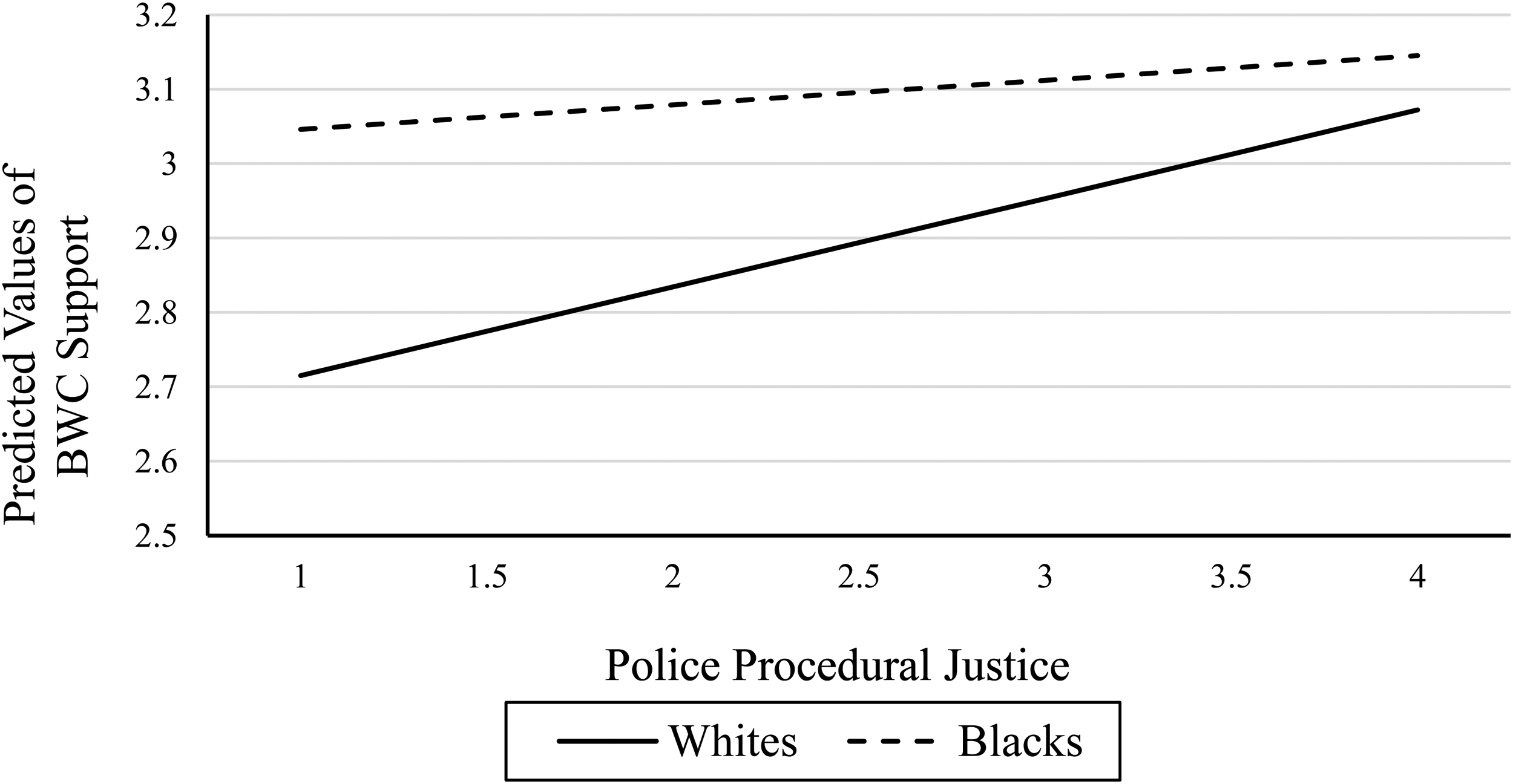
The conditional effect of police procedural justice on BWC support by race/ethnicity (Blacks vs. Whites), N = 3,083.
OLS Regression Testing the Conditional Effects of Instrumental Concerns and Police Procedural Justice by Race/Ethnicity on BWC Support, N = 3,083.
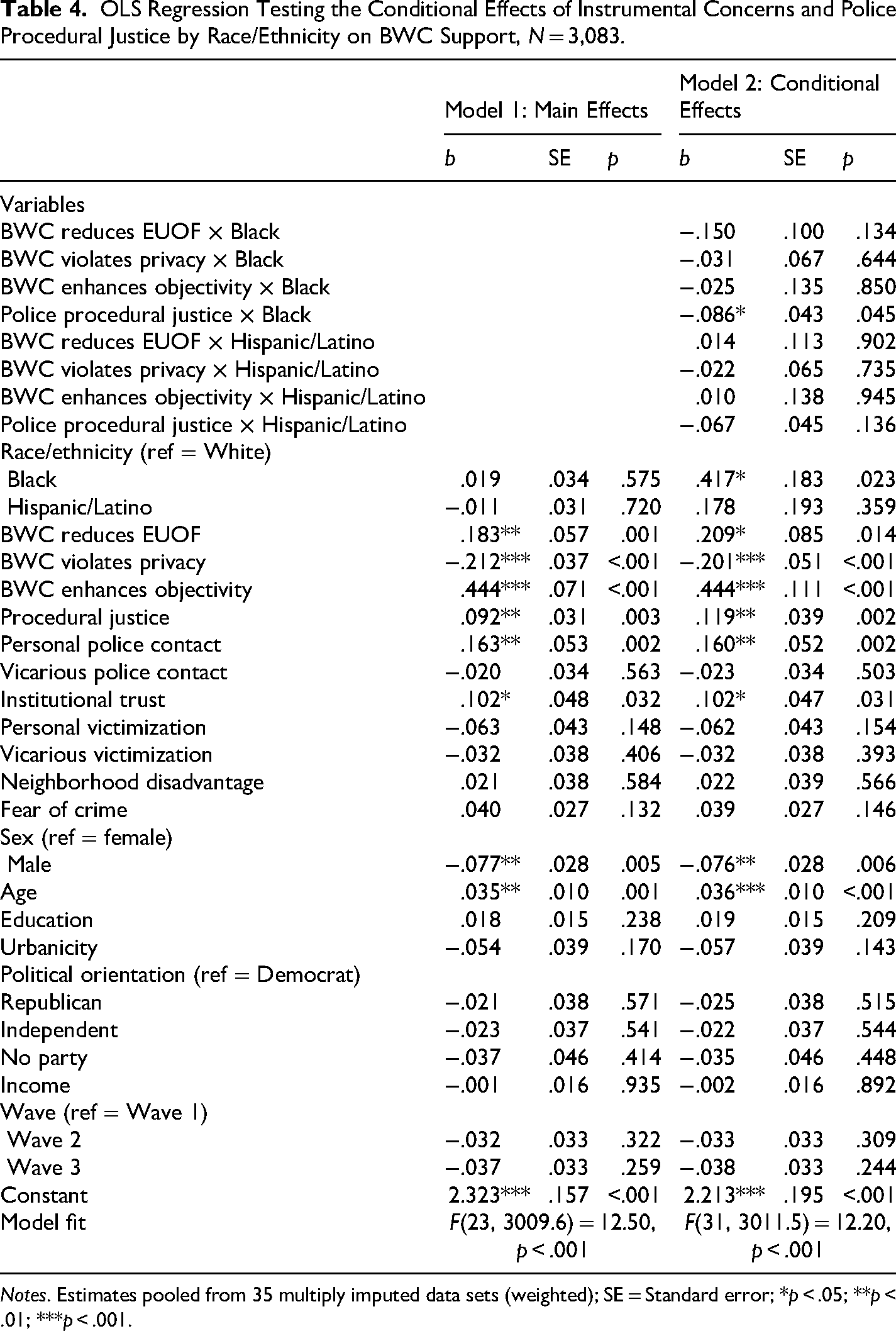
Notes. Estimates pooled from 35 multiply imputed data sets (weighted); SE = Standard error; *p < .05; **p < .01; ***p < .001.
Discussion
The current study aimed to address two research questions: (1) Does race/ethnicity shape public support for BWCs indirectly through perceived utility of BWCs and procedural justice? and (2) Do the effects of perceived utility of BWCs and procedural justice on BWC support differ across racial/ethnic groups? Our results suggest that both proposed models—their indirect effects model and the moderation model—are partially supported. Our examination of the indirect effects model revealed that one key role of race and ethnicity lies in shaping individuals’ perceptions of BWC utility and procedural justice, which then indirectly influence support for BWCs. African American respondents were more skeptical of BWCs’ ability to reduce excessive use of force, which subsequently lowered their support. This finding aligns with prior research showing that racial/ethnic minority communities, shaped by cumulated experiences of discrimination and disproportionate policing, often adopt deeply negative perceptions of police (Brunson, 2007; Unnever et al., 2016). As such, minorities may view the purported benefits of BWCs as rhetorical or unlikely to materialize (Crow et al., 2017; Ray et al., 2017; Sousa et al., 2018). Moreover, consistent with prior studies showing that minorities are more likely than Whites to question the trustworthiness of police motives (Atkin-Plunk et al., 2019; Johnson et al., 2017), both African American and Hispanic/Latino respondents in our study reported lower perceptions of police procedural justice. Furthermore, these perceptions decreased their support for BWCs. However, as the rest of the indirect paths were not statistically significant, Hypotheses 1 and 2 were partially supported.
Regarding the proposed moderation model, our analysis revealed that race and ethnicity condition the effect of procedural justice on support for BWCs. Specifically, perceiving the police as procedurally just increased support for BWCs overall, but this effect was weaker for Black respondents than for Whites. This finding supports our reasoning that procedural justice serves as an important heuristic for Whites, for whom policing is less salient in everyday life (Lerman & Weaver, 2014). By contrast, for Black Americans—whose frequent encounters with law enforcement reinforce perceptions of the police as a symbol of racial subordination (Unnever & Gabbidon, 2011)—the influence of procedural justice considerations may be attenuated. Notably, no such moderation was observed between Hispanic/Latino and White respondents, as stronger perceptions of procedural justice enhanced BWC support among both groups at a comparable level. This pattern echoes the view that although Hispanics have historically experienced unfavorable treatment by the police and more recently have been targeted by the “crimmigration” system (Coleman & Kocher, 2011), their policing attitudes tend to be mixed and occupy a middle ground between those of Black and White Americans (Lim & Bontcheva-Loyaga, 2024; Peck, 2015). However, as the moderating role of race and ethnicity did not extend to perceptions of BWC utility, only Hypothesis 4 was supported. Taken together, these findings contribute to theory by demonstrating that race and ethnicity matter in multifaceted and context-specific ways, and that BWC adoption is inseparable from issues of race and police accountability (Francis & Wright-Rigueur, 2021). Roughly a decade after BWCs became widely disseminated, it is time to recontextualize prior understandings of public support for the technology by situating race and ethnicity at the center of inquiry.
The findings of this study offer important implications for policy and practice as well. Our findings underscore the importance of addressing skepticism toward the utility of BWCs, particularly within African American communities. Efforts to enhance procedurally just policing in Black and Hispanic communities are likewise likely to foster stronger public support for BWCs. Such efforts may be most effective when they are accompanied by agencies’ acknowledgment of, repudiation of, and concrete action to address the historical oppression of Black Americans in policing (Goff, 2021). More concretely, improvements to BWC implementation—not merely their adoption—are needed. The U.S. Department of Justice's BWC Implementation Guide recommends that agencies share information about BWC policies with advocacy groups, community members, and media (Bureau of Justice Assistance, 2015). We argue that this recommendation should be extended beyond its current scope. Minority communities should not be treated as passive recipients of information, but rather engaged as active partners from the earliest stages of BWC policy development and implementation (National Urban League, 2021). Additionally, law enforcement agencies may enhance citizens’ perceived procedural justice through notifying individuals when BWCs are activated. Prior research suggests that notification practices are interpreted by citizens as direct signals of transparency and respect, thereby enhancing perceptions of procedural justice (Demir, 2023). Despite these benefits, the adoption of such practices seems to be limited. White et al. (2019) found that among 54 agencies funded through the Department of Justice's BWC Policy and Implementation Program, fewer than one quarter required officers to notify citizens of BWC activation. The extent to which notification policies have been implemented nationwide remains unclear, as national-level data sources—such as Law Enforcement Management and Administrative Statistics (LEMAS)—do not capture this level of policy detail. 3
This study is not without limitations. First, the cross-sectional design precludes firm conclusions about temporal ordering in the mediation model. Nonetheless, we believe this concern is mitigated because race and ethnicity logically precede perceptions of BWC utility, procedural justice, and BWC support, and by prior research supporting the assumed ordering among them (Lawrence et al., 2023; Sousa et al., 2018). Second, our measurement of BWC support was based on an average of six items, which may obscure variation across domains. For instance, support for BWCs during neighborhood patrols was lower than in other contexts, implying that support for BWCs itself can be context-specific. Future research may yield further insights by examining domain-specific support for BWCs. Third, the current data does not capture racial/ethnic groups other than White, Black, and Hispanic, omitting other groups that may have distinctive policing experiences and perspectives. While our study cannot speak to these populations, we advance the literature by highlighting differences across three major racial/ethnic groups and placing race/ethnicity at the center of the analysis. Finally, future research should seek to replicate the current analytic framework using more recent data. Although we expect the role of race and ethnicity in shaping perceptions of policing to be relatively persistent, events occurring after the 2017–2018 data collection period—most notably the killing of George Floyd in 2020 and the subsequent national reckoning with police accountability—may have altered public attitudes toward BWCs in unanticipated ways. Additionally, it is important to note that the present study captures public perceptions and instrumental beliefs about BWCs rather than their empirically demonstrated effects. Recent systematic reviews and meta-analyses have reported mixed or inconsistent effects of BWCs on outcomes such as use of force and police behavior (e.g., Lum et al., 2020), which contrasts with the generally favorable instrumental views reflected in the current sample. Replication with contemporary data is therefore essential for assessing the stability of the relationships observed here and for understanding how evolving empirical evidence and social contexts shape public support for BWCs.
In conclusion, this study advances the literature by positioning race/ethnicity as central factors in understanding public support for BWCs. By examining both indirect and moderating effects, we demonstrate that Black and Hispanic respondents’ perceptions of BWC are shaped in distinct and multifaceted ways. These findings underscore that race and ethnicity do not merely correlate with attitudes toward BWCs, but actively condition how citizens interpret the promises and shortcomings of the widely promoted reform. In doing so, this study contributes to broader debates on how historical and ongoing experiences of marginalization influence contemporary attitudes toward law enforcement initiatives. Practically, the results caution against colorblind approaches that disregard the deep and enduring effects of racialized policing. Only by recognizing these historical and social realities can BWCs enjoy continued public support and further fulfill their original promise.
Supplemental Material
sj-docx-1-raj-10.1177_21533687261460876 - Supplemental material for Rethinking Public Support for Body-Worn Cameras: Race, Ethnicity, and Context
Supplemental material, sj-docx-1-raj-10.1177_21533687261460876 for Rethinking Public Support for Body-Worn Cameras: Race, Ethnicity, and Context by Jangwon Kim and Bitna Kim in Race and Justice
Footnotes
Ethical Approval
This study did not require approval from an Institutional Review Board since it relies on publicly available secondary data and does not involve a risk of harm to human participants.
Funding
The authors received no financial support for the research, authorship, and/or publication of this article.
Declaration of Conflicting Interests
The authors declared no potential conflicts of interest with respect to the research, authorship, and/or publication of this article.
Data Availability
Data and syntax are available from the corresponding author upon request.
Supplemental Material
Supplemental material for this article is available online.

Notes
Author Biographies
References
Supplementary Material
Please find the following supplemental material available below.
For Open Access articles published under a Creative Commons License, all supplemental material carries the same license as the article it is associated with.
For non-Open Access articles published, all supplemental material carries a non-exclusive license, and permission requests for re-use of supplemental material or any part of supplemental material shall be sent directly to the copyright owner as specified in the copyright notice associated with the article.
