







Abstract
A quantitative study of 468 school counselors was conducted to examine if years of experience, training in grief and loss, and personal experiences of loss predicted school counselors’ coping with death competence. Using a cross-sectional, correlational design, the results answered two research questions utilizing the Coping with Death-Short Version (CDS-SV) scale. Our findings indicate that years of experience as a school counselor, training in grief and loss, and personal experiences of loss increased competence in coping with death. The article discusses implications for school counselor education, practice, and research and implementing practices for current school counselors as it pertains to grief and loss.
Over six million children will experience the death of a parent or sibling by age 18 (Judi’s House, 2024). This estimate, however, excludes other forms of bereavement, such as the death of grandparents, extended family members, or close family friends, and 64% of teachers report observing the adverse effects of grief on children within their classrooms (New York Life Foundation, 2024). Grief and loss experiences in childhood and adolescence have the potential to increase psychological and behavioral health problems and contribute to higher incidence of substance use, while also being associated with post-traumatic stressors, increased rates of anxiety and depression, and disruptions in interpersonal relationships, academic functioning, and overall well-being (Griese et al., 2017). Schonfeld and Quakenbush (2010) found that students experiencing grief frequently identify a teacher or school counselor as the primary adult source of support following a death.
While teachers may be the initial observers of students’ mental health concerns, limited formal training in this area frequently necessitates a referral to school counselors for specialized support (Caldwell, 2019). School counselors play a vital role in working with students who have experienced a death loss (Blueford & Gibbons, 2019; Provinak et al., 2020; Wood et al., 2023). In a study involving 257 school counselors in Texas, Dougherty (2016) found that 90.2% of participants reported providing support to students experiencing grief and significant loss. Given that school counselors often provide immediate support to students who are grieving, understanding competence in this area is necessary to help shape training programs (Dougherty, 2016). Additionally, within programs for both school and clinical mental health counselors-in-training, Imhoff’s (2015) study of CACREP programs in Ohio found that 73.4% of the 155 participants were working with clients who had experienced grief, which indicates the prevalence of grief and loss during field experience. These studies highlight the pervasiveness of grief and loss within both the training and professional experiences of school counselors (Dougherty, 2016; Imhoff, 2015).
Furthermore, there has been some attention to how to integrate grief interventions within schools through the use of the multi-tier system of supports (MTSS) (Blueford et al., 2021; Ziomek-Daigle, 2017). Tier 1 focuses on school-wide programs and classroom guidance activities, which can include classroom guidance lessons on types of grief and basic coping skills, developing a school-wide response plan for when a death occurs, how to identify a student grappling with grief, safe spaces within the school building, and/or professional development for teachers on grief and loss (Blueford et al., 2021; Ziomek-Daigle, 2017). Tier 2 encompasses individual and group counseling, check-ins, collaboration, and consultation as a responsive service (Blueford et al., 2021; Ziomek-Daigle, 2017). Tier 2 also enables creation of small groups or peer groups for those who have recently experienced a loss or are still actively grieving (Blueford et al., 2021; Ziomek-Daigle, 2017). Tier 3 is more specialized and individualized than Tier 2 (Ziomek-Daigle, 2017), possibly including individual counseling, mentoring, more frequent check-ins, and/or a referral to a summer grief camp (Blueford et al., 2021; Ziomek-Daigle, 2017). One study examined the openness to developing a bereavement plan for students, with 72% of respondents being willing to have a formal plan in place to help the student who is grieving (DeMuth et al., 2020); this could be an additional Tier 3 intervention. The MTSS process can provide assistance at each tier, creating structure and interventions for both the students who are grieving and school personnel, such as teachers and school counselors.
Grief and Loss Competence
There have been studies to assess school counselors’ grief and loss competencies, yet many studies combined school counselors with other types of counselors, like clinical mental health or family therapists (Harrawood et al., 2011; Wheat et al., 2019). In one study examining mental health counselors in training, Harrawood and colleagues (2011) had trainees complete a 30-h course on death education to assess if their perceptions shifted with new knowledge. The 11 participants, from across counseling specialties, completed the curriculum and showed increased openness and understanding of their beliefs regarding grief and experienced reduced negative emotions associated with grief and loss (Harrawood et al., 2011). Blueford et al.’s (2021) study found that many counselors in both clinical mental health and school counseling not only felt uncomfortable addressing grief but also had to seek out professional development about grief to feel equipped to address it.
Research on counselors working in clinical settings suggests that their coping with death competence, personal loss history, and level of academic training influence their comfort and efficacy in working with clients who are grieving (Blueford et al., 2022). In a qualitative study, Blueford et al. (2022) found that counselors who had not experienced personal grief felt inadequate to help clients manage a significant loss. Further, counselors in this study were less likely to broach grief and loss with their clients when they had discomfort surrounding their own grief and mortality (Blueford et al., 2022). Another study observed that counselors who lacked adequate death education and training struggled to provide appropriate client care (Ober et al., 2012). These findings are consistent with studies from other helping professions that show a lack of grief and loss training affects competence and efficacy in supporting students who have experienced a death loss (Case et al., 2020; Holland, 2008; Reid & Dixon, 1999).
Training in Grief and Loss
Ober et al. (2012) surveyed 369 practicing counselors (both school counselors and clinical mental health counselors), finding that almost 55% of counselors had no course or formal training on grief education, with 91% of respondents believing that grief and loss training should be a required part of the counseling curriculum. Findings also suggested that personal experiences with grief did not equate to professional knowledge about grief theory and practices (Ober et al., 2012). Montague et al.’s (2020) study showed that only 21% of training programs offered a grief course, and even when expanding this study to include related topics of crisis, trauma, or neurocounseling, only 31.4% of counseling programs offered a dedicated course on those subjects (Montague et al., 2020).
These studies demonstrate the importance of formal grief education training to provide school counselors with the tools to help other school personnel members provide the support needed when experiencing grief or helping a student who is grieving.
Personal Experiences with Grief and Loss
While many grief counselors are invested in helping others with loss due to their own experiences, Harris and Winokuer (2018) determined that it does not equate with competence. Ober et al. (2012) found that personal experience with grief and loss did not demonstrate statistical significance when predicting grief competence. Older research studies also support these claims, with Breen (2010-2011) finding that a third of the participants relied on their personal experiences to counsel those who are grieving. Additionally, Deffenbaugh (2008) found that personal experience with loss did not affect a counselor’s grief competence.
Although prior research did not support competence, we draw on the work of Servaty-Seib and Corr (2010) to observe that emotionally resonant experiences—such as a school counselor’s personal encounter with loss—can serve as powerful catalysts for systemic change. Additionally, Doka (2005) emphasizes that personal grief can motivate professionals to address unrecognized or hidden grief and advocate for emotionally supportive environments that acknowledge and validate students’ experiences of loss. This variable was included for this study in an effort to add to the current literature and highlight school counselors specifically in the research literature regarding how personal experiences with grief and loss impact the counseling relationship.
Years of Counseling Experience
Research on the correlation between years of counseling experience and grief competence is limited. Ober et al. (2012) found no significance with years of counseling experiences as a predictor of grief competence. An older study by Deffenbaugh (2008) found that years of experience had a negative relationship in their study of 369 licensed professional counselors in Ohio, with practitioners with more than 20 years of experience having significantly lower outcomes of the grief competencies.
While prior research has not found a significant relationship between years of experience and counseling grief competence, Servaty-Seib and Hayslip (2003) found that counselors with more extensive experience tend to exhibit greater confidence and competence in grief support, making them pivotal in leading grief-sensitive initiatives within schools. We sought to inform research within this underdeveloped area, adding more recent findings specific to school counseling to determine if years of experience as a school counselor correlates with grief competence.
Current Study
The current study contributes to the literature exploring the different variables of training, impact of personal losses, and years of counseling experience, with a specific focus on school counselors. Emphasis is on three sparsely studied variables: (1) training in grief and loss; (2) personal experience with grief; and, (3) years of experience as a school counselor as it relates to grief competence. The current study seeks to contribute to school counseling research through a correlational design, which provides an understanding and assessment of the strength of relationship between variables (Graziano & Raulin, 2020) as it relates to the school counselor’s ability to cope with death. We note the statement by Galiana et al. (2019, p. 210): “The coping with death competence is a construct that represents a wide range of skills for facing death, as well as our beliefs and attitudes about these capacities.” By examining the strength of the relationship between coping with death and the variables (training, personal experience, and years of school counseling experience), the study findings will provide insight into how the beliefs and attitudes of school counselors’ impact their perceived ability to cope when encountering students who are experiencing a death loss. Additionally, understanding the relationships between these variables can help to inform interventions and practices needed for school counselors who encounter death losses. Therefore, this study seeks to better understand school counselors’ beliefs and attitudes toward death losses and inform school counseling training.
Method
The purpose of this study was to explore how school counselors’ training in grief counseling influenced their perceived competence to cope with death. Using a cross-sectional, correlational design, we sought to address the following research questions: (1) Does grief and loss training predict school counselors’ coping with death competence above and beyond loss of a family member as a child, loss of a family member as an adult, and years of experience as a school counselor? (2) Do school counselors’ perceived coping with death competence differ according to school counselors’ dedicated grief coursework compared to other grief and loss training?
Participants and Procedures
After receiving approval from the institutional review board, we invited 7500 school counselors who met the inclusion criteria to participate in an online survey via Qualtrics. The inclusion criteria required that the school counselors: (a) lived in the United States; (b) were 18 years of age or older; and, (c) were certified as a school counselor in their state. Using the tailored design method for survey research (Dillman, 1999), we contacted school counselors who were employed across four states (i.e., Missouri, Pennsylvania, Tennessee, and Virginia) via email. Geographic regions were chosen based on the U. S. Department of Interior’s Bureau of Land Management (BLM)’s classification of regions of northeastern states, which comprise 20 states (U.S., n.d.a) and 11 southeastern (U.S., n.d.b) states. The four states were then chosen based on their state school-counselor ratio, with these states most closely aligning with ASCA’s (n.d.a) recommended 250:1 student-counselor ratio. Upon receiving an email invitation outlining the purpose of the study and the nature of participation, participants completed the survey using an enclosed hyperlink. The first page of the survey contained the informed consent document, and participants indicated their consent by continuing participation. Of the 7,500, 597 participants completed the survey, with a response rate of 12.5%. After removing 100 due to incomplete survey data, missing data (n = 100), and univariate outliers (n = 9), 468 participants were retained in the analyses.
Of the 468 participants, 403 identified as White (86.1%), 48 as Black/African-American (10.3%), 4 as Biracial/Multi-racial (0.9%), 4 as Hispanic or Latino (0.9%), 2 as Middle Eastern or North African (0.4%), 1 as American Indian or Alaskan Native (0.2%), 1 as Asian (0.2%), 2 as other (0.4%), and 3 participants did not disclose their race/ethnicity (0.6%). Most participants (n = 404; 86.1%) identified as female, with 59 participants identifying as male (12.9%), and 3 participants as non-binary (0.6%); 1 participant preferred to self-describe (0.2%), and 1 participant preferred not to answer (0.2%). On average, participants were approximately 43.06 years old (M = 43.06, SD = 10.10), with ages ranging between 22 and 77. The majority of participants reported their highest level of education as a Master’s degree (n = 396, 84.6%), while 45 participants had an Educational Specialist degree (9.6%), 23 (4.9%) reported a Doctor of Philosophy (PhD) or Doctor of Education (Ed.D), two reported as other (0.4%), and three participants declined to report their highest educational attainment. On average, participants had approximately 12 years of experience (M = 12.21, SD = 8.5), with years of experience ranging from 0 to 38.
All participants reported personal experiences with loss. Of the 468 participants, 328 (70.1%) reported experiencing the death of a family member as a child, while 430 (91.9%) reported experiencing the death of a loved one as an adult. Additionally, 317 participants (32.3%) experienced the loss of a meaningful person in their life as a child and 431 (92.1%) experienced the death of a meaningful person in their life as an adult. We also asked participants about their grief and loss training in their master’s level program. Of the 468, 247 participants (52.8%) reported some form of grief and loss training in their master’s programming, with 84 (17.9%) reporting that grief and loss was integrated into multiple courses, 78 (16.7%) had a required grief and loss course, 34 participants (7.3%) completed a grief and loss elective course, 30 (6.4%) had a trauma course that included grief and loss, 34 (7.3%) answered other. There were 206 (44%) participants who reported no grief and loss training in their master’s curriculum. The remaining 15 (3.2%) participants answered “other” to the question if grief and loss training was received in their master’s programming.
Instruments
Demographic Questionnaire
We developed a demographic questionnaire that consisted of 13 items related to racial identity, gender identity, age, highest educational attainment, years of experience as a school counselor, personal experiences with loss, and experience with grief and loss training. Demographic data provides critical insight into individual differences that may influence coping with death competence. A focus on school counselors specifically, without other counseling professionals, collects data across variables such as grief and loss training related to competence, while also accounting for other personal or professional characteristics.
Coping with Death-Short Version
The Coping with Death Scale -Short Version (CDS-SV; Galiana et al., 2019) is a nine-item, self-report scale designed to measure attitudes, beliefs, and skills for facing death across two dimensions: Coping with Death for Self and Coping with Death for Others. The CDS-SV was developed from the CDS (Bugen, 1980-1981) by retaining nine of the original items and adding them to develop a total score. The CDS was originally developed for palliative care professionals after they participated in a death education program, to assess the effectiveness and benefits of the program. Using a Likert-type response format ranging from strongly disagree (1) to strongly agree (7), respondents indicate the extent to which they agree with each statement. Higher scores indicate higher levels of perceived coping with death competence. Prior research reported Cronbach’s alpha as .85 for the CDS-SV total score. In the present study, Cronbach’s alpha was .87. By measuring key aspects of coping with death competence, the CDS-SV helps identify areas where additional training or supervision may be needed, thereby enhancing counselor effectiveness and student outcomes in death-related school counseling contexts.
Data Analysis
Prior to the analyses, data were screened for missing values, normality, outliers, linearity, multicollinearity, homoscedasticity, and homogeneity of variance. Six cases were found to be incomplete and were removed from the data set. Other missing values accounted for less than 5% of this data and were missing completely at random according to Little’s MCAR Test (χ2 (5285) = 5253.63, p = .61. Thus, we utilized multiple imputation to replace the missing values and used the fifth iteration of data in all analyses. To assess normality of CDS-SV scores, we inspected the histogram, Q-Q plot, and skewness and kurtosis values, and found that data were distributed normally. The boxplot revealed nine univariate outliers that appeared to be influential to these data; thus, all nine outliers were removed. After performing a chi-square test with Mahalanobis distance, we found no multivariate outliers in these data. Scatterplots showed linear relationships between the variables of interest, and variance inflation factor (VIF) and tolerance estimates indicated that multicollinearity was not present (VIF <10, tolerance >.1). We used Levene’s Test for Equality of Variance to assess homogeneity of variance, which was not statistically significant (F = .20, p = .65), indicating equal variances could be assumed.
To address our first research question, we used a hierarchical linear regression to examine whether experience with grief and loss training predicted school counselors’ perceived coping with death competence above and beyond loss of a family member as a child, loss of a family member as an adult, and years of experience as a school counselor. We entered the loss of a family member as a child and loss of a family member as an adult, which were binary variables, in Block 1 to control for personal loss experiences. In Block 2, we entered years of experience as a professional counselor to control for professional experience. In Block 3, we entered the binary variable indicating if they had grief and loss training during their Master’s counseling program. Finally, we entered the coping with death total score as the criterion variable.
To address our second research question, we performed an independent sample t test to examine the mean differences in perceived coping with death competence according to whether participants participated in a required grief and loss course. We coded grief and loss training experiences into two groups according to whether they participated in any dedicated grief and loss coursework (e.g., required or elective; n = 112) or whether they reported other grief and loss training experiences, which included grief and loss coursework embedded in other required courses (n = 148). We used Hedge’s g to estimate effect size due to disparities in cell sizes.
Positionality Statement
The research team comprised three counselor educators, all with varying degrees of experience with grief and loss work. All of the authors identify as White females, which was predominantly represented in our sample. Two of the authors identify as school counselors, and one counselor educator identifies as a clinical mental health counselor. All of the authors currently teach Master’s school counseling students. Additionally, all authors have professional experiences supporting students or counseling clients through loss experiences. Lastly, all of the authors have personal experiences of loss that shape their worldview and conceptualization of the study. The first author is a content expert in grief and loss work in school counseling. Her interests in grief and loss are informed by her own experiences with grief and direct school counseling work with students. As former practitioners and current counselor educators, we hold beliefs in the value of evidence-based practices to inform equity-driven school counseling. While quantitative research is data driven and rooted in objectivity, we recognize that our worldview and backgrounds inevitably influence the research questions posed and prioritized, and the populations we seek to understand. It is likely that our experiences with grief and loss personally and professionally shaped our demographic protocol, the instruments selected, and the hypotheses in our model. These experiences are also embedded in our interpretation of the data, the implications we offer for practitioners, and our understanding of the limitations of this study.
Results
Correlation Matrix for Regression Variables.
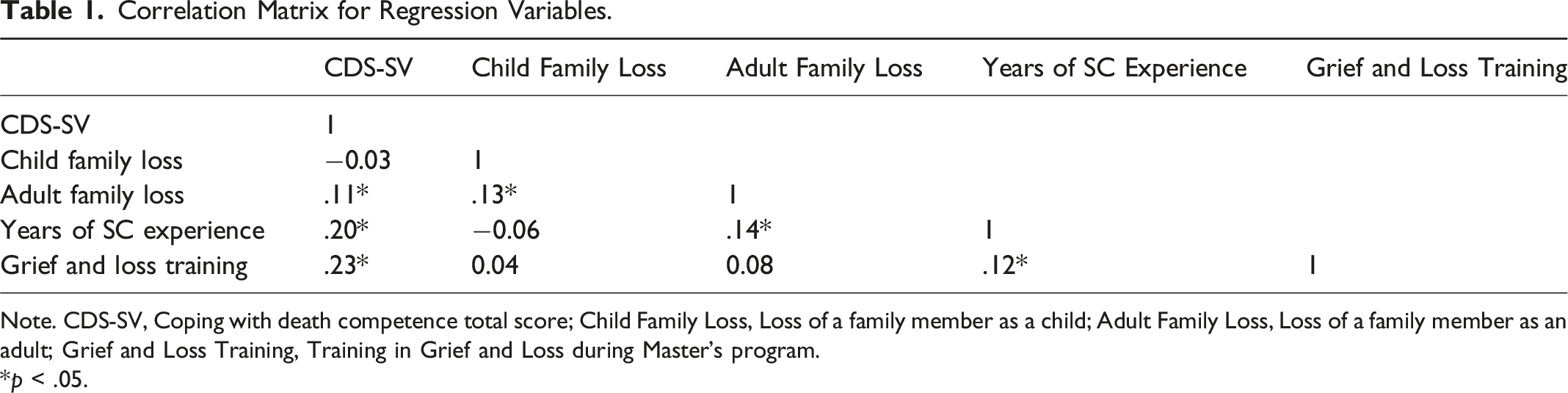
Note. CDS-SV, Coping with death competence total score; Child Family Loss, Loss of a family member as a child; Adult Family Loss, Loss of a family member as an adult; Grief and Loss Training, Training in Grief and Loss during Master’s program.
*p < .05.
Hierarchical Linear Regression Variables Predicting Coping With Death Competence.
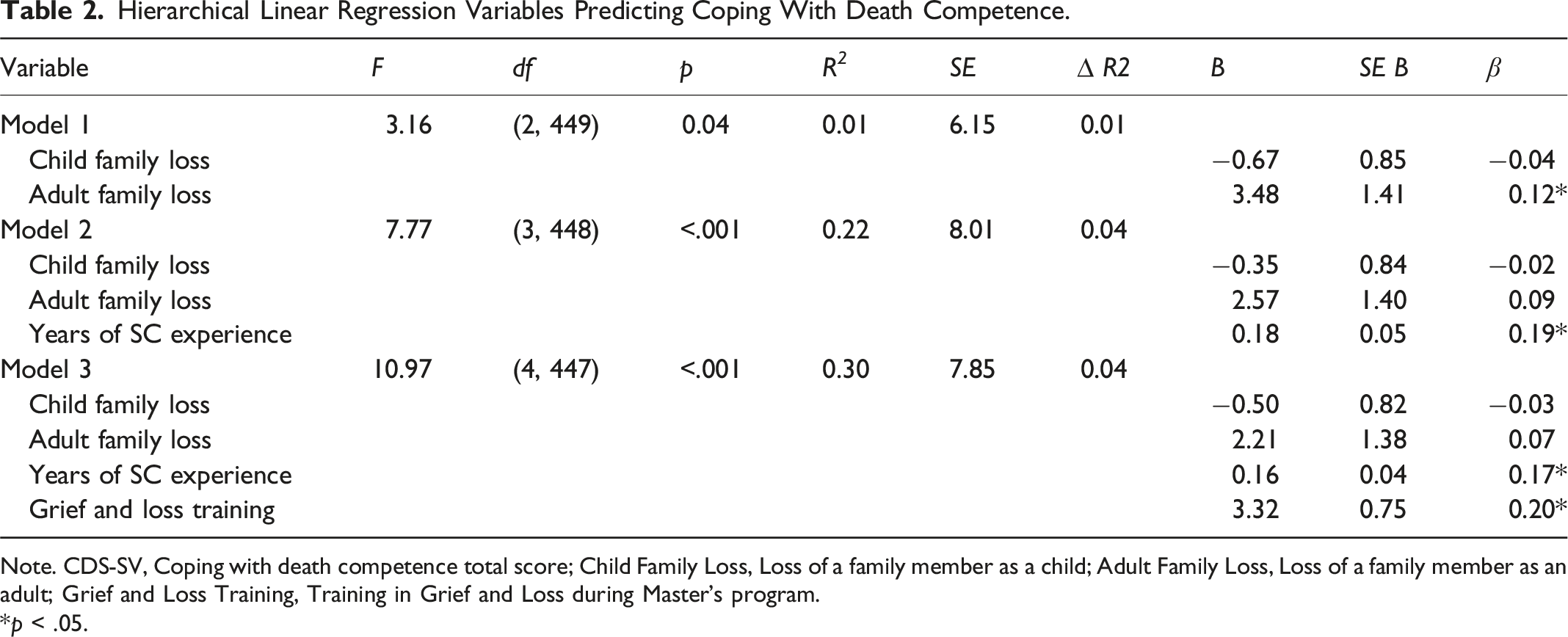
Note. CDS-SV, Coping with death competence total score; Child Family Loss, Loss of a family member as a child; Adult Family Loss, Loss of a family member as an adult; Grief and Loss Training, Training in Grief and Loss during Master’s program.
*p < .05.
Discussion
This study explored relationships between school counselors’ perceived ability to cope with death as it related to the school counselor’s own grief and loss experiences, years of experience as a school counselor, and training in their master’s program in grief and loss. We found a statistically significant relationship between coping with death competence and experiencing the personal loss of a family member as a child and personal loss of a family member as an adult. While our study differed from previous studies that found no statistical significance (Breen, 2010-2011; Deffenbaugh, 2008; Ober et al., 2012), the contrasting outcome could be attributed to different methodologies or the specifics of the type of death experienced as a child or adult. For example, Ober et al., (2012) used the Texas Revised Inventory of Grief (TRIG) in their study of 369 counselors, whereas Breen (2010-2011)’s qualitative study was completed in Western Australia and Deffenbaugh’s qualitative study focused on licensed professional counselors in Ohio. These differences between methodologies, geographic regions, and counseling specialization could all contribute to the varying results. Our study utilized the CDS-SV due to its focus on assessing how well a counselor can cope with death-related situations, based on personal views and how to comfort grieving individuals (Galiana et al., 2019), while the TRIG is not focused on the ability to support others through grief but on an individual’s past and present personal grief journey (Faschingbauer et al., 1987).
Secondly, we found a statistically significant relationship between coping with death competence and years of experience as a school counselor. This result differs from previous literature, which found no significant relationship (Ober et al., 2012), and a negative relationship (Deffenbaugh, 2008) between years of experience and grief competence. Ober et al. (2012) used the Grief Counseling Experience and Training Survey (GCETS) to measure both years of experience and training. The GCETS does not measure participants’ emotional responses or how personally comfortable they are with grief-related situations (Kaplow et al., 2014). Therefore, we chose the CDS-SV’s focus on the personal aspects of coping with grief for this study to determine how effectively school counselors can address grief and loss (Galiana et al., 2019).
Our last variable for research question one examined the relationship between coping with death and receiving grief and loss training in master’s programs, which was statistically significant. Receiving grief and loss training during their Master’s program was predictive of coping with death competence, which aligns with previous studies (Harrawood et al., 2011; Ober et al., 2012) and found significance between grief and loss training and grief competence. While those studies were not solely focused on school counselors, it does indicate the need for school counselors to be trained in grief and loss during their master’s program. For our final research question, which is also related to grief and loss training, we found that there is not a statistically significant difference between a master’s course in grief and loss and other training a counselor receives as it pertains to grief competence.
Implications
This study offers several important implications for school counselor education, professional practice, and future research. Existing literature has proposed various strategies for integrating grief and loss education throughout the CACREP core curriculum (Hartman & Brown, 2024; Horn et al., 2013; Stargell et al., 2025; Wood et al., 2023). In practice, numerous interventions, such as utilizing MTSS, developing school-wide bereavement plans, and pursuing additional professional development through organizations like ASCA, can guide school counselors in recognizing and supporting grieving students. As school counselors increasingly encounter students experiencing grief, evidence-based interventions can serve as critical tools for meeting students’ emotional and developmental needs. Finally, there are opportunities for expanding the research base to deepen understanding of grief and its application within counselor preparation programs and school-based settings. The following recommendations highlight how counselor educators, practitioners, and researchers can more effectively support students navigating grief and loss.
School Counselor Education
First, school counselor educators should consider ways to integrate grief and loss curriculum within training programs. Whether embedded across the core curriculum (e.g., Hartman & Brown, 2024; Horn et al., 2013; Stargell et al., 2025; Wood et al., 2023), in a trauma or crisis course (Montague et al., 2020), or as a dedicated course, the considerations for addressing grief and loss should be discussed.
Within school counseling curriculum, the MTSS process is one that can be useful in serving students who are grieving, and it can be introduced within the school counseling training program. As previously discussed, the MTSS process is a means of introducing grief and loss, and it can contribute to the comfortability of how to implement grief and loss interventions within the school setting. Additionally, as DeMuth et al.’s (2020) study noted, a formal grief plan is a resource that school counselors-in-training can use in learning the MTSS process. An example of a resource for this formalized grief plan is from the National Alliance for Children’s Grief (NACG), which provides a free resource titled Individual Student Bereavement Support Plan (https://nacg.org/isbsp/) to equip school personnel to help a student who has suffered a death loss (NACG, 2023). This individualized plan provides a variety of strategies across multiple areas to support the student as they re-integrate into the school environment (NACG, 2023). Implementation of a formal bereavement plan aids the student with the return and reintegration into school, while also providing support over time (Dyregrov et al., 2020).
School Counseling Practice
School counselors with extensive professional experience can contribute meaningfully to the development of tiered supports within a MTSS framework by applying their knowledge of student grief responses acquired through years of practice. As previously discussed, experienced school counselors are particularly well-suited to lead the design and implementation of Tier 1 interventions, which focus on proactive, school-wide strategies. These universal supports aim to foster a grief-sensitive environment and ensure that all students have access to developmentally appropriate resources and support following a death loss within the school community.
An additional avenue to ensure that students get the care they need is to become a Grief Sensitive School, whose aim is to cultivate a grief-sensitive school climate that proactively normalizes grief, reduces stigma, and ensures that all students receive access to developmentally appropriate education and emotional support during times of bereavement (New York Life Foundation, nd). As previously mentioned, these impactful personal experiences can spur the desire for systemic change, including the development of grief education initiatives and school-wide bereavement protocols in an effort to create emotionally supportive environments (Doka, 2005; Servaty-Seib & Corr, 2010).
ASCA provides a Grief and Loss Specialist training that school counseling students or professionals can complete to gain knowledge and skills related to grief and loss (ASCA, n.d.b). This training, which is online and self-paced, informs participants through knowing the developmental needs of children and adolescents, as well as how to serve students on both individual and school-wide levels. Graduate programs and districts can utilize this resource as a professional development opportunity for school counselors-in-training and professional school counselors, to expand the process for identifying, developing, and implementing grief and loss interventions for students.
School Counseling Grief Research
This study highlights important opportunities for advancing grief research in school counseling. First, it underscores the need for more empirical investigation into how school counselors’ training backgrounds, personal experiences with loss, and depth of knowledge about grief influence their approaches to supporting students who are grieving.
Secondly, this study suggests that systemic variables influencing grief responses within MTSS warrant further analysis. While MTSS has been applied to grief and loss within the literature (Blueford et al., 2021; Ziomek-Daigle, 2017) and specific bereavement accommodations (DeMuth et al., 2020), further research might investigate how grief is currently handled within MTSS frameworks, explore school counselor perceptions of their role in grief response, and identify the professional development needed to implement grief-sensitive MTSS effectively. For example, the Grief-Sensitive Schools Initiative demonstrated that grief-sensitive training improved educator confidence and highlighted the importance of ongoing, culturally responsive professional development (Lively-Endicott et al., 2024). While this study was focused on all school personnel, it highlights the impact of targeted professional development. Research combining the MTSS process within grief education for school counselors can create a uniformity in the system of care that can aid students who are grieving.
Lastly, by examining systemic factors, such as administrative policies, cross-professional collaboration, and resource allocation, future research can clarify the school counselor’s role and identify opportunities for targeted training in grief-informed care. This research advances the school counseling field in moving toward a more defined, impactful, and sustainable grief support systems in schools.
Limitations
One limitation of our study was that this is the first known application of the CDS-SV to a counseling population, as it is historically used in healthcare settings. Due to the use of this study within school counseling, there may be limitations with its adaptation to the field. Another limitation is the demographics of our study, which were primarily White and female. Although the demographics of the study are representative of the school counseling profession (ASCA, 2021), research suggests that cultural groups vary in their perceptions of grief and loss experiences, and some groups may have earlier and more collective loss experiences (Wilson & O'Connor, 2022). Therefore, results may not be as generalizable to school counselors who have different gender or ethnic identities. Future research should focus on topics of grief and loss with school counselors of color and other historically underrepresented identities to better understand the results of the study.
Due to the disparity between studies, additional research is warranted to better understand personal loss as it relates to grief competence. Future research could also examine types of loss (e.g., parent, sibling, extended family) as it relates to grief and loss competence for school counselors. For both studies, the populations were licensed professional counselors instead of school counselors, which could contribute to the differences due to counseling specialization. This study highlights a need for more research surrounding years of experience as a school counselor as it relates to grief and loss competence. Future research studies could explore how school counseling experience impacts grief and loss competence. This indicates that having a grief and loss course embedded within the masters curriculum provides a depth of understanding that is indicative of school counselors perceived competence.
Lastly, the current study used a correlational design that assumes linearity to investigate the variables under study. Conceptually, grief is considered to be nonlinear and can be prolonged, complicated, and cumulative (Hewson et al., 2024; Neimeyer, 2016; Stroebe & Schut, 2010). Thus, future research designs that use nonlinear approaches or investigate grief longitudinal may extend the results of the study.
Conclusion
The purpose of the current study was to determine how school counselors’ training in grief counseling influenced their perceived competence to cope with death above and beyond loss of a family member as a child, loss of a family member as an adult, and years of experience as a school counselor. We also explored if there were differences between a required grief and loss course with other specific grief training. Participants indicated that there were significant relationships between the variables, demonstrating that personal loss of a family member, either as a child or adult, years of experience as a school counselor, and training in grief and loss all demonstrated statistical significance. Additionally, a grief and loss course in a master’s program was an indicator of greater grief competence than other training related to grief and loss. As school counselors play an integral role in students who experience grief and loss, it is vital that school counselors have the requisite knowledge and skills to provide this specialized support.
Footnotes
Declaration of Conflicting Interests
The authors declared no potential conflicts of interest with respect to the research, authorship, and/or publication of this article.
Funding
The authors received no financial support for the research, authorship, and/or publication of this article.
