






Abstract
This case study focuses on an incident at a hotel and golf club that connects to guest service, service quality, the guest experience, and co-creation of the service process and product. The incident at the hotel was that the general manager, in agreement with the director of operations, simply had a note placed by the television in each room to let the guests know that there was no television service or internet service available at the property. Background information about guest service and the implications of the management decision in connection with the incident are provided. The reader of the case study is asked to assume the role of a manager, analyze the situation, and develop service recovery strategies that they could implement to manage the current negative incident and prevent service issues in the future.
Introduction
Guest service is seen as a central focus of the hospitality and tourism industry. For service businesses, including those involved in the hospitality and tourism industry, the nature of the product is different from manufactured products, such that the customer or guest is very involved in the production of the product, that of the guest experience. The guest experience has been defined as the overall impression and satisfaction that a guest receives, and the experience may seriously impact whether the guest decides to return and/or become a regular customer, or chooses to go somewhere else, and potentially leaves a bad review on a public platform (Glion Institute of Higher Education, n.d.). Furthermore, factors that form the nature of the product for service businesses include, but are not limited to, the following: the huge role the customer/guest plays in the creation of the product through his/her/their interactions with the product to create the customer experience; the fact that services cannot be inventoried; maintaining service quality standards can be difficult; timing in connection with service is very important; and the distribution channels are different from those of non-service products (Angelo & Vladimir, 2017; Deale & Hovda, 2006; Field et al., 2021).
Keys to delivering excellent service have encompassed many attributes, such as the following: remembering who the company/guest service professionals are; encouraging every employee to act like a manager; handling moments of truth correctly; hiring good people and keeping them happy; and responding promptly (e.g., Angelo & Vladimir, 2017; Deale & Hovda, 2006; Field et al., 2021). Overall, outstanding customer or guest service can build and/or save a brand while poor service can sink a brand (Podolsky, 2024). These factors impact service quality in many businesses, including lodging operations in hospitality and tourism, such as hotels and resorts.
This case study focuses on service quality and describes a service-related incident at a popular hotel. The case study is based on an incident that the author and family members, friends, and acquaintances experienced at a hotel in North Carolina, and it provides the reader with an interesting situation related to service issues and management in the hospitality and tourism industry. Through the presentation of the concepts and practices involved in guest service, and the discussion and analysis of the service issue, students have an opportunity to comprehend and analyze the components of excellent guest service, including co-creation and service recovery.
Learning Objectives
After reading and analyzing this case study, students should be able to:
Describe the components of excellent service.
Explain and assess ways to implement co-creation, develop and use service blueprints, and comprehend the guest experience effectively.
Identify, describe, and evaluate ways to address service recovery.
Recommend ways to resolve the service issues presented in the case study.
Suggest ways to avoid similar service issues in the future.
Background
This case study focuses on topics and issues related to guest/customer service. Therefore, to provide the context for the case study, brief background information is presented about the following components connected to guest service: definitions, models, and examples of guest service; co-creation; the guest experience; a service blueprint; and service recovery.
Definitions, Models, and Examples of Guest Service
Definitions of guest service vary, but one way to describe it is that it “is meeting customers’ needs in the way that they want and expect them to be met” (Angelo & Vladimir, 2017, p. 7). In addition, excellent service can be noted as offering the guest the necessary information at the correct time throughout all stages of the guest’s experience, from pre-purchase to post-experience (Maljak, 2023). Several research studies have demonstrated that outstanding service quality has a direct positive effect on customer satisfaction (e.g., Ali et al., 2021; Kurniawan et al., 2025), and numerous models for effective service have been developed (e.g., Bilgihan et al., 2024; Parasuraman et al., 1988). For example, a classic service model is called SERVQUAL, which is focused on the following five aspects of guest service: reliability, responsiveness, assurance, empathy, and tangibility (Parasuraman et al., 1988).
As noted above, service is important in the hospitality and tourism industry, and some companies have become known for their service culture and standards. For example, the Walt Disney company is known for its service culture that focuses on safety, courtesy, show, and efficiency (which used to be referred to as capacity; Disney Insights, n.d.). Whereas the Ritz-Carlton hotel company has been known for its focus on anticipatory service, and has the following motto: “We are Ladies and Gentlemen serving Ladies and Gentlemen” (Grant, 2026; The Ritz-Carlton Leadership Center, 2024).
Co-creation of Service
Another important component of service in the hospitality and tourism industry is that of co-creation, which can be described as a collaborative process that includes the engagement of a guest/customer with an entity that brings about a meaningful end product (Prahalad & Ramaswamy, 2004; Sharma & Bhat, 2020). It has been shown that if co-creation is highly positive, it offers a business a competitive advantage by improving guest/customer satisfaction and, in doing so, enhancing guest/customer loyalty (Oyner & Korelina, 2016). Researchers note that co-creation offers continuous feedback to help improve the components of guest service and provides a business with ongoing opportunities to grow its revenue and enhance quality (Chathoth et al., 2016).
The Guest Experience
Numerous definitions for the guest or customer experience can be found in the literature (e.g., Schmitt, 1999; Verhoef et al., 2009). For example, Schmitt (1999) associated five types of experiences with guest/customer service, including the following: sensory (sense), affective (feel), cognitive (think), physical (act), and social-identity (relate) experiences. Similarly, De Keyser et al. (2015, p. 14) observed that the customer experience is composed of “the cognitive, emotional, physical, sensorial, spiritual, and social elements that mark the customer’s direct or indirect interaction with (an)other market actor(s).”
Service Blueprint
One way to visualize the guest experience, and the entire service process, is via the service blueprint (e.g., Bitner et al., 2008; Milton & Johnson, 2012; Shostack, 1984, 1987). A service blueprint explains essential service actions in connection with various service processes and is used to help enhance service management. It has been applied in a variety of service encounters, including those in connection with guest service situations in hotels (Pandey & Kulshrestha, 2021).
Service Recovery
Along with the various components of service itself is the fact that guest service actions are impacted by many factors, such as the service environment, employee interactions, and product characteristics, and therefore, service issues and failures can happen (Vázquez-Casielles et al., 2010). As noted by researchers, the continuing challenge for hospitality companies is not to avoid service failures completely, but to find effective ways to recover from service glitches and/or failures (Lee, 2018). Thus, effective service recovery processes are needed to help guests/customers regain their satisfaction with the service provided (Lim et al., 2025; Nguyen et al., 2012). In addition, paying attention to service recovery justice is important (Akarsu et al., 2023). For example, distributive justice is about the fairness of the service recovery outcome, procedural justice is about the steps applied to solve the service issue(s), and interactional justice considers the fairness in terms of the interpersonal interactions, and these types of service recovery justice matter in connection with resolving all kinds of service issues (Blodgett et al., 1997).
The Dilemma
The dilemma described in this case study occurred at the Woodland Park Inn and Golf Club, which is a resort that includes a premier hotel and golf course near a well-respected, private university and hospital in the southern United States, in the metropolitan area known as the Research Triangle that includes Raleigh, Durham, and Chapel Hill, North Carolina. The 40-year-old property contains over 300 acres, including a golf course and a pretty, forested landscape, and its 300 guest rooms have lovely views of either the golf course or the forest. The hotel rooms typically sell for several hundred dollars a night, with $270 to $300 considered a great deal for a room rate at the property, and the golf course is highly rated, as are its restaurants, which include a family-oriented café, a pub-style bistro, and a fine dining restaurant. Plus, the hotel hosts many weddings, family reunions, and parties; plus, conferences, meetings, and events connected to the highly esteemed university nearby. Conferences and weddings are particularly popular events, and the hotel features an event space that can host 600 attendees. The property has a very good overall occupancy rate of approximately 80% when events are not scheduled, but during wedding season, its occupancy level rises to well above 90%, and its rooms are frequently sold out when an event or events take place on the property. In addition, family members of patients at the hospital nearby are frequently guests of the hotel. The hotel is promoted as being reminiscent of an English country inn and specifically notes on its website that, in addition to high-speed internet access and its exceptional amenities, guests can request a nightly turndown service that comes with gourmet chocolates.
On a recent summer afternoon, the hotel was sold out, and a large wedding reception was being held in the event space, which included a live band that was to play late into the night at the reception, and a note about issues with the television and internet was provided to all of the hotel’s guests in their rooms after they checked into the hotel (see Figure 1). The note indicated that the hotel had no internet or television services for guests, as the hotel leadership team had just learned that afternoon that both their internet and cable connections for guests were not viable options anymore, and changes were needed to offer those amenities to guests. The internet and/or cable television providers provided no explanations or plausible solutions, and the note was simply typed, printed out, and placed in front of the television in each guest room by the room attendants working their shifts at the time the internet and cable services were halted. Yet, while the issue was described in the note, it was not mentioned on the hotel’s website, by any staff members, or included in any written materials at the front desk. As noted, it was simply provided via the written note that was left in front of the television in each guest room. The decision to place a note by the television in each room was made by the director of operations in agreement with the general manager and was not discussed with any other management team members or other employees.
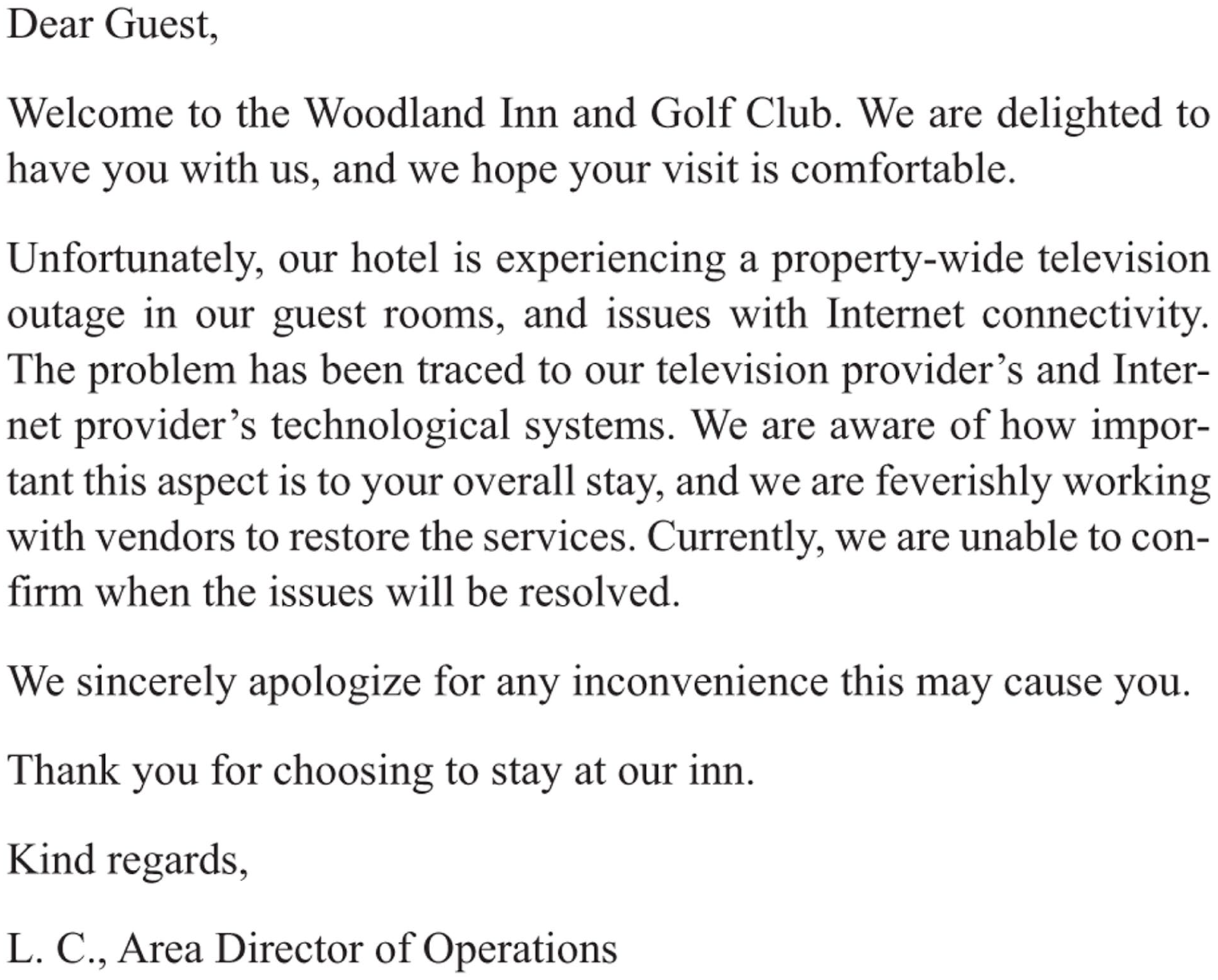
The note to the guests of the Woodland Inn.
Due to this incident, the front desk staff members were flooded with phone calls and inundated with guests who were making face-to-face complaints regarding the issue. While many guests were peaceful and cordial, others were quite angry. For example, some of the guests who were cordial over the phone and/or in-person had not even seen the note, and therefore, they were unaware of the situation and were simply wondering why they could not get on the internet or watch any television shows. However, several guests who had read the note were making irate phone calls and/or yelling in person at the front desk employees that they deserved a free room, and noted that they would never stay at the hotel again, and they would never recommend it to their friends, family members, and/or colleagues. Plus, other upset, angry guests were confronting employees who were working in the resort’s housekeeping, landscaping, golf course, and food service operations, about the issue when they saw them in the property’s hallways, lobby, gardens, dining establishments, and/or on the golf course. Furthermore, as the housekeeping, front desk, and dining staff members changed from the afternoon to the evening shift of employees, the newly arrived staff members had no idea what the guests were upset about at the typically calm, peaceful, upscale property. Additionally, when some employees became aware of the incident, they became quite upset, too. Overall, the atmosphere at the front desk area and lobby was very hectic, and the entire resort was in chaos.
To more fully understand the implications of this management decision that involved simply placing a note about the lack of internet connections and television shows in the guests’ rooms, the scenarios below demonstrate how this action specifically impacted some guests. Please see the following:
○ A young family, composed of a mother, a father, their 6-year-old son, and their 3-year-old son, came to stay at the hotel so that they could take their younger son to the nearby world-renowned hospital for cancer treatment. They thought that it would be fun to stay at the hotel to eat, relax, and enjoy some child-oriented television shows and movies in between the medical appointments they had at the hospital. Both parents were working remotely and had assumed that they would be able to use the hotel’s internet to do their jobs, while also being able to have access to the internet and the television to have their children enjoy movies, videos, and other types of entertainment throughout their stay. However, all they could access were items saved to their sons’ tablets or via the parents’ phones, and the parents were unable to access the internet to help them with their job-related tasks.
○ Also, in connection with the wedding festivities mentioned above in the case study, the bride’s aunt and uncle, an older couple, had come to stay at the hotel to attend the wedding, and had naturally assumed that they would have access to the internet. They had hoped to share live wedding moments with another aunt of the bride who was very close to the bride and her family, but was unable to attend the wedding. They also wanted to enjoy watching movies and television shows, and wanted access to the internet in between the wedding events that were taking place at the property. Yet, just like the family described above, they could not use any of those amenities.
○ In general, in connection with the wedding described above, the wedding guests depended upon access to the internet to coordinate with the wedding party, share moments in connection with the wedding in “real time” online with family members and friends who were not at the wedding, use transportation apps, access event schedules, and process digital payments. Unfortunately, due to the dilemma described here, they were unable to do any of those things while they attended the wedding and the reception.
Thus, the simple decision to use a note, placed by the television in each guest room to address the issue at the resort, turned into a very challenging situation. Poor communication was a factor in this incident as both staff members and guests were confused, upset, angry, and unsatisfied with the decision made to just leave a note by the television. It did not appear that the decision was made based on aspects of excellent guest service, such as those included in the SERVQUAL model, and/or on co-creation, in that staff members and guests were not consulted at all about the decision to leave the note. In fact, most staff members were unaware of the issue and did not know that the note had been placed in every guest room. Plus, due to emergency operations in place, the front desk staff members were able to check guests in and, therefore, did not even see evidence of the issue that guests were experiencing.
In addition, no service plan, such as a service blueprint, was available, and service recovery strategies were not considered at all. Staff members were caught by surprise and were not typically even offering an apology to their guests, as they did not even understand that the issue was taking place. Unfortunately, the director of operations and the general manager appeared to have naively thought that leaving the note was all the communication and/or service that was needed in connection with the incident. However, this simple incident turned a beautiful property into total disarray, and the employees, in every sector of the operation and at all levels, were challenged by what to do to alleviate the current chaotic situation at the property and how to prevent similar situations from occurring in the future.
Analysis
To analyze this case study, you are to put yourself in the role of a manager at the property and decide the actions you would take to mitigate the current situation and the measures you would take to prevent similar situations in the future. The focus of this case study involved what seemed like a little thing, as in a simple incident, which included a straightforward service-related action on the part of some of the hotel’s management team. However, the ramifications of that decision were not so simple and therefore, need some careful consideration to help those involved in this incident and others involved in guest service to avoid similar situations in the future.
In your examination of possible solutions, think through how to apply excellent guest service practices that include communication strategies and problem-solving techniques (e.g., Wu & Ko, 2013) and guest service models such as SERVQUAL (e.g., Parasuraman et al., 1988). In addition, consider the co-creation of service (e.g., Sharma & Bhat, 2020), the guest experience (e.g., Sofi et al., 2024), service blueprints (e.g., Pandey & Kulshrestha, 2021), and service recovery efforts (e.g., Vázquez-Casielles et al., 2010). These important aspects of guest service need to be considered to address the current situation and make improvements and plans to avoid and mitigate any difficult service-related issues in the future.
Conclusion
Overall, short-term decisions are necessary to alleviate the immediate situation occurring at the property, and improvements are needed and can be made in connection with planning and conducting excellent guest service practices to prevent service disasters such as this one in the future, and to create successful service experiences and a positive service culture. Hospitality operations need to have service policies and procedures in place that are known, understood, and practiced by all employees and shared with guests. Furthermore, while service issues can occur even with careful planning, effective service recovery procedures can truly help hospitality professionals to provide excellent guest/customer service.
Discussion Questions
After reading the case study, including the note provided in Figure 1, answer the following questions:
What do you think the major issues are regarding the situation described in connection with the note that was left by the televisions in the guest rooms at the hotel?
What communication issues do you see in the case study regarding the incident described in the case study, and how could communication at the hotel and at the resort overall be improved?
How can you use a service model, such as the classic SERVQUAL model, to assess the service provided at the hotel in connection with the incident described in the case study, and moving forward to provide excellent guest service?
How could the property’s employees and guests be involved in the co-creation of service at the hotel, and at the resort overall, to help resolve the incident described and to help prevent further issues?
How could the guest experience be improved immediately, in connection with the incident described in the case study?
How might a service blueprint be helpful in the current situation and enhance guest service in the future at the property, and what would you include in the service blueprint?
What kinds of service recovery strategies do you think could be applied to help resolve the situation described in the case study, such as the different aspects of service recovery justice (distributional, procedural, and interactional)?
What do you think could be done to prevent this kind of service issue in the future and improve the guest experience at the hotel described in the case study?
If you are an ICHRIE member, you can access the Teaching Notes for this case study here: https://ichrie.memberclicks.net/jhtc. If you are not an ICHRIE member, the Teaching Notes will be published in a future Sage Business Cases (SBC) annual collection: https://sk.sagepub.com/cases. For more information, please contact
Footnotes

Funding
The author received no financial support for the research, authorship, and/or publication of this article.
Declaration of Conflicting Interests
The author declared no potential conflicts of interest with respect to the research, authorship, and/or publication of this article.