







Abstract
The transition from adolescence to adulthood is considered a significant developmental stage in a young person’s growth. Most youth receive family support to help them weather the difficulties associated with this stage. When foster youth age out of the child welfare system, they confront the challenges associated with this developmental stage and are at risk of having to transition without family support. This article applies the life course perspective to describe the theoretical and contextual foundation that explains the hardships foster youth experience when they emancipate from the U.S. child welfare system. Next, the theoretical basis for natural mentoring among foster youth is explored using the resiliency perspective to frame the discussion. Then, current research on natural mentoring among foster youth is reviewed. The article concludes with implications for U.S. child welfare practice, policy, and research with respect to how to improve outcomes for youth who age out of foster care through the cultivation of natural mentoring relationships.
The transition from adolescence to adulthood is considered a significant developmental stage in a young person’s growth, a time when special risks and opportunities exclusive to that period surface. Young adults reach the legal age for many privileges and responsibilities, leave home, enter the workforce and/or higher education, and form long-term romantic relationships (Masten et al., 2004). This transition period is also considered a critical juncture in the course of psychopathology and mental health (Schulenberg, Sameroff, & Cicchetti, 2004). A successful transition to adulthood depends on both core (e.g., IQ, parenting quality, socioeconomic status) and adaptive resources (e.g., adult support, coping skills, planfulness/future motivation; Masten et al., 2004). Yet, vulnerable populations may not have access to such resources and are therefore at elevated risk of failing to negotiate this transition successfully. Youth who grow up amid the challenges of severe and ongoing adversity in their families and communities, including those who age out of foster care, are especially at risk of poor outcomes during this developmental stage.
During emerging adulthood, most youth receive family support to help them weather the difficulties associated with transitioning to independence (Goldscheider & Goldscheider, 1994; Schoeni & Ross, 2004). When foster youth age out of the child welfare system, they confront the challenges associated with this developmental stage and are at risk of having to transition without family support. As a result, many former foster youth experience myriad negative long-term outcomes; they often lack a high school education, suffer difficulty with employment, rely on public assistance, endure spells of homelessness, engage in delinquency (at times resulting in incarceration), experience problems obtaining health care, and face unplanned parenthood (e.g., Barth, 1990; Cook, 1994; Courtney & Dworsky, 2006; Courtney et al., 2007; Dworsky, 2005; McMillen & Tucker, 1999; Pecora et al., 2003, 2005; Reilly, 2003). A caring adult who offers social support is normative for adolescent development and protective for youth across many risk conditions (Fraser, Kirby, & Smokowski, 2004; Rutter, 1987; Werner & Smith, 2001), including youth in foster care (Ahrens, DuBois, Richardson, Fan, & Lozano, 2008; Courtney & Lyons, 2009). Natural mentoring can cultivate such relationships and is recognized as a promising approach for buffering foster youth against poor life course outcomes (Ahrens et al., 2011; Munson & McMillen, 2009). Natural mentors are naturally occurring important adults in a youth’s existing social network and can include teachers, extended family members, neighbors, coaches, and religious leaders (Hamilton et al., 2006).
This article proposes a conceptual framework that describes how the transitional period from late adolescence to early adulthood for former foster youth in the United States is characterized by not only the premature adoption of adult roles and responsibilities, but often takes place without the required help and support available to same age peers in the general population. The proposed conceptual framework also elucidates how supportive adult relationships in the form of natural mentoring can potentially buffer the developmental risks former foster youth face during this important developmental stage. Implications for U.S. child welfare practice, policy, and research with respect to how to improve outcomes for youth who age out of foster care through the cultivation of natural mentoring relationships are forwarded.
Life Course Theory and Emerging Adulthood
The life course perspective is a way to understand how chronological age, relationships, common life transitions, and social change shape people’s lives from birth to death (Elder, 1998). This perspective has developed into a dominant theoretical paradigm for studying the transition to adulthood in the United States (Shanahan, 2000), which is the period between adolescence and adulthood, or the age period from the late teens to the mid-20s (Arnett, 2000). This transition period is now commonly referred to as emerging adulthood (Arnett, 2000) and is considered a distinct period demographically, subjectively, and in terms of identity explorations. Emerging adulthood, or the “in-between age” (Munsey, 2006, p. 68), is defined by the special risks and opportunities exclusive to that period that surface. Young adults reach the legal age for many privileges and responsibilities, leave home, enter the workforce and/or higher education, and form long-term romantic relationships (Masten et al., 2004). Yet, for young people who emancipate from (i.e., age out of) child welfare, entry into emerging adulthood puts them out of sequence with prevailing institutional structures (Collins, 2001). These youth are typically on their own earlier than other young people their age due to the overall extension of youth as a life course phase over the last few decades (Furstenberg, Kennedy, McLloyd, Rumbaut, & Settersen, 2004). That is, the transition to adulthood now typically lasts until the mid- to late 20s, largely due to economic and social policy factors that influence the likelihood that a young person will successfully transition to self-sufficiency, including, housing costs, available job opportunities, and wage rates (Furstenberg et al., 2004). Currently, there is no single definition for the age range that captures the emerging adulthood stage and some variability exists with the upper limit. For example, Furstenberg, Kennedy, McLloyd, Rumbaut, and Settersen (2004) consider the upper limit to be 24–26 years, while the Society for the Study of Emerging Adulthood’s definition spans from 18 to 29 years (see http://www.ssea.org/index.htm).
A significant result of the extension of the time it takes to transition to adulthood is young people’s continued support from their families, primarily in the form of financial assistance. In the United States, nearly 1/4 of the entire cost of raising children has been estimated to occur after youth reach age 17, and nearly 2/3 of young adults in their early 20s receive economic help from parents, whereas about 40% still receive help in their late 20s (Schoeni & Ross, 2004). Moreover, about 40% of youth in their late teens and early 20s move back to their parents’ home at least once after leaving (Goldscheider & Goldscheider, 1994). These young people are typically the ones for whom emerging adulthood is characterized by identity exploration together with relative freedom from normative adult responsibilities (Arnett, 2000). In fact, as a concept, emerging adulthood has been critiqued for only being relevant to advantaged youth who have the opportunities to explore their identities and futures. Arnett (2007) argues that for most young people, well-being actually improves during emerging adulthood.
For other young people, including youth who age out of foster care well-being does not improve and in truth usually deteriorates. This is largely due to how emerging adulthood is characterized by the premature adoption of adult roles and responsibilities for this population, including money management/consumer awareness (e.g., opening a checking or savings account, reading monthly bank statements), food management (e.g., fixing meals, shopping for a week’s menu, staying within a food budget), housing (e.g., understanding the concept of renting, completing a rental application), job seeking and maintenance skills (e.g., knowing what the minimum wage is, filling out a standard job application form, dressing for work appropriately, knowing legal rights as an employee), and interpersonal skills (e.g., responding to introductions and answering simple questions, asking for help). This transition often takes place without the required help and support available to same age peers in the general population (Jessor, 1993). Thus, this early entry into adulthood is an “off-time” transition or a role change that occurs at an inopportune time; in this particular case, the change arrives too early (Hogan & Astone, 1986). The concept of emerging adulthood is a useful framework for understanding the hardships that foster youth experience when they emancipate and are forced to shoulder adults roles and responsibilities before many are prepared to do so; today, reaching the age of majority is no longer predictive of the ability to live independently of parents, parental figures, or for youth aging out of foster care, the state.
The consequences of off-time or disordered transitions have been linked to negative outcomes (Furstenberg, Brooks-Gunn, & Morgan, 1987; Hogan, 1978). Off-time transitions that occur too early are considered a crisis because individuals who experience them are often less prepared compared to those who experience the same transitions “on time” (Cooney, Pedersen, Indelicato, & Palkovitz, 1993). Moreover, off-time transitions may restrict options, exacerbate environmental adversity, and strain coping and social support systems.
Emancipation or aging out of the child welfare system creates off-time transitions for many foster youth. Aging out occurs when youth legally emancipate from the child welfare system prior to or without ever being reunified with their birth family, prior to being adopted, or prior to achieving some other permanent placement such as a guardianship arrangement. When this occurs, the child welfare system is typically considered to have failed to achieve permanency for the youth. Although 18 is typically considered the age of emancipation, today some states allow youth to remain in foster care several years following their 18th birthday (National Child Welfare Resource Center for Youth Development, 2008). This extended jurisdiction is largely a result of the landmark Fostering Connections to Success and Increasing Adoptions Act (P. L. 110–351) of 2009, designed to connect and support relative caregivers, improve outcomes for children in foster care, provide for tribal foster care and adoption access, and improve incentives for adoption (National Conference of State Legislatures, 2010). States vary with respect to under what circumstance youth are eligible for extended jurisdiction after their 18th birthday; as of May 2010, 11 states had enacted legislation related to extended jurisdiction (FosteringConnections.org, n.d.).
Prior research has shown that youth who remain in care beyond age 18 tend to fare better with respect to young adulthood outcomes (Courtney & Dworsky, 2006). However, a more recent study in a state where youth can elect to stay in care until 21 found that in their sample many chose to emancipate prior to reaching 21 (McCoy, McMillen, & Spitznagel, 2008). Findings suggested that these youth exited before required due to frustrations with the system based on their perceptions of poor service provision. For these youth, it is possible that their experience of the transition to adulthood was not “off time” despite being out of sync with societal norms; however, additional research is needed to better bring to light this possibility and explore the nuances related to timing and circumstances implied by the McCoy, McMillen, and Spitznagel (2008) study.
During fiscal year (FY) 2011, 26,286 youth nationwide experienced the transition out of foster care when they emancipated from the child welfare system because they were no longer eligible to receive services. This represents 11% of the overall child welfare population that exited foster care during FY 2011 (U.S. Department of Health & Human Services, Administration for Children and Families, Administration on Children, Youth and Families, Children’s Bureau, 2012). Because of these early, off-time transitions, a bleak portrait emerges for many of them. Figure 1 depicts the “chain of adversity” (Gotlib & Wheaton, 1997, p. 11) that typically follows youth who emancipate from foster care. The diagram shows how this critical transition can lead to persistent difficulties and hardships even after many years have passed.
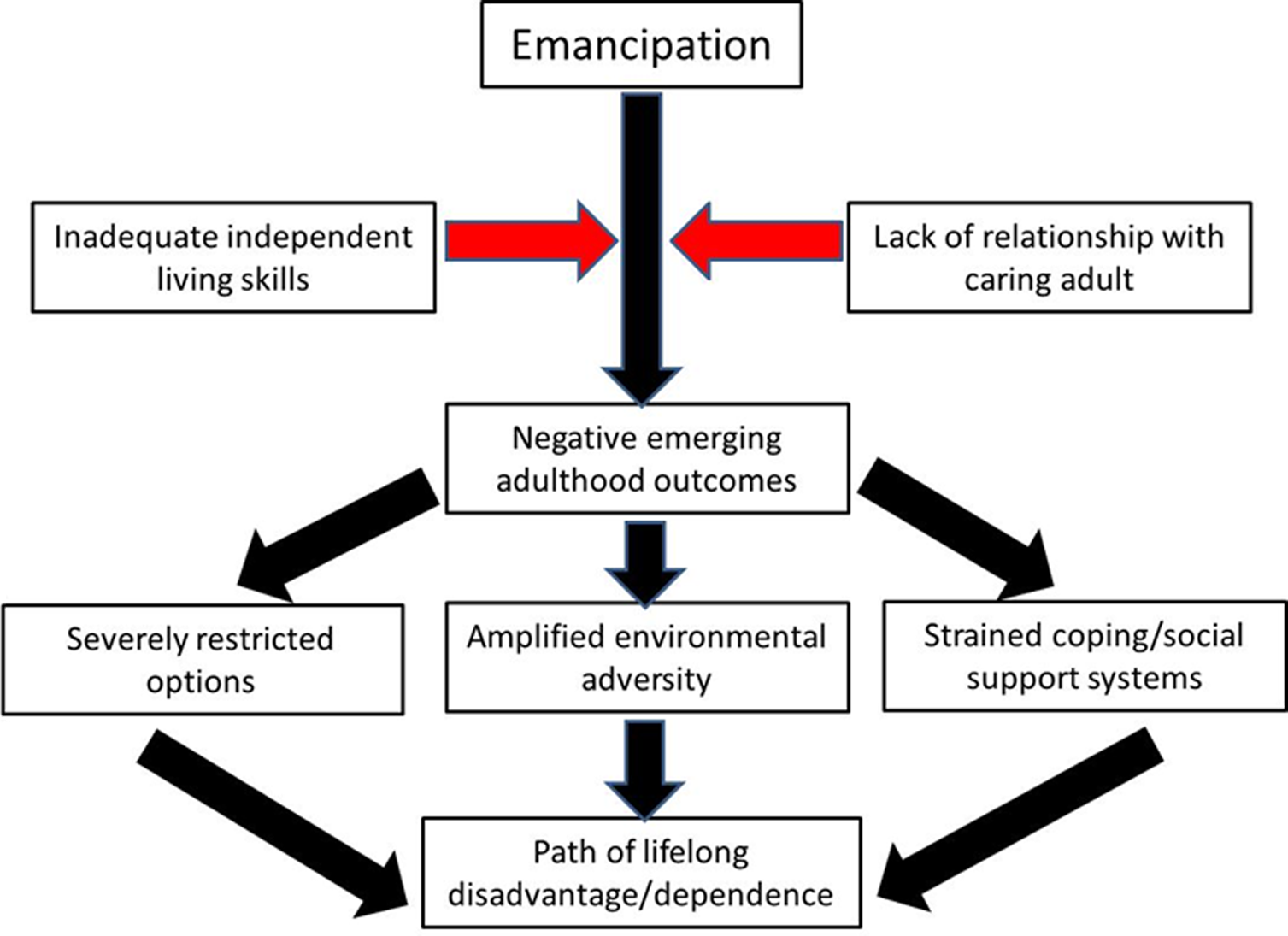
The pathway from emancipation to life-long disadvantage and dependence (adapted from Gotlib and Wheaton, 1997).
Resilience and Asset-Focused Strategies to Promote Positive Youth Development
Resilience is often defined as “the process of, capacity for or outcome of successful adaptation despite challenging or threatening circumstances” (Masten, Best, & Garmezy, 1990, p. 426). Resilience research points to three primary strategies for intervention with vulnerable youth, including asset-focused strategies, which seek to increase the amount or quality of resources available to youth that promote positive development (Masten, Cutuli, Herbers, & Reed, 2009). Assets are considered resources that enhance the likelihood of positive developmental outcomes, independent of risk status (Yates & Masten, 2004), such as factors within an individual (e.g., coping skills), within social relationships (e.g., connections to competent and caring nonparental adults), and organizations (e.g., good schools).
Resilience research concerning vulnerable and at-risk youth suggests that a relationship with at least one supportive and caring adult who is not a parent leads to improved outcomes during the emerging adulthood period (e.g., Garmezy, 1985; Rutter, 1987; Werner & Smith, 2001), especially among maltreated youth (Egeland, Jacobvitz, & Sroufe, 1988; Hines, Merdinger, & Wyatt, 2005; Lynch & Cichetti, 1992). These reports are often referred to as the beating-the-odds studies (Rhodes & Boburg, 2009). With little regard to location, time, or circumstances, the common element in the stories of at-risk youth who have beat the odds (e.g., Michael Oher, Manny Ramirez, Dave Thomas) is the presence of at least one adult—in addition to parents—who provides guidance and support. This type of relationship with a competent and caring adult has been confirmed as not only protective for at-risk youth (Rutter, 1987; Werner & Smith, 2001) but also normative for healthy adolescent development (Beam, Chen, & Greenberger, 2002).
Mentoring, or a relationship that brings young people together with caring adults who offer guidance, support, and encouragement aimed at developing the competence and character of the young person (MENTOR/National Mentoring Partnership, 2004), is one mechanism for cultivating caring relationships between youth and nonparental adults. The belief that growth-fostering relationships promote psychological health and well-being (Jordan, Kaplan, Miller, Stiver, & Surrey, 1991) guides the process of youth mentoring. A recent meta-analysis of mentoring research found support for the effectiveness of mentoring for improving youth’s behavioral, social, emotional, and academic outcomes (DuBois, Portillo, Rhodes, Silverthorn, & Valentine, 2011). The authors concluded that as an intervention, mentoring has the power to be both promotional and preventive.
Natural mentoring has emerged as one way to cultivate caring relationships between youth and adults and is as a promising approach for foster youth (Ahrens et al., 2008; Courtney & Lyons, 2009; Munson & McMillen, 2009) facing emancipation and the transition to adulthood. Theoretically and developmentally, natural mentoring may provide a better fit than other forms of mentoring, such as programmatic (e.g., Big Brothers/Big Sisters). Natural mentoring relationships form gradually and are therefore likely to be less pressured. The natural mentor is familiar to the youth, and as a result, the youth is less likely to have difficulty trusting the adult and developing an enduring bond (Ahrens et al., 2008; Britner, Balcazar, Blechman, Blinn-Pike, & Larose, 2006). Similarly, both the youth and the natural mentor are already in each other’s social networks and are likely to remain there. Consequently, the chances that the relationship will continue over time are better, and the likelihood of positive outcomes increases (Hamilton et al., 2006).
In light of its potential for longevity, natural mentoring also holds the promise of being an alternative to legal permanence for older foster youth. It offers youth the opportunity to establish lifetime relationships with nurturing individuals who can provide the relationship stability needed to help foster youth successfully make the transition to adulthood (Maluccio & Fein, 1983). This thinking is consistent with the Children’s Bureau’s Strategies for Permanency Planning with Youth, which advocates for expanded permanency options, including pursuing other permanent connections concurrently with caring adults, such as kin, teachers, former foster parents, employers, and others (Child Welfare Information Gateway, 2006).
Several studies have examined the impact of natural mentors on the lives of former foster youth. Ahrens, DuBois, Richardson, Fan, and Lozano (2008) investigated whether youth in foster care with natural mentors during adolescence had improved young adult outcomes. Mentored participants were more likely to report favorable overall health and were less likely to have reported suicidal ideation, to have received a sexually transmitted infection, and to have hurt someone in a fight in the past year. Similarly, Munson and McMillen (2009) analyzed data from a longitudinal study of older youth transitioning from foster care in Missouri. Youth in long-term natural mentoring relationships were less likely to have been arrested at age 19 and reported fewer depression symptoms, less stress, and more satisfaction with life.
Courtney and Lyons (2009) used data from the Midwest Evaluation of the Adult Functioning of Former Foster Youth to examine whether natural mentoring relationships were associated with outcomes at age 21 for former foster youth making the transition to adulthood. Results showed that closeness to an adult mentor was associated with an increase in the estimated odds of having worked in the past year and a large reduction in the odds of recent homelessness. However, unlike the two previous studies, no association between having a natural mentor and delinquency outcomes was found.
The above studies addressed the effectiveness of natural mentoring in improving outcomes for youth who age out of foster care; we know less about the processes and characteristics involved in effective youth–mentor relationships. Greeson, Usher, and Grinstein-Weiss (2010) examined the association between natural mentor relationship characteristics and emerging adulthood outcomes in a normative sample of young adults and young adults identified as former foster youth. The roles of “like a parent,” “role model,” and providing “guidance/advice” were significantly associated with having increased income expectations and asset ownership (e.g., having a bank account) during emerging adulthood for both groups.
Qualitative studies suggest that certain characteristics of caring adults are important for a successful mentor relationship, including affirmation, attention, availability, authenticity, companionship, empathy, respect, and trust (e.g., Drapeau, Saint-Jacques, Lépine, Bégin, & Bernard, 2007; Greeson & Bowen, 2008; Hines et al., 2005; Laursen & Birmingham, 2003; Munson, Smalling, Spencer, Scott, & Tracy, 2010; Spencer, 2006). Several studies demonstrate that social support, or the psychological and informational resources available to individuals through their relationships with family, friends, communities, and professionals (House, 1981), is one of the primary ways that mentor relationships may protect at-risk youth (Casey-Cannon, Pasch, Tschann, & Flores, 2006; Greeson & Bowen, 2008; Osterling & Hines, 2006). Because research on natural mentoring relationships is just emerging and the evidence base is just forming (Zimmerman, Bingenheimer, & Behrendt, 2005), previous studies have not been sensitive to the possibility that positive outcomes of natural mentoring relationships may only become evident when certain relationship characteristics are considered (DuBois & Silverthorn, 2005). Put simply, we know relatively little about what makes natural mentoring work, for whom, and under what circumstances.
Previous studies have also not been sensitive to the issue of endogeneity, which arises when there is a correlation between the independent variable and the error term, or when the factors that are supposed to affect a particular outcome, depend themselves on the outcome. Studies to date have reported associations between natural mentoring and positive psychosocial outcomes among older foster youth. However, these studies have not been able to say whether having a natural mentor leads to better outcomes or having fewer psychosocial problems leads to successful natural mentoring relationships. New research is needed to better understand these associations.
Future Expectations—A Mechanism of Change?
One way that supportive adult relationships, such as natural mentors, may positively influence foster youth’s emerging adulthood outcomes is through the encouragement of positive future expectations. Future expectations refer to the degree to which individuals have optimistic attitudes toward their future, including believing that good outcomes are achievable for them and feeling a high degree of control over their futures (Robbins & Bryan, 2004). Research suggests that mentors may affect youths’ perceptions of their futures (e.g., DuBois & Silverthorn, 2005; Hellenga, Aber, & Rhodes, 2003; Klaw, Fitzgerald, & Rhodes, 2003; Zimmerman, Bingenheimer, & Notaro, 2002). This is an emerging line of inquiry related to how caring adults may help at-risk youth develop resilience and avoid negative outcomes.
Positive future expectations have been linked to fewer risky behaviors and better young adult outcomes among both at-risk and normative samples of adolescents (Aronowitz & Morrison-Beedy, 2004; Klaw & Rhodes, 1995; Peters et al., 2005; Robbins & Bryan, 2004; Somers & Gizzi, 2001). We know much less, however, about the potential of positive future expectations to serve as a protective factor for foster youth. Only two studies are known to the author. One interviewed 350 adolescents in foster care to assess future expectations (Cabrera & Auslander, 2007). Results showed protective effects; positive future expectations were significantly associated with fewer sexual risk behaviors, fewer school behavioral problems, and safer attitudes, greater self-efficacy, and fewer risky intentions related to HIV beliefs and attitudes. In another study using data from the National Study of Child and Adolescent Wellbeing, future expectations had a counterintuitive finding; youth with higher future expectations were more likely to have engaged in sex (James, Montgomery, Leslie, & Zhang, 2009). Therefore, among foster youth, although there appears to be an association between the development of future orientation and improved outcomes, the direction of this association has not been empirically established.
Implications for Practice, Policy, and Research
Rethinking child welfare practice
Implications for practice with youth at risk of aging out foster care include both incorporating natural mentoring into existing child welfare services as well as developing programs that provide opportunities for older foster youth to interact and naturally develop relationships with caring, nonparental adults. Some may consider the idea of a natural mentoring “practice approach” paradoxical. However, the crux of the definition of a “natural mentor” is that he or she is a caring adult in a youth’s preexisting social network that the youth himself or herself identifies (as compared to being matched in a program to a stranger). Therefore, to include practice designed to cultivate and facilitate the relationship between the youth and caring adult does not inherently cease the relationship from being “natural.” Natural mentoring could be incorporated into standard child welfare permanency planning and independent living practices within foster care agencies in order to increase opportunities and supports that will more fully prepare the youth for the challenges associated with the transition to adulthood. One way this could be operationalized is through the strategies employed in Family Finding (Campbell, 2010), a program model that provides child welfare professionals with techniques for identifying and engaging family members and other adults who care about a child placed in foster care (Williams, Malm, Allen, & Ellis, 2011).
Another way natural mentoring could be operationalized in child welfare settings is through novel intervention approaches designed to facilitate and support the development of growth-fostering relationships among older foster youth and natural mentors. Such interventions could be designed to teach child welfare professionals how to better serve older foster youth by focusing on relationship facilitation and development. Both the content and the process of such interventions could be designed with hypotheses about the psychosocial conditions required to systematically modify targeted risk and protective mechanisms in mind (Snyder et al., 2006). Figure 2 shows a potential theory of change that could undergird such a practice approach in child welfare settings. Such interventions could use the natural mentoring relationship as the vehicle for teaching independent living skills, just as youth in the general population learn how to open a bank account, fix meals, ask for help, apply for a job, fill out a rental application, and so on, from their parents/caregivers. Developmentally, an approach to teaching independent living skills that capitalizes on the emotional connection between the foster youth and his or her natural mentor is a better fit with how youth naturally learn such skills. Other practice elements for child welfare professionals could include: (a) an overview of adolescent/young adult development in order to set the stage for the relationship, (b) an overview of the concept of emerging adulthood as a distinct developmental stage, (c) a Family-Finding approach to assessing youth’s connections to caring adults followed by locating these adults and engaging them about being a significant part of the youth’s life as a supportive adult, (d) supervision and support groups for the youth, the natural mentors, and the dyads, (e) activities designed to cultivate bonding and attachment between the youth and natural mentor (e.g., field trips, group activities), and (f) didactic training for the child welfare professionals and natural mentors pertaining to trauma and the concept of being “trauma-informed” 1 when working with and serving youth in foster care. Incorporating practices such as those associated with Family Finding as well as novel natural mentoring interventions within the permanency planning and independent living frameworks of child welfare is consistent with the current thinking about the potential benefit of integrating mentoring into comprehensive programs and services designed to promote positive youth development (Kuperminc et al., 2005).
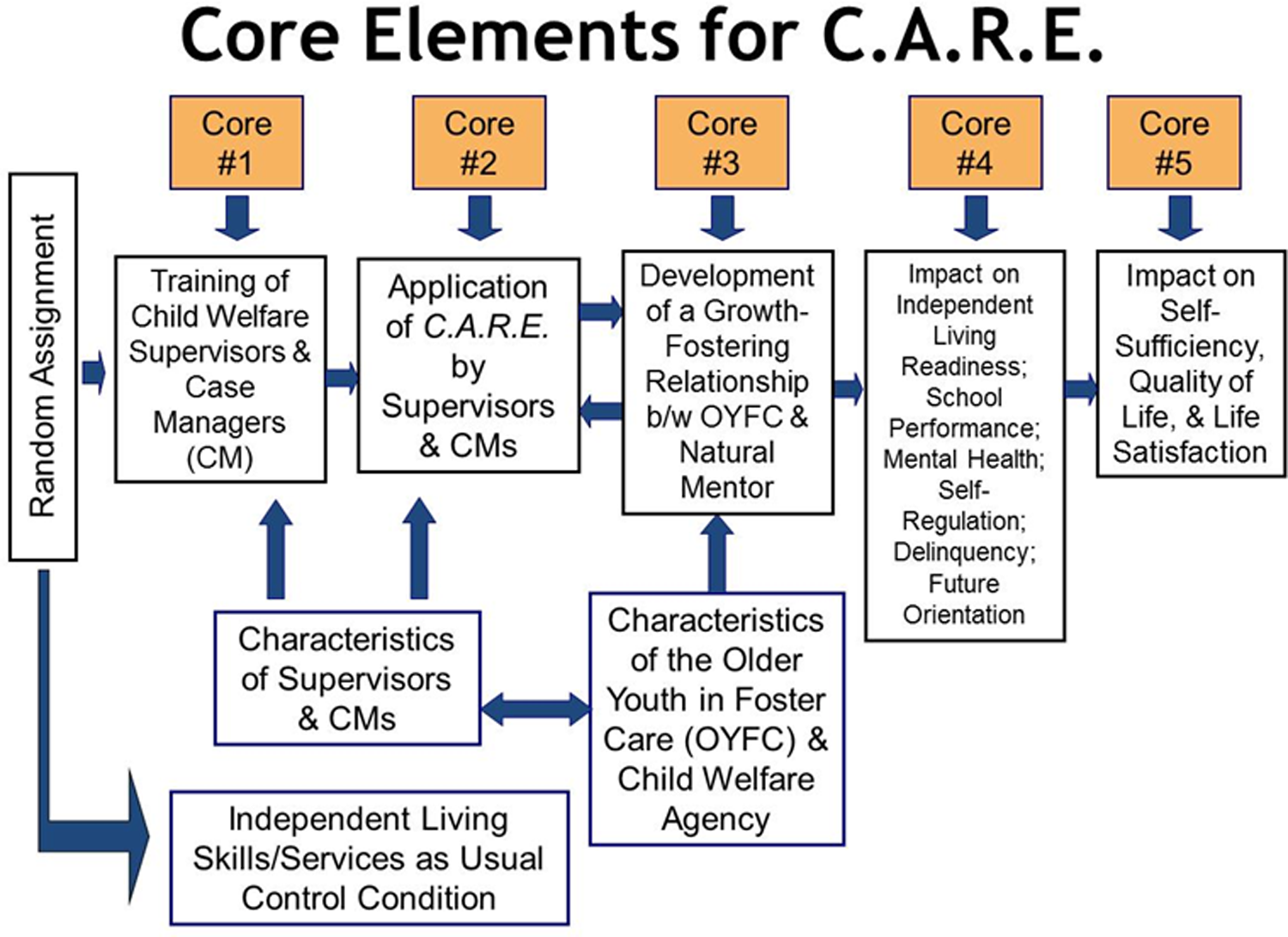
Theory of change for a child welfare–based natural mentoring intervention.
Development of natural mentoring relationships could also be facilitated by programs that provide opportunities for older foster youth and nonparental adults to interact naturally. This type of model has already been developed for at-risk adolescent mothers and has shown promising results. Healthy Start (Duggan et al., 2000) and the Nurse–Family Partnership (Olds, 2006) provide at-risk adolescent mothers with opportunities to connect with nonparental adults through frequent home visits made by nurses (Hurd & Zimmerman, 2010). Existing programs for older foster youth like those intended to teach independent living skills could also invite important nonparental adults in foster youths’ lives to program meetings and activities. These programs could also involve adult community members who may be especially interested in connecting with and supporting older foster youth (e.g., former foster youth).
Although natural mentoring for foster youth makes sense theoretically and conceptually, there is the concern that the process could result in yet another failed relationship, particularly for those youth for whom building meaningful connections is difficult. Spencer, Collins, Ward, and Smashnaya (2010) describe the attachment-related difficulties that many youth in foster care face. A large proportion of older youth in foster care have significant maltreatment histories, are related to insecure attachments, including mistrust of others and wariness in relationships (Price & Glad, 2003). Mentor abandonment is another way that these relationships can fail, and is considered one of the primary reasons why mentoring relationships, in general, end. Concern about mentor abandonment extends to foster youth as well (Clayden & Stein, 2005). In light of both attachment-related difficulties and the risk of mentor abandonment, the way that natural mentors already exist in a youth’s social network further suggests that natural mentoring could be the best way to meet foster youth’s critical needs for supportive connections with caring, nonparental adults. Additionally, if embedded within child welfare services in particular, practice support may reduce natural mentor abandonment, for example, if training for the adults includes how to end the youth–natural mentor relationship in a healthy, potentially corrective way, if necessary and unavoidable. When handled properly, even the ending of a significant relationship, like with a natural mentor, can be a “corrective emotional experience” (Olds, Kitzman, Cole, & Robinson, 1997) for those, like foster youth, who have experienced poor relationships with other significant adults, in particular their parents/caregivers.
Although contradictory to natural mentoring, it is important to note the current prevailing approach to child welfare practice that is utilized with older youth in foster care, that is, independent living programming. This programming has been developed based on the notion that by using a cognitive theory instructional model designed to teach older foster youth certain skills considered related to self-sufficiency, they will be ready to successfully transition to adulthood and live independently. Alternatively, mentoring is grounded in Relational–Cultural Theory (Munson & McMillen, 2008), which posits that development occurs through involvement in growth-fostering relationships that provide authenticity, engagement, and empowerment, which in turn promote psychological health and well-being (Jordan et al., 1991).
Additionally, it is conceivable that natural mentoring relationships could provide the context for teaching youth independent living skills by providing a caring adult who is able to model essential self-sufficiency skills. In turn, the youth could “learn by doing” and be afforded the support and guidance of the natural mentor through this developmental process. The association between having a natural mentor who is a role model and learning independent living related skills has been established empirically by Greeson et al. (2010) who found that having a natural mentor who served as a role model was associated with having a bank account in both former and nonformer foster youth during the emerging adulthood period.
Strengthening policy to support foster youth during emerging adulthood
Federal legislation providing support for mentoring of foster youth who age out of care exists (i.e., The Foster Care Independence Act of 1999) and bills have been introduced in Congress in recent years that would provide grants to states to encourage more mentoring programs to serve foster youth (e.g., Foster Care Mentoring Act of 2009). There is also state legislation enacted in both Iowa and Georgia as part of the Fostering Connections to Success and Increasing Adoptions Act that requires these states to create opportunities for older foster youth to have a mentor (FosteringConnections.org, n.d.). However, there is little guidance with respect to how to develop and implement mentoring interventions for this population (Spencer, Collins, Ward, & Smashnaya, 2010). For example, natural mentoring seems to make more sense, both theoretically and developmentally, for foster youth, as compared to other forms of mentoring, such as programmatic. Federal policy contains little information about such distinctions; yet the potential differences in youth outcomes are great.
Moreover, despite federal funds being available for mentoring programs, states must choose whether this is the best use of already limited funding for child welfare services. The issue, therefore, becomes what makes natural mentoring a more favorable potential policy approach to promoting positive emerging adulthood outcomes for foster youth? Although more effectiveness research is needed, the current evidence base suggests that a caring, supportive nonparental adult relationship that is consistent and long lasting can achieve improved emerging adulthood outcomes for youth who age out foster care, as compared to the traditional approach to youth policy, which attempts to prevent specific problems or to correct problems that have already arisen (Spencer et al., 2010). The current evidence base for natural mentoring for foster youth thus provides a direction for building and strengthening one approach to ameliorating the negative outcomes associated with aging out of foster care.
A research agenda for the future
Several types of research are needed to significantly advance the field of natural mentoring as it pertains to foster youth transitioning to adulthood. These include (1) effectiveness research using newly designed longitudinal surveys that sample children and families who have contact with the child welfare system, (2) intervention research with large, representative samples of foster youth that uses random assignment, (3) mechanistic research to facilitate a more sophisticated understanding of the processes by which natural mentoring achieves positive outcomes, and (4) studies designed to better understand how to measure resilience as cultivated through supportive adult relationships. Each of these areas is described below.
Additional effectiveness research is needed in order to strengthen the evidence base for using natural mentoring as a means to smooth the transition to adulthood for youth who age out of foster care. This includes new longitudinal surveys on children and families who have contact with the child welfare system and that also contain prospective questions pertaining to supportive adult relationships, including natural mentors. Such surveys could be exclusive to child welfare (e.g., National Survey for Child and Adolescent Wellbeing). They also could be of the normative population (e.g., National Longitudinal Study of Adolescent Health, aka Add Health), but with oversampling procedures built in so as to include enough former foster youth for a meaningful statistical analysis of this subgroup. For example, Greeson et al. (2010) used Add Health to examine the association between natural mentor relationship characteristics and outcomes during the emerging adulthood period in both a normative sample of young adults and young adults identified as former foster youth. Youth were first asked about having a natural mentor, “Other than a parent/step–parent, has an adult made an important positive difference in your life at any time since you were 14 years old?” This question was then followed with, “How old were you when s/he first became important in your life?” which permitted assessment of when the relationship started. Then to gauge if/when the relationship ended, youth were asked, “How many years has the adult been important in his/her life?” (UNC Carolina Population Center, n.d.). Greeson and colleagues found that the relationships identified by the young adults had lasted between 8 and 10½ years, and for nearly 100% of both groups, the relationship was still important to them.
There is also the need for new natural mentoring research with large, representative samples of youth in general and foster youth in particular in order to maximize sensitivity to relationship dynamics and generalizability of the findings. Furthermore, to test causal relationships between natural mentoring relationship characteristics and emerging adulthood outcomes, future research should model these variables longitudinally or in repeated-measures control-group designs. More specifically, intervention research that uses random assignment in order to address the issue of endogeneity is needed. Endogeneity is often described as having three sources: omitted variables, measurement error, and simultaneity. An independent variable (Xj ) is endogenous if it is correlated with ∊. For example, one problem that could arise due to endogeneity would be establishing whether the difference in outcomes is due to mentoring, or are youth who are better adjusted more amenable to being mentored? If foster youth were randomly assigned to receive “services as usual” (i.e., independent living services) or a natural mentoring intervention, establishing causality would be determined by ascertaining whether natural mentoring and positive psychosocial outcomes during emerging adulthood are correlated.
Additionally, as interest in natural mentoring continues to grow, there will be a need for studies that facilitate a more sophisticated understanding of the mechanisms and processes by which natural mentoring achieves positive outcomes among both normative and at-risk samples of young adults. For example, is the encouragement of positive future expectations a mechanism of change for older foster youth? Describing exactly how growth-fostering relationships with caring adults buffer youth from negative outcomes and promote positive outcomes remains a challenge (Rhodes, Spencer, R., Keller, T. E., Liang, B., & Noam, 2006). Future research should probe beyond the question of whether natural mentors make a difference by asking how they make difference, for whom, and under what circumstances. Studies which utilize conceptual models that include indirect effects are needed for better understanding the role of natural mentoring in the lives of foster youth, which in turn can inform intervention development and testing
In addition to effectiveness and mechanistic natural mentoring research, the field would benefit from better understanding how to measure resilience as cultivated through these supportive adult relationships, particularly in at-risk populations, such as foster youth. Although multiple measures of resilience exist, whether and how they work for foster youth are not well understood. We are aware of only one data set which specifically focuses on older foster youth that also includes multiple and diverse measures of resilience promoting and adaptive resources (i.e., McMillen’s Mental Health Service Use of Youth Leaving Foster Care, 2001–2003 also known as VOYAGES). VOYAGES involved 406 Missouri foster youth first interviewed at age 17. The original study explored changes in mental health service use as older youth leave foster care, as well as many additional parameters of the lives of older foster youth, from their perspective, including the following resilience promoting and adaptive resources (National Data Archive on Child Abuse & Neglect, 1996–2012): (1) Benevolent World scale (Janoff-Bulman, 1989), which assesses the degree to which one views the impersonal world (e.g., events) and people positively or negatively. The more positive one’s assumptions are, the more one expects good things, rather than bad, to happen and the more one views people as basically good, kind, helpful, and caring; (2) Life Orientation test–revised (Scheier, Carver, & Bridges, 1994), which assesses dispositional optimism; (3) Multidimensional Measure of Religiousness/Spirituality (Fetzer Institute & National Institute on Aging, 1999); (4) Rosenberg Self-Esteem scale (Rosenberg, 1965); (5) Students’ Life Satisfaction scale (Terry & Scott Huebner, 1995), (6) Perceived Benefit scale (McMillen & Fisher, 1998), which assesses perceived positive life changes after negative events; and (7) McMillen, Scott, and Auslander (2001a, 2001b) own measures of helpful people and influential adults. New research is needed that use the VOYAGES data set (and any similar ones) and these constructs specifically in order to elucidate whether and how such measures of resilience promoting and adaptive resources work for the foster care population.
Like most research that address at-risk and vulnerable youth, the historical focus of child welfare research pertaining to youth who age out of foster care has largely concerned “what’s wrong” with the population, such as psychopathology, substance use/misuse, legal/criminal justice involvement, homelessness, nonmarital pregnancies and births, and delinquency/violence. Although it is important to initially establish the epidemiology of these types of problems in order to describe the population, a number of studies have accumulated and today the unanimous consensus is that it is not typical for youth to emancipate from the child welfare system and function effectively on their own. As such, future research concerning this population would benefit from a new paradigm, one that employs a “positive psychology” framework and highlights the strengths and virtues that enable foster youth to not just survive, but thrive, including growth-fostering relationships with caring adults.
Conclusion
The life course and the resilience perspectives offer a rich potential for both how to conceptualize aging out and emerging adulthood experiences for foster youth and possible ways to intervene with the goal of easing the often tumultuous transition experience. Viewing the emancipation of foster youth within the context of emerging adulthood and an “off-time” transition provides a framework for better understanding the hardships they experience when required to shoulder adult roles and responsibilities prematurely and without the support typically afforded their same age peers. The resilience perspective provides a framework for considering potential intervention points or the processes that underlie resilience that mediate positive youth development outcomes. One of these processes or adaptational systems is healthy attachment relationships (Masten, 2001), for example, a relationship with a caring, nonparental adult. When the basic adaptational systems like having healthy attachment relationships are operating well, resilience can be expected (Yates, Egeland, & Sroufe, 2003; Yates & Masten, 2004). As such, helping older foster youth cultivate natural mentor relationships is potentially an effective strategy for promoting resilience and smoothing the often rough road of emerging adulthood for youth who age out of foster care.
Footnotes
Declaration of Conflicting Interests
The author declared no potential conflicts of interest with respect to the research, authorship, and/or publication of this article.
Funding
This work was funded in part by a Ruth L. Kirschstein National Research Service Award from the National Institute of Child Health & Human Development (2T32HD007376-21A1) awarded to the University of North Carolina at Chapel Hill, Center for Developmental Science.