







Abstract
Life satisfaction during emerging adulthood is important because it promotes positive psychological functioning and prevents risky behaviors that lead to poor health. Self-determination theory emphasizes the agentic nature of individuals to maintain well-being through the psychological needs of autonomy, competence, and relatedness, and the social contexts which influence these processes. Because siblings serve as an emotional resource throughout the life span, sibling support may predict well-being through these psychological needs. With this framework as a guide, 337 individuals from the Family Transitions Project reported sibling support at 17 years old, sense of autonomy, competence, and relatedness at 19 years old, and life satisfaction at 20 years old. Sibling support in adolescence was significantly associated with autonomy, competence, relatedness, and life satisfaction in emerging adulthood. Sense of competence mediated the association between sibling support and later life satisfaction. Results highlight the unique influence of siblings in contributing toward life satisfaction.
What contributes to individual life satisfaction during the transition from adolescence into emerging adulthood? Typically occurring from late adolescence to the mid- to late 20s, this period is filled with decisions regarding educational and career trajectories as well as adult roles (see Arnett, 2004; Mouw, 2005). Despite the choices individuals make—whether they continue education, pursue employment, begin a family, or a combination of these roles—the perception of receiving support and a sense of determination may be central to a satisfying life. This study investigates whether psychological perceptions related to motivation mediate the association between sibling support and later life satisfaction during the transition into emerging adulthood.
Life Satisfaction
Life satisfaction, satisfaction related to specific activities, and emotional responses together creates the construct of subjective well-being. Life satisfaction incorporates the full spectrum of functionality by measuring achievement of happiness and well-being as well as symptoms of psychopathology (Proctor, Linley, & Maltby, 2008). For instance, high life satisfaction is associated with high levels of hope and self-esteem as well as lower levels of psychopathology and substance use among adolescents and emerging adults (Proctor et al., 2008; Valois, Zullig, Huebner, Drane, & Zullig, 2013; Zullig, Valois, Huebner, Oeltmann, & Drane, 2001). Given that the presence of life satisfaction is accompanied by lower risky behaviors and health problems, it is critical to investigate the individual and social factors that contribute to high levels of life satisfaction during the transition from adolescence into emerging adulthood.
Using life satisfaction as an indicator of subjective well-being allows researchers to identify individual strengths as potential buffers against psychopathology. For example, high levels of social support from adult siblings, peers, fathers, and mothers are associated with high life satisfaction during emerging adulthood (Milevsky, 2005; Proctor et al., 2008). In addition, positive characteristics related to personality such as a sense of purpose in life, emotional stability, self-directedness, extroversion, and self-esteem are associated with high life satisfaction during emerging adulthood (Garcia, 2011; Proctor et al., 2008; Rigby & Huebner, 2005; Sumner, Burrow, & Hill, in press. Given this research, family support and psychological perceptions may play an integral role in the maintenance of life satisfaction during adolescence and early emerging adulthood.
Life satisfaction is moderately stable but experiences a linear decline across all life domains, during adolescence and emerging adulthood (Goldbeck, Schmitz, Besier, Herschbach, & Henrich, 2007; Lucas & Donnellan, 2007; Montepare, & Lachman, 1989). Because emerging adults may be at risk for declines in life satisfaction, it is beneficial to identify social support and psychological factors that promote life satisfaction. However, most previous studies investigating these links have been cross-sectional or retrospective in nature, thus limiting our confidence in whether these variables associate with life satisfaction across emerging adulthood. In addition, previous work investigating life satisfaction during emerging adulthood heavily relies on samples of college students, thus excluding those emerging adults not attending college. Using longitudinal data, this study investigates individual and social influences on life satisfaction using a community sample followed from adolescence to the emerging adulthood years.
Psychological Needs as Determinants of Life Satisfaction
Self-determination theory emphasizes the nature of individuals to actively maintain their satisfaction and well-being through the three psychological needs of autonomy, competence, and relatedness (Ryan & Deci, 2000a). These researchers describe autonomy as feeling agentic, competence as feeling effective, and relatedness as feeling connected to others. Satisfying these three psychological needs is theorized to engender intrinsic motivation, which is defined as pursuing an activity or goal for personal satisfaction, interest, or challenge, rather than for extrinsic reasons, which are represented by monetary or social rewards (Deci, 1971). Further, Sheldon, Elliot, Kim, and Kasser (2001) tested the salience of competence, autonomy, and relatedness as psychological needs, along with seven other candidates, among college students. The results yielded that autonomy, competence, and relatedness consistently appeared among the top four psychological needs for event satisfaction, which corroborates the importance of these variables in relation to life satisfaction. Based on self-determination theory and the Sheldon et al. (2001) study, feelings of competence, autonomy, and relatedness may play an important role in predicting later life satisfaction.
Competence
A sense of competence is discussed by researchers in terms of global or domain-specific ability conceptions. Dweck (2002) suggests these ability conceptions are characterized by variations in goal setting, efficacy, and motivation. A greater sense of competence during adolescence is positively linked with concurrent and emerging adult life satisfaction (Leversen, Danielsen, Birkeland, & Samdal, 2012; Proctor et al., 2008).
Autonomy
Autonomy is defined as a high degree of experienced choice, control, and mastery in daily and long-term life decisions (Deci & Ryan, 1985; Mirowsky & Ross, 1998). Feelings of autonomy positively influence behavioral, cognitive, and affective processes (Deci & Ryan, 1985). For example, a greater sense of autonomy is associated with the role in developing a healthy lifestyle (Mirowsky & Ross, 1998) as well as life satisfaction during adolescence (Leversen et al., 2012).
Relatedness
Larson (2006) highlights the role of perceiving supportive and caring adults in the development of youth motivation and engagement. One type of support, motivational scaffolding, is conceptualized as modeling enthusiasm and communicating confidence, supplying guidance toward achievable goals, and providing challenging experiences that matches the youth’s abilities (Larson, 2006). This scaffolding helps youth set realistic goals, persevere through challenges, and experience success. A greater feeling of relatedness positively predicts higher levels of concurrent life satisfaction during adolescence (Leversen et al., 2012).
Psychological needs within a social context
Self-determination theory emphasizes the salience of the social context in which psychological needs develop (Ryan & Deci, 2000a). For example, if an individual’s sense of autonomy, competence, and relatedness is supported in a given context, an individual is more likely to be self-determined. In a review of extant research, Deci and Ryan (1987) discussed how research has converged on the notion that social support of autonomy is positively associated with an individual’s intrinsic motivation as well as other indicators of well-being such as creativity, cognitive flexibility, conceptual learning, positive emotional tone, self-esteem, trust, persistence, and physical and psychological health in comparison to environments characterized by social control. The authors argue that these outcomes result from how an individual self-regulates his or her intentional behavior based on the support in a given social environment. Because the social context has the potential to contribute to the variance explained in the three psychological needs, this study includes the specific context of sibling relationships as one factor in understanding later psychological needs and life satisfaction.
Previous research suggests that parental factors can qualify an individual’s sense of psychological needs. For instance, more years of parental education significantly predicts greater adolescent academic engagement and emerging adulthood academic achievement, which are relevant to psychological needs (Melby, Conger, Fang, Wickrama, & Conger, 2008). In addition, individuals living in a single-parent household during adolescence report low psychological and educational adjustment such as high rates of delinquency, problems in school, and school suspension and expulsion as well as low grade point averages and verbal exam scores (e.g., Manning & Lamb, 2003).
Siblings as a Social Resource
Sibling relationships are neglected across relationship research as shown in psychological and sociological abstract database searches (McHale, Updegraff, & Whiteman, 2012). Searching from the year 1990 to 2011, the term “siblings” only yielded 741 citations compared to the 33,990 for “parent and parenting” and to over 5,000 for “peers,” “peer relations,” and “peer relationships.” Given how sibling interactions catalyze social understanding and socioemotional competence, the underrepresentation of siblings in adolescent research is rather surprising (Kramer & Conger, 2009). Sibling interactions, even those including conflict, contribute to social and cognitive development such as perspective taking, emotion understanding, negotiation, persuasion, and problem solving (Conger, Williams, Masyn, Little, & Shebloski, 2009), which is linked with later psychological perceptions and successful behaviors including self-validation, social competence, empathy, motivation, and academic achievement (Alfaro & Umaña-Taylor, 2010; Kramer & Conger, 2009; McHale et al., 2012). In addition, these positive sibling relationships appear to have lasting effects into emerging adulthood, such as college educational attainment (Melby et al., 2008). A potential mechanism for this influence may be the supportive behavior for nonfamilial issues that arise from positive sibling relationships (Tucker, McHale, & Crouter, 2001). Siblings may act as ideal models, through both observational learning and sibling deidentification (Whiteman, McHale, & Crouter, 2007), for developing and adapting strategies for motivationally driven perceptions and behavior, which in turn may influence life satisfaction during emerging adulthood.
Conger and Little (2010) propose a dynamic recentering approach for describing sibling relationships during the transition into emerging adulthood. They suggest that even though family ties may become de-emphasized during emerging adulthood due to the incorporation of new relationships, siblings become warmer and less conflictive with one another because their relationships are less strongly influenced by parental interactions. Goetting’s (1986) work supports this notion, as youthful sibling relationships were characterized as intense through conflict over space and family resources but also through companionship and emotional support during stressful times. Although these relationships diffuse in intensity during emerging adulthood, they still act as an emotional resource for events such as education, employment, marriage, and raising children (Conger & Little, 2010; Goetting, 1986; Milevsky, 2005). Sibling relationships are an important source of modeling, support, and warmth throughout these life stages.
There are several family factors that contribute to sibling relationships. Previous research suggests that parental education significantly predicts adolescent sibling relations, such that more years of parental education were associated with greater sibling relationship quality (e.g., Melby et al., 2008). Parents with more education may have more communication and problem-solving strategies and, in turn, model these behaviors for their children to build successful relationships. Sibling relationships can also be qualified by dyad characteristics, such as birth order and sex. For example, older siblings act as a buffer between family stress and psychological adjustment and as a source of support for nonfamilial issues including socializing, schoolwork, and risky behaviors (Conger, Conger, & Elder, 1994; Kramer & Conger, 2009; Tucker et al., 2001). This research suggests that younger siblings may receive greater benefits than older siblings in their relationships. In addition, sisters rate one another more highly on ratings of intimacy, companionship, admiration, warmth, sharing advice, and closeness than brothers or mixed sibling dyads (e.g., Buhrmester & Furman, 1990; Tucker, Barber, & Eccles, 1997; Updegraff, McHale, Whiteman, Thayer, & Delgado, 2005). Thus, sisters may develop closer relationships and share greater support than brothers or mixed pairs.
Psychological Needs
A few studies have directly examined the link between sibling behavior and psychological needs. Conger, Williams, Masyn, Little, & Shebloski (2009) found that observed positive problem-solving behavior within the sibling dyad positively predicts adolescent competence. Adolescent perceptions of high sibling confirmation, or validation of ideas and feelings, significantly predicted greater autonomy (Dailey, 2009). No studies to date have investigated the link between sibling support and relatedness during adolescence or emerging adulthood; however, some research indicates that moderate levels of both sibling support and conflict, as opposed to low support and high conflict, are associated with greater social competence during elementary school (Stormshak, Bellanti, & Bierman, 1996). Thus, it is beneficial to further investigate the effect of sibling support on later perception of psychological need satisfaction.
Life satisfaction
Although limited in number, there are a few studies that suggest that sibling relationships contribute to life satisfaction during emerging adulthood. Proctor, Linley, and Maltby (2008) reviewed variables predicting levels of life satisfaction during adolescence and early emerging adulthood. Positive sibling relationships were associated with high life satisfaction, especially as sibling relationships become a unique resource during late adolescence and into emerging adulthood due to shifts in socioemotional skills and peer networks. In addition, perceiving siblings as highly supportive is linked with high life satisfaction among the full spectrum of emerging adults and beyond, ages from 19 to 33 (Milevsky, 2005). Positive sibling relationships may act as a supportive resource during emerging adulthood, and as such, it is advantageous to investigate the psychological mechanisms through which siblings contribute toward life satisfaction.
Current Study
Drawing from this review of the life satisfaction, motivation, and sibling literature, this study investigates the associations between sibling support during adolescence, psychological needs during the transition into emerging adulthood, and life satisfaction during emerging adulthood. Within this overarching goal, this investigation includes four aims. First, we examine sex, birth order, and parental composition differences in sibling support, psychological needs, and life satisfaction. Because the literature on sibling relationships suggests that younger siblings and sisters report higher scores of support and intimacy, we expect that females, participants with sisters, and younger siblings will score more highly on sibling-related variables. We also expect adolescents to report greater sibling support in two-parent families. Second, we investigate the effect of sibling support on psychological needs and life satisfaction. Previous research on sibling relationships shows that supportive sibling behavior predicts positive outcomes; we expect sibling support to positively predict psychological needs and life satisfaction. Additionally, we hypothesize that psychological needs will positively predict life satisfaction. Third, we examine competence, autonomy, and relatedness as mediators between sibling support and later life satisfaction. These variables are theorized to act as mechanisms for individuals to maintain well-being through a supportive environment; we expect competence, autonomy, and relatedness to individually and positively mediate the association between sibling support and life satisfaction. Fourth, we test if sibling support predicts relative change in life satisfaction from adolescence to emerging adulthood. While life satisfaction research indicates moderate stability during emerging adulthood, we expect that psychological needs contribute to both level and relative change in life satisfaction.
Method
Participants
The Family Transitions Project (FTP) is an ongoing, longitudinal study of 556 target youth and their families. Interviews were first conducted with members of this cohort of adolescents in 1991, when they were in the ninth grade. Of the original 556 families, 107 adolescents lived in single-mother families and the remainder of these youth lived with both of their biological parents, and the retention rate is about 90% through 2007. The majority of the participants were drawn from rural counties in north central Iowa. Because this area had a minority population of only about 1%, all the participants were European Americans from primarily lower middle and middle-class families. Both the two-parent families and the single-mother families were based on community samples rather than self-selected volunteers or clinical cases. All eligible families were recruited through phone calls based on information from schools in several rural areas or small cities of 12,000 people or less. In order to participate in the study, families were required to consist of one or two parents who were biologically related to both children; one child was required to be attending ninth grade and the second child was required to be within 4 years of age of the target. In the cases where families included more than two children, the child closest in age to the target youth was selected for the study. For two-parent and single-mother families that were eligible to participate, an average of 88.5% agreed to participate in the study.
Results reported here are based on the 337 families remaining in the analyses after listwise deletion based on the variables of interest. There were no significant differences in background variables or variables of interest between the original sample of 556 families and the current subsample of 337 families. The majority of the families were composed of two biological parents (80.8%), and the remaining families were headed by a divorced biological mother. In addition, the families were split between those adolescents with an older sibling in the study (47%) compared to those with a younger sibling. On average, the siblings were 2.5 years apart in age. The target adolescent (hereafter referred to as the participant, adolescent, or emerging adult) answered questionnaires during three home visits at ages 17.7 years during the senior year of high school, 18.6 years (1 year post high school), and 20.6 years of age, on average. For additional details regarding recruitment, the participating families, or procedures, see Conger and Conger (2002).
Measures
The variables were operationalized through questionnaire items including adolescent perception of support received from their sibling, personal sense of the three psychological needs, and life satisfaction. Background variables reported by the adolescent or their mother were used in the analyses as well, and these are described at the end of the section on measures.
Sibling support
Adolescents answered questions regarding their sibling’s behaviors of support and warmth during the past month. The scale, comprising 9 items from the Behavioral Affect Rating Scale (Conger, 1989), was administered during the senior year of high school when adolescents were an average of 17.7 years old. The scale ranged from 1 = never to 7 = always. The adolescents answered items such as, “How often does your sibling listen carefully to your point of view” and “how often does your sibling help you do something that was important to you?” The internal reliability for this scale was excellent (α = .94). Items were coded such that higher scores indicated high support.
Psychological needs
One year later, the adolescents, at an average of 18.6 years old, reported on their psychological needs, including competence, autonomy, and relatedness, based on Ryan and Deci’s (2000a) conceptualization of self-determination.
Competence
Adolescents reported on sense of competence, which included feelings of global mastery and efficacy to navigate challenges. The 7 items were adapted from the Mastery scale (see Pearlin, Lieberman, Menaghan, & Mullan, 1981). The responses ranged from 1 = strongly disagree to 5 = strongly agree and consisted of items like, “I can do just about anything I really set my mind to” and reverse scored, “There is really no way I can solve some of the problems I have.” The scale’s internal reliability was very good (α = .84).
Autonomy
Adolescents also reported on sense of autonomy as a psychological need. The 7 items were drawn from the Control scale (see Mirowsky & Ross, 1998), which reflects an individual’s sense of agency and control in life decisions. Like the competence scale, the autonomy scale ranged from 1 = strongly disagree to 5 = strongly agree. Two examples of items included, “I am responsible for my own successes” and reverse scored, “I have little control over the bad things that happen to me.” The internal reliability of this scale was satisfactory (α = .73).
Relatedness
The last psychological need reported by adolescents was relatedness. The 12 items were a subset of the Network of Relationships Inventory (see Furman & Buhrmester, 1985) that captured the degree to which adolescents felt a sense of belonging and possessed positive social expectations about their sibling. The scale responses ranged from 1 = never to 5 = always. The scale prompt asked, “How often does your brother or sister in the study” followed by the individual items such as, “Make you feel he/she really cares about you” and “make you feel he/she is there for you when you really need him/her.” Items were scored such that a high score indicated high sense of relatedness. The scale yielded high internal reliability (α = .90).
Life satisfaction
At about 20.6 years of age, the emerging adults completed questionnaire items regarding their life satisfaction. The scale was developed for the FTP and included five questions regarding the target’s reflection of contentment with life choices and current station in life (Conger, 1993). Ranging on a scale from 1 = strongly disagree to 5 = strongly agree, examples of items included, “In most ways, my life is close to my ideal” and “if I had the chance to live my life again, I would live it exactly the same.” The scale reflected good reliability (α = .83).
Covariates
These covariates were included to control for determinants associated with sibling relationships, motivation, and life satisfaction based on previous literature. Maternal education and parental composition were reported by the mother. Maternal education represents years of completed education. Parental composition was coded as 0 = two-parent family and 1 = single-mother family. Participant sex, sibling sex, and birth order were reported by parents as part of the household roster. Participant sex and sibling sex were coded as 0 = female and 1 = male, and from this information the sex composition of the sibling dyad was coded as 0 = sisters, 1 = mixed pair, and 2 = brothers. Sibling birth order was coded as 1 = elder born sibling and 2 = later born sibling.
Results
The analyses included correlations, analysis of variance (ANOVA) tests, and hierarchal regression equations. First, the means, standard deviations, and correlations were computed for the continuous variables. Second, the differences in means were calculated for participant sex, sibling sex, sex composition of the sibling dyad, parental composition, and birth order for the variables of interest via ANOVA tests and the Tukey’s honest significant difference test. Third, we assessed the main effect of both sibling support and psychological needs during adolescence on life satisfaction reported in emerging adulthood. Fourth, competence, autonomy, and relatedness were tested as mediators of the association between sibling support and life satisfaction. Mediation analyses were conducted according to Baron and Kenny’s (1986) procedure and the Sobel test. Finally, we entered prior life satisfaction into the equations to evaluate relative change in life satisfaction from adolescence to emerging adulthood.
Correlations
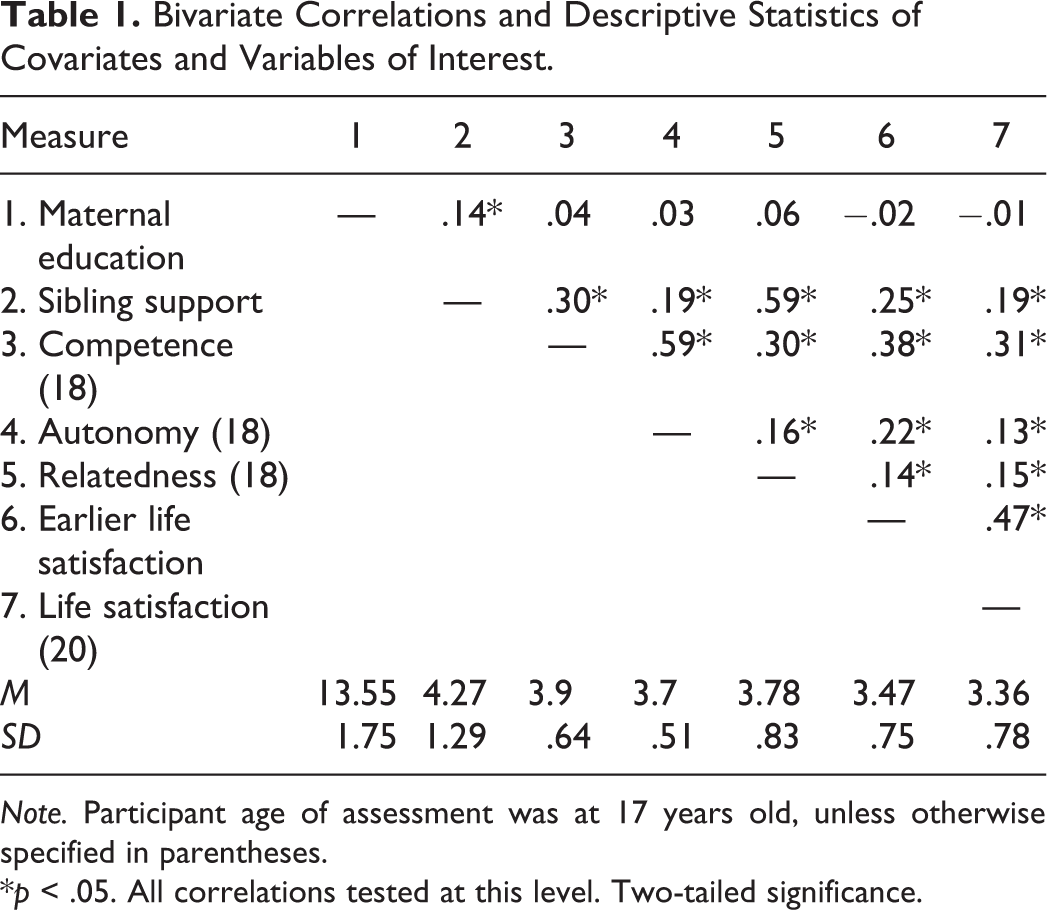
The bivariate correlations, means, and standard deviations for continuous variables are displayed in Table 1. Maternal education was positively associated with sibling support (r = .14, p < .05), such that more years of the mother attending school were related to higher levels of sibling support. All the variables of interest were significantly (p < .05) correlated with one another in the expected positive direction and yielded close to normal distributions based on the means and standard deviations. Sibling support was correlated with competence, autonomy, and relatedness 1 year later (rs = .30, .19, and .59, respectively) as well as with life satisfaction concurrently and 3 years later (rs = .25 and .19). These associations suggest that higher levels of sibling support were related to higher levels of each psychological need and life satisfaction. In addition, competence, autonomy, and relatedness were associated with life satisfaction 2 years later (rs = .31, .13, and .15, respectively), such that higher levels of each psychological need were related to greater life satisfaction. It should also be noted that the psychological needs were associated with one another (rs = .16 to .59), indicating that a high score in each psychological need was related to high scores of the other two. These significant and positive correlations suggest that sibling support in adolescence and competence, autonomy, and relatedness in early emerging adulthood, all associate with the sense of positive life satisfaction in emerging adulthood. The next set of results examines sex, family composition, and birth order differences in regard to each variable of interest.
Bivariate Correlations and Descriptive Statistics of Covariates and Variables of Interest.
Note. Participant age of assessment was at 17 years old, unless otherwise specified in parentheses.
*p < .05. All correlations tested at this level. Two-tailed significance.
Differences in Sex, Parental Composition, and Birth Order
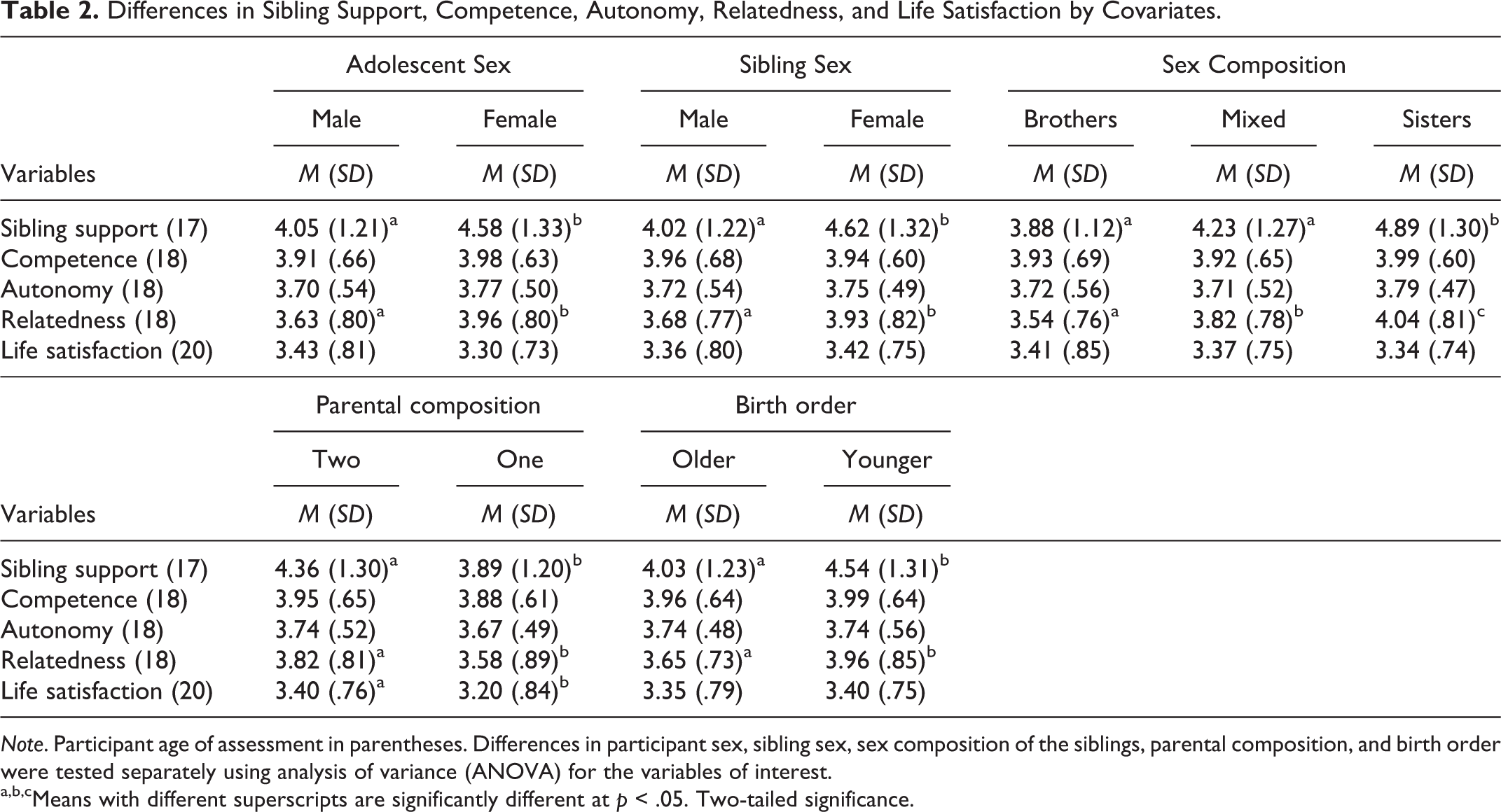
ANOVA tests were conducted at p < .05 to evaluate the categorical covariate differences in mean levels for the variables of interest (Table 2). There were a few significant sex differences. Mean levels of sibling support and relatedness significantly differed for both participant and sibling sex, such that female participants and having a sister were related to higher levels of sibling support and relatedness compared to males and brothers. Sibling sex composition groups also differed in mean values for sibling support and relatedness. Tukey’s tests indicated that sibling support and relatedness were significantly greater for sister pairs compared to mixed sex and brother pairs and that mixed pairs reported higher levels of relatedness than brother pairs. These results suggest that females, sisters, and sister pairs reported higher sibling support and relatedness than males, brothers, and other sibling pairs.
Differences in Sibling Support, Competence, Autonomy, Relatedness, and Life Satisfaction by Covariates.
Note. Participant age of assessment in parentheses. Differences in participant sex, sibling sex, sex composition of the siblings, parental composition, and birth order were tested separately using analysis of variance (ANOVA) for the variables of interest.
a,b,cMeans with different superscripts are significantly different at p < .05. Two-tailed significance.
There were also significant differences in parental composition and birth order for the variables of interest. Mean levels of sibling support, relatedness, and life satisfaction significantly differed for parental composition, such that adolescents in two-parent families reported higher levels of sibling support, relatedness, and life satisfaction than adolescents in single-mother families. There were significant differences in mean levels of sibling support and relatedness for birth order, as older sibling participants reported lower levels of sibling support and relatedness than younger sibling participants. These results show that living in a two-parent family and being a younger sibling was associated with greater perceptions of sibling support and relatedness, and life satisfaction specifically for adolescents in two-parent families. We turn next to the results for the regression analyses to evaluate our hypothesized associations.
Main Effects and Mediation Analyses
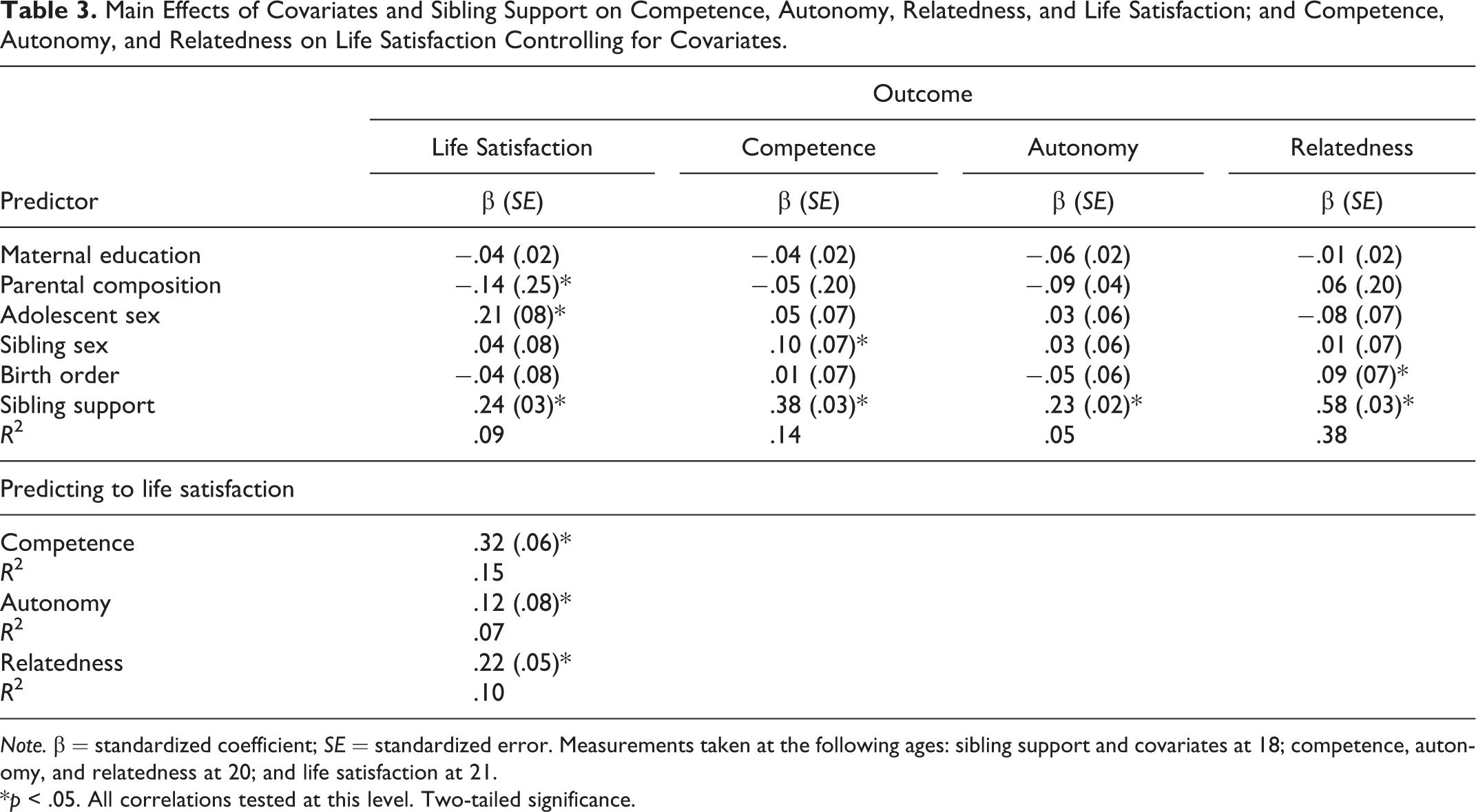
At Step 1, a set of three regression models were computed so that competence, autonomy, and relatedness were separately regressed onto the five covariates and sibling support to estimate the main effects on each psychological need. In order to avoid multicollinearity problems and issues of overfitting the equations when including all three sex variables, we dropped sex composition of the sibling dyad from the analysis. At Step 2, life satisfaction was regressed on the covariates and sibling support to account for these main effects on life satisfaction. At Step 3, each mediator (psychological need) was separately entered into the previous model predicting life satisfaction. In addition, the predictive value of each psychological need was computed for life satisfaction controlling for the covariates but not sibling support. These steps outline the steps necessary to test the main effects and meditational analyses. Finally, previous life satisfaction was entered into each of the three mediation models to test whether the direct or indirect effects held when accounting for relative change in life satisfaction. Main effects are displayed in Table 3 and the results for the three psychological need models are discussed in turn. 1
Main Effects of Covariates and Sibling Support on Competence, Autonomy, Relatedness, and Life Satisfaction; and Competence, Autonomy, and Relatedness on Life Satisfaction Controlling for Covariates.
Note. β = standardized coefficient; SE = standardized error. Measurements taken at the following ages: sibling support and covariates at 18; competence, autonomy, and relatedness at 20; and life satisfaction at 21.
*p < .05. All correlations tested at this level. Two-tailed significance.
Competence
Sibling support significantly predicted competence (β = .38, p < .05) and life satisfaction (β = .24, p < .05), even after taking the covariates into account. Further, competence significantly predicted life satisfaction (β = .32, p < .05). Mediation analyses indicated that competence partially mediated the association between sibling support and later life satisfaction (Figure 1). Incorporating competence into the model as a mediator reduced the sibling support to .13 (p < .05) in predicting life satisfaction, whereas competence also significantly predicted life satisfaction when controlling for sibling support (β = .29, p < .05). The Sobel test corroborated competence as a significant mediator between sibling support and life satisfaction (Z = 4.91, p < .001). These analyses suggest that competence partially and significantly mediated the association between sibling support and later life satisfaction.
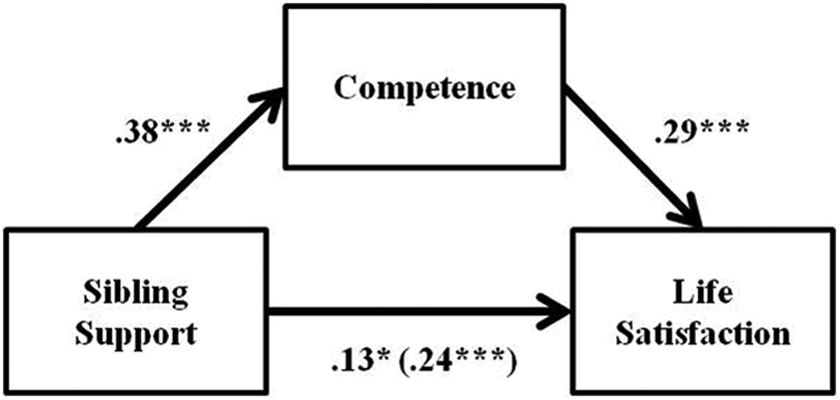
Path diagram of competence as a mediator between sibling support and life satisfaction. Values are standardized coefficients from ordinary least square regression, and the number in parentheses is the direct effect of sibling support on life satisfaction before entering competence into the model. *p < .05. **p < .01. ***p < .001. Two-tailed significance.
Autonomy
Sibling support significantly predicted both autonomy (β = .23, p < .05) and life satisfaction (β = .24, p < .05) when controlling for background variables. Autonomy also significantly predicted life satisfaction (β = .12, p < .05), but this association was nonsignificant when sibling support was in the model. In addition, the association between sibling support and life satisfaction did not significantly decrease when adding autonomy into the regression model to test for mediation.
Relatedness
Sibling support significantly predicted relatedness (β = .58, p < .05) and life satisfaction (β = .26, p < .05), even after taking background variables into account. Additionally, relatedness significantly predicted life satisfaction (β = .22, p < .05), but this association was nonsignificant when sibling support was in the model. Relatedness did not significantly decrease the association between sibling support and life satisfaction when incorporated into the mediation model. It is probable that the high intercorrelation of sibling support and relatedness (r = .59, p < .05) contributed to the nonsignificant mediation of this model.
Relative change in life satisfaction
Previous life satisfaction at age 17 was entered into the main effects model testing life satisfaction at 20 years as a function of the covariates and sibling support at age 17. However, the main effect of sibling support on later life satisfaction was not significant when accounting for earlier rates of life satisfaction. Thus, sibling support did not significantly predict the relative change in life satisfaction during the transition from adolescence to emerging adulthood.
Discussion
This longitudinal study examined family and sex differences in perceived sibling support during the senior year of high school, psychological needs at 18 years old, and later subjective life satisfaction at 20 years of age, and the associations among these variables were also investigated. In addition, this study investigated whether the three psychological needs (Ryan & Deci, 2000a) mediated the effect of sibling support on later life satisfaction and whether these processes predicted relative change in life satisfaction across emerging adulthood.
Being female, having a sister, and being in a sister pair were associated with greater levels of perceived sibling support and relatedness compared to being male, having a brother, and being in a mixed or brother pair. These results suggest that females and adolescents with a sister perceive greater supportive behavior from their sibling and report a greater sense of belonging with siblings. This finding corroborates previous research that indicates that sisters form closer relationships with one another than brothers, particularly through high levels of exchanging advice and experiencing greater satisfaction from sibling support (Tucker et al., 1997). Therefore, sisters may play a greater role in determining psychological needs and life satisfaction during emerging adulthood than brothers.
Differences were also found for family composition and birth order. Perceptions of sibling support, relatedness, and life satisfaction were greater for participants in two-parent families in contrast to single-mother families. On average, two-parent families earn a greater income compared to single-parent families; living in a single-parent household can increase child and adolescent risk for emotional and behavioral problems (Conger & Little, 2010). Taken together, youth in single-mother families may perceive less sibling support, relatedness, and life satisfaction due to fewer economic and emotional resources in the household. Birth order in the sibling dyad also yielded differences in sibling support and relatedness. Younger siblings perceived greater sibling support and relatedness than older siblings. Older siblings may perceive less benefit from the sibling relationship due to their potential role of buffering family stress and providing support to younger siblings (Conger et al., 1994; Kramer & Conger, 2009; Tucker et al., 2001).
The hierarchal regression analyses revealed that sibling support at 17 years of age significantly predicted all three psychological needs at 18 years old as well as life satisfaction at 20 years of age, even after controlling for the covariates. Given previous research on siblings, it is critical to note that above and beyond parental education and composition, as well as sibling birth order and sex, it is the supportiveness and warmth of a sibling that significantly predicts the variance in the three psychological needs and life satisfaction. The dimensional and complex nature of sibling dyad interactions, such as warm and supportive behaviors, may be more salient in determining psychological perceptions and well-being during emerging adulthood than family and sibling dyad characteristics. In addition, each psychological need significantly predicted life satisfaction after controlling for the covariates, however, only competence remained significant after accounting for sibling support. While the psychological needs related to life satisfaction during emerging adulthood, this finding also highlights the salient role of sibling support in predicting life satisfaction. These findings support self-determination theory in that the three psychological needs were significantly predicted by earlier sibling support, viewed here as a social resource, and the three psychological needs predicted life satisfaction, which reflects an individual’s well-being (Ryan & Deci, 2000b).
These results also indicated that sense of competence, at 18 years old, significantly mediated the effect of previous sibling support on later life satisfaction. This finding suggests that maintaining a sense of competence is one potential process whereby supportive sibling behavior might contribute to emerging adults’ life satisfaction. Specifically, supportive sibling behavior may engender greater feelings of high ability conceptions and competence in planning and executing goals, which may contribute to later life satisfaction through successfully met goals. Additionally, siblings may be a particularly salient support system for engendering competence toward later life satisfaction during emerging adulthood as individuals attempt to gain autonomy from parents and create new peer networks (Conger & Little, 2010). These results suggest that supportive sibling behavior positively affects life satisfaction in emerging adulthood through empowering individuals and boosting a sense of competency.
However, sense of autonomy and relatedness did not significantly mediate the association between sibling support and later life satisfaction. Sense of autonomy may not act as a mechanism between sibling support and later life satisfaction as it is likely that salient adults, such as parents and teachers, provide significantly more scaffolding and allowance toward independent decision making than siblings (Furman & Buhrmester, 1985; Soenens & Vansteenkiste, 2010). Because scaffolding and guidance toward independence is important to supporting an individual’s autonomy (Mirowsky & Ross, 1998), siblings may not be as influential through this psychological process. In regard to relatedness, this psychological need may not significantly mediate sibling support and life satisfaction as it might tap into the same overarching construct as sibling support. It would be interesting to see, in future studies, if adolescents and emerging adults differentiate between specific types of support and relatedness in other close relationships.
Although sibling support significantly predicted each psychological need and life satisfaction, it did not significantly predict relative change in life satisfaction during the transition from adolescence to emerging adulthood. One possible explanation may be the life role trajectory (i.e., education, career, and family choices) individuals choose during emerging adulthood. For example, the specific emerging adulthood life roles individuals choose and the quality of sibling support for these given life pathways may play a greater role in the relative change of life satisfaction than solely sibling support. Further work may benefit from investigating other mediating variables. Even though a relative change in life satisfaction was not found, given the variables of interest, the main effects of sibling support and the mediation of competence are exciting findings in understanding what mechanisms siblings may influence in contributing to life satisfaction during emerging adulthood.
This study contributes to the foundation of knowledge regarding sibling relationships as important contributors to individual well-being during emerging adulthood. Such research directly benefits developmentally applied work aiming to promote psychological health and prevent the development of psychopathology and risky behavior during adolescence and emerging adulthood (Conger & Little, 2010). While no sibling-focused interventions have been conducted during adolescence or emerging adulthood, such work has yielded positive results during childhood. For example, Feinberg et al. (2013) reported that children participating in a 12-week sibling-focused intervention demonstrated greater sibling fair play and positivity, self-control, social competence, academic performance, as well as less internalizing problems compared to children in the control group. Childhood interventions that aim to modify behavior and cognitions at the level of the sibling dyad promote well-being and functionality within family relationships (see Conger & Little, 2010; Conger, Stocker, & McGuire, 2009). Thus, adapting sibling-focused interventions to emerging adult sibling pairs appears an advantageous route to support healthy behaviors and to decrease psychopathological symptoms during this developmental transition.
Limitations
The limitations within this study deserve acknowledgment. First, because only Caucasian families from rural communities were recruited for the FTP, the conclusions of the study may not generalize to populations in urban or ethnically diverse communities. Future life satisfaction research should replicate these analyses in more diverse samples to increase the confidence of the present study’s conclusions. The authors note, however, that results from the FTP have been replicated in diverse samples in both national and international samples, which provide more confidence in the findings reported here (e.g., Conger et al., 2002; Parke et al., 2004).
A second limitation involves the scale selected to measure the target adolescent’s sense of relatedness. Although the scale captured adolescent feelings of belonging and connectedness in relation to their sibling, the responses of this scale may be tapping into the same underlying construct as the responses on the sibling support scale, which measured adolescent perception of supportive and warm sibling behavior. Despite the former scale measuring feelings and the latter scale assessing the perception of behavior, a more general scale of relatedness should be used in future studies. A relatedness scale that measures an individual’s sense of belonging and connectedness with proximal social agents in general would increase both construct validity and possibly coefficient weights of the relatedness mediation model.
This study addressed several questions in the literature of emerging adulthood, sibling relationships, and the maintenance of life satisfaction. In addition, the study generated a number of interesting questions and topics for future research. Although this study focused on emerging adult life satisfaction, the incorporation of success in adult roles such as education, employment, and family involvement could clarify what specific outcomes benefit from sibling support and fulfillment of the psychological needs. The literature on well-being could benefit from work investigating more specific adult outcomes. In addition, it would be advantageous to differentiate the unique contributions of parents, peers, and siblings in explaining the maintenance of the three psychological needs and life satisfaction. Because previous literature recognizes that these social agents explain unique variance in adolescent positive and negative outcomes (e.g., McHale et al., 2012), elucidating these processes would benefit the emerging adulthood literature and better inform adolescent interventions to improve mental health (Conger, Conger, Russell, & Hollis, 2013).
Future research should also utilize more complex analyses to investigate these developmental processes in more depth. For example, latent growth curve analyses could be used to test the stability or relative change in the psychological needs across emerging adulthood. Additionally, individual differences could be assessed using latent class analysis to identify individual profiles that predict different types of psychological need and life satisfaction trajectories across emerging adulthood. The incorporation of these advanced statistical models would contribute to the breadth of knowledge regarding the unique influence of sibling relationships on the maintenance of psychological needs and life satisfaction.
To conclude, this work corroborates aspects of self-determination theory and identifies siblings, especially sisters, as a significant social resource toward the maintenance of psychological needs and life satisfaction. In addition, this research highlights sense of competence as a mechanism through which supportive sibling behavior influences later life satisfaction. This work suggests sibling relationships as a potential point of intervention to enhance interpersonal functioning and individual health and well-being in emerging adulthood.
Footnotes
Declaration of Conflicting Interests
The authors declared no potential conflicts of interest with respect to the research, authorship, and/or publication of this article.
Funding
The authors disclosed receipt of the following financial support for the research, authorship and/or publication of this article: This work is supported by a grant to the first author, Christina Hollifield, from the National Science Foundation (Grant No. 1148897). Any opinions, findings, and conclusions or recommendations expressed in this material are those of the author(s) and do not necessarily reflect the views of the National Science Foundation, or other funding agencies. Additional support has been provided by the Eunice Kennedy Shriver National Institute of Child Health and Human Development and the National Institute of Mental Health (HD064687, HD051746, and MH051361). The mission of the Eunice Kennedy Shriver National Institute of Child Health and Human Development (NICHD) is to ensure that every person is born healthy and wanted, that women suffer no harmful effects from the reproductive process, that all children have the chance to fulfill their potential to live healthy and productive lives free from disease or disability, and to ensure the health, productivity, independence, and well-being of all people through optimal rehabilitation. The mission of the National Institute of Mental Health is to transform the understanding and treatment of mental illnesses through basic and clinical research, paving the way for prevention, recovery, and cure.